EP1455260A1 - Access control devices relating to data-processing systems, housings and sub-assemblies - Google Patents
Access control devices relating to data-processing systems, housings and sub-assemblies Download PDFInfo
- Publication number
- EP1455260A1 EP1455260A1 EP03290542A EP03290542A EP1455260A1 EP 1455260 A1 EP1455260 A1 EP 1455260A1 EP 03290542 A EP03290542 A EP 03290542A EP 03290542 A EP03290542 A EP 03290542A EP 1455260 A1 EP1455260 A1 EP 1455260A1
- Authority
- EP
- European Patent Office
- Prior art keywords
- housing
- cover
- sub
- assembly
- port
- Prior art date
- Legal status (The legal status is an assumption and is not a legal conclusion. Google has not performed a legal analysis and makes no representation as to the accuracy of the status listed.)
- Withdrawn
Links
Images


Classifications
-
- G—PHYSICS
- G06—COMPUTING OR CALCULATING; COUNTING
- G06F—ELECTRIC DIGITAL DATA PROCESSING
- G06F1/00—Details not covered by groups G06F3/00 - G06F13/00 and G06F21/00
- G06F1/16—Constructional details or arrangements
- G06F1/18—Packaging or power distribution
- G06F1/181—Enclosures
Definitions
- This invention relates, in broad terms, to the general field of casings for data-processing devices such as computers and relates, more specifically, to data-processing devices in which sub-assemblies are removably receivable within an external case or housing.
- Such sub-assemblies shall hereinafter be referred to, for the sake of convenience, as sub-assemblies "of the kind specified”.
- Hewlett Packard's "e-pc” desktop product www.hp.com/desktops/professional/e-pc
- the conventional base unit components and circuitry are contained within a relatively small housing which, in use, can be located in a vertical orientation, behind a flat-panel screen, for example, in addition to the more usual horizontal position.
- a housing for a data-processing device having a sub-assembly of the kind specified, the sub-assembly having a port, and a cover for the port, the cover being moveable between an operative position, in which access to the port is restricted, and an inoperative position, in which access is not so restricted, the cover having a barrier part which, when the cover is in the operative position, serves to restrict said access, and a first engaging part operative, in cooperation with a second engaging part associated with the sub-assembly or housing, to hinder or prevent movement of the cover between the operative and inoperative positions.
- the sub-assembly may be slidably receivable within the housing and the second engaging part, being associated with one of said sub-assembly or housing, may serve, in use, to hold the first engaging part between it and the other of the sub-assembly or housing.
- the first engaging portion may, in use, be clamped between the second engaging part and the other of said sub-assembly or housing.
- the sub-assembly preferably is slidably receivable within the housing, with the first engaging part, in use, preferably being held between the second engaging part and a part of the housing.
- the first engagement part may comprise a protrusion or recess cooperable with a recess or protrusion of the second engaging part.
- the first and second engaging parts are provided with a plurality of teeth whereby relative movement between them may be restricted or prevented.
- the cover is slidably engaged with a guide in the housing, sliding movement of the cover being restricted or prevented when the sub-assembly is fully received within the housing.
- the sub-assembly is securable in position, such as by locking, relative to the housing.
- the port may be a front-mounted USB port.
- a computer system having a housing in accordance with the first aspect of the invention.
- a computer system having a housing and a sub-assembly slidably receivable therewithin, the sub-assembly having a port for releasable connection of a peripheral device and the system being provided with a cover for the port whereby access to the port may be restricted, the cover having a barrier part and a first engaging part operative, in cooperation with a second engaging part associated with the sub-assembly or housing, to hinder or prevent movement of the cover between an operative position, in which access to the port is restricted, and an inoperative position, in which access is not so restricted.
- the cover when the first and second engaging parts are not in cooperation, is slidably engaged with a guide in the housing.
- the port is a front-mounted USB port.
- the invention in its third aspect, may comprise one or more of the features set out in relation to its first aspect.
- a computer housing having a port cover moveable between an operative position, in which access to an I/O port is restricted and an inoperative position in which access is not so restricted, the cover having an engagement part cooperable with a removable sub-assembly so as to hinder or prevent movement of the cover between the two positions.
- the cover is slidably engaged with the housing, sliding movement being restricted or prevented by interaction of engaging portions of the cover and sub-assembly.
- the housing is adapted for releasable sliding reception of the sub-assembly.
- the invention in its fourth aspect, may comprise one or more of the features set out in the preceding paragraphs.
- a data-processing device in the form of a computer system 10 comprises a plastics housing 11 in which is slidably received a sub-assembly 12 in the form of a drawer 13, in which are located a number of processing and data input/output components such as a Hard Disk Drive (HDD) 14 and Printed Circuit Boards (PCB's) 15.
- the drawer 13 is provided, at its rear end 16, with an integral plastics handle 17 by which sliding movement into and out of the housing 11 may be effected.
- the rear face 18 of the sub-assembly is also provided with a number of indicating devices such as LED's 19, to indicate operation/activation of a number of the internal computer components.
- the sub-assembly 12 is also provided with a locking mechanism illustrated generally at 20, operative to secure the drawer 13 in relation to the housing 11, once the drawer has successfully been inserted therein.
- the locking mechanism 20 may be key-operated, in generally conventional manner.
- a front part 21 of the sub-assembly 12 is provided with a pair of USB (Universal Serial Bus) ports 22 and a toothed engaging part 23, whose function and purpose will hereinafter be described.
- the front part 21 is also provided, in this example, with a CD ROM/DVD bay 24, through which CD ROM/DVD software may be loaded, via a front mounted slot 25 in the housing 11.
- the assembly shown in Figure 2 is also provided with a port cover 26 having a barrier part 27 and a toothed engaging part 28 operative, in use, to cooperate with the toothed engaging part 23 of the drawer, thus restricting sliding (i.e. sideways) movement of the cover relative to the drawer 13 and hence to the USB ports 22.
- an inwardly-facing surface of the front 29 of the housing is provided with a guide rail 30 engageable, conveniently in a snap-fitting manner, with a groove 31 provided in a forwardly-disposed surface of the cover 26.
- the cover In the absence of any engagement between the cover 28 and the engaging part 23, the cover is free to move slidably in relation to the housing 11, with the barrier part 27 thus being able to adopt an inoperative position, in which it does not overlie a USB aperture 32 and an operative position in which it at least partially blocks this aperture.
- FIGs 5 and 6 A somewhat more schematic illustration of this is provided in Figures 5 and 6, in which the overall assembly is shown in a generally standing orientation.
- Figure 5 when the cover 26 adopts its inoperative position, all that is visible externally is the grip element 33, with it thus being evident that the two USB ports 22 are available for use.
- Figure 6 shows that when the cover 26 adopts its operative position, the USB ports are completely concealed from view, thus not only preventing access thereto but also disguising the fact that the computer system is provided with any front-mounted USB ports at all.
- the cover 26 may not necessarily be guided slidably relative to the front part 29 of the housing 11, but may instead be provided with an alternative "clip on” facility whereby the cover 26 may be releasably attached to the USB port 22 and attachment part 23, in the absence of any engagement with the housing 11.
- Suitably configured snap-fitting protrusions and recesses may thus be provided in the cover 26 and front part 21 of the sub-assembly 13.
- the present invention in its various aspects, provides a number of security benefits by restricting unauthorised access to otherwise freely-exposed front-mounted USB ports (for example) with a release of the port cover only being possible in conjunction with a release of the drawer 13 from the housing 11.
- a release of the port cover only being possible in conjunction with a release of the drawer 13 from the housing 11.
- accessibility to the front-mounted USB ports can carefully be controlled.
- the hardware needed to implement the invention is simple and inexpensive to produce, thus making the added security benefits attractive to cost-conscious purchasers.
Landscapes
- Engineering & Computer Science (AREA)
- Theoretical Computer Science (AREA)
- Computer Hardware Design (AREA)
- Power Engineering (AREA)
- Human Computer Interaction (AREA)
- Physics & Mathematics (AREA)
- General Engineering & Computer Science (AREA)
- General Physics & Mathematics (AREA)
- Casings For Electric Apparatus (AREA)
Abstract
A cover for a port of a computer sub-assembly, the cover being
moveable between an operative position, in which access to the port is
restricted, and an inoperative position in which access is not so restricted, the
cover having a barrier part which, when the cover is in the operative position,
serves to restrict said access, and a first engaging part operative, in cooperation
with a second engaging part associated with the sub-assembly or housing, to
hinder or prevent movement of the cover between the operative and inoperative
positions.
Description
- This invention relates, in broad terms, to the general field of casings for data-processing devices such as computers and relates, more specifically, to data-processing devices in which sub-assemblies are removably receivable within an external case or housing. Such sub-assemblies shall hereinafter be referred to, for the sake of convenience, as sub-assemblies "of the kind specified".
- A particularly pertinent example of such an arrangement, in the computer field, is Hewlett Packard's "e-pc" desktop product (www.hp.com/desktops/professional/e-pc), in which the conventional base unit components and circuitry are contained within a relatively small housing which, in use, can be located in a vertical orientation, behind a flat-panel screen, for example, in addition to the more usual horizontal position.
- In order to facilitate assembly of such devices, it has been proposed to provide a sub-assembly within or in the form of a sliding drawer, in which are located the principal operating components of the computer system, such as the processor, motherboard, HDD (Hard Disk Drive), RAM circuitry and cooling apparatus, for example.
- Whilst some computer systems of this type are provided with an external security device, whereby unauthorised access to I/O ports and drive bays, for example, can be restricted, such devices typically comprise relatively bulky "bolt-on" elements such as attachable panels, brackets or stands. In any event, such approaches do nothing to reduce the possibility of unauthorised access being obtained to front-mounted I/O ports such as USB ports, which are increasingly being provided on the fronts of such systems to provide users with a readily accessible means to connect peripheral devices such as joysticks, tracker balls and web cams.
- Whilst it is known to provide flaps and access doors to cover otherwise exposed front-mounted USB ports, such approaches do nothing to prevent or effectively restrict access to such ports, which can give rise to serious security concerns, bearing in mind the risk of an unauthorised peripheral device being used to download sensitive information from a third party's computer or to upload unwanted information or viruses, for example. Similarly, whilst it is possible to block access to a particular USB port using the computer's BIOS, such approaches are not totally secure and, of course, leave the port inoperable to an authorised user, which may not be acceptable, in day-to-day use.
- In accordance with a first aspect of the present invention, there is provided a housing for a data-processing device having a sub-assembly of the kind specified, the sub-assembly having a port, and a cover for the port, the cover being moveable between an operative position, in which access to the port is restricted, and an inoperative position, in which access is not so restricted, the cover having a barrier part which, when the cover is in the operative position, serves to restrict said access, and a first engaging part operative, in cooperation with a second engaging part associated with the sub-assembly or housing, to hinder or prevent movement of the cover between the operative and inoperative positions.
- The sub-assembly may be slidably receivable within the housing and the second engaging part, being associated with one of said sub-assembly or housing, may serve, in use, to hold the first engaging part between it and the other of the sub-assembly or housing.
- The first engaging portion may, in use, be clamped between the second engaging part and the other of said sub-assembly or housing.
- The sub-assembly preferably is slidably receivable within the housing, with the first engaging part, in use, preferably being held between the second engaging part and a part of the housing.
- The first engagement part may comprise a protrusion or recess cooperable with a recess or protrusion of the second engaging part.
- Preferably, the first and second engaging parts are provided with a plurality of teeth whereby relative movement between them may be restricted or prevented.
- Preferably, the cover is slidably engaged with a guide in the housing, sliding movement of the cover being restricted or prevented when the sub-assembly is fully received within the housing.
- Conveniently, the sub-assembly is securable in position, such as by locking, relative to the housing.
- The port may be a front-mounted USB port.
- In accordance with a second aspect of the present invention, there is provided a computer system having a housing in accordance with the first aspect of the invention.
- In accordance with a third aspect of the present invention, there is provided a computer system having a housing and a sub-assembly slidably receivable therewithin, the sub-assembly having a port for releasable connection of a peripheral device and the system being provided with a cover for the port whereby access to the port may be restricted, the cover having a barrier part and a first engaging part operative, in cooperation with a second engaging part associated with the sub-assembly or housing, to hinder or prevent movement of the cover between an operative position, in which access to the port is restricted, and an inoperative position, in which access is not so restricted.
- Preferably, the cover, when the first and second engaging parts are not in cooperation, is slidably engaged with a guide in the housing.
- Conveniently, the port is a front-mounted USB port.
- The invention, in its third aspect, may comprise one or more of the features set out in relation to its first aspect.
- In accordance with a fourth aspect of the present invention, there is provided a computer housing having a port cover moveable between an operative position, in which access to an I/O port is restricted and an inoperative position in which access is not so restricted, the cover having an engagement part cooperable with a removable sub-assembly so as to hinder or prevent movement of the cover between the two positions.
- Preferably, the cover is slidably engaged with the housing, sliding movement being restricted or prevented by interaction of engaging portions of the cover and sub-assembly.
- Preferably, the housing is adapted for releasable sliding reception of the sub-assembly.
- The invention, in its fourth aspect, may comprise one or more of the features set out in the preceding paragraphs.
- Specific but non-limiting embodiments of the invention, in its various aspects, will now be described in greater detail, but strictly by way of example only, by reference to the accompanying drawings, of which:
- FIGURE 1 is a perspective view, from the rear and above, of a computer housing and sub-assembly;
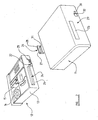
- FIGURE 2 is an exploded perspective view, from the front and above, of the housing and sub-assembly of Figure 1, showing the port cover of the present invention;
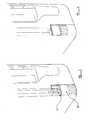
- FIGURE 3 is a cut-away view, taken from above, showing engagement of the port cover and drawer of Figure 2, the cover being in an inoperative position;
- FIGURE 4 is a somewhat similar view to that shown in Figure 3, with the cover being shown in an operative position; and
- FIGURES 5 and 6 are perspective views of the housing and sub-assembly, in a vertical orientation, showing the cover of Figures 2, 3 and 4 in inoperative and operative positions.
-
- Referring to the Figures, a data-processing device in the form of a
computer system 10 comprises aplastics housing 11 in which is slidably received asub-assembly 12 in the form of adrawer 13, in which are located a number of processing and data input/output components such as a Hard Disk Drive (HDD) 14 and Printed Circuit Boards (PCB's) 15. Thedrawer 13 is provided, at itsrear end 16, with an integral plastics handle 17 by which sliding movement into and out of thehousing 11 may be effected. The rear face 18 of the sub-assembly is also provided with a number of indicating devices such as LED's 19, to indicate operation/activation of a number of the internal computer components. Thesub-assembly 12 is also provided with a locking mechanism illustrated generally at 20, operative to secure thedrawer 13 in relation to thehousing 11, once the drawer has successfully been inserted therein. Thelocking mechanism 20 may be key-operated, in generally conventional manner. - As shown in Figure 2, a
front part 21 of thesub-assembly 12 is provided with a pair of USB (Universal Serial Bus)ports 22 and atoothed engaging part 23, whose function and purpose will hereinafter be described. Thefront part 21 is also provided, in this example, with a CD ROM/DVD bay 24, through which CD ROM/DVD software may be loaded, via a front mountedslot 25 in thehousing 11. - The assembly shown in Figure 2 is also provided with a
port cover 26 having abarrier part 27 and atoothed engaging part 28 operative, in use, to cooperate with thetoothed engaging part 23 of the drawer, thus restricting sliding (i.e. sideways) movement of the cover relative to thedrawer 13 and hence to theUSB ports 22. - As shown schematically in Figure 2, an inwardly-facing surface of the
front 29 of the housing is provided with aguide rail 30 engageable, conveniently in a snap-fitting manner, with agroove 31 provided in a forwardly-disposed surface of thecover 26. In the absence of any engagement between thecover 28 and theengaging part 23, the cover is free to move slidably in relation to thehousing 11, with thebarrier part 27 thus being able to adopt an inoperative position, in which it does not overlie aUSB aperture 32 and an operative position in which it at least partially blocks this aperture. - It will thus be understood that, in the absence of the
sub-assembly 13 from thehousing 11, a user is able to select one of a plurality of (conveniently two) positions of thecover 26, thus dictating whether or not access will be provided to theUSB ports 22 upon insertion of thesub-assembly 13 into thehousing 11. It will also be understood, from this, that once thesub-assembly 13 is secured (e.g. locked) in position in relation to the housing, the engagement between the teeth of thecover 26 and theengaging part 23 makes it very difficult - if not impossible - for the position of thecover 26 thereafter to be altered, without removing thedrawer 13 from the housing. - This is shown in more detail in Figures 3 and 4: in Figure 3, it can be seen that the
cover 26 is provided with agrip element 33 in the form of an upturned formation, whereby a user may slide thecover 26 between the inoperative and operative positions hereinbefore described. What is shown in Figures 3 and 4, however, is that such sliding movement is not permitted when thesub-assembly 13 is fully inserted in thehousing 11, as a result of the interaction between the teeth of theengaging parts - A somewhat more schematic illustration of this is provided in Figures 5 and 6, in which the overall assembly is shown in a generally standing orientation. As shown in Figure 5, when the
cover 26 adopts its inoperative position, all that is visible externally is thegrip element 33, with it thus being evident that the twoUSB ports 22 are available for use. On the other hand, Figure 6 shows that when thecover 26 adopts its operative position, the USB ports are completely concealed from view, thus not only preventing access thereto but also disguising the fact that the computer system is provided with any front-mounted USB ports at all. - Insofar as the operation of the
cover 26 is concerned, it will be understood that alternative approaches are envisaged: thus, for example, thecover 26 may not necessarily be guided slidably relative to thefront part 29 of thehousing 11, but may instead be provided with an alternative "clip on" facility whereby thecover 26 may be releasably attached to theUSB port 22 andattachment part 23, in the absence of any engagement with thehousing 11. Suitably configured snap-fitting protrusions and recesses may thus be provided in thecover 26 andfront part 21 of thesub-assembly 13. - What will be understood from the foregoing is that the present invention, in its various aspects, provides a number of security benefits by restricting unauthorised access to otherwise freely-exposed front-mounted USB ports (for example) with a release of the port cover only being possible in conjunction with a release of the
drawer 13 from thehousing 11. As, in many corporate environments, it is likely that relatively few, selected, personnel will be provided with an appropriate key to actuate thelock 20, this means that accessibility to the front-mounted USB ports can carefully be controlled. It will also be understood that the hardware needed to implement the invention is simple and inexpensive to produce, thus making the added security benefits attractive to cost-conscious purchasers. - It will be understood, by those well-versed in the relevant art, that the various aspects of the invention set out above may well find application in data-processing devices other than computer systems per se. Thus, it is envisaged that the housing and cover arrangements, for example, could be employed with smaller devices such as PDA's, digital cameras, palmtops and the like. Broadly speaking, where a requirement exists for a data processing device to be provided with an I/O port, the invention may be applicable in the general manner discussed above.
- In the present specification "comprises" means "includes or consists of' and "comprising" means "including or consisting of'.
- The features disclosed in the foregoing description, or the following claims, or the accompanying drawings, expressed in their specific forms or in terms of a means for performing the disclosed function, or a method or process for attaining the disclosed result, as appropriate, may, separately, or in any combination of such features, be utilised for realising the invention in diverse forms thereof.
Claims (17)
- A housing for a data-processing device having a sub-assembly of the kind specified, the sub-assembly having a port, and a cover for the port, the cover being moveable between an operative position, in which access to the port is restricted, and an inoperative position, in which access is not so restricted, the cover having a barrier part which, when the cover is in the operative position, serves to restrict said access, and a first engaging part operative, in cooperation with a second engaging part associated with the sub-assembly or housing, to hinder or prevent movement of the cover between the operative and inoperative positions.
- A housing according to claim 1 wherein the sub-assembly is slidably receivable therewithin and wherein the second engaging part, being associated with one of said sub-assembly or housing, serves, in use, to hold the first engaging part between it and the other of the sub-assembly or housing.
- A housing according to claim 2 wherein the first engaging part, in use, is clamped between the second engaging part and the other of said sub-assembly or housing.
- A housing according to claim 1, claim 2 or claim 3 wherein the sub-assembly is slidably receivable therewithin and wherein the first engaging part, in use, is held between the second engaging part and a part of the housing.
- A housing according to claim 4 wherein the first engaging part, in use, is clamped between said parts.
- A housing according to any one of the preceding claims wherein the first engaging part comprises a protrusion or recess cooperable with a recess or protrusion of the second engaging part.
- A housing according to any one of the preceding claims wherein the first and second engaging parts are provided with a plurality of teeth whereby relative movement between them may be restricted or prevented.
- A housing according to any one of the preceding claims wherein the cover is slidably engaged with a guide in the housing, sliding movement of the cover being restricted or prevented when the sub-assembly is fully received within the housing.
- A housing according to any one of the preceding claims wherein the sub-assembly is securable in position relative to the housing.
- A housing according to any one of the preceding claims wherein the port is a front-mounted USB port.
- A computer system having a housing according to any one of the preceding claims.
- A computer system having a housing and a sub-assembly slidably receivable therewithin, the sub-assembly having a port for releasable connection of a peripheral device and the system being provided with a cover for the port whereby access to the port may be restricted, the cover having a barrier part and a first engaging part operative, in cooperation with a second engaging part associated with the sub-assembly or housing, to hinder or prevent movement of the cover between an operative position, in which access to the port is restricted, and an inoperative position, in which access is not so restricted.
- A computer system according to claim 12 wherein the cover, when the first and second engaging parts are not in cooperation, is slidably engaged with a guide in the housing.
- A computer system according to claim 12 or claim 13 wherein the port is a front-mounted USB port.
- A computer housing having a port cover moveable between an operative position, in which access to an I/O port is restricted, and an inoperative position in which access is not so restricted, the cover having an engagement part cooperable with a removable sub-assembly so as to hinder or prevent movement of the cover between the two positions.
- A computer housing according to claim 15 wherein the cover is slidably engaged with the housing, sliding movement being restricted or prevented by interaction of engaging portions of the cover and sub-assembly.
- A computer housing according to claim 15 or claim 16 wherein the housing is adapted for releasable sliding reception of the sub-assembly.
Priority Applications (2)
| Application Number | Priority Date | Filing Date | Title |
|---|---|---|---|
| EP03290542A EP1455260A1 (en) | 2003-03-06 | 2003-03-06 | Access control devices relating to data-processing systems, housings and sub-assemblies |
| US10/794,414 US20050013111A1 (en) | 2003-03-06 | 2004-03-05 | Access control devices relating to data-processing systems, housings and sub-assemblies |
Applications Claiming Priority (1)
| Application Number | Priority Date | Filing Date | Title |
|---|---|---|---|
| EP03290542A EP1455260A1 (en) | 2003-03-06 | 2003-03-06 | Access control devices relating to data-processing systems, housings and sub-assemblies |
Publications (1)
| Publication Number | Publication Date |
|---|---|
| EP1455260A1 true EP1455260A1 (en) | 2004-09-08 |
Family
ID=32799097
Family Applications (1)
| Application Number | Title | Priority Date | Filing Date |
|---|---|---|---|
| EP03290542A Withdrawn EP1455260A1 (en) | 2003-03-06 | 2003-03-06 | Access control devices relating to data-processing systems, housings and sub-assemblies |
Country Status (2)
| Country | Link |
|---|---|
| US (1) | US20050013111A1 (en) |
| EP (1) | EP1455260A1 (en) |
Cited By (2)
| Publication number | Priority date | Publication date | Assignee | Title |
|---|---|---|---|---|
| WO2008125837A1 (en) * | 2007-04-12 | 2008-10-23 | David Land | Security device |
| CN107300951A (en) * | 2017-06-29 | 2017-10-27 | 联想(北京)有限公司 | A kind of electronic equipment |
Families Citing this family (4)
| Publication number | Priority date | Publication date | Assignee | Title |
|---|---|---|---|---|
| DE102006020701A1 (en) * | 2006-05-04 | 2007-11-08 | Preh Keytec Gmbh | keyboard |
| US7733659B2 (en) * | 2006-08-18 | 2010-06-08 | Delphi Technologies, Inc. | Lightweight audio system for automotive applications and method |
| JP4045461B1 (en) * | 2006-12-28 | 2008-02-13 | 富士ゼロックス株式会社 | Electronic apparatus and image forming apparatus |
| US20220063869A1 (en) * | 2019-04-15 | 2022-03-03 | Hewlett-Packard Development Company, L.P. | Package gates |
Citations (4)
| Publication number | Priority date | Publication date | Assignee | Title |
|---|---|---|---|---|
| US5781408A (en) * | 1994-05-03 | 1998-07-14 | The Panda Project | Computer system having a motorized door mechanism |
| US5816672A (en) * | 1995-11-28 | 1998-10-06 | Apple Computer, Inc. | Three-position locking mechanism |
| EP1126360A1 (en) * | 2000-02-14 | 2001-08-22 | Hewlett-Packard Company, A Delaware Corporation | Desktop computer appliance |
| US20020075657A1 (en) * | 1998-12-25 | 2002-06-20 | Masayuki Terao | Electonic computer with a file bay cover including an electronic lock and method of controlling the same |
Family Cites Families (13)
| Publication number | Priority date | Publication date | Assignee | Title |
|---|---|---|---|---|
| US4782971A (en) * | 1987-08-11 | 1988-11-08 | Hill Mary V | Device for preventing the unauthorized use of an electrical apparatus |
| FR2638039B1 (en) * | 1988-10-13 | 1990-11-23 | Telephonie Ind Commerciale | SECURITY LOCKING DEVICE |
| JPH08115636A (en) * | 1994-10-18 | 1996-05-07 | Cat I:Kk | Positioning device for selector knob |
| US5735701A (en) * | 1995-12-11 | 1998-04-07 | Intel Corporation | Locking power cable interface guard |
| US5717571A (en) * | 1996-08-14 | 1998-02-10 | Hewlett-Packard Company | Mechanism locking removable module into computer |
| US5661786A (en) * | 1996-08-19 | 1997-08-26 | Horn; Douglas | Electronic information lockout device |
| JP3369080B2 (en) * | 1997-07-22 | 2003-01-20 | 富士通株式会社 | Electronic equipment |
| JP3429681B2 (en) * | 1998-08-06 | 2003-07-22 | 松下電器産業株式会社 | Battery pack removal device |
| US6717802B2 (en) * | 2000-06-05 | 2004-04-06 | Asustek Computer Inc. | Computer communication port assembly |
| US6510960B1 (en) * | 2000-08-25 | 2003-01-28 | Square D Company | Captive slidable access cover |
| US20020065935A1 (en) * | 2000-10-18 | 2002-05-30 | Koperda Frank R. | Method and system for a modular residential gateway |
| US6878005B2 (en) * | 2001-01-22 | 2005-04-12 | Helix Technology Corporation | Module and connector latch |
| TW539274U (en) * | 2002-06-28 | 2003-06-21 | Hon Hai Prec Ind Co Ltd | Connectors' cover assembly |
-
2003
- 2003-03-06 EP EP03290542A patent/EP1455260A1/en not_active Withdrawn
-
2004
- 2004-03-05 US US10/794,414 patent/US20050013111A1/en not_active Abandoned
Patent Citations (4)
| Publication number | Priority date | Publication date | Assignee | Title |
|---|---|---|---|---|
| US5781408A (en) * | 1994-05-03 | 1998-07-14 | The Panda Project | Computer system having a motorized door mechanism |
| US5816672A (en) * | 1995-11-28 | 1998-10-06 | Apple Computer, Inc. | Three-position locking mechanism |
| US20020075657A1 (en) * | 1998-12-25 | 2002-06-20 | Masayuki Terao | Electonic computer with a file bay cover including an electronic lock and method of controlling the same |
| EP1126360A1 (en) * | 2000-02-14 | 2001-08-22 | Hewlett-Packard Company, A Delaware Corporation | Desktop computer appliance |
Cited By (2)
| Publication number | Priority date | Publication date | Assignee | Title |
|---|---|---|---|---|
| WO2008125837A1 (en) * | 2007-04-12 | 2008-10-23 | David Land | Security device |
| CN107300951A (en) * | 2017-06-29 | 2017-10-27 | 联想(北京)有限公司 | A kind of electronic equipment |
Also Published As
| Publication number | Publication date |
|---|---|
| US20050013111A1 (en) | 2005-01-20 |
Similar Documents
| Publication | Publication Date | Title |
|---|---|---|
| US7672124B2 (en) | Computer case with locking side panel and bezel | |
| US6570758B1 (en) | Docking unit for portable computer | |
| US6757166B2 (en) | System and method for multistage security of portable computing device and attachable expansion device | |
| DE60006481T2 (en) | Desktop computer device | |
| US20110279973A1 (en) | Bezel lock for an information handling system | |
| US10321597B2 (en) | User interface enhanced storage sled handle with embedded security features | |
| US5542044A (en) | Security device for a computer, and methods of constructing and utilizing same | |
| US6570756B2 (en) | Personal computer system housing and security system | |
| US10645835B1 (en) | Option card latch and button | |
| CA2099026C (en) | Trusted personal computer system with identification | |
| US5394713A (en) | Locking devices for floppy disk drives | |
| US5911777A (en) | Method and apparatus for reporting unauthorized attempt to release a portable computer from a docking station | |
| US6494070B1 (en) | Electronic system housing keylock cover | |
| EP1455260A1 (en) | Access control devices relating to data-processing systems, housings and sub-assemblies | |
| US7130200B1 (en) | PCI card-securing mechanism | |
| US6442984B1 (en) | Security system in an extend unit for a computer | |
| GB2481082A (en) | Computer case with improved heat dissipation of add-on cards | |
| US20080216179A1 (en) | Computer chassis for improved security and connectivity of secured items | |
| US20040240166A1 (en) | Computer face plate apparatus | |
| US7961461B2 (en) | Secure media bay and media module | |
| US7021682B2 (en) | Chassis locking bar | |
| JP3496705B2 (en) | Auxiliary storage device removable lock mechanism for computer | |
| US20050259390A1 (en) | Latch hook structure of removable storage devices | |
| US6295204B1 (en) | Linear security mechanism for enclosure | |
| US6636425B2 (en) | Case for computer body |
Legal Events
| Date | Code | Title | Description |
|---|---|---|---|
| PUAI | Public reference made under article 153(3) epc to a published international application that has entered the european phase |
Free format text: ORIGINAL CODE: 0009012 |
|
| AK | Designated contracting states |
Kind code of ref document: A1 Designated state(s): AT BE BG CH CY CZ DE DK EE ES FI FR GB GR HU IE IT LI LU MC NL PT SE SI SK TR |
|
| AX | Request for extension of the european patent |
Extension state: AL LT LV MK RO |
|
| AKX | Designation fees paid | ||
| REG | Reference to a national code |
Ref country code: DE Ref legal event code: 8566 |
|
| STAA | Information on the status of an ep patent application or granted ep patent |
Free format text: STATUS: THE APPLICATION IS DEEMED TO BE WITHDRAWN |
|
| 18D | Application deemed to be withdrawn |
Effective date: 20050309 |