EP1454942A1 - Powdery rubber having unevened surface and rubber compositions and tires using the same - Google Patents
Powdery rubber having unevened surface and rubber compositions and tires using the same Download PDFInfo
- Publication number
- EP1454942A1 EP1454942A1 EP02783670A EP02783670A EP1454942A1 EP 1454942 A1 EP1454942 A1 EP 1454942A1 EP 02783670 A EP02783670 A EP 02783670A EP 02783670 A EP02783670 A EP 02783670A EP 1454942 A1 EP1454942 A1 EP 1454942A1
- Authority
- EP
- European Patent Office
- Prior art keywords
- rubber
- powder rubber
- powder
- treatment
- microorganism
- Prior art date
- Legal status (The legal status is an assumption and is not a legal conclusion. Google has not performed a legal analysis and makes no representation as to the accuracy of the status listed.)
- Granted
Links
- 229920001971 elastomer Polymers 0.000 title claims abstract description 135
- 239000005060 rubber Substances 0.000 title claims abstract description 135
- 239000000203 mixture Substances 0.000 title claims abstract description 32
- 239000000843 powder Substances 0.000 claims abstract description 76
- 244000005700 microbiome Species 0.000 claims abstract description 29
- 241000204102 Pseudonocardiaceae Species 0.000 claims abstract description 9
- 239000002245 particle Substances 0.000 claims abstract description 9
- 230000008859 change Effects 0.000 claims description 4
- 238000000034 method Methods 0.000 abstract description 18
- 238000005299 abrasion Methods 0.000 abstract description 9
- 239000001963 growth medium Substances 0.000 abstract description 9
- 239000002699 waste material Substances 0.000 abstract description 7
- OKTJSMMVPCPJKN-UHFFFAOYSA-N Carbon Chemical compound [C] OKTJSMMVPCPJKN-UHFFFAOYSA-N 0.000 abstract description 5
- 229910052799 carbon Inorganic materials 0.000 abstract description 5
- 208000019585 progressive encephalomyelitis with rigidity and myoclonus Diseases 0.000 abstract 1
- 241000233866 Fungi Species 0.000 description 12
- 244000043261 Hevea brasiliensis Species 0.000 description 8
- 239000005062 Polybutadiene Substances 0.000 description 8
- 229920003052 natural elastomer Polymers 0.000 description 8
- 229920001194 natural rubber Polymers 0.000 description 8
- XLOMVQKBTHCTTD-UHFFFAOYSA-N Zinc monoxide Chemical compound [Zn]=O XLOMVQKBTHCTTD-UHFFFAOYSA-N 0.000 description 7
- 230000000813 microbial effect Effects 0.000 description 6
- 239000003921 oil Substances 0.000 description 6
- 239000000126 substance Substances 0.000 description 5
- 241000186361 Actinobacteria <class> Species 0.000 description 4
- 239000003963 antioxidant agent Substances 0.000 description 4
- 230000003078 antioxidant effect Effects 0.000 description 4
- 239000006229 carbon black Substances 0.000 description 4
- 230000000052 comparative effect Effects 0.000 description 4
- 238000002156 mixing Methods 0.000 description 4
- BASFCYQUMIYNBI-UHFFFAOYSA-N platinum Chemical compound [Pt] BASFCYQUMIYNBI-UHFFFAOYSA-N 0.000 description 4
- 239000002994 raw material Substances 0.000 description 4
- 235000021355 Stearic acid Nutrition 0.000 description 3
- NINIDFKCEFEMDL-UHFFFAOYSA-N Sulfur Chemical compound [S] NINIDFKCEFEMDL-UHFFFAOYSA-N 0.000 description 3
- 238000000354 decomposition reaction Methods 0.000 description 3
- 239000004615 ingredient Substances 0.000 description 3
- QIQXTHQIDYTFRH-UHFFFAOYSA-N octadecanoic acid Chemical compound CCCCCCCCCCCCCCCCCC(O)=O QIQXTHQIDYTFRH-UHFFFAOYSA-N 0.000 description 3
- OQCDKBAXFALNLD-UHFFFAOYSA-N octadecanoic acid Natural products CCCCCCCC(C)CCCCCCCCC(O)=O OQCDKBAXFALNLD-UHFFFAOYSA-N 0.000 description 3
- 239000002689 soil Substances 0.000 description 3
- 239000008117 stearic acid Substances 0.000 description 3
- 239000011593 sulfur Substances 0.000 description 3
- 229910052717 sulfur Inorganic materials 0.000 description 3
- 238000004381 surface treatment Methods 0.000 description 3
- 229920003051 synthetic elastomer Polymers 0.000 description 3
- 239000005061 synthetic rubber Substances 0.000 description 3
- 238000004073 vulcanization Methods 0.000 description 3
- 239000010920 waste tyre Substances 0.000 description 3
- XLYOFNOQVPJJNP-UHFFFAOYSA-N water Chemical compound O XLYOFNOQVPJJNP-UHFFFAOYSA-N 0.000 description 3
- 239000011787 zinc oxide Substances 0.000 description 3
- CSCPPACGZOOCGX-UHFFFAOYSA-N Acetone Chemical compound CC(C)=O CSCPPACGZOOCGX-UHFFFAOYSA-N 0.000 description 2
- 241000186046 Actinomyces Species 0.000 description 2
- IJGRMHOSHXDMSA-UHFFFAOYSA-N Atomic nitrogen Chemical compound N#N IJGRMHOSHXDMSA-UHFFFAOYSA-N 0.000 description 2
- 241000894006 Bacteria Species 0.000 description 2
- FAPWRFPIFSIZLT-UHFFFAOYSA-M Sodium chloride Chemical compound [Na+].[Cl-] FAPWRFPIFSIZLT-UHFFFAOYSA-M 0.000 description 2
- 239000004902 Softening Agent Substances 0.000 description 2
- PPBRXRYQALVLMV-UHFFFAOYSA-N Styrene Chemical compound C=CC1=CC=CC=C1 PPBRXRYQALVLMV-UHFFFAOYSA-N 0.000 description 2
- ZCCIPPOKBCJFDN-UHFFFAOYSA-N calcium nitrate Chemical compound [Ca+2].[O-][N+]([O-])=O.[O-][N+]([O-])=O ZCCIPPOKBCJFDN-UHFFFAOYSA-N 0.000 description 2
- 238000013329 compounding Methods 0.000 description 2
- 238000007796 conventional method Methods 0.000 description 2
- 229920001577 copolymer Polymers 0.000 description 2
- 238000006477 desulfuration reaction Methods 0.000 description 2
- 230000023556 desulfurization Effects 0.000 description 2
- 238000011156 evaluation Methods 0.000 description 2
- 238000009630 liquid culture Methods 0.000 description 2
- 239000000463 material Substances 0.000 description 2
- 229910052697 platinum Inorganic materials 0.000 description 2
- 229920002857 polybutadiene Polymers 0.000 description 2
- 238000004064 recycling Methods 0.000 description 2
- 238000012216 screening Methods 0.000 description 2
- 238000012360 testing method Methods 0.000 description 2
- 239000004636 vulcanized rubber Substances 0.000 description 2
- KGRVJHAUYBGFFP-UHFFFAOYSA-N 2,2'-Methylenebis(4-methyl-6-tert-butylphenol) Chemical compound CC(C)(C)C1=CC(C)=CC(CC=2C(=C(C=C(C)C=2)C(C)(C)C)O)=C1O KGRVJHAUYBGFFP-UHFFFAOYSA-N 0.000 description 1
- ZZMVLMVFYMGSMY-UHFFFAOYSA-N 4-n-(4-methylpentan-2-yl)-1-n-phenylbenzene-1,4-diamine Chemical compound C1=CC(NC(C)CC(C)C)=CC=C1NC1=CC=CC=C1 ZZMVLMVFYMGSMY-UHFFFAOYSA-N 0.000 description 1
- 241000201765 Actinocorallia libanotica Species 0.000 description 1
- 241000183219 Actinoplanes italicus Species 0.000 description 1
- 241000187843 Actinoplanes missouriensis Species 0.000 description 1
- 241000187840 Actinoplanes utahensis Species 0.000 description 1
- 229920001817 Agar Polymers 0.000 description 1
- 241001522168 Amycolatopsis sp. Species 0.000 description 1
- 241000228257 Aspergillus sp. Species 0.000 description 1
- 241001149955 Cladosporium cladosporioides Species 0.000 description 1
- 241001495437 Dactylosporangium Species 0.000 description 1
- 229920001875 Ebonite Polymers 0.000 description 1
- VGGSQFUCUMXWEO-UHFFFAOYSA-N Ethene Chemical compound C=C VGGSQFUCUMXWEO-UHFFFAOYSA-N 0.000 description 1
- 239000005977 Ethylene Substances 0.000 description 1
- 239000004606 Fillers/Extenders Substances 0.000 description 1
- 241000427940 Fusarium solani Species 0.000 description 1
- 241000203751 Gordonia <actinomycete> Species 0.000 description 1
- 241001657434 Gordonia sp. Species 0.000 description 1
- 241001195703 Juxtiphoma eupyrena Species 0.000 description 1
- 239000007836 KH2PO4 Substances 0.000 description 1
- 241000187708 Micromonospora Species 0.000 description 1
- 241000218953 Micromonospora aurantiaca Species 0.000 description 1
- 241000187723 Micromonospora sp. Species 0.000 description 1
- OUBMGJOQLXMSNT-UHFFFAOYSA-N N-isopropyl-N'-phenyl-p-phenylenediamine Chemical compound C1=CC(NC(C)C)=CC=C1NC1=CC=CC=C1 OUBMGJOQLXMSNT-UHFFFAOYSA-N 0.000 description 1
- 241000187654 Nocardia Species 0.000 description 1
- 241000187678 Nocardia asteroides Species 0.000 description 1
- 241000187681 Nocardia sp. Species 0.000 description 1
- CBENFWSGALASAD-UHFFFAOYSA-N Ozone Chemical compound [O-][O+]=O CBENFWSGALASAD-UHFFFAOYSA-N 0.000 description 1
- 241000589517 Pseudomonas aeruginosa Species 0.000 description 1
- 241000520873 Pseudomonas citronellolis Species 0.000 description 1
- 239000006087 Silane Coupling Agent Substances 0.000 description 1
- 241000371621 Stemphylium Species 0.000 description 1
- 241000187747 Streptomyces Species 0.000 description 1
- 239000005838 Streptomyces K61 (formerly S. griseoviridis) Substances 0.000 description 1
- 241000187746 Streptomyces acrimycini Species 0.000 description 1
- 241001488099 Streptomyces albogriseus Species 0.000 description 1
- 241000186988 Streptomyces antibioticus Species 0.000 description 1
- 241000936852 Streptomyces atroolivaceus Species 0.000 description 1
- 241000958256 Streptomyces aureocirculatus Species 0.000 description 1
- 241000936762 Streptomyces daghestanicus Species 0.000 description 1
- 241000936767 Streptomyces flavoviridis Species 0.000 description 1
- 241000187438 Streptomyces fradiae Species 0.000 description 1
- 241000936689 Streptomyces griseobrunneus Species 0.000 description 1
- 241001494960 Streptomyces griseoflavus Species 0.000 description 1
- 241000191251 Streptomyces griseoviridis Species 0.000 description 1
- 241000187392 Streptomyces griseus Species 0.000 description 1
- 241001137869 Streptomyces nitrosporeus Species 0.000 description 1
- 241000218589 Streptomyces olivaceus Species 0.000 description 1
- 241000946851 Streptomyces olivoviridis Species 0.000 description 1
- 241000187180 Streptomyces sp. Species 0.000 description 1
- 241000970845 Streptomyces tauricus Species 0.000 description 1
- 238000003811 acetone extraction Methods 0.000 description 1
- 230000004913 activation Effects 0.000 description 1
- 239000008272 agar Substances 0.000 description 1
- BFNBIHQBYMNNAN-UHFFFAOYSA-N ammonium sulfate Chemical compound N.N.OS(O)(=O)=O BFNBIHQBYMNNAN-UHFFFAOYSA-N 0.000 description 1
- 229910052921 ammonium sulfate Inorganic materials 0.000 description 1
- NTXGQCSETZTARF-UHFFFAOYSA-N buta-1,3-diene;prop-2-enenitrile Chemical compound C=CC=C.C=CC#N NTXGQCSETZTARF-UHFFFAOYSA-N 0.000 description 1
- 239000004568 cement Substances 0.000 description 1
- 239000003795 chemical substances by application Substances 0.000 description 1
- 239000011248 coating agent Substances 0.000 description 1
- 238000000576 coating method Methods 0.000 description 1
- 239000008367 deionised water Substances 0.000 description 1
- 229910021641 deionized water Inorganic materials 0.000 description 1
- 150000001993 dienes Chemical class 0.000 description 1
- ZPWVASYFFYYZEW-UHFFFAOYSA-L dipotassium hydrogen phosphate Chemical compound [K+].[K+].OP([O-])([O-])=O ZPWVASYFFYYZEW-UHFFFAOYSA-L 0.000 description 1
- 229910000396 dipotassium phosphate Inorganic materials 0.000 description 1
- 230000000694 effects Effects 0.000 description 1
- 238000005516 engineering process Methods 0.000 description 1
- 229910052564 epsomite Inorganic materials 0.000 description 1
- 239000000446 fuel Substances 0.000 description 1
- 239000007789 gas Substances 0.000 description 1
- 239000011521 glass Substances 0.000 description 1
- 238000000227 grinding Methods 0.000 description 1
- 229920005555 halobutyl Polymers 0.000 description 1
- 239000011261 inert gas Substances 0.000 description 1
- 238000004898 kneading Methods 0.000 description 1
- 239000002609 medium Substances 0.000 description 1
- 229910052751 metal Inorganic materials 0.000 description 1
- 239000002184 metal Substances 0.000 description 1
- 229910000402 monopotassium phosphate Inorganic materials 0.000 description 1
- 229920006173 natural rubber latex Polymers 0.000 description 1
- 229910052757 nitrogen Inorganic materials 0.000 description 1
- 239000003960 organic solvent Substances 0.000 description 1
- 238000006864 oxidative decomposition reaction Methods 0.000 description 1
- 150000002978 peroxides Chemical class 0.000 description 1
- 238000009832 plasma treatment Methods 0.000 description 1
- 239000004033 plastic Substances 0.000 description 1
- 229920003023 plastic Polymers 0.000 description 1
- 229920001084 poly(chloroprene) Polymers 0.000 description 1
- 229920001195 polyisoprene Polymers 0.000 description 1
- 229920001296 polysiloxane Polymers 0.000 description 1
- GNSKLFRGEWLPPA-UHFFFAOYSA-M potassium dihydrogen phosphate Chemical compound [K+].OP(O)([O-])=O GNSKLFRGEWLPPA-UHFFFAOYSA-M 0.000 description 1
- 238000002360 preparation method Methods 0.000 description 1
- 239000010734 process oil Substances 0.000 description 1
- QQONPFPTGQHPMA-UHFFFAOYSA-N propylene Natural products CC=C QQONPFPTGQHPMA-UHFFFAOYSA-N 0.000 description 1
- 125000004805 propylene group Chemical group [H]C([H])([H])C([H])([*:1])C([H])([H])[*:2] 0.000 description 1
- 238000010298 pulverizing process Methods 0.000 description 1
- 238000011084 recovery Methods 0.000 description 1
- 230000009467 reduction Effects 0.000 description 1
- 238000011160 research Methods 0.000 description 1
- 238000010058 rubber compounding Methods 0.000 description 1
- 239000004576 sand Substances 0.000 description 1
- 238000010008 shearing Methods 0.000 description 1
- 239000011780 sodium chloride Substances 0.000 description 1
- 239000007787 solid Substances 0.000 description 1
- 230000001954 sterilising effect Effects 0.000 description 1
- 238000004659 sterilization and disinfection Methods 0.000 description 1
- 239000004575 stone Substances 0.000 description 1
- UBCKGWBNUIFUST-YHYXMXQVSA-N tetrachlorvinphos Chemical compound COP(=O)(OC)O\C(=C/Cl)C1=CC(Cl)=C(Cl)C=C1Cl UBCKGWBNUIFUST-YHYXMXQVSA-N 0.000 description 1
- KAKZBPTYRLMSJV-UHFFFAOYSA-N vinyl-ethylene Natural products C=CC=C KAKZBPTYRLMSJV-UHFFFAOYSA-N 0.000 description 1
- 239000011782 vitamin Substances 0.000 description 1
- 229940088594 vitamin Drugs 0.000 description 1
- 229930003231 vitamin Natural products 0.000 description 1
- 235000013343 vitamin Nutrition 0.000 description 1
- 150000003722 vitamin derivatives Chemical class 0.000 description 1
- 239000013585 weight reducing agent Substances 0.000 description 1
Classifications
-
- B—PERFORMING OPERATIONS; TRANSPORTING
- B29—WORKING OF PLASTICS; WORKING OF SUBSTANCES IN A PLASTIC STATE IN GENERAL
- B29B—PREPARATION OR PRETREATMENT OF THE MATERIAL TO BE SHAPED; MAKING GRANULES OR PREFORMS; RECOVERY OF PLASTICS OR OTHER CONSTITUENTS OF WASTE MATERIAL CONTAINING PLASTICS
- B29B17/00—Recovery of plastics or other constituents of waste material containing plastics
- B29B17/04—Disintegrating plastics, e.g. by milling
-
- B—PERFORMING OPERATIONS; TRANSPORTING
- B29—WORKING OF PLASTICS; WORKING OF SUBSTANCES IN A PLASTIC STATE IN GENERAL
- B29B—PREPARATION OR PRETREATMENT OF THE MATERIAL TO BE SHAPED; MAKING GRANULES OR PREFORMS; RECOVERY OF PLASTICS OR OTHER CONSTITUENTS OF WASTE MATERIAL CONTAINING PLASTICS
- B29B17/00—Recovery of plastics or other constituents of waste material containing plastics
- B29B17/02—Separating plastics from other materials
-
- B—PERFORMING OPERATIONS; TRANSPORTING
- B29—WORKING OF PLASTICS; WORKING OF SUBSTANCES IN A PLASTIC STATE IN GENERAL
- B29B—PREPARATION OR PRETREATMENT OF THE MATERIAL TO BE SHAPED; MAKING GRANULES OR PREFORMS; RECOVERY OF PLASTICS OR OTHER CONSTITUENTS OF WASTE MATERIAL CONTAINING PLASTICS
- B29B17/00—Recovery of plastics or other constituents of waste material containing plastics
- B29B17/04—Disintegrating plastics, e.g. by milling
- B29B17/0404—Disintegrating plastics, e.g. by milling to powder
-
- B—PERFORMING OPERATIONS; TRANSPORTING
- B60—VEHICLES IN GENERAL
- B60C—VEHICLE TYRES; TYRE INFLATION; TYRE CHANGING; CONNECTING VALVES TO INFLATABLE ELASTIC BODIES IN GENERAL; DEVICES OR ARRANGEMENTS RELATED TO TYRES
- B60C1/00—Tyres characterised by the chemical composition or the physical arrangement or mixture of the composition
-
- B—PERFORMING OPERATIONS; TRANSPORTING
- B60—VEHICLES IN GENERAL
- B60C—VEHICLE TYRES; TYRE INFLATION; TYRE CHANGING; CONNECTING VALVES TO INFLATABLE ELASTIC BODIES IN GENERAL; DEVICES OR ARRANGEMENTS RELATED TO TYRES
- B60C1/00—Tyres characterised by the chemical composition or the physical arrangement or mixture of the composition
- B60C1/0025—Compositions of the sidewalls
-
- C—CHEMISTRY; METALLURGY
- C08—ORGANIC MACROMOLECULAR COMPOUNDS; THEIR PREPARATION OR CHEMICAL WORKING-UP; COMPOSITIONS BASED THEREON
- C08J—WORKING-UP; GENERAL PROCESSES OF COMPOUNDING; AFTER-TREATMENT NOT COVERED BY SUBCLASSES C08B, C08C, C08F, C08G or C08H
- C08J11/00—Recovery or working-up of waste materials
- C08J11/04—Recovery or working-up of waste materials of polymers
- C08J11/10—Recovery or working-up of waste materials of polymers by chemically breaking down the molecular chains of polymers or breaking of crosslinks, e.g. devulcanisation
-
- C—CHEMISTRY; METALLURGY
- C08—ORGANIC MACROMOLECULAR COMPOUNDS; THEIR PREPARATION OR CHEMICAL WORKING-UP; COMPOSITIONS BASED THEREON
- C08J—WORKING-UP; GENERAL PROCESSES OF COMPOUNDING; AFTER-TREATMENT NOT COVERED BY SUBCLASSES C08B, C08C, C08F, C08G or C08H
- C08J11/00—Recovery or working-up of waste materials
- C08J11/04—Recovery or working-up of waste materials of polymers
- C08J11/10—Recovery or working-up of waste materials of polymers by chemically breaking down the molecular chains of polymers or breaking of crosslinks, e.g. devulcanisation
- C08J11/105—Recovery or working-up of waste materials of polymers by chemically breaking down the molecular chains of polymers or breaking of crosslinks, e.g. devulcanisation by treatment with enzymes
-
- B—PERFORMING OPERATIONS; TRANSPORTING
- B29—WORKING OF PLASTICS; WORKING OF SUBSTANCES IN A PLASTIC STATE IN GENERAL
- B29K—INDEXING SCHEME ASSOCIATED WITH SUBCLASSES B29B, B29C OR B29D, RELATING TO MOULDING MATERIALS OR TO MATERIALS FOR MOULDS, REINFORCEMENTS, FILLERS OR PREFORMED PARTS, e.g. INSERTS
- B29K2021/00—Use of unspecified rubbers as moulding material
-
- B—PERFORMING OPERATIONS; TRANSPORTING
- B29—WORKING OF PLASTICS; WORKING OF SUBSTANCES IN A PLASTIC STATE IN GENERAL
- B29L—INDEXING SCHEME ASSOCIATED WITH SUBCLASS B29C, RELATING TO PARTICULAR ARTICLES
- B29L2030/00—Pneumatic or solid tyres or parts thereof
-
- C—CHEMISTRY; METALLURGY
- C08—ORGANIC MACROMOLECULAR COMPOUNDS; THEIR PREPARATION OR CHEMICAL WORKING-UP; COMPOSITIONS BASED THEREON
- C08J—WORKING-UP; GENERAL PROCESSES OF COMPOUNDING; AFTER-TREATMENT NOT COVERED BY SUBCLASSES C08B, C08C, C08F, C08G or C08H
- C08J2321/00—Characterised by the use of unspecified rubbers
-
- Y—GENERAL TAGGING OF NEW TECHNOLOGICAL DEVELOPMENTS; GENERAL TAGGING OF CROSS-SECTIONAL TECHNOLOGIES SPANNING OVER SEVERAL SECTIONS OF THE IPC; TECHNICAL SUBJECTS COVERED BY FORMER USPC CROSS-REFERENCE ART COLLECTIONS [XRACs] AND DIGESTS
- Y02—TECHNOLOGIES OR APPLICATIONS FOR MITIGATION OR ADAPTATION AGAINST CLIMATE CHANGE
- Y02W—CLIMATE CHANGE MITIGATION TECHNOLOGIES RELATED TO WASTEWATER TREATMENT OR WASTE MANAGEMENT
- Y02W30/00—Technologies for solid waste management
- Y02W30/50—Reuse, recycling or recovery technologies
- Y02W30/62—Plastics recycling; Rubber recycling
-
- Y—GENERAL TAGGING OF NEW TECHNOLOGICAL DEVELOPMENTS; GENERAL TAGGING OF CROSS-SECTIONAL TECHNOLOGIES SPANNING OVER SEVERAL SECTIONS OF THE IPC; TECHNICAL SUBJECTS COVERED BY FORMER USPC CROSS-REFERENCE ART COLLECTIONS [XRACs] AND DIGESTS
- Y10—TECHNICAL SUBJECTS COVERED BY FORMER USPC
- Y10T—TECHNICAL SUBJECTS COVERED BY FORMER US CLASSIFICATION
- Y10T428/00—Stock material or miscellaneous articles
- Y10T428/29—Coated or structually defined flake, particle, cell, strand, strand portion, rod, filament, macroscopic fiber or mass thereof
- Y10T428/2982—Particulate matter [e.g., sphere, flake, etc.]
-
- Y—GENERAL TAGGING OF NEW TECHNOLOGICAL DEVELOPMENTS; GENERAL TAGGING OF CROSS-SECTIONAL TECHNOLOGIES SPANNING OVER SEVERAL SECTIONS OF THE IPC; TECHNICAL SUBJECTS COVERED BY FORMER USPC CROSS-REFERENCE ART COLLECTIONS [XRACs] AND DIGESTS
- Y10—TECHNICAL SUBJECTS COVERED BY FORMER USPC
- Y10T—TECHNICAL SUBJECTS COVERED BY FORMER US CLASSIFICATION
- Y10T428/00—Stock material or miscellaneous articles
- Y10T428/29—Coated or structually defined flake, particle, cell, strand, strand portion, rod, filament, macroscopic fiber or mass thereof
- Y10T428/2982—Particulate matter [e.g., sphere, flake, etc.]
- Y10T428/2991—Coated
Definitions
- the present invention relates to powder rubber for obtaining a rubber composition maintaining good fracture characteristics and high abrasion resistance while using powder rubber and a rubber composition blended with the same.
- Waste tires have a high recovery rate as compared with those of general plastic products and are reused as a fuel mainly in cement mills.
- Microbial treatment is carried out at a low temperature, and therefore it is a treatment method consuming least energy.
- a method by which hard rubber is efficiently subjected to decomposition treatment is proposed in Japanese Patent Application Laid-Open No. 194624/1997 and Japanese Patent Application Laid-Open No. 60793/1999.
- treatment methods intending to completely decompose rubber pieces are shown in both the patent applications, and nothing is described on how powder rubber effective for material recycling can be obtained.
- An object of the present invention is to obtain powder rubber for obtaining a rubber composition which maintains better fracture characteristics and higher abrasion resistance as compared with a case where conventional powder rubber is used and which is obtained from a waste rubber by less energy, and a rubber composition blended with the same.
- the present invention comprises the following items (1) to (9).
- the kind of a waste rubber which is a raw material for the powder rubber used in the present invention shall not specifically be restricted.
- the microorganism used for the microbial treatment can be separated from soil by screening.
- the kind of a waste rubber which is a raw material for the powder rubber used in the present invention shall not specifically be restricted, and a waste rubber comprising at least one selected from natural rubber and synthetic rubbers can be used.
- the synthetic rubbers are preferably diene base rubbers, for example, 1,4-cis-polyisoprene, styrene ⁇ butadiene copolymers, low 1,4-cis-polybutadiene, high 1,4-cis-polybutadiene, ethylene ⁇ propylene ⁇ diene copolymers, chloroprene rubber, halogenated butyl rubber and acrylonitrile-butadiene ⁇ rubber.
- diene base rubbers for example, 1,4-cis-polyisoprene, styrene ⁇ butadiene copolymers, low 1,4-cis-polybutadiene, high 1,4-cis-polybutadiene, ethylene ⁇ propylene ⁇ diene copolymers,
- a vulcanized rubber which is a raw material for the powder rubber is blended with a silane coupling agent, sulfur, a vulcanizing agent, a vulcanization-accelerator, a vulcanization-accelerator activation, an antioxidant, an antiozonant, an age resistor, a process oil, zinc oxide (ZnO), stearic acid and a peroxide which are usually used in the rubber industry.
- capable of being used are not only powder rubber obtained by crushing waste tires and tubes by a conventional method but also powder rubber obtained by crushing non-vulcanized scraps generated in producing tires and spew pieces generated in vulcanizing tires.
- a surface area of the powder rubber can be increased without substantially changing the particle diameter by subjecting the surface thereof to treatment of making unevenness, and use of such powder rubber can provide a rubber composition having good fracture characteristics.
- a method for carrying out the treatment of making unevenness on the surface in the present invention shall not specifically be restricted, and to be specific, a method using microorganisms, oxidative decomposition, ozone treatment and plasma treatment can be given. Among them, the method using microorganisms is effective.
- microorganisms used in the present invention shall not specifically be restricted, and bacteria, actinomycetes, fungi and white rot fungi are preferred.
- these microorganisms can be used alone or in combination of a plurality thereof. These microorganisms can grow using fundamentally a rubber as an only carbon source, and arrangement of such environment that they can grow using a rubber as a carbon source makes it possible to screen and isolate them from soil.
- a liquid culture medium shown in Table 1 is given as the example thereof in the case of the actinomycetes.
- K 2 HPO 4 8.0 g KH 2 PO 4 1.0 g MgSO 4 ⁇ 7H 2 O 0.2 g NaCl 0.1 g (NH 4 ) 2 SO 4 0.5 g Ca(NO 3 ) 2 0.1 g
- Metal solution 10 ml Vitamin solution 1 ml Deionized water 1000 ml pH 7.5
- the above culture medium does not have a carbon source, and therefore the natural rubber-decomposing fungi described above can be grown by adding a natural rubber sheet to the medium. This can be a seed fungus for microbial treatment.
- a manner for carrying out the microbial treatment of the powder rubber in the present invention shall not specifically be restricted.
- powder rubber is added to the culture medium described above, and when a fungus such as a microorganism belonging to Pseudonocardiaceae obtained as a seed fungus is inoculated, the rubber-decomposing microorganism begins to proliferate using the powder rubber as an only carbon source and decomposes the surface of the powder rubber to form irregularities on the surface of the powder rubber.
- the cultivation conditions of the microorganism can be the cultivation conditions for conventional aerobic microorganisms, and amounts of the fungus and the powder rubber are one platinum loop and 1g to 5g per 1000 ml to 100 ml of a liquid culture medium respectively; the cultivation temperature is room temperature (25 to 35°C); and the cultivation time is, though depending on the level of the unevenness, 5 to 20 days.
- the powder rubber before subjected to the treatment of making unevenness has a particle diameter of preferably 1 mm or less, more preferably 0.5 mm or less, further preferably 0.2 mm or less and particularly preferably 0.1 mm or less. Even if the particle diameter is further larger, the desired effect can be obtained by providing the surface with unevenness, but reduction in advance in the particle diameter to some extent makes it possible to efficiently obtain the powder rubber having a large surface area.
- the degree of the unevenness shall not specifically be restricted and is suitably selected according to the purposes and the uses.
- the degree of the unevenness can be judged by a weight change rate of the powder rubber, and a weight change rate of the powder rubber falls preferably in a range of 0.1 to 40 %.
- the powder rubber is filtered, washed with an organic solvent and water, dried and then used as a raw material for a rubber composition.
- Blending of the powder rubber subjected to the surface treatment according to the present invention makes it possible to obtain a rubber composition which is better in fracture characteristics and abrasion resistance than those prepared by using conventional powder rubber.
- Use of such rubber composition for a tire tread, a side wall and coating rubber for a carcass ply and a belt ply makes it possible to improve the durability as compared with tires prepared by using conventional powder rubber.
- air but also inert gas such as nitrogen can be used as gas charged into the tire according to the present invention.
- a commercial powder rubber (200 mesh: manufactured by Rouse Co., Ltd. in U.S.A.) of 5 g/l was put into the culture medium having the composition shown in Table 1 charged into a glass bottle equipped with a silicone stopper, and it was subjected to sterilization treatment at 90°C in an autoclave, followed by aseptically inoculating the WU-YS05 strain by means of a platinum loop. It was cultivated by shake culture at 30°C for 10 days under the condition of 50 to 70 rpm, and then the powder rubber was filtered through a filter paper. The powder rubber on the filter paper was washed several times with acetone, then washed with pure water and dried at 40°C under vacuum to obtain a sample of the powder rubber for blending.
- a weight reduction rate (decomposition rate) of the inoculated powder rubber between before and after the treatment was 0.8 % in comparison with less than 0.1 % of the non-inoculated powder rubber, and therefore it was confirmed that the powder rubber was decomposed by the microorganism.
- the surface of the powder rubber after dried was observed under a scanning electron microscope (SEM) manufactured by JEOL Ltd. to confirm that the powder rubber treated with inoculating the Pseudonocardiaceae WU-YS05 strain was apparently corroded on the surface thereof so that the unevenness became finer as compared with the powder rubber treated without inoculating it.
- SEM scanning electron microscope
- the powder rubber obtained with inoculating the fungus as described above or the powder rubber obtained without inoculating the fungus and rubber compounding ingredients were added to a virgin rubber component and kneaded by means of a 80 ml plastomill to obtain a rubber composition for a tread and a side wall. This was pressed at 150°C for 20 minutes to obtain a vulcanized rubber sample.
- This composition was measured for abrasion resistance, fracture characteristics and crack growth resistance to evaluate the recycled rubber (surface-treated rubber).
- compounding ingredients and the powder rubber were blended with the rubber component of 70 parts by weight of SBR and 30 parts by weight of BR both of which were virgin rubber in a blending proportion shown in Table 2 to obtain rubber compositions
- compounding ingredients and the powder rubber were blended with the rubber component of 50 parts by weight of natural rubber and 50 parts by weight of BR both of which were virgin rubber in a blending proportion shown in Table 3 to obtain rubber compositions.
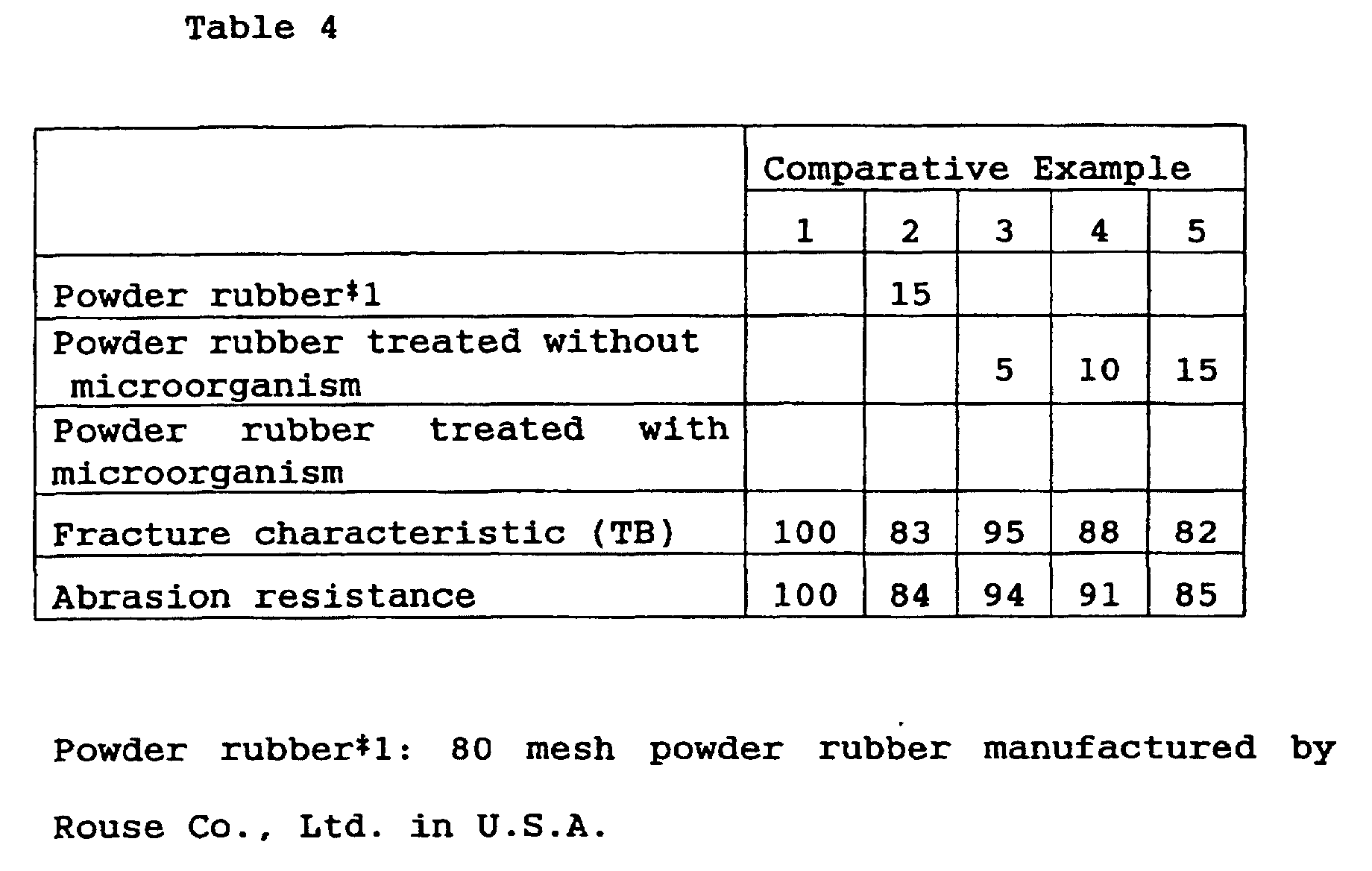
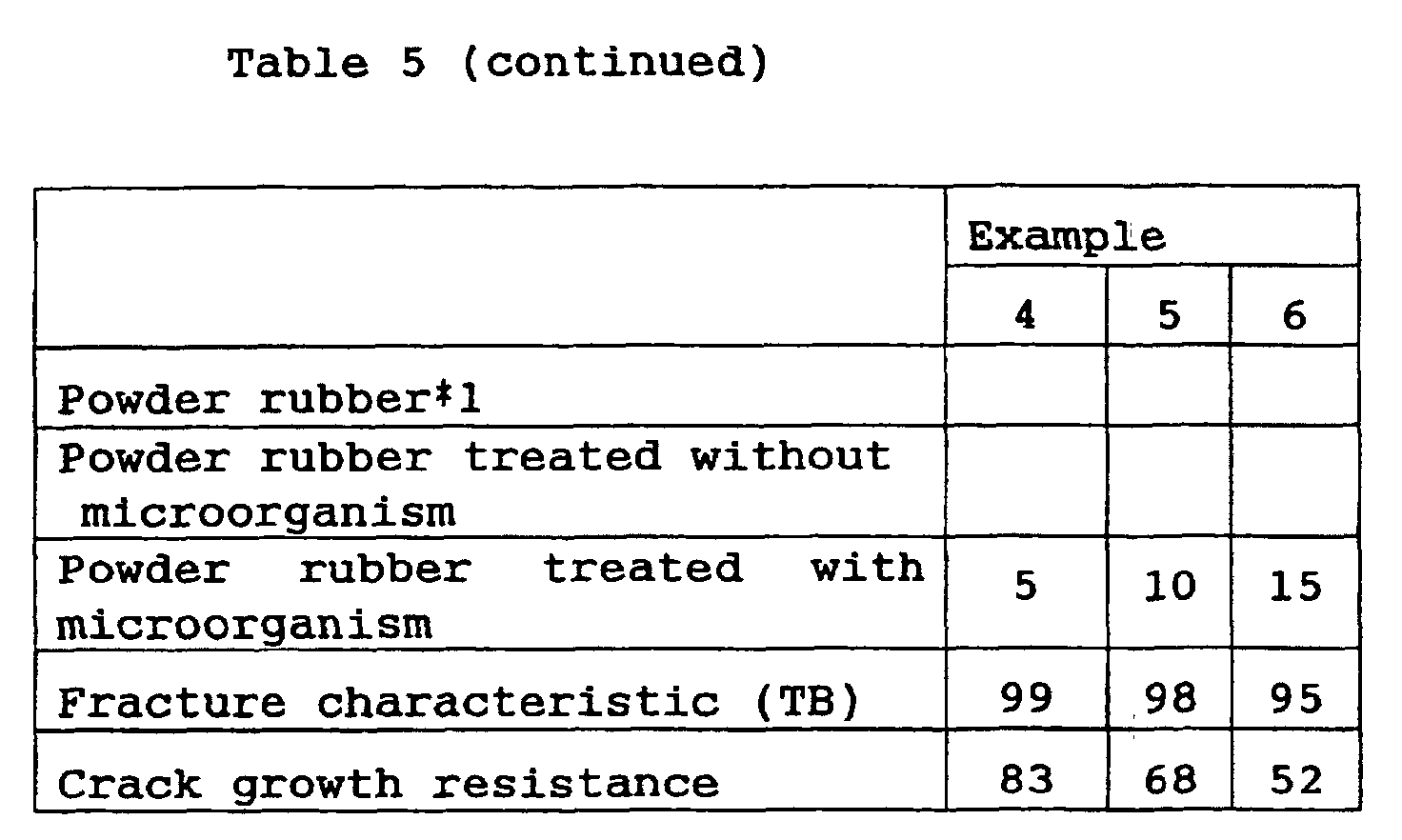
- the use amounts of the powder rubber in the respective examples and comparative examples are shown in Table 4 and Table 5.
- the amount of the aroma oil is the sum of an extender oil contained in the rubber component and a blend oil added in kneading.
- compositions described above were measured for abrasion resistance, fracture characteristics and crack growth resistance by the following methods to evaluate the recycled rubber.
- the fracture strength (TB) was measured according to JIS K6301-1995 and shown by an index, wherein the value of the control was set at 100. The larger the numerical value is, the better the fracture characteristic is.
- the test was carried out in the same manner as in JIS K6301-1995, and a flexing frequency counted until a length of cracks reached 10 mm was measured and shown by an index, wherein the value of the control was set at 100. The larger the numerical value is, the better the crack growth resistance is.
- the measuring conditions were an applied load of 4.5 kg, a surface speed of a grinding stone of 100 m/second, a test speed of 130 m/second, a slip rate of 30 %, a sand falling amount of 20 g/minute and a measuring temperature of room temperature.
- the results were shown by an index, wherein the value of the control was set at 100. The larger the numerical value is, the better the abrasion resistance is.
- the rubber composition prepared by using the powder rubber subjected to the treatment of the present invention has good fracture characteristics, high abrasion resistance and crack growth resistance as compared with a rubber composition prepared by using a conventional powder rubber, and it can suitably be applied to a tire tread, a side wall, a carcass ply and a belt ply.
Landscapes
- Engineering & Computer Science (AREA)
- Mechanical Engineering (AREA)
- Chemical & Material Sciences (AREA)
- Environmental & Geological Engineering (AREA)
- Life Sciences & Earth Sciences (AREA)
- Chemical Kinetics & Catalysis (AREA)
- Medicinal Chemistry (AREA)
- Polymers & Plastics (AREA)
- Organic Chemistry (AREA)
- Health & Medical Sciences (AREA)
- Sustainable Development (AREA)
- Compositions Of Macromolecular Compounds (AREA)
- Separation, Recovery Or Treatment Of Waste Materials Containing Plastics (AREA)
- Tires In General (AREA)
- Micro-Organisms Or Cultivation Processes Thereof (AREA)
Abstract
Description
| K2HPO4 | 8.0 g |
| KH2PO4 | 1.0 g |
| MgSO4·7H2O | 0.2 g |
| NaCl | 0.1 g |
| (NH4)2SO4 | 0.5 g |
| Ca(NO3)2 | 0.1 g |
| Metal solution | 10 ml |
| Vitamin solution | 1 ml |
| Deionized water | 1000 ml |
| pH | 7.5 |
| Tread blend | ||
| Rubber component | SBR | 70 |
| BR | 30 | |
| Powder rubber | variable | |
| Zinc oxide | 3 | |
| Stearic acid | 2 | |
| Carbon black | 85 | |
| Aroma oil | 36.25 | |
| Antioxidant | 1 | |
| Vulcanization accelerator | 1.2 | |
| Sulfur | 1.5 |
(brand name, manufactured by Ohuchishinko chemical Industrial Co., Ltd.)
| Side wall blend 1 | ||
| Rubber component | NR | 50 |
| BR | 50 | |
| Powder rubber | variable | |
| Carbon black | 50 | |
| Softening agent | 30 | |
| Zinc oxide | 2 | |
| Stearic acid | 1 | |
| Antioxidant | 2 | |
| Wax | 3 | |
| Vulcanization accelerator | 0.6 | |
| Sulfur | 1 |
- NR: RSS #3
- BR: BR 01 (brand name, manufactured by JSR Corporation Ltd.)
- Carbon black: FEF
- Softening agent: aroma oil
- Antioxidant: Nocrac 6C (brand name, manufactured by Ohuchishinko Chemical Industrial Co., Ltd.)
- Wax: Suntight S (manufactured by Seiko Chemical Industries Co., Ltd.)
- Accelerator: Nocceler NS-F (brand name, manufactured by Ohuchishinko Chemical Industrial Co., Ltd.)


Claims (9)
- A powder rubber subjected to treatment of making unevenness on a surface thereof.
- The powder rubber as described in claim 1, wherein the treatment of making unevenness is carried out using a microorganism.
- The powder rubber as described in claim 2, wherein the microorganism is a microorganism belonging to Pseudonocardiaceae.
- The powder rubber as described in claim 3, wherein the microorganism belonging to Pseudonocardiaceae is a WU-YS05 strain having an accession number of FERM P-18660.
- The powder rubber as described in any of claims 1 to 4, wherein the powder rubber before subjected to the treatment of making unevenness has an average particle diameter of 1 mm or less.
- The powder rubber as described in claim 5, wherein the powder rubber before subjected to the treatment of making unevenness has an average particle diameter of 0.2 mm or less.
- The powder rubber as described in any of claims 1 to 6, wherein the treatment of making unevenness is carried out such that a weight change rate of the powder rubber falls in a range of 0.01 to 40 % between before and after subjected to the treatment.
- A rubber composition using the powder rubber as described in any of claims 1 to 7.
- A tire characterized by using the rubber composition as described in claim 8.
Applications Claiming Priority (3)
| Application Number | Priority Date | Filing Date | Title |
|---|---|---|---|
| JP2001370373 | 2001-12-04 | ||
| JP2001370373 | 2001-12-04 | ||
| PCT/JP2002/012452 WO2003048236A1 (en) | 2001-12-04 | 2002-11-28 | Powdery rubber having unevened surface and rubber compositions and tires using the same |
Publications (3)
| Publication Number | Publication Date |
|---|---|
| EP1454942A1 true EP1454942A1 (en) | 2004-09-08 |
| EP1454942A4 EP1454942A4 (en) | 2005-01-05 |
| EP1454942B1 EP1454942B1 (en) | 2009-12-23 |
Family
ID=19179611
Family Applications (1)
| Application Number | Title | Priority Date | Filing Date |
|---|---|---|---|
| EP20020783670 Expired - Lifetime EP1454942B1 (en) | 2001-12-04 | 2002-11-28 | Method of treatment of powder rubber for making its surface uneven |
Country Status (6)
| Country | Link |
|---|---|
| US (1) | US7344777B2 (en) |
| EP (1) | EP1454942B1 (en) |
| CN (1) | CN1276941C (en) |
| DE (1) | DE60234861D1 (en) |
| ES (1) | ES2337032T3 (en) |
| WO (1) | WO2003048236A1 (en) |
Cited By (9)
| Publication number | Priority date | Publication date | Assignee | Title |
|---|---|---|---|---|
| EP1816143A1 (en) * | 2006-01-20 | 2007-08-08 | Bridgestone Corporation | a method for producing a natural rubber master batch using biodegraded rubber powder. |
| ES2293864A1 (en) * | 2007-12-05 | 2008-03-16 | Universidad Politecnica De Madrid | PROCEDURE OF FUNGICAL BIODEGRADATION OF CRUSHING OF TIRES. |
| WO2018020353A1 (en) | 2016-07-29 | 2018-02-01 | Compagnie Générale Des Établissements Michelin | Tyre with insert |
| FR3060587A1 (en) * | 2016-12-20 | 2018-06-22 | Compagnie Generale Des Etablissements Michelin | RUBBER COMPOSITION COMPRISING A SPECIFIC RUBBER POWDER |
| US11028254B2 (en) | 2016-12-20 | 2021-06-08 | Compagnie Generale Des Etablissements Michelin | Rubber composition comprising a specific crumb rubber |
| US11041065B2 (en) | 2016-12-20 | 2021-06-22 | Compagnie Generale Des Etablissements Michelin | Rubber composition comprising a specific crumb rubber |
| US11046838B2 (en) | 2016-12-20 | 2021-06-29 | Compagnie Generale Des Etablissements Michelin | Rubber composition comprising a specific crumb rubber |
| US11396208B2 (en) | 2016-12-20 | 2022-07-26 | Compagnie Generale Des Etablissements Michelin | Tire provided with an outer sidewall containing a composition comprising a crumb rubber |
| US11427702B2 (en) | 2016-12-20 | 2022-08-30 | Compagnie Generales des Etablissements Michelin | Rubber composition comprising a specific crumb rubber |
Families Citing this family (7)
| Publication number | Priority date | Publication date | Assignee | Title |
|---|---|---|---|---|
| GB0304574D0 (en) * | 2003-02-28 | 2003-04-02 | Univ Napier | Method |
| US7892332B2 (en) * | 2007-10-01 | 2011-02-22 | Baxter International Inc. | Dialysis systems having air traps with internal structures to enhance air removal |
| PT104150A (en) * | 2008-07-31 | 2010-02-01 | Inst Superior Tecnico | METHOD FOR COATING RUBBER BEADS BY POLYMERIC FILM AND RUBBER BEADS COATED AND OBTAINED BY THIS PROCESS |
| TW201022346A (en) * | 2008-12-04 | 2010-06-16 | pin-cong Zheng | Rubber particle composition and production method thereof |
| FR2965270B1 (en) | 2010-09-24 | 2014-11-07 | Eiffage Travaux Publics | BITUMEN AND RUBBER BINDER FOR PAVEMENT COATING OR THE LIKE, PROCESS FOR PRODUCING THE SAME AND USES THEREOF |
| CA2874248C (en) | 2012-05-30 | 2017-02-28 | Bridgestone Bandag, Llc | Tire tread and method of making the same |
| CN103305197B (en) * | 2013-06-08 | 2015-06-10 | 西南石油大学 | Cement paste toughening agent and application of cement paste toughening agent in preparation of cementing flexible cement paste |
Family Cites Families (12)
| Publication number | Priority date | Publication date | Assignee | Title |
|---|---|---|---|---|
| JPS527014B2 (en) | 1972-03-24 | 1977-02-26 | ||
| DE2648301C2 (en) | 1976-10-26 | 1983-01-13 | Bayer Ag, 5090 Leverkusen | Process for the production of powdered rubber powder |
| JPS5455778A (en) * | 1977-10-05 | 1979-05-04 | Agency Of Ind Science & Technol | Microbial decomposition of styrene oligomer |
| JPS55108431A (en) | 1979-02-15 | 1980-08-20 | Bridgestone Corp | Rubber composition |
| DE4042009C2 (en) * | 1990-12-22 | 1999-09-09 | Hoelzemann Metallverarbeitung | Process for the biological processing of waste rubber |
| US5597851A (en) * | 1995-09-14 | 1997-01-28 | Battelle Memorial Institute | Method for the addition of vulcanized waste rubber to virgin rubber products |
| JP2770007B2 (en) | 1996-01-23 | 1998-06-25 | 工業技術院長 | Disassembly method for hard rubber products |
| JP2840731B2 (en) | 1996-05-01 | 1998-12-24 | 工業技術院長 | Method for forming uneven surface of polymer molded article |
| JP3380124B2 (en) | 1996-09-10 | 2003-02-24 | 独立行政法人産業技術総合研究所 | Surface treatment method for vulcanized rubber |
| JP3079258B2 (en) | 1997-08-28 | 2000-08-21 | 工業技術院長 | Decomposition method of hard rubber by microorganism |
| US6407144B1 (en) * | 2000-04-04 | 2002-06-18 | Westinghouse Savannah River Company, Llc | Combination biological and microwave treatments of used rubber products |
| JP2002146031A (en) | 2000-11-13 | 2002-05-22 | Bridgestone Corp | Method for producing surface-modified rubber |
-
2002
- 2002-11-28 ES ES02783670T patent/ES2337032T3/en not_active Expired - Lifetime
- 2002-11-28 EP EP20020783670 patent/EP1454942B1/en not_active Expired - Lifetime
- 2002-11-28 DE DE60234861T patent/DE60234861D1/en not_active Expired - Lifetime
- 2002-11-28 US US10/497,476 patent/US7344777B2/en not_active Expired - Fee Related
- 2002-11-28 WO PCT/JP2002/012452 patent/WO2003048236A1/en not_active Ceased
- 2002-11-28 CN CNB028227697A patent/CN1276941C/en not_active Expired - Fee Related
Cited By (14)
| Publication number | Priority date | Publication date | Assignee | Title |
|---|---|---|---|---|
| EP1816143A1 (en) * | 2006-01-20 | 2007-08-08 | Bridgestone Corporation | a method for producing a natural rubber master batch using biodegraded rubber powder. |
| US7642311B2 (en) | 2006-01-20 | 2010-01-05 | Bridgestone Corporation | Method for producing a natural rubber master batch and a synthetic isoprene rubber batch using biodegraded rubber powder, using rubber powder and a filling agent, or using biodegraded rubber powder and a filling agent |
| ES2293864A1 (en) * | 2007-12-05 | 2008-03-16 | Universidad Politecnica De Madrid | PROCEDURE OF FUNGICAL BIODEGRADATION OF CRUSHING OF TIRES. |
| ES2293864B2 (en) * | 2007-12-05 | 2009-04-01 | Universidad Politecnica De Madrid | PROCEDURE OF FUNGICAL BIODEGRADATION OF CRUSHING OF TIRES. |
| WO2018020353A1 (en) | 2016-07-29 | 2018-02-01 | Compagnie Générale Des Établissements Michelin | Tyre with insert |
| FR3054482A1 (en) * | 2016-07-29 | 2018-02-02 | Michelin & Cie | PNEUMATIC WITH INSERT |
| FR3060587A1 (en) * | 2016-12-20 | 2018-06-22 | Compagnie Generale Des Etablissements Michelin | RUBBER COMPOSITION COMPRISING A SPECIFIC RUBBER POWDER |
| WO2018115714A1 (en) * | 2016-12-20 | 2018-06-28 | Compagnie Generale Des Etablissements Michelin | Rubber composition comprising a specific crumb rubber |
| US11028254B2 (en) | 2016-12-20 | 2021-06-08 | Compagnie Generale Des Etablissements Michelin | Rubber composition comprising a specific crumb rubber |
| US11041065B2 (en) | 2016-12-20 | 2021-06-22 | Compagnie Generale Des Etablissements Michelin | Rubber composition comprising a specific crumb rubber |
| US11046838B2 (en) | 2016-12-20 | 2021-06-29 | Compagnie Generale Des Etablissements Michelin | Rubber composition comprising a specific crumb rubber |
| US11155701B2 (en) | 2016-12-20 | 2021-10-26 | Compagnie Generale Des Etablissements Michelin | Rubber composition comprising a specific crumb rubber |
| US11396208B2 (en) | 2016-12-20 | 2022-07-26 | Compagnie Generale Des Etablissements Michelin | Tire provided with an outer sidewall containing a composition comprising a crumb rubber |
| US11427702B2 (en) | 2016-12-20 | 2022-08-30 | Compagnie Generales des Etablissements Michelin | Rubber composition comprising a specific crumb rubber |
Also Published As
| Publication number | Publication date |
|---|---|
| CN1276941C (en) | 2006-09-27 |
| CN1589291A (en) | 2005-03-02 |
| EP1454942A4 (en) | 2005-01-05 |
| US7344777B2 (en) | 2008-03-18 |
| WO2003048236A1 (en) | 2003-06-12 |
| DE60234861D1 (en) | 2010-02-04 |
| EP1454942B1 (en) | 2009-12-23 |
| US20050037199A1 (en) | 2005-02-17 |
| ES2337032T3 (en) | 2010-04-20 |
Similar Documents
| Publication | Publication Date | Title |
|---|---|---|
| US7344777B2 (en) | Powder rubber subjected to treatment of making unevenness on surface thereof and rubber composition using the same and tire | |
| US7642311B2 (en) | Method for producing a natural rubber master batch and a synthetic isoprene rubber batch using biodegraded rubber powder, using rubber powder and a filling agent, or using biodegraded rubber powder and a filling agent | |
| EP1489102B1 (en) | Natural rubber, rubber composition and pneumatic tire | |
| US10246578B2 (en) | Composite material from waste and at least one element of vulcanized rubber and tire cords | |
| JP5647128B2 (en) | Tires containing recycled materials | |
| US6479558B1 (en) | Microbial processing of used rubber | |
| AU2015289182A1 (en) | Process for bacterially devulcanizing sulphur-vulcanized rubber particles | |
| EP2993217A1 (en) | Devulcanization of rubber and other elastomers | |
| Bandyopadhyay et al. | An overview of rubber recycling | |
| AU696872B2 (en) | Improvements in and relating to the reclaimimg of elastomeric materials | |
| JP5222610B2 (en) | A novel microorganism having a resolution of polyisoprene rubber and a method for decomposing a rubber composition | |
| JP4251858B2 (en) | Powdered rubber with an uneven surface, rubber composition and tire using the same | |
| Klungsuwan et al. | Mechanical properties and biodegradability of cuttlebone/NR composites | |
| JP2007063507A (en) | Rubber powder treated with microorganism, rubber composition using the same and tire | |
| US6407144B1 (en) | Combination biological and microwave treatments of used rubber products | |
| JP2004035663A (en) | Rubber composition containing reclaimed rubber | |
| JP2005232347A (en) | Rubber composition containing enzyme-decomposed rubber decomposed by lignin-degrading enzyme, method for producing the same, and pneumatic tire using the same | |
| Tsuchii et al. | Colonization and disintegration of tire rubber by a colonial mutant of Nocardia | |
| JP2004027090A (en) | Tread rubber composition for studless tire and studless tire using the same | |
| JP4467424B2 (en) | Microbial treated rubber powder and rubber composition containing the rubber powder | |
| JP4603880B2 (en) | Novel microorganism BS-HA1 strain, method for microbial degradation of rubber | |
| Mathew et al. | Multifiller-matrix adhesion effects in epoxidized natural rubber | |
| JP4652147B2 (en) | Novel microorganism WU-YS09 strain, method for microbial degradation of rubber | |
| Hassim et al. | Fatigue Crack Growth of Recycled Rubber in Natural Rubber/butadiene Rubber Blends | |
| JP2006180794A (en) | Novel microorganism BS-TA1 strain, method for microbial degradation of rubber |
Legal Events
| Date | Code | Title | Description |
|---|---|---|---|
| PUAI | Public reference made under article 153(3) epc to a published international application that has entered the european phase |
Free format text: ORIGINAL CODE: 0009012 |
|
| 17P | Request for examination filed |
Effective date: 20040512 |
|
| AK | Designated contracting states |
Kind code of ref document: A1 Designated state(s): AT BE BG CH CY CZ DE DK EE ES FI FR GB GR IE IT LI LU MC NL PT SE SK TR |
|
| A4 | Supplementary search report drawn up and despatched |
Effective date: 20041123 |
|
| RIC1 | Information provided on ipc code assigned before grant |
Ipc: 7B 60C 1/00 B Ipc: 7B 29B 9/16 B Ipc: 7C 08J 3/12 A Ipc: 7B 29B 11/14 B Ipc: 7B 29B 17/00 B Ipc: 7C 08J 7/00 B Ipc: 7C 12R 1/00 B Ipc: 7C 12P 1/00 B Ipc: 7B 29B 13/00 B Ipc: 7C 08J 11/18 B |
|
| 17Q | First examination report despatched |
Effective date: 20050517 |
|
| 17Q | First examination report despatched |
Effective date: 20050517 |
|
| GRAP | Despatch of communication of intention to grant a patent |
Free format text: ORIGINAL CODE: EPIDOSNIGR1 |
|
| RTI1 | Title (correction) |
Free format text: METHOD OF TREATMENT OF POWDER RUBBER FOR MAKING ITS SURFACE UNEVEN |
|
| GRAS | Grant fee paid |
Free format text: ORIGINAL CODE: EPIDOSNIGR3 |
|
| GRAA | (expected) grant |
Free format text: ORIGINAL CODE: 0009210 |
|
| AK | Designated contracting states |
Kind code of ref document: B1 Designated state(s): DE ES FR GB IT |
|
| REG | Reference to a national code |
Ref country code: GB Ref legal event code: FG4D |
|
| REF | Corresponds to: |
Ref document number: 60234861 Country of ref document: DE Date of ref document: 20100204 Kind code of ref document: P |
|
| REG | Reference to a national code |
Ref country code: ES Ref legal event code: FG2A Ref document number: 2337032 Country of ref document: ES Kind code of ref document: T3 |
|
| PLBE | No opposition filed within time limit |
Free format text: ORIGINAL CODE: 0009261 |
|
| STAA | Information on the status of an ep patent application or granted ep patent |
Free format text: STATUS: NO OPPOSITION FILED WITHIN TIME LIMIT |
|
| 26N | No opposition filed |
Effective date: 20100924 |
|
| GBPC | Gb: european patent ceased through non-payment of renewal fee |
Effective date: 20101128 |
|
| REG | Reference to a national code |
Ref country code: DE Ref legal event code: R119 Ref document number: 60234861 Country of ref document: DE Effective date: 20110601 Ref country code: DE Ref legal event code: R119 Ref document number: 60234861 Country of ref document: DE Effective date: 20110531 |
|
| PG25 | Lapsed in a contracting state [announced via postgrant information from national office to epo] |
Ref country code: GB Free format text: LAPSE BECAUSE OF NON-PAYMENT OF DUE FEES Effective date: 20101128 |
|
| PG25 | Lapsed in a contracting state [announced via postgrant information from national office to epo] |
Ref country code: IT Free format text: LAPSE BECAUSE OF NON-PAYMENT OF DUE FEES Effective date: 20101128 |
|
| REG | Reference to a national code |
Ref country code: ES Ref legal event code: FD2A Effective date: 20120305 |
|
| PG25 | Lapsed in a contracting state [announced via postgrant information from national office to epo] |
Ref country code: ES Free format text: LAPSE BECAUSE OF NON-PAYMENT OF DUE FEES Effective date: 20101129 |
|
| PG25 | Lapsed in a contracting state [announced via postgrant information from national office to epo] |
Ref country code: DE Free format text: LAPSE BECAUSE OF NON-PAYMENT OF DUE FEES Effective date: 20110531 |
|
| REG | Reference to a national code |
Ref country code: FR Ref legal event code: CA Effective date: 20140812 |
|
| PGFP | Annual fee paid to national office [announced via postgrant information from national office to epo] |
Ref country code: FR Payment date: 20141119 Year of fee payment: 13 |
|
| REG | Reference to a national code |
Ref country code: FR Ref legal event code: ST Effective date: 20160729 |
|
| PG25 | Lapsed in a contracting state [announced via postgrant information from national office to epo] |
Ref country code: FR Free format text: LAPSE BECAUSE OF NON-PAYMENT OF DUE FEES Effective date: 20151130 |