EP1454898A1 - Novel phenylalanine derivative - Google Patents
Novel phenylalanine derivative Download PDFInfo
- Publication number
- EP1454898A1 EP1454898A1 EP02786095A EP02786095A EP1454898A1 EP 1454898 A1 EP1454898 A1 EP 1454898A1 EP 02786095 A EP02786095 A EP 02786095A EP 02786095 A EP02786095 A EP 02786095A EP 1454898 A1 EP1454898 A1 EP 1454898A1
- Authority
- EP
- European Patent Office
- Prior art keywords
- group
- substituted
- ring
- alkoxyl
- lower alkyl
- Prior art date
- Legal status (The legal status is an assumption and is not a legal conclusion. Google has not performed a legal analysis and makes no representation as to the accuracy of the status listed.)
- Withdrawn
Links
- 0 Cc1ccc(C[C@](C(O*)=O)N*)cc1 Chemical compound Cc1ccc(C[C@](C(O*)=O)N*)cc1 0.000 description 5
- JWTVASFRGURKBF-QFIPXVFZSA-N CCC(CC)(C(N[C@@H](Cc(cc1)ccc1N(C(c1c2c(C)ccc1)=O)C2=O)C(O)=O)=O)C(N1CCCC1)=O Chemical compound CCC(CC)(C(N[C@@H](Cc(cc1)ccc1N(C(c1c2c(C)ccc1)=O)C2=O)C(O)=O)=O)C(N1CCCC1)=O JWTVASFRGURKBF-QFIPXVFZSA-N 0.000 description 1
- HRFJFCXFBHTLLF-NRFANRHFSA-N Cc1c(C(N[C@@H](Cc(cc2)ccc2C(C(N(C)c(cc2)c3cc2Cl)=O)=C3OC)C(O)=O)=O)c(Cl)ccc1 Chemical compound Cc1c(C(N[C@@H](Cc(cc2)ccc2C(C(N(C)c(cc2)c3cc2Cl)=O)=C3OC)C(O)=O)=O)c(Cl)ccc1 HRFJFCXFBHTLLF-NRFANRHFSA-N 0.000 description 1
- MOPSNXJLJURKET-UHFFFAOYSA-N OC(C(Cc(cc1)ccc1N(C=C(C=CC=C1)C1=C1)C1=O)NC(c(c(Cl)ccc1)c1Cl)=O)=O Chemical compound OC(C(Cc(cc1)ccc1N(C=C(C=CC=C1)C1=C1)C1=O)NC(c(c(Cl)ccc1)c1Cl)=O)=O MOPSNXJLJURKET-UHFFFAOYSA-N 0.000 description 1
Classifications
-
- C—CHEMISTRY; METALLURGY
- C07—ORGANIC CHEMISTRY
- C07D—HETEROCYCLIC COMPOUNDS
- C07D209/00—Heterocyclic compounds containing five-membered rings, condensed with other rings, with one nitrogen atom as the only ring hetero atom
- C07D209/02—Heterocyclic compounds containing five-membered rings, condensed with other rings, with one nitrogen atom as the only ring hetero atom condensed with one carbocyclic ring
- C07D209/44—Iso-indoles; Hydrogenated iso-indoles
- C07D209/48—Iso-indoles; Hydrogenated iso-indoles with oxygen atoms in positions 1 and 3, e.g. phthalimide
-
- A—HUMAN NECESSITIES
- A61—MEDICAL OR VETERINARY SCIENCE; HYGIENE
- A61K—PREPARATIONS FOR MEDICAL, DENTAL OR TOILETRY PURPOSES
- A61K31/00—Medicinal preparations containing organic active ingredients
- A61K31/33—Heterocyclic compounds
- A61K31/395—Heterocyclic compounds having nitrogen as a ring hetero atom, e.g. guanethidine or rifamycins
- A61K31/40—Heterocyclic compounds having nitrogen as a ring hetero atom, e.g. guanethidine or rifamycins having five-membered rings with one nitrogen as the only ring hetero atom, e.g. sulpiride, succinimide, tolmetin, buflomedil
- A61K31/403—Heterocyclic compounds having nitrogen as a ring hetero atom, e.g. guanethidine or rifamycins having five-membered rings with one nitrogen as the only ring hetero atom, e.g. sulpiride, succinimide, tolmetin, buflomedil condensed with carbocyclic rings, e.g. carbazole
-
- A—HUMAN NECESSITIES
- A61—MEDICAL OR VETERINARY SCIENCE; HYGIENE
- A61K—PREPARATIONS FOR MEDICAL, DENTAL OR TOILETRY PURPOSES
- A61K31/00—Medicinal preparations containing organic active ingredients
- A61K31/33—Heterocyclic compounds
- A61K31/395—Heterocyclic compounds having nitrogen as a ring hetero atom, e.g. guanethidine or rifamycins
- A61K31/435—Heterocyclic compounds having nitrogen as a ring hetero atom, e.g. guanethidine or rifamycins having six-membered rings with one nitrogen as the only ring hetero atom
- A61K31/4353—Heterocyclic compounds having nitrogen as a ring hetero atom, e.g. guanethidine or rifamycins having six-membered rings with one nitrogen as the only ring hetero atom ortho- or peri-condensed with heterocyclic ring systems
- A61K31/4375—Heterocyclic compounds having nitrogen as a ring hetero atom, e.g. guanethidine or rifamycins having six-membered rings with one nitrogen as the only ring hetero atom ortho- or peri-condensed with heterocyclic ring systems the heterocyclic ring system containing a six-membered ring having nitrogen as a ring heteroatom, e.g. quinolizines, naphthyridines, berberine, vincamine
-
- A—HUMAN NECESSITIES
- A61—MEDICAL OR VETERINARY SCIENCE; HYGIENE
- A61K—PREPARATIONS FOR MEDICAL, DENTAL OR TOILETRY PURPOSES
- A61K31/00—Medicinal preparations containing organic active ingredients
- A61K31/33—Heterocyclic compounds
- A61K31/395—Heterocyclic compounds having nitrogen as a ring hetero atom, e.g. guanethidine or rifamycins
- A61K31/435—Heterocyclic compounds having nitrogen as a ring hetero atom, e.g. guanethidine or rifamycins having six-membered rings with one nitrogen as the only ring hetero atom
- A61K31/47—Quinolines; Isoquinolines
-
- A—HUMAN NECESSITIES
- A61—MEDICAL OR VETERINARY SCIENCE; HYGIENE
- A61K—PREPARATIONS FOR MEDICAL, DENTAL OR TOILETRY PURPOSES
- A61K31/00—Medicinal preparations containing organic active ingredients
- A61K31/33—Heterocyclic compounds
- A61K31/395—Heterocyclic compounds having nitrogen as a ring hetero atom, e.g. guanethidine or rifamycins
- A61K31/435—Heterocyclic compounds having nitrogen as a ring hetero atom, e.g. guanethidine or rifamycins having six-membered rings with one nitrogen as the only ring hetero atom
- A61K31/47—Quinolines; Isoquinolines
- A61K31/4709—Non-condensed quinolines and containing further heterocyclic rings
-
- A—HUMAN NECESSITIES
- A61—MEDICAL OR VETERINARY SCIENCE; HYGIENE
- A61K—PREPARATIONS FOR MEDICAL, DENTAL OR TOILETRY PURPOSES
- A61K31/00—Medicinal preparations containing organic active ingredients
- A61K31/33—Heterocyclic compounds
- A61K31/395—Heterocyclic compounds having nitrogen as a ring hetero atom, e.g. guanethidine or rifamycins
- A61K31/435—Heterocyclic compounds having nitrogen as a ring hetero atom, e.g. guanethidine or rifamycins having six-membered rings with one nitrogen as the only ring hetero atom
- A61K31/47—Quinolines; Isoquinolines
- A61K31/472—Non-condensed isoquinolines, e.g. papaverine
-
- A—HUMAN NECESSITIES
- A61—MEDICAL OR VETERINARY SCIENCE; HYGIENE
- A61K—PREPARATIONS FOR MEDICAL, DENTAL OR TOILETRY PURPOSES
- A61K31/00—Medicinal preparations containing organic active ingredients
- A61K31/33—Heterocyclic compounds
- A61K31/395—Heterocyclic compounds having nitrogen as a ring hetero atom, e.g. guanethidine or rifamycins
- A61K31/495—Heterocyclic compounds having nitrogen as a ring hetero atom, e.g. guanethidine or rifamycins having six-membered rings with two or more nitrogen atoms as the only ring heteroatoms, e.g. piperazine or tetrazines
- A61K31/50—Pyridazines; Hydrogenated pyridazines
- A61K31/502—Pyridazines; Hydrogenated pyridazines ortho- or peri-condensed with carbocyclic ring systems, e.g. cinnoline, phthalazine
-
- A—HUMAN NECESSITIES
- A61—MEDICAL OR VETERINARY SCIENCE; HYGIENE
- A61K—PREPARATIONS FOR MEDICAL, DENTAL OR TOILETRY PURPOSES
- A61K31/00—Medicinal preparations containing organic active ingredients
- A61K31/33—Heterocyclic compounds
- A61K31/395—Heterocyclic compounds having nitrogen as a ring hetero atom, e.g. guanethidine or rifamycins
- A61K31/495—Heterocyclic compounds having nitrogen as a ring hetero atom, e.g. guanethidine or rifamycins having six-membered rings with two or more nitrogen atoms as the only ring heteroatoms, e.g. piperazine or tetrazines
- A61K31/505—Pyrimidines; Hydrogenated pyrimidines, e.g. trimethoprim
- A61K31/517—Pyrimidines; Hydrogenated pyrimidines, e.g. trimethoprim ortho- or peri-condensed with carbocyclic ring systems, e.g. quinazoline, perimidine
-
- A—HUMAN NECESSITIES
- A61—MEDICAL OR VETERINARY SCIENCE; HYGIENE
- A61P—SPECIFIC THERAPEUTIC ACTIVITY OF CHEMICAL COMPOUNDS OR MEDICINAL PREPARATIONS
- A61P1/00—Drugs for disorders of the alimentary tract or the digestive system
-
- A—HUMAN NECESSITIES
- A61—MEDICAL OR VETERINARY SCIENCE; HYGIENE
- A61P—SPECIFIC THERAPEUTIC ACTIVITY OF CHEMICAL COMPOUNDS OR MEDICINAL PREPARATIONS
- A61P1/00—Drugs for disorders of the alimentary tract or the digestive system
- A61P1/04—Drugs for disorders of the alimentary tract or the digestive system for ulcers, gastritis or reflux esophagitis, e.g. antacids, inhibitors of acid secretion, mucosal protectants
-
- A—HUMAN NECESSITIES
- A61—MEDICAL OR VETERINARY SCIENCE; HYGIENE
- A61P—SPECIFIC THERAPEUTIC ACTIVITY OF CHEMICAL COMPOUNDS OR MEDICINAL PREPARATIONS
- A61P11/00—Drugs for disorders of the respiratory system
- A61P11/06—Antiasthmatics
-
- A—HUMAN NECESSITIES
- A61—MEDICAL OR VETERINARY SCIENCE; HYGIENE
- A61P—SPECIFIC THERAPEUTIC ACTIVITY OF CHEMICAL COMPOUNDS OR MEDICINAL PREPARATIONS
- A61P17/00—Drugs for dermatological disorders
- A61P17/06—Antipsoriatics
-
- A—HUMAN NECESSITIES
- A61—MEDICAL OR VETERINARY SCIENCE; HYGIENE
- A61P—SPECIFIC THERAPEUTIC ACTIVITY OF CHEMICAL COMPOUNDS OR MEDICINAL PREPARATIONS
- A61P19/00—Drugs for skeletal disorders
- A61P19/02—Drugs for skeletal disorders for joint disorders, e.g. arthritis, arthrosis
-
- A—HUMAN NECESSITIES
- A61—MEDICAL OR VETERINARY SCIENCE; HYGIENE
- A61P—SPECIFIC THERAPEUTIC ACTIVITY OF CHEMICAL COMPOUNDS OR MEDICINAL PREPARATIONS
- A61P25/00—Drugs for disorders of the nervous system
-
- A—HUMAN NECESSITIES
- A61—MEDICAL OR VETERINARY SCIENCE; HYGIENE
- A61P—SPECIFIC THERAPEUTIC ACTIVITY OF CHEMICAL COMPOUNDS OR MEDICINAL PREPARATIONS
- A61P29/00—Non-central analgesic, antipyretic or antiinflammatory agents, e.g. antirheumatic agents; Non-steroidal antiinflammatory drugs [NSAID]
-
- A—HUMAN NECESSITIES
- A61—MEDICAL OR VETERINARY SCIENCE; HYGIENE
- A61P—SPECIFIC THERAPEUTIC ACTIVITY OF CHEMICAL COMPOUNDS OR MEDICINAL PREPARATIONS
- A61P3/00—Drugs for disorders of the metabolism
- A61P3/08—Drugs for disorders of the metabolism for glucose homeostasis
- A61P3/10—Drugs for disorders of the metabolism for glucose homeostasis for hyperglycaemia, e.g. antidiabetics
-
- A—HUMAN NECESSITIES
- A61—MEDICAL OR VETERINARY SCIENCE; HYGIENE
- A61P—SPECIFIC THERAPEUTIC ACTIVITY OF CHEMICAL COMPOUNDS OR MEDICINAL PREPARATIONS
- A61P35/00—Antineoplastic agents
-
- A—HUMAN NECESSITIES
- A61—MEDICAL OR VETERINARY SCIENCE; HYGIENE
- A61P—SPECIFIC THERAPEUTIC ACTIVITY OF CHEMICAL COMPOUNDS OR MEDICINAL PREPARATIONS
- A61P35/00—Antineoplastic agents
- A61P35/04—Antineoplastic agents specific for metastasis
-
- A—HUMAN NECESSITIES
- A61—MEDICAL OR VETERINARY SCIENCE; HYGIENE
- A61P—SPECIFIC THERAPEUTIC ACTIVITY OF CHEMICAL COMPOUNDS OR MEDICINAL PREPARATIONS
- A61P37/00—Drugs for immunological or allergic disorders
- A61P37/02—Immunomodulators
-
- A—HUMAN NECESSITIES
- A61—MEDICAL OR VETERINARY SCIENCE; HYGIENE
- A61P—SPECIFIC THERAPEUTIC ACTIVITY OF CHEMICAL COMPOUNDS OR MEDICINAL PREPARATIONS
- A61P37/00—Drugs for immunological or allergic disorders
- A61P37/02—Immunomodulators
- A61P37/06—Immunosuppressants, e.g. drugs for graft rejection
-
- A—HUMAN NECESSITIES
- A61—MEDICAL OR VETERINARY SCIENCE; HYGIENE
- A61P—SPECIFIC THERAPEUTIC ACTIVITY OF CHEMICAL COMPOUNDS OR MEDICINAL PREPARATIONS
- A61P37/00—Drugs for immunological or allergic disorders
- A61P37/08—Antiallergic agents
-
- A—HUMAN NECESSITIES
- A61—MEDICAL OR VETERINARY SCIENCE; HYGIENE
- A61P—SPECIFIC THERAPEUTIC ACTIVITY OF CHEMICAL COMPOUNDS OR MEDICINAL PREPARATIONS
- A61P43/00—Drugs for specific purposes, not provided for in groups A61P1/00-A61P41/00
-
- A—HUMAN NECESSITIES
- A61—MEDICAL OR VETERINARY SCIENCE; HYGIENE
- A61P—SPECIFIC THERAPEUTIC ACTIVITY OF CHEMICAL COMPOUNDS OR MEDICINAL PREPARATIONS
- A61P9/00—Drugs for disorders of the cardiovascular system
-
- A—HUMAN NECESSITIES
- A61—MEDICAL OR VETERINARY SCIENCE; HYGIENE
- A61P—SPECIFIC THERAPEUTIC ACTIVITY OF CHEMICAL COMPOUNDS OR MEDICINAL PREPARATIONS
- A61P9/00—Drugs for disorders of the cardiovascular system
- A61P9/10—Drugs for disorders of the cardiovascular system for treating ischaemic or atherosclerotic diseases, e.g. antianginal drugs, coronary vasodilators, drugs for myocardial infarction, retinopathy, cerebrovascula insufficiency, renal arteriosclerosis
-
- C—CHEMISTRY; METALLURGY
- C07—ORGANIC CHEMISTRY
- C07D—HETEROCYCLIC COMPOUNDS
- C07D215/00—Heterocyclic compounds containing quinoline or hydrogenated quinoline ring systems
- C07D215/02—Heterocyclic compounds containing quinoline or hydrogenated quinoline ring systems having no bond between the ring nitrogen atom and a non-ring member or having only hydrogen atoms or carbon atoms directly attached to the ring nitrogen atom
- C07D215/16—Heterocyclic compounds containing quinoline or hydrogenated quinoline ring systems having no bond between the ring nitrogen atom and a non-ring member or having only hydrogen atoms or carbon atoms directly attached to the ring nitrogen atom with hetero atoms or with carbon atoms having three bonds to hetero atoms with at the most one bond to halogen, e.g. ester or nitrile radicals, directly attached to ring carbon atoms
- C07D215/20—Oxygen atoms
- C07D215/22—Oxygen atoms attached in position 2 or 4
-
- C—CHEMISTRY; METALLURGY
- C07—ORGANIC CHEMISTRY
- C07D—HETEROCYCLIC COMPOUNDS
- C07D215/00—Heterocyclic compounds containing quinoline or hydrogenated quinoline ring systems
- C07D215/02—Heterocyclic compounds containing quinoline or hydrogenated quinoline ring systems having no bond between the ring nitrogen atom and a non-ring member or having only hydrogen atoms or carbon atoms directly attached to the ring nitrogen atom
- C07D215/16—Heterocyclic compounds containing quinoline or hydrogenated quinoline ring systems having no bond between the ring nitrogen atom and a non-ring member or having only hydrogen atoms or carbon atoms directly attached to the ring nitrogen atom with hetero atoms or with carbon atoms having three bonds to hetero atoms with at the most one bond to halogen, e.g. ester or nitrile radicals, directly attached to ring carbon atoms
- C07D215/20—Oxygen atoms
- C07D215/22—Oxygen atoms attached in position 2 or 4
- C07D215/227—Oxygen atoms attached in position 2 or 4 only one oxygen atom which is attached in position 2
-
- C—CHEMISTRY; METALLURGY
- C07—ORGANIC CHEMISTRY
- C07D—HETEROCYCLIC COMPOUNDS
- C07D215/00—Heterocyclic compounds containing quinoline or hydrogenated quinoline ring systems
- C07D215/02—Heterocyclic compounds containing quinoline or hydrogenated quinoline ring systems having no bond between the ring nitrogen atom and a non-ring member or having only hydrogen atoms or carbon atoms directly attached to the ring nitrogen atom
- C07D215/16—Heterocyclic compounds containing quinoline or hydrogenated quinoline ring systems having no bond between the ring nitrogen atom and a non-ring member or having only hydrogen atoms or carbon atoms directly attached to the ring nitrogen atom with hetero atoms or with carbon atoms having three bonds to hetero atoms with at the most one bond to halogen, e.g. ester or nitrile radicals, directly attached to ring carbon atoms
- C07D215/36—Sulfur atoms
-
- C—CHEMISTRY; METALLURGY
- C07—ORGANIC CHEMISTRY
- C07D—HETEROCYCLIC COMPOUNDS
- C07D215/00—Heterocyclic compounds containing quinoline or hydrogenated quinoline ring systems
- C07D215/02—Heterocyclic compounds containing quinoline or hydrogenated quinoline ring systems having no bond between the ring nitrogen atom and a non-ring member or having only hydrogen atoms or carbon atoms directly attached to the ring nitrogen atom
- C07D215/16—Heterocyclic compounds containing quinoline or hydrogenated quinoline ring systems having no bond between the ring nitrogen atom and a non-ring member or having only hydrogen atoms or carbon atoms directly attached to the ring nitrogen atom with hetero atoms or with carbon atoms having three bonds to hetero atoms with at the most one bond to halogen, e.g. ester or nitrile radicals, directly attached to ring carbon atoms
- C07D215/38—Nitrogen atoms
-
- C—CHEMISTRY; METALLURGY
- C07—ORGANIC CHEMISTRY
- C07D—HETEROCYCLIC COMPOUNDS
- C07D237/00—Heterocyclic compounds containing 1,2-diazine or hydrogenated 1,2-diazine rings
- C07D237/26—Heterocyclic compounds containing 1,2-diazine or hydrogenated 1,2-diazine rings condensed with carbocyclic rings or ring systems
- C07D237/30—Phthalazines
- C07D237/32—Phthalazines with oxygen atoms directly attached to carbon atoms of the nitrogen-containing ring
-
- C—CHEMISTRY; METALLURGY
- C07—ORGANIC CHEMISTRY
- C07D—HETEROCYCLIC COMPOUNDS
- C07D239/00—Heterocyclic compounds containing 1,3-diazine or hydrogenated 1,3-diazine rings
- C07D239/70—Heterocyclic compounds containing 1,3-diazine or hydrogenated 1,3-diazine rings condensed with carbocyclic rings or ring systems
- C07D239/72—Quinazolines; Hydrogenated quinazolines
- C07D239/95—Quinazolines; Hydrogenated quinazolines with hetero atoms directly attached in positions 2 and 4
- C07D239/96—Two oxygen atoms
-
- C—CHEMISTRY; METALLURGY
- C07—ORGANIC CHEMISTRY
- C07D—HETEROCYCLIC COMPOUNDS
- C07D401/00—Heterocyclic compounds containing two or more hetero rings, having nitrogen atoms as the only ring hetero atoms, at least one ring being a six-membered ring with only one nitrogen atom
- C07D401/02—Heterocyclic compounds containing two or more hetero rings, having nitrogen atoms as the only ring hetero atoms, at least one ring being a six-membered ring with only one nitrogen atom containing two hetero rings
- C07D401/12—Heterocyclic compounds containing two or more hetero rings, having nitrogen atoms as the only ring hetero atoms, at least one ring being a six-membered ring with only one nitrogen atom containing two hetero rings linked by a chain containing hetero atoms as chain links
-
- C—CHEMISTRY; METALLURGY
- C07—ORGANIC CHEMISTRY
- C07D—HETEROCYCLIC COMPOUNDS
- C07D403/00—Heterocyclic compounds containing two or more hetero rings, having nitrogen atoms as the only ring hetero atoms, not provided for by group C07D401/00
- C07D403/02—Heterocyclic compounds containing two or more hetero rings, having nitrogen atoms as the only ring hetero atoms, not provided for by group C07D401/00 containing two hetero rings
- C07D403/12—Heterocyclic compounds containing two or more hetero rings, having nitrogen atoms as the only ring hetero atoms, not provided for by group C07D401/00 containing two hetero rings linked by a chain containing hetero atoms as chain links
-
- C—CHEMISTRY; METALLURGY
- C07—ORGANIC CHEMISTRY
- C07D—HETEROCYCLIC COMPOUNDS
- C07D471/00—Heterocyclic compounds containing nitrogen atoms as the only ring hetero atoms in the condensed system, at least one ring being a six-membered ring with one nitrogen atom, not provided for by groups C07D451/00 - C07D463/00
- C07D471/02—Heterocyclic compounds containing nitrogen atoms as the only ring hetero atoms in the condensed system, at least one ring being a six-membered ring with one nitrogen atom, not provided for by groups C07D451/00 - C07D463/00 in which the condensed system contains two hetero rings
- C07D471/04—Ortho-condensed systems
Definitions
- the present invention relates to new phenylalanine derivatives and the use of the phenylalanine derivatives as medicines.
- the present invention also relates to the compounds usable as therapeutic agents or preventive agents for inflammatory diseases in which ⁇ 4 integrin-depending adhesion process participates in the pathology. It was reported that ⁇ 4 integrins participate in rheumatoid arthritis, inflammatory bowel diseases, systemic lupus erythematosus, multiple sclerosis, Sjögren's syndrome, asthma, psoriasis, allergy, diabetes, cardiovascular diseases, arterial sclerosis, restenosis, tumor proliferation, tumor metastasis and transplantation rejection.
- the compounds of the present invention having an antagonistic effect on the ⁇ 4 integrins are usable as therapeutic agents or preventive agents for the above-described diseases.
- leukocytes In the inflammatory reactions, it is generally understood that when a microorganism invades a tissue or when the tissue is injured, leukocytes play an important role for the exclusion of the microorganism or for the repair of the injured tissue. It is also widely understood that in such cases, leukocytes usually circulating in the blood must pass through the vascular wall and be newly supplied to the injured tissue. It has been elucidated that the infiltration of the leukocytes from the blood vessel into the tissue is carried out by integrin molecules which are a group of heterodimeric proteins expressing on the leukocytes. The integrin molecules are classified into at least 8 subfamilies ( ⁇ 1 through ⁇ 8 subfamilies) depending on the ⁇ chains thereof.
- ⁇ 1 and ⁇ 3 subfamilies involved in the adhesion of cell ingredients to the extracellular matrix such as collagen and fibronectin; ⁇ 2 subfamily involved in cell-to-cell adhesion in the immune system; and ⁇ 7 subfamily which mainly participates in the infiltration of leukocytes into mucosal tissues (Shimizu et al., Adv. Immunol. 72: 325-380, 1999).
- ⁇ 4 integrins two kinds of molecules thereof are known.
- VLA-4 very late antigen-4
- LPAM-1 lymphocyte Peyer's patch HEV adhesion molecule-1
- lymphocytes mainly comprising T cells and B cells are capable of moving out of the blood vessel by a so-called lymphocyte homing phenomenon wherein they move from the blood into the lymphoid tissue through the blood vessel wall and then they return into the blood through the lymphatic vessel under the physiological conditions.
- LPAM-1 molecules participate in the lymphocyte homing into the lymphoid tissue of an intestinal tract such as Peyer's patch (Butcher et al., Adv. Immunol. 72: 209-253, 1999).
- the vascular-endothelium cells are activated by cytokine and chemokine released from the inflamed tissue, the expression of a group of cell surface antigens (adhesion molecules) participating in the adhesion of leukocytes to the vascular-endothelium cells is caused, and a lot of leukocytes infiltrate out of the blood vessel toward the inflamed tissue through the adhesion molecules.
- E-selectin adheresion molecule mainly participating in the adhesion of neutrophils
- ICAM-1 and VCAM-1 mainly participating in the adhesion of lymphocytes
- MAdCAM-1 mainly participating in the adhesion of lymphocytes in the lymphoid tissue of an intestinal tract
- VCAM-1 acts as a ligand of both VLA-4 and LPAM-1
- MAdCAM-1 acts as the ligand of LPAM-1.
- fibronectin which is a kind of extracellular matrix is also known (Shimizu et al., Adv. Immunol. 72: 325-380, 1999).
- the ⁇ 1 integrin subfamily to which VLA-4 belongs comprises at least 6 integrins (VLA-1 to VLA-6) using extracellular matrixes such as fibronectin, collagen and laminin as the ligands.
- integrins using extracellular matrixes as the ligands such as VLA-5, ⁇ 3 subfamily and ⁇ 5 subfamily, recognize arginine ⁇ glycine ⁇ aspartic acid (RGD) sequence in fibronectin, vitronectin, tenascin and osteopontin.
- RGD arginine ⁇ glycine ⁇ aspartic acid
- the RGD sequence does not participate but a CS-1 peptide segment comprising leucine ⁇ aspartic acid ⁇ valine (LDV) as the core sequence participates (Pulido et al., J. Biol. Chem. 266: 10241-10245, 1991). Clements et al.
- VCAM-1 in vascular-endothelium cells is caused by inflammatory factors such as LPS, TNF- ⁇ or IL-1 and that when the inflammation occurs, the infiltration of the leukocytes from the blood vessel into the tissue is carried out by the VLA-4/VCAM-1 adhesion mechanism (Elices, Cell 60: 577-584, 1990, Osborn et al., Cell 59: 1203-1211, 1989 and Issekutz et al., J. Eex. Med. 183: 2175-2184, 1996).
- VLA-4 is expressed on the surfaces of activated lymphocytes, monocytes, eosinophils, mast cells and neutrophils
- the adhesion mechanism of VLA-4/VCAM-1 plays an important role for the infiltration of those cells into the inflamed tissue. It was reported that VLA-4 is expressed on various sarcoma cells such as melanoma cells, and it was also elucidated that the adhesion mechanism of VLA-4/VCAM-1 participates in the metastasis of these tumors. By investigating the expression of VCAM-1 in various pathological tissues, it was made apparent that the adhesion mechanism of this VLA-4/VCAM-1 participates in various pathological stages.
- VCAM-1 in addition to the activated vascular-endothelium cells, the expression of VCAM-1 is increased in the inflamed tissues in the patients with autoimmune diseases such as rheumatoid synovial membrane (van Dinther-Janssen, J. Immunol. 147: 4207-4210, 1991 and Morales-Ducret et al., J. Immunol. 149: 1424-1431, 1992), lungs and respiratory tract epithelium in asthma (ten hacken et al., Clin. Exp. Allergy 12: 1518-1525, 1998) and allergic diseases (Randolph et al., J. Clin. Invest.
- autoimmune diseases such as rheumatoid synovial membrane (van Dinther-Janssen, J. Immunol. 147: 4207-4210, 1991 and Morales-Ducret et al., J. Immunol. 149: 1424-1431, 1992)
- lungs and respiratory tract epithelium in asthma
- ⁇ 4 integrin or VCAM antibody is effective in inhibiting the rejection of an implant or inhibiting metastasis of a cancer (Isobe et al., J. Immunol. 153: 5810-5818, 1994 and Okahara et al., Cancer Res. 54: 3233-3236, 1994).
- MAdCAM-1 which is a ligand of LPAM-1 is constitutively expressed on high endothelial venules (HEV) in the intestinal mucosa, mesenteric lymphatic nodes, Peyer's patch and spleen and it participates in the homing of mucosal lymphocytes. It is also known that LPAM-1/MAdCAM-1 adhesion mechanism not only has physiological roles in the homing of the lymphocytes but also participates in some pathological processes.
- HEV high endothelial venules
- Briskin et al reported an increase in the expression of MAdCAM-1 in inflamed regions in intestinal tracts of patients with inflammatory bowel diseases such as Crohn's disease and ulcerative colitis (Briskin et al., Am. J. Pathol. 151: 97-110, 1997).
- Hanninen et al. reported that induction of the expression is observed in an inflamed tissue of Langerhans island of NOD mouse which is a model of an insulin-dependent diabetes (Hanninen et al., J. Immunol. 160: 6018-6025, 1998).
- LPAM-1/MAdCAM-1 adhesion mechanism participates in the progress of diseases is apparent from the fact that conditions of mouse models with inflammatory bowel disease (Picarella et al., J. Immunol. 158: 2099-2106, 1997) and the above-described NOD mouse models are improved by the in vivo administration of antibody to MAdCAM or antibody to ⁇ 7 integrin (Hanninen et al., J. Immunol. 160: 6018-6025, 1998 and Yang et al., Diabetes 46: 1542-1547, 1997).
- Amino acid derivatives usable as VLA-4 antagonists are described in WO 99/10312, WO 99/10313, WO 99/36393, WO 99/37618 and WO 99/43642. However, none of them is practically used for the therapeutic treatment at present because of the lack of oral bioavailability and immunogenic properties during the use of them for a long period of time. Amino acid derivatives usable as VLA-4 antagonists are also described in WO 01/36376, WO 01/47868, WO 01/70670 and WO 01/42215.
- a of the general formula (1) represents a nonaromatic heterocyclic ring having a monocyclic structure
- a of the general formula (1) represents either one of the general formula (2) and (2-1) to (2-7).
- ⁇ 4 integrin antagonists wherein A of the general formula (1) represents (2-5) are disclosed in WO 02/28830. However, there is no disclosure therein on the compounds which the present invention refers to, wherein C of the general formula (1) represents the general formula (3).
- An object of the present invention is to provide new compounds having ⁇ 4 integrin antagonistic effect.
- Another object of the present invention is to provide the compounds having ⁇ 4 integrin antagonistic effect, which can be administered orally.
- Still another object of the present invention is to provide ⁇ 4 integrin antagonists.
- a further object of the present invention is to provide a pharmaceutical composition containing such new compounds.
- An additional object of the present invention is to provide therapeutic agents or preventive agents for diseases in which ⁇ 4 integrin-depending adhesion process participates in the pathology, such as inflammatory diseases, rheumatoid arthritis, inflammatory bowel diseases, systemic lupus erythematosus, multiple sclerosis, Sjögren's syndrome, asthma, psoriasis, allergy, diabetes, cardiovascular diseases, arterial sclerosis, restenosis, tumor proliferation, tumor metastasis and transplantation rejection.
- diseases in which ⁇ 4 integrin-depending adhesion process participates in the pathology, such as inflammatory diseases, rheumatoid arthritis, inflammatory bowel diseases, systemic lupus erythematosus, multiple sclerosis, Sjögren's syndrome, asthma, psoriasis, allergy, diabetes, cardiovascular diseases, arterial sclerosis, restenosis, tumor proliferation, tumor metastasis and transplantation rejection.
- the inventors have synthesized various phenylalanine derivatives and examined ⁇ 4 integrin antagonistic activities thereof, and the inventors have found that specified, new phenylalanine derivatives have an excellent ⁇ 4 integrin antagonistic activity.
- the present invention has been completed on the basis of this finding.
- the present invention provides phenylalanine derivatives of the following general formula (1) and pharmaceutically acceptable salts thereof: wherein A represents one of the following general formulae (2), (2-1), (2-2), (2-3), (2-4) and (2-5): wherein Arm represents a cyclic alkyl group or an aromatic ring containing 0, 1, 2, 3 or 4 hetero atoms selected from the group consisting of oxygen, sulfur and nitrogen atoms, R1 represents a hydrogen atom, an alkyl group which may have a substituent(s), a lower alkyl group substituted with a cycloalkyl group(s) which may contain a hetero atom(s) in the ring thereof, a lower alkyl group substituted with an aryl group(s), a lower alkyl group substituted with a heteroaryl group(s), a lower hydroxyalkyl group, a lower halogenoalkyl group, a cycloalkyl group which may contain a hetero atom(s) in the ring thereof, an alkyl
- A represents the following general formula (2-6): B represents a hydroxyl group or a lower alkoxyl group, C represents either one of the general formulae (3-1), (3-2) and (3-3) mentioned below, R7 represents a halogen atom or a methyl group, R8 represents a halogen atom, R9 represents a hydrogen atom, a halogen atom, a hydroxyl group, a lower alkyl group, a lower alkoxyl group, a lower alkylthio group, a lower halogenoalkyl group, a lower halogeno alkoxyl group, a lower halogenoalkylthio group, a nitro group, a cyano group, an amino group, a lower alkylamino group, a trialkylammonium group, a methansulfonylamino group or a tetrazol
- A represents the following general formula (2-7): B represents a hydroxyl group or a lower alkoxyl group, C represents either one of the general formulae (3-1), (3-2) and (3-3) mentioned below, R7 represents a halogen atom or a methyl group, R8 represents a halogen atom, R9 represents a hydrogen atom, a halogen atom, a hydroxyl group, a lower alkyl group, a lower alkoxyl group, a lower alkylthio group, a lower halogenoalkyl group, a lower halogeno alkoxyl group, a lower halogenoalkylthio group, a nitro group, a cyano group, an amino group, a lower alkylamino group, a trialkylammonium group, a methansulfonylamino group or a tetrazol
- the present invention provides an ⁇ 4 integrin antagonist containing the above-described phenylalanine derivative or a pharmaceutically acceptable salt thereof as the active ingredient.
- the present invention also provides a pharmaceutical composition containing the above-described phenylalanine derivative or a pharmaceutically acceptable salt thereof.
- the present invention further provides a therapeutic agent or preventive agent, containing the phenylalanine derivative or a pharmaceutically acceptable salt thereof as the active ingredient, for diseases in which ⁇ 4 integrin-depending adhesion process participates in the pathology, such as inflammatory diseases, rheumatoid arthritis, inflammatory bowel diseases, systemic lupus erythematosus, multiple sclerosis, Sjögren's syndrome, asthma, psoriasis, allergy, diabetes, cardiovascular diseases, arterial sclerosis, restenosis, tumor proliferation, tumor metastasis and transplantation rejection.
- diseases in which ⁇ 4 integrin-depending adhesion process participates in the pathology such as inflammatory diseases, rheumatoid arthritis, inflammatory bowel diseases, systemic lupus erythematosus, multiple sclerosis, Sjögren's syndrome, asthma, psoriasis, allergy, diabetes, cardiovascular diseases, arterial sclerosis, restenosis, tumor proliferation, tumor metasta
- Arm in the present specification is a cyclic alkyl group or an aromatic ring containing 0, 1, 2, 3 or 4 hetero atoms selected from the group consisting of oxygen, sulfur and nitrogen atoms. It includes, for example, cyclopentane, cyclohexane, piperidine, piperazine, morpholine, pyrrolidine, tetrahydrofuran, benzene, naphthalene, pyridine, pyridazine, pyrimidine, pyrazine, furan, thiophene, pyrrole, isoxazole, isothiazole, pyrazole, imidazole and tetrazole.
- the preferred are cyclohexane, piperidine, benzene, pyridine, thiophene, pyrazole, tetrazole and the like.
- lower in, for example, a lower alkyl group indicates that the group has 1 to 6 carbon atoms and preferably 1 to 4 carbon atoms.
- Alkyl groups, alkenyl groups and alkynyl groups in alkyl, alkenyl and alkynyl groups which may have a substituent(s), alkoxyl groups, alkylthio groups, alkanoyl groups, alkylamino groups, alkylsulfonyl groups, lower halogenoalkyl groups, lower hydroxyalkyl groups and the like may be either linear or branched.
- alkyl groups are methyl group, ethyl group, propyl group, isopropyl group, butyl group, secondary butyl group, tertiary butyl group, pentyl group and hexyl group.
- the alkyl groups have 1 to 6 carbon atoms and more preferable that the groups have 1 to 4 carbon atoms.
- the alkenyl groups are, for example, vinyl group, propenyl group, butenyl group and pentenyl group. It is preferable that the alkenyl groups have 2 to 6 carbon atoms and more preferable that the groups have 2 to 4 carbon atoms.
- the alkynyl groups include ethynyl group, propynyl group and butynyl group. It is preferable that the alkenyl groups have 2 to 8 carbon atoms and more preferable that the groups have 2 to 4 carbon atoms.
- the lower halogenoalkyl groups include chloromethyl group, trichloromethyl group, trifluoromethyl group, trifluoroethyl group, pentafluoromethyl group, etc.
- the lower hydroxyalkyl groups include hydroxymethyl group, hydroxyethyl group, etc.
- the cycloalkyl groups or the cycloalkyl groups as a component(s) indicate substituted or unsubstituted cycloalkyl groups and they are preferably nonaromatic hydrocarbon ring groups having 3 to 10 carbon atoms. They include, for example, cyclopropyl group, cyclobutyl group, cyclopentyl group, cyclohexyl group, cycloheptyl group, norbornyl group, adamantyl group and cyclohexenyl group. It is preferable that the cycloalkyl groups have 3 to 8 carbon atoms and more preferable that the groups have 3 to 6 carbon atoms.
- cycloalkyl groups which may contain a hetero atom(s) in the ring thereof may be either substituted or unsubstituted and they are monocyclic or bicyclic nonaromatic ring groups containing 0, 1, 2, 3 or 4 hetero atoms selected from the group consisting of oxygen, sulfur and nitrogen atoms.
- cycloalkyl group examples include, in addition to the above mentioned cycloalkyl group, pyrrolidinyl group, pyrazolidinyl group, imidazolidinyl group, pyrrolinyl group, pyrazolinyl group, imidazolinyl group, tetrahydrofuranyl group, tetrahydrothiophenyl group, thiazolidinyl group, piperidyl group, piperazinyl group, quinuclidinyl group, tetrahydropyranyl group, morpholinyl group, thiomorpholinyl group, dioxoranyl group, uracil group, homopiperidyl group, homopiperazinyl group, indolinyl group, isoindolinyl group, chromanyl group and isochromanyl group, which are preferably 3-to-8-membered cyclic group, and more preferably 5-to-7-membered cyclic group. It is particularly
- the alkoxyl groups include methoxyl group, ethoxyl group, propyloxy group, isopropyloxy group, etc.
- the lower halogenoalkoxyl groups include trichloromethoxyl group, trifluoromethoxyl group, etc.
- the hetero atoms include nitrogen atoms, oxygen atoms, sulfur atoms, etc.
- the halogen atoms are fluorine, chlorine, bromine and iodine.
- alkyl groups which may have the above substituent(s), alkenyl groups which may have a substituent(s), alkynyl groups which may have a substituent(s), substituted carbamoyl groups, substituted sulfamoyl groups and substituted lower alkoxyl groups are, for example, those mentioned in the above R2 to R6 and R10 to R40.
- halogen atom a hydroxyl group, a substituted or unsubstituted lower alkyl group, a lower alkyl group substituted with a cycloalkyl group(s) which may contain a hetero atom(s) in the ring thereof, a lower alkyl group substituted with an aryl group(s), a lower alkyl group substituted with a heteroaryl group(s), a lower hydroxyalkyl group, a lower halogenoalkyl group, a substituted or unsubstituted lower alkenyl group, a lower hydroxyalkenyl group, a lower halogenoalkenyl group, a substituted or unsubstituted lower alkynyl group, a cycloalkyl group which may contain a hetero atom(s) in the ring thereof, an aryl group, a heteroaryl group, a lower alkoxyl group, a lower alkylthio group,
- the aryl groups in aryl groups, arylsulfonyl groups, arylcarbonyl groups, arylalkoxylcarbonyl groups and the like are substituted or unsubstituted aryl groups. They are monocyclic or bicyclic aromatic hydrocarbon ring groups having 6 to 10 carbon atoms such as phenyl, 1-naphthyl and 2-naphthyl groups which may have a substituent(s). They are preferably phenyl groups which may have a substituent(s).
- heteroaryl groups or the heteroaryl groups as a component(s) are substituted or unsubstituted heteroaryl groups. They are monocyclic, bicyclic or tricyclic aromatic heterocyclic groups such as pyridyl, pyridazinyl, pyrimidinyl, pyrazinyl, furyl, thienyl, pyrrolyl, isoxazolyl, oxazolyl, isothiazolyl, thiazolyl, pyrazolyl, imidazolyl, oxadiazolyl, thiadiazolyl, triazoyl, triazinyltetrazolyl, benzofuranyl, benzothienyl, indolyl, isoindolyl, benzoxazolyl, benzothiazolyl, benzimidazolyl, indazolyl, benzisoxazolyl, benzisothiazolyl, benzofurazanyl, benzothiadiazol
- the substituent(s) may be multiple and their examples are those mentioned in the above R2 to R6 and R10 to R40. Namely, they are a halogen atom, a hydroxyl group, a substituted or unsubstituted lower alkyl group, a lower alkyl group substituted with a cycloalkyl group(s) which may contain a hetero atom(s) in the ring thereof, a lower alkyl group substituted with an aryl group(s), a lower alkyl group substituted with a heteroaryl group(s), a lower hydroxyalkyl group, a lower halogenoalkyl group, a substituted or unsubstituted lower alkenyl group, a lower hydroxyalkenyl group, a lower halogenoalkenyl group, a substituted or unsubstituted lower alkynyl group, a cycloalkyl group
- the alkanoyl groups include, for example, formyl groups, acetyl groups, propanoyl group, butanoyl group and pivaloyl group.
- the lower halogenoalkanoyl groups include, for example, trichloroacetyl group and trifluoroacetyl group.
- the aroyl groups are arylcarbonyl groups or heteroarylcarbonyl groups. They include, for example, benzoyl groups which may have a substituent(s) and pyridylcarbonyl group.
- the alkylsulfonyl groups include, for example, methanesulfonyl group, ethanesulfonyl group, etc.
- the arylsulfonyl groups include, for example, benzenesulfonyl group and p-toluenesulfonyl group.
- the heteroarylsulfonyl groups include, for example, pyridylsulfonyl group.
- the lower halogenoalkylsulfonyl groups include, for example, trifluoromethanesulfonyl group.
- the alkyloxycarbonyl groups include, for example, methoxycarbonyl group, ethoxycarbonyl group and tert-butoxycarbonyl group.
- the aryl alkoxycarbonyl groups include, for example, benzyloxycarbonyl group and 9-fluorenylmethoxycarbonyl group.
- the substituted carbamoyl groups include, for example, methylcarbamoyl group and arylcarbamoyl group.
- the substituted thiocarbamoyl groups include, for example, methylthiocarbamoyl group and arylthiocarbamoyl group.
- the substituted amino groups in the present specification indicate mono-substituted or di-substituted amino groups and the substituents thereof include substituted or unsubstituted lower alkyl groups, lower alkyl groups substituted with an aryl group, lower alkyl groups substituted with a heteroaryl group, lower alkanoyl groups, aroyl groups, lower halogenoalkanoyl groups, lower alkylsulfonyl groups, arylsulfonyl groups, heteroarylsulfonyl groups, lower halogenoalkylsulfonyl groups, lower alkyloxycarbonyl groups, aryl-substituted lower alkyloxycarbonyl groups, substituted or unsubstituted carbamoyl groups and substituted or unsubstituted thiocarbamoyl groups.
- substituted amino groups are di-substituted amino groups, those two substituents may be bonded together to form a ring.
- the phenylalanine derivatives of the general formula (1) of the present invention include asymmetric carbons, it can be considered that the phenylalanine derivatives of the general formula (1) of the present invention are optical isomers and the compound indicated in the present invention include the said optical isomers.
- L-form is preferable.
- the phenylalanine derivatives of the general formula (22) of the present invention include double bond, it can be considered that the phenylalanine derivatives of the general formula (22) of the present invention are geometric isomers and the compound indicated in the present invention include the said geometric isomers. However, Z-form is preferable.
- the diastereomer and the diastereomer mixture are included in the said phenylalanine derivatives.
- the phenylalanine derivatives of the general formulae (1) and (22) of the present invention include a movable hydrogen atom, it can be considered that the phenylalanine derivatives of the general formulae (1) and (22) of the present invention include a variety of tautomeric forms and the compounds indicated in the present invention include the said tautomeric forms.
- carboxyl groups of the compound of the present invention may be subtituted with appropriate substituents which are converted into a carboxyl group in vivo.
- substituents are those mentioned in Prog. Med. 5: 2157-2161 (1985), in Iyakuhin no Kaihatsu Vol. 7 Bunshisekkei p.163-198 (Hirokawa-shoten, 1990) and in Saishin Soyak Kagaku Gekan p.271-298 (Technomics, Inc., 1999).
- lower alkoxycarbonyl groups such as methoxycarbonyl group, ethoxycarbonyl group and isopropoxycarbonyl group and lower alkoxycarbonyl groups having a substituent(s) such as pivaloyloxymethyloxycarbonyl group, 2-morpholinoethyloxycarbonyl group and cyclohexyloxycarbonyloxymethyloxycarbonyl group.
- A is the above mentioned general formula (2) wherein Arm is preferably an aromatic ring containing 0, 1, 2, 3 or 4 hetero atoms selected from the group consisting of oxygen, sulfur and nitrogen atoms and more preferably a benzene ring, a pyridine ring or a thiophene ring and particularly preferably a benzene ring.
- R1 in the formula (2) is preferably a hydrogen atom or a lower alkyl group which may have a substituent(s). It is more preferable that R1 is methyl group or ethyl group.
- R2 of the formula (2) is a halogen atom, a cyano group, a lower halogenoalkyl group, a hydrogen atom, a hydroxyl group or a lower alkoxy group.
- R2 is more preferably methoxy group, ethoxy group or propyloxy group.
- R2 of the formula (2) is also preferably a lower alkyl group and more preferably methyl group, ethyl group, propyl group or butyl group and particularly preferably methyl group or propyl group.
- R3, R4, R5 and R6 of the formula (2) are preferably a hydrogen atom, a halogen atom, a hydroxyl group, a lower alkyl group, a cycloalkyl group which may contain a hetero atom(s) in the ring thereof, a lower alkoxyl group, a lower halogenoalkyl group, a lower halogeno alkoxyl group, a substituted or unsubstituted amino group, a lower alkylsulfonyl group or a trialkylammonium group.
- A is the above mentioned general formula (2) wherein Arm is a benzene ring, R1 is a lower alkyl group, R2 is a lower alkoxyl group or a hydrogen atom, R3, R4, R5 and R6 may be the same or different from each other and each represents a hydrogen atom, a halogen atom, a lower alkyl group, a lower halogenoalkyl group, a hydroxyl group, a lower alkoxyl group, a nitro group, a cyano group, an amino group, an amino group substituted with a lower alkyl group, an amino group substituted with a lower alkanoyl group, an amino group substituted with a lower alkyloxycarbonyl group, a lower alkylsulfonyl groups or a lower trialkylammonium group.
- An example of the amino group substituted with a lower alkyl group is a dimethylamino group.
- A is the above mentioned general formula (2) wherein Arm is a benzene ring, R1 is a lower alkyl group, R2 is a lower alkyl group, R3, R4, R5 and R6 may be the same or different from each other and each represents a hydrogen atom, a halogen atom, a lower alkyl group, a lower halogenoalkyl group, a hydroxyl group, a lower alkoxyl group, a nitro group, a cyano group, an amino group, an amino group substituted with a lower alkyl group, an amino group substituted with a lower alkanoyl group, an amino group substituted with a lower alkyloxycarbonyl group, a lower alkylsulfonyl groups or a lower trialkylammonium group.
- An example of the amino group substituted with a lower alkyl group is a dimethylamino group.
- B is preferably a hydroxyl group or a lower alkoxyl group.
- B is particularly preferably a hydroxyl group because, when B is a hydroxyl group, it can raise the blood concentration of the compound as the ester compound.
- Examples of the lower alkoxyl group are methoxy group, ethoxy group and isopropyl group.
- B is a substituted lower alkoxyl group
- the substituents thereof are, for example, an aryl group, a heteroaryl group, a cycloalkyl group which may contain a hetero atom(s) in the ring thereof, a lower alkylcarbonyloxy group, an arylcarbonyloxy group, a heteroarylcarbonyloxy group, a cycloalkylcarbonyloxy group which may contain a hetero atom(s) in the ring thereof, a lower alkyloxycarbonyloxy group, an aryloxycarbonyloxy group, a heteroaryloxycarbonyloxy group and a cycloalkyloxycarbonyloxy group which may contain a hetero atom(s) in the ring thereof.
- the substituted lower alkoxyl group are a pivaloyloxymethoxy group, a morpholin-4-yl-ethoxy group and a 1-(cyclohexyloxylcarbonyloxy) ethoxy
- C is preferably an aryl group, a heteroaryl group, the above mentioned general formula (3) or a cycloalkyl group which may contain a hetero atom(s) in the ring thereof.
- the aryl group, the heteroaryl group and the cycloalkyl group which may contain a hetero atom(s) in the ring thereof may have a substituent(s) as mentioned above, the substituents thereof are those mentioned in the above R3 to R6 and R10 to R33.
- C represents the above mentioned general formula (3) or the following general formulae (3-1), (3-2), (3-3) or (3-4): wherein R7 represents a halogen atom or methyl group, R8 represents a halogen atom, methyl group, trifluoromethyl group, methoxy group or a hydrogen atom, R9 represents a hydrogen atom, halogen atom, hydroxyl group, lower alkyl group, cycloalkyl group which may contain a hetero atom(s) in the ring thereof, lower alkoxyl group, lower alkylthio group, lower halogenoalkyl group, lower halogenoalkoxyl group, lower halogenoalkylthio group, nitro group, cyano group, amino group, amino group substituted with a lower alkyl group(s), lower trialkylammonium group, lower alkylsulfonylamino group or tetrazolyl group.
- C is further more preferably the above general formula (3-1) and particularly the formula (3-1) wherein R8 represents a halogen atom or methyl group.
- R8 represents a halogen atom or methyl group.
- An Example of such a group is 2,6-dichlorophenyl group.
- J and J' are preferably a hydrogen atom.
- the compounds of the general formula (1) are preferably the following compounds:
- A is the above mentioned general formula (2) wherein Arm is a benzene ring, R1 is a lower alkyl group, R2 is a lower alkyl group, a lower alkoxyl group or a hydrogen atom, R3, R4, R5 and R6 may be the same or different from each other and each represents a hydrogen atom, a halogen atom, a lower alkyl group, a lower halogenoalkyl group, a hydroxyl group, a lower alkoxyl group, a nitro group, a cyano group, an amino group, an amino group substituted with a lower alkyl group, an amino group substituted with a lower alkanoyl group, an amino group substituted with a lower alkyloxycarbonyl group, a lower alkylsulfonyl groups or a lower trialkylammonium group.
- A is the above mentioned general formula (2) wherein Arm is a benzene ring, R1 is a lower alkyl group, R2 is a lower alkoxyl group or a hydrogen atom, R3, R4, R5 and R6 may be the same or different from each other and each represents a hydrogen atom, a halogen atom, a lower alkyl group, a lower halogenoalkyl group, a hydroxyl group, a lower alkoxyl group, a nitro group, a cyano group, an amino group, an amino group substituted with a lower alkyl group, an amino group substituted with a lower alkanoyl group, an amino group substituted with a lower alkyloxycarbonyl group, a lower alkylsulfonyl groups or a lower trialkylammonium group.
- A is the above mentioned general formula (2) wherein Arm is a benzene ring, R1 is a lower alkyl group, R2 is a lower alkyl group, R3, R4, R5 and R6 may be the same or different from each other and each represents a hydrogen atom, a halogen atom, a lower alkyl group, a lower halogenoalkyl group, a hydroxyl group, a lower alkoxyl group, a nitro group, a cyano group, an amino group, an amino group substituted with a lower alkyl group, a lower alkylsulfonyl groups or a lower trialkylammonium group, B is a hydroxyl group or a lower alkoxyl group, C is the above mentioned general formulae (3-1) or (3-2), and J and J' are a hydrogen atom.
- A is the above mentioned general formula (2) wherein Arm is a benzene ring, R1 is a lower alkyl group, R2 is a lower alkoxyl group, R3, R4, R5 and R6 may be the same or different from each other and each represents a hydrogen atom, a halogen atom, a lower alkyl group, a lower halogenoalkyl group, a hydroxyl group, a lower alkoxyl group, a nitro group, a cyano group, an amino group, an amino group substituted with a lower alkyl group, a lower alkylsulfonyl groups or a lower trialkylammonium group, B is a hydroxyl group or a lower alkoxyl group, C is the above mentioned general formulae (3-1) or (3-2), and J and J' are a hydrogen atom.
- A is the above mentioned general formula (2) wherein Arm is a benzene ring, R1 is a lower alkyl group, R2 is a hydrogen atom, R3, R4, R5 and R6 may be the same or different from each other and each represents a hydrogen atom, a halogen atom, a lower alkyl group, a lower halogenoalkyl group, a hydroxyl group, a lower alkoxyl group, a nitro group, a cyano group, an amino group, an amino group substituted with a lower alkyl group, a lower alkylsulfonyl groups or a lower trialkylammonium group, B is a hydroxyl group or a lower alkoxyl group, C is the above mentioned general formulae (3-1) or (3-2), and J and J' are a hydrogen atom.
- A is the above mentioned general formula (2) wherein Arm is a benzene ring, R1 is a methyl group or an ethyl group, R2 is a methoxy group or a hydrogen atom, R3, R4, R5 and R6 may be the same or different from each other and each represents a hydrogen atom, a halogen atom, a lower alkyl group, a lower halogenoalkyl group, a hydroxyl group, a lower alkoxyl group, a nitro group, a cyano group, an amino group, an amino group substituted with a lower alkyl group, a lower alkylsulfonyl groups or a lower trialkylammonium group, B is a hydroxyl group, C is the above mentioned general formulae (3-1) or (3-2) wherein R7 represents a halogen atom or methyl group, R8 represents a halogen atom or methyl group
- A is the above mentioned general formula (2) wherein Arm is a benzene ring, R1 is a methyl group or an ethyl group, R2 is a methoxy group, an ethoxy group, a propoxy group, a methyl group, an ethyl group, a propyl group or a butyl group, R3, R4, R5 and R6 may be the same or different from each other and each represents a hydrogen atom, a halogen atom, a lower alkyl group, a lower halogenoalkyl group, a hydroxyl group, a lower alkoxyl group, a nitro group, a cyano group, an amino group, an amino group substituted with a lower alkyl group, a lower alkylsulfonyl groups or a lower trialkylammonium group, B is a hydroxyl group, C is the above mentioned general formula (2) wherein Arm is a benzene ring, R1 is a methyl group
- A is the above mentioned general formula (2) wherein Arm is a benzene ring, R1 is a methyl group or an ethyl group, R2 is a methoxy group, an ethoxy group or a propoxy group, R3, R4, R5 and R6 may be the same or different from each other and each represents a hydrogen atom, a halogen atom, a lower alkyl group, a lower halogenoalkyl group, a hydroxyl group, a lower alkoxyl group, a nitro group, a cyano group, an amino group, an amino group substituted with a lower alkyl group, a lower alkylsulfonyl groups or a lower trialkylammonium group, B is a hydroxyl group, C is the above mentioned general formulae (3-1) or (3-2) wherein R7 represents a halogen atom or methyl group, R8
- A is the above mentioned general formula (2) wherein Arm is a benzene ring, R1 is a methyl group or an ethyl group, R2 is a methyl group, an ethyl group, a propyl group or a butyl group, R3, R4, R5 and R6 may be the same or different from each other and each represents a hydrogen atom, a halogen atom, a lower alkyl group, a lower halogenoalkyl group, a hydroxyl group, a lower alkoxyl group, a nitro group, a cyano group, an amino group, an amino group substituted with a lower alkyl group, a lower alkylsulfonyl groups or a lower trialkylammonium group, B is a hydroxyl group, C is the above mentioned general formulae (3-1) or (3-2) wherein R7 represents a halogen
- A is the above mentioned general formulae (2-1), (2-2), (2-3) or (2-4) wherein R2 to R6 and R10 to R33 may be the same or different from one another and each represents a hydrogen atom, a halogen atom, a lower alkyl group, a lower halogenoalkyl group, a hydroxyl group, a lower alkoxyl group, a nitro group, a cyano group, an amino group, an amino group substituted with a lower alkyl group or a lower trialkylammonium group, B is a hydroxyl group or a lower alkoxyl group, and C is the above mentioned general formulae (3-1), (3-2), (3-3) or (3-4).
- A is the above mentioned general formula (2-5) wherein R30 to R33 may be the same or different from one another and each represents a hydrogen atom, a halogen atom, a lower alkyl group, a lower halogenoalkyl group, a hydroxyl group, a lower alkoxyl group, a nitro group, a cyano group, an amino group, an amino group substituted with a lower alkyl group or a lower trialkylammonium group, B is a hydroxyl group or a lower alkoxyl group, and C is the above mentioned general formula (3).
- A' is the above mentioned general formula (23-1) wherein Arm is preferably an aromatic ring and more preferably a benzene ring, a pyridine ring or a thiophene ring and particularly preferably a benzene ring.
- R34 in the formula (23-1) is preferably a hydrogen atom or a lower alkyl group which may have a substituent(s). It is more preferable that R34 is methyl group or ethyl group.
- R35 to R37 in the formula (23-1) are preferably a hydrogen atom, a halogen atom, a hydroxyl group, a lower alkyl group, a cycloalkyl group which may contain a hetero atom(s) in the ring thereof, a lower alkoxyl group, a lower halogenoalkyl group, a lower halogeno alkoxyl group, a nitro group, a cyano group, a substituted or unsubstituted amino group, or a trialkylammonium group.
- B' is preferably a hydroxyl group or a lower alkoxyl group and particularly preferably a hydroxyl group.
- the lower alkoxyl group are methoxy group, ethoxy group and isopropyl group.
- B' is a substituted lower alkoxyl group
- the substituents thereof are, for example, an aryl group, a heteroaryl group, a cycloalkyl group which may contain a hetero atom(s) in the ring thereof, a lower alkylcarbonyloxy group, an arylcarbonyloxy group, a heteroarylcarbonyloxy group, a cycloalkylcarbonyloxy group which may contain a hetero atom(s) in the ring thereof, a lower alkyloxycarbonyloxy group, an aryloxycarbonyloxy group, a heteroaryloxycarbonyloxy group and a cycloalkyloxycarbonyloxy group which may contain a hetero atom(s) in the ring thereof.
- the substituted lower alkoxyl group are a pivaloyloxymethoxy group, a morpholin-4-yl-ethoxy group and a 1-(cyclohexyloxylcarbonyloxy) eth
- C' is preferably a hydrogen atom or a lower alkyl group and more preferably a hydrogen atom.
- D' is preferably an aryl group, a heteroaryl group or a cycloalkyl group which may contain a hetero atom(s) in the ring thereof and more preferably an aryl group or a heteroaryl group. It is particularly preferable that D' is a benzene ring which may contain a hetero atom(s) in the ring thereof or a pyridine ring which may contain a hetero atom(s) in the ring thereof.
- the aryl group, the heteroaryl group and the cycloalkyl group which may contain a hetero atom(s) in the ring thereof may have a substituent(s) as mentioned above, the substituents thereof are those mentioned in the above R35 to R37.
- G and G' may be the same or different from one another and are preferably a hydrogen atom.
- A is the above mentioned general formula (2-6)
- B is a hydroxyl group or a lower alkoxyl group
- C is the above mentioned general formula (3-1) wherein R7 represents a chlorine atom, R8 represents a chlorine atom, R9 represents a hydrogen atom, and J and J' are a hydrogen atom.
- the general formula (1) it is also more preferably the phenylalanine derivatives or a pharmaceutically acceptable salt thereof wherein A is the above mentioned general formula (2-7), B is a hydroxyl group or a lower alkoxyl group, C is the above mentioned general formula (3-1) wherein R7 represents a chlorine atom, R8 represents a chlorine atom, R9 represents a hydrogen atom, and J and J' are a hydrogen atom.
- the compounds (1) of the present invention can be synthesized, for example, by common methods described below.
- PROT represents a protective group of an amine, such as t-butoxycarbonyl group
- R represents a lower alkyl group, a solid phase supporter and the like
- M represents a dialkoxyboron, dihydroxyboron, trialkyltin and the like.
- (4) can be prepared by converting iodine of the corresponding iodine-body into M by well-known reactions like Process 1 of Example 1.
- a halide (5) can be treated with (4) in a solvent(s) such as DMF (N,N-dimethylformamide) under the existence of a palladium catalyst(s) such as PdCl 2 (dppf)[dppf: 1,1'-bis(diphenylphosphino)ferrocene] and a base(s) such as an aqueous solution of sodium carbonate to obtain (6).
- a palladium catalyst(s) such as PdCl 2 (dppf)[dppf: 1,1'-bis(diphenylphosphino)ferrocene]
- a base(s) such as an aqueous solution of sodium carbonate to obtain (6).
- R2', R3', R4', R5' and R6' are the substituents having the structure of R2, R3, R4, R5 and R6 respectively or the substituents which can be converted into R2, R3, R4, R5 and R6 respectively in the subsequent synthesizing process.
- X 1 represents a halogen atom such as bromine and iodine or trifluoromethansulfonyloxy group and the like.
- R1'-X for example, can be treated with the compound (6) to introduce a cation (7).
- R1' is a substituent(s) having the structure of R1 or the substituent(s) which can be converted into R1 in a certain point of the subsequent synthesizing process.
- X represents a removing group of a halogen atom and the like.
- the cation (7) can be oxidized by treating with potassium t-butoxide in a solvent(s) such as t-butyl alcohol to obtain an amide (8).
- the amide (8) can also be obtained by treating an halide (9) with the phenylalanine derivative (4) in a solvent(s) such as DMF under the existence of a palladium catalyst(s) such as PdCl 2 (dppf) and a base(s) such as an aqueous solution of sodium carbonate.
- a palladium catalyst(s) such as PdCl 2 (dppf)
- a base(s) such as an aqueous solution of sodium carbonate.
- X 2 represents a halogen atom such as bromine and iodine or trifluoromethansulfonyloxy group and the like.
- the halide (5) and halide (9) can be synthesized, for example, by the well-known reactions such as halogenation of well-known materials like Referential Example 1.
- an amine (9) can be obtained by removing a protective group(s) from the amide (8).
- a protective group(s) can be removed by treating with a dioxane solution of hydrogen chloride.
- the amine (9) can be condensed with a proper carboxylic acid by using, if necessary, a suitable additive such as HOAt (1-hydroxy-7-azabenzotriazole) and HOBt (1-hydroxybenzotriazole) and a condensing agent such as DIC (diisopropylcarbodiimide) in an organic solvent such as DMF and dichloromethane to introduce an amide (10).
- the amine (9) can also be reacted with carboxylic halide, carboxylic anhydride and the like under the existence of a suitable base such as triethylamine in a solvent such as dichloromethane to introduce an amide (10).
- C' is a group having the structure of C in the formula (1) or a group which can be converted into C in the subsequent synthesizing process.
- the compound of the formula (1) wherein A represents the formula (2) and B represents a lower alkoxyl group can be obtained by converting R1' to R5' and C' of (10), if necessary.
- ester (10) can be hydrolyzed under the suitable condition such as the hydrolysis by treating with an aqueous solution of lithium hydroxide in a solvent(s) such as THF (tetrahydrofuran) or the hydrolysis by treating with 1,4-dioxane solution of hydrogen chloride under the wet condition to obtain a carboxylic acid (11) wherein, in the general formula (1), A represents the general formula (2) and B represents a hydroxyl group.
- R represents a solid phase supporter
- the ester (10) can be separated from the supporter by hydrated TFA to obtain a carboxylic acid (11) wherein, in the general formula (1), A represents the general formula (2) and B represents a hydroxyl group.
- the compounds of the general formula (1) wherein A are general formulae (2-1) and (2-4) respectively can be synthesized by the methods described below.
- the phenylalanine derivative (4) wherein M represents dihydroxyboron or dialkylboron can be treated with phenols (34) and (35) under the existence of copper acetate (II) to obtain amides (36) and (37) respectively.
- R10' to R14' and R24' to R29' are the substituents having the structure of R10 to R14 and R24 to R29 respectively or the substituents which can be converted into R10 to R14 and R24 to R29 respectively in the subsequent synthesizing process.
- the obtained (36) and (37) can be treated with the same reactions as those of the conversion from (8) to (11) to obtain carboxylic acids (38) and (39) wherein, in the general formula (1), A represent the general formulae (2-1) and (2-4) respectively and B represents a hydroxyl group.
- R41 is a functional group wherein R41-CH 2 - becomes R16'-.
- R15' to R20' are the substituents having the structure of R15 to R 20 respectively or the substituents which can be converted into R15 to R 20 respectively in the certain synthesizing process.
- PROT and R are the same functional groups as those represented in (4). (40) can be treated with various well-known N-monoalkylation methods to obtain an allylamine (41).
- the allylamine (41) can be reacted with halide benzoate having a halogen atom such as iodine and bromine on the second position in a solvent(s) such as dichloromethane under the existence of a suitable base to obtain an amide (42).
- X 3 represents a halogen atom.
- the amide (42) can be reacted with a palladium catalyst(s) such as palladium acetate in a solvent(s) such as DMF under the existence of a suitable base to obtain a cyclic compound (43).
- the obtained (43) can be treated with the same reactions as those of the conversion from (8) to (11) to obtain a carboxylic acid (44) wherein, in the general formula (1), A represents the general formula (2-2) and B represents a hydroxyl group.
- R21' to R23' are the substituents having the structure of R21 to R 23 respectively or the substituents which can be converted into R21 to R 23 respectively in the certain synthesizing process.
- the phenylalanine derivative (40) can be condensed with various picolinic acids having a hydroxyl group on the sixth position by using, if necessary, a suitable additive such as HOAt (1-hydroxy-7-azabenzotriazole) and HOBt (1-hydroxybenzotriazole) and a condensing agent such as DIC (diisopropylcarbodiimide) in an organic solvent such as DMF and dichloromethane to introduce an amide (45).
- the obtained amide (45) can be reacted with 1,1-carbonylbisimidazol, phosgene and the like in a solvent(s) such as decahydronaphthalene to obtain a cyclic compound (46).
- the obtained (46) can be treated with the same reactions as those of the conversion from (8) to (11) to obtain a carboxylic acid (47) wherein, in the general formula (1), A represents the general formula (2-3) and B represents a hydroxyl group.
- the compound of the general formula (1) wherein A is a general formula (2-5) can be synthesized by the methods described below.
- R30' to R33' are the substituents having the structure of R30 to R33 respectively or the substituents which can be converted into R30 to R33 respectively in the certain synthesizing process.
- the phenylalanine derivative (40) can be reacted with a phthalic anhydride in a solvent(s) such as benzene under the existence of a suitable base, if necessary, to obtain an imide (48).
- the imide (48) can be treated with the same reactions as those of the conversion from (8) to (11) to obtain a carboxylic acid (49) wherein, in the general formula (1), A represents the general formula (2-5) and B represents a hydroxyl group.
- the compound of the general formula (1) wherein B represents a lower alkoxyl group having a substituent(s) can be obtained by condensing a lower alcohol(s) having a substituent(s) with the carboxylic acids (11), (38), (39), (44), (47), (49) and the like under a suitable condensing agent or an acid catalyst.
- the compound of the general formula (1) wherein B represents a hydroxylamino group can be obtained by condensing a hydroxylamine with the carboxylic acids (11), (38), (39), (44), (47), (49) and the like by using a suitable condensing agent.
- synthesized compounds of the formula (1) and the salt thereof can be isolated and purified by using well-known isolating and purification methods such as condensation, extraction, crystallization, various chromatography and recrystallization.
- the salts can be ammonium salts, or salts thereof with alkali metals, e. g. sodium and potassium, salts thereof with alkaline earth metals, e. g. calcium and magnesium, salts thereof with aluminum and zinc, salts thereof with organic amines, e. g. triethylamine, ethanolamine, morpholine, piperidine and dicyclohexylamine, and salts thereof with basic amino acids, e. g. arginine and lysine.
- alkali metals e. g. sodium and potassium
- alkaline earth metals e. g. calcium and magnesium
- salts thereof with aluminum and zinc e. g. triethylamine, ethanolamine, morpholine, piperidine and dicyclohexylamine
- salts thereof with basic amino acids e. g. arginine and lysine.
- the salts can be those with inorganic acids, e. g. hydrochloric acid, sulfuric acid and phosphoric acid; those with organic carboxylic acids, e. g. acetic acid, citric acid, benzoic acid, maleic acid, fumaric acid, tartaric acid and succinic acid; and those with organosulfonic acids, e. g. methanesulfonic acid and p-toluenesulfonic acid.
- the salts can be formed by mixing a compound of the general formula (1) or (22) with a necessitated acid or base in a proper ratio in a solvent or dispersant or by the cation exchange or anion exchange reaction with another salt.
- the compounds of the general formula (1) or (22) of the present invention include also solvates thereof such as hydrates and alcohol adducts thereof.
- the compounds of general formula (1) or (22) and salts thereof are administered as they are or in the form of various pharmaceutical compositions to patients.
- the dosage forms of the pharmaceutical compositions are, for example, tablets, powders, pills, granules, capsules, suppositories, solutions, sugar-coated tablets, depots and syrups. They can be prepared with ordinary preparation assistants by an ordinary method.
- the tablets are prepared by mixing the phenylalanine derivative, the active ingredient of the present invention, with any of known adjuncts such as inert diluents, e. g. lactose, calcium carbonate and calcium phosphate; binders, e. g. acacia, corn starch and gelatin; extending agents, e. g. alginic acid, corn starch and pre-gelatinized starch; sweetening agents, e. g. sucrose, lactose and saccharin; flavour, e. g. peppermint, Akamono (Gaultheria aderothrix) Oil and cherry; lubricants, e. g.
- adjuncts such as inert diluents, e. g. lactose, calcium carbonate and calcium phosphate; binders, e. g. acacia, corn starch and gelatin; extending agents, e. g. alginic acid, corn star
- excipients for soft gelatin capsules and suppositories e. g. fats, waxes, semi-solid or liquid polyols, natural oils and hardened oils
- excipients for solutions e. g. water, alcohols, glycerols, polyols, sucrose, invert sugars, glucose and vegetable oils.
- the antagonist containing a compound(s) of the general formula (1) or (22) or a salt(s) thereof as active ingredient is usable as a therapeutic agent or preventing agent for diseases in which ⁇ 4 integrin-depending adhesion process participates in the pathology, such as inflammatory diseases, rheumatoid arthritis, inflammatory bowel diseases, systemic lupus erythematosus, multiple sclerosis, Sjögren's syndrome, asthma, psoriasis, allergy, diabetes, cardiovascular diseases, arterial sclerosis, restenosis, tumor proliferation, tumor metastasis, transplantation rejection, etc.
- diseases in which ⁇ 4 integrin-depending adhesion process participates in the pathology such as inflammatory diseases, rheumatoid arthritis, inflammatory bowel diseases, systemic lupus erythematosus, multiple sclerosis, Sjögren's syndrome, asthma, psoriasis, allergy, diabetes, cardiovascular diseases, arterial sclerosis, restenosis,
- the dose of the compound of the general formula (1) or (22) or salts thereof used for the above-described purpose varies depending on the intended therapeutic effect, administration method, period of the treatment, and age and body weight of the patient.
- the dose is usually 1 ⁇ g to 5 g a day for adults in the oral administration, and 0.01 ⁇ g to 1 g a day for adults in the parenteral administration.
- Methyl iodide (2 ml) and tetrahydrofuran (5 ml) were added to the compound obtained in Process 2 (200 mg) and stirred at 95°C for 13 hours.
- the solvent was removed and t-butoxy potassium (48 mg) and t-butyl alcohol (2 ml) were added to the obtained residue and stirred for 24 hours.
- the reaction solution was diluted with ethyl acetate, washed with an aqueous solution of 50% citric acid and dried over magnesium sulfate to remove the solvent.
- Example 2 of Table 1 The compound of Example 2 of Table 1 was synthesized by the same procedure as that of Example 1 except that corresponding alkylation reagents were used instead of methyl iodide in Process 3 of Example 1.
- R1, R2, R3, R4, R5 and R6 in Table 1 are the substituents in the formula (12).
- Lithium hydroxide monohydrate (10 mg), tetrahydrofuran (500 ⁇ l), methanol (30 ⁇ l) and water (30 ⁇ l) were added to the compound obtained in Process 3 (40 mg) and stirred at room temperature for one hour.
- the reaction solution was diluted with ethyl acetate, washed with 1N hydrochloric acid and dried over magnesium sulfate to remove the solvent.
- the residue was purified with a reverse phase HPLC (water - acetonitrile, each containing 0.1% TFA) to obtain the title compound (33 mg).
- R1 and R2 in Table 2 are the substituents in the formula (13).
- Example 12 of Table 3 was synthesized by the same procedure as that of Example 11 except that the compound obtained in Example 5 was used as a raw material.
- Example 15 to 16 of Table 3 were synthesized by the same procedure as that of Example 1 except that corresponding 3-bromoquinoline derivatives having the substituents were used instead of 3-bromoquinoline in Process 2 of Example 1.
- R3, R4, R5 and R6 in Table 3 are the substituents in the formula (14).
- R7, R8, R9 and X in Table 4 are the substituents or an atom(s) in the formula (15).
- NMP (7 ml) was added to the resin and 1.545 ml of pyridine in a solution of NMP (7 ml) and 1.506 ml of acetic anhydride in a solution of NMP (7 ml) were further added therein. After stirring the solution at room temperature for two hours, the reaction solution was removed and the resin was washed with DMF three times, ethanol three times and DCM three times. The obtained resin was dried under reduced pressure to obtain 2.22 g of the resin.
- Fmoc-Phe(4-nitro)-OH Fmoc: 9-fluorenylmethoxycarbonyl (2.5g), 2,6-dichlorobenzoyl chloride (0.745mL) and pyridine (1.5mL) in a solution of NMP (N-methyl-2-pyrrolidone) (25mL) were added to Wang resin (0.76mmol/g, 2.3g) and stirred at room temperature for 16 hours. After removing the excess solvent, the resin was washed with DMF three times, dichloromethane three times and NMP twice.
- NMP N-methyl-2-pyrrolidone
- the resin was treated with acetic anhydride (20mL), pyridine (20mL) and NMP (20mL) for 2 hours. After removing the excess solvent, the resin was washed with DMF three times and dichloromethane three times, and dried under reduced pressure.
- 6-hydroxypicolinic acid (285 mg), diisopropylcarbodiimide (DICD) (159 ⁇ l) and 1-hyrdoxy-7-azabenzotriazol (HOAt) (279 mg) were added to NMP (5.75 ml) and stirred at room temperature for one hour.
- NMP diisopropylcarbodiimide
- HOAt 1-hyrdoxy-7-azabenzotriazol
- Tetrakistriphenylphosphine palladium (40 mg), triethylamine (400 ⁇ l) and DMF (2 ml) were added to the resin obtained in Process 3 (200 mg) and stirred at 95°C for 10 hours. After removing the reaction solution, the resin was washed with DMF, methanol and dichloromethane three times each and treated with trifluoroacetic acid containing 5% of water for 1 hour. After filtration, the filtrate was concentrated under reduced pressure. The residue was purified with a high-pressure liquid chromatography (water - acetonitrile, each containing 0.1% TFA) to obtain 30 mg of the intended compound.
- the objective compound was obtained by the same procedure as that of Process 1 of Example 7 except that ethyl (2S)-2-[[2-ethyl-2-(1-pyrrolidinecarbonyl) butanoyl] amino]-3-[4-(4-methyl-1,3-dioxo-1,3-dihydroisoindol-2-yl) phenyl] propionate obtained in Example 25 was used as a starting material.
- MS(ESI MH+) 520 CHN0 : C29H33N306
- N,N'-dimethylformamide (17 ml), the compound obtained in Process 2 (1.21 g), triethylamine (1.3 ml), tetrabutylammonium chloride (892 mg) and palladium acetate (131 mg) were added to the compound obtained in Process 4 (800 mg) and stirred at 120°C for two hours.
- the reaction solution was concentrated and ethyl acetate was added therein.
- the mixture was washed with 1N hydrochloric acid, saturated sodium bicarbonate water and a saturated aqueous solution of sodium chloride and dried over magnesium sulfate to remove the solvent.
- Examples 28 to 30 of Table 5 were synthesized by the same procedure as that of Example 1 except that corresponding 3-bromoquinoline derivatives having the substituents were used instead of 3-bromoquinoline in Process 2 of Example 1. Those 3-bromoquinoline derivatives having the substituents were synthesized by the same procedure as that of Referential Example 1. Though the synthesizing method of 3-bromo-6-chloroquinoline was shown in Referential Example 1, the derivatives having other substituents were synthesized by the same procedure.
- R1, R2, R3, R4, R5 and R6 in Table 5 are the substituents in the formula (12).
- Example 31 to 32 of Table 6 were synthesized by the same procedure as that of Example 17 except that corresponding benzoic acid derivatives having substituents were used instead of 2-chloro-6-fluorobenzoic acid in Process 1 of Example 17.
- R7, R8, R9 and X in Table 6 are the substituents or an atom(s) in the formula (15).
- Example 35 to 36 of Table 7 were synthesized by the same procedure as that of Example 34 except that corresponding benzoic acid derivatives having substituents were used instead of 2-chloro-6-methylbenzoic acid in Process 1 of Example 34.
- R7, R8, R9 and X in Table 7 are the substituents or an atom(s) in the formula (26).
- R7, R8, R9 and X in Table 8 are the substituents or an atom(s) in the formula (27).
- Example 40 Synthesis of the compound of the following general formula (28) which has a substituent(s) of Example 40 of Table 9
- Tri-n-propyl orthoformate (5 ml) was added to the compound obtained in Example 7 (130 mg) and stirred at 150°C for eight hours.
- the reaction mixture was diluted with ethyl acetate, washed with 1N hydrochloric acid, saturated sodium bicarbonate water and a saturated aqueous solution of sodium chloride and dried over magnesium sulfate to remove the solvent.
- Example 41 of Table 9 The compound of Example 41 of Table 9 was synthesized by the same procedure as that of Example 40 except that ethyl orthoformate was used instead of tri-n-propyl orthoformate in Process 1 of Example 40.
- R2 in Table 9 is a substituent(s) in the formula (28).
- Example 42 Synthesis of the compound of the following general formula (29) which has a substituent(s) of Example 42 of Table 10
- Methyl iodide (2.4 ml), potassium carbonate (5.4 g) and DMF (30 ml) were added to 4-methyl-2-quinolinol (3.18 g) and stirred at room temperature overnight. After removing the solvent, the reaction mixture was diluted with chloroform, washed with water and dried over magnesium sulfate to remove the solvent. N-bromosuccinimide (3.07 g) and methanol (120 ml) were added to the residue (2.5 g) and stirred at 90°C for two hours.
- Example 43 of Table 10 The compound of Example 43 of Table 10 was synthesized by the same procedure as that of Example 42 except that a corresponding alkylating agent(s) was used instead of methyl iodide in Process 1 of Example 42.
- R1 in Table 10 is a substituent(s) in the formula (29).
- Example 45 The same procedure as that of Example 45 synthesizes (2 S )-2-[(2,6-dichlorobenzoyl) amino]-3-[4-(4-ethyl-1-methyl-2-oxo-1,2-dihydro-3-quinolinyl) phenyl] propanoic acid and (2 S )-3-[4-(4-butyl-1-methyl-2-oxo-1,2-dihydro-3-quinolinyl) phenyl]-2-[(2,6-dichlorobenzoyl) amino] propanoic acid.
- the ester compounds of Examples 48 to 72 of Table 11 were obtained as intermediates, which were synthesized in the synthesizing processes of corresponding carboxylic acid compounds in Examples of the present specification. They were also obtained by esterifying the corresponding carboxylic acid compounds with well-known methods. The esterification was done by the method comprising the step of reacting a carboxylic acid compound(s) with thionyl chloride in methanol or by the method comprising the step of reacting trimethylsilyldiazomethane in various solvents.
- test substance antagonistic to the binding of cell strain Jurkat (ATCC TIB-152) of human T cells, known to express integrin ⁇ 4 ⁇ 1, to VCAM-1 was determined.
- a solution (500 ng/ml) of recombinant human VCAM-1 (R & D systems) solution diluted with buffer A (0.1 M NaHCO 3 , pH 9.6) was added to a micro titer plate having 96 wells (Nunc Maxisorp). After the incubation at 4°C overnight, unbound VCAM-1 was removed by washing once with PBS. After completion of the washing, a buffer (buffer B) obtained by diluting Block Ace (Dainippon Pharmaceutical Co., Ltd.) with PBS to 1/4 concentration was added in an amount of 150 ⁇ l/well. After the incubation at room temperature for 1 hour, buffer B was removed and the plate was was washed with PBS once.
- buffer A 0.1 M NaHCO 3 , pH 9.6
- DMEM Dulbecco modified Eagle medium
- the fluorescent strength thus obtained is proportional to the number of Jurkat cells bound to VCAM-1 and remaining on the plate.
- the binding rate of each test material in various concentrations was determined while the fluorescent strength of the test material-free well was determined to be 100 %.
- the concentration IC 50 for the 50 % binding inhibition was calculated.
- VCAM antagonistic activity VCAM-1/ ⁇ 4 ⁇ 7 binding assay
- test substance antagonistic to the binding of lymphoma cell strain RPMI-8866 of human B cells, known to express integrin ⁇ 4 ⁇ 7, to VCAM-1 was determined.
- a solution (500 ng/ml) of recombinant human VCAM-1 (R & D systems) solution diluted with buffer A (0.1 M NaHCO 3 , pH 9.6) was added to a micro titer plate having 96 wells (Nunc Maxisorp). After the incubation at 4°C overnight, unbound VCAM-1 was removed by washing once with PBS. After completion of the washing, a buffer (buffer B) obtained by diluting Block Ace (Dainippon Pharmaceutical Co., Ltd.) with PBS to 1/4 concentration was added in an amount of 150 ⁇ l/well. After the incubation at room temperature for 1 hour, buffer B was removed and the plate was was washed with PBS once.
- buffer A 0.1 M NaHCO 3 , pH 9.6
- RPMI-8866 cells were incubated in Dulbecco modified Eagle medium containing 10 ⁇ g/ml of Calcein-AM (Wako Pure Chemical Industries, Ltd.) (SIGMA, hereinafter referred to as "DMEM") at 37°C for 30 minutes to label with fluorescence.
- DMEM Calcein-AM
- the cells were again suspended in a binding buffer (20 mM HEPES, DMEM containing 0.1 % BSA) containing 4 mM of MnCl 2 .
- the fluorescent strength thus obtained is proportional to the number of RPMI-8866 cells bound to VCAM-1 and remaining on the plate.
- the binding rate of each test material in various concentrations was determined while the fluorescent strength of the test material-free well was determined to be 100 %.
- the concentration IC 50 for the 50 % binding inhibition was calculated.
- the new phenylalanine derivatives of the present invention provide a therapeutic agent or preventive agent for diseases in which ⁇ 4 integrin-depending adhesion process participates in the pathology, such as inflammatory diseases, rheumatoid arthritis, inflammatory bowel diseases, systemic lupus erythematosus, multiple sclerosis, Sjögren's syndrome, asthma, psoriasis, allergy, diabetes, cardiovascular diseases, arterial sclerosis, restenosis, tumor proliferation, tumor metastasis and transplantation rejection.
- the above-described inflammatory bowel diseases include Crohn's disease and ulcerative colitis.
- the compound of the present invention has high bioavailability and/or blood level when administered orally. Therefore, an oral administration of a drug is effective.
- the compound of the present invention also has high stability in acidic or alkaline solution and is effective, for example, as it is possible to apply to various dosage forms.
Landscapes
- Health & Medical Sciences (AREA)
- Chemical & Material Sciences (AREA)
- Organic Chemistry (AREA)
- Pharmacology & Pharmacy (AREA)
- Public Health (AREA)
- General Health & Medical Sciences (AREA)
- Animal Behavior & Ethology (AREA)
- Veterinary Medicine (AREA)
- Medicinal Chemistry (AREA)
- Life Sciences & Earth Sciences (AREA)
- General Chemical & Material Sciences (AREA)
- Nuclear Medicine, Radiotherapy & Molecular Imaging (AREA)
- Chemical Kinetics & Catalysis (AREA)
- Bioinformatics & Cheminformatics (AREA)
- Engineering & Computer Science (AREA)
- Epidemiology (AREA)
- Immunology (AREA)
- Pulmonology (AREA)
- Diabetes (AREA)
- Rheumatology (AREA)
- Cardiology (AREA)
- Heart & Thoracic Surgery (AREA)
- Biomedical Technology (AREA)
- Oncology (AREA)
- Vascular Medicine (AREA)
- Urology & Nephrology (AREA)
- Emergency Medicine (AREA)
- Endocrinology (AREA)
- Hematology (AREA)
- Obesity (AREA)
- Transplantation (AREA)
- Neurology (AREA)
- Neurosurgery (AREA)
- Pain & Pain Management (AREA)
- Orthopedic Medicine & Surgery (AREA)
- Physical Education & Sports Medicine (AREA)
- Dermatology (AREA)
- Pharmaceuticals Containing Other Organic And Inorganic Compounds (AREA)
- Acyclic And Carbocyclic Compounds In Medicinal Compositions (AREA)
- Other In-Based Heterocyclic Compounds (AREA)
Abstract
Description


R1 represents a hydrogen atom, an alkyl group which may have a substituent(s), a lower alkyl group substituted with a cycloalkyl group(s) which may contain a hetero atom(s) in the ring thereof, a lower alkyl group substituted with an aryl group(s), a lower alkyl group substituted with a heteroaryl group(s), a lower hydroxyalkyl group, a lower halogenoalkyl group, a cycloalkyl group which may contain a hetero atom(s) in the ring thereof, an alkenyl group which may have a substituent(s), a lower hydroxyalkenyl group, a lower halogenoalkenyl group, an alkynyl group which may have a substituent(s), an aryl group, a heteroaryl group, a lower alkyloxycarbonyl group, a substituted or unsubstituted carbamoyl group, a lower alkanoyl group, an aroyl group, a lower alkylsulfonyl group or a substituted or unsubstituted sulfamoyl group,
R2 to R6 and R10 to R33 may be the same or different from one another and each represents a hydrogen atom, an alkyl group which may have a substituent(s), a lower alkyl group substituted with a cycloalkyl group(s) which may contain a hetero atom(s) in the ring thereof, a lower alkyl group substituted with an aryl group(s), a lower alkyl group substituted with a heteroaryl group(s), a lower hydroxyalkyl group, a lower halogenoalkyl group, a cycloalkyl group which may contain a hetero atom(s) in the ring thereof, an alkenyl group which may have a substituent(s), a lower hydroxyalkenyl group, a lower halogenoalkenyl group, an alkynyl group which may have a substituent(s), an aryl group, a heteroaryl group, a lower alkyloxycarbonyl group, a substituted or unsubstituted carbamoyl group, a lower alkanoyl group, an aroyl group, a lower alkylsulfonyl group, a substituted or unsubstituted sulfamoyl group, a halogen atom, a hydroxyl group, a lower alkoxyl group, a lower alkylthio group, a lower alkoxyl group and lower alkylthio group substituted with a cycloalkyl group(s) which may contain a hetero atom(s) in the ring thereof, a lower alkoxyl group and lower alkylthio group substituted with an aryl group(s), a lower alkoxyl group and lower alkylthio group substituted with a heteroaryl group(s), a lower hydroxylalkoxyl group, a lower halogeno alkoxyl group, a lower halogenoalkylthio group, a cycloalkyloxy group which may contain a hetero atom(s) in the ring thereof, an aryloxy group, a heteroaryloxy group, a nitro group, a cyano group, a substituted or unsubstituted amino group, carboxyl group or a trialkylammonium group,
B represents a hydroxyl group, an alkoxyl group, a substituted lower alkoxyl group or a hydroxylamino group,
in cases where A represents the general formula (2), (2-1), (2-2), (2-3) or (2-4), C represents an aryl group, a heteroaryl group, a cycloalkyl group which may contain a hetero atom(s) in the ring thereof, a lower alkyl group substituted with a cycloalkyl group(s) which may contain a hetero atom(s) in the ring thereof, a lower alkyl group substituted with an aryl group(s), a lower alkyl group substituted with a heteroaryl group(s), an alkyl group which may have a substituent(s), a lower hydroxyalkyl group, a lower halogenoalkyl group, an alkenyl group which may have a substituent(s), a lower hydroxyalkenyl group, a lower halogenoalkenyl group, an alkynyl group which may have a substituent(s), a lower alkoxyl group, a lower alkoxyl group substituted with a cycloalkyl group(s) which may contain a hetero atom(s) in the ring thereof, a lower alkoxyl group substituted with an aryl group(s), a lower alkoxyl group substituted with a heteroaryl group(s), a cycloalkyloxy group which may contain a hetero atom(s) in the ring thereof, an aryloxy group, a heteroaryloxy group, a lower hydroxylalkoxyl group, a lower halogeno alkoxyl group, a substituted or unsubstituted amino group or a lower alkylthio group, or C also represents an organic group of the following general formula (3):

D and D' may be bonded together to form a ring which may contain one or two oxygen, nitrogen or sulfur atoms,
E represents an amino group or a lower alkylamino group which may have a substituent(s), including an amino group(s) having two substituents wherein the substituents are bonded together to form a ring,
in cases where A represents the general formula (2-5), C represents an organic group of the general formula (3) wherein D, D' and E represent the same groups as those mentioned above,
J and J' may be the same or different from one another and each represents a hydrogen atom, a halogen atom, a lower alkyl group, a lower alkyloxy group, a nitro group, an amino group and a hydroxyl group.
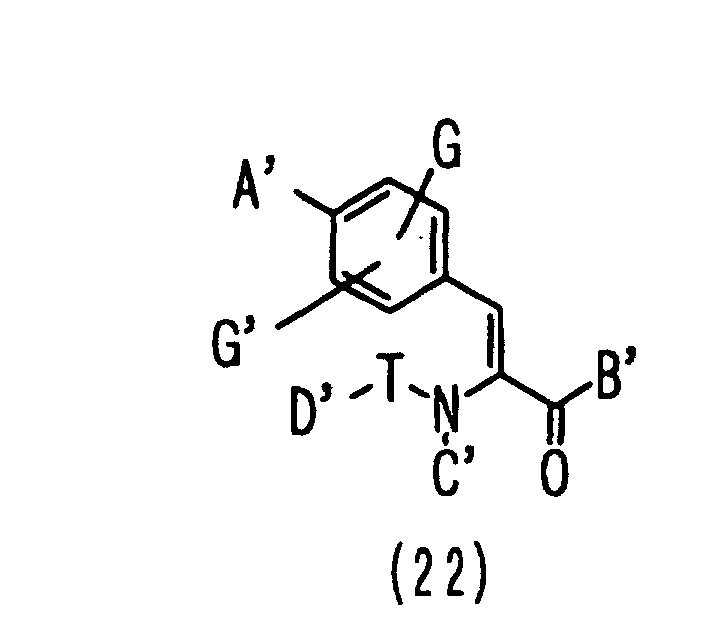
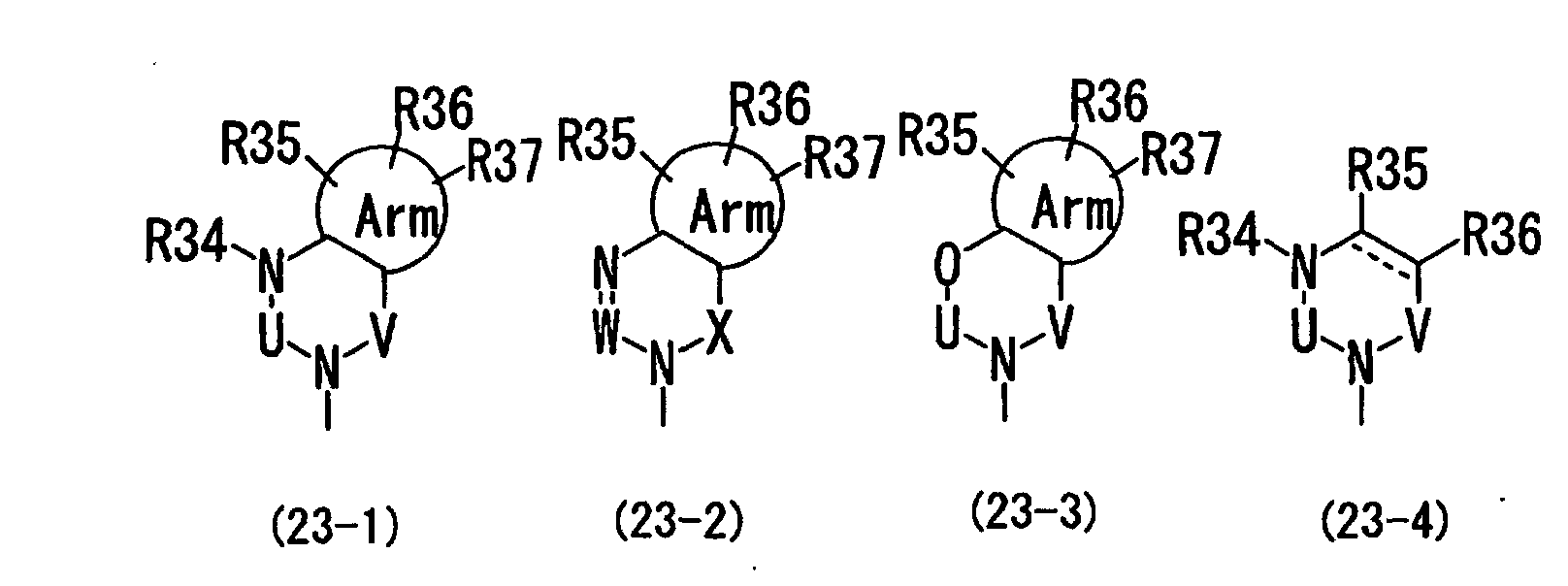
the composite line of solid line and dotted line in the formula (23-4) represents a single bond or a double bond,
U, V and X represent C(=O), S(=O)2, C(-R38)(-R39), C(=C(R38)(R39)), C(=S), S(=O), P(=O)(-OH) or P(-H)(=O),
W represents C(-R40) or a nitrogen atom,
R34 to R40 may be the same or different from one another and each represents a hydrogen atom, a halogen atom, a hydroxyl group, a lower alkyl group, a substituted lower alkyl group, a lower alkenyl group, a substituted lower alkenyl group, a lower alkynyl group, a substituted lower alkynyl group, a cycloalkyl group which may contain a hetero atom(s) in the ring thereof, an aryl group, a heteroaryl group, a lower alkyl group substituted with a cycloalkyl group(s) which may contain a hetero atom(s) in the ring thereof, a lower alkyl group substituted with an aryl group(s), a lower alkyl group substituted with a heteroaryl group(s), a lower alkoxyl group, a lower alkylthio group, a lower alkoxyl group and lower alkylthio group substituted with a cycloalkyl group(s) which may contain a hetero atom(s) in the ring thereof, a lower alkoxyl group and lower alkylthio group substituted with an aryl group(s), a lower alkoxyl group and lower alkylthio group substituted with a heteroaryl group(s), a cycloalkyloxy group which may contain a hetero atom(s) in the ring thereof, an aryloxy group, a heteroaryloxy group, a lower hydroxyalkyl group, a lower hydroxyalkenyl group, a lower hydroxylalkoxyl group, a lower halogenoalkyl group, a lower halogeno alkoxyl group, a lower halogenoalkylthio group, a lower halogenoalkenyl group, nitro group, cyano group, a substituted or unsubstituted amino group, carboxyl group, a lower alkyloxycarbonyl group, a substituted or unsubstituted carbamoyl group, a lower alkanoyl group, an aroyl group, a lower alkylsulfonyl group, a substituted or unsubstituted sulfamoyl group or an ammonium group, R38 and R39 may be bonded together to form a ring which may contain one or two oxygen, nitrogen or sulfur atoms,
B' represents a hydroxyl group, a lower alkoxyl group, a substituted lower alkoxyl group or a hydroxylamino group,
C' represents a hydrogen atom, a lower alkyl group, a lower alkenyl group, a lower alkynyl group, a lower alkyl group substituted with a cycloalkyl group(s) which may contain a hetero atom(s) in the ring thereof, a lower alkyl group substituted with an aryl group(s) or a lower alkyl group substituted with a heteroaryl group(s),
D' represents a lower alkyl group, a lower alkenyl group, a lower alkynyl group, a cycloalkyl group which may contain a hetero atom(s) in the ring thereof, an aryl group, a heteroaryl group, a lower alkyl group substituted with a cycloalkyl group(s) which may contain a hetero atom(s) in the ring thereof, a lower alkyl group substituted with an aryl group(s), a lower alkyl group substituted with a heteroaryl group(s), a lower alkoxyl group, a lower alkoxyl group substituted with a cycloalkyl group(s) which may contain a hetero atom(s) in the ring thereof, a lower alkoxyl group substituted with an aryl group(s), a lower alkoxyl group substituted with a heteroaryl group(s), a cycloalkyloxy group which may contain a hetero atom(s) in the ring thereof, an aryloxy group, a heteroaryloxy group, a lower hydroxyalkyl group, a lower hydroxyalkenyl group, a lower hydroxyalkoxyl group, a lower halogenoalkyl group, a lower halogenoalkoxyl group, a lower halogenoalkenyl group, nitro group, cyano group, a substituted or unsubstituted amino group, carboxyl group, a lower alkyloxycarbonyl group, a substituted or unsubstituted carbamoyl group, a lower alkanoyl group, an aroyl group, a lower alkylthio group, a lower alkylsulfonyl group or a substituted or unsubstituted sulfamoyl group,
C' and D' may be bonded together to form a ring which may contain one or two oxygen, nitrogen or sulfur atoms,
T represents an interatomic bond, C(=O), C(=S), S(=O), S(=O)2, N(H)-C(=O), or N(H)-C(=S),
G and G' may be the same or different from each other and each represents a hydrogen atom, a halogen atom, a lower alkyl group, a lower alkyloxy group or nitro group.

C represents either one of the general formulae (3-1), (3-2) and (3-3) mentioned below, R7 represents a halogen atom or a methyl group, R8 represents a halogen atom, R9 represents a hydrogen atom, a halogen atom, a hydroxyl group, a lower alkyl group, a lower alkoxyl group, a lower alkylthio group, a lower halogenoalkyl group, a lower halogeno alkoxyl group, a lower halogenoalkylthio group, a nitro group, a cyano group, an amino group, a lower alkylamino group, a trialkylammonium group, a methansulfonylamino group or a tetrazolyl group, and
J and J' represent a hydrogen atom.
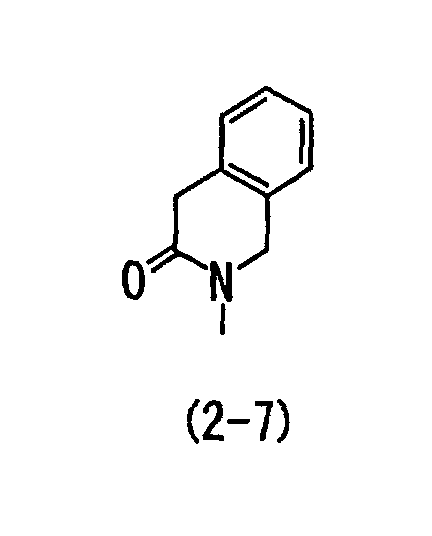
C represents either one of the general formulae (3-1), (3-2) and (3-3) mentioned below, R7 represents a halogen atom or a methyl group, R8 represents a halogen atom, R9 represents a hydrogen atom, a halogen atom, a hydroxyl group, a lower alkyl group, a lower alkoxyl group, a lower alkylthio group, a lower halogenoalkyl group, a lower halogeno alkoxyl group, a lower halogenoalkylthio group, a nitro group, a cyano group, an amino group, a lower alkylamino group, a trialkylammonium group, a methansulfonylamino group or a tetrazolyl group, and
J and J' represent a hydrogen atom.
it is preferable that A is the above mentioned general formula (2) wherein Arm is preferably an aromatic ring containing 0, 1, 2, 3 or 4 hetero atoms selected from the group consisting of oxygen, sulfur and nitrogen atoms and more preferably a benzene ring, a pyridine ring or a thiophene ring and particularly preferably a benzene ring. R1 in the formula (2) is preferably a hydrogen atom or a lower alkyl group which may have a substituent(s). It is more preferable that R1 is methyl group or ethyl group.
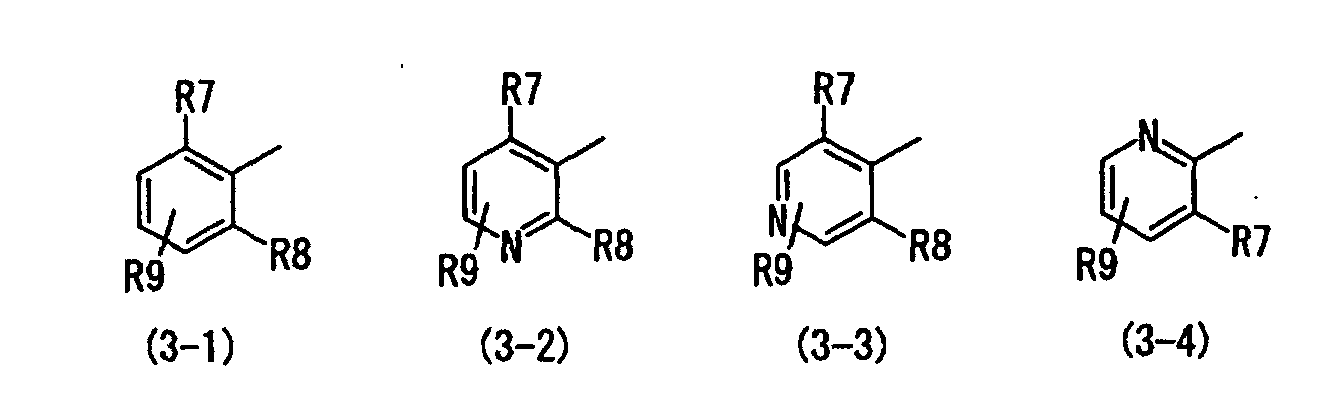
B is a hydroxyl group or a lower alkoxyl group,
C is the above mentioned general formulae (3-1) or (3-2), and
J and J' are a hydrogen atom.
B is a hydroxyl group or a lower alkoxyl group,
C is the above mentioned general formulae (3-1) or (3-2), and
J and J' are a hydrogen atom.
B is a hydroxyl group or a lower alkoxyl group,
C is the above mentioned general formulae (3-1) or (3-2), and
J and J' are a hydrogen atom.
B is a hydroxyl group,
C is the above mentioned general formulae (3-1) or (3-2) wherein R7 represents a halogen atom or methyl group, R8 represents a halogen atom, R9 represents a hydrogen atom, halogen atom, hydroxyl group, lower alkyl group, lower alkoxyl group, lower alkylthio group, lower halogenoalkyl group, lower halogenoalkoxyl group, lower halogenoalkylthio group, nitro group, cyano group, amino group, amino group substituted with a lower alkyl group(s), lower trialkylammonium group, methanesulfonyl amino group or tetrazolyl group, and
J and J' are a hydrogen atom.
B is a hydroxyl group,
C is the above mentioned general formulae (3-1) or (3-2) wherein R7 represents a halogen atom or methyl group, R8 represents a halogen atom, R9 represents a hydrogen atom, halogen atom, hydroxyl group, lower alkyl group, lower alkoxyl group, lower alkylthio group, lower halogenoalkyl group, lower halogenoalkoxyl group, lower halogenoalkylthio group, nitro group, cyano group, amino group, lower alkylamino group, trialkylammonium group, methanesulfonyl amino group or tetrazolyl group, and
J and J' are a hydrogen atom.
C is the above mentioned general formulae (3-1) or (3-2) wherein R7 represents a halogen atom or methyl group, R8 represents a halogen atom, R9 represents a hydrogen atom, halogen atom, hydroxyl group, lower alkyl group, lower alkoxyl group, lower alkylthio group, lower halogenoalkyl group, lower halogenoalkoxyl group, lower halogenoalkylthio group, nitro group, cyano group, amino group, lower alkylamino group, trialkylammonium group, methanesulfonyl amino group or tetrazolyl group, and
J and J' are a hydrogen atom.
B is a hydroxyl group,
C is the above mentioned general formulae (3-1) or (3-2) wherein R7 represents a halogen atom or methyl group, R8 represents a halogen atom, R9 represents a hydrogen atom, halogen atom, hydroxyl group, lower alkyl group, lower alkoxyl group, lower alkylthio group, lower halogenoalkyl group, lower halogenoalkoxyl group, lower halogenoalkylthio group, nitro group, cyano group, amino group, lower alkylamino group, trialkylammonium group, methanesulfonyl amino group or tetrazolyl group, and
J and J' are a hydrogen atom.
B is a hydroxyl group or a lower alkoxyl group, and
C is the above mentioned general formulae (3-1), (3-2), (3-3) or (3-4).
B is a hydroxyl group or a lower alkoxyl group, and
C is the above mentioned general formula (3).
it is preferable that A' is the above mentioned general formula (23-1) wherein Arm is preferably an aromatic ring and more preferably a benzene ring, a pyridine ring or a thiophene ring and particularly preferably a benzene ring.
it is more preferably the phenylalanine derivatives or a pharmaceutically acceptable salt thereof wherein A is the above mentioned general formula (2-6),
B is a hydroxyl group or a lower alkoxyl group,
C is the above mentioned general formula (3-1) wherein R7 represents a chlorine atom, R8 represents a chlorine atom, R9 represents a hydrogen atom, and
J and J' are a hydrogen atom.
it is also more preferably the phenylalanine derivatives or a pharmaceutically acceptable salt thereof wherein A is the above mentioned general formula (2-7),
B is a hydroxyl group or a lower alkoxyl group,
C is the above mentioned general formula (3-1) wherein R7 represents a chlorine atom, R8 represents a chlorine atom, R9 represents a hydrogen atom, and
J and J' are a hydrogen atom.
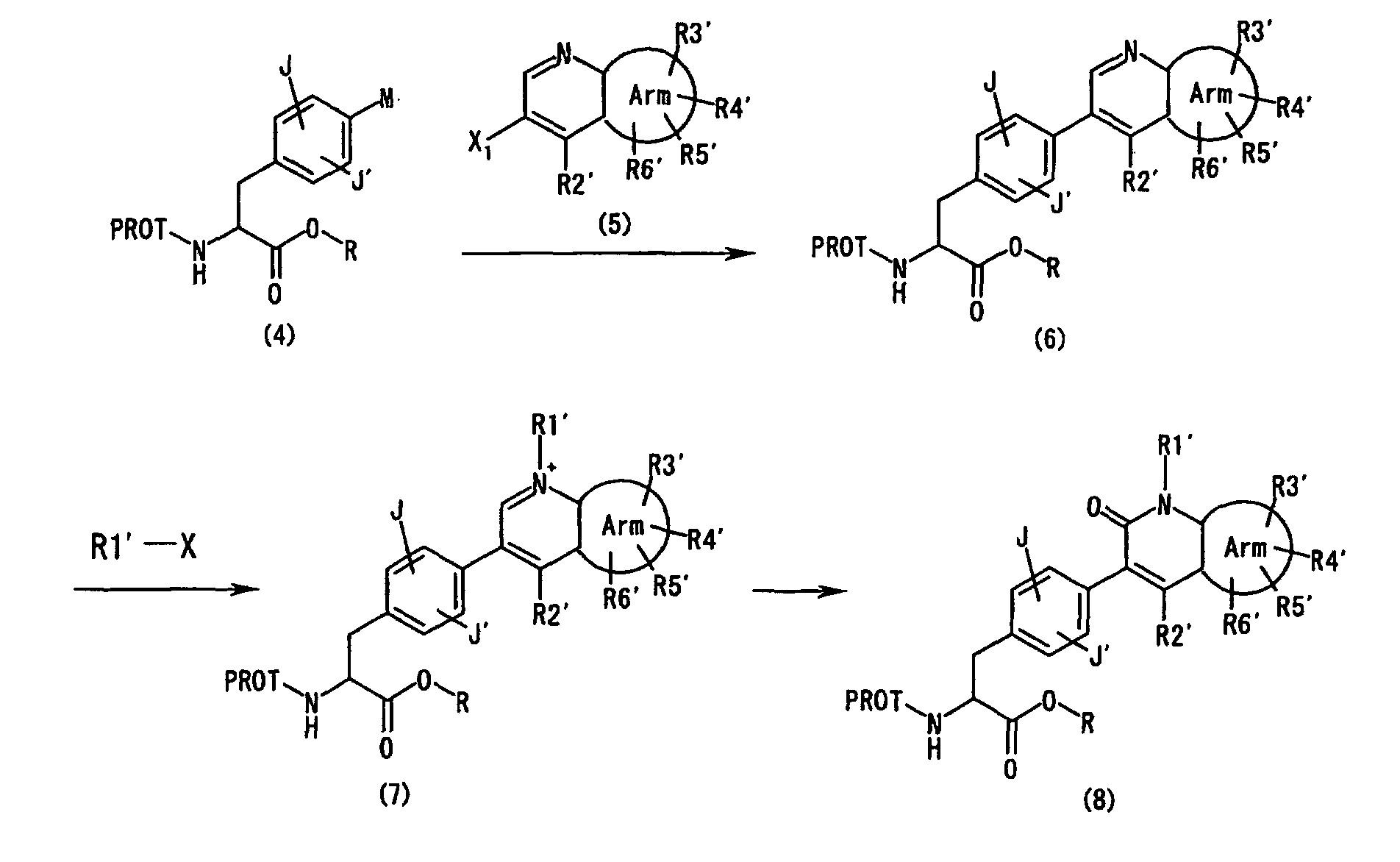


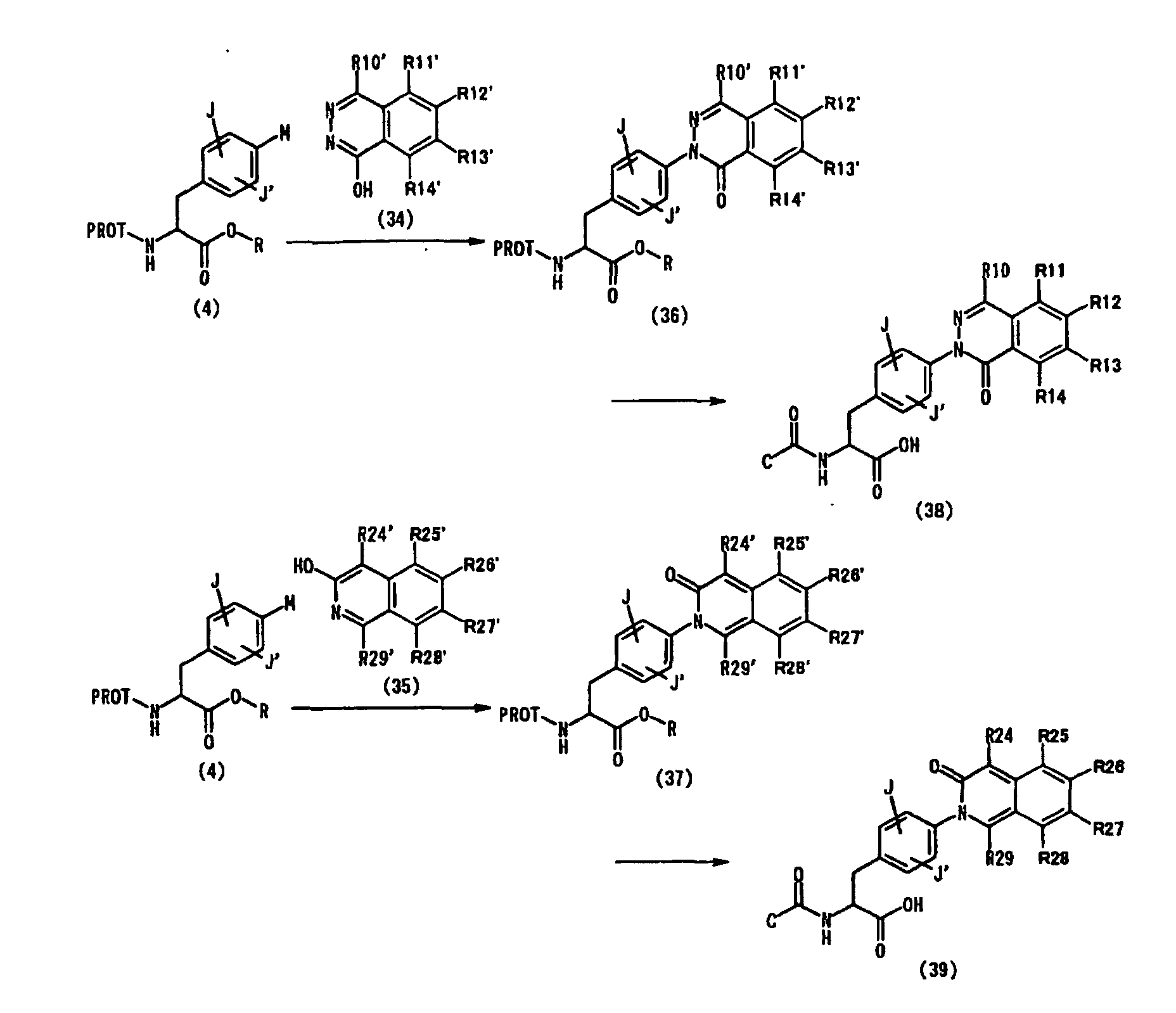


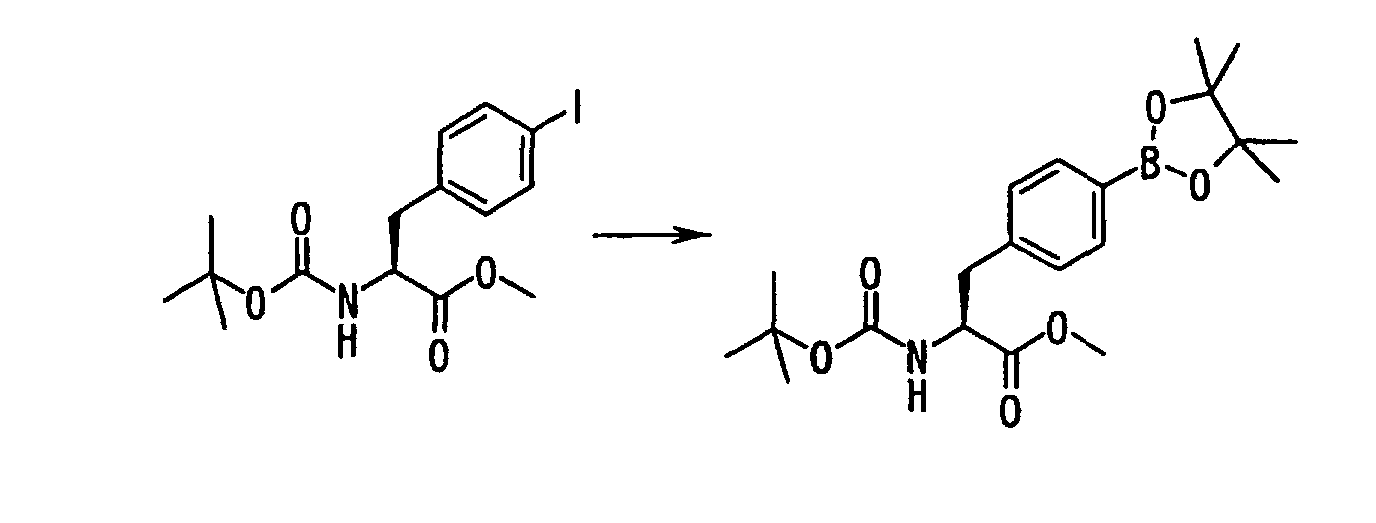
MS (ESI MH+) : 406
CHNO : C21H32BN06
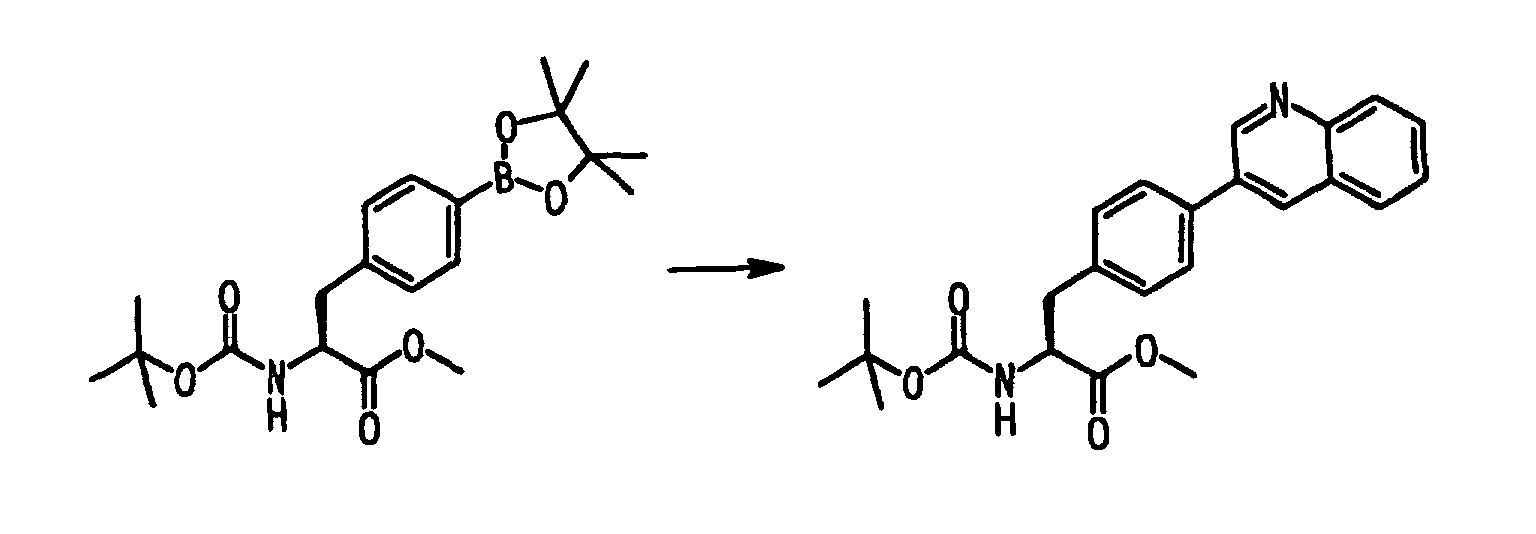
MS(ESI MH+) : 407
CHN0 : C24H26N204
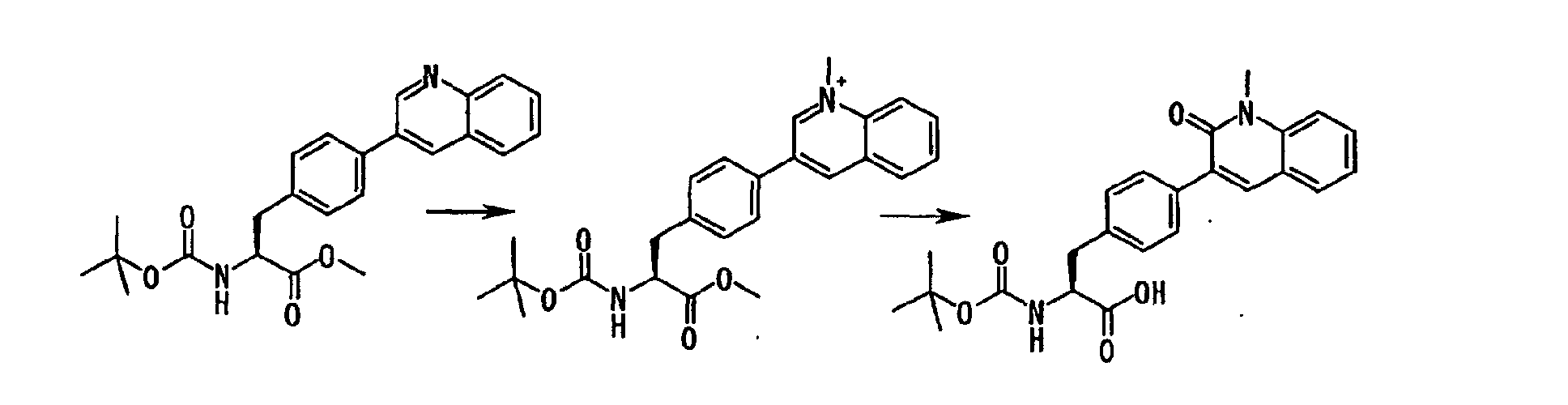
MS(ESI MH+) : 423
CHN0 : C24H26N205
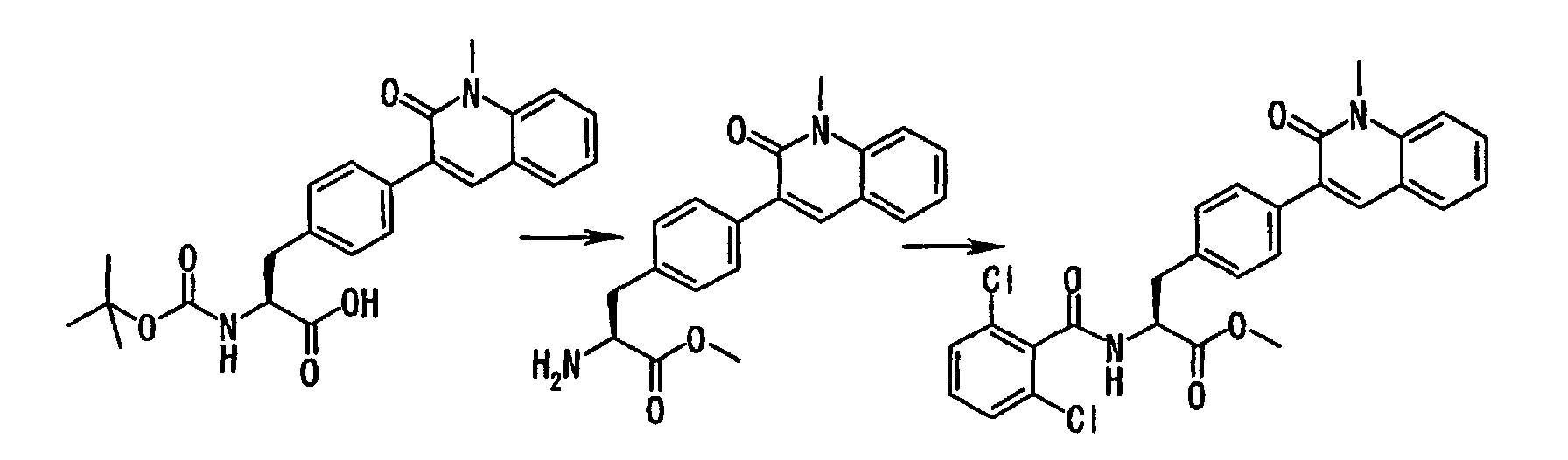
MS (ESI MH+) : 509
CHN0 : C27H22Cl2N204

MS (ESI MH+) : 495
CHN0 : C26H20Cl2N204
NMR data of the compound of Example 1: 1H-NMR (300 MHz, CDCl3) 3.33 (2H, brd, J=5.1 Hz), 3.78 (3H, s), 5.24 (1H, m), 6.64 (1H, m), 7.18-7.40 (6H, m), 7.54-7.60 (4H, m), 7.77 (1H, s).
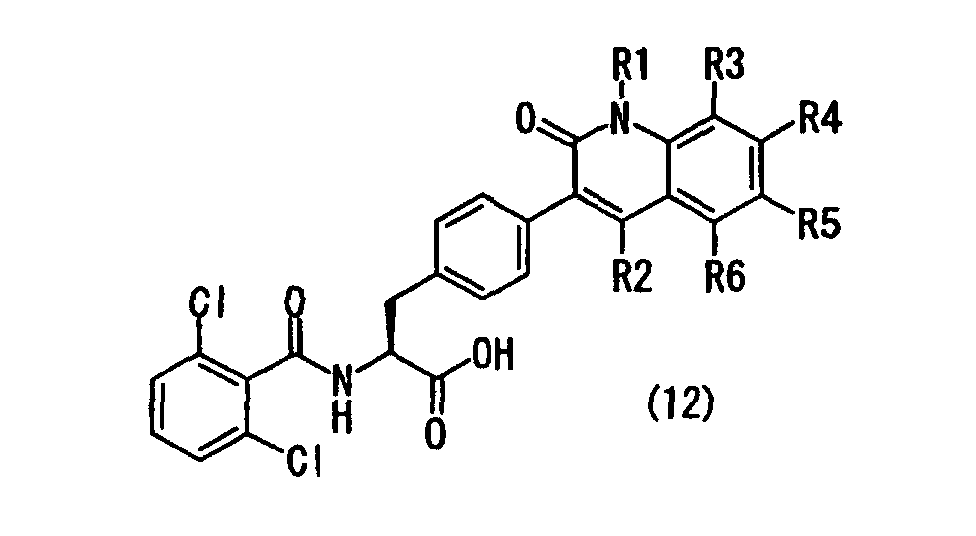
| Example | R1- | R2- | R3- | R4- | R5- | R6- | MS Found (MH+) |
| 1 | Me- | H- | H- | H- | H- | H- | 495 |
| 2 | Et- | H- | H- | H- | H- | H- | 509 |
| 3 | Me- | H- | H- | H- | Cl- | H- | 529 |
| 4 | Me- | H- | H- | H- | NO2- | H- | 540 |
| 5 | Me- | H- | H- | H- | H- | NO2- | 540 |

MS(ESI MH+) : 316
CHN0 : C11H10IN02
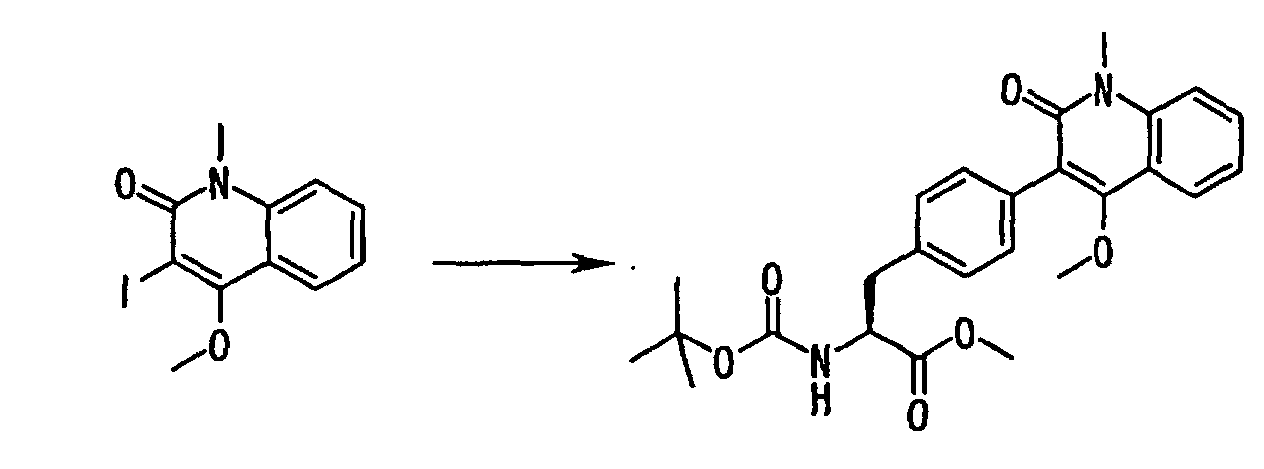
MS (ESI MH+) : 467
CHN0 : C26H30N206

CHN0 : C28H24C12N205

MS (ESI MH+) : 525
CHN0 : C27H22C12N205
NMR data of the compound of Example 6: 1H-NMR (300 MHz, DMSO-d6) 2.98 (1H, dd, J=14.1, 9.9 Hz), 3.17 (1H, dd, J=14.1, 9.9 Hz), 3.42 (3H, s), 3.63 (3H, s), 4.70 (1H, m), 7.28-7.45 (9H, m), 7.56 (1H, d, J=8.4 Hz), 7.66 (1H, t, J=7.5 Hz), 7.90 (1H, d, J=8.4 Hz), 9.14 (1H, d, J=8.1 Hz).

MS(ESI MH+) : 511
CHN0 : C26H20Cl2N205
NMR data of the compound of Example 7: 1H-NMR (300 MHz, DMSO-d6) 2.98 (1H, m), 3.15 (1H, m), 3.59 (3H, s), 4.71 (1H, m), 7.24-7.51 (9H, m), 7.63 (1H, t, J=7.5 Hz), 8.03 (1H, d, J=8.1 Hz), 9.13 (1H, d, J=8.2 Hz), 10.00 (1H, s).

| Example | R1- | R2- | MS Found (MH+) |
| 6 | Me- | MeO- | 525 |
| 7 | Me- | HO- | 511 |
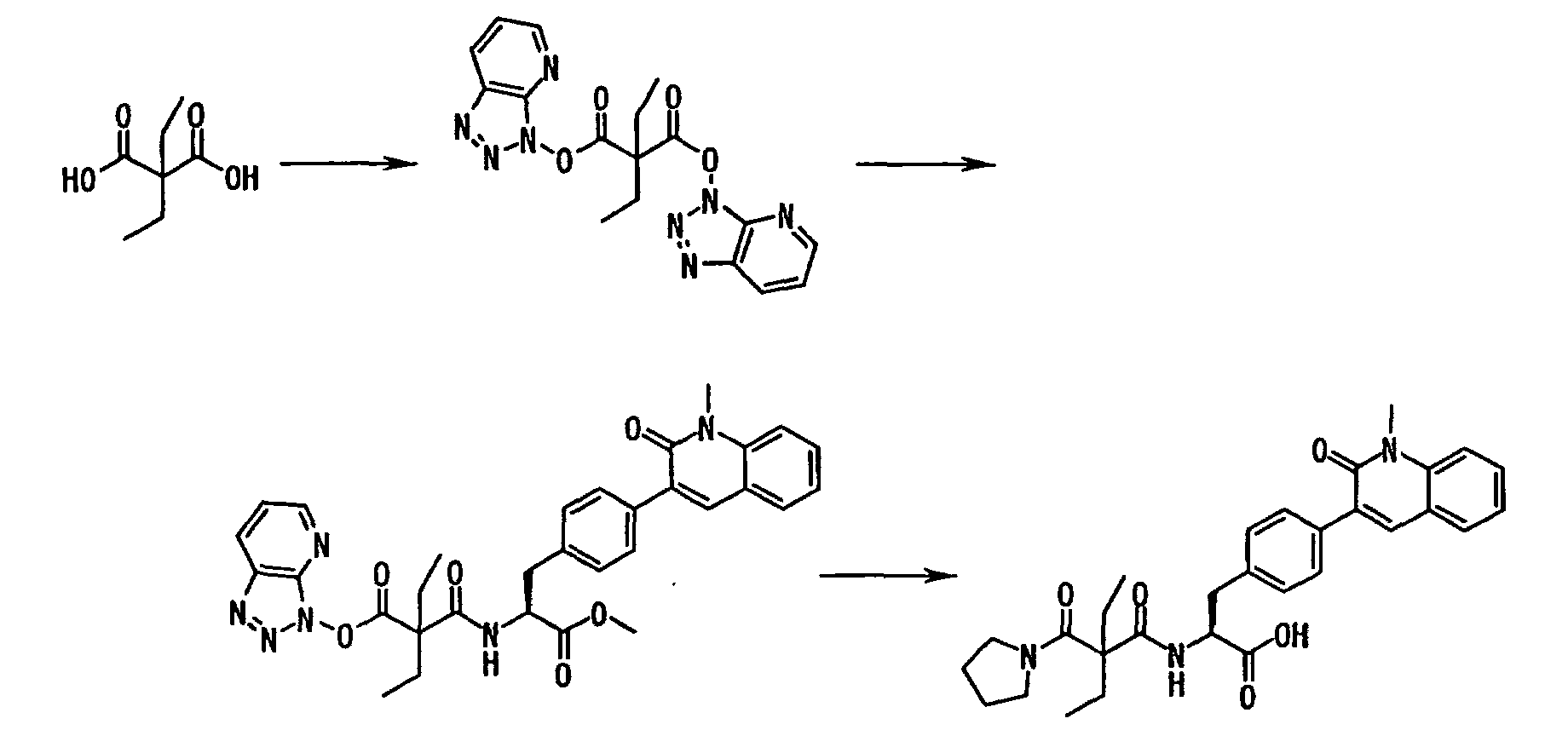
MS(ESI MH+) 518

MS(ESI MH+) : 510
CHN0 : C26H21C12N304
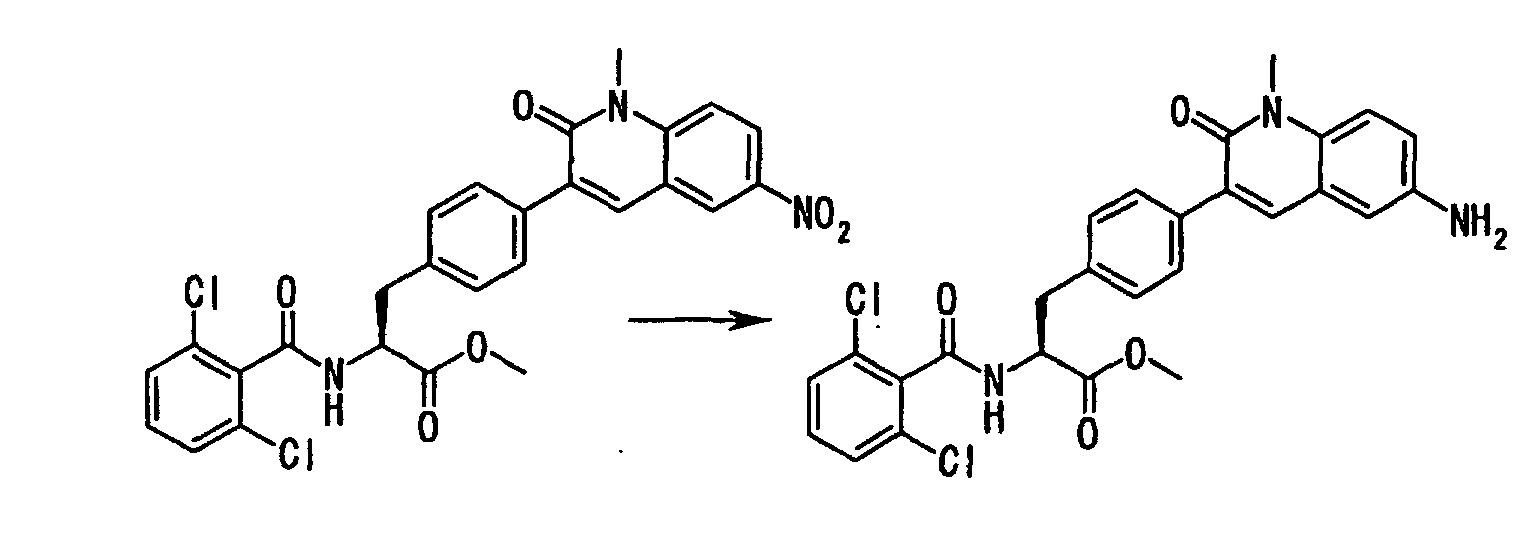
MS (ESI MH+) : 524
CHN0 : C27H23C12N304

MS (ESI MH+) : 552
CHN0 : C29H27Cl2N304

MS(ESI MH+) : 538
CHN0 : C28H25C12N304
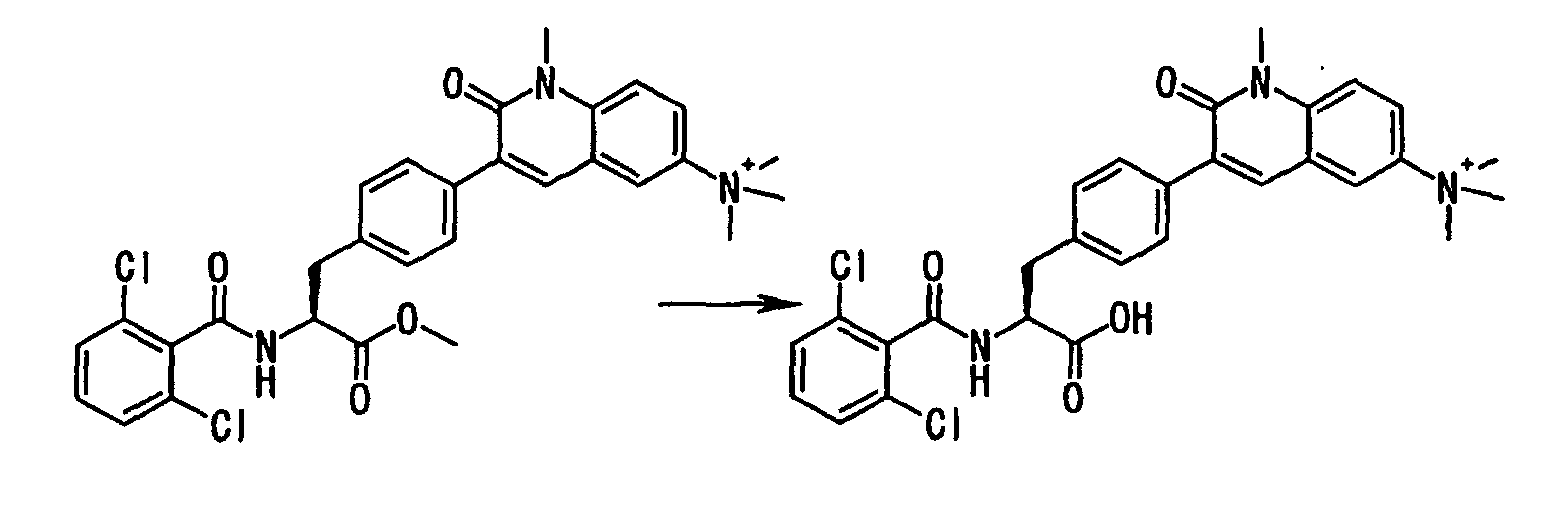
MS (ESI MH+) : 552
CHN0 : C29H28C12N304

| Example | R6- | R5- | R4- | R3- | MS Found (MH+) |
| 11 | H- | NH2- | H- | H- | 510 |
| 12 | NH2- | H- | H- | H- | 510 |
| 13 | H- | (CH3)2N- | H- | H- | 538 |
| 14 | H- | (CH3)3N+- | H- | H- | 552 |
| 15 | H- | Me- | H- | H- | 509 |
| 16 | H- | H- | Me- | H- | 509 |

MS (ESI MH+) : 493
CHNO : C27H22ClFN204

MS (ESI MH+) : 479
CHNO : C26H20ClFN204

| Example | R7- | R8- | R9- | X | MS Found (MH+) |
| 17 | F- | Cl- | H- | CH | 479 |
| 18 | Me- | Cl- | H- | CH | 475 |
| 19 | Cl- | Cl- | H- | N | 496 |
| 20 | Br- | Cl- | H- | CH | 539 |


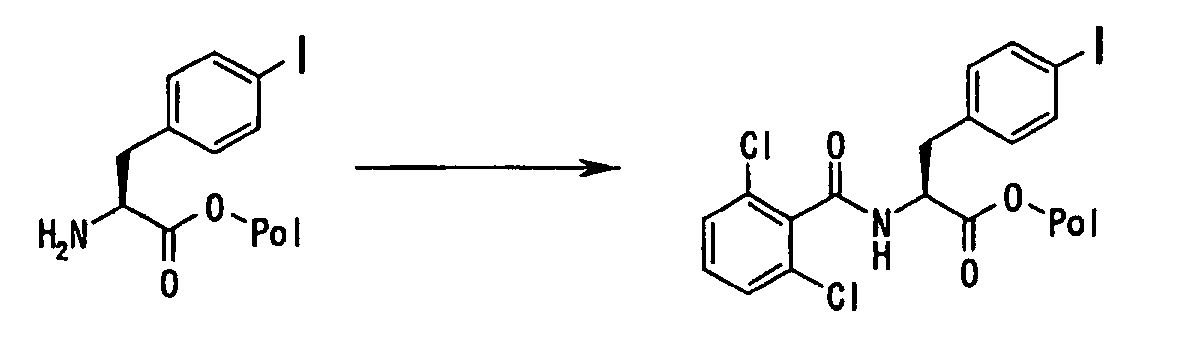


MS (ESI MH+) : 482
CHN0: C24H17Cl2N304
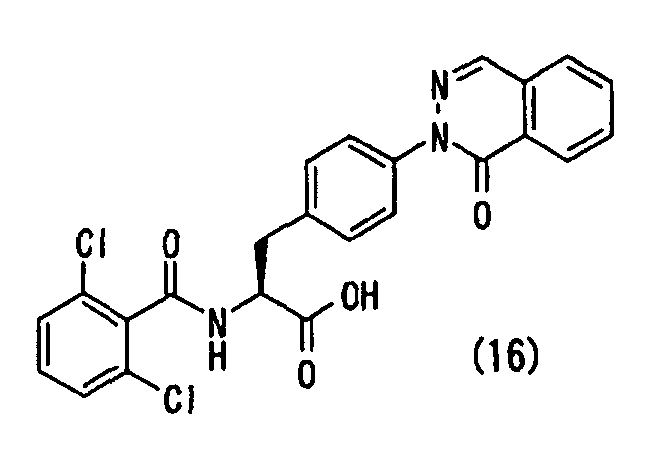

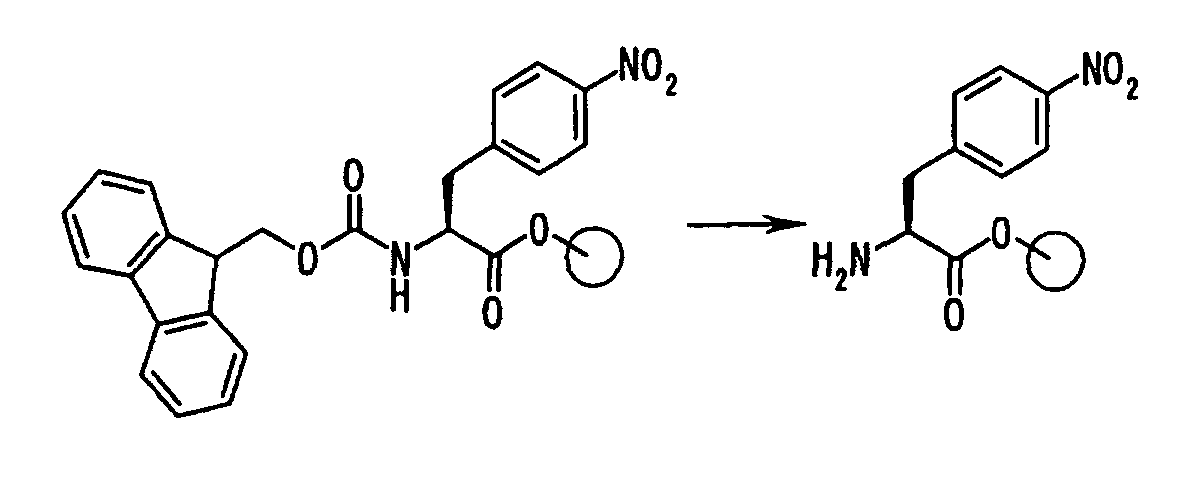
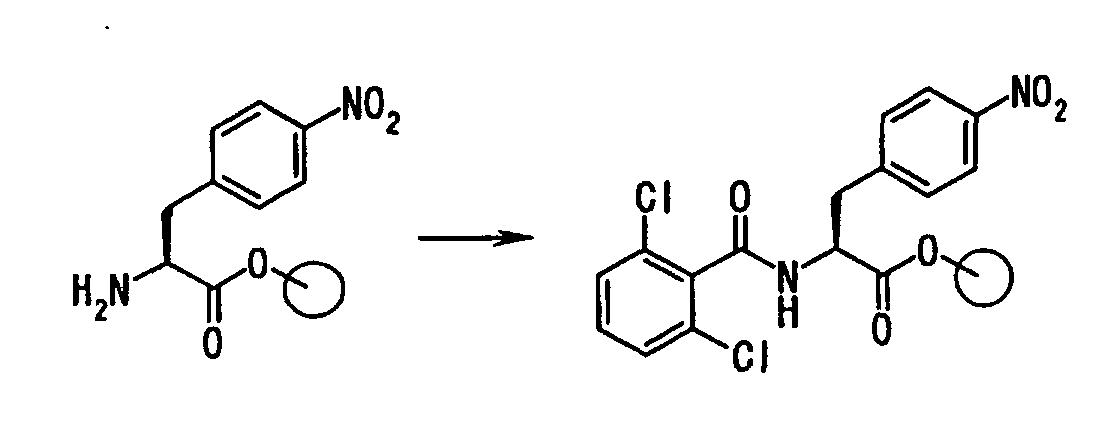
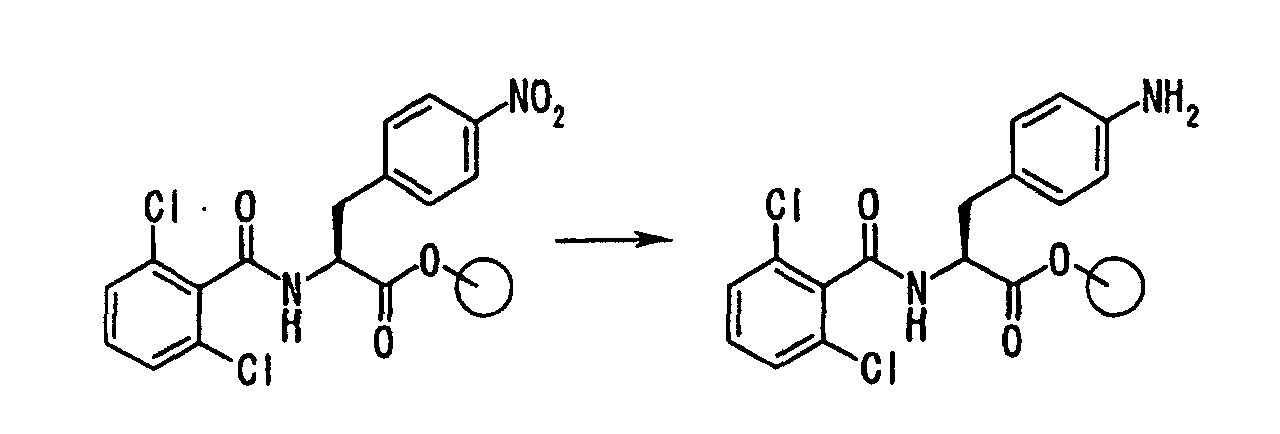

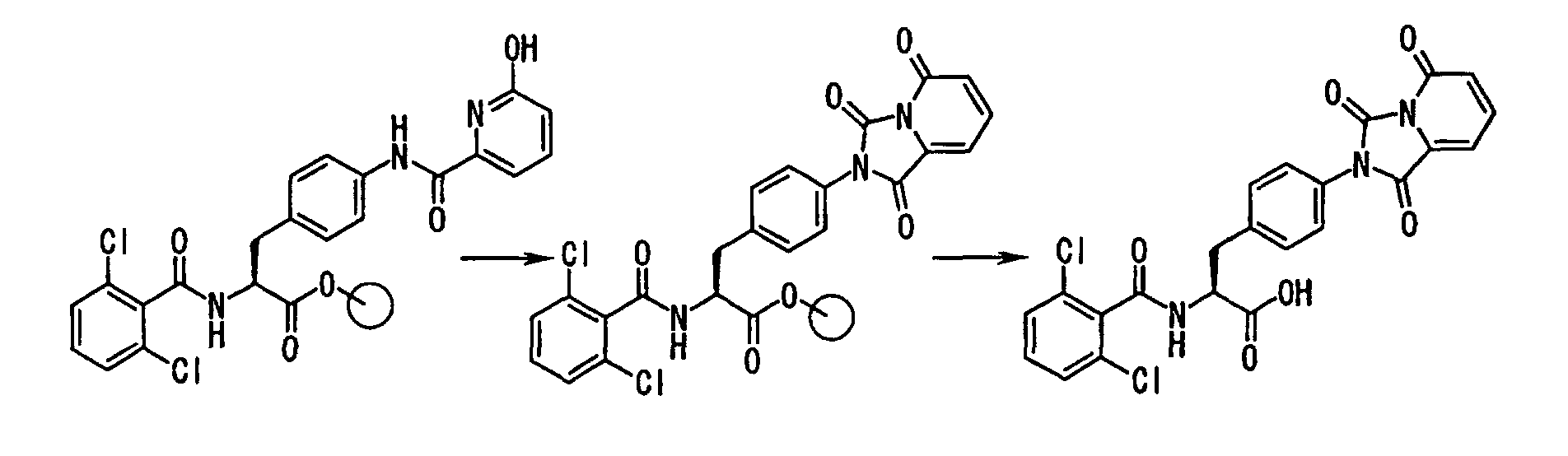
MS(ESI MH+) : 500
CHN0 : C23H15C12N306
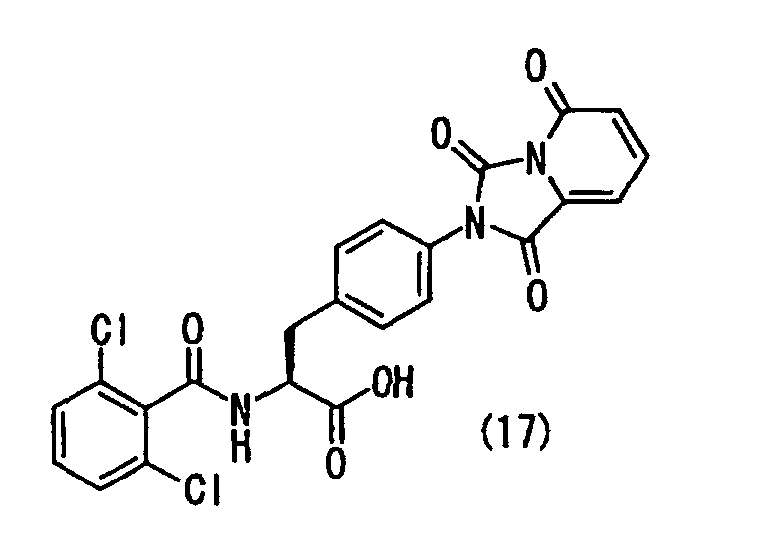
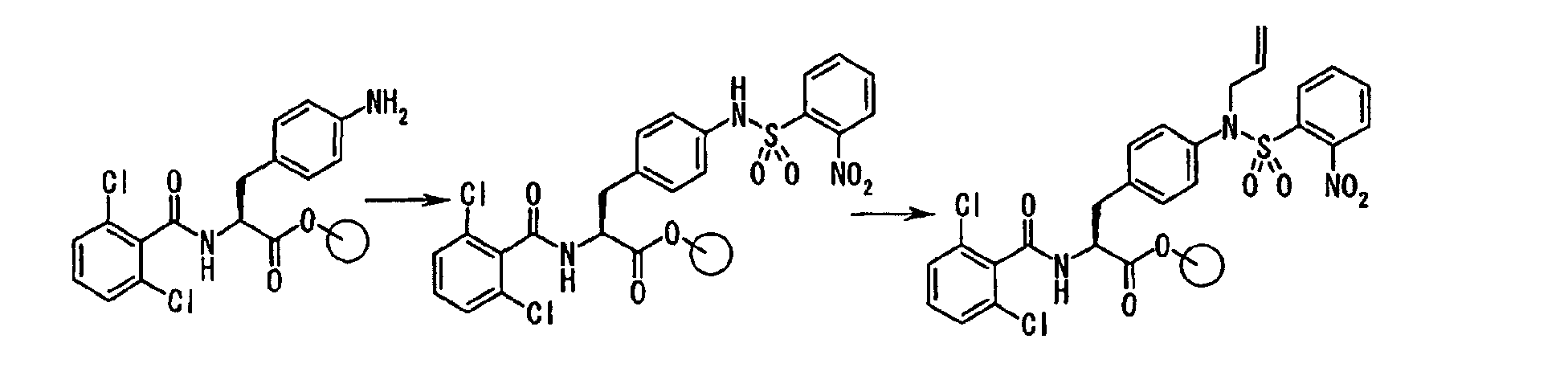

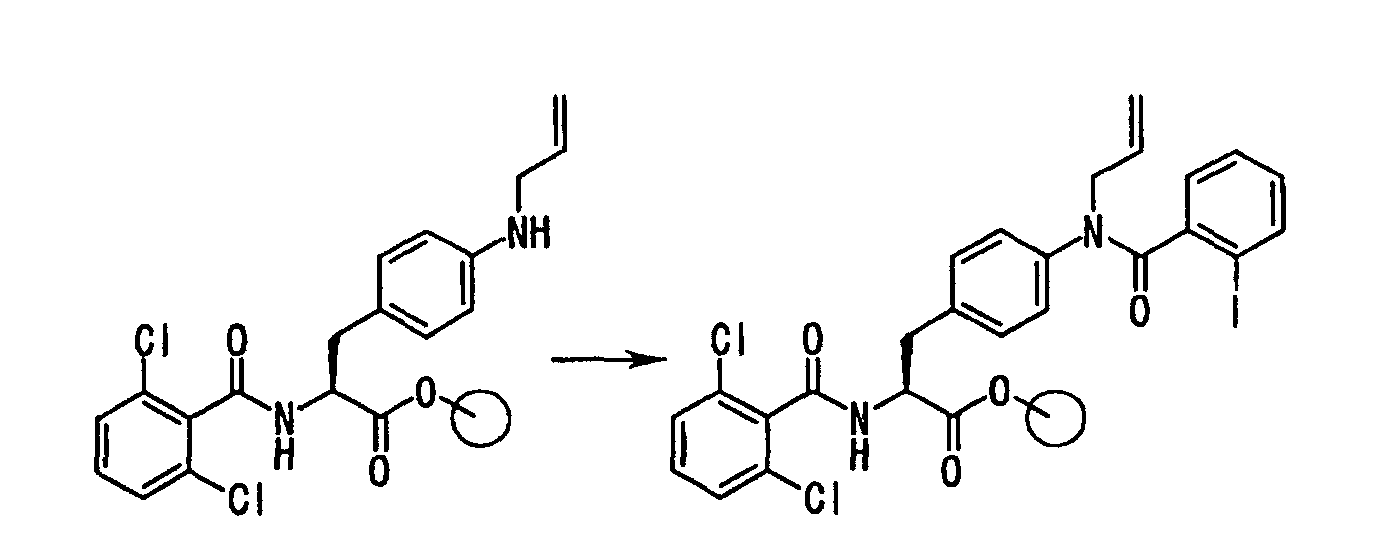

MS(ESI MH+) : 495
CHN0 : C26H20Cl2N204
NMR data of the compound of Example 23: 1H-NMR (300 MHz, DMSO-d6) 2.30 (3H, s), 2. 95-3. 30 (2H, m), 4. 75 (1H, m), 7. 20 (1H, s), 7. 30-7. 55 (7H, m), 7.60 (1H, t), 7.75 (1H, d), 7.85 (1H, t), 8.30 (1H, d), 9.15 (1H, d).

H-NMR (CDCl3) δ 1. 45 (9H, s), 3. 20 (2H, m), 4.60 (1H, m), 5. 30 (1H, m), 7.00-7.60 (9H, m), 8.35 (1H s).
MS (ESI, m/z) 409 (MH+)
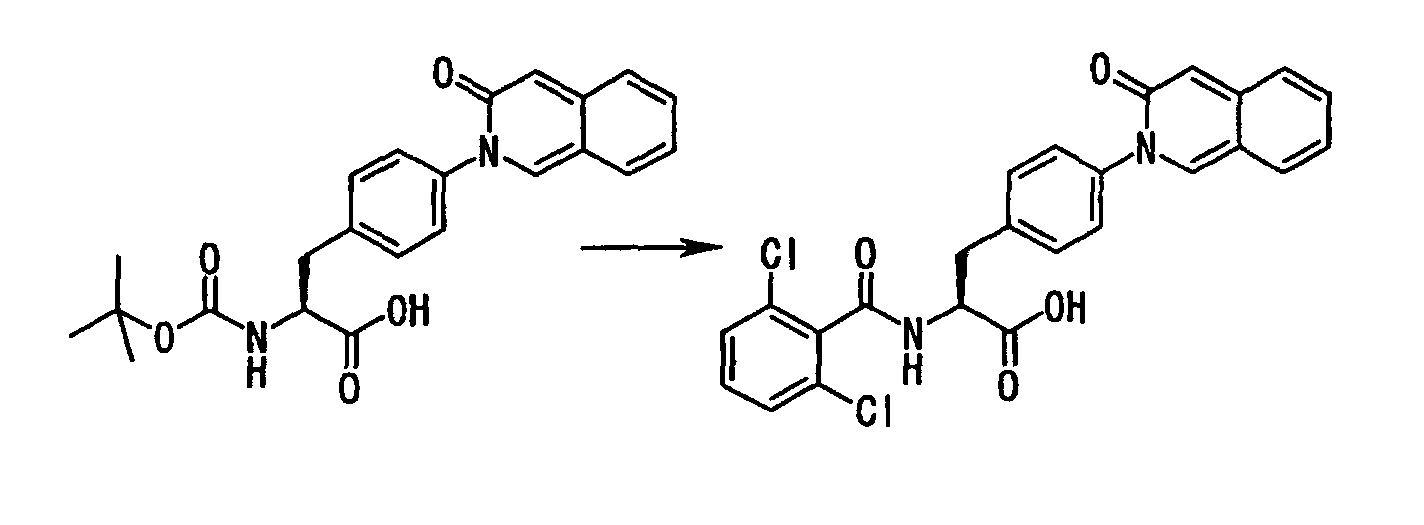
MS (ESI MH+) : 481
CHN0 : C25H18C12N204


Yield: 4.6 g
H-NMR (CDCl3) δ 1.25 (3H, t), 1. 40 (9H, s), 3. 05-3. 35 (2H, m), 4. 20 (2H, q), 4. 60 (1H, m), 5.10 (1H, br), 7. 35 (2H, d), 8. 15 (2H, d).
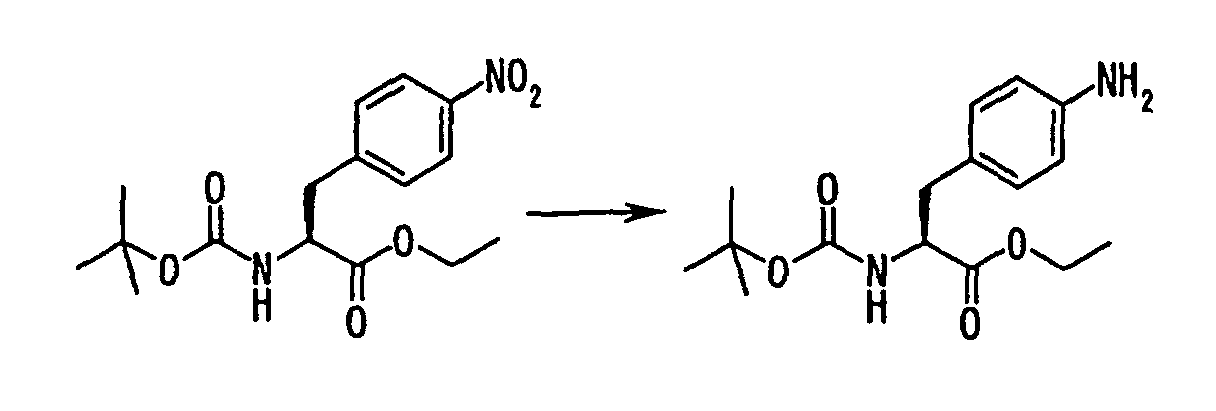
Yield: 4.4 g
H-NMR (CDCl3) δ 1. 25 (3H, t), 1. 40 (9H, s), 2. 95 (2H, br), 4. 15 (2H, q), 4.45 (1H, m), 4.95 (1H, br), 6.60 (2H, d), 6.95 (2H, d).
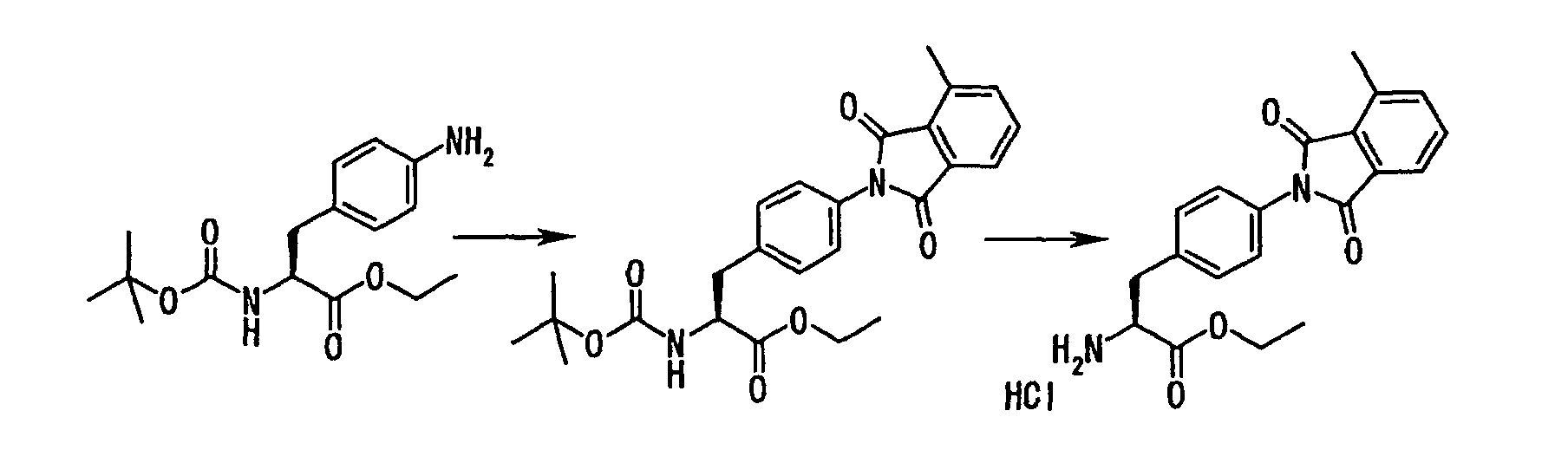
Yield: 1.9 g
H-NMR (DMSO-d6) δ 1. 15 (3H, m), 2. 65 (3H, s), 3.10-3.40 (2H, m), 4. 15 (2H, m), 4. 30 (1H, t), 7. 40 (4H, s), 7. 65-7. 80 (3H, m), 8. 70 (3H, br).
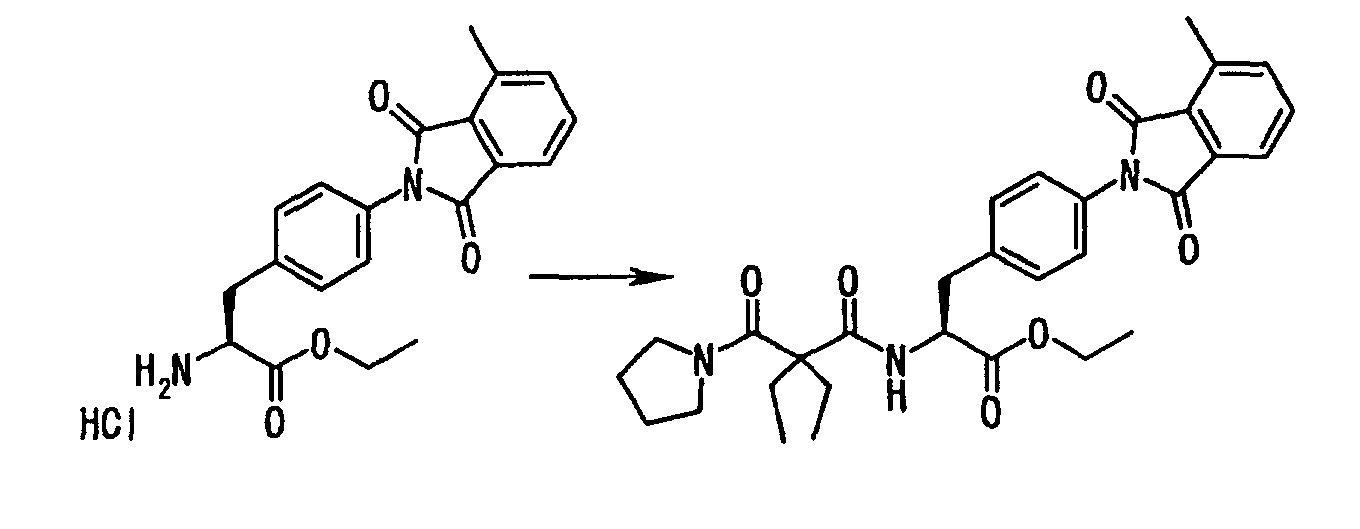
Yield: 66 mg
MS(ESI MH+) : 548
CHN0 : C31H37N306
NMR data of the compound of Example 25: H-NMR (DMSO-d6) δ 0.50-0.70 (6H, m), 1. 20 (3H, t), 1.50-1.90 (8H, m), 2. 65 (3H, s), 2. 80 (1H, m), 2. 90-3. 40 (5H, m), 4.10 (2H, q), 4. 60 (1H, m), 7. 35 (2H, d), 7. 45 (2H, d), 7. 65-7. 85 (3H, m), 8. 05 (1H, d).


MS(ESI MH+) : 520
CHN0 : C29H33N306
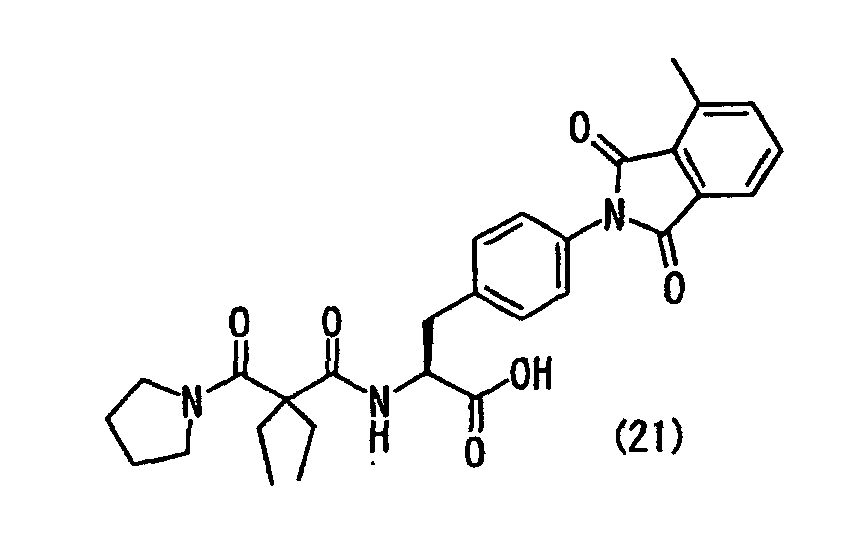

MS(ESI MH+) : 365
CHN0 : C14H9IN202
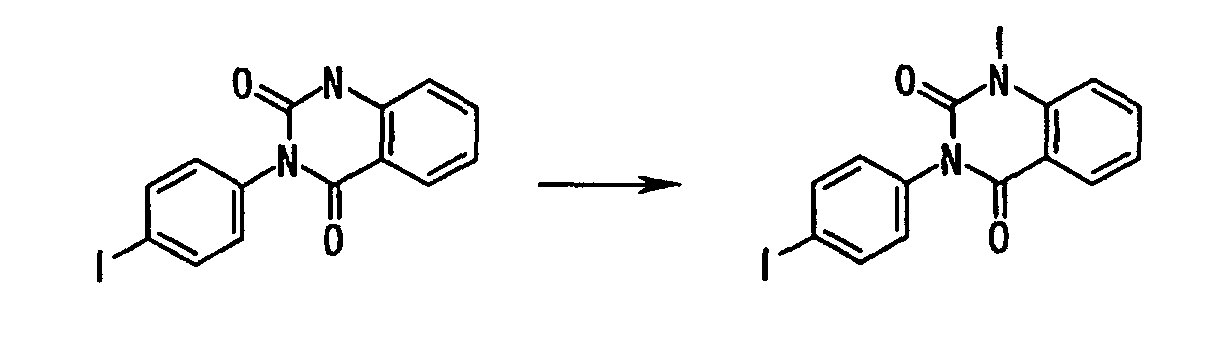
MS (ESI MH+) : 379
CHN0 : C15H11IN202
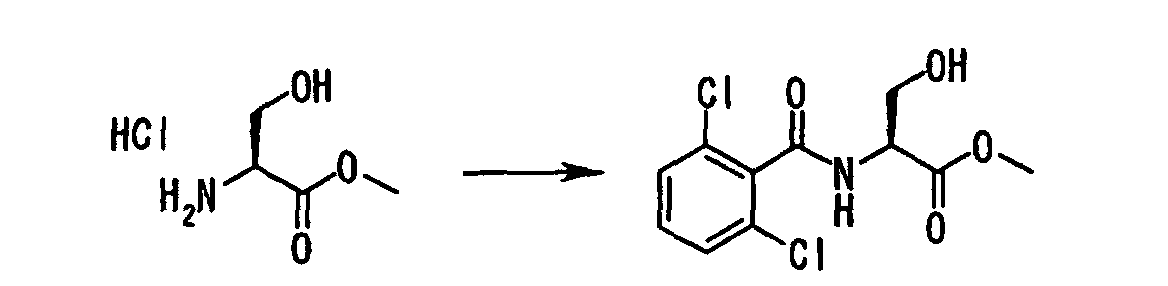
MS(ESI MH+) : 292
CHN0 : C11H11C12N04
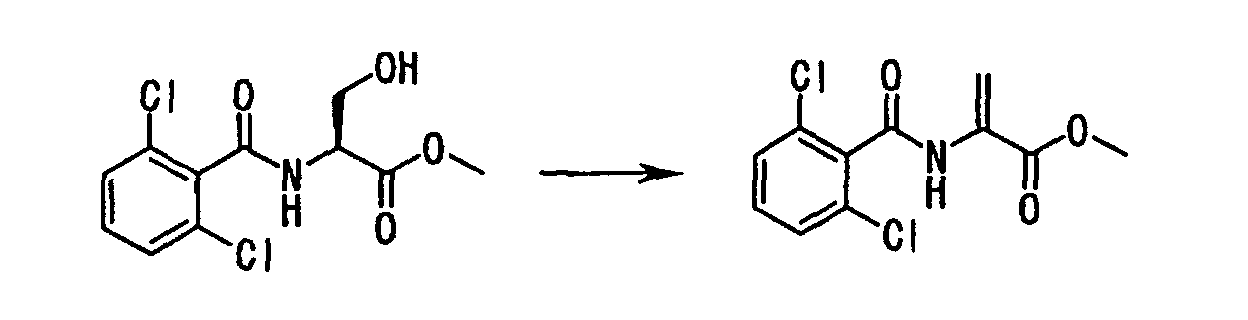
MS (ESI MH+) : 274
CHN0 : C11H9Cl2N03

MS(ESI MH+) : 524
CHN0 : C26H19C12N305

MS (ESI MH+) : 510
CHN0 : C25H17C12N305
NMR data of the compound of Example 27: 1H-NMR (300 MHz, DMSO-d6) 3.54 (3H, s), 7.31-7.38 (4H, m), 7.43-7.55 (4H, m), 7.80-7.88 (3H, m), 8.06 (1H, dd, J=7.8 Hz, 1.2 Hz), 10.48 (1H, s).
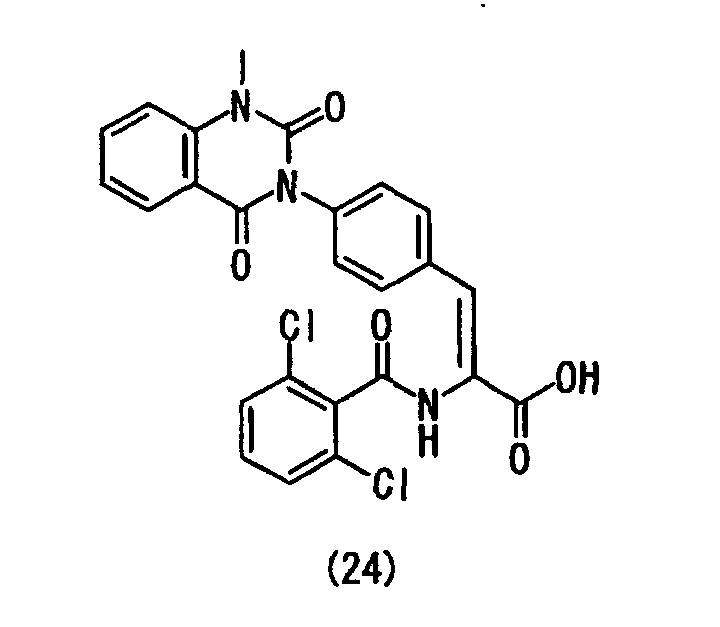
| Example | R1- | R2- | R3- | R4- | R5- | R6- | MS Found (MH+) |
| 28 | Me- | H- | H- | H- | MeO- | H- | 525 |
| 29 | Me- | H- | H- | H- | iPr- | H- | 537 |
| 30 | Me- | H- | H- | H- | MeSO2- | H- | 573 |
| Example | R7- | R8- | R9- | X | MS Found (MH+) |
| 31 | Cl- | Cl- | MeSO2NH- | CH | 588 |
| 32 | Me- | Me- | H- | CH | 455 |
MS(ESI MH+) : 511
CHN0 : C26H20C12N205

MS (ESI MH+) : 519
CHN0 : C29H27ClN205
MS (ESI MH+) : 505
CHN0 : C28H25ClN205
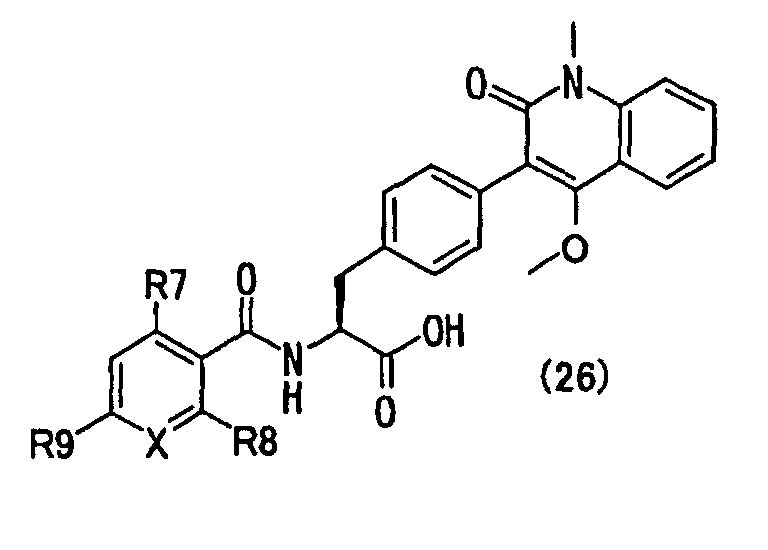
| Example | R7- | R8- | R9- | X | MS Found (MH+) |
| 34 | Me- | Cl- | H- | CH | 505 |
| 35 | Cl- | Cl- | Cl- | CH | 559 |
| 36 | Cl- | Cl- | H- | N | 526 |

| Example | R7- | R8- | R9- | X | MS Found (MH+) |
| 37 | Me- | Cl- | H- | CH | 491 |
| 38 | Cl- | Cl- | Cl- | CH | 545 |
| 39 | Cl- | Cl- | H- | N | 512 |
MS (ESI MH+) : 595
CHN0 : C32H32Cl2N205
MS (ESI MH+) : 553
CHN0 : C29H26Cl2N205

| Example | R2- | MS Found (MH+) |
| 40 | nPrO- | 553 |
| 41 | EtO- | 539 |
MS(ESI MH+) : 252
CHN0 : C11H10BrN0
NMR data of 3-bromo-1,4-dimethyl-2(1H)-quinolinone: 1H-NMR (300 MHz, CDCl3) 2.72 (3H, s), 3.82 (3H, s), 7.29 (1H, t, J=7.8 Hz), 7.39 (1H, d, J=9.0 Hz), 7.61 (1H, t, J=9.0 Hz), 7.80 (1H, d, J=8.1 Hz).
MS(ESI MH+) : 451
CHN0 : C26H30N205
NMR data of methyl 2-[(t-butoxycarbonyl) amino]-3-[4-(1,4-dimethyl-2-oxo-1,2-dihydro-3-quinolinyl) phenyl] propionate: 1H-NMR (300 MHz, CDCl3) 1.44 (9H, s), 2.32 (3H, s), 3.13 (2H, m), 3.73 (3H, s), 3.76 (3H, s), 4.62 (1H, m), 5.06 (1H, m), 7.21 (4H, s), 7.29 (1H, t, J=6.0 Hz), 7.41 (1H, d, J=8.4 Hz), 7.58 (1H, t, J=7.2 Hz), 7.81 (1H, d, J=7.8 Hz).
MS (ESI MH+) : 523
CHN0 : C28H24Cl2N204
NMR data of methyl 2-[(2,6-dichlorobenzoyl) amino]-3-[4-(1,4-dimethyl-2-oxo-1,2-dihydro-3-quinolinyl) phenyl] propionate: 1H-NMR (300 MHz, CDCl3) 2.31 (3H, s), 3.31 (2H, m), 3.74 (3H, s), 3.77 (3H, s), 5.24 (1H, m), 6.45 (1H, m), 7.17-7.32 (8H, m), 7.40 (1H, d, J=8.7 Hz), 7.58 (1H, t, J=9.0 Hz), 7.80 (1H, d, J=7.8 Hz).
MS(ESI MH+) : 509
CHN0 : C27H22C12N204
NMR data of Example 42: 1H-NMR (300 MHz, DMSO- d6) 2.26 (3H, s), 2.94-3.02 (1H, m), 3.18-3.24 (1H, m), 3.66 (3H, s), 4.75 (1H, m), 7.14 (2H, d, J=8.4 Hz), 7.25-7.46 (6H, m), 7.56 (1H, d, J=8.7 Hz), 7.65 (1H, t, J=6.0 Hz), 7.88 (1H, d, J=7.8 Hz), 9.14 (1H, d, J=8.1 Hz).
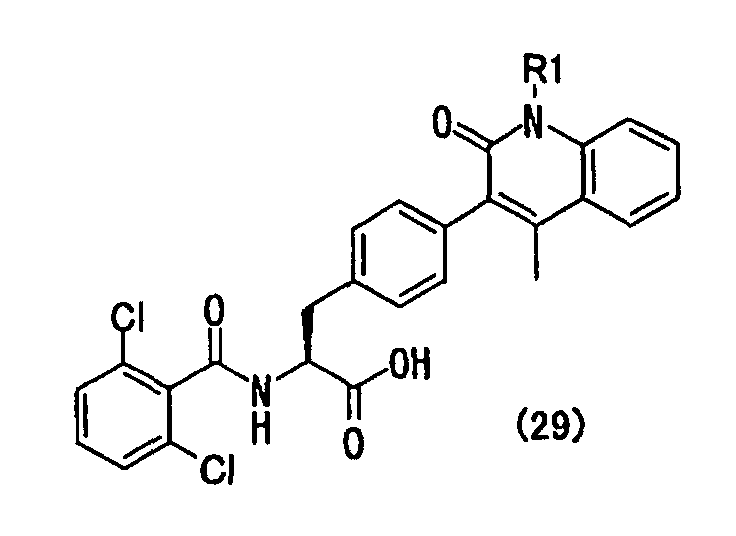
| Example | R1- | MS Found (MH+) |
| 42 | Me- | 509 |
| 43 | Et- | 523 |
MS (ESI MH+) : 302
CHN0 : C11H9BrClN02
NMR date of 3-bromo-6-chloro-4-methoxy-1-methyl-2(1H)-quinolinone: 1H-NMR (300 MHz, CDCl3) 3.77 (3H, s), 4.11 (3H, s), 7.33 (1H, d, J=9.0 Hz), 7.57 (1H, d, J=7.5 Hz), 7.88 (1H, s).
MS (ESI MH+) : 573
CHN0 : C28H23Cl3N205
NMR data of methyl 3-[4-(6-chloro-4-methoxy-1-methyl-2-oxo-1,2-dihydro-3-quinolinyl) phenyl]-2-[(2,6-dichlorobenzoyl) amino] propionate: 1H-NMR (300 MHz, CDCl3) 3.45 (3H, s), 3.70 (3H, s), 3.76 (3H, s), 5.24 (1H, m), 6.38 (1H, d, J=7.8 Hz), 7.23-7.34 (7H, m), 7.41 (2H, d, J=7.8 Hz), 7.53 (1H, dd, J=9.3, 2.7 Hz), 7.95 (1H, d, J=2.7 Hz).
MS(ESI MH+) : 559
CHN0: C27H21Cl3N205

MS(ESI MH+) : 202
CHN0 : C13H15N0
MS (ESI MH+) : 280
CHN0 : C13H14BrN0
NMR data of 3-bromo-1-methyl-4-propyl-2(1H)-quinolinone: 1H-NMR (300 MHz, CDCl3) 1.11 (3H, t, J=7.8Hz), 1.70 (2H, m), 3.10 (2H, m), 3.80 (3H, s), 7.28 (1H, t, J=9.0 Hz), 7.39 (1H, d, J=8.7 Hz), 7.59 (1H, t, J=8.1 Hz), 7.78 (1H, d, J=6.0 Hz).
MS(ESI MH+) : 537
CHN0 : C29H26Cl2N204
NMR data of the compound of Example 45: 1H-NMR (300 MHz, DMSO-d6) 0.79 (3H, t, J=7.2 Hz), 1.48 (2H, m), 2.58 (2H, m), 2.93-3.01 (1H, m), 3.16-3.22 (1H,m), 3.62 (3H, s), 4.72 (1H, m), 7.08 (2H, d, J=7.5 Hz), 7.28-7.44 (6H, m), 7.54 (1H, d, J=8.4 Hz), 7.62 (1H, t, J=7.5 Hz), 7.86 (1H, d, J=8.4 Hz), 9.13 (1H, d, J=8.1 Hz).

MS(ESI MH+) : 497
CHN0 : C26H22C12N204
NMR data of the compound of Example 46: 1H-NMR (300 MHz, DMSO-d6) 1.35 (3H, d), 2.90-4.10 (5H, m), 4.70 (1H, m), 7.20-7.60 (10H,m), 7.95 (1H, d), 9.10 (1H, d).

MS (ESI MH+) : 542
CHN0 : C28H28C12N205
Process 2 Cyclization, Hydrolysis
MS (ESI MH+) : 483
CHN0 : C25H20C12N204
NMR data of the compound of Example 47: 1H-NMR (300 MHz, CDCl3) 3.30 (2H, m), 3.82 (2H, s), 4.82 (2H, s), 5.23 (1H, m), 6.67 (1H, m), 7.17-7.36 (11H, m).
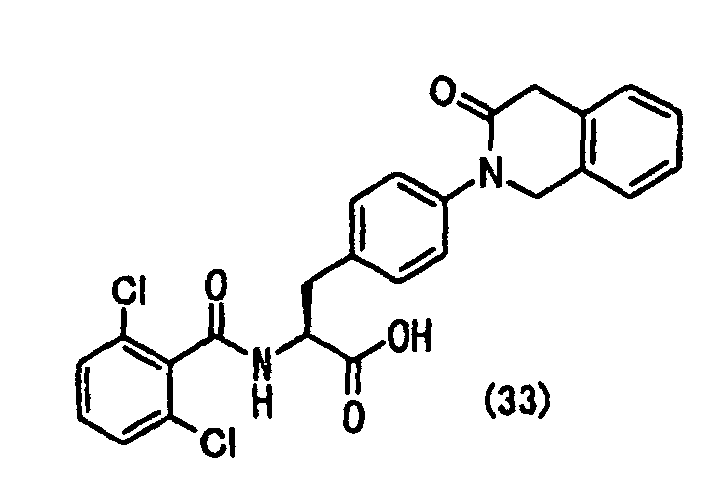


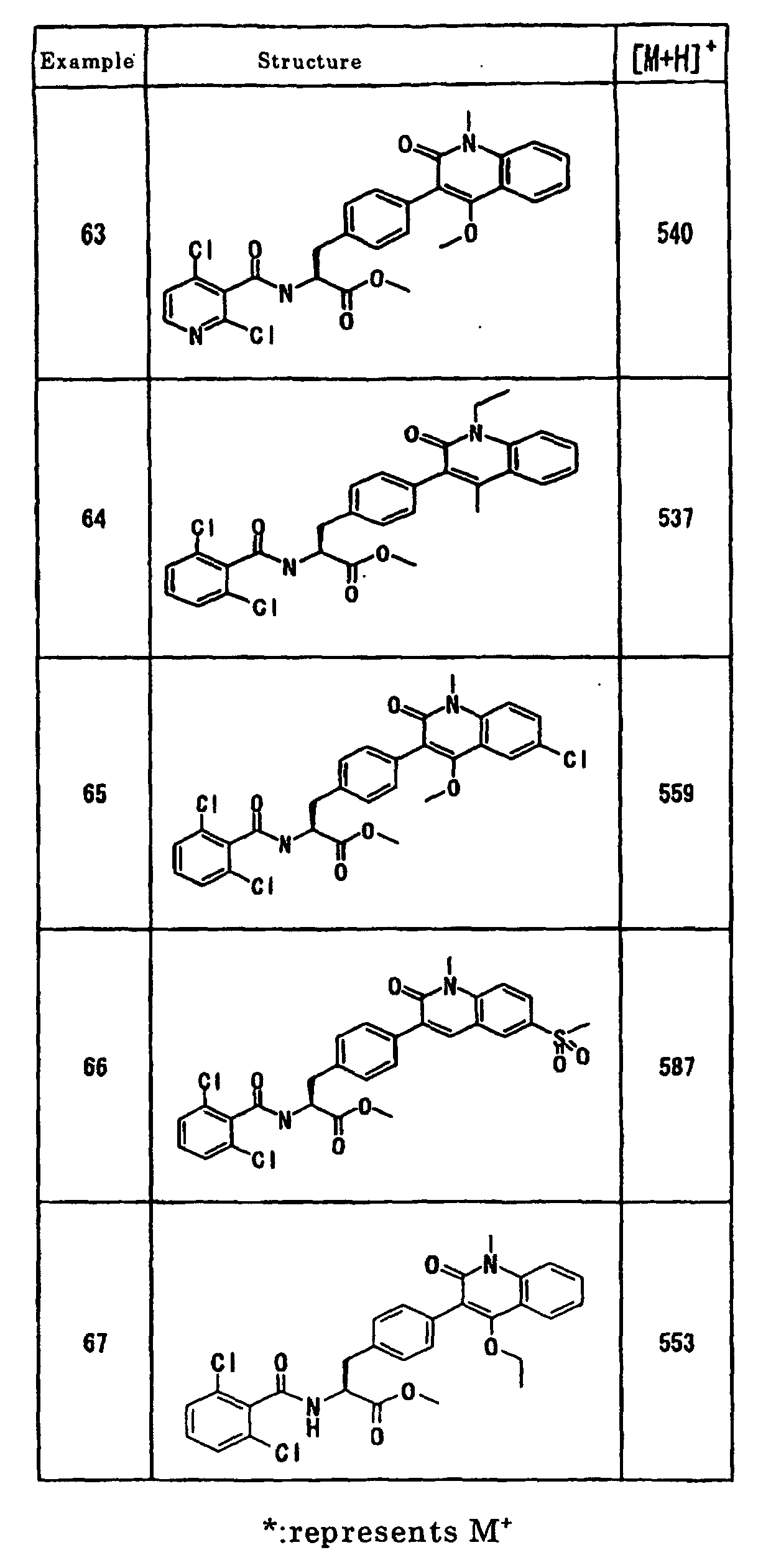

| Results of the determination of VCAM antagonistic activity (IC50,nmol/L) | ||
| Example | α4β7 | α4β1 |
| 1 | 90 | 620 |
| 6 | 3.5 | 44 |
| 8 | 18 | 320 |
| 14 | 3.3 | 150 |
| 19 | 11 | 290 |
| 21 | 2.4 | 190 |
| 22 | 150 | |
| 23 | 35 | |
| 26 | 44 | |
| 30 | 3.9 | 64 |
| 31 | 3.0 | 47 |
| 33 | 21 | 255 |
| 40 | 6.5 | 115 |
| 41 | 4.5 | 74 |
| 42 | 4.1 | 52 |
| 43 | 10 | 178 |
| 44 | 11 | 168 |
| 45 | 7.3 | 37 |
| 46 | 67 | |
| 47 | 97 |
Claims (19)
- Phenylalanine derivatives of the following general formula (1) or pharmaceutically acceptable salts thereof:wherein A represents one of the following general formulae (2), (2-1), (2-2), (2-3), (2-4) and (2-5):

 wherein Arm represents a cyclic alkyl group or an aromatic ring containing 0, 1, 2, 3 or 4 hetero atoms selected from the group consisting of oxygen, sulfur and nitrogen atoms,
R1 represents a hydrogen atom, an alkyl group which may have a substituent(s), a lower alkyl group substituted with a cycloalkyl group(s) which may contain a hetero atom(s) in the ring thereof, a lower alkyl group substituted with an aryl group(s), a lower alkyl group substituted with a heteroaryl group(s), a lower hydroxyalkyl group, a lower halogenoalkyl group, a cycloalkyl group which may contain a hetero atom(s) in the ring thereof, an alkenyl group which may have a substituent(s), a lower hydroxyalkenyl group, a lower halogenoalkenyl group, an alkynyl group which may have a substituent(s), an aryl group, a heteroaryl group, a lower alkyloxycarbonyl group, a substituted or unsubstituted carbamoyl group, a lower alkanoyl group, an aroyl group, a lower alkylsulfonyl group or a substituted or unsubstituted sulfamoyl group,
R2 to R6 and R10 to R33 may be the same or different from one another and each represents a hydrogen atom, an alkyl group which may have a substituent(s), a lower alkyl group substituted with a cycloalkyl group(s) which may contain a hetero atom(s) in the ring thereof, a lower alkyl group substituted with an aryl group(s), a lower alkyl group substituted with a heteroaryl group(s), a lower hydroxyalkyl group, a lower halogenoalkyl group, a cycloalkyl group which may contain a hetero atom(s) in the ring thereof, an alkenyl group which may have a substituent(s), a lower hydroxyalkenyl group, a lower halogenoalkenyl group, an alkynyl group which may have a substituent(s), an aryl group, a heteroaryl group, a lower alkyloxycarbonyl group, a substituted or unsubstituted carbamoyl group, a lower alkanoyl group, an aroyl group, a lower alkylsulfonyl group, a substituted or unsubstituted sulfamoyl group, a halogen atom, a hydroxyl group, a lower alkoxyl group, a lower alkylthio group, a lower alkoxyl group and lower alkylthio group substituted with a cycloalkyl group(s) which may contain a hetero atom(s) in the ring thereof, a lower alkoxyl group and lower alkylthio group substituted with an aryl group(s), a lower alkoxyl group and lower alkylthio group substituted with a heteroaryl group(s), a lower hydroxylalkoxyl group, a lower halogeno alkoxyl group, a lower halogenoalkylthio group, a cycloalkyloxy group which may contain a hetero atom(s) in the ring thereof, an aryloxy group, a heteroaryloxy group, a nitro group, a cyano group, a substituted or unsubstituted amino group, carboxyl group or a trialkylammonium group,
B represents a hydroxyl group, an alkoxyl group, a substituted lower alkoxyl group or a hydroxylamino group,
in cases where A represents the general formula (2), (2-1), (2-2), (2-3) or (2-4), C represents an aryl group, a heteroaryl group, a cycloalkyl group which may contain a hetero atom(s) in the ring thereof, a lower alkyl group substituted with a cycloalkyl group(s) which may contain a hetero atom(s) in the ring thereof, a lower alkyl group substituted with an aryl group(s), a lower alkyl group substituted with a heteroaryl group(s), an alkyl group which may have a substituent(s), a lower hydroxyalkyl group, a lower halogenoalkyl group, an alkenyl group which may have a substituent(s), a lower hydroxyalkenyl group, a lower halogenoalkenyl group, an alkynyl group which may have a substituent(s), a lower alkoxyl group, a lower alkoxyl group substituted with a cycloalkyl group(s) which may contain a hetero atom(s) in the ring thereof, a lower alkoxyl group substituted with an aryl group(s), a lower alkoxyl group substituted with a heteroaryl group(s), a cycloalkyloxy group which may contain a hetero atom(s) in the ring thereof, an aryloxy group, a heteroaryloxy group, a lower hydroxylalkoxyl group, a lower halogeno alkoxyl group, a substituted or unsubstituted amino group or a lower alkylthio group, or C also represents an organic group of the following general formula (3):wherein D and D' may be the same or different from one another and each represents a hydrogen atom, an alkyl group which may have a substituent(s), an alkenyl group which may have a substituent(s) or an alkynyl group which may have a substituent(s), and
D and D' may be bonded together to form a ring which may contain one or two oxygen, nitrogen or sulfur atoms,
E represents an amino group or a lower alkylamino group which may have a substituent(s), including an amino group(s) having two substituents wherein the substituents are bonded together to form a ring,
in cases where A represents the general formula (2-5), C represents an organic group of the general formula (3), and
J and J' may be the same or different from one another and each represents a hydrogen atom, a halogen atom, a lower alkyl group, a lower alkyloxy group, a nitro group, an amino group or a hydroxyl group. - The phenylalanine derivatives or pharmaceutically acceptable salts thereof according to claim 1, wherein A represents the general formula (2) wherein Arm represents a cyclic alkyl group or an aromatic ring containing 0, 1, 2, 3 or 4 hetero atoms selected from the group consisting of oxygen, sulfur and nitrogen atoms,
R1 represents a hydrogen atom, an alkyl group which may have a substituent(s), a lower alkyl group substituted with a cycloalkyl group(s) which may contain a hetero atom(s) in the ring thereof, a lower alkyl group substituted with an aryl group(s), a lower alkyl group substituted with a heteroaryl group(s), a lower hydroxyalkyl group, a lower halogenoalkyl group, a cycloalkyl group which may contain a hetero atom(s) in the ring thereof, an alkenyl group which may have a substituent(s), a lower hydroxyalkenyl group, a lower halogenoalkenyl group, an alkynyl group which may have a substituent(s), an aryl group, a heteroaryl group, a lower alkyloxycarbonyl group, a substituted or unsubstituted carbamoyl group, a lower alkanoyl group, an aroyl group, a lower alkylsulfonyl group or a substituted or unsubstituted sulfamoyl group,
R2, R3, R4, R5 and R6 may be the same or different from one another and each represents a hydrogen atom, an alkyl group which may have a substituent(s), a lower alkyl group substituted with a cycloalkyl group(s) which may contain a hetero atom(s) in the ring thereof, a lower alkyl group substituted with an aryl group(s), a lower alkyl group substituted with a heteroaryl group(s), a lower hydroxyalkyl group, a lower halogenoalkyl group, a cycloalkyl group which may contain a hetero atom(s) in the ring thereof, an alkenyl group which may have a substituent(s), a lower hydroxyalkenyl group, a lower halogenoalkenyl group, an alkynyl group which may have a substituent(s), an aryl group, a heteroaryl group, a lower alkyloxycarbonyl group, a substituted or unsubstituted carbamoyl group, a lower alkanoyl group, an aroyl group, a lower alkylsulfonyl group, a substituted or unsubstituted sulfamoyl group, a halogen atom, a hydroxyl group, a lower alkoxyl group, a lower alkylthio group, a lower alkoxyl group and lower alkylthio group substituted with a cycloalkyl group(s) which may contain a hetero atom(s) in the ring thereof, a lower alkoxyl group and lower alkylthio group substituted with an aryl group(s), a lower alkoxyl group and lower alkylthio group substituted with a heteroaryl group(s), a lower hydroxylalkoxyl group, a lower halogeno alkoxyl group, a lower halogenoalkylthio group, a cycloalkyloxy group which may contain a hetero atom(s) in the ring thereof, an aryloxy group, a heteroaryloxy group, a nitro group, a cyano group, a substituted or unsubstituted amino group, carboxyl group or a trialkylammonium group,
B represents a hydroxyl group, an alkoxyl group, a substituted lower alkoxyl group or a hydroxylamino group,
C represents an aryl group, a heteroaryl group, a cycloalkyl group which may contain a hetero atom(s) in the ring thereof, a lower alkyl group substituted with a cycloalkyl group(s) which may contain a hetero atom(s) in the ring thereof, a lower alkyl group substituted with an aryl group(s), a lower alkyl group substituted with a heteroaryl group(s), an alkyl group which may have a substituent(s), a lower hydroxyalkyl group, a lower halogenoalkyl group, an alkenyl group which may have a substituent(s), a lower hydroxyalkenyl group, a lower halogenoalkenyl group, an alkynyl group which may have a substituent(s), a lower alkoxyl group, a lower alkoxyl group substituted with a cycloalkyl group(s) which may contain a hetero atom(s) in the ring thereof, a lower alkoxyl group substituted with an aryl group(s), a lower alkoxyl group substituted with a heteroaryl group(s), a cycloalkyloxy group which may contain a hetero atom(s) in the ring thereof, an aryloxy group, a heteroaryloxy group, a lower hydroxylalkoxyl group, a lower halogeno alkoxyl group, a substituted or unsubstituted amino group or a lower alkylthio group, or C represents an organic group of the above general formula (3),
wherein D and D' may be the same or different from one another and each represents a hydrogen atom, an alkyl group which may have a substituent(s), an alkenyl group which may have a substituent(s) or an alkynyl group which may have a substituent(s), and
D and D' may be bonded together to form a ring which may contain one or two oxygen, nitrogen or sulfur atoms,
E represents an amino group or a lower alkylamino group which may have a substituent(s), including an amino group(s) having two substituents wherein the substituents are bonded together to form a ring, and
J and J' may be the same or different from one another and each represents a hydrogen atom, a halogen atom, a lower alkyl group, a lower alkyloxy group, a nitro group, an amino group or a hydroxyl group. - The phenylalanine derivatives or pharmaceutically acceptable salts thereof according to claim 2, wherein, in the general formula (1), A represents the above general formula (2) wherein Arm is a benzene ring, R1 is a lower alkyl group, R2 is a lower alkyl group, a lower alkoxyl group or a hydrogen atom, R3, R4, R5 and R6 may be the same or different from each other and each represents a hydrogen atom, a halogen atom, a lower alkyl group, a lower halogenoalkyl group, a hydroxyl group, a lower alkoxyl group, a nitro group, a cyano group, an amino group, an amino group substituted with a lower alkyl group, an amino group substituted with a lower alkanoyl group, an amino group substituted with a lower alkyloxycarbonyl group, a lower alkylsulfonyl groups or a lower trialkylammonium group.
- The phenylalanine derivatives or pharmaceutically acceptable salts thereof according to claims 1 and 2, wherein B represents a hydroxyl group or a lower alkoxyl group.
- The phenylalanine derivatives or pharmaceutically acceptable salts thereof according to claims 1 and 2, wherein C represents the above general formula (3) or the following general formulae (3-1), (3-2), (3-3) or (3-4):wherein R7 represents a halogen atom or methyl group, R8 represents a halogen atom, methyl group, trifluoromethyl group, methoxy group or a hydrogen atom, R9 represents a hydrogen atom, halogen atom, hydroxyl group, lower alkyl group, cycloalkyl group which may contain a hetero atom(s) in the ring thereof, lower alkoxyl group, lower alkylthio group, lower halogenoalkyl group, lower halogenoalkoxyl group, lower halogenoalkylthio group, nitro group, cyano group, amino group, amino group substituted with a lower alkyl group(s), lower trialkylammonium group, lower alkylsulfonylamino group or tetrazolyl group.

- The phenylalanine derivatives or pharmaceutically acceptable salts thereof according to claim 2, wherein, in the general formula (1), A represents the above general formula (2) wherein Arm is a benzene ring, R1 is a lower alkyl group, R2 is a lower alkyl group, a lower alkoxyl group or a hydrogen atom, R3, R4, R5 and R6 may be the same or different from each other and each represents a hydrogen atom, a halogen atom, a lower alkyl group, a lower halogenoalkyl group, a hydroxyl group, a lower alkoxyl group, a nitro group, a cyano group, an amino group, an amino group substituted with a lower alkyl group, a lower alkylsulfonyl groups or a lower trialkylammonium group,
B represents a hydroxyl group or a lower alkoxyl group, and
C represents the above general formulae (3), (3-1), (3-2), (3-3) or (3-4). - The phenylalanine derivatives or pharmaceutically acceptable salts thereof according to claim 2, wherein, in the general formula (1), A represents the above general formula (2) wherein Arm is a benzene ring, R1 is a lower alkyl group, R2 is a lower alkyl group, R3, R4, R5 and R6 may be the same or different from each other and each represents a hydrogen atom, a halogen atom, a lower alkyl group, a lower halogenoalkyl group, a hydroxyl group, a lower alkoxyl group, a nitro group, a cyano group, an amino group, an amino group substituted with a lower alkyl group, a lower alkylsulfonyl groups or a lower trialkylammonium group,
B represents a hydroxyl group or a lower alkoxyl group,
C represents the above general formulae (3-1) or (3-2), and
J and J' are a hydrogen atom. - The phenylalanine derivatives or pharmaceutically acceptable salts thereof according to claim 2, wherein, in the general formula (1), A represents the above general formula (2) wherein Arm is a benzene ring, R1 is a lower alkyl group, R2 is a lower alkoxyl group, R3, R4, R5 and R6 may be the same or different from each other and each represents a hydrogen atom, a halogen atom, a lower alkyl group, a lower halogenoalkyl group, a hydroxyl group, a lower alkoxyl group, a nitro group, a cyano group, an amino group, an amino group substituted with a lower alkyl group, a lower alkylsulfonyl groups or a lower trialkylammonium group,
B represents a hydroxyl group or a lower alkoxyl group,
C represents the above general formulae (3-1) or (3-2), and
J and J' are a hydrogen atom. - The phenylalanine derivatives or pharmaceutically acceptable salts thereof according to claim 2, wherein, in the general formula (1), A represents the above general formula (2) wherein Arm is a benzene ring, R1 is a lower alkyl group, R2 is a hydrogen atom, R3, R4, R5 and R6 may be the same or different from each other and each represents a hydrogen atom, a halogen atom, a lower alkyl group, a lower halogenoalkyl group, a hydroxyl group, a lower alkoxyl group, a nitro group, a cyano group, an amino group, an amino group substituted with a lower alkyl group, a lower alkylsulfonyl groups or a lower trialkylammonium group,
B represents a hydroxyl group or a lower alkoxyl group,
C represents the above general formulae (3-1) or (3-2), and
J and J' are a hydrogen atom. - The phenylalanine derivatives or pharmaceutically acceptable salts thereof according to claim 2, wherein, in the general formula (1), A represents the above general formula (2) wherein Arm is a benzene ring, R1 is a methyl group or an ethyl group, R2 is a methoxy group, an ethoxy group, a propoxy group, a methyl group, an ethyl group, a propyl group or a butyl group, R3, R4, R5 and R6 may be the same or different from each other and each represents a hydrogen atom, a halogen atom, a lower alkyl group, a lower halogenoalkyl group, a hydroxyl group, a lower alkoxyl group, a nitro group, a cyano group, an amino group, an amino group substituted with a lower alkyl group, a lower alkylsulfonyl groups or a lower trialkylammonium group,
B represents a hydroxyl group,
C represents the above general formulae (3-1) or (3-2) wherein R7 represents a halogen atom or methyl group, R8 represents a halogen atom, R9 represents a hydrogen atom, halogen atom, hydroxyl group, lower alkyl group, lower alkoxyl group, lower alkylthio group, lower halogenoalkyl group, lower halogenoalkoxyl group, lower halogenoalkylthio group, nitro group, cyano group, amino group, lower alkylamino group, trialkylammonium group, methanesulfonyl amino group or tetrazolyl group, and
J and J' are a hydrogen atom. - Phenylalanine derivatives of the following general formula (22) or pharmaceutically acceptable salts thereof:wherein A' represents one of the following general formulae (23-1), (23-2), (23-3) and (23-4):
 wherein Arm represents a cyclic alkyl group or an aromatic ring containing 0, 1, 2, 3 or 4 hetero atoms selected from the group consisting of oxygen, sulfur and nitrogen atoms,
the composite line of solid line and dotted line in the formula (23-4) represents a single bond or a double bond,
U, V and X represent C(=O), S(=O)2, C(-R38)(-R39), C(=C(R38)(R39)), C(=S), S(=O), P(=O)(-OH) or P(-H)(=O),
W represents C(-R40) or a nitrogen atom,
R34 to R40 may be the same or different from one another and each represents a hydrogen atom, a halogen atom, a hydroxyl group, a lower alkyl group, a substituted lower alkyl group, a lower alkenyl group, a substituted lower alkenyl group, a lower alkynyl group, a substituted lower alkynyl group, a cycloalkyl group which may contain a hetero atom(s) in the ring thereof, an aryl group, a heteroaryl group, a lower alkyl group substituted with a cycloalkyl group(s) which may contain a hetero atom(s) in the ring thereof, a lower alkyl group substituted with an aryl group(s), a lower alkyl group substituted with a heteroaryl group(s), a lower alkoxyl group, a lower alkylthio group, a lower alkoxyl group and lower alkylthio group substituted with a cycloalkyl group(s) which may contain a hetero atom(s) in the ring thereof, a lower alkoxyl group and lower alkylthio group substituted with an aryl group(s), a lower alkoxyl group and lower alkylthio group substituted with a heteroaryl group(s), a cycloalkyloxy group which may contain a hetero atom(s) in the ring thereof, an aryloxy group, a heteroaryloxy group, a lower hydroxyalkyl group, a lower hydroxyalkenyl group, a lower hydroxylalkoxyl group, a lower halogenoalkyl group, a lower halogeno alkoxyl group, a lower halogenoalkylthio group, a lower halogenoalkenyl group, nitro group, cyano group, a substituted or unsubstituted amino group, carboxyl group, a lower alkyloxycarbonyl group, a substituted or unsubstituted carbamoyl group, a lower alkanoyl group, an aroyl group, a lower alkylsulfonyl group, a substituted or unsubstituted sulfamoyl group or an ammonium group, R38 and R39 may be bonded together to form a ring which may contain one or two oxygen, nitrogen or sulfur atoms,
B' represents a hydroxyl group, a lower alkoxyl group, a substituted lower alkoxyl group or a hydroxylamino group,
C' represents a hydrogen atom, a lower alkyl group, a lower alkenyl group, a lower alkynyl group, a lower alkyl group substituted with a cycloalkyl group(s) which may contain a hetero atom(s) in the ring thereof, a lower alkyl group substituted with an aryl group(s) or a lower alkyl group substituted with a heteroaryl group(s),
D' represents a lower alkyl group, a lower alkenyl group, a lower alkynyl group, a cycloalkyl group which may contain a hetero atom(s) in the ring thereof, an aryl group, a heteroaryl group, a lower alkyl group substituted with a cycloalkyl group(s) which may contain a hetero atom(s) in the ring thereof, a lower alkyl group substituted with an aryl group(s), a lower alkyl group substituted with a heteroaryl group(s), a lower alkoxyl group, a lower alkoxyl group substituted with a cycloalkyl group(s) which may contain a hetero atom(s) in the ring thereof, a lower alkoxyl group substituted with an aryl group(s), a lower alkoxyl group substituted with a heteroaryl group(s), a cycloalkyloxy group which may contain a hetero atom(s) in the ring thereof, an aryloxy group, a heteroaryloxy group, a lower hydroxyalkyl group, a lower hydroxyalkenyl group, a lower hydroxyalkoxyl group, a lower halogenoalkyl group, a lower halogenoalkoxyl group, a lower halogenoalkenyl group, nitro group, cyano group, a substituted or unsubstituted amino group, carboxyl group, a lower alkyloxycarbonyl group, a substituted or unsubstituted carbamoyl group, a lower alkanoyl group, an aroyl group, a lower alkylthio group, a lower alkylsulfonyl group or a substituted or unsubstituted sulfamoyl group,
C' and D' may be bonded together to form a ring which may contain one or two oxygen, nitrogen or sulfur atoms,
T represents an interatomic bond, C(=O), C(=S), S(=O), S(=O)2, N(H)-C(=O), or N(H)-C(=S),
G and G' may be the same or different from each other and each represents a hydrogen atom, a halogen atom, a lower alkyl group, a lower alkyloxy group or nitro group. - The phenylalanine derivatives or pharmaceutically acceptable salts thereof according to claim 1, wherein, in the general formula (1), A represents the following general formula (2-6):B represents a hydroxyl group or a lower alkoxyl group,

C represents the general formulae (3-1), (3-2) or (3-3):R7 represents a halogen atom or a methyl group, R8 represents a halogen atom, R9 represents a hydrogen atom, a halogen atom, a hydroxyl group, a lower alkyl group, a lower alkoxyl group, a lower alkylthio group, a lower halogenoalkyl group, a lower halogeno alkoxyl group, a lower halogenoalkylthio group, a nitro group, a cyano group, an amino group, a lower alkylamino group, a trialkylammonium group, a methansulfonylamino group or a tetrazolyl group, and J and J' represent a hydrogen atom.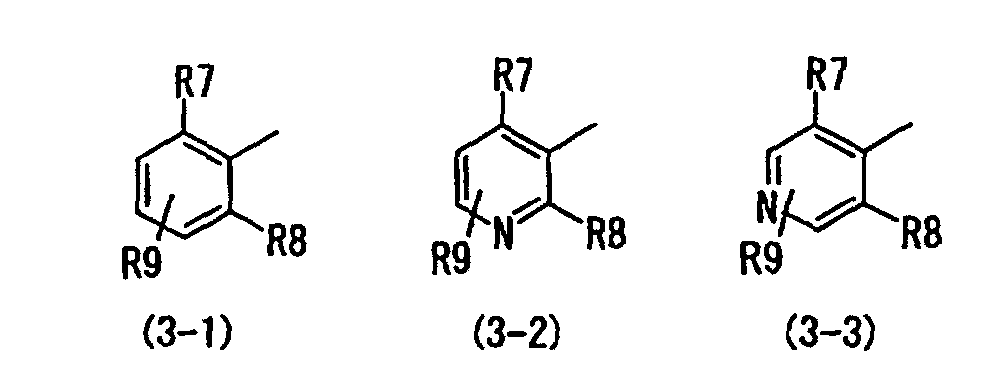
- The phenylalanine derivatives or pharmaceutically acceptable salts thereof according to claim 1, wherein, in the general formula (1), A represents the following general formula (2-7):B represents a hydroxyl group or a lower alkoxyl group,
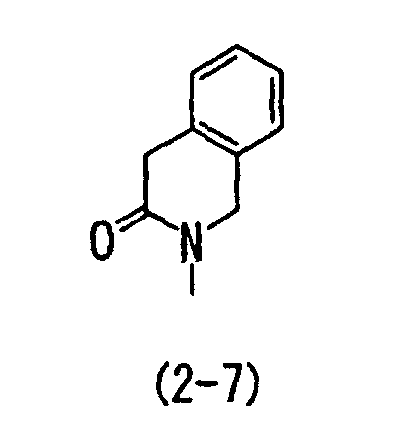
C represents the general formulae (3-1), (3-2) or (3-3):R7 represents a halogen atom or a methyl group, R8 represents a halogen atom, R9 represents a hydrogen atom, a halogen atom, a hydroxyl group, a lower alkyl group, a lower alkoxyl group, a lower alkylthio group, a lower halogenoalkyl group, a lower halogeno alkoxyl group, a lower halogenoalkylthio group, a nitro group, a cyano group, an amino group, a lower alkylamino group, a trialkylammonium group, a methansulfonylamino group or a tetrazolyl group, and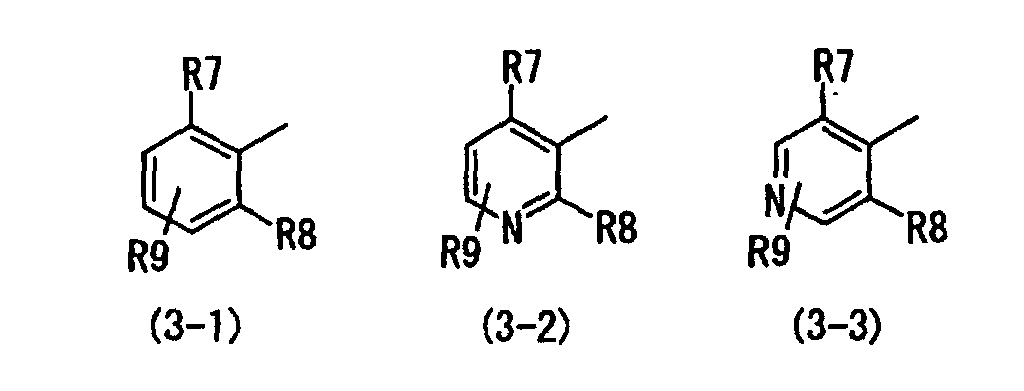
J and J' represent a hydrogen atom. - The phenylalanine derivatives or pharmaceutically acceptable salts thereof according to claim 12, wherein, in the general formula (1), A represents the general formula (2-6), B represents a hydroxyl group or a lower alkoxyl group, C represents the above general formula (3-1) wherein R7 represents a chlorine atom, R8 represents a chlorine atom, R9 represents a hydrogen atom, and
J and J' are a hydrogen atom. - The phenylalanine derivatives or pharmaceutically acceptable salts thereof according to claim 13, wherein, in the general formula (1), A represents the general formula (2-7), B represents a hydroxyl group or a lower alkoxyl group, C represents the general formula (3-1) wherein R7 represents a chlorine atom, R8 represents a chlorine atom, R9 represents a hydrogen atom, and
J and J' are a hydrogen atom. - An α4 integrin antagonist containing a phenylalanine derivative or a pharmaceutically acceptable salt thereof according to any of claims 1 to 15 as an active ingredient.
- A therapeutic agent or preventive agent for inflammatory diseases in which α4 integrin-depending adhesion process participates in the pathology, which contains a phenylalanine derivative or a pharmaceutically acceptable salt thereof according to any of claims 1 to 15 as an active ingredient.
- A pharmaceutical composition containing a phenylalanine derivative or a pharmaceutically acceptable salt thereof according to any of claims 1 to 15 as an active ingredient.
- A therapeutic agent or preventive agent for rheumatoid arthritis, inflammatory bowel diseases, systemic lupus erythematosus, multiple sclerosis, Sjögren's syndrome, asthma, psoriasis, allergy, diabetes, cardiovascular diseases, arterial sclerosis, restenosis, tumor proliferation, tumor metastasis and transplantation rejection, which contains a phenylalanine derivative or a pharmaceutically acceptable salt thereof according to any of claims 1 to 15 as an active ingredient.
Applications Claiming Priority (5)
| Application Number | Priority Date | Filing Date | Title |
|---|---|---|---|
| JP2001380655 | 2001-12-13 | ||
| JP2001380655 | 2001-12-13 | ||
| JP2002039070 | 2002-02-15 | ||
| JP2002039070 | 2002-02-15 | ||
| PCT/JP2002/013070 WO2003053926A1 (en) | 2001-12-13 | 2002-12-13 | Novel phenylalanine derivative |
Publications (2)
| Publication Number | Publication Date |
|---|---|
| EP1454898A1 true EP1454898A1 (en) | 2004-09-08 |
| EP1454898A4 EP1454898A4 (en) | 2006-12-13 |
Family
ID=26625047
Family Applications (1)
| Application Number | Title | Priority Date | Filing Date |
|---|---|---|---|
| EP02786095A Withdrawn EP1454898A4 (en) | 2001-12-13 | 2002-12-13 | Novel phenylalanine derivative |
Country Status (5)
| Country | Link |
|---|---|
| US (2) | US7250516B2 (en) |
| EP (1) | EP1454898A4 (en) |
| JP (1) | JP4452899B2 (en) |
| AU (1) | AU2002354224A1 (en) |
| WO (1) | WO2003053926A1 (en) |
Cited By (6)
| Publication number | Priority date | Publication date | Assignee | Title |
|---|---|---|---|---|
| WO2005111020A3 (en) * | 2004-04-30 | 2006-01-26 | Elan Pharm Inc | Pyrimidine hydantoin analogues which inhibit leukocyte adhesion mediated by vla-4 |
| WO2008064823A1 (en) * | 2006-11-27 | 2008-06-05 | Ucb Pharma, S.A. | Bicyclic and heterobicyclic derivatives, processes for preparing them and their uses |
| CN102970870A (en) * | 2010-05-04 | 2013-03-13 | Gtx公司 | Nuclear receptor binding agents |
| WO2014023732A1 (en) * | 2012-08-06 | 2014-02-13 | Life & Brain Gmbh | Niclosamide and its derivatives for use in the treatment of solid tumors |
| US9078888B2 (en) | 2007-01-22 | 2015-07-14 | Gtx, Inc. | Nuclear receptor binding agents |
| US9604931B2 (en) | 2007-01-22 | 2017-03-28 | Gtx, Inc. | Nuclear receptor binding agents |
Families Citing this family (47)
| Publication number | Priority date | Publication date | Assignee | Title |
|---|---|---|---|---|
| ATE497385T1 (en) * | 2000-08-18 | 2011-02-15 | Ajinomoto Kk | NEW PHENYLALANINE DERIVATIVES |
| WO2003053926A1 (en) * | 2001-12-13 | 2003-07-03 | Ajinomoto Co.,Inc. | Novel phenylalanine derivative |
| JP4572832B2 (en) * | 2003-02-20 | 2010-11-04 | 味の素株式会社 | Process for producing phenylalanine derivative having quinazolinedione skeleton and production intermediate |
| ES2451140T3 (en) * | 2003-11-27 | 2014-03-26 | Ajinomoto Co., Inc. | Phenylalanine derivative crystal and method for its production |
| EP1700850B1 (en) * | 2003-12-22 | 2015-07-15 | Ajinomoto Co., Inc. | Phenylalanine derivative |
| US7618981B2 (en) * | 2004-05-06 | 2009-11-17 | Cytokinetics, Inc. | Imidazopyridinyl-benzamide anti-cancer agents |
| EP1753455A2 (en) | 2004-06-04 | 2007-02-21 | Genentech, Inc. | Method for treating multiple sclerosis |
| CA2568336A1 (en) * | 2004-06-04 | 2005-12-22 | Genentech, Inc. | Method for treating lupus |
| KR101250889B1 (en) | 2004-12-24 | 2013-04-04 | 도레이 카부시키가이샤 | Glycine derivative and use thereof |
| ZA200709956B (en) | 2005-05-20 | 2009-02-25 | Genentech Inc | Pretreatment of a biological sample from an autoimmune disease subject |
| MY149159A (en) | 2005-11-15 | 2013-07-31 | Hoffmann La Roche | Method for treating joint damage |
| EA019879B1 (en) | 2005-12-29 | 2014-07-30 | Лексикон Фармасьютикалз, Инк. | Multicyclic amino acid derivatives, pharmaceutical composition containing them and method of treatment using these derivatives |
| AR059224A1 (en) * | 2006-01-31 | 2008-03-19 | Jerini Ag | COMPOUNDS FOR THE INHIBITION OF INTEGRINS AND USE OF THESE |
| EP2042171B1 (en) * | 2006-06-14 | 2011-05-11 | Toray Industries, Inc. | Therapeutic or prophylactic agent for allergic dermatitis |
| ATE556061T1 (en) * | 2006-06-19 | 2012-05-15 | Toray Industries | THERAPEUTIC OR PROPHYLACTIC AGENT AGAINST MULTIPLE SCLEROSIS |
| AU2007262083B2 (en) * | 2006-06-20 | 2012-01-19 | Toray Industries, Inc. | Therapeutic or prophylactic agent for leukemia |
| EP2510941A3 (en) | 2007-02-20 | 2013-01-23 | Merrimack Pharmaceuticals, Inc. | Methods of treating multiple sclerosis by administration of alpha-fetoprotein in combination with an integrin antagonist |
| BRPI0911652A2 (en) | 2008-04-11 | 2015-08-04 | Merrimack Pharmaceuticals Inc | Human serum albumin binders and their conjugates |
| TW201438738A (en) | 2008-09-16 | 2014-10-16 | 建南德克公司 | Method for treating progressive multiple sclerosis |
| CN102282168A (en) | 2008-11-18 | 2011-12-14 | 梅里麦克制药股份有限公司 | Human serum albumin linker and its conjugate |
| WO2010075249A2 (en) | 2008-12-22 | 2010-07-01 | Genentech, Inc. | A method for treating rheumatoid arthritis with b-cell antagonists |
| MX2014004025A (en) | 2011-10-17 | 2014-08-01 | Univ Muenster Wilhelms | Methods of risk assessment of pml and related apparatus. |
| WO2013101771A2 (en) | 2011-12-30 | 2013-07-04 | Genentech, Inc. | Compositions and method for treating autoimmune diseases |
| US20130243750A1 (en) | 2012-01-31 | 2013-09-19 | Genentech, Inc. | Anti-ige antibodies and methods using same |
| CA2871464C (en) * | 2012-04-24 | 2017-09-26 | Ajinomoto Co., Inc. | Sulfonamide derivatives and their use in the inhibition of .alpha.4.beta.7 integrin-dependent process |
| WO2014036520A1 (en) | 2012-08-30 | 2014-03-06 | Merrimack Pharmaceuticals, Inc. | Combination therapies comprising anti-erbb3 agents |
| CA2900652C (en) | 2013-02-15 | 2021-05-04 | Kala Pharmaceuticals, Inc. | Therapeutic compounds and uses thereof |
| US9688688B2 (en) | 2013-02-20 | 2017-06-27 | Kala Pharmaceuticals, Inc. | Crystalline forms of 4-((4-((4-fluoro-2-methyl-1H-indol-5-yl)oxy)-6-methoxyquinazolin-7-yl)oxy)-1-(2-oxa-7-azaspiro[3.5]nonan-7-yl)butan-1-one and uses thereof |
| CN107915751A (en) | 2013-02-20 | 2018-04-17 | 卡拉制药公司 | Therapeutic compound and its purposes |
| BR112015031040A8 (en) * | 2013-06-11 | 2018-01-02 | Receptos Inc | NEW GLP-1 RECEIVER MODULATORS |
| ES2778200T3 (en) * | 2013-10-29 | 2020-08-10 | Ea Pharma Co Ltd | Sulfonamide derivative and its medicinal use |
| WO2015066482A1 (en) | 2013-11-01 | 2015-05-07 | Kala Pharmaceuticals, Inc. | Crystalline forms of therapeutic compounds and uses thereof |
| US9890173B2 (en) | 2013-11-01 | 2018-02-13 | Kala Pharmaceuticals, Inc. | Crystalline forms of therapeutic compounds and uses thereof |
| US10696637B2 (en) * | 2015-07-17 | 2020-06-30 | Fujifilm Corporation | Nitrogen-containing heterocyclic compound |
| IL324412A (en) | 2015-10-06 | 2026-01-01 | Genentech Inc | Method for treating multiple sclerosis |
| AU2017324716B2 (en) | 2016-09-08 | 2020-08-13 | KALA BIO, Inc. | Crystalline forms of therapeutic compounds and uses thereof |
| MX2019002629A (en) | 2016-09-08 | 2019-10-07 | Kala Pharmaceuticals Inc | Crystalline forms of therapeutic compounds and uses thereof. |
| AU2017324713B2 (en) | 2016-09-08 | 2020-08-13 | KALA BIO, Inc. | Crystalline forms of therapeutic compounds and uses thereof |
| CA3048602A1 (en) | 2016-12-27 | 2018-07-05 | Fujifilm Corporation | Antitumor agent and bromodomain inhibitor |
| AU2019373242B2 (en) | 2018-10-30 | 2023-07-13 | Gilead Sciences, Inc. | Compounds for inhibition of alpha 4 beta 7 integrin |
| KR102630416B1 (en) | 2018-10-30 | 2024-02-01 | 길리애드 사이언시즈, 인코포레이티드 | Quinoline derivatives as alpha4beta7 integrin inhibitors |
| ES3013256T3 (en) | 2018-10-30 | 2025-04-11 | Gilead Sciences Inc | Imidazo[1,2-a]pyridine derivatives as alpha4beta7 integrin inhibitors for the treatment of inflammatory diseases |
| US11179383B2 (en) * | 2018-10-30 | 2021-11-23 | Gilead Sciences, Inc. | Compounds for inhibition of α4β7 integrin |
| CN114222730B (en) * | 2019-08-14 | 2024-09-10 | 吉利德科学公司 | Compounds for inhibiting α4β7 integrin |
| CN114853659A (en) * | 2021-01-20 | 2022-08-05 | 普洛药业股份有限公司 | N-(benzoyl)-phenylalanine compounds, pharmaceutical compositions containing the same, and uses thereof |
| CN115192564B (en) * | 2022-05-23 | 2023-11-17 | 四川大学华西医院 | Phenylalanine derivative, pharmaceutical composition and application thereof in tumor treatment |
| KR20250061759A (en) * | 2022-09-09 | 2025-05-08 | 시젱 하이스코 파마수티칼 씨오., 엘티디. | Propionic acid derivatives and their applications in medicine |
Family Cites Families (24)
| Publication number | Priority date | Publication date | Assignee | Title |
|---|---|---|---|---|
| IT1289522B1 (en) * | 1996-12-24 | 1998-10-15 | Zambon Spa | PROCESS FOR THE PREPARATION OF ETEROARIL-FENILALANINE |
| DE69821950T2 (en) * | 1997-08-22 | 2004-12-16 | F. Hoffmann-La Roche Ag | N-AROYLPHENYLALANINDERIVATE |
| US6229011B1 (en) * | 1997-08-22 | 2001-05-08 | Hoffman-La Roche Inc. | N-aroylphenylalanine derivative VCAM-1 inhibitors |
| US6455550B1 (en) * | 1997-08-22 | 2002-09-24 | Hoffmann-La Roche Inc. | N-alkanoylphenylalanine derivatives |
| ATE267801T1 (en) * | 1997-08-22 | 2004-06-15 | Hoffmann La Roche | N-ALKANOYLPHENYLALANINE DERIVATIVES |
| US6197794B1 (en) * | 1998-01-08 | 2001-03-06 | Celltech Therapeutics Limited | Phenylalanine derivatives |
| MY153569A (en) | 1998-01-20 | 2015-02-27 | Mitsubishi Tanabe Pharma Corp | Inhibitors of ?4 mediated cell adhesion |
| US6329372B1 (en) * | 1998-01-27 | 2001-12-11 | Celltech Therapeutics Limited | Phenylalanine derivatives |
| JP2002532416A (en) | 1998-12-17 | 2002-10-02 | マインドセット・バイオファーマシューティカルズ・(ユーエスエイ)・インコーポレイテッド | Enhancing brain glucose utilization |
| IN190990B (en) * | 1999-04-08 | 2003-09-06 | Council Scient Ind Res | |
| DE19924138A1 (en) * | 1999-05-26 | 2000-11-30 | Henkel Kgaa | Detachable adhesive connections |
| EP1233013B1 (en) * | 1999-11-18 | 2007-02-28 | Ajinomoto Co., Inc. | Novel phenylalanine derivatives |
| US6388084B1 (en) * | 1999-12-06 | 2002-05-14 | Hoffmann-La Roche Inc. | 4-pyridinyl-n-acyl-l-phenylalanines |
| SI1237878T1 (en) * | 1999-12-06 | 2007-08-31 | Hoffmann La Roche | 4-pyrimidinyl-n-acyl-l-phenylalanines |
| AU779063B2 (en) * | 1999-12-06 | 2005-01-06 | F. Hoffmann-La Roche Ag | 4-pyridinyl-N-acyl-L-phenylalanines |
| WO2001047868A1 (en) | 1999-12-28 | 2001-07-05 | Ajinomoto Co., Inc. | Novel phenylalanine derivatives |
| AU2001242743A1 (en) | 2000-03-23 | 2001-10-03 | Ajinomoto Co. Inc. | Novel phenylalanine derivative |
| ATE497385T1 (en) | 2000-08-18 | 2011-02-15 | Ajinomoto Kk | NEW PHENYLALANINE DERIVATIVES |
| JP4895067B2 (en) | 2000-09-29 | 2012-03-14 | 味の素株式会社 | New phenylalanine derivatives |
| JP4164871B2 (en) | 2001-07-26 | 2008-10-15 | 味の素株式会社 | Novel phenylpropionic acid derivatives |
| WO2003053926A1 (en) | 2001-12-13 | 2003-07-03 | Ajinomoto Co.,Inc. | Novel phenylalanine derivative |
| EP1477482B1 (en) | 2002-02-20 | 2010-04-14 | Ajinomoto Co., Inc. | Novel phenylalanine derivative |
| JP4572832B2 (en) | 2003-02-20 | 2010-11-04 | 味の素株式会社 | Process for producing phenylalanine derivative having quinazolinedione skeleton and production intermediate |
| ES2451140T3 (en) | 2003-11-27 | 2014-03-26 | Ajinomoto Co., Inc. | Phenylalanine derivative crystal and method for its production |
-
2002
- 2002-12-13 WO PCT/JP2002/013070 patent/WO2003053926A1/en not_active Ceased
- 2002-12-13 JP JP2003554643A patent/JP4452899B2/en not_active Expired - Fee Related
- 2002-12-13 EP EP02786095A patent/EP1454898A4/en not_active Withdrawn
- 2002-12-13 AU AU2002354224A patent/AU2002354224A1/en not_active Abandoned
-
2004
- 2004-06-14 US US10/866,260 patent/US7250516B2/en not_active Expired - Fee Related
-
2007
- 2007-06-25 US US11/767,969 patent/US7884204B2/en not_active Expired - Fee Related
Cited By (12)
| Publication number | Priority date | Publication date | Assignee | Title |
|---|---|---|---|---|
| WO2005111020A3 (en) * | 2004-04-30 | 2006-01-26 | Elan Pharm Inc | Pyrimidine hydantoin analogues which inhibit leukocyte adhesion mediated by vla-4 |
| US7205310B2 (en) | 2004-04-30 | 2007-04-17 | Elan Pharmaceuticals, Inc. | Pyrimidine hydantoin analogues which inhibit leukocyte adhesion mediated by VLA-4 |
| WO2008064823A1 (en) * | 2006-11-27 | 2008-06-05 | Ucb Pharma, S.A. | Bicyclic and heterobicyclic derivatives, processes for preparing them and their uses |
| US9078888B2 (en) | 2007-01-22 | 2015-07-14 | Gtx, Inc. | Nuclear receptor binding agents |
| US9604931B2 (en) | 2007-01-22 | 2017-03-28 | Gtx, Inc. | Nuclear receptor binding agents |
| US9623021B2 (en) | 2007-01-22 | 2017-04-18 | Gtx, Inc. | Nuclear receptor binding agents |
| CN102970870A (en) * | 2010-05-04 | 2013-03-13 | Gtx公司 | Nuclear receptor binding agents |
| EP2566330A4 (en) * | 2010-05-04 | 2013-11-06 | Gtx Inc | NUCLEAR RECEPTOR BINDING AGENTS |
| AU2011248154B2 (en) * | 2010-05-04 | 2016-03-03 | Gtx, Inc. | Nuclear receptor binding agents |
| WO2014023732A1 (en) * | 2012-08-06 | 2014-02-13 | Life & Brain Gmbh | Niclosamide and its derivatives for use in the treatment of solid tumors |
| WO2014023329A1 (en) * | 2012-08-06 | 2014-02-13 | Life And Brain Gmbh | Niclosamide and its derivatives for use in the treatment of solid tumors |
| US9844522B2 (en) | 2012-08-06 | 2017-12-19 | Life & Brain Gmbh | Niclosamide and its derivatives for use in the treatment of solid tumors |
Also Published As
| Publication number | Publication date |
|---|---|
| AU2002354224A1 (en) | 2003-07-09 |
| EP1454898A4 (en) | 2006-12-13 |
| US7884204B2 (en) | 2011-02-08 |
| JP4452899B2 (en) | 2010-04-21 |
| WO2003053926A1 (en) | 2003-07-03 |
| US7250516B2 (en) | 2007-07-31 |
| US20040235848A1 (en) | 2004-11-25 |
| JPWO2003053926A1 (en) | 2005-04-28 |
| US20080280909A1 (en) | 2008-11-13 |
Similar Documents
| Publication | Publication Date | Title |
|---|---|---|
| US7884204B2 (en) | Phenylalanine derivatives | |
| US7452905B2 (en) | Phenylalanine derivatives | |
| AU2001278740B2 (en) | Novel phenylalanine derivatives | |
| JP4470219B2 (en) | New phenylalanine derivatives | |
| JP4164871B2 (en) | Novel phenylpropionic acid derivatives | |
| JPWO2002016329A1 (en) | New phenylalanine derivatives |
Legal Events
| Date | Code | Title | Description |
|---|---|---|---|
| PUAI | Public reference made under article 153(3) epc to a published international application that has entered the european phase |
Free format text: ORIGINAL CODE: 0009012 |
|
| 17P | Request for examination filed |
Effective date: 20040625 |
|
| AK | Designated contracting states |
Kind code of ref document: A1 Designated state(s): AT BE BG CH CY CZ DE DK EE ES FI FR GB GR IE IT LI LU MC NL PT SE SI SK TR |
|
| AX | Request for extension of the european patent |
Extension state: AL LT LV MK RO |
|
| A4 | Supplementary search report drawn up and despatched |
Effective date: 20061114 |
|
| RIC1 | Information provided on ipc code assigned before grant |
Ipc: A61P 35/00 20060101ALI20061103BHEP Ipc: A61K 31/472 20060101ALI20061103BHEP Ipc: A61K 31/47 20060101ALI20061103BHEP Ipc: A61K 31/4375 20060101ALI20061103BHEP Ipc: A61K 31/403 20060101ALI20061103BHEP Ipc: C07D 471/04 20060101ALI20061103BHEP Ipc: C07D 401/12 20060101ALI20061103BHEP Ipc: C07D 239/96 20060101ALI20061103BHEP Ipc: C07D 237/32 20060101ALI20061103BHEP Ipc: C07D 217/24 20060101ALI20061103BHEP Ipc: C07D 215/22 20060101ALI20061103BHEP Ipc: C07D 209/48 20060101AFI20030710BHEP |
|
| 17Q | First examination report despatched |
Effective date: 20090727 |
|
| STAA | Information on the status of an ep patent application or granted ep patent |
Free format text: STATUS: THE APPLICATION IS DEEMED TO BE WITHDRAWN |
|
| 18D | Application deemed to be withdrawn |
Effective date: 20130115 |