EP1453892B1 - Self-photoinitiating multifunctional acrylates - Google Patents
Self-photoinitiating multifunctional acrylates Download PDFInfo
- Publication number
- EP1453892B1 EP1453892B1 EP02778480A EP02778480A EP1453892B1 EP 1453892 B1 EP1453892 B1 EP 1453892B1 EP 02778480 A EP02778480 A EP 02778480A EP 02778480 A EP02778480 A EP 02778480A EP 1453892 B1 EP1453892 B1 EP 1453892B1
- Authority
- EP
- European Patent Office
- Prior art keywords
- composition
- amine
- michael
- acetoacetate
- group
- Prior art date
- Legal status (The legal status is an assumption and is not a legal conclusion. Google has not performed a legal analysis and makes no representation as to the accuracy of the status listed.)
- Expired - Lifetime
Links
- 150000001252 acrylic acid derivatives Chemical class 0.000 title description 7
- 239000000203 mixture Substances 0.000 claims abstract description 44
- NIXOWILDQLNWCW-UHFFFAOYSA-M Acrylate Chemical compound [O-]C(=O)C=C NIXOWILDQLNWCW-UHFFFAOYSA-M 0.000 claims abstract description 25
- 238000006845 Michael addition reaction Methods 0.000 claims abstract description 16
- 239000007788 liquid Substances 0.000 claims abstract description 13
- 239000007795 chemical reaction product Substances 0.000 claims abstract description 6
- HVVWZTWDBSEWIH-UHFFFAOYSA-N [2-(hydroxymethyl)-3-prop-2-enoyloxy-2-(prop-2-enoyloxymethyl)propyl] prop-2-enoate Chemical compound C=CC(=O)OCC(CO)(COC(=O)C=C)COC(=O)C=C HVVWZTWDBSEWIH-UHFFFAOYSA-N 0.000 claims description 18
- 150000001412 amines Chemical class 0.000 claims description 14
- 150000003335 secondary amines Chemical class 0.000 claims description 13
- XYIBRDXRRQCHLP-UHFFFAOYSA-N ethyl acetoacetate Chemical compound CCOC(=O)CC(C)=O XYIBRDXRRQCHLP-UHFFFAOYSA-N 0.000 claims description 11
- ZBCBWPMODOFKDW-UHFFFAOYSA-N diethanolamine Chemical compound OCCNCCO ZBCBWPMODOFKDW-UHFFFAOYSA-N 0.000 claims description 9
- 238000000034 method Methods 0.000 claims description 9
- HZAXFHJVJLSVMW-UHFFFAOYSA-N 2-Aminoethan-1-ol Chemical compound NCCO HZAXFHJVJLSVMW-UHFFFAOYSA-N 0.000 claims description 8
- -1 hydroxyalkyl amines Chemical class 0.000 claims description 8
- DAKWPKUUDNSNPN-UHFFFAOYSA-N Trimethylolpropane triacrylate Chemical compound C=CC(=O)OCC(CC)(COC(=O)C=C)COC(=O)C=C DAKWPKUUDNSNPN-UHFFFAOYSA-N 0.000 claims description 7
- 150000003141 primary amines Chemical class 0.000 claims description 7
- 230000005855 radiation Effects 0.000 claims description 7
- 150000003512 tertiary amines Chemical group 0.000 claims description 7
- 150000004729 acetoacetic acid derivatives Chemical class 0.000 claims description 6
- 125000004386 diacrylate group Chemical group 0.000 claims description 6
- 239000000758 substrate Substances 0.000 claims description 6
- WDJHALXBUFZDSR-UHFFFAOYSA-M acetoacetate Chemical compound CC(=O)CC([O-])=O WDJHALXBUFZDSR-UHFFFAOYSA-M 0.000 claims description 5
- 150000003973 alkyl amines Chemical class 0.000 claims description 5
- 125000000325 methylidene group Chemical group [H]C([H])=* 0.000 claims description 5
- JZUHIOJYCPIVLQ-UHFFFAOYSA-N 2-methylpentane-1,5-diamine Chemical compound NCC(C)CCCN JZUHIOJYCPIVLQ-UHFFFAOYSA-N 0.000 claims description 4
- ROSDSFDQCJNGOL-UHFFFAOYSA-N Dimethylamine Chemical compound CNC ROSDSFDQCJNGOL-UHFFFAOYSA-N 0.000 claims description 4
- QUSNBJAOOMFDIB-UHFFFAOYSA-N Ethylamine Chemical compound CCN QUSNBJAOOMFDIB-UHFFFAOYSA-N 0.000 claims description 4
- YNAVUWVOSKDBBP-UHFFFAOYSA-N Morpholine Chemical compound C1COCCN1 YNAVUWVOSKDBBP-UHFFFAOYSA-N 0.000 claims description 4
- NQRYJNQNLNOLGT-UHFFFAOYSA-N Piperidine Chemical compound C1CCNCC1 NQRYJNQNLNOLGT-UHFFFAOYSA-N 0.000 claims description 4
- WGQKYBSKWIADBV-UHFFFAOYSA-N benzylamine Chemical compound NCC1=CC=CC=C1 WGQKYBSKWIADBV-UHFFFAOYSA-N 0.000 claims description 4
- JQVDAXLFBXTEQA-UHFFFAOYSA-N dibutylamine Chemical compound CCCCNCCCC JQVDAXLFBXTEQA-UHFFFAOYSA-N 0.000 claims description 4
- WTSXICLFTPPDTL-UHFFFAOYSA-N pentane-1,3-diamine Chemical compound CCC(N)CCN WTSXICLFTPPDTL-UHFFFAOYSA-N 0.000 claims description 4
- WGYKZJWCGVVSQN-UHFFFAOYSA-N propylamine Chemical compound CCCN WGYKZJWCGVVSQN-UHFFFAOYSA-N 0.000 claims description 4
- PUGOMSLRUSTQGV-UHFFFAOYSA-N 2,3-di(prop-2-enoyloxy)propyl prop-2-enoate Chemical compound C=CC(=O)OCC(OC(=O)C=C)COC(=O)C=C PUGOMSLRUSTQGV-UHFFFAOYSA-N 0.000 claims description 3
- CERQOIWHTDAKMF-UHFFFAOYSA-M Methacrylate Chemical compound CC(=C)C([O-])=O CERQOIWHTDAKMF-UHFFFAOYSA-M 0.000 claims description 3
- DYRDKSSFIWVSNM-UHFFFAOYSA-N acetoacetanilide Chemical class CC(=O)CC(=O)NC1=CC=CC=C1 DYRDKSSFIWVSNM-UHFFFAOYSA-N 0.000 claims description 3
- WYTZZXDRDKSJID-UHFFFAOYSA-N (3-aminopropyl)triethoxysilane Chemical compound CCO[Si](OCC)(OCC)CCCN WYTZZXDRDKSJID-UHFFFAOYSA-N 0.000 claims description 2
- HXKKHQJGJAFBHI-UHFFFAOYSA-N 1-aminopropan-2-ol Chemical compound CC(O)CN HXKKHQJGJAFBHI-UHFFFAOYSA-N 0.000 claims description 2
- BMVXCPBXGZKUPN-UHFFFAOYSA-N 1-hexanamine Chemical compound CCCCCCN BMVXCPBXGZKUPN-UHFFFAOYSA-N 0.000 claims description 2
- VILCJCGEZXAXTO-UHFFFAOYSA-N 2,2,2-tetramine Chemical compound NCCNCCNCCN VILCJCGEZXAXTO-UHFFFAOYSA-N 0.000 claims description 2
- JCUZDQXWVYNXHD-UHFFFAOYSA-N 2,2,4-trimethylhexane-1,6-diamine Chemical compound NCCC(C)CC(C)(C)CN JCUZDQXWVYNXHD-UHFFFAOYSA-N 0.000 claims description 2
- JCBPETKZIGVZRE-UHFFFAOYSA-N 2-aminobutan-1-ol Chemical compound CCC(N)CO JCBPETKZIGVZRE-UHFFFAOYSA-N 0.000 claims description 2
- RNLHGQLZWXBQNY-UHFFFAOYSA-N 3-(aminomethyl)-3,5,5-trimethylcyclohexan-1-amine Chemical compound CC1(C)CC(N)CC(C)(CN)C1 RNLHGQLZWXBQNY-UHFFFAOYSA-N 0.000 claims description 2
- KQIGMPWTAHJUMN-UHFFFAOYSA-N 3-aminopropane-1,2-diol Chemical compound NCC(O)CO KQIGMPWTAHJUMN-UHFFFAOYSA-N 0.000 claims description 2
- SJECZPVISLOESU-UHFFFAOYSA-N 3-trimethoxysilylpropan-1-amine Chemical compound CO[Si](OC)(OC)CCCN SJECZPVISLOESU-UHFFFAOYSA-N 0.000 claims description 2
- RPNUMPOLZDHAAY-UHFFFAOYSA-N Diethylenetriamine Chemical compound NCCNCCN RPNUMPOLZDHAAY-UHFFFAOYSA-N 0.000 claims description 2
- PIICEJLVQHRZGT-UHFFFAOYSA-N Ethylenediamine Chemical compound NCCN PIICEJLVQHRZGT-UHFFFAOYSA-N 0.000 claims description 2
- WJYIASZWHGOTOU-UHFFFAOYSA-N Heptylamine Chemical compound CCCCCCCN WJYIASZWHGOTOU-UHFFFAOYSA-N 0.000 claims description 2
- OPKOKAMJFNKNAS-UHFFFAOYSA-N N-methylethanolamine Chemical compound CNCCO OPKOKAMJFNKNAS-UHFFFAOYSA-N 0.000 claims description 2
- GCPWJFKTWGFEHH-UHFFFAOYSA-N acetoacetamide Chemical class CC(=O)CC(N)=O GCPWJFKTWGFEHH-UHFFFAOYSA-N 0.000 claims description 2
- YRKCREAYFQTBPV-UHFFFAOYSA-N acetylacetone Chemical class CC(=O)CC(C)=O YRKCREAYFQTBPV-UHFFFAOYSA-N 0.000 claims description 2
- HQABUPZFAYXKJW-UHFFFAOYSA-N butan-1-amine Chemical compound CCCCN HQABUPZFAYXKJW-UHFFFAOYSA-N 0.000 claims description 2
- GHWVXCQZPNWFRO-UHFFFAOYSA-N butane-2,3-diamine Chemical compound CC(N)C(C)N GHWVXCQZPNWFRO-UHFFFAOYSA-N 0.000 claims description 2
- MLIREBYILWEBDM-UHFFFAOYSA-N cyanoacetic acid Chemical class OC(=O)CC#N MLIREBYILWEBDM-UHFFFAOYSA-N 0.000 claims description 2
- SSJXIUAHEKJCMH-UHFFFAOYSA-N cyclohexane-1,2-diamine Chemical compound NC1CCCCC1N SSJXIUAHEKJCMH-UHFFFAOYSA-N 0.000 claims description 2
- VKIRRGRTJUUZHS-UHFFFAOYSA-N cyclohexane-1,4-diamine Chemical compound NC1CCC(N)CC1 VKIRRGRTJUUZHS-UHFFFAOYSA-N 0.000 claims description 2
- HPNMFZURTQLUMO-UHFFFAOYSA-N diethylamine Chemical compound CCNCC HPNMFZURTQLUMO-UHFFFAOYSA-N 0.000 claims description 2
- IUNMPGNGSSIWFP-UHFFFAOYSA-N dimethylaminopropylamine Chemical compound CN(C)CCCN IUNMPGNGSSIWFP-UHFFFAOYSA-N 0.000 claims description 2
- WEHWNAOGRSTTBQ-UHFFFAOYSA-N dipropylamine Chemical compound CCCNCCC WEHWNAOGRSTTBQ-UHFFFAOYSA-N 0.000 claims description 2
- NAQMVNRVTILPCV-UHFFFAOYSA-N hexane-1,6-diamine Chemical compound NCCCCCCN NAQMVNRVTILPCV-UHFFFAOYSA-N 0.000 claims description 2
- 150000002690 malonic acid derivatives Chemical class 0.000 claims description 2
- QOHMWDJIBGVPIF-UHFFFAOYSA-N n',n'-diethylpropane-1,3-diamine Chemical compound CCN(CC)CCCN QOHMWDJIBGVPIF-UHFFFAOYSA-N 0.000 claims description 2
- ZNZJJSYHZBXQSM-UHFFFAOYSA-N propane-2,2-diamine Chemical compound CC(C)(N)N ZNZJJSYHZBXQSM-UHFFFAOYSA-N 0.000 claims description 2
- BHRZNVHARXXAHW-UHFFFAOYSA-N sec-butylamine Chemical compound CCC(C)N BHRZNVHARXXAHW-UHFFFAOYSA-N 0.000 claims description 2
- FAGUFWYHJQFNRV-UHFFFAOYSA-N tetraethylenepentamine Chemical compound NCCNCCNCCNCCN FAGUFWYHJQFNRV-UHFFFAOYSA-N 0.000 claims description 2
- LEJBBGNFPAFPKQ-UHFFFAOYSA-N 2-(2-prop-2-enoyloxyethoxy)ethyl prop-2-enoate Chemical compound C=CC(=O)OCCOCCOC(=O)C=C LEJBBGNFPAFPKQ-UHFFFAOYSA-N 0.000 claims 4
- INQDDHNZXOAFFD-UHFFFAOYSA-N 2-[2-(2-prop-2-enoyloxyethoxy)ethoxy]ethyl prop-2-enoate Chemical compound C=CC(=O)OCCOCCOCCOC(=O)C=C INQDDHNZXOAFFD-UHFFFAOYSA-N 0.000 claims 2
- HCLJOFJIQIJXHS-UHFFFAOYSA-N 2-[2-[2-(2-prop-2-enoyloxyethoxy)ethoxy]ethoxy]ethyl prop-2-enoate Chemical compound C=CC(=O)OCCOCCOCCOCCOC(=O)C=C HCLJOFJIQIJXHS-UHFFFAOYSA-N 0.000 claims 2
- 239000002202 Polyethylene glycol Substances 0.000 claims 2
- WERYXYBDKMZEQL-UHFFFAOYSA-N butane-1,4-diol Chemical compound OCCCCO WERYXYBDKMZEQL-UHFFFAOYSA-N 0.000 claims 2
- YDKNBNOOCSNPNS-UHFFFAOYSA-N methyl 1,3-benzoxazole-2-carboxylate Chemical compound C1=CC=C2OC(C(=O)OC)=NC2=C1 YDKNBNOOCSNPNS-UHFFFAOYSA-N 0.000 claims 2
- 229920001223 polyethylene glycol Polymers 0.000 claims 2
- ZDQNWDNMNKSMHI-UHFFFAOYSA-N 1-[2-(2-prop-2-enoyloxypropoxy)propoxy]propan-2-yl prop-2-enoate Chemical compound C=CC(=O)OC(C)COC(C)COCC(C)OC(=O)C=C ZDQNWDNMNKSMHI-UHFFFAOYSA-N 0.000 claims 1
- VRWWRSQIOZLGAM-UHFFFAOYSA-N 2,2-bis(3-oxobutanoyloxymethyl)butyl 3-oxobutanoate Chemical compound CC(=O)CC(=O)OCC(CC)(COC(=O)CC(C)=O)COC(=O)CC(C)=O VRWWRSQIOZLGAM-UHFFFAOYSA-N 0.000 claims 1
- BCFBCLJFXYLWCI-UHFFFAOYSA-N 2,3-bis(3-oxobutanoyloxy)propyl 3-oxobutanoate Chemical compound CC(=O)CC(=O)OCC(OC(=O)CC(C)=O)COC(=O)CC(C)=O BCFBCLJFXYLWCI-UHFFFAOYSA-N 0.000 claims 1
- YIJYFLXQHDOQGW-UHFFFAOYSA-N 2-[2,4,6-trioxo-3,5-bis(2-prop-2-enoyloxyethyl)-1,3,5-triazinan-1-yl]ethyl prop-2-enoate Chemical compound C=CC(=O)OCCN1C(=O)N(CCOC(=O)C=C)C(=O)N(CCOC(=O)C=C)C1=O YIJYFLXQHDOQGW-UHFFFAOYSA-N 0.000 claims 1
- GTELLNMUWNJXMQ-UHFFFAOYSA-N 2-ethyl-2-(hydroxymethyl)propane-1,3-diol;prop-2-enoic acid Chemical class OC(=O)C=C.OC(=O)C=C.OC(=O)C=C.CCC(CO)(CO)CO GTELLNMUWNJXMQ-UHFFFAOYSA-N 0.000 claims 1
- QAUIAXORENGBSN-UHFFFAOYSA-N 2-ethylhexyl 3-oxobutanoate Chemical compound CCCCC(CC)COC(=O)CC(C)=O QAUIAXORENGBSN-UHFFFAOYSA-N 0.000 claims 1
- FIHBHSQYSYVZQE-UHFFFAOYSA-N 6-prop-2-enoyloxyhexyl prop-2-enoate Chemical compound C=CC(=O)OCCCCCCOC(=O)C=C FIHBHSQYSYVZQE-UHFFFAOYSA-N 0.000 claims 1
- REIYHFWZISXFKU-UHFFFAOYSA-N Butyl acetoacetate Chemical compound CCCCOC(=O)CC(C)=O REIYHFWZISXFKU-UHFFFAOYSA-N 0.000 claims 1
- WRQNANDWMGAFTP-UHFFFAOYSA-N Methylacetoacetic acid Chemical compound COC(=O)CC(C)=O WRQNANDWMGAFTP-UHFFFAOYSA-N 0.000 claims 1
- RASITSWSKYLIEX-UHFFFAOYSA-N [2,2-dimethyl-3-(3-oxobutanoyloxy)propyl] 3-oxobutanoate Chemical compound CC(=O)CC(=O)OCC(C)(C)COC(=O)CC(C)=O RASITSWSKYLIEX-UHFFFAOYSA-N 0.000 claims 1
- AUHWLIZFLUXUDG-UHFFFAOYSA-N [3-(3-oxobutanoyloxy)-2,2-bis(3-oxobutanoyloxymethyl)propyl] 3-oxobutanoate Chemical compound CC(=O)CC(=O)OCC(COC(=O)CC(C)=O)(COC(=O)CC(C)=O)COC(=O)CC(C)=O AUHWLIZFLUXUDG-UHFFFAOYSA-N 0.000 claims 1
- FHLPGTXWCFQMIU-UHFFFAOYSA-N [4-[2-(4-prop-2-enoyloxyphenyl)propan-2-yl]phenyl] prop-2-enoate Chemical class C=1C=C(OC(=O)C=C)C=CC=1C(C)(C)C1=CC=C(OC(=O)C=C)C=C1 FHLPGTXWCFQMIU-UHFFFAOYSA-N 0.000 claims 1
- IISBACLAFKSPIT-UHFFFAOYSA-N bisphenol A Chemical class C=1C=C(O)C=CC=1C(C)(C)C1=CC=C(O)C=C1 IISBACLAFKSPIT-UHFFFAOYSA-N 0.000 claims 1
- 229920006037 cross link polymer Polymers 0.000 claims 1
- GGGZAPAKHRYJCQ-UHFFFAOYSA-N cyclohexane;methanol;3-oxobutanoic acid Chemical compound OC.OC.C1CCCCC1.CC(=O)CC(O)=O.CC(=O)CC(O)=O GGGZAPAKHRYJCQ-UHFFFAOYSA-N 0.000 claims 1
- KCHWKBCUPLJWJA-UHFFFAOYSA-N dodecyl 3-oxobutanoate Chemical compound CCCCCCCCCCCCOC(=O)CC(C)=O KCHWKBCUPLJWJA-UHFFFAOYSA-N 0.000 claims 1
- XXMIOPMDWAUFGU-UHFFFAOYSA-N hexane-1,6-diol Chemical compound OCCCCCCO XXMIOPMDWAUFGU-UHFFFAOYSA-N 0.000 claims 1
- 229920001610 polycaprolactone Polymers 0.000 claims 1
- 239000004632 polycaprolactone Substances 0.000 claims 1
- AXLMPTNTPOWPLT-UHFFFAOYSA-N prop-2-enyl 3-oxobutanoate Chemical compound CC(=O)CC(=O)OCC=C AXLMPTNTPOWPLT-UHFFFAOYSA-N 0.000 claims 1
- 238000000576 coating method Methods 0.000 abstract description 4
- 125000002924 primary amino group Chemical group [H]N([H])* 0.000 abstract description 4
- 239000000853 adhesive Substances 0.000 abstract description 3
- 230000001070 adhesive effect Effects 0.000 abstract description 3
- 125000000467 secondary amino group Chemical class [H]N([*:1])[*:2] 0.000 abstract 1
- 125000001302 tertiary amino group Chemical group 0.000 abstract 1
- 229910052782 aluminium Inorganic materials 0.000 description 23
- XAGFODPZIPBFFR-UHFFFAOYSA-N aluminium Chemical compound [Al] XAGFODPZIPBFFR-UHFFFAOYSA-N 0.000 description 23
- 230000004927 fusion Effects 0.000 description 23
- 239000011347 resin Substances 0.000 description 23
- 229920005989 resin Polymers 0.000 description 23
- 238000006243 chemical reaction Methods 0.000 description 13
- QVGXLLKOCUKJST-UHFFFAOYSA-N atomic oxygen Chemical compound [O] QVGXLLKOCUKJST-UHFFFAOYSA-N 0.000 description 10
- 239000001301 oxygen Substances 0.000 description 10
- 229910052760 oxygen Inorganic materials 0.000 description 10
- 229940043237 diethanolamine Drugs 0.000 description 7
- 239000000047 product Substances 0.000 description 7
- 230000005764 inhibitory process Effects 0.000 description 6
- 150000003254 radicals Chemical group 0.000 description 6
- 239000000178 monomer Substances 0.000 description 5
- UEEJHVSXFDXPFK-UHFFFAOYSA-N N-dimethylaminoethanol Chemical compound CN(C)CCO UEEJHVSXFDXPFK-UHFFFAOYSA-N 0.000 description 4
- 150000001875 compounds Chemical class 0.000 description 4
- 239000011344 liquid material Substances 0.000 description 4
- 230000004048 modification Effects 0.000 description 4
- 238000012986 modification Methods 0.000 description 4
- 238000013459 approach Methods 0.000 description 3
- 239000012634 fragment Substances 0.000 description 3
- 230000006870 function Effects 0.000 description 3
- 238000004519 manufacturing process Methods 0.000 description 3
- 239000000463 material Substances 0.000 description 3
- QDFXRVAOBHEBGJ-UHFFFAOYSA-N 3-(cyclononen-1-yl)-4,5,6,7,8,9-hexahydro-1h-diazonine Chemical compound C1CCCCCCC=C1C1=NNCCCCCC1 QDFXRVAOBHEBGJ-UHFFFAOYSA-N 0.000 description 2
- WADSJYLPJPTMLN-UHFFFAOYSA-N 3-(cycloundecen-1-yl)-1,2-diazacycloundec-2-ene Chemical compound C1CCCCCCCCC=C1C1=NNCCCCCCCC1 WADSJYLPJPTMLN-UHFFFAOYSA-N 0.000 description 2
- IJGRMHOSHXDMSA-UHFFFAOYSA-N Atomic nitrogen Chemical compound N#N IJGRMHOSHXDMSA-UHFFFAOYSA-N 0.000 description 2
- GLUUGHFHXGJENI-UHFFFAOYSA-N Piperazine Chemical compound C1CNCCN1 GLUUGHFHXGJENI-UHFFFAOYSA-N 0.000 description 2
- 239000002131 composite material Substances 0.000 description 2
- 238000004132 cross linking Methods 0.000 description 2
- 230000000694 effects Effects 0.000 description 2
- 239000003999 initiator Substances 0.000 description 2
- 238000002386 leaching Methods 0.000 description 2
- 238000002156 mixing Methods 0.000 description 2
- 229920000642 polymer Polymers 0.000 description 2
- 238000007348 radical reaction Methods 0.000 description 2
- OCKGFTQIICXDQW-ZEQRLZLVSA-N 5-[(1r)-1-hydroxy-2-[4-[(2r)-2-hydroxy-2-(4-methyl-1-oxo-3h-2-benzofuran-5-yl)ethyl]piperazin-1-yl]ethyl]-4-methyl-3h-2-benzofuran-1-one Chemical compound C1=C2C(=O)OCC2=C(C)C([C@@H](O)CN2CCN(CC2)C[C@H](O)C2=CC=C3C(=O)OCC3=C2C)=C1 OCKGFTQIICXDQW-ZEQRLZLVSA-N 0.000 description 1
- 239000012958 Amine synergist Substances 0.000 description 1
- VCJPZAKKJXENBW-UHFFFAOYSA-N CC(COC(C)COC(C=C)=O)OCC(C)O[NH+](C=C)[O-] Chemical compound CC(COC(C)COC(C=C)=O)OCC(C)O[NH+](C=C)[O-] VCJPZAKKJXENBW-UHFFFAOYSA-N 0.000 description 1
- 238000006957 Michael reaction Methods 0.000 description 1
- 238000007259 addition reaction Methods 0.000 description 1
- 239000000654 additive Substances 0.000 description 1
- 230000002411 adverse Effects 0.000 description 1
- 125000000751 azo group Chemical group [*]N=N[*] 0.000 description 1
- 230000008901 benefit Effects 0.000 description 1
- 239000011230 binding agent Substances 0.000 description 1
- 239000003054 catalyst Substances 0.000 description 1
- 239000011248 coating agent Substances 0.000 description 1
- 229960002887 deanol Drugs 0.000 description 1
- 238000000354 decomposition reaction Methods 0.000 description 1
- 230000001627 detrimental effect Effects 0.000 description 1
- 239000012972 dimethylethanolamine Substances 0.000 description 1
- 229920001971 elastomer Polymers 0.000 description 1
- 239000000806 elastomer Substances 0.000 description 1
- 238000005516 engineering process Methods 0.000 description 1
- 230000007613 environmental effect Effects 0.000 description 1
- 150000002169 ethanolamines Chemical class 0.000 description 1
- 230000007717 exclusion Effects 0.000 description 1
- 238000009472 formulation Methods 0.000 description 1
- 125000000524 functional group Chemical group 0.000 description 1
- 150000002357 guanidines Chemical class 0.000 description 1
- 230000008821 health effect Effects 0.000 description 1
- AWZYJAFKVGBFEU-UHFFFAOYSA-N heptane-1,6-diamine Chemical compound CC(N)CCCCCN AWZYJAFKVGBFEU-UHFFFAOYSA-N 0.000 description 1
- 150000002432 hydroperoxides Chemical class 0.000 description 1
- 230000006872 improvement Effects 0.000 description 1
- 239000011261 inert gas Substances 0.000 description 1
- 230000000977 initiatory effect Effects 0.000 description 1
- 230000007246 mechanism Effects 0.000 description 1
- 229910052757 nitrogen Inorganic materials 0.000 description 1
- 150000002978 peroxides Chemical class 0.000 description 1
- 229920000768 polyamine Polymers 0.000 description 1
- 238000012545 processing Methods 0.000 description 1
- 230000001681 protective effect Effects 0.000 description 1
- 230000009257 reactivity Effects 0.000 description 1
- 238000011160 research Methods 0.000 description 1
- 239000004576 sand Substances 0.000 description 1
- 239000000565 sealant Substances 0.000 description 1
- 239000007787 solid Substances 0.000 description 1
- 239000007921 spray Substances 0.000 description 1
- 230000009466 transformation Effects 0.000 description 1
- 229910052723 transition metal Inorganic materials 0.000 description 1
- 150000003624 transition metals Chemical class 0.000 description 1
Classifications
-
- C—CHEMISTRY; METALLURGY
- C08—ORGANIC MACROMOLECULAR COMPOUNDS; THEIR PREPARATION OR CHEMICAL WORKING-UP; COMPOSITIONS BASED THEREON
- C08F—MACROMOLECULAR COMPOUNDS OBTAINED BY REACTIONS ONLY INVOLVING CARBON-TO-CARBON UNSATURATED BONDS
- C08F22/00—Homopolymers and copolymers of compounds having one or more unsaturated aliphatic radicals each having only one carbon-to-carbon double bond, and at least one being terminated by a carboxyl radical and containing at least one other carboxyl radical in the molecule; Salts, anhydrides, esters, amides, imides or nitriles thereof
- C08F22/10—Esters
- C08F22/1006—Esters of polyhydric alcohols or polyhydric phenols, e.g. ethylene glycol dimethacrylate
Definitions
- the present invention relates to self-photoinitiating multifunctional acrylate compositions. More particularly, the present invention relates to liquid oligomeric multifunctional acrylate compositions having tertiary amine groups bound as part of the polymer structure.
- the compositions of the present invention cure upon exposure to active radiation such as UV light in the absence of an added photoinitiator. Films made from the crosslinked oligomers of the invention are used as protective or decorative coatings on various substrates.
- the oligomers can be added to other resins used in adhesives or composites.
- Multifunctional acrylates, methacrylate and other unsaturated monomers are widely used in coatings, adhesives, sealants, elastomers, crosslinked films, foundry sand binders and composite structures. These monomers may be crosslinked by free radical chain mechanism, which may require any of a number of free radical generating species such as peroxides, hydroperoxides or azo compounds, for example, which may decompose to form radicals when heated, or at ambient temperature in the presence of amines or transition metal promoters.
- free radical chain mechanism which may require any of a number of free radical generating species such as peroxides, hydroperoxides or azo compounds, for example, which may decompose to form radicals when heated, or at ambient temperature in the presence of amines or transition metal promoters.
- a drawback to both means of effecting free radical reaction is that the decomposition of initiator or photoinitiator can produce low molecular weight fragments that may volatilize during or after the manufacturing process, creating issues with regard to worker, consumer and environmental safety. For instance, these low molecular weight fragments tend to be readily absorbed through skin which can cause adverse health effects.
- Another drawback is that free radical reactions of acrylates are typically inhibited by oxygen, i.e. the presence of oxygen prevents complete reaction.
- Oxygen inhibition of free radical acrylate reactions can be eliminated by inerting, i.e. exclusion of oxygen by inert gases, nitrogen being the most common. While this is an obvious solution, it is generally most appropriate for research or for specialty purposes since it is oftentimes impractical or prohibitively expensive for large-scale industrial applications.
- Another option, frequently more attractive from a cost perspective, is the use of amine synergists, tertiary amines which enhance surface cure.
- amine synergists, tertiary amines which enhance surface cure.
- a wide variety are available, but even well-known simple compounds such as common ethanolamine derivatives may function as effective synergists. However, as these are generally somewhat lower molecular weight compounds which may be present at 5 to as much as 15% (by weight) of a formulation in addition to added photoinitiators, fugitive emissions or subsequent leaching remain a potential problem.
- the present invention relates to significantly reducing, if not eliminating, problems associated with added low molecular weight photoinitiators and synergists by incorporating appropriate functional groups for these purposes into multifunctional acrylates/acrylate functional oligomers.
- the present invention is directed to a self-photoinitiating liquid oligomeric composition having tertiary amine groups comprising a Michael-type Addition reaction product of:
- the multifunctional acrylate is employed in excess of the Michael Donor and typically the equivalent ratio of the multifunctional acrylate to Michael Donor is about >1: 1 to about 13.2:1.
- the equivalent ratio of unreacted acrylate double bands in A):B) is typically about 100:1 to about 2:1.
- the present invention also relates to crosslinked products obtained by subjecting the above disclosed self-photoinitiating liquid oligomeric compositions to actinic light such as UV radiation.
- the present invention also relates to curing the above disclosed self-photoinitiating liquid oligomeric compositions by exposing the compositions to actinic light.
- Another aspect of the present invention relates to a method which comprises applying the above disclosed self-photoinitiating liquid oligomeric composition to a substrate and then exposing the composition to actinic light.
- a still further aspect of the present invention relates to the product obtained by the above disclosed method.
- multiacrylates used to make the oligomers of this invention are diacrylates, triacrylates and tetracrylates.
- diacrylates examples are:
- Michael Donors examples include active methylene compounds such as acetoacetates, cyanoacetates, 2, 4-pentanediones, malonate esters, acetoacetanilides, and acetoacetamides.
- the Michael Donors have functionality of at least two and typically from about 2 to about 8.
- acetoacetates having a functionality of two are:
- acetoacetates having a functionality of four are:
- acetoacetates having a functionality of six are:
- the multifunctional acrylate must be employed in amounts in excess of the equivalent reaction amounts with respect to the Michael Donor.
- the equivalent ratio of the multifunctional acrylate to acetoacetate is at least 1: 1 to about 13.2:1.
- the equivalent ratio of the unreacted acrylate double bands in above Michael reaction product to the secondary amine is typically about 100:1 to about 2:1, more typically about 50:1 to about 4:1, and preferably about 10:1 to about 6:1.
- Typical primary amines are aliphatic amines such as mono- and polyamines and including alkyl amines, hydroxyalkyl amines and cyclic amines.
- suitable primary amines are ethanolamine, 1-amino-2-propanol, aminopropyl triethoxysilane; difunctional primary amines such as methyl-1,6-hexanediamine, 2-methyl-1, 5-pentanediamine, 1,3-diamino pentane; Jeffamine® T-403 (a trifunctional amine); 3-aminopropyl trimethoxysilane, ethylamine, ethylene diamine, benzylamine, n-butylamine, sec-butylamine, 2-amino-1-butanol, 3-amino-1,2-propanediol, 3-(dimethylamino) propylamine, 3-(diethylamino) propylamine, propylamine, diaminopropane,
- secondary amines are alkyl amines, hydroxyalkyl amines and cyclic amines.
- Suitable alkyl amines are dimethylamine, diethylamine and dipropylamine, and dibutylamine.
- Suitable hydroxyalkyl amines are diethanolamine and N-methylethanolamine.
- Suitable cyclic amines are piperidine, piperazine and morpholine.
- the secondary amines are preferred.
- the Michael addition reactions can be catalyzed by a strong base; diazabicycloundecene (DBU) is sufficiently strong and readily soluble in the monomer mixtures.
- DBU diazabicycloundecene
- Other cyclic amidines for example diazabicyclo-nonene (DBN) and guanidines are also suitable for catalyzing this reaction.
- compositions of the present invention can be cured without added photoinitiators by exposure to actinic light and especially to UV radiation.
- liquid oligomer compositions of the present invention since they are liquids, can readily be applied to various substrates using coating technologies such as roll or spray prior to the actinic light cure.
- Example 1 is repeated except that the secondary amine was not used. A rigid film with a slightly tacky surface (slight oxygen inhibition) is obtained.
- a 2g sample of resin prepared via the Michael-Type Addition of diethanol amine (10%) and TMPTA (90%) is placed in an aluminum pan and subjected to one 630 mJ/cm 2 (approximate) exposure to a Fusion "H” bulb.
- a thin, fragile "skin” forms over unreacted material.
- TMPTA A 2 g sample of TMPTA is placed in an aluminum pan and subjected to one 630 mJ/cm 2 (approximate) exposure to a Fusion "H" bulb. TMPTA remains liquid, with no evidence of reaction.
- a 2 g sample of resin prepared via the Michael-Type Addition of diethanol amine (10%) and GPTA (90%) is placed in an aluminum pan and subjected to one 630 mJ/cm 2 (approximate) exposure to a Fusion "H” bulb.
- a thin, fragile "skin” forms over unreacted material.
- a 2 g sample of GPTA is placed in an aluminum pan and subjected to one 630 mJ/cm 2 (approximate) exposure to a Fusion "H" bulb. GPTA remains liquid, with no evidence of reaction.
- a 2 g sample of resin prepared via the Michael-Type Addition of diethanol amine (10%) and SR 444 (90%) is placed in an aluminum pan and subjected to one 630 mJ/cm 2 (approximate) exposure to a Fusion "H” bulb.
- a thin, fragile "skin” forms over unreacted material.
- a 2 g mixture consisting of SR 444 (90%) and N,N-dimethyl ethanolamine (10%) is placed in an aluminum pan and subjected to one 630 mJ/cm 2 (approximate) exposure to a Fusion "H" bulb.
- a fragile film with a wet surface forms; a strong amine odor is detected.
- SR 444 A 2 g sample of SR 444 is placed in an aluminum pan and subjected to one 630 mJ/cm 2 (approximate) exposure to a Fusion "H" bulb. SR 444 remains liquid, with no evidence of reaction.
- a 2 g sample of resin via the DBU-catalyzed Michael Addition of ethyl acetoacetate (2.6%) to pentaerythritol triacrylate (97.4%) is placed in an aluminum pan and subjected to one 500 mJ/cm 2 (approximate) exposure to a 300 W/in Fusion "H" bulb.
- a rigid film with a slightly tacky surface (slightly oxygen inhibited) is obtained.
- a 2 g sample of resin prepared via the Michael-Type Addition of ethanolamine (5%) to pentaerythritol triacrylate (95%) is placed in an aluminum pan and subjected to one 500 mJ/cm 2 (approximate) exposure to a 300 W/in Fusion "H” bulb.
- a thin, fragile surface “skin” forms over unreacted liquid material.
- a 2 g sample of resin prepared via the Michael-Type Addition of Vestamin® TMD (trimethyl-1,6-hexanediamine, mix of 2,2,4- and 2,4,4- isomers, 5%) to pentaerythritol triacrylate (95%) is placed in an aluminum pan and subjected to one 500 mJ/cm 2 (approximate) exposure to a 300 W/in Fusion "H" bulb.
- a thin, fragile surface "skin” forms over unreacted liquid material.
- the primary and/or secondary amine is incorporated into the resin as a tertiary amine group - the amine is thus bound as part of the resin structure (see Scheme 1), as opposed to simple physical mixing (Scheme II).
- the invention crosslinks upon exposure to UV in the absence of added photoinitiator and exhibits better surface cure compared to simple blends of multifunctional acrylates and tertiary amine.
Landscapes
- Chemical & Material Sciences (AREA)
- Chemical Kinetics & Catalysis (AREA)
- Medicinal Chemistry (AREA)
- Polymers & Plastics (AREA)
- Organic Chemistry (AREA)
- Health & Medical Sciences (AREA)
- Adhesives Or Adhesive Processes (AREA)
- Polymerisation Methods In General (AREA)
- Macromolecular Compounds Obtained By Forming Nitrogen-Containing Linkages In General (AREA)
- Processes Of Treating Macromolecular Substances (AREA)
- Addition Polymer Or Copolymer, Post-Treatments, Or Chemical Modifications (AREA)
- Paints Or Removers (AREA)
- Organic Low-Molecular-Weight Compounds And Preparation Thereof (AREA)
Abstract
Description
- The present invention relates to self-photoinitiating multifunctional acrylate compositions. More particularly, the present invention relates to liquid oligomeric multifunctional acrylate compositions having tertiary amine groups bound as part of the polymer structure. The compositions of the present invention cure upon exposure to active radiation such as UV light in the absence of an added photoinitiator. Films made from the crosslinked oligomers of the invention are used as protective or decorative coatings on various substrates. The oligomers can be added to other resins used in adhesives or composites.
- Multifunctional acrylates, methacrylate and other unsaturated monomers are widely used in coatings, adhesives, sealants, elastomers, crosslinked films, foundry sand binders and composite structures. These monomers may be crosslinked by free radical chain mechanism, which may require any of a number of free radical generating species such as peroxides, hydroperoxides or azo compounds, for example, which may decompose to form radicals when heated, or at ambient temperature in the presence of amines or transition metal promoters.
- Another means of initiating reaction, currently not as widespread but gaining in popularity, is the use of UV radiation to decompose photoinitiators to free radicals. This method offers extremely rapid processing potential for a number of applications, as the transformation from a liquid reactive composition to a crosslinked solid is essentially instantaneous upon exposure to UV radiation.
- A drawback to both means of effecting free radical reaction is that the decomposition of initiator or photoinitiator can produce low molecular weight fragments that may volatilize during or after the manufacturing process, creating issues with regard to worker, consumer and environmental safety. For instance, these low molecular weight fragments tend to be readily absorbed through skin which can cause adverse health effects.
- Another drawback is that free radical reactions of acrylates are typically inhibited by oxygen, i.e. the presence of oxygen prevents complete reaction.
- These limitations have been addressed in several key approaches. The challenge of fugitive emissions during manufacturing processes or subsequent leaching due to photoinitiator fragments has been attacked by creating acrylate monomers/oligomers with "built-in" photoinitiators. This may be accomplished by starting with a compound which is known to function as a photoinitiator (or a suitable derivative) and either functionalizing it with an appropriate unsaturated group, i.e. acrylate or methacrylate, so as to produce a new compound which functions as both monomer/oligomer and photoinitiator, or by "grafting" onto a preformed oligomer/polymer in order to produce a higher molecular weight photoinitiator.
- Regardless of the effectiveness of these methods, they add additional manufacturing procedures and costs.
- Also, with these approaches, low functionality may be detrimental to reactivity and final properties, and catalyst or initiator may be required to effect crosslinking.
- A more recent and effective solution is described in
U.S. Patents 5,945,489 and6,025,410 to Moy et al and assigned to Ashland, Inc., the assignee of the present application. Such approach involves reacting multifunctional acrylates with acetoacetates via Michael Addition in ratios which yield uncrosslinked, acrylate-functional resins. These resins crosslink upon exposure to an appropriate UV source in the absence of added photoinitiators. - Oxygen inhibition of free radical acrylate reactions can be eliminated by inerting, i.e. exclusion of oxygen by inert gases, nitrogen being the most common. While this is an obvious solution, it is generally most appropriate for research or for specialty purposes since it is oftentimes impractical or prohibitively expensive for large-scale industrial applications. Another option, frequently more attractive from a cost perspective, is the use of amine synergists, tertiary amines which enhance surface cure. A wide variety are available, but even well-known simple compounds such as common ethanolamine derivatives may function as effective synergists. However, as these are generally somewhat lower molecular weight compounds which may be present at 5 to as much as 15% (by weight) of a formulation in addition to added photoinitiators, fugitive emissions or subsequent leaching remain a potential problem.
- Accordingly, considerable room still exists for improvement, such as addressing problems associated with added low molecular weight photoinitiators and synergists.
- The present invention relates to significantly reducing, if not eliminating, problems associated with added low molecular weight photoinitiators and synergists by incorporating appropriate functional groups for these purposes into multifunctional acrylates/acrylate functional oligomers.
- In particular, the present invention is directed to a self-photoinitiating liquid oligomeric composition having tertiary amine groups comprising a Michael-type Addition reaction product of:
- A) uncrosslinked Michael addition reaction product of a multifunctional acrylate Michael acceptor and an active methylene-containing Michael Donor wherein the amount of the Michael Donor is not sufficient to effect crosslinking; and
- B) a primary and/or secondary amine.
- The multifunctional acrylate is employed in excess of the Michael Donor and typically the equivalent ratio of the multifunctional acrylate to Michael Donor is about >1: 1 to about 13.2:1. The equivalent ratio of unreacted acrylate double bands in A):B) is typically about 100:1 to about 2:1.
- The present invention also relates to crosslinked products obtained by subjecting the above disclosed self-photoinitiating liquid oligomeric compositions to actinic light such as UV radiation.
- The present invention also relates to curing the above disclosed self-photoinitiating liquid oligomeric compositions by exposing the compositions to actinic light.
- Another aspect of the present invention relates to a method which comprises applying the above disclosed self-photoinitiating liquid oligomeric composition to a substrate and then exposing the composition to actinic light.
- A still further aspect of the present invention relates to the product obtained by the above disclosed method.
- Still other objects and advantages of the present invention will become readily apparent by those skilled in the art from the following detailed description, wherein it is shown and described preferred embodiments of the invention, simply by way of illustration of the best mode contemplated of carrying out the invention. As will be realized the invention is capable of other and different embodiments, and its several details are capable of modifications in various obvious respects, without departing from the invention. Accordingly, the description is to be regarded as illustrative in nature and not as restrictive.
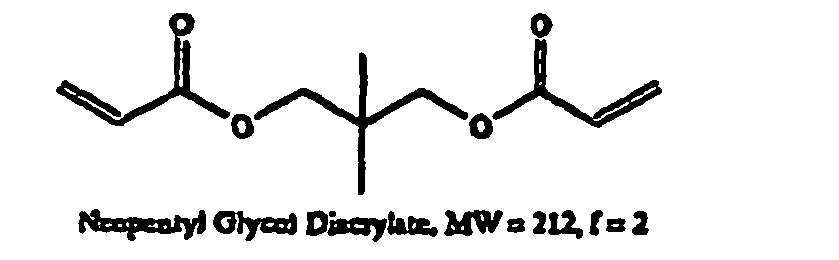
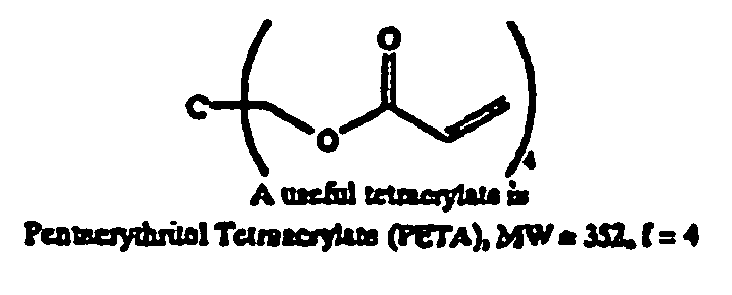
- Among the multiacrylates used to make the oligomers of this invention are diacrylates, triacrylates and tetracrylates.
- Examples of diacrylates are:




- Examples of triacrylates are:


- Examples of suitable Michael Donors include active methylene compounds such as acetoacetates, cyanoacetates, 2, 4-pentanediones, malonate esters, acetoacetanilides, and acetoacetamides. The Michael Donors have functionality of at least two and typically from about 2 to about 8.
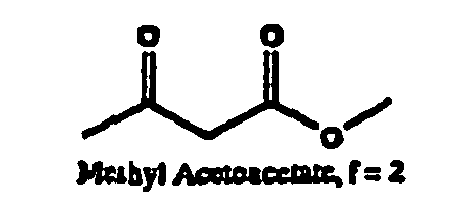
- Examples of acetoacetates having a functionality of two are:


- Examples of acetoacetates having a functionality of four are:


- Examples of acetoacetates having a functionality of six are:


- An example of an acetoacetate having a functionality of eight is:

- According to the present invention, the multifunctional acrylate must be employed in amounts in excess of the equivalent reaction amounts with respect to the Michael Donor. Typically, the equivalent ratio of the multifunctional acrylate to acetoacetate is at least 1: 1 to about 13.2:1.
- By way of illustrations, the following preferred equivalent ratios are provided:
- 1) diacrylate acceptor: Michael Donor of
>1:1 where donor functionality = 2
≥4.5:1 where donor functionality =4
≥4.5:1 where donor functionality = 6
≥4.5 :1 where donor functionality = 8 - 2) triacrylate acceptor: Michael donor of
≥2.25 where donor functionality =2
≥6.4:1 where donor functionality =4
≥7.8:1 where donor functionality =6
≥7.4:1 where donor functionality =8 - 3) tetraacrylate acceptor: Michael Donor of
≥6.6:1 where donor functionality =2
≥12.3:1 where donor functionality =4
≥13.2:1 where donor functionality =6
≥12.7:1 where donor functionality =8. - The equivalent ratio of the unreacted acrylate double bands in above Michael reaction product to the secondary amine is typically about 100:1 to about 2:1, more typically about 50:1 to about 4:1, and preferably about 10:1 to about 6:1.
- Typical primary amines are aliphatic amines such as mono- and polyamines and including alkyl amines, hydroxyalkyl amines and cyclic amines. Examples of same suitable primary amines are ethanolamine, 1-amino-2-propanol, aminopropyl triethoxysilane; difunctional primary amines such as methyl-1,6-hexanediamine, 2-methyl-1, 5-pentanediamine, 1,3-diamino pentane; Jeffamine® T-403 (a trifunctional amine); 3-aminopropyl trimethoxysilane, ethylamine, ethylene diamine, benzylamine, n-butylamine, sec-butylamine, 2-amino-1-butanol, 3-amino-1,2-propanediol, 3-(dimethylamino) propylamine, 3-(diethylamino) propylamine, propylamine, diaminopropane, diaminobutane, hexylamine, heptylamine, 1,6-hexanediamine, 1,2-diaminocyclohexane, 1,4-diamino cyclohexane, diethylenetriamine, triethylenetetramine, tetraethylenepentamine and isophorone diamine.
Typically, secondary amines are alkyl amines, hydroxyalkyl amines and cyclic amines. Suitable alkyl amines are dimethylamine, diethylamine and dipropylamine, and dibutylamine. Suitable hydroxyalkyl amines are diethanolamine and N-methylethanolamine. Suitable cyclic amines are piperidine, piperazine and morpholine. - The secondary amines are preferred.
- The Michael addition reactions can be catalyzed by a strong base; diazabicycloundecene (DBU) is sufficiently strong and readily soluble in the monomer mixtures. Other cyclic amidines, for example diazabicyclo-nonene (DBN) and guanidines are also suitable for catalyzing this reaction.
- The compositions of the present invention can be cured without added photoinitiators by exposure to actinic light and especially to UV radiation.
- The liquid oligomer compositions of the present invention, since they are liquids, can readily be applied to various substrates using coating technologies such as roll or spray prior to the actinic light cure.
- The following non-limiting examples are presented to further illustrate the present invention. In the following examples, all parts are by weight unless otherwise indicated. In addition, all references mentioned herein are specifically incorporated by reference.
- A 2 g sample of resin prepared via the Michael Addition of ethyl acetoacetate (5%) to trimethylolpropane triacrylate (TMPTA, 95%) followed by reaction with diethanolamine (10% with respect to acrylate component) is placed in an aluminum pan and subjected to one 630 mJ/cm2 (approximate) exposure to a Fusion "H" bulb: A rigid, dry, tack-free film with no amine odor is obtained.
- Example 1 is repeated except that the secondary amine was not used. A rigid film with a slightly tacky surface (slight oxygen inhibition) is obtained.
- A 2g sample of resin prepared via the Michael-Type Addition of diethanol amine (10%) and TMPTA (90%) is placed in an aluminum pan and subjected to one 630 mJ/cm2 (approximate) exposure to a Fusion "H" bulb. A thin, fragile "skin" forms over unreacted material.
- A 2 g mixture consisting of TMPTA (90%) and N,N-dimethyl ethanolamine (10%) is placed in an aluminum pan and subjected to one 630 mJ/cm2 (approximate) exposure to a Fusion "H" bulb. A fragile film with a wet surface forms; a strong amine odor is detected.
- A 2 g sample of TMPTA is placed in an aluminum pan and subjected to one 630 mJ/cm2 (approximate) exposure to a Fusion "H" bulb. TMPTA remains liquid, with no evidence of reaction.
- A 2 g sample of resin prepared via the Michael Addition of ethyl acetoacetate (5%) propoxylated glycerin triacrylate (GPTA) (95%) followed by reaction with diethanolamine (10% with respect to acrylate component) is placed in an aluminum pan and subjected to one 630 mJ/cm2 (approximate) exposure to a Fusion "H" bulb. A rigid, dry, tack-free film with no amine odor is obtained.
- A 2 g sample of resin prepared via the Michael Addition of ethyl acetoacetate (5%) to GPTA (95%) is placed in an aluminum pan and subjected to one 630 mJ/cm2 (approximate) exposure to a Fusion ''H'' bulb. A rigid film with a slightly wet surface (some oxygen inhibition) is obtained.
- A 2 g sample of resin prepared via the Michael-Type Addition of diethanol amine (10%) and GPTA (90%) is placed in an aluminum pan and subjected to one 630 mJ/cm2 (approximate) exposure to a Fusion "H" bulb. A thin, fragile "skin" forms over unreacted material.
- A 2 g mixture consisting of GPTA (90%) and N,N-dimethyl ethanolamine 10%) is placed in an aluminum pan and subjected to one 630 mJ/cm2 (approximate) exposure to a Fusion "H" bulb. A fragile film with a wet surface forms; a strong amine odor is detected.
- A 2 g sample of GPTA is placed in an aluminum pan and subjected to one 630 mJ/cm2 (approximate) exposure to a Fusion "H" bulb. GPTA remains liquid, with no evidence of reaction.
- A 2g sample of resin prepared via the Michael Addition of ethyl acetoacetate (5%) to pentaerythritol triacrylate (SR 444) (95%) followed by reaction with diethanolamine (10% with respect to acrylate component) is placed in an aluminum pan and subjected to one 630 mJ/cm2 (approximate) exposure to a Fusion "H" bulb. A rigid, dry, tack-free film with no amine odor is obtained.
- A 2 g sample of resin prepared via the Michael Addition of ethyl acetoacetate (5%) of SR 444 (95%) is placed in an aluminum pan and subjected to one 630 mJ/cm2 (approximate) exposure to a Fusion "H" bulb. A rigid film with a slightly tacky surface (slight oxygen inhibition) is obtained.
- A 2 g sample of resin prepared via the Michael-Type Addition of diethanol amine (10%) and SR 444 (90%) is placed in an aluminum pan and subjected to one 630 mJ/cm2 (approximate) exposure to a Fusion "H" bulb. A thin, fragile "skin" forms over unreacted material.
- A 2 g mixture consisting of SR 444 (90%) and N,N-dimethyl ethanolamine (10%) is placed in an aluminum pan and subjected to one 630 mJ/cm2 (approximate) exposure to a Fusion "H" bulb. A fragile film with a wet surface forms; a strong amine odor is detected.
- A 2 g sample of SR 444 is placed in an aluminum pan and subjected to one 630 mJ/cm2 (approximate) exposure to a Fusion "H" bulb. SR 444 remains liquid, with no evidence of reaction.
- A 2 g sample of resin prepared via the Michael-Type Addition of ethanolamine (5%) to pentaerythritol triacrylate (95%), followed by DBU-catalyzed Michael Addition of ethyl acetoacetate (2.5%) to the amine-pentaerythritol triacrylate product (97.5%), is placed in an aluminum pan and subjected to one 500 mJ/cm2 (approximate) exposure to a 300 W/in Fusion "H" bulb. A rigid, dry, tack-free film is obtained.
- A 2 g sample of resin via the DBU-catalyzed Michael Addition of ethyl acetoacetate (2.6%) to pentaerythritol triacrylate (97.4%) is placed in an aluminum pan and subjected to one 500 mJ/cm2 (approximate) exposure to a 300 W/in Fusion "H" bulb. A rigid film with a slightly tacky surface (slightly oxygen inhibited) is obtained.
- A 2 g sample of resin prepared via the Michael-Type Addition of ethanolamine (5%) to pentaerythritol triacrylate (95%) is placed in an aluminum pan and subjected to one 500 mJ/cm2 (approximate) exposure to a 300 W/in Fusion "H" bulb. A thin, fragile surface "skin" forms over unreacted liquid material.
- A 2 g sample of resin prepared via the Michael-Type Addition of Vestamin® TMD (5%) to pentaerythritol triacrylate (95%), followed by DBU-catalyzed Michael Addition of ethyl acetoacetate (2.5%) in the amine-pentaerythritol triacylate product (97.5%), is placed in an aluminum pan and subjected to one 500 mJ/cm2 (approximate) exposure to a 300 W/in Fusion "H" bulb. A rigid, dry, tack-free film is obtained.
- A 2 g sample of resin prepared via the Michael-Type Addition of Vestamin® TMD (trimethyl-1,6-hexanediamine, mix of 2,2,4- and 2,4,4- isomers, 5%) to pentaerythritol triacrylate (95%) is placed in an aluminum pan and subjected to one 500 mJ/cm2 (approximate) exposure to a 300 W/in Fusion "H" bulb. A thin, fragile surface "skin" forms over unreacted liquid material.
- A 2 g sample of resin prepared via the Michael-Type Addition of Dytek® A(2-methyl-1,5-pentanediamine, 2.5%) to pentaerythritol triacrylate product (97.5%), was placed in an aluminum pan and subjected to one 500 mJ/cm2 (approximate) exposure to a 300 W/in Fusion "H" bulb. A rigid, dry, tack-free film was obtained.
- A 2 g sample resin prepared via the Michael-Type Addition of Dytek® A(2-methyl-1,5-pentanediamine, 2.5%) to pentaerythritol triacrylate (97.5%) was placed in an aluminum pan and subjected to one 500 mJ/cm2 (approximate) exposure to 300 W/in Fusion "H" bulb. A thin, fragile surface "skin" formed over unreacted liquid material.
- A 2 g sample of resin prepared via the Michael-Type Addition of Dytek® EP (1,3-diamino pentane, 2.5%) to pentaerythritol triacrylate (97.5%), followed by DBU-catalyzed Michael Addition of ethyl acetoacetate (2.5%) to the amine-pentaerythritol triacrylate product (97.5%), is placed in an aluminum pan and subjected to one 500 mJ/cm2 (approximate) exposure to a 300 W/in Fusion "H" bulb. A rigid, dry, tack-free film is obtained.
- A 2 g sample of resin prepared via the Michael-Type Addition of Dytek® EP (1,3-diamino pentane, 2.5%) to pentaerythritol triacrylate (97.5%) is placed in an aluminum pan and subjected to one 500 mJ/cm2 (approximate) exposure to a 300 W/in Fusion "H" bulb. A thin, fragile surface "skin" forms over unreacted liquid material.
- The following is observed from the results obtained from the above examples.
- 1. Controls, i.e., neat multifunctional acrylates, fail to react upon exposure to UV light in the absence of appropriate additives.
- 2. Blending in a tertiary amine (dimethyl ethanolamine) aids reaction, but surfaces remain wet and amine odor remains; better surface cure and lower odor results from reacting a primary or secondary amine with a portion of the acrylate groups prior to UV cure, but through cure is incomplete.
- 3. Acetoacetate-multifunctional acrylate products show good through cure upon exposure to UV light but some oxygen inhibition at the surface; reaction with a primary or secondary amine produces a resin with both good through cure and reduced oxygen inhibition at the surface.
- According to the present invention, the primary and/or secondary amine is incorporated into the resin as a tertiary amine group - the amine is thus bound as part of the resin structure (see Scheme 1), as opposed to simple physical mixing (Scheme II). The invention crosslinks upon exposure to UV in the absence of added photoinitiator and exhibits better surface cure compared to simple blends of multifunctional acrylates and tertiary amine.

- The foregoing description of the invention illustrates and describes the present invention. Additionally, the disclosure shows and describes only the preferred embodiments of the invention but, as mentioned above, it is to be understood that the invention is capable of use in various other combinations, modifications, and environments and is capable of changes or modifications within the scope of the inventive concept as expressed herein, commensurate with the above teachings and/or the skill or knowledge of the relevant art. The embodiments described herein above are further intended to explain best modes known of practicing the invention and to enable others skilled in the art to utilize the invention in such, or other, embodiments and with the various modifications required by the particular applications or uses of the invention. Accordingly, the description is not intended to limit the invention to the form disclosed herein. Also, it is intended that the appended claims be construed to include alternative embodiments.
Claims (23)
- A self-photoinitiating liquid oligomeric composition having tertiary amine groups comprising Michael Addition reaction product of:A) uncrosslinked Michael Addition reaction product of a multifunctional acrylate Michael Acceptor and an active methylene-containing Michael Donor wherein the equivalent ratio of the multifunctional acrylate Michael Acceptor to the active methylene-containing Michael Donor is at least about >1:1; andB) at least one amine selected from the group consisting of primary amines and secondary amines wherein the equivalent ratio of unreacted acrylate double bonds in A):B) is about 100:1 to about 2:1.
- The composition of claim 1 wherein the multifunctional acrylate Michael Acceptor is a diacrylate selected from the group of diethylene glycol diacrylate, ethoxylated bisphenol A diacrylate, 1,6-hexanediol diacrylate, neopentyl glycol diacrylate, polyethylene glycol (Mn200) diacrylate, polyethylene glycol (Mn400) diacrylate, propoxylated neopentyl glycol diacrylate, tetraethylene glycol diacrylate, triethylene glycol diacrylate, and tripropylene glycol diacrylate.
- The composition of claim 1 wherein the multifunctional acrylate Michael Acceptor is a triacrylate selected from the group consisting of trimethylolpropane triacrylate, ethoxylated trimethylolpropane triacrylate, tris(2-hydroxyethyl) isocyanurate triacrylate, propoxylated glyceryl triacrylate and pentaerythritol triacrylate.
- The composition of claim 1 wherein the multifunctional acrylate Michael Acceptor comprises pentaerythritol triacrylate.
- The composition of claim 1 wherein the multifunctional acrylate Michael Acceptor comprises diethylene glycol diacrylate.
- The composition of claim 1 wherein the multifunctional acrylate Michael Acceptor comprises propoxylated glyceryl triacrylate.
- The composition of claim 1 wherein the active methylene-containing Michael Donor is at least one member selected from the group of acetoacetates, cyanoacetates, 2,4-pentanediones. malonate esters, acetoacetanilides and acetoacetamides.
- The composition of claim 1 wherein the active methylene-containig Michael Donor comprises an acetoacetate.
- The composition of claim 8 wherein the acetoacetate is selected from the group consisting of ethyl acetoacetate, 1-butylacetoacetate, methyl acetoacetate, 2-ethylhexyl acetoacetate, lauryl acetoacetate, acetoacetanilide, 2-acetoacetoxylethyl methacrylate, allyl acetoacetate, 1,4-butanediol diacetoacetate,1,6-hexanediol diacetoacetate, neopentyl glycol diacetoacetate, cyclohexane dimethanol diacetoacetate, ethoxylated bisphenol A diacetoacetate, trimethylolpropane triacetoacetate, glycerin triacetoacetate, polycaprolactone triacetoacetates, and pentaerythritol tetraacetoacetate.
- The composition of claims 8 wherein the acetoacetate comprises ethyl acetoacetate.
- The composition of claim 1 wherein the amine is a primary amine.
- The composition of claim 11 wherein the primary amine is at least one member selected from the group consisting of alkylamines, hydroxyalkyl amines and cyclic amines.
- The composition of claim 11 wherein the amine is selected from the group consisting of ethanolamine, 1-amino-2-propanol, aminopropyl triethoxysilane, trimethyl-1,6-hexanediamine, 2-methyl-1,5-pentanediamine, 1,3-diaminopentane; 3-aminopropyl trimethoxysilane; ethylamine, ethylene diamine, benzylamine, n-butylamine, sec-butylamine, 2-amino-1-butanol, 3-amino-1,2-propanediol, 3-(dimethylamino)-propylamine, 3-(diethylamino)propylamine, propylamine, diaminopropane, diaminobutane, hexylamine, heptylamine, 1,6-hexanediamine, 1,2-diaminocyclohexane, 1,4-diaminocyclohexane, diethylenetriamine, triethylenetetramine, tetraethylenepentamine and isophorone diamine.
- The composition of claim 1 wherein the amine is a secondary amine.
- The composition of claim, 14 wherein the secondary amine is at least one member selected from the group consisting of alkylamines, hydroxyalkyl amines and cyclic amines.
- The composition of claim 14 wherein the secondary amine is at least one member selected from the group consisting of dimethylamine, diethylamine, dipropylamine, dibutylamine, diethanolamine, N-methyl ethanolamine, piperidine and morpholine.
- The composition of claim 14 wherein the secondary amine comprises diethanolamine.
- A crosslinked polymer composition obtainable by subjecting the composition of any of claims 1 to 17 actinic light.
- A method for curing the composition of any of claims 1 to 17 which comprises exposing the composition to actinic light
- The method of claim 19 wherein the actinic light is UV radiation.
- A method for providing a coated substrate which comprises applying the composition of any of claims 1 to 17 to a substrate and then exposing the composition to actinic light.
- The method of claim 21 wherein the actinic light is UV radiation.
- The coated substrate obtainable by the method of claim 21 or 22.
Applications Claiming Priority (3)
| Application Number | Priority Date | Filing Date | Title |
|---|---|---|---|
| US974819 | 2001-10-12 | ||
| US09/974,819 US6673851B2 (en) | 2001-10-12 | 2001-10-12 | Self-photoinitiating multifunctional acrylates |
| PCT/US2002/032192 WO2003031502A1 (en) | 2001-10-12 | 2002-10-08 | Self-photoinitiating multifunctional acrylates |
Publications (3)
| Publication Number | Publication Date |
|---|---|
| EP1453892A1 EP1453892A1 (en) | 2004-09-08 |
| EP1453892A4 EP1453892A4 (en) | 2005-03-02 |
| EP1453892B1 true EP1453892B1 (en) | 2008-01-16 |
Family
ID=25522457
Family Applications (1)
| Application Number | Title | Priority Date | Filing Date |
|---|---|---|---|
| EP02778480A Expired - Lifetime EP1453892B1 (en) | 2001-10-12 | 2002-10-08 | Self-photoinitiating multifunctional acrylates |
Country Status (11)
| Country | Link |
|---|---|
| US (1) | US6673851B2 (en) |
| EP (1) | EP1453892B1 (en) |
| JP (1) | JP4202919B2 (en) |
| CN (1) | CN1298769C (en) |
| AT (1) | ATE384091T1 (en) |
| CA (1) | CA2463541C (en) |
| DE (1) | DE60224715T2 (en) |
| DK (1) | DK1453892T3 (en) |
| ES (1) | ES2295417T3 (en) |
| MX (1) | MXPA04003361A (en) |
| WO (1) | WO2003031502A1 (en) |
Families Citing this family (44)
| Publication number | Priority date | Publication date | Assignee | Title |
|---|---|---|---|---|
| KR20030053018A (en) * | 2001-12-21 | 2003-06-27 | 다이니혼 잉키 가가쿠 고교 가부시키가이샤 | CURABLE RESIN COMPOSITIONS AND PROCESS FOR PREPARING OLIGOMERS AND POLYMERS HAVING ACRYLOYL GROUPS, SUBSTITUTED METHACRYLATE GROUPS AND β-DICARBONYL GROUPS |
| CA2414719C (en) * | 2001-12-21 | 2009-07-21 | Dainippon Ink And Chemicals, Inc. | Curable resin compositions and process for preparing oligomers containing acrylate groups and substituted methacrylate groups |
| CN100473667C (en) * | 2002-04-03 | 2009-04-01 | 大日本油墨化学工业株式会社 | Photoinitiator, novel compound and photocurable composition |
| JP2004151691A (en) * | 2002-09-30 | 2004-05-27 | Rohm & Haas Electronic Materials Llc | Improved photoresist |
| US6878845B2 (en) * | 2002-10-15 | 2005-04-12 | Ashland Inc. | Oligomers from multifunctional acrylates |
| US8013068B2 (en) * | 2003-01-02 | 2011-09-06 | Rohm And Haas Company | Michael addition compositions |
| US7291658B2 (en) * | 2003-10-14 | 2007-11-06 | Ashland Licensing And Intellectual Property Llc | Radiation-curable inks for flexographic and screen-printing applications from multifunctional acrylate oligomers |
| US7252709B2 (en) * | 2003-10-14 | 2007-08-07 | Ashland Licensing And Intellectual Property Llc | Multifunctional acrylate oligomers as pigment grinding vehicles for radiation-curable ink applications |
| US20050261391A1 (en) * | 2004-04-21 | 2005-11-24 | Sridevi Narayan-Sarathy | Radiation-curable high gloss overprint varnish compositions |
| US7524565B2 (en) * | 2004-04-21 | 2009-04-28 | Ashland Licensing And Intellectual Property Llc | Radiation curable Michael addition resins having built-in photoinitiators |
| US20050245636A1 (en) * | 2004-04-29 | 2005-11-03 | Ashland Inc. | Radiation-curable coatings for wood substrates from multifunctional acrylate oligomers |
| US7214725B2 (en) * | 2004-04-30 | 2007-05-08 | Ashland Licensing And Intellectual Property Llc | Radiation-curable lithographic inks from multifunctional acrylate oligomers |
| US7232540B2 (en) * | 2004-05-02 | 2007-06-19 | Ashland Licensing And Intellectual Property Llc | Radiation-curable coatings for plastic substrates from multifunctional acrylate oligomers |
| JP2007536403A (en) * | 2004-05-02 | 2007-12-13 | アシュランド・ライセンシング・アンド・インテレクチュアル・プロパティー・エルエルシー | Radiation curable coatings for metal substrates from polyfunctional acrylate oligomers |
| US7307106B2 (en) * | 2004-12-10 | 2007-12-11 | 3M Innovative Properties Company | Photocurable Michael addition polymers |
| US20070004815A1 (en) * | 2005-06-30 | 2007-01-04 | Ashland Licensing And Intellectual Property Llc | Self-photoinitiating multifunctional urethane oligomers containing pendant acrylate groups |
| WO2007010865A1 (en) * | 2005-07-19 | 2007-01-25 | Toyo Ink Mfg. Co., Ltd. | Curable composition, cured film and multilayer body |
| CN101360777B (en) * | 2005-11-30 | 2012-12-19 | 亚什兰许可和知识产权有限公司 | Prepregs and cured in place solid surfaces prepared therefrom |
| AU2007243483B2 (en) | 2006-04-24 | 2012-07-26 | Incept, Llc | Protein crosslinkers, crosslinking methods and applications thereof |
| US8231973B2 (en) * | 2006-06-13 | 2012-07-31 | 3M Innovative Properties Company | Fluoro(meth)acrylate polymer composition suitable for low index layer of antireflective film |
| IN2009CN03518A (en) * | 2006-12-21 | 2015-09-04 | Agfa Graphics Nv | |
| CN101573387B (en) * | 2006-12-21 | 2013-05-29 | 爱克发印艺公司 | Novel radiation curable compositions |
| IN2009CN03580A (en) * | 2006-12-21 | 2015-09-11 | Agfa Graphics Nv | |
| US7705064B2 (en) * | 2007-07-23 | 2010-04-27 | Henkel Corporation | Photosensitive compounds, photopolymerizable compositions including the same, and methods of making and using the same |
| JP5654207B2 (en) * | 2008-03-24 | 2015-01-14 | アイカ工業株式会社 | Resin composition, hard coat agent, film, and method for producing molded article |
| EP2403911A1 (en) * | 2009-03-04 | 2012-01-11 | Basf Se | Radiation curable coating compounds comprising diacrylate |
| EP2236541A1 (en) | 2009-03-25 | 2010-10-06 | DSM IP Assets B.V. | Polyesteramide macromolecule and composition comprising such a macromolecule. |
| GB201005060D0 (en) | 2010-03-25 | 2010-05-12 | Davidson Robert S | Synergists |
| KR101267763B1 (en) | 2011-02-07 | 2013-05-24 | 조선대학교산학협력단 | Self-photoinitiating azobenzene acrylate, process for preparing the same, and PDLC composition comprising the same |
| JP6183642B2 (en) * | 2012-08-10 | 2017-08-23 | 株式会社リコー | Actinic ray curable composition, actinic ray curable ink composition for inkjet printing using the same, and actinic ray curable adhesive composition |
| EP3283584A1 (en) * | 2015-04-17 | 2018-02-21 | Allnex Netherlands B.V. | A rma crosslinkable composition with improved adhesion |
| CN107660227B (en) | 2015-04-17 | 2021-07-16 | 欧尼克斯荷兰有限公司 | floor coating composition |
| CA2983148C (en) | 2015-04-17 | 2023-05-09 | Allnex Netherlands B.V. | Process for the manufacture of a crosslinkable composition |
| PL3283587T3 (en) | 2015-04-17 | 2024-07-22 | Allnex Netherlands B.V. | Rma crosslinkable compositions and rma crosslinkable resins for easy to clean coatings |
| FR3035109B1 (en) * | 2015-04-20 | 2017-04-28 | Arkema France | HIGH-FUNCTIONALITY AMINOACRYLATE-ACRYLATE URETHANES DERIVED FROM THE ADDITION OF A SECONDARY AMINOALCOHOL AMINOALCOOL TO A MULTIFUNCTIONAL ACRYLATE. |
| US11370995B2 (en) * | 2017-07-31 | 2022-06-28 | Dow Global Technologies Llc | Detergent additive |
| US11162056B2 (en) * | 2017-07-31 | 2021-11-02 | Dow Global Technologies Llc | Encapsulation method |
| JP7359520B2 (en) | 2018-02-22 | 2023-10-11 | ビーエーエスエフ ソシエタス・ヨーロピア | Polyurethane-based polymer material with excellent thermal deformation resistance and tear elongation |
| WO2019212879A1 (en) * | 2018-05-03 | 2019-11-07 | Dow Global Technologies Llc | Method for providing substrate coated with a cured damping coating and coated substrate so provided |
| CN110760047B (en) * | 2018-07-26 | 2022-04-19 | 万华化学集团股份有限公司 | Bis-secondary amine containing siloxane group and preparation method and application thereof |
| KR102852297B1 (en) * | 2019-03-22 | 2025-09-01 | 헨켈 아게 운트 코. 카게아아 | Coating for waterproofing electronic components |
| CN112048206B (en) * | 2020-09-15 | 2021-11-16 | 王俊宇 | Michael addition curing coating system containing adhesion promoter |
| WO2023139231A1 (en) * | 2022-01-21 | 2023-07-27 | Arxada Ag | Resin composition |
| WO2025249512A1 (en) * | 2024-05-30 | 2025-12-04 | キヤノン株式会社 | Ink, inkjet recording method, and inkjet recording device |
Family Cites Families (16)
| Publication number | Priority date | Publication date | Assignee | Title |
|---|---|---|---|---|
| US925349A (en) * | 1909-06-15 | Paul H Kraetsch | Box. | |
| US3925349A (en) | 1972-09-18 | 1975-12-09 | Desoto Inc | Radiation curable non-gelled michael addition reaction products |
| US4284776A (en) * | 1977-12-09 | 1981-08-18 | Ppg Industries, Inc. | Radiation curable Michael addition amine adducts of amide acrylate compounds |
| US4217439A (en) | 1978-06-19 | 1980-08-12 | Armstrong Cork Company | Acrylate-acetoacetamide polymers |
| US4221902A (en) | 1978-09-14 | 1980-09-09 | Armstrong Cork Company | Acrylate-ureadiacetoacetamide-diacetoacetamide copolymers |
| US4218515A (en) | 1979-05-14 | 1980-08-19 | Heckles John S | Acrylate-cyanoacetate-ureadiacetoacetamide-diacetoacetamide copolymers useful as protective surfaces |
| DE3315469A1 (en) * | 1983-04-28 | 1984-10-31 | Hoechst Ag, 6230 Frankfurt | HARDENING COMPONENT FOR SYNTHETIC RESINS CONTAINING GROUPS APPROPRIATE FOR AMID OR ESTER FORMATION WITH CARBONIC ACIDS |
| EP0160824B2 (en) * | 1984-04-04 | 1994-08-03 | Hoechst Aktiengesellschaft | Reaction product of olefinically unsaturated compounds with active hydrogen compounds, process for their preparation and 2-component coating systems based thereon |
| DE3417441A1 (en) | 1984-05-11 | 1985-11-14 | Hoechst Ag, 6230 Frankfurt | HARDENING COMPONENT FOR SYNTHETIC RESINS CONTAINING GROUPS APPROPRIATE FOR AMID OR ESTER FORMATION WITH CARBONIC ACIDS |
| US5969046A (en) * | 1986-11-18 | 1999-10-19 | Rohm And Haas Company | Reacting methylene and alkene components in presence of tertiary amine reacted with epoxide |
| US5021511A (en) | 1988-12-27 | 1991-06-04 | Rohm And Haas Company | Polymer compositions derived from acryloxyalkylcyanoacetamides |
| US5430177A (en) | 1991-12-23 | 1995-07-04 | Albemarle Corporation | Polyfunctional Michael addition products |
| CA2141515A1 (en) * | 1994-02-08 | 1995-08-09 | John D. Blizzard | Abrasion-resistant coating |
| US5945489A (en) | 1997-09-19 | 1999-08-31 | Ashland, Inc. | Liquid oligomers containing unsaturation |
| US6025410A (en) * | 1997-09-19 | 2000-02-15 | Ashland Inc. | Liquid oligomers containing acrylate unsaturation |
| US6172129B1 (en) * | 1999-01-29 | 2001-01-09 | Sartomer Technologies, Inc. | Cyclic amine acrylate monomers and polymers |
-
2001
- 2001-10-12 US US09/974,819 patent/US6673851B2/en not_active Expired - Lifetime
-
2002
- 2002-10-08 CA CA002463541A patent/CA2463541C/en not_active Expired - Lifetime
- 2002-10-08 MX MXPA04003361A patent/MXPA04003361A/en active IP Right Grant
- 2002-10-08 DK DK02778480T patent/DK1453892T3/en active
- 2002-10-08 DE DE60224715T patent/DE60224715T2/en not_active Expired - Lifetime
- 2002-10-08 JP JP2003534482A patent/JP4202919B2/en not_active Expired - Fee Related
- 2002-10-08 CN CNB028200985A patent/CN1298769C/en not_active Expired - Fee Related
- 2002-10-08 EP EP02778480A patent/EP1453892B1/en not_active Expired - Lifetime
- 2002-10-08 AT AT02778480T patent/ATE384091T1/en not_active IP Right Cessation
- 2002-10-08 WO PCT/US2002/032192 patent/WO2003031502A1/en not_active Ceased
- 2002-10-08 ES ES02778480T patent/ES2295417T3/en not_active Expired - Lifetime
Also Published As
| Publication number | Publication date |
|---|---|
| ATE384091T1 (en) | 2008-02-15 |
| JP2005505653A (en) | 2005-02-24 |
| US20030073757A1 (en) | 2003-04-17 |
| CN1298769C (en) | 2007-02-07 |
| DE60224715T2 (en) | 2009-01-22 |
| ES2295417T3 (en) | 2008-04-16 |
| WO2003031502A1 (en) | 2003-04-17 |
| CA2463541A1 (en) | 2003-04-17 |
| EP1453892A4 (en) | 2005-03-02 |
| DK1453892T3 (en) | 2008-05-13 |
| DE60224715D1 (en) | 2008-03-06 |
| US6673851B2 (en) | 2004-01-06 |
| CA2463541C (en) | 2008-12-23 |
| JP4202919B2 (en) | 2008-12-24 |
| MXPA04003361A (en) | 2004-08-11 |
| CN1568341A (en) | 2005-01-19 |
| EP1453892A1 (en) | 2004-09-08 |
Similar Documents
| Publication | Publication Date | Title |
|---|---|---|
| US6673851B2 (en) | Self-photoinitiating multifunctional acrylates | |
| US7709545B2 (en) | Benzophenone/thioxanthone derivatives and their use in photopolymerizable compositions | |
| JP5587408B2 (en) | Dissociation method of organoborane-amine complex | |
| EP0632111B1 (en) | Coating process using radiation curable compositions | |
| AU713498B2 (en) | Anionic photocatalyst | |
| KR20060052928A (en) | Self-initiating polyfunctional acrylate and thiol double curing reaction product and synthesis method | |
| KR20070012502A (en) | Radiation Curing High Gloss Overprint Varnish Composition | |
| CN1140576C (en) | Crosslinkable surface coatings and method of preparation | |
| JP2007534800A (en) | Radiation curable Michael addition resin with photoinitiator | |
| EP3320002B1 (en) | Polymerization system using double click michael addition and photopolymerization | |
| TW201114858A (en) | Method of curing a coating composition comprising a radical curable compound and an organoborane-amine complex | |
| EP0906351B1 (en) | Photopolymerizable polyester composition and process for the production thereof | |
| AU2003282835B2 (en) | Oligomers from multifunctional acrylates | |
| DE60021717D1 (en) | NETWORKED ACRYLATE MICROPARTICLES, PROCESS FOR THEIR PREPARATION AND THEIR USE IN COATINGS AND MOLDING MATERIALS | |
| JPS5940846B2 (en) | Non-aqueous unsaturated resin composition | |
| FI74032C (en) | By radiation or photochemically curable composition for target paints, adhesives and insulation and sealants | |
| CA2535170A1 (en) | Method for improving environmental durability of materials | |
| JP2000119992A (en) | Active energy ray-hardenable resin composition for paper and its hardened material | |
| Hageman | Photoinitiators and photoinitiation, Part 14. N-substituted sulphamic esters of α-hydroxymethylbenzoin and α-hydroxymethylbenzoin ethers as multifunctional photo-initiators | |
| EP1169401A1 (en) | Radiation curable coating composition comprising a secondary curing agent | |
| JPS5821409A (en) | Water-miscible resin composition | |
| CA2032976A1 (en) | Photo-curable urea-containing compositions |
Legal Events
| Date | Code | Title | Description |
|---|---|---|---|
| PUAI | Public reference made under article 153(3) epc to a published international application that has entered the european phase |
Free format text: ORIGINAL CODE: 0009012 |
|
| 17P | Request for examination filed |
Effective date: 20040426 |
|
| AK | Designated contracting states |
Kind code of ref document: A1 Designated state(s): AT BE BG CH CY CZ DE DK EE ES FI FR GB GR IE IT LI LU MC NL PT SE SK TR |
|
| AX | Request for extension of the european patent |
Extension state: AL LT LV MK RO SI |
|
| A4 | Supplementary search report drawn up and despatched |
Effective date: 20050114 |
|
| 17Q | First examination report despatched |
Effective date: 20060907 |
|
| RAP1 | Party data changed (applicant data changed or rights of an application transferred) |
Owner name: ASHLAND LICENSING AND INTELLECTUAL PROPERTY LLC |
|
| GRAP | Despatch of communication of intention to grant a patent |
Free format text: ORIGINAL CODE: EPIDOSNIGR1 |
|
| GRAS | Grant fee paid |
Free format text: ORIGINAL CODE: EPIDOSNIGR3 |
|
| GRAA | (expected) grant |
Free format text: ORIGINAL CODE: 0009210 |
|
| AK | Designated contracting states |
Kind code of ref document: B1 Designated state(s): AT BE BG CH CY CZ DE DK EE ES FI FR GB GR IE IT LI LU MC NL PT SE SK TR |
|
| AX | Request for extension of the european patent |
Extension state: AL LT LV MK RO SI |
|
| REG | Reference to a national code |
Ref country code: GB Ref legal event code: FG4D |
|
| REG | Reference to a national code |
Ref country code: CH Ref legal event code: EP |
|
| REG | Reference to a national code |
Ref country code: IE Ref legal event code: FG4D |
|
| REF | Corresponds to: |
Ref document number: 60224715 Country of ref document: DE Date of ref document: 20080306 Kind code of ref document: P |
|
| REG | Reference to a national code |
Ref country code: SE Ref legal event code: TRGR |
|
| REG | Reference to a national code |
Ref country code: ES Ref legal event code: FG2A Ref document number: 2295417 Country of ref document: ES Kind code of ref document: T3 |
|
| REG | Reference to a national code |
Ref country code: DK Ref legal event code: T3 |
|
| PG25 | Lapsed in a contracting state [announced via postgrant information from national office to epo] |
Ref country code: AT Free format text: LAPSE BECAUSE OF FAILURE TO SUBMIT A TRANSLATION OF THE DESCRIPTION OR TO PAY THE FEE WITHIN THE PRESCRIBED TIME-LIMIT Effective date: 20080116 Ref country code: BG Free format text: LAPSE BECAUSE OF FAILURE TO SUBMIT A TRANSLATION OF THE DESCRIPTION OR TO PAY THE FEE WITHIN THE PRESCRIBED TIME-LIMIT Effective date: 20080416 |
|
| REG | Reference to a national code |
Ref country code: CH Ref legal event code: NV Representative=s name: VOSSIUS & PARTNER |
|
| ET | Fr: translation filed | ||
| PG25 | Lapsed in a contracting state [announced via postgrant information from national office to epo] |
Ref country code: PT Free format text: LAPSE BECAUSE OF FAILURE TO SUBMIT A TRANSLATION OF THE DESCRIPTION OR TO PAY THE FEE WITHIN THE PRESCRIBED TIME-LIMIT Effective date: 20080616 |
|
| PG25 | Lapsed in a contracting state [announced via postgrant information from national office to epo] |
Ref country code: SK Free format text: LAPSE BECAUSE OF FAILURE TO SUBMIT A TRANSLATION OF THE DESCRIPTION OR TO PAY THE FEE WITHIN THE PRESCRIBED TIME-LIMIT Effective date: 20080116 |
|
| PLBE | No opposition filed within time limit |
Free format text: ORIGINAL CODE: 0009261 |
|
| STAA | Information on the status of an ep patent application or granted ep patent |
Free format text: STATUS: NO OPPOSITION FILED WITHIN TIME LIMIT |
|
| PGFP | Annual fee paid to national office [announced via postgrant information from national office to epo] |
Ref country code: NL Payment date: 20081024 Year of fee payment: 7 |
|
| 26N | No opposition filed |
Effective date: 20081017 |
|
| PGFP | Annual fee paid to national office [announced via postgrant information from national office to epo] |
Ref country code: CH Payment date: 20081027 Year of fee payment: 7 Ref country code: DK Payment date: 20081030 Year of fee payment: 7 |
|
| PGFP | Annual fee paid to national office [announced via postgrant information from national office to epo] |
Ref country code: FI Payment date: 20081030 Year of fee payment: 7 |
|
| PGFP | Annual fee paid to national office [announced via postgrant information from national office to epo] |
Ref country code: BE Payment date: 20081112 Year of fee payment: 7 Ref country code: SE Payment date: 20081029 Year of fee payment: 7 |
|
| PG25 | Lapsed in a contracting state [announced via postgrant information from national office to epo] |
Ref country code: EE Free format text: LAPSE BECAUSE OF FAILURE TO SUBMIT A TRANSLATION OF THE DESCRIPTION OR TO PAY THE FEE WITHIN THE PRESCRIBED TIME-LIMIT Effective date: 20080116 |
|
| PG25 | Lapsed in a contracting state [announced via postgrant information from national office to epo] |
Ref country code: MC Free format text: LAPSE BECAUSE OF NON-PAYMENT OF DUE FEES Effective date: 20081031 |
|
| PG25 | Lapsed in a contracting state [announced via postgrant information from national office to epo] |
Ref country code: CY Free format text: LAPSE BECAUSE OF FAILURE TO SUBMIT A TRANSLATION OF THE DESCRIPTION OR TO PAY THE FEE WITHIN THE PRESCRIBED TIME-LIMIT Effective date: 20080116 |
|
| PG25 | Lapsed in a contracting state [announced via postgrant information from national office to epo] |
Ref country code: IE Free format text: LAPSE BECAUSE OF NON-PAYMENT OF DUE FEES Effective date: 20081008 |
|
| PGFP | Annual fee paid to national office [announced via postgrant information from national office to epo] |
Ref country code: CZ Payment date: 20090922 Year of fee payment: 8 |
|
| REG | Reference to a national code |
Ref country code: CH Ref legal event code: NV Representative=s name: VOSSIUS & PARTNER |
|
| BERE | Be: lapsed |
Owner name: ASHLAND LICENSING AND INTELLECTUAL PROPERTY LLC Effective date: 20091031 |
|
| REG | Reference to a national code |
Ref country code: NL Ref legal event code: V1 Effective date: 20100501 |
|
| REG | Reference to a national code |
Ref country code: CH Ref legal event code: PL |
|
| EUG | Se: european patent has lapsed | ||
| REG | Reference to a national code |
Ref country code: DK Ref legal event code: EBP |
|
| PG25 | Lapsed in a contracting state [announced via postgrant information from national office to epo] |
Ref country code: LU Free format text: LAPSE BECAUSE OF NON-PAYMENT OF DUE FEES Effective date: 20081008 Ref country code: NL Free format text: LAPSE BECAUSE OF NON-PAYMENT OF DUE FEES Effective date: 20100501 |
|
| PG25 | Lapsed in a contracting state [announced via postgrant information from national office to epo] |
Ref country code: TR Free format text: LAPSE BECAUSE OF FAILURE TO SUBMIT A TRANSLATION OF THE DESCRIPTION OR TO PAY THE FEE WITHIN THE PRESCRIBED TIME-LIMIT Effective date: 20080116 Ref country code: FI Free format text: LAPSE BECAUSE OF NON-PAYMENT OF DUE FEES Effective date: 20091008 |
|
| PG25 | Lapsed in a contracting state [announced via postgrant information from national office to epo] |
Ref country code: BE Free format text: LAPSE BECAUSE OF NON-PAYMENT OF DUE FEES Effective date: 20091031 Ref country code: LI Free format text: LAPSE BECAUSE OF NON-PAYMENT OF DUE FEES Effective date: 20091031 Ref country code: GR Free format text: LAPSE BECAUSE OF FAILURE TO SUBMIT A TRANSLATION OF THE DESCRIPTION OR TO PAY THE FEE WITHIN THE PRESCRIBED TIME-LIMIT Effective date: 20080417 Ref country code: CH Free format text: LAPSE BECAUSE OF NON-PAYMENT OF DUE FEES Effective date: 20091031 |
|
| PG25 | Lapsed in a contracting state [announced via postgrant information from national office to epo] |
Ref country code: DK Free format text: LAPSE BECAUSE OF NON-PAYMENT OF DUE FEES Effective date: 20091031 |
|
| PG25 | Lapsed in a contracting state [announced via postgrant information from national office to epo] |
Ref country code: SE Free format text: LAPSE BECAUSE OF NON-PAYMENT OF DUE FEES Effective date: 20091009 |
|
| PG25 | Lapsed in a contracting state [announced via postgrant information from national office to epo] |
Ref country code: CZ Free format text: LAPSE BECAUSE OF NON-PAYMENT OF DUE FEES Effective date: 20101008 |
|
| REG | Reference to a national code |
Ref country code: FR Ref legal event code: PLFP Year of fee payment: 14 |
|
| REG | Reference to a national code |
Ref country code: FR Ref legal event code: PLFP Year of fee payment: 15 |
|
| REG | Reference to a national code |
Ref country code: FR Ref legal event code: PLFP Year of fee payment: 16 |
|
| PGFP | Annual fee paid to national office [announced via postgrant information from national office to epo] |
Ref country code: FR Payment date: 20171025 Year of fee payment: 16 Ref country code: DE Payment date: 20171027 Year of fee payment: 16 |
|
| PGFP | Annual fee paid to national office [announced via postgrant information from national office to epo] |
Ref country code: GB Payment date: 20171027 Year of fee payment: 16 Ref country code: IT Payment date: 20171024 Year of fee payment: 16 Ref country code: ES Payment date: 20171102 Year of fee payment: 16 |
|
| REG | Reference to a national code |
Ref country code: DE Ref legal event code: R119 Ref document number: 60224715 Country of ref document: DE |
|
| GBPC | Gb: european patent ceased through non-payment of renewal fee |
Effective date: 20181008 |
|
| PG25 | Lapsed in a contracting state [announced via postgrant information from national office to epo] |
Ref country code: DE Free format text: LAPSE BECAUSE OF NON-PAYMENT OF DUE FEES Effective date: 20190501 |
|
| PG25 | Lapsed in a contracting state [announced via postgrant information from national office to epo] |
Ref country code: FR Free format text: LAPSE BECAUSE OF NON-PAYMENT OF DUE FEES Effective date: 20181031 |
|
| PG25 | Lapsed in a contracting state [announced via postgrant information from national office to epo] |
Ref country code: GB Free format text: LAPSE BECAUSE OF NON-PAYMENT OF DUE FEES Effective date: 20181008 Ref country code: IT Free format text: LAPSE BECAUSE OF NON-PAYMENT OF DUE FEES Effective date: 20181008 |
|
| REG | Reference to a national code |
Ref country code: ES Ref legal event code: FD2A Effective date: 20191129 |
|
| PG25 | Lapsed in a contracting state [announced via postgrant information from national office to epo] |
Ref country code: ES Free format text: LAPSE BECAUSE OF NON-PAYMENT OF DUE FEES Effective date: 20181009 |