EP1453330A1 - Mobile body communication system; radio communication control apparatus; mobile body communication apparatus; and mobile body communication method - Google Patents
Mobile body communication system; radio communication control apparatus; mobile body communication apparatus; and mobile body communication method Download PDFInfo
- Publication number
- EP1453330A1 EP1453330A1 EP02802722A EP02802722A EP1453330A1 EP 1453330 A1 EP1453330 A1 EP 1453330A1 EP 02802722 A EP02802722 A EP 02802722A EP 02802722 A EP02802722 A EP 02802722A EP 1453330 A1 EP1453330 A1 EP 1453330A1
- Authority
- EP
- European Patent Office
- Prior art keywords
- mobile communication
- information rate
- base station
- radio communication
- connections
- Prior art date
- Legal status (The legal status is an assumption and is not a legal conclusion. Google has not performed a legal analysis and makes no representation as to the accuracy of the status listed.)
- Withdrawn
Links
Images


Classifications
-
- H—ELECTRICITY
- H04—ELECTRIC COMMUNICATION TECHNIQUE
- H04W—WIRELESS COMMUNICATION NETWORKS
- H04W36/00—Hand-off or reselection arrangements
- H04W36/34—Reselection control
- H04W36/38—Reselection control by fixed network equipment
-
- H—ELECTRICITY
- H04—ELECTRIC COMMUNICATION TECHNIQUE
- H04B—TRANSMISSION
- H04B7/00—Radio transmission systems, i.e. using radiation field
- H04B7/02—Diversity systems; Multi-antenna system, i.e. transmission or reception using multiple antennas
- H04B7/022—Site diversity; Macro-diversity
-
- H—ELECTRICITY
- H04—ELECTRIC COMMUNICATION TECHNIQUE
- H04W—WIRELESS COMMUNICATION NETWORKS
- H04W28/00—Network traffic management; Network resource management
- H04W28/16—Central resource management; Negotiation of resources or communication parameters, e.g. negotiating bandwidth or QoS [Quality of Service]
- H04W28/18—Negotiating wireless communication parameters
- H04W28/22—Negotiating communication rate
-
- H—ELECTRICITY
- H04—ELECTRIC COMMUNICATION TECHNIQUE
- H04W—WIRELESS COMMUNICATION NETWORKS
- H04W36/00—Hand-off or reselection arrangements
- H04W36/16—Performing reselection for specific purposes
- H04W36/18—Performing reselection for specific purposes for allowing seamless reselection, e.g. soft reselection
-
- H—ELECTRICITY
- H04—ELECTRIC COMMUNICATION TECHNIQUE
- H04W—WIRELESS COMMUNICATION NETWORKS
- H04W52/00—Power management, e.g. Transmission Power Control [TPC] or power classes
- H04W52/04—Transmission power control [TPC]
- H04W52/18—TPC being performed according to specific parameters
- H04W52/26—TPC being performed according to specific parameters using transmission rate or quality of service QoS [Quality of Service]
-
- H—ELECTRICITY
- H04—ELECTRIC COMMUNICATION TECHNIQUE
- H04W—WIRELESS COMMUNICATION NETWORKS
- H04W52/00—Power management, e.g. Transmission Power Control [TPC] or power classes
- H04W52/04—Transmission power control [TPC]
- H04W52/38—TPC being performed in particular situations
- H04W52/40—TPC being performed in particular situations during macro-diversity or soft handoff
Definitions
- the present invention relates to a mobile communication system including a plurality of base stations and mobile communication apparatuses, and a radio communication control apparatus, a mobile communication apparatus, and a mobile communication method.
- a mobile station mobile communication apparatus
- Amobile station mobile communication apparatus
- Amobile station can use the system when it is positioned at least one of the base station cells. That is, the cells of the base stations collectively make up the service area of the system.
- the information rate between a base station and a mobile station in such a mobile communication system depends on the communication quality and tightly relates to the signal-to-interference power ratio (SIR).
- SIR signal-to-interference power ratio
- a high SIR at the mobile station (high transmission power at the base station) is required.
- a high SIR at the mobile station is not necessary (high transmission power at the base station is not necessary). The same applies to cases where data is transmitted from the mobile station to the base station.
- a mobile communication system must ensure a required communication quality and, for that purpose, uses transmission power control.
- a radio wave transmitted from a base station attenuates as it propagates through the air before reaching a mobile station.
- the attenuation is affected by the distance between the base station and the mobile station and geographic features of structures. Therefore, power received at the base station drastically varies (fades) as a mobile station being transmitting data moves if the transmission power is constant.
- Feedback transmission power control involves: at the receiving end, measuring the reception quality, comparing it with a desired value, associating the result of the comparison with a radio frame or timeslot, and feeding it back to the sending end; and at the sending end, controlling the transmission power according to the fed result of the comparison.
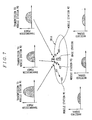
- Figure 7 shows signal levels obtained when transmission control is performed. If mobile stations M1 and M2 in Figure 7 communicate with the base station at the same information rate, transmission power is controlled in order to make the communication qualities equal to each other. As a result, communication between the base station and mobile station M1, which is farther away from the base station than mobile station M2 is, is carried out at a transmission power level higher than that of communication between the base station and mobile station M2. This transmission power control provides mobile stations M1 and M2 with the same reception quality.
- Mobile stations M2 andM3 in Figure 7 are at substantially equal distances to the base station but communication between mobile station M3 and the base station is carried out at an information rate higher than that of communication between mobile station M2 and base station. In this case, communication between the base station and mobile station M3 is performed at a transmission power level higher than that of communication between the base station and mobile station M2.
- transmission power control can maintain reception quality at the same level and, in addition, can reduce variations in communication quality depending on the location of a mobile station in the service area.
- This technology can also lower transmission power, thereby improving the efficiency of power usage.
- the reception quality that provides the measure for controlling transmission power may be, besides SIR, reception power (received signal level), the result of error detection by using signal quality (CRC: Cyclic Redundancy Check), or an error rate such as BLER (Block Error Rate) and BER (Bit Error Rate).
- CRC Cyclic Redundancy Check
- BLER Block Error Rate
- BER Bit Error Rate
- a mobile station in the mobile communication system can carry out communication when it is within the cell of a base station. As the mobile station moves across more than one cell, communication is switched from one base station to another. This is commonly known as a handover. Handover schemes can be classified broadly into two types. Aprior-art handover technology is described in Japanese Patent Laid-Open No. 2002-232353.
- a first scheme is called a hard handover (HHO).
- HHO hard handover
- a mobile station moves from one cell to another, the mobile station instantly switches to a base station to which it establishes a radio channel.
- the mobile station can carry out communication with only one base station at a time.
- a second scheme is called a diversity handover (DHO).
- DHO diversity handover
- the mobile station before a mobile station releases the radio channel to a base station to which it is connected, the mobile station establishes a radio channel to a new base station. Then, the mobile station releases the radio channel to the base station to which it has been connected.
- a mobile station can communicates with more than one base stations at a time. Each of radio channels the mobile station has established is called a DHO branch (or diversity branch) .
- the DHO scheme has an advantage over the HHO scheme in that a short transmission interrupt does not occur when connection is switched from one base station to another.
- the degree of fading depends on base stations. According to the DHO scheme, a decrease in the signal level of a base station due to fading can be compensated by another base station. Thus, the stability of communication quality can be maintained and transmission power can be reduced.
- Figure 8 shows a communication power levels when a DHO scheme is used.
- mobile station M4 is at the edge of the cell of base station B1 and also included in the cell of base station B2.
- Mobile station M5 is included only in the cell of base station B1 and, like mobile station M4, is positioned at the edge of the cell of base station B1.
- a DHO causes transmission power to mobile station M4 to be provided from base stations B1 and B2.
- predetermined total transmission power is provided. That is, the transmission power of each of base station B1 and B2 is the divisions of the predetermined transmission power and transmission power from B1 to mobile station M4 is smaller than transmission power from base station B1 to M5.
- transmission power control and DHO allow a mobile station to obtain a predetermined, required communication quality at anywhere in the coverage area of the mobile communication system.
- a mobile station uses more power for communication when it is at the edge of the cell of a base station than when it is near the base station.
- transmission power that each of a number of base stations should provide is relatively small.
- the system as a whole requires large transmission power.
- higher transmission power is required.
- Power that base station can transmit is limited. Therefore, a mobile station that is at the edge of its cell and consumes large transmission power may place overload on power resources and reduce the capacity of the base station. This causes a reduction in communication efficiency of the entire system.
- An object of the present invention is to prevent a reduction in communication efficiency of an entire DHO-based mobile communication system.
- a mobile communication system comprising a plurality of base station units (for example base stations 21-23, 31, 32 in Figure 1) having a predetermined radio communication coverage area (for example, the cells of the base stations 21-23, 31, 32 in Figure 1), a mobile communication apparatus (for example mobile stations 41- 43 in Figure 1) capable of communicating with the base station units, and a radio communication control apparatus that provides centralized control over the plurality of base station units, the mobile communication apparatus connecting to base station units corresponding to a plurality of radio communication coverage areas when the mobile communication apparatus is within an area in which the plurality of radio communication coverage areas overlap with each other, the mobile communication system comprising: connection count managing means (for example a DHO control unit 20e and a storage 20d in Figure 2) for managing the number of connections (for example "the number of DHO branches" in an embodiment of the present invention) that represents the number of base station units to which the mobile communication apparatus is connected; and information rate changing means (for example an information rate control unit 20c in Figure 2) for changing, based on
- the mobile communication system is also characterized in that the connection count managing means manages at any time the number of connections which changes as the mobile station moves; and the information rate changing means changes the information rate at any time based on the number of connections managed by the connection count managing means.
- the mobile communication system is also characterized in that the information rate changing means changes the information rate to a base rate divided by the number of connections, the base rate being an information rate at which the mobile communication apparatus is being connected to one of the base station units.
- the mobile communication system is also characterized in that the information rate changing means comprises storage means (for example the storage 20d in Figure 2) for storing a predetermined information rate corresponding to the number of connections and changes the information rate to the predetermined information rate stored in the storage means in accordance with the number of connections.
- storage means for example the storage 20d in Figure 2 for storing a predetermined information rate corresponding to the number of connections and changes the information rate to the predetermined information rate stored in the storage means in accordance with the number of connections.
- a radio communication control apparatus for a mobile communication system comprising a plurality of base station units having a predetermined radio communication coverage area, amobile communication apparatus capable of communicating with the base station units, and a radio communication control apparatus that provides centralized control over the plurality of base station units, the mobile communication apparatus connecting to base station units corresponding to a plurality of radio communication coverage areas when the mobile communication apparatus is within an area in which the plurality of radio communication coverage areas overlap with each other, the radio communication control apparatus being characterized by comprising: connection count managing means for managing the number of connections that represents the number of base station units to which the mobile communication apparatus is connected; and information rate changing means for changing, based on the number of connections managed by the connection count managing means, an information rate at which communication between the mobile communication apparatus and the base station unit corresponding to a radio communication coverage area in which the mobile communication apparatus is positioned is performed.
- the radio communication control apparatus is also characterized in that the connection count managing means manages at any time the number of connections which changes as the mobile station moves; and the information rate changing means changes the information rate at any time based on the number of connections managed by the connection count managing means.
- the radio communication control apparatus is also characterized in that the information rate changing means changes the information rate to a base rate divided by the number of connections, the base rate being an information rate at which the mobile communication apparatus is being connected to one of the base station units.
- the radio communication control apparatus is also characterized in that the information rate changing means comprises storage means for storing a predetermined information rate corresponding to the number of connections and changes the information rate to the predetermined information rate store in the storage means in accordance with the number of connections.
- a mobile communication apparatus for a for a mobile communication system comprising a plurality of base station units having a predetermined radio communication coverage area, amobile communication apparatus capable of communicatingwith the base station units, and a radio communication control apparatus that provides centralized control over the plurality of base station units, the mobile communication apparatus connecting to base station units corresponding to a plurality of radio communication coverage areas when the mobile communication apparatus is within an area in which the plurality of radio communication coverage areas overlap with each other, characterized in that an information rate at which the mobile communication apparatus communicates with a base station to which the mobile communication apparatus is connected can be changed according to an instruction from the radio communication control apparatus.
- amobile communicationmethod for a mobile communication system comprising a plurality of base station units having a predetermined radio communication coverage area, a mobile communication apparatus capable of communicatingwith the base station units, and a radio communication control apparatus that provides centralized control over the plurality of base station units, the mobile communication apparatus connecting to base station units corresponding to a plurality of radio communication coverage areas when the mobile communication apparatus is within an area in which the plurality of radio communication coverage areas overlap with each other,
- the mobile communication method being characterized by comprising: a connection count managing step of managing the number of connections that represents the number of base station units to which the mobile communication apparatus is connected; and a information rate changing step of changing, based on the number of connections managed, an information rate at which communication between the mobile communication apparatus and the base station unit corresponding to a radio communication coverage area in which the mobile communication apparatus is positioned is performed.
- the mobile communication method is also characterized in that, at the connection count managing step, the number of connections which changes as the mobile station moves is managed at any time; and at the information rate changing step, the information rate is changed at any time based on the number of connections managed by the connection count managing means.
- the mobile communication method is also characterized in that, at the information rate changing step, the information rate is changed to a base rate divided by the number of connections, the base rate being an information rate at which the mobile communication apparatus is being connected to one of the base station units.
- the mobile communication method is also characterized in that, at the information rate changing step, the information rate is changed to a stored predetermined information rate corresponding to the number of connections.
- FIG. 1 to 6 shows a mobile communication system 1 to which the present invention is applied.
- the mobile communication system 1 uses a diversity handover (DHO) scheme.
- DHO diversity handover
- FIG. 1 shows a system configuration of the mobile communication system 1 according to the present invention.
- the mobile communication system in Figure 1 comprises a backbone network 10, a radio communication control apparatuses 20, 30, base stations 21 to 23 and 31 and 32, and mobile stations 41 to 43.
- the backbone network 10 is a typical cellular phone network, which includes switches and the like.
- the radio communication control apparatuses 20 and 30 communicate with each other over the backbone network 10.
- the radio communication control apparatuses 20 and 30 direct the base stations 21 to 23, and 31 and 32 to control information rates and to add or delete DHO branches. They also provide centralized control over the base stations 21-23, 31, 32.
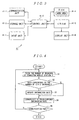
- FIG. 2 is a block diagram showing a functional configuration of the radio communication control apparatus 20.
- the radio communication control apparatus 30 has the same configuration and therefore only the radio communication control apparatus 20 will be described.
- the radio communication control apparatus 20 in Figure 2 comprises a user data buffer 20a, a queuing unit 20b, an information rate control unit 20c, a storage unit 20d, and a DHO control unit 20e.
- the user data buffer 20a temporarily stores data transmitted by the backbone network 10 and outputs data to the queuing unit 20b at a certain time.
- the queuing unit 20b controls the order in which data inputted from the user data buffer 20a is outputted and sends each piece of data to an appropriate base station unit in that output order.
- the information rate control unit 20c specifies an information rate at which data sent from the queuing unit 20b is transmitted from a base station unit to a mobile station unit according to the number of the DHO branches of the mobile station that is stored in the storage unit 20d.
- the storage unit 20d stores the number of the DHO branches of each mobile station. Its content is updated as instructed by the DHO control unit 20e.
- the number of DHO branches represents the number of base stations to which amobile station is connected at a time with a diversity handover.
- the DHO control unit 20e in response to a request provided from a mobile station to add or delete a DHO branch, directs a relevant base station to connect to or disconnect from the mobile station, thereby adding or deleting the DHO branch.
- the base stations 21 - 23, 31, 32 can communicate with mobile stations within their cells.
- the base stations 21-23, 31, 32 are configured such that they can change the information rate of communication withmobile stations in their cells and communicates with each mobile station at an information rate indicated by a radio communication control apparatus 20, 30.
- the mobile stations 41 to 43 may be mobile communication apparatus such as cellular phones and can connect to the base stations 21, 23, 31, 32 by using a DHO scheme.
- FIG. 3 is a block diagram showing a functional configuration of a mobile station 41.
- the mobile stations 41 - 43 have a similar configuration and therefore the functional configuration of the mobile station 41 will be taken as an example and described below.
- the mobile station 41 comprises an input unit 41-1 for inputting information, a control unit 41-2 for controlling the entire mobile station, a storage 41-3 for storing information, a RAM (Random Access Memory) 41-4 used as a work area for processing, a VRAM (Video Random Access Memory) 41-5 for storing display data, a display unit 41-6 for displaying information stored in the VRAM, and a communication unit 41-7 for communicating with base stations.
- a RAM Random Access Memory
- VRAM Video Random Access Memory
- the mobile station 41 which has the configuration described above, communicates with a base station through the communication unit 41-7 and the control unit 41-2 changes the information rate of communication with the base station according to an information rate change instruction sent from the base station.
- Figure 4 shows an information rate control process performed by the mobile communication system 1.
- the information rate control process is started when a mobile station initiates communication through any of the base station in the mobile communication system 1.
- the radio communication control apparatus 20 checks the number of the DHO branches of the mobile station 41 that is connecting to the base station 21 (step S1).
- the radio communication control apparatus 20 judges whether the information rate of the mobile station 41 is in accordance with the number of DHO branches (step S2). If it judges that the information rate of the mobile station 41 is not in accordance with the number of DHO branches, the radio communication control apparatus 20 changes the information rate of the mobile station 41 to a rate in accordance with the number of DHO branches (step S3).
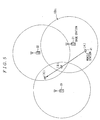
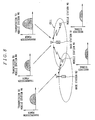
- the information rate of the mobile station 41 would not be in accordance with the number of DHO branches if the mobile station 41 is at the edge of the cell of the base station 21, is within the cell of the base station 22, and is connecting to the base stations 21, 22, 23 through DHO (when moving from position A to position B) , for example.
- the base station 41 starts communicating with the mobile station 41 at the given information rate (the information rate changed at step S3) (step 4).
- step S2 determines whether the information rate of the mobile station 41 is in accordance with the number of DHO branches. If it is judged at step S2 that the information rate of the mobile station 41 is in accordance with the number of DHO branches, then the process proceeds to step S4 (communication at the current information rate).
- the radio communication control apparatus 20 judges whether the mobile station 41 is not connected to any of the base stations (it has end the communication) (step S5). If it is judges that the mobile station 41 is connected to any of the base stations, the process returns to step 1.
- step S5 if it is judged at step S5 that the mobile station 41 is not connected to any of the base stations, the information rate control process will end.
- step S3 (hereinafter called the "information rate update process") of the information rate control process shown in Figure 4 will be described below.
- the information rate update process is performed by the information rate control unit 20c of the radio communication control apparatus 20.
- FIG. 6 is a flowchart of the information rate update process performed by the information rate control unit 20c.
- the information rate control unit 20c obtains the number of the DHO branches of the mobile station 41 from the storage 20d based on the identification number of the mobile station 41 inputted as the destination of data from the queuing unit 20b (step P1).
- the information rate control unit 20c then updates the information rate to the initial information rate of the mobile station 41 (the information rate when the number of branches is "1") divided by the number of DHO branches and indicates the new, updated information to the queuing unit 20b (step P2).
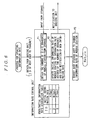
- the information rate control unit 20c manages the initial information rate of each mobile station by associating its initial information rate with its identification number (see Figure 6).
- the information rate control unit 20c sends the updated information rate to the base station 21 and provides indication of the information rate update to the mobile station 41 (step P3).
- the initial information rate divided by the number of DHO branches is set as the new information rate in the information rate update process shown in Figure 6.
- a table for setting a given information rate associated with the number of DHO branches may be provided and the current information rate may be updated to the given information rate depending on the number of DHO branches of the mobile station 41. In that case, the table is referred to at step P2 in Figure 6 to update the information rate.
- the mobile communication system 1 to which the present invention is applied changes the information rate of communication between a mobile station and a base station as appropriate on the basis of the number of DHO branches of the mobile station.
- overload on the power resources at the base station can be prevented and therefore decreases in capacity of the base station and decreases in communication efficiency of the entire mobile communication system 1 can be prevented.
- the effects of the present invention can be obtained with little modification to the hardware resources of an existing mobile communication system.
- an information rate is controlled in accordance with the number of DHO branches, rather than controlling transmission power as in conventional approaches.
- Transmission power at mobile and base stations has upper and lower limits and can be changed within the range between them.
- required communication quality can be provided by controlling the information rate to a lower value.
- controlling an information rate provides control characteristics and effects that are different from those provided by controlling transmission power and therefore the present invention provides unique effects.
- the information rate at which communication between a mobile station unit and a base station unit is carried out is changed in accordance with the number of connections of the mobile station.
- the present invention can prevent overload on power resources in base station units and therefore can prevent decreases in capacity of the base station units and in the communication efficiency of the entire mobile communication system.
- the effects of the present invention can be obtained by managing the number of connections by means of radio communication control apparatuses with little modification to the hardware resources of an existing mobile communication system.
Landscapes
- Engineering & Computer Science (AREA)
- Computer Networks & Wireless Communication (AREA)
- Signal Processing (AREA)
- Mobile Radio Communication Systems (AREA)
Abstract
A mobile communication system 1 to which the present
invention is applied changes appropriately the information
rate at which communication between a mobile station and a
base station is performed, according to the number of DHO
branches of the mobile station. Thus, overload on power
resources at the base station can be prevented and decreases
in capacity of the base station and decreases in communication
efficiency of the entire mobile communication system 1 can
be prevented. The number of DHO branches is managed by radio
communication control apparatuses 20, 30 and therefore the
effects of the present invention can be obtained with little
modification to the hardware resources of an existing mobile
communication system.
Description
The present invention relates to a mobile communication
system including a plurality of base stations and mobile
communication apparatuses, and a radio communication control
apparatus, a mobile communication apparatus, and a mobile
communication method.
The widespread use of cellular phones and the like has
drastically increased the use of mobile communication systems
in recent years.
In a mobile communication system currently available,
a number of base stations having a predetermined coverage area
(hereinafter referred to as a "cell") are installed in many
locations. Amobile station (mobile communication apparatus)
can use the system when it is positioned at least one of the
base station cells. That is, the cells of the base stations
collectively make up the service area of the system.
The information rate between a base station and a mobile
station in such a mobile communication system depends on the
communication quality and tightly relates to the
signal-to-interference power ratio (SIR).
The following relationship exists between the
communication quality and SIR: in order to provide
communication at a high information rate, a low error rate,
besides a highly efficient modulation method, is essential
and therefore a high SIR at a receiving end is required. This
means that in order to carry out communications at a higher
information rate, a higher transmission electric power is
required at sending ends.
For example, in order to transmit data from a base station
to a mobile station at a high information rate, a high SIR
at the mobile station (high transmission power at the base
station) is required. On the other hand, in order to transmit
data from the base station to the mobile station at a low
information rate, a high SIR at the mobile station is not
necessary (high transmission power at the base station is not
necessary). The same applies to cases where data is
transmitted from the mobile station to the base station.
Thus, a mobile communication system must ensure a required
communication quality and, for that purpose, uses transmission
power control.
In mobile communication, a radio wave transmitted from
a base station attenuates as it propagates through the air
before reaching a mobile station. The attenuation is affected
by the distance between the base station and the mobile station
and geographic features of structures. Therefore, power
received at the base station drastically varies (fades) as
a mobile station being transmitting data moves if the
transmission power is constant.
Therefore, in order to maintain a constant communication
quality even if fading occurs, feedback transmission power
control based on the communication quality is performed in
addition to the transmission power control described above.
Feedback transmission power control involves: at the
receiving end, measuring the reception quality, comparing it
with a desired value, associating the result of the comparison
with a radio frame or timeslot, and feeding it back to the
sending end; and at the sending end, controlling the
transmission power according to the fed result of the
comparison.
Figure 7 shows signal levels obtained when transmission
control is performed. If mobile stations M1 and M2 in Figure
7 communicate with the base station at the same information
rate, transmission power is controlled in order to make the
communication qualities equal to each other. As a result,
communication between the base station and mobile station M1,
which is farther away from the base station than mobile station
M2 is, is carried out at a transmission power level higher
than that of communication between the base station and mobile
station M2. This transmission power control provides mobile
stations M1 and M2 with the same reception quality.
Mobile stations M2 andM3 in Figure 7 are at substantially
equal distances to the base station but communication between
mobile station M3 and the base station is carried out at an
information rate higher than that of communication between
mobile station M2 and base station. In this case,
communication between the base station and mobile station M3
is performed at a transmission power level higher than that
of communication between the base station and mobile station
M2.
In this way, transmission power control can maintain
reception quality at the same level and, in addition, can reduce
variations in communication quality depending on the location
of a mobile station in the service area. This technology can
also lower transmission power, thereby improving the
efficiency of power usage.
The reception quality that provides the measure for
controlling transmission power may be, besides SIR, reception
power (received signal level), the result of error detection
by using signal quality (CRC: Cyclic Redundancy Check), or
an error rate such as BLER (Block Error Rate) and BER (Bit
Error Rate).
As described above, a mobile station in the mobile
communication system can carry out communication when it is
within the cell of a base station. As the mobile station moves
across more than one cell, communication is switched from one
base station to another. This is commonly known as a handover.
Handover schemes can be classified broadly into two types.
Aprior-art handover technology is described in Japanese Patent
Laid-Open No. 2002-232353.
A first scheme is called a hard handover (HHO). In this
scheme, when a mobile station moves from one cell to another,
the mobile station instantly switches to a base station to
which it establishes a radio channel. The mobile station can
carry out communication with only one base station at a time.
A second scheme is called a diversity handover (DHO).
In this scheme, before a mobile station releases the radio
channel to a base station to which it is connected, the mobile
station establishes a radio channel to a new base station.
Then, the mobile station releases the radio channel to the
base station to which it has been connected. In the DOH scheme,
a mobile station can communicates with more than one base
stations at a time. Each of radio channels the mobile station
has established is called a DHO branch (or diversity branch) .
The DHO scheme has an advantage over the HHO scheme in that
a short transmission interrupt does not occur when connection
is switched from one base station to another.
When a mobile station is at the edge of the cell of a
base station and is communicating with only that base station
(in HHO scheme), a large transmission power is required for
keeping the reception quality at a constant level. Therefore,
in some cases, power supply sufficient for compensating for
decreases in the signal level due to fading cannot be secured.
On the other hand, according to the DHO scheme, when a
mobile station is at the edge of the cell of a base station,
signals from the base station to which the mobile station
previously connected and signals from the base station to which
the mobile station has newly connected are combined, allowing
the reception quality at the mobile station to be kept at a
constant level.
The degree of fading depends on base stations. According
to the DHO scheme, a decrease in the signal level of a base
station due to fading can be compensated by another base station.
Thus, the stability of communication quality can be maintained
and transmission power can be reduced.
Figure 8 shows a communication power levels when a DHO
scheme is used. In figure 8, mobile station M4 is at the edge
of the cell of base station B1 and also included in the cell
of base station B2. Mobile station M5 is included only in
the cell of base station B1 and, like mobile station M4, is
positioned at the edge of the cell of base station B1.
When mobile stations M4 andM5 communicate with each other
at the same information rate, a DHO causes transmission power
to mobile station M4 to be provided from base stations B1 and
B2. Thus, predetermined total transmission power is provided.
That is, the transmission power of each of base station B1
and B2 is the divisions of the predetermined transmission power
and transmission power from B1 to mobile station M4 is smaller
than transmission power from base station B1 to M5.
As described above, transmission power control and DHO
allow a mobile station to obtain a predetermined, required
communication quality at anywhere in the coverage area of the
mobile communication system.
However, a mobile station uses more power for
communication when it is at the edge of the cell of a base
station than when it is near the base station. When the DHO
scheme is used, transmission power that each of a number of
base stations should provide is relatively small. However,
the system as a whole requires large transmission power. In
addition, when communication is taking place at a high
information rate, higher transmission power is required.
Power that base station can transmit is limited.
Therefore, a mobile station that is at the edge of its cell
and consumes large transmission power may place overload on
power resources and reduce the capacity of the base station.
This causes a reduction in communication efficiency of the
entire system.
An object of the present invention is to prevent a
reduction in communication efficiency of an entire DHO-based
mobile communication system.
According to the present invention, there is provided
a mobile communication system comprising a plurality of base
station units ( for example base stations 21-23, 31, 32 in Figure
1) having a predetermined radio communication coverage area
(for example, the cells of the base stations 21-23, 31, 32
in Figure 1), a mobile communication apparatus (for example
mobile stations 41- 43 in Figure 1) capable of communicating
with the base station units, and a radio communication control
apparatus that provides centralized control over the plurality
of base station units, the mobile communication apparatus
connecting to base station units corresponding to a plurality
of radio communication coverage areas when the mobile
communication apparatus is within an area in which the
plurality of radio communication coverage areas overlap with
each other, the mobile communication system comprising:
connection count managing means (for example a DHO control
unit 20e and a storage 20d in Figure 2) for managing the number
of connections (for example "the number of DHO branches" in
an embodiment of the present invention) that represents the
number of base station units to which the mobile communication
apparatus is connected; and information rate changing means
(for example an information rate control unit 20c in Figure
2) for changing, based on the number of connections managed
by the connection count managing means, an information rate
at which communication between the mobile communication
apparatus and the base station unit corresponding to a radio
communication coverage area in which the mobile communication
apparatus is positioned is performed.
The mobile communication system is also characterized
in that the connection count managing means manages at any
time the number of connections which changes as the mobile
station moves; and the information rate changing means changes
the information rate at any time based on the number of
connections managed by the connection count managing means.
The mobile communication system is also characterized
in that the information rate changing means changes the
information rate to a base rate divided by the number of
connections, the base rate being an information rate at which
the mobile communication apparatus is being connected to one
of the base station units.
The mobile communication system is also characterized
in that the information rate changing means comprises storage
means (for example the storage 20d in Figure 2) for storing
a predetermined information rate corresponding to the number
of connections and changes the information rate to the
predetermined information rate stored in the storage means
in accordance with the number of connections.
According to the present invention, there is provided
a radio communication control apparatus for a mobile
communication system comprising a plurality of base station
units having a predetermined radio communication coverage area,
amobile communication apparatus capable of communicating with
the base station units, and a radio communication control
apparatus that provides centralized control over the plurality
of base station units, the mobile communication apparatus
connecting to base station units corresponding to a plurality
of radio communication coverage areas when the mobile
communication apparatus is within an area in which the
plurality of radio communication coverage areas overlap with
each other, the radio communication control apparatus being
characterized by comprising: connection count managing means
for managing the number of connections that represents the
number of base station units to which the mobile communication
apparatus is connected; and information rate changing means
for changing, based on the number of connections managed by
the connection count managing means, an information rate at
which communication between the mobile communication
apparatus and the base station unit corresponding to a radio
communication coverage area in which the mobile communication
apparatus is positioned is performed.
The radio communication control apparatus is also
characterized in that the connection count managing means
manages at any time the number of connections which changes
as the mobile station moves; and the information rate changing
means changes the information rate at any time based on the
number of connections managed by the connection count managing
means.
The radio communication control apparatus is also
characterized in that the information rate changing means
changes the information rate to a base rate divided by the
number of connections, the base rate being an information rate
at which the mobile communication apparatus is being connected
to one of the base station units.
The radio communication control apparatus is also
characterized in that the information rate changing means
comprises storage means for storing a predetermined
information rate corresponding to the number of connections
and changes the information rate to the predetermined
information rate store in the storage means in accordance with
the number of connections.
According to the present invention, there is provided
a mobile communication apparatus for a for a mobile
communication system comprising a plurality of base station
units having a predetermined radio communication coverage area,
amobile communication apparatus capable of communicatingwith
the base station units, and a radio communication control
apparatus that provides centralized control over the plurality
of base station units, the mobile communication apparatus
connecting to base station units corresponding to a plurality
of radio communication coverage areas when the mobile
communication apparatus is within an area in which the
plurality of radio communication coverage areas overlap with
each other, characterized in that an information rate at which
the mobile communication apparatus communicates with a base
station to which the mobile communication apparatus is
connected can be changed according to an instruction from the
radio communication control apparatus.
According to the present invention, there is provided
amobile communicationmethod for a mobile communication system
comprising a plurality of base station units having a
predetermined radio communication coverage area, a mobile
communication apparatus capable of communicatingwith the base
station units, and a radio communication control apparatus
that provides centralized control over the plurality of base
station units, the mobile communication apparatus connecting
to base station units corresponding to a plurality of radio
communication coverage areas when the mobile communication
apparatus is within an area in which the plurality of radio
communication coverage areas overlap with each other, the
mobile communication method being characterized by
comprising: a connection count managing step of managing the
number of connections that represents the number of base
station units to which the mobile communication apparatus is
connected; and a information rate changing step of changing,
based on the number of connections managed, an information
rate at which communication between the mobile communication
apparatus and the base station unit corresponding to a radio
communication coverage area in which the mobile communication
apparatus is positioned is performed.
The mobile communication method is also characterized
in that, at the connection count managing step, the number
of connections which changes as the mobile station moves is
managed at any time; and at the information rate changing step,
the information rate is changed at any time based on the number
of connections managed by the connection count managing means.
The mobile communication method is also characterized
in that, at the information rate changing step, the information
rate is changed to a base rate divided by the number of
connections, the base rate being an information rate at which
the mobile communication apparatus is being connected to one
of the base station units.
The mobile communication method is also characterized
in that, at the information rate changing step, the information
rate is changed to a stored predetermined information rate
corresponding to the number of connections.
An embodiment of a mobile communication system according
to the present invention will be detailed below with reference
to the accompanying drawings.
Figures 1 to 6 shows a mobile communication system 1 to
which the present invention is applied. The mobile
communication system 1 uses a diversity handover (DHO) scheme.
A configuration of the system will be described first.
Figure 1 shows a system configuration of the mobile
communication system 1 according to the present invention.
The mobile communication system in Figure 1 comprises a
backbone network 10, a radio communication control apparatuses
20, 30, base stations 21 to 23 and 31 and 32, and mobile stations
41 to 43.
The backbone network 10 is a typical cellular phone network,
which includes switches and the like. The radio communication
control apparatuses 20 and 30 communicate with each other over
the backbone network 10.
The radio communication control apparatuses 20 and 30
direct the base stations 21 to 23, and 31 and 32 to control
information rates and to add or delete DHO branches. They
also provide centralized control over the base stations 21-23,
31, 32.
Figure 2 is a block diagram showing a functional
configuration of the radio communication control apparatus
20. The radio communication control apparatus 30 has the same
configuration and therefore only the radio communication
control apparatus 20 will be described.
The radio communication control apparatus 20 in Figure
2 comprises a user data buffer 20a, a queuing unit 20b, an
information rate control unit 20c, a storage unit 20d, and
a DHO control unit 20e.
The user data buffer 20a temporarily stores data
transmitted by the backbone network 10 and outputs data to
the queuing unit 20b at a certain time.
The queuing unit 20b controls the order in which data
inputted from the user data buffer 20a is outputted and sends
each piece of data to an appropriate base station unit in that
output order.
The information rate control unit 20c specifies an
information rate at which data sent from the queuing unit 20b
is transmitted from a base station unit to a mobile station
unit according to the number of the DHO branches of the mobile
station that is stored in the storage unit 20d.
The storage unit 20d stores the number of the DHO branches
of each mobile station. Its content is updated as instructed
by the DHO control unit 20e. The number of DHO branches
represents the number of base stations to which amobile station
is connected at a time with a diversity handover.
The DHO control unit 20e, in response to a request provided
from a mobile station to add or delete a DHO branch, directs
a relevant base station to connect to or disconnect from the
mobile station, thereby adding or deleting the DHO branch.
The base stations 21 - 23, 31, 32 can communicate with
mobile stations within their cells. The base stations 21-23,
31, 32 are configured such that they can change the
information rate of communication withmobile stations in their
cells and communicates with each mobile station at an
information rate indicated by a radio communication control
apparatus 20, 30.
The mobile stations 41 to 43 may be mobile communication
apparatus such as cellular phones and can connect to the base
stations 21, 23, 31, 32 by using a DHO scheme.
Figure 3 is a block diagram showing a functional
configuration of a mobile station 41. The mobile stations
41 - 43 have a similar configuration and therefore the
functional configuration of the mobile station 41 will be taken
as an example and described below.
As shown in Figure 3, the mobile station 41 comprises
an input unit 41-1 for inputting information, a control unit
41-2 for controlling the entire mobile station, a storage 41-3
for storing information, a RAM (Random Access Memory) 41-4
used as a work area for processing, a VRAM (Video Random Access
Memory) 41-5 for storing display data, a display unit 41-6
for displaying information stored in the VRAM, and a
communication unit 41-7 for communicating with base stations.
The mobile station 41, which has the configuration
described above, communicates with a base station through the
communication unit 41-7 and the control unit 41-2 changes the
information rate of communication with the base station
according to an information rate change instruction sent from
the base station.
Operation will be described below.
Operation of the entire mobile communication system 1
will be described first.
Figure 4 shows an information rate control process
performed by the mobile communication system 1. The
information rate control process is started when a mobile
station initiates communication through any of the base station
in the mobile communication system 1.
An example will be describe below in which the mobile
station 41 starts to communicate in the cell (at position A)
of a base station 21 and moves to the cells of base stations
21 and 23 (position B to position C).
In Figure 4, when the information rate control process
starts, the radio communication control apparatus 20 checks
the number of the DHO branches of the mobile station 41 that
is connecting to the base station 21 (step S1).
The radio communication control apparatus 20 judges
whether the information rate of the mobile station 41 is in
accordance with the number of DHO branches (step S2). If it
judges that the information rate of the mobile station 41 is
not in accordance with the number of DHO branches, the radio
communication control apparatus 20 changes the information
rate of the mobile station 41 to a rate in accordance with
the number of DHO branches (step S3).
As shown in Figure 5, the information rate of the mobile
station 41 would not be in accordance with the number of DHO
branches if the mobile station 41 is at the edge of the cell
of the base station 21, is within the cell of the base station
22, and is connecting to the base stations 21, 22, 23 through
DHO (when moving from position A to position B) , for example.
The base station 41 starts communicating with the mobile
station 41 at the given information rate (the information rate
changed at step S3) (step 4).
On the other hand, if it is judged at step S2 that the
information rate of the mobile station 41 is in accordance
with the number of DHO branches, then the process proceeds
to step S4 (communication at the current information rate).
Next, the radio communication control apparatus 20 judges
whether the mobile station 41 is not connected to any of the
base stations (it has end the communication) (step S5). If
it is judges that the mobile station 41 is connected to any
of the base stations, the process returns to step 1.
On the other hand, if it is judged at step S5 that the
mobile station 41 is not connected to any of the base stations,
the information rate control process will end.
The process performed at step S3 (hereinafter called the
"information rate update process") of the information rate
control process shown in Figure 4 will be described below.
The information rate update process is performed by the
information rate control unit 20c of the radio communication
control apparatus 20.
Figure 6 is a flowchart of the information rate update
process performed by the information rate control unit 20c.
In Figure 6, when the information rate update process
is started, the information rate control unit 20c obtains the
number of the DHO branches of the mobile station 41 from the
storage 20d based on the identification number of the mobile
station 41 inputted as the destination of data from the queuing
unit 20b (step P1).
The information rate control unit 20c then updates the
information rate to the initial information rate of the mobile
station 41 (the information rate when the number of branches
is "1") divided by the number of DHO branches and indicates
the new, updated information to the queuing unit 20b (step
P2).
The information rate control unit 20c manages the initial
information rate of each mobile station by associating its
initial information rate with its identification number (see
Figure 6).
The information rate control unit 20c sends the updated
information rate to the base station 21 and provides indication
of the information rate update to the mobile station 41 (step
P3).
In the foregoing description, the initial information
rate divided by the number of DHO branches is set as the new
information rate in the information rate update process shown
in Figure 6. Alternatively, a table for setting a given
information rate associated with the number of DHO branches
may be provided and the current information rate may be updated
to the given information rate depending on the number of DHO
branches of the mobile station 41. In that case, the table
is referred to at step P2 in Figure 6 to update the information
rate.
As described above, the mobile communication system 1
to which the present invention is applied changes the
information rate of communication between a mobile station
and a base station as appropriate on the basis of the number
of DHO branches of the mobile station.
Thus, overload on the power resources at the base station
can be prevented and therefore decreases in capacity of the
base station and decreases in communication efficiency of the
entire mobile communication system 1 can be prevented.
Moreover, because the number of DHO branches is controlled
by the radio communication control apparatuses 20, 30, the
effects of the present invention can be obtained with little
modification to the hardware resources of an existing mobile
communication system.
According to the present invention, an information rate
is controlled in accordance with the number of DHO branches,
rather than controlling transmission power as in conventional
approaches.
Transmission power at mobile and base stations has upper
and lower limits and can be changed within the range between
them.
Therefore, in a system in which only transmission power
is controlled, there may be a case where a mobile station at
the edge of the cell of a base station, for example, cannot
obtain required communication quality even if transmission
is being performed at the upper-limit transmission power
(maximum power).
In such a case, required communication quality can be
provided by controlling the information rate to a lower value.
On the other hand, there may be a case where a required
quality is substantially exceeded when transmission is being
performed at the lower-limit transmission power (minimum
power). In such a case, power can efficiently be used by
increasing the information rate.
Thus, controlling an information rate provides control
characteristics and effects that are different from those
provided by controlling transmission power and therefore the
present invention provides unique effects.
According to the present invention, the information rate
at which communication between a mobile station unit and a
base station unit is carried out is changed in accordance with
the number of connections of the mobile station.
Consequently, the present invention can prevent overload
on power resources in base station units and therefore can
prevent decreases in capacity of the base station units and
in the communication efficiency of the entire mobile
communication system.
Furthermore, the effects of the present invention can
be obtained by managing the number of connections by means
of radio communication control apparatuses with little
modification to the hardware resources of an existing mobile
communication system.
Claims (13)
- A mobile communication system comprising a plurality of base station units having a predetermined radio communication coverage area, a mobile communication apparatus capable of communicating with said base station units, and a radio communication control apparatus that provides centralized control over said plurality of base station units, said mobile communication apparatus connecting to base station units corresponding to a plurality of radio communication coverage areas when said mobile communication apparatus is within an area in which said plurality of radio communication coverage areasoverlapwitheachother, saidmobilecommunicationsystem being characterized by comprising:connection count managing means for managing the number of connections that represents the number of base station units to which said mobile communication apparatus is connected; andinformation rate changing means for changing, based on the number of connections managed by said connection count managing means, an information rate at which communication between said mobile communication apparatus and the base station unit corresponding to a radio communication coverage area in which said mobile communication apparatus is positioned is performed.
- The mobile communication system according to claim 1, characterized in that said connection count managing means manages at any time the number of connections which changes as said mobile station moves; and
said information rate changing means changes said information rate at any time based on the number of connections managed by said connection count managing means. - The mobile communication system according to claim 1 or 2, characterized in that said information rate changing means changes said information rate to a base rate divided by said number of connections, said base rate being an information rate at which said mobile communication apparatus is being connected to one of the base station units.
- The mobile communication system according to any of claims 1 to 3, characterized in that said information rate changing means comprises storage means for storing a predetermined information rate corresponding to said number of connections and changes said information rate to the predetermined information rate stored in said storage means in accordance with said number of connections.
- A radio communication control apparatus for a mobile communication system comprising a plurality of base station units having a predetermined radio communication coverage area, amobile communication apparatus capable of communicating with said base station units, and a radio communication control apparatus that provides centralized control over said plurality of base station units, said mobile communication apparatus connecting to base station units corresponding to a plurality of radio communication coverage areas when said mobile communication apparatus is within an area in which said plurality of radio communication coverage areas overlap with each other, said radio communication control apparatus being characterized by comprising:connection count managing means for managing the number of connections that represents the number of base station units to which said mobile communication apparatus is connected; andinformation rate changing means for changing, based on the number of connections managed by said connection count managing means, an information rate at which communication between said mobile communication apparatus and the base station unit corresponding to a radio communication coverage area in which said mobile communication apparatus is positioned is performed.
- The radio communication control apparatus according to claim 5, characterized in that said connection count managing means manages at any time the number of connections which changes as said mobile station moves; and
said information rate changing means changes said information rate at any time based on the number of connections managed by said connection count managing means. - The radio communication control apparatus according to claim 5 or 6, characterized in that said information rate changing means changes said information rate to a base rate divided by said number of connections, said base rate being an information rate at which said mobile communication apparatus is being connected to one of the base station units.
- The radio communication control apparatus according to any of claims 5 to 7, characterized in that said information rate changing means comprises storage means for storing a predetermined information rate corresponding to said number of connections and changes said information rate to the predetermined information rate store in said storage means in accordance with said number of connections.
- A mobile communication apparatus for a for a mobile communication system comprising a plurality of base station units having a predetermined radio communication coverage area, a mobile communication apparatus capable of communicating with said base station units, and a radio communication control apparatus that provides centralized control over said plurality of base station units, said mobile communication apparatus connecting to base station units corresponding to a plurality of radio communication coverage areas when said mobile communication apparatus is within an area in which said plurality of radio communication coverage areas overlap with each other, characterized in that an information rate at which said mobile communication apparatus communicates with a base station to which said mobile communication apparatus is connected can be changed according to an instruction from said radio communication control apparatus.
- A mobile communication method for a mobile communication system comprising a plurality of base station units having a predetermined radio communication coverage area, a mobile communication apparatus capable of communicating with said base station units, and a radio communication control apparatus that provides centralized control over said plurality of base station units, said mobile communication apparatus connecting to base station units corresponding to a plurality of radio communication coverage areas when said mobile communication apparatus is within an area in which said plurality of radio communication coverage areas overlap with each other, said mobile communication method being characterized by comprising:a connection count managing step of managing the number of connections that represents the number of base station units to which said mobile communication apparatus is connected; andan information rate changing step of changing, based on said number of connections managed, an information rate at which communication between said mobile communication apparatus and the base station unit corresponding to a radio communication coverage area in which said mobile communication apparatus is positioned is performed.
- The mobile communication method according to claim 10, characterized in that, at said connection count managing step, the number of connections which changes as said mobile station moves is managed at any time; and
at said information rate changing step, said information rate is changed at any time based on the number of connections managed by said connection count managing means. - The mobile communication method according to claim 10 or 11, characterized in that, at said information rate changing step, said information rate is changed to a base rate divided by said number of connections, said base rate being an information rate at which said mobile communication apparatus is being connected to one of the base station units.
- The mobile communication method according to any of claims 10 to 12, characterized in that, at said information rate changing step, said information rate is changed to a stored predetermined information rate corresponding to said number of connections.
Applications Claiming Priority (3)
| Application Number | Priority Date | Filing Date | Title |
|---|---|---|---|
| JP2001342219 | 2001-11-07 | ||
| JP2001342219 | 2001-11-07 | ||
| PCT/JP2002/011617 WO2003041432A1 (en) | 2001-11-07 | 2002-11-07 | Mobile body communication system, radio communication control apparatus, mobile body communication apparatus, and mobile body communication method |
Publications (2)
| Publication Number | Publication Date |
|---|---|
| EP1453330A1 true EP1453330A1 (en) | 2004-09-01 |
| EP1453330A4 EP1453330A4 (en) | 2008-04-09 |
Family
ID=19156110
Family Applications (1)
| Application Number | Title | Priority Date | Filing Date |
|---|---|---|---|
| EP02802722A Withdrawn EP1453330A4 (en) | 2001-11-07 | 2002-11-07 | MOBILE BODY COMMUNICATION SYSTEM, RADIO COMMUNICATION CONTROL APPARATUS, MOBILE BODY COMMUNICATION APPARATUS, AND MOBILE BODY COMMUNICATION METHOD |
Country Status (5)
| Country | Link |
|---|---|
| US (1) | US20040248584A1 (en) |
| EP (1) | EP1453330A4 (en) |
| JP (1) | JPWO2003041432A1 (en) |
| CN (1) | CN1272974C (en) |
| WO (1) | WO2003041432A1 (en) |
Families Citing this family (6)
| Publication number | Priority date | Publication date | Assignee | Title |
|---|---|---|---|---|
| US20050070293A1 (en) * | 2003-09-24 | 2005-03-31 | Kyocera Corporation | Communication terminal and base station selection method |
| US7664466B2 (en) | 2005-03-22 | 2010-02-16 | Ntt Docomo, Inc. | Transmission rate control method, transmission rate control system, and mobile station |
| JP4595629B2 (en) * | 2005-03-30 | 2010-12-08 | 日本電気株式会社 | Mobile radio communication control method, mobile radio communication terminal and base station |
| CN101150832B (en) * | 2007-10-31 | 2010-06-02 | 中兴通讯股份有限公司 | Method, device and system for dynamic management of WIMAX communication resources |
| EP2983448A1 (en) * | 2012-07-06 | 2016-02-10 | Qualcomm Technologies, Inc. | Configurable host interface using multi-radio device and architecture for wlan offload |
| CN105323830B (en) * | 2014-07-24 | 2020-04-07 | 中兴通讯股份有限公司 | Energy-saving compensation method, energy-saving compensation recovery method and device |
Family Cites Families (14)
| Publication number | Priority date | Publication date | Assignee | Title |
|---|---|---|---|---|
| WO1995022857A1 (en) * | 1994-02-17 | 1995-08-24 | Motorola Inc. | Method and apparatus for controlling encoding rate in a communication system |
| US5712624A (en) * | 1995-03-03 | 1998-01-27 | Motorola, Inc. | Method and apparatus for optimizing receiver synchronization in a radio communication system |
| US5950124A (en) * | 1995-09-06 | 1999-09-07 | Telxon Corporation | Cellular communication system with dynamically modified data transmission parameters |
| JP3961660B2 (en) * | 1998-03-02 | 2007-08-22 | 株式会社日立製作所 | Communication connection switching method and communication connection switching device |
| JPH11275623A (en) * | 1998-03-20 | 1999-10-08 | Fujitsu Ltd | Zone selection method according to line status in mobile radio communication system |
| JP3956479B2 (en) * | 1998-04-27 | 2007-08-08 | ソニー株式会社 | Mobile communication system, mobile station and base station |
| US6018662A (en) * | 1998-09-08 | 2000-01-25 | Nortel Networks Corporation | Method for performing progressive soft handoff in CDMA systems |
| JP4231593B2 (en) * | 1999-07-21 | 2009-03-04 | 株式会社日立コミュニケーションテクノロジー | Communication system and communication method thereof |
| US6563810B1 (en) * | 1999-09-30 | 2003-05-13 | Qualcomm Incorporated | Closed loop resource allocation |
| US6393276B1 (en) * | 2000-01-12 | 2002-05-21 | Telefonaktiebolaget Lm Ericsson | Mobile station assisted forward link open loop power and rate control in a CDMA system |
| JP2001238239A (en) * | 2000-02-23 | 2001-08-31 | Fujitsu Ltd | Mobile communication system and handover method |
| JP3338821B2 (en) * | 2000-02-23 | 2002-10-28 | 日本電気通信システム株式会社 | Mobile communication congestion control method |
| US6823193B1 (en) * | 2000-02-28 | 2004-11-23 | Telefonaktiebolaget Lm Ericsson (Publ) | Downlink transmit power synchronization during diversity communication with a mobile station |
| US6542736B1 (en) * | 2000-04-04 | 2003-04-01 | Telefonaktiebolaget Lm Ericsson (Publ) | Efficient radio link adaptation and base station sector selection in a radio communication system |
-
2002
- 2002-07-11 US US10/493,425 patent/US20040248584A1/en not_active Abandoned
- 2002-11-07 CN CNB028213890A patent/CN1272974C/en not_active Expired - Fee Related
- 2002-11-07 EP EP02802722A patent/EP1453330A4/en not_active Withdrawn
- 2002-11-07 WO PCT/JP2002/011617 patent/WO2003041432A1/en not_active Ceased
- 2002-11-07 JP JP2003543339A patent/JPWO2003041432A1/en active Pending
Also Published As
| Publication number | Publication date |
|---|---|
| WO2003041432A1 (en) | 2003-05-15 |
| CN1579105A (en) | 2005-02-09 |
| US20040248584A1 (en) | 2004-12-09 |
| CN1272974C (en) | 2006-08-30 |
| JPWO2003041432A1 (en) | 2005-03-03 |
| EP1453330A4 (en) | 2008-04-09 |
Similar Documents
| Publication | Publication Date | Title |
|---|---|---|
| US5809430A (en) | Method and apparatus for base selection in a communication system | |
| KR101059662B1 (en) | Methods and apparatus related to power control and/or interference management in a mixed wireless communications system supporting wan signaling and peer to peer signaling | |
| EP1048115B1 (en) | Apparatus and method for selecting power control modes | |
| US6405021B1 (en) | Method of controlling transmission power in cellular system and base station apparatus | |
| US7573849B2 (en) | Method and apparatus for high rate channel access control | |
| KR100656100B1 (en) | Power Control in CDM Mobile Communication System | |
| US20090325622A1 (en) | Communication Terminal, Mobile Communication System and Communication Method | |
| US20020119798A1 (en) | Mobile communication system, transmission power control method therefor, and base station used therefor | |
| JPH10290196A (en) | Method for controlling power to communicate multiple classes of information in a wireless network | |
| US7379755B2 (en) | Mobile communication system, radio base station controller and transmitting and receiving power control method therefor | |
| WO1997008847A1 (en) | Method and device for controlling transmission power of a radio transmitter in a cellular communication system | |
| EP1133070A2 (en) | Transmit power control method and apparatus in a radio communication system | |
| JPH08256102A (en) | Cellular system | |
| US7539173B2 (en) | Radio communication system, radio terminal, base station, control equipment and communication method | |
| US7376390B2 (en) | Radio control apparatus, mobile communication method, mobile communication program, and mobile communication system | |
| CN100379171C (en) | Mobile communication system, wireless control device, base station and transmission power control method | |
| EP1243154A1 (en) | Measures against rayleigh fading on a radio channel in a cellular system | |
| US20040248584A1 (en) | Mobile body communication system, radio communication control apparatus mobile body communication apparatus, and mobile body communication method | |
| EP1599061B1 (en) | Method and apparatus for transmission rate modification of communication channels | |
| JPWO2003041302A1 (en) | Information rate control method, mobile station, radio control apparatus, base station, and mobile communication system | |
| US20040162100A1 (en) | Radio communication system, radio network controller, mobile station and down link transmission power control method | |
| JP4099086B2 (en) | Mobile communication system, radio control apparatus, base station, and transmission power control method | |
| EP1298816B1 (en) | Transmission power control method and mobile station | |
| US6466791B1 (en) | Transmission power control system | |
| US20010021642A1 (en) | Mobile telecommunication system and hand-off method of radio speech paths at the system |
Legal Events
| Date | Code | Title | Description |
|---|---|---|---|
| PUAI | Public reference made under article 153(3) epc to a published international application that has entered the european phase |
Free format text: ORIGINAL CODE: 0009012 |
|
| 17P | Request for examination filed |
Effective date: 20040519 |
|
| AK | Designated contracting states |
Kind code of ref document: A1 Designated state(s): AT BE BG CH CY CZ DE DK EE ES FI FR GB GR IE IT LI LU MC NL PT SE SK TR |
|
| A4 | Supplementary search report drawn up and despatched |
Effective date: 20080312 |
|
| 17Q | First examination report despatched |
Effective date: 20080618 |
|
| STAA | Information on the status of an ep patent application or granted ep patent |
Free format text: STATUS: THE APPLICATION IS DEEMED TO BE WITHDRAWN |
|
| 18D | Application deemed to be withdrawn |
Effective date: 20081029 |