EP1453279A1 - Ordonnancement d'adresses dans serveur de noms de domaine - Google Patents
Ordonnancement d'adresses dans serveur de noms de domaine Download PDFInfo
- Publication number
- EP1453279A1 EP1453279A1 EP04290472A EP04290472A EP1453279A1 EP 1453279 A1 EP1453279 A1 EP 1453279A1 EP 04290472 A EP04290472 A EP 04290472A EP 04290472 A EP04290472 A EP 04290472A EP 1453279 A1 EP1453279 A1 EP 1453279A1
- Authority
- EP
- European Patent Office
- Prior art keywords
- domain name
- address
- addresses
- network
- name server
- Prior art date
- Legal status (The legal status is an assumption and is not a legal conclusion. Google has not performed a legal analysis and makes no representation as to the accuracy of the status listed.)
- Granted
Links
Images
Classifications
-
- H—ELECTRICITY
- H04—ELECTRIC COMMUNICATION TECHNIQUE
- H04L—TRANSMISSION OF DIGITAL INFORMATION, e.g. TELEGRAPHIC COMMUNICATION
- H04L61/00—Network arrangements, protocols or services for addressing or naming
- H04L61/45—Network directories; Name-to-address mapping
-
- H—ELECTRICITY
- H04—ELECTRIC COMMUNICATION TECHNIQUE
- H04L—TRANSMISSION OF DIGITAL INFORMATION, e.g. TELEGRAPHIC COMMUNICATION
- H04L61/00—Network arrangements, protocols or services for addressing or naming
-
- H—ELECTRICITY
- H04—ELECTRIC COMMUNICATION TECHNIQUE
- H04L—TRANSMISSION OF DIGITAL INFORMATION, e.g. TELEGRAPHIC COMMUNICATION
- H04L69/00—Network arrangements, protocols or services independent of the application payload and not provided for in the other groups of this subclass
- H04L69/16—Implementation or adaptation of Internet protocol [IP], of transmission control protocol [TCP] or of user datagram protocol [UDP]
Definitions
- the present invention relates to telecommunication networks, particularly those using the IPv6 protocol stack ( Internet Protocol - version 6 ). More specifically, it concerns the resolution of addresses within a domain name server associated with such telecommunication networks.
- IPv6 protocol stack Internet Protocol - version 6
- domain name servers are well known in the state of the art, and are conventionally called in their English acronym DNS, for " Domain Name Server ".
- DNS Internet Engineering Task Force
- the purpose of domain name servers is to simplify addressing within an IP telecommunication network: they act as directories associating symbolic names of network elements (or domain names), representing no reality on the Internet. network, to the numeric addresses of these network elements.
- IETF Internet Engineering Task Force
- the purpose of domain name servers is to simplify addressing within an IP telecommunication network: they act as directories associating symbolic names of network elements (or domain names), representing no reality on the Internet. network, to the numeric addresses of these network elements.
- IETF Internet Engineering Task Force
- addresses can be addresses of different levels. As described in IETF RFC 2373, " IP Version 6 Addressing Architecture ", different types of addresses exist, differentiated on the basis of a prefix. There are thus addresses with global value, and addresses with local value, including local to a site. When the sender and the receiver of the data stream are located in the same address space (a site), it is appropriate to use a local address specific to this address space. This type of local address to a site will later be called also, site address. Otherwise, a global address must be used, otherwise the data stream can not be properly routed to the recipient. If, the global address is systematically used, the data flows will be correctly routed, but the use of the network will not be optimal. In addition, there is no guarantee that flows will not leave the site.
- IPv6 address and for example a so-called "6to4" address, as defined by the RFC 3056 of the Internet Engineering Task Force (IETF ) entitled " Connection of IPv6 Domains via IPv4 Clouds”.
- IETF Internet Engineering Task Force
- This mechanism is one of the mechanisms for the gradual migration of an IPv4 compliant network to an IPv6 compliant network.
- the "6To4" mechanism allows pure IPv6 network elements to communicate with other IPv6 network elements through purely IPv4 network elements. To do this, a particular type of address is defined, called “6TO4 addresses”.
- the addresses of this type are recognizable by the network elements in that they start with the prefix "2002": also, on receipt of a packet carrying such an address, a network element at the edge of the IPv6 site is able to encapsulate it in an IPv4 packet to make it reach its destination.
- the use of the wrong address could result in the receipt of an IPv6 address by a network element compatible only with IPv4 or an unacceptable limitation of the address space. This results in the non-routing of the data stream.
- the same name is associated with several addresses.
- the domain name server therefore returns as a response to a request, all of these addresses, and the transmitting network element of this query arbitrarily uses one or other of these addresses.
- the use of a non-address may not be appropriate to address the network that we want to reach.
- the object of the invention is to overcome these disadvantages of the state of the by allowing the transmitting network element a flow of data, to use an effective and optimal address.
- the scheduling is performed at least according to the content of the request.
- the scheduling can be carried out further according to the topology of the network, the most local address making it possible to address both said sender of the request and the network element corresponding to the domain name, being inserted first.
- the scheduling can also be done so that if there is an IPv4 cloud between the sender of the request and the network element corresponding to the domain name, a "6to4" address is inserted first. .
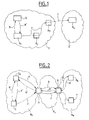
- Figure 1 illustrates a network composed of two sites, S and S '.
- the site S contains network elements R 1 , R 2 and R 3 , and the site S 'contains a network element R 4 .
- IPv6 addresses which can be distinguished by different prefixes. These types of addresses include site -local addresses, or site addresses, and global addresses.
- a local site address is recognized in that it is of the form "FEC0 :: / 10", which means that the first 10 bits have the value FEC0 and the following 118 represent the address space itself. .
- FE80 :: / 80".
- the network element R 4 may have a global address a g and a local address of site a s .
- This global address, a g may be as defined in RFC 2374, entitled " An IPv6 Aggregatable Global Unicast Address ". It allows the network element R 4 to communicate with network elements located in other sites, such as, for example, the network element R 1 located in the site S.
- the network element R 1 wishes to transmit a data stream to the network element R 4 . To do this, it sends a request R to the domain name server D, containing the symbolic name or domain name, of the network element R 4 .
- the domain name server D is able to schedule the different addresses of the searched network element, in the response made to the transmitter of the request R. It can use the information contained in this request R. This information includes the source address of the request, that is to say the address of the network element R 1 . Knowing the addresses of network elements R 1 and R 4 , as well as the topology of the network, the domain name server can determine which type of address should be used. In the present example, it can determine that the network elements R 1 and R 4 are not located in the same site and therefore the local address should not be used. Apart from the other possible addresses, the server D therefore orders the addresses in the order a g , a s in the response R 'that it transmits to the network element R 1 .
- the network element R 1 Upon receipt of this response R ', the network element R 1 can determine which address to use, by choosing the first in the order, that is to say the address a g . He can then use the address a g to insert it as the destination address in the packets of the data stream F which he transmits to the network element R 4 .
- the network element R 1 would have no way of determining which address it should use. It could then have used the local address at L , which would have resulted in a non-routing of the data stream F.
- the scheduling done by the name server of domain D is performed according to the query: if the source address of the request is a local address, and if the requested name has an address local, this is the local address that will be returned first.
- the domain name server would return its local site address first (if it exists), so that the network element R 1 uses this one in his communications with R 3 .
- FIG. 2 illustrates a second implementation of the invention in the context of a heterogeneous network composed of IPv4 network elements and IPv6 or IPv4 / IPv6 network elements.
- Different mechanisms exist In this example, the 6to4 mechanism is used.
- the invention is, however, likely to apply to different mechanisms as long as different addresses are needed.
- a data network is composed of two domains N A and N B separated by an N 4 cloud, composed solely of IPv6 network elements.
- This example illustrates the classic case of two sites that have migrated to IPv4 technology and are connected via a third party network, provided by a telecom operator, which has not yet migrated and is still only compatible with IPv4 protocols.
- the network elements A and B are routers connecting the cloud N 4 respectively to the domains N A and N B.
- a domain name server D A and D B respectively, or DNS. It will be assumed that the two servers D A and D B are suitably configured and mutually dispose of their good address.
- the domain name server D B orders the two (or more) addresses corresponding to the symbolic name of the searched network element Y.
- the scheduling can be done according to the content of the request transmitted by the domain name server D A.
- This request indeed contains the address of the sender (the domain name server D A ), which allows the domain name server D B to determine that, as the source address is an address of type "6to4
- the "6to4" technology must be used. It can therefore determine that the relevant address is the address 6to4 of the recipient Y, and it can therefore, order the different addresses by putting the most relevant address, a 6to4 (address "6to4" of the recipient Y) in first and insert these ordered addresses in a response R '.
- This response is sent to the domain name server D A which is now able to respond to the request from the sender X.
- this transmitter is able to interpret the order of the addresses contained in the response R '. This interpretation may consist of simply using the first address contained in the response. This first address is the 6to4 address, compatible with the "6to4" mechanism.
- the sending network element X can then use the address a 6to4 to address the data stream to the destination network element Y. This data flow F will traverse the network elements A and B and the cloud N 4 , in being properly routed.
- the scheduling carried out by the domain name server D B is performed so that in the event of the presence of an IPv4 cloud (here N 4 ) between the sender of the request (here X) and the network element corresponding to the domain name contained in the request (here Y), an address of type "6to4" is inserted first (here at 6to4 ). It is thanks to this scheduling carried out by the domain name server D B that the sending network element X is able to determine the 6to4 address to be used.
Landscapes
- Engineering & Computer Science (AREA)
- Computer Networks & Wireless Communication (AREA)
- Signal Processing (AREA)
- Data Exchanges In Wide-Area Networks (AREA)
- Computer And Data Communications (AREA)
- Saccharide Compounds (AREA)
Abstract
Description
Le but des serveurs de noms de domaine est de simplifier l'adressage au sein d'un réseau de télécommunication IP : ils agissent comme des annuaires associant des noms symboliques des éléments de réseau (ou noms de domaine), ne représentant aucune réalité sur le réseau, aux adresses numériques de ces éléments de réseau.
Ainsi, lorsqu'un premier élément de réseau veut adresser un flux de données à un second élément de réseau, il peut utiliser soit l'adresse de ce second élément de réseau, s'il la connaít, soit le nom symbolique de ce second élément.
Dans ce dernier cas, le premier élément de réseau adresse une requête au serveur de noms de domaine, contenant ce nom symbolique. En retour, il reçoit la (ou les) adresse numérique correspondant à ce nom symbolique. Il peut alors envoyer le flux de données vers ce second élément de réseau en utilisant son adresse.
L'utilisation d'un système DNS dans un réseau de type IPv6 est décrite dans le RFC 1886 de l'IETF, intitulé « DNS Extensions to Support IP Version 6 ».
Dans le cas contraire, une adresse globale doit être utilisée, sinon le flux de données ne pourra être correctement acheminé vers le destinataire.
Si, l'adresse globale est systématiquement utilisée, les flux de données seront correctement acheminés, mais l'utilisation du réseau ne sera pas optimale. De plus, aucune garantie n'est donnée sur le fait que les flux ne sortiront pas du site.
Ce mécanisme est un des mécanismes permettant la migration graduelle d'un réseau conforme à IPv4 vers un réseau conforme à IPv6.
Le mécanisme « 6To4 » permet à des éléments de réseau purement IPv6 de communiquer avec d'autres éléments de réseau IPv6 au travers ) d'éléments de réseau purement IPv4. Pour ce faire, un type particulier d'adresses est défini, appelé « adresses 6TO4 ». Les adresses de ce type sont reconnaissables, par les éléments de réseau, en ce qu'elles commencent par le préfixe « 2002 » : aussi, à la réception d'un paquet portant une telle adresse, un élément de réseau en bordure du site IPv6 est à même de l'encapsuler dans un paquet IPv4 pour lui faire atteindre sa destination.
L'utilisation de la mauvaise adresse pourrait déboucher par la réception d'une adresse IPv6 par un élément de réseau compatible uniquement avec IPv4 ou bien sur une limitation inacceptable de l'espace d'adressage. Il en résulte alors le non-acheminement du flux de données.
Mais une telle solution surcharge les applications, et en leur laissant trop de liberté peut engendrer des mauvais comportements d'ensemble du réseau de communication. De surcroít, une application peut ne pas avoir la visibilité du réseau suffisante pour permettre le choix de l'adresse optimal. Enfin, une telle solution ne permet pas de déploiement d'une politique d'ensemble de gestion du réseau.
- des moyens de réception de requêtes contenant un nom de domaine et
- des moyens pour retourner à l'émetteur de la requête, une réponse contenant une ou plusieurs adresses associées au nom de domaine,
L'ordonnancement peut être effectué en outre en fonction de la topologie du réseau, l'adresse la plus locale permettant d'adresser à la fois ledit émetteur de la requête et l'élément de réseau correspondant au nom de domaine, étant insérée en premier.
L'ordonnancement peut aussi être effectué de sorte qu'en cas de présence d'un nuage IPv4 entre l'émetteur de la requête et l'élément de réseau correspondant au nom de domaine, une adresse de type « 6to4 » est insérée en premier.
Comme il a été évoqué précédemment, il existe différents types d'adresses IPv6, que l'on peut distinguer par des préfixes différents.
Parmi ces types d'adresses, on trouve des adresses locales de site (Site-local address), ou adresses de site, et des adresses globales.
On reconnaít une adresse locale de site en ce qu'elle est de la forme « FEC0::/10 », ce qui signifie que les 10 premiers bits ont pour valeur FEC0 et que les 118 suivants représentent l'espace d'adressage proprement dit. Similairement, on reconnaít une adresse local de lien, en ce qu'elle est de la forme « FE80::/80 ».
Par conséquent, l'élément de réseau R4, par exemple, peut posséder une adresse globale ag et une adresse local de site as. Cette adresse globale, ag peut être telle que définie dans le RFC 2374, intitulé « An IPv6 Aggregatable Global Unicast Address ». Elle permet à l'élément de réseau R4 d'entrer en communication avec des éléments de réseau, situés dans d'autres sites, comme par exemple, l'élément de réseau R1 situé dans le site S.
Il adresse, pour ce faire, une requête R au serveur de noms de domaine D, contenant le nom symbolique ou nom de domaine, de l'élément de réseau R4.
Il peut utiliser pour ce faire les informations contenues dans cette requête R. Parmi ces informations, on trouve notamment l'adresse source de la requête, c'est-à-dire l'adresse de l'élément de réseau R1. Connaissant les adresses des éléments de réseau R1 et R4, ainsi que la topologie du réseau, le serveur de noms de domaine peut déterminer quel type d'adresse doit être utilisé. Dans l'exemple présent, il peut déterminer que les éléments de réseau R1 et R4 ne sont pas situé dans le même site et donc que l'adresse locale ne doit pas être utilisée.
Abstraction faite des autres adresses possibles, le serveur D ordonne donc les adresses dans l'ordre ag, as dans la réponse R' qu'il transmet à l'élément de réseau R1.
À la réception de cette réponse R', l'élément de réseau R1 peut déterminer quelle adresse utiliser, en choisissant la première dans l'ordre, c'est-à-dire l'adresse ag. Il peut alors utiliser l'adresse ag pour l'insérer comme adresse de destination dans les paquets du flux de données F qu'il transmet à l'élément de réseau R4.
Différents mécanismes existent. Dans cet exemple, le mécanisme 6to4 est utilisé. L'invention est toutefois susceptible de s'appliquer à différents mécanismes du moment que différentes adresses sont nécessaires.
Dans cet exemple, un réseau de données est composé de deux domaines NA et NB séparés par un nuage N4, composé uniquement d'éléments de réseau IPv6. Cet exemple illustre le cas classique, de deux sites ayant migrés vers la technologie IPv4 et qui sont connectés via un réseau tiers, fournis par un opérateur de télécommunication, n'ayant pas encore migré et encore compatible uniquement avec les protocoles IPv4.
Les éléments de réseau A et B sont des routeurs connectant le nuage N4 respectivement aux domaines NA et NB.
Dans chacun des domaines NA et NB, on a un serveur de noms de domaine DA et DB, respectivement, ou DNS. On supposera que les deux serveurs DA et DB sont convenablement configurés et disposent mutuellement de leur bonne adresse.
À la réception de cette requête R, le serveur DA détermine s'il possède une association entre le nom symbolique contenu dans la requête et une adresse. Comme le destinataire Y est hors du domaine NA « contrôlé » par le serveur DA, cette association ne figure pas dans les tables ou dans la base de données du serveur DA. Selon une configuration récursive, il transmet la requête vers le serveur de noms de domaine DB du domaine NB.
Le destinataire Y et le serveur DB faisant partie du même domaine NB, ce dernier possède les informations relatives au destinataire Y et à l'association de son nom de domaine (symbolique) et de ses adresses. Dans cet exemple, le destinataire Y possède au moins deux adresses :
- une adresse av6 conforme au protocole IPv6 permettant à l'élément de réseau Y de communiquer avec les autres éléments de réseau du domaine Y ou avec des éléments de réseau d'autres domaines IPv6 (non représentés).
- Une adresse a6to4 conforme à la technologie « 6to4 » précédemment évoquée, permettant la communication de deux éléments de réseau IPv6 au travers d'un nuage IPv4.
Il peut donc déterminer que l'adresse pertinente est l'adresse a6to4 du destinataire Y, et il peut par conséquent, ordonner les différentes adresses en mettant l'adresse la plus pertinente, a6to4 (adresse « 6to4 » du destinataire Y) en premier et insérer ces adresses ordonnées dans une réponse R'.
Cette réponse est envoyée au serveur de noms de domaine DA qui est maintenant en mesure de répondre à la requête de l'émetteur X.
L'élément de réseau émetteur X peut alors utiliser l'adresse a6to4 pour adresser le flux de données vers l'élément de réseau destinataire Y. Ce flux de données F traversera les éléments de réseau A et B et le nuage N4, en étant correctement acheminé.
C'est grâce à cet ordonnancement effectué par le serveur de noms de domaine DB que l'élément de réseau émetteur X est à même de déterminer l'adresse a6to4 à utiliser.
Claims (4)
- Serveur de noms de domaine (DNS), associé à un réseau de données, comportant des moyens de réception de requêtes (R) contenant un nom de domaine et des moyens pour retourner à l'émetteur de ladite requête, une réponse contenant une ou plusieurs adresses associées audit nom de domaine, caractérisé en ce que la ou lesdites adresses sont ordonnancées par ledit serveur de noms de domaine, au sein de ladite réponse.
- Serveur de noms de domaine, selon la revendication 1, dans lequel l'ordonnancement est effectué au moins en fonction du contenu de ladite requête.
- Serveur de noms de domaine, selon la revendication 2, dans lequel l'ordonnancement est effectué en outre en fonction de la topologie du réseau, l'adresse la plus locale permettant d'adresser à la fois ledit émetteur de la requête et l'élément de réseau correspondant audit nom de domaine, étant insérée en premier.
- Serveur de noms de domaine, selon la revendication 3, dans lequel l'ordonnancement est effectué de sorte qu'en cas de présence d'un nuage IPv4 entre ledit émetteur de la requête et l'élément de réseau correspondant audit nom de domaine, une adresse de type « 6to4 » est insérée en premier.
Applications Claiming Priority (2)
| Application Number | Priority Date | Filing Date | Title |
|---|---|---|---|
| FR0302443A FR2851867B1 (fr) | 2003-02-28 | 2003-02-28 | Ordonnancement d'adresses dans serveur de noms de domaine |
| FR0302443 | 2003-02-28 |
Publications (2)
| Publication Number | Publication Date |
|---|---|
| EP1453279A1 true EP1453279A1 (fr) | 2004-09-01 |
| EP1453279B1 EP1453279B1 (fr) | 2007-06-06 |
Family
ID=32749743
Family Applications (1)
| Application Number | Title | Priority Date | Filing Date |
|---|---|---|---|
| EP04290472A Expired - Lifetime EP1453279B1 (fr) | 2003-02-28 | 2004-02-20 | Ordonnancement d'adresses dans serveur de noms de domaine |
Country Status (7)
| Country | Link |
|---|---|
| US (1) | US20040215827A1 (fr) |
| EP (1) | EP1453279B1 (fr) |
| JP (1) | JP4418694B2 (fr) |
| CN (1) | CN100536458C (fr) |
| AT (1) | ATE364290T1 (fr) |
| DE (1) | DE602004006786T2 (fr) |
| FR (1) | FR2851867B1 (fr) |
Cited By (2)
| Publication number | Priority date | Publication date | Assignee | Title |
|---|---|---|---|---|
| EP1742446A1 (fr) * | 2005-07-05 | 2007-01-10 | Brother Kogyo Kabushiki Kaisha | Dispositif et programme de traitement d'information |
| WO2010131633A1 (fr) * | 2009-05-13 | 2010-11-18 | Canon Kabushiki Kaisha | Appareil de communication de réseau, procédé et programme |
Families Citing this family (9)
| Publication number | Priority date | Publication date | Assignee | Title |
|---|---|---|---|---|
| US7437470B2 (en) * | 2004-11-18 | 2008-10-14 | International Business Machines Corporation | Tunneling IPv6 packets |
| KR100643761B1 (ko) * | 2005-01-28 | 2006-11-10 | 삼성전자주식회사 | 애드 혹 네트워크에서 주소 할당 방법 및 시스템 |
| CN100505684C (zh) | 2005-03-29 | 2009-06-24 | 国际商业机器公司 | 网络系统,流量均衡方法,网络监视设备和主机 |
| US20070150611A1 (en) * | 2005-12-28 | 2007-06-28 | Davy Chan | DNS based client-server system and its use in electronic devices |
| US8804759B2 (en) * | 2006-02-28 | 2014-08-12 | Hewlett-Packard Development Company, L.P. | Network name resolution into network address |
| CN101378407B (zh) * | 2008-09-26 | 2012-10-17 | 成都市华为赛门铁克科技有限公司 | 一种信息推送方法、系统及设备 |
| CN102196052A (zh) * | 2010-03-03 | 2011-09-21 | 华为终端有限公司 | 一种基于IPv6网络的DNS重定向方法和用户端设备 |
| CN104683501A (zh) * | 2015-03-30 | 2015-06-03 | 乐视致新电子科技(天津)有限公司 | 域名解析方法以及装置 |
| CN119645002A (zh) * | 2024-12-16 | 2025-03-18 | 浙江吉利控股集团有限公司 | 车辆控制器的诊断方法、装置、系统、电子设备及车辆 |
Citations (2)
| Publication number | Priority date | Publication date | Assignee | Title |
|---|---|---|---|---|
| WO2001091370A2 (fr) * | 2000-05-22 | 2001-11-29 | Nokia Corporation | Systeme et procede permettant d'etablir une connexion dans un reseau de communication |
| WO2002039699A1 (fr) * | 2000-11-09 | 2002-05-16 | Cacheflow, Inc. | Extensions de systeme de nom de domaine destinees a supporter des operations de mandataires inverses et des reacheminements de couche 7 |
Family Cites Families (2)
| Publication number | Priority date | Publication date | Assignee | Title |
|---|---|---|---|---|
| US6748434B2 (en) * | 2001-09-18 | 2004-06-08 | Ericsson Inc. | Adaptive node selection |
| US7308499B2 (en) * | 2003-04-30 | 2007-12-11 | Avaya Technology Corp. | Dynamic load balancing for enterprise IP traffic |
-
2003
- 2003-02-28 FR FR0302443A patent/FR2851867B1/fr not_active Expired - Fee Related
-
2004
- 2004-02-20 EP EP04290472A patent/EP1453279B1/fr not_active Expired - Lifetime
- 2004-02-20 AT AT04290472T patent/ATE364290T1/de not_active IP Right Cessation
- 2004-02-20 DE DE602004006786T patent/DE602004006786T2/de not_active Expired - Lifetime
- 2004-02-27 JP JP2004052957A patent/JP4418694B2/ja not_active Expired - Fee Related
- 2004-02-27 US US10/787,145 patent/US20040215827A1/en not_active Abandoned
- 2004-02-27 CN CNB2004100060935A patent/CN100536458C/zh not_active Expired - Fee Related
Patent Citations (2)
| Publication number | Priority date | Publication date | Assignee | Title |
|---|---|---|---|---|
| WO2001091370A2 (fr) * | 2000-05-22 | 2001-11-29 | Nokia Corporation | Systeme et procede permettant d'etablir une connexion dans un reseau de communication |
| WO2002039699A1 (fr) * | 2000-11-09 | 2002-05-16 | Cacheflow, Inc. | Extensions de systeme de nom de domaine destinees a supporter des operations de mandataires inverses et des reacheminements de couche 7 |
Non-Patent Citations (3)
| Title |
|---|
| "Re: (ngtrans) I-D ACTION:draft-ietf-ngtrans-6to4-03.txt", GOOGLE'S CACHE, 14 October 1999 (1999-10-14), pages 1 - 5, XP002262761, Retrieved from the Internet <URL:http://www.google.be/search?q=cache:-FuPf1YetN4J:www.wcug.wwu.edu/lists/ngtrans/199910/msg00056.html+DNS+%22list+of+addresses%22++6to4+order+OR+ordered&hl=nl&ie=UTF-8> [retrieved on 20031125] * |
| GULBRANDSEN A ET AL: "A DNS RR for specifying the location of services (DNS SRV)", REQUEST FOR COMMENT: RFC2782, February 2000 (2000-02-01), XP002176085, Retrieved from the Internet <URL:http://www.faqs.org/rfcs/rfc2782.html> [retrieved on 20010829] * |
| RICHARD DRAVES: "draft-ietf-ipngwg-default-addr-select-05.txt: Default Address Selection for IPv6", INTERNET DRAFT, 4 June 2001 (2001-06-04), pages 1 - 15, XP002262762, Retrieved from the Internet <URL:http://www.ietf.org/proceedings/01aug/I-D/draft-ietf-ipngwg-default-addr-select-05.txt> [retrieved on 20031125] * |
Cited By (5)
| Publication number | Priority date | Publication date | Assignee | Title |
|---|---|---|---|---|
| EP1742446A1 (fr) * | 2005-07-05 | 2007-01-10 | Brother Kogyo Kabushiki Kaisha | Dispositif et programme de traitement d'information |
| US8478869B2 (en) | 2005-07-05 | 2013-07-02 | Brother Kogyo Kabushiki Kaisha | Information processing device and program |
| WO2010131633A1 (fr) * | 2009-05-13 | 2010-11-18 | Canon Kabushiki Kaisha | Appareil de communication de réseau, procédé et programme |
| US8165042B2 (en) | 2009-05-13 | 2012-04-24 | Canon Kabushiki Kaisha | Network communication apparatus, method and program |
| US8964602B2 (en) | 2009-05-13 | 2015-02-24 | Canon Kabushiki Kaisha | Network communication apparatus, method and program |
Also Published As
| Publication number | Publication date |
|---|---|
| FR2851867A1 (fr) | 2004-09-03 |
| DE602004006786D1 (de) | 2007-07-19 |
| CN1525713A (zh) | 2004-09-01 |
| FR2851867B1 (fr) | 2005-06-24 |
| JP2004266834A (ja) | 2004-09-24 |
| CN100536458C (zh) | 2009-09-02 |
| DE602004006786T2 (de) | 2008-01-31 |
| EP1453279B1 (fr) | 2007-06-06 |
| JP4418694B2 (ja) | 2010-02-17 |
| ATE364290T1 (de) | 2007-06-15 |
| US20040215827A1 (en) | 2004-10-28 |
Similar Documents
| Publication | Publication Date | Title |
|---|---|---|
| JP4130962B2 (ja) | ネットワーク上のデスティネーションへ送信されたデータの経路決めをするドメイン名を使用するためのシステムおよび方法 | |
| USRE41024E1 (en) | Communication using two addresses for an entity | |
| EP2297928B1 (fr) | Procede de reception d'un paquet de donnees dans un domaine ipv6, dispositif et passerelle residentielle associes | |
| EP1898593B1 (fr) | Traversée d'un équipement de traduction d'adresse NAT pour messages de signalisation conformes au protocole SIP | |
| FR2855697A1 (fr) | SYSTEME DE CONVERSION DE DONNEES BASEE SUR IPv4 EN DONNEES BASEES SUR IPv6 A TRANSMETTRE A TRAVERS UN RESEAU COMMUTE IP | |
| EP1453279B1 (fr) | Ordonnancement d'adresses dans serveur de noms de domaine | |
| EP2294798B1 (fr) | Procede de routage d'un paquet de donnees dans un reseau et dispositif associe | |
| FR2860369A1 (fr) | Localisation de points d'entree de flux dans un reseau de communications | |
| Gopalan et al. | TCP/IP ILLUSTRATED | |
| US7356031B1 (en) | Inter-v4 realm routing | |
| WO1997005727A1 (fr) | Dispositif, procede et routeur d'interconnexion de reseaux | |
| EP1142269B1 (fr) | Procede d'adressage et serveur de noms et d'adresses dans un reseau numerique | |
| US20070189329A1 (en) | System for combining networks of different addressing schemes | |
| FR3023098A1 (fr) | Procede et systeme de traitement d'une demande de resolution d'un nom d'un serveur, emise par une application cliente sur un reseau de communication. | |
| FR2805432A1 (fr) | Point d'acces sans fil d'un reseau de transmission de paquets en mode non-connecte, et procede de gestion de mobilite mis en oeuvre avec de tels points d'acces | |
| EP1341360B1 (fr) | Système de gestion de réseau permettant la détermination d'une passerelle de communication entre domaines | |
| FR2805430A1 (fr) | Procede de gestion de mobilite dans un reseau de telecommunications, et serveur de mobilite pour la mise en oeuvre du procede | |
| EP1575226B1 (fr) | Procédé de transmission de paquets de données dans un réseau de télécommunication et dispositif mettant en oeuvre ce procédé | |
| WO2007003818A1 (fr) | Procede de filtrage par couplage multi-protocolaire sur la base du protocole dns. | |
| EP1432213B1 (fr) | Plate-forme de médiation et réseau de transport de messages | |
| Dong et al. | Interworking Between IP and ICN with | |
| Nakamura et al. | SMTP Operational Experience in Mixed IPv4/v6 Environments | |
| Itoh et al. | A study on the applicability of MIDCOM method and a solution to its topology discovery problem | |
| EP1757073A1 (fr) | Routage pour detection de serveurs au sein d'un reseau de communication | |
| WO2025061515A1 (fr) | Procédés, dispositifs et système de contrôle d'une communication dans un réseau |
Legal Events
| Date | Code | Title | Description |
|---|---|---|---|
| PUAI | Public reference made under article 153(3) epc to a published international application that has entered the european phase |
Free format text: ORIGINAL CODE: 0009012 |
|
| AK | Designated contracting states |
Kind code of ref document: A1 Designated state(s): AT BE BG CH CY CZ DE DK EE ES FI FR GB GR HU IE IT LI LU MC NL PT RO SE SI SK TR |
|
| AX | Request for extension of the european patent |
Extension state: AL LT LV MK |
|
| 17P | Request for examination filed |
Effective date: 20041216 |
|
| AKX | Designation fees paid |
Designated state(s): AT BE BG CH CY CZ DE DK EE ES FI FR GB GR HU IE IT LI LU MC NL PT RO SE SI SK TR |
|
| 17Q | First examination report despatched |
Effective date: 20050421 |
|
| APBN | Date of receipt of notice of appeal recorded |
Free format text: ORIGINAL CODE: EPIDOSNNOA2E |
|
| APBR | Date of receipt of statement of grounds of appeal recorded |
Free format text: ORIGINAL CODE: EPIDOSNNOA3E |
|
| APBV | Interlocutory revision of appeal recorded |
Free format text: ORIGINAL CODE: EPIDOSNIRAPE |
|
| GRAP | Despatch of communication of intention to grant a patent |
Free format text: ORIGINAL CODE: EPIDOSNIGR1 |
|
| GRAS | Grant fee paid |
Free format text: ORIGINAL CODE: EPIDOSNIGR3 |
|
| RAP1 | Party data changed (applicant data changed or rights of an application transferred) |
Owner name: ALCATEL LUCENT |
|
| GRAA | (expected) grant |
Free format text: ORIGINAL CODE: 0009210 |
|
| REG | Reference to a national code |
Ref country code: DE Ref legal event code: R081 Ref document number: 602004006786 Country of ref document: DE Owner name: WSOU INVESTMENTS, LLC, LOS ANGELES, US Free format text: FORMER OWNER: ALCATEL, PARIS, FR |
|
| AK | Designated contracting states |
Kind code of ref document: B1 Designated state(s): AT BE BG CH CY CZ DE DK EE ES FI FR GB GR HU IE IT LI LU MC NL PT RO SE SI SK TR |
|
| PG25 | Lapsed in a contracting state [announced via postgrant information from national office to epo] |
Ref country code: FI Free format text: LAPSE BECAUSE OF FAILURE TO SUBMIT A TRANSLATION OF THE DESCRIPTION OR TO PAY THE FEE WITHIN THE PRESCRIBED TIME-LIMIT Effective date: 20070606 |
|
| REG | Reference to a national code |
Ref country code: GB Ref legal event code: FG4D Free format text: NOT ENGLISH |
|
| REG | Reference to a national code |
Ref country code: CH Ref legal event code: EP |
|
| REG | Reference to a national code |
Ref country code: IE Ref legal event code: FG4D Free format text: LANGUAGE OF EP DOCUMENT: FRENCH |
|
| REF | Corresponds to: |
Ref document number: 602004006786 Country of ref document: DE Date of ref document: 20070719 Kind code of ref document: P |
|
| REG | Reference to a national code |
Ref country code: DE Ref legal event code: R096 Ref document number: 602004006786 Country of ref document: DE Effective date: 20070719 |
|
| GBT | Gb: translation of ep patent filed (gb section 77(6)(a)/1977) |
Effective date: 20070808 |
|
| PG25 | Lapsed in a contracting state [announced via postgrant information from national office to epo] |
Ref country code: SE Free format text: LAPSE BECAUSE OF FAILURE TO SUBMIT A TRANSLATION OF THE DESCRIPTION OR TO PAY THE FEE WITHIN THE PRESCRIBED TIME-LIMIT Effective date: 20070906 |
|
| PG25 | Lapsed in a contracting state [announced via postgrant information from national office to epo] |
Ref country code: ES Free format text: LAPSE BECAUSE OF FAILURE TO SUBMIT A TRANSLATION OF THE DESCRIPTION OR TO PAY THE FEE WITHIN THE PRESCRIBED TIME-LIMIT Effective date: 20070917 |
|
| PG25 | Lapsed in a contracting state [announced via postgrant information from national office to epo] |
Ref country code: AT Free format text: LAPSE BECAUSE OF FAILURE TO SUBMIT A TRANSLATION OF THE DESCRIPTION OR TO PAY THE FEE WITHIN THE PRESCRIBED TIME-LIMIT Effective date: 20070606 |
|
| NLV1 | Nl: lapsed or annulled due to failure to fulfill the requirements of art. 29p and 29m of the patents act | ||
| REG | Reference to a national code |
Ref country code: IE Ref legal event code: FD4D |
|
| PG25 | Lapsed in a contracting state [announced via postgrant information from national office to epo] |
Ref country code: IE Free format text: LAPSE BECAUSE OF FAILURE TO SUBMIT A TRANSLATION OF THE DESCRIPTION OR TO PAY THE FEE WITHIN THE PRESCRIBED TIME-LIMIT Effective date: 20070606 Ref country code: SI Free format text: LAPSE BECAUSE OF FAILURE TO SUBMIT A TRANSLATION OF THE DESCRIPTION OR TO PAY THE FEE WITHIN THE PRESCRIBED TIME-LIMIT Effective date: 20070606 Ref country code: PT Free format text: LAPSE BECAUSE OF FAILURE TO SUBMIT A TRANSLATION OF THE DESCRIPTION OR TO PAY THE FEE WITHIN THE PRESCRIBED TIME-LIMIT Effective date: 20071106 Ref country code: NL Free format text: LAPSE BECAUSE OF FAILURE TO SUBMIT A TRANSLATION OF THE DESCRIPTION OR TO PAY THE FEE WITHIN THE PRESCRIBED TIME-LIMIT Effective date: 20070606 Ref country code: CZ Free format text: LAPSE BECAUSE OF FAILURE TO SUBMIT A TRANSLATION OF THE DESCRIPTION OR TO PAY THE FEE WITHIN THE PRESCRIBED TIME-LIMIT Effective date: 20070606 Ref country code: BG Free format text: LAPSE BECAUSE OF FAILURE TO SUBMIT A TRANSLATION OF THE DESCRIPTION OR TO PAY THE FEE WITHIN THE PRESCRIBED TIME-LIMIT Effective date: 20070906 |
|
| PG25 | Lapsed in a contracting state [announced via postgrant information from national office to epo] |
Ref country code: SK Free format text: LAPSE BECAUSE OF FAILURE TO SUBMIT A TRANSLATION OF THE DESCRIPTION OR TO PAY THE FEE WITHIN THE PRESCRIBED TIME-LIMIT Effective date: 20070606 |
|
| PLBE | No opposition filed within time limit |
Free format text: ORIGINAL CODE: 0009261 |
|
| STAA | Information on the status of an ep patent application or granted ep patent |
Free format text: STATUS: NO OPPOSITION FILED WITHIN TIME LIMIT |
|
| PG25 | Lapsed in a contracting state [announced via postgrant information from national office to epo] |
Ref country code: DK Free format text: LAPSE BECAUSE OF FAILURE TO SUBMIT A TRANSLATION OF THE DESCRIPTION OR TO PAY THE FEE WITHIN THE PRESCRIBED TIME-LIMIT Effective date: 20070606 Ref country code: GR Free format text: LAPSE BECAUSE OF FAILURE TO SUBMIT A TRANSLATION OF THE DESCRIPTION OR TO PAY THE FEE WITHIN THE PRESCRIBED TIME-LIMIT Effective date: 20070907 |
|
| 26N | No opposition filed |
Effective date: 20080307 |
|
| PG25 | Lapsed in a contracting state [announced via postgrant information from national office to epo] |
Ref country code: RO Free format text: LAPSE BECAUSE OF FAILURE TO SUBMIT A TRANSLATION OF THE DESCRIPTION OR TO PAY THE FEE WITHIN THE PRESCRIBED TIME-LIMIT Effective date: 20070606 |
|
| REG | Reference to a national code |
Ref country code: DE Ref legal event code: R097 Ref document number: 602004006786 Country of ref document: DE Effective date: 20080307 |
|
| BERE | Be: lapsed |
Owner name: ALCATEL LUCENT Effective date: 20080228 |
|
| REG | Reference to a national code |
Ref country code: CH Ref legal event code: PL |
|
| PG25 | Lapsed in a contracting state [announced via postgrant information from national office to epo] |
Ref country code: LI Free format text: LAPSE BECAUSE OF NON-PAYMENT OF DUE FEES Effective date: 20080229 Ref country code: MC Free format text: LAPSE BECAUSE OF NON-PAYMENT OF DUE FEES Effective date: 20080228 Ref country code: CH Free format text: LAPSE BECAUSE OF NON-PAYMENT OF DUE FEES Effective date: 20080229 |
|
| PG25 | Lapsed in a contracting state [announced via postgrant information from national office to epo] |
Ref country code: EE Free format text: LAPSE BECAUSE OF FAILURE TO SUBMIT A TRANSLATION OF THE DESCRIPTION OR TO PAY THE FEE WITHIN THE PRESCRIBED TIME-LIMIT Effective date: 20070606 |
|
| PG25 | Lapsed in a contracting state [announced via postgrant information from national office to epo] |
Ref country code: BE Free format text: LAPSE BECAUSE OF NON-PAYMENT OF DUE FEES Effective date: 20080228 |
|
| PG25 | Lapsed in a contracting state [announced via postgrant information from national office to epo] |
Ref country code: CY Free format text: LAPSE BECAUSE OF FAILURE TO SUBMIT A TRANSLATION OF THE DESCRIPTION OR TO PAY THE FEE WITHIN THE PRESCRIBED TIME-LIMIT Effective date: 20070606 |
|
| PG25 | Lapsed in a contracting state [announced via postgrant information from national office to epo] |
Ref country code: LU Free format text: LAPSE BECAUSE OF NON-PAYMENT OF DUE FEES Effective date: 20080220 Ref country code: HU Free format text: LAPSE BECAUSE OF FAILURE TO SUBMIT A TRANSLATION OF THE DESCRIPTION OR TO PAY THE FEE WITHIN THE PRESCRIBED TIME-LIMIT Effective date: 20071207 |
|
| PG25 | Lapsed in a contracting state [announced via postgrant information from national office to epo] |
Ref country code: TR Free format text: LAPSE BECAUSE OF FAILURE TO SUBMIT A TRANSLATION OF THE DESCRIPTION OR TO PAY THE FEE WITHIN THE PRESCRIBED TIME-LIMIT Effective date: 20070606 |
|
| REG | Reference to a national code |
Ref country code: GB Ref legal event code: 732E Free format text: REGISTERED BETWEEN 20130926 AND 20131002 |
|
| REG | Reference to a national code |
Ref country code: FR Ref legal event code: GC Effective date: 20131018 |
|
| REG | Reference to a national code |
Ref country code: FR Ref legal event code: PLFP Year of fee payment: 12 |
|
| REG | Reference to a national code |
Ref country code: FR Ref legal event code: CA Effective date: 20150521 |
|
| REG | Reference to a national code |
Ref country code: FR Ref legal event code: CA Effective date: 20150521 |
|
| REG | Reference to a national code |
Ref country code: FR Ref legal event code: PLFP Year of fee payment: 13 |
|
| REG | Reference to a national code |
Ref country code: FR Ref legal event code: PLFP Year of fee payment: 14 |
|
| REG | Reference to a national code |
Ref country code: FR Ref legal event code: PLFP Year of fee payment: 15 |
|
| PGFP | Annual fee paid to national office [announced via postgrant information from national office to epo] |
Ref country code: IT Payment date: 20180227 Year of fee payment: 15 |
|
| PG25 | Lapsed in a contracting state [announced via postgrant information from national office to epo] |
Ref country code: IT Free format text: LAPSE BECAUSE OF NON-PAYMENT OF DUE FEES Effective date: 20190220 |
|
| REG | Reference to a national code |
Ref country code: DE Ref legal event code: R082 Ref document number: 602004006786 Country of ref document: DE Representative=s name: METACOM LEGAL RECHTSANWAELTE, DE Ref country code: DE Ref legal event code: R082 Ref document number: 602004006786 Country of ref document: DE Representative=s name: METACOM LEGAL, DE Ref country code: DE Ref legal event code: R082 Ref document number: 602004006786 Country of ref document: DE Representative=s name: BARKHOFF REIMANN VOSSIUS, DE Ref country code: DE Ref legal event code: R081 Ref document number: 602004006786 Country of ref document: DE Owner name: WSOU INVESTMENTS, LLC, LOS ANGELES, US Free format text: FORMER OWNER: ALCATEL LUCENT, PARIS, FR |
|
| REG | Reference to a national code |
Ref country code: GB Ref legal event code: 732E Free format text: REGISTERED BETWEEN 20201203 AND 20201209 |
|
| REG | Reference to a national code |
Ref country code: DE Ref legal event code: R079 Ref document number: 602004006786 Country of ref document: DE Free format text: PREVIOUS MAIN CLASS: H04L0029120000 Ipc: H04L0067286900 |
|
| REG | Reference to a national code |
Ref country code: DE Ref legal event code: R082 Ref document number: 602004006786 Country of ref document: DE Representative=s name: METACOM LEGAL RECHTSANWAELTE, DE Ref country code: DE Ref legal event code: R082 Ref document number: 602004006786 Country of ref document: DE Representative=s name: METACOM LEGAL, DE |
|
| P01 | Opt-out of the competence of the unified patent court (upc) registered |
Effective date: 20230606 |
|
| PGFP | Annual fee paid to national office [announced via postgrant information from national office to epo] |
Ref country code: GB Payment date: 20230727 Year of fee payment: 20 |
|
| PGFP | Annual fee paid to national office [announced via postgrant information from national office to epo] |
Ref country code: FR Payment date: 20230725 Year of fee payment: 20 Ref country code: DE Payment date: 20230727 Year of fee payment: 20 |
|
| REG | Reference to a national code |
Ref country code: DE Ref legal event code: R071 Ref document number: 602004006786 Country of ref document: DE |
|
| REG | Reference to a national code |
Ref country code: GB Ref legal event code: PE20 Expiry date: 20240219 |
|
| PG25 | Lapsed in a contracting state [announced via postgrant information from national office to epo] |
Ref country code: GB Free format text: LAPSE BECAUSE OF EXPIRATION OF PROTECTION Effective date: 20240219 |