EP1452910A1 - Photographic peracid bleaching compositon, processing kit, and method of use - Google Patents
Photographic peracid bleaching compositon, processing kit, and method of use Download PDFInfo
- Publication number
- EP1452910A1 EP1452910A1 EP04075472A EP04075472A EP1452910A1 EP 1452910 A1 EP1452910 A1 EP 1452910A1 EP 04075472 A EP04075472 A EP 04075472A EP 04075472 A EP04075472 A EP 04075472A EP 1452910 A1 EP1452910 A1 EP 1452910A1
- Authority
- EP
- European Patent Office
- Prior art keywords
- composition
- photographic
- color
- acid
- bleaching
- Prior art date
- Legal status (The legal status is an assumption and is not a legal conclusion. Google has not performed a legal analysis and makes no representation as to the accuracy of the status listed.)
- Withdrawn
Links
- 238000004061 bleaching Methods 0.000 title claims abstract description 57
- 150000004965 peroxy acids Chemical class 0.000 title claims abstract description 33
- 238000012545 processing Methods 0.000 title claims description 40
- 238000000034 method Methods 0.000 title claims description 20
- 239000000203 mixture Substances 0.000 claims abstract description 108
- 239000007844 bleaching agent Substances 0.000 claims abstract description 33
- 239000000463 material Substances 0.000 claims abstract description 26
- 150000003839 salts Chemical class 0.000 claims abstract description 25
- 239000002253 acid Substances 0.000 claims abstract description 23
- 150000001875 compounds Chemical class 0.000 claims abstract description 23
- 239000003795 chemical substances by application Substances 0.000 claims abstract description 16
- 150000002978 peroxides Chemical class 0.000 claims abstract description 14
- JRKICGRDRMAZLK-UHFFFAOYSA-L peroxydisulfate Chemical compound [O-]S(=O)(=O)OOS([O-])(=O)=O JRKICGRDRMAZLK-UHFFFAOYSA-L 0.000 claims abstract description 7
- KHIWWQKSHDUIBK-UHFFFAOYSA-N periodic acid Chemical compound OI(=O)(=O)=O KHIWWQKSHDUIBK-UHFFFAOYSA-N 0.000 claims abstract description 5
- MHAJPDPJQMAIIY-UHFFFAOYSA-N Hydrogen peroxide Chemical group OO MHAJPDPJQMAIIY-UHFFFAOYSA-N 0.000 claims description 21
- 239000001257 hydrogen Substances 0.000 claims description 4
- 229910052739 hydrogen Inorganic materials 0.000 claims description 4
- 125000004435 hydrogen atom Chemical group [H]* 0.000 claims description 4
- 125000005647 linker group Chemical group 0.000 claims description 4
- OKTJSMMVPCPJKN-UHFFFAOYSA-N Carbon Chemical compound [C] OKTJSMMVPCPJKN-UHFFFAOYSA-N 0.000 claims description 2
- NINIDFKCEFEMDL-UHFFFAOYSA-N Sulfur Chemical compound [S] NINIDFKCEFEMDL-UHFFFAOYSA-N 0.000 claims description 2
- 125000001931 aliphatic group Chemical group 0.000 claims description 2
- QVGXLLKOCUKJST-UHFFFAOYSA-N atomic oxygen Chemical compound [O] QVGXLLKOCUKJST-UHFFFAOYSA-N 0.000 claims description 2
- 229910052799 carbon Inorganic materials 0.000 claims description 2
- 150000001732 carboxylic acid derivatives Chemical class 0.000 claims description 2
- 150000001768 cations Chemical class 0.000 claims description 2
- 125000004433 nitrogen atom Chemical group N* 0.000 claims description 2
- 229910052760 oxygen Inorganic materials 0.000 claims description 2
- 239000001301 oxygen Substances 0.000 claims description 2
- 125000002924 primary amino group Chemical group [H]N([H])* 0.000 claims description 2
- 229910052717 sulfur Inorganic materials 0.000 claims description 2
- 239000011593 sulfur Substances 0.000 claims description 2
- 230000000087 stabilizing effect Effects 0.000 abstract description 10
- -1 silver halide Chemical class 0.000 description 17
- 239000000243 solution Substances 0.000 description 17
- 239000000872 buffer Substances 0.000 description 16
- 239000010410 layer Substances 0.000 description 11
- 229910052709 silver Inorganic materials 0.000 description 11
- 239000004332 silver Substances 0.000 description 11
- KVUUQMDVROTSNI-UHFFFAOYSA-N [morpholin-4-yl(phosphono)methyl]phosphonic acid Chemical compound OP(O)(=O)C(P(O)(O)=O)N1CCOCC1 KVUUQMDVROTSNI-UHFFFAOYSA-N 0.000 description 10
- CDBYLPFSWZWCQE-UHFFFAOYSA-L Sodium Carbonate Chemical compound [Na+].[Na+].[O-]C([O-])=O CDBYLPFSWZWCQE-UHFFFAOYSA-L 0.000 description 9
- FAPWRFPIFSIZLT-UHFFFAOYSA-M Sodium chloride Chemical compound [Na+].[Cl-] FAPWRFPIFSIZLT-UHFFFAOYSA-M 0.000 description 8
- 230000008569 process Effects 0.000 description 8
- 238000003672 processing method Methods 0.000 description 8
- 238000011160 research Methods 0.000 description 8
- 238000011161 development Methods 0.000 description 6
- 239000000975 dye Substances 0.000 description 6
- 238000009472 formulation Methods 0.000 description 6
- QAOWNCQODCNURD-UHFFFAOYSA-N Sulfuric acid Chemical compound OS(O)(=O)=O QAOWNCQODCNURD-UHFFFAOYSA-N 0.000 description 5
- 235000010724 Wisteria floribunda Nutrition 0.000 description 5
- 230000008859 change Effects 0.000 description 5
- 239000000839 emulsion Substances 0.000 description 5
- 239000003446 ligand Substances 0.000 description 5
- 239000003352 sequestering agent Substances 0.000 description 5
- 241001479434 Agfa Species 0.000 description 4
- NBIIXXVUZAFLBC-UHFFFAOYSA-N Phosphoric acid Chemical compound OP(O)(O)=O NBIIXXVUZAFLBC-UHFFFAOYSA-N 0.000 description 4
- BQCADISMDOOEFD-UHFFFAOYSA-N Silver Chemical compound [Ag] BQCADISMDOOEFD-UHFFFAOYSA-N 0.000 description 4
- 230000002378 acidificating effect Effects 0.000 description 4
- 150000007513 acids Chemical class 0.000 description 4
- XYXNTHIYBIDHGM-UHFFFAOYSA-N ammonium thiosulfate Chemical compound [NH4+].[NH4+].[O-]S([O-])(=O)=S XYXNTHIYBIDHGM-UHFFFAOYSA-N 0.000 description 4
- NXMSOLWESKBEJJ-UHFFFAOYSA-N ethyl 2,2-difluoro-3-oxobutanoate Chemical compound CCOC(=O)C(F)(F)C(C)=O NXMSOLWESKBEJJ-UHFFFAOYSA-N 0.000 description 4
- 238000005259 measurement Methods 0.000 description 4
- BWHMMNNQKKPAPP-UHFFFAOYSA-L potassium carbonate Chemical compound [K+].[K+].[O-]C([O-])=O BWHMMNNQKKPAPP-UHFFFAOYSA-L 0.000 description 4
- 229910000029 sodium carbonate Inorganic materials 0.000 description 4
- 239000011780 sodium chloride Substances 0.000 description 4
- 239000003381 stabilizer Substances 0.000 description 4
- DHCDFWKWKRSZHF-UHFFFAOYSA-L thiosulfate(2-) Chemical compound [O-]S([S-])(=O)=O DHCDFWKWKRSZHF-UHFFFAOYSA-L 0.000 description 4
- DBVJJBKOTRCVKF-UHFFFAOYSA-N Etidronic acid Chemical compound OP(=O)(O)C(O)(C)P(O)(O)=O DBVJJBKOTRCVKF-UHFFFAOYSA-N 0.000 description 3
- VTLYFUHAOXGGBS-UHFFFAOYSA-N Fe3+ Chemical compound [Fe+3] VTLYFUHAOXGGBS-UHFFFAOYSA-N 0.000 description 3
- WSFSSNUMVMOOMR-UHFFFAOYSA-N Formaldehyde Chemical compound O=C WSFSSNUMVMOOMR-UHFFFAOYSA-N 0.000 description 3
- RWRDLPDLKQPQOW-UHFFFAOYSA-N Pyrrolidine Chemical compound C1CCNC1 RWRDLPDLKQPQOW-UHFFFAOYSA-N 0.000 description 3
- HEMHJVSKTPXQMS-UHFFFAOYSA-M Sodium hydroxide Chemical compound [OH-].[Na+] HEMHJVSKTPXQMS-UHFFFAOYSA-M 0.000 description 3
- RAXXELZNTBOGNW-UHFFFAOYSA-N imidazole Natural products C1=CNC=N1 RAXXELZNTBOGNW-UHFFFAOYSA-N 0.000 description 3
- ICIWUVCWSCSTAQ-UHFFFAOYSA-M iodate Chemical class [O-]I(=O)=O ICIWUVCWSCSTAQ-UHFFFAOYSA-M 0.000 description 3
- 230000021148 sequestering of metal ion Effects 0.000 description 3
- 239000000126 substance Substances 0.000 description 3
- XLYOFNOQVPJJNP-UHFFFAOYSA-N water Substances O XLYOFNOQVPJJNP-UHFFFAOYSA-N 0.000 description 3
- LCPVQAHEFVXVKT-UHFFFAOYSA-N 2-(2,4-difluorophenoxy)pyridin-3-amine Chemical compound NC1=CC=CN=C1OC1=CC=C(F)C=C1F LCPVQAHEFVXVKT-UHFFFAOYSA-N 0.000 description 2
- IAVREABSGIHHMO-UHFFFAOYSA-N 3-hydroxybenzaldehyde Chemical compound OC1=CC=CC(C=O)=C1 IAVREABSGIHHMO-UHFFFAOYSA-N 0.000 description 2
- PLIKAWJENQZMHA-UHFFFAOYSA-N 4-aminophenol Chemical compound NC1=CC=C(O)C=C1 PLIKAWJENQZMHA-UHFFFAOYSA-N 0.000 description 2
- KDCGOANMDULRCW-UHFFFAOYSA-N 7H-purine Chemical compound N1=CNC2=NC=NC2=C1 KDCGOANMDULRCW-UHFFFAOYSA-N 0.000 description 2
- QTBSBXVTEAMEQO-UHFFFAOYSA-M Acetate Chemical compound CC([O-])=O QTBSBXVTEAMEQO-UHFFFAOYSA-M 0.000 description 2
- XTEGARKTQYYJKE-UHFFFAOYSA-M Chlorate Chemical class [O-]Cl(=O)=O XTEGARKTQYYJKE-UHFFFAOYSA-M 0.000 description 2
- DHMQDGOQFOQNFH-UHFFFAOYSA-N Glycine Chemical compound NCC(O)=O DHMQDGOQFOQNFH-UHFFFAOYSA-N 0.000 description 2
- AFVFQIVMOAPDHO-UHFFFAOYSA-N Methanesulfonic acid Chemical compound CS(O)(=O)=O AFVFQIVMOAPDHO-UHFFFAOYSA-N 0.000 description 2
- NQRYJNQNLNOLGT-UHFFFAOYSA-N Piperidine Chemical compound C1CCNCC1 NQRYJNQNLNOLGT-UHFFFAOYSA-N 0.000 description 2
- FOIXSVOLVBLSDH-UHFFFAOYSA-N Silver ion Chemical compound [Ag+] FOIXSVOLVBLSDH-UHFFFAOYSA-N 0.000 description 2
- 150000007933 aliphatic carboxylic acids Chemical class 0.000 description 2
- 125000000217 alkyl group Chemical group 0.000 description 2
- 229910000147 aluminium phosphate Inorganic materials 0.000 description 2
- 239000003963 antioxidant agent Substances 0.000 description 2
- 125000003118 aryl group Chemical group 0.000 description 2
- 239000002585 base Substances 0.000 description 2
- 230000008901 benefit Effects 0.000 description 2
- WPYMKLBDIGXBTP-UHFFFAOYSA-N benzoic acid Chemical compound OC(=O)C1=CC=CC=C1 WPYMKLBDIGXBTP-UHFFFAOYSA-N 0.000 description 2
- WYEMLYFITZORAB-UHFFFAOYSA-N boscalid Chemical compound C1=CC(Cl)=CC=C1C1=CC=CC=C1NC(=O)C1=CC=CN=C1Cl WYEMLYFITZORAB-UHFFFAOYSA-N 0.000 description 2
- 125000004432 carbon atom Chemical group C* 0.000 description 2
- 239000013078 crystal Substances 0.000 description 2
- 238000013461 design Methods 0.000 description 2
- 238000001704 evaporation Methods 0.000 description 2
- 230000008020 evaporation Effects 0.000 description 2
- PCHJSUWPFVWCPO-UHFFFAOYSA-N gold Chemical compound [Au] PCHJSUWPFVWCPO-UHFFFAOYSA-N 0.000 description 2
- 239000010931 gold Substances 0.000 description 2
- 229910052737 gold Inorganic materials 0.000 description 2
- VKYKSIONXSXAKP-UHFFFAOYSA-N hexamethylenetetramine Chemical compound C1N(C2)CN3CN1CN2C3 VKYKSIONXSXAKP-UHFFFAOYSA-N 0.000 description 2
- 239000007788 liquid Substances 0.000 description 2
- 125000002496 methyl group Chemical group [H]C([H])([H])* 0.000 description 2
- 125000004573 morpholin-4-yl group Chemical group N1(CCOCC1)* 0.000 description 2
- 235000019645 odor Nutrition 0.000 description 2
- 125000005342 perphosphate group Chemical class 0.000 description 2
- XNGIFLGASWRNHJ-UHFFFAOYSA-N phthalic acid Chemical compound OC(=O)C1=CC=CC=C1C(O)=O XNGIFLGASWRNHJ-UHFFFAOYSA-N 0.000 description 2
- 235000011181 potassium carbonates Nutrition 0.000 description 2
- 239000002244 precipitate Substances 0.000 description 2
- 239000002243 precursor Substances 0.000 description 2
- 239000011347 resin Substances 0.000 description 2
- 229920005989 resin Polymers 0.000 description 2
- JQWHASGSAFIOCM-UHFFFAOYSA-M sodium periodate Chemical compound [Na+].[O-]I(=O)(=O)=O JQWHASGSAFIOCM-UHFFFAOYSA-M 0.000 description 2
- CHQMHPLRPQMAMX-UHFFFAOYSA-L sodium persulfate Substances [Na+].[Na+].[O-]S(=O)(=O)OOS([O-])(=O)=O CHQMHPLRPQMAMX-UHFFFAOYSA-L 0.000 description 2
- AKHNMLFCWUSKQB-UHFFFAOYSA-L sodium thiosulfate Chemical compound [Na+].[Na+].[O-]S([O-])(=O)=S AKHNMLFCWUSKQB-UHFFFAOYSA-L 0.000 description 2
- 235000019345 sodium thiosulphate Nutrition 0.000 description 2
- 239000007787 solid Substances 0.000 description 2
- 239000002904 solvent Substances 0.000 description 2
- 238000001228 spectrum Methods 0.000 description 2
- SNICXCGAKADSCV-JTQLQIEISA-N (-)-Nicotine Chemical compound CN1CCC[C@H]1C1=CC=CN=C1 SNICXCGAKADSCV-JTQLQIEISA-N 0.000 description 1
- VKZRWSNIWNFCIQ-WDSKDSINSA-N (2s)-2-[2-[[(1s)-1,2-dicarboxyethyl]amino]ethylamino]butanedioic acid Chemical compound OC(=O)C[C@@H](C(O)=O)NCCN[C@H](C(O)=O)CC(O)=O VKZRWSNIWNFCIQ-WDSKDSINSA-N 0.000 description 1
- CBCKQZAAMUWICA-UHFFFAOYSA-N 1,4-phenylenediamine Chemical compound NC1=CC=C(N)C=C1 CBCKQZAAMUWICA-UHFFFAOYSA-N 0.000 description 1
- GTOOAPLRWMOITA-UHFFFAOYSA-N 2-(4-amino-n-ethyl-3-methylanilino)ethyl hydrogen sulfate Chemical compound OS(=O)(=O)OCCN(CC)C1=CC=C(N)C(C)=C1 GTOOAPLRWMOITA-UHFFFAOYSA-N 0.000 description 1
- XWSGEVNYFYKXCP-UHFFFAOYSA-N 2-[carboxymethyl(methyl)amino]acetic acid Chemical compound OC(=O)CN(C)CC(O)=O XWSGEVNYFYKXCP-UHFFFAOYSA-N 0.000 description 1
- BWLBGMIXKSTLSX-UHFFFAOYSA-N 2-hydroxyisobutyric acid Chemical compound CC(C)(O)C(O)=O BWLBGMIXKSTLSX-UHFFFAOYSA-N 0.000 description 1
- UWRBFYBQPCJRRL-UHFFFAOYSA-N 3-[bis(carboxymethyl)amino]propanoic acid Chemical compound OC(=O)CCN(CC(O)=O)CC(O)=O UWRBFYBQPCJRRL-UHFFFAOYSA-N 0.000 description 1
- WNKQDGLSQUASME-UHFFFAOYSA-N 4-sulfophthalic acid Chemical compound OC(=O)C1=CC=C(S(O)(=O)=O)C=C1C(O)=O WNKQDGLSQUASME-UHFFFAOYSA-N 0.000 description 1
- CARJPEPCULYFFP-UHFFFAOYSA-N 5-Sulfo-1,3-benzenedicarboxylic acid Chemical compound OC(=O)C1=CC(C(O)=O)=CC(S(O)(=O)=O)=C1 CARJPEPCULYFFP-UHFFFAOYSA-N 0.000 description 1
- 239000004475 Arginine Substances 0.000 description 1
- DCXYFEDJOCDNAF-UHFFFAOYSA-N Asparagine Natural products OC(=O)C(N)CC(N)=O DCXYFEDJOCDNAF-UHFFFAOYSA-N 0.000 description 1
- CPELXLSAUQHCOX-UHFFFAOYSA-M Bromide Chemical compound [Br-] CPELXLSAUQHCOX-UHFFFAOYSA-M 0.000 description 1
- KCXVZYZYPLLWCC-UHFFFAOYSA-N EDTA Chemical compound OC(=O)CN(CC(O)=O)CCN(CC(O)=O)CC(O)=O KCXVZYZYPLLWCC-UHFFFAOYSA-N 0.000 description 1
- PIICEJLVQHRZGT-UHFFFAOYSA-N Ethylenediamine Chemical compound NCCN PIICEJLVQHRZGT-UHFFFAOYSA-N 0.000 description 1
- 108010010803 Gelatin Proteins 0.000 description 1
- 239000004471 Glycine Substances 0.000 description 1
- VEXZGXHMUGYJMC-UHFFFAOYSA-N Hydrochloric acid Chemical compound Cl VEXZGXHMUGYJMC-UHFFFAOYSA-N 0.000 description 1
- DGAQECJNVWCQMB-PUAWFVPOSA-M Ilexoside XXIX Chemical compound C[C@@H]1CC[C@@]2(CC[C@@]3(C(=CC[C@H]4[C@]3(CC[C@@H]5[C@@]4(CC[C@@H](C5(C)C)OS(=O)(=O)[O-])C)C)[C@@H]2[C@]1(C)O)C)C(=O)O[C@H]6[C@@H]([C@H]([C@@H]([C@H](O6)CO)O)O)O.[Na+] DGAQECJNVWCQMB-PUAWFVPOSA-M 0.000 description 1
- ONIBWKKTOPOVIA-BYPYZUCNSA-N L-Proline Chemical compound OC(=O)[C@@H]1CCCN1 ONIBWKKTOPOVIA-BYPYZUCNSA-N 0.000 description 1
- ODKSFYDXXFIFQN-BYPYZUCNSA-P L-argininium(2+) Chemical compound NC(=[NH2+])NCCC[C@H]([NH3+])C(O)=O ODKSFYDXXFIFQN-BYPYZUCNSA-P 0.000 description 1
- DCXYFEDJOCDNAF-REOHCLBHSA-N L-asparagine Chemical compound OC(=O)[C@@H](N)CC(N)=O DCXYFEDJOCDNAF-REOHCLBHSA-N 0.000 description 1
- HNDVDQJCIGZPNO-YFKPBYRVSA-N L-histidine Chemical compound OC(=O)[C@@H](N)CC1=CN=CN1 HNDVDQJCIGZPNO-YFKPBYRVSA-N 0.000 description 1
- AGPKZVBTJJNPAG-WHFBIAKZSA-N L-isoleucine Chemical compound CC[C@H](C)[C@H](N)C(O)=O AGPKZVBTJJNPAG-WHFBIAKZSA-N 0.000 description 1
- ROHFNLRQFUQHCH-YFKPBYRVSA-N L-leucine Chemical compound CC(C)C[C@H](N)C(O)=O ROHFNLRQFUQHCH-YFKPBYRVSA-N 0.000 description 1
- ROHFNLRQFUQHCH-UHFFFAOYSA-N Leucine Natural products CC(C)CC(N)C(O)=O ROHFNLRQFUQHCH-UHFFFAOYSA-N 0.000 description 1
- ONIBWKKTOPOVIA-UHFFFAOYSA-N Proline Natural products OC(=O)C1CCCN1 ONIBWKKTOPOVIA-UHFFFAOYSA-N 0.000 description 1
- 239000004115 Sodium Silicate Substances 0.000 description 1
- ULUAUXLGCMPNKK-UHFFFAOYSA-N Sulfobutanedioic acid Chemical compound OC(=O)CC(C(O)=O)S(O)(=O)=O ULUAUXLGCMPNKK-UHFFFAOYSA-N 0.000 description 1
- ZMZDMBWJUHKJPS-UHFFFAOYSA-M Thiocyanate anion Chemical compound [S-]C#N ZMZDMBWJUHKJPS-UHFFFAOYSA-M 0.000 description 1
- 125000004442 acylamino group Chemical group 0.000 description 1
- 125000004423 acyloxy group Chemical group 0.000 description 1
- 230000002411 adverse Effects 0.000 description 1
- 238000013019 agitation Methods 0.000 description 1
- 150000001299 aldehydes Chemical class 0.000 description 1
- 239000003513 alkali Substances 0.000 description 1
- 229910052783 alkali metal Inorganic materials 0.000 description 1
- 150000001340 alkali metals Chemical class 0.000 description 1
- 125000003545 alkoxy group Chemical group 0.000 description 1
- 125000004397 aminosulfonyl group Chemical group NS(=O)(=O)* 0.000 description 1
- 150000003863 ammonium salts Chemical class 0.000 description 1
- SOIFLUNRINLCBN-UHFFFAOYSA-N ammonium thiocyanate Chemical compound [NH4+].[S-]C#N SOIFLUNRINLCBN-UHFFFAOYSA-N 0.000 description 1
- 239000007864 aqueous solution Substances 0.000 description 1
- ODKSFYDXXFIFQN-UHFFFAOYSA-N arginine Natural products OC(=O)C(N)CCCNC(N)=N ODKSFYDXXFIFQN-UHFFFAOYSA-N 0.000 description 1
- 125000004104 aryloxy group Chemical group 0.000 description 1
- 229960001230 asparagine Drugs 0.000 description 1
- 235000009582 asparagine Nutrition 0.000 description 1
- 239000003139 biocide Substances 0.000 description 1
- 229910021538 borax Inorganic materials 0.000 description 1
- SXDBWCPKPHAZSM-UHFFFAOYSA-M bromate Inorganic materials [O-]Br(=O)=O SXDBWCPKPHAZSM-UHFFFAOYSA-M 0.000 description 1
- SXDBWCPKPHAZSM-UHFFFAOYSA-N bromic acid Chemical class OBr(=O)=O SXDBWCPKPHAZSM-UHFFFAOYSA-N 0.000 description 1
- 239000006172 buffering agent Substances 0.000 description 1
- AXCZMVOFGPJBDE-UHFFFAOYSA-L calcium dihydroxide Chemical compound [OH-].[OH-].[Ca+2] AXCZMVOFGPJBDE-UHFFFAOYSA-L 0.000 description 1
- 239000000920 calcium hydroxide Substances 0.000 description 1
- 229910001861 calcium hydroxide Inorganic materials 0.000 description 1
- FAYYUXPSKDFLEC-UHFFFAOYSA-L calcium;dioxido-oxo-sulfanylidene-$l^{6}-sulfane Chemical compound [Ca+2].[O-]S([O-])(=O)=S FAYYUXPSKDFLEC-UHFFFAOYSA-L 0.000 description 1
- 125000001951 carbamoylamino group Chemical group C(N)(=O)N* 0.000 description 1
- 125000003178 carboxy group Chemical group [H]OC(*)=O 0.000 description 1
- 238000012993 chemical processing Methods 0.000 description 1
- 239000003153 chemical reaction reagent Substances 0.000 description 1
- 238000010668 complexation reaction Methods 0.000 description 1
- 239000012141 concentrate Substances 0.000 description 1
- 238000010276 construction Methods 0.000 description 1
- 125000004093 cyano group Chemical group *C#N 0.000 description 1
- 238000000354 decomposition reaction Methods 0.000 description 1
- 239000008367 deionised water Substances 0.000 description 1
- 229910021641 deionized water Inorganic materials 0.000 description 1
- 229940090960 diethylenetriamine pentamethylene phosphonic acid Drugs 0.000 description 1
- GMKDNCQTOAHUQG-UHFFFAOYSA-L dilithium;dioxido-oxo-sulfanylidene-$l^{6}-sulfane Chemical compound [Li+].[Li+].[O-]S([O-])(=O)=S GMKDNCQTOAHUQG-UHFFFAOYSA-L 0.000 description 1
- FGRVOLIFQGXPCT-UHFFFAOYSA-L dipotassium;dioxido-oxo-sulfanylidene-$l^{6}-sulfane Chemical compound [K+].[K+].[O-]S([O-])(=O)=S FGRVOLIFQGXPCT-UHFFFAOYSA-L 0.000 description 1
- UODXSCCNACAPCE-UHFFFAOYSA-N draft:flumetramide Chemical compound C1=CC(C(F)(F)F)=CC=C1C1OCC(=O)NC1 UODXSCCNACAPCE-UHFFFAOYSA-N 0.000 description 1
- DUYCTCQXNHFCSJ-UHFFFAOYSA-N dtpmp Chemical compound OP(=O)(O)CN(CP(O)(O)=O)CCN(CP(O)(=O)O)CCN(CP(O)(O)=O)CP(O)(O)=O DUYCTCQXNHFCSJ-UHFFFAOYSA-N 0.000 description 1
- 230000000694 effects Effects 0.000 description 1
- 238000005868 electrolysis reaction Methods 0.000 description 1
- 230000005670 electromagnetic radiation Effects 0.000 description 1
- 230000007613 environmental effect Effects 0.000 description 1
- 229910001447 ferric ion Inorganic materials 0.000 description 1
- 239000003205 fragrance Substances 0.000 description 1
- 229920000159 gelatin Polymers 0.000 description 1
- 239000008273 gelatin Substances 0.000 description 1
- 235000019322 gelatine Nutrition 0.000 description 1
- 235000011852 gelatine desserts Nutrition 0.000 description 1
- 239000011521 glass Substances 0.000 description 1
- 239000008187 granular material Substances 0.000 description 1
- 150000004820 halides Chemical class 0.000 description 1
- 125000005843 halogen group Chemical group 0.000 description 1
- HNDVDQJCIGZPNO-UHFFFAOYSA-N histidine Natural products OC(=O)C(N)CC1=CN=CN1 HNDVDQJCIGZPNO-UHFFFAOYSA-N 0.000 description 1
- ZMZDMBWJUHKJPS-UHFFFAOYSA-N hydrogen thiocyanate Natural products SC#N ZMZDMBWJUHKJPS-UHFFFAOYSA-N 0.000 description 1
- 125000002887 hydroxy group Chemical group [H]O* 0.000 description 1
- 150000002443 hydroxylamines Chemical class 0.000 description 1
- 238000003384 imaging method Methods 0.000 description 1
- 230000003993 interaction Effects 0.000 description 1
- 239000011229 interlayer Substances 0.000 description 1
- 150000002500 ions Chemical class 0.000 description 1
- XEEYBQQBJWHFJM-UHFFFAOYSA-N iron Substances [Fe] XEEYBQQBJWHFJM-UHFFFAOYSA-N 0.000 description 1
- AGPKZVBTJJNPAG-UHFFFAOYSA-N isoleucine Natural products CCC(C)C(N)C(O)=O AGPKZVBTJJNPAG-UHFFFAOYSA-N 0.000 description 1
- 229960000310 isoleucine Drugs 0.000 description 1
- 238000010030 laminating Methods 0.000 description 1
- 230000007774 longterm Effects 0.000 description 1
- 229940062135 magnesium thiosulfate Drugs 0.000 description 1
- TZKHCTCLSRVZEY-UHFFFAOYSA-L magnesium;dioxido-oxo-sulfanylidene-$l^{6}-sulfane Chemical compound [Mg+2].[O-]S([O-])(=O)=S TZKHCTCLSRVZEY-UHFFFAOYSA-L 0.000 description 1
- 238000004519 manufacturing process Methods 0.000 description 1
- 230000000873 masking effect Effects 0.000 description 1
- 229940098779 methanesulfonic acid Drugs 0.000 description 1
- 238000012986 modification Methods 0.000 description 1
- 230000004048 modification Effects 0.000 description 1
- 229910000403 monosodium phosphate Inorganic materials 0.000 description 1
- 235000019799 monosodium phosphate Nutrition 0.000 description 1
- NJHNNLREFCWCRT-UHFFFAOYSA-N n-[2-(4-amino-n-ethyl-3-methylanilino)ethyl]methanesulfonamide;sulfuric acid;hydrate Chemical compound O.OS(O)(=O)=O.OS(O)(=O)=O.OS(O)(=O)=O.CS(=O)(=O)NCCN(CC)C1=CC=C(N)C(C)=C1.CS(=O)(=O)NCCN(CC)C1=CC=C(N)C(C)=C1 NJHNNLREFCWCRT-UHFFFAOYSA-N 0.000 description 1
- 229960002715 nicotine Drugs 0.000 description 1
- SNICXCGAKADSCV-UHFFFAOYSA-N nicotine Natural products CN1CCCC1C1=CC=CN=C1 SNICXCGAKADSCV-UHFFFAOYSA-N 0.000 description 1
- MGFYIUFZLHCRTH-UHFFFAOYSA-N nitrilotriacetic acid Chemical compound OC(=O)CN(CC(O)=O)CC(O)=O MGFYIUFZLHCRTH-UHFFFAOYSA-N 0.000 description 1
- 125000000449 nitro group Chemical group [O-][N+](*)=O 0.000 description 1
- 239000008188 pellet Substances 0.000 description 1
- VLTRZXGMWDSKGL-UHFFFAOYSA-M perchlorate Inorganic materials [O-]Cl(=O)(=O)=O VLTRZXGMWDSKGL-UHFFFAOYSA-M 0.000 description 1
- VLTRZXGMWDSKGL-UHFFFAOYSA-N perchloric acid Chemical class OCl(=O)(=O)=O VLTRZXGMWDSKGL-UHFFFAOYSA-N 0.000 description 1
- KHIWWQKSHDUIBK-UHFFFAOYSA-M periodate Chemical class [O-]I(=O)(=O)=O KHIWWQKSHDUIBK-UHFFFAOYSA-M 0.000 description 1
- 150000003009 phosphonic acids Chemical class 0.000 description 1
- XNGIFLGASWRNHJ-UHFFFAOYSA-L phthalate(2-) Chemical compound [O-]C(=O)C1=CC=CC=C1C([O-])=O XNGIFLGASWRNHJ-UHFFFAOYSA-L 0.000 description 1
- 230000003863 physical function Effects 0.000 description 1
- SIOXPEMLGUPBBT-UHFFFAOYSA-N picolinic acid Chemical compound OC(=O)C1=CC=CC=N1 SIOXPEMLGUPBBT-UHFFFAOYSA-N 0.000 description 1
- 229940081066 picolinic acid Drugs 0.000 description 1
- 238000009428 plumbing Methods 0.000 description 1
- 239000004848 polyfunctional curative Substances 0.000 description 1
- 229910000027 potassium carbonate Inorganic materials 0.000 description 1
- ZNNZYHKDIALBAK-UHFFFAOYSA-M potassium thiocyanate Chemical compound [K+].[S-]C#N ZNNZYHKDIALBAK-UHFFFAOYSA-M 0.000 description 1
- 229940116357 potassium thiocyanate Drugs 0.000 description 1
- 239000000843 powder Substances 0.000 description 1
- 239000003755 preservative agent Substances 0.000 description 1
- 239000000047 product Substances 0.000 description 1
- JEXVQSWXXUJEMA-UHFFFAOYSA-N pyrazol-3-one Chemical compound O=C1C=CN=N1 JEXVQSWXXUJEMA-UHFFFAOYSA-N 0.000 description 1
- MCSKRVKAXABJLX-UHFFFAOYSA-N pyrazolo[3,4-d]triazole Chemical compound N1=NN=C2N=NC=C21 MCSKRVKAXABJLX-UHFFFAOYSA-N 0.000 description 1
- 125000002112 pyrrolidino group Chemical group [*]N1C([H])([H])C([H])([H])C([H])([H])C1([H])[H] 0.000 description 1
- 230000005855 radiation Effects 0.000 description 1
- 229910052708 sodium Inorganic materials 0.000 description 1
- 235000017550 sodium carbonate Nutrition 0.000 description 1
- 235000011182 sodium carbonates Nutrition 0.000 description 1
- AJPJDKMHJJGVTQ-UHFFFAOYSA-M sodium dihydrogen phosphate Chemical compound [Na+].OP(O)([O-])=O AJPJDKMHJJGVTQ-UHFFFAOYSA-M 0.000 description 1
- 235000019982 sodium hexametaphosphate Nutrition 0.000 description 1
- GCLGEJMYGQKIIW-UHFFFAOYSA-H sodium hexametaphosphate Chemical compound [Na]OP1(=O)OP(=O)(O[Na])OP(=O)(O[Na])OP(=O)(O[Na])OP(=O)(O[Na])OP(=O)(O[Na])O1 GCLGEJMYGQKIIW-UHFFFAOYSA-H 0.000 description 1
- 239000001488 sodium phosphate Substances 0.000 description 1
- 229910000162 sodium phosphate Inorganic materials 0.000 description 1
- 235000011008 sodium phosphates Nutrition 0.000 description 1
- NTHWMYGWWRZVTN-UHFFFAOYSA-N sodium silicate Chemical compound [Na+].[Na+].[O-][Si]([O-])=O NTHWMYGWWRZVTN-UHFFFAOYSA-N 0.000 description 1
- 229910052911 sodium silicate Inorganic materials 0.000 description 1
- 235000010339 sodium tetraborate Nutrition 0.000 description 1
- VGTPCRGMBIAPIM-UHFFFAOYSA-M sodium thiocyanate Chemical compound [Na+].[S-]C#N VGTPCRGMBIAPIM-UHFFFAOYSA-M 0.000 description 1
- MWNQXXOSWHCCOZ-UHFFFAOYSA-L sodium;oxido carbonate Chemical class [Na+].[O-]OC([O-])=O MWNQXXOSWHCCOZ-UHFFFAOYSA-L 0.000 description 1
- 239000008247 solid mixture Substances 0.000 description 1
- 239000007921 spray Substances 0.000 description 1
- 239000012089 stop solution Substances 0.000 description 1
- 125000001424 substituent group Chemical group 0.000 description 1
- LSNNMFCWUKXFEE-UHFFFAOYSA-L sulfite Chemical compound [O-]S([O-])=O LSNNMFCWUKXFEE-UHFFFAOYSA-L 0.000 description 1
- AGGIJOLULBJGTQ-UHFFFAOYSA-N sulfoacetic acid Chemical compound OC(=O)CS(O)(=O)=O AGGIJOLULBJGTQ-UHFFFAOYSA-N 0.000 description 1
- 125000005420 sulfonamido group Chemical group S(=O)(=O)(N*)* 0.000 description 1
- 239000004094 surface-active agent Substances 0.000 description 1
- 239000003826 tablet Substances 0.000 description 1
- 239000001577 tetrasodium phosphonato phosphate Substances 0.000 description 1
- 150000003567 thiocyanates Chemical class 0.000 description 1
- 229940006280 thiosulfate ion Drugs 0.000 description 1
- 150000004764 thiosulfuric acid derivatives Chemical class 0.000 description 1
- 125000005591 trimellitate group Chemical group 0.000 description 1
- WUUHFRRPHJEEKV-UHFFFAOYSA-N tripotassium borate Chemical compound [K+].[K+].[K+].[O-]B([O-])[O-] WUUHFRRPHJEEKV-UHFFFAOYSA-N 0.000 description 1
- BSVBQGMMJUBVOD-UHFFFAOYSA-N trisodium borate Chemical compound [Na+].[Na+].[Na+].[O-]B([O-])[O-] BSVBQGMMJUBVOD-UHFFFAOYSA-N 0.000 description 1
- RYFMWSXOAZQYPI-UHFFFAOYSA-K trisodium phosphate Chemical compound [Na+].[Na+].[Na+].[O-]P([O-])([O-])=O RYFMWSXOAZQYPI-UHFFFAOYSA-K 0.000 description 1
- AQLJVWUFPCUVLO-UHFFFAOYSA-N urea hydrogen peroxide Chemical compound OO.NC(N)=O AQLJVWUFPCUVLO-UHFFFAOYSA-N 0.000 description 1
- 238000001429 visible spectrum Methods 0.000 description 1
Classifications
-
- G—PHYSICS
- G03—PHOTOGRAPHY; CINEMATOGRAPHY; ANALOGOUS TECHNIQUES USING WAVES OTHER THAN OPTICAL WAVES; ELECTROGRAPHY; HOLOGRAPHY
- G03C—PHOTOSENSITIVE MATERIALS FOR PHOTOGRAPHIC PURPOSES; PHOTOGRAPHIC PROCESSES, e.g. CINE, X-RAY, COLOUR, STEREO-PHOTOGRAPHIC PROCESSES; AUXILIARY PROCESSES IN PHOTOGRAPHY
- G03C7/00—Multicolour photographic processes or agents therefor; Regeneration of such processing agents; Photosensitive materials for multicolour processes
- G03C7/30—Colour processes using colour-coupling substances; Materials therefor; Preparing or processing such materials
- G03C7/42—Bleach-fixing or agents therefor ; Desilvering processes
Definitions
- this invention relates to photography and to photographic processing compositions and methods used to provide color images in color photographic materials.
- it relates to a photographic bleaching composition containing a peracid bleaching agent and a specific polyphosphonic acid. It also relates to photographic processing kits and methods of use for the bleaching composition.
- the basic image-forming process of color silver halide photography comprises the exposure of a silver halide color photographic recording material to actinic radiation (such as light) and the manifestation of a useful image by wet chemical processing of the material.
- actinic radiation such as light
- the fundamental steps of this wet processing include color development to reduce silver halide to silver and to produce dye images in exposed areas of the material.
- the silver ion is generally removed by dissolving it in a silver solvent, commonly known as a fixing agent.
- the most common bleaching agents for color photographic processing are complexes of ferric [Fe (III)] ion and various organic chelating ligands (such as aminopolycarboxylic acids), of which there are hundreds of possibilities, all with varying photographic bleaching abilities and biodegradability.
- peracids including the most common peracid, hydrogen peroxide. These bleaching agents provide some advantages over the more common ferric ion-ligand complexes including reduced environmental concerns. Numerous publications describe peroxide, persulfate, and other peracid bleaching agents and their use in photographic processing. See for example U.S.
- the present invention provides an advance in the photographic art with a composition for photographic bleaching comprising at least 0.005 mol/l of a peracid bleaching agent or a compound that generates or provides a peracid bleaching agent, the composition characterized as further comprising at least 0.00005 mol/l of a cyclicaminomethanediphosphonic acid or a salt thereof.
- a composition for photographic bleaching has a pH of from 1 to 11, and comprises:
- This invention also provides a photographic processing kit comprising:
- compositions in the kit can be in liquid or solid form.
- a method of providing a color image comprises contacting a color photographic material with a composition for photographic bleaching comprising at least 0.005 mol/l of a peracid bleaching agent or a compound that generates or provides a peracid bleaching agent, and at least 0.00005 mol/l of a cyclicaminomethanediphosphonic acid or a salt thereof.
- a method of photographic processing comprises:
- This invention includes aqueous peracid bleaching compositions (solutions or compounds) containing peracids in combination with a cyclicaminomethanediphosphonic acid, such as morpholinomethanediphosphonic acid, alone or in combination with other sequestering agents at either acidic or alkaline pH conditions.
- a cyclicaminomethanediphosphonic acid such as morpholinomethanediphosphonic acid
- sequestering agents at either acidic or alkaline pH conditions.
- Photographic bleaching is carried out according to the present invention in one or more steps using one or more peracid photographic bleaching agents as the first essential component of the bleaching composition.
- peracid photographic bleaching agents include, but are not limited to, the hydrogen, alkali and alkaline earth salts of persulfate, peroxide, perchlorate, perborate, periodate, perphosphate, percarbonate, chlorate, bromate, iodate, and metaperiodate.
- These bleaching agents can be formulated as described, for example, in Research Disclosure September 1994, Item 36544 published by Kenneth Mason Publications, Ltd., Dudley House, 12 North Street, Emsworth, Hampshire PO10 7DQ, England.
- Especially useful peracids are peroxides, persulfates, and periodates.
- Sodium persulfate and hydrogen peroxide are most preferred bleaching agents.
- compositions and kits of this invention Compounds that generate or provide a suitable peracid can be present in the compositions and kits of this invention.
- precursors of hydrogen peroxide are well known in the art and include, for example, perborates, perphosphates, percabonates, percarboxylates, and hydrogen peroxide urea.
- hydrogen peroxide can be generated within a solution by electrolysis.
- compositions and kits of this invention that appear to act as “stabilizing” compounds are cyclicaminomethanediphosphonic acid (and salts thereof), or mixtures thereof, as described in U.S. Patent 4,873,180 (Marchesano et al.).
- "Cyclicamino” groups comprise 3- to 6-membered rings, including but not limited to substituted or unsubstituted aziridino, pyrrolidino, imidazolidino, piperidino, piperazino, isoindolino, and morpholino groups. The substituted or unsubstituted morpholino groups are preferred.
- Suitable substituents for the cyclicamino groups include, but are not limited to, alkyl groups having 1 to 4 carbon atoms, halo groups, nitro groups, cyano groups, aryl groups, alkoxy groups having 1 to 4 carbon atoms, aryloxy groups, sulfamoyl groups, acyloxy groups, acylamino groups, ureido groups, sulfonamido groups, hydroxy groups, and others that would be readily apparent to one skilled in the art from the teaching of U.S. Patent 4,873,180.
- cyclicamino groups are attached to a methyl group that includes two phosphonic acids (or alkali metal or ammonium salts thereof) and the remaining valence of the methyl group can be hydrogen, a substituted or unsubstituted alkyl group, or a substituted or unsubstituted aryl group.
- Representative cyclicaminomethanediphosphonic acids are compounds 7-17 of U.S. Patent 4,873,180 (noted above).
- a most preferred compound of this type is morpholinomethanediphosphonic acid or a salt thereof that is commercially available as BUDEXTM 5103 from Budenheim (Germany).
- the bleaching compositions can include a variety of optional chemical components that provide one or more chemical or physical functions, including but not limited to, buffers, rehalogenating agents, metal ion sequestering agents, bleach accelerating agents, biocides, photographic hardeners, and other materials readily apparent to one skilled in the art.
- the bleaching composition of this invention is highly acidic, that is having a pH less than 2 (preferably less than 1.5, and more preferably, less than 1.25), the pH can be provided by adding at least one conventional strong acid, including, but not limited to, sulfuric acid, phosphoric acid and methanesulfonic acid. Sulfuric acid is preferred.
- the pH of the bleaching composition is between 3 and 6, the pH may be maintained with any of a variety of organic or inorganic buffers, as long as the buffer has at least one pKa value between 1.5 and 7.5 (preferably 3 to 6) and does not substantially disrupt the complexation of ferric ion by the pyridinecarboxylate ligand. Furthermore, the buffer should not be readily oxidized by the bleaching composition nor should it adversely affect image and masking dyes.
- buffers such as aliphatic or aromatic carboxylic acid buffers, and particularly sulfo-substituted aliphatic and aromatic carboxylic acid buffers are used at concentrations and pH values such that the concentration of the basic form of the buffer (for example, acetate ion) is less than 0.5 mol/l, and more preferably less than 0.2 mol/l.
- useful buffers are acetate, 2-methyllactate, phthalate, 4-sulfophthalate, 5-sulfoisophthalic acid, sulfoacetate, sulfosuccinate, and trimellitate.
- the ligand may also serve as the buffer.
- the pH can be provided by adding a conventional weak or strong base, and can be maintained by the presence of one or more suitable buffers including, but not limited to, sodium carbonate, potassium carbonate, sodium borate, potassium borate, sodium phosphate, calcium hydroxide, sodium silicate, ⁇ -alaninediacetic acid, arginine, asparagine, ethylenediamine, ethylenediaminetetraacetic acid, ethylenediaminedisuccinic acid, glycine, histidine, imidazole, isoleucine, leucine, methyliminodiacetic acid, nicotine, nitrilotriacetic acid, piperidine, proline, purine and pyrrolidine.
- Sodium and potassium carbonates are preferred. The amount of useful buffer or base would be readily apparent to one skilled in the art.
- a rehalogenating agent in the bleaching composition including but not limited to, chloride and/or bromide ions.
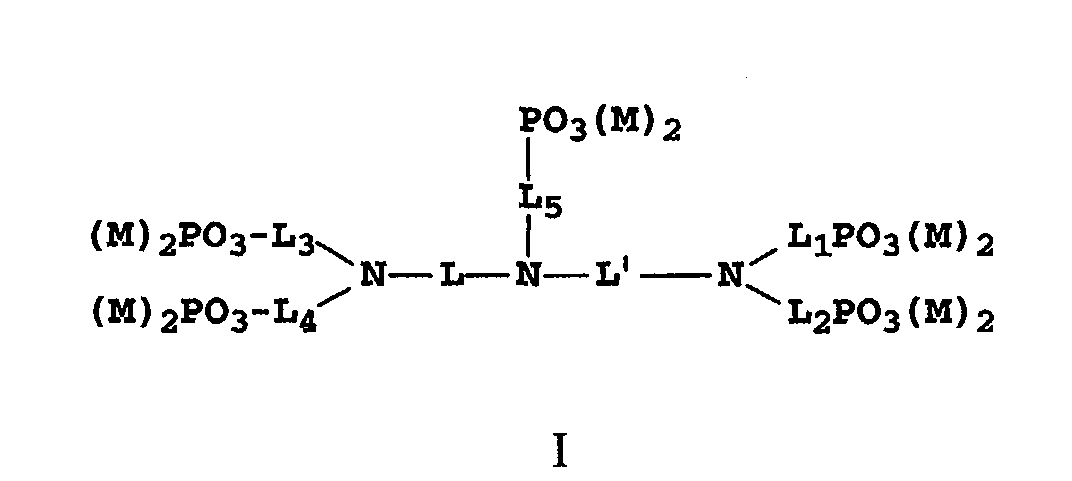
- polyaminopolyphosphonic acids or salts thereof can be represented by the following Structure I: wherein L, L', L 1 , L 2 , L 3 , L 4 and L 5 are independently divalent aliphatic linking groups independently having from 1 to 4 carbon, oxygen, sulfur or nitrogen atoms in the linking group chain, and M is hydrogen or a monovalent cation.
- a particularly useful polyaminopolyphosphonic acid or salt thereof is diethylenetriaminepentamethylenephosphonic acid or a salt thereof.
- the bleaching compositions of this invention can be bleach-fixing compositions that also include one or more photographic fixing agents such as the thiosulfate or thiocyanates as described below.
- Thiosulfates are particularly useful fixing agents and can be present in an amount of at least 0.005 mol/l.
- the fixing agent is particularly useful in the second composition of the photographic processing kit of this invention.
- the components of the bleaching composition can be mixed together in any suitable order.
- the compositions can be stored for a time or used immediately as liquid or solid formulations. They can be formulated in aqueous concentrates or working strength solutions, and diluted if necessary before use. Alternatively, they can be formulated as solid compositions in the form of powders, tablets, granules, or pellets and added to a processing vessel or replenishment tank in a suitable manner at a suitable rate.
- the rate of bleaching solution replenishment is not more than 3000 ml/m 2 , and preferably from 250 to 1500 ml/m 2 of processed photographic material.
- the processing equipment can be any suitable processor having one or more processing tanks or vessels, including minilab processors and larger scale processors.
- the bleaching step can be carried out in one or more tanks or stages arranged in concurrent or countercurrent flow.
- the present invention can be used advantageously with any of the known methods of applying photographic bleaching compositions to photographic materials. These methods include, but are not limited to, immersing the material into an aqueous bleaching composition (with or without agitation or circulation), bringing the material into contact with a web or drum surface that is wet with the bleaching composition, laminating the material with a cover sheet or web in such a way that the composition is brought into contact with the material, or applying the bleaching composition to the material by high velocity jet or spray.
- Each bleaching step can be generally carried out at a temperature of from 20 to 65°C (preferably from 30 to 60°C).
- the time of processing is generally up to 600 seconds and preferably at least 10 and up to 400 seconds (more preferably from 10 to 240 seconds).
- the other processing steps desired to provide color images can be similarly rapid or conventional in time and conditions.
- the other processing steps such as color development, fixing, and/or stabilizing (or rinsing)
- color development can be carried out for from 12 to 360 seconds
- a fixing step for from 12 seconds to 8 minutes
- stabilizing (or rinsing) for from 15 to 240 seconds in various processing protocols.
- the bleaching step can be carried out more than once in some processing methods.
- the processing methods can have any of a wide number of arrangements of steps, as described for example in U.S. Patent 5,633,124 (Schmittou et al.).
- the total processing time for bleaching can be up to 100 seconds (preferably from 40 to 100 seconds).
- the present invention can therefore be used to process silver halide materials of various types including color papers (for example using Process RA-4), color motion picture prints (for example using Process ECP), and color positive films (for example using Process E-6), and color negative films (for example using Process C-41).
- color papers for example using Process RA-4
- color motion picture prints for example using Process ECP
- color positive films for example using Process E-6
- color negative films for example using Process C-41).
- the various processing sequences, conditions and solutions for these processing methods are well known in the art, as well as obvious modifications thereof.
- the "stop” solution generally is an aqueous solution having a pH below 7.
- one preferred processing method of the present invention for obtaining color images in photographic materials includes the following individual processing steps, in order: color development, bleaching, fixing, and final rinsing or stabilizing.
- the photographic elements processed in the practice of this invention can be single or multilayer color elements.
- Multilayer color elements typically contain dye image-forming units sensitive to each of the three primary regions of the visible spectrum. Each unit can be comprised of a single emulsion layer or multiple emulsion layers sensitive to a given region of the spectrum.
- the layers of the element can be arranged in any of the various orders known in the art.
- the emulsions sensitive to each of the three primary regions of the spectrum can be disposed as a single segmented layer.
- the elements can also contain other conventional layers such as filter layers, interlayers, subbing layers, overcoats and other layers readily apparent to one skilled in the art.
- a magnetic backing can be included on the backside of conventional supports.
- the invention can be practiced with photographic color papers containing any of many varied types of silver halide crystal morphology, sensitizers, color couplers, and addenda known in the art, as described in the noted Research Disclosure publication and the many publications noted therein.
- the color papers can have one or more layers, at least one of which is a silver halide emulsion layer that is sensitive to electromagnetic radiation, disposed on a suitable resin-coated paper support.
- the supports can be subbed or unsubbed and coated with various antihalation, antistatic, or other non-imaging layers as is known in the art.
- Representative photographic materials that can be processed to advantage using the present invention include, but are not limited to, KODAK ROYAL GOLD® Color Films (especially the 1000 speed color film), KODAK GOLD MAX® Color Films, KODAK ADVANTIX® Color Films, KODAK VERICOLOR® III Color Films, KONICA VX400 Color Film, KONICA Super SR400 Color Film, KONICA CENTURIA Color Negative Films, FUJI SUPERIA and NEXIA Color Films, and LUCKY Color Films.
- KODAK ROYAL GOLD® Color Films especially the 1000 speed color film
- KODAK GOLD MAX® Color Films KODAK ADVANTIX® Color Films
- KONICA VX400 Color Film KONICA Super SR400 Color Film
- KONICA CENTURIA Color Negative Films FUJI SUPERIA and NEXIA Color Films
- the present invention can be used to provide color images in photographic color papers including, but not limited to, the following commercial products: KODAK® SUPRA ENDURA Color Papers, KODAK® PORTRA ENDURA Color Papers, KODAK® EKTACOLOR® EDGE 5, 7 and 8 Color Papers (Eastman Kodak Company), KODAK® ROYAL® VII Color Papers (Eastman Kodak Company), KODAK® PORTRA III, IIIM Color Papers (Eastman Kodak Company), KODAK® SUPRA III and IIIM Color Papers (Eastman Kodak Company), KODAK® ULTRA III Color Papers (Eastman Kodak Company), Fujicolor Super Color Papers (Fuji Photo Co., FA5, FA7, FA9, Type D and Type DII), Fujicolor Crystal Archive Color Papers (Fuji Photo Co., Digital Paper Type DP, Professional Paper Type DP, Professional Type CD, Professional Type CDII, Professional Type PD, Professional Type PDII, Professional Type PIII,
- KODAK® DURATRANS®, KODAK® DURACLEAR, KODAK® EKTAMAX RA and KODAK® DURAFLEX transparent photographic color positive materials and KODAK® Digital Paper Type 2976 can also be processed using the present invention.
- the color developers can include one or more buffers, antioxidants (or preservatives, such as sulfo-, carboxy, and hydroxy-substituted mono- and dialkylhydroxylamines), antifoggants, fragrances, solubilizing agents, brighteners, halides, sequestering agents, and other conventional addenda.
- antioxidants or preservatives, such as sulfo-, carboxy, and hydroxy-substituted mono- and dialkylhydroxylamines
- antifoggants such as sulfo-, carboxy, and hydroxy-substituted mono- and dialkylhydroxylamines
- fragrances such as sulfo-, carboxy, and hydroxy-substituted mono- and dialkylhydroxylamines
- solubilizing agents such as sulfo-, carboxy, and hydroxy-substituted mono- and dialkylhydroxylamines
- fragrances such as sulfoggants
- Patent 4,170,478 (Case et al.), U.S. Patent 4,264,716 (Vincent et al.), U.S Patent 4,482,626 (Twist et al.), U.S. Patent 4,892,804 (Vincent et al.), U.S. Patents 5,491,050 (Brust et al.), U.S. Patent 5,709,982 (Marrese et al.), U.S. Patent 6,037,111 (Haye et al.), U.S. Patent 6,017,687 (Darmon et al.), U.S. Patent 6,077,651 (Darmon et al.), and U.S. Serial No. 09/706,474 (filed November 3, 2000 by Arcus et al.).
- a preferred photographic color developing composition has a pH of from 9.5 to 13 and comprises 4-(N-ethyl-N-2-methanesulfonylaminoethyl)-2-methylphenylenediamine sesquisulfate (KODAK Color Developing Agent CD-3), one or more hydroxylamine derivatives as antioxidants, and various addenda commonly included in such compositions.
- Fixing can be carried out using conventional fixing compositions that generally include one or more thiosulfate fixing agents in conventional amounts.
- the thiosulfate can be any of sodium thiosulfate, potassium thiosulfate, ammonium thiosulfate, lithium thiosulfate, calcium thiosulfate, or magnesium thiosulfate, or mixtures thereof such that a desired concentration of thiosulfate ion is provided.
- ammonium thiosulfate or sodium thiosulfate (or a mixture thereof) is used.
- ammonium thiosulfate is preferably used for rapid fixing.
- one or more thiocyanate fixing agents can also be present as a fixing agent especially for more rapid silver removal. If present, it can be provided as sodium thiocyanate, potassium thiocyanate, or ammonium thiocyanate, or mixtures thereof.
- a particularly useful photographic fixing composition has a pH of from 2 to 9 and comprises ammonium thiosulfate as the fixing agent, sulfite ions, and a buffer such as a phthalic acid or a salt thereof as described above.
- Stabilizing or rinsing compositions can include one or more surfactants, and in the case of stabilizing compositions, a dye stabilizing compound such as a formaldehyde precursor, hexamethylenetetraamine or various other aldehydes such as m -hydroxybenzaldehyde.
- a dye stabilizing compound such as a formaldehyde precursor, hexamethylenetetraamine or various other aldehydes such as m -hydroxybenzaldehyde.
- Useful stabilizing or rinsing compositions are described in U.S. Patent 4,859,574 (Gonnel), U.S. Patent 4,923,782 (Schwartz), U.S. Patent 4,927,746 (Schwartz), U.S. Patent 5,278,033 (Hagiwara et al.), U.S. Patent 5,441,852 (Hagiwara et al.), U.S.
- Patent 5,529,890 (McGuckin et al.), U.S. Patent 5,534,396 (McGuckin et al.), U.S. Patent 5,578,432 (McGuckin et al.), U.S. Patent 5,645,980 (McGuckin et al.), and U.S. Patent 5,716,765 (McGuckin et al).
- the photographic bleaching composition of this invention can be provided in any suitable container, and can also be included in a processing kit with one or more other processing compositions (such as a color developing composition) in suitable containers.
- processing methods of the present invention can be carried out using any suitable processing equipment or machine that include suitable processing chambers or containers, metering pumps, plumbing, and transport rollers if necessary.
- Processing according to the present invention can be carried out using conventional deep tanks holding processing solutions. Alternatively, it can be carried out using what is known in the art as “low volume thin tank” processing systems, or LVTT, which have either a rack and tank or automatic tray design. These processors are sometimes included in what are known as “minilabs.” Such processing methods and equipment are described, for example, in U.S. Patent 5,436,118 (Carli et al) and publications noted therein.
- bleaching composition of this invention is formulated by mixing two or three “parts” or individual solutions that are manufactured, transported, and stored separately or as bleaching "kits” prior to use.
- bleaching kit of this invention can include a first "part” or solution that includes the peracid bleaching agent and a second "part” or solution that includes the cyclicaminomethanediphosphonic acid (or salt thereof).
- the solutions can be mixed in a suitable manner prior to or during photographic processing.
- the color images obtained using the present invention can be further processed electronically through conventional digital means, transmitted, modified, or stored in digital or physical form.
- the alkaline peroxide bleach formulations shown in TABLE I below, was prepared and stored in open glass containers at room temperature for over 7 days. A decrease in volume due to evaporation was compensated for by periodically adding deionized water. The solutions were analyzed periodically for the amount of remaining peroxide and the change in pH. The results of these measurements are shown in the following TABLE II.
- Example 1 Hydrogen peroxide (30%) 0.98 0.98 Sodium chloride 0.35 0.35 Sodium carbonate buffer 0.05 0.05 1-Hydroxyethylidene-1,1-diphosphonic acid (DEQUEST® 2010) 0.0025 0 Morpholinomethane-diphosphonic acid (BUDEXTM 5103) 0 0.0025 pH 10 10 Time (hours) % H 2 O 2 Remaining Control A Example 1 0 100 100 24 96.0 100 48 91.7 100 72 85.8 96.4 168 7.0 76.6
- peracid bleaching compositions were prepared and evaluated.
- the bleaching compositions were analyzed periodically for the amount of peracid (iodate and persulfate ions) remaining and for the change in pH. The results of these measurements are shown in the following TABLE VIII. After keeping for a period of time, the compositions were used to process samples of commercial color photographic paper to provide acceptable color images.
- Example 9 Control F
- Example 10 Water 600 ml 600 ml 600 ml 600 ml Sodium hexametaphosphate 0 0 2 g 2 g Sodium periodate 2.14 g 2.14 g 0 0 Sodium persulfate 0 0 33 g 33 g Sodium chloride 2.93 g 2.93 g 15 g 15 g Sodium dihydrogen phosphate 0 0 7 g 7 g Phosphoric acid (85%) 0 0 0 2.5 ml 2.5 ml Gelatin 0 0 0.3 g 0.3 g Morpholinomethanediphosphonic acid (Budex 5103) 0 0.005 mol 0 0.005 mol H 2 SO 4 to pH 1.28 1.28 ⁇ 1 ⁇ 1 Final volume 1 liter 1 liter 1 liter 1 liter Time (days) Iodate remaining (%) Persulfate remaining (%) Control E Example 9 Control F Example 10 0 100 100 100 100 100 100 100 8 100 100 72.6
- compositions of this invention produced no precipitates.
- the use of morpholinomethanediphosphonic acid did not negatively impact the stability of the periodate and persulfate bleaching compositions after 8 days. Samples of commercial color photographic paper were processed with these compositions to provide acceptable color images.
Landscapes
- Physics & Mathematics (AREA)
- General Physics & Mathematics (AREA)
- Silver Salt Photography Or Processing Solution Therefor (AREA)
- Detergent Compositions (AREA)
Abstract
A composition for photographic bleaching contains a peracid
bleaching agent such as a peroxide, persulfate, or periodate, and a
cyclicaminomethanediphosphonic acid or a salt thereof as a stabilizing compound.
This bleaching composition can also include a fixing agent, and can be used to
provide color photographic images in various color photographic materials.
Description
- In general, this invention relates to photography and to photographic processing compositions and methods used to provide color images in color photographic materials. In particular, it relates to a photographic bleaching composition containing a peracid bleaching agent and a specific polyphosphonic acid. It also relates to photographic processing kits and methods of use for the bleaching composition.
- The basic image-forming process of color silver halide photography comprises the exposure of a silver halide color photographic recording material to actinic radiation (such as light) and the manifestation of a useful image by wet chemical processing of the material. The fundamental steps of this wet processing include color development to reduce silver halide to silver and to produce dye images in exposed areas of the material. During or after bleaching to oxidize metallic silver to silver (I), the silver ion is generally removed by dissolving it in a silver solvent, commonly known as a fixing agent.
- The most common bleaching agents for color photographic processing are complexes of ferric [Fe (III)] ion and various organic chelating ligands (such as aminopolycarboxylic acids), of which there are hundreds of possibilities, all with varying photographic bleaching abilities and biodegradability.
- Less common bleaching agents are what are known as peracids including the most common peracid, hydrogen peroxide. These bleaching agents provide some advantages over the more common ferric ion-ligand complexes including reduced environmental concerns. Numerous publications describe peroxide, persulfate, and other peracid bleaching agents and their use in photographic processing. See for example U.S. Patents 5,451,491 (Szajewski et al.), 5,460,924 (Buchanan et al.), 5,464,728 (Szajewski et al.), 5,508,151 (O'Toole et al.), 5,510,232 (O'Toole), 5,521,056 (Buchanan et al.), 5,538,834 (Buchanan et al.), 5,541,041 (Haye), 5,547,816 (Fyson et al.), 5,550,009 (Haye et al.), 5,554,491 (O'Toole et al.), 5,578,428 (Fyson), 5,614,355 (Haye et al.), 5,641,615 (Haye et al.), 5,641,616 (Haye et al), 5,656,416 (O'Toole et al.), 5,683,858 (Fyson), 5,691,118 (Haye), 5,691,112 (O'Toole), 5,763,147 (Haye et al.), and 5,773,202 (Haye et al.).
- Throughout the photographic industry, there is a desire to provide photographic processing solutions that are safe and easy to use, photographically effective, and environmentally acceptable. One desirable property is that the solutions are not objectionable due to unpleasant odors. In addition, there is a need to stabilize some of the peracid bleaching agents that can decompose upon long-term storage or use and providing rapid bleaching.
- Despite the many useful photographic bleaching solutions and processing methods known in the art, there is a continuing need for a highly effective photographic bleaching composition containing a peracid bleaching agent that has improved stability.
- The present invention provides an advance in the photographic art with a composition for photographic bleaching comprising at least 0.005 mol/l of a peracid bleaching agent or a compound that generates or provides a peracid bleaching agent, the composition characterized as further comprising at least 0.00005 mol/l of a cyclicaminomethanediphosphonic acid or a salt thereof.
- In preferred embodiments of this invention, a composition for photographic bleaching has a pH of from 1 to 11, and comprises:
- from 0.01 to 3 mol/l of hydrogen peroxide or a compound that provides hydrogen peroxide as a photographic bleaching agent,
- the composition characterized as further comprising from 0.0001 to 0.25 mol/l of morpholinomethanediphosphonic acid or a salt thereof, and
- optionally, one or more additional polyaminopolyphosphonic acids or salts thereof.
-
- This invention also provides a photographic processing kit comprising:
- A) a first composition comprising a peracid bleaching agent or
a compound that generates or provides a peracid bleaching agent, and
the kit characterized as further comprising - B) a second composition comprising a cyclicaminomethanediphosphonic acid or a salt thereof
-
- These compositions in the kit can be in liquid or solid form.
- In addition, a method of providing a color image comprises contacting a color photographic material with a composition for photographic bleaching comprising at least 0.005 mol/l of a peracid bleaching agent or a compound that generates or provides a peracid bleaching agent, and at least 0.00005 mol/l of a cyclicaminomethanediphosphonic acid or a salt thereof.
- In preferred embodiments, a method of photographic processing comprises:
- A) contacting a color photographic material with a color developing composition, and
- B) contacting the color photographic material with a composition for photographic bleaching comprising at least 0.005 mol/l of a peracid bleaching agent or a compound that generates or provides a peracid bleaching agent, and at least 0.00005 mol/l of a cyclicaminomethanediphosphonic acid or a salt thereof.
-
- This invention includes aqueous peracid bleaching compositions (solutions or compounds) containing peracids in combination with a cyclicaminomethanediphosphonic acid, such as morpholinomethanediphosphonic acid, alone or in combination with other sequestering agents at either acidic or alkaline pH conditions. These compositions have reduced odor and can be used for the bleaching of a wide variety of silver halide based photographic materials.
- Photographic bleaching is carried out according to the present invention in one or more steps using one or more peracid photographic bleaching agents as the first essential component of the bleaching composition. Such compounds include, but are not limited to, the hydrogen, alkali and alkaline earth salts of persulfate, peroxide, perchlorate, perborate, periodate, perphosphate, percarbonate, chlorate, bromate, iodate, and metaperiodate. These bleaching agents can be formulated as described, for example, in Research Disclosure September 1994, Item 36544 published by Kenneth Mason Publications, Ltd., Dudley House, 12 North Street, Emsworth, Hampshire PO10 7DQ, England.
- Especially useful peracids are peroxides, persulfates, and periodates. Sodium persulfate and hydrogen peroxide are most preferred bleaching agents.
- Compounds that generate or provide a suitable peracid can be present in the compositions and kits of this invention. For examples, precursors of hydrogen peroxide are well known in the art and include, for example, perborates, perphosphates, percabonates, percarboxylates, and hydrogen peroxide urea. In addition, hydrogen peroxide can be generated within a solution by electrolysis.
- The second essential component of the compositions and kits of this invention that appear to act as "stabilizing" compounds are cyclicaminomethanediphosphonic acid (and salts thereof), or mixtures thereof, as described in U.S. Patent 4,873,180 (Marchesano et al.). "Cyclicamino" groups comprise 3- to 6-membered rings, including but not limited to substituted or unsubstituted aziridino, pyrrolidino, imidazolidino, piperidino, piperazino, isoindolino, and morpholino groups. The substituted or unsubstituted morpholino groups are preferred. Suitable substituents for the cyclicamino groups include, but are not limited to, alkyl groups having 1 to 4 carbon atoms, halo groups, nitro groups, cyano groups, aryl groups, alkoxy groups having 1 to 4 carbon atoms, aryloxy groups, sulfamoyl groups, acyloxy groups, acylamino groups, ureido groups, sulfonamido groups, hydroxy groups, and others that would be readily apparent to one skilled in the art from the teaching of U.S. Patent 4,873,180.
- The "cyclicamino" groups are attached to a methyl group that includes two phosphonic acids (or alkali metal or ammonium salts thereof) and the remaining valence of the methyl group can be hydrogen, a substituted or unsubstituted alkyl group, or a substituted or unsubstituted aryl group.
- Representative cyclicaminomethanediphosphonic acids (or salts thereof) are compounds 7-17 of U.S. Patent 4,873,180 (noted above). A most preferred compound of this type is morpholinomethanediphosphonic acid or a salt thereof that is commercially available as BUDEX™ 5103 from Budenheim (Germany).
- The bleaching compositions can include a variety of optional chemical components that provide one or more chemical or physical functions, including but not limited to, buffers, rehalogenating agents, metal ion sequestering agents, bleach accelerating agents, biocides, photographic hardeners, and other materials readily apparent to one skilled in the art.
- It is particularly useful to include one or more buffers in the bleaching composition (when in aqueous form) to maintain the pH of up to 13 (preferably from 1 to 11).
- If the bleaching composition of this invention is highly acidic, that is having a pH less than 2 (preferably less than 1.5, and more preferably, less than 1.25), the pH can be provided by adding at least one conventional strong acid, including, but not limited to, sulfuric acid, phosphoric acid and methanesulfonic acid. Sulfuric acid is preferred.
- If the pH of the bleaching composition is between 3 and 6, the pH may be maintained with any of a variety of organic or inorganic buffers, as long as the buffer has at least one pKa value between 1.5 and 7.5 (preferably 3 to 6) and does not substantially disrupt the complexation of ferric ion by the pyridinecarboxylate ligand. Furthermore, the buffer should not be readily oxidized by the bleaching composition nor should it adversely affect image and masking dyes. It is to avoid such dye interactions that preferred buffers such as aliphatic or aromatic carboxylic acid buffers, and particularly sulfo-substituted aliphatic and aromatic carboxylic acid buffers are used at concentrations and pH values such that the concentration of the basic form of the buffer (for example, acetate ion) is less than 0.5 mol/l, and more preferably less than 0.2 mol/l. Examples of useful buffers are acetate, 2-methyllactate, phthalate, 4-sulfophthalate, 5-sulfoisophthalic acid, sulfoacetate, sulfosuccinate, and trimellitate. In one embodiment, the ligand may also serve as the buffer.
- If the bleaching composition is alkaline that is having a pH within the general range of from 7 to 13 (with a pH of from 8 to 12 being preferred, and a pH of from 9 to 11 being most preferred), the pH can be provided by adding a conventional weak or strong base, and can be maintained by the presence of one or more suitable buffers including, but not limited to, sodium carbonate, potassium carbonate, sodium borate, potassium borate, sodium phosphate, calcium hydroxide, sodium silicate, β-alaninediacetic acid, arginine, asparagine, ethylenediamine, ethylenediaminetetraacetic acid, ethylenediaminedisuccinic acid, glycine, histidine, imidazole, isoleucine, leucine, methyliminodiacetic acid, nicotine, nitrilotriacetic acid, piperidine, proline, purine and pyrrolidine. Sodium and potassium carbonates are preferred. The amount of useful buffer or base would be readily apparent to one skilled in the art.
- It may also be desirable to include a rehalogenating agent in the bleaching composition including but not limited to, chloride and/or bromide ions.
- It may further be desirable to include one or more uncomplexed (poly)amino(poly)carboxylic acid, an additional polyphosphonic acid, or a salt of either of these compounds in the bleaching compositions. Particularly useful polyaminopolyphosphonic acids or salts thereof can be represented by the following Structure I:wherein L, L', L1, L2, L3, L4 and L5 are independently divalent aliphatic linking groups independently having from 1 to 4 carbon, oxygen, sulfur or nitrogen atoms in the linking group chain, and M is hydrogen or a monovalent cation.
- A particularly useful polyaminopolyphosphonic acid or salt thereof is diethylenetriaminepentamethylenephosphonic acid or a salt thereof.
- The following TABLE I lists the general and preferred amounts of the essential and some optional components of the bleaching compositions of this invention. The preferred ranges are listed in parentheses (), and all of the ranges are considered to be approximate or "about" in the upper and lower end points. During processing, the actual concentrations can vary depending upon extracted chemicals in the composition, replenishment rates, water losses due to evaporation and carryover from any preceding processing bath and carryover to the next processing bath. The amounts are total concentrations for the various components that can be present in mixtures.
COMPONENT CONCENTRATIONS Peracid bleaching agent(s) 0.005 - 5 mol/l
(0.01 - 3 mol/l)Rehalogenating agent(s) 0 - 2 mol/l
(0.01 - 1 mol/l)Buffering agent(s) 0.05 - 3 mol/l
(0.1 - 2 mol/l)Cyclicaminomethane-diphosphonic acid (or salt) 0.00005 - 0.5 mol/l
(0.0001 - 0.25 mol/l)pH Up to 13
(1 - 11) - The bleaching compositions of this invention can be bleach-fixing compositions that also include one or more photographic fixing agents such as the thiosulfate or thiocyanates as described below. Thiosulfates are particularly useful fixing agents and can be present in an amount of at least 0.005 mol/l. The fixing agent is particularly useful in the second composition of the photographic processing kit of this invention.
- The components of the bleaching composition can be mixed together in any suitable order. The compositions can be stored for a time or used immediately as liquid or solid formulations. They can be formulated in aqueous concentrates or working strength solutions, and diluted if necessary before use. Alternatively, they can be formulated as solid compositions in the form of powders, tablets, granules, or pellets and added to a processing vessel or replenishment tank in a suitable manner at a suitable rate.
- During photographic processing, conventional procedures can be used for replenishment of the various processing solutions, including the photographic bleaching composition of this invention. Preferably, the rate of bleaching solution replenishment is not more than 3000 ml/m2, and preferably from 250 to 1500 ml/m2 of processed photographic material. The processing equipment can be any suitable processor having one or more processing tanks or vessels, including minilab processors and larger scale processors. The bleaching step can be carried out in one or more tanks or stages arranged in concurrent or countercurrent flow.
- The present invention can be used advantageously with any of the known methods of applying photographic bleaching compositions to photographic materials. These methods include, but are not limited to, immersing the material into an aqueous bleaching composition (with or without agitation or circulation), bringing the material into contact with a web or drum surface that is wet with the bleaching composition, laminating the material with a cover sheet or web in such a way that the composition is brought into contact with the material, or applying the bleaching composition to the material by high velocity jet or spray.
- Each bleaching step can be generally carried out at a temperature of from 20 to 65°C (preferably from 30 to 60°C). The time of processing is generally up to 600 seconds and preferably at least 10 and up to 400 seconds (more preferably from 10 to 240 seconds).
- The other processing steps desired to provide color images can be similarly rapid or conventional in time and conditions. Preferably the other processing steps, such as color development, fixing, and/or stabilizing (or rinsing), are likewise shorter than conventional times. For example, color development can be carried out for from 12 to 360 seconds, a fixing step for from 12 seconds to 8 minutes, and stabilizing (or rinsing) for from 15 to 240 seconds in various processing protocols. The bleaching step can be carried out more than once in some processing methods. The processing methods can have any of a wide number of arrangements of steps, as described for example in U.S. Patent 5,633,124 (Schmittou et al.).
- In rapid processing methods, the total processing time for bleaching can be up to 100 seconds (preferably from 40 to 100 seconds).
- The present invention can therefore be used to process silver halide materials of various types including color papers (for example using Process RA-4), color motion picture prints (for example using Process ECP), and color positive films (for example using Process E-6), and color negative films (for example using Process C-41). The various processing sequences, conditions and solutions for these processing methods are well known in the art, as well as obvious modifications thereof.
- An acidic stop solution can be used between color development and the first bleaching step. The "stop" solution generally is an aqueous solution having a pH below 7.
- Thus, one preferred processing method of the present invention for obtaining color images in photographic materials includes the following individual processing steps, in order: color development, bleaching, fixing, and final rinsing or stabilizing.
- The photographic elements processed in the practice of this invention can be single or multilayer color elements. Multilayer color elements typically contain dye image-forming units sensitive to each of the three primary regions of the visible spectrum. Each unit can be comprised of a single emulsion layer or multiple emulsion layers sensitive to a given region of the spectrum. The layers of the element can be arranged in any of the various orders known in the art. In an alternative format, the emulsions sensitive to each of the three primary regions of the spectrum can be disposed as a single segmented layer. The elements can also contain other conventional layers such as filter layers, interlayers, subbing layers, overcoats and other layers readily apparent to one skilled in the art. A magnetic backing can be included on the backside of conventional supports.
- More details of the element structure and components, and suitable methods of processing various types of elements are described in Research Disclosure publication 38957 noted above. Included within such teachings in the art is the use of various classes of cyan, yellow and magenta color couplers that can be used with the present invention (including pyrazolone and pyrazolotriazole type magenta dye forming couplers). Preferably, the present invention can be used to process color photographic papers having pigmented resin-coated paper supports.
- The emulsions and other components, and structure of color photographic materials processed using this invention and the various procedures for manufacturing them are well known and described in considerable publications, including, for example, Research Disclosure, publication 38957, pages 592-639 (September 1996), and Research Disclosure, Volume 370, February 1995, and hundreds of references noted therein. Research Disclosure is a publication of Kenneth Mason Publications Ltd., Dudley House, 12 North Street, Emsworth, Hampshire PO10 7DQ England (also available from Emsworth Design Inc., New York, N.Y. 10011). This reference will be referred to hereinafter as "Research Disclosure". More details about such materials are provided herein below. In particular, the invention can be practiced with photographic color papers containing any of many varied types of silver halide crystal morphology, sensitizers, color couplers, and addenda known in the art, as described in the noted Research Disclosure publication and the many publications noted therein. The color papers can have one or more layers, at least one of which is a silver halide emulsion layer that is sensitive to electromagnetic radiation, disposed on a suitable resin-coated paper support. The supports can be subbed or unsubbed and coated with various antihalation, antistatic, or other non-imaging layers as is known in the art.
- Representative photographic materials that can be processed to advantage using the present invention include, but are not limited to, KODAK ROYAL GOLD® Color Films (especially the 1000 speed color film), KODAK GOLD MAX® Color Films, KODAK ADVANTIX® Color Films, KODAK VERICOLOR® III Color Films, KONICA VX400 Color Film, KONICA Super SR400 Color Film, KONICA CENTURIA Color Negative Films, FUJI SUPERIA and NEXIA Color Films, and LUCKY Color Films. Other elements that could be used in the practice of this invention would be readily apparent to one skilled in the art.
- More preferably, the present invention can be used to provide color images in photographic color papers including, but not limited to, the following commercial products: KODAK® SUPRA ENDURA Color Papers, KODAK® PORTRA ENDURA Color Papers, KODAK® EKTACOLOR® EDGE 5, 7 and 8 Color Papers (Eastman Kodak Company), KODAK® ROYAL® VII Color Papers (Eastman Kodak Company), KODAK® PORTRA III, IIIM Color Papers (Eastman Kodak Company), KODAK® SUPRA III and IIIM Color Papers (Eastman Kodak Company), KODAK® ULTRA III Color Papers (Eastman Kodak Company), Fujicolor Super Color Papers (Fuji Photo Co., FA5, FA7, FA9, Type D and Type DII), Fujicolor Crystal Archive Color Papers (Fuji Photo Co., Digital Paper Type DP, Professional Paper Type DP, Professional Type CD, Professional Type CDII, Professional Type PD, Professional Type PDII, Professional Type PIII, Professional Type SP, Type One, Professional Paper Type MP, , Type D and Type C), Fuji Prolaser (Fuji Photo Co.), KONICA COLOR QA Color Papers (Konica, Type QA6E and QA7, Type AD Amateur Digital, Type CD Professional Digital), Konica Color Paper Professional SP (Konica), Konica Color Paper Professional HC (Konica), Konica Color Paper Professional for Digital Type CD (Konica), Agfa Prestige Color Papers (AGFA, Digital and Prestige II), Agfa Laser II Paper (AGFA), Agfa Professional Portrait (AGFA), Agfa Professional Signum II (AGFA), Mitsubishi Color Paper SA Color Papers (Mitsubishi, Type SA-C, Type SA-PRO-L and Type SA-PRO-H). The compositions and constructions of such commercial photographic color papers would be readily determined by one skilled in the art.
- KODAK® DURATRANS®, KODAK® DURACLEAR, KODAK® EKTAMAX RA and KODAK® DURAFLEX transparent photographic color positive materials and KODAK® Digital Paper Type 2976 can also be processed using the present invention.
- Reagents for color development compositions are well known, and described, for example, in Research Disclosure (noted above), sections XVIII and XIX, and the many references described therein. Thus, besides a color developing agent (such as a p-aminophenol or p-phenylenediamine), the color developers can include one or more buffers, antioxidants (or preservatives, such as sulfo-, carboxy, and hydroxy-substituted mono- and dialkylhydroxylamines), antifoggants, fragrances, solubilizing agents, brighteners, halides, sequestering agents, and other conventional addenda. Representative teaching about color developing compositions can also be found in U.S. Patent 4,170,478 (Case et al.), U.S. Patent 4,264,716 (Vincent et al.), U.S Patent 4,482,626 (Twist et al.), U.S. Patent 4,892,804 (Vincent et al.), U.S. Patents 5,491,050 (Brust et al.), U.S. Patent 5,709,982 (Marrese et al.), U.S. Patent 6,037,111 (Haye et al.), U.S. Patent 6,017,687 (Darmon et al.), U.S. Patent 6,077,651 (Darmon et al.), and U.S. Serial No. 09/706,474 (filed November 3, 2000 by Arcus et al.).
- A preferred photographic color developing composition has a pH of from 9.5 to 13 and comprises 4-(N-ethyl-N-2-methanesulfonylaminoethyl)-2-methylphenylenediamine sesquisulfate (KODAK Color Developing Agent CD-3), one or more hydroxylamine derivatives as antioxidants, and various addenda commonly included in such compositions.
- Fixing can be carried out using conventional fixing compositions that generally include one or more thiosulfate fixing agents in conventional amounts. The thiosulfate can be any of sodium thiosulfate, potassium thiosulfate, ammonium thiosulfate, lithium thiosulfate, calcium thiosulfate, or magnesium thiosulfate, or mixtures thereof such that a desired concentration of thiosulfate ion is provided. Preferably, ammonium thiosulfate or sodium thiosulfate (or a mixture thereof) is used. For rapid fixing, ammonium thiosulfate is preferably used.
- Optionally, one or more thiocyanate fixing agents can also be present as a fixing agent especially for more rapid silver removal. If present, it can be provided as sodium thiocyanate, potassium thiocyanate, or ammonium thiocyanate, or mixtures thereof.
- A particularly useful photographic fixing composition has a pH of from 2 to 9 and comprises ammonium thiosulfate as the fixing agent, sulfite ions, and a buffer such as a phthalic acid or a salt thereof as described above.
- Stabilizing or rinsing compositions can include one or more surfactants, and in the case of stabilizing compositions, a dye stabilizing compound such as a formaldehyde precursor, hexamethylenetetraamine or various other aldehydes such as m-hydroxybenzaldehyde. Useful stabilizing or rinsing compositions are described in U.S. Patent 4,859,574 (Gonnel), U.S. Patent 4,923,782 (Schwartz), U.S. Patent 4,927,746 (Schwartz), U.S. Patent 5,278,033 (Hagiwara et al.), U.S. Patent 5,441,852 (Hagiwara et al.), U.S. Patent 5,529,890 (McGuckin et al.), U.S. Patent 5,534,396 (McGuckin et al.), U.S. Patent 5,578,432 (McGuckin et al.), U.S. Patent 5,645,980 (McGuckin et al.), and U.S. Patent 5,716,765 (McGuckin et al).
- The photographic bleaching composition of this invention can be provided in any suitable container, and can also be included in a processing kit with one or more other processing compositions (such as a color developing composition) in suitable containers.
- The processing methods of the present invention can be carried out using any suitable processing equipment or machine that include suitable processing chambers or containers, metering pumps, plumbing, and transport rollers if necessary.
- Processing according to the present invention can be carried out using conventional deep tanks holding processing solutions. Alternatively, it can be carried out using what is known in the art as "low volume thin tank" processing systems, or LVTT, which have either a rack and tank or automatic tray design. These processors are sometimes included in what are known as "minilabs." Such processing methods and equipment are described, for example, in U.S. Patent 5,436,118 (Carli et al) and publications noted therein.
- Generally, the bleaching composition of this invention is formulated by mixing two or three "parts" or individual solutions that are manufactured, transported, and stored separately or as bleaching "kits" prior to use. Thus, bleaching kit of this invention can include a first "part" or solution that includes the peracid bleaching agent and a second "part" or solution that includes the cyclicaminomethanediphosphonic acid (or salt thereof). The solutions can be mixed in a suitable manner prior to or during photographic processing.
- The color images obtained using the present invention can be further processed electronically through conventional digital means, transmitted, modified, or stored in digital or physical form.
- The following examples are provided to illustrate the practice of the present invention and are not meant to be limiting in any way.
- In this example, the alkaline peroxide bleach formulations, shown in TABLE I below, was prepared and stored in open glass containers at room temperature for over 7 days. A decrease in volume due to evaporation was compensated for by periodically adding deionized water. The solutions were analyzed periodically for the amount of remaining peroxide and the change in pH. The results of these measurements are shown in the following TABLE II.
Component Formulation (mol/l) Control A Example 1 Hydrogen peroxide (30%) 0.98 0.98 Sodium chloride 0.35 0.35 Sodium carbonate buffer 0.05 0.05 1-Hydroxyethylidene-1,1-diphosphonic acid (DEQUEST® 2010) 0.0025 0 Morpholinomethane-diphosphonic acid (BUDEX™ 5103) 0 0.0025 pH 10 10 Time (hours) % H2O2 Remaining Control A Example 1 0 100 100 24 96.0 100 48 91.7 100 72 85.8 96.4 168 7.0 76.6 - This study shows that the bleaching composition of this invention produced no precipitate and was very stable to decomposition at pH 10 after seven days compared to the Control A composition. Samples of commercial color photographic paper processed using this composition and other commercial processing solutions produced the desired image.
- In these examples, the effect of higher levels of stabilizer compound within the present invention was evaluated as well as a combination of the stabilizer compound and a common metal ion sequestering agent, aminotri(methylenephosphonic acid)pentasodium salt (DEQUEST® 2006). The tested compositions, described in TABLE III below, were evaluated as described in Example 1. The compositions were analyzed periodically for the amount of remaining peroxide and for the change in pH. The results of these measurements are shown in TABLE IV below.
Component Formulations (mol/l) Control B Control C Example 2 Example 3 Example 4 Hydrogen peroxide (30%) 0.98 0.98 0.98 0.98 0.98 Sodium chloride 0.35 0.35 0.35 0.35 0.35 Sodium carbonate 0.05 0.05 0.05 0.05 0.05 1-Hydroxyethylidene-1,1-diphosphonic acid (DEQUEST® 2010) 0.002 0 0 0 0 Aminotri(methylenephosphonic acid)pentasodium salt (DEQUEST® 2006). 0 0.002 0 0 0.002 Morpholinomethanediphosphonic acid (Budex 5103) 0 0 0.002 0.004 0.001 pH 10 10 10 10 10 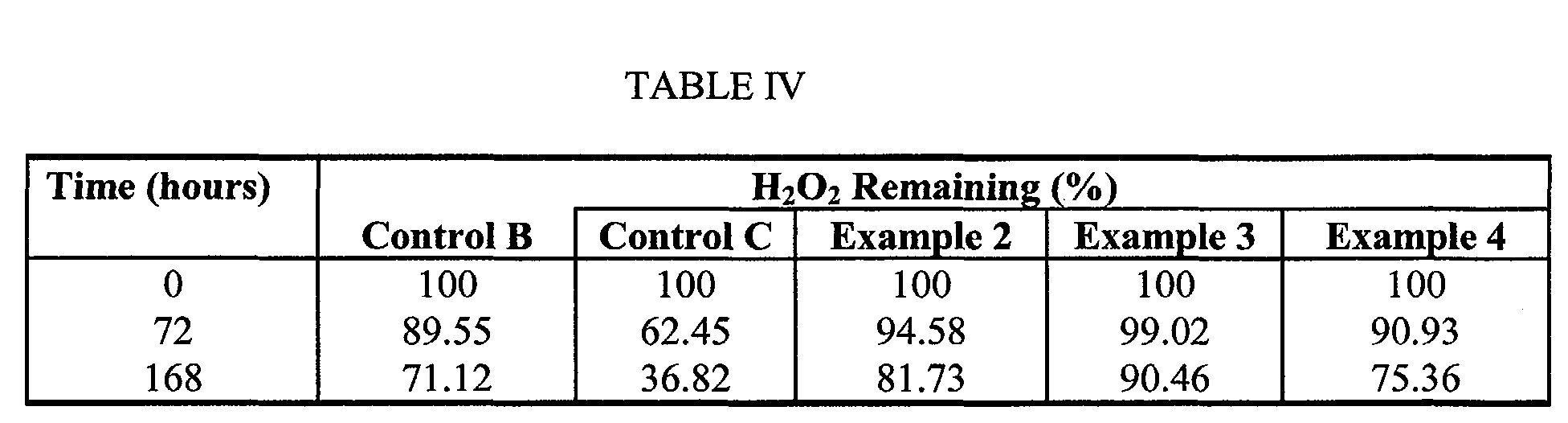
- These results show that in the alkaline peroxide bleaching compositions of this invention, the use of morpholinomethanediphosphonic acid alone or in combination with of aminotri(methylenephosphonic acid)pentasodium salt improved the stability of the peroxide bleaching agent over the use common metal ion sequestering agent 1-hydroxyethylidene-1,1-diphosphonic acid or aminotri(methylenephosphonic acid)pentasodium salt alone. Very little change in pH was observed with the invention peroxide compositions.
- In these examples, the stability of an iron (III)-containing peroxide bleaching compositions was evaluated at pH 4.5 using various concentrations of morpholinomethanediphosphonic acid. The compositions, described in TABLE V below were evaluated as described in Example 1. The bleaching compositions were analyzed periodically for the amount of remaining peroxide and for the change in pH. The results of these measurements are shown in TABLE VI below.
Component Formulations (mol/l) Control D Example 5 Example 6 Example 7 Hydrogen peroxide ( 30%) 0.25 0.25 0.25 0.25 2,6-Picolinic acid 0.02 0.02 0.02 0.02 NaOH to pH of 3.5 3.5 3.5 3.5 Fe (NO3)3. 9H2O 0.0062 0.0062 0.0062 0.0062 Sodium carbonate to pH of 3.5 3.5 3.5 3.5 Sodium chloride 0.25 0.25 0.25 0.25 Morpholinomethanediphosphonic acid (Budex 5103) 0 0.002 0.005 0.01 Volume 1 liter 1 liter 1 liter 1 liter Final pH 3.5 3.5 3.5 3.5 Time (days) H2O2 remaining (%) Control D Example 5 Example 6 Example 7 0 100 100 100 100 3 8.6 22.2 73.8 97.9 7 0 0.4 62.2 95.9 - These results show that the stability of acidic iron-ligand peroxide bleaching compositions can be significantly improved with the addition of the stabilizing compound according to the present invention. A small increase in pH was observed in the compositions. Samples of a commercial color photographic paper were processed using the Example 6 bleaching composition (and other commercial processing compositions) to provide acceptable color images.
- Various peracid bleaching compositions were prepared and evaluated. The compositions, described in the following TABLE VII, were evaluated as described in Example 1. The bleaching compositions were analyzed periodically for the amount of peracid (iodate and persulfate ions) remaining and for the change in pH. The results of these measurements are shown in the following TABLE VIII. After keeping for a period of time, the compositions were used to process samples of commercial color photographic paper to provide acceptable color images.
Component Formulations Control E Example 9 Control F Example 10 Water 600 ml 600 ml 600 ml 600 ml Sodium hexametaphosphate 0 0 2 g 2 g Sodium periodate 2.14 g 2.14 g 0 0 Sodium persulfate 0 0 33 g 33 g Sodium chloride 2.93 g 2.93 g 15 g 15 g Sodium dihydrogen phosphate 0 0 7 g 7 g Phosphoric acid (85%) 0 0 2.5 ml 2.5 ml Gelatin 0 0 0.3 g 0.3 g Morpholinomethanediphosphonic acid (Budex 5103) 0 0.005 mol 0 0.005 mol H2SO4 to pH 1.28 1.28 ~1 ~1 Final volume 1 liter 1 liter 1 liter 1 liter Time (days) Iodate remaining (%) Persulfate remaining (%) Control E Example 9 Control F Example 10 0 100 100 100 100 8 100 100 72.6 72.5 - These results show that the compositions of this invention produced no precipitates. The use of morpholinomethanediphosphonic acid did not negatively impact the stability of the periodate and persulfate bleaching compositions after 8 days. Samples of commercial color photographic paper were processed with these compositions to provide acceptable color images.
Claims (13)
- A composition for photographic bleaching comprising at least 0.005 mol/l of a peracid bleaching agent or a compound that generates or provides a peracid bleaching agent, the composition characterized as further comprising at least 0.00005 mol/l of a cyclicaminomethanediphosphonic acid or a salt thereof.
- The composition of claim 1 wherein the bleaching composition is a bleach-fixing composition and further comprises a photographic fixing agent that is present in an amount of at least 0.005 mol/l.
- The composition of claim 1 or 2 wherein the peracid bleaching agent is present in an amount of from 0.005 to 5 mol/l, and the cyclicaminomethanediphosphonic acid or a salt thereof is present in an amount of from 0.00005 to 0.5 mol/l.
- The composition of any of claims 1 to 3 wherein the peracid bleaching agent is a persulfate, periodate, or a peroxide.
- The composition of any of claims 1 to 4 wherein the peracid bleaching agent is hydrogen peroxide or a compound that provides hydrogen peroxide that is present in an amount of from 0.01 to 3 mol/l.
- The composition of any of claims 1 to 5 wherein the cyclicaminomethanediphosphonic acid or a salt thereof is morpholinomethanediphoshonic acid or a salt thereof.
- The composition of any of claims 1 to 6 further comprising an uncomplexed (poly)amino(poly)carboxylic acid, an additional polyphosphonic acid, or a salt of either of these compounds.
- The composition of any of claims 1 to 7 further comprising a polyaminopolyphosphonic acid or a salt thereof that is represented by the following Structure I:wherein L, L', L1, L2, L3, L4 and L5 are independently divalent aliphatic linking groups independently having from 1 to 4 carbon, oxygen, sulfur or nitrogen atoms in the linking group chain, and M is hydrogen or a monovalent cation.

- A photographic processing kit comprising:A) a first composition comprising a peracid bleaching agent or a compound that generates or provides a peracid bleaching agent, and
the kit characterized as further comprisingB) a second composition comprising a cyclicaminomethanediphosphonic acid or a salt thereof. - The photographic processing kit of claim 9 further comprising a third composition that is a photographic color developing composition.
- The photographic processing kit of claim 9 or 10 wherein the second composition further comprises a photographic fixing agent.
- A method of providing a color image comprising contacting a color photographic material with a composition of any of claims 1 to 8.
- A method of photographic processing comprising:A) contacting a color photographic material with a color developing composition, andB) contacting the color photographic material with a composition of any of claims 1 to 8.
Applications Claiming Priority (2)
| Application Number | Priority Date | Filing Date | Title |
|---|---|---|---|
| US376717 | 1995-01-23 | ||
| US10/376,717 US6703192B1 (en) | 2003-02-28 | 2003-02-28 | Photographic peracid bleaching composition, processing kit, and method of use |
Publications (1)
| Publication Number | Publication Date |
|---|---|
| EP1452910A1 true EP1452910A1 (en) | 2004-09-01 |
Family
ID=31888150
Family Applications (1)
| Application Number | Title | Priority Date | Filing Date |
|---|---|---|---|
| EP04075472A Withdrawn EP1452910A1 (en) | 2003-02-28 | 2004-02-16 | Photographic peracid bleaching compositon, processing kit, and method of use |
Country Status (4)
| Country | Link |
|---|---|
| US (2) | US6703192B1 (en) |
| EP (1) | EP1452910A1 (en) |
| JP (1) | JP2004264849A (en) |
| CN (1) | CN1525244A (en) |
Families Citing this family (2)
| Publication number | Priority date | Publication date | Assignee | Title |
|---|---|---|---|---|
| KR101016913B1 (en) * | 2003-03-31 | 2011-02-22 | 도쿄엘렉트론가부시키가이샤 | Barrier layer for processing element and method of forming the same |
| EP2225175B1 (en) * | 2007-12-13 | 2012-12-12 | Akzo Nobel N.V. | Stabilized hydrogen peroxide solutions |
Citations (3)
| Publication number | Priority date | Publication date | Assignee | Title |
|---|---|---|---|---|
| US4277556A (en) * | 1976-08-18 | 1981-07-07 | Konishiroku Photo Industry Co., Ltd. | Process for treating light-sensitive silver halide color photographic materials |
| EP0678783A1 (en) * | 1994-04-20 | 1995-10-25 | Eastman Kodak Company | Hydrogen peroxide bleach composition for use with silver halide photographic elements |
| EP0747764A1 (en) * | 1995-05-26 | 1996-12-11 | Eastman Kodak Company | Method of processing camera speed silver chloride photographic elements using peroxide bleaching solutions |
Family Cites Families (38)
| Publication number | Priority date | Publication date | Assignee | Title |
|---|---|---|---|---|
| JPS5598750A (en) | 1979-01-23 | 1980-07-28 | Fuji Photo Film Co Ltd | Photographic bleaching composition |
| JPS5633646A (en) | 1979-08-29 | 1981-04-04 | Fuji Photo Film Co Ltd | Processing method for color photographic material |
| US4448878A (en) | 1981-11-13 | 1984-05-15 | Fuji Photo Film Co., Ltd. | Silver halide photographic light-sensitive materials |
| JPS5883852A (en) | 1981-11-13 | 1983-05-19 | Fuji Photo Film Co Ltd | Method for bleaching color photographic material |
| JPS58168049A (en) | 1982-03-29 | 1983-10-04 | Fuji Photo Film Co Ltd | Color phtographic sensitive silver halide material |
| US4508816A (en) | 1982-10-21 | 1985-04-02 | Fuji Photo Film Co., Ltd. | Method for bleaching color photosensitive material |
| US4454224A (en) | 1982-12-22 | 1984-06-12 | Eastman Kodak Company | Photographic bleaching compositions |
| JPS59187341A (en) | 1983-04-08 | 1984-10-24 | Fuji Photo Film Co Ltd | Method for processing color photographic sensitive material |
| US4717649A (en) | 1986-04-18 | 1988-01-05 | Eastman Kodak Company | Photographic bleach-fixing compositions |
| IT1215423B (en) | 1987-04-13 | 1990-02-08 | Minnesota Mining & Mfg | DEVELOPMENT COMPOSITIONS FOR SILVER HALIDE PHOTOGRAPHIC MATERIALS. |
| JP2568924B2 (en) | 1989-11-13 | 1997-01-08 | 富士写真フイルム株式会社 | Processing method of silver halide color photosensitive material |
| GB9016472D0 (en) | 1990-07-26 | 1990-09-12 | Kodak Ltd | Photographic bleach compositions |
| US5547816A (en) | 1990-10-19 | 1996-08-20 | Eastman Kodak Company | Photographic processing method using bleach solution comprising hydrogen peroxide and halide ions |
| GB9022749D0 (en) | 1990-10-19 | 1990-12-05 | Kodak Ltd | Photographic bleach solution |
| SE467436B (en) * | 1990-11-16 | 1992-07-13 | Ericsson Telefon Ab L M | PROCEDURE AND DEVICE TO REDUCE THE NECESSARY SIZE OF A DIGITAL FILTER IN CONNECTION WITH ECO-ELIMINATION IN A SUBSCRIPTION LINE |
| DE69226069T2 (en) | 1991-12-19 | 1999-03-11 | Eastman Kodak Co., Rochester, N.Y. | Blocked compounds used in photography for processes in whose peroxides are used |
| US5318880A (en) | 1992-06-01 | 1994-06-07 | Eastman Kodak Company | Method of processing a photographic element with a peracid bleach |
| US5683858A (en) | 1992-11-30 | 1997-11-04 | Eastman Kodak Company | Photographic bleach composition |
| JPH06214365A (en) | 1992-12-14 | 1994-08-05 | Eastman Kodak Co | Bleaching accelerator, bleaching composition and photographic element |
| DE69305728T2 (en) | 1992-12-29 | 1997-05-15 | Eastman Kodak Co | Process for bleaching and fixing a color photographic element |
| US5464728A (en) | 1992-12-29 | 1995-11-07 | Eastman Kodak Company | Method of bleaching and fixing a color photographic element containing high iodine emulsions |
| EP0665220B1 (en) | 1994-01-28 | 1999-04-07 | Shin-Etsu Chemical Co., Ltd. | Novel sulfonium salt and chemically amplified positive resist composition |
| DE69504126T2 (en) | 1994-04-20 | 1998-12-24 | Eastman Kodak Co., Rochester, N.Y. | Processing a silver halide photographic element with a hydrogen peroxide bleaching composition |
| GB9425508D0 (en) | 1994-12-17 | 1995-02-15 | Kodak Ltd | Process and apparatus for the peroxide bleaching of photographic materials |
| US5508151A (en) | 1994-12-22 | 1996-04-16 | Eastman Kodak Company | Processing of photographic elements using copper ligand complexes to catalyze peracid bleaching agents |
| US5510232A (en) | 1994-12-22 | 1996-04-23 | Eastman Kodak Company | Photographic processing composition and method using cationic hydroquinone as organic catalyst for persulfate bleaching agent |
| US5656416A (en) | 1994-12-22 | 1997-08-12 | Eastman Kodak Company | Photographic processing composition and method using organic catalyst for peroxide bleaching agent |
| US5521056A (en) | 1995-01-10 | 1996-05-28 | Eastman Kodak Company | Photographic peracid bleaching composition and processing method using ternary iron carboxylate complexes as catalysts in peracid bleaching solutions |
| US5763147A (en) | 1995-02-21 | 1998-06-09 | Eastman Kodak Company | Method for processing high silver bromide color negative photographic films using a peroxide bleaching composition |
| US5614355A (en) | 1995-02-21 | 1997-03-25 | Eastman Kodak Company | Peroxide composition and method for processing color photographic elements containing predominantly chloride silver halide emulsions |
| US5773202A (en) | 1995-02-21 | 1998-06-30 | Haye; Shirleyanne Elizabeth | Method for processing color photographic films using a peroxide bleaching composition |
| US5554491A (en) | 1995-03-21 | 1996-09-10 | Eastman Kodak Company | Use of an alkaline prebath to activate an acidic peroxide bleach solution for processing color photographic elements |
| US5541041A (en) | 1995-04-17 | 1996-07-30 | Eastman Kodak Company | Stabilized peroxide bleaching solutions containing multiple chelating ligands and their use for processing of photographic elements |
| US5550009A (en) | 1995-04-17 | 1996-08-27 | Eastman Kodak Company | Stabilized peroxide bleaching solutions and their use for processing of photographic elements |
| US5691118A (en) | 1996-10-10 | 1997-11-25 | Eastman Kodak Company | Color paper processing using two acidic stop solutions before and after bleaching |
| GB2330211A (en) | 1997-10-08 | 1999-04-14 | Eastman Kodak Co | Periodate photographic bleaching compositions |
| US5885758A (en) | 1997-12-03 | 1999-03-23 | Eastman Kodak Company | Periodate photographic bleaching method without acidic prebath |
| US5900355A (en) * | 1998-03-26 | 1999-05-04 | Eastman Kodak Company | Method of making uniformly mixed dry photographic processing composition using hot melt binder |
-
2003
- 2003-02-28 US US10/376,717 patent/US6703192B1/en not_active Expired - Fee Related
- 2003-10-22 US US10/691,083 patent/US6852477B2/en not_active Expired - Fee Related
-
2004
- 2004-02-16 EP EP04075472A patent/EP1452910A1/en not_active Withdrawn
- 2004-02-27 CN CNA2004100078290A patent/CN1525244A/en active Pending
- 2004-02-27 JP JP2004054467A patent/JP2004264849A/en active Pending
Patent Citations (3)
| Publication number | Priority date | Publication date | Assignee | Title |
|---|---|---|---|---|
| US4277556A (en) * | 1976-08-18 | 1981-07-07 | Konishiroku Photo Industry Co., Ltd. | Process for treating light-sensitive silver halide color photographic materials |
| EP0678783A1 (en) * | 1994-04-20 | 1995-10-25 | Eastman Kodak Company | Hydrogen peroxide bleach composition for use with silver halide photographic elements |
| EP0747764A1 (en) * | 1995-05-26 | 1996-12-11 | Eastman Kodak Company | Method of processing camera speed silver chloride photographic elements using peroxide bleaching solutions |
Also Published As
| Publication number | Publication date |
|---|---|
| US6852477B2 (en) | 2005-02-08 |
| CN1525244A (en) | 2004-09-01 |
| US6703192B1 (en) | 2004-03-09 |
| US20040171506A1 (en) | 2004-09-02 |
| JP2004264849A (en) | 2004-09-24 |
Similar Documents
| Publication | Publication Date | Title |
|---|---|---|
| US6017687A (en) | Low replenishment color development using chloride ion-free color developer concentrate | |
| US6312877B1 (en) | Calcium ion stable photographic color developing concentrate and method of manufacture | |
| EP1099979B1 (en) | Calcium ion stable photographic color developing composition and method of use | |
| JP3116194B2 (en) | Processing solution for silver halide photographic materials | |
| US6703192B1 (en) | Photographic peracid bleaching composition, processing kit, and method of use | |
| US6037111A (en) | Lithium and magnesium ion free color developing composition and method of photoprocessing | |
| EP0678783B1 (en) | Hydrogen peroxide bleach composition for use with silver halide photographic elements | |
| EP0605039A1 (en) | A method of bleaching and fixing a color photographic element containing high iodide emulsions | |
| US6828084B2 (en) | Odorless photographic bleaching composition and color photographic processing | |
| US6001545A (en) | Photographic fixing composition and method of rapid photographic processing | |
| US5837432A (en) | Photographic reversal process prebleach concentrate and method of use | |
| US6790600B2 (en) | Method of color photographic processing for color photographic papers | |
| EP0605036A1 (en) | A method of bleaching and fixing a color photographic element | |
| US5773202A (en) | Method for processing color photographic films using a peroxide bleaching composition | |
| US5972579A (en) | Periodate photographic bleaching methods | |
| EP1389743A1 (en) | Stable photographic color developing composition and method of use | |
| US6958208B2 (en) | Methods of providing color photographic image using acidic stop and rinse solutions | |
| US6007972A (en) | Photographic fixing composition containing an oxadiazolethione and method of rapid photographic processing | |
| US6599688B1 (en) | Stable photographic color developing composition and method of use | |
| US6159669A (en) | Photographic fixing composition containing a 1,3-thiazolidine-2-thione and method of rapid photographic processing | |
| AU1557502A (en) | Photographic processing compositions and methods of using in color reversal image formation |
Legal Events
| Date | Code | Title | Description |
|---|---|---|---|
| PUAI | Public reference made under article 153(3) epc to a published international application that has entered the european phase |
Free format text: ORIGINAL CODE: 0009012 |
|
| AK | Designated contracting states |
Kind code of ref document: A1 Designated state(s): AT BE BG CH CY CZ DE DK EE ES FI FR GB GR HU IE IT LI LU MC NL PT RO SE SI SK TR |
|
| AX | Request for extension of the european patent |
Extension state: AL LT LV MK |
|
| AKX | Designation fees paid | ||
| REG | Reference to a national code |
Ref country code: DE Ref legal event code: 8566 |
|
| DBV | Designated contracting states (deleted) | ||
| STAA | Information on the status of an ep patent application or granted ep patent |
Free format text: STATUS: THE APPLICATION IS DEEMED TO BE WITHDRAWN |
|
| 18D | Application deemed to be withdrawn |
Effective date: 20050302 |