EP1452885B1 - Method of evaluating malt qualities by electron spin resonance spectrometry - Google Patents
Method of evaluating malt qualities by electron spin resonance spectrometry Download PDFInfo
- Publication number
- EP1452885B1 EP1452885B1 EP02783757A EP02783757A EP1452885B1 EP 1452885 B1 EP1452885 B1 EP 1452885B1 EP 02783757 A EP02783757 A EP 02783757A EP 02783757 A EP02783757 A EP 02783757A EP 1452885 B1 EP1452885 B1 EP 1452885B1
- Authority
- EP
- European Patent Office
- Prior art keywords
- malt
- esr
- sampled
- signal intensity
- esr signal
- Prior art date
- Legal status (The legal status is an assumption and is not a legal conclusion. Google has not performed a legal analysis and makes no representation as to the accuracy of the status listed.)
- Expired - Lifetime
Links
Images



Classifications
-
- G—PHYSICS
- G01—MEASURING; TESTING
- G01N—INVESTIGATING OR ANALYSING MATERIALS BY DETERMINING THEIR CHEMICAL OR PHYSICAL PROPERTIES
- G01N24/00—Investigating or analyzing materials by the use of nuclear magnetic resonance, electron paramagnetic resonance or other spin effects
- G01N24/10—Investigating or analyzing materials by the use of nuclear magnetic resonance, electron paramagnetic resonance or other spin effects by using electron paramagnetic resonance
Definitions
- the present invention generally relates to a quality evaluation method of malt to be used in the production of malt alcoholic beverages such as beer, and, more particularly, to a method of evaluating by Electron Spin Resonance (ESR) the germination state or modification state of malt sampled in a germination process of barley.
- ESR Electron Spin Resonance
- Beer is mainly made of barley malt that serves as the source of starch and enzyme.
- the production process of beer is classified into a malting process, a brewing process, and a packaging process.
- malt is steeped into water for germination.
- degradative enzymes are activated.
- the germinating barley is called green malt.
- green malt After germinating to an expected extent of modification, green malt is dried (kilned).
- water is added to ground malt and is heated for saccharification, and then, is filtered.
- the filtered liquid is boiled after adding hop, and saccharified liquid (wort) is obtained by separating hop dreg.
- the wort After cooling, the wort is fermented by adding yeast, and is stored at a cold temperature. After carbon dioxide generated during the storage is dissolved into the fermented liquid (beer), and flavor is matured, the beer is filtered. In the packaging process, the beer is antiseptically filtered and is contained in barrels and/or bottles for distribution.
- the quality of beer heavily depends on the quality control of the malting process, that is the quality of produced malt.
- a germinating process takes about four to six days.
- enzymes are synthesized, and starch and protein are partially degraded.
- the grade of malt degradation is referred to as "modification".
- Kohlbach Index the ratio of the nitrogen amount of congress wort prepared for analysis and the nitrogen amount of the whole malt. It indicates the extent of protein degradation in the malt. The higher the Kohlbach Index is, the more the malt is degraded (modified).
- Hartong index at 45°C the ratio of the extract of 45°C, 1-hour mashing of fine ground malt and the extract of the congress wort.
- the amount of extract mainly depends on the amount of starch and sugar. In malt, the degradation of protein components existing among starch particles affects the amount of extract. Accordingly, Hartong index at 45°C indicates the degradation grade of both starch and protein. The higher the Hartong index at 45°C is, the more the malt is modified.
- Diastatic power To determine the starch degradative enzyme power of malt, the amount of reduced sugar generated by affecting water-extraction liquid of malt to soluble starch is measured using iodometry.
- the starch degradative enzymes are synthesized as the barley germinates. In a brewing process, these enzymes are required for degradation of starch in malt and in adjuncts (for example corn starch). Malt with low diastatic power may cause a problem in a beer brewing process.
- ⁇ -glucan content ⁇ -glucan is the degradative product of cell wall of the malt. If the cell wall is not degraded enough, the lautering of mash becomes not smooth. Beer with high ⁇ -glucan content may cause haze after freezing.
- the ⁇ -glucan content is measured as follows: after ground malt is heated in ethanol to inactivate enzyme, ⁇ -glucan in the malt is degraded to glucose by processing with lichenaze and ⁇ -glucosidase; and the amount of generated glucose is determined using glucose-oxidase/paroxidase method.
- Viscosity the viscosity of congress wort prepared for the analysis.
- Polysaccharides such as starch, dextrin, ⁇ -glucan, and pentosan mainly affect the viscosity of wort.
- the viscosity indicates the degree of degradation of stored starch and cell wall. The lower is the viscosity, the more the malt is moderated. The viscosity is measured at 20.00°C with Ubbelohde type viscometer.
- Friability is measured by a dedicated friability meter. Specifically, the friability is measured as follows. After being ground with a roller, malt samples are separated into one that passes through a specific slit and one that does not pass through the specific slit and remains. The separated malt samples are measured. The friability of the malt samples is defined as the ratio between the separated malt samples. Malt of which starch and cell wall are not well degraded is crystalline and consequently hard. Friability of such malt is low. Well degraded malt is mealy and easy to grind. The friability of such malt is high.
- ESR electron spin resonance
- ESR nuclear magnetic resonance
- ESR spectra show the following: g value indicating the position of resonance of the unpaired electrons, resonance intensity indicating the number of unpaired electrons, absorption width related to relaxation time, and hyper fine structure caused by the coupling between the unpaired electrons and atoms ( 1 H and 14 N, for example) having nuclear spin near the unpaired electrons. Since each of radical species exhibits an intrinsic position of absorption, one can identify the radical species based on the g value. Additionally, one can consider reaction time and reaction mechanism based on the change over time of absorption (intensity).
- Embodiments of the present invention are described in more detail below. The outline of the ESR analyses performed by the inventors is described first.
- Japanese "Amagi Nijo” barleys and Canadian “Kendall” barleys were used as the samples. They were malted with a 90 kg-scaled pilot malting plant. The barleys were steeped in water at 14°C and were germinated at 14°C. Malt with different germination time was prepared using an 8 kg-scaled kilning apparatus.
- the ESR analysis was carried out at the following measuring conditions.
- ESR sample tube (cylindrical tube), and their electron spin resonance absorption was measured with an electron spin resonance spectrometer. After the measurement of g value based on measured spectra, the signal intensity was calculated as the relative ratio of the peak height of the sample to the peak height of Mn 2+ used as the internal standard. The ESR signal intensity is defined as the relative height per a unit weight of sample (/g). One sample was measured 5 times and obtained data were averaged.
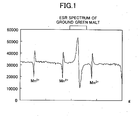
- FIG. 1 is a graph showing an ESR spectrum of ground green malt.
- ground malt samples and whole grain samples of malt and green malt (without grind) showed similar spectra pattern.
- FIGs. 2A and 2B show the results of ESR measurement of the lyophilized green malt sampled once a day after germination and lyophilized.
- FIG. 2A shows the result of whole grains of green malt malted with two different steep-out moisture levels of 37% and 43%
- FIG. 2B shows the result of ground green malt malted with steep-out moisture levels of 37% and 43%.
- ESR signal intensity of green malt increased with grind. This increase in ESR signal intensity could be derived from the increase in radicals by oxidation during grinding.
- the inventors speculate that the amount of radicals is increased during germination because the germination activates the respiration of barley and consequently, the oxidation of ingredients contained in the barley, and accelerates the generation of stable organic radicals derived from proteins. Only the signal intensity changed with the germination time in the spectra. No new peak is observed in the spectra.
- the increase in stable organic radicals derived from proteins during germination is an interesting discovery in view of various changes of ingredients including the synthesis of enzyme in germinating barley. This discovery is expected to bring a new angle into the study of botanical germination.
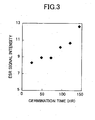
- FIG. 3 shows the result of the above experiment. As is shown in FIG. 3, the ESR signal intensity increased with germination time. Based on this result, the inventors confirmed that the increase in the ESR signal intensity of green malt with germination time is retained even after kilning.
- FIGs. 4A through 4F show the relationship between the parameters indicating malt modification and the ESR signal intensity of malt samples used for the measurement shown in FIG. 3.
- FIGs. 4A through 4F show the relationship of malt quality parameters, that is, Hartong index at 45°C (FIG. 4A), viscosity (FIG. 4B), ⁇ -glucan content (FIG. 4C), friability (FIG. 4D), diastatic power (FIG. 4E), and Kohlbach index (FIG. 4F), respectively, with the ESR signal intensity.
- FIG. 4A shows that Hartong index at 45°C increases with signal intensity less than 9.5, and remains constant with signal intensity of 9.5 or more.
- FIG. 4B shows that viscosity is constant with signal intensity of 12 or more.
- FIG. 4C shows ⁇ -glucan content does not remain constant over whole range of signal intensity.
- FIG. 4D shows that friability remains constant with signal intensity of 9 or more.
- FIG. 4E shows that the diastatic power remains constant with signal intensity of 9 or more.
- FIG. 4F shows that Kohlbach index remains constant with signal intensity of about 9 or more.
- germination state of malt can be estimated and evaluated based on the ESR signal intensity of the germinating malt (green malt).
- the modification and/or diastatic power of malt can be evaluated by sampling green malt or malt during malting, and measuring ESR signal intensity using the ESR analysis. If the ESR signal intensity is equal to or more than a specific level, the malt quality can be guaranteed. Such a quality evaluation method can be used as a rapid and simple method to check the malt quality.
- the ESR analysis of malt does not require lyophilizing the malt sample.
- the malt sample is ground and put in an ESR sample tube.
- the measurement by the ESR spectrometer takes less than two minutes. Although the setting of the ESR spectrometer takes about 30 minutes, the ESR analysis requires substantially less time than conventional method does.
- the preparation of malt samples is quite easy too.
- the present invention makes it possible to evaluate the quality of green malt based on the ESR signal intensity of green malt sample using electron spin resonance method.
- the present invention also makes it possible to evaluate the quality of malt based on the ESR signal intensity of malt sample using the electron spin resonance method.
- the present invention makes it possible to estimate parameters indicating malt modification such as Kohlbach index, Hartong index at 45°C, diastatic power, ⁇ -glucan content, viscosity, and friability based on parameters measured by the electron spin resonance method.
Landscapes
- Physics & Mathematics (AREA)
- General Physics & Mathematics (AREA)
- Pathology (AREA)
- Life Sciences & Earth Sciences (AREA)
- Chemical & Material Sciences (AREA)
- Analytical Chemistry (AREA)
- Biochemistry (AREA)
- Health & Medical Sciences (AREA)
- General Health & Medical Sciences (AREA)
- Immunology (AREA)
- High Energy & Nuclear Physics (AREA)
- Distillation Of Fermentation Liquor, Processing Of Alcohols, Vinegar And Beer (AREA)
- Analysing Materials By The Use Of Radiation (AREA)
- Other Investigation Or Analysis Of Materials By Electrical Means (AREA)
- Saccharide Compounds (AREA)
- Measuring Or Testing Involving Enzymes Or Micro-Organisms (AREA)
- Investigating Or Analysing Materials By Optical Means (AREA)
Abstract
Description
- The present invention generally relates to a quality evaluation method of malt to be used in the production of malt alcoholic beverages such as beer, and, more particularly, to a method of evaluating by Electron Spin Resonance (ESR) the germination state or modification state of malt sampled in a germination process of barley.
- Beer is mainly made of barley malt that serves as the source of starch and enzyme. The production process of beer is classified into a malting process, a brewing process, and a packaging process. In the malting process, malt is steeped into water for germination. During germination, degradative enzymes are activated. The germinating barley is called green malt. After germinating to an expected extent of modification, green malt is dried (kilned). In the next brewing process, water is added to ground malt and is heated for saccharification, and then, is filtered. The filtered liquid is boiled after adding hop, and saccharified liquid (wort) is obtained by separating hop dreg. After cooling, the wort is fermented by adding yeast, and is stored at a cold temperature. After carbon dioxide generated during the storage is dissolved into the fermented liquid (beer), and flavor is matured, the beer is filtered. In the packaging process, the beer is antiseptically filtered and is contained in barrels and/or bottles for distribution.
- The quality of beer heavily depends on the quality control of the malting process, that is the quality of produced malt. In general, a germinating process takes about four to six days. During germination, enzymes are synthesized, and starch and protein are partially degraded. The grade of malt degradation is referred to as "modification".
- In the production process of beer, it is important to control the malt quality. Kohlbach Index, Hartong index at 45°C, diastatic power, viscosity, and β-glucan content are indexes that indicate the quality of malt. These parameters are controlled in the malting process to maintain constant malt quality.
- The parameters for indicating malt modification are described below.
- Kohlbach Index: the ratio of the nitrogen amount of congress wort prepared for analysis and the nitrogen amount of the whole malt. It indicates the extent of protein degradation in the malt. The higher the Kohlbach Index is, the more the malt is degraded (modified).
- Hartong index at 45°C: the ratio of the extract of 45°C, 1-hour mashing of fine ground malt and the extract of the congress wort. The amount of extract mainly depends on the amount of starch and sugar. In malt, the degradation of protein components existing among starch particles affects the amount of extract. Accordingly, Hartong index at 45°C indicates the degradation grade of both starch and protein. The higher the Hartong index at 45°C is, the more the malt is modified.
- Diastatic power: To determine the starch degradative enzyme power of malt, the amount of reduced sugar generated by affecting water-extraction liquid of malt to soluble starch is measured using iodometry. The starch degradative enzymes are synthesized as the barley germinates. In a brewing process, these enzymes are required for degradation of starch in malt and in adjuncts (for example corn starch). Malt with low diastatic power may cause a problem in a beer brewing process.
- β-glucan content: β-glucan is the degradative product of cell wall of the malt. If the cell wall is not degraded enough, the lautering of mash becomes not smooth. Beer with high β-glucan content may cause haze after freezing.
- The β-glucan content is measured as follows: after ground malt is heated in ethanol to inactivate enzyme, β-glucan in the malt is degraded to glucose by processing with lichenaze and β-glucosidase; and the amount of generated glucose is determined using glucose-oxidase/paroxidase method.
- Viscosity: the viscosity of congress wort prepared for the analysis. Polysaccharides such as starch, dextrin, β-glucan, and pentosan mainly affect the viscosity of wort. The viscosity indicates the degree of degradation of stored starch and cell wall. The lower is the viscosity, the more the malt is moderated. The viscosity is measured at 20.00°C with Ubbelohde type viscometer.
- Friability: Friability is measured by a dedicated friability meter. Specifically, the friability is measured as follows. After being ground with a roller, malt samples are separated into one that passes through a specific slit and one that does not pass through the specific slit and remains. The separated malt samples are measured. The friability of the malt samples is defined as the ratio between the separated malt samples. Malt of which starch and cell wall are not well degraded is crystalline and consequently hard. Friability of such malt is low. Well degraded malt is mealy and easy to grind. The friability of such malt is high.
- Conventionally, the above parameters for analyzing the modification of malt are determined with general analytical methods such as chemical analysis. However, the general analytical methods have problems such that the preparation and measurement of samples require considerable time. A rapid and simple analytical technique for malt quality evaluation is needed.
- There are many analytical techniques for analyzing material, such as chemical analysis, optical analysis, and physical analysis (using X-ray, for example). Recently, electron spin resonance (ESR) analysis is drawing attention as an analytical technique to obtain molecular level information of material. The application of ESR analysis is being intensively studied.
- The principle of ESR is exactly the same as that of nuclear magnetic resonance (NMR). ESR is a kind of magnetic resonance spectrum. Whereas the NMR measures the resonant absorption of nuclear spins, the ESR measures the resonant absorption of electron spins. The ESR most directly reveals information about the molecular structures and electron states of materials having unpaired electrons such as a radical and a transition metal complex (trivalent iron ion and bivalent copper ion, for example). As of now, the ESR is the most reliable analytical technique for detecting radicals.
- ESR spectra show the following: g value indicating the position of resonance of the unpaired electrons, resonance intensity indicating the number of unpaired electrons, absorption width related to relaxation time, and hyper fine structure caused by the coupling between the unpaired electrons and atoms (1H and 14N, for example) having nuclear spin near the unpaired electrons. Since each of radical species exhibits an intrinsic position of absorption, one can identify the radical species based on the g value. Additionally, one can consider reaction time and reaction mechanism based on the change over time of absorption (intensity).
- The inventors intensely studied the application of ESR to the evaluation of state (quality) of malt in beer brewing. As a result of the study, the inventors discovered that, if an absorption intensity (signal intensity) is observed, the radical species is roughly identifiable based on the g value, and that there is a correlation between the absorption intensity (signal intensity) and the state (quality) of green malt and malt. There already exist documents referring to malting grain, such as
WO 01/40433 - The above problems can be solved by means of the present invention as defined in
claim 1. - Preferred embodiments are defined in the dependent claims.
-
- FIG. 1 is a graph showing an ESR spectrum of green malt;
- FIGs. 2A and 2B are charts showing the effect of steep-out moisture and germination time on the ESR signal intensity of green malt;
- FIG. 3 is a chart showing the effect of germination time on the ESR signal intensity of malt; and
- FIGs. 4A through 4F are charts showing the correlation between various parameters and the ESR signal intensity of malt.
- Embodiments of the present invention are described in more detail below. The outline of the ESR analyses performed by the inventors is described first.
- If much moisture is contained in the sample, the moisture absorbs the electron spin resonance. When solid samples containing much moisture are measured with an ordinary ESR analysis method, the moisture needs to be removed. Accordingly, green malt was used after being lyophilized, as a sample for the analysis of germinating barleys (green malt). However, since malt contains low enough moisture, the malt was used as a sample without being lyophilized.
- Japanese "Amagi Nijo" barleys and Canadian "Kendall" barleys were used as the samples. They were malted with a 90 kg-scaled pilot malting plant. The barleys were steeped in water at 14°C and were germinated at 14°C. Malt with different germination time was prepared using an 8 kg-scaled kilning apparatus.
- The ESR analysis was carried out at the following measuring conditions.
- Temperature of sample: room temperature
- Sweep time: 60 seconds
- Modulation width: 0.1 mT
- Microwave power: 10.63 mW
- Sweeps/measurement: 1 time
- Internal standard: Mn2+
- Five whole grains of green malt and malt (0.4g), or about 0.2g of ground samples of them were put in an ESR sample tube (cylindrical tube), and their electron spin resonance absorption was measured with an electron spin resonance spectrometer. After the measurement of g value based on measured spectra, the signal intensity was calculated as the relative ratio of the peak height of the sample to the peak height of Mn2+ used as the internal standard. The ESR signal intensity is defined as the relative height per a unit weight of sample (/g). One sample was measured 5 times and obtained data were averaged.
- FIG. 1 is a graph showing an ESR spectrum of ground green malt.
- As is shown in FIG. 1, the spectrum shows a singlet peak at the position of g=2.0049. The g value g=2.0049 means that this spectrum is caused by carbon radicals. It is well known that, in food samples, which contain lipids and proteins (amino acid), for example, free radicals generated by the oxidation of lipids take hydrogen from the proteins and generate stable organic radicals derived from proteins, and that they produce a singlet peak around g=2.00. Accordingly, the inventors speculate that this peak is also caused by stable organic radicals derived from proteins in the green malt. In addition, ground malt samples and whole grain samples of malt and green malt (without grind) showed similar spectra pattern.
- Another experiment was performed to determine change in the ESR spectrum (signal intensity) of green malt during malting (germination).
- FIGs. 2A and 2B show the results of ESR measurement of the lyophilized green malt sampled once a day after germination and lyophilized. FIG. 2A shows the result of whole grains of green malt malted with two different steep-out moisture levels of 37% and 43%, and FIG. 2B shows the result of ground green malt malted with steep-out moisture levels of 37% and 43%.
- These experimental results show that, as germination time passes, the ESR signal intensity increases. The results also show that the higher is the steep-out moisture level, the higher is the ESR signal intensity. Accordingly, it is found that the germination state of barley can be evaluated based on the ESR signal intensity.
- From a comparison between the whole grain samples and ground samples, the ESR signal intensity of green malt increased with grind. This increase in ESR signal intensity could be derived from the increase in radicals by oxidation during grinding.
- Based on the above experimental results, the inventors speculate that the amount of radicals is increased during germination because the germination activates the respiration of barley and consequently, the oxidation of ingredients contained in the barley, and accelerates the generation of stable organic radicals derived from proteins. Only the signal intensity changed with the germination time in the spectra. No new peak is observed in the spectra. The increase in stable organic radicals derived from proteins during germination is an interesting discovery in view of various changes of ingredients including the synthesis of enzyme in germinating barley. This discovery is expected to bring a new angle into the study of botanical germination.
- Other green malts germinated for one through six days were kilned into malts and ground. The ESR signal intensities of the ground malts were compared.
- FIG. 3 shows the result of the above experiment. As is shown in FIG. 3, the ESR signal intensity increased with germination time. Based on this result, the inventors confirmed that the increase in the ESR signal intensity of green malt with germination time is retained even after kilning.
- The correlation between several typical parameters indicating malt modification and the ESR signal intensity was studied. FIGs. 4A through 4F show the relationship between the parameters indicating malt modification and the ESR signal intensity of malt samples used for the measurement shown in FIG. 3. FIGs. 4A through 4F show the relationship of malt quality parameters, that is, Hartong index at 45°C (FIG. 4A), viscosity (FIG. 4B), β-glucan content (FIG. 4C), friability (FIG. 4D), diastatic power (FIG. 4E), and Kohlbach index (FIG. 4F), respectively, with the ESR signal intensity.
- FIG. 4A shows that Hartong index at 45°C increases with signal intensity less than 9.5, and remains constant with signal intensity of 9.5 or more.
- FIG. 4B shows that viscosity is constant with signal intensity of 12 or more.
- FIG. 4C shows β-glucan content does not remain constant over whole range of signal intensity.
- FIG. 4D shows that friability remains constant with signal intensity of 9 or more.
- FIG. 4E shows that the diastatic power remains constant with signal intensity of 9 or more.
- FIG. 4F shows that Kohlbach index remains constant with signal intensity of about 9 or more.
- The results of the above experiments confirm that malt with ESR signal intensity between 9 and 15 is modified enough and satisfies the general requirement level of malt quality.
- According to the above experimental results, germination state of malt can be estimated and evaluated based on the ESR signal intensity of the germinating malt (green malt).
- The modification and/or diastatic power of malt can be evaluated by sampling green malt or malt during malting, and measuring ESR signal intensity using the ESR analysis. If the ESR signal intensity is equal to or more than a specific level, the malt quality can be guaranteed. Such a quality evaluation method can be used as a rapid and simple method to check the malt quality.
- The ESR analysis of malt does not require lyophilizing the malt sample. The malt sample is ground and put in an ESR sample tube. The measurement by the ESR spectrometer takes less than two minutes. Although the setting of the ESR spectrometer takes about 30 minutes, the ESR analysis requires substantially less time than conventional method does. The preparation of malt samples is quite easy too.
- Preferred embodiments of the present invention are described in detail above. However, the present invention is not limited to these embodiments, and variations and modifications may be made without departing from the scope of the present invention.
- As is apparent from the above detailed description, the present invention makes it possible to evaluate the quality of green malt based on the ESR signal intensity of green malt sample using electron spin resonance method.
- The present invention also makes it possible to evaluate the quality of malt based on the ESR signal intensity of malt sample using the electron spin resonance method.
- Additionally, the present invention makes it possible to estimate parameters indicating malt modification such as Kohlbach index, Hartong index at 45°C, diastatic power, β-glucan content, viscosity, and friability based on parameters measured by the electron spin resonance method.
Claims (4)
- A method of evaluating by electron spin resonance (ESR) the germination state or modification state of malt sampled in a germination process of barley, comprisirg the steps of:measuring the height of a peak of the ESR spectrum at a g value at which an unpaired electron derived from a carbon radical is resonant;determining an ESR signal intensity that is a ratio of the measured peak height of spectrum to a peak height of spectrum of an ESR signal intensity calibration standard, per a unit weight of the sampled malt; andevaluating a germination or modification state of the sampled malt by comparing the determined ESR signal intensity with a predetermined reference level.
- The method according to claim 1, wherein the malt to be sampled is green malt, and wherein the evaluation by ESR is of the modification state of the sampled green malt.
- The method according to claim 1, comprising the additional steps of determining in advance a correlation between a parameter measured by general analytical methods including chemical analytical methods, said parameter indicating a modification state of the sampled malt, and said ESR signal intensity of the sampled malt; and
evaluating said modification of said sampled malt based on said parameter determined using the correlation with the ESR signal intensity determined by said ESR spectrometry. - The evaluation method as claimed in claim 3, wherein said parameter is at least one of a Kohlbach index, Hartong index at 45°C, diastatic power, β-glucan content, viscosity, and friability.
Applications Claiming Priority (3)
| Application Number | Priority Date | Filing Date | Title |
|---|---|---|---|
| JP2001370632A JP3909359B2 (en) | 2001-12-04 | 2001-12-04 | Green malt quality evaluation method and malt quality evaluation method by electron spin resonance analysis |
| JP2001370632 | 2001-12-04 | ||
| PCT/JP2002/012678 WO2003048798A1 (en) | 2001-12-04 | 2002-12-03 | Method of evaluating green malt qualities by electron spin resonance spectrometry and method of evaluating malt qualities |
Publications (3)
| Publication Number | Publication Date |
|---|---|
| EP1452885A1 EP1452885A1 (en) | 2004-09-01 |
| EP1452885A4 EP1452885A4 (en) | 2006-03-08 |
| EP1452885B1 true EP1452885B1 (en) | 2007-08-22 |
Family
ID=19179823
Family Applications (1)
| Application Number | Title | Priority Date | Filing Date |
|---|---|---|---|
| EP02783757A Expired - Lifetime EP1452885B1 (en) | 2001-12-04 | 2002-12-03 | Method of evaluating malt qualities by electron spin resonance spectrometry |
Country Status (8)
| Country | Link |
|---|---|
| US (1) | US6952098B2 (en) |
| EP (1) | EP1452885B1 (en) |
| JP (1) | JP3909359B2 (en) |
| AT (1) | ATE371197T1 (en) |
| CA (1) | CA2437295C (en) |
| DE (1) | DE60222014T2 (en) |
| DK (1) | DK1452885T3 (en) |
| WO (1) | WO2003048798A1 (en) |
Cited By (1)
| Publication number | Priority date | Publication date | Assignee | Title |
|---|---|---|---|---|
| CN103278470A (en) * | 2013-05-29 | 2013-09-04 | 山东农业大学 | Method for rapidly monitoring solubility of beer wheat malt protein |
Families Citing this family (4)
| Publication number | Priority date | Publication date | Assignee | Title |
|---|---|---|---|---|
| US20100009032A1 (en) * | 2005-12-19 | 2010-01-14 | Suntory Limited | Method for reducing oral cavity stimulating substance of sprouted grain |
| CN103745478B (en) * | 2014-01-24 | 2016-06-08 | 山东农业大学 | Machine vision determination method for wheat germination rate |
| CN107102086A (en) * | 2017-06-24 | 2017-08-29 | 深圳源广安智能科技有限公司 | A kind of Beer Brewage material quality evaluation system |
| CN116466029B (en) * | 2023-03-13 | 2024-06-04 | 粤海永顺泰(广州)麦芽有限公司 | Method for rapidly evaluating variety characteristics of beer barley |
Family Cites Families (8)
| Publication number | Priority date | Publication date | Assignee | Title |
|---|---|---|---|---|
| DE3206911A1 (en) * | 1982-02-26 | 1983-09-15 | Lohmann Tierernährung GmbH, 2190 Cuxhaven | BIOCHEMICAL ACTIVE SUBSTANCE, THE PRODUCTION THEREOF AND SUBSTANCE CONTAINING THIS ACTIVE SUBSTANCE |
| US5431901A (en) * | 1988-08-03 | 1995-07-11 | Halpern; Howard J. | Selective isotopic labeling of spin labels for electron spin resonance spectroscopy |
| JPH0659008A (en) * | 1992-08-06 | 1994-03-04 | Sumitomo Electric Ind Ltd | Physical property measuring device and its measuring method |
| JP3231223B2 (en) * | 1994-12-28 | 2001-11-19 | サントリー株式会社 | Evaluation method of flavor stability of fermented sake using electron spin resonance |
| EP0879878A1 (en) | 1997-05-23 | 1998-11-25 | Quest International B.V. | Beer and similar light-sensitive beverages with increased flavour stability and process for producing them |
| TWI279254B (en) * | 1999-10-29 | 2007-04-21 | Sumitomo Chemical Co | Titanium oxide, and photocatalyst and photocatalyst coating composition using the same |
| EP1151316B1 (en) * | 1999-11-13 | 2005-09-21 | Bruker BioSpin GmbH | Method and device for analysing the stability of fluid foodstuffs by means of electron spin resonance |
| GB9928490D0 (en) * | 1999-12-03 | 2000-02-02 | Scott Lionel | Products and processes therefor |
-
2001
- 2001-12-04 JP JP2001370632A patent/JP3909359B2/en not_active Expired - Fee Related
-
2002
- 2002-12-03 DE DE60222014T patent/DE60222014T2/en not_active Expired - Lifetime
- 2002-12-03 AT AT02783757T patent/ATE371197T1/en not_active IP Right Cessation
- 2002-12-03 US US10/466,778 patent/US6952098B2/en not_active Expired - Fee Related
- 2002-12-03 CA CA002437295A patent/CA2437295C/en not_active Expired - Fee Related
- 2002-12-03 EP EP02783757A patent/EP1452885B1/en not_active Expired - Lifetime
- 2002-12-03 WO PCT/JP2002/012678 patent/WO2003048798A1/en not_active Ceased
- 2002-12-03 DK DK02783757T patent/DK1452885T3/en active
Non-Patent Citations (1)
| Title |
|---|
| None * |
Cited By (1)
| Publication number | Priority date | Publication date | Assignee | Title |
|---|---|---|---|---|
| CN103278470A (en) * | 2013-05-29 | 2013-09-04 | 山东农业大学 | Method for rapidly monitoring solubility of beer wheat malt protein |
Also Published As
| Publication number | Publication date |
|---|---|
| JP3909359B2 (en) | 2007-04-25 |
| WO2003048798A1 (en) | 2003-06-12 |
| CA2437295A1 (en) | 2003-06-12 |
| DK1452885T3 (en) | 2007-09-17 |
| ATE371197T1 (en) | 2007-09-15 |
| US20040066196A1 (en) | 2004-04-08 |
| EP1452885A4 (en) | 2006-03-08 |
| US6952098B2 (en) | 2005-10-04 |
| EP1452885A1 (en) | 2004-09-01 |
| CA2437295C (en) | 2008-09-30 |
| DE60222014D1 (en) | 2007-10-04 |
| DE60222014T2 (en) | 2008-04-30 |
| JP2003166958A (en) | 2003-06-13 |
Similar Documents
| Publication | Publication Date | Title |
|---|---|---|
| Siebert | Chemometrics in brewing—A review | |
| Gasiński et al. | Production of gluten-free beer brewing from sorghum malts mashed without external enzyme preparations | |
| Marin et al. | Physico-chemical and sensory characterization of a fruit beer obtained with the addition of cv. Lambrusco grapes must | |
| US6952098B2 (en) | Method of evaluating green malt qualities by electron spin resonance spectrometry and method of evaluating malt qualities | |
| Singh et al. | Production and characterization of anthocyanin-rich beer from black wheat by an efficient isolate Saccharomyces cerevisiae CMS12 | |
| Labrado et al. | Identification by NMR of key compounds present in beer distillates and residual phases after dealcoholization by vacuum distillation | |
| Kefale et al. | Assessment of malt quality attributes of barley genotypes grown in Bekoji, Holeta and Ankober, Ethiopia | |
| Kefale et al. | Malt quality profile of malt barley varieties grown in the Central Highlands of Ethiopia | |
| WO2019099611A1 (en) | Methods for malt production | |
| WO2005121304A1 (en) | Process for producing processed barley as raw material for brewing, processed barley as raw material for brewing, process for producing wort, process for producing malt-derived alcoholic beverage, and method of improving real degree of fermentation of malt-derived alcoholic beverage | |
| Iyuke et al. | The effect of hydroxycinnamic acids and volatile phenols on beer quality | |
| Jensen et al. | A fluorimetric method for measuring 1, 3∶ 1, 4-β-glucan in beer, wort, malt and barley by use of Calcofluor | |
| Kunz et al. | Improvement of the oxidative wort and beer stability by increased unmalted barley proportion | |
| US11655438B2 (en) | Crystal malt and methods for forming crystal malt | |
| Pahl et al. | Wort and wort quality parameters | |
| JP2010207243A (en) | Malt alcoholic beverage | |
| JP2002272446A (en) | Malt alcoholic beverage and method for producing the same | |
| US20020164400A1 (en) | Method for minimizing beta glucan problems in beer brewing | |
| JP2003232755A (en) | Method for measuring polyphenol content in grains by electron spin resonance analysis | |
| Sánchez-Ortiz et al. | Assessment of colour and tannin extraction in Tempranillo and Cabernet-Sauvignon using small-scale fermentation vessels | |
| Denver | WORLD BREWING CONGRESS 2016 World Brewing Congress | |
| CN212514115U (en) | System for Analysis of Moisture, Ash, Tannin, Amylose/Amylopectin in Brewed Sorghum | |
| Bruce | Analysis of anions in beer using ion chromatography | |
| Pliego Garcia | Metabolomics of Unhopped Wort and Beer | |
| JP2024172975A (en) | Method for producing malt, method for producing malt beverage, method for increasing 2-acetyltetrahydropyridine content in malt, malt, and malt beverage |
Legal Events
| Date | Code | Title | Description |
|---|---|---|---|
| PUAI | Public reference made under article 153(3) epc to a published international application that has entered the european phase |
Free format text: ORIGINAL CODE: 0009012 |
|
| 17P | Request for examination filed |
Effective date: 20030804 |
|
| AK | Designated contracting states |
Kind code of ref document: A1 Designated state(s): AT BE BG CH CY CZ DE DK EE ES FI FR GB GR IE IT LI LU MC NL PT SE SI SK TR |
|
| A4 | Supplementary search report drawn up and despatched |
Effective date: 20060125 |
|
| 17Q | First examination report despatched |
Effective date: 20060925 |
|
| RTI1 | Title (correction) |
Free format text: METHOD OF EVALUATING MALT QUALITIES BY ELECTRON SPIN RESONANCE SPECTROMETRY |
|
| GRAP | Despatch of communication of intention to grant a patent |
Free format text: ORIGINAL CODE: EPIDOSNIGR1 |
|
| GRAS | Grant fee paid |
Free format text: ORIGINAL CODE: EPIDOSNIGR3 |
|
| GRAA | (expected) grant |
Free format text: ORIGINAL CODE: 0009210 |
|
| AK | Designated contracting states |
Kind code of ref document: B1 Designated state(s): AT BE BG CH CY CZ DE DK EE ES FI FR GB GR IE IT LI LU MC NL PT SE SI SK TR |
|
| REG | Reference to a national code |
Ref country code: GB Ref legal event code: FG4D |
|
| REG | Reference to a national code |
Ref country code: CH Ref legal event code: EP |
|
| REG | Reference to a national code |
Ref country code: DK Ref legal event code: T3 |
|
| REG | Reference to a national code |
Ref country code: IE Ref legal event code: FG4D |
|
| REF | Corresponds to: |
Ref document number: 60222014 Country of ref document: DE Date of ref document: 20071004 Kind code of ref document: P |
|
| ET | Fr: translation filed | ||
| PG25 | Lapsed in a contracting state [announced via postgrant information from national office to epo] |
Ref country code: ES Free format text: LAPSE BECAUSE OF FAILURE TO SUBMIT A TRANSLATION OF THE DESCRIPTION OR TO PAY THE FEE WITHIN THE PRESCRIBED TIME-LIMIT Effective date: 20071203 Ref country code: FI Free format text: LAPSE BECAUSE OF FAILURE TO SUBMIT A TRANSLATION OF THE DESCRIPTION OR TO PAY THE FEE WITHIN THE PRESCRIBED TIME-LIMIT Effective date: 20070822 Ref country code: BG Free format text: LAPSE BECAUSE OF FAILURE TO SUBMIT A TRANSLATION OF THE DESCRIPTION OR TO PAY THE FEE WITHIN THE PRESCRIBED TIME-LIMIT Effective date: 20071122 |
|
| PG25 | Lapsed in a contracting state [announced via postgrant information from national office to epo] |
Ref country code: AT Free format text: LAPSE BECAUSE OF FAILURE TO SUBMIT A TRANSLATION OF THE DESCRIPTION OR TO PAY THE FEE WITHIN THE PRESCRIBED TIME-LIMIT Effective date: 20070822 Ref country code: LI Free format text: LAPSE BECAUSE OF FAILURE TO SUBMIT A TRANSLATION OF THE DESCRIPTION OR TO PAY THE FEE WITHIN THE PRESCRIBED TIME-LIMIT Effective date: 20070822 Ref country code: CH Free format text: LAPSE BECAUSE OF FAILURE TO SUBMIT A TRANSLATION OF THE DESCRIPTION OR TO PAY THE FEE WITHIN THE PRESCRIBED TIME-LIMIT Effective date: 20070822 |
|
| REG | Reference to a national code |
Ref country code: CH Ref legal event code: PL |
|
| PG25 | Lapsed in a contracting state [announced via postgrant information from national office to epo] |
Ref country code: GR Free format text: LAPSE BECAUSE OF FAILURE TO SUBMIT A TRANSLATION OF THE DESCRIPTION OR TO PAY THE FEE WITHIN THE PRESCRIBED TIME-LIMIT Effective date: 20071123 |
|
| PG25 | Lapsed in a contracting state [announced via postgrant information from national office to epo] |
Ref country code: PT Free format text: LAPSE BECAUSE OF FAILURE TO SUBMIT A TRANSLATION OF THE DESCRIPTION OR TO PAY THE FEE WITHIN THE PRESCRIBED TIME-LIMIT Effective date: 20080122 |
|
| PLBE | No opposition filed within time limit |
Free format text: ORIGINAL CODE: 0009261 |
|
| STAA | Information on the status of an ep patent application or granted ep patent |
Free format text: STATUS: NO OPPOSITION FILED WITHIN TIME LIMIT |
|
| PG25 | Lapsed in a contracting state [announced via postgrant information from national office to epo] |
Ref country code: SE Free format text: LAPSE BECAUSE OF FAILURE TO SUBMIT A TRANSLATION OF THE DESCRIPTION OR TO PAY THE FEE WITHIN THE PRESCRIBED TIME-LIMIT Effective date: 20071122 |
|
| 26N | No opposition filed |
Effective date: 20080526 |
|
| PG25 | Lapsed in a contracting state [announced via postgrant information from national office to epo] |
Ref country code: MC Free format text: LAPSE BECAUSE OF NON-PAYMENT OF DUE FEES Effective date: 20071231 |
|
| PG25 | Lapsed in a contracting state [announced via postgrant information from national office to epo] |
Ref country code: EE Free format text: LAPSE BECAUSE OF FAILURE TO SUBMIT A TRANSLATION OF THE DESCRIPTION OR TO PAY THE FEE WITHIN THE PRESCRIBED TIME-LIMIT Effective date: 20070822 |
|
| PG25 | Lapsed in a contracting state [announced via postgrant information from national office to epo] |
Ref country code: SI Free format text: LAPSE BECAUSE OF FAILURE TO SUBMIT A TRANSLATION OF THE DESCRIPTION OR TO PAY THE FEE WITHIN THE PRESCRIBED TIME-LIMIT Effective date: 20070822 |
|
| PG25 | Lapsed in a contracting state [announced via postgrant information from national office to epo] |
Ref country code: CY Free format text: LAPSE BECAUSE OF FAILURE TO SUBMIT A TRANSLATION OF THE DESCRIPTION OR TO PAY THE FEE WITHIN THE PRESCRIBED TIME-LIMIT Effective date: 20070822 |
|
| PG25 | Lapsed in a contracting state [announced via postgrant information from national office to epo] |
Ref country code: LU Free format text: LAPSE BECAUSE OF NON-PAYMENT OF DUE FEES Effective date: 20071203 |
|
| PG25 | Lapsed in a contracting state [announced via postgrant information from national office to epo] |
Ref country code: TR Free format text: LAPSE BECAUSE OF FAILURE TO SUBMIT A TRANSLATION OF THE DESCRIPTION OR TO PAY THE FEE WITHIN THE PRESCRIBED TIME-LIMIT Effective date: 20070822 |
|
| PG25 | Lapsed in a contracting state [announced via postgrant information from national office to epo] |
Ref country code: IT Free format text: LAPSE BECAUSE OF NON-PAYMENT OF DUE FEES Effective date: 20071231 |
|
| PGFP | Annual fee paid to national office [announced via postgrant information from national office to epo] |
Ref country code: DK Payment date: 20131210 Year of fee payment: 12 |
|
| PGFP | Annual fee paid to national office [announced via postgrant information from national office to epo] |
Ref country code: GB Payment date: 20131127 Year of fee payment: 12 Ref country code: CZ Payment date: 20131118 Year of fee payment: 12 Ref country code: IE Payment date: 20131210 Year of fee payment: 12 Ref country code: DE Payment date: 20131127 Year of fee payment: 12 Ref country code: SK Payment date: 20131104 Year of fee payment: 12 |
|
| PGFP | Annual fee paid to national office [announced via postgrant information from national office to epo] |
Ref country code: NL Payment date: 20131109 Year of fee payment: 12 Ref country code: FR Payment date: 20131209 Year of fee payment: 12 |
|
| PGFP | Annual fee paid to national office [announced via postgrant information from national office to epo] |
Ref country code: BE Payment date: 20131217 Year of fee payment: 12 |
|
| PG25 | Lapsed in a contracting state [announced via postgrant information from national office to epo] |
Ref country code: BE Free format text: LAPSE BECAUSE OF NON-PAYMENT OF DUE FEES Effective date: 20141231 |
|
| REG | Reference to a national code |
Ref country code: DE Ref legal event code: R119 Ref document number: 60222014 Country of ref document: DE |
|
| REG | Reference to a national code |
Ref country code: DK Ref legal event code: EBP Effective date: 20141231 |
|
| REG | Reference to a national code |
Ref country code: NL Ref legal event code: V1 Effective date: 20150701 |
|
| REG | Reference to a national code |
Ref country code: NL Ref legal event code: V1 Effective date: 20150701 |
|
| PG25 | Lapsed in a contracting state [announced via postgrant information from national office to epo] |
Ref country code: CZ Free format text: LAPSE BECAUSE OF NON-PAYMENT OF DUE FEES Effective date: 20141203 |
|
| GBPC | Gb: european patent ceased through non-payment of renewal fee |
Effective date: 20141203 |
|
| REG | Reference to a national code |
Ref country code: SK Ref legal event code: MM4A Ref document number: E 2638 Country of ref document: SK Effective date: 20141203 |
|
| REG | Reference to a national code |
Ref country code: IE Ref legal event code: MM4A |
|
| REG | Reference to a national code |
Ref country code: FR Ref legal event code: ST Effective date: 20150831 |
|
| PG25 | Lapsed in a contracting state [announced via postgrant information from national office to epo] |
Ref country code: NL Free format text: LAPSE BECAUSE OF NON-PAYMENT OF DUE FEES Effective date: 20150701 |
|
| PG25 | Lapsed in a contracting state [announced via postgrant information from national office to epo] |
Ref country code: GB Free format text: LAPSE BECAUSE OF NON-PAYMENT OF DUE FEES Effective date: 20141203 Ref country code: SK Free format text: LAPSE BECAUSE OF NON-PAYMENT OF DUE FEES Effective date: 20141203 Ref country code: IE Free format text: LAPSE BECAUSE OF NON-PAYMENT OF DUE FEES Effective date: 20141203 Ref country code: DE Free format text: LAPSE BECAUSE OF NON-PAYMENT OF DUE FEES Effective date: 20150701 |
|
| PG25 | Lapsed in a contracting state [announced via postgrant information from national office to epo] |
Ref country code: FR Free format text: LAPSE BECAUSE OF NON-PAYMENT OF DUE FEES Effective date: 20141231 |
|
| PG25 | Lapsed in a contracting state [announced via postgrant information from national office to epo] |
Ref country code: DK Free format text: LAPSE BECAUSE OF NON-PAYMENT OF DUE FEES Effective date: 20141231 |