TECHNICAL FIELD
The present invention relates to a TGF-β (transforming
growth factor-β) inhibitor comprising an amide derivative or a
pharmaceutically acceptable salt thereof as an active ingredient.
The present invention also relates to a novel amide derivative
or a pharmaceutically acceptable salt thereof. The TGF-β
inhibitor is useful for the prevention or treatment of diseases
whose main characteristics are fibroproliferative disorders,
cicatricial lesions or sclerosing lesions involving TGF-β.
BACKGROUND ART
TGF-β is an important cytokine which regulates the
proliferation and differentiation of cells, and the repair and
regeneration of damaged tissue. TGF-β facilitates the
infiltration of leukocytes and vascularization, and promotes the
production and deposition of elements of the extracellular matrix
(such as laminin B1, fibronectin, collagen, tenascin and
proteoglycan) in case of repairing damages tissues.
The production and deposition of the extracellular matrix
by TGF-β involves the following three mechanisms. First, TGF-β
promotes the expression of genes for extracellular matrix
proteins, and increases their synthesis and secretion. Second,
TGF-β inhibits the synthesis of proteolytic enzymes which degrade
synthesized extracellular matrix proteins, and at the same time
enhances the synthesis of inhibitors of proteolytic enzymes.
Third, TGF-β increases the levels of integrin, a receptor for
extracellular matrix proteins, and enhances the deposition of
extracellular matrix.
Thus, TGF-β plays an extremely important role in living
organisms. It regulates the proliferation and differentiation
of various cells, particularly fibroblasts, which are the main
constituent cells of fibrous tissues, and regulates the
production and deposition of the extracellular matrix, which is
essential for wound healing. However, excessive production of
TGF-β or facilitation of its activity promotes diseases
characterized by fibroproliferative disorders, cicatricial
lesions or sclerosing lesions of tissues, organs or even the whole
body. There is also reported an action of serving as a growth
factor to cancer cells or promoting the formation of a newborn
blood vessel thereby to promote the growth of cancer when cancer
cells grow in vivo (Human Cell, 13, 97-101, 2000, Adv. Immunol.,
75, 115-157, 2000).
Therefore, the TGF-β inhibitor can be therapeutic drugs for
the above diseases involving TGF-β (Border, W. A. et al., J. Clin.
Invest., (90), 1-7, 1992).
International Publication WO00/44743 describes that
indole-3-carboxamide derivatives have an inhivitory action
against TGF-β, while International Publication WO01/43746
describes that indole-3-carboxamide derivatives have an action
for the treatment of nephritis.
DISCLOSURE OF THE INVENTION
The object of the present invention is to provide a novel
amide derivative which has higher absorptivity than that of an
amide derivative of the prior art upon oral administration, and
also has a strong inhibitory action against TGF-β.
As a result of having conducted intensive studies on various
compounds, the present inventors have found that an amide
derivative of the present invention can achieve the above object,
and the present invention has been completed based on this finding.
Thus, the present invention is directed to an amide
derivative, which is a compound represented by the following
formula [1] in any of the following cases (A), (B) and (C).
in which p represents 1 or 2,
- R3A represents a divalent group of pyridine, pyrazine,
pyridazine or pyrimidine,
- R3B represents tetrazolyl [ the tetrazolyl may be substituted
by alkyl ( the alkyl may be substituted by hydroxy, dialkylamino
or cycloalkyl )] or a group represented by the following formula
[3],
- R3C and R3D may be the same or different and each represents
any of the following groups (1) to (4):
- (1) hydrogen,
- (2) cycloalkyl ( the cycloalkyl may be substituted by alkyl,
hydroxy, hydroxyalkyl, carboxy, alkoxycarbonyl or aryl ),
- (3) alkyl [ the alkyl may be substituted by 1 to 5 same or
different members selected from the group consisting of (i) a
saturated heterocyclic group ( the saturated heterocyclic group
may be substituted by alkyl, hydroxyalkyl or alkoxyalkyl), (ii)
an aromatic heterocyclic group ( the aromatic heterocyclic group
may be substituted by 1 to 3 same or different members selected
from the group consisting of alkyl, hydroxy, amino, hydroxyalkyl
and alkoxyalkyl ), (iii) hydroxy, (iv) alkoxy, (v) aryl ( the aryl
may be substituted by alkyl, hydroxy, alkoxy or alkoxyalkyl ),
(vi) aryloxy ( the aryl moiety of the aryloxy may be substituted
by alkyl, hydroxy, alkoxy or alkoxyalkyl ), (vii) alkylamino,
(viii) dialkylamino, (ix) carboxy, (x) alkoxycarbonyl and (xi)
halogen ], and
- (4) an aromatic heterocyclic group ( the aromatic
heterocyclic group may be substituted by alkyl, hydroxyalkyl,
alkoxyalkyl, alkoxycarbonylalkyl or aryl ), or
R3C, R3D and adjacent N jointly form cyclic amino ( the cyclic
amino may be substituted by alkyl, hydroxyalkyl, alkoxyalkyl,
aminoalkyl, hydroxy, aryl or arylalkyl ),
with the exception of the case that R3C is hydrogen and R3D
is hydrogen or non-substituted alkyl;
n represents 0, X represents CR4 or N, Y represents CR6 or N, Z represents
CR7 or N, R1 and R2 may be the same or different and each represents
alkyl, haloalkyl, hydroxyalkyl, alkoxyalkyl, carboxyalkyl, acyl,
aryl, an aromatic heterocyclic group or arylalkyl ( the aryl, the
aromatic heterocyclic group and the aryl moiety of the arylalkyl
may be substituted by R81, R82 or R83, and R81, R82 and R83 may be the
same or different and each represents halogen, alkyl, haloalkyl,
alkoxy, haloalkoxy, hydroxy, hydroxyalkyl, carboxy,
alkoxycarbonyl, cyano or nitro, or the two adjacent groups among
R81, R82 and R83 may jointly form methylenedioxy or ethylenedioxy), R4, R5, R6 and R7 may be the same or different and each
represents hydrogen, halogen, hydroxy, amino, alkyl, haloalkyl,
alkoxy, monoalkylamino, dialkylamino, arylalkyl, cyano or nitro,
or the two adjacent groups among R4, R5, R6 and R7 may jointly form
methylenedioxy or ethylenedioxy, R3 represents a group represented by the following formula
[4] :
n represents 1, X represents CR4 or N, Y represents CR6 or N, Z represents
CR7 or N, R1 and R2 may be the same or different and each represents
hydrogen, alkyl, haloalkyl, hydroxyalkyl, alkoxyalkyl,
carboxyalkyl, acyl, aryl, an aromatic heterocyclic group or
arylalkyl ( the aryl, the aromatic heterocyclic group and the aryl
moiety of the arylalkyl may be substituted with R81, R82 or R83,
and R81, R82 and R83 may be the same or different and each represents
halogen, alkyl, haloalkyl, alkoxy, haloalkoxy, hydroxy,
hydroxyalkyl, cyano, alkoxycarbonyl, carboxy or nitro, or the two
adjacent groups among R81, R82 and R83 may jointly form
methylenedioxy or ethylenedioxy ), R4, R5, R6 and R7 may be the same or different and each
represents hydrogen, halogen, hydroxy, amino, alkyl, haloalkyl,
alkoxy, monoalkylamino, dialkylamino, arylalkyl, cyano or nitro,
or the two adjacent groups among R4, R5, R6 and R7 may jointly form
methylenedioxy or ethylenedioxy, R3 represents the following group (1) or (2):
- (1) cyclic amino [ the cyclic amino may be substituted by
R91, R92 or R93 on the same or different carbon atom and the benzene
ring may be condensed, R91, R92 and R93 may be the same or different
and each represents alkyl, alkoxy, hydroxy, hydroxyalkyl,
alkoxyalkyl, alkoxycarbonylalkyl, carboxy, carboxyalkyl, acyl,
2-hydroxybenzimidazole, aryl ( the aryl may be substituted by
alkyl or alkoxy ) or an aromatic heterocyclic group ( the aromatic
heterocyclic group may be substituted by alkyl, hydroxy, oxo or
alkoxy), or the two groups on the same carbon jointly represent
-CONHCH2N(Ph)- ( Ph represents phenyl ), the benzene ring
condensed with the cyclic amino may be substituted with R94 or R95,
and R94 and R95 may be the same or different and each represents
alkyl, alkoxy, halogen, hydroxy, amino, monoalkylamino,
dialkylamino, alkylsulfonylamino, acylamino, carbamoyl,
monoalkylcarbamoyl, dialkylcarbamoyl, cyano, carboxy,
alkoxycarbonyl, sulfamoyl, monoalkylaminosulfonyl,
dialkylaminosulfonyl or nitro, or the two adjacent groups among
R94 and R95 may jointly form methylenedioxy or ethylenedioxy ],
- (2) a group represented by the following formula [5]:
R3E and R3F may be the same or different and each represents
any of the following groups (i) to (v):
- (i) hydrogen,
- (ii) alkyl { the alkyl may be substituted by 1 to 3 same or
different members selected from the group consisting of (a)
hydroxy, (b) aryl ( the aryl may be substituted with 1 to 3 same
or different members selected from the group consisting of alkyl,
haloalkyl, hydroxy, alkoxy, halogen, cyano and nitro ), (c)
carboxy, (d) a saturated heterocyclic group [ the saturated
heterocyclic group may be substituted by alkyl or arylalkyl ( the
aryl moiety of the arylalkyl may be substituted with alkyl, alkoxy
or halogen )], and (e) an aromatic heterocyclic group ( the
aromatic heterocyclic group may be substituted by alkyl,
haloalkyl, hydroxy, hydroxyalkyl, alkoxy, halogen, cyano or
nitro )},
- (iii) aryl ( the aryl may be substituted by alkyl, haloalkyl,
hydroxy, hydroxyalkyl, alkoxy, halogen, cyano or nitro ),
- (iv) cycloalkyl ( the cycloalkyl may be substituted by alkoxy,
alkoxycarbonyl or hydroxy and the benzene ring may be condensed),
and
- (v) a saturated heterocyclic group ( the saturated
heterocyclic group may be substituted by alkyl, haloalkyl,
hydroxy, hydroxyalkyl, alkoxy, halogen, cyano or nitro ).
The present invention is also directed to a TGF-β inhibitor
comprising the amide derivative, which is a compound represented
by the above formula [1] in any of the following cases (A), (B)
and (C), or a pharmaceutically acceptable salt thereof as an active
ingredient.
It has never been known that the compound represented by the
above formula [1] has an inhivitory action against TGF-β.
The amide derivative, which is a compound represented by the
above formula [1] in either the case (A) or (C), is a novel compound
which is not disclosed in any documents.
The amide derivative, which is a compound represented by the
above formula [1] in the case (B), is not specifically disclosed
in aforementioned International Publication WO00/44743 and
International Publication WO01/43746.
Examples of particularly preferred compounds among the
compound [1] of the present invention include the following amide
derivatives (1) to (36):
The present invention will now be described in detail.
In the present invention, "alkyl" includes straight or
branched alkyl groups containing 1 to 10 carbons, for example,
methyl, ethyl, n-propyl, isopropyl, n-butyl, isobutyl, sec-butyl,
tert-butyl, n-pentyl, isopentyl, n-hexyl, isohexyl, n-heptyl,
and isoheptyl. Straight alkyl groups having 1 to 7 carbon atoms
are preferred and straight alkyl groups having 1 to 3 carbon atoms
are more preferred, and include, for example, methyl, ethyl and
n-propyl.
The alkyl moiety of "haloalkyl", "arylalkyl", "alkoxy",
"akoxyalkyl", "haloalkoxy", "monoalkylamino", "dialkylamino",
"hydroxyalkyl", "alkylsulfoniumamino", "monoalkylcarbamoyl",
"dialkylcarbamoyl", "monoalkylaminosulfonyl",
"dialkylaminosulfonyl" and "carboxyalkyl" includes the above-mentioned
alkyl.
The cycloalkyl includes cycloalkyl group having 3 to 7 carbon
aroms, for example, cyclopropyl, cyclobutyl, cyclopentyl,
cyclohexyl, and cycloheptyl.
"Aryl" includes aryl groups having 6 to 10 carbon atoms, for
example, phenyl, 1-naphthyl, and 2-naphthyl.
The aryl moiety of "arylalkyl" include the above-mentioned
aryl.
"Aromatic heterocyclic group" includes 5- to 6-membered
aromatic ring group having 1 to 4 heteroatoms selected from
nitrogen, oxygen and sulfur, or benzene-fused ring thereof. When
atoms composing the ring of the aromatic heterocyclic group
include nitrogen or sulfur atom, such nitrogen or sulfur atom may
form oxide. For example, 1-pyrolyl, 2-pyrolyl, 3-pyrolyl, 3-indolyl,
2-furanyl, 3-furanyl, 3-benzofuranyl, 2-thienyl, 3-thienyl,
3-benzothienyl, 2-oxazolyl, 4-isoxazolyl, 2-thiazolyl,
5-thiazolyl, 2-benzothiazolyl, 1-imidazolyl, 2-imidazolyl, 4-imidazolyl,
2-benzimidazolyl, 1H-1,2,4-triazol-1-yl, 1H-tertazol-5-yl,
2H-tertazol-5-yl, 2-pyridyl, 3-pyridyl, 4-pyridyl,
3-pyrazole, 2-pyrimidinyl, 4-pyrimidinyl, 2-pyradinyl
and 1,3,5-triadin-2-yl are included.
"Halogen" includes, for example, fluorine, chlorine,
bromine and iodine.
The halogen moiety of "haloalkyl" and "haloalkoxy" includes
the above-mentioned halogen. "Haloalkyl" includes, for example,
trifluoromethyl and 2,2,2-trifluoroethyl. "Haloalkoxy"
includes, for example, trifluoromethoxy and 2,2,2-trifluoroethoxy.
"Acyl" includes acyl groups having 1 to 11 carbons, for
example, formyl, acetyl, propionyl, butyryl, isobutyryl, benzoyl,
1-naphthoyl, and 2-naphthoyl.
"Cyclic amino" includes 4- to 8-membered ring group having
1 or 2 same or different members selected from the group consisting
of nitrogen, oxygen and sulfur atoms as the atoms composing the
ring. When the atoms composing the ring of cyclic amino includes
nitrogen or sulfur atom, such nitrogen or sulfur atom may form
oxide. For example, pyrolidino, piperidino, piperazinyl, 3-methylpiperazin-1-yl,
homopiperazinyl, morpholino,
thiomorphorino, imidazol-1-yl, thiazolin-3-yl are included.
"Saturated heterocyclic group" includes 5- to 6-membered
saturated ring group having 1 to 4 heteroatoms selected from
nitrogen, oxygen and sulfur, or benzene-fused ring thereof. For
example, 1-pyrolidinyl, 2-pyrolidinyl, 1-morpholinyl, 1-piperidinyl,
and 2-tetrahydrofuranyl are included.
The compound of the present invention represented by the
above formula [1] can be produced by the method described below,
or the method described in International Publication WO00/44743
or International Publication WO01/43746.
In production method described below, it is common that the
source materials are used for reaction after protecting with the
protecting groups (for example, methoxymethyl, 2-methoxyethoxymethyl,
benzyl, 4-methoxybenzyl, triphenylmethyl,
4,4'-dimethoxytrityl, acetyl, tert-butoxycarbonyl,
benzyloxycarbonyl, phthaloyl, tetrahydropyranyl or tertbutyldimethylsilyl)
by the per se known methods, when the source
materials have substituents intended not to be reacted (for
example, hydroxy, amino or carboxy). After the reaction, the
protecting groups can be removed by per se known methods such as
catalytic reduction, alkali treatment and acid treatment.
Process 1
The amide derivative [1] can be produced by reacting the
indole derivative [6] with amine [7].
wherein R
1, R
2, R
3, R
5, X, Y, Z and n are as defined above, and
M represents a leaving group such as hydroxy, or halogen (chlorine,
bromine, iodine, etc), alkoxy (e.g., methoxy), aryloxy (e.g.,
p-nitrophenoxy), alkylsulfoxy (e.g., methanesulfoxy),
arylsulfoxy (e.g., toluenesulfoxy), imidazolyl, alkylcarboxy or
arylcarboxy.
Specifically, the amide derivative [1] can be produced by
the method in which the indole derivative [6] (wherein M is the
above-mentioned leaving group other than hydroxy), for example,
acid halide, alkyl ester, active ester, imidazolide or mixed acid
anhydride is appropriately reacted with amine [7], or by the method
in which the indole derivative [6] (wherein M is hydroxy) is
directly bound to amine [7] using a condensing agent [for example,
1-ethyl-3-(3-dimethylaminopropyl)carbodiimide hydrochloride
(hereinafter referred to as WSCD·HCl), dicyclohexylcarbodiimide,
diisopropyl-carbodiimide, benzotriazol-1-yl-tris(dimethylamino)phosphonium
hexafluorophosphide salt,
diphenylphosphorylazide or propane phosphate anhydride] in the
presence or absence of an additive (N-hydroxysuccinimide, 1-hydroxybenzotriazole,
3-hydroxy-4-oxo-3,4-dihidro-1,2,3-triazine,
and the like).
When acid halide (the indole derivative [6] wherein M is
halogen) is used, the amide derivative [1] can be produced by
reacting at -20 to 100°C in aprotic solvents (for example, polar
solvents such as acetonitrile and; N, N-dimethyl formamide (DMF),
ether solvents such as tetrahydrofuran (THF) and diethyl ether,
halogenated hydrocarbon solvents such as chloroform and methylene
chloride, hydrocarbon solvents such as benzene, toluene and
n-hexane, and the mixtures thereof) in the presence of a base (for
example, potassium carbonate, sodium carbonate, sodium hydrogen
carbonate, potassium hydrogen carbonate, pyridine; 4-dimethylaminopyridine,
triethylamine, sodium hydride and the
like). The reaction time varies depending on the kinds of acid
halide and amine [7] and the temperature of the reaction, and
usually the appropriate reaction time is from 30 min to 24 hours.
The molar amount of amine [7] for use is preferably 1 to 1.2 molar
equivalents based on the acid halide.
Such acid halide can be produced by reacting the indole
derivative [6] (wherein M is hydroxy) and thionyl halide (e.g.,
thionyl chloride, thionyl bromide) at -20 to 100°C in the absence
of a solvent or in the same aprotic solvent as the above-mentioned
in the presence or absence of the same base as the above-mentioned.
The reaction time varies depending on the kind of acid halide and
the temperature of the reaction, and usually the appropriate
reaction time is 30 min to 24 hours. The amount of thionyl halide
needed is equimolar or more equivalents based on the indole
derivative [6], and an extremely excessive amount such as 10 molar
equivalents or more can be used.
When a condensing agent is used, the amide derivative [1]
can be produced by reacting at -20 to 100°C in the same aprotic
solvent as the above-mentioned in the presence or absence of the
same base as the above-mentioned. The reaction time varies
depending on the kind of condensing agents and the temperature
of the reaction, and usually the appropriate reaction time is 30
minutes to 24 hours. The amounts of amine [7] and a condensing
agent for use are preferably 1 to 1.2 molar equivalents based on
the indole derivative [6] (wherein M is hydroxy).
Process 2
Among the compounds [1] of the present invention, the
compound [1b] wherein R
3 is the above-mentioned formula [2] and
R
3B is the above-mentioned formula [3] can also be produced by
reacting the indole derivative [8] with amine [9] in the same
manner as in the process 1.
wherein R
1, R
2, R
3A, R
3C, R
3D, R
5, X, Y, Z, p and M are as defined
above.
Specifically, the amide derivative [1b] can be produced by
the method in which the indole derivative [8] (wherein M is the
above-mentioned leaving group other than hydroxy), for example,
acid halide, alkyl ester, active ester, imidazolide or mixed acid
anhydride is appropriately reacted with amine [9], or by the method
in which the indole derivative [8] (wherein M is hydroxy) is
directly bound to amine [9] using a condensing agent [for example,
WSCD·HCl, dicyclohexylcarbodiimide, diisopropyl-carbodiimide,
benzotriazol-1-yl-tris(dimethylamino)phosphonium
hexafluorophosphide salt, diphenylphosphorylazide or propane
phosphate anhydride] in the presence or absence of an additive
(N-hydroxysuccinimide, 1-hydroxybenzotriazole, 3-hydroxy-4-oxo-3,4-dihidro-1,2,3-triazine,
and the like).
Details of the reaction conditions in these reactions are
the same as those in the process 1.
The indole derivative [6], the indole derivative [8], the
amine [7] and the amine [9] used as the source materials in these
reactions are per se known compounds, or can be produced by the
per se known method or the method disclosed in the reference
example.
The indole derivative [8] can be produced by version of the
method of the process 1, or the method described in WO00/44743.
Among the indole compound [6], the compound [6a] wherein n
is 1 and M is alkoxy and the compound [6b] wherein n is 1 and M
is hydroxy can be produced from the indole derivative [10] in the
following manner.
wherein R
1, R
2, R
5, X, Y and Z are as defined above, and R
10 represents
alkyl.
Specifically, the compound [6a] can be produced by reacting
(Vilsmeier reaction) the indole derivative [10] with phosphoryl
chloride at -20 to 100°C in N,N-dimethylformamide solvent to
obtain a formyl compound and subsequently reacting (Horner-Emmons
reaction) the formyl compound with a phosphonic acid ester
derivative (e.g., ethyl diethylphosphinoacetate, methyl
diethylphosphinoacetate, allyl diethylphosphinoacetate, tert-butyl
diethylphosphinoacetate, phenyl diethylphosphinoacetate)
at -20 to 100°C in the above aprotic solvent in the presence of
the above base.
Alternatively, it can be produced by reacting the indole
derivative [10] with acrylic acid derivatives (e.g., ethyl
acrylate, n-butyl acrylate, tert-butyl acrylate, methyl acrylate,
n-hexyl acrylate, tert-butyl acrylate) at -20 to 150°C in an acetic
acid solvent in the presence of a palladium (II) catalyst (e.g.,
palladium acetate, palladium chloride, palladium
trifluoroacetate).
The indole derivative [10] used as the source materials in
these reactions are per se known compounds, or can be produced
by the per se known method, or the method disclosed in the reference
example.
The compound [6b] can be produced from the compound [6a] by
the per se known methods such as alkali treatment, acid treatment
and treatment using palladium catalysts (e.g.,
tetrakis(triphenylphosphine)palladium). Alternatively, it can
be produced by reacting (Knoevenagel condensation) the formyl
compound produced from the above indole derivative [10] with
malonic acid at 0 to 100°C in a pyridine solvent in the presence
of a catalytic amount of piperidine.
The compound of the present invention can be isolated and
purified from the above reaction mixture using the conventional
means for isolation and purification such as extraction,
concentration, neutralization, filtration, recrystallization,
column chromatography or thin layer chromatography.
The compound of the present invention may exist in
geometrical isomers (Z and E forms). These geometrical isomers
and their mixtures also fall within the scope of the present
invention.
The compound of the present invention may exist in keto-enol
tautomers. These tautomers and their mixtures also fall
within the scope of the present invention.
The compound of the present invention can be used in the form
of a free base as a medicine, however, it can be also used as a
pharmaceutically acceptable salt made by the per se known methods.
These salts include salts of mineral acids such as hydrochloric
acid, hydrobromic acid, sulfuric acid and phosphoric acid, and
organic acids such as acetic acid, citric acid, tartaric acid,
maleic acid, succinic acid, fumaric acid, p-toluene sulfonic acid,
benzene sulfonic acid and methane sulfonic acid.
For example, hydrochloride of the amide derivative of the
present invention can be obtained by dissolving the amide
derivative in an alcohol, ethyl acetate or ether solution of
hydrogen chloride.
The compound of the present invention has excellent high
absorptivity upon oral administration and/or high inhivitory
action against TGF-β as compared with the amide derivative whose
inhivitory action against TGF-β is disclosed in aforementioned
International Publication WO00/44743, as shown in the test
examples given below. Due to its low toxicity, the compound of
the present invention is useful for the prevention and treatment
of diseases of the liver, gall bladder, heart, lung, skin, pancreas,
large intestine, prostate gland, uterus, blood vessels and other
organs, and specifically, hepatic fibrosis, biliary fibrosis,
cirrhosis of the liver, pulmonary fibrosis, adult respiratory
distress syndrome, bone marrow fibrosis, scleroderma, pachyderma,
systemic sclerosis, intraocular proliferative disorders,
proliferative vitreous retinopathy, cataract, cardiac fibrosis
after infarction, restenosis after angioplasty, arterial
sclerosis, hyperplasia of connective tissues (abdominal adhesion,
scar, keloid) resulting from wounds such as surgical incisions,
injury, or burns, fibrosis after radiation therapy, chronic
pancreatitis, chronic nephritis, chronic renal insufficiency,
diabetic nephropathy, fibrosing tumors, nasal polyp, periodontal
disease, chronic ulcerative colitis, sclerosing Hodgkin's
disease, prostatic hypertrophy, fibroid uterus, and various
tumors. Alternatively, the compound of the present invention is
useful as an antitumor agent, a metastasis inhibitor and a
hair-restoring agent against various tumors.
The compound of the present invention is useful as an
excellent therapeutic agent for nephritis, and is particularly
useful as a therapeutic agent for chronic renal insufficiency,
diabetic nephropathy and chronic glomerulonephritis, more
particularly proliferative glomerulonephritis, among nephritis.
When the compound of the present invention is administered
as a medicine, it can be administered to mammals, including humans,
either by itself or as a pharmaceutical composition in which the
compound is contained in a pharmaceutically acceptable non-toxic
and inert carrier in the proportion of, for example, 0.1 to 99.5%,
or preferably 0.5 to 90%.
One or more auxiliary agents for formulation such as fillers
or a solid, semisolid or liquid diluent are used. It is desirable
to administer the pharmaceutical composition is in unit dosage
form. The pharmaceutical composition of the present invention
can be administered intravenously, orally, directly to the target
tissue, topically (e.g., transdermally), or rectally. The
formulation suitable for these administration routes is
specifically administered.
It is desirable to set the dosage of the compound as a TGF-β
inhibitor by considering the condition of the patient, such as
age, body weight, and the characteristics and severity of the
disease and other factors such as the administration route; but
usually for adults, an amount in the range of 0.1 to 1000 mg/person
per day, and preferably 1 to 500 mg/ person per day, is generally
a dose of the compound of the present invention.
In some cases, amounts below this range are sufficient, and
conversely, in other cases larger amounts are required. It can
be administered by dividing the total dosage into two or three
doses per day.
BEST MODE FOR CARRYING OUT THE INVENTION
The present invention is described in more detail by
presenting Reference Examples, Examples, Test Examples
and Formulation Examples of the compound of the present
invention, to which, however, the present invention is not
limited.
Reference Example 1
N-methyl-4-methylformanilide
p-toluidine (51.2 g, 0.48mol) and methyl orthof ormate (76.5
g, 0.72 mol) were stirred with heating at 100°C for one hour in
the presence of concentrated sulfuric acid (1.9 g, 0.019 mol) while
distilling off by-producing methanol. The mixture was stirred
at 175°C for another one hour. Then the reaction solution was
distilled under reduced pressure to obtain a colorless oil (21.9
g).
Boiling point: 103-107°C/5 mmHg
Reference Example 2
N-methyltoluidine
N-methyl-4-methylformanilide(53.5 g, 0.36 mol) was heated
at reflux in 10% hydrochloric acid (163 ml) for one hour. The
reaction solution was cooled, alkalified with an aqueous 15%
potassium hydroxide solution and then extracted with ether. The
organic layer was washed with saturated brine, dried and then
concentrated. The resulting residue was distilled under reduced
pressure to obtain a colorless oily product (42.6 g)
Boiling point: 100 to 103°C/25mmHg
Reference Example 3
N-nitroso-N-methyltoluidine
N-methyltoluidine (42.3 g, 0.35 mol) was added in
concentrated hydrochloric acid (52 ml) and ice (142 g) and then
aqueous solution (86 ml) of sodium nitrite (24.1 g, 0.35 mol) was
gradually added dropwise so that the reaction temperature does
not exceed 10°C. After stirring another one hour, the reaction
solution was extracted with ethyl acetate, washed with water,
dried and then concentrated. The resulting crude crystal was
recrystallized from n-hexane to obtain a yellow crystal (47. 9 g).
Reference Example 4
1-methyl-1-(4-methylphenyl)hydrazine
A zinc powder (85.3 g, 1.3 mol) was suspended in water (142
ml) and an acetic acid solution (90 ml) of N-nitroso-N-methyltoluidine
(47.8 g, 0.32 mol) was added dropwise over 2.5
hours under ice cooling. After stirring at room temperature for
another 2.5 hours, the reaction solution was filtered. The
insolubles were sufficiently washed with 10% hydrochloric acid.
The mother liquor was alkalified with an aqueous 40% sodium
hydroxide solution and then extracted with ether. The organic
layer was washed with saturated brine, dried and then concentrated.
The residue was purified by silica gel column chromatography
(chloroform, and then chloroform:methanol = 50:1) to obtain a
brown oily product (33.3 g).
Reference Example 5
Another process for producing 1-methyl-1-(4-methylphenyl)hydrazine
Under an argon gas flow, to a suspension of sodium amide (2.14
g, 54.9 mmol) in anhydrous tetrahydrofuran (40 ml), a solution
of p-tolylhydrazine (6.38 g, 52.3 mmol) in anhydrous
tetrahydrofuran (20 ml) was added dropwise under ice cooling over
80 minutes. After returning to room temperature, the reaction
solution was stirred for 30 minutes while bubbling an argon gas,
thereby to distill off ammonia. After obtaining a nearly uniform
brown solution, the solution was cooled to 10 to 15°C and a solution
of methyl iodide (7.79 g, 54.9 mmol) in anhydrous tetrahydrofuran
(20 ml) was added dropwise over 80 minutes. After stirring as
it is for 30 minutes, the reaction solution was mixed with ice
and then concentrated. The residue was mixed with water,
extracted with ethyl acetate, dried and then concentrated. The
residue was distilled under reduced pressure to obtain the
objective product (4.1 g).
Boiling point: 61 to 63°C/2 mmHg
Reference Example 6
Ethyl 1,5-dimethyl-2-phenylindole-3-carboxylate
1-methyl-1-(4-methylphenyl)hydrazine (10.3 g, 76 mmol) and
benzoylethyl acetate (14.5 g, 76 mmol) were stirred in acetic acid
(40 ml) at room temperature overnight. The reaction solution was
mixed with ice water and sodium hydrogen carbonate and then
extracted with ethyl acetate. The organic layer was washed with
saturated brine, dried and then concentrated. The residue was
mixed with polyphosphoric acid (100 g) and stirred at 50 to 60°C
for 30 minutes. The reaction solution was poured into ice water,
neutralized with an aqueous 10% sodium hydroxide solution and then
extracted with ethyl acetate. The organic layer was washed with
saturated brine, dried and then concentrated. The residue was
purified by silica gel column chromatography (chloroform) to
obtain a pale yellow needle crystal (6.15 g).
Reference Example 7
1,5-dimethyl-2-phenylindole-3-carboxylic acid
Ethyl 1,5-dimethyl-2-phenylindole-3-carboxylate (6.15 g,
21 mmol), sodium hydroxide (8 g) and water (35 ml) were added to
ethanol (80 ml) and the mixture was heated at reflux overnight.
The reaction solution was concentrated, mixed with an aqueous
2N-sodium hydroxide solution and then extracted with ethyl
acetate. The aqueous layer was acidified with 6N-hydrochloric
acid and then extracted with chloroform. The organic layer was
washed with saturated brine, dried and then concentrated. The
residue was purified by silica gel column chromatography
(chloroform) to obtain a pale yellow crystal (5.06 g).
Reference Example 8
2-phenyl-1H-pyrrolo[2,3-b]pyridine
Under an argon gas flow, a solution of 3-methylpyridine (10
g) in anhydrous tetrahydrofuran (100 ml) was added dropwise in
a solution of about 1.5 M lithium diisopropylamide (hereinafter
referred to as LDA) in anhydrous tetrahydrofuran (200 ml) prepared
immediately before the reaction over one hour with stirring at
0°C, followed by stirring at 0°C for another 30 minutes. In a
suspension containing a lithium salt deposited therein, a
solution of cyanobenzene (10.1 g) in anhydrous tetrahydrofuran
(100 ml) was added dropwise over one hour while maintaining at
0°C, followed by stirring at 0°C for 1.5 hours. The above LDA
solution (200 ml) was further added, followed by stirring with
heating at 40°C for 4 hours. After ice cooling, the reaction
mixture was partitioned by adding water and saturated brine. The
resulting organic layer was washed twice with saturated brine,
dried and then concentrated to obtain a pale orange powder. The
resulting powder was washed with diethyl ether and then dried to
obtain the objective product (14.3 g) as a white powder.
Reference Example 9
1-methyl-2-phenyl-1H-pyrrolo[2,3-b]pyridine
Under an argon gas flow, sodium hydride(60% dispersion in
mineral oil) (3.2 g) was washed three times with n-hexane (20 ml),
ice-cooled and then suspended in dimethylformamide (50 ml). Then
a solution of 2-phenyl-1H-pyrrolo[2,3-b]pyridine (14 g) in
dimethylformamide (200 ml) was added dropwise over one hour and
the mixture was stirred at room temperature for 30 minutes. After
ice cooling again, a solution of methyl iodide (10.6 g) in
dimethylformamide (50 ml) was added dropwise over one hour,
followed by stirring under ice cooling for 3 hours. After the
reaction solution was mixed with water and extracted with ethyl
acetate, the organic layer was washed three times with saturated
brine, dried and then concentrated. The resulting residue was
purified by silica gel column chromatography
(chloroform:methanol = 50:1) to obtain a colorless oily product
(11.1 g).
Reference Example 10
1-methyl-2-phenyl-1H-pyrrolo[2,3-b]pyridine-3-carbaldehyde
Under an argon gas flow, 1-methyl-2-phenyl-1H-pyrrolo[2,3-b]pyridine
(11 g) was dissolved in dimethylformamide
(50 ml) and phosphoryl chloride (12.3 g) was added dropwise under
ice cooling over 30 minutes and, after stirring at the same
temperature for 3 hours, the reaction solution was poured into
ice water (200 ml) and the pH was adjusted to 14 or higher by adding
sodium hydroxide. The deposited white powder was collected by
suction filtration, washed with water and diethyl ether and then
dried under reduced pressure at 40°C for 10 hours to obtain the
objective product (11.6 g) as a white powder.
Reference Example 11
Ethyl 3-(1-methyl-2-phenyl-1H-pyrrolo[2,3-b]pyridin-3-yl)acrylate
Under an argon gas flow, sodium hydride(60% dispersion in
mineral oil) (2.95 g) was washed with three times with n-hexane
(20 ml) and suspended in dimethylformamide (10 ml) after ice
cooling. Then a solution of diethylphosphinoethyl acetate (16.5
g) in dimethylformamide (50 ml) wad added dropwise over one hour,
followed by stirring at room temperature for 30 minutes. To the
reaction solution, a solution of 1-methyl-2-phenyl-1H-pyrrolo[2,3-b]pyridine-3-carbaldehyde
(11.6 g) in
dimethylformamide (150 ml) was added dropwise over one hour,
followed by stirring at room temperature for another 3 hours.
After the reaction solution was mixed with water under ice cooling
and extracted with ethyl acetate, the organic layer was washed
three times with saturated brine, dried and then concentrated
under reduced pressure. The resulting product was mixed with
methanol (150 ml) and, after stirring, the deposited objective
product was collected by filtration and then dried to obtain a
white powder (15 g).
Reference Example 12
3-(1-methyl-2-phenyl-1H-pyrrolo[2,3-b]pyridin-3-yl)acrylic
acid
Under an argon gas flow, ethyl 3-(1-methyl-2-phenyl-1H-pyrrolo[2,3-b]pyridin-3-yl)acrylate
(15 g) was dissolved in
2-methyl-2-propanol (60 ml) and an aqueous 10% sodium hydroxide
solution (120 ml) was added, followed by stirring with heating
at 100°C for 12 hours. After removing 2-methyl-2-propanol under
reduced pressure, the reaction solution was poured into water and
the pH was adjusted to 4 with 2N-hydrochloric acid. The deposited
white powder was collected by filtration and then dried to obtain
the objective product (13.2 g).
Reference Example 13
(1R,2S)-2-methoxy-1-aminoindane
Under an argon gas flow, sodium hydride(60% dispersion in
mineral oil) (0.6 g) was washed three times with n-hexane (20 ml)
and suspended in dimethylformamide (10 ml) after ice cooling.
Then a solution of (1R, 2S)-1-amino-2-indanole (2 g) in
dimethylformamide (5 ml) was added dropwise over 30 minutes,
followed by stirring at room temperature for 30 minutes. After
ice cooling again, a solution of methyl iodide (2.1 g) in
dimethylformamide (5 ml) was added dropwise over 30 minutes,
followed by stirring under ice cooling for another one hour.
After water was added and saturated brine was added, the objective
product was extracted with ethyl acetate, dried and then
concentrated. The residue was purified by silica gel column
chromatography (chloroform:methanol = 10:1) to obtain the
objective product (1.3 g) as a pale brown oily product.
Reference Example 14
(2E)-3-(1-methyl-2-phenyl-1H-indol-3-yl)acrylic acid
Under an argon atmosphere, 1-methyl-2-phenylindole (40 g)
was dissolved in acetic acid (600 ml) and ethyl acrylate (62 ml)
and palladium (II) acetate (4.34 g) were added, followed by
stirring at 100°C overnight. The reaction solution was filtered
through celite to remove insolubles and the filtrate was
concentrated. After purifying by silica gel column
chromatography (n-hexane:ethyl acetate = 10:1), the resulting
crude crystal was washed with petroleum ether to obtain a pale
yellow powder (34 g). The pale yellow powder was dissolved in
tert-butanol (130 ml) and an aqueous 10% sodium hydroxide solution
(260 ml), followed by stirring at 100°C overnight. After
returning to room temperature, the reaction solution was mixed
with water and then washed with ethyl acetate. The aqueous layer
was acidified with 10% hydrochloric acid and the deposited crystal
was collected by filtration, washed with water and diethyl ether
and then dried to obtain the objective product (31.2 g).
Reference Example 15
Methyl 6-(piperazin-1-yl)nicotinate
Step 1
6-chloronicotinic acid (5 g) was dissolved in
dimethylformamide (100 ml) and potassium carbonate (13.2 g) was
added and, after adding dropwise methyl iodide (9 g) at 0°C, the
mixture was stirred at 60°C for 2 hours. After the mixture was
mixed with water and extracted with ethyl acetate, the organic
layer was washed several times with water, dried and then
concentrated to obtain an orange crystal (5.6 g).
Step 2
Methyl 6-chloronicotinate (5.6 g) was dissolved in toluene
(50 ml) and piperazine (8.43 g) was added, followed by stirring
at 100°C for 5 hours. After returning to room temperature, the
deposit was removed by filtration and water was added to the
filtrate. After extracting with ethyl acetate, the organic layer
was washed several times with water, dried and then concentrated.
The residue was purified by silica gel column chromatography
(chloroform:methanol:ammonia water = 20:1:0.1) to obtain a pale
yellow crystal (5.1 g).
Reference Example 16
6-{4-[(1,5-dimethyl-2-phenyl-1H-indol-3-yl)carbonyl]piperazin-1-yl}nicotinic
acid
Step 1
1,5-dimethyl-2-phenyl-indole-3-carboxylic acid (2 g) was
dissolved in dimethylformamide (50 ml) and WSCD·HCl (1.59 g),
1-hydroxybenzotriazole (1.12 g) and triethylamine (0.83 g) were
added, followed by stirring for 30 minutes. Then methyl 6-(piperazin-1-yl)nicotinate
(1.83 g) was added, followed by
stirring at room temperature overnight. The reaction solution
was poured into water, extracted with ethyl acetate, washed
several times with water, dried and then concentrated. The
resulting crude crystal was crystallized from chloroform-ether
to obtain a white powder (3.5 g).
Step 2
6-{4-[(1,5-dimethyl-2-phenyl-1H-indol-3-yl)carbonyl]piperazin-1-yl}nicotinic
acid methylester (3.5 g)
was dissolved in an aqueous 1N sodium hydroxide solution (22 ml)
and methanol (40 ml), followed by stirring at 60°C for 3 hours.
The reaction solution was poured into ice water, neutralized with
10% hydrochloric acid, extracted with chloroform, dried and then
concentrated. The resulting crude crystal was crystallized from
chloroform-ether to obtain a white powder (2.75 g).
Reference Example 17
1-methyl-2-phenyl-1H-pyrrolo[2,3-b]pyridine-3-carboxylic acid
Under an argon atmosphere, 1-methyl-2-phenyl-1H-pyrrolo[2,3-b]pyridine
(5.5 g) was dissolved in
dimethylformamide (25 ml) and trifluoroacetic anhydride (6. 66 g)
was added dropwise at 0°C, followed by stirring for one hour. The
reaction solution was mixed with water (50 ml), extracted with
ethyl acetate (100 ml), and then concentrated. To the residue,
an aqueous 10% sodium hydroxide solution (80 ml) and methanol (80
ml) were added, followed by stirring at 100°C for 5 hours. After
returning to room temperature, the reaction solution was mixed
with water and washed with ethyl acetate. The aqueous layer was
acidified with 10% hydrochloric acid and the deposited crystal
was collected by filtration, washed with water and then dried to
obtain the objective product (5.5 g).
Reference Example 18
2-hydroxy-5-carbomethoxy-pyrazine
1,2-diamino-1,2-dicyanoethylene (25 g) and glyoxylic acid
monohydrate (21.3 g) were dissolved in 2N-hydrochloric acid (240
ml), and the solution was stirred at room temperature for 4 hours
and then concentrated under reduced pressure. To the residue,
an aqueous 10% sodium hydroxide solution (600 ml) was added and,
after heating at reflux for 13 hours, the reaction solution was
ice-cooled and neutralized with concentrated hydrochloric acid.
The resulting ocher precipitate was collected by filtration and
then washed with water and acetone. The crude product was
suspended in acetic acid (800 ml) and heated at reflux at 120°C
for 2 hours. The reaction mixture was returned to room
temperature and filtered, and then the filtrate was concentrated.
The resulting precipitate was collected by filtration and washed
with ether. After ice cooling methanol (600 ml), thionyl chloride
(60 ml) was added dropwise, followed by stirring at room
temperature for one hour, the addition of the crude product and
further stirring at 80°C. The reaction solution was concentrated
and then purified by silica gel column chromatography
(chloroform:methanol = 10:1 to 5:1) to obtain the objective
product (8.0 g).
Reference Example 19
2-piperazinyl-5-carbomethoxypyrazine
Step 1
2-hydroxy-5-carbomethoxy-pyrazine (15.4 g) was dissolved
in phosphorus oxychloride (100 ml) and several drops of
dimethylformamide were added, followed by stirring with heating
at 140°C for 3 hours. After the reaction solution was poured into
ice water and extracted with chloroform, the organic layer was
washed with an aqueous saturated sodium hydrogen carbonate
solution and saturated brine, dried and then concentrated. The
resulting crystal was collected by filtration and washed with
ether to obtain 2-chloro-5-carbomethoxy-pyrazine (14.0 g).
Step 2
2-chloro-5-carbomethoxy-pyrazine (14.0 g) and piperazine
(21.0 g) were dissolved in toluene (200 ml) , followed by stirring
with heating at 130°C for one hour. The reaction solution was
mixed with ice water, extracted with chloroform, washed with
saturated brine, dried and then concentrated. The resulting
crystal was collected by filtration and then washed with ether
and a small amount of methanol to obtain the objective product
(17.1 g).
Reference Example 20
5-{4-[(1,5-dimethyl-2-phenyl-1H-indol-3-yl)carbonyl]piperazin-1-yl}-2-(carbomethoxy)pyrazine
1,5-dimethyl-2-phenylindole-3-carboxylic acid (9.55 g) and
2-piperazinyl-5-carbomethoxypyrazine (8.0 g) were dissolved in
dimethylformamide (360 ml) and triethylamine (10.93 g), WSCD·
HCl (10.35 g) and 1-hydroxybenzotriazole (7.30 g) were added,
followed by stirring at 50°C for one day. The reaction solution
was mixed with water, extracted with ethyl acetate, washed with
saturated brine, dried and then concentrated. The residue was
purified by silica gel column chromatography
(chloroform:methanol = 30:1) to obtain the objective product
(16.16 g).
Reference Example 21
5-{4-[(1,5-dimethyl-2-phenyl-1H-indol-3-yl)carbonyl]piperazin-1-yl}pyrazine-2-carboxylic
acid
5-{4-[(1,5-dimethyl-2-phenyl-1H-indol-3-yl)carbonyl]piperazin-1-yl}-2-(carbomethoxy)pyrazine
(16.16 g)
was dissolved in an aqueous 1N sodium hydroxide solution (150 ml)
and methanol (300 ml), followed by stirring with heating at 80°C
for 5 hours. After the reaction solution was ice-cooled and
neutralized with 1N hydrochloric acid (150 ml), the precipitate
was collected by filtration, washed with ether and then dried under
reduced pressure to obtain the objective product (11.58 g).
Reference Example 22
6-phenyl-5H-pyrrolo[2,3-b]pyrazine
Under an argon gas flow, diisopropylamine (7.70 g) was
dissolved in tetrahydrofuran (50 ml), followed by stirring at
-78°C. A solution of 1.52 M n-butyl lithium in hexane (50 ml)
was slowly added dropwise. After the dropwise addition, the
mixture was slowly returned to room temperature over 30 minutes
and cooled to -78°C again to prepare lithium diisopropylamide.
To this was added 2-methylpyrazine (4.29 g), the solution was
stirred at 0°C for 30 minutes and benzonitrile (4.7 g) was slowly
added dropwise so that the inner temperature does not exceed 15°C.
After stirring at 0°C for 90 minutes, lithium diisopropylamide
was added dropwise, followed by stirring at 40°C for 3 hours. The
reaction solution was mixed with ice water, extracted with
chloroform, washed with saturated brine, dried and then
concentrated. The residue was purified by silica gel column
chromatography (chloroform:n-hexane = 20:1) to obtain the
objective product (2.2 g).
Reference Example 23
5-methyl-6-phenyl-5H-pyrrolo[2,3-b]pyrazine
6-phenyl-5H-pyrrolo[2,3-b]pyrazine (0.8 g) was dissolved
in dimethylformamide (40 ml) and sodium hydride (60% dispersion
in mineral oil) (246 mg) was added under ice cooling, followed
by stirring for 10 minutes. Then, methyl iodide (0.88 g) was added
dropwise and the mixture was stirred at room temperature for one
day. The reaction solution was mixed with ice water, extracted
with ethyl acetate, washed with saturated brine, dried and then
concentrated. The residue was purified by silica gel column
chromatography (n-hexane:ethyl acetate = 4:1 to 1:1) to obtain
the objective product (0.68 g).
Reference Example 24
5-methyl-6-phenyl-5H-pyrrolo[2,3-b]pyrazine-7-carboxylic acid
5-methyl-6-phenyl-5H-pyrrolo[2,3-b]pyrazine (0.68 g) was
dissolved in dimethylformamide (4 ml) and trifluoroacetic
anhydride (0.82 g) was added under ice cooling, followed by
stirring for one hour. After the reaction, the reaction solution
was extracted with ethyl acetate (50 ml), washed with saturated
brine and then concentrated. The resulting crude product was
dissolved in an aqueous 1N sodium hydroxide solution (15 ml) and
methanol (30 ml), followed by stirring with heating at 80°C for
one hour. After the reaction solution was ice-cooled,
neutralized with 1N hydrochloric acid, the precipitate was
collected by filtration, washed with ether and then dried to obtain
the objective product (227 mg).
Reference Example 25
5-{4-[(5-methyl-6-phenyl-5H-pyrrolo[2,3-b]pyrazin-7-yl)carbonyl]piperazin-1-yl}pyrazine-2-carboxylic
acid
Step 1
5-methyl-6-phenyl-5H-pyrrolo[2,3-b]pyrazine-7-carboxylic
acid (227 mg) and 2-piperazinyl-5-carbomethoxypyrazine (200 mg)
were dissolved in dimethylformamide (10 ml) and triethylamine
(0.28 g), WSCD·HCl (0.26 g) and 1-hydroxybenzotriazole (0.15 g)
were added, followed by stirring at 50°C for one day. The reaction
solution was mixed with water, extracted with ethyl acetate,
washed with saturated brine, dried and then concentrated. The
residue was purified by silica gel column chromatography
(chloroform:methanol = 20:1) to obtain methyl 5-{4-[(5-methyl-6-phenyl-5H-pyrrolo[2,3-b]pyrazin-7-yl)carbonyl]piperazin-1-yl}pyrazine-2-carboxylate
(398 mg).
Step 2
Methyl 5-{4-[(5-methyl-6-phenyl-5H-pyrrolo[2,3-b]pyrazin-7-yl)carbonyl]piperazin-1-yl}pyrazine-2-carboxylate
(398 mg) was dissolved in an aqueous 1N sodium hydroxide solution
(10 ml) and methanol (20 ml), followed by stirring with heating
at 80°C for 5 hours. After the reaction solution was neutralized
with 1N hydrochloric acid under ice cooling, the precipitate was
collected by filtration, washed with ether and then dried under
reduced pressure to obtain the objective product (300 mg).
Reference Example 26
1-hydroxy-2-phenyl-3-ethoxycarbonyl-1H-pyrrolo[3,2-b]pyridine
Step 1
In dimethylformamide (15 ml), sodium hydride (60% dispersion
in mineral oil) (1.51 g) was suspended and benzoylethyl acetate
(7.27 g) was added dropwise so that the temperature does not exceed
50°C. After stirring at room temperature for 20 minutes, 2-chloro-3-nitropyridine
(2.0 g) was added by several portions,
followed by stirring at room temperature for 80 hours. The
reaction solution was mixed with water,extracted with ethyl
acetate, dried and then concentrated. The residue was purified
by silica gel column chromatography (n-hexane:ethyl acetate =
3:1) to obtain 2-(3-nitropyridin-2-yl)benzoylethyl acetate (1.4
g) as a yellow oily product.
Step 2
2-(3-nitropyridin-2-yl)benzoylethyl acetate (1.4 g) was
dissolved in ethanol (120 ml) and 5% palladium-carbon (1.0 g) was
added and the mixture was subjected to catalytic hydrogenation
for 4 hours. After filtration, the filtrate was concentrated and
the residue was purified by silica gel column chromatography
(chloroform:methanol = 19:1 to 9:1) to obtain a yellow powder (0. 83
g).
Reference Example 27
2-phenyl-3-ethoxycarbonyl-1H-pyrrolo[3,2-b]pyridine
1-hydroxy-2-phenyl-3-ethoxycarbonyl-1H-pyrrolo[3,2-b]
pyridine (0.50 g) was dissolved in acetic acid (30 ml) and zinc
powder (1.26 g) was added, and then the mixture was heated at reflux
for one hour. After filtration, the filtrate was concentrated
and the residue was mixed with an aqueous saturated sodium hydrogen
carbonate solution, extracted with chloroform, dried and then
concentrated to obtain a brown powder (0.4 g).
Reference Example 28
1-methyl-2-phenyl-3-ethoxycarbonyl-1H-pyrrolo[3,2-b]pyridine
2-phenyl-3-ethoxycarbonyl-1H-pyrrolo[3,2-b]pyridine (0.4
g) was dissolved in dimethylformamide (20 ml) and sodium hydride
(60% dispersion in mineral oil) (90 mg) was added, followed by
stirring at room temperature for 15 minutes. Then, methyl iodide
(0.32 g) was added and the mixture was stirred at room temperature
for 3.5 hours. The reaction solution was mixed with water,
extracted with ethyl acetate, dried and then concentrated. The
residue was purified by silica gel column chromatography
(chloroform:methanol = 19:1) to obtain a brown powder (0.32 g).
Reference Example 29
1-methyl-2-phenyl-1H-pyrrolo[3,2-b]pyridine-3-carboxylic acid
1-methyl-2-phenyl-3-ethoxycarbonyl-1H-pyrrolo[3,2-b]pyridine
(0.32 g) was dissolved in ethanol (3 ml) and an aqueous
solution (1 ml) of potassium hydroxide (0.19 g) was added and the
mixture was heated at reflux for 6 hours. After concentration,
water was added and the pH was adjusted to 5 with 1N-hydrochloric
acid. The solution was extracted with chloroform, dried and then
concentrated to obtain a brown powder (0.27 g).
Reference Example 30
5-{4-[(1-methyl-2-phenyl-1H-pyrrolo[3,2-b]pyridin-3-yl)carbonyl]piperazin-1-yl}-2-pyrazinecarboxylic
acid
Step 1
1-methyl-2-phenyl-1H-pyrrolo[3,2-b]pyridine-3-carboxylic
acid (0.15 g) and 2-piperazinyl-5-carbomethoxypyrazine (0.19 g)
were dissolved in dimethylformamide (5 ml) and triethylamine
(0.18 g), WSCD·HCl (0.17 g) and 1-hydroxybenzotriazole (0.12 g)
were added, followed by stirring at room temperature overnight.
The reaction solution was mixed with water, extracted with ethyl
acetate, dried and then concentrated. The residue was purified
by silica gel column chromatography (chloroform:methanol = 19:1)
to obtain a pale brown powder (0.37 g).
Step 2
Methyl 5-{4-[(1-methyl-2-phenyl-1H-pyrrolo[3,2-b]pyridin-3-yl)carbonyl]piperazin-1-yl}pyrazine-2-carboxylate
(0.37 g) was dissolved in methanol and an aqueous 10% sodium
hydroxide solution (3 ml) was added, followed by stirring at 60 °C
for one hour. After concentration, the reaction solution was
mixed with water, neutralized with 1N-hydrochloric acid,
extracted with chloroform, dried and then concentrated to obtain
a pale brown powder (0.32 g).
In the same manner as in Reference Examples 26 to 30, 5-{4-[(1-methyl-2-phenyl-1H-pyrrolo[2,3-c]pyridin-3-yl)carbonyl]piperazin-1-yl}-2-pyrazinecarboxylic
acid was
synthesized.
Reference Example 31
1-benzyloxycarbonyl-4-(5-bromopyridin-2-yl)piperazine
Under an argon atmosphere, 1-benzyloxycarbonyl-4-(pyridin-2-yl)piperazine
(16 g) was dissolved in dihloromethane
(300 ml) and N-bromosuccinimide (10.5 g) was added by several
portions at 0°C, followed by stirring for one hour. The reaction
solution was mixed with water, extracted with chloroform, dried
and then concentrated. The residue was purified by silica gel
column chromatography (n-hexane:ethyl acetate = 5:1). The
resulting crude crystal was washed with petroleum ether to obtain
the objective product (18.4 g).
Reference Example 32
2-[(1-benzyloxycarbonyl)piperazin-4-yl]pyridine-5-boric acid
1-benzyloxycarbonyl-4-(5-bromopyridin-2-yl)piperazine (9
g) was dissolved in tetrahydrofuran (90 ml) and boric acid
triisopropyl ester (6.52 g) was added. Under an argon atmosphere,
1.52M n-butyl lithium (22 ml) was added dropwise (inner
temperature: -70°C or lower) at -78°C over 1.5 hours, followed
by stirring for 3 hours. The reaction solution was heated to 15°C
and an aqueous 1M potassium hydroxide solution (78 ml) was slowly
added (inner temperature: 20°C). After stirring for 10 minutes,
the reaction solution was concentrated and the residue was
dissolved in isopropanol (26 ml) and an aqueous 1M sulfuric acid
solution (72 ml) was added at 55-60°C (pH3-4). After stirring
at 55-60°C for 2 hours and returning to room temperature, the
crystal was collected by filtration, washed with water and then
dried to obtain the objective product (5.4 g).
Reference Example 33
2-benzyloxymethyl-5-bromo-2H-tetrazole
2-benzyloxymethyl-2H-tetrazole (6.2 g) was dissolved in
tetrahydrofuran (90 ml) and tetramethylethylenediamine (7.69 g)
was added. Under an argon atmosphere, 1.52M n-butyl lithium (22
ml) was added dropwise (inner temperature: -70°C) at -78°C over
30 minutes, followed by stirring for 10 minutes. A solution of
bromine (5.29 g) in tetrahydrofuran (48 ml) was added dropwise
over 30 minutes, followed by stirring for 2.5 hours. The reaction
solution was mixed with water, extracted with diethyl ether, dried
and then concentrated. The residue was purified by silica gel
column chromatography (n-hexane:ethyl acetate = 6:1) to obtain
the objective product (4.5 g).
Reference Example 34
1-{5-[2-(2-hydroxyethyl)-2H-tetrazol-5-yl]pyridin-2-yl}piperazine
Step 1
2-[(1-benzyloxycarbonyl)piperazin-4-yl]pyridine-5-boric
acid (5.4 g) and 2-benzyloxymethyl-5-bromo-2H-tetrazole (3.88 g)
were dissolved in a solvent (toluene:water:ethanol = 8:1:1) (310
ml) and tetrakistriphenylphosophine palladium (0.72 g) and sodium
carbonate (3.36 g) were added, followed by stirring at 90°C for
5 hours. After returning the reaction solution to room
temperature, the solvent was distilled off and the residue was
mixed with water, extracted with chloroform, dried and then
concentrated. The residue was purified by silica gel column
chromatography (chloroform) to obtain 1-benzyloxycarbonyl-4-{5-[2-(2-benzyloxymethyl)-2H-tetrazol-5-yl]pyridin-2-yl}piperazine
as a white powder (4.8 g).
Step 2
1-benzyloxycarbonyl-4-{5-[2-(2-benzyloxymethyl)-2H-tetrazol-5-yl]pyridin-2-yl}piperazine
(4.8 g) was dissolved in
methanol (150 ml) and 10% hydrochloric acid (150 ml) was added,
followed by stirring at 65°C for 9 hours. After the reaction
solution was ice-cooled, the precipitate was collected by
filtration, washed with water and then dried to obtain 1-benzyloxycarbonyl-4-[5-(2H-tetrazol-5-yl)pyridin-2-yl]piperazine
as a white powder (3 g).
Step 3
1-benzyloxycarbonyl-4-[5-(2H-tetrazol-5-yl)pyridin-2-yl]piperazine
(3 g) was dissolved in dimethylformamide (40 ml)
and potassium carbonate (6.2 g) and 2-bromoethanol (2.8 g) were
added, followed by stirring at 100°C for 3 hours. After returning
to room temperature, the reaction solution was mixed with water,
extracted with chloroform, dried and then concentrated. The
resulting crude crystal was crystallized from chloroform/ether
to obtain 1-benzyloxycarbonyl-4-{5-[2-(2-hydroxyethyl)-2H-tetrazol-5-yl]pyridin-2-yl}piperazine
as a pale yellow powder
(2.44 g).
Step 4
1-benzyloxycarbonyl-4-{5-[2-(2-hydroxyethyl)-2H-tetrazol-5-yl]pyridin-2-yl}piperazine
(2.44 g) was dissolved in
a solvent (methanol:chloroform = 2:1) and 10% palladium-carbon
(3.5 g) was added, and then the mixture was subjected to catalytic
hydrogenation (5 kgf/cm2) at 50°C for 4 days. The reaction
solution was filtered and then concentrated to obtain the
objective product (1.5 g).
Reference Example 35
1-methyl-1H-pyrrolo[2,3-b]pyridine
To dimethylformamide (50 ml), sodium hydride (60% dispersion
in mineral oil) (5.1 g) was added under ice cooling, followed by
stirring. To this was gradually added dropwise a solution of
7-azwindole (10 g) in dimethylformamide (50 ml). After stirring
at the same temperature for 30 minutes, methyl iodide (6.3 ml)
was added dropwise, followed by stirring for another 20 minutes.
After the reaction solution was mixed with ice water, extracted
with ethyl acetate, the organic layer was washed with water and
saturated brine, dried and then concentrated. The resulting
residue was purified by silica gel column chromatography (n-hexane:
ethyl acetate = 2:1) to obtain a yellow oily product (10.26
g).
Reference Example 36
1-methyl-1H-pyrrolo[2,3-b]pyridine-3-boric acid
To a solution of 1-methyl-1H-pyrrolo[2,3-b] pyridine (5.1 g)
in anhydrous tetrahydrofuran (50 ml), t-butyl lithium (1.6M,
n-hexane solution) (36 ml) was added dropwise at -78°C for 15
minutes. After stirring for 45 minutes, a solution of boric acid
triisopropyl (17.8 ml)in tetrahydrofuran (36 ml) was gradually
added dropwise. After reacting at the same temperature for 30
minutes and at room temperature for one hour, water (100 ml) was
added, followed by stirring for 40 minutes. After
tetrahydrofuran was distilled off, the resulting aqueous layer
was washed with diethyl ether. After the pH of the aqueous layer
was adjusted to 6 to 7, the deposited crystal was collected by
filtration and dried. The objective product (5.43 g) was obtained
as a white crystal.
Reference Example 37
2-(4-fluorophenyl)-1-methyl-1H-pyrrolo[2,3-b]pyridine
1-methyl-1H-pyrrolo[2,3-b]pyridine-3-boric acid (3 g) was
dissolved in toluene-ethanol (2:1) (60 ml) and 1-bromo-4-fluorobenzene
(4.5 g), an aqueous 2M sodium hydrogen carbonate
solution (26ml) and lithium chloride (2.2 g) were added, followed
by deaeration and further replacement by argon. To the solution,
tetrakis(triphenylphosphine)palladium (0) (591 mg) was added,
followed by replacement by argon and stirring with heating at 80°C
for 17 hours. The reaction solution was cooled and filtered
through celite, and then the filtrate was concentrated. After
adding water to the residue, the solution was extracted with ethyl
acetate and the organic layer was washed with water and saturated
brine, dried and then concentrated. The resulting residue was
purified by silica gel column chromatography (n-hexane:ethyl
acetate = 5:1) to obtain the objective product (2.34 g).
In the same manner as in Reference Examples 35 to 37, 2-(3,4-dimethoxyphenyl)-1-methyl-1H-pyrrolo[2,3-b]pyridine,
2-(4-pyridyl)-1-methyl-1H-pyrrolo[2,3-b]pyridine,
2-(3,4-methylenedioxyphenyl)-1-methyl-1H-pyrrolo[2,3-b]pyridine,
and
2-(4-carbomethoxyphenyl)-1-methyl-1H-pyrrolo[2,3-b]pyridine
were synthesized.
In the same manner as in Reference Example 10, 2-(4-carbomethoxyphenyl)-1-methyl-1H-pyrrolo[2,3-b]pyridine-carbaldehyde
was synthesized.
In the same manner as in Reference Examples 10 to 12, 3-[2-(4-fluorophenyl)-1-methyl-1H-pyrrolo[2,3-b]pyridin-3-yl]acrylic
acid, 3-[2-(3,4-dimethoxyphenyl)-1-methyl-1H-pyrrolo[2,3-b]pyridin-3-yl]acrylic
acid, 3-[2-(4-pyridyl)-1-methyl-1H-pyrrolo[2,3-b]pyridin-3-yl]acrylic
acid, and 3-[2-(3,4-methylenedioxyphenyl)-1-methyl-1H-pyrrolo[2,3-b]pyridin-3-yl]acrylic
acid were synthesized.
Reference Example 38
2-phenyl-1H-pyrrolo[2,3-c]pyridine
Step 1
Under an argon atmosphere, 3-aminopyridine (4.32 g) was
dissolved in tetrahydrofuran (50 ml) and a solution of 1.0M sodium
hexamethyldisilazidein tetrahydrofuran (100 ml) was added
dropwise at room temperature with stirring over 15 minutes. After
stirring for 10 minutes, a solution of di-t-butoxy dicarbonate
(12.0 g) in tetrahydrofuran (20 ml) was added dropwise over 10
minutes. After stirring for 3 hours, the reaction solution was
extracted with ethyl acetate, washed with saturated brine, dried
over anhydrous magnesium sulfate, and then concentrated under
reduced pressure. The residue was purified by silica gel column
chromatography (chloroform:methanol = 20:1) to obtain 3-(t-butoxycarbonylamino)pyridine
(5.47 g)
Step 2
Under an argon atmosphere, 3-(t-butoxycarbonylamino)pyridine
(2.40 g) was dissolved in
tetrahydrofuran (60 ml) and a solution of 1.58M n-butyl lithium
in tetrahydrofuran (20 ml) was added dropwise with stirring at
-78°C. The mixture was stirred at the same temperature for one
hour and then stirred at 0°C for 2 hours. After cooling to -
78°C again, methyl iodide (2.1 g) was added dropwise, followed
by stirring for one hour. After returning to room temperature
and stirring for one hour, the reaction solution was mixed with
water, extracted with ethyl acetate, washed with saturated brine,
dried over anhydrous magnesium sulfate and then concentrated
under reduced pressure. The residue was purified by silica gel
column chromatography (n-hexane:ethyl acetate = 1:1) to obtain
3-(t-butoxycarbonylamino)-4-methylpyridine (0.85 g).
Step 3
Under an argon atmosphere, 3-(t-butoxycarbonylamino)-4-methylpyridine
(1.50 g) was dissolved in tetrahydrofuran (40 ml)
and a solution of 1. 58M n-butyl lithiumin tetrahydrofuran (10 ml)
was added dropwise with stirring at -78°C. The mixture was
stirred at the same temperature for 30 minutes and then stirred
at -20°C for 30 minutes. After cooling to -78°C again, a solution
of N-methoxy-N-methylbenzamide (1.78 g) in tetrahydrofuran (10
ml) was added dropwise and the mixture was stirred until the inner
temperature reaches room temperature. The reaction solution was
mixed with water, extracted with ethyl acetate, washed with
saturated brine, dried over anhydrous magnesium sulfate and then
concentrated under reduced pressure. The residue was purified
by silica gel column chromatography (n-hexane:ethyl acetate =
1:1). The residue was dissolved in tetrahydrofuran (25 ml) and
5.5M hydrochloric acid (6 ml) was added, followed by stirring at
50°C for 2 hours. The reaction solution was alkalified with
aqueous 10% sodium hydroxide solution, extracted with ethyl
acetate, washed with saturated brine, dried over anhydrous
magnesium sulfate and then concentrated under reduced pressure.
2-phenyl-1H-pyrrolo[2,3-c]pyridine (0.8 g) was obtained.
Reference Example 39
2-phenyl-1H-pyrrolo[2,3-c]pyridine-3-carbaldehyde
Under an argon atmosphere, 2-phenyl-1H-pyrrolo[2,3-c]pyridine
(0.4 g) was added to a mixed solvent of nitromethane
(15 ml) and 1,2-dichloroethane (15 ml), followed by stirring at
0°C. To the suspension, dichloromethyl methyl ether (1.18 g) and
aluminum chloride (0. 96 g) were added, followed by stirring. The
suspension was converted into a uniform solution, followed by
stirring for 20 minutes. The same amount of dichloromethyl methyl
ether and aluminum chloride were added, followed by stirring for
one hour. The reaction solution was alkalified by adding an
aqueous 10% sodium hydroxide solution and then extracted with
chloroform. The extract was washed with saturated brine, dried
over anhydrous magnesium sulfate and then concentrated under
reduced pressure. The residue was purified by silica gel column
chromatography (chloroform:methanol = 20:1) to obtain the
objective product (0.35 g).
Reference Example 40
1-methyl-2-phenyl-1H-pyrrolo[2,3-c]pyridine-3-carbaldehyde
2-phenyl-1H-pyrrolo[2,3-c]pyridine-3-carbaldehyde (0.35
g) was dissolved in dimethylformamide (10 ml) and sodium
hydride(60% dispersion in mineral oil) (100 mg) was added under
ice cooling, followed by stirring for 2 hours. Then, methyl
iodide (0.35 g) was added dropwise, followed by stirring at room
temperature for 20 minutes. After adding ice water, the reaction
solution was extracted with ethyl acetate, washed with saturated
brine, died over anhydrous magnesium sulfate and then
concentrated under reduced pressure. The resulting crude product
was purified by NH silica gel column chromatography (hexane: ethyl
acetate = 2:1) to obtain the objective product (300 mg).
In the same manner as in Reference Examples 11 to 12, 3-(1-methyl-2-phenyl-1H-pyrrolo[2,3-c]pyridin-3-yl)acrylic
acid
was synthesized.
Reference Example 41
2-phenyl-1H-pyrrolo[3,2-b]pyridine
Step 1
2-chloro-3-aminopyridine (5 g) was dissolved in
triethylamine (50 ml), followed by deaeration-replacement by
argon, addition of bis(triphenylphosphine)palladium (II)
chloride (55 mg) and copper iodide (I) (150 mg) and further
deaeration-replacement by argon. Under ice cooling,
ethynylbenzene (6.3 ml) was slowly added dropwise over 30 minutes.
After the completion of dropwise addition, the mixture was stirred
with heating in an oil bath heated previously to 80°C for 12.5
hours. After cooling to room temperature, the reaction solution
was filtered through celite and then concentrated. The resulting
residue was purified by silica gel column chromatography (n-hexane:ethyl
acetate = 4:1) to obtain 2-(2-phenylethynyl)-3-aminopyridine
(1.54 g) as a brown powder.
Step 2
2-(2-phenylethynyl)-3-aminopyridine (1.54 g) was dissolved
in dehydrated dimethylformamide (140 ml), followed by
deaeration-replacement by argon, addition of copper iodide (I)
(0.76 g) and further deaeration-replacement by argon. The
mixture was stirred with heating in an oil bath heated previously
to 110°C for 20 hours. After cooling to room temperature, 2/3
of the solvent was removed and the mixture was partitioned with
ethyl acetate□saturated brine, and then the organic layer was
dried over anhydrous magnesium sulfate and concentrated. The
resulting residue was purified by silica gel column
chromatography (n-hexane:ethyl acetate = 1:1) to obtain 2-phenyl-1H-pyrrolo[3,2-b]pyridine
(1.12 g) as a white powder.
In the same manner as in Reference Examples 9 to 12, 3-(1-methyl-2-phenyl-1H-pyrrolo[3,2-b]pyridin-3-yl)acrylic
acid
was synthesized.
Reference Example 42
5-methyl-2-phenyl-1H-pyrrolo[2,3-b]pyridine
Step 1
Under an argon atmosphere, 2-amino-3-bromo-5-methylpyridine
(3.0 g) was dissolved in triethylamine (50 ml) and
ethynyl benzene (3.27 g) was added. Then,
bis(triphenylphosphine)palladium (II) chloride (1.12 g) and
copper iodide (I) (0.31 g) were added, followed by stirring with
heating at 70°C for 3 hours. The reaction solution was mixed with
chloroform and then filtered through celite to remove insolubles.
The organic layer was washed with water, dried over anhydrous
magnesium sulfate and then concentrated under reduced pressure.
The residue was purified by silica gel columnchromatography
(n-hexane:ethyl acetate = 4:1 to 1:1) to obtain 2-amino-3-phenylethynyl-5-methylpyridine
(3.0 g).
Step 2
Under an argon atmosphere, potassium hydride (4.5 g) were
suspended in N-methylpiperidone (100 ml) and a solution of 2-amino-3-phenylethynyl-5-methylpyridine
(3.4 g) in N-methylpiperidone
(60 ml) was added with stirring at room
temperature, followed by stirring for 12 hours. After ice cooling,
a small amount of ice was added to the reaction mixture and the
reaction was completed by adding ice water, and then the reaction
mixture was extracted with ethyl acetate. Since a precipitate
was produced during a partitioning operation, the precipitate was
collected and dissolved in chloroform to obtain a filtrate. The
organic layer was washed with water and then washed with saturated
brine. The entire organic layers were combined, dried over
anhydrous magnesium sulfate and then concentrated under reduced
pressure. Ether was added to the resulting residue and the
resulting deposit was collected by filtration. 5-methyl-2-phenyl-1H-pyrrolo[2,3-b]pyridine
(2.30 g) was obtained.
In the same manner as in Reference Examples 9, 24, 16 and
17, 6-{4-[(1,5-dimethyl-2-phenyl-1H-pyrrolo[2,3-b]pyridin-3-yl)carbonyl]piperazin-1-yl}nicotinic
acid was synthesized.
In the same manner as in Reference Examples 9 to 12, 3-(1,5-dimethyl-2-phenyl-1H-pyrrolo[2,3-b]pyridin-3-yl)acrylic
acid
was synthesized.
Reference Example 43
5-fluoro-2-phenyl-1H-indole
Step 1
To a solution of 5-fluoro-2-nitrotoluene (10.0 g) in
anhydrous methanol (50 ml), 10% palladium-carbon (1.0 g) was added,
followed by stirring under normal pressure for 7 hours.
Furthermore, 10% palladium-carbon (1.5 g) was added and the
mixture was stirred under pressure of 2.5 atom overnight. The
palladium-carbon was removed by filtration and the solution was
concentrated under reduced pressure. 4-fluoro-2-methylaniline
was obtained as a reddish violet oily product (7.24 g).
Step 2
N-(4-fluoro-2-methylphenyl)benzamide
To a solution of 4-fluoro-2-methylaniline (5.0 g) in
anhydrous methylene chloride (50 ml), benzoyl chloride (4.6 ml)
was added dropwise under ice cooling, over 10 minutes, followed
by stirring at room temperature for 3.5 hours. The reaction
solution was mixed with an aqueous 1N sodium hydroxide solution
under ice cooling and then diluted with ethyl acetate (200 ml).
The aqueous layer was extracted with ethyl acetate (200 ml) and
the combined organic layer was washed in turn with 1N hydrochloric
acid (100 ml), water (100 ml) and saturated brine (100 ml), dried
and then concentrated. The resulting crude product was
recrystallized from ethyl acetate to obtain N-(4-fluoro-2-methylphenyl)benzamide
as a white needle crystal (7. 1g).
Step 3
To a suspension of N-(4-fluoro-2-methylphenyl)benzamide
(5.0 g) in anhydrous tetrahydrofuran (40 ml), n-butyl lithium (1.58M
hexane solution) (27.5 ml) was added dropwise at -25°C over 20
minutes, followed by stirring at -78°C for one hour and further
stirring at room temperature overnight. The reaction solution
was mixed with 2N hydrochloric acid (200 ml) under ice cooling
and then diluted with ethyl acetate (100 ml). The aqueous layer
was extracted with ethyl acetate (150 ml × 2) and the combined
organic layer was washed in turn with saturated sodium bicarbonate
water (50 ml), water (50 ml) and saturated brine (50 ml), dried
and then concentrated. The resulting residue was purified by
silica gel column chromatography (n-hexane:ethyl acetate = 10:1
→ 5:1 → 2:1) to obtain 5-fluoro-2-phenyl-1H-indole as a white
crystal (814 mg).
In the same manner as in Reference Examples 9, 24, 16 and
17, 6-{4-[(5-fluoro-1-methyl-2-phenyl-1H-indol-3-yl)carbonyl]piperazin-1-yl}nicotinic
acid was synthesized.
Reference Example 44
5-bromo-2-phenyl-1H-indole
Step 1
To a solution of 4-bromo-2-iodoaniline (3.0 g) in anhydrous pyridine
(100 ml), ethyl chlorocarbonate (1.02 ml) was added dropwise under
ice cooling, followed by stirring for 40 minutes. To the reaction
solution, water (100 ml) was added and the resulting white crystal
was collected by filtration to obtain ethyl (4-bromo-2-iodophenyl)carbamate
(3.01 g). The resulting objective product
was used for the following reaction as it is.
Step 2
To a solution of ethyl (4-bromo-2-iodophenyl) carbamate (2.5
g) in triethylamine (20 ml), ethynylbenzene (1.1 ml),
bis(triphenylphosphine)palladium (II) chloride (475 mg) and
copper iodide (I) (128.9 mg) were added, followed by stirring under
an argon atmosphere at room temperature for one hour and further
stirring at 50°C overnight. The reaction solution was diluted
with ethyl acetate (30 ml), filtered through celite and then mixed
with water (50 ml) and saturated brine (50 ml). The aqueous layer
was extracted with ethyl acetate (200 ml × 2) and the combined
the organic layer was washed with saturated brine (50 ml), dried
and then concentrated. The resulting residue was purified by
silica gel column chromatography (n-hexane: ethyl acetate = 30: 1)
to obtain ethyl (4-bromo-2-phenylethynyl-phenyl)carbamate as a
pale yellow crystal (775 mg).
Step 3
To a solution of ethyl (4-bromo-2-phenylethynyl-phenyl)
carbamate (765 mg) in tetrahydrofuran (15 ml),
tetrabutylammonium fluoride (5.5 ml) (1.0M tetrahydrofuran
solution) was added and the mixture was heated at reflux for 17
hours. After the reaction solution was concentrated under
reduced pressure and diluted with ethyl acetate (30 ml) and water
(20 ml), the aqueous layer was extracted with ethyl acetate (30
ml × 2) and the combined organic layer was washed with saturated
brine (10 ml), dried and then concentrated. The resulting residue
was purified by silica gel column chromatography (n-hexane: ethyl
acetate = 5:1) to obtain 5-bromo-2-phenyl-1H-indole as a yellow
crystal (590 mg).
In the same manner as in Reference Examples 9, 24, 16 and
17, 6-{4-[(5-bromo-1-methyl-2-phenyl-1H-indol-3-yl)carbonyl]piperazin-1-yl}nicotinic
acid was synthesized.
Reference Example 45
1-methoxymethyl-2-phenyl-1H-pyrrolo[2,3-b]pyridine
sodium hydride (60% dispersion in mineral oil) (148 mg) was
washed three times with n-hexane under an argon atmosphere and
then dehydrated dimethylformamide (5.0 ml) was added under
ice-cooling. To the resulting suspension, a solution of 2-phenyl-1H-pyrrolo[2,3-b]pyridine
(550 mg) in dehydrated
dimethylformamide (20 ml) was added dropwise over 30 minutes,
followed by stirring at the same temperature for one hour. A
solution of chloromethyl methyl ether (148 ml) in
dimethylformamide (5.0 ml) was added dropwise over 30 minutes and
the mixture was stirred under ice-cooling for one hour and then
stirred at room temperature for 30 minutes. The reaction solution
was mixed with water under ice-cooling and then extracted with
ethyl acetate. The organic layer was washed with saturated brine,
dried over anhydrous sodium sulfate and then concentrated. The
residue was purified by silica gel column chromatography (n-hexane:
ethyl acetate = 2:1) to obtain the objective product (529
mg) as a white amorphous compound.
In the same manner as in Reference Examples 10 to 12, 3-(1-methoxymethyl-2-phenyl-1H-pyrrolo[2,3-b]pyridin-3-yl)acrylic
acid was synthesized.
Reference Example 46
2-(4-bromophenyl)-1,5-dimethyl-1H-indole
p-tolylhydrazine hydrochloride (4.0 g) and 4-bromoacetophenone
(5.0 g) were added to acetic acid (100 ml),
followed by stirring at 100°C for 8 hours. The mixture was
concentrated under reduced pressure and the deposited crystal was
collected by filtration. The crystal was added to 116%
polyphosphoric acid (30 g) and then stirred at 120°C for 2 hours.
After the reaction solution was poured into ice water and extracted
with ethyl acetate (200 ml), the organic layer was washed with
saturated brine (100 ml), dried over anhydrous sodium sulfate and
then concentrated under reduced pressure. The deposited crystal
was collected by filtration. Under an argon gas flow, sodium
hydride (60% dispersion in mineral oil) (460 mg) was suspended in
anhydrous dimethylformamide (30 ml). A solution of the above
crystal in anhydrous dimethylformamide (10ml) was added dropwise
over 10 minutes, followed by stirring for another one hour. To
the mixture was added methyl iodide (0. 90 ml) , followed by stirring
for 15 hours. After water (10 ml) was added and saturated brine
(50 ml) was added and extracted with ethyl acetate (200 ml) , the
organic layer was dried over anhydrous sodium sulfate. After
concentration under reduced pressure, the residue was purified
by silica gel column chromatography (n-hexane:ethyl acetate =
10:1) to obtain the objective product (2.2 g) as a yellow powder.
Reference Example 47
Methyl 4-(1,5-dimethyl-1H-indol-2-yl)benzoate
Under an argon atmosphere, 2-(4-bromophenyl)-1,5-dimethyl-1H-indole
(2.2 g) was dissolved in dimethylformamide (40
ml) and 1,1'-bis(diphenylphosphino) ferrocene (960 mg),
triethylamine (2.8 ml), methanol (5.3 ml) and
palladium(II)acetate(300 mg) were added. The argon atmosphere
in the reaction vessel was replaced by carbon monoxide, followed
by stirring at 60°C for 15 hours. After cooling to room
temperature, water (40 ml) was added and the objective product
was extracted with ethyl acetate (200 ml). The organic layer was
washed with saturated brine (30 ml), dried over anhydrous sodium
sulfate and then concentrated under reduced pressure. The
residue was purified by silica gel column chromatography (n-hexane:
ethyl acetate = 10:1 → 5:1) to obtain the objective product
(1.7 g) as a pale yellow powder.
Reference Example 48
Allyl (2E)-3-[1,5-dimethyl-2-(4-carbomethoxyphenyl)-1H-indol-3-yl]acrylate
Under an argon atmosphere, methyl 4-(1,5-dimethyl-1H-indol-2-yl)benzoate
(780 mg) was dissolved in anhydrous
dimethylformamide (10 ml) and phosphoryl chloride (0.27 ml) was
added under ice cooling. After returning to room temperature and
stirring for 4 hours, the reaction solution was poured into
ice-cooled distilled water (20ml) and extracted with chloroform
(100 ml). The organic layer was washed with saturated brine (30
ml), dried over anhydrous sodium sulfate and then concentrated
under reduced pressure. Under an argon atmosphere, sodium
hydride (60% dispersion in mineral oil) (230 mg) was suspended in
anhydrous dimethylformamide (10 ml) and allyl
diethylphosphinoacetate (1.2 ml) was added, followed by stirring
at room temperature for 30 minutes. To the mixture, a solution
prepared by dissolving the residue obtained after concentration
in anhydrous dimethylformamide (20 ml) was added dropwise for 15
minutes, followed by stirring for 2 hours, heating to 100°C and
further stirring for another 15 hours. After water (20 ml) was
added and the solution was extracted with chloroform (100 ml),
the resulting organic layer was dried over anhydrous sodium
sulfate and then concentrated under reduced pressure. The
residue was purified by silica gel column chromatography (n-hexane:
ethyl acetate = 10:1) to obtain the objective product (580
mg) as a pale yellow powder.
Reference Example 49
(2E)-3-[1,5-dimethyl-2-(4-carbomethoxyphenyl)-1H-indol-3-yl]acrylic
acid
Under an argon atmosphere, allyl (2E)-3-[1,5-dimethyl-2-(4-carbomethoxyphenyl)-1H-indol-3-yl]acrylate
(580 mg) was
dissolved in acetonitrile (10 ml) and morpholine (0.65 ml) and
tetrakis(triphenylphosphine)palladium (0) (50 mg) were added,
followed by stirring for 15 hours. The residue obtained after
concentration under reduced pressure was dissolved in chloroform
(100 ml) and the solution was washed with 10% hydrochloric acid
(10 ml) and saturated brine (10 ml). The organic layer was dried
over anhydrous sodium sulfate and then concentrated under reduced
pressure. The deposited crystal was collected by filtration to
obtain the objective product (430 mg) as a pale yellow powder.
Reference Example 50
1-[2-(trimethylsilyl)ethoxy]methyl-2-phenyl-1H-pyrrolo[2,3-b]pyridine
To a solution of 2-phenyl-1H-pyrrolo[2, 3-b]pyridine (2. 0 g)
in dimethylformamide (25 ml), sodium hydride(60% dispersion in
mineral oil) (600 mg) was added under ice cooling. After stirring
for one hour under ice cooling, [2-(trimethylsilyl)ethoxy]methyl
chloride (1.84 g) was added dropwise, followed by stirring under
ice cooling for 20 minutes. After the reaction solution was mixed
with water and extracted with ethyl acetate, the organic layer
was washed twice with water, washed once with saturated brine,
dried and then concentrated. The resulting residue was purified
by silica gel column chromatography (hexane:ethyl acetate = 1:1)
to obtain a colorless oily product (2.84 g).
In the same manner as in Examples 10 to 12, 3-{1-[2-(trimethylsilyl)ethoxy]methyl-2-phenyl-1H-pyrrolo[2,3-b]pyridin-3-yl}acrylic
acid was synthesized.
Reference Example 51
Methyl 6,7-dimethoxy-1,2,3,4-tetrahydro-1-isoquinolineacetate
hydrochloride
Under ice cooling, thionyl chloride (10 ml) was added
dropwise to methanol (25 ml), followed by stirring for 30 minutes.
To the solution, 6,7-dimethoxy-1,2,3,4-tetrahydro-1-isoquinolineacetic
acid monohydrate (1.42 g) was added and the
mixture was heated at reflux for 3 hours. The reaction solution
was concentrated under reduced pressure and diethyl ether and
methanol were added to the residue. The resulting crystal was
collected by filtration, washed with diethyl ether and then dried.
A white crystal (1.55 g) was obtained.
Reference Example 52
3-[2-(4-carbomethoxyphenyl)-1-methyl-1H-pyrrolo[2,3-b]pyridin-3-yl]acrylic
acid
A solution of 2-(4-carbomethoxyphenyl)-1-methyl-1H-pyrrolo[2,3-b]pyridine-3-carbaldehyde
(170 mg), malonic acid
(120 mg) and piperidine (0.69 ml) in pyridine (4 ml) were stirred
at 80 °C for 45 minutes and then stirred at 120 °C for another one
hour. The reaction solution was concentrated under reduced
pressure and chloroform was added to the residue. The mixture
was washed with 10% hydrochloric acid, water and saturated brine,
dried and then concentrated to obtain the objective product (120
mg)
Example 1
6-{4-[(1,5-dimethyl-2-phenyl-1H-indol-3-yl)carbonyl]piperazin-1-yl}-N-(2-hydroxyethyl)nicotinamide
6-{4-[(1,5-dimethyl-2-phenyl-1H-indol-3-yl)carbonyl]piperazin-1-yl}nicotinic
acid (20 g) was dissolved
in dimethylformamide (100 ml) and WSCD·HCl (12.7 g), 1-hydroxybenzotriazole
(8.9 g) and triethylamine (13.4 g) were
added, followed by stirring for 30 minutes. Then, 2-hydroxyethylamine
5.4 g was added and the mixture was stirred at
room temperature overnight. The reaction solution was poured
into water, extracted with ethyl acetate, washed several times
with water, dried and then concentrated. The resulting residue
was washed with chloroform-ether to obtain the objective product
(20.1 g).
| Elemental analysis for (C29H31N5O3) |
| Calcd.(%) | C,70.00; | H,6.28; | N,14.07 |
| Found (%) | C,69.87; | H,6.37; | N,13.96 |
(2E)-3-(1-methyl-2-phenyl-1H-indol-3-yl)acrylic acid
(17.5 g) was dissolved in dimethylformamide (200 ml) and WSCD·
HCl (13.3 g), 1-hydroxybenzotriazole (9.4 g) and triethylamine
(7.0 g) were added, followed by stirring for 30 minutes. Then,
4-methoxybenzylamine (8.66 g) was added and the mixture was
stirred at room temperature overnight. The reaction solution was
poured into water, extracted with ethyl acetate, washed several
times with water, dried and then concentrated.. The residue was
purified by silica gel column chromatography (chloroform) and the
resulting concentrate was washed with chloroform-ether to obtain
a white powder (20.2 g).
| Elemental analysis for (C26H24N2O2) |
| Calcd.(%) | C,78.76; | H,6.10; | N,7.07 |
| Found (%) | C,78.92; | H,6.22; | N,7.04 |
Under an argon atmosphere, to 3-(1-methyl-2-phenyl-1H-pyrrolo[2,3-b]pyridin-3-yl)-acrylic
acid (9.74 g), WSCD·HCl
(0.95 g) and 1-hydroxybenzotriazole (7.1 g), dimethylformamide
(20 ml) was added, followed by stirring until a uniform mixture
is obtained. Then, triethylamine (7.1 g) was added and the
mixture was stirred for 30 minutes. Furthermore, salsolidine
hydrochloride (9.75 g) was added, followed by stirring at room
temperature for 15 hours. After the reaction solution was poured
into water, the deposited white powder was collected by filtration,
washed with water, dissolved in chloroform, washed with saturated
brine, dried and then concentrated. The residue was purified by
silica gel column chromatography (n-hexane: ethyl acetate = 2:1)
and the resulting product was dissolved in dichloroethane (100
ml). Under an argon atmosphere, a 4.0M HCl/ethyl acetate solution
(10 ml) was added during stirring with ice cooling. After ether
was added, the deposit was collected by filtration and then dried
under reduced pressure at 40°C for 10 hours to obtain the objective
product (15.7 g).
| Elemental analysis for (C29H29N3O3·HCl·1.5H2O) |
| Calcd.(%) | C,65.59; | H,6.26; | N,7.91 |
| Found (%) | C,65.96; | H,6.00; | N,7.92 |
Positive ion ESI-MS m/z : 468[M+H]
+ In the same manner as in Example 3, the following compound
of Example 4 was synthesized.
Example 4
(2E)-N-[(1R,2S)-2-methoxy-2,3-dihydro-1H-inden-1-yl]-3-(1-methyl-2-phenyl-1H-pyrrolo[2,3-b]pyridin-3-yl)acrylamide
hydrochloride
| Elemental analysis for (C27H25N3O2·HCl·H2O) |
| Calcd.(%) | C,67.98; | H,6.07; | N,8.81 |
| Found (%) | C,67.84; | H,5.90; | N,8.79 |
Positive ion FAB-MS m/z: 424[M+H]
+
Example 5
5-{4-[(1,5-dimethyl-2-phenyl-1H-indol-3-yl)carbonyl]piperazin-1-yl}-N-[2-(4-methyl-1,3-thiazol-5-yl)ethyl]pyrazine-2-carboxamide
trihydrochloride
Under an argon atmosphere, to 5-{4-[(1,5-dimethyl-2-phenyl-1H-indol-3-yl)carbonyl]piperazin-1-yl}pyrazine-2-carboxylic
acid (1.5 g), WSCD·HCl (0.95 g) and
hydroxybenzotriazole (0.67 g), dimethylformamide (10 ml) was
added, followed by stirring until a uniform mixture is obtained.
Then, triethylamine (0.50 g) was added and the mixture was stirred
for 30 minutes. Then, 2-(4-methylthiazol-5-yl)ethylamine (0.56
g) was added, followed by stirring at room temperature for 15 hours.
After the reaction solution was poured into water, the deposited
white powder was collected by filtration, washed with water,
dissolved in chloroform, washed with saturated brine, dried and
then concentrated. The resulting product was dissolved in
dichloroethane (100 ml). Under an argon atmosphere, a 1.0M
HCl/diethyl ether solution (10 ml) was added during stirring with
ice cooling and the deposited powder was collected by filtration
and then dried under reduced pressure at 40°C for 10 hours to obtain
the objective product (2.0 g).
| Elemental analysis for (C32H33N7O2S·3HCl·5H2O) |
| Calcd.(%) | C,49.33; | H,5.95; | N,12.58 |
| Found (%) | C,49.88; | H,6.12; | N,12.61 |
Positive ion ESI-MS m/z: 580[M+H]
+ In the same manner as in Example 5, the following compound
of Example 6 was synthesized.
Example 6
5-{4-[(1-methyl-2-phenyl-1H-pyrrolo[2,3-c]pyridin-3-yl)carbonyl]piperazin-1-yl}-N-[2-(4-methyl-1,3-thiazol-5-yl)ethyl]pyrazine-2-carboxamide
dihydrochloride
| Elemental analysis for (C30H30N8O2S·2HCl·3H2O) |
| Calcd.(%) | C,51.95; | H,5.52; | N,16.15 |
| Found (%) | C,52.18; | H,5.52; | N,16.21 |
Positive ion ESI-MS m/z: 567[M+H]
+
Example 7
5-{4-[(1-methyl-2-phenyl-1H-pyrrolo[3,2-b]pyridin-3-yl)carbonyl]piperazin-1-yl}-N-[2-(4-methyl-1,3-thiazol-5-yl)ethyl]pyrazine-2-carboxamide
5-{4-[(1-methyl-2-phenyl-1H-pyrrolo[3,2-b]pyridin-3-yl)carbonyl]piperazin-1-yl}-2-pyrazinecarboxylic
acid (0.15 g)
and 2-(4-methyl-1,3-thiazol-5-yl)ethylamine (53 mg) were
dissolved in dimethylformamide (5 ml) and triethylamine (75 mg),
WSCD·HCl (71 mg) and 1-hydroxybenzotriazole (50 mg) were added,
followed by stirring at room temperature for 3 days. The reaction
solution was mixed with water, extracted with ethyl acetate, dried
and then concentrated. The residue was washed with ethanol to
obtain a colorless powder (0.11 g).
Melting point: 224.6°C
Positive ion ESI-MS m/z: 567[M+H]+
In the same manner as in Example 7, the following compound
of Example 8 was synthesized.
Example 8
5-{4-[(5-methyl-6-phenyl-5H-pyrrolo[2,3-b]pyrazin-7-yl)carbonyl]piperazin-1-yl}-N-[2-(4-methyl-1,3-thiazol-5-yl)ethyl]pyrazine-2-carboxamide
Positive ion FABMS m/z: 568[M+H]+
Example 9
1,5-dimethyl-2-phenyl-3-[(4-{5-[2-(2-hydroxyethyl)-2H-tetrazol-5-yl]pyridin-2-yl}piperazin-1-yl)carbonyl]-1H-indole
hydrochloride
Step 1
Under an argon atmosphere, 1,5-dimethyl-2-phenylindole-3-carboxylic
acid (1.4 g), 1-(5-[2-(2-hydroxyethyl)-2H-tetrazol-5-yl]pyridin-2-yl}piperazine
(1.5 g), WSCD·HCl (1.1 g)
and hydroxybenzotriazole (0.78 g) were dissolved in
dimethylformamide (20 ml) and triethylamine (1.17 g) was added,
followed by stirring at 60°C for 2 days. After the reaction
solution was poured into water, the deposited white powder was
collected by filtration, washed with water, dissolved in
chloroform, washed with saturated brine, dried and then
concentrated. The residue was purified by silica gel column
chromatography (chloroform:methanol = 50:1) and then washed with'
ether.
Step 2
The resulting 1,5-dimethyl-2-phenyl-3-[(4-{5-[2-(2-hydroxyethyl)-2H-tetrazol-5-yl]pyridin-2-yl}piperazin-1-yl)carbonyl]-1H-indole
was dissolved in chloroform (10 ml) and
a 1.0M HCl in diethyl ether solution was added under ice cooling,
and then the deposited powder was collected by filtration to obtain
the objective product (1.29 g).
Positive ion FAB-MS m/z: 523[M+H]+
Example 10
5-{4-[(1,5-dimethyl-2-phenyl-1H-indol-3-yl)carbonyl]piperazin-1-yl}-N-(4-pyridylmethyl)pyrazine-2-carboxamide
Under an argon atmosphere, 5-{4-[(1,5-dimethyl-2-phenyl-1H-indol-3-yl)carbonyl]piperazin-1-yl}pyrazine-2-carboxylic
acid (0.2 g), 4-aminomethylpyridine (52 mg), WSCD·HCl (93 mg) and
hydroxybenzotriazole (65 mg) were dissolved in dimethylformamide
(5 ml) and triethylamine (98 mg) was added, followed by stirring
for 15 hours. After water was added to the reaction solution,
the deposited white powder was collected by filtration, washed
with water, dissolved in chloroform, washed with saturated brine,
dried and then concentrated. The residue was purified by silica
gel column chromatography (chloroform:methanol = 19:1),
dissolved in methanol and, after adding ether, the deposited
powder was collected by filtration and dried to obtain the
objective product (0.13 g).
| Elemental analysis for (C32H31N7O2·0.5H2O) |
| Calcd.(%) | C,69.30; | H,5.82; | N,17.68 |
| Found (%) | C,69.70; | H,5.87; | N,17.43 |
In the same manner as in Example 10, the following compounds
of Examples 11 to 19 were synthesized.
Example 11
5-{4-[(1,5-dimethyl-2-phenyl-1H-indol-3-yl)carbonyl]piperazin-1-yl}-N-[2-(4-pyridyl)ethyl]pyrazine-2-carboxamide
| Elemental analysis for (C33H33N7O2·2H2O) |
| Calcd.(%) |
C,66.54; |
H,6.26; |
N,16.46 |
| Found (%) |
C,66.68; |
H,5.81; |
N,16.48 |
Example 12
5-{4-[(1,5-dimethyl-2-phenyl-1H-indol-3-yl)carbonyl]piperazin-1-yl}-N-(2-thienylmethyl)pyrazine-2-carboxamide
| Elemental analysis for (C31H30N6O2S) |
| Calcd.(%) |
C,67.37; |
H,5.84; |
N,15.21 |
| Found (%) |
C,67.19; |
H,5.55; |
N,14.94 |
Example 13
5-{4-[(1,5-dimethyl-2-phenyl-1H-indol-3-yl)carbonyl]piperazin-1-yl}-N-[2-(2-thienyl)ethyl]pyrazine-2-carboxamide
| Elemental analysis for (C32H32N6O2S) |
| Calcd.(%) |
C,68.06; |
H,5.71; |
N,14.88 |
| Found (%) |
C,67.95; |
H,5.88; |
N,14.48 |
Example 14
5-{4-[(1,5-dimethyl-2-phenyl-1H-indol-3-yl)carbonyl]piperazin-1-yl}-N-[2-(3-thienyl)ethyl]pyrazine-2-carboxamide
| Elemental analysis for (C32H32N6O2S) |
| Calcd.(%) |
C,68.06; |
H,5.71; |
N,14.88 |
| Found (%) |
C,67.86; |
H,5.78; |
N,14.44 |
Example 15
5-{4-[(1,5-dimethyl-2-phenyl-1H-indol-3-yl)carbonyl]piperazin-1-yl}-N-(2-furylmethyl)pyrazine-2-carboxamide
| Elemental analysis for (C31H30N6O3) |
| Calcd.(%) |
C,69.65; |
H,5.66; |
N,15.72 |
| Found (%) |
C,69.48; |
H,5.74; |
N,15.42 |
Example 16
5-{4-[(1,5-dimethyl-2-phenyl-1H-indol-3-yl)carbonyl]piperazin-1-yl}-N-[2-(piperidin-1-yl)ethyl]pyrazine-2-carboxamide
Positive ion ESI-MS m/z: 566[M+H]+
Example 17
5-{4-[(1,5-dimethyl-2-phenyl-1H-indol-3-yl)carbonyl]piperazin-1-yl}-N-[2-(pyrrolidin-1-yl)ethyl]pyrazine-2-carboxamide
Positive ion ESI-MS m/z: 552[M+H]+
Example 18
5-{4-[(1,5-dimethyl-2-phenyl-1H-indol-3-yl)carbonyl]piperazin-1-yl}-N-[2-(morpholin-4-yl)ethyl]pyrazine-2-carboxamide
| Elemental analysis for (C32H37N7O3·H2O) : |
| Calcd.(%) |
C,65.62; |
H, 6.71; |
N,16.74 |
| Found (%) |
C,65.45; |
H,6.48; |
N,16.52 |
Example 19
5-{4-[(1,5-dimethyl-2-phenyl-1H-indol-3-yl)carbonyl]piperazin-1-yl}-N-[3-(morpholin-4-yl)propyl]pyrazine-2-carboxamide
| Elemental analysis for (C33H39N7O3·0.25H2O) |
| Calcd.(%) |
C,67.61; |
H,6.79; |
N,16.73 |
| Found (%) |
C,67.66; |
H,6.79; |
N,16.54 |
In the same manner as in Example 5, the following compounds
of Examples 20 to 25 were synthesized.
Example 20
4-[(1,5-dimethyl-2-phenyl-1H-indol-3-yl)carbonyl]-1-(5-[(thiomorpholin-4-yl)carbonyl]pyridin-2-yl}piperazine
hydrochloride
| Elemental analysis for (C31H33N5O2S·HCl·1.5H2O) |
| Calcd.(%) | C,61.73; | H,6.18; | N,11.61 |
| Found (%) | C,62.01; | H,6.07; | N,11.64 |
Positive ion ESI-MS m/z: 540[M+H]
+
Example 21
6-{4-[(1,5-dimethyl-2-phenyl-1H-indol-3-yl)carbonyl]piperazin-1-yl}-N-(2-thienylmethyl)nicotinamide
hydrochloride
| Elemental analysis for (C32H31N5O2S·HCl·1H2O) |
| Calcd.(%) | C,63.62; | H,5.67; | N,11.59 |
| Found (%) | C,63.63; | H,5.77; | N,11.33 |
Positive ion ESI-MS m/z: 550[M+H]
+
Example 22
6-{4-[(1,5-dimethyl-2-phenyl-1H-indol-3-yl)carbonyl]piperazin-1-yl}-N-(2-methoxy-1-methylethyl)nicotinamide
hydrochloride
| Elemental analysis for (C31H35N5O3·HCl·1H2O) |
| Calcd.(%) | C,64.18; | H,6.60; | N,12.07 |
| Found (%) | C,63.96; | H,6.48; | N,12.28 |
Positive ion ESI-MS m/z: 526[M+H]
+
Example 23
6-{4-[(1,5-dimethyl-2-phenyl-1H-indol-3-yl)carbonyl]piperazin-1-yl}-N-ethyl-N-(4-pyridylmethyl)nicotinamide
dihydrochloride
| Elemental analysis for (C35H36N6O2·2HCl·2.5H2O) |
| Calcd.(%) | C,60.87; | H,6.28; | N,12.17 |
| Found (%) | C,61.14; | H,6.44; | N,12.38 |
Positive ion ESI-MS m/z: 573[M+H]
+
Example 24
6-{4-[(1,5-dimethyl-2-phenyl-1H-indol-3-yl)carbonyl]piperazin-1-yl}-N-[2-(4-methyl-1,3-thiazol-5-yl)ethyl]nicotinamide
dihydrochloride
| Elemental analysis for (C33H34N6O2S·2HCl·2.5H2O) |
| Calcd.(%) | C,56.89; | H,5.93; | N,12.06 |
| Found (%) | C,56.90; | H,5.85; | N,11.90 |
Positive ion ESI-MS m/z: 579[M+H]
+
Example 25
6-{4-[(1,5-dimethyl-2-phenyl-1H-indol-3-yl)carbonyl]piperazin-1-yl}-N-[(5-methylpyrazin-2-yl)methyl]nicotinamide
dihydrochloride
| Elemental analysis for (C33H33N7O2·2HCl·2H2O) |
| Calcd.(%) | C,59.28; | H,5.88; | N,14.66 |
| Found (%) | C,59.58; | H,5.94; | N,14.78 |
Positive ion ESI-MS m/z: 560[M+H]
+
In the same manner as in Example 9, the following compound
of Example 26 was synthesized.
Example 26
1,5-dimethyl-2-phenyl-3-[{4-[5-(2-methyl-2H-tetrazol-5-yl)pyridin-2-yl]piperazin-1-yl}carbonyl]-1H-indole
| Elemental analysis for (C28H28N8O·0.5H2O) |
| Calcd.(%) | C,67.66; | H,5.78; | N,22.54 |
| Found (%) | C,67.72; | H,5.81; | N,22.09 |
Positive ion FAB-MS m/z: 492[M]
+
In the same manner as in Example 5, the following compound
of Example 27 was synthesized.
Example 27
5-{4-[(1-methyl-2-phenyl-1H-pyrrolo[2,3-b]pyridin-3-yl)carbonyl]piperazin-1-yl}-N-[2-(4-methyl-1,3-thiazol-5-yl)ethyl]pyrazine-2-carboxamide
dihydrochloride
| Elemental analysis for (C30H30N8O2S·2HCl·2H2O) |
| Calcd.(%) |
C,53.33; |
H,5.37; |
N,16.57 |
| Found (%) |
C,53.14; |
H,5.56; |
N,16.20 |
In the same manner as in Example 3, the following compounds
of Examples 28 to 30 were synthesized.
Example 28
5-methyl-6-[(2E)-3-(1-methyl-2-phenyl-1H-pyrrolo[2,3-b]pyridin-3-yl)prop-2-enoyl]-5,6,7,8-tetrahydro[1,3]dioxolo[4,5-g]isoquinoline
hydrochloride
| Elemental analysis for (C28H25N3O3·HCl·H2O) |
| Calcd.(%) | C,66.46; | H,5.58; | N,8.30 |
| Found (%) | C,66.32; | H,5.69; | N,8.82 |
Positive ion ESI-MS m/z: 452[M+H]
+
Example 29
1-{1-[(2E)-3-(1-methyl-2-phenyl-1H-pyrrolo[2,3-b]pyridin-3-yl)prop-2-enoyl]piperidin-4-yl}-1,3-dihydro-2H-benzimidazol-2-one
hydrochloride
| Elemental analysis for (C29H27N5O2·HCl·2H2O) |
| Calcd.(%) | C,63.32; | H,5.86; | N,12.73 |
| Found (%) | C,63.93; | H,5.58; | N,12.30 |
Positive ion ESI-MS m/z: 478[M+H]
+
Example 30
(2E)-N-{[4-(4-fluorobenzyl)morpholin-2-yl]methyl}-3-(1-methyl-2-phenyl-1H-indol-3-yl)acrylamide
hydrochloride
| Elemental analysis for (C30H30N3O2F·HCl·2H2O) |
| Calcd.(%) |
C,64.80; |
H,6.34; |
N,7.56 |
| Found (%) |
C,65.18; |
H,6.24; |
N,7.61 |
In the same manner as in Example 10, the following compounds
of Examples 31 and 32 were synthesized.
Example 31
5-{4-[(1,5-dimethyl-2-phenyl-1H-indol-3-yl)carbonyl]piperazin-1-yl}-N-[3-(1H-imidazol-1-yl)propyl]pyrazine-2-carboxamide
| Elemental analysis for (C32H34N8O2) |
| Calcd.(%) | C,68.00; | H,6.15; | N,20.25 |
| Found (%) | C,68.31; | H,6.09; | N,19.91 |
Positive ion ESI-MS m/z: 563[M+H]
+
Example 32
5-{4-[(1,5-dimethyl-2-phenyl-1H-indol-3-yl)carbonyl]piperazin-1-yl}-N-[(3,5-dimethylisoxazol-4-yl)methyl]pyrazine-2-carboxamide
| Elemental analysis for (C32H33N7O3) |
| Calcd.(%) | C,67.90; | H,6.01; | N,17.29 |
| Found (%) | C,68.19; | H,5.90; | N,17.40 |
Positive ion MS m/z: 564[M+H]
+
In the same manner as in the step 1 of Example 9, the following
compounds of Examples 33 to 35 were synthesized.
Example 33
1,5-dimethyl-2-phenyl-3-[{4-[5-(1H-tetrazol-5-yl)pyridin-2-yl]piperazin-1-yl}carbonyl]-1H-indole
| Elemental analysis for (C27H26N8O·0.4H2O) |
| Calcd.(%) | C,66.76; | H,5.56; | N,23.07 |
| Found (%) | C,67.27; | H,5.59; | N,22.68 |
Positive ion FAB-MS m/z: 478[M]
+
Example 34
1,5-dimethyl-2-phenyl-3-[{4-[5-(1-methyl-1H-tetrazol-5-yl)pyridin-2-yl]piperazin-1-yl}carbonyl]-1H-indole
Positive ion FAB-MS m/z: 492[M]+
Example 35
1,5-dimethyl-2-phenyl-3-[{4-[5-(2-isobutyl-2H-tetrazol-5-yl)pyridin-2-yl]piperazin-1-yl}carbonyl]-1H-indole
Positive ion FAB-MS m/z: 535[M+H]+
In the same manner as in Example 9, the following compounds
of Examples 36 to 37 were synthesized.
Example 36
1,5-dimethyl-2-phenyl-3-[{4-[5-(2-cyclohexylmethyl-2H-tetrazol-5-yl)pyridin-2-yl]piperazin-1-yl}carbonyl]-1H-indole
hydrochloride
Positive ion FAB-MS m/z: 575[M+H]+
Example 37
1,5-dimethyl-2-phenyl-3-[{4-[5-(2-diethylaminoethyl-2H-tetrazol-5-yl)pyridin-2-yl]piperazin-1-yl}carbonyl]-1H-indole
hydrochloride
Positive ion FAB-MS m/z: 578[M+H]+
In the same manner as in Example 5, the following compounds
of Examples 38 to 61 were synthesized.
Example 38
6-{4-[(1,5-dimethyl-2-phenyl-1H-indol-3-yl)carbonyl]piperazin-1-yl}-N-cyclohexyl-N-methylnicotinamide
hydrochloride
| Elemental analysis for (C34H39N5O2·HCl·H2O) |
| Calcd.(%): | C,67.59; | H,7.01; | N,11.59 |
| Found (%): | C,67.34; | H,6.98; | N,11.22 |
Positive ion FAB-MS m/z: 550[M+H]
+
Example 39
6-{4-[(1,5-dimethyl-2-phenyl-1H-indol-3-yl)carbonyl]piperazin-1-yl}-N-(2-hydroxyethyl)-N-methylnicotinamide
hydrochloride
Positive ion FAB-MS m/z: 512[M+H]+
Example 40
6-{4-[(1,5-dimethyl-2-phenyl-1H-indol-3-yl)carbonyl]piperazin-1-yl}-N,N-bis(2-hydroxyethyl)nicotinamide
hydrochloride
Positive ion FAB-MS m/z: 542[M+H]+
Example 41
[1-{[6-{4-[(1,5-dimethyl-2-phenyl-1H-indol-3-yl)carbonyl]piperazin-1-yl}pyridin-3-yl]carbonyl}piperidin-2-yl]methanol
hydrochloride
Positive ion FAB-MS m/z: 552[M+H]+
Example 42
1-{[6-{4-[(1,5-dimethyl-2-phenyl-1H-indol-3-yl)carbonyl]piperazin-1-yl}pyridin-3-yl]carbonyl}piperidin-3-ol
hydrochloride
Positive ion FAB-MS m/z: 538[M+H]+
Example 43
1-{[6-{4-[(1,5-dimethyl-2-phenyl-1H-indol-3-yl)carbonyl]piperazin-1-yl}pyridin-3-yl]carbonyl}piperidin-4-ol
hydrochloride
Positive ion FAB-MS m/z: 538[M+H]+
Example 44
6-{4-[(1,5-dimethyl-2-phenyl-1H-indol-3-yl)carbonyl]piperazin-1-yl}-N-[(2S)-pyrrolidin-2-ylmethyl]nicotinamide
hydrochloride
Positive ion FAB-MS m/z: 537[M+H]+
Example 45
6-{4-[(1,5-dimethyl-2-phenyl-1H-indol-3-yl)carbonyl]piperazin-1-yl}-N-(3-hydroxypropyl)nicotinamide
hydrochloride
Positive ion FAB-MS m/z: 512[M+H]+
Example 46
6-{4-[(1,5-dimethyl-2-phenyl-1H-indol-3-yl)carbonyl]piperazin-1-yl}-N-[2-hydroxy-2-(hydroxymethyl)ethyl]nicotinamide
hydrochloride
Positive ion FAB-MS m/z: 528[M+H]+
Example 47
{(2S)-1-[(6-{4-[(1,5-dimethyl-2-phenyl-1H-indol-3-yl)carbonyl]piperazin-1-yl}pyridin-3-yl)carbonyl]pyrrolidin-2-yl}methylamine
hydrochloride
Positive ion FAB-MS m/z: 537[M+H]+
Example 48
5-{4-[(1,5-dimethyl-2-phenyl-1H-indol-3-yl)carbonyl]piperazin-1-yl}-N-[(5-methylpyrazin-2-yl)methyl]pyrazine-2-carboxamide
hydrochloride
Positive ion ESI-MS m/z: 561[M]+
Example 49
5-{4-[(5-methyl-6-phenyl-5H-pyrrolo[2,3-b]pyrazin-7-yl)carbonyl]piperazin-1-yl}-N[2-(4-methyl-1,3-thiazol-5-yl)ethyl]pyrazine-2-carboxamide
hydrochloride
Positive ion ESI-MS m/z: 568[M]+
Example 50
6-{4-[(1,5-dimethyl-2-phenyl-1H-indol-3-yl)carbonyl]piperazin-1-yl}-N-[2-(dimethylamino)ethyl]nicotinamide
hydrochloride
Positive ion FAB-MS m/z: 525[M+H]+
Example 51
6-{4-[(1,5-dimethyl-2-phenyl-1H-indol-3-yl)carbonyl]piperazin-1-yl}-N-[3-(dimethylamino)propyl]nicotinamide
dihydrochloride
| Elemental analysis for (C32H38N6O2·2HCl·2.5H2O) |
| Calcd.(%) | C,58.53; | H,6.91; | N,12.80 |
| Found (%) | C,58.56; | H,7.06; | N,12.49 |
Positive ion FAB-MS m/z: 539[M+H]
+
Example 52
4-{[6-{4-[(1,5-dimethyl-2-phenyl-1H-indol-3-yl)carbonyl]piperazin-1-yl}pyridin-3-yl]carbonyl}morpholine
hydrochloride
| Elemental analysis for (C31H33N5O3·HCl·2H2O) |
| Calcd.(%) | C,62.46; | H,6.43; | N,11.75 |
| Found (%) | C,62.98; | H,6.37; | N,11.26 |
Positive ion FAB-MS m/z: 524[M+H]
+
Example 53
6-{4-[(1,5-dimethyl-2-phenyl-1H-indol-3-yl)carbonyl]piperazin-1-yl}-N-[2-(1-methylpyrrolidin-2-yl)ethyl]nicotinamide
hydrochloride
Positive ion FAB-MS m/z: 565[M+H]+
Example 54
6-{4-[(1,5-dimethyl-2-phenyl-1H-indol-3-yl)carbonyl]piperazin-1-yl}-N-(2-furylmethyl)nicotinamide
hydrochloride
Positive ion FAB-MS m/z: 533[M]+
Example 55
6-{4-[(1,5-dimethyl-2-phenyl-1H-indol-3-yl)carbonyl]piperazin-1-yl}-N-(2-methoxyethyl)nicotinamide
hydrochloride
| Elemental analysis for (C30H33N5O3·HCl·1.5H2O) |
| Calcd.(%) | C,62.65; | H,6.48; | N,12.18 |
| Found (%) | C,62.37; | H,6.37; | N,11.98 |
Positive ion FAB-MS m/z: 512[M+H]
+
Example 56
6-{4-[(1,5-dimethyl-2-phenyl-1H-indol-3-yl)carbonyl]piperazin-1-yl}-N-butylnicotinamide
hydrochloride
| Elemental analysis for (C31H35N5O2·HCl·1.5H2O) |
| Calcd.(%) | C,64.96; | H,6.86; | N,12.22 |
| Found (%) | C,65.18; | H,6.70; | N,12.26 |
Positive ion FAB-MS m/z: 510[M+H]
+
Example 57
6-{4-[(1,5-dimethyl-2-phenyl-1H-indol-3-yl)carbonyl]piperazin-1-yl}-N-(2-phenoxyethyl)nicotinamide
hydrochloride
| Elemental analysis for (C35H35N5O3·HCl·1.5H2O) |
| Calcd.(%) | C,65.98; | H,6.17; | N,10.99 |
| Found (%) | C,65.91; | H,6.07; | N,10.88 |
Positive ion FAB-MS m/z: 574[M+H]
+
Example 58
6-{4-[(1,5-dimethyl-2-phenyl-1H-indol-3-yl)carbonyl]piperazin-1-yl}-N-(trans-4-hydroxycyclohexyl)nicotinamide
hydrochloride
| Elemental analysis for (C33H37N5O3·HCl·2.5H2O) |
| Calcd.(%) | C,62.60; | H, 6.84; | N,11.06 |
| Found (%) | C,62.81; | H,6.56; | N,10.75 |
Positive ion FAB-MS m/z: 551[M]
+
Example 59
6-{4-[(1,5-dimethyl-2-phenyl-1H-indol-3-yl)carbonyl]piperazin-1-yl}-N-(2-methoxyethyl)-N-methylnicotinamide
hydrochloride
| Elemental analysis for (C31H35N5O3·HCl·H2O) |
| Calcd.(%) | C,64.18; | H,6.60; | N,12.07 |
| Found (%) | C,64.20; | H,6.41; | N,11.99 |
Positive ion FAB-MS m/z: 526[M+H]
+
Example 60
6-{4-[(1,5-dimethyl-2-phenyl-1H-indol-3-yl)carbonyl]piperazin-1-yl}-N-(2-hydroxyethyl)-N-benzylnicotinamide
hydrochloride
Positive ion FAB-MS m/z: 588[M+H]+
Example 61
6-{4-[(1,5-dimethyl-2-phenyl-1H-indol-3-yl)carbonyl]piperazin-1-yl}-N,N-bis(2-methoxyethyl)nicotinamide
hydrochloride
| Elemental analysis for (C33H39N5O4·HCl·0.5H2O) |
| Calcd.(%) | C,64.43; | H,6.72; | N,11.38 |
| Found (%) | C,64.06; | H,6.61; | N,11.30 |
Positive ion FAB-MS m/z: 569[M]
+
In the same manner as in Example 10, the following compounds
of Examples 62 to 90 were synthesized.
Example 62
6-{4-[(1,5-dimethyl-2-phenyl-1H-indol-3-yl)carbonyl]piperazin-1-yl}-N-cyclohexylnicotinamide
| Elemental analysis for (C33H37N5O2·0.6H2O) |
| Calcd.(%) | C,72.53; | H,7.05; | N,12.81 |
| Found (%) | C,72.39; | H,6.91; | N,12.71 |
Positive ion FAB-MS m/z: 536[M+H]
+
Example 63
5-{4-[(1,5-dimethyl-2-phenyl-1H-indol-3-yl)carbonyl]piperazin-1-yl}-N,N-dimethyl-pyrazine-2-carboxamide
| Elemental analysis for (C28H30N6O2) |
| Calcd.(%) | C,69.68; | H,6.27; | N,17.41 |
| Found (%) | C,69.41; | H,6.34; | N,17.15 |
Positive ion FAB-MS m/z: 483[M+H]
+
Example 64
5-{4-[(1,5-dimethyl-2-phenyl-1H-indol-3-yl)carbonyl]piperazin-1-yl}-N-(2-hydroxyethyl)pyrazine-2-carboxamide
| Elemental analysis for (C28H30N6O3·0.7H2O) |
| Calcd.(%) | C,65.79; | H,6.19; | N,16.44 |
| Found (%) | C,65.89; | H,6.30; | N,16.01 |
Positive ion FAB-MS m/z: 499[M+H]
+
Example 65
5-{4-[(1,5-dimethyl-2-phenyl-1H-indol-3-yl)carbonyl]piperazin-1-yl}-N-(2-methoxyethyl)pyrazine-2-carboxamide
| Elemental analysis for (C29H32N6O3·0.6H2O) |
| Calcd.(%) | C,66.55; | H,6.39; | N,16.06 |
| Found (%) | C,66.94; | H,6.43; | N,15.56 |
Positive ion FAB-MS m/z: 513[M+H]
+
Example 66
5-{4-[(1,5-dimethyl-2-phenyl-1H-indol-3-yl)carbonyl]piperazin-1-yl}-N-(tetrahydrofuran-2-ylmethyl)pyrazine-2-carboxamide
| Elemental analysis for (C31H34N6O3·0.5H2O) |
| Calcd.(%) | C,67.99; | H,6.44; | N,15.35 |
| Found (%) | C,68.22; | H,6.56; | N,14.87 |
Positive ion FAB-MS m/z: 539[M+H]
+
Example 67
5-{4-[(1,5-dimethyl-2-phenyl-1H-indol-3-yl)carbonyl]piperazin-1-yl}-N-(2-hydroxy-1,1-dimethylethyl)pyrazine-2-carboxamide
Positive ion FAB-MS m/z: 527[M+H]+
Example 68
2-[1-{[5-{4-[(1,5-dimethyl-2-phenyl-1H-indol-3-yl)carbonyl]piperazin-1-yl}pyrazin-2-yl]carbonyl}piperidin-2-yl]ethanol
Positive ion FAB-MS m/z: 567[M+H]+
Example 69
5-{4-[(1,5-dimethyl-2-phenyl-1H-indol-3-yl)carbonyl]piperazin-1-yl}-N-(2,2,2-trifluoroethyl)pyrazine-2-carboxamide
| Elemental analysis for (C28H27F3N6O2) |
| Calcd.(%) | C,62.68; | H,5.07; | N,15.66 |
| Found (%) | C,62.59; | H,5.16; | N,15.33 |
Positive ion FAB-MS m/z: 537[M+H]
+
Example 70
5-{4-[(1,5-dimethyl-2-phenyl-1H-indol-3-yl)carbonyl]piperazin-1-yl}-N-[3-(1H-imidazol-1-yl)propyl]nicotinamide
Positive ion ESI-MS m/z: 562[M+H]+
Example 71
5-{4-[(1,5-dimethyl-2-phenyl-1H-indol-3-yl)carbonyl]piperazin-1-yl}-N-(3-pyridylmethyl)pyrazine-2-carboxamide
Positive ion ESI-MS m/z: 546[M+H]+
Example 72
5-{4-[(1,5-dimethyl-2-phenyl-1H-indol-3-yl)carbonyl]piperazin-1-yl}-N-[2-(3-pyridyl)ethyl]pyrazine-2-carboxamide
| Elemental analysis for (C33H33N7O2·0.5H2O) |
| Calcd.(%) | C,69.70; | H,6.03; | N,17.24 |
| Found (%) | C,69.89; | H,6.00; | N,17.21 |
Positive ion ESI-MS m/z: 560[M+H]
+
Example 73
5-{4-[(1,5-dimethyl-2-phenyl-1H-indol-3-yl)carbonyl]piperazin-1-yl}-N-[2-(1H-pyrrol-1-yl)ethyl]pyrazine-2-carboxamide
| Elemental analysis for (C32H33N7O2·0.25H2O) |
| Calcd.(%) | C,69.61; | H,6.12; | N,17.76 |
| Found (%) | C,69.50; | H,6.14; | N,17.58 |
Positive ion ESI-MS m/z: 548[M+H]
+
Example 74
5-{4-[(1,5-dimethyl-2-phenyl-1H-indol-3-yl)carbonyl]piperazin-1-yl}-N-[3-(1H-pyrrol-1-yl)propyl]pyrazine-2-Carboxamide
| Elemental analysis for (C33H35N7O2·0.2H2O) |
| Calcd.(%) | C,70.12; | H,6.31; | N,17.34 |
| Found (%) | C,70.10; | H,6.34; | N,17.23 |
Positive ion ESI-MS m/z: 562[M+H]
+
Example 75
5-{4-[(1,5-dimethyl-2-phenyl-1H-indol-3-yl)carbonyl]piperazin-1-yl}-N-(2-pyridylmethyl)pyrazine-2-carboxamide
| Elemental analysis for (C32H31N7O2) |
| Calcd.(%) | C,70.44; | H,5.73; | N,17.97 |
| Found (%) | C,70.18; | H,5.89; | N,17.65 |
Positive ion FAB-MS m/z: 546[M+H]
+
Example 76
5-{4-[(1,5-dimethyl-2-phenyl-1H-indol-3-yl)carbonyl]piperazin-1-yl}-N-[2-(2-pyridyl)ethyl]pyrazine-2-carboxamide
| Elemental analysis for (C33H33N7O2·0.3H2O) |
| Calcd.(%) | C,70.14; | H,5.99; | N,17.35 |
| Found (%) | C,70.25; | H,5.98; | N,17.28 |
Positive ion FAB-MS m/z: 560[M+H]
+
Example 77
5-{4-[(1,5-dimethyl-2-phenyl-1H-indol-3-yl)carbonyl]piperazin-1-yl}-N-(2-phenylethyl)pyrazine-2-carboxamide
| Elemental analysis for (C34H34N6O2·0.3H2O) |
| Calcd.(%) | C,72.40; | H,6.18; | N,14.90 |
| Found (%) | C,72.69; | H,6.14; | N,14.87 |
Positive ion FAB-MS m/z: 559[M+H]
+
Example 78
5-{4-[(1,5-dimethyl-2-phenyl-1H-indol-3-yl)carbonyl]piperazin-1-yl}-N-[2-(4-methoxyphenyl)ethyl]pyrazine-2-carboxamide
| Elemental analysis for (C35H36N6O3·0.3H2O) |
| Calcd.(%) | C,70.76; | H,6.21; | N,14.15 |
| Found (%) | C,70.94; | H,6.17; | N,14.06 |
Positive ion FAB-MS m/z: 589[M+H]
+
Example 79
5-{4-[(1,5-dimethyl-2-phenyl-1H-indol-3-yl)carbonyl]piperazin-1-yl}-N-[3-(3-pyridyl)propyl]pyrazine-2-carboxamide
| Elemental analysis for (C34H35N7O2) |
| Calcd.(%) |
C,71.18; |
H,6.15; |
N,17.09 |
| Found (%) |
C,71.14; |
H,6.17; |
N,17.12 |
Example 80
5-{4-[(1,5-dimethyl-2-phenyl-1H-indol-3-yl)carbonyl]piperazin-1-yl}-N-[2-(4-methyl-1,3-thiazol-5-yl)ethyl]pyrazine-2-carboxamide
| Elemental analysis for (C32H33N7O2S·0.25H2O) |
| Calcd.(%) |
C,65.79; |
H,5.78; |
N,16.78 |
| Found (%) |
C,65.77; |
H,5.70; |
N,16.66 |
Example 81
5-{4-[(1,5-dimethyl-2-phenyl-1H-indol-3-yl)carbonyl]piperazin-1-yl}-N-[(5-methylpyrazin-2-yl)methyl]pyrazine-2-carboxamide
| Elemental analysis for (C32H32N8O2·0.25H2O) |
| Calcd.(%) |
C,68.01; |
H,5.80; |
N,19.83 |
| Found (%) |
C,67.98; |
H,5.90; |
N,19.53 |
Example 82
5-{4-[(1,5-dimethyl-2-phenyl-1H-indol-3-yl)carbonyl]piperazin-1-yl}-N-[2-(1-methyl-1H-pyrrol-2-yl)ethyl]pyrazine-2-carboxamide
Positive ion ESI-MS m/z: 562[M+H]+
Example 83
5-{4-[(1,5-dimethyl-2-phenyl-1H-indol-3-yl)carbonyl]piperazin-1-yl}-N-[2-(4-hydroxyphenyl)ethyl]pyrazine-2-carboxamide
| Elemental analysis for (C34H34N6O3) |
| Calcd.(%) | C,71.06; | H,5.96; | N,14.62 |
| Found (%) | C,70.95; | H,6.03; | N,14.73 |
Positive ion FAB-MS m/z: 575[M+H]
+
Example 84
5-{4-[(1,5-dimethyl-2-phenyl-1H-indol-3-yl)carbonyl]piperazin-1-yl}-N-(pyrazin-2-ylmethyl)pyrazine-2-carboxamide
| Elemental analysis for (C31H30N8O2) |
| Calcd.(%) | C,68.11; | H,5.53; | N,20.50 |
| Found (%) | C,68.52; | H,5.76; | N,20.10 |
Positive ion FAB-MS m/z: 547[M+H]
+
Example 85
5-{4-[(1,5-dimethyl-2-phenyl-1H-indol-3-yl)carbonyl]piperazin-1-yl}-N-(pyrimidine-2-ylmethyl)pyrazine-2-carboxamide
| Elemental analysis for (C31H30N8O2·0.2H2O) |
| Calcd.(%) | C,67.67; | H,5.57; | N,20.36 |
| Found (%) | C,67.84; | H,5.59; | N,19.99 |
Positive ion FAB-MS m/z: 547[M+H]
+
Example 86
5-{4-[(1-methyl-2-phenyl-1H-pyrrolo[2,3-b]pyridin-3-yl)carbonyl]piperazin-1-yl}-N-[3-(1H-imidazol-1-yl)propyl]pyrazine-2-carboxamide
| Elemental analysis for (C30H31N9O2·0.5H2O) |
| Calcd.(%) |
C,64.50; |
H,5.77; |
N,22.57 |
| Found (%) |
C,64.60; |
H,5.63; |
N,22.49 |
Example 87
5-{4-[(1-methyl-2-phenyl-1H-pyrrolo[2,3-b]pyridin-3-yl)carbonyl]piperazin-1-yl}-N-[2-(4-methyl-1,3-thiazol-5-yl)ethyl]pyrazine-2-carboxamide
| Elemental analysis for (C30H30N8O2S·0.3H2O) |
| Calcd.(%) |
C,62.98; |
H,5.39; |
N,19.59 |
| Found (%) |
C,63.26; |
H,5.38; |
N,19.36 |
Example 88
5-{4-[(1,5-dimethyl-2-phenyl-1H-indol-3-yl)carbonyl]piperazin-1-yl}-N-[2-(2-amino-1,3-thiazol-4-yl)ethyl]pyrazine-2-carboxamide
Positive ion ESI-MS m/z:581 [M+H]+
Example 89
5-{4-[(1,5-dimethyl-2-phenyl-1H-indol-3-yl)carbonyl]piperazin-1-yl}-N-[2-(3,5-dimethylisoxazol-4-yl)ethyl]pyrazine-2-carboxamide
Positive ion ESI-MS m/z: 578[M+H]+
Example 90
5-{4-[(1,5-dimethyl-2-phenyl-1H-indol-3-yl)carbonyl]piperazin-1-yl}-N-[(5-ethoxycarbonylmethyl)1,3-thiazol-2-yl]pyrazine-2-carboxamide
Positive ion ESI-MS m/z: 634[M+H]+
In the same manner as in Example 2, the following compounds
of Examples 91 to 100 were synthesized.
Example 91
(2E)-N-(2-fluorobenzyl)-3-(1-methyl-2-phenyl-1H-indol-3-yl)acrylamide
| Elemental analysis for (C25H21FN2O) |
| Calcd.(%) |
C,78.10; |
H,5.51; |
N,7.29 |
| Found (%) |
C,77.91; |
H,5.57; |
N,7.24 |
Example 92
(2E)-N-(3-fluorobenzyl)-3-(1-methyl-2-phenyl-1H-indol-3-yl)acrylamide
| Elemental analysis for (C25H21FN2O) |
| Calcd.(%) |
C,78.10; |
H,5.51; |
N,7.29 |
| Found (%) |
C,78.14; |
H,5.60; |
N,7.16 |
Example 93
(2E)-N-(4-fluorobenzyl)-3-(1-methyl-2-phenyl-1H-indol-3-yl)acrylamide
| Elemental analysis for (C25H21FN2O) |
| Calcd.(%) |
C,78.10; |
H,5.51; |
N,7.29 |
| Found (%) |
C,78.11; |
H,5.68; |
N,7.29 |
Example 94
(2E)-N-(2-methylbenzyl)-3-(1-methyl-2-phenyl-1H-indol-3-yl)acrylamide
| Elemental analysis for (C26H24N2O) |
| Calcd.(%) |
C,82.07; |
H,6.36; |
N,7.36 |
| Found (%) |
C,82.11; |
H,6.44; |
N,7.35 |
Example 95
(2E)-N-(3-methylbenzyl)-3-(1-methyl-2-phenyl-1H-indol-3-yl)acrylamide
| Elemental analysis for (C26H24N2O) |
| Calcd.(%) |
C,82.07; |
H,6.36; |
N,7.36 |
| Found (%) |
C,82.19; |
H,6.43; |
N,7.35 |
Example 96
(2E)-N-(4-methylbenzyl)-3-(1-methyl-2-phenyl-1H-indol-3-yl)acrylamide
| Elemental analysis for (C26H24N2O) |
| Calcd.(%) |
C,82.07; |
H,6.36; |
N,7.36 |
| Found (%) |
C,81.66; |
H,6.40; |
N,7.33 |
Example 97
(2E)-N-[(1R, 2S)-2-hydroxy-2,3-dihydro-1H-inden-1-yl]-3-(1-methyl-2-phenyl-5,6-methylenedioxy-1H-indol-3-yl)acrylamide
Positive ion FAB-MS m/z: 452[M]+
Example 98
1-[(2E)-3-(1-methyl-2-phenyl-1H-pyrrolo[2,3-b]pyridin-3-yl)prop-2-enoyl]-4-(4-methoxyphenyl)piperazine
| Elemental analysis for (C28H28N4O2·0.5H2O) |
| Calcd.(%) | C,72.86; | H,6.33; | N,12.14 |
| Found (%) | C,72.47; | H,6.07; | N,12.38 |
Positive ion ESI-MS m/z: 453[M+H]
+
Example 99
(2E)-N-[(1R, 2S)-2-methoxy-2,3-dihydro-1H-inden-1-yl]-3-(1-methyl-2-phenyl-5,6-methylenedioxy-1H-indol-3-yl)acrylamide
| Elemental analysis for (C29H26N2O4·0.5H2O) |
| Calcd.(%) | C,73.25; | H,5.72; | N,5.89 |
| Found (%) | C,73.20; | H,5.84; | N,5.59 |
Positive ion ESI-MS m/z: 467[M+H]
+
Example 100
(2E)-N-(4-methoxyphenyl)-3-(1-methyl-2-phenyl-1H-pyrrolo[2,3-b]pyridin-3-yl)acrylamide
| Elemental analysis for (C24H21N3O2) |
| Calcd.(%) | C,75.18; | H,5.52; | N,10.96 |
| Found (%) | C,74.69; | H,5.66; | N,10.84 |
Positive ion ESI-MS m/z: 384[M+H]
+
In the same manner as in Example 3, the following compounds
of Examples 101 to 109 were synthesized.
Example 101
(2E)-N-{[4-(4-fluorobenzyl)morpholin-2-yl]methyl}-3-(1-methyl-2-phenyl-5-methoxy-1H-indol-3-yl)acrylamide
hydrochloride
| Elemental analysis for (C31H32FN3O3·HCl·1.5H2O) |
| Calcd.(%) |
C,64.52; |
H,6.29; |
N,7.28 |
| Found (%) |
C,64.70; |
H,6.41; |
N,7.31 |
Example 102
(2E)-N-{[4-(4-fluorobenzyl)morpholin-2-yl]methyl}-3-(1,5-dimethyl-2-phenyl-1H-indol-3-yl)acrylamide
hydrochloride
| Elemental analysis for (C31H32FN3O2·HCl·2.5H2O) |
| Calcd.(%) |
C,64.30; |
H,6.61; |
N,7.26 |
| Found (%) |
C,64.36; |
H, 6.21; |
N,7.34 |
Example 103
(2E)-N-{[4-(4-fluorobenzyl)morpholin-2-yl]methyl}-3-(1-methyl-2-phenyl-5-fluoro-1H-indol-3-yl)acrylamide
hydrochloride
| Elemental analysis for (C30H29F2N3O2·HCl·0.75H2O) |
| Calcd.(%) |
C,65.33; |
H,5.75; |
N,7.62 |
| Found (%) |
C,65.05; |
H,5.48; |
N,8.16 |
Example 104
2-[(2E)-3-(1-methyl-2-phenyl-1H-pyrrolo[2,3-b]pyridin-3-yl)prop-2-enoyl]-1,2,3,4-tetrahydroisoquinoline
hydrochloride
| Elemental analysis for (C26H23N3O·HCl) |
| Calcd.(%) | C,72.63; | H,5.63; | N,9.77 |
| Found (%) | C,72.13; | H,5.71; | N,9.19 |
Positive ion ESI-MS m/z: 394[M+H]
+
Example 105
1-[(2E)-3-(1-methyl-2-phenyl-1H-pyrrolo[2,3-b]pyridin-3-yl)prop-2-enoyl]-4-(4-pyrazin-2-yl)piperazine
trihydrochloride
| Elemental analysis for (C25H24N6O·3HCl) |
| Calcd.(%) | C,56.24; | H,5.10; | N,15.74 |
| Found (%) | C,56.28; | H,5.58; | N,15.26 |
Positive ion ESI-MS m/z: 425[M+H]
+
Example 106
8-[(2E)-3-(1-methyl-2-phenyl-1H-pyrrolo[2,3-b]pyridin-3-yl)prop-2-enoyl]-2-phenyl-1,3,8-triazabicyclo[4.5]decan-4-one
hydrochloride
| Elemental analysis for (C30H29N5O2·HCl·H2O) |
| Calcd.(%) | C,65.99; | H,5.91; | N,12.83 |
| Found (%) | C,66.22; | H,5.66; | N,12.18 |
Positive ion ESI-MS m/z: 492[M+H]
+
Example 107
(2E)-N-(3-hydroxy-3-phenylpropyl)-3-(1-methyl-2-phenyl-1H-pyrrolo[2,3-b]pyridin-3-yl)acrylamide
hydrochloride
| Elemental analysis for (C26H25N3O2·HCl·2H2O) |
| Calcd.(%) | C,64.52; | H,6.25; | N,8.68 |
| Found (%) | C,65.96; | H,6.66; | N,8.08 |
Positive ion ESI-MS m/z: 412[M+H]
+
Example 108
1-[(2E)-3-(1-methyl-2-phenyl-1H-pyrrolo[2,3-b]pyridin-3-yl)prop-2-enoyl]-4-phenylpiperidin-4-ol
hydrochloride
| Elemental analysis for (C28H27N3O2·HCl·H2O) |
| Calcd.(%) | C,68.35; | H,6.15; | N,8.54 |
| Found (%) | C,68.71; | H,6.20; | N,8.06 |
Positive ion ESI-MS m/z: 438[M+H]
+
Example 109
2-[(2E)-3-(1-methyl-2-phenyl-1H-pyrrolo[2,3-b]pyridin-3-yl)prop-2-enoyl]-6,7-dimethoxy-1,2,3,4-tetrahydroisoquinoline
hydrochloride
| Elemental analysis for (C28H27N3O3·HCl·0.8H2O) |
| Calcd.(%) | C,66.67; | H,5.91; | N,8.33 |
| Found (%) | C,66.63; | H,5.91; | N,8.37 |
Positive ion ESI-MS m/z: 454[M+H]
+
Example 110
(2E)-N-methyl-N-(3-hydroxy-3-phenylpropyl)-3-[1-methyl-2-(4-fluorophenyl)-1H-indol-3-yl]acrylamide
(2E)-3-[1-methyl-2-(4-fluorophenyl)-1H-indol-3-yl]acrylic
acid (30 mg) was dissolved in dimethylformamide (3 ml)
and PS(polystyrene)-carbodiimide (0.88 mmol/g, 174 mg) and 1-hydroxybenzotriazole
(21 mg) were added, followed by stirring for
30 minutes. Then, α-[2-(methylamino)ethyl]benzyl alcohol (19
mg) was added and the mixture was stirred overnight. To the
reaction solution was added PS-trisamine (4.50 mmol/g, 100 mg),
followed by stirring for another one hour. The reaction solution
was filtered and the filtrate was concentrated. The resulting
residue was purified by LC-MS to obtain the objective product (29
mg).
Positive ion ESI-MS m/z: 443[M+H]+
In the same manner as in Example 110, the following compounds
of Examples 111 to 119 were synthesized.
Example 111
(2E)-N-methyl-N-(3-hydroxy-3-phenylpropyl)-3-(1-methyl-2-phenyl-7-methoxy-1H-indol-3-yl)acrylamide
Positive ion ESI-MS m/z: 455[M+H]+
Example 112
(2E)-N-methyl-N-(3-hydroxy-3-phenylpropyl)-3-[1-methyl-2-(3,4-methylenedioxyphenyl)-1H-indol-3-yl]acrylamide
Positive ion ESI-MS m/z: 469[M+H]+
Example 113
(2E)-N-[(1R,2S)-2-hydroxy-2,3-dihydro-1H-inden-1-yl]-3-[1-methyl-2-(3,4-methylenedioxyphenyl)-1H-indol-3-yl]acrylamide
Positive ion ESI-MS m/z: 453[M+H]+
Example 114
2-{(2E)-3-[1-methyl-2-(3,4-methylenedioxyphenyl)-1H-indol-3-yl]prop-2-enoyl}-1-methyl-6,7-dihydroxy-1,2,3,4-tetrahydroisoquinoline
Positive ion ESI-MS m/z: 483[M+H]+
Example 115
(2E)-N-methyl-N-[2-(3,4-dimethoxyphenyl)ethyl]-3-[1-methyl-2-(3,4-methylenedioxyphenyl)-1H-indol-3-yl]acrylamide
Positive ion ESI-MS m/z: 499[M+H]+
Example 116
(2E)-N-(4-hydroxybutyl)-N-benzyl-3-[1-methyl-2-(3,4-methylenedioxyphenyl)-1H-indol-3-yl]acrylamide
Positive ion ESI-MS m/z: 483[M+H]+
Example 117
2-{(2E)-3-[1-methyl-2-phenyl-(5,6-methylenedioxy)-1H-indol-3-yl]prop-2-enoyl}-1-methyl-6,7-dihydroxy-1,2,3,4-tetrahydroisoquinoline
Positive ion ESI-MS m/z: 483[M+H]+
Example 118
(2E)-N-methyl-N-(3-hydroxy-3-phenylpropyl)-3-[1-methyl-2-(3-methoxyphenyl)-1H-indol-3-yl]acrylamide
Positive ion ESI-MS m/z: 455[M+H]+
Example 119
(2E)-N-methyl-N-(3-hydroxy-3-phenylpropyl)-3-[1-methyl-2-(4-methoxyphenyl)-1H-indol-3-yl]acrylamide
Positive ion ESI-MS m/z: 455[M+H]+
In the same manner as in Example 5, the following compound
of Example 120 was synthesized.
Example 120
6-{4-[(1,5-dimethyl-2-phenyl-1H-indol-3-yl)carbonyl]piperazin-1-yl}-N,N-dimethylnicotinamide
hydrochloride
| Elemental analysis for (C29H31N5O2·HCl·0.5H2O) |
| Calcd.(%) | C,66.09; | H,6.31; | N,13.29 |
| Found (%) | C,66.29; | H,6.42; | N,12.95 |
Positive ion ESI-MS m/z: 482[M+H]
+
In the same manner as in the step 1 of Example 9, the following
compound of Example 121 was synthesized.
Example 121
N-[5-{4-[(1,5-dimethyl-2-phenyl-1H-indol-3-yl)carbonyl]piperazin-1-yl}pyrazin-2-yl]acetamide
| Elemental analysis for (C27H28N6O2) |
| Calcd.(%) | C,64.80; | H,6.34; | N,7.56 |
| Found (%) | C,65.18; | H,6.24; | N,7.61 |
Positive ion FABMS m/z: 469[M+H]
+
In the same manner as in Example 110, the following compound
of Example 122 was synthesized.
Example 122
(2E)-N-methyl-N-(1-methyl-piperidin-4-yl)-3-(1-methyl-2-phenyl-1H-pyrrolo[2,3-b]pyridin-3-yl)acrylamide
Positive ion ESI-MS m/z: 389[M+H]+
In the same manner as in Example 3, the following compound
of Example 123 was synthesized.
Example 123
2-[(2E)-3-(1,5-dimethyl-2-phenyl-1H-pyrrolo[2,3-b]pyridin-3-yl)prop-2-enoyl]-6,7-dimethoxy-1,2,3,4-tetrahydroisoquinoline
hydrochloride
| Elemental analysis for (C29H29N3O3·HCl·0.5H2O) |
| Calcd.(%) | C,67.89; | H,6.09; | N,8.19 |
| Found (%) | C,67.73; | H,6.02; | N,8.18 |
Positive ion FAB-MS m/z: 468[M+H]
+
Example 124
{6,7-dimethoxy-2-[(2E)-3-(1-methyl-2-phenyl-1H-pyrrolo[2,3-b]pyridin-3-yl)prop-2-enoyl]-1,2,3,4-tetrahydroisoquinolin-1-yl}acetic
acid
1-carboxymethyl-6,7-dimethoxy-3,4-dihydro-1H-isoquinoline-2-carboxylic
acid9H-fluoren-9-ylmethyl ester (100
mg) was dissolved in dimethylformamide (3 ml) and a Wang resin
(2.53 mmol/g, 100 mg), diisopropyl carbodiimide (0.15 ml) and
dimethylaminopyridine (12 mg) were added, followed by stirring
for 5 hours. After suction filtration, the resin was washed five
times with dimethylformamide (4 ml). Subsequently, a 20%
piperidine in dimethylformamide solution (4 ml) was added,
followed by stirring for 20 minutes. After suction filtration,
the resin was washed four times with dimethylformamide (4 ml).
Dimethylformamide (3 ml) was added, and diisopropyl carbodiimide
(0.15 ml), hydroxybenztriazole (135 mg) and (2E)-3-[1-methyl-2-phenyl-1H-pyrrolo[2,3-b]pyridin-3-yl]acrylic
acid (30 mg)
were added, followed by stirring for 5 hours, After suction
filtration, the resin was washed three times with
dimethylformamide (4 ml). Trifluoroacetic acid (2 ml) was added,
followed by stirring for 2 hours. The reaction solution was
subjected to suction filtration and the filtrate was concentrated
under reduced pressure. The resulting residue was purified by
LC-MS to obtain the objective product (32 mg).
Positive ion ESI-MS m/z: 512 [M+H]+
In the same manner as in Example 110, the following compounds
of Examples 125 to 127 were synthesized.
Example 125
N-benzyl-N-[(5-{4-[(1,5-dimethyl-2-phenyl-1H-indol-3-yl)carbonyl]piperazin-1-yl}pyrazin-2-yl)carbonyl]aminoethyl
acetate
Positive ion ESI-MS m/z: 631[M+H]+
Example 126
Ethyl 2-{N-[(2E)-3-(1-methyl-2-phenyl-1H-pyrrolo[2,3-b]pyridin-3-yl)prop-2-enoyl]amino}-1-cyclopentanecarboxylate
Positive ion ESI-MS m/z: 418[M+H]+
Example 127
Ethyl 2-{N-[(5-{4-[(1,5-dimethyl-2-phenyl-1H-indol-3-yl)carbonyl]piperazin-1-yl}pyrazin-2-yl)carbonyl]amino}-1-cyclohexanecarboxylate
Positive ion ESI-MS m/z: 609[M+H]+
In the same manner as in Example 3, the following compound
of Example 128 was synthesized.
Example 128
2-[(2E)-3-(5-methyl-6-phenyl-5H-pyrrolo[2,3-b]pyrazin-7-yl)prop-2-enoyl]-6,7-dimethoxy-1,2,3,4-tetrahydroisoquinoline
hydrochloride
| Elemental analysis for (C27H26N4O3·HCl·0.25H2O) |
| Calcd.(%) | C,65.45; | H,5.59; | N,11.31 |
| Found (%) | C,65.48; | H,5.61; | N,11.34 |
Positive ion ESI-MS m/z: 454[M]
+
In the same manner as in Example 110, the following compound
of Example 129 was synthesized.
Example 129
Ethyl 2-{N-[(5-{4-[(1,5-dimethyl-2-phenyl-1H-indol-3-yl)carbonyl]piperazin-1-yl}pyrazin-2-yl)carbonyl]amino}-1-cyclopentanecarboxylate
Positive ion ESI-MS m/z: 595[M+H]+
In the same manner as in Example 3, the following compounds
130 and 131 were synthesized.
Example 130
2-[(2E)-3-(1-methyl-2-phenyl-1H-pyrrolo[2,3-c]pyridin-3-yl)prop-2-enoyl]-6,7-dimethoxy-1,2,3,4-tetrahydroisoquinoline
hydrochloride
| Elemental analysis for (C28H27N3O3·HCl·2H2O) |
| Calcd.(%) | C,63.93; | H,6.13; | N,7.99 |
| Found (%) | C,63.82; | H,6.65; | N,8.04 |
Positive ion ESI-MS m/z: 453[M]
+
Example 131
2-{(2E)-3-[1-methyl-2-(3,4-dimethoxyphenyl)-1H-pyrrolo[2,3-b]pyridin-3-yl]prop-2-enoyl}-6,7-dimethoxy-1,2,3,4-tetrahydroisoquinoline
hydrochloride
| Elemental analysis for (C30H31N3O5·HCl·2H2O) |
| Calcd.(%) | C,61.48; | H,6.19; | N,7.17 |
| Found (%) | C,61.43; | H,6.12; | N,7.08 |
Positive ion ESI-MS m/z: 513[M]
+
In the same manner as in Example 125, the following compound
of Example 132 was synthesized.
Example 132
N-methyl-N-[(5-{4-[(1,5-dimethyl-2-phenyl-1H-indol-3-yl)carbonyl]piperazin-1-yl}pyrazin-2-yl)carbonyl]-(S)-phenylalanine
Positive ion ESI-MS m/z: 617[M+H]+
In the same manner as in Example 3, the following compound
of Example 133 was synthesized.
Example 133
Methyl {6,7-dimethoxy-2-[(2E)-3-(1-methyl-2-phenyl-1H-pyrrolo[2,3-b]pyridin-3-yl)prop-2-enoyl]-1,2,3,4-tetrahydroisoquinolin-1-yl}acetate
hydrochloride
| Elemental analysis for (C31H31N3O5·HCl·0.75H2O) |
| Calcd.(%) | C,64.69; | H,5.87; | N,7.30 |
| Found (%) | C,64.93; | H,6.18; | N,7.26 |
Positive ion ESI-MS m/z: 525[M]
+
The following compound of Example 134 was synthesized by
hydrolyzing the compound of Example 133 with an alkali and
converting the product into a hydrochloride using 4N hydrochloric
acid in ethyl acetate.
Example 134
{6,7-dimethoxy-2-[(2E)-3-(1-methyl-2-phenyl-1H-pyrrolo[2,3-b]pyridin-3-yl)prop-2-enoyl]-1,2,3,4-tetrahydroisoquinolin-1-yl}acetic
acid hydrochloride
| Elemental analysis for (C30H29N3O5·HCl·H2O) |
| Calcd.(%) | C,63.66; | H,5.70; | N,7.42 |
| Found (%) | C,63.98; | H,5.94; | N,7.14 |
Positive ion ESI-MS m/z: 511[M]
+
In the same manner as in Example 3, the following compounds
of Examples 135 and 136 were synthesized.
Example 135
2-{(2E)-3-[1-methyl-2-(4-pyridyl)-1H-pyrrolo[2,3-b]pyridin-3-yl]prop-2-enoyl}-6,7-dimethoxy-1,2,3,4-tetrahydroisoquinoline
dihydrochloride
| Elemental analysis for (C27H26N4O3·2HCl·0.8H2O) |
| Calcd.(%) |
C,59.85; |
H,5.51; |
N,10.33 |
| Found (%) |
C,59.94; |
H,5.66; |
N,10.03 |
Example 136
2-[(2E)-3-(1-methyl-2-phenyl-1H-pyrrolo[3,2-b]pyridin-3-yl)prop-2-enoyl]-6,7-dimethoxy-1,2,3,4-tetrahydroisoquinoline
hydrochloride
| Elemental analysis for (C28H27N3O3·HCl·0.5H2O) |
| Calcd.(%) | C,67.39; | H,5.86; | N,8.42 |
| Found (%) | C,67.11; | H,5.87; | N,8.33 |
Positive ion ESI-MS m/z: 453[M]
+
Example 137
N-[(2E)-3-(1-methyl-2-phenyl-1H-pyrrolo[2,3-b]pyridin-3-yl)prop-2-enoyl]-N-[2-(2-thienyl)ethyl]aminoacetic
acid
2-(2-thienyl)ethylamine (20 mg) was dissolved in
acetonitrile (2 ml) and bromoacetic acid tert-butyl ester (63 mg)
and triethylamine (50 mg) were added, followed by stirring for
14 hours. To the reaction solution was added a 4-benzyloxybenzaldehyde
polystyrene resin (2.81 mmol/g, 100 mg),
followed by stirring for another 8 hours. The reaction solution
was subjected to suction filtration and the filtrate was
concentrated under reduced pressure. The concentrate was
dissolved in dimethylformamide (2 ml) and 1-ethyl-3-(3'-dimethylaminopropyl)carbodiimide
hydrochloride (25 mg),
hydroxybenztriazole (17 mg) and (2E)-3-[1-methyl-2-phenyl-1H-pyrrolo[2,3-b]pyridin-3-yl]acrylic
acid (30 mg) were added,
followed by stirring for 14 hours. The reaction solution was
concentrated under reduced pressure and trifluoroacetic acid (2
ml) was added, followed by stirring for 12 hours. The solution
was concentrated under reduced pressure again and the resulting
residue was purified by LC-MS to obtain the objective product (18
mg).
Positive ion ESI-MS m/z: 446 [M+H]+
Example 138
6,7-dimethoxy-2-[(2E)-3-(2-phenyl-1H-pyrrolo[2,3-b]pyridin-3-yl)prop-2-enoyl]-1,2,3,4-tetrahydroisoquinoline
dihydrochloride
To a solution of 6,7-dimethoxy-2-[(2E)-3-{1-[2-(trimethylsilyl)ethoxy]methyl-2-phenyl-1H-pyrrolo[2,3-b]pyridin-3-yl)prop-2-enoyl]-1,2,3,4-tetrahydroisoquinoline
(150 mg) obtained in the same manner as in Example 3 in
tetrahydrofuran (1 ml), 1.0M tetrabutylammonium fluoride (2.1 ml)
was added at room temperature. After refluxing for 3 hours, a
1.0M tetrabutylammonium chloride tetrahydrofuran solution (1.5
ml) was further added and the mixture was heated at reflux for
13.5 hours. The reaction solution was mixed with water, extracted
with ethyl acetate, washed twice with water, washed once with
saturated brine, dried and then concentrated. The resulting
product was washed with diethyl ether and methanol to obtain a
white powder (52 mg). The white powder was dissolved in
chloroform (2 ml) and a 4.0M HCl in ethyl acetate solution (0.031
ml) was added during stirring at room temperature. The reaction
solution was concentrated and the resulting product was washed
with diethyl ether and ethyl acetate to obtain a white powder (45
mg).
| Elemental analysis for (C27H25N3O3·2HCl·2.2H2O) |
| Calcd.(%) | C,58.74; | H,5.73; | N,7.61 |
| Found (%) | C,58.67; | H,5.58; | N,7.50 |
In the same manner as in Example 3, the following compounds
of Examples 139 and 140 were synthesized.
Example 139
2-[(2E)-3-(1-methoxymethyl-2-phenyl-1H-pyrrolo[2,3-b]pyridin-3-yl)prop-2-enoyl]-6,7-dimethoxy-1,2,3,4-tetrahydroisoquinoline
hydrochloride
| Elemental analysis for (C29H29N3O4·HCl·) |
| Calcd.(%) |
C,66.98; |
H,5.81; |
N,8.08 |
| Found (%) |
C,67.09; |
H,5.91; |
N,8.05 |
Example 140
2-{(2E)-3-[1-methyl-2-(4-fluorophenyl)-1H-pyrrolo[2,3-b]pyridin-3-yl]prop-2-enoyl}-6,7-dimethoxy-1,2,3,4-tetrahydroisoquinoline
hydrochloride
| Elemental analysis for (C28H26FN3O3·HCl·H2O) |
| Calcd.(%) |
C,63.94; |
H,5.56; |
N,7.99 |
| Found (%) |
C,64.00; |
H,5.55; |
N,8.04 |
In the same manner as in Example 110, the following compounds
of Examples 141 to 143 were synthesized.
Example 141
4-acetyl-1-{(2E)-3-[1,5-dimethyl-2-(4-carbomethoxyphenyl)-1H-indol-3-yl]prop-2-enoyl}-4-phenylpiperidine
Positive ion ESI-MS m/z: 535[M+H]+
Example 142
2-{(2E)-3-[1,5-dimethyl-2-(4-carbomethoxyphenyl)-1H-indol-3-yl]prop-2-enoyl}-6,7-dimethoxy-1,2,3,4-tetrahydroisoquinoline
Positive ion ESI-MS m/z: 525[M+H]+
Example 143
(2E)-N-methyl-N-(1-methylpiperidin-4-yl)-3-[1,5-dimethyl-2-(4-carbomethoxyphenyl)-1H-indol-3-yl]acrylamide
Positive ion ESI-MS m/z: 460[M+H]+
In the same manner as in Example 5, the following compounds
of Examples 144 and 145 were synthesized.
Example 144
5-{4-[(5-bromo-1-methyl-2-phenyl-1H-indol-3-yl)carbonyl]piperazin-1-yl}-N-[2-(4-methyl-1,3-thiazol-5-yl)ethyl]pyrazine-2-carboxamide
hydrochloride
Positive ion FAB-MS m/z: 644[M+H]+
Example 145
5-{4-[(1,5-dimethyl-2-phenyl-1H-indol-3-yl)carbonyl]piperazin-1-yl}-N-[2-(4-hydroxyphenyl)ethyl]pyrazine-2-carboxamide
hydrochloride
Positive ion FAB-MS m/z: 575[M+H]+
The following compound of Example 146 was synthesized by
hydrolyzing the compound obtained in the same manner as in Example
110 with an alkali.
Example 146
4-{3-[3-(4-acetyl-4-phenylpiperidin-1-yl)-3-oxo-1-propenyl]-1,5-dimethyl-1H-indol-2-yl}benzoic
acid
Positive ion ESI-MS m/z: 521[M+H]+
In the same manner as in Example 5, the following compound
of Example 147 was synthesized.
Example 147
5-{4-[(5-fluoro-1-methyl-2-phenyl-1H-indol-3-yl)carbonyl]piperazin-1-yl}-N-[2-(4-methyl-1,3-thiazol-5-yl)ethyl]pyrazine-2-carboxamide
dihydrochloride
| Elemental analysis for (C31H30FN7O2S·2HCl·3.5H2O) |
| Calcd.(%) |
C,51.74; |
H,5.46; |
N,13.62 |
| Found (%) |
C,51.75; |
H,5.81; |
N,13.59 |
In the same manner as in Example 5, the following compound
of Example 148 was synthesized.
Example 148
5-{4-[(1,5-dimethyl-2-phenyl-1H-pyrrolo[2,3-b]pyridin-3-yl)carbonyl]piperazin-1-yl}-N-[2-(4-methyl-1,3-thiazol-5-yl)ethyl]pyrazine-2-carboxamide
trihydrochloride
| Elemental analysis for (C31H32N8O2S·3HCl·4H2O) |
| Calcd.(%) | C,46.65; | H,5.93; | N,14.04 |
| Found (%) | C,46.73; | H,5.85; | N,13.98 |
Positive ion ESI-MS m/z: 580[M]
+
In the same manner as in Example 3, the following compound
of Example 149 was synthesized.
Example 149
2-{(2E)-3-[1-methyl-2-(3,4-methylenedioxyphenyl)-1H-pyrrolo[2,3-b]pyridin-3-yl]prop-2-enoyl}-6,7-dimethoxy-1,2,3,4-tetrahydroisoquinoline
hydrochloride
| Elemental analysis for (C29H27N3O5·HCl·H2O) |
| Calcd.(%) |
C,63.10; |
H,5.48; |
N,7.62 |
| Found (%) |
C,63.11; |
H,5.39; |
N,7.69 |
In the same manner as in Example 5, the following compound
of Example 150 was synthesized.
Example 150
5-{4-[(5-chloro-1-methyl-2-phenyl-1H-indol-3-yl)carbonyl]piperazin-1-yl}-N-[2-(4-methyl-1,3-thiazol-5-yl)ethyl]pyrazine-2-carboxamide
dihydrochloride
Positive ion ESI-MS m/z:600[M+H]+
The following compound of Example 151 was synthesized by
hydrolyzing the compound obtained in the same manner as in Example
5 with an alkali.
Example 151
N-{[5-{4-[(1,5-dimethyl-2-phenyl-1H-indol-3-yl)carbonyl]piperazin-1-yl}pyrazin-2-yl]carbonyl}-(S)-phenylalanine
| Elemental analysis for (C35H34N6O4·H2O) |
| Calcd.(%) |
C,67.73; |
H,5.85; |
N,13.54 |
| Found (%) |
C,67.47; |
H,5.66; |
N,13.48 |
In the same manner as in Example 5, the following compound
of Example 152 was synthesized.
Example 152
N-methyl-N-{[5-{4-[(1,5-dimethyl-2-phenyl-1H-indol-3-yl)carbonyl]piperazin-1-yl}pyrazin-2-yl]carbonyl}-(S)-phenylalaninemethyl
ester
| Elemental analysis for (C38H40N6O4·0.5H2O) |
| Calcd.(%) |
C,69.81; |
H,6.32; |
N,12.85 |
| Found (%) |
C,69.64; |
H,6.18; |
N,12.87 |
The following compound of Example 153 was synthesized by
hydrolyzing the compound obtained in the same manner as in Example
3 with an alkali.
Example 153
4-{3-[3-(6,7-dimethoxy-1,2,3,4-tetrahydroisoquinolin-2-yl)-3-oxo-propenyl]-1-methyl-1H-pyrrolo[2,3-b]pyridin-2-yl}benzoic
acid hydrochloride
| Elemental analysis for (C29H27N3O5·HCl·0.5H2O) |
| Calcd.(%) |
C,64.14; |
H,5.38; |
N,7.74 |
| Found (%) |
C,64.37; |
H,5.11; |
N,7.76 |
In the same manner as in Example 3, the following compound
of Example 154 was synthesized.
Example 154
Methyl [6,7-dimethoxy-2-{(2E)-3-[1-methyl-2-(4-fluorophenyl)-1H-pyrrolo[2,3-b]pyridin-3-yl]prop-2-enoyl}-1,2,3,4-tetrahydroisoquinolin-1-yl]acetate
hydrochloride
| Elemental analysis for (C32H32FN3O5·HCl·1.3H2O) |
| Calcd.(%) |
C,62.24; |
H,5.81; |
N,6.80 |
| Found (%) |
C,62.33; |
H,5.91; |
N,6.99 |
The following compound of Example 155 was synthesized by
hydrolyzing the compound obtained in the same manner as in Example
3 with an alkali.
Example 155
[6,7-dimethoxy-2-{(2E)-3-[1-methyl-2-(4-fluorophenyl)-1H-pyrrolo[2,3-b]pyridin-3-yl]prop-2-enoyl}-1,2,3,4-tetrahydroisoquinolin-1-yl]acetic
acid
| Elemental analysis for (C30H28FN3O5·0.7H2O) |
| Calcd.(%) |
C,66.46; |
H,5.47; |
N,7.75 |
| Found (%) |
C,66.53; |
H,5.58; |
N,7.53 |
In the following Test Examples 1 and 2, 1-(1,5-dimethyl-2-phenylindol-3-ylcarbonyl)-4-(2-pyridyl)piperazine
hydrochloride (hereinafter referred to
as a compound A) whose inhivitory action against TGF-β is
described in International Publication WO00/44743 was used as
a control compound for comparison.
Test Example 1
Inhibitory effect on collagen production induced by TGF-β
As an index of collagen production, the uptake of [3H] proline
was measured.
Using a 96-well microplate, normal human skin derived
fibroblast (NHDF, 104/well) or human embryonic lung fibroblast
(TIG-3, 104/well) were cultured in a 10% fetal calf serum
(FCS)-containing Dulbecco's modified Eagle medium (DMEM) for one
day. After removing the culture supernatant, the cells were
washed once with a 0.1% bovine serum albumin (BSA) -containing DMEM
medium and then cultured in the 0.1% bovine serum albumin
(BSA)-containing DMEM medium for one day. After adding each of
the test compounds in each concentration (1, 3, 10 µM), the cells
were cultured and, after adding TGF-β1 (3ng/ml) and [3H] proline
(18.5 kBq/well), the cells were further cultured for additional
one day.
After removing the culture supernatant, the cells were
washed twice with a phosphate buffer solution (PBS) and dissolved
with 0.3M NaOH and 1% sodium dodecylsulfate (SDS) , and then each
protein fraction was precipitated with trichloroacetic acid (TCA).
After the precipitate was filtered through a glass filter (GF/B)
and washed, the quantity of [3H] proline on the glass filter was
measured by a liquid scintillation counter. The number of cells
was measured by a cell growth measuring kit (XTT, Roche) and the
uptake of [3H] proline was corrected by the number of cells.
Inhibitory ratio was calculated as compared with the case where
a difference between the uptake of [3H] proline with or without
TGF-β1.
The results of NHDF are shown in Table 1, and the results
of TIG-3 are shown in Table 2.
| Inhibitory effect on collagen production induced by TGF-β (NHDF cells) |
| Inhibitory effect on collagen production induced Test drugs by TGF-β (% inhibition) |
| | 1 µM | 3 µM | 10 µM |
| Compound A | 8 | 9 | 30 |
| Example 2 | 23 | 61 | 79 |
| Example 30 | 41 | 94 | 148 |
| Example 121 | - | 39 | 54 |
| Example 31 | - | - | 74 |
| Example 5 | 40 | 43 | 88 |
| Example 27 | 25 | 35 | 42 |
| Example 97 | 37 | 69 | - |
| Example 98 | 47 | 92 | - |
| Example 3 | 65 | 105 | 143 |
| Example 28 | 31 | 40 | 92 |
| Example 4 | 41 | 70 | 138 |
| Example 29 | 64 | 72 | 123 |
| Example 109 | 50 | 76 | 135 |
| Example 110 | - | 66 | 143 |
| Example 111 | - | 82 | 168 |
| Example 112 | - | 73 | 143 |
| Example 113 | - | 88 | 148 |
| Example 114 | - | 94 | 165 |
| Example 115 | - | 84 | 155 |
| Example 116 | - | 76 | 168 |
| Example 117 | - | 82 | 140 |
| Example 118 | - | 81 | 147 |
| Example 119 | - | 75 | 153 |
| Example 122 | 20 | 57 | - |
| Example 123 | 55 | 125 | - |
| Example 124 | 21 | 108 | - |
| Example 125 | 52 | 91 | - |
| Example 126 | 29 | 86 | - |
| Example 127 | 72 | 78 | - |
| Example 128 | 61 | 76 | - |
| Example 129 | 75 | 73 | - |
| Example 130 | 92 | 157 | - |
| Example 131 | 96 | 141 | - |
| Example 132 | 67 | 122 | - |
| Example 133 | 57 | 104 | - |
| Example 134 | 90 | 111 | - |
| Example 135 | 78 | 110 | - |
| Example 136 | 66 | 111 | - |
| Example 137 | 38 | 72 | - |
| Example 138 | 65 | 53 | - |
| Example 139 | 37 | 54 | - |
| Example 140 | 140 | 171 | - |
| Example 141 | 111 | 114 | - |
| Example 142 | 65 | 130 | - |
| Example 143 | 42 | 104 | - |
| Example 144 | 78 | 85 | - |
| Example 145 | 55 | 64 | - |
| Example 146 | 43 | 60 | - |
| Example 147 | 29 | 59 | - |
| Example 148 | 29 | 53 | - |
| Inhibitory effect on collagen production induced by TGF-β (TIG-3 cells) |
| Test drugs | Inhibitory effect on collagen production induced by TGF-β (% inhibition) |
| | 3 µM | 10 µM |
| Compound A | 28 | 63 |
| Example 2 | 74 | 117 |
| Example 9 | 42 | 71 |
| Example 31 | 36 | 90 |
| Example 1 | 21 | 56 |
| Example 76 | 78 | 101 |
| Example 80 | 105 | 149 |
| Example 15 | 82 | 140 |
| Example 32 | 62 | 117 |
| Example 60 | 70 | 133 |
As is apparent from the results shown in Table 1 and Table
2, the compound of the present invention has an excellent
inhivitory action against TGF-β.
Test Example 2
Measurement of concentration of compound in rat plasma
Each of the test compounds was dissolved or suspended in
methyl cellulose and the resulting solution or suspension was
orally administered to rats at a dosage of 10 mg/kg and blood was
collected after 0.25 hours, 1 hour and 4 hours. The concentration
in plasma in each of the compounds was measured by HPLC.
The results are shown in Table 3.
| Concentration of compound in rat plasma |
| Test drugs | Concentration (ng/ml) |
| | After 0.25 hours | After 1 hour | After 4 hours |
| Compound A | 0 to 69 | 55 to 120 | 5 to 18 |
| Example 121 | 3900 to 5800 | 2100 to 5800 | 310 to 580 |
| Example 26 | 230 to 800 | 130 to 300 | 0 to 92 |
| Example 9 | 1300 to 3900 | 720 to 2200 | 350 to 530 |
| Example 120 | 6400 to 10000 | 3200 to 5700 | 2500 to 3100 |
| Example 31 | 320 to 370 | 320 to 640 | 420 to 650 |
| Example 1 | 2300 to 29000 | 1300 to 7300 | 750 to 940 |
| Example 5 | 1400 to 2300 | 520 to 720 | 87 to 160 |
| Example 27 | 2400 to 4100 | 1500 to 1900 | |
| Example 3 | 120 to 660 | 370 to 640 | 260 to 310 |
| Example 28 | 71 to 170 | 400 to 550 | 320 to 460 |
| Example 4 | 390 to 500 | 490 to 590 | 180 to 290 |
| Example 104 | 14 to 19 | 44 to 71 | 25 to 32 |
| Example 29 | 330 to 940 | 280 to 1100 | 170 to 710 |
As is apparent from the results shown in Table 3, the
concentration in the compound of the present invention in blood
is by far higher than the concentration of the compound A in blood.
Test Example 3
Acute toxicity
A suspension of the test drug was orally administered to mice
at a dosage of 1000 mg/kg, and their general condition was observed
for a week after administration. Each of the compounds in
Examples 1, 9, 31, 120, and 121 was administered.
As a result, no deaths were observed in any of the
administration groups.
Formulation Example 1
| Formulation/tablet (in 80 mg) |
| Compound of Example 3 |
5.0 mg |
| Corn Starch |
46.6 mg |
| Crystalline cellulose |
24.0 mg |
| Methyl cellulose |
4.0 mg |
| Magnesium stearate |
0.4 mg |
The mixed powder of this composition is compressed and molded
to make oral tablets.
Formulation Example 2
| Formulation/tablet (in 80 mg) |
| Compound of Example 5 |
5.0 mg |
| Corn Starch |
46.6 mg |
| Crystalline cellulose |
24.0 mg |
| Methyl cellulose |
4.0 mg |
| Magnesium stearate |
0.4 mg |
The mixed powder of this composition is compressed and molded
to make oral tablets.
INDUSTRIAL APPLICABILITY
As described above, since the compound of the present
invention has an excellent inhivitory action against TGF-β and
is a safe compound with low toxicity, a pharmaceutical composition
containing the compound of the invention as an active ingredient
is useful as an inhibitor of TGF-β in mammals, including humans.


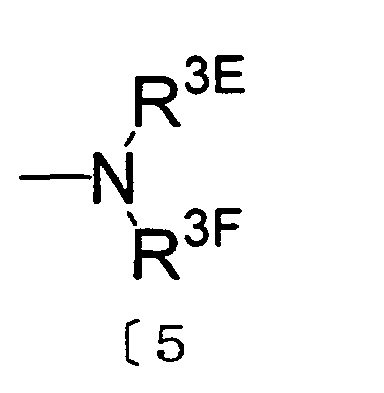

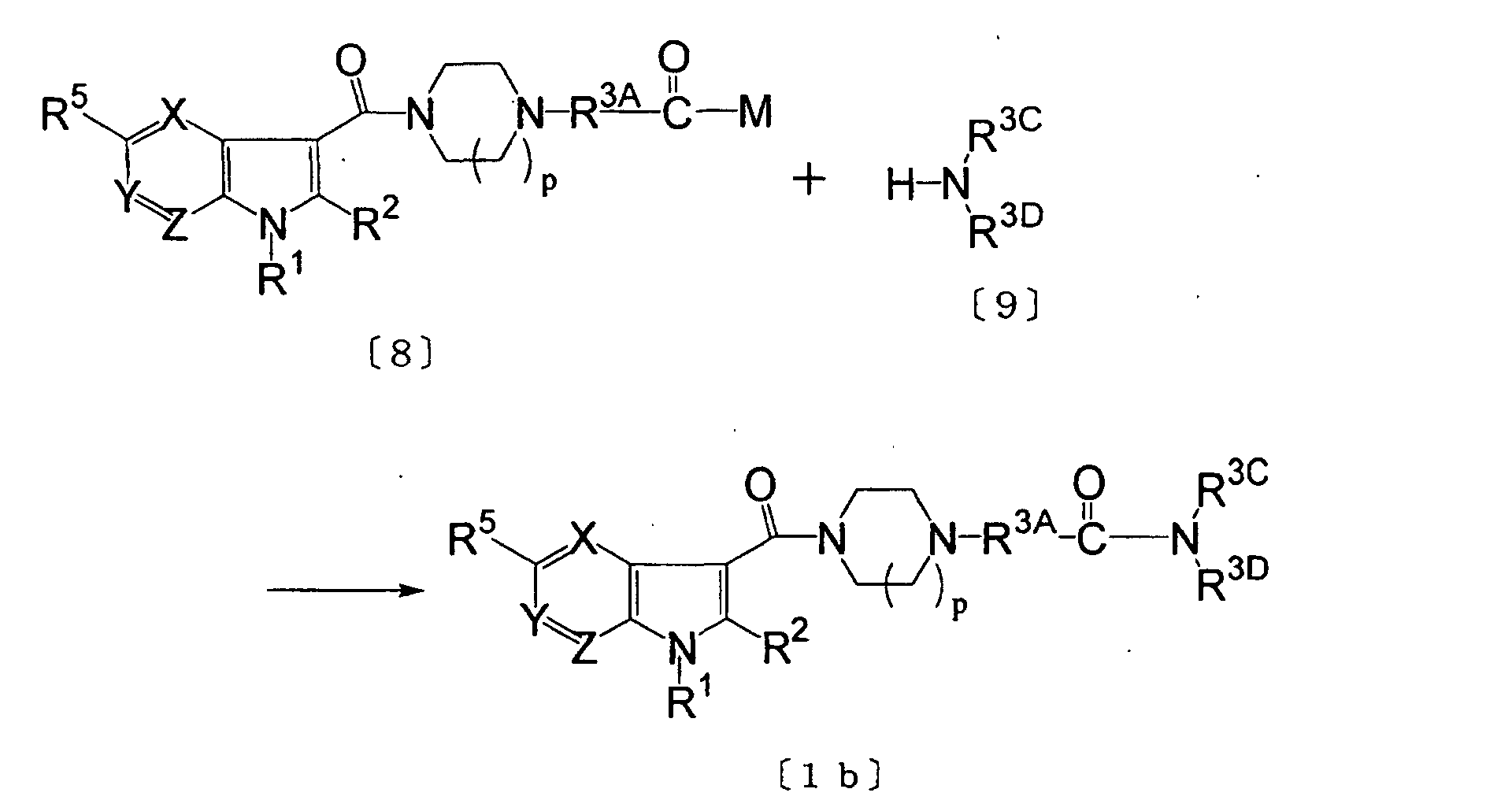
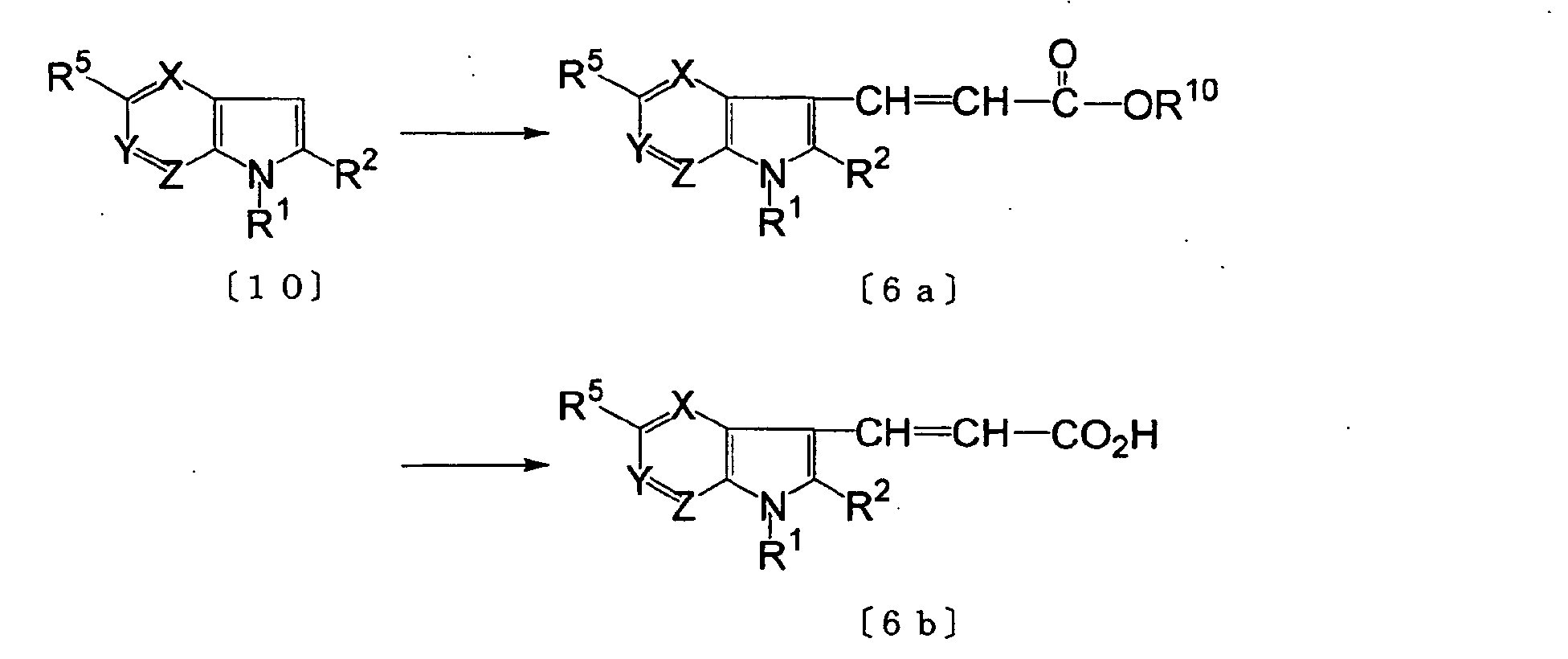
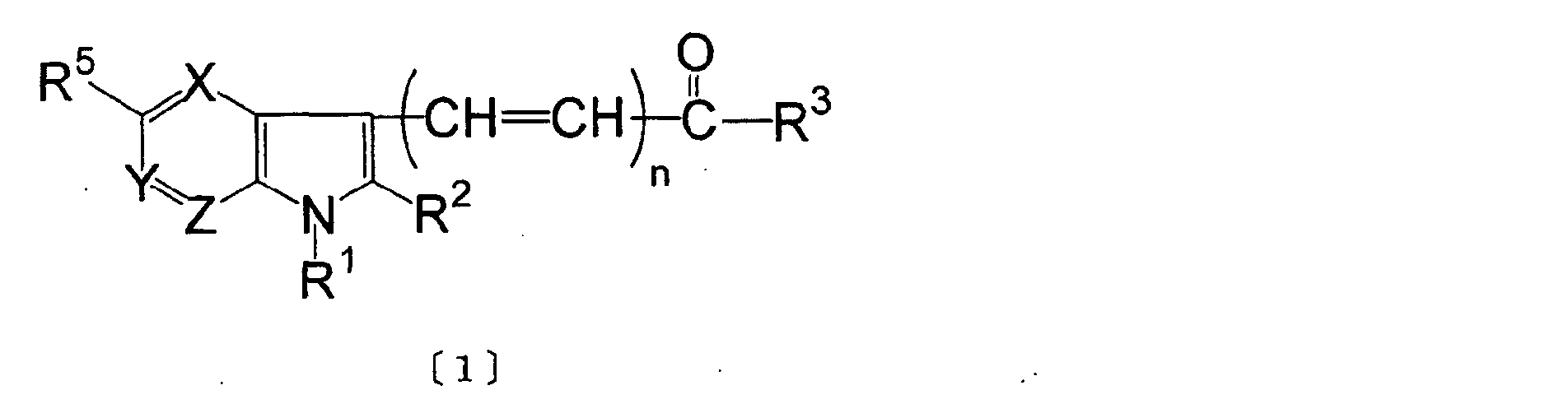 (A)n represents 0,X represents CR4 or N, Y represents CR6 or N, Z represents CR7 or N,R1 and R2 may be the same or different and each represents hydrogen, alkyl, haloalkyl, hydroxyalkyl, alkoxyalkyl, carboxyalkyl, acyl, aryl, an aromatic heterocyclic group or arylalkyl ( the aryl, the aromatic heterocyclic group and the aryl moiety of the arylalkyl may be substituted by R81, R82 or R83, and R81, R82 and R83 may be the same or different and each represents halogen, alkyl, haloalkyl, alkoxy, haloalkoxy, hydroxy, hydroxyalkyl, carboxy, alkoxycarbonyl, cyano or nitro, or the two adjacent groups among R81, R82 and R83 may jointly form methylenedioxy or ethylenedioxy ),R4, R5, R6 and R7 may be the same or different and each represents hydrogen, halogen, hydroxy, amino, alkyl, haloalkyl, alkoxy, monoalkylamino, dialkylamino, arylalkyl, cyano or nitro, or the two adjacent groups among R4, R5, R6 and R7 may jointly form methylenedioxy or ethylenedioxy,R3 represents a group represented by the following formula [2]:in which p represents 1 or 2,
 R3A represents a divalent group of pyridine, pyrazine, pyridazine or pyrimidine,R3B represents tetrazolyl [ the tetrazolyl may be substituted by alkyl ( the alkyl may be substituted by hydroxy, dialkylamino or cycloalkyl ] or a group represented by the following formula [3],
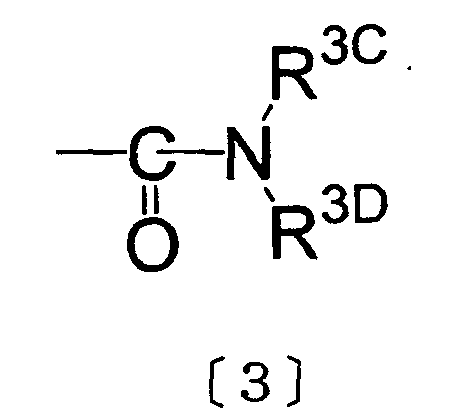 R3C and R3D may be the same or different and each represents any of the following groups (1) to (4):(1) hydrogen,(2) cycloalkyl ( the cycloalkyl may be substituted by alkyl, hydroxy, hydroxyalkyl, carboxy, alkoxycarbonyl or aryl ),(3) alkyl [ the alkyl may be substituted by 1 to 5 same or different members selected from the group consisting of (i) a saturated heterocyclic group ( the saturated heterocyclic group may be substituted by alkyl, hydroxyalkyl or alkoxyalkyl ) , (ii) an aromatic heterocyclic group ( the aromatic heterocyclic group may be substituted by 1 to 3 same or different members selected from the group consisting of alkyl, hydroxy, amino, hydroxyalkyl and alkoxyalkyl ), (iii) hydroxy, (iv) alkoxy, (v) aryl ( the aryl may be substituted by alkyl, hydroxy, alkoxy or alkoxyalkyl ), (vi) aryloxy ( the aryl moiety of the aryloxy may be substituted by alkyl, hydroxy, alkoxy or alkoxyalkyl ), (vii) alkylamino, (viii) dialkylamino, (ix) carboxy, (x) alkoxycarbonyl and (xi) halogen ], and(4) an aromatic heterocyclic group ( the aromatic heterocyclic group may be substituted by alkyl, hydroxyalkyl, alkoxyalkyl, alkoxycarbonylalkyl or aryl ), orR3C, R3D and adjacent N jointly form cyclic amino ( the cyclic amino may be substituted by alkyl, hydroxyalkyl, alkoxyalkyl, aminoalkyl, hydroxy, aryl or arylalkyl ),
 (C)n represents 1,X represents CR4 or N, Y represents CR6 or N, Z represents CR7 or N,R1 and R2 may be the same or different and each represents hydrogen, alkyl, haloalkyl, hydroxyalkyl, alkoxyalkyl, carboxyalkyl, acyl, aryl, an aromatic heterocyclic group or arylalkyl ( the aryl, the aromatic heterocyclic group and the aryl moiety of the arylalkyl may be substituted with R81, R82 or R83, and R81, R82 and R83 may be the same or different and each represents halogen, alkyl, haloalkyl, alkoxy, haloalkoxy, hydroxy, hydroxyalkyl, cyano, alkoxycarbonyl, carboxy or nitro, or the two adjacent groups among R81, R82 and R83 may jointly form methylenedioxy or ethylenedioxy ),R4, R5, R6 and R7 may be the same or different and each represents hydrogen, halogen, hydroxy, amino, alkyl, haloalkyl, alkoxy, monoalkylamino, dialkylamino, arylalkyl, cyano or nitro, or the two adjacent groups among R4, R5, R6 and R7 may jointly form methylenedioxy or ethylenedioxy,R3 represents the following group (1) or (2):(1) cyclic amino [ the cyclic amino may be substituted by R91, R92 or R93 on the same or different carbon atom and the benzene ring may be condensed, R91, R92 and R93 may be the same or different and each represents alkyl, alkoxy, hydroxy, hydroxyalkyl, alkoxyalkyl, alkoxycarbonylalkyl, carboxy, carboxyalkyl, acyl, 2-hydroxybenzimidazole, aryl ( the aryl may be substituted by alkyl or alkoxy ) or an aromatic heterocyclic group ( the aromatic heterocyclic group may be substituted by alkyl, hydroxy, oxo or alkoxy ), or the two groups on the same carbon jointly represent -CONHCH2N(Ph)- ( Ph represents phenyl ), the benzene ring condensed with the cyclic amino may be substituted with R94 or R95, and R94 and R95 may be the same or different and each represents alkyl, alkoxy, halogen, hydroxy, amino, monoalkylamino, dialkylamino, alkylsulfonylamino, acylamino, carbamoyl, monoalkylcarbamoyl, dialkylcarbamoyl, cyano, carboxy, alkoxycarbonyl, sulfamoyl, monoalkylaminosulfonyl, dialkylaminosulfonyl or nitro, or the two adjacent groups among R94 and R95 may jointly form methylenedioxy or ethylenedioxy ],(2) a group represented by the following formula [5]:
 R3E and R3F may be the same or different and each represents any of the following groups (i) to (v):(i) hydrogen,(ii) alkyl { the alkyl may be substituted by 1 to 3 same or different members selected from the group consisting of (a) hydroxy, (b) aryl ( the aryl may be substituted with 1 to 3 same or different members selected from the group consisting of alkyl, haloalkyl, hydroxy, alkoxy, halogen, cyano and nitro ), (c) carboxy, (d) a saturated heterocyclic group [ the saturated heterocyclic group may be substituted by alkyl or arylalkyl ( the aryl moiety of the arylalkyl may be substituted with alkyl, alkoxy or halogen )], and (e) an aromatic heterocyclic group ( the aromatic heterocyclic group may be substituted by alkyl, haloalkyl, hydroxy, hydroxyalkyl, alkoxy, halogen, cyano or nitro )},(iii) aryl (the aryl may be substituted by alkyl, haloalkyl, hydroxy, hydroxyalkyl, alkoxy, halogen, cyano or nitro ),(iv) cycloalkyl ( the cycloalkyl may be substituted by alkoxy, alkoxycarbonyl or hydroxy and the benzene ring may be condensed ), and(v) a saturated heterocyclic group ( the saturated heterocyclic group may be substituted by alkyl, haloalkyl, hydroxy, hydroxyalkyl, alkoxy, halogen, cyano or nitro ).
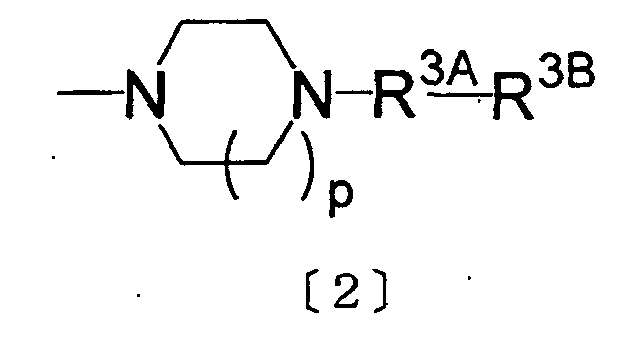 R3A represents a divalent group of pyridine or pyrazine,R3B represents tetrazolyl [ the tetrazolyl may be substituted by alkyl ( the alkyl may be substituted by hydroxy, dialkylamino or cycloalkyl )] or a group represented by the following formula [3]in which R3C and R3D may be the same or different and each represents any of the following groups (1) to (4):
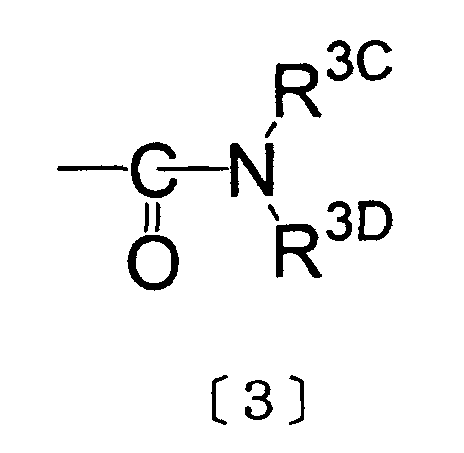 (1) hydrogen,(2) cycloalkyl ( the cycloalkyl may be substituted by hydroxy or alkoxycarbonyl ),(3) alkyl [ the alkyl may be substituted by 1 to 5 same or different members selected from the group consisting of (i) a saturated heterocyclic group ( the saturated heterocyclic group may be substituted by alkyl), (ii) an aromatic heterocyclic group ( the aromatic heterocyclic group may be substituted by 1 to 3 same or different members selected from the group consisting of alkyl and amino), (iii) hydroxy, (iv) alkoxy, (v) aryl ( the aryl may be substituted by alkyl, hydroxy or alkoxy), (vi) aryloxy, (vii) dialkylamino, (viii) carboxy, (ix) alkoxycarbonyl and (x) halogen ], and(4) an aromatic heterocyclic group ( the aromatic heterocyclic group may be substituted by alkoxycarbonylalkyl ),
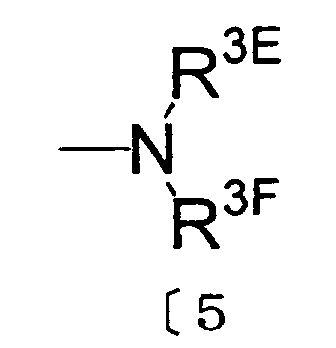 (i) hydrogen,(ii) alkyl { the alkyl may be substituted by 1 to 3 same or different members selected from the group consisting of (a) hydroxy, (b) aryl ( the aryl may be substituted by 1 to 3 same or different members selected from the group consisting of alkyl, haloalkyl, hydroxy, alkoxy and halogen), (c) carboxy, (d) a saturated heterocyclic group [ the saturated heterocyclic group may be substituted with arylalkyl ( the aryl moiety of the arylalkyl may be substituted by halogen )] and (e) an aromatic heterocyclic group ( the aromatic heterocyclic group may be substituted by alkyl, haloalkyl, hydroxy, hydroxyalkyl, alkoxy or halogen )},(iii) aryl ( the aryl may be substituted by alkyl, haloalkyl, hydroxy, hydroxyalkyl, alkoxy or halogen ),(iv) cycloalkyl (the cycloalkyl may be substituted by alkoxy, alkoxycarbonyl or hydroxy and the benzene ring may be condensed), and(v) a saturated heterocyclic group ( the saturated heterocyclic group may be substituted by alkyl, haloalkyl, hydroxy, hydroxyalkyl, alkoxy or halogen ) in case (C).
 in which R3C and R3D may be the same or different and each represents any of the following groups (1) to (3):R3A represents a divalent group of pyrazine, andR3B represents a group represented by the following formula [3]:
 (1) hydrogen,(2) cycloalkyl ( the cycloalkyl may be substituted by alkoxycarbonyl ), and(3) alkyl [ the alkyl may be substitiuted by 1 to 5 same or different members selected from the group consisting of (i) an aromatic heterocyclic group ( the aromatic heterocyclic group may be substituted by 1 to 3 same or different alkyl), (ii) aryl ( the aryl may be substituted by hydroxy ), (iii) carboxy and (iv) alkoxycarbonyl ] in case (A).
 (i) hydrogen,(ii) alkyl ( the alkyl may be substituted with 1 to 3 same or different members selected from the group consisting of carboxy and aromatic heterocyclic group ),(iii) cycloalkyl ( the cycloalkyl may be substituted by alkoxycarbonyl ), and(iv) a saturated heterocyclic group ( the saturated heterocyclic group may be substituted with alkyl ) in case (C).
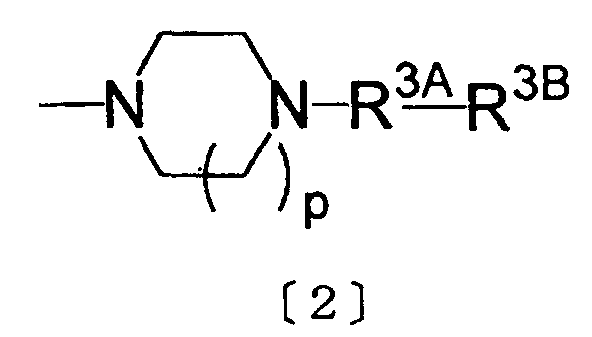 in which R3C and R3D may be the same or different and each represents any of the following groups (1) to (3):R3A represents a divalent group of pyrazine,R3B represents a group represented by the following formula [3]:
 (1) hydrogen,(2) cycloalkyl ( the cycloalkyl may be substituted by alkoxycarbonyl ), and(3) alkyl [ the alkyl may be substituted by 1 to 5 same or different members selected from the group consisting of (i) an aromatic heterocyclic group ( the aromatic heterocyclic group may be substituted by 1 to 3 same or different alkyl ) , (ii) aryl ( the aryl may be substituted by hydroxy ), (iii) carboxy and (iv) alkoxycarbonyl ] in case (A).
 (i) hydrogen,(ii) alkyl ( the alkyl may be substituted by 1 to 3 same or different members selected from the group consisting of carboxy and an aromatic heterocyclic group ),(iii) cycloalkyl ( the cycloalkyl may be substituted by alkoxycarbonyl ), and(iv) a saturated heterocyclic group ( the saturated heterocyclic group may be substituted by alkyl ) in case (C).