EP1449861A2 - Fluoropolymer low reflecting layers for plastic lenses and devices - Google Patents
Fluoropolymer low reflecting layers for plastic lenses and devices Download PDFInfo
- Publication number
- EP1449861A2 EP1449861A2 EP04076018A EP04076018A EP1449861A2 EP 1449861 A2 EP1449861 A2 EP 1449861A2 EP 04076018 A EP04076018 A EP 04076018A EP 04076018 A EP04076018 A EP 04076018A EP 1449861 A2 EP1449861 A2 EP 1449861A2
- Authority
- EP
- European Patent Office
- Prior art keywords
- tfe
- hfp
- mole
- poly
- pmma
- Prior art date
- Legal status (The legal status is an assumption and is not a legal conclusion. Google has not performed a legal analysis and makes no representation as to the accuracy of the status listed.)
- Granted
Links
Classifications
-
- C—CHEMISTRY; METALLURGY
- C09—DYES; PAINTS; POLISHES; NATURAL RESINS; ADHESIVES; COMPOSITIONS NOT OTHERWISE PROVIDED FOR; APPLICATIONS OF MATERIALS NOT OTHERWISE PROVIDED FOR
- C09D—COATING COMPOSITIONS, e.g. PAINTS, VARNISHES OR LACQUERS; FILLING PASTES; CHEMICAL PAINT OR INK REMOVERS; INKS; CORRECTING FLUIDS; WOODSTAINS; PASTES OR SOLIDS FOR COLOURING OR PRINTING; USE OF MATERIALS THEREFOR
- C09D127/00—Coating compositions based on homopolymers or copolymers of compounds having one or more unsaturated aliphatic radicals, each having only one carbon-to-carbon double bond, and at least one being terminated by a halogen; Coating compositions based on derivatives of such polymers
- C09D127/02—Coating compositions based on homopolymers or copolymers of compounds having one or more unsaturated aliphatic radicals, each having only one carbon-to-carbon double bond, and at least one being terminated by a halogen; Coating compositions based on derivatives of such polymers not modified by chemical after-treatment
- C09D127/12—Coating compositions based on homopolymers or copolymers of compounds having one or more unsaturated aliphatic radicals, each having only one carbon-to-carbon double bond, and at least one being terminated by a halogen; Coating compositions based on derivatives of such polymers not modified by chemical after-treatment containing fluorine atoms
-
- C—CHEMISTRY; METALLURGY
- C08—ORGANIC MACROMOLECULAR COMPOUNDS; THEIR PREPARATION OR CHEMICAL WORKING-UP; COMPOSITIONS BASED THEREON
- C08F—MACROMOLECULAR COMPOUNDS OBTAINED BY REACTIONS ONLY INVOLVING CARBON-TO-CARBON UNSATURATED BONDS
- C08F214/00—Copolymers of compounds having one or more unsaturated aliphatic radicals, each having only one carbon-to-carbon double bond, and at least one being terminated by a halogen
- C08F214/18—Monomers containing fluorine
- C08F214/26—Tetrafluoroethene
-
- C—CHEMISTRY; METALLURGY
- C08—ORGANIC MACROMOLECULAR COMPOUNDS; THEIR PREPARATION OR CHEMICAL WORKING-UP; COMPOSITIONS BASED THEREON
- C08F—MACROMOLECULAR COMPOUNDS OBTAINED BY REACTIONS ONLY INVOLVING CARBON-TO-CARBON UNSATURATED BONDS
- C08F214/00—Copolymers of compounds having one or more unsaturated aliphatic radicals, each having only one carbon-to-carbon double bond, and at least one being terminated by a halogen
- C08F214/18—Monomers containing fluorine
- C08F214/28—Hexyfluoropropene
-
- C—CHEMISTRY; METALLURGY
- C08—ORGANIC MACROMOLECULAR COMPOUNDS; THEIR PREPARATION OR CHEMICAL WORKING-UP; COMPOSITIONS BASED THEREON
- C08F—MACROMOLECULAR COMPOUNDS OBTAINED BY REACTIONS ONLY INVOLVING CARBON-TO-CARBON UNSATURATED BONDS
- C08F218/00—Copolymers of compounds having one or more unsaturated aliphatic radicals, each having only one carbon-to-carbon double bond, and at least one being terminated by an acyloxy radical of a saturated carboxylic acid, of carbonic acid or of a haloformic acid
- C08F218/02—Esters of monocarboxylic acids
- C08F218/04—Vinyl esters
- C08F218/08—Vinyl acetate
-
- C—CHEMISTRY; METALLURGY
- C08—ORGANIC MACROMOLECULAR COMPOUNDS; THEIR PREPARATION OR CHEMICAL WORKING-UP; COMPOSITIONS BASED THEREON
- C08J—WORKING-UP; GENERAL PROCESSES OF COMPOUNDING; AFTER-TREATMENT NOT COVERED BY SUBCLASSES C08B, C08C, C08F, C08G or C08H
- C08J7/00—Chemical treatment or coating of shaped articles made of macromolecular substances
- C08J7/04—Coating
- C08J7/0427—Coating with only one layer of a composition containing a polymer binder
-
- C—CHEMISTRY; METALLURGY
- C08—ORGANIC MACROMOLECULAR COMPOUNDS; THEIR PREPARATION OR CHEMICAL WORKING-UP; COMPOSITIONS BASED THEREON
- C08J—WORKING-UP; GENERAL PROCESSES OF COMPOUNDING; AFTER-TREATMENT NOT COVERED BY SUBCLASSES C08B, C08C, C08F, C08G or C08H
- C08J7/00—Chemical treatment or coating of shaped articles made of macromolecular substances
- C08J7/04—Coating
- C08J7/043—Improving the adhesiveness of the coatings per se, e.g. forming primers
-
- C—CHEMISTRY; METALLURGY
- C09—DYES; PAINTS; POLISHES; NATURAL RESINS; ADHESIVES; COMPOSITIONS NOT OTHERWISE PROVIDED FOR; APPLICATIONS OF MATERIALS NOT OTHERWISE PROVIDED FOR
- C09D—COATING COMPOSITIONS, e.g. PAINTS, VARNISHES OR LACQUERS; FILLING PASTES; CHEMICAL PAINT OR INK REMOVERS; INKS; CORRECTING FLUIDS; WOODSTAINS; PASTES OR SOLIDS FOR COLOURING OR PRINTING; USE OF MATERIALS THEREFOR
- C09D127/00—Coating compositions based on homopolymers or copolymers of compounds having one or more unsaturated aliphatic radicals, each having only one carbon-to-carbon double bond, and at least one being terminated by a halogen; Coating compositions based on derivatives of such polymers
- C09D127/02—Coating compositions based on homopolymers or copolymers of compounds having one or more unsaturated aliphatic radicals, each having only one carbon-to-carbon double bond, and at least one being terminated by a halogen; Coating compositions based on derivatives of such polymers not modified by chemical after-treatment
- C09D127/12—Coating compositions based on homopolymers or copolymers of compounds having one or more unsaturated aliphatic radicals, each having only one carbon-to-carbon double bond, and at least one being terminated by a halogen; Coating compositions based on derivatives of such polymers not modified by chemical after-treatment containing fluorine atoms
- C09D127/16—Homopolymers or copolymers of vinylidene fluoride
-
- C—CHEMISTRY; METALLURGY
- C09—DYES; PAINTS; POLISHES; NATURAL RESINS; ADHESIVES; COMPOSITIONS NOT OTHERWISE PROVIDED FOR; APPLICATIONS OF MATERIALS NOT OTHERWISE PROVIDED FOR
- C09D—COATING COMPOSITIONS, e.g. PAINTS, VARNISHES OR LACQUERS; FILLING PASTES; CHEMICAL PAINT OR INK REMOVERS; INKS; CORRECTING FLUIDS; WOODSTAINS; PASTES OR SOLIDS FOR COLOURING OR PRINTING; USE OF MATERIALS THEREFOR
- C09D127/00—Coating compositions based on homopolymers or copolymers of compounds having one or more unsaturated aliphatic radicals, each having only one carbon-to-carbon double bond, and at least one being terminated by a halogen; Coating compositions based on derivatives of such polymers
- C09D127/02—Coating compositions based on homopolymers or copolymers of compounds having one or more unsaturated aliphatic radicals, each having only one carbon-to-carbon double bond, and at least one being terminated by a halogen; Coating compositions based on derivatives of such polymers not modified by chemical after-treatment
- C09D127/12—Coating compositions based on homopolymers or copolymers of compounds having one or more unsaturated aliphatic radicals, each having only one carbon-to-carbon double bond, and at least one being terminated by a halogen; Coating compositions based on derivatives of such polymers not modified by chemical after-treatment containing fluorine atoms
- C09D127/18—Homopolymers or copolymers of tetrafluoroethene
-
- C—CHEMISTRY; METALLURGY
- C09—DYES; PAINTS; POLISHES; NATURAL RESINS; ADHESIVES; COMPOSITIONS NOT OTHERWISE PROVIDED FOR; APPLICATIONS OF MATERIALS NOT OTHERWISE PROVIDED FOR
- C09D—COATING COMPOSITIONS, e.g. PAINTS, VARNISHES OR LACQUERS; FILLING PASTES; CHEMICAL PAINT OR INK REMOVERS; INKS; CORRECTING FLUIDS; WOODSTAINS; PASTES OR SOLIDS FOR COLOURING OR PRINTING; USE OF MATERIALS THEREFOR
- C09D127/00—Coating compositions based on homopolymers or copolymers of compounds having one or more unsaturated aliphatic radicals, each having only one carbon-to-carbon double bond, and at least one being terminated by a halogen; Coating compositions based on derivatives of such polymers
- C09D127/02—Coating compositions based on homopolymers or copolymers of compounds having one or more unsaturated aliphatic radicals, each having only one carbon-to-carbon double bond, and at least one being terminated by a halogen; Coating compositions based on derivatives of such polymers not modified by chemical after-treatment
- C09D127/12—Coating compositions based on homopolymers or copolymers of compounds having one or more unsaturated aliphatic radicals, each having only one carbon-to-carbon double bond, and at least one being terminated by a halogen; Coating compositions based on derivatives of such polymers not modified by chemical after-treatment containing fluorine atoms
- C09D127/20—Homopolymers or copolymers of hexafluoropropene
-
- C—CHEMISTRY; METALLURGY
- C09—DYES; PAINTS; POLISHES; NATURAL RESINS; ADHESIVES; COMPOSITIONS NOT OTHERWISE PROVIDED FOR; APPLICATIONS OF MATERIALS NOT OTHERWISE PROVIDED FOR
- C09D—COATING COMPOSITIONS, e.g. PAINTS, VARNISHES OR LACQUERS; FILLING PASTES; CHEMICAL PAINT OR INK REMOVERS; INKS; CORRECTING FLUIDS; WOODSTAINS; PASTES OR SOLIDS FOR COLOURING OR PRINTING; USE OF MATERIALS THEREFOR
- C09D131/00—Coating compositions based on homopolymers or copolymers of compounds having one or more unsaturated aliphatic radicals, each having only one carbon-to-carbon double bond, and at least one being terminated by an acyloxy radical of a saturated carboxylic acid, of carbonic acid, or of a haloformic acid; Coating compositions based on derivatives of such polymers
- C09D131/02—Homopolymers or copolymers of esters of monocarboxylic acids
- C09D131/04—Homopolymers or copolymers of vinyl acetate
-
- C—CHEMISTRY; METALLURGY
- C08—ORGANIC MACROMOLECULAR COMPOUNDS; THEIR PREPARATION OR CHEMICAL WORKING-UP; COMPOSITIONS BASED THEREON
- C08J—WORKING-UP; GENERAL PROCESSES OF COMPOUNDING; AFTER-TREATMENT NOT COVERED BY SUBCLASSES C08B, C08C, C08F, C08G or C08H
- C08J2427/00—Characterised by the use of homopolymers or copolymers of compounds having one or more unsaturated aliphatic radicals, each having only one carbon-to-carbon double bond, and at least one being terminated by a halogen; Derivatives of such polymers
-
- C—CHEMISTRY; METALLURGY
- C08—ORGANIC MACROMOLECULAR COMPOUNDS; THEIR PREPARATION OR CHEMICAL WORKING-UP; COMPOSITIONS BASED THEREON
- C08L—COMPOSITIONS OF MACROMOLECULAR COMPOUNDS
- C08L2205/00—Polymer mixtures characterised by other features
- C08L2205/02—Polymer mixtures characterised by other features containing two or more polymers of the same C08L -group
-
- Y—GENERAL TAGGING OF NEW TECHNOLOGICAL DEVELOPMENTS; GENERAL TAGGING OF CROSS-SECTIONAL TECHNOLOGIES SPANNING OVER SEVERAL SECTIONS OF THE IPC; TECHNICAL SUBJECTS COVERED BY FORMER USPC CROSS-REFERENCE ART COLLECTIONS [XRACs] AND DIGESTS
- Y10—TECHNICAL SUBJECTS COVERED BY FORMER USPC
- Y10T—TECHNICAL SUBJECTS COVERED BY FORMER US CLASSIFICATION
- Y10T428/00—Stock material or miscellaneous articles
- Y10T428/26—Web or sheet containing structurally defined element or component, the element or component having a specified physical dimension
- Y10T428/263—Coating layer not in excess of 5 mils thick or equivalent
- Y10T428/264—Up to 3 mils
- Y10T428/265—1 mil or less
-
- Y—GENERAL TAGGING OF NEW TECHNOLOGICAL DEVELOPMENTS; GENERAL TAGGING OF CROSS-SECTIONAL TECHNOLOGIES SPANNING OVER SEVERAL SECTIONS OF THE IPC; TECHNICAL SUBJECTS COVERED BY FORMER USPC CROSS-REFERENCE ART COLLECTIONS [XRACs] AND DIGESTS
- Y10—TECHNICAL SUBJECTS COVERED BY FORMER USPC
- Y10T—TECHNICAL SUBJECTS COVERED BY FORMER US CLASSIFICATION
- Y10T428/00—Stock material or miscellaneous articles
- Y10T428/31504—Composite [nonstructural laminate]
- Y10T428/31507—Of polycarbonate
-
- Y—GENERAL TAGGING OF NEW TECHNOLOGICAL DEVELOPMENTS; GENERAL TAGGING OF CROSS-SECTIONAL TECHNOLOGIES SPANNING OVER SEVERAL SECTIONS OF THE IPC; TECHNICAL SUBJECTS COVERED BY FORMER USPC CROSS-REFERENCE ART COLLECTIONS [XRACs] AND DIGESTS
- Y10—TECHNICAL SUBJECTS COVERED BY FORMER USPC
- Y10T—TECHNICAL SUBJECTS COVERED BY FORMER US CLASSIFICATION
- Y10T428/00—Stock material or miscellaneous articles
- Y10T428/31504—Composite [nonstructural laminate]
- Y10T428/3154—Of fluorinated addition polymer from unsaturated monomers
-
- Y—GENERAL TAGGING OF NEW TECHNOLOGICAL DEVELOPMENTS; GENERAL TAGGING OF CROSS-SECTIONAL TECHNOLOGIES SPANNING OVER SEVERAL SECTIONS OF THE IPC; TECHNICAL SUBJECTS COVERED BY FORMER USPC CROSS-REFERENCE ART COLLECTIONS [XRACs] AND DIGESTS
- Y10—TECHNICAL SUBJECTS COVERED BY FORMER USPC
- Y10T—TECHNICAL SUBJECTS COVERED BY FORMER US CLASSIFICATION
- Y10T428/00—Stock material or miscellaneous articles
- Y10T428/31504—Composite [nonstructural laminate]
- Y10T428/31786—Of polyester [e.g., alkyd, etc.]
-
- Y—GENERAL TAGGING OF NEW TECHNOLOGICAL DEVELOPMENTS; GENERAL TAGGING OF CROSS-SECTIONAL TECHNOLOGIES SPANNING OVER SEVERAL SECTIONS OF THE IPC; TECHNICAL SUBJECTS COVERED BY FORMER USPC CROSS-REFERENCE ART COLLECTIONS [XRACs] AND DIGESTS
- Y10—TECHNICAL SUBJECTS COVERED BY FORMER USPC
- Y10T—TECHNICAL SUBJECTS COVERED BY FORMER US CLASSIFICATION
- Y10T428/00—Stock material or miscellaneous articles
- Y10T428/31504—Composite [nonstructural laminate]
- Y10T428/31855—Of addition polymer from unsaturated monomers
- Y10T428/31935—Ester, halide or nitrile of addition polymer
Definitions
- the present invention relates to fluoropolymer coated plastics. More specifically, it relates to fluoropolymer coated plastics having good adhesion. low reflective properties, and water and oil repellency.
- the one layer coating system provided by the present invention consists of a fluorinated copolymer having the formula VF 2 /TFE/HFP wherein the molar ratio of Tetrafluoroethylene (TFE) to Hexafluoropropylene (HFP) is between 0.3 and 1.9, and the VF 2 content is preferably 12 to 50 mole % for PMMA substrates and 18 to 50 mole % for PC, PET, and PS substrates.
- TFE Tetrafluoroethylene
- HFP Hexafluoropropylene
- the molar ratio of TFE to HFP is between 0.9 and 1.9, and the VF 2 content is preferably 12 to 40 mole % for Polymethylmethacrylate (PMMA) substrates and 18 to 40 mole % for Polycarbonate (PC), Polyethyleneterephthalate (PET), and Polysulfone (PS) substrates.
- PMMA Polymethylmethacrylate
- PC Polycarbonate
- PET Polyethyleneterephthalate
- PS Polysulfone
- the two-layer coating system developed for PMMA, PC, PET, and PS substrates compnses an upper layer selected from the group consisting of:
- the ratio of TFE to HFP is between about 0.9 and 1.9 in both the lower and upper layer, and wherein the concentration of VF 2 is between about 12 and 40 mole % when PC, PET, and PS substrates are utilized.
- the thickness of the coating is preferably between about 10 and 1000 nm, more preferably, between about 30 and 120 nm, and most preferably between about 70 and 120 nm.
- the thickness of the upper layer is preferably between 10 and 1000 nm. More preferably, it is between 30 and 120 nm and most preferably, it is between 70 and 120 nm.
- Preferred substrates are PMMA, PC, PET, and PS.
- the one layer coating system provided by the present invention consists of a fluorinated copolymer having the formula VF 2 /TFE/HFP wherein the molar ratio of TFE to HFP is between 0.3 and 1.9 and the VF 2 content is preferably 12 to 50 mole % for PMMA substrates and 18 to 50 mole % for PC, PET, and PS substrates. These compositions balance the high fluorine content needed for low reflection, the high HFP content needed for optical clarity, and a sufficient VF 2 content to afford good adhesion to the substrate. More preferred is where the molar ratio of TFE to HFP is between 0.9 and 1.9, and the VF 2 content is preferably 12 to 40 mole % for PMMA substrates and 18 to 40 mole % for PC, PET, and PS substrates.
- the ratio of TFE to HFP is between about 0.9 and 1.9 in both the lower and upper layer, and wherein the concentration of VF 2 is between about 12 and 40 mole % when PC, PET, and PS substrates are utilized.
- the purpose of the lower layer in the present invention is to bond highly-fluorinated, low-reflection polymers to higher-reflection, hydrocarbon-polymer substrates.
- the polymer used for the adhesive layer combines perfluorocarbon monomers such as TFE and HFP with either partially fluorinated or hydrocarbon comonomers such as VF 2 , HFIB, and VAc.
- the coating needs to be thicker than about 10 nm in order to observe a significant reduction in reflectivity. While thicknesses greater than 10 nm work well, practical problems eventually arise as the coating is made thicker. For example, above about 1000 nm, thickness variation can become a problem, and, if the coating polymer is expensive, economics start to be prohibitive.
- the thickness of the coating is preferably between about 10 and 1000 nm, more preferably, between about 300 and 120 nm, most preferably, between about 70 and 120 nm.
- the thickness of the upper layer can be between 10 and 1000 nm. More preferably, it is between about 30 and 120 nm, most preferably between about 70 and 120 nm.
- the coating process for the present invention can include any process known in the art, including but not limited to dipping, spray, or spin coating method using polymer.
- the polymer can be produced using any free-radical polymerization method known in the art, including but not limited to bulk, solution or dispersion polymerization, using either nonaqueous or aqueous solvents.
- a preferred method is dispersion polymerization.
- Preferred solvents are water and tert-butanol/methyl acetate mixture.
- Dispersing agents can optionally be used; a preferred initiator is Vazo®52.
- the polymer can further be hydrolyzed, partially or completely, to provide a vinyl alcohol containing copolymer.
- the polymer can be recovered from the reaction using any conventional procedure such as filtration, followed by washing and drying.
- the polymer product can be readily dissolved in many solvents such as acetone and used for casting films and surface coatings having the advantageous properties of fluoropolymers.
- solvents such as acetone
- One particular use is for preparing coatings having low reflective properties.
- Light transmission was measured at 500 nm using a Shimadzu #UV-3100 Spectrometer. This machine measures a continuous comparison of a split beam, part of which passes through the sample.
- a tool with 10 razor blades separated by a distance of 1 mm was used to cut the coating down to the plastic substrate, drawing the razor blade tool first in one direction and then a second time in a perpendicular direction. This cuts 100 crosshatched squares. Scotch tape was applied to the crosshatched area with moderate pressure and pulled off rapidly. Adhesion is scored as the number of squares out of 100 still attached to the substrate.
- VF 2 /TFE/HFP terpolymers and the TFE/HFP dipolymers used in the present invention are compositions chosen for optical clarity and solubility. They were prepared by polymerization at 14,000 psi and 200-400°C as described in U.S. Patent Nos. 5,478,905 and 5.637,663. This method of polymerization gives higher HFP contents and different monomer sequences than polymerizations run under ordinary emulsion and bulk polymerization methods known in the art, see for instance, Encyclopedia of Polymer Science and Engineering, 1989. Vol. 16, pg 601-613 and Vol. 7, pg. 257-269, John Wiley & Sons. VF 2 /TFE/HFP and TFE/HFP compolymers made by these more conventional methods may also work in our application as long as high fluorine content, optical clarity and easy solution coatability can be maintained.
- PVOH grafted with TFE was prepared as in U.S. Patent No. 5,847,048, hereby incorporated by reference.
- the polymer contained about 46 mole % TFE groups grafted to the vinyl alcohol.
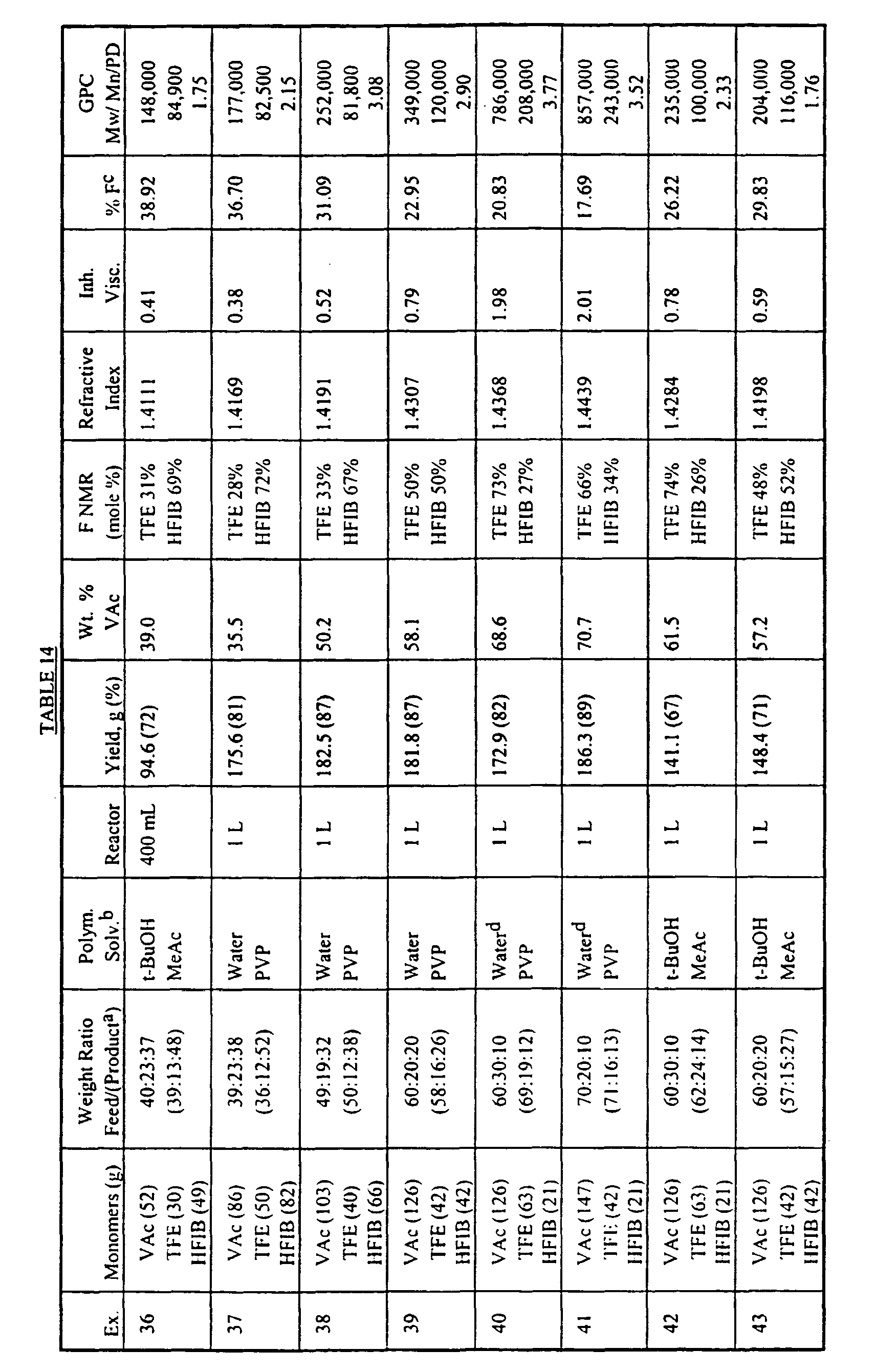
- VAc/TFE/HFIB terpolymers were prepared as described in Examples 36 to 45 below.
- Uncoated PMMA showed 92.1 % transmission. Coatings thicker than 20.0 nm and thinner than 1000 nm gave improved transmission (>93%) relative to uncoated PMMA. The highest transmissions (>96%) were shown by coatings ⁇ 30 to 120 nm thick.
- Polymer films were prepared as in Examples 1 to 9. Transmittance and adhesion were measured with the results shown in Table 2 below which lists Examples and Comparative Examples in order of increasing VF 2 content. Adhesion by Standard Tape Pull Test Single Coat Poly(VF 2 /TFE/HFP) on PMMA Mole % VF 2 /TFE/HFP Adhesion (/100) Transmittance (%) Comp. #1 Uncoated PMMA control -- 92.1 Comp. #4 0/57/43 Control 0 97.2 Comp.
- Example #11 18.7/43.3/18.0 99 97.9
- Example #12 25.2/42.9/31.9 100 95.1
- Example #13 37.4/28.9/33.7 100 96.0
- a solution, 2 wt % poly(VF 2 /TFE/HFP 46.9/13.5/39.6 mole %) in Vertrel® XF, were made by agitating chunks of the polymer with solvent for several days at room temperature. PMMA plates measuring 2.5 cm by 5.0 cm by 3 mm thick were used for testing. The PMMA plates were coated by lowering the plates into the polymer solution at a rate of 300 mm/min. and then, 30 seconds later. raising the plates back our of the solution at 50 mm/min. After 5-10 minutes air drying, the plates were dried horizontally for 60 minutes in a 100°C air oven. Transmittance and adhesion were measured with the results shown the table below which lists Examples.
- VF 2 content in the poly(VF 2 )/TFE/HFP) primer coat was varied.
- a 57 mole % TFE/43 mole % HFP top coat was used for all samples with a poly(VF 2 /TFE/HFP) primer coat.
- Transmittance and adhesion were measured with the results shown in Table 4 below which lists the Examples and Comparative Examples in order of increasing thickness.
- Poly(VF 2 /TFE/HFP) samples of different VF 2 content see Table 5 below, were used for the primer coat.
- Solutions 1 wt % poly(VF 2 /TFE/HFP) in acetone, were made by agitating chunks of the polymer with solvent for several days at room temperature.
- PMMA plates measuring 2.5 cm by 5.0 cm by 3 mm thick were used for testing.
- the PMMA plates were coated by lowering the plates into the polymer solution at a rate of 300 mm/min. and then, immediately, raising the plates back out of the solution at 50 mm/min. After 5-10 minutes air drying, the plates were dried horizontally for 60 minutes in a 100°C air oven.
- the topcoat in every instance the same 18.7 mole % VF 2 /43.3 mole % TFE/38.0 mole % HFP terpolymer, was prepared by the same method.
- Poly(VF 2 /TFE/HFP) terpolymer samples of different VF 2 content were coated on polycarbonate (PC) sheet using the method of Example 14.
- the polycarbonate was manufactured by Kyoto-Jushi Seiko Co., Ltd.
- the polycarbonate sheets measured 2.5 cm X 5.0 cm by 3 mm thick.
- VF 2 contents between about 18 and 40 mole % give improved adhesion (>70/100) relative to HFP/TFE copolymer (0/100) and improved transmission (>92%) relative to uncoated PC (87.2%).
- Poly(VF 2 /TFE/HFP) samples of different VF 2 content see Table 7 below, were used for the primer coat.
- Solutions. 1 wt % poly(VF 2 /TFE/HFP) in acetone. were made by agitating chunks of the polymer with solvent for several days at room temperature.
- PC plates Kelto-Jushi Seiko Co., Ltd. measuring 2.5 cm by 5.0 cm by 3 mm thick were used for testing. The PC plates were coated by lowering the plates into the polymer solution at a rate of 300 mm/min. and then, immediately, raising the plates back out of the solution at 50 mm/min. After 5-10 minutes air drying, the plates were dried horizontally for 60 minutes in a 100°C air oven.
- the topcoat in every instance the same 57.0 mole % TFE/43.0 mole % HFP copolymer, was prepared by the same method.
- VF 2 ) contents between about 12 and 40 mole % give improved adhesion (>83/100) relative to HFP/TFE dipolymer (68/100) and improved transmittance (>92.3%) relative to uncoated polycarbonate (87.2%).
- a stirred jacketed stainless steel horizontal autoclave of 7.6 L (2 U.S. gal) capacity was used as the polymerization vessel.
- the autoclave was equipped with instrumentation to measure temperature and pressure and with a compressor that could feed monomer mixtures to the autoclave at the desired pressure.
- the autoclave was filled to 55-60% of its volume with deionized water containing 15 g of Zonyl ® FS-62 surfactant (DuPont Co., Wilmington. DE) and heated to 90°C. It was then pressured to 3.1 MPa (450 psig) with nitrogen and vented three times.
- the autoclave was precharged with monomers in the desired ratio, as shown in the table below, and brought to the working pressure of 3.1 MPa (450 psig).
- Initiator solution was prepared by dissolving 2 g APS in 1 L of deionized water. The initiator solution was fed to the reactor at a rate of 25 mL/min for a period of five minutes and then the rate was reduced and maintained at 1 mL/min for the duration of the experiment.
- the autoclave was operated in a batch mode. The polymerization was terminated after a 10% pressure drop was observed by venting the remaining unconverted monomers and by reducing the autoclave temperature to room temperature.
- the autoclave was operated in a semibatch fashion in which a monomer mixture was added to the reactor to maintain constant pressure by means of the compressor as polymerization occurred.
- the composition of this make-up feed was different from the precharged mixture, as shown in the table below, because of the differences in monomer reactivity.
- the composition was selected to maintain a constant monomer composition in the reactor so compositionally homogeneous product was formed.
- Make-up monomer feed was admitted to the autoclave, through the compressor, by means of an automatic pressure regulated valve to maintain reactor pressure. Monomer feeds were continued until a predetermined amount to give the final latex solids was fed to the autoclave. The feed was then stopped and the contents of the autoclave were cooled and vented.
- Poly(VF/TFE/HFP) samples of different VF content see Table 9 below, were used for the primer coat.
- Solutions 2 wt % poly(VF/TFE/HFP) in acetone, were made by agitating chunks of the polymer with solvent for several days at room temperature.
- PMMA plates measuring 2.5 cm by 5.0 cm by 3 mm thick were used for testing. The PMMA plates were coated by lowering the plates into the polymer solution at a rate of 300 mm/min. and then, immediately, raising the plates back out of the solution at 50 mm/min. After 5-10 minutes air drying, the plates were dried horizontally for 60 minutes in a 100°C air oven.
- the topcoat in every instance the same 57 mole % TFE/43 mole % HFP polymer, was prepared by the same method.
- VF contents from about 42 to 58 mole %
- use of poly(VF/TFE/HFP) as the primer coat gives excellent transmittance (>96.0%) relative to uncoated PMMA (92.1%) along with excellent adhesion (>99/100).
- a poly(vinyl alcohol) to which 46 mole % TFE had been grafted was used for the primer coat.
- PMMA plates measuring 2.5 cm by 5.0 cm by 3 mm thick were used for testing.
- the PMMA plates were coated by lowering the plates into the polymer solution at a rate of 300 mm/min. and then, immediately, raising the plates back out of the solution at 50 mm/min. After 5-10 minutes air drying, the plates were dried horizontally for 60 minutes in a 100°C air oven.
- the topcoat an 57 mole % TFE/43 mole % HFP polymer, was prepared by the same method.
- Uncoated PET showed 85.0% transmission. Simultaneous good adhesion (>99/100) and improved transmission (>96%) relative to uncoated PET were observed.
- Coatings were prepared as in Example 1 to 9. Polysulfone sheets measuring 2.5 X 5.0 cm by 0.05 mm thick were as substrate. Transmittance and adhesion results are shown in the table below which lists Examples and Comparative Examples. Single Coat Poly(VF 2 /TFE/HFP) on Polysulfone Mole %'s VF 2 /TFE/HFP Adhesion (/100) Transmittance (%) Comp. #17 Uncoated PS -- 88.5 Comp. # 18 0/57/43 97 98.2 Example #34 18.7/43.3/38.0 100 95.0
- Uncoated polysulfone showed 88.5% transmittance. Simultaneous good adhesion (>97/100) and improved transmission (>95%) relative to uncoated polysulfone (88.5%) were observed.
- Adhesion was 100/100 for the two coat sheet (VF 2 /TFE/HFP and Teflon® AF) but only 0/100 for the sheet with a single coating of Teflon® AF. This shows that poly(VF 2 /TFE/HFP) is an effective primer that further improves the adhesion of Teflon® AF.
- Transmittance at 500 nm was 98.0% for two coat sheet (VF 2 /TFE/HFP and AF) but only 92.1 for uncoated PMMA control. This shows that Teflon® AF is an effective top coat that further improves the transmittance of poly(VF 2 /TFE/HFP).
- Aqueous Polymerization of VAc/TFE/HFIB A 1-L stirred vertical autoclave was charged with a solution of 0.3 g of Plasdone K-90 (steric stabilizer) and 5 mL isopropanol (chain transfer agent) in 400 mL of deionized water. Vinyl acetate (126 g, 1.47 mole) and 0.6 g of Vazo® 52 were added. The vessel was closed, pressurized to 100 psi with nitrogen and vented twice. The vessel was pressured to 295 psi with nitrogen as a leak test and vented.
- the vessel was cooled to about -4°C, evacuated and charged with 42 g (0.26 mol) of hexafluoroisobutylene and 42 g (0.42 mol) of tetrafluoroethylene. With stirring at 750 rpm, the vessel contents were heated to 70°C and maintained for 3 hr. The contents was heated to 85°C and maintained for 3 hr. After cooling to room temperature and venting to atmospheric pressure, the aqueous suspension was removed from the vessel using water as necessary to rinse. An additional 350 mL of deionized water were added and the white suspension was heated with stirring on a hot plate until about 250 mL of solution had evaporated. After cooling to room temperature, the solid was easily filtered on a sintered glass funnel and washed with deionized water. It was dried in a vacuum oven at 90°C overnight giving 181.8 g (87%) of white polymer.
- Nonaqueous Polymerization of VAc/TFE/HFIB A 1-L stirred vertical autoclave was charged with a solution of 126 g of vinyl acetate in 110 g of methyl acetate and 200 g of tert-butanol. The vessel was closed, pressurized to 100 psi with nitrogen and vented twice. The vessel was pressured to 295 psi with nitrogen as a leak test and vented. The vessel was cooled to about -4°C, evacuated and charged with 63 g of tetrafluoroethylene and 21 g of HFIB. With stirring at 750 rpm, the vessel contents were heated to 70°C.
- Vinyl acetate content was determined by hydrolysis of the acetate groups using excess of sodium hydroxide in refluxing THF, followed by titration of excess base by standard hydrochloric acid solution. GPC analyses were conducted using THF as solvent and polystyrene standards. Elemental analyses were done by Schwarkkoff Microanalytical Laboratory. 19 F NMR spectra were generally measured in THF-d6 solutions using TMS and CFC-11 as internal standards. 19 F NMR was used to assign relative amounts of the two fluorinated monomers from integration of the CF 3 groups of HFIB at -66 to -70 versus the CF 2 groups from TFE at -110 to -126.
- Poly(VAc/TFE/HFIB) samples of different VAc content see Table 9 below, were used for the primer coat.
- Solutions, 2 wt % poly(VAc/TFE/HFIB) in acetone were made by agitating chunks of the polymer with solvent for several days at room temperature.
- PMMA plates measuring 2.5 cm by 5.0 cm by 3 mm thick were used for testing.
- the PMMA plates were coated by lowering the plates into the polymer solution at a rate of 300 mm/min. and then, immediately, raising the plates back out of the solution at 50 mm/min. After 5-10 minutes air drying, the plates were dried horizontally for 60 minutes in a 100°C air oven.
- the topcoat in every instance the same 57 mole % TFE/43 mole % HFP polymer, was prepared by the same method.
- VAc contents from about 36 to 69 mole %, use of poly(VAc/TFE/HFIB) as the primer coat gives excellent transmittance (>96.8%) relative to uncoated PMMA (92.1 %) along with excellent adhesion (100/100).
Landscapes
- Chemical & Material Sciences (AREA)
- Organic Chemistry (AREA)
- Health & Medical Sciences (AREA)
- Chemical Kinetics & Catalysis (AREA)
- Medicinal Chemistry (AREA)
- Polymers & Plastics (AREA)
- Life Sciences & Earth Sciences (AREA)
- Engineering & Computer Science (AREA)
- Materials Engineering (AREA)
- Wood Science & Technology (AREA)
- Paints Or Removers (AREA)
- Addition Polymer Or Copolymer, Post-Treatments, Or Chemical Modifications (AREA)
- Laminated Bodies (AREA)
- Surface Treatment Of Optical Elements (AREA)
- Coating Of Shaped Articles Made Of Macromolecular Substances (AREA)
Abstract
- a) poly(VF2/TFE/HFP) wherein the ratio of TFE to HFP is between about 0.9 and 1.9 and the concentration of VF2 is between about 18 and 60% on PMMA substrates and between about 12 and 40 mole % on PC, PET, and PS substrates;
- b) poly(VF/TFE/HFP) wherein the ratio of TFE to HFP is between about 2.1 and 0.9 and the concentration of VF is between about 42 and 58 mole %;
- c) poly(VAc/TFE/HFIB) wherein the concentration of VAc is between 36 and 69 mole % and the concentration of HFIB is between 14 and 52 mole %; and
- d) TFE graft to PVOH wherein about 46 mole % TFE has been grafted to the PVOH;
a coating system for coating a substrate comprising a fluorinated copolymer having the formula
Description
or
poly(TFE/perfluoro-2,2-dimethyidioxole) wherein the concentration of the perfluorodimethyldioxole is between 60 and 90 mole %
or
Poly(VF/TFE/HFP) wherein the ratio of TFE to HFP is between about 2.1 and 0.9 and the concentration of VF is between about 42 and 58 mole %
or
Poly(VAc/TFE/HFIB) wherein the concentration of VAc is between 36 and 69 mole % and the concentration of HFIB is between 14 and 52 mole %
or
A TFE graft to PVOH wherein about 46 mole % TFE has been grafted.
APS - Ammonium persulfate
HFIB - Hexafluoroisobutylene. (CF3)2C=CH2
HFP - Hexafluoropropylene, CF2=CF-CF3
PC - Polycarbonate
PET - Polyethyleneterephthalate
PMMA - Polymethylmethacrylate
PVOH - Polyvinyl alcohol
PS - Polysulfone
Teflon® AF - TFE/Perfluoro-2,2-dimethyldioxole copolymer
TFE - Tetrafluoroethylene, CF2=CF2
VAc - Vinyl acetate, CH3-C(O)-OCH=CH2
VF - Vinyl fluoride, CH2=CHF
VF2 - Vinylidene fluoride, CF2=CH2
| Single Coat of 18.7/43.3/38.0 mole % Poly(VF2/TFE/HFP) on PMMA | ||
| Thickness (nm) | Transmittance (%) | |
| Comp. #1 | Uncoated PMMA control | 92.1 |
| Comp. #2 | 5.0 | 92.8 |
| Example #1 | 20.0 | 94.5 |
| Example #2 | 70.6 | 96.7 |
| Example #3 | 76.3 | 97.7 |
| Example #4 | 90.2 | 98.0 |
| Example #5 | 106.2 | 96.6 |
| Example #6 | 133.3 | 93.2 |
| Example #7 | 209.2 | 94.6 |
| Example #8 | 394.7 | 95.2 |
| Example #9 | 572.1 | 94.4 |
| Comp. #3 | 2000 | not uniform |
| Adhesion by Standard Tape Pull Test Single Coat Poly(VF2/TFE/HFP) on PMMA | |||
| Mole % VF2/TFE/HFP | Adhesion (/100) | Transmittance (%) | |
| Comp. #1 | Uncoated PMMA control | -- | 92.1 |
| Comp. #4 | 0/57/43 Control | 0 | 97.2 |
| Comp. #5 | 7.8 /60.3/31.8 | 64 | 97.5 |
| Example #10 | 12.6/51.3/36.1 | 96 | 97.2 |
| Example #11 | 18.7/43.3/18.0 | 99 | 97.9 |
| Example #12 | 25.2/42.9/31.9 | 100 | 95.1 |
| Example #13 | 37.4/28.9/33.7 | 100 | 96.0 |
| Single Coat of 46.9/13.5/39.6 mole % Poly(VF2/TFE/HFP) on PMMA | |||
| Mole %'s VF2TFE/HFP | Adhesion (/100) | Transmittance (%) | |
| Example #14B | 46.9/13.5/39.6 | 100 | 97.4 |
| Comp. #1 | Uncoated PMMA control | -- | 92.1 |
| Two Coat. Poly(VF2/TFE/HFP) and Poly(HFP/TFE) on PMMA Preferred VF2 Content | |||
| Mole % VF2/TFE/HFP | Adhesion (/100) | Transmittance (%) | |
| Comp. #1 | Uncoated PMMA control | -- | 92.1 |
| Comp. #4 | 0/57/43 Control | 0 | 97.2 |
| Comp. #6 | 7.8 /60.3/31.8 | 0 | 97.7 |
| Comp. #7 | 12.6/51.3/36.1 | 4 | 97.5 |
| Example #15 | 18.7/43.3/38.0 | 90 | 97.7 |
| Example #16 | 49.3/27.7/23.0 | 100 | 97.3 |
| Example #17 | 52.0/25.9/22.1 | 98 | 97.5 |
| Example #18 | 61.0/21.7/17.3 | 80 | 97.4 |
| Comp. #8 | 66.2/16.9/16.9 | 6 | 97.1 |
| Two Poly(VF2/TFE/HFP) Coats on PMMA | |||
| Primer Coat Mole % VF2/TFE/HFP | Adhesion (/100) | Transmittance (%) | |
| Comp. #1 | Uncoated PMMA Control | --- | 92.1 |
| Example 19 | 49.3/27.7/23.0 | 100 | 97.5 |
| Example 20 | 61.0/21.7/17.3 | 100 | 97.0 |
| Example 21 | 66.2/16.9/16.9 | 100 | 97.5 |
| Single Poly(VF2/TFE/HFP) Coat on PC | |||
| Mole %'s VF2/TFE/HFP | Adhesion (/100) | Transmittance (%) | |
| Comp. #9 | Uncoated PC Control | -- | 87.2 |
| Comp. #10 | 0/57/43 | 0 | 95.2 |
| Comp. #11 | 7.8/60.3/31.8 | 0 | 90.5 |
| Comp. #12 | 12.6/51.3/36.1 | 53 | 94.7 |
| Example #22 | 18.7/43.3/38.0 | 70 | 94.0 |
| Example #23 | 25.2/42.9/31.9 | 100 | 92.0 |
| Example #24 | 37.4/28.9/33.7 | 100 | 93.8 |
| Two Coats on PC | |||
| Primer Coat Mole % VF2/TFE/HFP | Adhesion (/100) | Transmittance (%) | |
| Comp. #9 | Uncoated PC control | -- | 87.2 |
| Comp. #13 | 0/57/43 control | 68 | 93.8 |
| Comp. # 14 | 7.8/60.3/31.8 | 12 | 91.6 |
| Example #25 | 12.6/51.3/36.1 | 83 | 94.2 |
| Example #26 | 18.7/43.3/38.0 | 96 | 92.3 |
| Example #27 | 25.2/42.9/31.9 | 88 | 93.4 |
| Example #28 | 37.4/28.9/33.7 | 97 | 93.2 |
| Monomer Precharge TFE/VF/HFP (wt%) | Monomer Make-up TFE/VF/HFP (wt%) | Monomer Fed (g) | Polymer Comp. Solids (wt%) | Polymer (g) | TFE/VF/HFP (wt%) |
| 15/3/82 | 750.9 | 2.1 | 96.6 | 38.3/42.8/19 | |
| 9/3/88 | 29/46/25 | 1702 | 18.3 | 1063 | 26.2/46.4/27.5 |
| 10/10/80 | 636.1 | 2.2 | 99.7 | 20.3/57.8/22 |
| Two Coats, VF/TFE/HFP Primer, on PMMA | |||
| Primer Coat Mole %'s VF/TFE/HFP | Adhesion (/100) | Transmittance (%) | |
| Comp. #1 | Uncoated PMMA control | --- | 92.1 |
| Example #29 | 42.8/38.3/19.0 | 99 | 96.3 |
| Example #30 | 46.4/26.2/27.5 | 100 | 97.3 |
| Example #31 | 57.8/20.8/22.0 | 100 | 96.0 |
| Two Coats, PVOH-g-TFE Primer, on PMMA | |||
| Primer Coat PVOH-g-TFE | Adhesion (/100) | Transmittance (%) | |
| Comp. #1 | Uncoated PMMA control | -- | 92.1 |
| Example #32 | 46 mole % TFE | 97 | 97.1 |
| Poly(VF2/TFE/HFP) Coat on PET | |||
| Mole %'s VF2/TFE/HFP | Adhesion (/100) | Transmittance (%) | |
| Comp. # 15 | Uncoated PET control | -- | 85.0 |
| Comp. #16 | 0/57/43 | 2 | 96.0 |
| Example #33 | 18.7/43.3/38.0 | 99 | 96.0 |
| Single Coat Poly(VF2/TFE/HFP) on Polysulfone | |||
| Mole %'s VF2/TFE/HFP | Adhesion (/100) | Transmittance (%) | |
| Comp. #17 | Uncoated PS | -- | 88.5 |
| Comp. # 18 | 0/57/43 | 97 | 98.2 |
| Example #34 | 18.7/43.3/38.0 | 100 | 95.0 |
| Two Coats, Poly(VF2/TFE/HFP) and Teflon® AF, on PMMA | |||
| Mole %'s VF2/TFE/HFP | Adhesion (/100) | Transmittance (%) | |
| Comp. #1 | Uncoated PMMA control | -- | 92.1 |
| Comp. #19 | AF1600 control (no lower coat) | 0 | 98.1 |
| Example #35 | 49.3/27.7/23.0 | 100 | 98.0 |

| Two Coats, VAc/TFE/HFIB Primer, on PMMA | |||
| Primer Coat Mole % VAc/TFE/HFIB | Adhesion (/100) | Transmittance (%) | |
| Comp. #1 | Uncoated PMMA control | --- | 92.1 |
| Example #46 | 36/12/52 | 100 | 96.8 |
| Example #47 | 58/16/26 | 100 | 97.6 |
| Example #48 | 69/17/14 | 100 | 97.3 |
Claims (8)
- A two-layer coating system for coating substrates selected from the group consisting of PMMA, PC, PET, and PS comprising an upper layer selected from the group consisting of:and a lower coating layer selected from the group consisting of:a) poly(TFE/HFP) and poly(VF2/TFE/HFP), wherein the molar ratio of HFP to TFE is between about 0.9 and 1.9 and, in the case of the VF2/TFE/HFP terpolymer, the concentration of VF2 is about 19 mole %; andb) poly(TFE/perfluoro-2,2-dimethyldioxole) wherein the concentration of the perfluorodimethyldioxole is between 60 and 90 mole %;a) poly(VF2/TFE/HFP) wherein the ratio of TFE to HFP is between about 0.9 and 1.9 and the concentration of VF2 is between about 18 and 60% on PMMA substrates and between about 12 and 40 mole % on PC, PET, and PS substrates;b) poly(VF/TFE/HFP) wherein the ratio of TFE to HFP is between about 2.1 and 0.9 and the concentration of VF is between about 42 and 58 mole %;c) poly(VAc/TFE/HFIB) wherein the concentration of VAc is between 36 and 69 mole % and the concentration of HFIB is between 14 and 52 mole %; andd) TFE graft to PVOH wherein about 46 mole % TFE has been grafted to the PVOH.
- The two layer coating system of Claim 1 wherein the thickness of the lower coating layer is less than 20 nm.
- The two layer coating system according to claim 1 wherein the thickness of the upper layer is 10 nm to 1000 nm.
- The two layer coating system of Claim 3 wherein the thickness of the upper layer is between 70 nm and 120 nm.
- A composition prepared by the polymerization of vinyl acetate (VAc, CH3-C(O)-OCH=CH2), tetrafluoroethylene (CF2=CF2), and hexafluoroisobutylene ((CF3)2C=CH2).
- A coating system for coating a substrate comprising a fluorinated copolymer having the formula
- The coating system of claim 6 wherein the substrate is PMMA and the coating adheres without chemical bonding.
- The coating of Claim 6 wherein the coating is sufficiently adherent to the substrate to pass a cross-hatch adhesion test with a score of > 70, and the transparency of the substrate increases by at least 3%.
Applications Claiming Priority (3)
| Application Number | Priority Date | Filing Date | Title |
|---|---|---|---|
| US12452099P | 1999-03-16 | 1999-03-16 | |
| US124520P | 1999-03-16 | ||
| EP00915008A EP1169399B1 (en) | 1999-03-16 | 2000-03-15 | Fluoropolymer low reflecting layers for plastic lenses and devices |
Related Parent Applications (2)
| Application Number | Title | Priority Date | Filing Date |
|---|---|---|---|
| EP00915008A Division EP1169399B1 (en) | 1999-03-16 | 2000-03-15 | Fluoropolymer low reflecting layers for plastic lenses and devices |
| EP00915008.7 Division | 2000-03-15 |
Publications (3)
| Publication Number | Publication Date |
|---|---|
| EP1449861A2 true EP1449861A2 (en) | 2004-08-25 |
| EP1449861A3 EP1449861A3 (en) | 2004-11-10 |
| EP1449861B1 EP1449861B1 (en) | 2006-08-09 |
Family
ID=22415356
Family Applications (2)
| Application Number | Title | Priority Date | Filing Date |
|---|---|---|---|
| EP04076018A Expired - Lifetime EP1449861B1 (en) | 1999-03-16 | 2000-03-15 | Fluoropolymer low reflecting layers for plastic lenses and devices |
| EP00915008A Expired - Lifetime EP1169399B1 (en) | 1999-03-16 | 2000-03-15 | Fluoropolymer low reflecting layers for plastic lenses and devices |
Family Applications After (1)
| Application Number | Title | Priority Date | Filing Date |
|---|---|---|---|
| EP00915008A Expired - Lifetime EP1169399B1 (en) | 1999-03-16 | 2000-03-15 | Fluoropolymer low reflecting layers for plastic lenses and devices |
Country Status (8)
| Country | Link |
|---|---|
| US (2) | US7297398B2 (en) |
| EP (2) | EP1449861B1 (en) |
| JP (2) | JP4758004B2 (en) |
| KR (2) | KR100750752B1 (en) |
| AT (1) | ATE295397T1 (en) |
| CA (1) | CA2360903A1 (en) |
| DE (2) | DE60030014T2 (en) |
| WO (1) | WO2000055130A2 (en) |
Families Citing this family (11)
| Publication number | Priority date | Publication date | Assignee | Title |
|---|---|---|---|---|
| US7569275B2 (en) * | 2002-04-18 | 2009-08-04 | 3M Innovative Properties Company | Fluoropolymer articles |
| US7276624B2 (en) | 2002-05-14 | 2007-10-02 | E. I. Du Pont De Nemours And Company | Fluorosulfates of hexafluoroisobutylene and its higher homologs |
| JP4610856B2 (en) * | 2003-02-06 | 2011-01-12 | Nok株式会社 | Composition for fluororubber-based sealing material and fluororubber-based sealing material |
| JP4123002B2 (en) * | 2003-02-19 | 2008-07-23 | Nok株式会社 | Fluoro rubber composition |
| AU2003277336A1 (en) * | 2003-10-07 | 2005-05-26 | E.I. Du Pont De Nemours And Company | Fluoropolymer low reflecting layers for polastic lenses and devices |
| DE602005012318D1 (en) | 2004-11-02 | 2009-02-26 | Du Pont | FLUORPOLYMER COATINGS WITH TELOMERS |
| US8558152B2 (en) * | 2010-07-22 | 2013-10-15 | Raytheon Company | Lens concentrator system for semi-active laser target designation |
| JP5413479B2 (en) * | 2011-03-31 | 2014-02-12 | ダイキン工業株式会社 | Hexafluoropropylene-vinyl acetate copolymer |
| US11254104B2 (en) | 2016-04-01 | 2022-02-22 | 3M Innovative Properties Company | Multilayer fluoropolymer films |
| CN110030463B (en) * | 2019-04-01 | 2021-05-28 | 江西天然气管道防腐有限公司 | Heat-insulating anti-corrosion pipeline |
| WO2023272451A1 (en) * | 2021-06-28 | 2023-01-05 | Entegris, Inc. | Oleophobic fluoropolymers and filter materials prepared therefrom |
Family Cites Families (36)
| Publication number | Priority date | Publication date | Assignee | Title |
|---|---|---|---|---|
| US3429846A (en) * | 1965-06-15 | 1969-02-25 | Du Pont | Polysilicic acid/tetrafluoroethylene secondary alcohol copolymer compositions |
| US3652328A (en) * | 1969-09-02 | 1972-03-28 | Gen Motors Corp | Transparent plastic having transparent mar-resistant coating of barium titanate |
| US4225379A (en) * | 1976-12-13 | 1980-09-30 | Asahi Glass Company, Limited | Method of laminating plastic film and shaped metal substrates |
| US4329399A (en) * | 1980-10-06 | 1982-05-11 | E. I. Du Pont De Nemours And Company | Coated, heat-sealable aromatic polymer film |
| US4678709A (en) * | 1982-09-15 | 1987-07-07 | Raychem Corporation | Electrical insulation |
| JPS6083032A (en) * | 1983-10-13 | 1985-05-11 | Asahi Chem Ind Co Ltd | Dustproof cover for photomask with superior light transmittancy |
| JPS60203613A (en) * | 1984-03-28 | 1985-10-15 | Asahi Chem Ind Co Ltd | Fluorine-containing copolymer |
| JPS61120743A (en) * | 1984-11-17 | 1986-06-07 | 旭化成株式会社 | Sheet-shaped molded shape |
| JPS61235409A (en) * | 1985-04-10 | 1986-10-20 | Daikin Ind Ltd | Fluorine-containing elastomeric copolymer and wire-coating material comprising same |
| JPS6251109A (en) * | 1986-07-07 | 1987-03-05 | ダイキン工業株式会社 | Material for wire cover and wire covered therewith |
| US5008156A (en) * | 1986-11-07 | 1991-04-16 | Exion Technology, Inc. | Photochemically stable mid and deep ultraviolet pellicles |
| JP2739976B2 (en) * | 1988-12-05 | 1998-04-15 | 電気化学工業株式会社 | Fluorine resin film laminate |
| ATE122477T1 (en) * | 1989-09-06 | 1995-05-15 | Du Pont | NON-REFLECTIVE FILM COVERING. |
| EP0524174A4 (en) * | 1990-04-10 | 1993-07-21 | Sheldahl, Inc. | Method of preparing amorphous fluorocarbon coatings |
| US5053470A (en) | 1990-10-09 | 1991-10-01 | Allied-Signal Inc. | Copolymers of hexafluoroisobutylene with vinyl esters and vinyl alcohol |
| JPH085816A (en) * | 1994-06-21 | 1996-01-12 | Toray Ind Inc | Color filter |
| US5824749A (en) * | 1994-10-04 | 1998-10-20 | Nippon Mektron, Limited | Fluorine-containing elastomer composition |
| JPH08122502A (en) * | 1994-10-20 | 1996-05-17 | Asahi Glass Co Ltd | Optical article having antireflection layer |
| JP3079917B2 (en) | 1994-10-28 | 2000-08-21 | 豊田合成株式会社 | Layered molded body |
| DE4440201A1 (en) * | 1994-11-10 | 1996-05-15 | Bayer Ag | Reactive and processable fluoropolymers, a process for their preparation, a process for the production of crosslinked, grafted or modified fluoropolymers using the reactive and processable fluoropolymers and their use |
| JP3007007B2 (en) * | 1994-11-24 | 2000-02-07 | フクビ化学工業株式会社 | Anti-reflective coating |
| US5712355A (en) * | 1995-02-03 | 1998-01-27 | E. I. Du Pont De Nemours And Company | Fluoromonomer/functionalized hydrocarbon monomer copolymerization process and copolymer product |
| US5478905A (en) | 1995-02-06 | 1995-12-26 | E. I. Du Pont De Nemours And Company | Amorphous tetrafluoroethylene/hexafluoropropylene copolymers |
| CN1290879C (en) * | 1995-02-06 | 2006-12-20 | 纳幕尔杜邦公司 | Amorphous tetrafluoroethylene-hexafluoropropylene copolymer, its preparation method and use |
| EP0808336B1 (en) * | 1995-02-06 | 2002-07-24 | E.I. Du Pont De Nemours And Company | Amorphous copolymers of tetrafluoroethylene and hexafluoropropylene |
| EP0837901A1 (en) * | 1995-06-28 | 1998-04-29 | E.I. Du Pont De Nemours And Company | Fluoropolymer nanocomposites |
| JPH0996701A (en) * | 1995-10-03 | 1997-04-08 | Nikon Corp | Antireflection film and manufacturing method thereof |
| US5880234A (en) * | 1996-04-01 | 1999-03-09 | Central Glass Company, Limited | Curable fluorine-containing copolymer and coating liquid composition containing same |
| US5846650A (en) * | 1996-05-10 | 1998-12-08 | Minnesota Mining And Manufacturing Company | Anti-reflective, abrasion resistant, anti-fogging coated articles and methods |
| JPH10101740A (en) * | 1996-10-01 | 1998-04-21 | Nippon Mektron Ltd | Fluoroelastomer and crosslinkable composition thereof |
| US5945223A (en) * | 1997-03-24 | 1999-08-31 | Xerox Corporation | Flow coating solution and fuser member layers prepared therewith |
| JP3779422B2 (en) * | 1997-05-15 | 2006-05-31 | スリーエム カンパニー | Decorative film, decorated article and method for producing the same |
| JPH10330682A (en) * | 1997-05-28 | 1998-12-15 | Nagoya Gosei Kk | Fluororesin coating agent and its production |
| JP3758323B2 (en) * | 1997-07-18 | 2006-03-22 | ユニマテック株式会社 | Method for producing fluorine-containing elastomer |
| US6365693B1 (en) * | 1999-05-07 | 2002-04-02 | Dupont Dow Elastomers, L.L.C. | Fluoroalkanesulfonyl azide copolymers |
| JP2001030440A (en) * | 1999-07-26 | 2001-02-06 | Mitsubishi Plastics Ind Ltd | Membrane material and manufacturing method thereof |
-
2000
- 2000-03-15 AT AT00915008T patent/ATE295397T1/en not_active IP Right Cessation
- 2000-03-15 EP EP04076018A patent/EP1449861B1/en not_active Expired - Lifetime
- 2000-03-15 KR KR1020067015224A patent/KR100750752B1/en not_active Expired - Fee Related
- 2000-03-15 KR KR1020017011757A patent/KR100615497B1/en not_active Expired - Fee Related
- 2000-03-15 DE DE60030014T patent/DE60030014T2/en not_active Expired - Fee Related
- 2000-03-15 JP JP2000605561A patent/JP4758004B2/en not_active Expired - Lifetime
- 2000-03-15 EP EP00915008A patent/EP1169399B1/en not_active Expired - Lifetime
- 2000-03-15 WO PCT/US2000/007263 patent/WO2000055130A2/en not_active Ceased
- 2000-03-15 CA CA002360903A patent/CA2360903A1/en not_active Abandoned
- 2000-03-15 DE DE60020105T patent/DE60020105T2/en not_active Expired - Fee Related
-
2003
- 2003-01-30 US US10/355,202 patent/US7297398B2/en not_active Expired - Fee Related
-
2007
- 2007-10-23 US US11/877,644 patent/US20090054594A1/en not_active Abandoned
-
2010
- 2010-08-09 JP JP2010178771A patent/JP5292367B2/en not_active Expired - Lifetime
Also Published As
| Publication number | Publication date |
|---|---|
| JP4758004B2 (en) | 2011-08-24 |
| KR100750752B1 (en) | 2007-08-20 |
| EP1169399A2 (en) | 2002-01-09 |
| DE60030014D1 (en) | 2006-09-21 |
| JP2011016361A (en) | 2011-01-27 |
| EP1169399B1 (en) | 2005-05-11 |
| EP1449861B1 (en) | 2006-08-09 |
| KR20060095782A (en) | 2006-09-01 |
| WO2000055130A3 (en) | 2001-04-12 |
| KR100615497B1 (en) | 2006-08-25 |
| DE60020105D1 (en) | 2005-06-16 |
| DE60030014T2 (en) | 2007-03-08 |
| CA2360903A1 (en) | 2000-09-21 |
| KR20020000782A (en) | 2002-01-05 |
| ATE295397T1 (en) | 2005-05-15 |
| US20040037967A1 (en) | 2004-02-26 |
| US20090054594A1 (en) | 2009-02-26 |
| WO2000055130A2 (en) | 2000-09-21 |
| DE60020105T2 (en) | 2006-03-09 |
| JP5292367B2 (en) | 2013-09-18 |
| EP1449861A3 (en) | 2004-11-10 |
| JP2002539293A (en) | 2002-11-19 |
| US7297398B2 (en) | 2007-11-20 |
Similar Documents
| Publication | Publication Date | Title |
|---|---|---|
| JP5292367B2 (en) | Low reflection fluoropolymer layer for plastic lenses and devices | |
| EP0911347B1 (en) | Copolymers of maleic anhydride or acid and fluorinated olefins | |
| US4701508A (en) | Solvent soluble fluorine-containing polymer, coating composition containing the same and coating process thereof | |
| US5510406A (en) | Fluoropolymer composition for coating and article coated with the same | |
| US5851593A (en) | Fluoromonomer/functionalized hydrocarbon monomer copolymerization process and copolymer product | |
| KR100494864B1 (en) | Fluorine-containing polymer aqueous solution | |
| US6710123B1 (en) | Fluoropolymers containing organo-silanes and methods of making the same | |
| EP0975683B1 (en) | Vinyl fluoride interpolymers of low crystallinity | |
| EP0808336A2 (en) | Amorphous copolymers of tetrafluoroethylene and hexafluoropropylene | |
| CN103842389B (en) | The manufacture method of Fluorine containing olefine/vinyl alcohol copolymer and by the composition that comprises this copolymer film forming that is shaped | |
| US5043390A (en) | Fluoroolefin-alkene base copolymer useful as paint vehicle | |
| WO1989004847A1 (en) | Fluorinated copolymer and barrier films | |
| WO2001034670A1 (en) | Fluoropolymers containing organo-silanes and methods of making the same | |
| EP0462603B1 (en) | Chlorotrifluoroethylene based copolymer suitable as paint vehicle | |
| US7147922B2 (en) | Vinylidene fluoride copolymer resin film | |
| EP1828324B1 (en) | Fluoropolymer coatings containing telomers | |
| US20140187699A1 (en) | Composition comprising fluorinated olefin/vinyl alcohol copolymer and alkoxysilane, compound, cured product formed from said composition, and film comprising said cured product | |
| US20070021550A1 (en) | Fluoropolymer low reflecting layers for plastic lenses and devices |
Legal Events
| Date | Code | Title | Description |
|---|---|---|---|
| PUAI | Public reference made under article 153(3) epc to a published international application that has entered the european phase |
Free format text: ORIGINAL CODE: 0009012 |
|
| AC | Divisional application: reference to earlier application |
Ref document number: 1169399 Country of ref document: EP Kind code of ref document: P |
|
| AK | Designated contracting states |
Kind code of ref document: A2 Designated state(s): AT BE CH CY DE DK ES FI FR GB GR IE IT LI LU MC NL PT SE |
|
| PUAL | Search report despatched |
Free format text: ORIGINAL CODE: 0009013 |
|
| AK | Designated contracting states |
Kind code of ref document: A3 Designated state(s): AT BE CH CY DE DK ES FI FR GB GR IE IT LI LU MC NL PT SE |
|
| 17P | Request for examination filed |
Effective date: 20050510 |
|
| AKX | Designation fees paid |
Designated state(s): DE FR GB IT NL |
|
| GRAP | Despatch of communication of intention to grant a patent |
Free format text: ORIGINAL CODE: EPIDOSNIGR1 |
|
| GRAS | Grant fee paid |
Free format text: ORIGINAL CODE: EPIDOSNIGR3 |
|
| GRAA | (expected) grant |
Free format text: ORIGINAL CODE: 0009210 |
|
| AC | Divisional application: reference to earlier application |
Ref document number: 1169399 Country of ref document: EP Kind code of ref document: P |
|
| AK | Designated contracting states |
Kind code of ref document: B1 Designated state(s): DE FR GB IT NL |
|
| PG25 | Lapsed in a contracting state [announced via postgrant information from national office to epo] |
Ref country code: IT Free format text: LAPSE BECAUSE OF FAILURE TO SUBMIT A TRANSLATION OF THE DESCRIPTION OR TO PAY THE FEE WITHIN THE PRESCRIBED TIME-LIMIT;WARNING: LAPSES OF ITALIAN PATENTS WITH EFFECTIVE DATE BEFORE 2007 MAY HAVE OCCURRED AT ANY TIME BEFORE 2007. THE CORRECT EFFECTIVE DATE MAY BE DIFFERENT FROM THE ONE RECORDED. Effective date: 20060809 Ref country code: NL Free format text: LAPSE BECAUSE OF FAILURE TO SUBMIT A TRANSLATION OF THE DESCRIPTION OR TO PAY THE FEE WITHIN THE PRESCRIBED TIME-LIMIT Effective date: 20060809 |
|
| REG | Reference to a national code |
Ref country code: GB Ref legal event code: FG4D |
|
| REF | Corresponds to: |
Ref document number: 60030014 Country of ref document: DE Date of ref document: 20060921 Kind code of ref document: P |
|
| NLV1 | Nl: lapsed or annulled due to failure to fulfill the requirements of art. 29p and 29m of the patents act | ||
| ET | Fr: translation filed | ||
| PLBE | No opposition filed within time limit |
Free format text: ORIGINAL CODE: 0009261 |
|
| STAA | Information on the status of an ep patent application or granted ep patent |
Free format text: STATUS: NO OPPOSITION FILED WITHIN TIME LIMIT |
|
| 26N | No opposition filed |
Effective date: 20070510 |
|
| PGFP | Annual fee paid to national office [announced via postgrant information from national office to epo] |
Ref country code: GB Payment date: 20090311 Year of fee payment: 10 |
|
| PGFP | Annual fee paid to national office [announced via postgrant information from national office to epo] |
Ref country code: DE Payment date: 20090313 Year of fee payment: 10 Ref country code: IT Payment date: 20090319 Year of fee payment: 10 |
|
| PGFP | Annual fee paid to national office [announced via postgrant information from national office to epo] |
Ref country code: FR Payment date: 20090316 Year of fee payment: 10 |
|
| GBPC | Gb: european patent ceased through non-payment of renewal fee |
Effective date: 20100315 |
|
| REG | Reference to a national code |
Ref country code: FR Ref legal event code: ST Effective date: 20101130 |
|
| PG25 | Lapsed in a contracting state [announced via postgrant information from national office to epo] |
Ref country code: FR Free format text: LAPSE BECAUSE OF NON-PAYMENT OF DUE FEES Effective date: 20100331 |
|
| PG25 | Lapsed in a contracting state [announced via postgrant information from national office to epo] |
Ref country code: DE Free format text: LAPSE BECAUSE OF NON-PAYMENT OF DUE FEES Effective date: 20101001 |
|
| PG25 | Lapsed in a contracting state [announced via postgrant information from national office to epo] |
Ref country code: IT Free format text: LAPSE BECAUSE OF NON-PAYMENT OF DUE FEES Effective date: 20100315 Ref country code: GB Free format text: LAPSE BECAUSE OF NON-PAYMENT OF DUE FEES Effective date: 20100315 |