EP1449674A1 - Network point printed matter and printing method - Google Patents
Network point printed matter and printing method Download PDFInfo
- Publication number
- EP1449674A1 EP1449674A1 EP02775414A EP02775414A EP1449674A1 EP 1449674 A1 EP1449674 A1 EP 1449674A1 EP 02775414 A EP02775414 A EP 02775414A EP 02775414 A EP02775414 A EP 02775414A EP 1449674 A1 EP1449674 A1 EP 1449674A1
- Authority
- EP
- European Patent Office
- Prior art keywords
- halftone
- image
- pixels
- region
- laid out
- Prior art date
- Legal status (The legal status is an assumption and is not a legal conclusion. Google has not performed a legal analysis and makes no representation as to the accuracy of the status listed.)
- Granted
Links
Images



Classifications
-
- B—PERFORMING OPERATIONS; TRANSPORTING
- B41—PRINTING; LINING MACHINES; TYPEWRITERS; STAMPS
- B41M—PRINTING, DUPLICATING, MARKING, OR COPYING PROCESSES; COLOUR PRINTING
- B41M3/00—Printing processes to produce particular kinds of printed work, e.g. patterns
- B41M3/14—Security printing
-
- B—PERFORMING OPERATIONS; TRANSPORTING
- B42—BOOKBINDING; ALBUMS; FILES; SPECIAL PRINTED MATTER
- B42D—BOOKS; BOOK COVERS; LOOSE LEAVES; PRINTED MATTER CHARACTERISED BY IDENTIFICATION OR SECURITY FEATURES; PRINTED MATTER OF SPECIAL FORMAT OR STYLE NOT OTHERWISE PROVIDED FOR; DEVICES FOR USE THEREWITH AND NOT OTHERWISE PROVIDED FOR; MOVABLE-STRIP WRITING OR READING APPARATUS
- B42D25/00—Information-bearing cards or sheet-like structures characterised by identification or security features; Manufacture thereof
- B42D25/20—Information-bearing cards or sheet-like structures characterised by identification or security features; Manufacture thereof characterised by a particular use or purpose
- B42D25/29—Securities; Bank notes
Definitions
- the present invention relates to printed products and a method for printing the same, such as banknotes, passports, stocks/bonds, cards, and valuable printed products, which require anti-forgery and anti-alteration functions.
- Japanese Patent Laid-Open No. 2001-205917 filed by the present applicant discloses an image masking method, in which visible and invisible images are generated by uniformly laying out two kinds of halftone dot images on the same plane, aiming at imparting an anti-forgery measure to continuous-tone images. According to this method, a latent image printed by using a functional ink can visually be recognized under predetermined visual recognition conditions corresponding to the optical characteristic of the ink regardless of its type.
- C cyan
- M magenta
- Y yellow
- Bk black
- the black (Bk) ink is a black pigment mainly containing carbon black and exhibits absorbance throughout the range from ultraviolet to infrared.
- security printing materials with unique characteristics, like chromofine black ink available from Dainichiseika Color & Chemicals, which absorbs no infrared rays.
- a halftone dot printed product is characterized in that a first halftone region having m ⁇ m pixels (m ⁇ 2, m is an integer) and a second halftone region having n ⁇ n pixels (1 ⁇ n ⁇ m, n is an integer), where halftone dots to express a continuous-tone image are printed, are laid out, a plurality of first halftone regions having m ⁇ m pixels in independent regions are laid out without gaps around one second halftone region having n ⁇ n pixels, a plurality of second halftone regions having n ⁇ n pixels in independent regions are laid out along an outer periphery of one first halftone region having m ⁇ m pixels at an equal interval, an embedded image formed by at least one color ink containing no infrared absorptive dye is laid out by using halftone dots in the first halftone region having m ⁇ m pixels, an invisible image formed from one of a character and a face image is laid out in the second
- a halftone dot printed product is characterized in that a first halftone region having m ⁇ m pixels (m ⁇ 2, m is an integer) and a second halftone region having n ⁇ n pixels (1 ⁇ n ⁇ m, n is an integer), where halftone dots to express a continuous-tone image are printed, are laid out, the first halftone region having m ⁇ m pixels is not printed, and an invisible image formed from one of a character and a face image is laid out in the second halftone region having n ⁇ n pixels by using halftone dots using black (Bk) ink containing an infrared absorptive dye, a portion around the invisible image region is formed by black-based ink of three primary colors containing no infrared absorptive dye, which are prepared by the three primary color inks of cyan (C), magenta (M), and yellow (Y), to form the two kinds of second halftone regions in which a monochrome achromatic image in which
- a halftone dot printed product according to the present invention is characterized in that the halftone dots to express the continuous-tone image, which are printed in the two kinds of second halftone regions, are printed on a printed product which requires anti-forgery and anti-alteration functions as individual information by using a total of four color inks of black (Bk) ink containing the infrared absorptive dye and the cyan (C), magenta (M), and yellow (Y) inks containing no infrared absorptive dye so as to print different pieces of individual information at least on each page.
- black (Bk) ink containing the infrared absorptive dye and the cyan (C), magenta (M), and yellow (Y) inks containing no infrared absorptive dye
- a method for printing a halftone dot printed product according to the present invention is characterized in that a first halftone region having m ⁇ m pixels (m ⁇ 2, m is an integer) and a second halftone region having n ⁇ n pixels (1 ⁇ n ⁇ m, n is an integer), where halftone dots to express a continuous-tone image are printed, are laid out, a plurality of first halftone regions having m ⁇ m pixels in independent regions are laid out without gaps around one second halftone region having n ⁇ n pixels, a plurality of second halftone regions having n ⁇ n pixels in independent regions are laid out along an outer periphery of one first halftone region having m ⁇ m pixels at an equal interval, an embedded image formed by at least one color ink containing no infrared absorptive dye is laid out by using halftone dots in the first halftone region having m ⁇ m pixels, an invisible image formed from one of a character and a face image is laid out in the second
- a method for printing a halftone dot printed product according to the present invention is characterized in that a first halftone region having m ⁇ m pixels (m ⁇ 2, m is an integer) and a second halftone region having n ⁇ n pixels (1 ⁇ n ⁇ m, n is an integer), where halftone dots to express a continuous-tone image are printed, are laid out, the first halftone region having m ⁇ m pixels is not printed, an invisible image formed from one of a character and a face image is laid out in the second halftone region having n ⁇ n pixels by using halftone dots using black (Bk) ink containing an infrared absorptive dye, a portion around the invisible image region is formed by black-based ink of three primary colors containing no infrared absorptive dye, which are prepared by the three primary color inks of cyan (C), magenta (M), and yellow (Y), to form the two kinds of second halftone regions in which a monochrome a
- a method for printing a halftone dot printed product according to the present invention is characterized in that the halftone dots to express the continuous-tone image, which are printed in the two kinds of second halftone regions, are printed on a printed product which requires anti-forgery and anti-alteration functions as individual information by using a total of four color inks of black (Bk) ink containing the infrared absorptive dye and the cyan (C), magenta (M), and yellow (Y) inks containing no infrared absorptive dye so as to print different pieces of individual information at least on each page.
- black (Bk) ink containing the infrared absorptive dye and the cyan (C), magenta (M), and yellow (Y) inks containing no infrared absorptive dye
- halftone dots are always necessary for expressing a halftone dot image, i.e., a continuous-tone image in addition to two values of white and black on a printing paper sheet. This depends on the human visual nature that recognizes an aggregate of small dots as one tone in identifying a grayscale. Since techniques for converting a continuous-tone image into a halftone dot image have been led by major platemakers, users cannot freely create halftone dots by themselves. In the recent plate making industry, however, a postscript (registered trademark) language as one of computer page description languages has been developed, and commercially available application software based on the postscript language is becoming popular. For these reasons, color printed products that integrate characters and images can relatively easily be created. In addition, as the postscript language is widely used, users can launch creating halftone dots.
- a postscript registered trademark
- the present inventor has proposed, in Japanese Patent Laid-Open No. 2001-205917, an image processing method of uniformly laying out two kinds of halftone dot images on the same plane by applying the above-described technique.
- a halftone dot printed product of the present invention provides a printed product which uses an infrared reflection (transmission) characteristic between a portion printed by cyan (C), magenta (M), and yellow (Y) inks used in known color inks and a portion printed by black (Bk) ink generally used and in which an invisible image is printed by the black (Bk) ink so that the image cannot be recognized unless a special authentication apparatus such as an infrared camera is used.
- an image is printed in a predetermined region including a first halftone region having m ⁇ m pixels and a second halftone region having n ⁇ n pixels such that the image can be seen as a full-color image under ordinary light, and the other continuous-tone image can visually be recognized under a predetermined visual recognition condition different from the visual recognition condition and, for example, by using an infrared camera.
- a halftone dot image P1 (Fig. 1 B) laid out by circular dots 1 is printed by three colors, i.e., cyan (C), magenta (M), and yellow (Y).
- a halftone dot image P2 (Fig. 1C) laid out by circular dots 3 is printed by only black (Bk) ink containing an infrared absorptive dye.
- Bk black ink containing an infrared absorptive dye.
- halftone dots 2 around the halftone dot image P2 three color solid images of cyan (C), magenta (M), and yellow (Y) containing no infrared absorptive dye are laid out.
- the shape of halftone dots in each halftone region is not limited to the circular shape. Instead, random dots or a special halftone dot shape with a degree of freedom, which is obtained by converting an input image with a design into continuous-tone halftone dots made of halftone dots (halftone screen) by using a special halftone dot generation method proposed in Japanese Patent Laid-Open No. 11-268228 filed by the present applicant, may be used.
- Fig. 2 shows a partial enlarged view d1 (Fig. 2B) of the halftone dot image P1 (Fig. 2A) generated by a technique for directly defining two kinds of halftone dot data in the postscript halftone dot generation method, a partial enlarged view d2 (Fig. 2D) of the halftone dot image P2 (Fig. 2C), and a partial enlarged view m (Fig. 2E) of an image mask generated by the image processing method of uniformly laying out two kinds of halftone dot images on the same plane, which is proposed in Japanese Patent Laid-Open No. 2001-205917 filed by the present applicant.
- Figs. 2A to 2E explain halftone dot images of a cyan (C) plate in the halftone dot images which reproduce a full-color image containing cyan (C), magenta (M), yellow (Y), and black. (Bk).
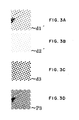
- Fig. 3 explains that a visible halftone dot image d1' (Fig. 3A) is generated by image arithmetic processing of the partial enlarged view d1 of the halftone dot image P1 and the partial enlarged view m of the image mask, and an invisible halftone dot image d2' (Fig. 3B) is generated by image arithmetic processing of the partial enlarged view d2 of the halftone dot image P2 and the partial enlarged view m of the image mask.
- Image arithmetic processing of the invisible halftone dot image d2' and the partial enlarged view m of the image mask is also executed to generate a halftone dot image d3 to multiply the three color solid images of cyan (C), magenta (M), and yellow (Y) inks around the invisible halftone dot image d2'.
- the inks that can be used in the present invention are not limited to cyan (C), magenta (M), and yellow (Y).
- C cyan
- M magenta
- Y yellow
- a combination of three colors including two colors having a complementary color relationship and black (Bk) which has an isochromatic relationship to the two colors and contains an infrared absorptive dye can also be implemented.
- the first halftone region 1 having m ⁇ m pixels shown in Fig. 1 is laid out by double tones of two colors having a complementary color relationship and containing no infrared absorptive dye.
- the second halftone region 3 having n ⁇ n pixels printing is performed by using only black (Bk) ink which has an isochromatic relationship to the two colors having a complementary color relationship and contains an infrared absorptive dye.
- Bk black
- the halftone region 2 around the second halftone region is laid out by solid images of two colors having a complementary color relationship and containing no infrared absorptive dye, which are the same inks as in the first halftone region 1.
- a printed product thus obtained by this embodiment has the structure of a partial enlarged view P3 shown in Fig. 3D.
- the landscape P1 of a mountain is recognized, though it is difficult to recognize that the landscape P2 of a river is hidden.
- this printed product is observed as an infrared photo, the halftone image of the landscape P2 of the river can be recognized as a latent image.
- An identification card is produced as the second embodiment.
- a general halftone dot image which does not use the halftone dot structure of the present invention is laid out by cyan (C), magenta (M), and yellow (Y).
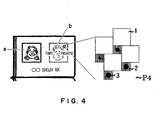
- a portion b shown in Fig. 4 is halftone-processed by a method based on the postscript halftone dot generation method by using the halftone dot structure of the present invention. No visible image is laid out in a first halftone region 1 having m ⁇ m pixels. An invisible image is laid out in a second halftone region 3 having n ⁇ n pixels by using only black (Bk) ink containing an infrared absorptive dye.
- a portion 2 around the invisible image is constituted by three color solid images of cyan (C), magenta (M), and yellow (Y) containing no infrared absorptive dye so that the second halftone region having n ⁇ n pixels has a black-color-based isochromatic solid image layout.
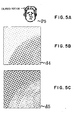
- Fig. 5 explains the halftone dot layout state of each color plate in the second halftone regions 2 and 3 having n ⁇ n pixels on the portion b shown in Fig. 4.
- a black-based uniform tint state is obtained.
- an invisible image P5 (Fig. 5A) cannot visually be recognized.
- on-demand printing can be interpreted in various ways. It sometimes indicates short-run color printing, a service for continuously executing processes up to bookbinding and providing books just in time, or a service for outputting books one by one.
- page variable printing takes the best advantage of uniqueness of the on-demand printing. This means to print different contents (information), i.e., "variable data” and quickly and properly provides character or image information specialized to an individual or company through a "paper medium”.
- Invisible images according to this embodiment are uniformly laid out on the same planes as those of face images c of individuals in Fig. 6.
- a variable printed product with four plates P6-1 to P6-4 is obtained by an on-demand printer.
- Personal names are also simultaneously variable-printed. In this embodiment, the personal names are added as visible information.
- production of an identification card is applied to on-demand printing by the method of the second embodiment.
- a general halftone dot image which does not use the halftone dot structure of the present invention is halftone-arranged by cyan (C), magenta (M), yellow (Y), and black (Bk) inks.
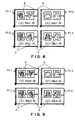
- Each portion e shown in Fig. 8 is halftone-processed by a method based on the postscript halftone dot generation method by using the halftone dot structure of the present invention.
- the portion e has a black-based uniform tint state. Hence, the invisible image cannot visually be recognized.
- Invisible images P7-1 to P7-4 are variable-printed in four plates by an on-demand printer. Personal names are also simultaneously variable-printed. In this embodiment, the personal names are added as visible information.
- the invisible images P7-1 to P7-4 shown in Fig. 9 are variable-printed by the four plates.
- each personal name and company name are also displayed on the infrared monitor.
- the black (Bk) component of the face image in each portion d in Fig. 9 is also displayed. Whether these portions are to be made visible or invisible can freely be arranged as a design, and the present invention is not limited to the second to fourth embodiments.
- a continuous-tone image is printed by using halftone dots that can hardly be copied by a general plate making device and can be read by a machine, thereby preventing any forgery or alteration of a printed product.
- one continuous-tone image can be printed in a predetermined region.
- two continuous-tone images which do not overlap each other are equally laid out in a predetermined region without fusing the halftone dots.
- security printing by four color printing using cyan (C), magenta (M), yellow (Y), and black (Bk), which is widely used in a general market, can be implemented at a low cost.
- individual information such as a character, symbol, pattern, or grayscale image can be printed as an invisible image on each page of printed products which require an anti-forgery and anti-alteration functions, including valuable printed product.
Landscapes
- Business, Economics & Management (AREA)
- Accounting & Taxation (AREA)
- Finance (AREA)
- Printing Methods (AREA)
- Credit Cards Or The Like (AREA)
- Inspection Of Paper Currency And Valuable Securities (AREA)
Abstract
Description
- 1 A first halftone region having m × m pixels, which is formed by at least one color ink containing no infrared absorptive dye and in which an embedded image which can visually be recognized is laid out by using halftone dots or no image is laid out by using halftone dots.
- 2 A portion in a second halftone region having n × n pixels, which is formed by three color solid images containing no infrared absorptive dye, which are prepared by three primary colors cyan (C), magenta (M), and yellow (Y).
- 3 A portion in the second halftone region having n × n pixels, in which an embedded image such as a character or an image formed by black (Bk) ink containing an infrared absorptive dye is laid out by using halftone dots.
- a A general halftone dot image which does not use the halftone dot structure according to the present invention.
- b A special halftone dot image which uses the halftone dot structure according to the present invention.
- c A portion where the face image and name of an individual, which
are laid out by a special halftone dot image using the halftone dots
according to the present invention by the method of
claim 1, are variable-printed by an on-demand printer. The portion explains an appearance change from a visible image to an invisible image. - d A portion where a general halftone dot image which does not use the halftone dot structure according to the present invention is laid out. The portion explains that the appearance does not change in the face image portion.
- e A portion where the face image and name of an individual, which
are laid out by a special halftone dot image using the halftone dots
according to the present invention by the method of
claim 2, are variable-printed by an on-demand printer. The portion explains an appearance change from a visible image to an invisible image.
- d1 A partial enlarged view of the halftone dots of a landscape image of a mountain, which is halftone-processed by a method based on the postscript halftone dot generation method.
- d1' A partial enlarged view of the halftone dots of a landscape image of a mountain, which is generated by using d1 and an image mask m. The halftone dots are used as halftone dots for a visible image.
- d2 A partial enlarged view of the halftone dots of a landscape image of a river, which is halftone-processed by a method based on the postscript halftone dot generation method.
- d2' A partial enlarged view of the halftone dots of a landscape image of a river, which is generated by using d2 and the image mask m. The halftone dots are used as halftone dots for an invisible image.
- d3 A partial enlarged view of halftone dots around the landscape image of the river, which is generated by using d2' and the image mask m. The halftone dots are used to hide the halftone dots for the invisible image.
- d4 A partial enlarged view of halftone dots of an invisible image of an identification card. The halftone dots are printed by black (Bk) ink containing an infrared absorptive dye.
- d5 A partial enlarged view of a portion around the halftone dots of the invisible image of the identification card. The portion is printed by a black-color-based three solid images formed by three primary colors of cyan (C), magenta (M), and yellow (Y).
- P1 A landscape image of a mountain, which is used as a visible image.
- P2 A landscape image of a river, which is used as an invisible image.
- P3 An enlarged view of a printed product in which visible and invisible images are uniformly laid out on the same plane.
- P4 An identification card in which visible and invisible images are uniformly laid out on the same plane.
- P5 A face image of an identification card, which is used as an invisible image.
- P6-1 - P6-4 An identification card variable-printed by an on-demand printer by using the method of the first embodiment.
- P7-1 - P7-4 An identification card variable-printed by an on-demand printer by using the method of the second embodiment.
Claims (6)
- A halftone dot printed product characterized in that
a first halftone region having m × m pixels (m ≧ 2, m is an integer) and a second halftone region having n × n pixels (1 ≦ n < m, n is an integer), where halftone dots to express a continuous-tone image are printed, are laid out,
a plurality of first halftone regions having m × m pixels in independent regions are laid out without gaps around one second halftone region having n × n pixels,
a plurality of second halftone regions having n × n pixels in independent regions are laid out along an outer periphery of one first halftone region having m × m pixels at an equal interval,
an embedded image formed by at least one color ink containing no infrared absorptive dye is laid out by using halftone dots in the first halftone region having m × m pixels,
an invisible image formed from one of a character and a face image is laid out in the second halftone region having n × n pixels by using halftone dots using black (Bk) ink containing an infrared absorptive dye,
a portion around the invisible image region is formed by black-based ink of three primary colors containing no infrared absorptive dye, which are prepared by the three primary color inks of cyan (C), magenta (M), and yellow (Y), to form the two kinds of second halftone regions in which an image of at least one color, in which the invisible image is embedded, is laid out, and
the halftone dots to express the continuous-tone image are printed by using the first halftone region and the two kinds of second halftone regions. - A halftone dot printed product characterized in that
a first halftone region having m × m pixels (m ≧ 2, m is an integer) and a second halftone region having n × n pixels (1 ≦ n < m, n is an integer), where halftone dots to express a continuous-tone image are printed, are laid out,
the first halftone region having m × m pixels is not printed, and an invisible image formed from one of a character and a face image is laid out in the second halftone region having n × n pixels by using halftone dots using black (Bk) ink containing an infrared absorptive dye,
a portion around the invisible image region is formed by black-based ink of three primary colors containing no infrared absorptive dye, which are prepared by the three primary color inks of cyan (C), magenta (M), and yellow (Y), to form the two kinds of second halftone regions in which a monochrome achromatic image in which the invisible image is embedded is laid out, and
the halftone dots to invisibly express one continuous-tone image are printed as the monochrome achromatic invisible image by using the two kinds of second halftone regions. - A halftone dot printed product according to claim 1 or 2, characterized in that the halftone dots to express the continuous-tone image, which are printed in the two kinds of second halftone regions, are printed on a printed product which requires anti-forgery and anti-alteration functions as individual information by using a total of four color inks of black (Bk) ink containing the infrared absorptive dye and the cyan (C), magenta (M), and yellow (Y) inks containing no infrared absorptive dye so as to print different pieces of individual information at least on each page.
- A halftone dot printed product printing method characterized in that
a first halftone region having m × m pixels (m ≧ 2, m is an integer) and a second halftone region having n × n pixels (1 ≦ n < m, n is an integer), where halftone dots to express a continuous-tone image are printed, are laid out,
a plurality of first halftone regions having m × m pixels in independent regions are laid out without gaps around one second halftone region having n × n pixels,
a plurality of second halftone regions having n × n pixels in independent regions are laid out along an outer periphery of one first halftone region having m × m pixels at an equal interval,
an embedded image formed by at least one color ink containing no infrared absorptive dye is laid out by using halftone dots in the first halftone region having m × m pixels,
an invisible image formed from one of a character and a face image is laid out in the second halftone region having n × n pixels by using halftone dots using black (Bk) ink containing an infrared absorptive dye,
a portion around the invisible image region is formed by black-based ink of three primary colors containing no infrared absorptive dye, which are prepared by the three primary color inks of cyan (C), magenta (M), and yellow (Y), to form the two kinds of second halftone regions in which an image of at least one color, in which the invisible image is embedded, is laid out, and
printing is performed by using a plate arrangement using the first halftone region and the two kinds of second halftone regions. - A method for printing a halftone dot printed product characterized in that
a first halftone region having m × m pixels (m ≧ 2, m is an integer) and a second halftone region having n × n pixels (1 ≦ n < m, n is an integer), where halftone dots to express a continuous-tone image are printed, are laid out,
the first halftone region having m × m pixels is not printed,
an invisible image formed from one of a character and a face image is laid out in the second halftone region having n × n pixels by using halftone dots using black (Bk) ink containing an infrared absorptive dye,
a portion around the invisible image region is formed by black-based ink of three primary colors containing no infrared absorptive dye, which are prepared by the three primary color inks of cyan (C), magenta (M), and yellow (Y), to form the two kinds of second halftone regions in which a monochrome achromatic image in which the invisible image is embedded is laid out, and
printing is performed by using a plate arrangement which expresses the halftone dots to invisibly express one continuous-tone image by using the two kinds of second halftone regions as an invisible image by a monochrome achromatic color. - A method for printing a halftone dot printed product according to claim 4 or 5, characterized in that the halftone dots to express the continuous-tone image, which are printed in the two kinds of second halftone regions, are printed on a printed product which requires anti-forgery and anti-alteration functions as individual information by using a total of four color inks of black (Bk) ink containing the infrared absorptive dye and the cyan (C), magenta (M), and yellow (Y) inks containing no infrared absorptive dye so as to print different pieces of individual information at least on each page.
Applications Claiming Priority (3)
| Application Number | Priority Date | Filing Date | Title |
|---|---|---|---|
| JP2001331891A JP3544536B2 (en) | 2001-10-30 | 2001-10-30 | Halftone printed matter and printing method thereof |
| JP2001331891 | 2001-10-30 | ||
| PCT/JP2002/011258 WO2003037643A1 (en) | 2001-10-30 | 2002-10-30 | Network point printed matter and printing method |
Publications (3)
| Publication Number | Publication Date |
|---|---|
| EP1449674A1 true EP1449674A1 (en) | 2004-08-25 |
| EP1449674A4 EP1449674A4 (en) | 2006-08-02 |
| EP1449674B1 EP1449674B1 (en) | 2012-06-27 |
Family
ID=19147391
Family Applications (1)
| Application Number | Title | Priority Date | Filing Date |
|---|---|---|---|
| EP02775414A Expired - Lifetime EP1449674B1 (en) | 2001-10-30 | 2002-10-30 | Network point printed matter and printing method |
Country Status (5)
| Country | Link |
|---|---|
| US (1) | US7298528B2 (en) |
| EP (1) | EP1449674B1 (en) |
| JP (1) | JP3544536B2 (en) |
| KR (1) | KR100609031B1 (en) |
| WO (1) | WO2003037643A1 (en) |
Cited By (6)
| Publication number | Priority date | Publication date | Assignee | Title |
|---|---|---|---|---|
| EP1585303A3 (en) * | 2004-03-29 | 2009-01-21 | Hitachi, Ltd. | Print management system |
| US7505179B2 (en) | 2004-08-11 | 2009-03-17 | Fuji Xerox Co., Ltd. | Print controlling apparatus, method, and storage medium for generating print image data of a particular color space representing a print object document in the form of a plurality of color components |
| EP2165844A3 (en) * | 2008-09-22 | 2011-12-28 | Vilko Ziljak | Infrared printing with process printing inks |
| EP2786877A1 (en) * | 2013-04-01 | 2014-10-08 | Kabushiki Kaisha Toshiba | Printed matter, printed matter inspection device, manufacturing method of printed matter, and manufacturing device of printed matter |
| DE102015114665A1 (en) * | 2015-09-02 | 2017-03-02 | Bundesdruckerei Gmbh | grid |
| DE102023112927A1 (en) * | 2023-05-16 | 2024-11-21 | Bundesdruckerei Gmbh | Printing plate combination and method for its production, security printing and method for its production, identification, value or security document with such a security print and method for verifying the security print |
Families Citing this family (35)
| Publication number | Priority date | Publication date | Assignee | Title |
|---|---|---|---|---|
| JP4622230B2 (en) * | 2003-10-22 | 2011-02-02 | 富士ゼロックス株式会社 | Image processing apparatus, printed material manufacturing method, and program |
| JP4608867B2 (en) * | 2003-10-22 | 2011-01-12 | 富士ゼロックス株式会社 | Image processing device |
| JP4118872B2 (en) * | 2004-12-06 | 2008-07-16 | シャープ株式会社 | Management device, print processing system, management device control method, management device control program, and recording medium on which management device control program is recorded |
| KR100645442B1 (en) * | 2005-07-25 | 2006-11-14 | 삼성전자주식회사 | Color halftone screen design method and device therefor |
| US8007578B2 (en) * | 2005-10-07 | 2011-08-30 | Hewlett-Packard Development Company, L.P. | Pigmented ink having infrared absorption and low visible color |
| JP4649612B2 (en) * | 2005-11-25 | 2011-03-16 | 独立行政法人 国立印刷局 | Authentic printed material |
| JP2007323139A (en) * | 2006-05-30 | 2007-12-13 | National Printing Bureau | Certificate issuing system |
| JP4706574B2 (en) | 2006-06-30 | 2011-06-22 | 富士ゼロックス株式会社 | Printing system and program |
| JP4844891B2 (en) * | 2006-11-20 | 2011-12-28 | 独立行政法人 国立印刷局 | Image display |
| JP5062553B2 (en) * | 2007-03-14 | 2012-10-31 | 独立行政法人 国立印刷局 | Halftone print |
| JP4512789B2 (en) * | 2007-04-23 | 2010-07-28 | 独立行政法人 国立印刷局 | Anti-counterfeit printed matter |
| JP5142143B2 (en) * | 2008-02-28 | 2013-02-13 | 独立行政法人 国立印刷局 | How to create a halftone print |
| JP4958117B2 (en) * | 2008-06-23 | 2012-06-20 | 独立行政法人 国立印刷局 | Halftone data production apparatus and production program |
| JP5239034B2 (en) * | 2008-07-16 | 2013-07-17 | 独立行政法人 国立印刷局 | Automatic certificate generation system |
| US8985634B2 (en) | 2008-09-16 | 2015-03-24 | National Printing Bureau, Incorporated Administrative Agency | Anti-counterfeit printed matter, method of manufacturing the same, and recording medium storing halftone dot data creation software |
| JP5190624B2 (en) * | 2009-03-25 | 2013-04-24 | 独立行政法人 国立印刷局 | Printed material having latent image |
| JP5732693B2 (en) * | 2009-12-08 | 2015-06-10 | 独立行政法人 国立印刷局 | Method for producing halftone dot printed matter and recording medium storing software for producing halftone dot printed matter |
| JP5533484B2 (en) * | 2010-09-17 | 2014-06-25 | 独立行政法人 国立印刷局 | Printed material having latent image |
| JP5715386B2 (en) | 2010-11-19 | 2015-05-07 | キヤノン株式会社 | Image processing apparatus, control method therefor, program, and storage medium |
| JP5715385B2 (en) | 2010-11-19 | 2015-05-07 | キヤノン株式会社 | Information generating apparatus, information generating method, image processing apparatus, and image processing method |
| JP5662768B2 (en) | 2010-11-19 | 2015-02-04 | キヤノン株式会社 | Image processing apparatus and image processing method |
| JP5691631B2 (en) * | 2011-02-24 | 2015-04-01 | 株式会社大林組 | Image composition method |
| JP5921120B2 (en) | 2011-09-07 | 2016-05-24 | キヤノン株式会社 | Information processing apparatus and information processing method |
| JP5835708B2 (en) * | 2012-03-01 | 2015-12-24 | 独立行政法人 国立印刷局 | Image display |
| JP6403014B2 (en) * | 2015-07-01 | 2018-10-10 | 独立行政法人 国立印刷局 | Authentic printed material |
| CN112130776B (en) * | 2019-06-25 | 2024-09-20 | 株式会社理光 | Image processing apparatus, printing system, recording medium, and latent image embedding method |
| CN110376104B (en) * | 2019-08-13 | 2024-10-11 | 广州幸泽服装辅料有限公司 | Textile fabric thermal transfer printing bleeding test paper and manufacturing method thereof |
| KR102350081B1 (en) * | 2020-02-06 | 2022-01-12 | 주식회사 광인사 | the improved security printing structure using color mixing |
| JP6739089B1 (en) * | 2020-03-10 | 2020-08-12 | 光村印刷株式会社 | Anti-counterfeit printed matter and method of manufacturing anti-counterfeit printed matter |
| JP7494599B2 (en) | 2020-06-25 | 2024-06-04 | 株式会社リコー | Image forming apparatus and image forming method |
| JP7541679B2 (en) * | 2021-02-12 | 2024-08-29 | 独立行政法人 国立印刷局 | Anti-counterfeiting printed matter, method for creating data for anti-counterfeiting printed matter, and software for creating the same |
| JP7599653B2 (en) | 2021-03-23 | 2024-12-16 | 独立行政法人 国立印刷局 | Method and software for creating data for latent image prints |
| JP7164855B1 (en) | 2021-10-20 | 2022-11-02 | 独立行政法人 国立印刷局 | anti-counterfeit printed matter |
| KR102848847B1 (en) | 2022-05-02 | 2025-08-22 | 대한민국 | Apparatus for printer identification using halftone characteristics of counterfeit banknotes and method thereof |
| KR102789722B1 (en) | 2024-07-26 | 2025-03-31 | 정천 | Special massing adjustment printing method and massing adjustment printing system thereof |
Family Cites Families (7)
| Publication number | Priority date | Publication date | Assignee | Title |
|---|---|---|---|---|
| JPH01128877A (en) | 1987-11-16 | 1989-05-22 | Toppan Printing Co Ltd | information recording medium |
| US5259907A (en) * | 1990-03-29 | 1993-11-09 | Technical Systems Corp. | Method of making coded playing cards having machine-readable coding |
| GB9323352D0 (en) | 1993-11-12 | 1994-01-05 | De La Rue Thomas & Co Ltd | Security documents and the like device |
| DE19611383A1 (en) | 1996-03-22 | 1997-09-25 | Giesecke & Devrient Gmbh | Data carrier with optically variable element |
| US6441921B1 (en) * | 1997-10-28 | 2002-08-27 | Eastman Kodak Company | System and method for imprinting and reading a sound message on a greeting card |
| JP3478474B2 (en) | 1998-03-23 | 2003-12-15 | 独立行政法人 国立印刷局 | Halftone screen making method and printed matter |
| JP4336807B2 (en) * | 2000-01-26 | 2009-09-30 | 独立行政法人 国立印刷局 | Printed halftone dot and printing method thereof |
-
2001
- 2001-10-30 JP JP2001331891A patent/JP3544536B2/en not_active Expired - Lifetime
-
2002
- 2002-10-30 WO PCT/JP2002/011258 patent/WO2003037643A1/en not_active Ceased
- 2002-10-30 EP EP02775414A patent/EP1449674B1/en not_active Expired - Lifetime
- 2002-10-30 KR KR1020047005969A patent/KR100609031B1/en not_active Expired - Fee Related
- 2002-10-30 US US10/494,203 patent/US7298528B2/en not_active Expired - Fee Related
Cited By (8)
| Publication number | Priority date | Publication date | Assignee | Title |
|---|---|---|---|---|
| EP1585303A3 (en) * | 2004-03-29 | 2009-01-21 | Hitachi, Ltd. | Print management system |
| US7505179B2 (en) | 2004-08-11 | 2009-03-17 | Fuji Xerox Co., Ltd. | Print controlling apparatus, method, and storage medium for generating print image data of a particular color space representing a print object document in the form of a plurality of color components |
| EP2165844A3 (en) * | 2008-09-22 | 2011-12-28 | Vilko Ziljak | Infrared printing with process printing inks |
| EP2786877A1 (en) * | 2013-04-01 | 2014-10-08 | Kabushiki Kaisha Toshiba | Printed matter, printed matter inspection device, manufacturing method of printed matter, and manufacturing device of printed matter |
| US9509883B2 (en) | 2013-04-01 | 2016-11-29 | Kabushiki Kaisha Toshiba | Printed matter, printed matter inspection device, manufacturing method of printed matter, and manufacturing device of printed matter |
| DE102015114665A1 (en) * | 2015-09-02 | 2017-03-02 | Bundesdruckerei Gmbh | grid |
| DE102015114665B4 (en) * | 2015-09-02 | 2021-01-28 | Bundesdruckerei Gmbh | Grid |
| DE102023112927A1 (en) * | 2023-05-16 | 2024-11-21 | Bundesdruckerei Gmbh | Printing plate combination and method for its production, security printing and method for its production, identification, value or security document with such a security print and method for verifying the security print |
Also Published As
| Publication number | Publication date |
|---|---|
| WO2003037643A1 (en) | 2003-05-08 |
| EP1449674A4 (en) | 2006-08-02 |
| KR100609031B1 (en) | 2006-08-09 |
| JP2003136828A (en) | 2003-05-14 |
| US20040255808A1 (en) | 2004-12-23 |
| KR20050042001A (en) | 2005-05-04 |
| EP1449674B1 (en) | 2012-06-27 |
| US7298528B2 (en) | 2007-11-20 |
| JP3544536B2 (en) | 2004-07-21 |
Similar Documents
| Publication | Publication Date | Title |
|---|---|---|
| US7298528B2 (en) | Network point printed matter and printing method | |
| JP4915883B2 (en) | Printed matter for preventing forgery, method for producing the same, and recording medium storing software for producing halftone data | |
| EP2079227A1 (en) | UV Encryption via intelligent halftoning | |
| JPH06258982A (en) | System for electronic printing of plurality of color-indelible documents | |
| JP4512789B2 (en) | Anti-counterfeit printed matter | |
| JP6991514B2 (en) | How to create anti-counterfeit printed matter and anti-counterfeit printed matter data | |
| JP5799425B2 (en) | Printed material capable of authenticating authenticity, manufacturing apparatus and manufacturing method thereof, authentication apparatus for printed matter capable of authenticating authenticity and authentication method thereof | |
| JP6888769B2 (en) | How to create data for special latent image pattern structure and special latent image pattern structure | |
| JP4352168B2 (en) | Halftone image data authentication program, halftone print authentication system, and halftone image data authentication system | |
| JP4214262B2 (en) | Printed halftone dot, its production method and printing method | |
| JP2008265190A (en) | Anti-counterfeit printed matter | |
| US7512248B2 (en) | Method of incorporating a secondary image into a primary image | |
| JP7284950B2 (en) | LATENT IMAGE PRINTED MATERIAL READING DEVICE, READING METHOD AND SOFTWARE FOR READING | |
| JP5990791B2 (en) | Anti-counterfeit printed matter | |
| JPH11268229A (en) | Halftone screen making method and its printed matter | |
| JP6976525B2 (en) | How to create data for special latent image pattern forming body and special latent image pattern forming body | |
| JP7599653B2 (en) | Method and software for creating data for latent image prints | |
| CA2618052A1 (en) | Covert document system | |
| JP7024979B1 (en) | How to create data for anti-counterfeit printed matter and anti-counterfeit printed matter and its creation device | |
| JP4997531B2 (en) | Printed matter with continuous tone pattern | |
| CN113269289A (en) | Method for generating multispectral composite anti-counterfeiting image and printed matter | |
| JP2024053283A (en) | Anti-counterfeiting printed matter, method for creating data for anti-counterfeiting printed matter, and software for creating the same | |
| JP2024017568A (en) | Latent image printed matter and its production method |
Legal Events
| Date | Code | Title | Description |
|---|---|---|---|
| PUAI | Public reference made under article 153(3) epc to a published international application that has entered the european phase |
Free format text: ORIGINAL CODE: 0009012 |
|
| 17P | Request for examination filed |
Effective date: 20040429 |
|
| AK | Designated contracting states |
Kind code of ref document: A1 Designated state(s): AT BE BG CH CY CZ DE DK EE ES FI FR GB GR IE IT LI LU MC NL PT SE SK TR |
|
| AX | Request for extension of the european patent |
Extension state: AL LT LV MK RO SI |
|
| A4 | Supplementary search report drawn up and despatched |
Effective date: 20060703 |
|
| 17Q | First examination report despatched |
Effective date: 20061115 |
|
| GRAP | Despatch of communication of intention to grant a patent |
Free format text: ORIGINAL CODE: EPIDOSNIGR1 |
|
| GRAS | Grant fee paid |
Free format text: ORIGINAL CODE: EPIDOSNIGR3 |
|
| GRAA | (expected) grant |
Free format text: ORIGINAL CODE: 0009210 |
|
| AK | Designated contracting states |
Kind code of ref document: B1 Designated state(s): AT BE BG CH CY CZ DE DK EE ES FI FR GB GR IE IT LI LU MC NL PT SE SK TR |
|
| REG | Reference to a national code |
Ref country code: GB Ref legal event code: FG4D |
|
| REG | Reference to a national code |
Ref country code: CH Ref legal event code: EP |
|
| REG | Reference to a national code |
Ref country code: AT Ref legal event code: REF Ref document number: 563941 Country of ref document: AT Kind code of ref document: T Effective date: 20120715 |
|
| REG | Reference to a national code |
Ref country code: IE Ref legal event code: FG4D |
|
| REG | Reference to a national code |
Ref country code: DE Ref legal event code: R096 Ref document number: 60243224 Country of ref document: DE Effective date: 20120823 |
|
| REG | Reference to a national code |
Ref country code: CH Ref legal event code: NV Representative=s name: SCHNEIDER FELDMANN AG PATENT- UND MARKENANWAELTE |
|
| PG25 | Lapsed in a contracting state [announced via postgrant information from national office to epo] |
Ref country code: SE Free format text: LAPSE BECAUSE OF FAILURE TO SUBMIT A TRANSLATION OF THE DESCRIPTION OR TO PAY THE FEE WITHIN THE PRESCRIBED TIME-LIMIT Effective date: 20120627 Ref country code: FI Free format text: LAPSE BECAUSE OF FAILURE TO SUBMIT A TRANSLATION OF THE DESCRIPTION OR TO PAY THE FEE WITHIN THE PRESCRIBED TIME-LIMIT Effective date: 20120627 |
|
| REG | Reference to a national code |
Ref country code: NL Ref legal event code: T3 |
|
| REG | Reference to a national code |
Ref country code: AT Ref legal event code: MK05 Ref document number: 563941 Country of ref document: AT Kind code of ref document: T Effective date: 20120627 |
|
| PG25 | Lapsed in a contracting state [announced via postgrant information from national office to epo] |
Ref country code: GR Free format text: LAPSE BECAUSE OF FAILURE TO SUBMIT A TRANSLATION OF THE DESCRIPTION OR TO PAY THE FEE WITHIN THE PRESCRIBED TIME-LIMIT Effective date: 20120928 |
|
| PG25 | Lapsed in a contracting state [announced via postgrant information from national office to epo] |
Ref country code: AT Free format text: LAPSE BECAUSE OF FAILURE TO SUBMIT A TRANSLATION OF THE DESCRIPTION OR TO PAY THE FEE WITHIN THE PRESCRIBED TIME-LIMIT Effective date: 20120627 Ref country code: CZ Free format text: LAPSE BECAUSE OF FAILURE TO SUBMIT A TRANSLATION OF THE DESCRIPTION OR TO PAY THE FEE WITHIN THE PRESCRIBED TIME-LIMIT Effective date: 20120627 Ref country code: CY Free format text: LAPSE BECAUSE OF FAILURE TO SUBMIT A TRANSLATION OF THE DESCRIPTION OR TO PAY THE FEE WITHIN THE PRESCRIBED TIME-LIMIT Effective date: 20120627 Ref country code: EE Free format text: LAPSE BECAUSE OF FAILURE TO SUBMIT A TRANSLATION OF THE DESCRIPTION OR TO PAY THE FEE WITHIN THE PRESCRIBED TIME-LIMIT Effective date: 20120627 Ref country code: SK Free format text: LAPSE BECAUSE OF FAILURE TO SUBMIT A TRANSLATION OF THE DESCRIPTION OR TO PAY THE FEE WITHIN THE PRESCRIBED TIME-LIMIT Effective date: 20120627 |
|
| PG25 | Lapsed in a contracting state [announced via postgrant information from national office to epo] |
Ref country code: IT Free format text: LAPSE BECAUSE OF FAILURE TO SUBMIT A TRANSLATION OF THE DESCRIPTION OR TO PAY THE FEE WITHIN THE PRESCRIBED TIME-LIMIT Effective date: 20120627 Ref country code: PT Free format text: LAPSE BECAUSE OF FAILURE TO SUBMIT A TRANSLATION OF THE DESCRIPTION OR TO PAY THE FEE WITHIN THE PRESCRIBED TIME-LIMIT Effective date: 20121029 |
|
| PG25 | Lapsed in a contracting state [announced via postgrant information from national office to epo] |
Ref country code: ES Free format text: LAPSE BECAUSE OF FAILURE TO SUBMIT A TRANSLATION OF THE DESCRIPTION OR TO PAY THE FEE WITHIN THE PRESCRIBED TIME-LIMIT Effective date: 20121008 Ref country code: DK Free format text: LAPSE BECAUSE OF FAILURE TO SUBMIT A TRANSLATION OF THE DESCRIPTION OR TO PAY THE FEE WITHIN THE PRESCRIBED TIME-LIMIT Effective date: 20120627 |
|
| PLBE | No opposition filed within time limit |
Free format text: ORIGINAL CODE: 0009261 |
|
| STAA | Information on the status of an ep patent application or granted ep patent |
Free format text: STATUS: NO OPPOSITION FILED WITHIN TIME LIMIT |
|
| PG25 | Lapsed in a contracting state [announced via postgrant information from national office to epo] |
Ref country code: MC Free format text: LAPSE BECAUSE OF NON-PAYMENT OF DUE FEES Effective date: 20121031 |
|
| 26N | No opposition filed |
Effective date: 20130328 |
|
| REG | Reference to a national code |
Ref country code: DE Ref legal event code: R097 Ref document number: 60243224 Country of ref document: DE Effective date: 20130328 |
|
| PG25 | Lapsed in a contracting state [announced via postgrant information from national office to epo] |
Ref country code: BG Free format text: LAPSE BECAUSE OF FAILURE TO SUBMIT A TRANSLATION OF THE DESCRIPTION OR TO PAY THE FEE WITHIN THE PRESCRIBED TIME-LIMIT Effective date: 20120927 |
|
| REG | Reference to a national code |
Ref country code: IE Ref legal event code: MM4A |
|
| PG25 | Lapsed in a contracting state [announced via postgrant information from national office to epo] |
Ref country code: IE Free format text: LAPSE BECAUSE OF NON-PAYMENT OF DUE FEES Effective date: 20121030 |
|
| PG25 | Lapsed in a contracting state [announced via postgrant information from national office to epo] |
Ref country code: TR Free format text: LAPSE BECAUSE OF FAILURE TO SUBMIT A TRANSLATION OF THE DESCRIPTION OR TO PAY THE FEE WITHIN THE PRESCRIBED TIME-LIMIT Effective date: 20120627 |
|
| PG25 | Lapsed in a contracting state [announced via postgrant information from national office to epo] |
Ref country code: LU Free format text: LAPSE BECAUSE OF NON-PAYMENT OF DUE FEES Effective date: 20121030 |
|
| REG | Reference to a national code |
Ref country code: CH Ref legal event code: PCOW Free format text: NEW ADDRESS: 2-5, TORANOMON 2-CHOME, MINATO-KU, TOKYO 105-8445 (JP) |
|
| REG | Reference to a national code |
Ref country code: FR Ref legal event code: CA Effective date: 20150126 |
|
| REG | Reference to a national code |
Ref country code: FR Ref legal event code: PLFP Year of fee payment: 14 |
|
| REG | Reference to a national code |
Ref country code: FR Ref legal event code: PLFP Year of fee payment: 15 |
|
| REG | Reference to a national code |
Ref country code: FR Ref legal event code: PLFP Year of fee payment: 16 |
|
| PGFP | Annual fee paid to national office [announced via postgrant information from national office to epo] |
Ref country code: DE Payment date: 20171019 Year of fee payment: 16 Ref country code: FR Payment date: 20171024 Year of fee payment: 16 |
|
| PGFP | Annual fee paid to national office [announced via postgrant information from national office to epo] |
Ref country code: CH Payment date: 20171019 Year of fee payment: 16 Ref country code: BE Payment date: 20171019 Year of fee payment: 16 Ref country code: NL Payment date: 20171019 Year of fee payment: 16 Ref country code: GB Payment date: 20171019 Year of fee payment: 16 |
|
| REG | Reference to a national code |
Ref country code: DE Ref legal event code: R119 Ref document number: 60243224 Country of ref document: DE |
|
| REG | Reference to a national code |
Ref country code: CH Ref legal event code: PL |
|
| REG | Reference to a national code |
Ref country code: NL Ref legal event code: MM Effective date: 20181101 |
|
| GBPC | Gb: european patent ceased through non-payment of renewal fee |
Effective date: 20181030 |
|
| REG | Reference to a national code |
Ref country code: BE Ref legal event code: MM Effective date: 20181031 |
|
| PG25 | Lapsed in a contracting state [announced via postgrant information from national office to epo] |
Ref country code: NL Free format text: LAPSE BECAUSE OF NON-PAYMENT OF DUE FEES Effective date: 20181101 Ref country code: DE Free format text: LAPSE BECAUSE OF NON-PAYMENT OF DUE FEES Effective date: 20190501 |
|
| PG25 | Lapsed in a contracting state [announced via postgrant information from national office to epo] |
Ref country code: LI Free format text: LAPSE BECAUSE OF NON-PAYMENT OF DUE FEES Effective date: 20181031 Ref country code: BE Free format text: LAPSE BECAUSE OF NON-PAYMENT OF DUE FEES Effective date: 20181031 Ref country code: FR Free format text: LAPSE BECAUSE OF NON-PAYMENT OF DUE FEES Effective date: 20181031 Ref country code: CH Free format text: LAPSE BECAUSE OF NON-PAYMENT OF DUE FEES Effective date: 20181031 |
|
| PG25 | Lapsed in a contracting state [announced via postgrant information from national office to epo] |
Ref country code: GB Free format text: LAPSE BECAUSE OF NON-PAYMENT OF DUE FEES Effective date: 20181030 |