EP1449609A1 - Electric discharge machining electrode - Google Patents
Electric discharge machining electrode Download PDFInfo
- Publication number
- EP1449609A1 EP1449609A1 EP04003745A EP04003745A EP1449609A1 EP 1449609 A1 EP1449609 A1 EP 1449609A1 EP 04003745 A EP04003745 A EP 04003745A EP 04003745 A EP04003745 A EP 04003745A EP 1449609 A1 EP1449609 A1 EP 1449609A1
- Authority
- EP
- European Patent Office
- Prior art keywords
- electric discharge
- electrode
- work
- discharge machining
- generation rate
- Prior art date
- Legal status (The legal status is an assumption and is not a legal conclusion. Google has not performed a legal analysis and makes no representation as to the accuracy of the status listed.)
- Granted
Links
- 238000003754 machining Methods 0.000 title claims abstract description 71
- 239000000463 material Substances 0.000 claims abstract description 18
- 230000002285 radioactive effect Effects 0.000 claims abstract description 18
- 229910052751 metal Inorganic materials 0.000 claims abstract description 15
- 239000002184 metal Substances 0.000 claims abstract description 15
- GUTLYIVDDKVIGB-UHFFFAOYSA-N cobalt atom Chemical compound [Co] GUTLYIVDDKVIGB-UHFFFAOYSA-N 0.000 claims description 15
- 229910017052 cobalt Inorganic materials 0.000 claims description 12
- 239000010941 cobalt Substances 0.000 claims description 12
- 239000000203 mixture Substances 0.000 claims description 5
- 238000005245 sintering Methods 0.000 claims description 5
- 239000000843 powder Substances 0.000 claims description 4
- WFKWXMTUELFFGS-UHFFFAOYSA-N tungsten Chemical compound [W] WFKWXMTUELFFGS-UHFFFAOYSA-N 0.000 claims description 4
- 229910052721 tungsten Inorganic materials 0.000 claims description 4
- 239000010937 tungsten Substances 0.000 claims description 4
- 239000007788 liquid Substances 0.000 abstract description 13
- 238000009877 rendering Methods 0.000 abstract description 5
- 230000005592 electrolytic dissociation Effects 0.000 abstract description 3
- XLYOFNOQVPJJNP-UHFFFAOYSA-N water Substances O XLYOFNOQVPJJNP-UHFFFAOYSA-N 0.000 abstract description 3
- 230000007423 decrease Effects 0.000 description 4
- 235000014443 Pyrus communis Nutrition 0.000 description 3
- 230000000694 effects Effects 0.000 description 3
- 238000000034 method Methods 0.000 description 3
- 238000010276 construction Methods 0.000 description 2
- 238000010586 diagram Methods 0.000 description 2
- 238000013459 approach Methods 0.000 description 1
- 230000002238 attenuated effect Effects 0.000 description 1
- 230000005250 beta ray Effects 0.000 description 1
- 150000001868 cobalt Chemical class 0.000 description 1
- 238000009413 insulation Methods 0.000 description 1
- 230000001678 irradiating effect Effects 0.000 description 1
- 238000005259 measurement Methods 0.000 description 1
- 230000000630 rising effect Effects 0.000 description 1
- 239000000126 substance Substances 0.000 description 1
Images


Classifications
-
- B—PERFORMING OPERATIONS; TRANSPORTING
- B23—MACHINE TOOLS; METAL-WORKING NOT OTHERWISE PROVIDED FOR
- B23H—WORKING OF METAL BY THE ACTION OF A HIGH CONCENTRATION OF ELECTRIC CURRENT ON A WORKPIECE USING AN ELECTRODE WHICH TAKES THE PLACE OF A TOOL; SUCH WORKING COMBINED WITH OTHER FORMS OF WORKING OF METAL
- B23H1/00—Electrical discharge machining, i.e. removing metal with a series of rapidly recurring electrical discharges between an electrode and a workpiece in the presence of a fluid dielectric
- B23H1/04—Electrodes specially adapted therefor or their manufacture
-
- B—PERFORMING OPERATIONS; TRANSPORTING
- B23—MACHINE TOOLS; METAL-WORKING NOT OTHERWISE PROVIDED FOR
- B23H—WORKING OF METAL BY THE ACTION OF A HIGH CONCENTRATION OF ELECTRIC CURRENT ON A WORKPIECE USING AN ELECTRODE WHICH TAKES THE PLACE OF A TOOL; SUCH WORKING COMBINED WITH OTHER FORMS OF WORKING OF METAL
- B23H1/00—Electrical discharge machining, i.e. removing metal with a series of rapidly recurring electrical discharges between an electrode and a workpiece in the presence of a fluid dielectric
- B23H1/04—Electrodes specially adapted therefor or their manufacture
- B23H1/06—Electrode material
Definitions
- This invention relates to an electric discharge machining electrode suitable as an electrode used for an electric discharge machine, an engraving electric discharge machine, a wire electric discharge machine, a micro electric discharge machine, a generating electric discharge machine and the like which are adapted to subject a work to an electric discharge machining process by generating electric discharge pulses between the work and such an electrode disposed with a space kept between the work and the electrode, and an electric discharge machining apparatus; and more particularly to an electric discharge machining electrode capable of improving the quality of a finished surface of the work by heightening a machining speed by improving an electric discharge generation rate ⁇ even in a fine machining process and even when the conditions including a time width and a voltage of the electric discharge pulses applied to the electric discharge machining electrode are the same, and by rendering it possible to maintain the electric discharge generation rate ⁇ even when a time width and an applied voltage of each pulse are reduced, and an electric discharge machine.
- the present invention is preferably used for a micro electric discharge machining process.
- a time width (which will hereinafter be referred to simply as a pulse width) of pulses of a voltage (which will hereinafter be referred to as a gap voltage) applied to a position between a work and an electric discharge machining electrode
- a finished surface of the work becomes similar to the skin of a pear, i.e., the quality of a finished product lowers. Therefore, the pulse width is set small in accordance with the highness of demanded quality of a finished product.
- the causes of such a failure in generation of electric discharge resides in that correspondingly much time is needed to electrolytically dissociate an interelectrode substance existing between a work and an electric discharge electrode therefrom, i.e. a so-called processing liquid, such as pure water and oil therefrom.
- the (Number of Applied Pulses) is the number of applied pulses of a gap voltage
- the (Number of Generation of Electric Discharge) the number of the electric discharge pulses generated when the voltage pulses are applied to a position between a work and an electrode. Accordingly, in a case where electric discharge pulses occur at all times when the pulses of a gap voltage are applied to a position between a work and an electrode, the electric discharge generation rate ⁇ in the above equation becomes 100%.
- the present invention has been made with a view to solving these problems encountered in the related techniques of this kind, and aims at providing an electric discharge machining electrode capable of improving the quality of a finished surface of a work by heightening a machining speed by improving an electric discharge generation rate ⁇ even in a fine machining process and even when the conditions including a time width and a voltage of the electric discharge pulses applied to the electric discharge machining electrode are the same, and by rendering it possible to maintain the electric discharge generation rate ⁇ even when a time width and an applied voltage of each pulse are reduced, and an electric discharge machining apparatus.
- the present invention solved these problems by providing an electric discharge machining electrode, used as an electrode for the machining of a surface of a work carried out by generating electric discharge pulses between the work and the electrode disposed with a space kept from the work, wherein a radioactive metal is contained at least in the portion of the electrode in which the electric discharge occurs, or in the portion thereof which is in the vicinity of the mentioned portion.
- the above-mentioned problems are solved by forming the electrode out of a superhard material obtained by sintering a mixture containing at least fine powder of tungsten and cobalt, turning the superhard material into such a radioactive metal as mentioned above, by irradiating the superhard material with neutrons and thereby substituting radioactive cobalt atoms for the mentioned cobalt atoms, and using the radioactive metal as a negative pole.
- the electric discharge machining electrode according to the present invention is different from a related art electric discharge machining electrode of a superhard material only in that the former electrode has radioactivity, and the other characteristics of the former electrode can be set identical with those of the latter electrode.
- the mechanical characteristics, such as rigidity as well as electric characteristics of the electrode according to the present invention can be set identical with those a related art electrode, which has actual past results, for an electric discharge machining process, so that the reliability of the electrode according to the present invention during the use thereof for the electric discharge machining of a work can be secured easily.
- a radioactive metal is contained at least in the portion thereof in which electric discharge pulses occur, or in the portion thereof which is in the vicinity of the mentioned portion.
- the radiant rays emitted by the radioactive metal contained in the electrode exert influence upon the materials existing between a work and electric discharge machining electrode, which are usually, a so-called processing liquid, such as pure water and oil, and work so as to promote the electrolytic dissociation of these materials therefrom.
- This electrode is formed so as to induce electric discharge used for the machining of a work with the operation of the radiant rays utilized as so to speak a trigger.
- the radiant rays in use are beta rays formed of electrons.
- the electric discharge comes to occur easily between the work and electric discharge machining electrode.
- the electrode-opposed area of the work is small, the demanded quality of a processed product is high. Therefore, even when it is necessary to reduce the pulse width or gap voltage to a low level, the electric discharge generation rate ⁇ can be improved.
- the improving of the quality of a finished surface of a work can be done by improving an electric discharge generation rate ⁇ even in a fine machining process and even when the conditions including a time width and a voltage of the electric discharge pulses applied to the electrode for an electric discharge machining process are the same, and thereby improving a machining rate, and by rendering it possible to maintain the electric discharge generation rate ⁇ even when the time width of the pulses and applied voltage are reduced.
- the portion of the electric discharge machining electrode in which a radioactive metal is contained may be a portion as long as the portion can induce the electric discharge by the radiant rays emitted by the radioactive metal as mentioned above, and the present invention does not specially limit such a portion of the electrode to the mentioned portion.
- the matter also depends upon the intensity of the radioactivity of the radioactive metal.
- the portion of the electrode in which the radioactive metal is contained may not be the whole of the electrode.
- the portion of an electrode in which a radioactive metal is to be contained is preferably at least a portion in which electric discharge pulses occur.
- Fig. 1 is a block diagram showing the construction of an electric discharge machine in a mode of embodiment to which the present invention is applied.
- a work 3 has on an upper side thereof a surface 4 to be machined.
- An electric discharge machining electrode 1 has a pin-like shape, and is 0.3 mm in thickness ⁇ and around 10 mm in length.
- the electric discharge machining electrode 1 was made of a superhard material obtained by sintering a mixture containing fine powder of tungsten and cobalt. This superhard material is different from a common superhard material.
- the superhard material is irradiated with neutrons as will be described later, and the cobalt is turned into radioactive 60Co.
- the dimensions of the work 3 are comparatively small as compared with those of the above-mentioned electric discharge machining electrode 1.
- This mode of embodiment also includes as an object thereof machining a work by using electric discharge pulses generated in the air without using a processing liquid. In this case, the effect ascribed to the applying of the present invention can also be obtained.
- a pulse generator 10 constitutes a power source unit for giving a pulse type gap voltage Vg of a predetermined pulse width to the work 3 and electric discharge machining electrode 1.
- the gap voltage Vg is applied to the work and electrode in such a manner as will be described later by using, for example, Fig. 4.
- a power source terminal E+ on a positive side of the pulse generator 10 is connected to a portion of the work shown by a reference numeral 34, via a cable 32.
- a power source terminal E- on a negative side is connected to a brush 24 via a cable 28.
- the brush 24 is pressed down by a spring 26 against a holder 22, which is fixed to an insulating spindle 20, in such a manner that a current-supplied condition is maintained.
- the holder 22 is in a conductive state with respect to the electrode 1 for an electric discharge machining process fixed to the holder 22. Accordingly, the power source terminal E - and electrode 1 are also in a mutually conductive state.
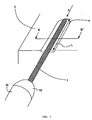
- Fig. 2 is an enlarged view of a portion enclosed with one-dot chain lines in Fig. 1.
- the electric discharge machining electrode 1 is shown by rightwardly lowering diagonal lines.
- the portion of this electrode 1 in which electric discharge pulses can be generated is the portion of a length L measured from a free end thereof as shown in the drawing.
- Fig. 3 is a sectional view taken along the line III-III' in Fig. 2 which includes an electric discharge machining electrode 1, and viewed in the direction of an arrow A in the same drawing.
- the electrode 1 for an electric discharge machining process is shown by rightwardly lowering diagonal lines, and the work 3 by rightwardly rising diagonal lines.
- the electric discharge machining electrode 1 keeps a clearance as an electric discharge gap Gp with respect to the surface 4 to be machined of the work 3.
- the electric discharge gap Gp is about 1 ⁇ m. In this gap Gp, a machining liquid made to drop by the dropping unit 40 as mentioned above is permeated.
- the material of the electrode 1 for an electric discharge process is a superhard material obtained by sintering a mixture containing at least fine powder of tungsten and cobalt.
- the cobalt is 59Co existing in the natural world, and does not have a radioactivity.
- the cobalt When the cobalt is turned from 59Co into 60Co, the cobalt comes to emit the following radiant rays.
- beta rays of 0.3 MeV are emitted.
- the beta rays are used in this mode of embodiment.
- the beta rays are currents of electrons. Therefore, when the electric discharge machining of a work is done with a material containing this cobalt 60Co used as an electric discharge machining electrode which forms a negative pole, electrons are sent out therefrom without receiving the influence of the work function of the electrode 1 and work 3 and the processing liquid 5 interposed between the electrode 1 and work 3.
- An electric discharge machining electrode 1 the intensity of radioactivity of which has been ascertained as mentioned above is fixed to a holder 22, and the resultant holder 22 is secured to an insulating spindle 20 as shown in Fig. 1 and Fig. 2.
- a pulse type gap voltage Vg is applied to a position between the electrode 1 and work 3 as a processing liquid 5 is dropped suitably therebetween from a dropping unit 40, to generate electric discharge pulse.
- each emitted electron has energy accelerated at 300,000 V, and the electrons can pass through a processing liquid 5 over a distance of several micronmeters certainly even when the processing liquid has insulation characteristics, so that the electrons can pass certainly through the electric discharge gap Gp shown in Fig.3.
- the beta rays cause the electrolytic dissociation of the processing liquid, so that the electric current is easily induced in the processing liquid. As a result, the electric discharge generation rate ⁇ is increased. The same applies to a case where a work is machined by generating electric discharge pulses in the air without using the processing liquid 5.
- Fig. 4 is a time chart of the gap voltage Vg in this mode of embodiment.
- a gap voltage Vg of about 100 V as shown in Fig. 4 is applied from the pulse generator 10 to a position between the work 3 and electrode 1.
- the pulse width tw is 10 nano-seconds.
- the intensity of radioactivity is 100 M bequerel as mentioned above, one electron on an average comes to be emitted during a period of time of 10 nano-seconds. Accordingly, it comes to be possible that an electric discharge pulse occurs reliably even when the pulse width is as very short as 10 nano-seconds.
- the electric discharge generation rate ⁇ can be maintained 100% even when a gap voltage Vg of about 100V has a very small pulse width of 10 nano-seconds, or even when a work 3 is small and cannot take a large electrode-opposed area. Therefore, a finely machined surface made of a sub-specular surface of a high appearance quality can be obtained without causing a machining rate to decrease.
- the present invention can be applied thereto effectively, and an excellent effect can be obtained.
- the half life of the cobalt 60Co is five years. Therefore, when the cobalt 60Co is stored for around twenty years, the radioactivity thereof is attenuated to around 1/16. Accordingly, the disposal of a used electric discharge machining electrode 1 can be carried out comparatively easily.
- the quality of a finished surface of a work can be improved by improving an electric discharge generation rate ⁇ even in a fine machining operation and even when the conditions including a time width and a voltage of the electric discharge pulses applied to the electric discharge machining electrode are the same, and thereby improving a machining speed, and by rendering it possible to maintain the electric discharge generation rate ⁇ even when the time width of the pulses and applied voltage are reduced.
- the present invention is preferable for a micro electric discharge machining process.
Landscapes
- Engineering & Computer Science (AREA)
- Manufacturing & Machinery (AREA)
- Mechanical Engineering (AREA)
- Electrical Discharge Machining, Electrochemical Machining, And Combined Machining (AREA)
Abstract
Description
- This invention relates to an electric discharge machining electrode suitable as an electrode used for an electric discharge machine, an engraving electric discharge machine, a wire electric discharge machine, a micro electric discharge machine, a generating electric discharge machine and the like which are adapted to subject a work to an electric discharge machining process by generating electric discharge pulses between the work and such an electrode disposed with a space kept between the work and the electrode, and an electric discharge machining apparatus; and more particularly to an electric discharge machining electrode capable of improving the quality of a finished surface of the work by heightening a machining speed by improving an electric discharge generation rate η even in a fine machining process and even when the conditions including a time width and a voltage of the electric discharge pulses applied to the electric discharge machining electrode are the same, and by rendering it possible to maintain the electric discharge generation rate η even when a time width and an applied voltage of each pulse are reduced, and an electric discharge machine. The present invention is preferably used for a micro electric discharge machining process.
- When in an electric discharge machining process a time width (which will hereinafter be referred to simply as a pulse width) of pulses of a voltage (which will hereinafter be referred to as a gap voltage) applied to a position between a work and an electric discharge machining electrode is large, a finished surface of the work becomes similar to the skin of a pear, i.e., the quality of a finished product lowers. Therefore, the pulse width is set small in accordance with the highness of demanded quality of a finished product.
- However, when the pulse width is set small, a phenomenon of a failure in generation of electric discharge comes to occur frequently notwithstanding that a voltage pulse is applied to a position between a work and an electrode. Especially, when a work is small, i.e., when an electrode-opposed area of a work is small, and when a gap voltage is low, such a phenomenon occurs noticeably.
- The causes of such a failure in generation of electric discharge resides in that correspondingly much time is needed to electrolytically dissociate an interelectrode substance existing between a work and an electric discharge electrode therefrom, i.e. a so-called processing liquid, such as pure water and oil therefrom.
- The electric discharge generation rate η will be defined as follows.
- In the above equation, the (Number of Applied Pulses) is the number of applied pulses of a gap voltage, and the (Number of Generation of Electric Discharge) the number of the electric discharge pulses generated when the voltage pulses are applied to a position between a work and an electrode. Accordingly, in a case where electric discharge pulses occur at all times when the pulses of a gap voltage are applied to a position between a work and an electrode, the electric discharge generation rate η in the above equation becomes 100%.
- A rough, practical example will now be shown. When a gap voltage and a pulse width of the applied voltage are 100V and 10 nano-seconds respectively, an electric discharge generation rate η is only around 1% at the highest. However, when the pulse width is 10 micro-seconds with the gap voltage at the same level, the electric discharge generation rate η becomes limitlessly close to 100%. It is true that, when the pulse width is 10 nano-seconds, a processed surface made of a sub-specular surface close to a specular surface is obtained but, when the pulse width is 10 micro-seconds, a processed surface becomes similar to the skin of a pear and extremely rough.
- It has been ascertained that, even when the pulse width is set small, the electric discharge generation rate η can be improved when the gap voltage is heightened. However, when the gap voltage is heightened, a processed surface becomes similar to the skin of a pear, and the quality of a finished product lowers.
- When a work has a certain degree of sizes, the area thereof opposed to an electric discharge machining electrode becomes wide, so that the electric discharge generation rate η becomes high as compared with that in a case where a work has a small area opposed to an electric discharge machining electrode. It is generally said that, when the area of a work which is opposed to such an electrode is up to 0.2 mm x 50 mm, the electric discharge generation rate η is improved in proportion to an exponent of the area. Such relation between the electric discharge generation rate η and the area of a work opposed to an electric discharge machining electrode is called an area effect in an idiomatic phrase in this world of industry.
- However, since the fine electric discharge machining of a work of a small area of 5 µm x 5 µm to 25 µm x 100 µm is also much in demand, it is necessary that an electric discharge generation rate η concerning a work of such an area does not decrease either.
- In view of the above, when a finely machined finished product of a high quality having a sub-specular surface is demanded, it is unavoidable that an electric discharge generation rate η decreases. This necessarily causes a machining rate to decrease.
- The present invention has been made with a view to solving these problems encountered in the related techniques of this kind, and aims at providing an electric discharge machining electrode capable of improving the quality of a finished surface of a work by heightening a machining speed by improving an electric discharge generation rate η even in a fine machining process and even when the conditions including a time width and a voltage of the electric discharge pulses applied to the electric discharge machining electrode are the same, and by rendering it possible to maintain the electric discharge generation rate η even when a time width and an applied voltage of each pulse are reduced, and an electric discharge machining apparatus.
- The present invention solved these problems by providing an electric discharge machining electrode, used as an electrode for the machining of a surface of a work carried out by generating electric discharge pulses between the work and the electrode disposed with a space kept from the work, wherein a radioactive metal is contained at least in the portion of the electrode in which the electric discharge occurs, or in the portion thereof which is in the vicinity of the mentioned portion.
- In this electric discharge machining electrode, the above-mentioned problems are solved by forming the electrode out of a superhard material obtained by sintering a mixture containing at least fine powder of tungsten and cobalt, turning the superhard material into such a radioactive metal as mentioned above, by irradiating the superhard material with neutrons and thereby substituting radioactive cobalt atoms for the mentioned cobalt atoms, and using the radioactive metal as a negative pole. The electric discharge machining electrode according to the present invention is different from a related art electric discharge machining electrode of a superhard material only in that the former electrode has radioactivity, and the other characteristics of the former electrode can be set identical with those of the latter electrode. Therefore, the mechanical characteristics, such as rigidity as well as electric characteristics of the electrode according to the present invention can be set identical with those a related art electrode, which has actual past results, for an electric discharge machining process, so that the reliability of the electrode according to the present invention during the use thereof for the electric discharge machining of a work can be secured easily.
- Also, the above-mentioned problems were so lved by providing an electric discharge machining apparatus the features of which reside in that the apparatus is provided with such an electric discharge machining electrode that was described above.
- The operation of the present invention will now be simply described.
- In the electric discharge machining electrode according to the present invention, a radioactive metal is contained at least in the portion thereof in which electric discharge pulses occur, or in the portion thereof which is in the vicinity of the mentioned portion. The radiant rays emitted by the radioactive metal contained in the electrode exert influence upon the materials existing between a work and electric discharge machining electrode, which are usually, a so-called processing liquid, such as pure water and oil, and work so as to promote the electrolytic dissociation of these materials therefrom. This electrode is formed so as to induce electric discharge used for the machining of a work with the operation of the radiant rays utilized as so to speak a trigger. The radiant rays in use are beta rays formed of electrons.
- Accordingly, the electric discharge comes to occur easily between the work and electric discharge machining electrode. As mentioned above, when the electrode-opposed area of the work is small, the demanded quality of a processed product is high. Therefore, even when it is necessary to reduce the pulse width or gap voltage to a low level, the electric discharge generation rate η can be improved.
- According to the present invention described above, the improving of the quality of a finished surface of a work can be done by improving an electric discharge generation rate η even in a fine machining process and even when the conditions including a time width and a voltage of the electric discharge pulses applied to the electrode for an electric discharge machining process are the same, and thereby improving a machining rate, and by rendering it possible to maintain the electric discharge generation rate η even when the time width of the pulses and applied voltage are reduced.
- The portion of the electric discharge machining electrode in which a radioactive metal is contained may be a portion as long as the portion can induce the electric discharge by the radiant rays emitted by the radioactive metal as mentioned above, and the present invention does not specially limit such a portion of the electrode to the mentioned portion. The matter also depends upon the intensity of the radioactivity of the radioactive metal. The portion of the electrode in which the radioactive metal is contained may not be the whole of the electrode. In a general electric discharge machining process, the portion of an electrode in which a radioactive metal is to be contained is preferably at least a portion in which electric discharge pulses occur.
- A preferred embodiment of the present invention will now be described with reference to the accompanying drawings, wherein:
- Fig. 1 is a block diagram showing the construction of a principal portion of an electric discharge machine in a mode of embodiment to which the present invention is applied;
- Fig. 2 is an enlarged view of the portion of Fig. 1 which is enclosed with one-dot chain lines;
- Fig. 3 is a sectional view taken along the line III-III' in Fig. 2, which includes the electric discharge machining electrode, and viewed in the direction of an arrow A in the same drawing; and
- Fig. 4 is a time chart of a gap voltage Vg in the mode of embodiment referred to above.
-
- Fig. 1 is a block diagram showing the construction of an electric discharge machine in a mode of embodiment to which the present invention is applied.
- In this mode of embodiment, a
work 3 has on an upper side thereof a surface 4 to be machined. An electricdischarge machining electrode 1 has a pin-like shape, and is 0.3 mm in thickness and around 10 mm in length. The electricdischarge machining electrode 1 was made of a superhard material obtained by sintering a mixture containing fine powder of tungsten and cobalt. This superhard material is different from a common superhard material. In this mode of embodiment, the superhard material is irradiated with neutrons as will be described later, and the cobalt is turned into radioactive 60Co. As is clear from Fig. 1, the dimensions of thework 3 are comparatively small as compared with those of the above-mentioned electricdischarge machining electrode 1. - Between an outer cylindrical circumferential surface of the electric
discharge machining electrode 1 and a surface 4 to be machined, electric discharge pulses used for the machining of the surface 4 occur. From a droppingunit 40, a so-called processing liquid shown by areference numeral 5 is dropped. This mode of embodiment also includes as an object thereof machining a work by using electric discharge pulses generated in the air without using a processing liquid. In this case, the effect ascribed to the applying of the present invention can also be obtained. - A
pulse generator 10 constitutes a power source unit for giving a pulse type gap voltage Vg of a predetermined pulse width to thework 3 and electricdischarge machining electrode 1. The gap voltage Vg is applied to the work and electrode in such a manner as will be described later by using, for example, Fig. 4. - Therefore, a power source terminal E+ on a positive side of the
pulse generator 10 is connected to a portion of the work shown by areference numeral 34, via acable 32. A power source terminal E- on a negative side is connected to abrush 24 via acable 28. Thebrush 24 is pressed down by aspring 26 against aholder 22, which is fixed to an insulatingspindle 20, in such a manner that a current-supplied condition is maintained. Theholder 22 is in a conductive state with respect to theelectrode 1 for an electric discharge machining process fixed to theholder 22. Accordingly, the power source terminal E - andelectrode 1 are also in a mutually conductive state. - Fig. 2 is an enlarged view of a portion enclosed with one-dot chain lines in Fig. 1. In this Fig. 2, the electric
discharge machining electrode 1 is shown by rightwardly lowering diagonal lines. The portion of thiselectrode 1 in which electric discharge pulses can be generated is the portion of a length L measured from a free end thereof as shown in the drawing. - Fig. 3 is a sectional view taken along the line III-III' in Fig. 2 which includes an electric
discharge machining electrode 1, and viewed in the direction of an arrow A in the same drawing. - Referring to Fig. 3, the
electrode 1 for an electric discharge machining process is shown by rightwardly lowering diagonal lines, and thework 3 by rightwardly rising diagonal lines. As shown in the drawing, the electricdischarge machining electrode 1 keeps a clearance as an electric discharge gap Gp with respect to the surface 4 to be machined of thework 3. The electric discharge gap Gp is about 1 µm. In this gap Gp, a machining liquid made to drop by the droppingunit 40 as mentioned above is permeated. - The electric
discharge machining electrode 1, a part to which the present invention is mainly applied in this mode of embodiment will now be described. - The material of the
electrode 1 for an electric discharge process is a superhard material obtained by sintering a mixture containing at least fine powder of tungsten and cobalt. When the mixture is sintered, the cobalt is 59Co existing in the natural world, and does not have a radioactivity. - In this mode of embodiment, for example, several thousands pieces of
electrodes 1 for an electric discharge process are left together in a nuclear reactor after the sintering operation finishes. Neutrons are thereby applied to eachelectrode 1. When the cobalt is turned from 59Co into 60Co, theelectrodes 1 are taken out from the nuclear reactor. The intensity of the radioactivity is determined at this time to ascertain that the radioactivity is 100 M becquerel. Namely, it is ascertained by conducting a measurement operation that theelectrodes 1 come to be provided with sufficient radioactivity. - When the cobalt is turned from 59Co into 60Co, the cobalt comes to emit the following radiant rays.
- Firstly, beta rays of 0.3 MeV are emitted.
- Secondly, gamma rays of 1.1 MeV are emitted.
- Thirdly, gamma rays of 1.3 MeV are emitted.
- Among these radiant rays, the beta rays are used in this mode of embodiment. The beta rays are currents of electrons. Therefore, when the electric discharge machining of a work is done with a material containing this cobalt 60Co used as an electric discharge machining electrode which forms a negative pole, electrons are sent out therefrom without receiving the influence of the work function of the
electrode 1 andwork 3 and theprocessing liquid 5 interposed between theelectrode 1 andwork 3. - An electric
discharge machining electrode 1 the intensity of radioactivity of which has been ascertained as mentioned above is fixed to aholder 22, and theresultant holder 22 is secured to an insulatingspindle 20 as shown in Fig. 1 and Fig. 2. A pulse type gap voltage Vg is applied to a position between theelectrode 1 andwork 3 as aprocessing liquid 5 is dropped suitably therebetween from a droppingunit 40, to generate electric discharge pulse. - When the intensity of radioactivity in this embodiment is 100 M bequerel as mentioned above, 100 M pieces of electrons occurs per second in the
electrode 1 as a whole. The energy of these emitted electrons is 0.3 MeV. Namely, each emitted electron has energy accelerated at 300,000 V, and the electrons can pass through aprocessing liquid 5 over a distance of several micronmeters certainly even when the processing liquid has insulation characteristics, so that the electrons can pass certainly through the electric discharge gap Gp shown in Fig.3. The beta rays cause the electrolytic dissociation of the processing liquid, so that the electric current is easily induced in the processing liquid. As a result, the electric discharge generation rate η is increased. The same applies to a case where a work is machined by generating electric discharge pulses in the air without using theprocessing liquid 5. - Fig. 4 is a time chart of the gap voltage Vg in this mode of embodiment.
- In this mode of embodiment, a gap voltage Vg of about 100 V as shown in Fig. 4 is applied from the
pulse generator 10 to a position between thework 3 andelectrode 1. The pulse width tw is 10 nano-seconds. When the intensity of radioactivity is 100 M bequerel
as mentioned above, one electron on an average comes to be emitted during a period of time of 10 nano-seconds. Accordingly, it comes to be possible that an electric discharge pulse occurs reliably even when the pulse width is as very short as 10 nano-seconds. - In short, electric discharge is excited every time one beta ray occurs to cause one electron to be emitted. Consequently, the electric discharge frequency increases greatly, and the electric discharge generation rate η approaches limitlessly to 100%.
- In this mode of embodiment described above, the electric discharge generation rate η can be maintained 100% even when a gap voltage Vg of about 100V has a very small pulse width of 10 nano-seconds, or even when a
work 3 is small and cannot take a large electrode-opposed area. Therefore, a finely machined surface made of a sub-specular surface of a high appearance quality can be obtained without causing a machining rate to decrease. Thus, in this mode of embodiment, the present invention can be applied thereto effectively, and an excellent effect can be obtained. - The half life of the cobalt 60Co is five years. Therefore, when the cobalt 60Co is stored for around twenty years, the radioactivity thereof is attenuated to around 1/16. Accordingly, the disposal of a used electric
discharge machining electrode 1 can be carried out comparatively easily. - According to the present invention, the quality of a finished surface of a work can be improved by improving an electric discharge generation rate η even in a fine machining operation and even when the conditions including a time width and a voltage of the electric discharge pulses applied to the electric discharge machining electrode are the same, and thereby improving a machining speed, and by rendering it possible to maintain the electric discharge generation rate η even when the time width of the pulses and applied voltage are reduced. Especially, the present invention is preferable for a micro electric discharge machining process.
Claims (3)
- An electric discharge machining electrode used for machining an object surface of a work by generating electric discharge pulses between the work and the electrode disposed with a clearance kept with respect to the work,
the electrode comprising a radioactive metal contained at least in the part of a portion thereof in which the electric discharge pulses occur, or in the part thereof which is in the vicinity of the mentioned portion thereof. - An electric discharge machining electrode according to Claim 1, wherein:the material for the electrode is a superhard material obtained by sintering a mixture containing at least fine powder of tungsten and cobalt,neutrons being applied to the superhard material, radioactive cobalt atoms being thereby substituted for the cobalt atoms to form the radioactive metal,the radioactive metal being used as a negative pole.
- An electric discharge machining apparatus comprising an electric discharge machining electrode according to Claim 1 or 2.
Applications Claiming Priority (2)
| Application Number | Priority Date | Filing Date | Title |
|---|---|---|---|
| JP2003046248A JP4040493B2 (en) | 2003-02-24 | 2003-02-24 | Electrode for electrical discharge machining |
| JP2003046248 | 2003-02-24 |
Publications (2)
| Publication Number | Publication Date |
|---|---|
| EP1449609A1 true EP1449609A1 (en) | 2004-08-25 |
| EP1449609B1 EP1449609B1 (en) | 2008-05-28 |
Family
ID=32733026
Family Applications (1)
| Application Number | Title | Priority Date | Filing Date |
|---|---|---|---|
| EP04003745A Expired - Lifetime EP1449609B1 (en) | 2003-02-24 | 2004-02-19 | Electric discharge machining electrode |
Country Status (5)
| Country | Link |
|---|---|
| US (1) | US6797911B2 (en) |
| EP (1) | EP1449609B1 (en) |
| JP (1) | JP4040493B2 (en) |
| CN (1) | CN100340367C (en) |
| DE (1) | DE602004014050D1 (en) |
Families Citing this family (3)
| Publication number | Priority date | Publication date | Assignee | Title |
|---|---|---|---|---|
| US9878386B2 (en) * | 2013-10-31 | 2018-01-30 | Foundation Of Soongsil University-Industry Cooperation | Eccentric electrode for electric discharge machining, method of manufacturing the same, and micro electric discharge machining apparatus including the same |
| CN104646774B (en) * | 2014-12-15 | 2016-11-16 | 哈尔滨工业大学 | A kind of export license real-time compensation method based on spark discharge rate |
| CN105618873B (en) * | 2016-03-15 | 2017-12-05 | 哈尔滨工业大学深圳研究生院 | A kind of soft electrode electric discharge machining apparatus |
Citations (2)
| Publication number | Priority date | Publication date | Assignee | Title |
|---|---|---|---|---|
| US3290124A (en) * | 1964-10-29 | 1966-12-06 | Rametco Inc | Porous electrical discharge machine electrodes |
| US4027134A (en) * | 1973-11-12 | 1977-05-31 | Tokyo Shibaura Electric Co., Ltd. | Electrode for electrical discharge machining |
Family Cites Families (5)
| Publication number | Priority date | Publication date | Assignee | Title |
|---|---|---|---|---|
| US3727489A (en) * | 1967-06-28 | 1973-04-17 | Ijr Inoue Japax Res Inc | Die-making process |
| JPS5558929A (en) * | 1978-10-18 | 1980-05-02 | Toshiba Corp | Manufacturing method of electrode material for electrical discharge machining |
| FR2654964B1 (en) * | 1989-11-27 | 1994-07-08 | Thermo Compact | METALLIC COATING FILIFORM ELECTRODE FOR EROSIVE SPARKING, AND METHOD FOR THE PRODUCTION THEREOF. |
| WO2001023641A1 (en) * | 1999-09-30 | 2001-04-05 | Mitsubishi Denki Kabushiki Kaisha | Electric discharge surface treating electrode and production method thereof and electric discharge surface treating method |
| JP3902421B2 (en) * | 2001-06-15 | 2007-04-04 | スズキ株式会社 | Aluminum alloy surface treatment electrode and method for producing the same |
-
2003
- 2003-02-24 JP JP2003046248A patent/JP4040493B2/en not_active Expired - Fee Related
-
2004
- 2004-02-18 US US10/779,800 patent/US6797911B2/en not_active Expired - Fee Related
- 2004-02-19 DE DE602004014050T patent/DE602004014050D1/en not_active Expired - Lifetime
- 2004-02-19 EP EP04003745A patent/EP1449609B1/en not_active Expired - Lifetime
- 2004-02-24 CN CNB2004100066077A patent/CN100340367C/en not_active Expired - Fee Related
Patent Citations (2)
| Publication number | Priority date | Publication date | Assignee | Title |
|---|---|---|---|---|
| US3290124A (en) * | 1964-10-29 | 1966-12-06 | Rametco Inc | Porous electrical discharge machine electrodes |
| US4027134A (en) * | 1973-11-12 | 1977-05-31 | Tokyo Shibaura Electric Co., Ltd. | Electrode for electrical discharge machining |
Also Published As
| Publication number | Publication date |
|---|---|
| CN100340367C (en) | 2007-10-03 |
| EP1449609B1 (en) | 2008-05-28 |
| CN1526503A (en) | 2004-09-08 |
| JP4040493B2 (en) | 2008-01-30 |
| US6797911B2 (en) | 2004-09-28 |
| US20040164054A1 (en) | 2004-08-26 |
| DE602004014050D1 (en) | 2008-07-10 |
| JP2004255477A (en) | 2004-09-16 |
Similar Documents
| Publication | Publication Date | Title |
|---|---|---|
| US4912731A (en) | Plasma focus apparatus with field distortion elements | |
| Boucique et al. | On the production and the decay of delayed molecular ultraviolet radiation in rare gas Townsend discharges | |
| Malik et al. | An experimental investigation on developed WECSM during micro slicing of e-glass fibre epoxy composite | |
| US4847463A (en) | Method for the electroerosive machining of electrically slightly or non-conductive workpieces, as well as electroerosion machine for performing the method | |
| Wong et al. | Vacuum spark as a reproducible x‐ray source | |
| DE112009005052T5 (en) | Method and device for protecting plasma chamber surfaces | |
| EP1449609B1 (en) | Electric discharge machining electrode | |
| Coteaţă et al. | Electrochemical discharge machining of small diameter holes | |
| Van Goor | Fast rise time X-ray pre-ionization source using a corona plasma cathode | |
| JP3132766B2 (en) | Method and apparatus for electrical discharge machining of hard metal objects | |
| Bartholomew et al. | Ignition of the high voltage discharge in hydrogen at low pressures | |
| Al-Assadi et al. | Langmuir probe studies of oxygen and chlorine discharges in a 13.56 MHz plasma reactor | |
| Bhattacharya | Measurement of Townsend ionization coefficients and the breakdown potentials for the Penning mixtures of Ne and Kr | |
| DE1265338B (en) | Gas discharge device with Penning discharge for generating and measuring high vacuum | |
| EP0421648A2 (en) | A surface discharge plasma cathode electron beam generating assembly | |
| EP2382891A1 (en) | Platinum microparticles production apparatus | |
| Dote et al. | Analysis of the negative characteristic of a cylindrical probe in a magnetic field | |
| Lu | Plasma motion and neutron emission in an 18-kJ plasma focus | |
| RU73579U1 (en) | PLASMA SOURCE OF PASSING RADIATION | |
| SU652698A1 (en) | Method of shaping high-voltage subnanosecond pulses | |
| CN102470468A (en) | Method for electrochemically machining workpieces | |
| Winograd et al. | Experimental Investigation of Electric Discharge Machining by Radioactive Tracers | |
| Khasa et al. | A study on MECD-machining during drilling of electrically non-conductive ceramic | |
| Steinberg et al. | A Low‐Current Low‐Energy‐Spread Duoplasmatron Ion Source | |
| Casey et al. | High‐power‐density electron‐beam‐sustained laser |
Legal Events
| Date | Code | Title | Description |
|---|---|---|---|
| PUAI | Public reference made under article 153(3) epc to a published international application that has entered the european phase |
Free format text: ORIGINAL CODE: 0009012 |
|
| AK | Designated contracting states |
Kind code of ref document: A1 Designated state(s): AT BE BG CH CY CZ DE DK EE ES FI FR GB GR HU IE IT LI LU MC NL PT RO SE SI SK TR |
|
| AX | Request for extension of the european patent |
Extension state: AL LT LV MK |
|
| 17P | Request for examination filed |
Effective date: 20041217 |
|
| AKX | Designation fees paid |
Designated state(s): DE FR GB IT |
|
| RBV | Designated contracting states (corrected) |
Designated state(s): DE FR GB IT |
|
| 17Q | First examination report despatched |
Effective date: 20070313 |
|
| GRAP | Despatch of communication of intention to grant a patent |
Free format text: ORIGINAL CODE: EPIDOSNIGR1 |
|
| GRAS | Grant fee paid |
Free format text: ORIGINAL CODE: EPIDOSNIGR3 |
|
| GRAA | (expected) grant |
Free format text: ORIGINAL CODE: 0009210 |
|
| AK | Designated contracting states |
Kind code of ref document: B1 Designated state(s): DE FR GB IT |
|
| REG | Reference to a national code |
Ref country code: GB Ref legal event code: FG4D |
|
| REF | Corresponds to: |
Ref document number: 602004014050 Country of ref document: DE Date of ref document: 20080710 Kind code of ref document: P |
|
| PLBE | No opposition filed within time limit |
Free format text: ORIGINAL CODE: 0009261 |
|
| STAA | Information on the status of an ep patent application or granted ep patent |
Free format text: STATUS: NO OPPOSITION FILED WITHIN TIME LIMIT |
|
| 26N | No opposition filed |
Effective date: 20090303 |
|
| PGFP | Annual fee paid to national office [announced via postgrant information from national office to epo] |
Ref country code: IT Payment date: 20110216 Year of fee payment: 8 Ref country code: FR Payment date: 20110218 Year of fee payment: 8 Ref country code: DE Payment date: 20110216 Year of fee payment: 8 |
|
| PGFP | Annual fee paid to national office [announced via postgrant information from national office to epo] |
Ref country code: GB Payment date: 20110216 Year of fee payment: 8 |
|
| GBPC | Gb: european patent ceased through non-payment of renewal fee |
Effective date: 20120219 |
|
| REG | Reference to a national code |
Ref country code: FR Ref legal event code: ST Effective date: 20121031 |
|
| PG25 | Lapsed in a contracting state [announced via postgrant information from national office to epo] |
Ref country code: IT Free format text: LAPSE BECAUSE OF NON-PAYMENT OF DUE FEES Effective date: 20120219 |
|
| REG | Reference to a national code |
Ref country code: DE Ref legal event code: R119 Ref document number: 602004014050 Country of ref document: DE Effective date: 20120901 |
|
| PG25 | Lapsed in a contracting state [announced via postgrant information from national office to epo] |
Ref country code: GB Free format text: LAPSE BECAUSE OF NON-PAYMENT OF DUE FEES Effective date: 20120219 Ref country code: FR Free format text: LAPSE BECAUSE OF NON-PAYMENT OF DUE FEES Effective date: 20120229 |
|
| PG25 | Lapsed in a contracting state [announced via postgrant information from national office to epo] |
Ref country code: DE Free format text: LAPSE BECAUSE OF NON-PAYMENT OF DUE FEES Effective date: 20120901 |