EP1449442A1 - Method for reducing viscosity of mechanically separated meats or ground meats - Google Patents
Method for reducing viscosity of mechanically separated meats or ground meats Download PDFInfo
- Publication number
- EP1449442A1 EP1449442A1 EP04250214A EP04250214A EP1449442A1 EP 1449442 A1 EP1449442 A1 EP 1449442A1 EP 04250214 A EP04250214 A EP 04250214A EP 04250214 A EP04250214 A EP 04250214A EP 1449442 A1 EP1449442 A1 EP 1449442A1
- Authority
- EP
- European Patent Office
- Prior art keywords
- meat
- mechanically separated
- ground
- pyrophosphate
- ground meat
- Prior art date
- Legal status (The legal status is an assumption and is not a legal conclusion. Google has not performed a legal analysis and makes no representation as to the accuracy of the status listed.)
- Withdrawn
Links
- 235000013372 meat Nutrition 0.000 title claims abstract description 113
- 238000000034 method Methods 0.000 title claims abstract description 25
- 235000020993 ground meat Nutrition 0.000 title claims description 42
- 235000011180 diphosphates Nutrition 0.000 claims abstract description 27
- 238000012545 processing Methods 0.000 claims abstract description 17
- 238000005086 pumping Methods 0.000 claims abstract description 17
- XPPKVPWEQAFLFU-UHFFFAOYSA-J diphosphate(4-) Chemical compound [O-]P([O-])(=O)OP([O-])([O-])=O XPPKVPWEQAFLFU-UHFFFAOYSA-J 0.000 claims abstract description 9
- 229910019142 PO4 Inorganic materials 0.000 claims description 36
- NBIIXXVUZAFLBC-UHFFFAOYSA-K phosphate Chemical compound [O-]P([O-])([O-])=O NBIIXXVUZAFLBC-UHFFFAOYSA-K 0.000 claims description 33
- 239000010452 phosphate Substances 0.000 claims description 33
- 229940048084 pyrophosphate Drugs 0.000 claims description 24
- 235000015278 beef Nutrition 0.000 claims description 13
- 239000000203 mixture Substances 0.000 claims description 9
- RYCLIXPGLDDLTM-UHFFFAOYSA-J tetrapotassium;phosphonato phosphate Chemical compound [K+].[K+].[K+].[K+].[O-]P([O-])(=O)OP([O-])([O-])=O RYCLIXPGLDDLTM-UHFFFAOYSA-J 0.000 claims description 9
- 244000144977 poultry Species 0.000 claims description 6
- 235000013594 poultry meat Nutrition 0.000 claims description 6
- 239000007788 liquid Substances 0.000 claims description 5
- 238000002156 mixing Methods 0.000 claims description 5
- FQENQNTWSFEDLI-UHFFFAOYSA-J sodium diphosphate Chemical group [Na+].[Na+].[Na+].[Na+].[O-]P([O-])(=O)OP([O-])([O-])=O FQENQNTWSFEDLI-UHFFFAOYSA-J 0.000 claims description 5
- 235000019832 sodium triphosphate Nutrition 0.000 claims description 5
- 235000019818 tetrasodium diphosphate Nutrition 0.000 claims description 5
- 239000001577 tetrasodium phosphonato phosphate Substances 0.000 claims description 5
- ZLMJMSJWJFRBEC-UHFFFAOYSA-N Potassium Chemical compound [K] ZLMJMSJWJFRBEC-UHFFFAOYSA-N 0.000 claims description 4
- 235000015277 pork Nutrition 0.000 claims description 4
- 239000011591 potassium Substances 0.000 claims description 4
- 229910052700 potassium Inorganic materials 0.000 claims description 4
- 229940048086 sodium pyrophosphate Drugs 0.000 claims description 3
- 229940005740 hexametaphosphate Drugs 0.000 claims description 2
- 235000007686 potassium Nutrition 0.000 claims description 2
- 235000019982 sodium hexametaphosphate Nutrition 0.000 claims description 2
- GCLGEJMYGQKIIW-UHFFFAOYSA-H sodium hexametaphosphate Chemical compound [Na]OP1(=O)OP(=O)(O[Na])OP(=O)(O[Na])OP(=O)(O[Na])OP(=O)(O[Na])OP(=O)(O[Na])O1 GCLGEJMYGQKIIW-UHFFFAOYSA-H 0.000 claims description 2
- UNXRWKVEANCORM-UHFFFAOYSA-I triphosphate(5-) Chemical compound [O-]P([O-])(=O)OP([O-])(=O)OP([O-])([O-])=O UNXRWKVEANCORM-UHFFFAOYSA-I 0.000 claims description 2
- 239000000843 powder Substances 0.000 claims 1
- 230000000694 effects Effects 0.000 abstract description 2
- 235000021317 phosphate Nutrition 0.000 description 35
- XPPKVPWEQAFLFU-UHFFFAOYSA-N diphosphoric acid Chemical compound OP(O)(=O)OP(O)(O)=O XPPKVPWEQAFLFU-UHFFFAOYSA-N 0.000 description 19
- XLYOFNOQVPJJNP-UHFFFAOYSA-N water Substances O XLYOFNOQVPJJNP-UHFFFAOYSA-N 0.000 description 16
- 238000007792 addition Methods 0.000 description 9
- 238000003860 storage Methods 0.000 description 8
- 239000004606 Fillers/Extenders Substances 0.000 description 4
- 241000287828 Gallus gallus Species 0.000 description 4
- 239000011230 binding agent Substances 0.000 description 4
- 210000000988 bone and bone Anatomy 0.000 description 4
- 238000006073 displacement reaction Methods 0.000 description 4
- 150000003013 phosphoric acid derivatives Chemical class 0.000 description 4
- 108010085238 Actins Proteins 0.000 description 3
- 102000007469 Actins Human genes 0.000 description 3
- 108060008487 Myosin Proteins 0.000 description 3
- 102000003505 Myosin Human genes 0.000 description 3
- 235000004348 Perilla frutescens Nutrition 0.000 description 3
- 244000124853 Perilla frutescens Species 0.000 description 3
- 229920000388 Polyphosphate Polymers 0.000 description 3
- 235000011194 food seasoning agent Nutrition 0.000 description 3
- 230000003647 oxidation Effects 0.000 description 3
- 238000007254 oxidation reaction Methods 0.000 description 3
- 230000002572 peristaltic effect Effects 0.000 description 3
- 239000001205 polyphosphate Substances 0.000 description 3
- 235000011176 polyphosphates Nutrition 0.000 description 3
- 230000009467 reduction Effects 0.000 description 3
- 241000894007 species Species 0.000 description 3
- 108010043137 Actomyosin Proteins 0.000 description 2
- JVTAAEKCZFNVCJ-UHFFFAOYSA-M Lactate Chemical compound CC(O)C([O-])=O JVTAAEKCZFNVCJ-UHFFFAOYSA-M 0.000 description 2
- WSMYVTOQOOLQHP-UHFFFAOYSA-N Malondialdehyde Chemical compound O=CCC=O WSMYVTOQOOLQHP-UHFFFAOYSA-N 0.000 description 2
- 239000007864 aqueous solution Substances 0.000 description 2
- 230000009286 beneficial effect Effects 0.000 description 2
- 239000012141 concentrate Substances 0.000 description 2
- 239000001177 diphosphate Substances 0.000 description 2
- 238000010494 dissociation reaction Methods 0.000 description 2
- 230000005593 dissociations Effects 0.000 description 2
- 238000002347 injection Methods 0.000 description 2
- 239000007924 injection Substances 0.000 description 2
- 238000012423 maintenance Methods 0.000 description 2
- 229940118019 malondialdehyde Drugs 0.000 description 2
- 238000012986 modification Methods 0.000 description 2
- 230000004048 modification Effects 0.000 description 2
- 210000003205 muscle Anatomy 0.000 description 2
- 239000002245 particle Substances 0.000 description 2
- 230000008569 process Effects 0.000 description 2
- 235000018102 proteins Nutrition 0.000 description 2
- 108090000623 proteins and genes Proteins 0.000 description 2
- 102000004169 proteins and genes Human genes 0.000 description 2
- 229910001220 stainless steel Inorganic materials 0.000 description 2
- 239000010935 stainless steel Substances 0.000 description 2
- RVBUGGBMJDPOST-UHFFFAOYSA-N 2-thiobarbituric acid Chemical compound O=C1CC(=O)NC(=S)N1 RVBUGGBMJDPOST-UHFFFAOYSA-N 0.000 description 1
- OYPRJOBELJOOCE-UHFFFAOYSA-N Calcium Chemical compound [Ca] OYPRJOBELJOOCE-UHFFFAOYSA-N 0.000 description 1
- 239000004278 EU approved seasoning Substances 0.000 description 1
- DGAQECJNVWCQMB-PUAWFVPOSA-M Ilexoside XXIX Chemical compound C[C@@H]1CC[C@@]2(CC[C@@]3(C(=CC[C@H]4[C@]3(CC[C@@H]5[C@@]4(CC[C@@H](C5(C)C)OS(=O)(=O)[O-])C)C)[C@@H]2[C@]1(C)O)C)C(=O)O[C@H]6[C@@H]([C@H]([C@@H]([C@H](O6)CO)O)O)O.[Na+] DGAQECJNVWCQMB-PUAWFVPOSA-M 0.000 description 1
- 235000019687 Lamb Nutrition 0.000 description 1
- 108010064851 Plant Proteins Proteins 0.000 description 1
- 108060008539 Transglutaminase Proteins 0.000 description 1
- 239000002253 acid Substances 0.000 description 1
- 230000009471 action Effects 0.000 description 1
- 210000000577 adipose tissue Anatomy 0.000 description 1
- 239000008365 aqueous carrier Substances 0.000 description 1
- 238000003556 assay Methods 0.000 description 1
- 239000011575 calcium Substances 0.000 description 1
- 229910052791 calcium Inorganic materials 0.000 description 1
- 238000006243 chemical reaction Methods 0.000 description 1
- 239000003153 chemical reaction reagent Substances 0.000 description 1
- 238000010586 diagram Methods 0.000 description 1
- CQAIPTBBCVQRMD-UHFFFAOYSA-L dipotassium;phosphono phosphate Chemical compound [K+].[K+].OP(O)(=O)OP([O-])([O-])=O CQAIPTBBCVQRMD-UHFFFAOYSA-L 0.000 description 1
- 239000000839 emulsion Substances 0.000 description 1
- 235000013305 food Nutrition 0.000 description 1
- 235000015220 hamburgers Nutrition 0.000 description 1
- 244000144972 livestock Species 0.000 description 1
- 238000004519 manufacturing process Methods 0.000 description 1
- 230000007246 mechanism Effects 0.000 description 1
- 230000004118 muscle contraction Effects 0.000 description 1
- 235000021118 plant-derived protein Nutrition 0.000 description 1
- 239000002243 precursor Substances 0.000 description 1
- 238000002360 preparation method Methods 0.000 description 1
- 230000000750 progressive effect Effects 0.000 description 1
- 239000002994 raw material Substances 0.000 description 1
- 238000000926 separation method Methods 0.000 description 1
- 210000002027 skeletal muscle Anatomy 0.000 description 1
- 239000011734 sodium Substances 0.000 description 1
- 229910052708 sodium Inorganic materials 0.000 description 1
- 239000007787 solid Substances 0.000 description 1
- 238000012360 testing method Methods 0.000 description 1
- 102000003601 transglutaminase Human genes 0.000 description 1
- 238000011144 upstream manufacturing Methods 0.000 description 1
Images
Classifications
-
- A—HUMAN NECESSITIES
- A23—FOODS OR FOODSTUFFS; TREATMENT THEREOF, NOT COVERED BY OTHER CLASSES
- A23L—FOODS, FOODSTUFFS OR NON-ALCOHOLIC BEVERAGES, NOT OTHERWISE PROVIDED FOR; PREPARATION OR TREATMENT THEREOF
- A23L13/00—Meat products; Meat meal; Preparation or treatment thereof
- A23L13/60—Comminuted or emulsified meat products, e.g. sausages; Reformed meat from comminuted meat product
-
- A—HUMAN NECESSITIES
- A23—FOODS OR FOODSTUFFS; TREATMENT THEREOF, NOT COVERED BY OTHER CLASSES
- A23L—FOODS, FOODSTUFFS OR NON-ALCOHOLIC BEVERAGES, NOT OTHERWISE PROVIDED FOR; PREPARATION OR TREATMENT THEREOF
- A23L13/00—Meat products; Meat meal; Preparation or treatment thereof
- A23L13/40—Meat products; Meat meal; Preparation or treatment thereof containing additives
- A23L13/42—Additives other than enzymes or microorganisms in meat products or meat meals
- A23L13/432—Addition of inorganic compounds, e.g. minerals; oligo-elements
-
- A—HUMAN NECESSITIES
- A23—FOODS OR FOODSTUFFS; TREATMENT THEREOF, NOT COVERED BY OTHER CLASSES
- A23V—INDEXING SCHEME RELATING TO FOODS, FOODSTUFFS OR NON-ALCOHOLIC BEVERAGES AND LACTIC OR PROPIONIC ACID BACTERIA USED IN FOODSTUFFS OR FOOD PREPARATION
- A23V2002/00—Food compositions, function of food ingredients or processes for food or foodstuffs
Definitions
- the present invention relates to a method for reducing the viscosity of mechanically separated meats and ground meats. More particularly, mechanically separated meat or ground meat is blended with an amount of pyrophosphate effective for reducing the viscosity of the meat which allows the meat to be pumped long distances through processing equipment at lower pressures.
- Mechanically separated meat and ground meat is typically used in a number of food processing and manufacturing systems. During processing, the meat is transported to various processing steps through pipes using pumps. The mechanically separated meat is viscous, thus, increased pumping pressures are required to maintain desirable flow rates. High pump pressures, i.e. greater than 200 psig [1378.95 kPa], tend to cause excessive pump wear, rupturing of pump rotors, and increased maintenance. High pumping pressure may also activate pressure overload switches which result in a system shut down.
- High pumping pressures may also diminish the quality of the mechanically separated meat. For example, when pumping at high pressures, temperatures may increase as much as 4°F [2.22°C]. Further, higher pressures may result in higher oxidation rates in the meat and high shear rates may deteriorate emulsion stability in products made with this raw material.
- the viscosity of mechanically separated and ground meats may be reduced through the addition of water.
- Water addition in amount sufficient to reduce viscosity to desired levels may result in product having unacceptably high levels of water in the finished product.
- Typical water additions may range:from 0.5 to 3.0 gallons per minute [from 1.89 to 11.36 liters per minute] with meat flow rates ranging from 400 to 1000 lbs./minute [from 181.44 to 453.59 kg/minute] in a meat pumping system.
- the present invention is directed to a method for transporting mechanically separated meat and ground meat through a processing system.
- the method reduces the viscosity of the mechanically separated meat or ground meat which is effective for providing a more easily pumpable mechanically separated meat or ground meat.
- the mechanically separated meat or ground meat can be pumped through existing processing equipment at lower pumping pressures.
- the lower pumping pressures are beneficial in providing lower processing costs and in maintaining the functionality and quality of the meat.
- mechanically separated meat or ground meat is blended with pyrophosphate in an amount effective for reducing the viscosity of the mechanically separated meat or ground meat as compared to mechanically separated meat or ground meat which has not been blended with pyrophosphate.
- the mechanically separated meat or ground meat is blended with about 0.1 to about 0.5 weight percent pyrophosphate, based on the weight of the meat pyrophosphate blend.
- the pyrophosphate may be sodium pyrophosphate, potassium pyrophosphate, other phosphates such as tripolyphosphates which rapidly convert to pyrophosphate in meat or mixtures thereof.
- the pyrophosphate may be added to the meat in a dry form or in a liquid form. An important aspect is that the meat does not require further blending with water to achieve reduced viscosity.
- Mechanically separated meats and ground meat which may be used in accordance with the method of the invention includes poultry, beef, pork and mixtures thereof.
- mechanically separated meat is poultry such as chicken and turkey.
- the method of the invention is effective for lowering processing costs.
- mechanically separated meat or ground meat that has been blended with pyrophosphate has a viscosity that allows the meat to be pumped from about 50 to about 165 feet [about 15.24 to about 50.29 meters] with a pumping pressure of about 200 psig [about 1378.95 kPa] or less at a flow rate of about 400 to about 1000 lbs/minute [about 181.44 to about 453.59 kg/minute].
- Lower pumping pressures result in less damage and wear to the pumps which reduces maintenance costs.
- the method of the invention is also effective for maintaining the functionality and quality of the meat being processed.
- mechanically separated meat or ground meat does not increase in temperature more than about 2°C when the meat or ground meat is pumped about 250 feet [about 76.20 meters].
- the method is also effective for not increasing the oxidation value (TBA) to more than about 1-3 ppm when the mechanically separated meat or ground meat is pumped about 250 feet [about 76.20 meters].
- TSA oxidation value
- the present invention also provides a system for processing mechanically separated meat and ground meat.
- the system includes a feed hopper for mixing and transporting. The meat is transported from the feed hopper and past the phosphate application wand which is effective for uniformly applying phosphate to the meat.
- the system also includes at least one pump for transporting the meat through the system.
- Mechanically separated meat is generally defined in 9 CPR 319.5 which is herein incorporated by reference.
- “mechanically separated meat” refers to finely comminuted product resulting from the mechanical separation and removal of most of the bone from attached skeletal muscle of livestock carcasses and parts of carcasses. Examples of such a product are "Mechanically Separated Beef", “Mechanically Separated Veal”, “Mechanically Separated Pork”, “Mechanically Separated Lamb” and “Mechanically Separated Poultry”. At least 98 percent of the bone particles present in such a product shall ahve a maximum size of no greater than 0.5 millimeter in their greatest dimension and there shall be no bone particles larger than 0.85 millimeter in their greatest dimension. The product resulting from the separating process shall not have a calcium content exceeding 0.75 percent, as a measure of a bone solids content of not more than 3 percent, and shall have a minimum PER of 2.5.
- a "pumpable mechanically separated meat” means a mechanically separated meat that has been blended with an amount of pyrophosphate effective for reducing the viscosity of the blend as compared to mechanically separated meat that has not been blended with pyrophosphate.
- the reduction in viscosity is sufficient to allow the pumpable mechanically separated meat to be pumped long distances (up to about 165 feet [about 50.29 meters]), at low pressure (less than about 200 psig [about 1378.95 kPa]).
- “Ground Meat” is generally defined in 9 CFR 319.15 which is incorporated herein by reference.
- “Ground meat” refers to "Ground Beef”, “Ground Veal”, “Ground Lamb”, “Ground Pork” and “Ground Poultry” and shall consist of chopped fresh and/or frozen meat with or without seasoning and without the addition of fat as such, shall not contain added water, phosphates, binders, or extenders.
- cheek meat trimmed beef cheeks
- the amount of such cheek meat shall be limited to the 25 percent.
- “Hamburger” shall consist of chopped fresh and/or frozen beef with or without the addition of beef fat as such and/or seasoning, shall not contain more than 30 percent fat, and shall not contain added water, phosphates, binders, or extenders.
- Beef Patties shall consist of chopped fresh and/or frozen beef with or without the addition of beef fat as such and/or seasonings, binders, or extenders. Mechanically separated (species) used in accordance with Sec. 319.6 and/or partially defatted beef fatty tissue may be used without added water or with added water only in amounts such that the product characteristics are essentially that of a meat pattie.
- “Fabricated Beef Steaks”, “Veal Steaks”, “Beef and Veal Steaks”, or “Veal and Beef Steaks”, and similar products, such as those labeled “Beef Steak, Chopped, Shaped, Frozen”, “Minute Steak, Formed, Water Sliced, Frozen, Hydrolyzed Plant Protein, and Flavoring” shall be prepared by comminuting and forming the product from fresh and/or frozen meat, with or without added fat, of the species indicated on the label. Such products shall not contain more than 30 percent fat and shall not contain added water or extenders. Transglutaminase enzyme at levels of up to 65 ppm may be used as a binder.
- a "pumpable ground meat” means a ground meat that has been blended with an amount of pyrophosphate effective for reducing the viscosity of the blend as compared to ground meat meat that has not been blended with pyrophosphate.
- the reduction in viscosity is sufficient to allow the pumpable mechanically separated meat to be pumped long distances (up to about 165 feet [about 50.29 meters]), at low pressure (less than about 200 psig [about 1378.95 kPa]).
- the method of the present invention is effective for reducing the viscosity of the mechanically separated meat without adding water.
- "without added water” means that no water is added to the mechanically separated meat during the pumping process.
- Pyrophosphate may be added to the mechanically separated meat in an aqueous solution.
- Aqueous solutions of pyrophosphate may be an aqueous concentrate having a pyrophosphate concentration of up to 60 weight percent.
- Oxidation or TBA is measured by extracting a meat sample with acid; taking the filtered extract and conducting a reaction with thiobarbituric acid (TBA reagent) to generate a color which is quantified spectrophotometrically.
- TBA reagent thiobarbituric acid
- the assay is calibrated against color developed from a standard using malondialdehyde and results are expressed as ppm malondialdehyde equivalents in the meat. This is also often referred to as the TBA value.
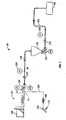
- a processing system for processing mechanically separated meat 10 is shown in Figure 1.
- Containers of meat or mechanically separated meat are placed on a lift dump station 100 that dumps the meat into an auger feed hopper 110.
- Any type of feed hopper known in the art may be used.
- the auger feed hopper 110 augers meat towards a positive displacement pump 120 which pumps the meat into a large storage vessel 130 through 4" [10.16 cm] diameter stainless steel pipe 140.
- the distance to the storage vessel is up to 90' [27.43 meters] which also includes 33' [10.06 meters] of head.
- the positive displacement pump 120 shown in Figure 1 is a lobe pump, but vane and progressive cavity styles of positive displacement pumps may also be used.
- liquid potassium pyrophosphate is added to the meat by an application wand 160 which is placed in the flow of the meat moving toward the pump 120.
- the application wand 160 is located in front of the meat pump 120, and the mechanical action of the pump mixes the phosphate with the meat.
- the liquid phosphate is metered into the meat flow using a peristaltic pump 170 that pumps the phosphate to the application wand 160.
- the amount of phosphate delivered to the meat is controlled by the speed of the peristaltic pump 170, or it can be controlled through the use of a flow meter 180 and a different type of positive displacement pump.
- the meat is pumped up to 165' [about 50.29 meters] distance (10' [3.05 meters] head) to the blender 190 through a 4" [10.16 cm] diameter stainless steel pipe 200.
- No additional phosphate addition is needed when pumping from the storage vessel to the mixer because the previously added phosphate remains capable of reducing meat viscosity. Processing may be further controlled and monitored using valves 210 and gauges 220.
- dry phosphate addition to the meat also results in a reduction of meat viscosity which facilitates low pressure pumping over long distances.
- dry granular or powdered phosphate is mixed with the meat prior to or during pumping of the meat, such as, for example, in the auger feed hopper 110.
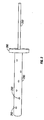
- Figure 2 illustrates a phosphate application wand 160.
- the phosphate application wand 160 includes tubing 250 for transporting phosphate to the wand.
- the phosphate application wand 160 includes phosphate output holes 260 that are effective for evenly distributing phosphate in meat flow.
- the phosphate application wand 160 further includes a base 280 and wand body 290.
- phosphate from a phosphate storage vessel 270 is pumped by peristaltic pump 170 via tubing 250 to the phosphate application wand 160.
- the wand body 290 of the phosphate application wand 160 extends into the flow of meat prior to the meat reaching the pump 120.
- Phosphate sources according to the invention include a variety of phosphate salts and polyphosphates.
- a polyphosphate may require time to dissociate so as to free individual diphosphate moieties which are found to achieve the beneficial effect in accordance with the invention.
- the phosphate source can be added at between about 0.1 to about 0.5 weight percent phosphate, based upon the meat being treated.
- a preferred range is between about 0.15% and about 0.25% phosphate.
- higher levels do not further reduce meat viscosity and typically will be avoided.
- phosphate sources include sodium pyrophosphate (a diphosphate), potassium pyrophosphate, sodium tripolyphosphate and potassium tripolyphosphate. Also available and useful are blends of sodium or potassium acid pyrophosphate, tetrasodium pyrophosphate, tetrapotassium pyrophosphate, potassium hexametaphosphate, sodium hexametaphosphate or other such polyphosphates. They can be in particulate form, which is preferred, or in liquid form, such as when the phosphate is within an aqueous carrier.
- phosphate addition reduces the viscosity of the meat.
- myosin and actin two proteins of muscle tissue which is the precursor of meat, "slide" with respect to each other during muscle contraction. In meat these proteins are complexed to form a new species called actomyosin.
- Diphosphate causes dissociation of actomyosin back into the myosin and actin components resulting in a loosening of this muscle structure so that actin protein and myosin can move around more easily. This dissociation is reflected in a decrease in viscosity of ground meat and mechanically separated meat or greater pliability of intact meat pieces.
Landscapes
- Chemical & Material Sciences (AREA)
- Health & Medical Sciences (AREA)
- Nutrition Science (AREA)
- Life Sciences & Earth Sciences (AREA)
- Engineering & Computer Science (AREA)
- Food Science & Technology (AREA)
- Polymers & Plastics (AREA)
- Inorganic Chemistry (AREA)
- Meat, Egg Or Seafood Products (AREA)
Abstract
Description
- The present invention relates to a method for reducing the viscosity of mechanically separated meats and ground meats. More particularly, mechanically separated meat or ground meat is blended with an amount of pyrophosphate effective for reducing the viscosity of the meat which allows the meat to be pumped long distances through processing equipment at lower pressures.
- Mechanically separated meat and ground meat is typically used in a number of food processing and manufacturing systems. During processing, the meat is transported to various processing steps through pipes using pumps. The mechanically separated meat is viscous, thus, increased pumping pressures are required to maintain desirable flow rates. High pump pressures, i.e. greater than 200 psig [1378.95 kPa], tend to cause excessive pump wear, rupturing of pump rotors, and increased maintenance. High pumping pressure may also activate pressure overload switches which result in a system shut down.
- High pumping pressures may also diminish the quality of the mechanically separated meat. For example, when pumping at high pressures, temperatures may increase as much as 4°F [2.22°C]. Further, higher pressures may result in higher oxidation rates in the meat and high shear rates may deteriorate emulsion stability in products made with this raw material.
- The viscosity of mechanically separated and ground meats may be reduced through the addition of water. Water addition in amount sufficient to reduce viscosity to desired levels may result in product having unacceptably high levels of water in the finished product. Typical water additions may range:from 0.5 to 3.0 gallons per minute [from 1.89 to 11.36 liters per minute] with meat flow rates ranging from 400 to 1000 lbs./minute [from 181.44 to 453.59 kg/minute] in a meat pumping system.
- The present invention is directed to a method for transporting mechanically separated meat and ground meat through a processing system. The method reduces the viscosity of the mechanically separated meat or ground meat which is effective for providing a more easily pumpable mechanically separated meat or ground meat. Thus the mechanically separated meat or ground meat can be pumped through existing processing equipment at lower pumping pressures. The lower pumping pressures are beneficial in providing lower processing costs and in maintaining the functionality and quality of the meat.
- In one aspect of the invention, mechanically separated meat or ground meat is blended with pyrophosphate in an amount effective for reducing the viscosity of the mechanically separated meat or ground meat as compared to mechanically separated meat or ground meat which has not been blended with pyrophosphate. In this aspect of the invention, the mechanically separated meat or ground meat is blended with about 0.1 to about 0.5 weight percent pyrophosphate, based on the weight of the meat pyrophosphate blend. The pyrophosphate may be sodium pyrophosphate, potassium pyrophosphate, other phosphates such as tripolyphosphates which rapidly convert to pyrophosphate in meat or mixtures thereof. The pyrophosphate may be added to the meat in a dry form or in a liquid form. An important aspect is that the meat does not require further blending with water to achieve reduced viscosity.
- Mechanically separated meats and ground meat which may be used in accordance with the method of the invention includes poultry, beef, pork and mixtures thereof. In a very important aspect, mechanically separated meat is poultry such as chicken and turkey.
- The method of the invention is effective for lowering processing costs. In this aspect of the invention, mechanically separated meat or ground meat that has been blended with pyrophosphate has a viscosity that allows the meat to be pumped from about 50 to about 165 feet [about 15.24 to about 50.29 meters] with a pumping pressure of about 200 psig [about 1378.95 kPa] or less at a flow rate of about 400 to about 1000 lbs/minute [about 181.44 to about 453.59 kg/minute]. Lower pumping pressures result in less damage and wear to the pumps which reduces maintenance costs.
- The method of the invention is also effective for maintaining the functionality and quality of the meat being processed. In this aspect of the invention, mechanically separated meat or ground meat does not increase in temperature more than about 2°C when the meat or ground meat is pumped about 250 feet [about 76.20 meters]. In another aspect, the method is also effective for not increasing the oxidation value (TBA) to more than about 1-3 ppm when the mechanically separated meat or ground meat is pumped about 250 feet [about 76.20 meters]. The present invention also provides a system for processing mechanically separated meat and ground meat. The system includes a feed hopper for mixing and transporting. The meat is transported from the feed hopper and past the phosphate application wand which is effective for uniformly applying phosphate to the meat. The system also includes at least one pump for transporting the meat through the system.
-
- Figure 1 is a schematic view of a meat processing system.
- Figure 2 illustrates a phosphate application wand.
-
- Unless defined otherwise, all technical and scientific terms used herein have the same meaning as commonly understood by one of ordinary skill in the art to which this invention belongs. All patents and publications referred to herein are incorporated by reference herein. For purposes of the present invention, the following terms are defined below.
- Mechanically separated meat is generally defined in 9 CPR 319.5 which is herein incorporated by reference. As used herein, "mechanically separated meat" refers to finely comminuted product resulting from the mechanical separation and removal of most of the bone from attached skeletal muscle of livestock carcasses and parts of carcasses. Examples of such a product are "Mechanically Separated Beef", "Mechanically Separated Veal", "Mechanically Separated Pork", "Mechanically Separated Lamb" and "Mechanically Separated Poultry". At least 98 percent of the bone particles present in such a product shall ahve a maximum size of no greater than 0.5 millimeter in their greatest dimension and there shall be no bone particles larger than 0.85 millimeter in their greatest dimension. The product resulting from the separating process shall not have a calcium content exceeding 0.75 percent, as a measure of a bone solids content of not more than 3 percent, and shall have a minimum PER of 2.5.
- As used herein, a "pumpable mechanically separated meat" means a mechanically separated meat that has been blended with an amount of pyrophosphate effective for reducing the viscosity of the blend as compared to mechanically separated meat that has not been blended with pyrophosphate. The reduction in viscosity is sufficient to allow the pumpable mechanically separated meat to be pumped long distances (up to about 165 feet [about 50.29 meters]), at low pressure (less than about 200 psig [about 1378.95 kPa]).
- "Ground Meat" is generally defined in 9 CFR 319.15 which is incorporated herein by reference. As used herein, "Ground meat" refers to "Ground Beef", "Ground Veal", "Ground Lamb", "Ground Pork" and "Ground Poultry" and shall consist of chopped fresh and/or frozen meat with or without seasoning and without the addition of fat as such, shall not contain added water, phosphates, binders, or extenders.
When cheek meat (trimmed beef cheeks) is used in the preparation of chopped or ground beef, the amount of such cheek meat shall be limited to the 25 percent. - "Hamburger" shall consist of chopped fresh and/or frozen beef with or without the addition of beef fat as such and/or seasoning, shall not contain more than 30 percent fat, and shall not contain added water, phosphates, binders, or extenders.
- "Beef Patties" shall consist of chopped fresh and/or frozen beef with or without the addition of beef fat as such and/or seasonings, binders, or extenders. Mechanically separated (species) used in accordance with Sec. 319.6 and/or partially defatted beef fatty tissue may be used without added water or with added water only in amounts such that the product characteristics are essentially that of a meat pattie.
- "Fabricated Beef Steaks", "Veal Steaks", "Beef and Veal Steaks", or "Veal and Beef Steaks", and similar products, such as those labeled "Beef Steak, Chopped, Shaped, Frozen", "Minute Steak, Formed, Water Sliced, Frozen, Hydrolyzed Plant Protein, and Flavoring" shall be prepared by comminuting and forming the product from fresh and/or frozen meat, with or without added fat, of the species indicated on the label. Such products shall not contain more than 30 percent fat and shall not contain added water or extenders. Transglutaminase enzyme at levels of up to 65 ppm may be used as a binder.
- As used herein a "pumpable ground meat" means a ground meat that has been blended with an amount of pyrophosphate effective for reducing the viscosity of the blend as compared to ground meat meat that has not been blended with pyrophosphate. The reduction in viscosity is sufficient to allow the pumpable mechanically separated meat to be pumped long distances (up to about 165 feet [about 50.29 meters]), at low pressure (less than about 200 psig [about 1378.95 kPa]).
- The method of the present invention is effective for reducing the viscosity of the mechanically separated meat without adding water. As used herein, "without added water" means that no water is added to the mechanically separated meat during the pumping process. Pyrophosphate may be added to the mechanically separated meat in an aqueous solution. Aqueous solutions of pyrophosphate may be an aqueous concentrate having a pyrophosphate concentration of up to 60 weight percent.
- Oxidation or TBA is measured by extracting a meat sample with acid; taking the filtered extract and conducting a reaction with thiobarbituric acid (TBA reagent) to generate a color which is quantified spectrophotometrically. The assay is calibrated against color developed from a standard using malondialdehyde and results are expressed as ppm malondialdehyde equivalents in the meat. This is also often referred to as the TBA value.
- A processing system for processing mechanically separated
meat 10 is shown in Figure 1. Containers of meat or mechanically separated meat are placed on alift dump station 100 that dumps the meat into anauger feed hopper 110. Any type of feed hopper known in the art may be used. Theauger feed hopper 110 augers meat towards apositive displacement pump 120 which pumps the meat into alarge storage vessel 130 through 4" [10.16 cm] diameterstainless steel pipe 140. The distance to the storage vessel is up to 90' [27.43 meters] which also includes 33' [10.06 meters] of head. Thepositive displacement pump 120 shown in Figure 1 is a lobe pump, but vane and progressive cavity styles of positive displacement pumps may also be used. - To reduce meat viscosity, liquid potassium pyrophosphate is added to the meat by an
application wand 160 which is placed in the flow of the meat moving toward thepump 120. Theapplication wand 160 is located in front of themeat pump 120, and the mechanical action of the pump mixes the phosphate with the meat. - The liquid phosphate is metered into the meat flow using a
peristaltic pump 170 that pumps the phosphate to theapplication wand 160. The amount of phosphate delivered to the meat is controlled by the speed of theperistaltic pump 170, or it can be controlled through the use of aflow meter 180 and a different type of positive displacement pump. - From the
storage vessel 130, the meat is pumped up to 165' [about 50.29 meters] distance (10' [3.05 meters] head) to theblender 190 through a 4" [10.16 cm] diameterstainless steel pipe 200. No additional phosphate addition is needed when pumping from the storage vessel to the mixer because the previously added phosphate remains capable of reducing meat viscosity. Processing may be further controlled and monitored usingvalves 210 and gauges 220. - The use of dry phosphate addition to the meat also results in a reduction of meat viscosity which facilitates low pressure pumping over long distances. In this aspect of the invention, dry granular or powdered phosphate is mixed with the meat prior to or during pumping of the meat, such as, for example, in the
auger feed hopper 110. - Figure 2 illustrates a
phosphate application wand 160. Thephosphate application wand 160 includestubing 250 for transporting phosphate to the wand. Thephosphate application wand 160 includesphosphate output holes 260 that are effective for evenly distributing phosphate in meat flow. Thephosphate application wand 160 further includes abase 280 andwand body 290. - When the system shown in Figure 1 is in operation, phosphate from a
phosphate storage vessel 270 is pumped byperistaltic pump 170 viatubing 250 to thephosphate application wand 160. Thewand body 290 of thephosphate application wand 160 extends into the flow of meat prior to the meat reaching thepump 120. - Phosphate sources according to the invention include a variety of phosphate salts and polyphosphates. As discussed herein, a polyphosphate may require time to dissociate so as to free individual diphosphate moieties which are found to achieve the beneficial effect in accordance with the invention. Thus, as a general rule, the more complex the phosphate source, the more likely some will have to be added at an upstream injection location, rather than at a more downstream injection location into the meat flow. Generally speaking, the phosphate source can be added at between about 0.1 to about 0.5 weight percent phosphate, based upon the meat being treated. A preferred range is between about 0.15% and about 0.25% phosphate. Generally speaking, higher levels do not further reduce meat viscosity and typically will be avoided.
- Examples of phosphate sources include sodium pyrophosphate (a diphosphate), potassium pyrophosphate, sodium tripolyphosphate and potassium tripolyphosphate.
Also available and useful are blends of sodium or potassium acid pyrophosphate, tetrasodium pyrophosphate, tetrapotassium pyrophosphate, potassium hexametaphosphate, sodium hexametaphosphate or other such polyphosphates. They can be in particulate form, which is preferred, or in liquid form, such as when the phosphate is within an aqueous carrier. - Without being bound by any theory of a functional mechanism regarding this invention, it is believed that the phosphate addition as discussed herein reduces the viscosity of the meat. It is well known that myosin and actin, two proteins of muscle tissue which is the precursor of meat, "slide" with respect to each other during muscle contraction. In meat these proteins are complexed to form a new species called actomyosin. Diphosphate causes dissociation of actomyosin back into the myosin and actin components resulting in a loosening of this muscle structure so that actin protein and myosin can move around more easily. This dissociation is reflected in a decrease in viscosity of ground meat and mechanically separated meat or greater pliability of intact meat pieces.
- The following examples illustrate methods for carrying out the invention and should be understood to be illustrative of, but not limiting upon, the scope of the invention which is defined in the appended claims.
- Mechanically separated chicken (MSC) was mixed with concentrated potassium pyrophosphate (60%), water and lactate at the levels indicated below.
- Each sample was pumped from the ground floor to the storage vessel and then from the storage vessel to the mixer (see diagram). The pressure to pump the sample from the storage vessel and then to the mixer was recorded.
Treatment Mechanically
Separated Chicken
(lbs) [kg]Phosphate
(lbs) [kg]Lactate
(lbs) [kg]Water
(lbs) [kg]Pressure to Pump 90' [27.43 meters] (33' [10.06 meters] head; psig {kPa}) Pressure to Pump 165' [50.29 meters] (10' [3.05 meters] head; psig {kPa}) 1 8000 [3628.74] 12 [5.44]
(0.15%)300
[136.08]642
[291.21]80
{551.58}90
{620.53}2 8000 [3628.74] 12 [5.44]
(0.15%)0 642
[291.21]90
{620.53}95
{655.00}3 8000 [3628.74] 0 300 [136.08] 642 [291.21] 115
{792.90}135
{930.79}4 2000 [907.18] 5 [2.27]
(0.25%)75
[34.02]47
[21.32]90
{620.53}100
{689.48} - In the current test (Table 2), 60% concentrate potassium pyrophosphate was added to MSC from two different vendors at levels of 0%; 0.15%, 0.25%, 0.35%, 0.45% and 0.55% on a 100% phosphate basis. Each sample was extruded through a 4 mm annulus, and the energy to extrude was measured.
Pyrophosphate (%) 0 0.15 0.25 0.35 0.45 0.55 Energy to extrude MSC vendor 1
(Ft-lbs) [Joules]97
[13.41]77
[10.65]85
[11.75]83
[11.48]79
[10.92]78
[10.78]Energy to extrude MSC vendor 2
(Ft-lbs) [Joules]155
[21.43]125
[17.28]125
[17.28]128
[17.70]131
[18.11]125
[17.28] - Numerous modifications and variations in practice of the invention are expected to occur to those skilled in the art upon consideration of the foregoing detailed description of the invention. Consequently, such modifications and variations are intended to be included within the scope of the following claims.
Claims (11)
- A method for transporting mechanically separated meat or ground meat through a processing system, the method comprising:blending the mechanically separated meat or ground meat with an amount of pyrophosphate effective for providing a pumpable mechanically separated meat or ground meat; andtransporting the pumpable mechanically separated meat or ground meat through the processing system.
- A method according to claim 1, wherein the meat can be transported through the system for up to about 165 feet [about 50.29 meters] with a pressure of not more than about 200 psig [1378.95 kPa].
- A method according to claim 1 or claim 2, wherein the mechanically separated meat or ground meat is selected from poultry, beef, pork and mixtures thereof.
- A method for pumping mechanically separated meat or ground meat, the method comprising blending the mechanically separated meat or ground meat with an amount of pyrophosphate effective for providing a pumpable mechanically separated meat or ground meat having a reduced viscosity and allowing the pumpable meat to be pumped from about 50 to about 165 feet [about 50.29 meters] with a pumping pressure of about 200 psig [about 1378.95 kPa] or less.
- A method according to claim 4, wherein the mechanically separated meat or ground meat is poultry.
- A method according to any one of claims 1 to 5, wherein the mechanically separated meat or ground meat is blended with about 0.15 to about 0.25 weight percent pyrophosphate, based on the weight of the meat/pyrophosphate blend.
- A method according to any one of claims 1 to 6, wherein the pyrophosphate is blended as a dry powder or as a liquid.
- A method according to any one of claims 1 to 7, wherein the pyrophosphate is selected from sodium pyrophosphate, potassium pyrophosphate, sodium tripolyphosphate, potassium tripolyphosphate, tetrasodium pyrophosphate, tetrapotassium pyrophosphate, potassium hexametaphosphate, sodium hexametaphosphate and mixtures thereof.
- A method according to any one of claims 1 to 8, wherein transporting or pumping of the mechanically separated meat or ground meat does not increase a temperature of the mechanically separated meat or ground meat more than about 2°C when the mechanically separated meat is transported about 250 feet [about 76.20 meters].
- A method according to any one of claims 1 to 9, wherein transporting of the mechanically separated meat or ground meat does not increase a TBA value of the meat more than about 1-3 ppm when the meat is transported about 250 feet [about 76.20 meters].
- A system for processing mechanically separated meat or ground meat, the system comprising:a feed hopper (110) for mixing and transporting mechanically separated meat or ground meat;a phosphate application wand (160) contacting the mechanically separated meat or ground meat transported from the feed hopper (110); andat least one pump (120) for transporting the mechanically separated meat or ground meat through the system.
Applications Claiming Priority (2)
| Application Number | Priority Date | Filing Date | Title |
|---|---|---|---|
| US347090 | 2003-01-17 | ||
| US10/347,090 US6939215B2 (en) | 2003-01-17 | 2003-01-17 | Method for reducing viscosity of mechanically separated meats and ground meats |
Publications (1)
| Publication Number | Publication Date |
|---|---|
| EP1449442A1 true EP1449442A1 (en) | 2004-08-25 |
Family
ID=32681603
Family Applications (1)
| Application Number | Title | Priority Date | Filing Date |
|---|---|---|---|
| EP04250214A Withdrawn EP1449442A1 (en) | 2003-01-17 | 2004-01-16 | Method for reducing viscosity of mechanically separated meats or ground meats |
Country Status (3)
| Country | Link |
|---|---|
| US (1) | US6939215B2 (en) |
| EP (1) | EP1449442A1 (en) |
| CA (1) | CA2455093A1 (en) |
Families Citing this family (2)
| Publication number | Priority date | Publication date | Assignee | Title |
|---|---|---|---|---|
| ATE396616T1 (en) * | 2006-03-02 | 2008-06-15 | Handtmann Albert Maschf | FILLING MACHINE AND METHOD FOR FEEDING PASTY MASSES FROM A FUNNEL INTO A CONVEYOR |
| ES2314767T3 (en) * | 2006-03-09 | 2009-03-16 | ALBERT HANDTMANN MASCHINENFABRIK GMBH & CO. KG | DEVICE FOR REGULATING THE FILLING LEVEL AND FOR EVACUATING REGULATED MASS PASTOSA. |
Citations (6)
| Publication number | Priority date | Publication date | Assignee | Title |
|---|---|---|---|---|
| GB714500A (en) * | 1948-11-05 | 1954-09-01 | Hees G M B H Van | Meat sausages and other meat-containing products |
| GB754406A (en) * | 1953-09-10 | 1956-08-08 | Chem Fab Budenheim Ag | Process of improving sausage meat |
| US3029150A (en) * | 1948-01-07 | 1962-04-10 | Benckiser Gmbh Joh A | Method of curing meat and composition therefor |
| GB1265445A (en) * | 1969-10-24 | 1972-03-01 | ||
| EP0951843A1 (en) * | 1998-04-20 | 1999-10-27 | David Cahill | A method for preparing a poultry product |
| US6099891A (en) * | 1992-02-19 | 2000-08-08 | Kraft Foods, Inc. | Low fat meat product |
Family Cites Families (13)
| Publication number | Priority date | Publication date | Assignee | Title |
|---|---|---|---|---|
| US3681275A (en) | 1969-01-27 | 1972-08-01 | Japan Exlan Co Ltd | Acrylonitrile composition improved in yellowness and brightness and production of fibers therefrom |
| US3675567A (en) * | 1970-06-08 | 1972-07-11 | Pillsbury Co | Meat injection apparatus |
| US4210677A (en) * | 1978-01-24 | 1980-07-01 | Auburn Research Foundation | Process for production of a restructured fresh meat product |
| US4313963A (en) * | 1980-08-19 | 1982-02-02 | Beatrice Foods Co. | Method for tenderizing cut meat portions |
| US4514094A (en) * | 1983-06-23 | 1985-04-30 | International Flavors & Fragrances Inc. | Mixed seasoning |
| DE3560175D1 (en) * | 1984-02-03 | 1987-06-25 | Matthews Bernard Plc | Meat based product |
| JPS61234760A (en) * | 1985-04-11 | 1986-10-20 | Nippon Suisan Kaisha Ltd | Method for continuous addition of sugar and other subsidiary raw material to ground meat and apparatus therefor |
| US4667370A (en) * | 1985-04-15 | 1987-05-26 | Brockington F Rhett | Salt-water butchering process for poultry and other fowl |
| US4675947A (en) * | 1986-07-09 | 1987-06-30 | Campbell Soup Company | Method of eliminating aging step in poultry processing |
| DE3728155A1 (en) * | 1986-12-03 | 1987-12-10 | Inst Hochseefischerei | METHOD AND INSTALLATION FOR PRODUCING STRUCTURED PRODUCTS |
| US5840359A (en) * | 1995-10-27 | 1998-11-24 | Nestec S.A. | Process and apparatus for manufacturing noodles |
| US5997925A (en) * | 1997-07-22 | 1999-12-07 | Swift-Eckrich, Inc. | Continuous manufacturing process and apparatus for preparing pre-cooked bacon |
| US6406730B1 (en) * | 1998-12-01 | 2002-06-18 | Carl E. Banyard | Process for producing low acid food products |
-
2003
- 2003-01-17 US US10/347,090 patent/US6939215B2/en not_active Expired - Fee Related
-
2004
- 2004-01-09 CA CA002455093A patent/CA2455093A1/en not_active Abandoned
- 2004-01-16 EP EP04250214A patent/EP1449442A1/en not_active Withdrawn
Patent Citations (6)
| Publication number | Priority date | Publication date | Assignee | Title |
|---|---|---|---|---|
| US3029150A (en) * | 1948-01-07 | 1962-04-10 | Benckiser Gmbh Joh A | Method of curing meat and composition therefor |
| GB714500A (en) * | 1948-11-05 | 1954-09-01 | Hees G M B H Van | Meat sausages and other meat-containing products |
| GB754406A (en) * | 1953-09-10 | 1956-08-08 | Chem Fab Budenheim Ag | Process of improving sausage meat |
| GB1265445A (en) * | 1969-10-24 | 1972-03-01 | ||
| US6099891A (en) * | 1992-02-19 | 2000-08-08 | Kraft Foods, Inc. | Low fat meat product |
| EP0951843A1 (en) * | 1998-04-20 | 1999-10-27 | David Cahill | A method for preparing a poultry product |
Non-Patent Citations (1)
| Title |
|---|
| MACFARLANE J J ET AL: "BINDING OF COMMINUTED MEAT: EFFECT OF HIGH PRESSURE", MEAT SCIENCE, ELSEVIER SCIENCE, GB, vol. 10, 1984, pages 307 - 320, XP000872061, ISSN: 0309-1740 * |
Also Published As
| Publication number | Publication date |
|---|---|
| US6939215B2 (en) | 2005-09-06 |
| US20040142649A1 (en) | 2004-07-22 |
| CA2455093A1 (en) | 2004-07-17 |
Similar Documents
| Publication | Publication Date | Title |
|---|---|---|
| JP4274726B2 (en) | Pet food to maintain normal bowel health | |
| EP0265740B1 (en) | Layered meat emulsion product and method of producing same | |
| US6379738B1 (en) | Meat emulsion product | |
| US11333441B2 (en) | Methods and devices for heating or cooling viscous materials | |
| CN103874421B (en) | For the technique preparing food compositions | |
| CN103906441A (en) | Method and apparatus for heating or cooling viscous materials | |
| NO313071B1 (en) | Sterilized animal feed mix and method of preparation thereof | |
| WO2016100299A1 (en) | Process for enhancing muscle portions and products | |
| WO2004023887A1 (en) | Pet food product and method of producing same | |
| JPH1066543A (en) | Enhancement of removal of meat fat | |
| US6939215B2 (en) | Method for reducing viscosity of mechanically separated meats and ground meats | |
| CN107404900A (en) | Bacon product and its manufacture method | |
| CN103494150A (en) | Basic condiment, meat product and preparation methods of basic condiment and meat product | |
| Cunningham et al. | A review of factors affecting emulsifying characteristics of poultry meat | |
| US3270041A (en) | Low-temperature rendering of animal fatty tissue | |
| Knipe et al. | Effects of sodium hydroxide and selected inorganic phosphates on the characteristics of reduced sodium meat emulsions | |
| JPS61104765A (en) | Production of meat product | |
| Farouk | Restructured whole-tissue meats | |
| JP2003047441A (en) | Method for producing ham-like food using salmon and trout flesh | |
| JPS58205472A (en) | Meat-like composition and method for producing the same | |
| Cordray | PRE-RIGOR PROCESSING OF PORK: HIDE REMOVAL AND MANUFACTURE OF RESTRUCTURED MEATS. |
Legal Events
| Date | Code | Title | Description |
|---|---|---|---|
| PUAI | Public reference made under article 153(3) epc to a published international application that has entered the european phase |
Free format text: ORIGINAL CODE: 0009012 |
|
| AK | Designated contracting states |
Kind code of ref document: A1 Designated state(s): AT BE BG CH CY CZ DE DK EE ES FI FR GB GR HU IE IT LI LU MC NL PT RO SE SI SK TR |
|
| AX | Request for extension of the european patent |
Extension state: AL LT LV MK |
|
| 17P | Request for examination filed |
Effective date: 20050124 |
|
| AKX | Designation fees paid |
Designated state(s): AT BE BG CH CY CZ DE DK EE ES FI FR GB GR HU IE IT LI LU MC NL PT RO SE SI SK TR |
|
| AXX | Extension fees paid |
Extension state: MK Payment date: 20050124 Extension state: LV Payment date: 20050124 Extension state: LT Payment date: 20050124 Extension state: AL Payment date: 20050124 |
|
| APBN | Date of receipt of notice of appeal recorded |
Free format text: ORIGINAL CODE: EPIDOSNNOA2E |
|
| APBR | Date of receipt of statement of grounds of appeal recorded |
Free format text: ORIGINAL CODE: EPIDOSNNOA3E |
|
| APAF | Appeal reference modified |
Free format text: ORIGINAL CODE: EPIDOSCREFNE |
|
| RAP1 | Party data changed (applicant data changed or rights of an application transferred) |
Owner name: KRAFT FOODS GLOBAL BRANDS LLC |
|
| APBT | Appeal procedure closed |
Free format text: ORIGINAL CODE: EPIDOSNNOA9E |
|
| STAA | Information on the status of an ep patent application or granted ep patent |
Free format text: STATUS: THE APPLICATION HAS BEEN WITHDRAWN |
|
| 18W | Application withdrawn |
Effective date: 20110216 |