EP1448439B1 - Nets - Google Patents
Nets Download PDFInfo
- Publication number
- EP1448439B1 EP1448439B1 EP02774989A EP02774989A EP1448439B1 EP 1448439 B1 EP1448439 B1 EP 1448439B1 EP 02774989 A EP02774989 A EP 02774989A EP 02774989 A EP02774989 A EP 02774989A EP 1448439 B1 EP1448439 B1 EP 1448439B1
- Authority
- EP
- European Patent Office
- Prior art keywords
- net
- lengths
- length
- fixing means
- nets
- Prior art date
- Legal status (The legal status is an assumption and is not a legal conclusion. Google has not performed a legal analysis and makes no representation as to the accuracy of the status listed.)
- Expired - Lifetime
Links
Images


Classifications
-
- B—PERFORMING OPERATIONS; TRANSPORTING
- B60—VEHICLES IN GENERAL
- B60P—VEHICLES ADAPTED FOR LOAD TRANSPORTATION OR TO TRANSPORT, TO CARRY, OR TO COMPRISE SPECIAL LOADS OR OBJECTS
- B60P7/00—Securing or covering of load on vehicles
- B60P7/06—Securing of load
- B60P7/08—Securing to the vehicle floor or sides
- B60P7/0876—Securing to the vehicle floor or sides using restraining net or tarpaulin in contact with the load
-
- B—PERFORMING OPERATIONS; TRANSPORTING
- B64—AIRCRAFT; AVIATION; COSMONAUTICS
- B64D—EQUIPMENT FOR FITTING IN OR TO AIRCRAFT; FLIGHT SUITS; PARACHUTES; ARRANGEMENT OR MOUNTING OF POWER PLANTS OR PROPULSION TRANSMISSIONS IN AIRCRAFT
- B64D9/00—Equipment for handling freight; Equipment for facilitating passenger embarkation or the like
-
- B—PERFORMING OPERATIONS; TRANSPORTING
- B60—VEHICLES IN GENERAL
- B60R—VEHICLES, VEHICLE FITTINGS, OR VEHICLE PARTS, NOT OTHERWISE PROVIDED FOR
- B60R21/00—Arrangements or fittings on vehicles for protecting or preventing injuries to occupants or pedestrians in case of accidents or other traffic risks
- B60R21/02—Occupant safety arrangements or fittings, e.g. crash pads
- B60R21/06—Safety nets, transparent sheets, curtains, or the like, e.g. between occupants and glass
Definitions
- the present invention relates to nets, for example cargo nets to restrain the movement of cargo in the fuselage of aircraft.
- nets as barriers on aircraft to restrain cargo that would otherwise move and penetrate into areas occupied by aircraft personnel, critical equipment and systems, access door or emergency access routes during the acceleration and deceleration of the aircraft during take-off and landing and also during the extreme deceleration of the aircraft during emergency landing.
- such nets comprise a network of textile straps to which securing means are fitted, e.g. shackles, quick release fittings, snap latches, single and double stud floor fittings to connect the net to the aircraft structure.
- securing means e.g. shackles, quick release fittings, snap latches, single and double stud floor fittings to connect the net to the aircraft structure.
- the straps are stitched at their intersections which helps to maintain the shape of the net and also ensures that the strap lengths between intersections are approximately equal. This means that when the load is applied to the net the load distribution throughout the net should be as designed. However, manufacturing tolerances used in the construction of the net mean that it is impossible to make the individual lengths exactly equal. Nets made of a high elongation material are able to compensate for this. If a member of the net from one stitched intersection to the other is shorter than it should be, all that happens, is that it will experience a magnitude of load sooner than it should have, the material elongates, which causes the load to be shared to the other members in the net.
- the textile straps elongate under tensile load, which although in some cases can be an advantage in forming the desired profile when restraining the shifted cargo, in cases when the net is fitted in close proximity to the areas occupied by aircraft personnel, critical equipment and systems, or emergency access routes, the elongation of the net must be strictly limited. Limitation of the elongation of the net is currently achieved through the employment of multiple layers of textile straps. Multiple layers of textile straps increase the volume of the cargo net and, depending on the number of layers required, can prove very difficult to manufacture.
- nets out of materials having a much lower elongation, e.g. nets comprising metallic fibre cables or plastics fibre materials.
- Nets made of plastics fibre materials such as aramid fibre materials, e.g. Kevlar®
- aramid fibre materials e.g. Kevlar®
- a net constructed of low elongation material in the conventional manner with stitched intersections would experience a number of problems.
- the accuracy of the net manufacturer would need to be much higher. If a member of the net from one stitched intersection to the other was shorter than it should be then it would experience a magnitude of load sooner than it should have but, because of the low elongation properties of the material it would not elongate sufficiently to share the load to the other members of the net and consequently it would experience a larger magnitude of load for a longer period of time thus making that member of the net more susceptible to breakage.
- GB-A-2 339 802 discloses a restraining net for a car.
- the net comprises a plurality of knitted net strands with different stress-strain behaviour so that the net is able to absorb or degrade the kinetic energy of an object hurled into the net in a "stepwise" manner.
- US-A-6 123 294 discloses a cargo barrier for retaining cargo within an aircraft fuselage.
- the cargo barrier is in the form of a net structure made from Kevlar® or other materials having a high strength-to-weight ratio, with end loops made from straps of nylon.
- US-B1-6 244 803 discloses a cargo barrier net made of a high-strength, lightweight, low-elongation material such as Kevlar® in which the net straps intersect at intersections at varying angles.
- a stitching pattern is configured at each intersection so that it will not fail irrespective of the direction of the force applied to the intersection.
- a net comprising a combination of a plurality of lengths of a first material with a plurality of lengths of a second material having a relatively lower elongation than that of the first material, the lengths of the first material being arranged in the form of an interconnected network and being stitched together at their points of intersection, characterised in that each of the lengths of the second material is substantially coextensive with a corresponding one of the lengths of the first material and has freedom of movement in the direction of the first length of material.
- the lengths of a first material are transverse to each other and more preferable that the lengths of the first material are transverse to each other at substantially right angles.
- the net is in the form of a network of horizontal and vertical lengths but it is also possible to have a net which is in a "spider web" configuration, that is a plurality of concentric lengths intersected by a plurality of radial lengths.
- a variety of stitching patterns as known in the art may be used to secure the lengths.
- Securing means may be fitted to each end of the lengths of material in order that the net may be attached to another device or structure.
- the securing means may comprise a number of different devices such as shackles, quick release fittings, snap latches and single or double stud floor fittings. Both the first and the second lengths of material may be provided with one of the above securing means.
- the securing means for the lengths of second material may be common to the securing means of the corresponding lengths of first material. At least some of the lengths of second material may be transverse to each other. When this is the case it is preferred that the lengths are transverse to one another at substantially right angles.
- a net provided with securing means as described may be installed across an internal space to act as a barrier.
- the net may act as a barrier to restrain the unwanted movement of cargo when it is transported in the fuselage of aircraft.
- the lengths of second material comprise metallic fibre cables or plastics fibre cables. More preferably the lengths of second material comprise aramid fibre cables, e.g. Kevlar®. Such a net would have the advantage of being strong, lightweight and having a low elongation under tensile loading when compared to conventional textile nets.
- the net may be provided with a number of bindings around some, but not necessarily all, of the regions at which the lengths cross. These bindings may be in the form of textile loops and will ensure that the lengths of material are held in position at the region in which they cross.
- the bindings are formed around the crossing regions but are not physically attached to either the horizontal or vertical lengths. The bindings allow a degree of freedom of movement for the lengths whilst helping to maintain the overall shape of the net and ensuring that the lengths of second material, which are only attached at each end, are held in place.
- a cargo net 1 for restraining the movement of cargo in the fuselage of an aircraft
- Fig. 1 being a view looking aft in the installed position of the net 1
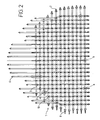
- Fig. 2 being a view looking forward in the installed position of the net 1.
- the net 1 comprises a plurality of horizontal lengths 2 of a first material and a plurality of vertical lengths 3 of the first material which are transverse to one another at substantially right angles.
- the lengths are stitched together at each of the regions 10 at which they cross using a conventional stitching pattern (not shown) such that the net comprises a plurality of sections between the stitched intersections each of a substantially similar length.
- Each of the horizontal lengths is provided with a shackle 7 at each end which provides a securing means for fixing the net in position, for example to act as an internal barrier across the fuselage of an aircraft.
- Some of the securing means down a portion of one side of the net are provided with quick release fittings 8 such that this part of the net may be easily detached.
- the vertical lengths are provided with a smaller shackle 9 at each end since the side walls of the fuselage are able to withstand a larger force.
- the net is also provided with a plurality of lengths of a second material (not shown) which has a lower elongation than that of the first material. These lengths run in a horizontal direction and are substantially coextensive with a corresponding length of first material and are attached to the same securing means as the corresponding length of first material.
- the securing means are the only points of attachment for the lengths of second material as they are not stitched at the crossing regions 10.
- a plurality of binding loops 4, 5, 6 of different kinds are provided which fit around the stitched crossing regions 10 of the first material.
- the lengths of second material pass through the binding loops 4, 5, 6.
- the binding loops 4, 5, 6 prevent the length of second material from moving in the vertical direction but allow a certain degree of freedom for the length to move in the horizontal direction.
- Figs. 3a and 3b show front and back views of one kind of binding loop 4 used in the net.
- This form of the binding loop is provided at the majority of the regions 10 where the horizontal lengths 2 and vertical lengths 3 of first material cross.
- the binding loop 4 is formed from a single length of material which is looped around the vertical length of first material at the crossing region 10 in a figure of eight loop and stitched using stitching pattern 13.
- the length 11 of lower elongation second material which is covered with a sleeve 12 of textile material (such as polyester) in order to protect it, passes through the binding loop 4 in the horizontal direction.
- the binding loop 4 restrains movement of the length 11 of lower elongation material in the vertical direction but also allows the length 11 of lower elongation material the freedom to slide through the loop 4 in the horizontal direction.
- Figs. 4a and 4b show front and back views of a second kind of binding, loops 5a and 5b, used in the net.
- loops 5a and 5b In order to provide extra support loop 5a is provided over the top of loop 5b.
- the loops 5a and5b have the same basic construction features as the loop in Fig.3 but are slightly larger in order to accommodate a different stitching pattern 15.
- the loops are provided at the outermost crossing regions 10 and the stitching pattern 15 gives the extra strength which is required at these points.
- Figs. 5a and 5b show front and back views of a third kind of binding loop 6 used in the net.
- the material loop has a different orientation from the loops in Figs. 3 and 4 such that the figure of eight loop is provided around the horizontal length of first material at the crossing region 10. This loop occurs only at the top and bottom of the centre vertical length. This is because this length does not have securing means attached to the ends.
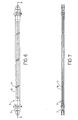
- Fig. 6 is an illustration of how one of the lengths 11 of lower elongation material is provided in the net.
- the cut away portions show the length 11 of lower elongation material housed in a protective sleeve 12.
- the lower elongation material comprises plastics fibre material such as Kevlar®.
- the plastics fibre is in the form of a single length of material which is wound around each of the securing means 7 a plurality of times to give a length 11 of lower elongation material which is of the required length.
- Fig. 7 shows a section along A-A of the length 11 of lower elongation material in Fig. 6.
- the length 11 of lower elongation material is wound around each of the fixing means 7 a plurality of times and is encased in a protective sleeve 12.
- a net as described above would go at least some way towards overcoming the disadvantages of conventional nets, or at least to provide an acceptable alternative system for reasonably ensuring the net distributes the resulting tensile load safely into the aircraft structure and does not penetrate into areas occupied by aircraft personnel, critical equipment and systems, or emergency access routes during the acceleration and deceleration of the aircraft during take-off and landing and also during the extreme deceleration of the aircraft during emergency landing.
- the low elongation material takes the majority of the load that is applied to the net, the traditional high elongation material does take a portion of the load.
Landscapes
- Engineering & Computer Science (AREA)
- Transportation (AREA)
- Mechanical Engineering (AREA)
- Aviation & Aerospace Engineering (AREA)
- Braiding, Manufacturing Of Bobbin-Net Or Lace, And Manufacturing Of Nets By Knotting (AREA)
- Polysaccharides And Polysaccharide Derivatives (AREA)
- Glass Compositions (AREA)
- Saccharide Compounds (AREA)
Abstract
Description
- The present invention relates to nets, for example cargo nets to restrain the movement of cargo in the fuselage of aircraft.
- It is well known to use nets as barriers on aircraft to restrain cargo that would otherwise move and penetrate into areas occupied by aircraft personnel, critical equipment and systems, access door or emergency access routes during the acceleration and deceleration of the aircraft during take-off and landing and also during the extreme deceleration of the aircraft during emergency landing.
- Conventionally, such nets comprise a network of textile straps to which securing means are fitted, e.g. shackles, quick release fittings, snap latches, single and double stud floor fittings to connect the net to the aircraft structure.
- The success of the net to act as a barrier to the moving cargo relies on the net forming a profile when loaded that does not encroach into the areas it is intended to protect, whilst safely distributing the resulting tensile load into the aircraft structure.
- In conventional textile nets, the straps are stitched at their intersections which helps to maintain the shape of the net and also ensures that the strap lengths between intersections are approximately equal. This means that when the load is applied to the net the load distribution throughout the net should be as designed. However, manufacturing tolerances used in the construction of the net mean that it is impossible to make the individual lengths exactly equal. Nets made of a high elongation material are able to compensate for this. If a member of the net from one stitched intersection to the other is shorter than it should be, all that happens, is that it will experience a magnitude of load sooner than it should have, the material elongates, which causes the load to be shared to the other members in the net.
- Such known nets suffer from disadvantages. The textile straps elongate under tensile load, which although in some cases can be an advantage in forming the desired profile when restraining the shifted cargo, in cases when the net is fitted in close proximity to the areas occupied by aircraft personnel, critical equipment and systems, or emergency access routes, the elongation of the net must be strictly limited. Limitation of the elongation of the net is currently achieved through the employment of multiple layers of textile straps. Multiple layers of textile straps increase the volume of the cargo net and, depending on the number of layers required, can prove very difficult to manufacture.
- It would therefore be preferable to make nets out of materials having a much lower elongation, e.g. nets comprising metallic fibre cables or plastics fibre materials. Nets made of plastics fibre materials (such as aramid fibre materials, e.g. Kevlar®) would be highly desirable since such nets would have a much lighter weight, a much higher strength to weight ratio and prevent cargo from penetrating into unwanted areas.
- A net constructed of low elongation material in the conventional manner with stitched intersections would experience a number of problems. For a low elongation material net to balance out as described before, the accuracy of the net manufacturer would need to be much higher. If a member of the net from one stitched intersection to the other was shorter than it should be then it would experience a magnitude of load sooner than it should have but, because of the low elongation properties of the material it would not elongate sufficiently to share the load to the other members of the net and consequently it would experience a larger magnitude of load for a longer period of time thus making that member of the net more susceptible to breakage.
- The manufacturing tolerances used for both high and low elongation material are identical and it is not practical to have increased accuracy for low elongation materials and hence not possible to compensate for low elongation material in the manner described for high elongation materials.
- GB-A-2 339 802 discloses a restraining net for a car. The net comprises a plurality of knitted net strands with different stress-strain behaviour so that the net is able to absorb or degrade the kinetic energy of an object hurled into the net in a "stepwise" manner.
- US-A-6 123 294 discloses a cargo barrier for retaining cargo within an aircraft fuselage. The cargo barrier is in the form of a net structure made from Kevlar® or other materials having a high strength-to-weight ratio, with end loops made from straps of nylon.
- US-B1-6 244 803 discloses a cargo barrier net made of a high-strength, lightweight, low-elongation material such as Kevlar® in which the net straps intersect at intersections at varying angles. A stitching pattern is configured at each intersection so that it will not fail irrespective of the direction of the force applied to the intersection.
- According to the present invention there is provided a net comprising a combination of a plurality of lengths of a first material with a plurality of lengths of a second material having a relatively lower elongation than that of the first material, the lengths of the first material being arranged in the form of an interconnected network and being stitched together at their points of intersection, characterised in that each of the lengths of the second material is substantially coextensive with a corresponding one of the lengths of the first material and has freedom of movement in the direction of the first length of material.
- It is preferable that at least some of the lengths of a first material are transverse to each other and more preferable that the lengths of the first material are transverse to each other at substantially right angles.
- It is preferred that the net is in the form of a network of horizontal and vertical lengths but it is also possible to have a net which is in a "spider web" configuration, that is a plurality of concentric lengths intersected by a plurality of radial lengths. A variety of stitching patterns as known in the art may be used to secure the lengths.
- Securing means may be fitted to each end of the lengths of material in order that the net may be attached to another device or structure. The securing means may comprise a number of different devices such as shackles, quick release fittings, snap latches and single or double stud floor fittings. Both the first and the second lengths of material may be provided with one of the above securing means.
- The securing means for the lengths of second material may be common to the securing means of the corresponding lengths of first material. At least some of the lengths of second material may be transverse to each other. When this is the case it is preferred that the lengths are transverse to one another at substantially right angles.
- A net provided with securing means as described may be installed across an internal space to act as a barrier. In this case the net may act as a barrier to restrain the unwanted movement of cargo when it is transported in the fuselage of aircraft.
- Additionally, it is preferred that the lengths of second material comprise metallic fibre cables or plastics fibre cables. More preferably the lengths of second material comprise aramid fibre cables, e.g. Kevlar®. Such a net would have the advantage of being strong, lightweight and having a low elongation under tensile loading when compared to conventional textile nets.
- The net may be provided with a number of bindings around some, but not necessarily all, of the regions at which the lengths cross. These bindings may be in the form of textile loops and will ensure that the lengths of material are held in position at the region in which they cross. The bindings are formed around the crossing regions but are not physically attached to either the horizontal or vertical lengths. The bindings allow a degree of freedom of movement for the lengths whilst helping to maintain the overall shape of the net and ensuring that the lengths of second material, which are only attached at each end, are held in place.
- For a better understanding of the invention, reference will now be made to the accompanying drawings showing, solely by way of example, one embodiment of the present invention, in which:
- Fig. 1 is a view from one side of one embodiment of a net according to the present invention;
- Fig. 2 is a view from the other side of the net shown in Fig. 1;
- Figs. 3a and 3b show front and back views of one kind of binding loop used in the net;
- Figs. 4a and 4b show front and back views of a second kind of binding loop used in the net;
- Figs. 5a and 5b show front and back views of a third kind of binding loop used in the net;
- Fig. 6 is an illustration of how one of the lengths of low elongation material is provided in the net; and
- Fig. 7 is a section along A-A of the length shown in Fig. 6.
- The embodiment to be described is a
cargo net 1 for restraining the movement of cargo in the fuselage of an aircraft, Fig. 1 being a view looking aft in the installed position of the net 1 and Fig. 2 being a view looking forward in the installed position of thenet 1. - The
net 1 comprises a plurality ofhorizontal lengths 2 of a first material and a plurality ofvertical lengths 3 of the first material which are transverse to one another at substantially right angles. The lengths are stitched together at each of theregions 10 at which they cross using a conventional stitching pattern (not shown) such that the net comprises a plurality of sections between the stitched intersections each of a substantially similar length. Each of the horizontal lengths is provided with ashackle 7 at each end which provides a securing means for fixing the net in position, for example to act as an internal barrier across the fuselage of an aircraft. Some of the securing means down a portion of one side of the net are provided withquick release fittings 8 such that this part of the net may be easily detached. The vertical lengths are provided with asmaller shackle 9 at each end since the side walls of the fuselage are able to withstand a larger force. - In addition to the network of
lengths crossing regions 10. - To ensure that the lengths of second material remain in position, substantially coextensive with a length of first material, a plurality of
binding loops crossing regions 10 of the first material. The lengths of second material pass through the bindingloops loops - Figs. 3a and 3b show front and back views of one kind of
binding loop 4 used in the net. This form of the binding loop is provided at the majority of theregions 10 where thehorizontal lengths 2 andvertical lengths 3 of first material cross. Thebinding loop 4 is formed from a single length of material which is looped around the vertical length of first material at thecrossing region 10 in a figure of eight loop and stitched usingstitching pattern 13. Thelength 11 of lower elongation second material, which is covered with asleeve 12 of textile material (such as polyester) in order to protect it, passes through thebinding loop 4 in the horizontal direction. Thebinding loop 4 restrains movement of thelength 11 of lower elongation material in the vertical direction but also allows thelength 11 of lower elongation material the freedom to slide through theloop 4 in the horizontal direction. - Figs. 4a and 4b show front and back views of a second kind of binding,
loops extra support loop 5a is provided over the top ofloop 5b. Theloops 5a and5b have the same basic construction features as the loop in Fig.3 but are slightly larger in order to accommodate adifferent stitching pattern 15. The loops are provided at theoutermost crossing regions 10 and thestitching pattern 15 gives the extra strength which is required at these points. - Figs. 5a and 5b show front and back views of a third kind of
binding loop 6 used in the net. The material loop has a different orientation from the loops in Figs. 3 and 4 such that the figure of eight loop is provided around the horizontal length of first material at thecrossing region 10. This loop occurs only at the top and bottom of the centre vertical length. This is because this length does not have securing means attached to the ends. - Fig. 6 is an illustration of how one of the
lengths 11 of lower elongation material is provided in the net. The cut away portions show thelength 11 of lower elongation material housed in aprotective sleeve 12. In this embodiment the lower elongation material comprises plastics fibre material such as Kevlar®. The plastics fibre is in the form of a single length of material which is wound around each of the securing means 7 a plurality of times to give alength 11 of lower elongation material which is of the required length. - Fig. 7 shows a section along A-A of the
length 11 of lower elongation material in Fig. 6. Thelength 11 of lower elongation material is wound around each of the fixing means 7 a plurality of times and is encased in aprotective sleeve 12. - Although the
length 11 of lower elongation material is only provided in the horizontal direction in the described embodiment it is foreseeable that a net could be made having thelength 11 of lower elongation material in the vertical direction or in a combination of horizontal and vertical directions. - It is envisaged that a net as described above would go at least some way towards overcoming the disadvantages of conventional nets, or at least to provide an acceptable alternative system for reasonably ensuring the net distributes the resulting tensile load safely into the aircraft structure and does not penetrate into areas occupied by aircraft personnel, critical equipment and systems, or emergency access routes during the acceleration and deceleration of the aircraft during take-off and landing and also during the extreme deceleration of the aircraft during emergency landing.
- Whilst the low elongation material takes the majority of the load that is applied to the net, the traditional high elongation material does take a portion of the load.
Claims (11)
- A net (1) comprising a combination of a plurality of lengths of a first material (2, 3) with a plurality of lengths of a second material (11) having a relatively lower elongation than that of the first material (2, 3), the lengths of the first material (2, 3) being arranged in the form of an interconnected network and being stitched together at their points of intersection (10), wherein each of the lengths of the second material (11) is substantially coextensive with a corresponding one of the lengths of the first material (2, 3), characterised in that each of the lengths of the second material (11) has freedom of movement in the direction of and relative to the corresponding first length of material (2, 3).
- A net (1) according to claim 1, wherein at least some of the lengths of a first material (2, 3) are transverse to each other.
- A net (1) according to claim 2, wherein the lengths of first material (2, 3) are transverse to each other substantially at right angles.
- A net (1) according to any preceding claim, wherein the lengths of first material (2, 3) are provided with fixing means (7, 9) at each end.
- A net (1) according to any preceding claim, wherein the lengths of second material (11) are provided with fixing means (7) at each end.
- A net (1) according to claim 5 as dependent on claim 4, wherein the fixing means (7) of the lengths of a second material (11) are common to the fixing means (7) of the corresponding lengths of a first material (2).
- A net (1) according to any of claims 4-6, wherein the fixing means (7, 9) provide a means of attachment for installing the net (1) across an internal space to act as a barrier.
- A net (1) according to any of claims 4-7, wherein at least some of the fixing means (7, 9) are quick-release fixings.
- A net (1) according to any preceding claim, wherein at least some of the regions (10) at which the lengths of first material (2, 3) and second material (11) cross are provided with bindings (4, 5a, 5b, 6) for holding the lengths of a second material (11) in position.
- A net (1) according to claim 9, wherein each of the binding means (4, 5a, 5b, 6) comprises at least one length of material looped around the crossing region (10).
- A net (1) according to any preceding claim, wherein the second material (11) comprises metallic cables or plastics fibre cables.
Applications Claiming Priority (3)
| Application Number | Priority Date | Filing Date | Title |
|---|---|---|---|
| GB0128163 | 2001-11-23 | ||
| GBGB0128163.3A GB0128163D0 (en) | 2001-11-23 | 2001-11-23 | Nets |
| PCT/GB2002/005063 WO2003045779A1 (en) | 2001-11-23 | 2002-11-08 | Nets |
Publications (2)
| Publication Number | Publication Date |
|---|---|
| EP1448439A1 EP1448439A1 (en) | 2004-08-25 |
| EP1448439B1 true EP1448439B1 (en) | 2006-08-30 |
Family
ID=9926375
Family Applications (1)
| Application Number | Title | Priority Date | Filing Date |
|---|---|---|---|
| EP02774989A Expired - Lifetime EP1448439B1 (en) | 2001-11-23 | 2002-11-08 | Nets |
Country Status (8)
| Country | Link |
|---|---|
| US (1) | US7080967B2 (en) |
| EP (1) | EP1448439B1 (en) |
| CN (1) | CN100586795C (en) |
| AT (1) | ATE337962T1 (en) |
| AU (1) | AU2002341197A1 (en) |
| DE (1) | DE60214416D1 (en) |
| GB (1) | GB0128163D0 (en) |
| WO (1) | WO2003045779A1 (en) |
Families Citing this family (25)
| Publication number | Priority date | Publication date | Assignee | Title |
|---|---|---|---|---|
| DE102005003518A1 (en) * | 2005-01-25 | 2006-08-17 | Autoflug Gmbh | Wind deflector for use in aircraft |
| ATE506212T1 (en) * | 2006-03-28 | 2011-05-15 | Dynatex S A | REINFORCEMENT MATERIAL AND ROOF STABILIZATION SYSTEM TO PREVENT DEFORMATION OF FEEDERS, TRAILERS AND/OR TRUCKS |
| US20080173854A1 (en) * | 2007-01-22 | 2008-07-24 | Meaux Chad G | Portable barricade system and method of using same |
| DE102007012108A1 (en) * | 2007-03-13 | 2008-09-18 | Telair International Ab | Network arrangement for a cargo hold, preferably in an aircraft, and adapters therefor |
| DE102007012452B4 (en) * | 2007-03-15 | 2014-01-16 | SynCraft Enegineering GmbH | carburettor |
| US20090057637A1 (en) * | 2007-08-30 | 2009-03-05 | Galla Paul V | Mounting Straps for Barriers |
| US8282518B2 (en) * | 2008-01-01 | 2012-10-09 | Got I, Llc | Apparatus with mesh and manducable protrusion |
| KR20110041485A (en) | 2008-06-23 | 2011-04-21 | 디에스엠 아이피 어셋츠 비.브이. | Cargo Net |
| US20100124470A1 (en) * | 2008-11-18 | 2010-05-20 | Mcwain Richard Lynn | Security Load Bra |
| GB2466307A (en) * | 2008-12-22 | 2010-06-23 | Amsafe Bridport Ltd | A net comprising a net body and a plurality of lifting loops formed from at least two materials |
| GB2466487B (en) * | 2008-12-23 | 2013-04-24 | Amsafe Bridport Ltd | Barrier net with tear webbing |
| US8424852B2 (en) * | 2009-01-28 | 2013-04-23 | Benjamin Anson | Kit for a barrier system |
| US20100224659A1 (en) * | 2009-03-06 | 2010-09-09 | Remchuk Alan | Apparatus for carrying articles |
| US8714230B2 (en) * | 2011-03-25 | 2014-05-06 | Sennco Solutions, Inc. | Fabric security barrier, system and/or method for impeding entry into a space |
| FR2980422B1 (en) * | 2011-09-28 | 2015-05-29 | Eurocopter France | MEANS OF SURFACE SAFETY AND VEHICLE |
| DE102012006565A1 (en) * | 2012-03-30 | 2013-10-02 | Atlas Elektronik Gmbh | Underwater work system and method of operating an underwater workstation |
| AU2015101277B4 (en) * | 2015-09-11 | 2016-02-04 | Heatley Sales Pty Ltd | Vehicle cargo net |
| CN105584633A (en) * | 2016-02-18 | 2016-05-18 | 广州飞机维修工程有限公司 | Main cargo compartment door blocking net for cargo aircraft |
| FR3052120B1 (en) * | 2016-06-02 | 2019-11-22 | Faurecia Automotive Industrie | TRUNK FLOORING DEVICE, AND VEHICLE TRUNK COMPRISING SUCH A RECOVERY DEVICE |
| CN108202866A (en) * | 2018-03-01 | 2018-06-26 | 山东太古飞机工程有限公司 | A kind of full-scale arresting gear of aircraft hold |
| US11795713B2 (en) * | 2022-01-18 | 2023-10-24 | Tie Down, Inc. | Fall protection system |
| US11753836B2 (en) * | 2022-01-18 | 2023-09-12 | Tie Down, Inc. | Fall protection system |
| USD1015865S1 (en) | 2022-12-08 | 2024-02-27 | Charles J. Mackarvich | Corner guard |
| US12325113B2 (en) | 2023-11-14 | 2025-06-10 | Charles J. Mackarvich | Clamp assembly for fall protection reinforcement post |
| US12359452B1 (en) | 2024-01-09 | 2025-07-15 | Tie Down, Inc. | Fall protection system and guardrail post assembly therefor |
Family Cites Families (18)
| Publication number | Priority date | Publication date | Assignee | Title |
|---|---|---|---|---|
| US2669402A (en) * | 1951-08-11 | 1954-02-16 | Douglas Aircraft Co Inc | High strength cable network for impact bulkheads |
| US3099313A (en) * | 1961-12-12 | 1963-07-30 | Peck & Hale | Shoring system |
| US3486723A (en) * | 1968-03-08 | 1969-12-30 | Mc Donnell Douglas Corp | Cargo barrier net |
| USRE28788E (en) * | 1972-09-18 | 1976-04-27 | Load restrainer | |
| US3961585A (en) * | 1974-11-11 | 1976-06-08 | Irvin Industries, Inc. | Cargo net |
| US4168667A (en) * | 1977-08-01 | 1979-09-25 | Unarco Industries, Inc. | Curtain for lading protection |
| US5458447A (en) * | 1994-03-01 | 1995-10-17 | R. L. Clason, Inc. | Cargo restraint |
| US5752459A (en) * | 1995-11-14 | 1998-05-19 | Rexroad; John | Net with flattened surface members connected at sewn intersections |
| US5860350A (en) * | 1997-01-29 | 1999-01-19 | Rexroad; John | Flat braid with web core |
| US5876167A (en) | 1997-10-29 | 1999-03-02 | Keeper Corporation | Load restraint with longitudinal and transverse stringers |
| US5848864A (en) * | 1997-10-29 | 1998-12-15 | Keeper Corporation | Color coded load restraint |
| DE29810014U1 (en) * | 1998-06-04 | 1998-08-13 | TEC-KNIT Technische Gewirke, 46414 Rhede | Restraint net for fastening in the interior of cars |
| US5944381A (en) * | 1998-09-14 | 1999-08-31 | Nguyen; Xuan C. | Hanging chair |
| US6123294A (en) * | 1998-11-16 | 2000-09-26 | Smr Technologies, Inc. | Airplane barrier net |
| US6244803B1 (en) * | 1999-02-05 | 2001-06-12 | Smr Technologies, Inc. | Aircraft cargo barrier net |
| CN2416044Y (en) * | 2000-04-14 | 2001-01-24 | 建湖县鑫源绳带有限公司 | Aviation non-knot net |
| US6435786B1 (en) * | 2000-07-24 | 2002-08-20 | The Boeing Company | Main deck cargo barrier net configuration |
| AUPQ956800A0 (en) * | 2000-08-21 | 2000-09-14 | Safe.T.Nett Pty Ltd | Safety net |
-
2001
- 2001-11-23 GB GBGB0128163.3A patent/GB0128163D0/en not_active Ceased
-
2002
- 2002-11-08 AU AU2002341197A patent/AU2002341197A1/en not_active Abandoned
- 2002-11-08 CN CN02822813A patent/CN100586795C/en not_active Expired - Fee Related
- 2002-11-08 AT AT02774989T patent/ATE337962T1/en not_active IP Right Cessation
- 2002-11-08 EP EP02774989A patent/EP1448439B1/en not_active Expired - Lifetime
- 2002-11-08 US US10/496,406 patent/US7080967B2/en not_active Expired - Lifetime
- 2002-11-08 DE DE60214416T patent/DE60214416D1/en not_active Expired - Lifetime
- 2002-11-08 WO PCT/GB2002/005063 patent/WO2003045779A1/en not_active Ceased
Also Published As
| Publication number | Publication date |
|---|---|
| EP1448439A1 (en) | 2004-08-25 |
| CN1589212A (en) | 2005-03-02 |
| US7080967B2 (en) | 2006-07-25 |
| CN100586795C (en) | 2010-02-03 |
| GB0128163D0 (en) | 2002-01-16 |
| WO2003045779A1 (en) | 2003-06-05 |
| US20040265089A1 (en) | 2004-12-30 |
| AU2002341197A1 (en) | 2003-06-10 |
| ATE337962T1 (en) | 2006-09-15 |
| DE60214416D1 (en) | 2006-10-12 |
Similar Documents
| Publication | Publication Date | Title |
|---|---|---|
| US7080967B2 (en) | Nets | |
| JP5038442B2 (en) | Net structure | |
| EP2028103A2 (en) | Cargo barrier net for aircarft | |
| CA2619758C (en) | Energy absorbing webbings | |
| US7934775B2 (en) | Restraint in vest | |
| US6123294A (en) | Airplane barrier net | |
| US8475097B2 (en) | Cargo barrier net | |
| AU720323B2 (en) | Load securing and releasing system | |
| CN1325330C (en) | A cargo barrier | |
| EP1470044B1 (en) | Barrier net | |
| RU2117607C1 (en) | Barrier for aircraft cargo compartments | |
| US20250145062A1 (en) | Child restraint | |
| EP1539571B1 (en) | Barrier net | |
| CN115556700B (en) | Automobile safety belt structure | |
| RU164559U1 (en) | FREIGHT NETWORK FOR HELICOPTER LUGGAGE |
Legal Events
| Date | Code | Title | Description |
|---|---|---|---|
| PUAI | Public reference made under article 153(3) epc to a published international application that has entered the european phase |
Free format text: ORIGINAL CODE: 0009012 |
|
| 17P | Request for examination filed |
Effective date: 20040616 |
|
| AK | Designated contracting states |
Kind code of ref document: A1 Designated state(s): AT BE BG CH CY CZ DE DK EE ES FI FR GB GR IE IT LI LU MC NL PT SE SK TR |
|
| AX | Request for extension of the european patent |
Extension state: AL LT LV MK RO SI |
|
| GRAP | Despatch of communication of intention to grant a patent |
Free format text: ORIGINAL CODE: EPIDOSNIGR1 |
|
| GRAS | Grant fee paid |
Free format text: ORIGINAL CODE: EPIDOSNIGR3 |
|
| GRAA | (expected) grant |
Free format text: ORIGINAL CODE: 0009210 |
|
| AK | Designated contracting states |
Kind code of ref document: B1 Designated state(s): AT BE BG CH CY CZ DE DK EE ES FI FR GB GR IE IT LI LU MC NL PT SE SK TR |
|
| PG25 | Lapsed in a contracting state [announced via postgrant information from national office to epo] |
Ref country code: IT Free format text: LAPSE BECAUSE OF FAILURE TO SUBMIT A TRANSLATION OF THE DESCRIPTION OR TO PAY THE FEE WITHIN THE PRESCRIBED TIME-LIMIT;WARNING: LAPSES OF ITALIAN PATENTS WITH EFFECTIVE DATE BEFORE 2007 MAY HAVE OCCURRED AT ANY TIME BEFORE 2007. THE CORRECT EFFECTIVE DATE MAY BE DIFFERENT FROM THE ONE RECORDED. Effective date: 20060830 Ref country code: LI Free format text: LAPSE BECAUSE OF FAILURE TO SUBMIT A TRANSLATION OF THE DESCRIPTION OR TO PAY THE FEE WITHIN THE PRESCRIBED TIME-LIMIT Effective date: 20060830 Ref country code: SK Free format text: LAPSE BECAUSE OF FAILURE TO SUBMIT A TRANSLATION OF THE DESCRIPTION OR TO PAY THE FEE WITHIN THE PRESCRIBED TIME-LIMIT Effective date: 20060830 Ref country code: NL Free format text: LAPSE BECAUSE OF FAILURE TO SUBMIT A TRANSLATION OF THE DESCRIPTION OR TO PAY THE FEE WITHIN THE PRESCRIBED TIME-LIMIT Effective date: 20060830 Ref country code: FI Free format text: LAPSE BECAUSE OF FAILURE TO SUBMIT A TRANSLATION OF THE DESCRIPTION OR TO PAY THE FEE WITHIN THE PRESCRIBED TIME-LIMIT Effective date: 20060830 Ref country code: AT Free format text: LAPSE BECAUSE OF FAILURE TO SUBMIT A TRANSLATION OF THE DESCRIPTION OR TO PAY THE FEE WITHIN THE PRESCRIBED TIME-LIMIT Effective date: 20060830 Ref country code: CZ Free format text: LAPSE BECAUSE OF FAILURE TO SUBMIT A TRANSLATION OF THE DESCRIPTION OR TO PAY THE FEE WITHIN THE PRESCRIBED TIME-LIMIT Effective date: 20060830 Ref country code: BE Free format text: LAPSE BECAUSE OF FAILURE TO SUBMIT A TRANSLATION OF THE DESCRIPTION OR TO PAY THE FEE WITHIN THE PRESCRIBED TIME-LIMIT Effective date: 20060830 Ref country code: CH Free format text: LAPSE BECAUSE OF FAILURE TO SUBMIT A TRANSLATION OF THE DESCRIPTION OR TO PAY THE FEE WITHIN THE PRESCRIBED TIME-LIMIT Effective date: 20060830 |
|
| REG | Reference to a national code |
Ref country code: GB Ref legal event code: FG4D |
|
| REG | Reference to a national code |
Ref country code: CH Ref legal event code: EP |
|
| REG | Reference to a national code |
Ref country code: IE Ref legal event code: FG4D |
|
| REF | Corresponds to: |
Ref document number: 60214416 Country of ref document: DE Date of ref document: 20061012 Kind code of ref document: P |
|
| PG25 | Lapsed in a contracting state [announced via postgrant information from national office to epo] |
Ref country code: IE Free format text: LAPSE BECAUSE OF NON-PAYMENT OF DUE FEES Effective date: 20061108 |
|
| PG25 | Lapsed in a contracting state [announced via postgrant information from national office to epo] |
Ref country code: SE Free format text: LAPSE BECAUSE OF FAILURE TO SUBMIT A TRANSLATION OF THE DESCRIPTION OR TO PAY THE FEE WITHIN THE PRESCRIBED TIME-LIMIT Effective date: 20061130 Ref country code: DK Free format text: LAPSE BECAUSE OF FAILURE TO SUBMIT A TRANSLATION OF THE DESCRIPTION OR TO PAY THE FEE WITHIN THE PRESCRIBED TIME-LIMIT Effective date: 20061130 Ref country code: MC Free format text: LAPSE BECAUSE OF NON-PAYMENT OF DUE FEES Effective date: 20061130 Ref country code: BG Free format text: LAPSE BECAUSE OF FAILURE TO SUBMIT A TRANSLATION OF THE DESCRIPTION OR TO PAY THE FEE WITHIN THE PRESCRIBED TIME-LIMIT Effective date: 20061130 |
|
| PG25 | Lapsed in a contracting state [announced via postgrant information from national office to epo] |
Ref country code: DE Free format text: LAPSE BECAUSE OF FAILURE TO SUBMIT A TRANSLATION OF THE DESCRIPTION OR TO PAY THE FEE WITHIN THE PRESCRIBED TIME-LIMIT Effective date: 20061201 |
|
| PG25 | Lapsed in a contracting state [announced via postgrant information from national office to epo] |
Ref country code: ES Free format text: LAPSE BECAUSE OF FAILURE TO SUBMIT A TRANSLATION OF THE DESCRIPTION OR TO PAY THE FEE WITHIN THE PRESCRIBED TIME-LIMIT Effective date: 20061211 |
|
| PG25 | Lapsed in a contracting state [announced via postgrant information from national office to epo] |
Ref country code: PT Free format text: LAPSE BECAUSE OF FAILURE TO SUBMIT A TRANSLATION OF THE DESCRIPTION OR TO PAY THE FEE WITHIN THE PRESCRIBED TIME-LIMIT Effective date: 20070212 |
|
| REG | Reference to a national code |
Ref country code: CH Ref legal event code: PL |
|
| NLV1 | Nl: lapsed or annulled due to failure to fulfill the requirements of art. 29p and 29m of the patents act | ||
| EN | Fr: translation not filed | ||
| PLBE | No opposition filed within time limit |
Free format text: ORIGINAL CODE: 0009261 |
|
| STAA | Information on the status of an ep patent application or granted ep patent |
Free format text: STATUS: NO OPPOSITION FILED WITHIN TIME LIMIT |
|
| 26N | No opposition filed |
Effective date: 20070531 |
|
| PG25 | Lapsed in a contracting state [announced via postgrant information from national office to epo] |
Ref country code: GR Free format text: LAPSE BECAUSE OF FAILURE TO SUBMIT A TRANSLATION OF THE DESCRIPTION OR TO PAY THE FEE WITHIN THE PRESCRIBED TIME-LIMIT Effective date: 20061201 Ref country code: FR Free format text: LAPSE BECAUSE OF FAILURE TO SUBMIT A TRANSLATION OF THE DESCRIPTION OR TO PAY THE FEE WITHIN THE PRESCRIBED TIME-LIMIT Effective date: 20070511 |
|
| PG25 | Lapsed in a contracting state [announced via postgrant information from national office to epo] |
Ref country code: EE Free format text: LAPSE BECAUSE OF FAILURE TO SUBMIT A TRANSLATION OF THE DESCRIPTION OR TO PAY THE FEE WITHIN THE PRESCRIBED TIME-LIMIT Effective date: 20060830 |
|
| PG25 | Lapsed in a contracting state [announced via postgrant information from national office to epo] |
Ref country code: LU Free format text: LAPSE BECAUSE OF NON-PAYMENT OF DUE FEES Effective date: 20061108 Ref country code: TR Free format text: LAPSE BECAUSE OF FAILURE TO SUBMIT A TRANSLATION OF THE DESCRIPTION OR TO PAY THE FEE WITHIN THE PRESCRIBED TIME-LIMIT Effective date: 20060830 |
|
| PG25 | Lapsed in a contracting state [announced via postgrant information from national office to epo] |
Ref country code: FR Free format text: LAPSE BECAUSE OF FAILURE TO SUBMIT A TRANSLATION OF THE DESCRIPTION OR TO PAY THE FEE WITHIN THE PRESCRIBED TIME-LIMIT Effective date: 20060830 Ref country code: CY Free format text: LAPSE BECAUSE OF FAILURE TO SUBMIT A TRANSLATION OF THE DESCRIPTION OR TO PAY THE FEE WITHIN THE PRESCRIBED TIME-LIMIT Effective date: 20060830 |
|
| PGFP | Annual fee paid to national office [announced via postgrant information from national office to epo] |
Ref country code: GB Payment date: 20211118 Year of fee payment: 20 |
|
| REG | Reference to a national code |
Ref country code: GB Ref legal event code: PE20 Expiry date: 20221107 |
|
| PG25 | Lapsed in a contracting state [announced via postgrant information from national office to epo] |
Ref country code: GB Free format text: LAPSE BECAUSE OF EXPIRATION OF PROTECTION Effective date: 20221107 |
|
| P01 | Opt-out of the competence of the unified patent court (upc) registered |
Effective date: 20230512 |