EP1447983B1 - Method of recording scrambled digital data, storage medium and method of reading such data - Google Patents
Method of recording scrambled digital data, storage medium and method of reading such data Download PDFInfo
- Publication number
- EP1447983B1 EP1447983B1 EP04100220A EP04100220A EP1447983B1 EP 1447983 B1 EP1447983 B1 EP 1447983B1 EP 04100220 A EP04100220 A EP 04100220A EP 04100220 A EP04100220 A EP 04100220A EP 1447983 B1 EP1447983 B1 EP 1447983B1
- Authority
- EP
- European Patent Office
- Prior art keywords
- data
- ecm
- packet
- control packet
- data stream
- Prior art date
- Legal status (The legal status is an assumption and is not a legal conclusion. Google has not performed a legal analysis and makes no representation as to the accuracy of the status listed.)
- Expired - Lifetime
Links
Images


Classifications
-
- H—ELECTRICITY
- H04—ELECTRIC COMMUNICATION TECHNIQUE
- H04N—PICTORIAL COMMUNICATION, e.g. TELEVISION
- H04N21/00—Selective content distribution, e.g. interactive television or video on demand [VOD]
- H04N21/40—Client devices specifically adapted for the reception of or interaction with content, e.g. set-top-box [STB]; Operations thereof
- H04N21/41—Structure of client; Structure of client peripherals
- H04N21/4104—Peripherals receiving signals from specially adapted client devices
- H04N21/4135—Peripherals receiving signals from specially adapted client devices external recorder
-
- G—PHYSICS
- G09—EDUCATION; CRYPTOGRAPHY; DISPLAY; ADVERTISING; SEALS
- G09B—EDUCATIONAL OR DEMONSTRATION APPLIANCES; APPLIANCES FOR TEACHING, OR COMMUNICATING WITH, THE BLIND, DEAF OR MUTE; MODELS; PLANETARIA; GLOBES; MAPS; DIAGRAMS
- G09B5/00—Electrically-operated educational appliances
- G09B5/04—Electrically-operated educational appliances with audible presentation of the material to be studied
-
- G—PHYSICS
- G11—INFORMATION STORAGE
- G11B—INFORMATION STORAGE BASED ON RELATIVE MOVEMENT BETWEEN RECORD CARRIER AND TRANSDUCER
- G11B15/00—Driving, starting or stopping record carriers of filamentary or web form; Driving both such record carriers and heads; Guiding such record carriers or containers therefor; Control thereof; Control of operating function
- G11B15/02—Control of operating function, e.g. switching from recording to reproducing
-
- G—PHYSICS
- G11—INFORMATION STORAGE
- G11B—INFORMATION STORAGE BASED ON RELATIVE MOVEMENT BETWEEN RECORD CARRIER AND TRANSDUCER
- G11B20/00—Signal processing not specific to the method of recording or reproducing; Circuits therefor
- G11B20/00086—Circuits for prevention of unauthorised reproduction or copying, e.g. piracy
-
- G—PHYSICS
- G11—INFORMATION STORAGE
- G11B—INFORMATION STORAGE BASED ON RELATIVE MOVEMENT BETWEEN RECORD CARRIER AND TRANSDUCER
- G11B20/00—Signal processing not specific to the method of recording or reproducing; Circuits therefor
- G11B20/00086—Circuits for prevention of unauthorised reproduction or copying, e.g. piracy
- G11B20/0021—Circuits for prevention of unauthorised reproduction or copying, e.g. piracy involving encryption or decryption of contents recorded on or reproduced from a record carrier
-
- G—PHYSICS
- G11—INFORMATION STORAGE
- G11B—INFORMATION STORAGE BASED ON RELATIVE MOVEMENT BETWEEN RECORD CARRIER AND TRANSDUCER
- G11B27/00—Editing; Indexing; Addressing; Timing or synchronising; Monitoring; Measuring tape travel
- G11B27/10—Indexing; Addressing; Timing or synchronising; Measuring tape travel
- G11B27/102—Programmed access in sequence to addressed parts of tracks of operating record carriers
- G11B27/105—Programmed access in sequence to addressed parts of tracks of operating record carriers of operating discs
-
- H—ELECTRICITY
- H04—ELECTRIC COMMUNICATION TECHNIQUE
- H04N—PICTORIAL COMMUNICATION, e.g. TELEVISION
- H04N21/00—Selective content distribution, e.g. interactive television or video on demand [VOD]
- H04N21/40—Client devices specifically adapted for the reception of or interaction with content, e.g. set-top-box [STB]; Operations thereof
- H04N21/43—Processing of content or additional data, e.g. demultiplexing additional data from a digital video stream; Elementary client operations, e.g. monitoring of home network or synchronising decoder's clock; Client middleware
- H04N21/433—Content storage operation, e.g. storage operation in response to a pause request, caching operations
- H04N21/4334—Recording operations
-
- H—ELECTRICITY
- H04—ELECTRIC COMMUNICATION TECHNIQUE
- H04N—PICTORIAL COMMUNICATION, e.g. TELEVISION
- H04N21/00—Selective content distribution, e.g. interactive television or video on demand [VOD]
- H04N21/40—Client devices specifically adapted for the reception of or interaction with content, e.g. set-top-box [STB]; Operations thereof
- H04N21/43—Processing of content or additional data, e.g. demultiplexing additional data from a digital video stream; Elementary client operations, e.g. monitoring of home network or synchronising decoder's clock; Client middleware
- H04N21/44—Processing of video elementary streams, e.g. splicing a video clip retrieved from local storage with an incoming video stream or rendering scenes according to encoded video stream scene graphs
- H04N21/4405—Processing of video elementary streams, e.g. splicing a video clip retrieved from local storage with an incoming video stream or rendering scenes according to encoded video stream scene graphs involving video stream decryption
-
- H—ELECTRICITY
- H04—ELECTRIC COMMUNICATION TECHNIQUE
- H04N—PICTORIAL COMMUNICATION, e.g. TELEVISION
- H04N21/00—Selective content distribution, e.g. interactive television or video on demand [VOD]
- H04N21/40—Client devices specifically adapted for the reception of or interaction with content, e.g. set-top-box [STB]; Operations thereof
- H04N21/45—Management operations performed by the client for facilitating the reception of or the interaction with the content or administrating data related to the end-user or to the client device itself, e.g. learning user preferences for recommending movies, resolving scheduling conflicts
- H04N21/462—Content or additional data management e.g. creating a master electronic programme guide from data received from the Internet and a Head-end or controlling the complexity of a video stream by scaling the resolution or bit-rate based on the client capabilities
- H04N21/4623—Processing of entitlement messages, e.g. ECM [Entitlement Control Message] or EMM [Entitlement Management Message]
-
- H—ELECTRICITY
- H04—ELECTRIC COMMUNICATION TECHNIQUE
- H04N—PICTORIAL COMMUNICATION, e.g. TELEVISION
- H04N5/00—Details of television systems
- H04N5/76—Television signal recording
- H04N5/91—Television signal processing therefor
- H04N5/913—Television signal processing therefor for scrambling ; for copy protection
-
- H—ELECTRICITY
- H04—ELECTRIC COMMUNICATION TECHNIQUE
- H04N—PICTORIAL COMMUNICATION, e.g. TELEVISION
- H04N7/00—Television systems
- H04N7/16—Analogue secrecy systems; Analogue subscription systems
- H04N7/167—Systems rendering the television signal unintelligible and subsequently intelligible
- H04N7/1675—Providing digital key or authorisation information for generation or regeneration of the scrambling sequence
-
- G—PHYSICS
- G11—INFORMATION STORAGE
- G11B—INFORMATION STORAGE BASED ON RELATIVE MOVEMENT BETWEEN RECORD CARRIER AND TRANSDUCER
- G11B2220/00—Record carriers by type
- G11B2220/20—Disc-shaped record carriers
- G11B2220/25—Disc-shaped record carriers characterised in that the disc is based on a specific recording technology
- G11B2220/2537—Optical discs
- G11B2220/2545—CDs
-
- G—PHYSICS
- G11—INFORMATION STORAGE
- G11B—INFORMATION STORAGE BASED ON RELATIVE MOVEMENT BETWEEN RECORD CARRIER AND TRANSDUCER
- G11B2220/00—Record carriers by type
- G11B2220/20—Disc-shaped record carriers
- G11B2220/25—Disc-shaped record carriers characterised in that the disc is based on a specific recording technology
- G11B2220/2537—Optical discs
- G11B2220/2562—DVDs [digital versatile discs]; Digital video discs; MMCDs; HDCDs
-
- H—ELECTRICITY
- H04—ELECTRIC COMMUNICATION TECHNIQUE
- H04N—PICTORIAL COMMUNICATION, e.g. TELEVISION
- H04N5/00—Details of television systems
- H04N5/76—Television signal recording
- H04N5/91—Television signal processing therefor
- H04N5/913—Television signal processing therefor for scrambling ; for copy protection
- H04N2005/91357—Television signal processing therefor for scrambling ; for copy protection by modifying the video signal
- H04N2005/91364—Television signal processing therefor for scrambling ; for copy protection by modifying the video signal the video signal being scrambled
-
- H—ELECTRICITY
- H04—ELECTRIC COMMUNICATION TECHNIQUE
- H04N—PICTORIAL COMMUNICATION, e.g. TELEVISION
- H04N5/00—Details of television systems
- H04N5/76—Television signal recording
- H04N5/78—Television signal recording using magnetic recording
- H04N5/781—Television signal recording using magnetic recording on disks or drums
-
- H—ELECTRICITY
- H04—ELECTRIC COMMUNICATION TECHNIQUE
- H04N—PICTORIAL COMMUNICATION, e.g. TELEVISION
- H04N5/00—Details of television systems
- H04N5/76—Television signal recording
- H04N5/78—Television signal recording using magnetic recording
- H04N5/782—Television signal recording using magnetic recording on tape
- H04N5/783—Adaptations for reproducing at a rate different from the recording rate
-
- H—ELECTRICITY
- H04—ELECTRIC COMMUNICATION TECHNIQUE
- H04N—PICTORIAL COMMUNICATION, e.g. TELEVISION
- H04N9/00—Details of colour television systems
- H04N9/79—Processing of colour television signals in connection with recording
- H04N9/80—Transformation of the television signal for recording, e.g. modulation, frequency changing; Inverse transformation for playback
- H04N9/804—Transformation of the television signal for recording, e.g. modulation, frequency changing; Inverse transformation for playback involving pulse code modulation of the colour picture signal components
- H04N9/8042—Transformation of the television signal for recording, e.g. modulation, frequency changing; Inverse transformation for playback involving pulse code modulation of the colour picture signal components involving data reduction
Definitions
- the present invention relates to the field of the recording of compressed and scrambled digital data. It is more particularly concerned with a method of recording scrambled digital data and a method of reading such data.
- an attractive functionality consists in reading back these data according to particular modes of reading often referred to by the term “trick play modes”, such as “backward play” or “fast forward” or even accelerated backward play.
- Another attractive mode consists in directly accessing a specific part of a program or in being able to make “jumps" in the data.
- the recorded digital data are scrambled (one also speaks of “enciphered” or “encrypted” data), it is even more difficult to implement the "trick play” modes. It is in fact necessary to retrieve the descrambling keys before being able to descramble, then decode the data.
- the data descrambling keys are transmitted, in the digital data stream, in data packets denoted ECM (standing for "Entitlement Control Message”).
- the keys used to scramble the data are denoted CW (standing for "Control Word") and are changed periodically, typically every 10 seconds.
- the ECMs are transmitted in the data stream by being repeated every 100 ms for example and their content changes roughly every 10 seconds. In order to descramble a digital data packet, it is therefore necessary to retrieve firstly an ECM containing the CW key for descrambling this data packet.
- An ECM customarily contains two CW keys: an even key and an odd key.
- the digital data transport packets coded in particular according to the DVB standard (standing for “Digital Video Broadcasting") or according to the standard of the ATSC (standing for “Advanced Television Systems Committee”) contain, in a header, a scrambling indicator (or “flag") indicating whether or not the packet is scrambled and if it is, whether it is scrambled with the even or odd key.
- An ECM therefore always contains the CW key necessary for descrambling the next data packet transmitted in the stream.
- the second CW key that it contains is useful, either for descrambling certain data packets transmitted before the ECM in the data stream, or for descrambling certain data packets transmitted after the ECM in the stream.
- Figure 1 diagrammatically illustrates this principle.
- a data stream 10 scrambled with various CW keys.
- the data packets 100 corresponding to the period n-1 have been scrambled with the key CW n-1
- the data packets 101 corresponding to the period n have been scrambled with the key CW n
- the data packets 102 corresponding to the period n+1 have been scrambled with the key CW n+1 .
- Each "key period" which corresponds to the period during which a key is used to scramble the data lasts, according to the example of Figure 1 , 10 seconds.
- FIG 1 we have also represented the ECMs which are transmitted in this data stream. For greater clarity, they are represented separately from the data stream but of course the ECMs are transmitted in practice in the data stream. They are transmitted, in the example represented in Figure 1 , every 100 ms and each contain, as made explicit at the bottom of Figure 1 , two CW keys. These keys are represented diagrammatically with crosshatching or square hatching corresponding to the period for which they are used to scramble the data of the stream 10. In Figure 1 , only period n is represented in full, accompanied by the end of period n-1 and by the start of period n+1.
- the content of the ECMs transmitted in the data stream alters: at the start, the ECMs contain the key CW n-1 corresponding to the previous period and the key CW n corresponding to the current period. Then, their content is modified and they contain the key CW n corresponding to the current period and the key CW n+1 corresponding to the next period.
- the period during which a key CW is transmitted in the ECMs before the stream of data scrambled with this key CW is transmitted is referred to as "ECM Advance". This ECM Advance can last between 0 and the duration of the key period (10 s).
- the CW keys are transmitted in the ECMs by being encrypted and that they have to be decrypted, generally in a smart card linked up to the device for receiving the data stream, before being utilizable by this device for the descrambling of the data.
- Document EP 1 143 722 A1 proposes a solution for facilitating the backward-play reading of this type of data stream consisting in inserting three CW keys into each ECM: a key for the current period, a key for the previous period and a key for the next period.
- This solution is not however satisfactory for the accelerated modes of reading (fast forward or accelerated backward play) and neither does it make it possible to perform fast "jumps" from one data block to another in a digital data stream.
- Document EP 1 215 905 proposes another solution for facilitating "trick-play" of this type of data stream, wherein the recorder stores ECMs with the corresponding CW keys in a list, each ECM having a transport stream packet index indicating the position of the packets. The following or the previous CW key may then easily be retrieved from this list.
- the present invention presents an alternative solution to the problems.
- the invention solves these problems by proposing a method of recording scrambled digital data comprising the steps consisting in: (a) receiving a scrambled digital data stream; (b) identifying in the data stream a control packet containing at least one key for descrambling at least a part of the data of the stream; (c) calculating an index indicating the position of the control packet (ECM) in the data stream, wherein said index comprises a time stamp (ETS) which defines the position of said control packet in the data stream with respect to clock reference values (PCR) transmitted immediately before said control packet and immediately after said control packet in the data stream; (d) storing the control packet and said index in a table; and (d) recording the data stream and the table on a data storage medium.
- ETS time stamp
- the invention also relates to a data storage medium, containing: a scrambled digital data stream comprising control packets each containing at least one key for descrambling a part of the digital data, the control packets being multiplexed with the data packets, characterized in that it furthermore contains a table, stored separately from the data stream and containing at least one control packet and for each control packet, an index indicating the position of the control packet (ECM) in the data stream, wherein said index comprises a time stamp (ETS) which defines the position of said control packet in the data stream with respect to clock reference values (PCR) transmitted immediately before said control packet and immediately after said control packet in the data stream.
- ECM control packet
- ETS time stamp
- the invention also relates to a method for reading scrambled digital data recorded on a data storage medium, comprising the steps consisting in: (i) selecting a block of data from a stream of recorded data, (j) extracting from said data block at least one clock reference value (PCR); (k) estimating, as a function of the clock reference value or values extracted, time stamps associated with the first packet and with the last packet that are contained in said data block selected in step (i); (l) extracting from the table recorded with the data at least one control packet (ECM) corresponding to this block of data using the time stamps estimated in step (k); (m) extracting from said control packet a descrambling key; and (n) using the descrambling key to descramble the block of data and to supply its content in clear for presentation to a user.
- PCR clock reference value
- the basic idea of the invention is to create, during the recording of data, a table of ECMs in such a way as to very quickly retrieve the ECM containing the appropriate CW key during the reading of the recorded data. This advantageously makes it possible to gain access to the ECMs in advance with respect to the moment at which it is necessary to descramble the data and hence to be able to decrypt the ECMs in advance so as to retrieve the CW keys.
- the invention therefore advantageously allows the carrying out of varied "trick play” modes on digital data that are scrambled when they are recorded.
- the principle consists in recording an ECM table for each program recorded, this table containing all the ECMs necessary for descrambling the program.
- this table containing all the ECMs necessary for descrambling the program.
- all the ECMs necessary for descrambling these various streams are recorded in the ECM table for this program.
- an ECM index is recorded in the ECM table, for each ECM recorded, in such a way as to be able subsequently to very quickly retrieve the ECM necessary for descrambling specified data packets.
- the ECM index is produced by calculating a stamp, that is to say a time stamp associated with the ECM defining its position in the data stream with respect to the value of the clock transmitted in the data stream.
- a recording device 1 receives a stream of input data to be recorded.
- This stream of digital data is typically scrambled according to the principle of digital pay-TV by control words - or keys - CW, the keys CW being renewed with a certain periodicity (for example every 10 seconds) and being inserted into control messages denoted ECM as is illustrated in Figure 1 that has already been described.
- the recording device comprises means of storing the recorded data, for example a hard disk, and is linked up via a digital bus 3 to a presentation device 2.
- the recording device can also be a digital video recorder that records data on magnetic media, such as cassettes, or else an optical disk writer that records data on optical media (such as CD - standing for "compact disc” - or DVD - standing for "digital versatile disc”).
- the presentation device 2 is for example a digital television receiver which contains at least elements for deciphering the ECMs, for descrambling the data received and for decoding them so as to present them to a user.
- the recorded data are typically audio/video data and their presentation to the user is performed by display on a screen as regards the video data and transmission on speakers as regards the audio data.
- the presentation device 2 also comprises a user interface allowing the user to read back the data recorded according to "trick play" modes such as, fast forward, backward play, slow motion, jumping from one program to another, etc.
- the digital bus 3 is for example a bus according to the IEEE 1394 standard.
- the invention is naturally not limited to this setup.
- the recording device 1 and for certain elements (deciphering of the ECMs, descrambling and decoding of the data) of the presentation device to be included in one and the same appliance, such as a new-generation digital decoder comprising a hard disk.
- This appliance would in this case be linked to a traditional television for the presentation of the data to the user.
- the recording device 1 analyzes the stream so as to extract the ECMs and simultaneously create an ECM table containing all the ECMs that are necessary for descrambling the recorded part of the data stream.
- the user records audiovisual programs, transmitted according to the DVB digital television transmission standard and coded according to the MPEG-2 standard (ITU-T Rec. H.222.0
- the ECMs corresponding to a specified program to be recorded are identified in the data stream by the PID (standing for "Packet Identifier") of the data transport packets that contain them. This PID is itself indicated in the PMT (standing for "Program Map Table”) associated with each program transmitted.
- the recording device 1 uses this PID to extract the ECMs of a program that it records.
- the process for recording the ECMs in the table is as follows: when the recording device 1 receives the first ECM of the recorded data stream, it stores it in the ECM table. When it receives the next ECM, it compares it with the one stored previously: if their content is identical, it takes no account thereof, otherwise it stores it too. The process continues thus with all the ECMs received.
- ECM table will therefore have to contain 188 x 900 bytes, i.e. 169200 bytes.
- the recording device 1 also creates, for each ECM recorded in the table, an index making it possible to store the position of the ECM in the data stream. This index, stored in the table, is thereafter used by the presentation device 2 to easily retrieve the ECM necessary for descrambling a specified part of the data.
- ETS standing for "ECM Time Stamp”
- PCR standing for "Program Clock Reference”
- the PCR values are situated in an adaptation field of the header of certain data packets. It will be noted that, even when the data (for example video) contained in the packet are scrambled, the header of the transport packet, which optionally comprises an adaptation field containing among other things a PCR value, is not scrambled. The PCR values are therefore accessible in clear.
- the PCR values represent the values of a 27-MHz clock tick counter and are transmitted in the data packets with a certain periodicity.
- the method of indexing of the embodiment is performed as follows, illustrated by Figures 3 and 4 : to calculate the index ETS n of an ECM n extracted from a recorded data stream, one recovers the value of PCR1 n immediately preceding the ECM n and the value of PCR2 n immediately following the ECM n . One then counts the number of packets P n between the two values PCR1 n and PCR2 n transmitted and the number of packets E n between the value PCR1 n and ECM n and it is thus possible to interpolate a virtual value of PCR corresponding to the packet containing the ECM n .
- ETS n PCR ⁇ 1 n + E n ⁇ PCR ⁇ 2 n - PCR ⁇ 1 n P n
- the ECM table is constructed with an index for each ECM stored in the table, the latter is recorded with the data constituting the program that has just been recorded on an appropriate medium.
- the ECM table is stored in the same file as that containing the audio/video data of the program, for example at the start of the file.
- the ECM table can also, as a variant, be stored in a different file from that containing the recorded program.
- the ECM table can also be multiplexed with the data constituting the program. For example, when the data stored are in the MPEG 2 format, it is possible to create a "private section" according to MPEG 2 with a specific PID number and to store all the data packets forming the ECM table with this PID in their header.
- the ECM table will preferably be recorded at the start of the cassette.
- the program which is recorded always contains the ECM packets in the data stream so that any device can always perform an ordinary reading of the data even if it is not equipped with means for managing "trick play" modes.
- the presentation device 2 recovers the data of a program as blocks of data containing several data packets which approximately represent a GOP (standing for "Group Of Pictures"), a concept that is defined in the MPEG-2 standard.
- GOP standing for "Group Of Pictures”
- the CW keys for descrambling the data block recovered must therefore be quickly retrieved and the ECM or ECMs containing the CW keys necessary for the descrambling of the data block must therefore be retrieved.
- the PCR values are transmitted regularly in the data streams, at least every 0.1 s. Moreover, the amount of data for a GOP lasts roughly 0.5 s. When a data block of the approximate size of a GOP is recovered, there is therefore always at least one packet in the data block which contains a PCR value.
- the presentation device searches the ECM table for the value of the index ETS n which is just below but closest to the calculated value STAMP n .
- the ECM stored at this index ETS n in principle contains the necessary key(s) for descrambling the packets of the data block.
- the data block recovered by the presentation device is such that it is necessary to retrieve several ECMs to descramble the data block. This can occur, for example, if the data block overlaps several key periods. Referring to Figure 1 , this could be the case if the data block recovered overlapped periods n-1, n and n+1. In this case, it would be necessary to recover the ECM containing CW n-1 and CW n and the ECM containing CW n and CW n+1 .
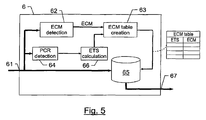
- the recording device 6 comprises an input 61 for receiving a scrambled data stream to be recorded, representing for example an audiovisual program. It also comprises a module for detecting the ECMs 62 which extracts the ECMs from the data stream received. The recording device 6 also comprises a PCR detection module 64 which extracts the values of the PCR of the data packets received. These values are used as was seen above to calculate, in a module 66, estimated values of PCR (ETS stamps) for the packets containing the ECMs. The module for creating an ECM table 63 then associates the ECMs whose values differ from one another with the ETS stamps calculated by the module 66 to form the ECM table of the recorded program.
- ETS stamps estimated values of PCR
- This ECM table is sent to a storage module 65 which records it with the data stream received on the input 61.
- the storage module 65 supplies the recorded data to an output 67 linked up preferably to a digital bus.
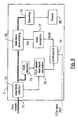
- This device receives on an input 71 a recorded data stream corresponding to a program.
- a module for selecting data blocks 72 asks the recording device for a particular data block in the program.
- a PCR detection module 73 extracts from this data block the PCR value or values which are contained therein so as to send them to a module 74 for calculating PCR values estimated for the data block.
- This module 74 calculates, according to a method which was developed above, an estimated stamp value for the first and the last packet of the data block and it sends these values to the ECM search module 75.
- This ECM search module 75 asks the recording device to send it the ECM table of the program which is currently being read and it extracts therefrom, on the basis of the estimated stamp values and according to a method which was set forth above, the ECM containing the keys necessary to descramble the packets of the data block received.
- the ECM is then transmitted to a decryption module 77 which extracts therefrom the descrambling key CW (or control word). It will be noted that the module 77 can carry out the decryption of the ECMs only if it is authorized to do so and possesses the key for decrypting the ECMs.
- the CW key is finally used by a descrambling module 78 which descrambles the packets of the data block and sends them to a decoding module 79 which supplies the signals necessary for the displaying of the program to a display device 80 (which possesses a screen for the video and speakers for the audio if necessary).
Landscapes
- Engineering & Computer Science (AREA)
- Signal Processing (AREA)
- Multimedia (AREA)
- Computer Security & Cryptography (AREA)
- Databases & Information Systems (AREA)
- Physics & Mathematics (AREA)
- Business, Economics & Management (AREA)
- Educational Administration (AREA)
- Educational Technology (AREA)
- General Physics & Mathematics (AREA)
- Theoretical Computer Science (AREA)
- Signal Processing For Digital Recording And Reproducing (AREA)
- Television Signal Processing For Recording (AREA)
Description
- The present invention relates to the field of the recording of compressed and scrambled digital data. It is more particularly concerned with a method of recording scrambled digital data and a method of reading such data.
- Devices for recording compressed digital data streams in particular for recording digital television signals have now been around for some time. This type of device, which takes the form for example of a hard disk, thus offers the users the ability to record digital television programs that they can subsequently read back as they used to do previously with their video recorder for analogue television programs.
- When data are recorded, in particular television programs, an attractive functionality consists in reading back these data according to particular modes of reading often referred to by the term "trick play modes", such as "backward play" or "fast forward" or even accelerated backward play. Another attractive mode consists in directly accessing a specific part of a program or in being able to make "jumps" in the data.
- These modes of reading are not always easy to implement with digital data compressed and coded, for example according to the MPEG-2 standard. Specifically, the compression and coding techniques have been designed to be used essentially for the transmission of digital data. Consequently, it is envisaged that the decoding of the data be done in "forward play" mode at normal speed. When digital audio/video data compressed and coded according to the MPEG-2 standard has to be read in backward play mode for example, it may be necessary, in order to display certain images, to decode several images before being capable of displaying one of them.
- When the recorded digital data are scrambled (one also speaks of "enciphered" or "encrypted" data), it is even more difficult to implement the "trick play" modes. It is in fact necessary to retrieve the descrambling keys before being able to descramble, then decode the data. According to the most conventional method of scrambling used in the field of digital pay-TV, the data descrambling keys are transmitted, in the digital data stream, in data packets denoted ECM (standing for "Entitlement Control Message"). The keys used to scramble the data (and which serve also to descramble them) are denoted CW (standing for "Control Word") and are changed periodically, typically every 10 seconds. The ECMs are transmitted in the data stream by being repeated every 100 ms for example and their content changes roughly every 10 seconds. In order to descramble a digital data packet, it is therefore necessary to retrieve firstly an ECM containing the CW key for descrambling this data packet.
- An ECM customarily contains two CW keys: an even key and an odd key. The digital data transport packets, coded in particular according to the DVB standard (standing for "Digital Video Broadcasting") or according to the standard of the ATSC (standing for "Advanced Television Systems Committee") contain, in a header, a scrambling indicator (or "flag") indicating whether or not the packet is scrambled and if it is, whether it is scrambled with the even or odd key. An ECM therefore always contains the CW key necessary for descrambling the next data packet transmitted in the stream. The second CW key that it contains is useful, either for descrambling certain data packets transmitted before the ECM in the data stream, or for descrambling certain data packets transmitted after the ECM in the stream.
-
Figure 1 diagrammatically illustrates this principle. We have represented adata stream 10 scrambled with various CW keys. We assume that thedata packets 100 corresponding to the period n-1 have been scrambled with the key CWn-1, thedata packets 101 corresponding to the period n have been scrambled with the key CWn and thedata packets 102 corresponding to the period n+1 have been scrambled with the key CWn+1. Each "key period" which corresponds to the period during which a key is used to scramble the data lasts, according to the example ofFigure 1 , 10 seconds. - In
Figure 1 we have also represented the ECMs which are transmitted in this data stream. For greater clarity, they are represented separately from the data stream but of course the ECMs are transmitted in practice in the data stream. They are transmitted, in the example represented inFigure 1 , every 100 ms and each contain, as made explicit at the bottom ofFigure 1 , two CW keys. These keys are represented diagrammatically with crosshatching or square hatching corresponding to the period for which they are used to scramble the data of thestream 10. InFigure 1 , only period n is represented in full, accompanied by the end of period n-1 and by the start of period n+1. - As illustrated in
Figure 1 , during a period n, the content of the ECMs transmitted in the data stream alters: at the start, the ECMs contain the key CWn-1 corresponding to the previous period and the key CWn corresponding to the current period. Then, their content is modified and they contain the key CWn corresponding to the current period and the key CWn+1 corresponding to the next period. The period during which a key CW is transmitted in the ECMs before the stream of data scrambled with this key CW is transmitted is referred to as "ECM Advance". This ECM Advance can last between 0 and the duration of the key period (10 s). - It may therefore be noted that, according to the direction of reading of the data stream and according to the reading speed, it may in certain cases be difficult to recover the CW key necessary in order to descramble the data before receiving the data. Specifically, it should be pointed out that the CW keys are transmitted in the ECMs by being encrypted and that they have to be decrypted, generally in a smart card linked up to the device for receiving the data stream, before being utilizable by this device for the descrambling of the data.
-
Document EP 1 143 722 A1 proposes a solution for facilitating the backward-play reading of this type of data stream consisting in inserting three CW keys into each ECM: a key for the current period, a key for the previous period and a key for the next period. This solution is not however satisfactory for the accelerated modes of reading (fast forward or accelerated backward play) and neither does it make it possible to perform fast "jumps" from one data block to another in a digital data stream. -
Document EP 1 215 905 proposes another solution for facilitating "trick-play" of this type of data stream, wherein the recorder stores ECMs with the corresponding CW keys in a list, each ECM having a transport stream packet index indicating the position of the packets. The following or the previous CW key may then easily be retrieved from this list. The present invention, however, presents an alternative solution to the problems. - The invention solves these problems by proposing a method of recording scrambled digital data comprising the steps consisting in: (a) receiving a scrambled digital data stream; (b) identifying in the data stream a control packet containing at least one key for descrambling at least a part of the data of the stream; (c) calculating an index indicating the position of the control packet (ECM) in the data stream, wherein said index comprises a time stamp (ETS) which defines the position of said control packet in the data stream with respect to clock reference values (PCR) transmitted immediately before said control packet and immediately after said control packet in the data stream; (d) storing the control packet and said index in a table; and (d) recording the data stream and the table on a data storage medium.
- According to particular characteristics of the invention:
- in the case where the data stream received in step (a) comprises a plurality of control packets containing at least one descrambling key, the storage step (c
d ) is carried out only if the control packet identified in step (b) is not already stored in the table. - The invention also relates to a data storage medium, containing: a scrambled digital data stream comprising control packets each containing at least one key for descrambling a part of the digital data, the control packets being multiplexed with the data packets, characterized in that it furthermore contains a table, stored separately from the data stream and containing at least one control packet and for each control packet, an index indicating the position of the control packet (ECM) in the data stream, wherein said index comprises a time stamp (ETS) which defines the position of said control packet in the data stream with respect to clock reference values (PCR) transmitted immediately before said control packet and immediately after said control packet in the data stream.
- The invention also relates to a method for reading scrambled digital data recorded on a data storage medium, comprising the steps consisting in: (i) selecting a block of data from a stream of recorded data, (j) extracting from said data block at least one clock reference value (PCR); (k) estimating, as a function of the clock reference value or values extracted, time stamps associated with the first packet and with the last packet that are contained in said data block selected in step (i); (l) extracting from the table recorded with the data at least one control packet (ECM) corresponding to this block of data using the time stamps estimated in step (k); (m) extracting from said control packet a descrambling key; and (n) using the descrambling key to descramble the block of data and to supply its content in clear for presentation to a user.
- The data reading method according to the invention can furthermore comprise one or more of the following characteristics:
- step (I) comprises: extracting from the table the control packet or packets lying from the packet having the highest index lower than the time stamp associated with the first packet of the data block and the packet having the highest index lower than the time stamp associated with the last packet of said data block, inclusive;
- step (m) of extracting a descrambling key from the control packet comprises a step of decrypting the control packet or the descrambling key.
- The invention will be better understood on reading the description which follows, given merely by way of example and while referring to the appended drawings in which:
-
Figure 1 diagrammatically illustrates a portion of a scrambled data stream. -
Figure 2 illustrates an exemplary implementation of the invention. -
Figures 3 and 4 illustrate a method of indexing the ECMs to construct an ECM table according to an embodiment of the invention. -
Figures 5 and6 represent details of the devices illustrated inFigure 2 according to the embodiment of the invention. - The basic idea of the invention is to create, during the recording of data, a table of ECMs in such a way as to very quickly retrieve the ECM containing the appropriate CW key during the reading of the recorded data. This advantageously makes it possible to gain access to the ECMs in advance with respect to the moment at which it is necessary to descramble the data and hence to be able to decrypt the ECMs in advance so as to retrieve the CW keys.
- The invention therefore advantageously allows the carrying out of varied "trick play" modes on digital data that are scrambled when they are recorded.
- The principle consists in recording an ECM table for each program recorded, this table containing all the ECMs necessary for descrambling the program. In particular, in the case where a program comprises streams of digital Audio and Video data and possibly streams of other data, all the ECMs necessary for descrambling these various streams are recorded in the ECM table for this program.
- It will also be noted that only the ECMs whose content differs with respect to that transmitted previously in the data stream are recorded in the ECM table. Thus, for that part of the data stream that is represented in
Figure 1 , only the ECM containing the keys CWn-1 and CWn, the ECM containing the keys CWn and CWn+1 and the ECM containing the keys CWn+1 and CWn+2 will be recorded in the ECM table. As the content of the ECMs changes roughly once per "key period" it is only necessary to record one of them per "key period". - According to another aspect of the invention, an ECM index is recorded in the ECM table, for each ECM recorded, in such a way as to be able subsequently to very quickly retrieve the ECM necessary for descrambling specified data packets.
- According to an embodiment, the ECM index is produced by calculating a stamp, that is to say a time stamp associated with the ECM defining its position in the data stream with respect to the value of the clock transmitted in the data stream.
- In
Figure 2 , we have represented an example of the practice of the invention. Arecording device 1 receives a stream of input data to be recorded. This stream of digital data is typically scrambled according to the principle of digital pay-TV by control words - or keys - CW, the keys CW being renewed with a certain periodicity (for example every 10 seconds) and being inserted into control messages denoted ECM as is illustrated inFigure 1 that has already been described. - The recording device comprises means of storing the recorded data, for example a hard disk, and is linked up via a
digital bus 3 to apresentation device 2. The recording device can also be a digital video recorder that records data on magnetic media, such as cassettes, or else an optical disk writer that records data on optical media (such as CD - standing for "compact disc" - or DVD - standing for "digital versatile disc"). - The
presentation device 2 is for example a digital television receiver which contains at least elements for deciphering the ECMs, for descrambling the data received and for decoding them so as to present them to a user. The recorded data are typically audio/video data and their presentation to the user is performed by display on a screen as regards the video data and transmission on speakers as regards the audio data. Thepresentation device 2 also comprises a user interface allowing the user to read back the data recorded according to "trick play" modes such as, fast forward, backward play, slow motion, jumping from one program to another, etc. - The
digital bus 3 is for example a bus according to the IEEE 1394 standard. - The invention is naturally not limited to this setup. In particular, it is possible for the
recording device 1 and for certain elements (deciphering of the ECMs, descrambling and decoding of the data) of the presentation device to be included in one and the same appliance, such as a new-generation digital decoder comprising a hard disk. This appliance would in this case be linked to a traditional television for the presentation of the data to the user. - At the time of the recording of the data stream, the
recording device 1 analyzes the stream so as to extract the ECMs and simultaneously create an ECM table containing all the ECMs that are necessary for descrambling the recorded part of the data stream. We shall assume hereinbelow that the user records audiovisual programs, transmitted according to the DVB digital television transmission standard and coded according to the MPEG-2 standard (ITU-T Rec. H.222.0 | ISO/IEC 13818-1) but the invention naturally applies to any type of digital data on which it may be useful to perform particular modes of reading ("trick play" modes), whether they are coded according to a compression standard other than the MPEG-2 standard or whether they are broadcast according to a broadcasting standard other than the DVB standard. - The ECMs corresponding to a specified program to be recorded are identified in the data stream by the PID (standing for "Packet Identifier") of the data transport packets that contain them. This PID is itself indicated in the PMT (standing for "Program Map Table") associated with each program transmitted. The
recording device 1 uses this PID to extract the ECMs of a program that it records. - The process for recording the ECMs in the table is as follows: when the
recording device 1 receives the first ECM of the recorded data stream, it stores it in the ECM table. When it receives the next ECM, it compares it with the one stored previously: if their content is identical, it takes no account thereof, otherwise it stores it too. The process continues thus with all the ECMs received. - By way of example, for a film lasting 2.5 hours (i.e. 9000 seconds), there will be roughly 900 different ECMs (since their content is renewed roughly every 10 seconds) if a single ECM stream is necessary for the audio and the video. Each ECM being stored in a 188-byte data transport packet (in the aforesaid MPEG standard), the ECM table will therefore have to contain 188 x 900 bytes, i.e. 169200 bytes.
- The
recording device 1 also creates, for each ECM recorded in the table, an index making it possible to store the position of the ECM in the data stream. This index, stored in the table, is thereafter used by thepresentation device 2 to easily retrieve the ECM necessary for descrambling a specified part of the data. - A method of indexing the ECMs is now described in conjunction with
Figures 3 and 4 . - According to this method, one seeks to allocate a time stamp to each packet containing an ECM which is to be stored in the ECM table. This index is denoted ETS (standing for "ECM Time Stamp") and is calculated from values of clock references that are transmitted in the data stream and that are denoted PCR (standing for "Program Clock Reference") in the aforesaid MPEG-2 standard.
- The PCR values are situated in an adaptation field of the header of certain data packets. It will be noted that, even when the data (for example video) contained in the packet are scrambled, the header of the transport packet, which optionally comprises an adaptation field containing among other things a PCR value, is not scrambled. The PCR values are therefore accessible in clear.
- The PCR values represent the values of a 27-MHz clock tick counter and are transmitted in the data packets with a certain periodicity.
- The method of indexing of the embodiment is performed as follows, illustrated by
Figures 3 and 4 : to calculate the index ETSn of an ECMn extracted from a recorded data stream, one recovers the value of PCR1n immediately preceding the ECMn and the value of PCR2n immediately following the ECMn. One then counts the number of packets Pn between the two values PCR1n and PCR2n transmitted and the number of packets En between the value PCR1n and ECMn and it is thus possible to interpolate a virtual value of PCR corresponding to the packet containing the ECMn. - This value ETSn, which constitutes the index of the ECMn in the ECM table represented in
Figure 6 , is calculated as follows:
- Given the accuracy required for the PCR values in the MPEG-2 standard and their period of repetition in the data streams (they have to be transmitted at least every 0.1 s), this method of calculation makes it possible to ensure that each ECM that will have to be stored in the ECM table will have a different ETS index (roughly one ECM every 10 s - but this remains true even in the case where a different ECM is transmitted every second).
- Once the ECM table has been constructed with an index for each ECM stored in the table, the latter is recorded with the data constituting the program that has just been recorded on an appropriate medium. Preferably, the ECM table is stored in the same file as that containing the audio/video data of the program, for example at the start of the file. The ECM table can also, as a variant, be stored in a different file from that containing the recorded program.
- The ECM table can also be multiplexed with the data constituting the program. For example, when the data stored are in the
MPEG 2 format, it is possible to create a "private section" according toMPEG 2 with a specific PID number and to store all the data packets forming the ECM table with this PID in their header. - In another variant where the program is recorded on a cassette, the ECM table will preferably be recorded at the start of the cassette.
- It will be noted that the program which is recorded always contains the ECM packets in the data stream so that any device can always perform an ordinary reading of the data even if it is not equipped with means for managing "trick play" modes.
- We shall now describe the manner in which a program's data recorded by the
recording device 1 according to the method seen hereinabove are read back by thepresentation device 2, in particular when the data are read according to a "trick play" mode such as "fast forward", "backward play" or "jump to a specific location of the program". - To do this, the
presentation device 2 recovers the data of a program as blocks of data containing several data packets which approximately represent a GOP (standing for "Group Of Pictures"), a concept that is defined in the MPEG-2 standard. When the data are scrambled, they have to be descrambled before any subsequent processing. The CW keys for descrambling the data block recovered must therefore be quickly retrieved and the ECM or ECMs containing the CW keys necessary for the descrambling of the data block must therefore be retrieved. - To do this, the ECM table stored with the data will be used.
- According to the method, it is necessary to retrieve what would be the PCR value of the data packets belonging to the data block recovered by the
presentation device 2. - As explained above, the PCR values are transmitted regularly in the data streams, at least every 0.1 s. Moreover, the amount of data for a GOP lasts roughly 0.5 s. When a data block of the approximate size of a GOP is recovered, there is therefore always at least one packet in the data block which contains a PCR value.
- According to the number of PCR values present in the data block, we have two methods of determining the value of the stamp of the packets of the data block:
- 1/ A single PCR value in the entire data block:
Let us assume that we seek to determine the stamp STAMPn of a data packet n of the data block (corresponding to the virtual PCR value for this packet) and let us assume that a PCR value has been found in a packet of the data block, then the value of the stamp is calculated as follows:
- Dn corresponding to the distance in terms of number of packets between packet n and the packet containing the PCR value (Dn can be positive or negative);
- PCR being the value of PCR found in the data block;
- Rn corresponding to the bit rate in bits/s of the data block;
- F being the frequency of the system reference clock (customarily 27 MHz +/- 810 Hz according to the
MPEG 2 standard); - and Tn corresponding to the size of the packets in bits (customarily 188 x 8 according to the
MPEG 2 standard).
- 2/ Two or more PCR values contained in the entire data block:
To determine the value of the stamp STAMPn of a packet n of the data block containing at least two PCR values, we perform the following calculation:
- PCR1n being the first PCR value closest to packet n;
- PCR2n being the second PCR value closest to packet n;
- Pn corresponding to the number of packets between that containing PCR1n and that containing PCR2n; and
- Dn corresponding to the distance in terms of number of packets between packet n and the packet containing PCR1n (Dn can be positive or negative).
- Once this stamp STAMPn has been calculated according to one of the above methods, the presentation device searches the ECM table for the value of the index ETSn which is just below but closest to the calculated value STAMPn. The ECM stored at this index ETSn in principle contains the necessary key(s) for descrambling the packets of the data block.
- In certain cases it may happen that the data block recovered by the presentation device is such that it is necessary to retrieve several ECMs to descramble the data block. This can occur, for example, if the data block overlaps several key periods. Referring to
Figure 1 , this could be the case if the data block recovered overlapped periods n-1, n and n+1. In this case, it would be necessary to recover the ECM containing CWn-1 and CWn and the ECM containing CWn and CWn+1. - This is why, we shall in practice proceed to the calculation of a stamp value STAMPn1 for the first packet of the data block and STAMPn2 for the last packet of the data block. The ECM table is then searched for ECM1 and ECM2 stored at the indices ETS1 and ETS2 whose values are less than and closest to the values STAMPn1 and STAMPn2 and all the ECMs between ECM1 and ECM2 may possibly be recovered. In most cases however, one and the same ECM will be found in the ECM table for the stamp values STAMPn1 and STAMPn2.
- We shall now describe an exemplary embodiment of recording devices or presentation devices.
- In
Figure 5 , we have represented arecording device 6 according to the embodiment of the invention. - The
recording device 6 comprises aninput 61 for receiving a scrambled data stream to be recorded, representing for example an audiovisual program. It also comprises a module for detecting theECMs 62 which extracts the ECMs from the data stream received. Therecording device 6 also comprises aPCR detection module 64 which extracts the values of the PCR of the data packets received. These values are used as was seen above to calculate, in amodule 66, estimated values of PCR (ETS stamps) for the packets containing the ECMs. The module for creating an ECM table 63 then associates the ECMs whose values differ from one another with the ETS stamps calculated by themodule 66 to form the ECM table of the recorded program. - This ECM table is sent to a
storage module 65 which records it with the data stream received on theinput 61. Thestorage module 65 supplies the recorded data to anoutput 67 linked up preferably to a digital bus. - Finally, we have represented in
Figure 6 apresentation device 7 according to the embodiment of the invention. - This device receives on an input 71 a recorded data stream corresponding to a program. A module for selecting data blocks 72 asks the recording device for a particular data block in the program. A
PCR detection module 73 extracts from this data block the PCR value or values which are contained therein so as to send them to amodule 74 for calculating PCR values estimated for the data block. Thismodule 74 calculates, according to a method which was developed above, an estimated stamp value for the first and the last packet of the data block and it sends these values to theECM search module 75. - This
ECM search module 75 asks the recording device to send it the ECM table of the program which is currently being read and it extracts therefrom, on the basis of the estimated stamp values and according to a method which was set forth above, the ECM containing the keys necessary to descramble the packets of the data block received. The ECM is then transmitted to adecryption module 77 which extracts therefrom the descrambling key CW (or control word). It will be noted that themodule 77 can carry out the decryption of the ECMs only if it is authorized to do so and possesses the key for decrypting the ECMs. - The CW key is finally used by a
descrambling module 78 which descrambles the packets of the data block and sends them to adecoding module 79 which supplies the signals necessary for the displaying of the program to a display device 80 (which possesses a screen for the video and speakers for the audio if necessary).
Claims (6)
- Method of recording scrambled digital data comprising the steps consisting in:(a) receiving a scrambled digital data stream;(b) identifying in said data stream a control packet (ECM) containing at least one key (CW) for descrambling at least a part of the data of the stream;(c) calculating an index indicating the position of the control packet (ECM) in the data stream, wherein said index comprises a time stamp (ETS) which defines the position of said control packet in the data stream with respect to clock reference values (PCR) transmitted immediately before said control packet and immediately after said control packet in the data stream;(d) storing said control packet and said index in a table; and(e) recording the data stream and the table on a data storage medium.
- Method according to Claim 1 in which the data stream received in step (a) comprises a plurality of control packets (ECM) containing at least one descrambling key (CW), characterized in that the storage step (d) is carried out only if the control packet identified in step (b) is not already stored in said table.
- Data storage medium, containing:a scrambled digital data stream comprising control packets (ECM) each containing at least one key (CW) for descrambling a part of the digital data, the control packets being multiplexed with the data packets,characterized in that it furthermore contains a table, stored separately from the data stream and containing:- at least one control packet; and- for each control packet, an index indicating the position of the control packet (ECM) in the data stream, wherein said index comprises a time stamp (ETS) which defines the position of said control packet in the data stream with respect to clock reference values (PCR) transmitted immediately before said control packet and immediately after said control packet in the data stream.
- Method for reading scrambled digital data recorded on a medium according to Claim 3, comprising the steps consisting in:(i) selecting a block of data from a stream of recorded data,(j) extracting from said data block at least one clock reference value (PCR),(k) estimating, as a function of the clock reference value or values extracted, time stamps associated with the first packet and with the last packet that are contained in said data block selected in step (i), and(l) extracting from the table recorded with the data at least one control packet (ECM) corresponding to this block of data using the time stamps estimated in step (k),(m) extracting from said control packet a descrambling key (CW); and(n) using said descrambling key to descramble the block of data and to supply its content in clear for presentation to a user.
- Method according to claim 4, characterized in that step (I) comprises: extracting from the table the control packet or packets lying from the packet having the highest index lower than the time stamp associated with the first packet of the data block and the packet having the highest index lower than the time stamp associated with the last packet of said data block, inclusive.
- Method according to Claim 4, characterized in that step (m) of extracting a descrambling key (CW) from the control packet comprises a step of decrypting said control packet or said descrambling key
Applications Claiming Priority (2)
| Application Number | Priority Date | Filing Date | Title |
|---|---|---|---|
| FR0301857 | 2003-02-11 | ||
| FR0301857 | 2003-02-11 |
Publications (2)
| Publication Number | Publication Date |
|---|---|
| EP1447983A1 EP1447983A1 (en) | 2004-08-18 |
| EP1447983B1 true EP1447983B1 (en) | 2009-12-30 |
Family
ID=32669378
Family Applications (1)
| Application Number | Title | Priority Date | Filing Date |
|---|---|---|---|
| EP04100220A Expired - Lifetime EP1447983B1 (en) | 2003-02-11 | 2004-01-22 | Method of recording scrambled digital data, storage medium and method of reading such data |
Country Status (8)
| Country | Link |
|---|---|
| US (1) | US7869596B2 (en) |
| EP (1) | EP1447983B1 (en) |
| JP (1) | JP4322695B2 (en) |
| KR (1) | KR101004248B1 (en) |
| CN (1) | CN100477771C (en) |
| DE (1) | DE602004024839D1 (en) |
| MY (1) | MY140600A (en) |
| TW (1) | TWI332800B (en) |
Cited By (1)
| Publication number | Priority date | Publication date | Assignee | Title |
|---|---|---|---|---|
| US9171569B2 (en) | 2007-04-27 | 2015-10-27 | Google Technology Holdings LLC | Method and apparatus for assisting with content key changes |
Families Citing this family (41)
| Publication number | Priority date | Publication date | Assignee | Title |
|---|---|---|---|---|
| EP1447983B1 (en) | 2003-02-11 | 2009-12-30 | Thomson Licensing | Method of recording scrambled digital data, storage medium and method of reading such data |
| JP4162629B2 (en) * | 2004-06-01 | 2008-10-08 | 三洋電機株式会社 | Decoder device |
| EP1742473A1 (en) * | 2005-07-06 | 2007-01-10 | Nagra France Sarl | Method for transmitting a digital data stream and control meessages associated with the data stream to mobile devices |
| EP1742475A1 (en) * | 2005-07-07 | 2007-01-10 | Nagravision S.A. | Method to control access to enciphered data |
| KR20070058288A (en) * | 2005-12-02 | 2007-06-08 | 삼성전자주식회사 | Method and apparatus for descrambling av stream |
| EP1850593A1 (en) * | 2006-04-27 | 2007-10-31 | Nagravision S.A. | Method for generating packets destinated to at least one mobile receiver |
| EP1863285A1 (en) * | 2006-05-29 | 2007-12-05 | Nagra France Sas | Method for processing entitlement control messages |
| US9277295B2 (en) | 2006-06-16 | 2016-03-01 | Cisco Technology, Inc. | Securing media content using interchangeable encryption key |
| US9137480B2 (en) | 2006-06-30 | 2015-09-15 | Cisco Technology, Inc. | Secure escrow and recovery of media device content keys |
| US20080270311A1 (en) * | 2007-04-27 | 2008-10-30 | General Instrument Corporation | Method and Apparatus for Composing a Digital Rights Management License Format |
| CN101325480B (en) * | 2007-06-13 | 2012-05-23 | 中兴通讯股份有限公司 | Method and device for scrambling control based on multiplexed subframes |
| US8108680B2 (en) | 2007-07-23 | 2012-01-31 | Murray Mark R | Preventing unauthorized poaching of set top box assets |
| US8385545B2 (en) | 2007-07-27 | 2013-02-26 | Howard G. Pinder | Secure content key distribution using multiple distinct methods |
| US7949133B2 (en) * | 2007-09-26 | 2011-05-24 | Pinder Howard G | Controlled cryptoperiod timing to reduce decoder processing load |
| US8837908B2 (en) * | 2009-01-06 | 2014-09-16 | Cyberlink Corp. | Systems and methods for performing secure playback of media content |
| WO2010079435A2 (en) * | 2009-01-07 | 2010-07-15 | Nds Limited | Data stream storage system |
| EP2207340A1 (en) | 2009-01-12 | 2010-07-14 | Thomson Licensing | Method and device for reception of control words, and device for transmission thereof |
| JP4731619B2 (en) * | 2009-09-18 | 2011-07-27 | 三菱電機株式会社 | Storage / playback device |
| CN102714594B (en) * | 2009-12-14 | 2016-08-10 | 住友电气工业株式会社 | Content receiving device, content reproducing device, content receiving and reproducing device, content receiving method and program |
| GB2481573A (en) * | 2010-06-15 | 2012-01-04 | Nds Ltd | Splicng of encoded media content |
| JP4954337B2 (en) * | 2011-03-30 | 2012-06-13 | 三菱電機株式会社 | Storage / playback device |
| US9503785B2 (en) * | 2011-06-22 | 2016-11-22 | Nagrastar, Llc | Anti-splitter violation conditional key change |
| US9357159B2 (en) | 2011-08-23 | 2016-05-31 | Echostar Technologies L.L.C. | Grouping and presenting content |
| US8660412B2 (en) | 2011-08-23 | 2014-02-25 | Echostar Technologies L.L.C. | System and method for dynamically adjusting recording parameters |
| US9621946B2 (en) | 2011-08-23 | 2017-04-11 | Echostar Technologies L.L.C. | Frequency content sort |
| US8447170B2 (en) | 2011-08-23 | 2013-05-21 | Echostar Technologies L.L.C. | Automatically recording supplemental content |
| US9185331B2 (en) | 2011-08-23 | 2015-11-10 | Echostar Technologies L.L.C. | Storing multiple instances of content |
| US8437622B2 (en) | 2011-08-23 | 2013-05-07 | Echostar Technologies L.L.C. | Altering presentation of received content based on use of closed captioning elements as reference locations |
| US8627349B2 (en) | 2011-08-23 | 2014-01-07 | Echostar Technologies L.L.C. | User interface |
| JP5389959B2 (en) * | 2012-01-26 | 2014-01-15 | 三菱電機株式会社 | Storage and reproduction apparatus and method thereof |
| US8959544B2 (en) | 2012-03-15 | 2015-02-17 | Echostar Technologies L.L.C. | Descrambling of multiple television channels |
| US8819722B2 (en) | 2012-03-15 | 2014-08-26 | Echostar Technologies L.L.C. | Smartcard encryption cycling |
| US9489981B2 (en) | 2012-03-15 | 2016-11-08 | Echostar Technologies L.L.C. | Successive initialization of television channel recording |
| US8793724B2 (en) | 2012-11-08 | 2014-07-29 | Eldon Technology Limited | Image domain compliance |
| US9392319B2 (en) | 2013-03-15 | 2016-07-12 | Nagrastar Llc | Secure device profiling countermeasures |
| US9628838B2 (en) | 2013-10-01 | 2017-04-18 | Echostar Technologies L.L.C. | Satellite-based content targeting |
| CN104244068B (en) * | 2014-09-04 | 2018-05-01 | 深圳市九洲电器有限公司 | One kind records program reproduction process method and system |
| US9756378B2 (en) | 2015-01-07 | 2017-09-05 | Echostar Technologies L.L.C. | Single file PVR per service ID |
| WO2017047399A1 (en) * | 2015-09-15 | 2017-03-23 | ソニー株式会社 | Reception device and method, and transmission device and method |
| JP6596363B2 (en) * | 2016-03-08 | 2019-10-23 | 日本放送協会 | Time mapping information generation apparatus, synchronized playback system, time mapping information generation method, and time mapping information generation program |
| CN113721074A (en) * | 2020-11-12 | 2021-11-30 | 王沛 | Novel intelligent electric energy meter |
Family Cites Families (13)
| Publication number | Priority date | Publication date | Assignee | Title |
|---|---|---|---|---|
| JP3585679B2 (en) | 1996-12-04 | 2004-11-04 | 株式会社東芝 | Broadcast station device and receiving terminal device |
| JP2000115091A (en) | 1998-10-07 | 2000-04-21 | Nippon Hoso Kyokai <Nhk> | Information recording device and information reproducing device |
| JP3774579B2 (en) | 1998-11-18 | 2006-05-17 | 松下電器産業株式会社 | AV bitstream recording / playback system |
| JP2000173181A (en) * | 1998-12-04 | 2000-06-23 | Sony Corp | Data recording device and output device, data output system, data recording method and output method, and data recording and output method |
| FR2801464B1 (en) | 1999-11-22 | 2001-12-28 | Thomson Multimedia Sa | METHOD FOR RECORDING A SCRATCHED MPEG STREAM |
| JP4012398B2 (en) | 2000-12-15 | 2007-11-21 | 松下電器産業株式会社 | BROADCAST DEVICE AND RECEPTION DEVICE PROVIDING STORAGE SERVICE |
| EP1215905B2 (en) * | 2000-12-15 | 2010-04-21 | Panasonic Corporation | Reception apparatus having a storage unit for recording a scrambled broadcast signal and broadcast apparatus for scrambling a signal to be broadcast, and associated methods |
| US6662198B2 (en) * | 2001-08-30 | 2003-12-09 | Zoteca Inc. | Method and system for asynchronous transmission, backup, distribution of data and file sharing |
| US20050201556A1 (en) * | 2002-06-12 | 2005-09-15 | Koninklijke Philipselectronics N.V. | Trick play of encrypted data in a conditional access signal |
| US7796503B2 (en) * | 2002-09-03 | 2010-09-14 | Fujitsu Limited | Fault tolerant network routing |
| US7020287B2 (en) * | 2002-09-30 | 2006-03-28 | Sony Corporation | Method and system for key insertion for stored encrypted content |
| US20040083177A1 (en) * | 2002-10-29 | 2004-04-29 | General Instrument Corporation | Method and apparatus for pre-encrypting VOD material with a changing cryptographic key |
| EP1447983B1 (en) | 2003-02-11 | 2009-12-30 | Thomson Licensing | Method of recording scrambled digital data, storage medium and method of reading such data |
-
2004
- 2004-01-22 EP EP04100220A patent/EP1447983B1/en not_active Expired - Lifetime
- 2004-01-22 DE DE602004024839T patent/DE602004024839D1/en not_active Expired - Lifetime
- 2004-02-06 TW TW093102707A patent/TWI332800B/en not_active IP Right Cessation
- 2004-02-10 MY MYPI20040404A patent/MY140600A/en unknown
- 2004-02-10 JP JP2004033668A patent/JP4322695B2/en not_active Expired - Fee Related
- 2004-02-11 CN CNB2004100053683A patent/CN100477771C/en not_active Expired - Fee Related
- 2004-02-11 KR KR1020040008895A patent/KR101004248B1/en not_active Expired - Fee Related
- 2004-02-11 US US10/776,560 patent/US7869596B2/en not_active Expired - Fee Related
Cited By (1)
| Publication number | Priority date | Publication date | Assignee | Title |
|---|---|---|---|---|
| US9171569B2 (en) | 2007-04-27 | 2015-10-27 | Google Technology Holdings LLC | Method and apparatus for assisting with content key changes |
Also Published As
| Publication number | Publication date |
|---|---|
| US20050105886A1 (en) | 2005-05-19 |
| JP2004247036A (en) | 2004-09-02 |
| CN100477771C (en) | 2009-04-08 |
| CN1522063A (en) | 2004-08-18 |
| EP1447983A1 (en) | 2004-08-18 |
| TW200423743A (en) | 2004-11-01 |
| TWI332800B (en) | 2010-11-01 |
| MY140600A (en) | 2009-12-31 |
| DE602004024839D1 (en) | 2010-02-11 |
| JP4322695B2 (en) | 2009-09-02 |
| KR101004248B1 (en) | 2010-12-24 |
| KR20040073347A (en) | 2004-08-19 |
| US7869596B2 (en) | 2011-01-11 |
Similar Documents
| Publication | Publication Date | Title |
|---|---|---|
| US7869596B2 (en) | Method of recording scrambled digital data, storage medium and method of reading such data | |
| EP1324614B1 (en) | System for data stream processing | |
| US7079752B1 (en) | Process for recording a scrambled MPEG stream | |
| EP1547300B1 (en) | Method and system for key insertion for stored encrypted content | |
| US7391866B2 (en) | Broadcast apparatus and reception apparatus for providing a storage service by which scrambled content is stored and descrambled using scrambling key list | |
| US20080170687A1 (en) | Device for and a Method of Processing an Encrypted Data Stream | |
| EP1417837B1 (en) | System for random access to content | |
| EP1309195B1 (en) | Method for recording a digital broadcast program and time-based playback of a recorded broadcast program and apparatus therefor | |
| US20070258586A1 (en) | Personal video recorder having dynamic security functions and method thereof | |
| JP2001502854A (en) | Method of forming program specific information for digital data processing | |
| JP2000511019A (en) | Packetized data format for digital data storage media | |
| US20090141888A1 (en) | Method and apparatus for performing trick play on scrambled data stream | |
| WO2006114761A1 (en) | A device for and a method of detecting positions of intra-coded frames in a data stream | |
| EP1995731B1 (en) | Method to guarantee seamless playback of data streams | |
| EP1602235B1 (en) | Generation of encrypted video information | |
| RU2180470C2 (en) | Processing digital data and program pointer information | |
| CN100588245C (en) | Conditional access device and method | |
| US7006755B2 (en) | Storage device with an index indicating a sequential relationship | |
| JP2002281456A (en) | Digital broadcast stream storage method | |
| JP4861221B2 (en) | RECORDING DEVICE, RECORDING METHOD, VIDEO RECORDING / REPRODUCING DEVICE, AND RECORDING FILE PROCESSING METHOD THEREOF | |
| WO2004112395A1 (en) | Device and method in a multimedia broadcast system |
Legal Events
| Date | Code | Title | Description |
|---|---|---|---|
| PUAI | Public reference made under article 153(3) epc to a published international application that has entered the european phase |
Free format text: ORIGINAL CODE: 0009012 |
|
| AK | Designated contracting states |
Kind code of ref document: A1 Designated state(s): AT BE BG CH CY CZ DE DK EE ES FI FR GB GR HU IE IT LI LU MC NL PT RO SE SI SK TR |
|
| AX | Request for extension of the european patent |
Extension state: AL LT LV MK |
|
| 17P | Request for examination filed |
Effective date: 20050121 |
|
| 17Q | First examination report despatched |
Effective date: 20050217 |
|
| AKX | Designation fees paid |
Designated state(s): DE FR GB IT |
|
| RBV | Designated contracting states (corrected) |
Designated state(s): DE FR GB IT |
|
| RAP1 | Party data changed (applicant data changed or rights of an application transferred) |
Owner name: THOMSON LICENSING |
|
| GRAP | Despatch of communication of intention to grant a patent |
Free format text: ORIGINAL CODE: EPIDOSNIGR1 |
|
| GRAS | Grant fee paid |
Free format text: ORIGINAL CODE: EPIDOSNIGR3 |
|
| GRAA | (expected) grant |
Free format text: ORIGINAL CODE: 0009210 |
|
| AK | Designated contracting states |
Kind code of ref document: B1 Designated state(s): DE FR GB IT |
|
| REG | Reference to a national code |
Ref country code: GB Ref legal event code: FG4D |
|
| REF | Corresponds to: |
Ref document number: 602004024839 Country of ref document: DE Date of ref document: 20100211 Kind code of ref document: P |
|
| RAP2 | Party data changed (patent owner data changed or rights of a patent transferred) |
Owner name: THOMSON LICENSING |
|
| PLBE | No opposition filed within time limit |
Free format text: ORIGINAL CODE: 0009261 |
|
| STAA | Information on the status of an ep patent application or granted ep patent |
Free format text: STATUS: NO OPPOSITION FILED WITHIN TIME LIMIT |
|
| 26N | No opposition filed |
Effective date: 20101001 |
|
| PGFP | Annual fee paid to national office [announced via postgrant information from national office to epo] |
Ref country code: DE Payment date: 20110119 Year of fee payment: 8 Ref country code: IT Payment date: 20110122 Year of fee payment: 8 Ref country code: FR Payment date: 20110201 Year of fee payment: 8 |
|
| PGFP | Annual fee paid to national office [announced via postgrant information from national office to epo] |
Ref country code: GB Payment date: 20110127 Year of fee payment: 8 |
|
| GBPC | Gb: european patent ceased through non-payment of renewal fee |
Effective date: 20120122 |
|
| REG | Reference to a national code |
Ref country code: FR Ref legal event code: ST Effective date: 20120928 |
|
| PG25 | Lapsed in a contracting state [announced via postgrant information from national office to epo] |
Ref country code: GB Free format text: LAPSE BECAUSE OF NON-PAYMENT OF DUE FEES Effective date: 20120122 Ref country code: DE Free format text: LAPSE BECAUSE OF NON-PAYMENT OF DUE FEES Effective date: 20120801 |
|
| REG | Reference to a national code |
Ref country code: DE Ref legal event code: R119 Ref document number: 602004024839 Country of ref document: DE Effective date: 20120801 |
|
| PG25 | Lapsed in a contracting state [announced via postgrant information from national office to epo] |
Ref country code: IT Free format text: LAPSE BECAUSE OF NON-PAYMENT OF DUE FEES Effective date: 20120122 |
|
| PG25 | Lapsed in a contracting state [announced via postgrant information from national office to epo] |
Ref country code: FR Free format text: LAPSE BECAUSE OF NON-PAYMENT OF DUE FEES Effective date: 20120131 |