EP1447974A2 - Method and program for correcting facial image and recording medium - Google Patents
Method and program for correcting facial image and recording medium Download PDFInfo
- Publication number
- EP1447974A2 EP1447974A2 EP04250577A EP04250577A EP1447974A2 EP 1447974 A2 EP1447974 A2 EP 1447974A2 EP 04250577 A EP04250577 A EP 04250577A EP 04250577 A EP04250577 A EP 04250577A EP 1447974 A2 EP1447974 A2 EP 1447974A2
- Authority
- EP
- European Patent Office
- Prior art keywords
- correction
- color
- pixel
- facial image
- pointed
- Prior art date
- Legal status (The legal status is an assumption and is not a legal conclusion. Google has not performed a legal analysis and makes no representation as to the accuracy of the status listed.)
- Granted
Links
Images



Classifications
-
- G—PHYSICS
- G06—COMPUTING OR CALCULATING; COUNTING
- G06T—IMAGE DATA PROCESSING OR GENERATION, IN GENERAL
- G06T11/00—Two-dimensional [2D] image generation
- G06T11/60—Creating or editing images; Combining images with text
-
- G—PHYSICS
- G06—COMPUTING OR CALCULATING; COUNTING
- G06V—IMAGE OR VIDEO RECOGNITION OR UNDERSTANDING
- G06V40/00—Recognition of biometric, human-related or animal-related patterns in image or video data
- G06V40/10—Human or animal bodies, e.g. vehicle occupants or pedestrians; Body parts, e.g. hands
- G06V40/16—Human faces, e.g. facial parts, sketches or expressions
- G06V40/168—Feature extraction; Face representation
- G06V40/171—Local features and components; Facial parts ; Occluding parts, e.g. glasses; Geometrical relationships
-
- H—ELECTRICITY
- H04—ELECTRIC COMMUNICATION TECHNIQUE
- H04N—PICTORIAL COMMUNICATION, e.g. TELEVISION
- H04N1/00—Scanning, transmission or reproduction of documents or the like, e.g. facsimile transmission; Details thereof
- H04N1/46—Colour picture communication systems
- H04N1/56—Processing of colour picture signals
- H04N1/60—Colour correction or control
- H04N1/62—Retouching, i.e. modification of isolated colours only or in isolated picture areas only
- H04N1/622—Retouching, i.e. modification of isolated colours only or in isolated picture areas only with simulation on a subsidiary picture reproducer
-
- H—ELECTRICITY
- H04—ELECTRIC COMMUNICATION TECHNIQUE
- H04N—PICTORIAL COMMUNICATION, e.g. TELEVISION
- H04N1/00—Scanning, transmission or reproduction of documents or the like, e.g. facsimile transmission; Details thereof
- H04N1/46—Colour picture communication systems
- H04N1/56—Processing of colour picture signals
- H04N1/60—Colour correction or control
- H04N1/62—Retouching, i.e. modification of isolated colours only or in isolated picture areas only
- H04N1/624—Red-eye correction
Definitions
- the present invention relates to a method and program for correcting a facial image of a person taken by a digital camera.
- a digital camera records an optical subject image formed by a CCD or the like on a memory such as an internal memory, a memory card and the like.
- the image photographed by the digital camera is downloaded to, for example, a PC (personal computer), in order to post the image on a World Wide Web home page or print it on a recording paper.
- PC personal computer
- Japanese Patent Laid-Open Publication No. 11-17969 discloses a method for correcting color in which when the skin color becomes greenish or blackish due to lighting in the image, only the hue value of a pixel, which is outside of a predetermined range, is replaced or smoothed to correct the skin color.
- Japanese Patent Laid-Open Publication No. 11-250227 discloses the technology in which the pixel image is subjected to smoothing only when dispersion of the pixel values of surrounding pixels is small. This technology makes it possible to smoothly correct bumps and dips in skin due to a wrinkle, a pimple and the like, while defining the borders between areas such as eyes and hair which have different colors from each other.
- each correction has to be carried out item by item.
- each correction has to be carried out item by item.
- taking a case of correcting skin color and hair color first the skin color is corrected, and then the hair color is corrected.
- the procedure for correcting operation differs from each correction item. Therefore, there are problems that it takes a lot of time to carry out every selected correction item, and the correcting operation is troublesome.
- An object of the present invention is to provide a method and program for correcting a facial image by which the image is corrected for plural correction items with single and simple operation in a short time.
- a method for correcting a facial image comprises the steps of (a) extracting pixels representing specific areas from the facial image; (b) determining a correction item to be performed out of plural correction items, each of the correction items corresponding to each area; (c) detecting the position of a cursor in the facial image displayed on a monitor; and (d) if a pointed pixel pointed by the cursor is in the area corresponding to the correction item to be executed, subjecting the pointed pixel to correction process that is set in accordance with the correction item.
- One of the correction items is skin correction.
- the pointed pixel is in a skin area, and the color of the pointed pixel is outside of the range of predetermined skin color, the color of the pointed pixel is corrected.
- the predetermined skin color is selectable from plural colors.
- One of the correction items is red-eye correction.
- the pointed pixel is in an eye area, and the color of the pointed pixel is red, the color of the pointed pixel is corrected.
- the pointed pixel may be corrected to a selected eye color.
- One of the correction items is teeth color correction.
- the pointed pixel is in a teeth area, and the pointed pixel has color out of the range of predetermined white, the color of the pointed pixel is corrected.
- One of the correction items is hair color correction.
- the pointed pixel is in a hair area, and the color of the pointed pixel is white, the color of the pointed pixel is corrected.
- the pointed pixel may be corrected to the same color as another pixel in the hair area.
- the pointed pixel may be corrected to a selected hair color.
- a program for correcting a facial image is capable of causing a computer to perform extracting pixels representing specific areas from the facial image displayed on a monitor; determining a corrected item to be performed out of plural correction items, each of the correction items corresponding to each area; detecting the position of a cursor in the facial image displayed on the monitor; and if a pointed pixel pointed by the cursor is in the area corresponding to the correction item to be executed, subjecting the pointed pixel to correction process that is set in accordance with the correction item.
- a recording medium according to the present invention is readable by a computer on which the program of this invention is stored.
- a PC (personal computer) 40 comprises a CPU 10, a monitor 11, a keyboard 12, a mouse 13, an external interface 14, a memory device 15 and a RAM 21.
- the PC 40 is connected to a digital camera 17 through the external interface 14.
- the memory device 15 may be an external memory such as a floppy disk, CD-ROM or DVD-ROM, or may be an internal memory such as an integrated hard disk.
- a facial image correction program 16 stored on the memory device 15 is read by the CPU 10, and is loaded into the RAM 21. When the CPU 10 gets access to the facial image correction program 16 in the RAM 21, facial image correction process starts.
- the facial image correction program 16, as described later in detail, makes the PC 40 correct for various correction items in a facial image photographed by the digital camera 17.
- the CPU 10 controls the whole operation of the PC 40.
- the CPU 10 comprises a pixel extraction circuit 18, a cursor position detection circuit 19, and a facial image correction circuit 20.
- a correction window 30 shown in Fig. 2 and a correction item selection window 34 shown in Fig. 3 are displayed side by side on the monitor 11.
- a cursor 32 in the shape of, for example, a brush appears in the correction window 30.
- the pixel extraction circuit 18 extracts pixels representing a skin area 33a, an eye area 33b, a teeth area 33c, and a hair area 33d as follows.
- the pixel extraction circuit 18 By receiving image data of the facial image 31 which consists of luminance signals Y and chromatic signals Cb and Cr, the pixel extraction circuit 18 carries out raster scan of image data of the two-dimensional original image. If the difference in luminance " ⁇ Y" between two adjoining pixels is smaller than a predetermined threshold value, and the difference “ ⁇ C” between the chromaticities Cb and Cr or the difference “ ⁇ H” between chromaticity angles is smaller than a predetermined threshold value, the adjoining pixels are in the same area. Otherwise, on the other hand, the adjacent pixels are grouped into different areas. The pixel extraction circuit 18 divides the facial image 31 into the areas 33a to 33d by successively repeating the foregoing comparison. When the facial image 31 consists of RGB signals, instead of luminance signals Y and chromatic signals Cb and Cr, the RGB signals may be used.
- the pixel extraction circuit 18 calculates the number of pixels, an average luminance Y, an average chromaticity Cb, an average chromaticity Cr, average coordinates (x, y) and the like of each area.
- the pixels representing the skin area 33a, the eye area 33b, the teeth area 33c and the hair area 33d are determined on the basis of geometric information such as the size and position of each area and the distance among the areas.
- the pixel extraction circuit 18 may determine the areas 33a to 33d by extracting the characteristic parts of a face such as eyes, nostrils, the ends of a lip and the like.
- USP 2001/0005222 referring to the pixel extraction method in detail, is hereby incorporated by reference.
- desired correction item(s) is/are selectable out of four correction items, those are, “skin tone correction”, “red-eye correction”, “teeth color correction”, and “hair color correction” in the correction item selection window 34. Putting the cursor 32 on a check box 35 of each correction item and clicking the mouse 13 make it possible to select the corresponding correction item.
- the cursor position detection circuit 19 detects the position of the cursor 32 in the correction window 30, and outputs a position signal to the facial image correction circuit 20.
- the facial image correction circuit 20 corrects a pixel pointed by the cursor 32.
- the facial image correction circuit 20 compares the luminance Y and chromaticities Cb, Cr of the pixel, which the cursor 32 is pointing at, with those of predetermined target skin color. If the differences in luminance Y and chromaticities Cb, Cr are in the predetermined ranges, the facial image correction circuit 20 judges that correction is unnecessary. Otherwise, the color of the pixel is corrected in accordance with the correction amounts which are determined in proportion to the differences in luminance Y and chromaticities Cb, Cr, in order to actualize preferable skin tone.
- the facial image correction circuit 20 compares the luminance Y and chromaticities Cb, Cr of the pixel, which the cursor 32 is pointing at, with those of predetermined red color. If the differences in luminance Y and chromaticities Cb, Cr are outside of predetermined ranges, the facial image correction circuit 20 judges that correction is unnecessary. Otherwise, the color of the pixel is replaced with predetermined brown color to correct red-eye.
- the facial image correction circuit 20 compares the luminance Y and chromaticities Cb, Cr of the pixel, which the cursor 32 is pointing at, with those of predetermined target white color. If the differences in luminance Y and chromaticities Cb, Cr are within the predetermined ranges, the facial image correction circuit 20 judges that correction is unnecessary. Otherwise, the color of the pixel is replaced with predetermined white color to correct teeth color.
- the facial image correction circuit 20 compares the luminance Y and chromaticities Cb and Cr of the pixel, which the cursor 32 is pointing at, with those of predetermined white color. If the differences in luminance Y and chromaticities Cb and Cr are outside of the predetermined ranges, the facial image correction circuit 20 judges that correction is unnecessary. Otherwise, the facial image correction circuit 20 extracts hair color other than white in the vicinity of the pixel within the hair area 33d, to replace the color of the pixel with the extracted hair color.
- the operation of the facial image correction program 16 will be hereinafter described with referring to Fig. 4.
- An image taken by the digital camera 17 is stored on an internal memory such as the RAM 21, HDD, or the like.
- the facial image correction program 16 runs (S10), the correction window 30 and the correction item selection window 34 open on the monitor 11.
- the user opens the facial image 31 to be corrected out of downloaded images in the correction window 30 (S20), and the pixel extraction circuit 18 extracts pixels representing the skin area 33a, the eye area 33b, the teeth area 33c, and the hair area 33d (S30). Then, one or plural correction item is/are selected in the correction item selection window 34 (S40).
- the cursor position detection circuit 19 detects the position of the cursor 32 in the correction window 30 (S50).
- the facial image correction circuit 20 judges whether the correction item corresponding to the position of the cursor 32 is selected (S60).
- the corresponding correction item is selected, whether correction is necessary or not is judged in accordance with the color of the pixel which the cursor 32 is pointing at (S70). If the correction is necessary, predetermined correction processing is carried out (S80).
- step S80 the correction processing (S80) is not carried out. Steps from S50 to S80 are repeated until the user finishes the whole correction.
- the color of the eye area 33b is replaced with brown in "red-eye correction".
- skin tone correction the necessity of correction is judged on the basis of whether the color of the skin area 33a is in the predetermined range of target skin color.
- the method according to the first embodiment is applicable in a region such as Asia in which almost all users have similar eye colors and skin colors.
- the method according to the first embodiment is not sufficient in a region such as Europe and America, in which users have various eye colors, skin colors, and hair colors.
- a method for correcting a facial image which is adaptable to various eye colors, skin colors, and hair colors will be hereinafter described as the second embodiment.
- the facial image 31 photographed by the digital camera 17 is downloaded to the PC 40.
- the correction window 20 and the correction item selection window 34 open.
- an eye color selection window 42 opens (refer to Fig. 5).
- a brown color palette 43, a blue color palette 44, a green color palette 45, and a gray color palette 46 are displayed in the eye color selection window 42.
- browns with four-step gradation in color from light brown to dark brown are displayed.
- blues, greens, and grays with four-step gradation in color are displayed in the blue, green, and gray color palettes 44 to 46, respectively. Since the user selects a color close to that of his/her eyes from the color palettes 43 to 46, the selected color is used in "red-eye correction".
- a skin color selection window (not illustrated) opens.
- Various skin colors are displayed in the skin color selection window, so that a user can select a color close to that of his/her skin.
- the selected skin color is used as reference color or correction color in the correction processing.
- the facial image 31 is so corrected as to have a good complexion by selecting a skin color brighter than actual one, or as to have different eye color from actual one for fun.
- a hair color selection window (not illustrated) is used in "hair color correction"
- the facial image 31 is corrected with hair color different from actual one. Therefore, it is possible for a user with white hair to correct his/her hair with desired color, or for a user with colored hair to select a hair color different from actual one for fun.
- the method and program for correcting a facial image according to the present invention are applied to the PC 40.
- the present invention is applicable to other types of electric equipment such as PDA and the like. If a color printer which prints an image directly downloaded from a digital camera is provided with a touch panel or the like, the present invention is applicable to the color printer.
- the types of correction items are not limited to four described above, but are properly addable and changeable.
Landscapes
- Engineering & Computer Science (AREA)
- Oral & Maxillofacial Surgery (AREA)
- Multimedia (AREA)
- Health & Medical Sciences (AREA)
- Physics & Mathematics (AREA)
- General Health & Medical Sciences (AREA)
- Signal Processing (AREA)
- General Physics & Mathematics (AREA)
- Theoretical Computer Science (AREA)
- Computer Vision & Pattern Recognition (AREA)
- Human Computer Interaction (AREA)
- Image Processing (AREA)
- Processing Or Creating Images (AREA)
- Processing Of Color Television Signals (AREA)
- Editing Of Facsimile Originals (AREA)
- Facsimile Image Signal Circuits (AREA)
- Color Image Communication Systems (AREA)
- Image Analysis (AREA)
- Studio Circuits (AREA)
Abstract
Description
- The present invention relates to a method and program for correcting a facial image of a person taken by a digital camera.
- A digital camera records an optical subject image formed by a CCD or the like on a memory such as an internal memory, a memory card and the like. The image photographed by the digital camera is downloaded to, for example, a PC (personal computer), in order to post the image on a World Wide Web home page or print it on a recording paper.
- Recently, image correction software is widely used for correcting an image downloaded to a PC. Japanese Patent Laid-Open Publication No. 11-17969, for example, discloses a method for correcting color in which when the skin color becomes greenish or blackish due to lighting in the image, only the hue value of a pixel, which is outside of a predetermined range, is replaced or smoothed to correct the skin color. Japanese Patent Laid-Open Publication No. 11-250227 discloses the technology in which the pixel image is subjected to smoothing only when dispersion of the pixel values of surrounding pixels is small. This technology makes it possible to smoothly correct bumps and dips in skin due to a wrinkle, a pimple and the like, while defining the borders between areas such as eyes and hair which have different colors from each other.
- In the ordinary image correction software, however, when plural correction items are selected, each correction has to be carried out item by item. In other words, for example, taking a case of correcting skin color and hair color, first the skin color is corrected, and then the hair color is corrected. The procedure for correcting operation differs from each correction item. Therefore, there are problems that it takes a lot of time to carry out every selected correction item, and the correcting operation is troublesome.
- An object of the present invention is to provide a method and program for correcting a facial image by which the image is corrected for plural correction items with single and simple operation in a short time.
- To achieve the above object, a method for correcting a facial image according to the present invention comprises the steps of (a) extracting pixels representing specific areas from the facial image; (b) determining a correction item to be performed out of plural correction items, each of the correction items corresponding to each area; (c) detecting the position of a cursor in the facial image displayed on a monitor; and (d) if a pointed pixel pointed by the cursor is in the area corresponding to the correction item to be executed, subjecting the pointed pixel to correction process that is set in accordance with the correction item.
- One of the correction items is skin correction. When the pointed pixel is in a skin area, and the color of the pointed pixel is outside of the range of predetermined skin color, the color of the pointed pixel is corrected. The predetermined skin color is selectable from plural colors.
- One of the correction items is red-eye correction. When the pointed pixel is in an eye area, and the color of the pointed pixel is red, the color of the pointed pixel is corrected. The pointed pixel may be corrected to a selected eye color.
- One of the correction items is teeth color correction. When the pointed pixel is in a teeth area, and the pointed pixel has color out of the range of predetermined white, the color of the pointed pixel is corrected.
- One of the correction items is hair color correction. When the pointed pixel is in a hair area, and the color of the pointed pixel is white, the color of the pointed pixel is corrected. The pointed pixel may be corrected to the same color as another pixel in the hair area. The pointed pixel may be corrected to a selected hair color.
- A program for correcting a facial image according to the present invention is capable of causing a computer to perform extracting pixels representing specific areas from the facial image displayed on a monitor; determining a corrected item to be performed out of plural correction items, each of the correction items corresponding to each area; detecting the position of a cursor in the facial image displayed on the monitor; and if a pointed pixel pointed by the cursor is in the area corresponding to the correction item to be executed, subjecting the pointed pixel to correction process that is set in accordance with the correction item.
- A recording medium according to the present invention is readable by a computer on which the program of this invention is stored.
- According to the present invention, it is possible to correct plural correction items with single and simple operation, so that operability and convenience increase.
- The above objects and advantages of the present invention will become easily understood by one of ordinary skill in the art when the following detailed description would be read in connection with the accompanying drawings.
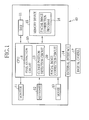
- Fig. 1 is a block diagram of a PC;
- Fig. 2 is an explanatory view of a facial image displayed on a correction window;
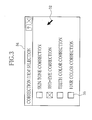
- Fig. 3 is an explanatory view of a correcting item selection window;
- Fig. 4 is a flow chart of a facial image correction program according to the present invention; and
- Fig. 5 is an explanatory view of an eye color selection window.
-
- PREFERRED EMBODIMENTS OF THE INVENTION
- Referring to Fig. 1, a PC (personal computer) 40 comprises a
CPU 10, amonitor 11, akeyboard 12, amouse 13, anexternal interface 14, amemory device 15 and aRAM 21. The PC 40 is connected to adigital camera 17 through theexternal interface 14. - The
memory device 15 may be an external memory such as a floppy disk, CD-ROM or DVD-ROM, or may be an internal memory such as an integrated hard disk. A facialimage correction program 16 stored on thememory device 15 is read by theCPU 10, and is loaded into theRAM 21. When theCPU 10 gets access to the facialimage correction program 16 in theRAM 21, facial image correction process starts. The facialimage correction program 16, as described later in detail, makes the PC 40 correct for various correction items in a facial image photographed by thedigital camera 17. TheCPU 10 controls the whole operation of the PC 40. TheCPU 10 comprises apixel extraction circuit 18, a cursorposition detection circuit 19, and a facialimage correction circuit 20. - When the facial
image correction program 16 starts, acorrection window 30 shown in Fig. 2 and a correctionitem selection window 34 shown in Fig. 3 are displayed side by side on themonitor 11. Referring to Fig. 2, acursor 32 in the shape of, for example, a brush appears in thecorrection window 30. When afacial image 31 to be subjected to correction processing is open in thecorrection window 30, thepixel extraction circuit 18 extracts pixels representing askin area 33a, aneye area 33b, ateeth area 33c, and ahair area 33d as follows. - By receiving image data of the
facial image 31 which consists of luminance signals Y and chromatic signals Cb and Cr, thepixel extraction circuit 18 carries out raster scan of image data of the two-dimensional original image. If the difference in luminance "ΔY" between two adjoining pixels is smaller than a predetermined threshold value, and the difference "ΔC" between the chromaticities Cb and Cr or the difference "ΔH" between chromaticity angles is smaller than a predetermined threshold value, the adjoining pixels are in the same area. Otherwise, on the other hand, the adjacent pixels are grouped into different areas. Thepixel extraction circuit 18 divides thefacial image 31 into theareas 33a to 33d by successively repeating the foregoing comparison. When thefacial image 31 consists of RGB signals, instead of luminance signals Y and chromatic signals Cb and Cr, the RGB signals may be used. - Then, the
pixel extraction circuit 18 calculates the number of pixels, an average luminance Y, an average chromaticity Cb, an average chromaticity Cr, average coordinates (x, y) and the like of each area. The pixels representing theskin area 33a, theeye area 33b, theteeth area 33c and thehair area 33d are determined on the basis of geometric information such as the size and position of each area and the distance among the areas. Besides, thepixel extraction circuit 18 may determine theareas 33a to 33d by extracting the characteristic parts of a face such as eyes, nostrils, the ends of a lip and the like. USP 2001/0005222, referring to the pixel extraction method in detail, is hereby incorporated by reference. - Referring to Fig. 3, desired correction item(s) is/are selectable out of four correction items, those are, "skin tone correction", "red-eye correction", "teeth color correction", and "hair color correction" in the correction
item selection window 34. Putting thecursor 32 on acheck box 35 of each correction item and clicking themouse 13 make it possible to select the corresponding correction item. - The cursor
position detection circuit 19 detects the position of thecursor 32 in thecorrection window 30, and outputs a position signal to the facialimage correction circuit 20. When thecursor 32 is in one of theabove areas 33a to 33d, and the correction item corresponding to thearea 33a to 33d is selected, the facialimage correction circuit 20 corrects a pixel pointed by thecursor 32. - To be more specific, when the
cursor 32 is in theskin area 33a, and the correction item of "skin tone correction" is selected, the facialimage correction circuit 20 compares the luminance Y and chromaticities Cb, Cr of the pixel, which thecursor 32 is pointing at, with those of predetermined target skin color. If the differences in luminance Y and chromaticities Cb, Cr are in the predetermined ranges, the facialimage correction circuit 20 judges that correction is unnecessary. Otherwise, the color of the pixel is corrected in accordance with the correction amounts which are determined in proportion to the differences in luminance Y and chromaticities Cb, Cr, in order to actualize preferable skin tone. - When the
cursor 32 is in theeye area 33b, and "red-eye correction" is selected, the facialimage correction circuit 20 compares the luminance Y and chromaticities Cb, Cr of the pixel, which thecursor 32 is pointing at, with those of predetermined red color. If the differences in luminance Y and chromaticities Cb, Cr are outside of predetermined ranges, the facialimage correction circuit 20 judges that correction is unnecessary. Otherwise, the color of the pixel is replaced with predetermined brown color to correct red-eye. - As in the case of "skin tone correction", when the
cursor 32 is in theteeth area 33c, and "teeth color correction" is selected, the facialimage correction circuit 20 compares the luminance Y and chromaticities Cb, Cr of the pixel, which thecursor 32 is pointing at, with those of predetermined target white color. If the differences in luminance Y and chromaticities Cb, Cr are within the predetermined ranges, the facialimage correction circuit 20 judges that correction is unnecessary. Otherwise, the color of the pixel is replaced with predetermined white color to correct teeth color. - As in the case of the "red-eye correction", when the
cursor 32 is in thehair area 33d, and "hair color correction" is selected, the facialimage correction circuit 20 compares the luminance Y and chromaticities Cb and Cr of the pixel, which thecursor 32 is pointing at, with those of predetermined white color. If the differences in luminance Y and chromaticities Cb and Cr are outside of the predetermined ranges, the facialimage correction circuit 20 judges that correction is unnecessary. Otherwise, the facialimage correction circuit 20 extracts hair color other than white in the vicinity of the pixel within thehair area 33d, to replace the color of the pixel with the extracted hair color. - The operation of the facial
image correction program 16 will be hereinafter described with referring to Fig. 4. An image taken by thedigital camera 17 is stored on an internal memory such as theRAM 21, HDD, or the like. When the facialimage correction program 16 runs (S10), thecorrection window 30 and the correctionitem selection window 34 open on themonitor 11. The user opens thefacial image 31 to be corrected out of downloaded images in the correction window 30 (S20), and thepixel extraction circuit 18 extracts pixels representing theskin area 33a, theeye area 33b, theteeth area 33c, and thehair area 33d (S30). Then, one or plural correction item is/are selected in the correction item selection window 34 (S40). - The cursor
position detection circuit 19 detects the position of thecursor 32 in the correction window 30 (S50). When thecursor 32 is in one of theskin area 33a, theeye area 33b, theteeth area 33c, and thehair area 33d, the facialimage correction circuit 20 judges whether the correction item corresponding to the position of thecursor 32 is selected (S60). When the corresponding correction item is selected, whether correction is necessary or not is judged in accordance with the color of the pixel which thecursor 32 is pointing at (S70). If the correction is necessary, predetermined correction processing is carried out (S80). - When the correction item corresponding to the position of the
cursor 32 is not selected in step S60, or the correction is judged to be unnecessary in step S70, the correction processing (S80) is not carried out. Steps from S50 to S80 are repeated until the user finishes the whole correction. - Although only the single pixel which the
cursor 32 is pointing at is corrected in the above embodiment, all pixels belonging to an area in which thecursor 32 is sitting may be corrected at a time. In this case, it is possible to efficiently carry out the correction in a short time. - In the above first embodiment, the color of the
eye area 33b is replaced with brown in "red-eye correction". In "skin tone correction", the necessity of correction is judged on the basis of whether the color of theskin area 33a is in the predetermined range of target skin color. The method according to the first embodiment is applicable in a region such as Asia in which almost all users have similar eye colors and skin colors. The method according to the first embodiment, however, is not sufficient in a region such as Europe and America, in which users have various eye colors, skin colors, and hair colors. A method for correcting a facial image which is adaptable to various eye colors, skin colors, and hair colors will be hereinafter described as the second embodiment. - In the second embodiment, the
facial image 31 photographed by thedigital camera 17 is downloaded to thePC 40. As in the case of the first embodiment, when the facialimage correction program 16 starts, thecorrection window 20 and the correctionitem selection window 34 open. - When a user selects, for example, "red-eye correction" from the correction
item selection window 34, an eyecolor selection window 42 opens (refer to Fig. 5). Abrown color palette 43, ablue color palette 44, agreen color palette 45, and agray color palette 46 are displayed in the eyecolor selection window 42. In thebrown color palette 43, browns with four-step gradation in color from light brown to dark brown are displayed. Just as with the browns, blues, greens, and grays with four-step gradation in color are displayed in the blue, green, andgray color palettes 44 to 46, respectively. Since the user selects a color close to that of his/her eyes from thecolor palettes 43 to 46, the selected color is used in "red-eye correction". - Similarly, when "skin tone correction" is selected in the correction
item selection window 34, a skin color selection window (not illustrated) opens. Various skin colors are displayed in the skin color selection window, so that a user can select a color close to that of his/her skin. The selected skin color is used as reference color or correction color in the correction processing. - Using the foregoing eye
color selection window 42 and the skin color selection window makes it possible to correct thefacial image 31 with the desired eye color and skin color. Therefore, it is possible that thefacial image 31 is so corrected as to have a good complexion by selecting a skin color brighter than actual one, or as to have different eye color from actual one for fun. - If a hair color selection window (not illustrated) is used in "hair color correction", the
facial image 31 is corrected with hair color different from actual one. Therefore, it is possible for a user with white hair to correct his/her hair with desired color, or for a user with colored hair to select a hair color different from actual one for fun. - In the above embodiments, the method and program for correcting a facial image according to the present invention are applied to the
PC 40. The present invention, however, is applicable to other types of electric equipment such as PDA and the like. If a color printer which prints an image directly downloaded from a digital camera is provided with a touch panel or the like, the present invention is applicable to the color printer. The types of correction items are not limited to four described above, but are properly addable and changeable. - Although the present invention has been described with respect to the preferred embodiments, the present invention is not limited to the above embodiments but, on the contrary, various modifications will be possible to those skilled in the art without departing from the scope of claims appended hereto.
Claims (11)
- A method for correcting a facial image (31) displayed on a monitor (11), said method comprising the steps of:(a) extracting pixels representing specific areas (33a to 33d) from said facial image (31);(b) determining a correction item to be performed out of plural correction items, each of said correction items corresponding to each of said areas (33a to 33d);(c) detecting the position of a cursor (32) in said facial image (31) displayed on said monitor (11); and(d) if a pointed pixel pointed by said cursor (32) is in said area (33a to 33d) corresponding to said correction item to be executed, subjecting said pointed pixel to correction process that is set in accordance with said correction item.
- A method as recited in claim 1, wherein one of said correction items is skin correction, wherein when said pointed pixel is in a skin area (33a) and the color of said pointed pixel is outside of the range of predetermined skin color, the color of said pointed pixel is corrected.
- A method as recited in claim 2, wherein said predetermined skin color is selectable from plural colors.
- A method as recited in claim 1, wherein one of said correction items is red-eye correction, wherein when said pointed pixel is in an eye area (33b) and the color of said pointed pixel is red, the color of said pointed pixel is corrected.
- A method as recited in claim 4, wherein said pointed pixel is corrected to a selected eye color.
- A method as recited in claim 1, wherein one of said correction items is teeth color correction, wherein when said pointed pixel is in a teeth area (33c) and said pointed pixel has color out of a range of predetermined white, the color of said pointed pixel is corrected.
- A method as recited in claim 1, wherein one of said correction items is hair color correction, wherein when said pointed pixel is in a hair area (33d) and the color of said pointed pixel is white, the color of said pointed pixel is corrected.
- A method as recited in claim 7, wherein said pointed pixel is corrected to the same color as another pixel in said hair area (33d).
- A method as recited in claim 1, wherein one of said correction items is hair color correction, and said pointed pixel is corrected to a selected hair color.
- A program (16) for correcting a facial image (31) that is capable of causing a computer (40) to perform:extracting pixels representing specific areas (33a to 33d) from said facial image (31) displayed on a monitor (11);determining a correction item to be performed out of plural correction items, each of said correction items corresponding to each of said areas (33a to 33d);detecting the position of a cursor (32) in said facial image (31) displayed on said monitor (11); andif a pointed pixel pointed by said cursor (32) is in said area (33a to 33d) corresponding to said correction item to be executed, subjecting said pointed pixel to correction process that is set in accordance with said correction item.
- A recording medium readable by a computer (40) on which said program (16) according to claim 10 is stored.
Applications Claiming Priority (2)
| Application Number | Priority Date | Filing Date | Title |
|---|---|---|---|
| JP2003035302 | 2003-02-13 | ||
| JP2003035302A JP4072071B2 (en) | 2003-02-13 | 2003-02-13 | Face image correction method and apparatus, and face image correction program |
Publications (3)
| Publication Number | Publication Date |
|---|---|
| EP1447974A2 true EP1447974A2 (en) | 2004-08-18 |
| EP1447974A3 EP1447974A3 (en) | 2007-04-25 |
| EP1447974B1 EP1447974B1 (en) | 2011-08-31 |
Family
ID=32677611
Family Applications (1)
| Application Number | Title | Priority Date | Filing Date |
|---|---|---|---|
| EP04250577A Expired - Lifetime EP1447974B1 (en) | 2003-02-13 | 2004-02-03 | Method and program for correcting facial image and recording medium |
Country Status (6)
| Country | Link |
|---|---|
| US (1) | US7519219B2 (en) |
| EP (1) | EP1447974B1 (en) |
| JP (1) | JP4072071B2 (en) |
| KR (1) | KR100572227B1 (en) |
| CN (1) | CN1328698C (en) |
| TW (1) | TWI241125B (en) |
Cited By (3)
| Publication number | Priority date | Publication date | Assignee | Title |
|---|---|---|---|---|
| WO2007127144A1 (en) * | 2006-04-28 | 2007-11-08 | Hewlett-Packard Development Company L.P. | Perceptually-derived red-eye correction |
| EP2238574A4 (en) * | 2008-02-01 | 2015-02-11 | Hewlett Packard Development Co | LOCALIZATION AND WHITENING OF TEETH ON A DIGITAL IMAGE |
| CN111712852A (en) * | 2018-02-19 | 2020-09-25 | 三菱电机株式会社 | Passenger state detection device, passenger state detection system and passenger state detection method |
Families Citing this family (33)
| Publication number | Priority date | Publication date | Assignee | Title |
|---|---|---|---|---|
| US7630006B2 (en) | 1997-10-09 | 2009-12-08 | Fotonation Ireland Limited | Detecting red eye filter and apparatus using meta-data |
| US7042505B1 (en) | 1997-10-09 | 2006-05-09 | Fotonation Ireland Ltd. | Red-eye filter method and apparatus |
| US7738015B2 (en) | 1997-10-09 | 2010-06-15 | Fotonation Vision Limited | Red-eye filter method and apparatus |
| US7689009B2 (en) | 2005-11-18 | 2010-03-30 | Fotonation Vision Ltd. | Two stage detection for photographic eye artifacts |
| US7792970B2 (en) | 2005-06-17 | 2010-09-07 | Fotonation Vision Limited | Method for establishing a paired connection between media devices |
| US7574016B2 (en) | 2003-06-26 | 2009-08-11 | Fotonation Vision Limited | Digital image processing using face detection information |
| US8036458B2 (en) | 2007-11-08 | 2011-10-11 | DigitalOptics Corporation Europe Limited | Detecting redeye defects in digital images |
| US7920723B2 (en) | 2005-11-18 | 2011-04-05 | Tessera Technologies Ireland Limited | Two stage detection for photographic eye artifacts |
| US7970182B2 (en) | 2005-11-18 | 2011-06-28 | Tessera Technologies Ireland Limited | Two stage detection for photographic eye artifacts |
| US8170294B2 (en) | 2006-11-10 | 2012-05-01 | DigitalOptics Corporation Europe Limited | Method of detecting redeye in a digital image |
| US7587085B2 (en) | 2004-10-28 | 2009-09-08 | Fotonation Vision Limited | Method and apparatus for red-eye detection in an acquired digital image |
| US7536036B2 (en) | 2004-10-28 | 2009-05-19 | Fotonation Vision Limited | Method and apparatus for red-eye detection in an acquired digital image |
| US8254674B2 (en) | 2004-10-28 | 2012-08-28 | DigitalOptics Corporation Europe Limited | Analyzing partial face regions for red-eye detection in acquired digital images |
| US9412007B2 (en) | 2003-08-05 | 2016-08-09 | Fotonation Limited | Partial face detector red-eye filter method and apparatus |
| US8520093B2 (en) | 2003-08-05 | 2013-08-27 | DigitalOptics Corporation Europe Limited | Face tracker and partial face tracker for red-eye filter method and apparatus |
| US20060008169A1 (en) * | 2004-06-30 | 2006-01-12 | Deer Anna Y | Red eye reduction apparatus and method |
| US7599577B2 (en) | 2005-11-18 | 2009-10-06 | Fotonation Vision Limited | Method and apparatus of correcting hybrid flash artifacts in digital images |
| JP2007189663A (en) * | 2005-12-15 | 2007-07-26 | Ricoh Co Ltd | User interface device, preview image display method, and program |
| EP1987475A4 (en) | 2006-02-14 | 2009-04-22 | Fotonation Vision Ltd | Automatic detection and correction of non-red eye flash defects |
| US7965875B2 (en) | 2006-06-12 | 2011-06-21 | Tessera Technologies Ireland Limited | Advances in extending the AAM techniques from grayscale to color images |
| US7889242B2 (en) * | 2006-10-26 | 2011-02-15 | Hewlett-Packard Development Company, L.P. | Blemish repair tool for digital photographs in a camera |
| US8055067B2 (en) | 2007-01-18 | 2011-11-08 | DigitalOptics Corporation Europe Limited | Color segmentation |
| JP4329821B2 (en) | 2007-01-31 | 2009-09-09 | ブラザー工業株式会社 | Face detection device, face detection method, and face detection program |
| US7995804B2 (en) | 2007-03-05 | 2011-08-09 | Tessera Technologies Ireland Limited | Red eye false positive filtering using face location and orientation |
| US20080310712A1 (en) * | 2007-06-12 | 2008-12-18 | Edgar Albert D | Method and system to detect and correct whiteness with a digital image |
| US8503818B2 (en) | 2007-09-25 | 2013-08-06 | DigitalOptics Corporation Europe Limited | Eye defect detection in international standards organization images |
| US8212864B2 (en) | 2008-01-30 | 2012-07-03 | DigitalOptics Corporation Europe Limited | Methods and apparatuses for using image acquisition data to detect and correct image defects |
| US8081254B2 (en) | 2008-08-14 | 2011-12-20 | DigitalOptics Corporation Europe Limited | In-camera based method of detecting defect eye with high accuracy |
| US20100186234A1 (en) | 2009-01-28 | 2010-07-29 | Yehuda Binder | Electric shaver with imaging capability |
| JP5273208B2 (en) * | 2011-06-07 | 2013-08-28 | オムロン株式会社 | Image processing apparatus, image processing method, and control program |
| US9225538B2 (en) * | 2011-09-01 | 2015-12-29 | Microsoft Technology Licensing, Llc | Stateless application notifications |
| JP5970937B2 (en) * | 2012-04-25 | 2016-08-17 | ソニー株式会社 | Display control apparatus and display control method |
| KR102083619B1 (en) * | 2015-08-31 | 2020-03-03 | 오스템임플란트 주식회사 | Image processing method for planning of orthodontic treatment, apparatus, and recording medium thereof |
Family Cites Families (13)
| Publication number | Priority date | Publication date | Assignee | Title |
|---|---|---|---|---|
| US5130935A (en) * | 1986-03-31 | 1992-07-14 | Canon Kabushiki Kaisha | Color image processing apparatus for extracting image data having predetermined color information from among inputted image data and for correcting inputted image data in response to the extracted image data |
| DE3729023C2 (en) * | 1986-08-29 | 1995-03-16 | Canon Kk | Imaging device |
| US5490245A (en) * | 1993-08-12 | 1996-02-06 | Ast Research, Inc. | Component-based icon construction and customization system |
| JP3370770B2 (en) * | 1994-04-15 | 2003-01-27 | 松下電器産業株式会社 | Video signal skin color reproduction circuit |
| JPH1117969A (en) | 1997-06-23 | 1999-01-22 | Fuji Photo Film Co Ltd | Color correcting method |
| US6009209A (en) | 1997-06-27 | 1999-12-28 | Microsoft Corporation | Automated removal of red eye effect from a digital image |
| JP3539665B2 (en) | 1998-03-05 | 2004-07-07 | 日本電信電話株式会社 | Face area correction method, face area correction apparatus, and recording medium storing face area correction program |
| US6285410B1 (en) | 1998-09-11 | 2001-09-04 | Mgi Software Corporation | Method and system for removal of flash artifacts from digital images |
| JP2000235648A (en) * | 1999-02-17 | 2000-08-29 | Fujitsu Ltd | Eye extraction device and blink detection device |
| JP2001186323A (en) | 1999-12-24 | 2001-07-06 | Fuji Photo Film Co Ltd | Identification photograph system and picture on processing method |
| GB2365648A (en) | 2000-08-07 | 2002-02-20 | Dentpark Ltd | Colour correction in image processing |
| US7002546B1 (en) * | 2002-05-15 | 2006-02-21 | Rockwell Collins, Inc. | Luminance and chromaticity control of an LCD backlight |
| US7082211B2 (en) * | 2002-05-31 | 2006-07-25 | Eastman Kodak Company | Method and system for enhancing portrait images |
-
2003
- 2003-02-13 JP JP2003035302A patent/JP4072071B2/en not_active Expired - Fee Related
-
2004
- 2004-01-30 US US10/766,922 patent/US7519219B2/en not_active Expired - Lifetime
- 2004-02-03 EP EP04250577A patent/EP1447974B1/en not_active Expired - Lifetime
- 2004-02-12 TW TW093103266A patent/TWI241125B/en not_active IP Right Cessation
- 2004-02-13 CN CNB2004100394705A patent/CN1328698C/en not_active Expired - Fee Related
- 2004-02-13 KR KR1020040009528A patent/KR100572227B1/en not_active Expired - Fee Related
Non-Patent Citations (1)
| Title |
|---|
| None |
Cited By (5)
| Publication number | Priority date | Publication date | Assignee | Title |
|---|---|---|---|---|
| WO2007127144A1 (en) * | 2006-04-28 | 2007-11-08 | Hewlett-Packard Development Company L.P. | Perceptually-derived red-eye correction |
| US7830418B2 (en) | 2006-04-28 | 2010-11-09 | Hewlett-Packard Development Company, L.P. | Perceptually-derived red-eye correction |
| EP2238574A4 (en) * | 2008-02-01 | 2015-02-11 | Hewlett Packard Development Co | LOCALIZATION AND WHITENING OF TEETH ON A DIGITAL IMAGE |
| CN111712852A (en) * | 2018-02-19 | 2020-09-25 | 三菱电机株式会社 | Passenger state detection device, passenger state detection system and passenger state detection method |
| CN111712852B (en) * | 2018-02-19 | 2023-08-11 | 三菱电机株式会社 | Passenger state detection device, system and method |
Also Published As
| Publication number | Publication date |
|---|---|
| TW200420113A (en) | 2004-10-01 |
| US7519219B2 (en) | 2009-04-14 |
| JP4072071B2 (en) | 2008-04-02 |
| EP1447974B1 (en) | 2011-08-31 |
| CN1521693A (en) | 2004-08-18 |
| KR100572227B1 (en) | 2006-04-19 |
| TWI241125B (en) | 2005-10-01 |
| EP1447974A3 (en) | 2007-04-25 |
| KR20040073395A (en) | 2004-08-19 |
| US20040196292A1 (en) | 2004-10-07 |
| CN1328698C (en) | 2007-07-25 |
| JP2004246593A (en) | 2004-09-02 |
Similar Documents
| Publication | Publication Date | Title |
|---|---|---|
| EP1447974B1 (en) | Method and program for correcting facial image and recording medium | |
| JP2830871B2 (en) | Image color correction device and recording medium storing color correction program | |
| US7720279B2 (en) | Specifying flesh area on image | |
| US7580169B2 (en) | Image processing apparatus and its method | |
| JP3607059B2 (en) | Color feature extraction apparatus, color feature extraction method, and program storage medium | |
| WO1999017254A1 (en) | Digital redeye removal | |
| US20090027732A1 (en) | Image processing apparatus, image processing method, and computer program | |
| JP5164692B2 (en) | Image processing apparatus, image processing method, and program | |
| JP2010273144A (en) | Image processing apparatus, control method therefor, and program | |
| US6906826B1 (en) | Medium on which image modifying program is recorded, image modifying apparatus and method | |
| US20120189213A1 (en) | Image processing method and apparatus thereof | |
| US7468812B2 (en) | Image processing apparatus and its method for color correction | |
| US20090316168A1 (en) | Image processing apparatus, image processing method, and image processing program | |
| US8290262B2 (en) | Color processing apparatus and method thereof | |
| JP2009033361A (en) | Color adjustment unit, image-forming device, and program | |
| US20130004070A1 (en) | Skin Color Detection And Adjustment In An Image | |
| US20070252906A1 (en) | Perceptually-derived red-eye correction | |
| JP3925476B2 (en) | Judgment of shooting scene and image processing according to shooting scene | |
| JP2000050318A (en) | Method for characterizing response function of output device, program product and system | |
| JPH07111600A (en) | Color conversion image creation device | |
| JP2008154261A (en) | Judgment of shooting scene and image processing according to shooting scene | |
| JP2009016962A (en) | Image printing apparatus, image printing method, and image printing program | |
| US20020060798A1 (en) | Image processing apparatus, method and program enabling high-precision color conversion | |
| US20090059263A1 (en) | Image processor | |
| JP4332474B2 (en) | Image processing apparatus and method |
Legal Events
| Date | Code | Title | Description |
|---|---|---|---|
| PUAI | Public reference made under article 153(3) epc to a published international application that has entered the european phase |
Free format text: ORIGINAL CODE: 0009012 |
|
| AK | Designated contracting states |
Kind code of ref document: A2 Designated state(s): AT BE BG CH CY CZ DE DK EE ES FI FR GB GR HU IE IT LI LU MC NL PT RO SE SI SK TR |
|
| AX | Request for extension of the european patent |
Extension state: AL LT LV MK |
|
| RAP1 | Party data changed (applicant data changed or rights of an application transferred) |
Owner name: FUJIFILM CORPORATION |
|
| PUAL | Search report despatched |
Free format text: ORIGINAL CODE: 0009013 |
|
| AK | Designated contracting states |
Kind code of ref document: A3 Designated state(s): AT BE BG CH CY CZ DE DK EE ES FI FR GB GR HU IE IT LI LU MC NL PT RO SE SI SK TR |
|
| AX | Request for extension of the european patent |
Extension state: AL LT LV MK |
|
| 17P | Request for examination filed |
Effective date: 20070531 |
|
| 17Q | First examination report despatched |
Effective date: 20071011 |
|
| AKX | Designation fees paid |
Designated state(s): DE FR GB |
|
| GRAC | Information related to communication of intention to grant a patent modified |
Free format text: ORIGINAL CODE: EPIDOSCIGR1 |
|
| GRAJ | Information related to disapproval of communication of intention to grant by the applicant or resumption of examination proceedings by the epo deleted |
Free format text: ORIGINAL CODE: EPIDOSDIGR1 |
|
| GRAP | Despatch of communication of intention to grant a patent |
Free format text: ORIGINAL CODE: EPIDOSNIGR1 |
|
| GRAS | Grant fee paid |
Free format text: ORIGINAL CODE: EPIDOSNIGR3 |
|
| GRAA | (expected) grant |
Free format text: ORIGINAL CODE: 0009210 |
|
| AK | Designated contracting states |
Kind code of ref document: B1 Designated state(s): DE FR GB |
|
| REG | Reference to a national code |
Ref country code: GB Ref legal event code: FG4D |
|
| REG | Reference to a national code |
Ref country code: DE Ref legal event code: R096 Ref document number: 602004034188 Country of ref document: DE Effective date: 20111110 |
|
| PLBE | No opposition filed within time limit |
Free format text: ORIGINAL CODE: 0009261 |
|
| STAA | Information on the status of an ep patent application or granted ep patent |
Free format text: STATUS: NO OPPOSITION FILED WITHIN TIME LIMIT |
|
| 26N | No opposition filed |
Effective date: 20120601 |
|
| REG | Reference to a national code |
Ref country code: DE Ref legal event code: R097 Ref document number: 602004034188 Country of ref document: DE Effective date: 20120601 |
|
| PGFP | Annual fee paid to national office [announced via postgrant information from national office to epo] |
Ref country code: FR Payment date: 20140211 Year of fee payment: 11 |
|
| PGFP | Annual fee paid to national office [announced via postgrant information from national office to epo] |
Ref country code: GB Payment date: 20140129 Year of fee payment: 11 |
|
| GBPC | Gb: european patent ceased through non-payment of renewal fee |
Effective date: 20150203 |
|
| REG | Reference to a national code |
Ref country code: FR Ref legal event code: ST Effective date: 20151030 |
|
| PG25 | Lapsed in a contracting state [announced via postgrant information from national office to epo] |
Ref country code: GB Free format text: LAPSE BECAUSE OF NON-PAYMENT OF DUE FEES Effective date: 20150203 |
|
| PG25 | Lapsed in a contracting state [announced via postgrant information from national office to epo] |
Ref country code: FR Free format text: LAPSE BECAUSE OF NON-PAYMENT OF DUE FEES Effective date: 20150302 |
|
| PGFP | Annual fee paid to national office [announced via postgrant information from national office to epo] |
Ref country code: DE Payment date: 20210119 Year of fee payment: 18 |
|
| REG | Reference to a national code |
Ref country code: DE Ref legal event code: R119 Ref document number: 602004034188 Country of ref document: DE |
|
| PG25 | Lapsed in a contracting state [announced via postgrant information from national office to epo] |
Ref country code: DE Free format text: LAPSE BECAUSE OF NON-PAYMENT OF DUE FEES Effective date: 20220901 |