Technical Field
-
The present invention relates to an OFDM
transmission apparatus and OFDM transmission method
designed to modulate transmission data according to an
OFDM-CDMA system which combines an OFDM (Orthogonal
Frequency Division Multiplexing) modulation system with
a CDMA (Code Division Multiple Access) system and then
transmit the data.
Background Art
-
In conventional transmission according to an
OFDM-CDMA system which combines an OFDM system and CDMA
system, high quality transmission data can be transmitted
to many communication terminals at high speed by
effectively using the resistance to frequency selective
fading by the OFDM modulation system and the resistance
to interference and noise by the CDMA modulation system.
-
The OFDM-CDMA system is roughly divided into a time
area spreading system and a frequency area spreading
system. The time area spreading system arranges spread
signals which are spread in chip units by a spreading
code within a same subcarrier in a time direction. On
the other hand, the frequency area spreading system
arranges spread signals which are spread in chip units
by assigning them to different subcarriers.
-
The frequency area spreading system will be
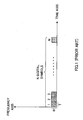
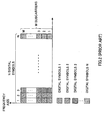
explained below. FIG.1 is a schematic view showing a
state of digital symbols before modulation processing
according to the OFDM-CDMA system and FIG. 2 is a schematic
view showing an arrangement of chips after modulation
processing according to the frequency area spreading
system. According to the frequency area spreading system,
each of N digital symbols (FIG.1) which constitute a serial
data string is multiplied by a spreading code with a
spreading factor M.
-
As a result, M chips are formed for each symbol and
the chips are arranged on a plurality of subcarriers at
a same time. In this case, carrying out IFFT (Inverse
Fast Fourier Transform) processing facilitates
arrangement of chips on the plurality of subcarriers.
Thus, according to the frequency area spreading system,
chips after spreading are arranged on the frequency
direction (FIG.2).
-
A configuration example of a conventional OFDM
transmission apparatus that implements this frequency
spreading system will be shown in FIG.3 and FIG.4. FIG.3
and FIG.4 will describe a case where four subcarriers
are formed and different pieces of transmission data are
transmitted to four users. As shown in FIG.3, an OFDM
transmission apparatus 1 is fed user data U1(k) to U4(k)
which are directed to users to transmission processing
blocks 11 to 14 which correspond in number to the users.
-
The transmission processing blocks 11 to 14 carry
out spreading processing on the user data U1(k) to U4(k)
using different spreading codes for the input data. In
the example of FIG.3, "1100", "0110", "0101" and "1001"
are used as spreading codes. By the way, when a cross
correlation is established for these four spreading codes
by correlating +1 with 1 and -1 with 0, any combination
will result in 0, and therefore it is possible to separate
only symbols for the own station by carrying out
dispreading using the same spreading code on the receiving
side. For example, even if a symbol spread with a
spreading code "1100" and a symbol spread with a spreading
code "0101" are multiplexed, its cross correlation is
1×(-1)+1×1+(-1)×(-1)+(-1)×1=0, and therefore the
output of the symbol spread by the spreading code "1100"
becomes 0 even if despread by the spreading code "0101"
and cannot be reconstructed.
-
Furthermore, the transmission processing blocks 11
to 14 modulate different subcarriers using the chips
obtained through spreading processing. An addition
circuit 15 adds up OFDM-CDMA signals obtained through
the transmission processing blocks 11 to 14.
-
The transmission processing blocks 11 to 14 are each
constructed as shown in FIG.4. FIG.4 shows the
transmission processing block 11 and spreads user the
data U1(k) using the spreading code "1100." First, the
user data U1(k) is input to a copy circuit 20. The user
data U1(k) corresponding to subcarriers copied by the
copy circuit 20 is sent to multiplication circuits 21
to 24 that form a CDMA processing section 40.
-
The multiplication circuits 21 to 24 multiply each
symbol by a multiplication value corresponding to the
spreading code "1100" (which associates "+1" with "1"
of spreading code "1100" and "-1" with "0"). More
specifically, a multiplication circuit 21 multiplies a
multiplication value "+1", a multiplication circuit 22
multiplies a multiplication value "+1", a multiplication
circuit 23 multiplies a multiplication value "-1" and
a multiplication circuit 24 multiplies a multiplication
value "-1."
-
The multiplication results of the multiplication
circuits 21 to 24 are sent to multiplication circuits
31 to 34 of an OFDM processing section 50 . The multipliers
31 to 34 multiply symbols which are respective frequency
spread outputs by subcarrier waveforms of frequencies
3/2 times, 1/2 times, -1/2 times and -3/2 times a symbol
rate Ts-1 (assuming the symbol time length of the user
data is Ts) at the same timing. By the way, 3/2 times,
1/2 times, -1/2 times or -3/2 times here means that the
frequency fc of a subcarrier expressed in a complex number
ej2öfct is (3/2)Ts, (1/2)Ts, (-1/2)Ts or (-3/2)Ts.
-
The modulated subcarrier signals modulated by the
spread chips obtained from the multiplication circuits
31 to 34 are all added up by an adder 51 and a transmission
OFDM-CDMA signal is output from a transmission output
terminal 52.
-
By the way, the configuration of this conventional
example assumes all signals as real number values
(assuming BPSK modulation), but the same applies to the
case of a complex number (QPSK modulation, etc.). In this
case, it is only necessary to replace all symbols,
spreading codes, adders and multipliers by those
corresponding to complex numbers.
-
On the other hand, in the conventional OFDM
transmission apparatus using the above-described
OFDM-CDMA system, a peak amplitude is generated when
transmission symbols of all subcarriers match. That is,
a maximum combined signal voltage is generated when the
transmission symbols have the same phase.
-
To put it simply, when it is assumed that a peak
voltage of a single carrier is P and an average signal
voltage is a, a peak voltage of two carriers becomes 2
×P and an average signal voltage becomes √2×a.
-
when a large back-off is taken so that this peak
voltage falls within the input range of the transmit power
amplifier, the power efficiency decreases. On the other
hand, when a small back-off is taken, large non-linear
distortion is generated when the above-described peak
amplitude occurs, causing a problem such as emission of
unnecessary radio wave.
Disclosure of Invention
-
It is an object of the present invention to provide
an OFDM transmission apparatus and OFDM transmission
method capable of suppressing, when spread signals are
superimposed on a plurality of mutually orthogonal
subcarriers for transmission (that is, when OFDM-CDMA
system based transmission is performed), a peak voltage
of a signal combining the plurality of subcarriers.
-
This object can be attained by forming, when forming
an OFDM-CDMA signal, modulated signals that move on
different straight lines on an I-Q plane and thereby
uniformly dispersing signal points of the modulated
signals on the I-Q plane.
-
To disperse signal points of the modulated signals
on the I-Q plane uniformly, the present invention spreads
transmission data using even symmetric or odd symmetric
spreading codes. Furthermore, the present invention
forms an OFDM-CDMA signal by adapting even symmetric or
odd symmetric chips after the spreading processing so
that mutually symmetric chips are assigned to subcarriers
having mutually opposite phases.
Brief Description of Drawings
-
- FIG.1 illustrates a state of digital symbols before
modulation processing according to an OFDM-CDMA system;
- FIG.2 illustrates a configuration of chips after
modulation processing according to a frequency area
spreading system;
- FIG.3 illustrates a configuration of an OFDM
transmission apparatus that carries out transmission
according to a conventional OFDM-CDMA system;
- FIG.4 illustrates a configuration of the
transmission processing block in FIG.3;
- FIG.5 illustrates a transmission symbol (1 symbol)
assigned to each subcarrier (2N subcarriers);
- FIG.6 illustrates spread output using even
symmetric codes;
- FIG.7 illustrates spread output using odd symmetric
codes;
- FIG.8 illustrates a signal trail of a spread output
signal obtained by an even symmetric code on the I-Q plane;
- FIG.9 illustrates a signal trail of a spread output
signal obtained by an odd symmetric code on the I-Q plane;
- FIG.10 is a block diagram showing a configuration
of an OFDM transmission apparatus according to Embodiment
1 of the present invention;
- FIG.11 illustrates a configuration of a
transmission processing block;
- FIG.12A illustrates a signal point vector when an
even symmetric code and odd symmetric code are used as
in the case of the embodiment;
- FIG.12B illustrates a signal point vector when
neither even symmetric code nor odd symmetric code is
used;
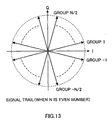
- FIG.13 illustrates principles of Embodiment 2 of
the present invention;
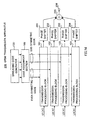
- FIG.14 is a block diagram showing a configuration
of an OFDM transmission apparatus according to Embodiment
2 of the present invention;
- FIG.15 illustrates a phase rotation operation by
a phase shifter according to Embodiment 2;
- FIG.16 illustrates principles of Embodiment 3 of
the present invention;
- FIG.17 illustrates principles of Embodiment 3 of
the present invention;
- FIG.18 is a block diagram showing a configuration
of an OFDM transmission apparatus according to Embodiment
3 of the present invention;
- FIG.19 illustrates a configuration of a
transmission processing block;
- FIG.20 illustrates a phase rotation operation by
a phase shifter of Embodiment 3; and
- FIG.21 is a block diagram showing a configuration
of an OFDM transmission apparatus according to another
embodiment.
-
Best Mode for Carrying out the Invention
-
With reference now to the attached drawings,
embodiments of the present invention will be explained
in detail below.
(Embodiment 1)
(1) Principles
-
The inventor of the present invention has come up
with the present invention noticing that a large peak
voltage is generated when transmission signals after
modulation according to an OFDM-CDMA system have similar
phases, and therefore it would be possible to suppress
the peak voltage if the phases of the transmission signals
after modulation according to an OFDM-CDMA system can
be dispersed.
-
Thus, the present invention spreads transmission
data using even symmetric or odd symmetric spreading codes.
In addition, by adapting even symmetric or odd symmetric
chips after spreading processing so that mutually
symmetric chips are assigned to subcarriers having
mutually orthogonal phases, the present invention has
been successful in dispersing the phase of a final
OFDM-CDMA transmission signal.
-
First, principles of this embodiment will be
explained using FIG.5 to FIG.9. First, the principle that
"using an even symmetric or odd symmetric spreading code
will cause a trail of a transmission signal of each code
to move only on a straight line on the I-Q plane" will
be explained. FIG.5 shows a BPSK transmission symbol
(during "+1" transmission) assigned to each subcarrier
before frequency area spreading. That is, FIG.5 as a
whole corresponds to one symbol of transmission data and
this is assigned to (2×N) subcarriers during
transmission.
-
Since these subcarriers have a common amplitude,
the spread output becomes a spreading code itself (or
sign-inverted code during "-1" transmission). As a
result, the spread output by even symmetric codes
corresponding to one symbol of the transmission data
becomes even symmetric as shown in FIG.6. On the other
hand, the spread output by odd symmetric codes becomes
odd symmetric as shown in FIG.7.
-
Then, when a signal trail is drawn focused on a pair
of subcarriers at a distance corresponding to ±k
subcarriers from the center of the even symmetric output
in FIG.6, it looks like FIG.8. In FIG.8, the central
frequency of the signal band is regarded as 0[Hz]. When
the I-Q plane is considered, a transmission symbol of
"+1" is located at a point (1,0) on the I-axis and the
subcarrier of +k rotates from that point counterclockwise
according to the subcarrier phase and the subcarrier of
- k rotates with constant velocity from that point in the
opposite direction according to the subcarrier phase.
Therefore, the addition result of these vectors is always
on the 1-axis and the trail of the OFDM-CDMA signal of
the even symmetric output only moves on the 1-axis as
a consequence.
-
Likewise, in the case of odd symmetric output, as
shown in FIG.9, the subcarrier of +k rotates clockwise
from a point (1,0) as a starting point according to the
subcarrier phase and the subcarrier of -k rotates
counterclockwise from a point (-1,0) as a starting point
according to the subcarrier phase. Therefore, the
addition result of the vectors is on the Q-axis and the
trail of the OFDM-CDMA signal of the odd symmetric output
only moves on the Q-axis as a consequence.
-
Here, the case where the number of subcarriers is
even and the symbol before OFDM-CDMA modulation is
BPSK-modulated has been explained. The same applies to
a case where the number of subcarriers is odd or the symbol
before OFDM-CDMA modulation is another modulation symbol
such as QPSK. For example, when the number of subcarriers
is odd, it is only necessary to add a DC component and
as the trail of a spread signal for modulations other
than BPSK modulation, it is only necessary to start to
draw the starting point of the rotation of each subcarrier
pair from themodulation symbol coordinates. As a result,
in any case, using even symmetric or odd symmetric
spreading code on frequency area spreading causes the
trail of a transmission signal of each code to move only
on the straight line on the I-Q plane.
-
By the way, creating such a subcarrier pair requires
even symmetric or odd symmetric chips after spreading
processing of to be adapted so that mutually symmetric
chips are assigned to subcarriers of mutually opposite
phases.
-
In order to create spreading codes which become even
symmetric and odd symmetric, for example, an OVSF
(Orthogonal Variable Spreading Factor) generation
circuit which is also adopted by the IMT-2000 can be used.
Using this OVSF generation circuit allows the same number
of even symmetric codes as odd symmetric codes to be
obtained.
-
Furthermore, scrambling for cell recognition is
possible using codes which are even symmetric or odd
symmetric in the frequency direction and arbitrary in
the time direction.
(2) Configuration
-
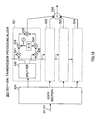
FIG.10 shows an OFDM transmission apparatus
according to Embodiment 1 of the present invention. An
OFDM transmission apparatus 100 has OFDM-CDMA
transmission processing blocks (hereinafter simply
referred to as "transmission processing blocks") 101 to
104 corresponding to user data U1(k) to U4(k).
-
The transmission processing blocks 101 to 104 are
fed even symmetric codes and odd symmetric codes generated
by a spreading code generator 105 through a code assignment
section 106. The code assignment section 106 selects even
symmetric codes and odd symmetric codes so that the number
of the transmission processing blocks 101 to 104 to which
even symmetric codes are assigned is the same as the number
of the transmission processing blocks 101 to 104 to which
odd symmetric codes are assigned and assigns spreading
codes to the respective transmission processing blocks
101 to 104.
-
Each of the transmission processing blocks 101 to
104 is constructed as shown in FIG.11. Here, the
transmission processing block 101 which processes user
data U1(k) will be explained. A copy section 110 of the
transmission processing block 101 is fed user data U1(k)
and the copy section 110 copies as many pieces of user
data U1(k) as the subcarriers.
-
A plurality of copies of the user data U1 (k) is input
to their respective multipliers 111 to 114 of a CDMA
processing section 130 as a spreading processing section.
Furthermore, the even symmetric codes or odd symmetric
codes output from the code assignment section 106 (FIG.10)
are input from a code input terminal 111a of themultipliers
111 to 114. An even symmetric code "1001" is input to
the transmission processing block 101.
-
The multiplication circuits 111 to 114 multiply the
respective symbols by a multiplication value
corresponding to the even symmetric code "1001" (which
associates "+1" with "1" of spreading code "1001" and
"-1" with "0"). More specifically, the multiplication
circuit 111 multiplies a multiplication value "+1", the
multiplication circuit 112 multiplies a multiplication
value "-1", the multiplication circuit 113 multiplies
a multiplication value "-1" and the multiplication
circuit 114 multiplies a multiplication value "+1".
-
As a result, chips subjected to spreading processing
which become even symmetric or odd symmetric are obtained
from the CDMA processing section 130. More specifically,
chips subjected to spreading processing which become even
symmetric with respect to the multiplier 112 and
multiplier 113 as a boundary are obtained from the CDMA
processing section 130 of the transmission processing
block 101.
-
The chips which are frequency spread outputs from
the CDMA processing section 130 are sent to multipliers
121 to 124 of an OFDM processing section 140 as an
orthogonal multicarrier modulation section. The
multipliers 121 to 124 each multiply the chips which are
their respective frequency spread outputs by subcarrier
waveforms at frequencies 3/2 times, 1/2 times, -1/2 times
and -3/2 times symbol rate Ts-1 (where Ts is a symbol time
length of a transmission symbol string) at the same timing.
By the way, 3/2 times, 1/2 times, -1/2 times and -3/2
times referred to here means that the frequency fc of
a subcarrier expressed in a complex number ej2öfct is (3/2)Ts,
(1/2)Ts, (-1/2)Ts or (-3/2)Ts.
-
Thus, the OFDM processing section 140 assigns even
symmetric or odd symmetric chips after spreading
processing formed by the CDMA processing section 130 so
that mutually symmetric chips are assigned to subcarriers
having mutually opposite phases to modulate a plurality
of mutually orthogonal subcarriers. An adder 150 adds
up the outputs of the multipliers 121 to 124. This causes
an OFDM-CDMA signal corresponding to one user to be output
from the output terminal 151.
-
The other transmission processing blocks 102 to 104
also perform processing similar to that of the
above-described transmission processing block 101.
They differ in that user data to be processed is different
and that the transmission processing blocks 103 and 104
perform spreading processing using odd symmetric codes.
-
The OFDM transmission apparatus 100 adds up the
OFDM-CDMA signals corresponding to a plurality of users
formed by the transmission processing blocks 101 to 104
using the adder 107 and thereby forms transmission
OFDM-CDMA in which a plurality of pieces of user data
U1(k) to U4(k) are subjected to frequency area spreading.
(3) Operation
-
In the above-described configuration, even
symmetric codes are input to the transmission processing
block 101 and therefore the trail of the OFDM-CDMA signal
output from the transmission processing block 101 moves
on the 1-axis on the I-Q plane. Likewise, since even
symmetric codes are also input to the transmission
processing block 102, the signal trail of the OFDM-CDMA
signal output from the transmission processing block 102
also moves on the 1-axis on the I-Q plane.
-
On the other hand, since odd symmetric codes are
input to the transmission processing blocks 103 and 104,
the signal trail of the OFDM-CDMA signal output from the
transmission processing blocks 103 and 104 moves on the
Q-axis of the I-Q plane.
-
Therefore, the addition result of the OFDM-CDMA
signals output from the transmission processing blocks
101 and 102 moves on the I-axis and the addition result
of the OFDM-CDMA signals output from the transmission
processing blocks 103 and 104 moves on the Q-axis. As
a result, the vector on the I-Q plane of the transmission
OFDM-CDMA signal finally output from the adder 107 becomes
a vector combining the vector moving on the I-axis and
the vector moving on the Q-axis.
-
This causes the final combined vector to become a
vector combining mutually orthogonal vectors, and can
thereby reduce the combined vector. As a result, the peak
voltage of the transmission OFDM-CDMA signal can be
reduced.
-
Furthermore, the code assignment section 106 makes
the number of transmission processing blocks to which
even symmetric codes are assigned equal to the number
of transmission processing blocks to which odd symmetric
codes are assigned, which makes the peak on the I-axis
obtained by adding up signals output from the transmission
processing blocks 101 and 102 with even symmetric codes
assigned almost equal to the peak on the Q-axis obtained
by adding up the signals output from the transmission
processing blocks 103 and 104 with odd symmetric codes
assigned.
-
As a result, the combined vector becomes a
combination of the vectors of two mutually neighboring
sides of a square, and therefore it is possible to obtain
a much smaller combined vector. This can further reduce
the peak voltage of the transmission OFDM-CDMA signal.
-
For example, when the peak of the OFDM-CDMA signal
output from the transmission processing blocks 101 to
104 is assumed to be "1", the peak value of the transmission
OFDM-CDMA signal of the OFDM transmission apparatus 100
of this embodiment becomes "2√2" as shown in FIG.12A.
-
In contrast, suppose a case where even symmetric
codes are assigned only to the transmission processing
block 101 and odd symmetric codes are assigned to the
transmission processing blocks 102 to 104. In this case,
as shown in FIG.12B, the peak of the signal output from
the transmission processing block 101 is on the 1-axis
and its value is "1". In contrast, the peak of the signal
output from the transmission processing blocks 102 to
104 is on the Q-axis and its value is "3". As a result,
the magnitude of the vector combining these vectors, that
is, the peak of the transmission OFDM-CDMA signal becomes
√10(>2√2).
(4) Effects
-
According to the above-described configuration,
when transmission data is modulated using the OFDM-CDMA
system and transmitted, transmission data is spread using
even symmetric codes and odd symmetric codes as spreading
codes and the even symmetric or odd symmetric chips after
spreading processing are adapted so that mutually
symmetric chips are assigned to subcarriers having
mutually opposite phases, which allows the peak voltage
of the transmission OFDM-CDMA signal to be suppressed
effectively. As a result, it is possible to obtain
demodulated data with less distortion on the receiving
side.
-
Furthermore, making the number of transmission
processing blocks 101, 102 for forming OFDM-CDMA signals
using even symmetric codes equal to the number of
transmission processing blocks 103, 104 for forming
OFDM-CDMA signals using odd symmetric codes allows the
peak voltage of the transmission OFDM-CDMA signal to be
further suppressed.
(Embodiment 2)
(1) Principles
-
Focusing on the fact that when OFDM-CDMA signals
obtained through spreading processing using even
symmetric codes and odd symmetric codes are divided into
a total of N groups, N/2 signals each, signals of each
group move on the same straight line on the I-Q plane,
this embodiment gives a phase offset to signals of each
group and thereby causes the signals of each group to
move on straight lines at intervals of the same angle.
This allows the peak of a signal combining the signals
of each group to be uniformly dispersed on the I-Q plane,
thus making it possible to further suppress the peak
voltage of the final transmission OFDM-CDMA signal.
-
Here, if the number of multiplexed spreading codes
is assumed to be (M×N), M spreading codes are assigned
to each group. Then, as shown in FIG.13, a phase offset
is given so that signals between groups move on straight
lines at intervals of (180/N)°. Then, the peak amplitude
value at each group becomes M times the peak when a normal
one code is used. Therefore, considering the symmetry
of FIG.13, the total peak value obtained by adding up
peak values of each group is multiplied by the value in
the following expression:
WHEN N IS AN EVEN NUMBER:
-
Therefore, the total peak value is reduced compared
to normal code multiplexing as shown in the following
expression:
WHEN N IS AN EVEN NUMBER:
WHEN N IS AN ODD NUMBER;
-
The processing here only performs code multiplexing
while giving a phase offset so that the signal trail of
each group becomes as shown in FIG.13, and therefore
transmit power never changes. Therefore, the
above-described peak value reduction effect itself
results in a reduction of the peak factor. Furthermore,
if the above-described phase offset value is also regarded
as a known value on the receiving side, it is only necessary
for the receiving side to return the phase by an amount
corresponding to the offset, and therefore the
transmission characteristic never deteriorates.
(2) Configuration
-
In FIG.14 in which the parts corresponding to those
in FIG.10 are assigned the same reference numerals,
reference numeral 200 shows a configuration of an OFDM
transmission apparatus according to Embodiment 2 of the
present invention as a whole. The OFDM transmission
apparatus 200 is provided with phase shifters 201 to 204
that rotate the phases of OFDM-CDMA signals output from
the transmission processing blocks 101 to 104 by
predetermined angles.
-
In the case of this embodiment, since the number
of groups N is 4, the phase shifters 201 to 204 give phase
offsets so that the signal trail of each group moves on
straight lines at intervals of (180/4)° = 45°. More
specifically, the phase shifters 201, 202, 203 and 204
are designed to rotate the phases of their respective
input signals by 45°, 90°, 45° and 90° respectively.
-
As a result, the OFDM-CDMA signal which is output
from the transmission processing block 101 and moves on
the I-axis is given a phase offset of 45° by the phase
shifter 201 and this causes the OFDM-CDMA signal to move
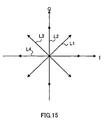
on a straight line L1 shown in FIG.15. Furthermore, the
OFDM-CDMA signal which is output from the transmission
processing block 102 and moves on the 1-axis is given
a phase offset of 90° by the phase shifter 202 and this
causes the OFDM-CDMA signal to move on a straight line
L2 (Q-axis).
-
Furthermore, the OFDM-CDMA signal which is output
from the transmission processing block 103 and moves on
the Q-axis is given a phase offset of 45° by the phase
shifter 203 and this causes the OFDM-CDMA signal to move
on a straight line L3 . Furthermore, the OFDM-CDMA signal
which is output from the transmission processing block
104 and moves on the Q-axis is given a phase offset of
90° by the phase shifter 204 and this causes the OFDM-CDMA
signal to move on a straight line L4 (1-axis).
-
The OFDM-CDMA signals of the user data U1(k) to U4(k)
which have been given phase offsets by the phase shifters
201 to 204 are added up by the adder 205 and a transmission
OFDM-CDMA signal is output through an output terminal
206.
(3) Operation
-
In the above configuration, the signal trail of the
transmission OFDM-CDMA signal output from the OFDM
transmission apparatus 200 is a combination of the signals
which move on the straight lines L1 to L4 in FIG.15. The
straight lines L1 to L4 here are arranged in such a way
as to disperse in all directions centered on the origin
on the I-Q plane, and therefore the magnitude of their
combined vector never outstands in a certain direction.
As a result, it is possible to suppress the peak voltage
of the transmission OFDM-CDMA signal output from the OFDM
transmission apparatus 200.
-
Here, assuming the peak voltage of the OFDM-CDMA
signals output from the phase shifters 201 to 204 on the
I-Q plane is "1", a case where signal points of the
transmission processing blocks 101, 102, 103 and 104 exist
on (I,Q)=(1/√2,1/√2), (0,1), (-1/√2,1/√2), (-1,0) as
a state in which the peak voltage of the combined signal
reaches a maximum (that is, signal points of the respective
signals are located in similar directions) will be
considered. The signal point of the combined signal at
this time is (I,Q)=(-1,1+√2). Therefore, the magnitude
of the vector is √(4+2√2).
-
Under the same condition, this is compared with the
peak voltage of the OFDM transmission apparatus 100 of
Embodiment 1. In the case of the OFDM transmission
apparatus 100, the combined signal becomes the largest
when the signal points of the transmission processing
blocks 101, 102, 103 and 104 are (I,Q)=(1,0), (1,0), (0,1),
(0,1) and the magnitude of the vector is 2√2.
-
Thus, the magnitude of the vector of √(4+2√2) of
the combined signal of this embodiment is smaller than
the magnitude of the vector of 2√2 of the combined signal
of Embodiment 1, and therefore it can be appreciated that
the OFDM transmission apparatus 200 of this embodiment
has a greater peak suppression effect.
-
That is, in the case of the OFDM transmission
apparatus 100 of Embodiment 1, the OFDM-CDMA signals
output from both the transmission processing block 101
and transmission processing block 102 move on the 1-axis,
and therefore these signals move drastically on the I-axis.
Likewise, the OFDM-CDMA signals output from both the
transmission processing block 103 and transmission
processing block 104 move on the Q-axis, and therefore
these signals move drastically on the Q-axis.
-
In contrast, in the case of the OFDM transmission
apparatus 200 of this embodiment, the signal obtained
by spreading using the same even symmetric code does not
move on the 1-axis alone but moves on different straight
lines, which allows the directions in which a peak occurs
to be dispersed further. The same applies to signals
spread using odd symmetric codes.
-
This is completely different from the conventional
way of simply dispersing signals obtained by spreading
codes randomly on the I-Q plane, but it is intended to
disperse the directions of straight lines for the signals
that move on the straight lines according to even symmetric
codes or odd symmetric codes to prevent the straight lines
from being directed in similar directions.
-
That is, using even symmetric or odd symmetric
spreading codes, trails of transmission signals are moved
only on the straight lines on the I-Q plane, a phase offset
is selected as appropriate and in this way, the straight
lines on which the trails of transmission signals are
moved are placed at an angle as close to 90° as possible.
As a result, it is possible to reduce the combined vector
of the trails of transmission signals on the I-Q plane
and thereby reduce the peak amplitude of a transmission
OFDM-CDMA signal.
(4) Effects
-
According to the above-described configuration, by
performing spreading using even symmetric codes or odd
symmetric codes, the OFDM-CDMA signals of each group that
move on the 1-axis or Q-axis are given a predetermined
phase offset for each group so that they move on straight
lines at intervals of the same angle, and in this way
it is possible to implement the OFDM transmission
apparatus 200 capable of further suppressing a peak
voltage.
(Embodiment 3)
(1) Principles
-
For simplicity of explanation, aforementioned
Embodiment 1 and Embodiment 2 have described the case
where signals subjected to BPSK modulation processing
at the transmission processing blocks 101 to 104 of the
OFDM transmission apparatuses 100 and 200 are subjected
to OFDM-CDMA modulation. However, this embodiment will
describe a case where m-value PSK-modulated signals such
as QPSK modulation in transmission processing blocks are
subjected to OFDM-CDMA modulation.
-
As in the case of above-described Embodiment 2,
focusing on the fact that when OFDM-CDMA signals obtained
through spreading using even symmetric codes and odd
symmetric codes are divided into a total of N groups,
N/2 signals each, signals of each group move on the same
straight line on the I-Q plane, this embodiment gives
phase offsets to signals of each group to cause the signal
of each group to move on straight lines at intervals of
the same angle.
-
Here, if the number of multiplexed spreading codes
is assumed to be (MXN), M spreading codes are assigned
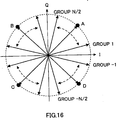
to each group. Then, as shown in FIG.16, a phase offset
is given so that signals between groups move on straight
lines at intervals of (360/(m×N))° considering that each
transmission processing block processes m-value
PSK-modulated signals. Then, the peak amplitude value
at each group becomes M times the peak when a normal one
code is used.
-
Therefore, as in the case of
Embodiment 2,
considering the symmetry of FIG.16, the total peak value
of transmission OFDM-CDMA signals in this embodiment is
reduced compared to normal code multiplexing as shown
in the following expression:
WHEN N IS AN EVEN NUMBER:
-
Here, signal trails of transmission OFDM-CDMA
signals when the method of this embodiment is applied
to a QPSK modulated signal and a 16-value QAM modulated
signal are shown in FIG.16 and FIG.17, respectively. In
FIG.16, the original signal points of a QPSK modulation
are four points A, B, C and D and even symmetric codes
and odd symmetric codes are used, and therefore their
signal trails move on a straight line AC or straight line
BD.
-
That is, a signal trail is located on the straight
line AC when "point A or point C is transmitted using
even symmetric codes" or "point B or point D is transmitted
using odd symmetric codes." On the other hand, a signal
trail is located on the straight line BD when "point B
or point D is transmitted using even symmetric codes"
or "point A or point C is transmitted using odd symmetric
codes."
-
Thus, by dividing (360/m)° = (360/4)° = 90° by N and
assigning it to each group of spreading codes, the
above-described peak factor suppression effect can be
obtained. It is understandable that for m-value PSK, a
minimum phase difference (360/m)° of signal points can
be divided by N.
-
In FIG.17, original signal points of a 16-value QAM
modulated signal are 16 points expressed by black bullets
and signal trails of transmission OFDM-CDMA signals vary
depending on which of the even symmetric code or odd
symmetric code is used or which signal point is transmitted,
but it is obvious that the signal trails are on straight
lines that pass through signal points expressed by the
black bullets or straight lines orthogonal thereto.
-
Therefore, by dividing a minimum phase difference
of 18.4° of signal points by N and assigning it to each
group of codes, it is possible to obtain peak factor
suppression effects similar to those described above.
(2) Configuration and operation
-
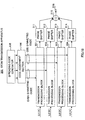
In FIG.18 in which the parts corresponding to those
in FIG.14 are assigned the same reference numerals,
reference numeral 300 shows an OFDM transmission
apparatus according to Embodiment 3 of the present
invention as a whole. In the OFDM transmission apparatus
300, transmission processing blocks 301 to 304 are
designed to perform QPSK modulation processing and
OFDM-CDMA modulation processing. Here, the
transmission processing blocks 301 and 302 are fed even
symmetric codes and the transmission processing blocks
303 and 304 are fed odd symmetric codes.
-
The transmission processing blocks 301 to 304 in
this embodiment are constructed as shown in FIG.19. Here,
the transmission processing block 301 that processes user
data U1(k) will be explained. A copy section 320 of the
transmission processing block 301 is fed the user data
U1(k) and the copy section 320 copies the same number
of pieces of user data U1(k) as subcarriers.
-
There are transmission processing blocks 301
corresponding in number to subcarriers and the
transmission processing blocks 301 have their respective
OFDM-CDMA processing sections 321 to 324 in the same
configuration. The configuration of the OFDM-CDMA
processing section 321 will be explained below.
-
The OFDM-CDMA processing section 321 inputs the user
data U1(k) copied by the copy section 320 to a splitter
circuit 330. The splitter circuit 330 divides the input
data into two lines. For example, when data "1" and "0"
are input in that order, the data "1" is sorted out for
the first line, while the data "0" is sorted out for the
second line.
-
As in the case of the above-described multiplier
111 (FIG.11), a spreading code portion corresponding to
one chip is input to the multipliers 331 and 332.
Therefore, the multipliers 331 and 332 as a whole carry
out processing of multiplying the data corresponding to
the two input bits by the same spread chip.
-
Then, the multipliers 333 and 334 multiply the
outputs of the multipliers 331 and 332 by subcarrier
waveforms of frequencies 3/2 times a symbol rate Ts-1 at
the same timing. By the way, multipliers (not shown)
corresponding to the multipliers 333 and 334 of the other
OFDM-CDMA processing sections 322 to 324 multiply
subcarrier waveforms of frequencies 1/2 times, -1/2 times
and -3/2 times the symbol rate Ts-1, respectively at the
same timing. At this time, the multiplier 334 is designed
to multiply a subcarrier whose phase is shifted by
π/2 with respect to the subcarrier waveformto be multiplied
by the multiplier 333.
-
The outputs of the multipliers 333 and 334 are added
up by the adder 335. In this way, an OFDM-CDMA signal
in which user data U1(k) corresponding to two bits is
spread by a one-chip spreading code (that is,
QPSK-modulated) is formed. The outputs of the OFDM-CDMA
processing sections 321 to 324 are added up by an adder
336. In this way, from the adder 336, user data U1(k)
corresponding to two bits is spread by a spreading code
of four chips and a QPSK-OFDM-CDMA signal with the spread
chips superimposed on four orthogonal subcarriers is
output.
-
FIG.18 will be referenced again to continue the
explanation. The OFDM transmission apparatus 300 sends
the QPSK-OFDM-CDMA signals output from the transmission
processing blocks 301 to 304 to phase shifters 311 to
314 provided for the transmission processing blocks 301
to 304. The phase shifters 311 to 314 give phase offsets
so that signals between the groups move on straight lines
at intervals of (360/(m×N))° = (360/(4×4))° = 22.5°
according to the rules explained in the section of the
aforementioned principles of this embodiment.
-
More specifically, the phase shifters 311, 312, 313
and 314 rotate the phases of the input QPSK-OFDM-CDMA
signals by 22.5°, 45°, 67.5° and 90° respectively. This
causes the signals between the groups to move on straight
lines at intervals of 22.5° without overlapping with one
another on the same straight lines.
-
This will be explained using FIG.20. First, for
simplicity of explanation, only operations of the
transmission processing block 301 and phase shifter 311
will be explained. With QPSK modulation, signal points
of modulated signals according to the user data U1(k)
are any one of point A, point B, point C or point D in
the figure. When these signal points are spread using
even symmetric codes, the symbol at point A moves on a
straight lineL10, the symbol at point B moves on a straight
line L14, the symbol at point C moves on a straight line
L10 and the symbol at point D moves on a straight line
L14.
-
Furthermore, when odd symmetric codes are used, the
phases of the respective signal trails rotate by only
π/2 and signal trails after spreading processing of the
respective symbols at points A to D move on the straight
line L10 or L14. Thus, in the case of the QPSK modulation,
signal trails when even symmetric codes or odd symmetric
codes are used move on the mutually orthogonal straight
lines L10 and L14 including point A, point C and point
B, point D, respectively.
-
Then, the phase shifter 311 rotates the phases of
these straight lines L10 and L14 by 22.5° so that the signal
trail of the output of the transmission processing block
301 moves on the straight lines L11 and L15. Furthermore,
the phase shifter 312 rotates the phases of the straight
lines L10 and L14 by 45° so that the signal trail of the
output of the transmission processing block 302 moves
on the straight lines L12 and L16.
-
The phase shifter 313 rotates the phases of the
straight lines L10 and L14 by 67.5° so that the signal
trail of the output of the transmission processing block
303 moves on the straight lines L13 and L17. Furthermore,
the phase shifter 314 rotates the phases of the straight
lines L10 and L14 by 90° so that the signal trail of the
output of the transmission processing block 304 moves
on the straight lines L14 and L10.
-
Thus, the signals which are output from the
transmission processing blocks 301 to 304 and move the
straight lines L10 and L14 are arranged by the phase
shifters 311 to 314 into transmission OFDM-CDMA signals
which move on the straight lines L10 to L14 without
overlapping with one another at intervals of the same
angle.
-
As a result, by avoiding signal points from
concentrating on the same direction on the I-Q plane,
it is possible to suppress a peak voltage effectively.
(3) Effects
-
According to the above-described configuration,
when an OFDM-CDMA signal corresponding to 1 user data
is regarded as a unit processing group and subjected to
spreading processing using even symmetric codes or odd
symmetric codes in each group and when m-value PSK
modulation such as QPSK modulation is used, phase offsets
are given so that signals between the groups move on the
straight lines at intervals of (360/(m×N))°, and it is
thereby possible to suppress the peak voltage of the
transmission OFDM-CDMA signal.
(Other Embodiments)
-
Above-described Embodiment 3 has described the case
where transmission data is QPSK-modulated, but the
present invention is not limited to this, and it is also
applicable to other modulation systems such as 8-phase
PSK. For example, when four pieces of user data is
transmitted as an OFDM-CDMA signal using 8-phase PSK,
phase offsets can be given based on the above-described
express ion of (360/(m×N))° so that straight lines on which
the OFDM-CDMA signal of each piece of the user data are
arranged at intervals of (360/(8×4))° = 11.25°.
-
Furthermore, the aforementioned embodiment has
described the configuration shown in FIG.11 and FIG.19
as the configuration that implements the OFDM
transmission method according to the present invention,
but the present invention is not limited to this
configuration example, and it is widely applicable to
an OFDM transmission apparatus that carries out frequency
area spreading processing of the OFDM-CDMA system.
-
For example, as shown in FIG.21, it is also possible
to spread transmission data by a spreading section 401
using even symmetric codes or odd symmetric codes,
serial/parallel-convert the spread signals by a
serial/parallel conversion section (S/P) 402, subject
the serial/parallel-converted signal to inverse discrete
Fourier transform by an inverse discrete Fourier
transform section (IDFT) 403, and
parallel/serial-convert the signal after discrete
Fourier transformby a parallel/serial conversion section
(P/S) 404 to form a transmission OFDM-CDMA signal. In
this case, the spreading section 401 functions as the
spreading processing section and the parallel/serial
conversion section 402, inverse discrete Fourier
transform section 403 and parallel/serial conversion
section 404 function as an orthogonal multicarrier
modulation section. Furthermore, to rotate the phase of
each subcarrier, it is possible to provide a phase shifter
between the inverse discrete Fourier transform section
403 and parallel/serial conversion section 404.
-
The present invention is not limited to the
above-described embodiments, but can be implemented
modified in various ways.
-
The OFDM transmission apparatus of the present
invention adopts a configuration including a spreading
processing section that spreads transmission data using
even symmetric codes and odd symmetric codes as spreading
codes and an orthogonal multicarrier modulation section
that modulates a plurality of mutually orthogonal
subcarriers by adapting even symmetric or odd symmetric
chips after spreading processing formed by the spreading
processing section so that mutually symmetric chips are
assigned to subcarriers having mutually opposite phases.
-
According to this configuration, the spreading
processing section spreads one symbol of transmission
data into an even symmetric or odd symmetric chip according
to an even symmetric code or odd symmetric code. For
spread chips spread by even symmetric codes, the
orthogonal multicarrier modulation section forms signal
points with the phase rotating from the same starting
point on the same circumference on an I-Q plane by a same
angle in mutually opposite directions. On the other hand,
for spread chips spread by odd symmetric codes, the
orthogonal multicarrier modulation section forms signal
points with the phase rotating from the starting points
whose phases are different by 180° on the same
circumference on the I-Q plane by a same angle in mutually
opposite directions. As a result, a combined signal point
after orthogonal multicarrier modulation of symbols
spread by even symmetric codes moves on a predetermined
straight line. Furthermore, a combined signal point
after orthogonal multicarrier modulation of symbols
spread by odd symmetric codes moves on a straight line
orthogonal to the straight line of the even symmetric
code on the I-Q plane. This causes the combined signal
vector output from the orthogonal multicarrier modulation
section to become the one that combines signal vectors
that move on mutually orthogonal straight lines, and can
thereby reduce the magnitude of the combined signal vector
compared to the case where signal points are concentrated
at a similar position on the I-Q plane. Thus, using even
symmetric codes and odd symmetric codes as spreading codes
allows the combined signal vector after orthogonal
multicarrier modulation to become a combined vector of
signal points that move on mutually orthogonal straight
lines, and can thereby suppress the peak voltage of the
OFDM-CDMA signal.
-
Furthermore, the OFDM transmission apparatus of the
present invention adopts a configuration including a
spreading processing section that spreads a plurality
of pieces of transmission data using even symmetric codes
or odd symmetric codes, an orthogonal multicarrier
modulation section that modulates a plurality of mutually
orthogonal subcarriers by adapting chips after spreading
processing for each piece of transmission data so that
mutually symmetric chips are assigned to subcarriers
having mutually opposite phases and a phase rotation
section that rotates the phase of the modulated signal
of each piece of transmission data output from the
orthogonal multicarrier modulation section for each
modulated signal of the transmission data.
-
According to this configuration, the trail of the
combined signal of the transmission data after modulation
moves on straight lines on the I-Q plane, but if the
straight lines of the transmission data overlap with one
another, the combined signal finally output from the
orthogonal multicarrier modulation section finally has
a greater vector in the direction of the straight line,
and therefore the phase rotation section carries out phase
rotation processing to prevent the overlapping between
the straight lines. As a result, it is possible to further
disperse signal points and further suppress the peak
voltage of the OFDM-CDMA signal.
-
Furthermore, the present invention adopts a
configuration, wherein the phase rotation section rotates
the phase so that the trails of modulated signals of
transmission data that move on straight lines on the I-Q
plane are arranged at intervals of almost the same angle
on the I-Q plane.
-
This configuration allows signal points of the
transmission data subjected to spreading processing and
orthogonal multicarrier modulation processing to be
distributed almost uniformly on the I-Q plane, making
it possible to further suppress the peak voltage of the
transmission OFDM-CDMA signal.
-
Furthermore, the present invention adopts a
configuration, wherein when transmission data has N
groups and orthogonal multicarrier CDMA signals output
from the orthogonal multicarrier modulation section are
m-value PSK modulated signals, the phase rotation section
rotates the phases of modulated signals so that straight
lines on which the trails of the modulated signals of
the transmission data move are arranged at intervals of
an angle of 360°/(m×N) on the I-Q plane.
-
According to this configuration, when, for example,
there are four pieces of transmission data and the
orthogonal multicarrier CDMA signal is a QPSK modulated
signal (m=4), the transfer rotation section rotates the
phase of the modulated signal so that straight lines on
which the trails of modulated signals of the transmission
data move are arranged at intervals of an angle of 22.5°.
As a result, when transmission data of N groups is subjected
to m-value PSK modulation, final signal points of
OFDM-CDMA signals can be dispersed uniformly without
concentrating in one direction of the I-Q plane. This
makes it possible to suppress the peak voltage of the
OFDM-CDMA signals.
-
Furthermore, the present invention adopts a
configuration, wherein the spreading processing section
performs spreading processing using substantially the
same number of even symmetric codes as odd symmetric codes.
-
According to this configuration, the combined
signal point on the I-Q plane of spread chips of
transmission data spread by even symmetric codes and the
combined signal point on the I-Q plane of spread chips
of transmission data spread by odd symmetric codes move
on mutually orthogonal straight lines, but if the number
of pieces of transmission data spread us ing even symmetric
codes is substantially equal to the number of pieces of
transmission data spread using odd symmetric codes, the
final combined signal vector of the OFDM-CDMA signal
output from the orthogonal multicarrier modulation
section becomes a combined vector of vectors of two
neighboring sides of a square. As a result, it is possible
to further suppress the peak voltage of the OFDM-CDMA
signals.
-
Furthermore, the radio base station apparatus of
the present invention adopts a configuration including
the above-described OFDM transmission apparatus.
-
Furthermore, the OFDM transmission method of the
present invention spreads transmission data using odd
symmetric codes or even symmetric codes as the spreading
codes, adapts chips after spreading processing so that
mutually symmetric chips are assigned to subcarriers
having mutually opposite phases and thereby modulates
a plurality of mutually orthogonal subcarriers.
-
According to this method, one symbol of transmission
data is spread into an even symmetric or odd symmetric
chip according to the even symmetric code or odd symmetric
code. When spread chips which are spread by even
symmetric codes and located at mutually symmetrical
positions are assigned to subcarriers having opposite
phases, signal points whose phases rotate by the same
angle from the same starting point on the same
circumference of the I-Q plane in mutually opposite
directions are formed. On the other hand, for spread
chips spread by odd symmetric codes, signal points whose
phases rotate by the same angle from starting points with
a 180° phase difference on the same circumference on the
I-Q plane in mutually opposite directions are formed.
As a result, the combined signal point after orthogonal
multicarrier modulation of symbols spread by even
symmetric codes moves on a predetermined straight line.
Furthermore, the combined signal point after orthogonal
multicarrier modulation of symbols spread by odd
symmetric codes moves on a straight line orthogonal to
the straight line of the even symmetric codes on the I-Q
plane. This causes the combined signal vector output from
the orthogonal multicarrier modulation section to be the
one combining signal vectors that move on mutually
orthogonal straight lines, and can thereby reduce the
magnitude of the combined signal vector compared to the
case where signal points are concentrated at similar
positions on the I-Q plane. Thus, using even symmetric
codes and odd symmetric codes as spreading codes allows
the combined signal vector after the orthogonal
multicarrier modulation to be the vector combining signal
points that move on mutually orthogonal straight lines,
and can thereby suppress the peak voltage of the OFDM-CDMA
signals.
-
As explained above, when an OFDM-CDMA signal is
formed, the present invention causes signal points of
modulated signals of transmission data to move on
different straight lines on the I-Q plane, and can thereby
disperse signal points uniformly and control the peak
voltage of the transmission OFDM-CDMA signal
consequently.
-
This application is based on the Japanese Patent
Application No. 2001-297174 filed on September 27, 2001,
entire content of which is expressly incorporated by
reference herein.
Industrial Applicability
-
The present invention is applicable to a transmitter
that transmits signals according to an OFDM-CDMA system.