EP1447727A2 - System and method of accelerated active set search for quadratic programming in real-time model predictive control - Google Patents
System and method of accelerated active set search for quadratic programming in real-time model predictive control Download PDFInfo
- Publication number
- EP1447727A2 EP1447727A2 EP04250825A EP04250825A EP1447727A2 EP 1447727 A2 EP1447727 A2 EP 1447727A2 EP 04250825 A EP04250825 A EP 04250825A EP 04250825 A EP04250825 A EP 04250825A EP 1447727 A2 EP1447727 A2 EP 1447727A2
- Authority
- EP
- European Patent Office
- Prior art keywords
- quadratic programming
- active set
- constraints
- factorization
- further including
- Prior art date
- Legal status (The legal status is an assumption and is not a legal conclusion. Google has not performed a legal analysis and makes no representation as to the accuracy of the status listed.)
- Withdrawn
Links
Images
Classifications
-
- G—PHYSICS
- G05—CONTROLLING; REGULATING
- G05B—CONTROL OR REGULATING SYSTEMS IN GENERAL; FUNCTIONAL ELEMENTS OF SUCH SYSTEMS; MONITORING OR TESTING ARRANGEMENTS FOR SUCH SYSTEMS OR ELEMENTS
- G05B13/00—Adaptive control systems, i.e. systems automatically adjusting themselves to have a performance which is optimum according to some preassigned criterion
- G05B13/02—Adaptive control systems, i.e. systems automatically adjusting themselves to have a performance which is optimum according to some preassigned criterion electric
- G05B13/04—Adaptive control systems, i.e. systems automatically adjusting themselves to have a performance which is optimum according to some preassigned criterion electric involving the use of models or simulators
- G05B13/048—Adaptive control systems, i.e. systems automatically adjusting themselves to have a performance which is optimum according to some preassigned criterion electric involving the use of models or simulators using a predictor
Definitions
- the present invention relates to on-board optimization techniques for on-board control, and is particularly useful for Model Predictive Control of a dynamical system.
- This invention describes a significant enhancement to existing optimization techniques for on-board control.
- On-board Model Predictive Control of a nonlinear dynamical system often involves linearizing the nonlinear dynamics and posing a Quadratic Program to stay close to a desired profile of outputs. Since on-board control requires computing a reliable solution in a robust manner in real-time, the quadratic programming algorithm needs to use linear algebra optimally.
- Model Predictive Control refers to the procedure of determining optimal operating parameters of a dynamic process based on a model of the 'plant,' or the dynamical system.
- This plant model can be a physics-based model of anything ranging from a gas turbine engine to the acoustics inside a helicopter. It is of interest to engineers to operate such a plant optimally, i.e. meet or exceed certain goals during operation, while honoring physical constraints of the system. To this end, it is common to solve a constrained optimization problem during the operation of the plant, and update the parameters of the optimization problem as the system evolves in time or as the forecast of the future requirements change, and re-solve the problem.
- the present invention provides an algorithm and apparatus for controlling a dynamical system in real-time.
- dynamical systems include, but are not limited to, gas turbine engines and aircraft flight control systems.
- the mechanism of searching for the optimal active set or the set of binding constraints described herein can be applied to any convex optimization problem, including convex quadratic programming.
- the present invention provides and exploits an 'active set hot start,' i.e. the set of constraints guessed to be binding at optimality. This is different from existing methods which use a starting guess for the solution and not the active set.
- the present invention provides a consistent active set method where constraints that are not binding are dropped from the active set, irrespective of the sign of the multiplier. This results in iterates that improve the objective function monotonically.
- the present invention also provides an inconsistent active set method where the iterates of the algorithm are not consistent with the active set. This is because most constraints in the initial hot start guess are expected to end up in the optimal active set and hence not dropped, even though inconsistent. While iterates may not improve the objective monotonically, this results in faster convergence and better performance in real-time when the starting guess is even moderately good.
- the present invention provides a mechanism for detecting linear dependency in the set of active constraints in an iteration without prior pre-processing using the steps in the current factorization.
- the present invention also provides a 'big-K' formulation of the Quadratic Program for a values of M ⁇ 0 and K > 0 to simultaneously attain a feasible and optimal solution in the absence of knowledge of an initial feasible point. Any or all of the above techniques can be applied to a sparse version of the optimization.
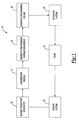
- FIG. 1 is a generic model of a control system 10 using Model Predictive Control and of a type that would benefit from the present invention.
- the control system 10 includes a desired trajectory generator 12 which creates a desired profile of the outputs of the system 10.
- a linearization module 14 derives a linearized model about the desired trajectory from the desired trajectory generator 12.
- a quadratic Programming formulation module 16 forms a quadratic program to determine a control profile for best attaining the desired trajectory while respecting any constraints.
- the Quadratic Programming Solver 18 solves the optimization problem established by the formulation module 16 to generate a profile of the optimal controls.
- the Quadratic Programming Solver 18 is the focus of this invention.
- the profile of the optimal controls is sent to an actuation system 20, which acts on the plant 22 of the system 10.
- the sensor system 24 provides feedback from the plant 22 to the desired trajectory generator 12. Again, the plant 22 could be anything ranging from a gas turbine engine to the acoustics inside a helicopter.
- a t I + ⁇ x ( x s , u s ) ⁇ t
- B t ⁇ u (x s , u s ) ⁇ t
- C t h x ( x s , u s ) ⁇ t
- yb t h ( x s , u s )-( h x ( x s ,u s ) x s +( h u ( x s ,u s ) u s ) ⁇ t .
- the aim is to optimally control the system over a particular time window.
- the degree of success in doing so is measured by how closely the variables of the system track certain reference trajectories. If T y / t , T x / t , T u / t represent reference trajectories for y t ,x t ,u t , the desired objective can be expressed as
- the diagonals of the weighting matrices represent the relative weights of the various objectives. We usually have only one or two primary objectives, while the rest are secondary. While the weights on the secondary objective are set to a small number, they are always non-zero and sufficiently large so that the Hessian of the problem is not very poorly conditioned. We generally try to keep the condition number below 10 7 for double precision computation. This is also necessary to ensure that there is a unique solution for the optimal controls even in the absence of constraints. If not, imagine the case where the system could be in steady state, but yet the optimal controls could be jumping around, causing what engineers call 'chattering.' The reason for re-casting the problem formulation is to justify solving a convex quadratic program, and not to cover the formulation under this patent.
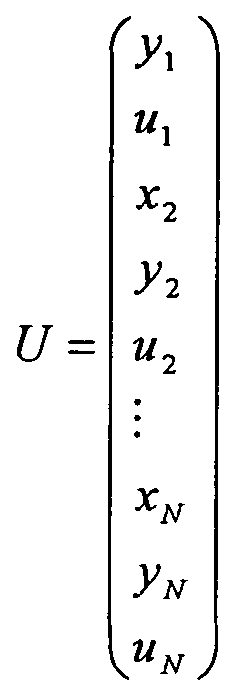
- Constraints Bound constraints are typically imposed on x,y,u, as well as on their rates of change. In addition, there are other linear inequality constraints involving combinations of these variables. The inequality constraints can thus be expressed as A 0 U ⁇ b 0 where represents the vector of optimization variables. Note that x 1 is not an optimization variable since the initial state and control variables from the prior time determine the states x 1 at the first time point.
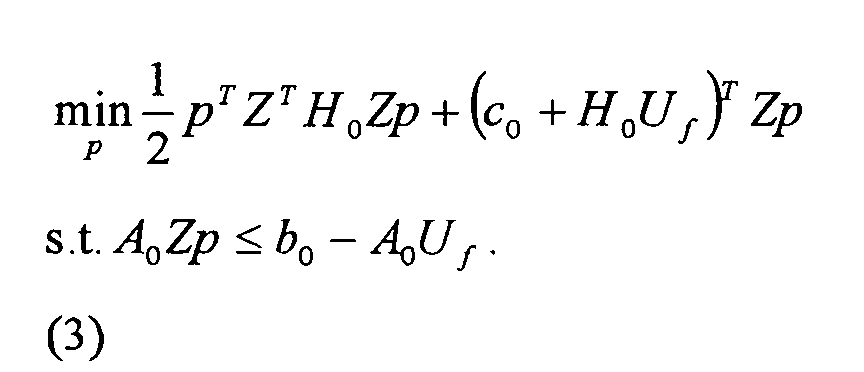
- the next section describes a method for computing the matrix Z by exploiting the state equations (1) and (2) defining the equality constraints in (3), and without performing an actual factorization.
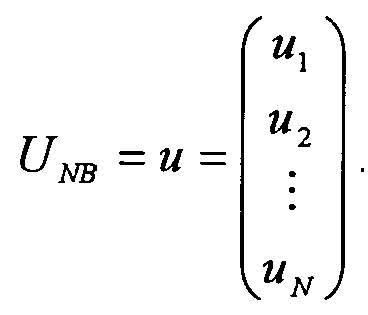
- the matrix contains columns that form a basis for the null space of interest, and the vector U NB assumes the role of p .
- a null space computed using a QR factorization part of it is a sparse identity block.
- U NB as the vector of control variables stacked in time, i.e., U B then becomes the corresponding vector of outputs and state variables, stacked in time.
- Active set algorithms search iteratively for the set of binding constraints at optimality, usually referred to as the active set.
- the solution to the MPC problem in the current time step provides a guess for the optimal active set in the next time step. This particular guess is used to great advantage to cut down on the number of iterations required for solving the QP to convergence, a feature that is practically indispensable in real-time control.
- the broad steps of the active set algorithm are sketched below, and the associated linear algebra is elaborated in the following section.
- Degeneracy is caused by introducing redundant constraints whose physical equivalents are already represented by other constraints, and which could alternately have been expressed as linear combinations of other constraints. Often, such dependent constraints could become active at the same time, and end up in the working set. This results in the loss of row rank in E , the matrix of active constraints, leading to a zero or near-zero condition number reciprocal for EH -1 E T , the coefficient matrix in computing ⁇ * as per (9).
- the second safeguard adopted in most commercial codes is that of pre-processing , or eliminating redundant constraints by a prior examination of the constraint matrix. This involves steps similar to Gaussian Elimination, and is extra computation wasted in the dominant majority of cases where degeneracy is not an issue.
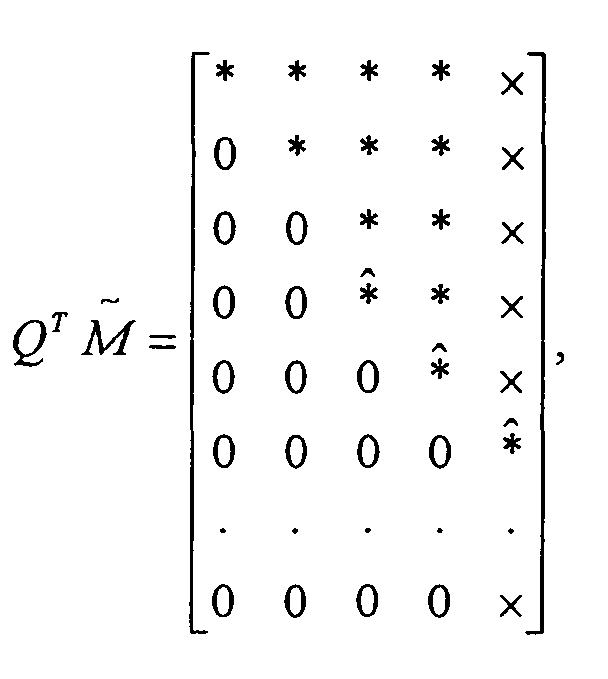
- n ⁇ be the number of active constraints, i.e., the number of rows in E or M .
- the j th Householder transformation operating on column j of M zeros out every element in column j , rows j + 1 through n ⁇ .
- the upper triangular matrix R is formed.
- v be the column vector such that the first j - 1 elements are 0, and on the rest, matches the elements of column j of Q ( j -1) ... Q (1) M (the intermediate reduced matrix).
- column j of E represents a degenerate constraint, and can be formed as a linear combination of columns 1 through j - 1 of E , the same is true of column j of M .
- the preceding Householder transformations Q ( j -1) through Q (1) on M would have already zeroed out elements j through n ⁇ in column j of the intermediate reduced matrix.
- the vector v for the Householder transformation based on that sub-column would be all zeros, thereby indicating the presence of a linearly dependent constraint.
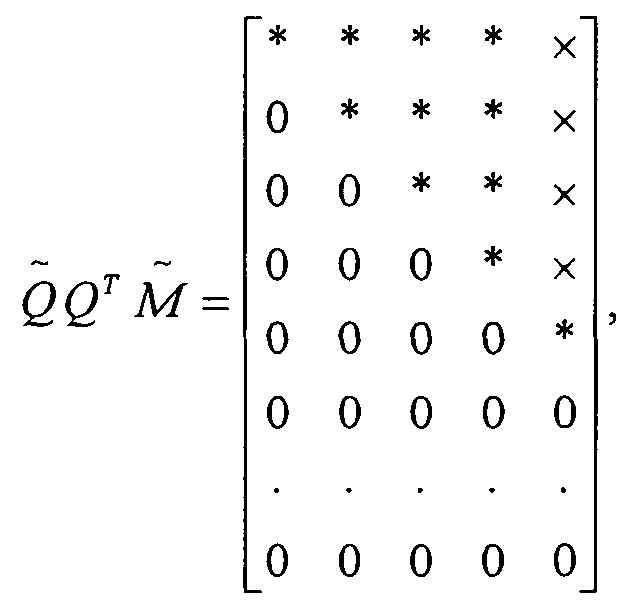
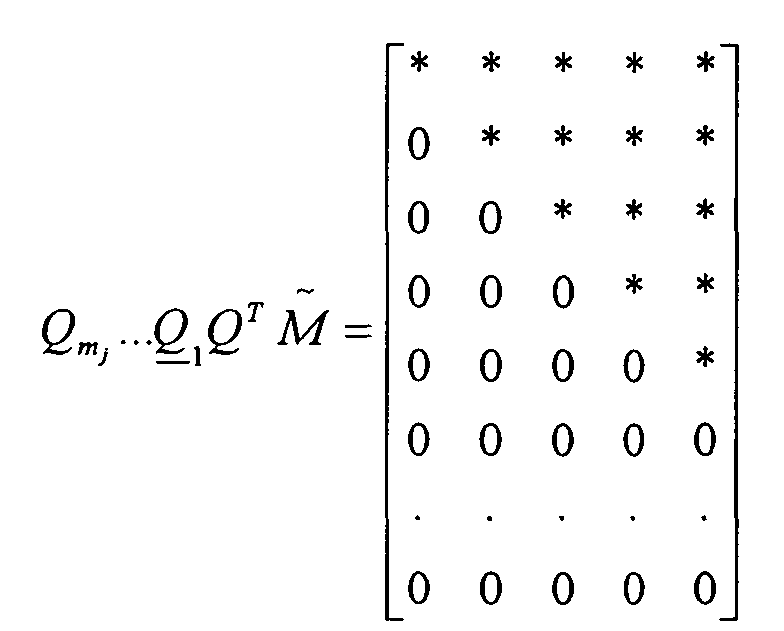
- ⁇ is the original matrix E of active constraints with the degenerate rows excluded. Thus detection of degeneracy and factorization are achieved simultaneously.
- the matrices M and G L -T M that appear in the preceding computations can be updated given the matrices from the prior iteration, rather than computed from scratch, which reduces an expensive matrix product operation to two O ( n 2 ) operations.
- the upper-triangularized matrix above thus provides the updated R , while the updated Q can be expressed as Q Q T / 1,... Q T / m j .
- T ⁇ t 0 , t 0 + ⁇ t, t 0 + 2 ⁇ t,... t 0 +( N - 1 ) ⁇ t ⁇ denote the set of time points under consideration in the time window of the particular MPC problem at time t0 .
- u * / t 0 denotes the values of the optimal controls arrived at by executing the iterative algorithm on the optimization problem corresponding to the MPC problem at time t 0 .
- the final iteration of the active set algorithm for this problem tells us which constraints are in the active set.
- g t is active for t ⁇ T_ ⁇ T ( T _ could represent some or all of the points in the set T ), i.e., for all t ⁇ T _.
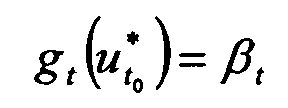
- the constraint g t appears as 0 ⁇ g t ( u ) ⁇ t for all t ⁇ T '. in this following MPC problem. This is the optimization problem we want to active set guess for.
- the constraint g t is guessed to be active for all t ⁇ T _ ⁇ T' ( and hence put in the initial active set W 0 ). Further, g t is guessed to be active at the last time point t 0 + N ⁇ t , of the MPC problem at time t 0 + ⁇ t if it was also active in the last time point t 0 + ( N - 1) ⁇ t of the MPC problem at time t 0 .
Landscapes
- Engineering & Computer Science (AREA)
- Health & Medical Sciences (AREA)
- Artificial Intelligence (AREA)
- Computer Vision & Pattern Recognition (AREA)
- Evolutionary Computation (AREA)
- Medical Informatics (AREA)
- Software Systems (AREA)
- Physics & Mathematics (AREA)
- General Physics & Mathematics (AREA)
- Automation & Control Theory (AREA)
- Feedback Control In General (AREA)
Abstract
Description






- Start off with a guess for an active set. We will denote the set of indices of constraints in the active set by W, and also characterize by E the rows in the constraint matrix A corresponding to the guessed active set. Assume a feasible point uf is known, i.e., Auf≤ b.
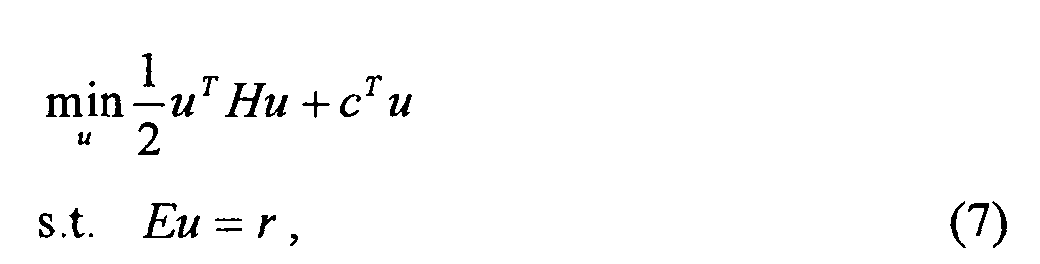
- In iteration k, given a guess E for the active constraints, solve the Equality-Constrained
QP (EQP)
where r represents the sub-vector of right hand sides for the active constraints. The optimal u *, and Lagrange multipliers λ* are given by
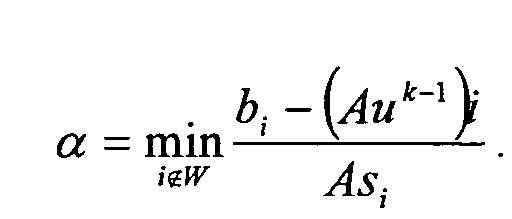
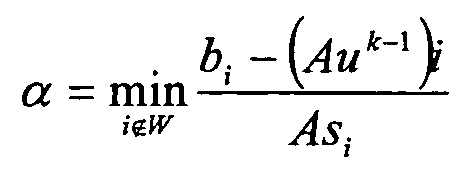
 Ratio Test Determine largest α ∈ [0,1] such that uk -1 + αs is feasible, where s=u*-u k-1, and uk-1 denotes the prior iterate. Note that u0 = uf . In other words, α is picked to be the largest value in [0,1] such that Auk-1 + αAs≤b. This test need not be performed for constraint indices i that are in the active set, since they have Asi = 0 (or Asi ≤0 in iteration 1), and the prior iterate uk -1 is feasible. (footnote: It is possible to have degenerate constraints not in the active set that have Asi = 0, and the ratio test over such constraints would also be skipped.) Thus α is given by

- Update the guess for the active set in the next iterate.
If there exist constraints for which the Lagrange multiplier λ* in the EQP (7) is negative, drop the constraint with the most negative multiplier from the active set. This is the so-called steepest edge rule. Bland's Rule is deployed whenever degeneracy is detected in the active set, and in these instances, the first constraint with a negative multiplier is dropped. Details on treatment and detection of degeneracy appear later in this disclosure.
Special case for first iteration Define a constraint in the initial active set to be consistent if the constraint is binding at uf . If in the first iteration α < 1, then all constraints that are not consistent are dropped, irrespective of the sign of their multiplier. This is because if Eu f ≤ r with strict inequality for some components, the updated iterate u 1 = uf + α(u* - uf ) does not satisfy Eu 1 = r for all constraints in the active set for the next iteration, leading to a discrepancy. This is the consistent active set method. For example, if uf is in the strict interior of the feasible set, this could lead to dropping all the constraints and re-starting with an empty active set, thereby allowing little exploitation of 'hot start'. However, if uf is the set of optimal controls obtained by solving the MPC problem at the prior time step, it is usually consistent with the initial guess for the active set.
Update the iterate

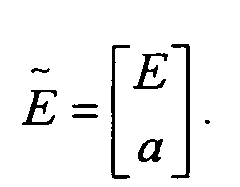







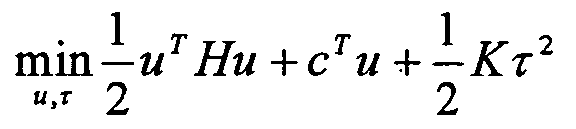
τ≥0
where d is a vector with a 1 in position I if α iuf > bi (α i represents the ith row of A), zeros elsewhere. It can be observed that u = uf , τ = maxi{α iuf -bi }is a feasible point for the big M QP, so we have knowledge of a feasible point.
Claims (35)
- A method for controlling a multivariable system including the steps of:a) receiving a plurality of sensor signals indicating current conditions of the system;b) receiving a plurality of commands;c) determining a desired dynamic response of the system based upon the commands and the sensor signals;d) in each of a plurality of time steps, formulating a problem of achieving the desired dynamic response for a window spanning multiple time steps as a solution to a quadratic programming problem;e) solving the quadratic programming problem in each time step using an iterative algorithm which searches for an optimal active set;f) in each subsequent time step of the plurality of time steps, initializing a search for the best active set based on a final active set of a prior time step of the plurality of time steps;g) generating a plurality of actuator control commands based upon the solution to the quadratic programming problem.
- The method of claim 1 wherein the active set comprises a set of constraints that are binding at an optimized solution.
- The method of claim 2 wherein said step c) further includes the procedure of dropping only one constraint with a negative Lagrange multiplier.
- The method of claim 2 wherein said step c) further includes the procedure of dropping all constraints that are not binding irrespective of signs of Lagrange multipliers of the constraints.
- The method of claim 2 further including the steps of:Determining that the final active set of the prior time step is not feasible in a current timestep;Minimizing a weighted sum of the original QP problem and a measure of infeasibility.
- The method of claim 2 further including the steps of:Determining that the feasible point is largely inconsistent with the active set; andRetaining inconsistent constraints in the active set while continuing the optimization.
- The method of claim 1 further including the step of performing a QR factorization in each iterate of the iterative algorithm of said step e).
- The method of claim 7 wherein a first iterate of the iterative algorithm includes the step of performing a full QR factorization and subsequent iterates include the step of performing a QR factorization update.
- The method of claim 7 further including the step of detecting degeneracy during each QR factorization.
- The method of claim 9 further including the step of dropping a degenerate constraint.
- The method of claim 10 further including the step of detecting linear dependency in the active constraints in each of the iterations without pre-processing.
- A method for controlling a multivariable system including the steps of:a) receiving a plurality of sensor signals indicating current conditions of the system;b) receiving a plurality of commands;c) determining a desired dynamic response of the system based upon the commands and the sensor signals;d) in each of a plurality of time steps, formulating a problem of achieving the desired dynamic response for a window spanning multiple time steps as a solution to a quadratic programming problem;e) solving the quadratic programming problem in each time step using an iterative algorithm;f) performing a Cholesky factorization of H in a first iteration;g) reusing the Cholesky factorization in iterations subsequent to the first iteration;h) computing an unconstrained solution in one of the iterations;i) reusing the unconstrained solution in iterations subsequent to the one of the iterations; andj) generating a plurality of actuator control commands based upon the solution to the quadratic programming problem.
- The method of claim 12 further including the step of performing a QR factorization in each iterate of the iterative algorithm.
- The method of claim 13 wherein an initial iterate of the iterative algorithm includes the step of performing a full QR factorization and subsequent iterates include the step of performing a QR factorization update.
- The method of claim 13 further including the step of detecting degeneracy during each QR factorization.
- The method of claim 15 further including the step of dropping a degenerate constraint.
- The method of claim 16 further including the step of detecting linear dependency in the active constraints in each of the iterations without pre-processing.
- A method for controlling a multivariable system including the steps of:a) receiving a plurality of sensor signals indicating current conditions of the system;b) receiving a plurality of commands;c) determining a desired dynamic response of the system based upon the commands and the sensor signals;d) in each of a plurality of time steps, formulating a problem of achieving the desired dynamic response for a window spanning multiple time steps as a solution to a quadratic programming problem;e) solving the quadratic programming problem in each time step using an iterative algorithm, including iteratively solving a quadratic programming problem where the set of indices of constraints in the active set is denoted by W and the rows in the constraint matrix A corresponding to the active set are characterized by E, and wherein a feasible point uf is known, Auf≤ b, the method including the steps of:i) choosing an initial guess active set;ii) in iteration k, given a guess E for the active constraints, solving the Equality-Constrained QP (EQP)s.t. Eu = r
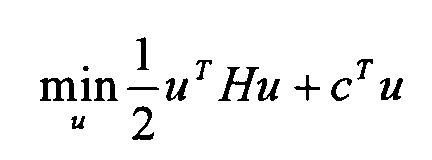
where r represents the sub-vector of right hand sides for the active constraints;iii) determining the optimal u *, and Lagrange multipliers λ* as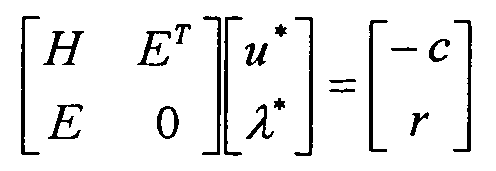 j) generating a plurality of actuator control commands based upon the solution to the quadratic programming problem.
- The method of claim 18 further including the steps of:Determining a largest α ∈ [0,1] such that u k-1 +αs is feasible, where s = u* - u k -1 ' uk -1 denotes the prior iterate and u 0 = uf .
- The method of claim 19 where α is given by
- The method of claim 20 further including the step of updating the guess for the active set in the next iterate.
- The method of claim 21 further including the step of adding to W the first index iB corresponding to which α achieves its minimum value in the ratio test, the guess for the active indices in the next iterate.
- The method of claim 22 further including the step of dropping the constraint with the most negative multiplier from the active set.
- The method of claim 23 further including the step of: in the first iteration, dropping all constraints that are not consistent if α < 1.
- A model predictive control system comprising:a plurality of sensors for determining a state of the system and for generating sensor signals indicative of the state of the system;a desired trajectory generator for creating a desired trajectory based upon the plurality of sensor signals and a plurality of commands;a linearization module deriving a linearized model about the desired trajectory;a quadratic programming module in each of a plurality of time steps formulating a problem of achieving the desired trajectory for a multiple timestep window as a solution to a quadratic programming problem;a quadratic programming solver for solving an optimization problem established by the quadratic programming module to generate a profile of optimal controls, the quadratic programming solver solving the quadratic programming problem in each time step using an iterative algorithm which searches for an optimal active set and in each subsequent time step of the plurality of time steps, initializing a search for the best active set based on a final active set of a prior time step of the plurality of time steps; andactuators acting on the system based upon the optimal controls to move the system toward the desired trajectory.
- The system of claim 25 wherein the active set comprises a set of constraints that are binding at an optimized solution.
- The system of claim 26 wherein the quadratic programming solver drops only one constraint with a negative Lagrange multipliers.
- The system of claim 26 wherein the quadratic programming solver drops all constraints that are not binding irrespective of signs of Lagrange multipliers of the constraints.
- The system of claim 25 the quadratic programming solver performs a QR factorization in each iterate of the iterative algorithm of said step e).
- The system of claim 29 wherein a first iterate of the iterative algorithm includes performing a full QR factorization and subsequent iterates include performing a QR factorization update.
- The system of claim 29 wherein the quadratic programming solver detects degeneracy during each QR factorization.
- The system of claim 31 wherein the quadratic programming solver drops a degenerate constraint.
- The system of claim 32 wherein the quadratic programming solver detects linear dependency in the active constraints in each of the iterations without pre-processing.
- A method for controlling a multivariable system including the steps of:a) receiving a plurality of sensor signals indicating current conditions of the system;b) receiving a plurality of commands;c) determining a desired dynamic response of the system based upon the commands and the sensor signals;d) in each of a plurality of time steps, formulating a problem of achieving the desired dynamic response for a window spanning multiple time steps as a solution to a quadratic programming problem;e) optimizing a quadratic programming problem using an iterative algorithm which searches for an optimal active set to solve the quadratic programming problem, the algorithm including the steps of:i) Determining that an initial starting point set is not feasible; andii) Reformulating the problem to obtain a feasible iterate.f) generating a plurality of actuator control commands based upon the solution to the quadratic programming problem.
- The method of claim 34 further including the step of minimizing a weighted sum of the original QP problem and a measure of infeasibility.
Applications Claiming Priority (2)
| Application Number | Priority Date | Filing Date | Title |
|---|---|---|---|
| US367458 | 1989-06-16 | ||
| US10/367,458 US7152023B2 (en) | 2003-02-14 | 2003-02-14 | System and method of accelerated active set search for quadratic programming in real-time model predictive control |
Publications (2)
| Publication Number | Publication Date |
|---|---|
| EP1447727A2 true EP1447727A2 (en) | 2004-08-18 |
| EP1447727A3 EP1447727A3 (en) | 2006-10-18 |
Family
ID=32681753
Family Applications (1)
| Application Number | Title | Priority Date | Filing Date |
|---|---|---|---|
| EP04250825A Withdrawn EP1447727A3 (en) | 2003-02-14 | 2004-02-16 | System and method of accelerated active set search for quadratic programming in real-time model predictive control |
Country Status (3)
| Country | Link |
|---|---|
| US (1) | US7152023B2 (en) |
| EP (1) | EP1447727A3 (en) |
| JP (1) | JP2004280792A (en) |
Cited By (18)
| Publication number | Priority date | Publication date | Assignee | Title |
|---|---|---|---|---|
| US7363094B2 (en) | 2006-01-09 | 2008-04-22 | General Electric Company | Multivariable controller design method for multiple input/outputs systems with multiple input/output constraints |
| EP1950636A1 (en) * | 2007-01-23 | 2008-07-30 | General Electric Company | Multivariable controller design method for multiple input/output systems with multiple input/output constraints |
| EP1965280A1 (en) * | 2007-03-02 | 2008-09-03 | Scania CV AB | Embedded real-time system |
| US8483260B2 (en) | 2010-09-29 | 2013-07-09 | Telefonaktiebolaget Lm Ericsson (Publ) | Covariance factor matrix reuse |
| CN103459785A (en) * | 2011-03-22 | 2013-12-18 | 通用电气公司 | Model predictive control system and method for integrated gasification combined cycle power generation |
| EP3125052A1 (en) * | 2015-07-31 | 2017-02-01 | Honeywell International Inc. | Quadratic program solver for mpc using variable ordering |
| US9650934B2 (en) | 2011-11-04 | 2017-05-16 | Honeywell spol.s.r.o. | Engine and aftertreatment optimization system |
| US10036338B2 (en) | 2016-04-26 | 2018-07-31 | Honeywell International Inc. | Condition-based powertrain control system |
| US10124750B2 (en) | 2016-04-26 | 2018-11-13 | Honeywell International Inc. | Vehicle security module system |
| US10272779B2 (en) | 2015-08-05 | 2019-04-30 | Garrett Transportation I Inc. | System and approach for dynamic vehicle speed optimization |
| US10309287B2 (en) | 2016-11-29 | 2019-06-04 | Garrett Transportation I Inc. | Inferential sensor |
| US10415492B2 (en) | 2016-01-29 | 2019-09-17 | Garrett Transportation I Inc. | Engine system with inferential sensor |
| US10503128B2 (en) | 2015-01-28 | 2019-12-10 | Garrett Transportation I Inc. | Approach and system for handling constraints for measured disturbances with uncertain preview |
| US10621291B2 (en) | 2015-02-16 | 2020-04-14 | Garrett Transportation I Inc. | Approach for aftertreatment system modeling and model identification |
| CN111025898A (en) * | 2019-11-07 | 2020-04-17 | 江南大学 | A dimensionality reduction identification method for large-scale process control in process industry |
| US11057213B2 (en) | 2017-10-13 | 2021-07-06 | Garrett Transportation I, Inc. | Authentication system for electronic control unit on a bus |
| US11156180B2 (en) | 2011-11-04 | 2021-10-26 | Garrett Transportation I, Inc. | Integrated optimization and control of an engine and aftertreatment system |
| WO2024062637A1 (en) * | 2022-09-23 | 2024-03-28 | Mitsubishi Electric Corporation | System and method for controlling an operation of a machine according to a task |
Families Citing this family (55)
| Publication number | Priority date | Publication date | Assignee | Title |
|---|---|---|---|---|
| US7328074B2 (en) * | 2002-12-02 | 2008-02-05 | United Technologies Corporation | Real-time quadratic programming for control of dynamical systems |
| US7197485B2 (en) * | 2003-07-16 | 2007-03-27 | United Technologies Corporation | Square root method for computationally efficient model predictive control |
| US7689592B2 (en) * | 2005-08-11 | 2010-03-30 | International Business Machines Corporation | Method, system and program product for determining objective function coefficients of a mathematical programming model |
| US7389773B2 (en) | 2005-08-18 | 2008-06-24 | Honeywell International Inc. | Emissions sensors for fuel control in engines |
| US7376471B2 (en) * | 2006-02-21 | 2008-05-20 | United Technologies Corporation | System and method for exploiting a good starting guess for binding constraints in quadratic programming with an infeasible and inconsistent starting guess for the solution |
| US8005575B2 (en) | 2006-06-01 | 2011-08-23 | General Electric Company | Methods and apparatus for model predictive control in a real time controller |
| US7949417B2 (en) * | 2006-09-22 | 2011-05-24 | Exxonmobil Research And Engineering Company | Model predictive controller solution analysis process |
| US7844352B2 (en) * | 2006-10-20 | 2010-11-30 | Lehigh University | Iterative matrix processor based implementation of real-time model predictive control |
| US7885717B2 (en) * | 2008-03-31 | 2011-02-08 | Sikorsky Aircraft Corporation | Fast control law optimization |
| US8073555B2 (en) * | 2008-05-06 | 2011-12-06 | United Technologies Corporation | Basepoint estimator |
| US7949416B2 (en) * | 2008-05-06 | 2011-05-24 | United Technologies Corporation | Multivariable control system |
| US8078292B2 (en) * | 2008-07-08 | 2011-12-13 | United Technologies Corporation | Basepoint estimator |
| US8060290B2 (en) | 2008-07-17 | 2011-11-15 | Honeywell International Inc. | Configurable automotive controller |
| US8529189B2 (en) * | 2009-01-30 | 2013-09-10 | Honeywell International Inc. | Linear quadratic regulator control for bleed air system fan air valve |
| US8620461B2 (en) | 2009-09-24 | 2013-12-31 | Honeywell International, Inc. | Method and system for updating tuning parameters of a controller |
| JP5581753B2 (en) * | 2010-03-17 | 2014-09-03 | 富士電機株式会社 | Plant control device, model predictive control device |
| US8504175B2 (en) * | 2010-06-02 | 2013-08-06 | Honeywell International Inc. | Using model predictive control to optimize variable trajectories and system control |
| US8682454B2 (en) | 2011-02-28 | 2014-03-25 | United Technologies Corporation | Method and system for controlling a multivariable system with limits |
| US8899488B2 (en) | 2011-05-31 | 2014-12-02 | United Technologies Corporation | RFID tag system |
| US9677493B2 (en) | 2011-09-19 | 2017-06-13 | Honeywell Spol, S.R.O. | Coordinated engine and emissions control system |
| US9494925B2 (en) * | 2011-12-20 | 2016-11-15 | United Technologies Corporation | Hybrid control system |
| US8849542B2 (en) * | 2012-06-29 | 2014-09-30 | United Technologies Corporation | Real time linearization of a component-level gas turbine engine model for model-based control |
| US9235657B1 (en) | 2013-03-13 | 2016-01-12 | Johnson Controls Technology Company | System identification and model development |
| US10418833B2 (en) | 2015-10-08 | 2019-09-17 | Con Edison Battery Storage, Llc | Electrical energy storage system with cascaded frequency response optimization |
| US9436179B1 (en) | 2013-03-13 | 2016-09-06 | Johnson Controls Technology Company | Systems and methods for energy cost optimization in a building system |
| US9852481B1 (en) * | 2013-03-13 | 2017-12-26 | Johnson Controls Technology Company | Systems and methods for cascaded model predictive control |
| US9481473B2 (en) | 2013-03-15 | 2016-11-01 | Rolls-Royce North American Technologies, Inc. | Distributed control system with smart actuators and sensors |
| US10175681B2 (en) | 2014-05-01 | 2019-01-08 | Johnson Controls Technology Company | High level central plant optimization |
| EP3091212A1 (en) | 2015-05-06 | 2016-11-09 | Honeywell International Inc. | An identification approach for internal combustion engine mean value models |
| US10190789B2 (en) | 2015-09-30 | 2019-01-29 | Johnson Controls Technology Company | Central plant with coordinated HVAC equipment staging across multiple subplants |
| US11210617B2 (en) | 2015-10-08 | 2021-12-28 | Johnson Controls Technology Company | Building management system with electrical energy storage optimization based on benefits and costs of participating in PDBR and IBDR programs |
| US10190793B2 (en) | 2015-10-08 | 2019-01-29 | Johnson Controls Technology Company | Building management system with electrical energy storage optimization based on statistical estimates of IBDR event probabilities |
| US10389136B2 (en) | 2015-10-08 | 2019-08-20 | Con Edison Battery Storage, Llc | Photovoltaic energy system with value function optimization |
| US10283968B2 (en) | 2015-10-08 | 2019-05-07 | Con Edison Battery Storage, Llc | Power control system with power setpoint adjustment based on POI power limits |
| US10700541B2 (en) | 2015-10-08 | 2020-06-30 | Con Edison Battery Storage, Llc | Power control system with battery power setpoint optimization using one-step-ahead prediction |
| US10222427B2 (en) | 2015-10-08 | 2019-03-05 | Con Edison Battery Storage, Llc | Electrical energy storage system with battery power setpoint optimization based on battery degradation costs and expected frequency response revenue |
| US10554170B2 (en) | 2015-10-08 | 2020-02-04 | Con Edison Battery Storage, Llc | Photovoltaic energy system with solar intensity prediction |
| US10197632B2 (en) | 2015-10-08 | 2019-02-05 | Taurus Des, Llc | Electrical energy storage system with battery power setpoint optimization using predicted values of a frequency regulation signal |
| US10222083B2 (en) | 2015-10-08 | 2019-03-05 | Johnson Controls Technology Company | Building control systems with optimization of equipment life cycle economic value while participating in IBDR and PBDR programs |
| US10418832B2 (en) | 2015-10-08 | 2019-09-17 | Con Edison Battery Storage, Llc | Electrical energy storage system with constant state-of charge frequency response optimization |
| US10742055B2 (en) | 2015-10-08 | 2020-08-11 | Con Edison Battery Storage, Llc | Renewable energy system with simultaneous ramp rate control and frequency regulation |
| US10564610B2 (en) | 2015-10-08 | 2020-02-18 | Con Edison Battery Storage, Llc | Photovoltaic energy system with preemptive ramp rate control |
| US10250039B2 (en) | 2015-10-08 | 2019-04-02 | Con Edison Battery Storage, Llc | Energy storage controller with battery life model |
| US10190522B2 (en) * | 2016-06-17 | 2019-01-29 | Toyota Motor Engineering & Manufacturing North America, Inc. | Hybrid partial and full step quadratic solver for model predictive control of diesel engine air path flow and methods of use |
| US10778012B2 (en) | 2016-07-29 | 2020-09-15 | Con Edison Battery Storage, Llc | Battery optimization control system with data fusion systems and methods |
| US10594153B2 (en) | 2016-07-29 | 2020-03-17 | Con Edison Battery Storage, Llc | Frequency response optimization control system |
| CN107728468B (en) * | 2017-08-16 | 2020-11-10 | 中山大学 | Novel discrete full-stability control method applied to suspension load helicopter |
| US10838440B2 (en) | 2017-11-28 | 2020-11-17 | Johnson Controls Technology Company | Multistage HVAC system with discrete device selection prioritization |
| US10838441B2 (en) | 2017-11-28 | 2020-11-17 | Johnson Controls Technology Company | Multistage HVAC system with modulating device demand control |
| US11159022B2 (en) | 2018-08-28 | 2021-10-26 | Johnson Controls Tyco IP Holdings LLP | Building energy optimization system with a dynamically trained load prediction model |
| US11163271B2 (en) | 2018-08-28 | 2021-11-02 | Johnson Controls Technology Company | Cloud based building energy optimization system with a dynamically trained load prediction model |
| DE102018220505A1 (en) * | 2018-11-28 | 2020-05-28 | Robert Bosch Gmbh | Model predictive control with improved consideration of restrictions |
| CN110442149A (en) * | 2019-07-30 | 2019-11-12 | 北京航空航天大学 | A kind of unmanned plane Aerodynamic Parameter Identification method based on improved differential evolution algorithm |
| US11568101B2 (en) | 2019-08-13 | 2023-01-31 | International Business Machines Corporation | Predictive multi-stage modelling for complex process control |
| US20230083788A1 (en) * | 2021-09-13 | 2023-03-16 | Mitsubishi Electric Corporation | Computing device and computing method |
Family Cites Families (15)
| Publication number | Priority date | Publication date | Assignee | Title |
|---|---|---|---|---|
| US4979118A (en) * | 1989-03-10 | 1990-12-18 | Gte Laboratories Incorporated | Predictive access-control and routing system for integrated services telecommunication networks |
| US5394322A (en) * | 1990-07-16 | 1995-02-28 | The Foxboro Company | Self-tuning controller that extracts process model characteristics |
| JPH06266409A (en) * | 1993-03-15 | 1994-09-22 | Toshiba Corp | Model predictive controller |
| JPH0728506A (en) * | 1993-07-08 | 1995-01-31 | Toshiba Corp | Model predictive controller |
| JP3279078B2 (en) * | 1994-07-05 | 2002-04-30 | 富士電機株式会社 | Controller control constant determination method |
| JPH0883104A (en) * | 1994-09-12 | 1996-03-26 | Toshiba Corp | Plant control equipment |
| US5682309A (en) * | 1995-04-28 | 1997-10-28 | Exxon Chemical Patents Inc. | Feedback method for controlling non-linear processes |
| US6064809A (en) * | 1998-06-05 | 2000-05-16 | The Board Of Trustees Of The University Of Illinois | Fast model predictive ellipsoid control process |
| US6381505B1 (en) * | 1998-09-28 | 2002-04-30 | Aspen Technology, Inc. | Robust steady-state target calculation for model predictive control |
| US6330483B1 (en) * | 1999-05-07 | 2001-12-11 | The Boeing Company | Optimal control system |
| JP2003500717A (en) * | 1999-05-25 | 2003-01-07 | シーメンス アクチエンゲゼルシヤフト | Method, apparatus and computer program for designing a technical system |
| DE59913911D1 (en) * | 1999-08-02 | 2006-11-23 | Siemens Schweiz Ag | Predicative device for regulating or controlling supply quantities |
| JP2001067103A (en) * | 1999-08-30 | 2001-03-16 | Hitachi Ltd | Process control method and apparatus |
| JP3962527B2 (en) * | 2000-03-30 | 2007-08-22 | 株式会社東芝 | Feedback control device and control method, magnetic disk device and control method thereof |
| JP2004527860A (en) | 2001-05-25 | 2004-09-09 | パラメトリック・オプティミゼーション・ソリューションズ・リミテッド | Improved process control |
-
2003
- 2003-02-14 US US10/367,458 patent/US7152023B2/en not_active Expired - Lifetime
-
2004
- 2004-02-13 JP JP2004037402A patent/JP2004280792A/en active Pending
- 2004-02-16 EP EP04250825A patent/EP1447727A3/en not_active Withdrawn
Cited By (29)
| Publication number | Priority date | Publication date | Assignee | Title |
|---|---|---|---|---|
| US7363094B2 (en) | 2006-01-09 | 2008-04-22 | General Electric Company | Multivariable controller design method for multiple input/outputs systems with multiple input/output constraints |
| EP1950636A1 (en) * | 2007-01-23 | 2008-07-30 | General Electric Company | Multivariable controller design method for multiple input/output systems with multiple input/output constraints |
| EP1965280A1 (en) * | 2007-03-02 | 2008-09-03 | Scania CV AB | Embedded real-time system |
| US8483260B2 (en) | 2010-09-29 | 2013-07-09 | Telefonaktiebolaget Lm Ericsson (Publ) | Covariance factor matrix reuse |
| CN103459785B (en) * | 2011-03-22 | 2015-10-07 | 通用电气公司 | For control system and the method for Integrated gasification combined cycle energy generation device |
| WO2012128813A3 (en) * | 2011-03-22 | 2014-01-30 | General Electric Company | Model predictive control system and method for integrated gasification combined cycle power generation |
| CN103459785A (en) * | 2011-03-22 | 2013-12-18 | 通用电气公司 | Model predictive control system and method for integrated gasification combined cycle power generation |
| US9650934B2 (en) | 2011-11-04 | 2017-05-16 | Honeywell spol.s.r.o. | Engine and aftertreatment optimization system |
| US11619189B2 (en) | 2011-11-04 | 2023-04-04 | Garrett Transportation I Inc. | Integrated optimization and control of an engine and aftertreatment system |
| US11156180B2 (en) | 2011-11-04 | 2021-10-26 | Garrett Transportation I, Inc. | Integrated optimization and control of an engine and aftertreatment system |
| US10503128B2 (en) | 2015-01-28 | 2019-12-10 | Garrett Transportation I Inc. | Approach and system for handling constraints for measured disturbances with uncertain preview |
| US11687688B2 (en) | 2015-02-16 | 2023-06-27 | Garrett Transportation I Inc. | Approach for aftertreatment system modeling and model identification |
| US10621291B2 (en) | 2015-02-16 | 2020-04-14 | Garrett Transportation I Inc. | Approach for aftertreatment system modeling and model identification |
| EP3125052A1 (en) * | 2015-07-31 | 2017-02-01 | Honeywell International Inc. | Quadratic program solver for mpc using variable ordering |
| US11144017B2 (en) | 2015-07-31 | 2021-10-12 | Garrett Transportation I, Inc. | Quadratic program solver for MPC using variable ordering |
| US11687047B2 (en) | 2015-07-31 | 2023-06-27 | Garrett Transportation I Inc. | Quadratic program solver for MPC using variable ordering |
| US10423131B2 (en) | 2015-07-31 | 2019-09-24 | Garrett Transportation I Inc. | Quadratic program solver for MPC using variable ordering |
| US11180024B2 (en) | 2015-08-05 | 2021-11-23 | Garrett Transportation I Inc. | System and approach for dynamic vehicle speed optimization |
| US10272779B2 (en) | 2015-08-05 | 2019-04-30 | Garrett Transportation I Inc. | System and approach for dynamic vehicle speed optimization |
| US11506138B2 (en) | 2016-01-29 | 2022-11-22 | Garrett Transportation I Inc. | Engine system with inferential sensor |
| US10415492B2 (en) | 2016-01-29 | 2019-09-17 | Garrett Transportation I Inc. | Engine system with inferential sensor |
| US10124750B2 (en) | 2016-04-26 | 2018-11-13 | Honeywell International Inc. | Vehicle security module system |
| US10036338B2 (en) | 2016-04-26 | 2018-07-31 | Honeywell International Inc. | Condition-based powertrain control system |
| US10309287B2 (en) | 2016-11-29 | 2019-06-04 | Garrett Transportation I Inc. | Inferential sensor |
| US11057213B2 (en) | 2017-10-13 | 2021-07-06 | Garrett Transportation I, Inc. | Authentication system for electronic control unit on a bus |
| CN111025898B (en) * | 2019-11-07 | 2021-08-24 | 江南大学 | A dimensionality reduction identification method for large-scale process control in process industry |
| CN111025898A (en) * | 2019-11-07 | 2020-04-17 | 江南大学 | A dimensionality reduction identification method for large-scale process control in process industry |
| WO2024062637A1 (en) * | 2022-09-23 | 2024-03-28 | Mitsubishi Electric Corporation | System and method for controlling an operation of a machine according to a task |
| US12282311B2 (en) | 2022-09-23 | 2025-04-22 | Mitsubishi Electric Research Laboratories, Inc. | System and method for controlling an operation of a machine according to a task |
Also Published As
| Publication number | Publication date |
|---|---|
| EP1447727A3 (en) | 2006-10-18 |
| US7152023B2 (en) | 2006-12-19 |
| JP2004280792A (en) | 2004-10-07 |
| US20040162709A1 (en) | 2004-08-19 |
Similar Documents
| Publication | Publication Date | Title |
|---|---|---|
| US7152023B2 (en) | System and method of accelerated active set search for quadratic programming in real-time model predictive control | |
| EP4363936B1 (en) | Stochastic nonlinear predictive controller and method based on uncertainty propagation by gaussian-assumed density filters | |
| US7328074B2 (en) | Real-time quadratic programming for control of dynamical systems | |
| US7197485B2 (en) | Square root method for computationally efficient model predictive control | |
| Baranyi | Extracting LPV and qLPV structures from state-space functions: A TP model transformation based framework | |
| Grancharova et al. | Explicit nonlinear model predictive control: Theory and applications | |
| EP0645025B1 (en) | System and method for controlling a plant | |
| Di Lizia et al. | High order optimal feedback control of space trajectories with bounded control | |
| EP1821164B1 (en) | System and method for exploiting a good starting guess for binding constraints in quadratic programming with an infeasible and inconsistent starting guess for the solution | |
| US9494925B2 (en) | Hybrid control system | |
| US5115391A (en) | Kalman filter-based optimizer and method and optimizing | |
| Fan et al. | Fast preliminary design of low-thrust trajectories for multi-asteroid exploration | |
| Majeed et al. | Aerodynamic parameter estimation using adaptive unscented Kalman filter | |
| Yao et al. | A reduced-order model for gradient-based aerodynamic shape optimisation | |
| Lian et al. | Inverse Q-learning using input–output data | |
| Poustini et al. | A new approach to trajectory optimization based on direct transcription and differential flatness | |
| Servadio et al. | Nonlinear prediction in marker-based spacecraft pose estimation with polynomial transition maps | |
| Panagiotopoulos et al. | Parametric model order reduction for acoustic boundary element method systems through a multiparameter Krylov subspaces recycling strategy | |
| Morelli et al. | Warm start of interior-point methods applied to sequential convex programming | |
| Gros et al. | Numerical optimal control (draft) | |
| Roh et al. | Trajectory optimization for a multi-stage launch vehicle using time finite element and direct collocation methods | |
| Margolis | A sweeping gradient method for ordinary differential equations with events | |
| Lee et al. | Time optimal attitude control for a rigid body | |
| Hindmarsh et al. | Algorithms and software for ordinary differential equations and differential-algebraic equations, Part I: Euler methods and error estimation | |
| Jain et al. | Multi-phase spacecraft trajectory optimization via transformer-based reinforcement learning |
Legal Events
| Date | Code | Title | Description |
|---|---|---|---|
| PUAI | Public reference made under article 153(3) epc to a published international application that has entered the european phase |
Free format text: ORIGINAL CODE: 0009012 |
|
| AK | Designated contracting states |
Kind code of ref document: A2 Designated state(s): AT BE BG CH CY CZ DE DK EE ES FI FR GB GR HU IE IT LI LU MC NL PT RO SE SI SK TR |
|
| AX | Request for extension of the european patent |
Extension state: AL LT LV MK |
|
| RIN1 | Information on inventor provided before grant (corrected) |
Inventor name: DAS, INDRANEEL |
|
| PUAL | Search report despatched |
Free format text: ORIGINAL CODE: 0009013 |
|
| AK | Designated contracting states |
Kind code of ref document: A3 Designated state(s): AT BE BG CH CY CZ DE DK EE ES FI FR GB GR HU IE IT LI LU MC NL PT RO SE SI SK TR |
|
| AX | Request for extension of the european patent |
Extension state: AL LT LV MK |
|
| 17P | Request for examination filed |
Effective date: 20070118 |
|
| AKX | Designation fees paid |
Designated state(s): AT BE BG CH CY CZ DE DK EE ES FI FR GB GR HU IE IT LI LU MC NL PT RO SE SI SK TR |
|
| 17Q | First examination report despatched |
Effective date: 20091110 |
|
| STAA | Information on the status of an ep patent application or granted ep patent |
Free format text: STATUS: THE APPLICATION IS DEEMED TO BE WITHDRAWN |
|
| 18D | Application deemed to be withdrawn |
Effective date: 20100323 |