EP1447430A1 - New monoanthraquinone azamethine dyes - Google Patents
New monoanthraquinone azamethine dyes Download PDFInfo
- Publication number
- EP1447430A1 EP1447430A1 EP03002976A EP03002976A EP1447430A1 EP 1447430 A1 EP1447430 A1 EP 1447430A1 EP 03002976 A EP03002976 A EP 03002976A EP 03002976 A EP03002976 A EP 03002976A EP 1447430 A1 EP1447430 A1 EP 1447430A1
- Authority
- EP
- European Patent Office
- Prior art keywords
- alkyl
- independently hydrogen
- aryl
- halogen
- compound according
- Prior art date
- Legal status (The legal status is an assumption and is not a legal conclusion. Google has not performed a legal analysis and makes no representation as to the accuracy of the status listed.)
- Withdrawn
Links
- 239000000975 dye Substances 0.000 title description 8
- -1 polyethylene Polymers 0.000 claims abstract description 22
- 229920000728 polyester Polymers 0.000 claims abstract description 10
- 239000004952 Polyamide Substances 0.000 claims abstract description 9
- 229920002647 polyamide Polymers 0.000 claims abstract description 9
- 239000004743 Polypropylene Substances 0.000 claims abstract description 8
- 229920001155 polypropylene Polymers 0.000 claims abstract description 8
- 239000004698 Polyethylene Substances 0.000 claims abstract description 7
- 238000004040 coloring Methods 0.000 claims abstract description 7
- 229920000573 polyethylene Polymers 0.000 claims abstract description 7
- 229920000122 acrylonitrile butadiene styrene Polymers 0.000 claims abstract description 6
- 125000003118 aryl group Chemical group 0.000 claims abstract description 6
- 229920000515 polycarbonate Polymers 0.000 claims abstract description 6
- 239000004417 polycarbonate Substances 0.000 claims abstract description 6
- 229920000642 polymer Polymers 0.000 claims abstract description 6
- 125000005842 heteroatom Chemical group 0.000 claims abstract description 4
- 150000001875 compounds Chemical class 0.000 claims description 22
- 229910052739 hydrogen Inorganic materials 0.000 claims description 16
- 239000001257 hydrogen Substances 0.000 claims description 16
- 150000002431 hydrogen Chemical class 0.000 claims description 14
- 229910052736 halogen Inorganic materials 0.000 claims description 11
- 150000002367 halogens Chemical class 0.000 claims description 11
- 125000000041 C6-C10 aryl group Chemical group 0.000 claims description 10
- 125000000008 (C1-C10) alkyl group Chemical group 0.000 claims description 7
- 125000004191 (C1-C6) alkoxy group Chemical group 0.000 claims description 7
- QUPVURNJBGAEQX-UHFFFAOYSA-N 1-amino-9,10-dioxoanthracene-2-carbaldehyde Chemical compound O=C1C2=CC=CC=C2C(=O)C2=C1C=CC(C=O)=C2N QUPVURNJBGAEQX-UHFFFAOYSA-N 0.000 claims description 7
- 125000002887 hydroxy group Chemical group [H]O* 0.000 claims description 7
- 125000003837 (C1-C20) alkyl group Chemical group 0.000 claims description 6
- 125000000956 methoxy group Chemical group [H]C([H])([H])O* 0.000 claims description 6
- 229920001059 synthetic polymer Polymers 0.000 claims description 6
- 125000000217 alkyl group Chemical group 0.000 claims description 5
- 150000001412 amines Chemical class 0.000 claims description 5
- 150000005840 aryl radicals Chemical class 0.000 claims description 5
- 125000004169 (C1-C6) alkyl group Chemical group 0.000 claims description 4
- 238000004519 manufacturing process Methods 0.000 claims description 4
- 150000003839 salts Chemical class 0.000 claims description 4
- 238000009833 condensation Methods 0.000 claims description 3
- 230000005494 condensation Effects 0.000 claims description 3
- 239000000155 melt Substances 0.000 claims description 3
- 239000003960 organic solvent Substances 0.000 claims description 3
- 239000002904 solvent Substances 0.000 claims description 3
- WKBOTKDWSSQWDR-UHFFFAOYSA-N Bromine atom Chemical compound [Br] WKBOTKDWSSQWDR-UHFFFAOYSA-N 0.000 claims description 2
- ZAMOUSCENKQFHK-UHFFFAOYSA-N Chlorine atom Chemical compound [Cl] ZAMOUSCENKQFHK-UHFFFAOYSA-N 0.000 claims description 2
- UFHFLCQGNIYNRP-UHFFFAOYSA-N Hydrogen Chemical compound [H][H] UFHFLCQGNIYNRP-UHFFFAOYSA-N 0.000 claims description 2
- GDTBXPJZTBHREO-UHFFFAOYSA-N bromine Substances BrBr GDTBXPJZTBHREO-UHFFFAOYSA-N 0.000 claims description 2
- 229910052794 bromium Inorganic materials 0.000 claims description 2
- 239000000460 chlorine Substances 0.000 claims description 2
- 229910052801 chlorine Inorganic materials 0.000 claims description 2
- 125000000449 nitro group Chemical group [O-][N+](*)=O 0.000 claims description 2
- 229910052757 nitrogen Inorganic materials 0.000 claims 1
- 125000004433 nitrogen atom Chemical group N* 0.000 claims 1
- 239000003086 colorant Substances 0.000 abstract description 10
- 229920006113 non-polar polymer Polymers 0.000 abstract description 7
- 229920006112 polar polymer Polymers 0.000 abstract description 7
- 229920000307 polymer substrate Polymers 0.000 abstract description 3
- ZMXDDKWLCZADIW-UHFFFAOYSA-N N,N-Dimethylformamide Chemical compound CN(C)C=O ZMXDDKWLCZADIW-UHFFFAOYSA-N 0.000 description 27
- 239000000843 powder Substances 0.000 description 16
- QTBSBXVTEAMEQO-UHFFFAOYSA-N Acetic acid Chemical compound CC(O)=O QTBSBXVTEAMEQO-UHFFFAOYSA-N 0.000 description 15
- OKKJLVBELUTLKV-UHFFFAOYSA-N Methanol Chemical compound OC OKKJLVBELUTLKV-UHFFFAOYSA-N 0.000 description 15
- 239000012299 nitrogen atmosphere Substances 0.000 description 6
- 239000011248 coating agent Substances 0.000 description 5
- 238000000576 coating method Methods 0.000 description 5
- 239000004676 acrylonitrile butadiene styrene Substances 0.000 description 4
- 238000001816 cooling Methods 0.000 description 4
- 229920005989 resin Polymers 0.000 description 4
- 239000011347 resin Substances 0.000 description 4
- 239000000243 solution Substances 0.000 description 4
- 239000000725 suspension Substances 0.000 description 4
- LFQSCWFLJHTTHZ-UHFFFAOYSA-N Ethanol Chemical compound CCO LFQSCWFLJHTTHZ-UHFFFAOYSA-N 0.000 description 3
- 239000003054 catalyst Substances 0.000 description 3
- 239000003822 epoxy resin Substances 0.000 description 3
- 239000000463 material Substances 0.000 description 3
- 238000002074 melt spinning Methods 0.000 description 3
- 239000000203 mixture Substances 0.000 description 3
- 150000007524 organic acids Chemical class 0.000 description 3
- 235000005985 organic acids Nutrition 0.000 description 3
- 229920000647 polyepoxide Polymers 0.000 description 3
- VEXZGXHMUGYJMC-UHFFFAOYSA-N Hydrochloric acid Chemical compound Cl VEXZGXHMUGYJMC-UHFFFAOYSA-N 0.000 description 2
- LRHPLDYGYMQRHN-UHFFFAOYSA-N N-Butanol Chemical compound CCCCO LRHPLDYGYMQRHN-UHFFFAOYSA-N 0.000 description 2
- PPBRXRYQALVLMV-UHFFFAOYSA-N Styrene Chemical compound C=CC1=CC=CC=C1 PPBRXRYQALVLMV-UHFFFAOYSA-N 0.000 description 2
- 238000012644 addition polymerization Methods 0.000 description 2
- WNLRTRBMVRJNCN-UHFFFAOYSA-N adipic acid Chemical compound OC(=O)CCCCC(O)=O WNLRTRBMVRJNCN-UHFFFAOYSA-N 0.000 description 2
- 239000003795 chemical substances by application Substances 0.000 description 2
- 229940125904 compound 1 Drugs 0.000 description 2
- 150000001991 dicarboxylic acids Chemical class 0.000 description 2
- ZUOUZKKEUPVFJK-UHFFFAOYSA-N diphenyl Chemical compound C1=CC=CC=C1C1=CC=CC=C1 ZUOUZKKEUPVFJK-UHFFFAOYSA-N 0.000 description 2
- JBKVHLHDHHXQEQ-UHFFFAOYSA-N epsilon-caprolactam Chemical compound O=C1CCCCCN1 JBKVHLHDHHXQEQ-UHFFFAOYSA-N 0.000 description 2
- 239000000835 fiber Substances 0.000 description 2
- 239000008187 granular material Substances 0.000 description 2
- LNEPOXFFQSENCJ-UHFFFAOYSA-N haloperidol Chemical compound C1CC(O)(C=2C=CC(Cl)=CC=2)CCN1CCCC(=O)C1=CC=C(F)C=C1 LNEPOXFFQSENCJ-UHFFFAOYSA-N 0.000 description 2
- NAQMVNRVTILPCV-UHFFFAOYSA-N hexane-1,6-diamine Chemical compound NCCCCCCN NAQMVNRVTILPCV-UHFFFAOYSA-N 0.000 description 2
- 239000000976 ink Substances 0.000 description 2
- 238000000034 method Methods 0.000 description 2
- LQNUZADURLCDLV-UHFFFAOYSA-N nitrobenzene Chemical compound [O-][N+](=O)C1=CC=CC=C1 LQNUZADURLCDLV-UHFFFAOYSA-N 0.000 description 2
- 125000001997 phenyl group Chemical group [H]C1=C([H])C([H])=C(*)C([H])=C1[H] 0.000 description 2
- 238000006068 polycondensation reaction Methods 0.000 description 2
- 229920001225 polyester resin Polymers 0.000 description 2
- 239000004645 polyester resin Substances 0.000 description 2
- 239000004848 polyfunctional curative Substances 0.000 description 2
- SCVFZCLFOSHCOH-UHFFFAOYSA-M potassium acetate Chemical compound [K+].CC([O-])=O SCVFZCLFOSHCOH-UHFFFAOYSA-M 0.000 description 2
- 239000000758 substrate Substances 0.000 description 2
- NJVOHKFLBKQLIZ-UHFFFAOYSA-N (2-ethenylphenyl) prop-2-enoate Chemical compound C=CC(=O)OC1=CC=CC=C1C=C NJVOHKFLBKQLIZ-UHFFFAOYSA-N 0.000 description 1
- MRERMGPPCLQIPD-NBVRZTHBSA-N (3beta,5alpha,9alpha,22E,24R)-3,5,9-Trihydroxy-23-methylergosta-7,22-dien-6-one Chemical compound C1C(O)CCC2(C)C(CCC3(C(C(C)/C=C(\C)C(C)C(C)C)CCC33)C)(O)C3=CC(=O)C21O MRERMGPPCLQIPD-NBVRZTHBSA-N 0.000 description 1
- JTPNRXUCIXHOKM-UHFFFAOYSA-N 1-chloronaphthalene Chemical compound C1=CC=C2C(Cl)=CC=CC2=C1 JTPNRXUCIXHOKM-UHFFFAOYSA-N 0.000 description 1
- LBLYYCQCTBFVLH-UHFFFAOYSA-N 2-Methylbenzenesulfonic acid Chemical compound CC1=CC=CC=C1S(O)(=O)=O LBLYYCQCTBFVLH-UHFFFAOYSA-N 0.000 description 1
- MELAGXOBBSTJPI-UHFFFAOYSA-N 5-methyl-1,3-benzothiazol-2-amine Chemical compound CC1=CC=C2SC(N)=NC2=C1 MELAGXOBBSTJPI-UHFFFAOYSA-N 0.000 description 1
- WREVVZMUNPAPOV-UHFFFAOYSA-N 8-aminoquinoline Chemical compound C1=CN=C2C(N)=CC=CC2=C1 WREVVZMUNPAPOV-UHFFFAOYSA-N 0.000 description 1
- NIXOWILDQLNWCW-UHFFFAOYSA-M Acrylate Chemical compound [O-]C(=O)C=C NIXOWILDQLNWCW-UHFFFAOYSA-M 0.000 description 1
- 229920000178 Acrylic resin Polymers 0.000 description 1
- 239000004925 Acrylic resin Substances 0.000 description 1
- ZNHHOFQIOTZJRZ-CCVNUDIWSA-N CCN(c(ccc(/N=C/c(c(N)c1C(c2c3cccc2)=O)ccc1C3=O)c1)c1N1CC)C1=O Chemical compound CCN(c(ccc(/N=C/c(c(N)c1C(c2c3cccc2)=O)ccc1C3=O)c1)c1N1CC)C1=O ZNHHOFQIOTZJRZ-CCVNUDIWSA-N 0.000 description 1
- KXDHJXZQYSOELW-UHFFFAOYSA-N Carbamic acid Chemical class NC(O)=O KXDHJXZQYSOELW-UHFFFAOYSA-N 0.000 description 1
- GEOXJFOHAXUWEV-OPEKNORGSA-N Cc1ccc2[s]c(/N=C/c(c(N)c3C(c4ccccc44)=O)ccc3C4=O)nc2c1 Chemical compound Cc1ccc2[s]c(/N=C/c(c(N)c3C(c4ccccc44)=O)ccc3C4=O)nc2c1 GEOXJFOHAXUWEV-OPEKNORGSA-N 0.000 description 1
- DGAQECJNVWCQMB-PUAWFVPOSA-M Ilexoside XXIX Chemical compound C[C@@H]1CC[C@@]2(CC[C@@]3(C(=CC[C@H]4[C@]3(CC[C@@H]5[C@@]4(CC[C@@H](C5(C)C)OS(=O)(=O)[O-])C)C)[C@@H]2[C@]1(C)O)C)C(=O)O[C@H]6[C@@H]([C@H]([C@@H]([C@H](O6)CO)O)O)O.[Na+] DGAQECJNVWCQMB-PUAWFVPOSA-M 0.000 description 1
- 229920000877 Melamine resin Polymers 0.000 description 1
- FXHOOIRPVKKKFG-UHFFFAOYSA-N N,N-Dimethylacetamide Chemical compound CN(C)C(C)=O FXHOOIRPVKKKFG-UHFFFAOYSA-N 0.000 description 1
- SECXISVLQFMRJM-UHFFFAOYSA-N N-Methylpyrrolidone Chemical compound CN1CCCC1=O SECXISVLQFMRJM-UHFFFAOYSA-N 0.000 description 1
- 229920002292 Nylon 6 Polymers 0.000 description 1
- CTQNGGLPUBDAKN-UHFFFAOYSA-N O-Xylene Chemical compound CC1=CC=CC=C1C CTQNGGLPUBDAKN-UHFFFAOYSA-N 0.000 description 1
- 239000002174 Styrene-butadiene Substances 0.000 description 1
- QAOWNCQODCNURD-UHFFFAOYSA-L Sulfate Chemical compound [O-]S([O-])(=O)=O QAOWNCQODCNURD-UHFFFAOYSA-L 0.000 description 1
- QAOWNCQODCNURD-UHFFFAOYSA-N Sulfuric acid Chemical compound OS(O)(=O)=O QAOWNCQODCNURD-UHFFFAOYSA-N 0.000 description 1
- 150000008065 acid anhydrides Chemical class 0.000 description 1
- 239000000654 additive Substances 0.000 description 1
- 239000001361 adipic acid Substances 0.000 description 1
- 235000011037 adipic acid Nutrition 0.000 description 1
- 150000001298 alcohols Chemical class 0.000 description 1
- 125000001931 aliphatic group Chemical group 0.000 description 1
- 150000001408 amides Chemical class 0.000 description 1
- 239000011230 binding agent Substances 0.000 description 1
- 230000015572 biosynthetic process Effects 0.000 description 1
- 239000004305 biphenyl Substances 0.000 description 1
- 235000010290 biphenyl Nutrition 0.000 description 1
- 238000009835 boiling Methods 0.000 description 1
- MTAZNLWOLGHBHU-UHFFFAOYSA-N butadiene-styrene rubber Chemical compound C=CC=C.C=CC1=CC=CC=C1 MTAZNLWOLGHBHU-UHFFFAOYSA-N 0.000 description 1
- 239000000919 ceramic Substances 0.000 description 1
- 125000001309 chloro group Chemical group Cl* 0.000 description 1
- 150000008422 chlorobenzenes Chemical class 0.000 description 1
- 239000004567 concrete Substances 0.000 description 1
- 239000000470 constituent Substances 0.000 description 1
- 238000007796 conventional method Methods 0.000 description 1
- 238000011161 development Methods 0.000 description 1
- 150000004985 diamines Chemical class 0.000 description 1
- QGBSISYHAICWAH-UHFFFAOYSA-N dicyandiamide Chemical compound NC(N)=NC#N QGBSISYHAICWAH-UHFFFAOYSA-N 0.000 description 1
- 229920001971 elastomer Polymers 0.000 description 1
- LYCAIKOWRPUZTN-UHFFFAOYSA-N ethylene glycol Natural products OCCO LYCAIKOWRPUZTN-UHFFFAOYSA-N 0.000 description 1
- 238000002474 experimental method Methods 0.000 description 1
- 238000001125 extrusion Methods 0.000 description 1
- 238000010096 film blowing Methods 0.000 description 1
- 239000011521 glass Substances 0.000 description 1
- 230000008642 heat stress Effects 0.000 description 1
- 229920001903 high density polyethylene Polymers 0.000 description 1
- 239000004700 high-density polyethylene Substances 0.000 description 1
- 239000012943 hotmelt Substances 0.000 description 1
- 229930195733 hydrocarbon Natural products 0.000 description 1
- 150000002430 hydrocarbons Chemical class 0.000 description 1
- WGCNASOHLSPBMP-UHFFFAOYSA-N hydroxyacetaldehyde Natural products OCC=O WGCNASOHLSPBMP-UHFFFAOYSA-N 0.000 description 1
- 150000002460 imidazoles Chemical class 0.000 description 1
- 238000001746 injection moulding Methods 0.000 description 1
- 239000012948 isocyanate Substances 0.000 description 1
- 150000002513 isocyanates Chemical class 0.000 description 1
- 150000003951 lactams Chemical class 0.000 description 1
- 239000007788 liquid Substances 0.000 description 1
- 229920001684 low density polyethylene Polymers 0.000 description 1
- 239000004702 low-density polyethylene Substances 0.000 description 1
- 229910052751 metal Inorganic materials 0.000 description 1
- 239000002184 metal Substances 0.000 description 1
- 150000007522 mineralic acids Chemical class 0.000 description 1
- 150000002918 oxazolines Chemical class 0.000 description 1
- 239000000123 paper Substances 0.000 description 1
- ISWSIDIOOBJBQZ-UHFFFAOYSA-N phenol group Chemical group C1(=CC=CC=C1)O ISWSIDIOOBJBQZ-UHFFFAOYSA-N 0.000 description 1
- 229920001568 phenolic resin Polymers 0.000 description 1
- 239000000049 pigment Substances 0.000 description 1
- 229920003023 plastic Polymers 0.000 description 1
- 239000004033 plastic Substances 0.000 description 1
- 229920002492 poly(sulfone) Polymers 0.000 description 1
- 238000006116 polymerization reaction Methods 0.000 description 1
- 229920000098 polyolefin Polymers 0.000 description 1
- 229920002635 polyurethane Polymers 0.000 description 1
- 239000004814 polyurethane Substances 0.000 description 1
- 229920005749 polyurethane resin Polymers 0.000 description 1
- 235000011056 potassium acetate Nutrition 0.000 description 1
- 238000011160 research Methods 0.000 description 1
- 239000005060 rubber Substances 0.000 description 1
- 229910052708 sodium Inorganic materials 0.000 description 1
- 239000001632 sodium acetate Substances 0.000 description 1
- 235000017281 sodium acetate Nutrition 0.000 description 1
- 238000009987 spinning Methods 0.000 description 1
- 239000011115 styrene butadiene Substances 0.000 description 1
- 229920003048 styrene butadiene rubber Polymers 0.000 description 1
- 239000001117 sulphuric acid Substances 0.000 description 1
- 235000011149 sulphuric acid Nutrition 0.000 description 1
- 238000003786 synthesis reaction Methods 0.000 description 1
- 239000004753 textile Substances 0.000 description 1
- 239000001993 wax Substances 0.000 description 1
- 239000002023 wood Substances 0.000 description 1
- 239000008096 xylene Substances 0.000 description 1
Classifications
-
- C—CHEMISTRY; METALLURGY
- C09—DYES; PAINTS; POLISHES; NATURAL RESINS; ADHESIVES; COMPOSITIONS NOT OTHERWISE PROVIDED FOR; APPLICATIONS OF MATERIALS NOT OTHERWISE PROVIDED FOR
- C09B—ORGANIC DYES OR CLOSELY-RELATED COMPOUNDS FOR PRODUCING DYES, e.g. PIGMENTS; MORDANTS; LAKES
- C09B55/00—Azomethine dyes
- C09B55/005—Disazomethine dyes
- C09B55/007—Disazomethine dyes containing only carbocyclic rings
-
- C—CHEMISTRY; METALLURGY
- C09—DYES; PAINTS; POLISHES; NATURAL RESINS; ADHESIVES; COMPOSITIONS NOT OTHERWISE PROVIDED FOR; APPLICATIONS OF MATERIALS NOT OTHERWISE PROVIDED FOR
- C09B—ORGANIC DYES OR CLOSELY-RELATED COMPOUNDS FOR PRODUCING DYES, e.g. PIGMENTS; MORDANTS; LAKES
- C09B1/00—Dyes with anthracene nucleus not condensed with any other ring
- C09B1/16—Amino-anthraquinones
- C09B1/20—Preparation from starting materials already containing the anthracene nucleus
- C09B1/22—Dyes with unsubstituted amino groups
Definitions
- the present invention relates to novel colorants based on mono-anthraquinone azamethine derivatives for the mass coloring of polymers.
- the novel colorants provide for excellent compatibility with the polymer substrate, excellent heat stability and light fastness as required for mass coloring of polar and non-polar polymers.
- Polar polymers are for example polyamides, polyesters, polycarbonates and ABS; non-polar polymers are olefin polymers such as polyethylene and polypropylene.
- the mono-anthraquinone azamethine phenyl dye disclosed in DE 1285078 has limited heat stability and limited solubility and therefore only poorly qualifies as polymer-soluble dye. In polymers it provides for rather unattractive brownish red shades and the available colour range is rather narrow.
- the object of the present invention is to provide new heat- and lightfast monoanthraquinone azamethine dyes with excellent compatibility with the polymer substrate and with a wide colour range available, to be useful as polymer-soluble colorants for the mass coloration of polar and non-polar polymers.
- the compounds of the formula (I), wherein the nucleus A' represents a substituted or unsubstituted annealed aromatic ring system comprising at least one heteroatom provide for the required properties to qualify as polymer-soluble dyes.
- the present invention also provides a process for preparing the compounds of the formula (I), characterized in that an 1-amino-anthraquinone-2-aldehyde of the formula (II) wherein R 1 , R 2 , R 3 and R 4 are defined as above, is condensed with an amine or the salt of an amine according to formula (III).
- Suitable salts of the amine of the respective formulae (III) are the chlorhydrate or the sulfate.
- the condensation can be conducted without solvent in the melt at temperatures of between 150°C and 300°C, preferably up to 250°C, or in an inert organic solvent at temperatures between 25°C and 300°C, preferably between 80°C and 250°C, in the presence or absence of a catalyst, at atmospheric pressure or under pressure.
- suitable inert organic solvents are relatively high-boiling aliphatic or aromatic, substituted or unsubstituted hydrocarbons, examples being xylene (mixture), biphenyl, nitrobenzene, chlorobenzenes, chloronaphthalene, glycol ethers, organic acids and acid amides, especially dimethylformamide, dimethylacetamide or N-methylpyrrolidone.
- suitable solvents are alcohols, such as methanol, ethanol or butanol.
- catalysts examples include inorganic or organic acids, such as hydrochloric or sulphuric acid, benzenesulphonic, toluenesulphonic acid, or acetic acid.
- organic acids such as hydrochloric or sulphuric acid, benzenesulphonic, toluenesulphonic acid, or acetic acid.
- the salts of organic acids such as sodium or potassium acetate, are in many cases also suitable as catalysts.
- the compounds of the invention are eminently suitable for the coloring of melts of synthetic polar and non-polar polymers.
- Synthetic polar polymers are for example polyamide, polyester, polycarbonate or ABS.
- Preferred polyamides are, for example polycondensation products or addition polymerization products of dicarboxylic acids and diamines, e.g. of adipic acid and hexamethylenediamine, of lactams, e.g. ⁇ -caprolactam, or of aminocarboxylic acids, e.g. ⁇ -aminoundecanoic acid.
- Synthetic non-polar polymers are for example polyethylene, in particular low or high-density polyethylene and polypropylene.
- the polymer melt is mixed with the colorant by conventional methods - for example, in melt spinning, injection molding, extrusion or film blowing machines.
- novel dyes of formula (I) give red to magenta coloration in synthetic non-polar or polar polymers, such as for example polyethylene, polypropylene, ABS, polyester, polycarbonate or polyamides.
- novel dyes of the formula (I) are highly compatible with the synthetic polymer substrate and they are extremely stable to the heat stress, which is necessarily part of the coloring of synthetic polymers. Further, the mass-colored substrates display excellent fastness properties, in particular light fastness.
- novel compounds of the formula (I) are also suitable as colorants in electrophotographic toners and developers, such as one- or two-component powder toners (also called one- or two-component developers), magnetic toners, liquid toners, polymerization toners and specialty toners (literature: L.B. Schein, "Electrophotography and Development Physics”; Springer Series in Electrophysics 14, Springer Verlag, 2 nd Edition, 1992).
- Typical toner binders are addition polymerization, polyaddition and polycondensation resins, such as styrene, styrene-acrylate, styrene-butadiene, acrylate, polyester and phenol-epoxy resins, polysulphones, polyurethanes, individually or in combination, and also polyethylene and polypropylene, which may comprise further constituents, such as charge control agents, waxes or flow assistants, or may be modified subsequently with these additives.
- polyaddition and polycondensation resins such as styrene, styrene-acrylate, styrene-butadiene, acrylate, polyester and phenol-epoxy resins, polysulphones, polyurethanes, individually or in combination, and also polyethylene and polypropylene, which may comprise further constituents, such as charge control agents, waxes or flow assistants, or may be modified subsequently with these additives.
- novel compounds of the formula (I) are suitable, furthermore, as colorants in powders and powder coating materials, especially in triboelectrically or electrokinetically sprayable powder coating materials which are used for the surface coating of articles made, for example, from metal, wood, plastic, glass, ceramic, concrete, textile material, paper or rubber (J.F. Hughes, "Electrostatics Powder Coating” Research Studies, John Wiley & Sons, 1984).
- Powder coating resins that are typically employed are epoxy resins, carboxyl- and hydroxyl-containing polyester resins, polyurethane resins and acrylic resins, together with customary hardeners. Combinations of resins are also used. For example, epoxy resins are frequently employed in combination with carboxyl- and hydroxyl-containing polyester resins.
- Typical hardener components are, for example, acid anhydrides, imidazoles and also dicyanodiamide and its derivatives, blocked isocyanates, bisacylurethanes, phenolic and melamine resins, triglycidyl isocyanurates, oxazolines and dicarboxylic acids.
- novel compounds of the formula (I) are suitable as colorants in ink-jet inks, both aqueous and non-aqueous, and in those inks which operate in accordance with the hot-melt process.
- 100 parts of polypropylene in the form of a powder are mixed with 0.1 and with 1.0 part respectively of the dye from Examples 1 in powder form in a drum mixer. After a short time, the powder is uniformly distributed and adheres to the granules. After about 10 minutes, the mixture is dried at 120°C for 16 hours, transferred to a melt spinning machine and following a residence time of about 8 minutes is spun to fibers at 275-280°C under a nitrogen atmosphere. The colored fibers are extremely lightfast.
- All other known synthetic polymers can be mass-colored in the same way, e.g. (HD/LD) polyethylene, polyamides, polyesters, ABS, polycarbonates.
- HD/LD high density polyethylene
- polyamides polyamides
- polyesters polyamides
- ABS polycarbonates
- Polyester fibres containing 0.1 parts of compound 1 have been prepared according to the following method: the polyester is fused and extruded through a drawing plate at constant rate by gear pump regulation. The spinning machine is heated during 2 hours at temperatures of 260-265°C under pressure of 80 bars. The drawing plate is heated in an oven at 350°C for at least 30 minutes. The obtained fibres are recovered on a bobbin. The obtained fibres provide a strong violet color with excellent light and weather fastness.
Landscapes
- Chemical & Material Sciences (AREA)
- Organic Chemistry (AREA)
- Compositions Of Macromolecular Compounds (AREA)
Abstract
The present invention relates to novel colorants based on monoanthraquinone
azamethine derivatives for the mass coloring of polymers, either for polar polymers
such as polyamides, polyesters, polycarbonates and ABS; or for non-polar polymers
such as polyethylene and polypropylene.
The novel colorants are characterized by a substituted or unsubstituted annealed
aromatic ring system comprising at least one heteroatom.
The novel colorants provide for excellent compatibility with the polymer substrate,
excellent heat stability and light fastness.
Description
- The present invention relates to novel colorants based on mono-anthraquinone azamethine derivatives for the mass coloring of polymers. The novel colorants provide for excellent compatibility with the polymer substrate, excellent heat stability and light fastness as required for mass coloring of polar and non-polar polymers. Polar polymers are for example polyamides, polyesters, polycarbonates and ABS; non-polar polymers are olefin polymers such as polyethylene and polypropylene.
- DE 1285078 (Cassella Farbwerke AG) discloses the use of mono-anthraquinone azamethine derivatives of the formulae given below as pigments for polymer mass coloration. The synthesis of the mono-anthraquinone azamethine phenyl is described starting from the 1-amino-anthraquinone-2-aldehyde.
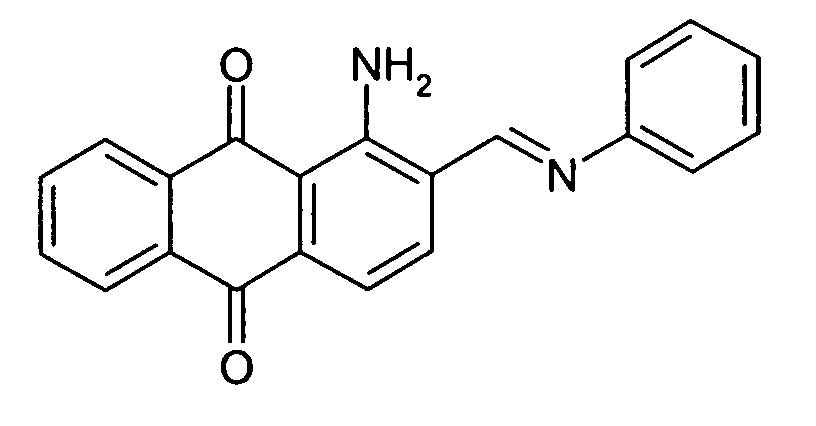
- Based on own experiments, the mono-anthraquinone azamethine phenyl dye disclosed in DE 1285078 has limited heat stability and limited solubility and therefore only poorly qualifies as polymer-soluble dye. In polymers it provides for rather unattractive brownish red shades and the available colour range is rather narrow.
- The object of the present invention is to provide new heat- and lightfast monoanthraquinone azamethine dyes with excellent compatibility with the polymer substrate and with a wide colour range available, to be useful as polymer-soluble colorants for the mass coloration of polar and non-polar polymers.
- Surprisingly, it has been found that the compounds of the formula (I), wherein the nucleus A' represents a substituted or unsubstituted annealed aromatic ring system comprising at least one heteroatom, provide for the required properties to qualify as polymer-soluble dyes.
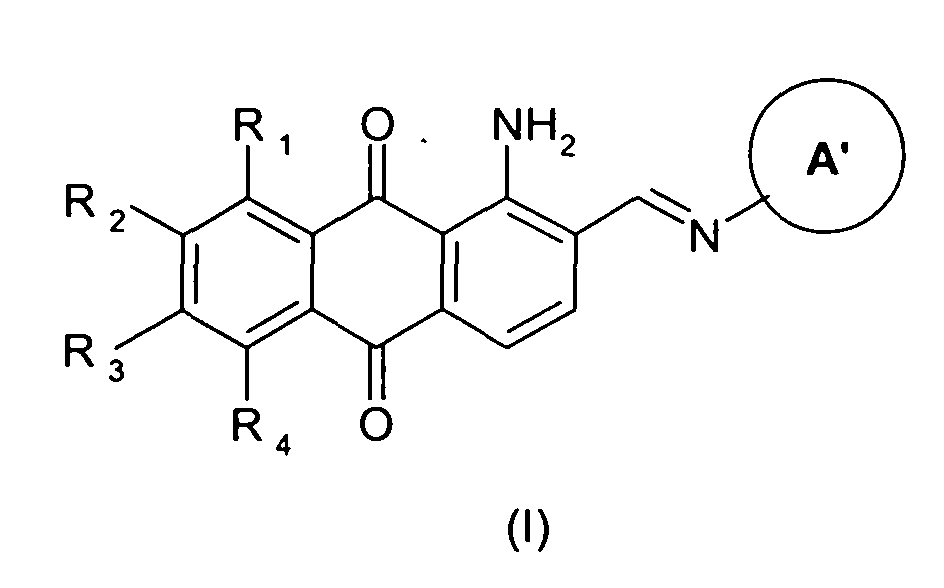
- In formulae (I) the following definitions apply:
- R1, R2, R3 and R4
- are independently hydrogen, halogen, R11R12N-, R12-O- or R12-S-, in which R11 and R12 are independently hydrogen, C1-C6-alkyl, C6-C10-aryl, in which the alkyl and/or aryl radicals can be substituted by hydroxyl, C1-C6-alkyl, C6-C10-aryl, C1-C6-alkoxy, C6-C10-aryloxy or halogen.
- The nucleus A'
- represents a substituted or unsubstituted annealed aromatic ring system comprising at least one heteroatom in either the first or the second ring or in both.
- In preferred compounds of the formula (I)
- R1, R2, R3, R4
- are independently hydrogen, chlorine, bromine, methoxy, ethoxy, phenyloxy, -NH-C6H4-OCH3, -O-C6H4-OCH3 or -S-C6H4-OCH3
- the nucleus A
- is selected from one of the moieties (1) to (4)
- R6 and R7
- are independently hydrogen, C1-C20-alkyl, C6-C10-aryl, 2,2,6,6-tetramethylpiperidinyl, in which the alkyl and/or aryl radicals can be substituted by hydroxyl, C1-C20-alkyl, C6-C10-aryl,C1-C6-alkoxy, C6-C10-aryloxy or halogen.
- R8 and R9
- are independently hydrogen, halogen, C1-C20-alkyl, C1-C6-alkoxy, nitro.
- In more preferred compounds of the formulae (I)
- R6 and R7
- are independently hydrogen, C1-C10-alkyl, C6-C10-aryl, in which the alkyl and/or aryl radicals can be substituted by hydroxyl, C1-C10-alkyl, C6-C10-aryl, C1-C6-alkoxy, C6-C10-aryloxy or halogen.
- R8 and R9
- are independently hydrogen, halogen or C1-C10-alkyl.
- In most preferred compounds of the formulae (I)
- R6 and R7
- are independently hydrogen or C1-C10-alkyl;
- R8 and R9
- are independently hydrogen, chloro or C1-C10-alkyl.
- The present invention also provides a process for preparing the compounds of the formula (I), characterized in that an 1-amino-anthraquinone-2-aldehyde of the formula (II)wherein R1, R2, R3 and R4 are defined as above,
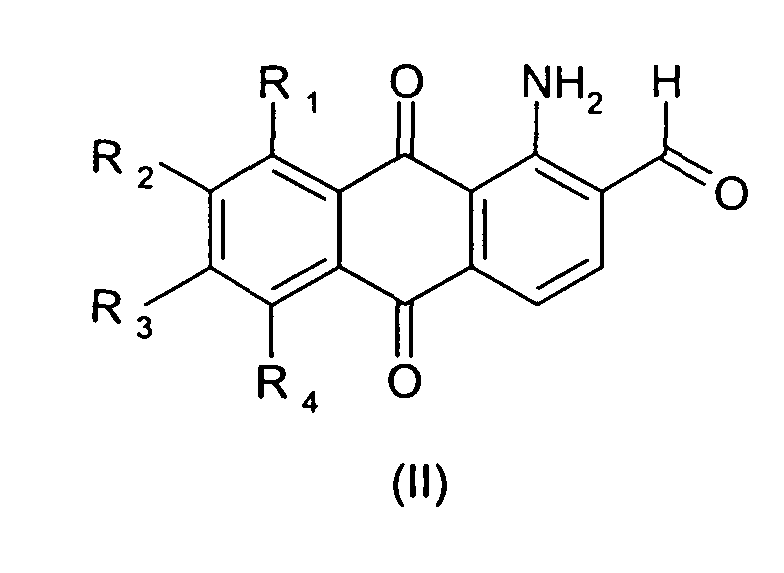
is condensed with an amine or the salt of an amine according to formula (III).
- Suitable salts of the amine of the respective formulae (III) are the chlorhydrate or the sulfate.
The condensation can be conducted without solvent in the melt at temperatures of between 150°C and 300°C, preferably up to 250°C, or in an inert organic solvent at temperatures between 25°C and 300°C, preferably between 80°C and 250°C, in the presence or absence of a catalyst, at atmospheric pressure or under pressure. - Examples of suitable inert organic solvents are relatively high-boiling aliphatic or aromatic, substituted or unsubstituted hydrocarbons, examples being xylene (mixture), biphenyl, nitrobenzene, chlorobenzenes, chloronaphthalene, glycol ethers, organic acids and acid amides, especially dimethylformamide, dimethylacetamide or N-methylpyrrolidone. Further suitable solvents are alcohols, such as methanol, ethanol or butanol.
- Examples of possible catalysts are inorganic or organic acids, such as hydrochloric or sulphuric acid, benzenesulphonic, toluenesulphonic acid, or acetic acid. The salts of organic acids, such as sodium or potassium acetate, are in many cases also suitable as catalysts.
- The compounds of the invention are eminently suitable for the coloring of melts of synthetic polar and non-polar polymers.
- Synthetic polar polymers are for example polyamide, polyester, polycarbonate or ABS. Preferred polyamides are, for example polycondensation products or addition polymerization products of dicarboxylic acids and diamines, e.g. of adipic acid and hexamethylenediamine, of lactams, e.g. ε-caprolactam, or of aminocarboxylic acids, e.g. ω-aminoundecanoic acid.
- Synthetic non-polar polymers are for example polyethylene, in particular low or high-density polyethylene and polypropylene.
- The polymer melt is mixed with the colorant by conventional methods - for example, in melt spinning, injection molding, extrusion or film blowing machines.
- The novel dyes of formula (I) give red to magenta coloration in synthetic non-polar or polar polymers, such as for example polyethylene, polypropylene, ABS, polyester, polycarbonate or polyamides.
- The novel dyes of the formula (I) are highly compatible with the synthetic polymer substrate and they are extremely stable to the heat stress, which is necessarily part of the coloring of synthetic polymers. Further, the mass-colored substrates display excellent fastness properties, in particular light fastness.
- The novel compounds of the formula (I) are also suitable as colorants in electrophotographic toners and developers, such as one- or two-component powder toners (also called one- or two-component developers), magnetic toners, liquid toners, polymerization toners and specialty toners (literature: L.B. Schein, "Electrophotography and Development Physics"; Springer Series in Electrophysics 14, Springer Verlag, 2nd Edition, 1992).
- Typical toner binders are addition polymerization, polyaddition and polycondensation resins, such as styrene, styrene-acrylate, styrene-butadiene, acrylate, polyester and phenol-epoxy resins, polysulphones, polyurethanes, individually or in combination, and also polyethylene and polypropylene, which may comprise further constituents, such as charge control agents, waxes or flow assistants, or may be modified subsequently with these additives.
- The novel compounds of the formula (I) are suitable, furthermore, as colorants in powders and powder coating materials, especially in triboelectrically or electrokinetically sprayable powder coating materials which are used for the surface coating of articles made, for example, from metal, wood, plastic, glass, ceramic, concrete, textile material, paper or rubber (J.F. Hughes, "Electrostatics Powder Coating" Research Studies, John Wiley & Sons, 1984).
- Powder coating resins that are typically employed are epoxy resins, carboxyl- and hydroxyl-containing polyester resins, polyurethane resins and acrylic resins, together with customary hardeners. Combinations of resins are also used. For example, epoxy resins are frequently employed in combination with carboxyl- and hydroxyl-containing polyester resins. Typical hardener components (as a function of the resin system) are, for example, acid anhydrides, imidazoles and also dicyanodiamide and its derivatives, blocked isocyanates, bisacylurethanes, phenolic and melamine resins, triglycidyl isocyanurates, oxazolines and dicarboxylic acids.
- In addition, the novel compounds of the formula (I) are suitable as colorants in ink-jet inks, both aqueous and non-aqueous, and in those inks which operate in accordance with the hot-melt process.
- In the examples below, all parts are parts by weight.
- 14 parts of 5-amino-N,N-diethyl-benzimidazolone and 11 parts of 1-amino-anthraquinone-2-aldehyde are suspended in 100 parts of N,N-dimethylformamide. 0.2 part of acetic acid is added and the red solution is heated to 140°C for 8 hours under nitrogen atmosphere. After cooling to 25°C, the suspension is filtered and the cake is washed successively with N,N-dimethylformamide and methanol and then dried. This gives 15 parts of a violet-colored powder.
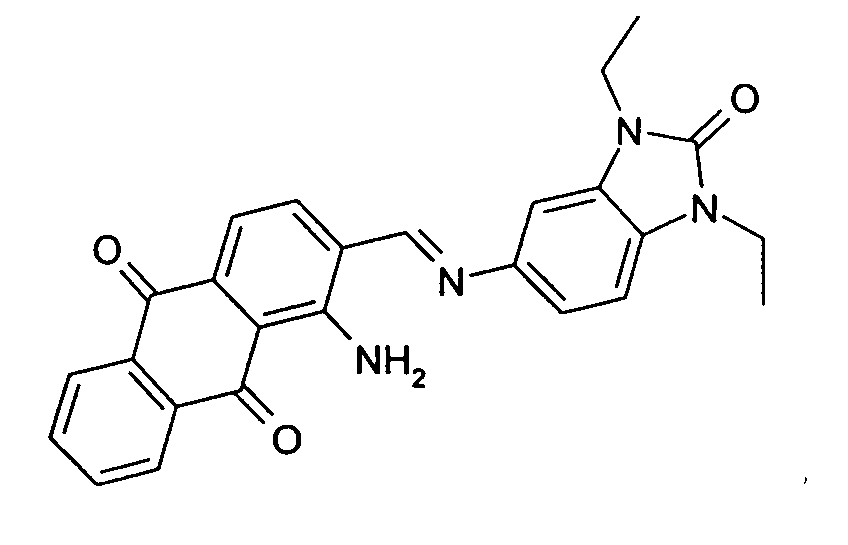
- 14 parts of 1-(4'-(2,2,6,6-tetramethyl)piperidinyl)-5-amino-benzimidazolone and 11 parts of 1-amino-anthraquinone-2-aldehyde are suspended in 100 parts of N,N-dimethylformamide. 0.2 part of acetic acid is added and the red solution is heated to 140°C for 8 hours under nitrogen atmosphere. After cooling to 25°C, the suspension is filtered and the cake is washed successively with N,N-dimethylformamide and methanol and then dried. This gives 15 parts of a violet-colored powder.

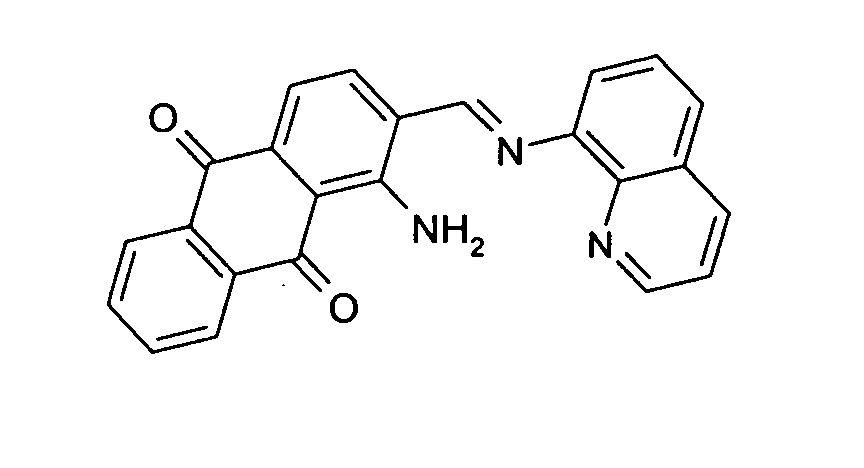
- 14 parts of 8-amino-quinoline and 11 parts of 1-amino-anthraquinone-2-aldehyde are suspended in 100 parts of N,N-dimethylformamide. 0.2 part of acetic acid is added and the red solution is heated to 140°C for 8 hours under nitrogen atmosphere. After cooling to 25°C, the suspension is filtered and the cake is washed successively with N,N-dimethylformamide and methanol and then dried. This gives 15 parts of a violet-colored powder.
- 14 parts of 2-amino-5-methyl-benzothiazole and 11 parts of 1-amino-anthraquinone-2-aldehyde are suspended in 100 parts of N,N-dimethylformamide. 0.2 part of acetic acid is added and the red solution is heated to 140°C for 8 hours under nitrogen atmosphere. After cooling to 25°C, the suspension is filtered and the cake is washed successively with N,N-dimethylformamide and methanol and then dried. This gives 15 parts of a violet-colored powder.
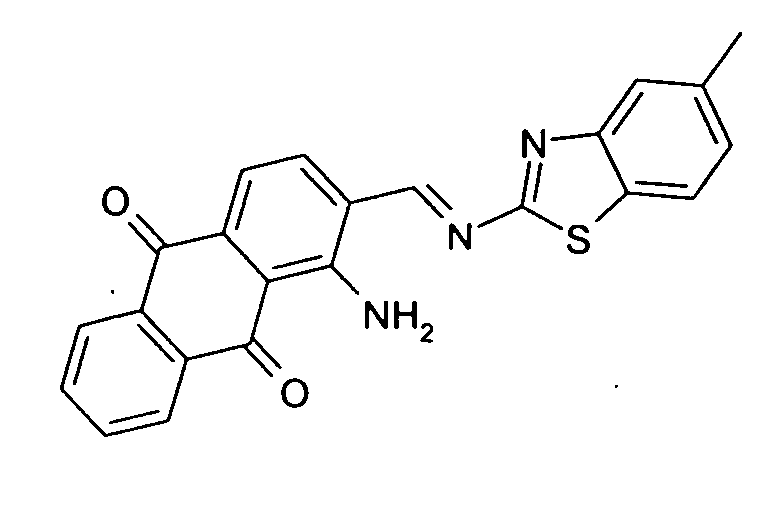
- 100 parts of polypropylene in the form of a powder are mixed with 0.1 and with 1.0 part respectively of the dye from Examples 1 in powder form in a drum mixer. After a short time, the powder is uniformly distributed and adheres to the granules. After about 10 minutes, the mixture is dried at 120°C for 16 hours, transferred to a melt spinning machine and following a residence time of about 8 minutes is spun to fibers at 275-280°C under a nitrogen atmosphere. The colored fibers are extremely lightfast.
- All other known synthetic polymers can be mass-colored in the same way, e.g. (HD/LD) polyethylene, polyamides, polyesters, ABS, polycarbonates.
- 100 parts of polycaprolactam in the form of a powder are mixed in a drum mixer with 0.1 parts of compound 1 in powder form. After a short time; the powder is uniformly distributed and adheres to the granules. After about 10 minutes, the mixture is dried at 120°C for 16 hours, transferred to a melt spinning machine and following a residence time of about 8 minutes is spun to fibres at 275-280°C under a nitrogen atmosphere. The violet colored polyamide fibres are extremely lightfast.
- Polyester fibres containing 0.1 parts of compound 1 have been prepared according to the following method: the polyester is fused and extruded through a drawing plate at constant rate by gear pump regulation. The spinning machine is heated during 2 hours at temperatures of 260-265°C under pressure of 80 bars. The drawing plate is heated in an oven at 350°C for at least 30 minutes. The obtained fibres are recovered on a bobbin. The obtained fibres provide a strong violet color with excellent light and weather fastness.

Claims (10)
- Compounds of the formulae (I)
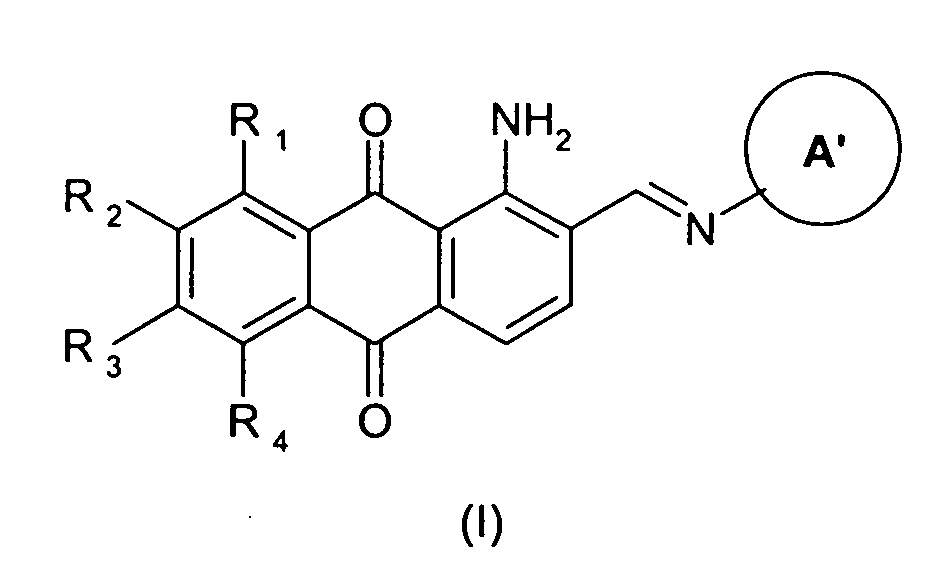
- R1, R2, R3 and R4
- are independently hydrogen, halogen, R11R12N-, R12-O- or R12-S-, in which R11 and R12 are independently hydrogen, C1-C6-alkyl, C6-C10-aryl, in which the alkyl and/or aryl radicals can be substituted by hydroxyl, C1-C6-alkyl, C6-C10-aryl, C1-C6-alkoxy, C6-C10-aryloxy or halogen,
- the nucleus A'
- represents a substituted or unsubstituted annealed aromatic ring system comprising at least one heteroatom in either the first or the second ring or in both.
- Compounds according to Claim 1, characterized in that
- R1, R2, R3, R4
- are independently hydrogen, chlorine, bromine, methoxy, ethoxy, phenyloxy, -NH-C6H4-OCH3, -O-C6H4-OCH3 or -S-C6H4-OCH3, and
- the nucleus A'
- represents a substituted or unsubstituted annealed aromatic ring system comprising at least one nitrogen atom in either the first or the second ring or in both.
- Compounds according to Claim 1, characterized in that the the nucleus A' is selected from one of the moieties (1) to (4)wherein

- R6 and R7
- are independently hydrogen, C1-C20-alkyl, C6-C10-aryl, 2,2,6,6-tetramethylpiperidinyl, in which the alkyl and/or aryl radicals can be substituted by hydroxyl, C1-C20-alkyl, C6-C10-aryl, C1-C6-alkoxy, C6-C10-aryloxy or halogen,
- R8 and R9
- are independently hydrogen, halogen, C1-C20-alkyl, C1-C6-alkoxy, nitro.
- Compounds according to Claim 3, characterized in that
- R6 and R7
- are independently hydrogen or C1-C10-alkyl, and
- R8 and R9
- are independently hydrogen, halogen or C1-C10-alkyl.
- Process for preparing a compound according to one of claims 1 to 4, characterized in that a 1-amino-anthraquinone-2-aldehyde of formula (II)wherein R1, R2, R3 and R4 are defined as above,

is condensed with an amine or the salt of an amine of formula (III)wherein the nucleus A' is defined as in claims 1 to 4.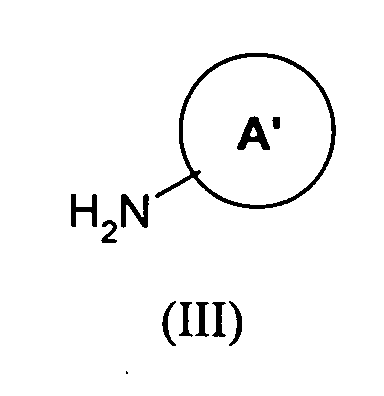
- Process for preparing a compound according to claim 5, characterized in that the condensation is conducted without solvent in the melt at temperatures between 150°C and 300°C.
- Process for preparing a compound according to claim 5, characterized in that the condensation is conducted in an inert organic solvent at temperatures between 25°C and 300°C.
- Use of a compound according to any one of claims 1 to 4 for mass-coloring polar synthetic polymers, preferably polyamides, polyesters, ABS, polycarbonates.
- Use of a compound according to any one of claims 1 to 4 for mass-coloring non polar synthetic polymers, preferably polyethylene or polypropylene.
- Mass-colored polymer fibres manufactured from mass-colored polar or non polar synthetic polymers comprising a compound according to any one of claims 1 to 4.
Priority Applications (1)
| Application Number | Priority Date | Filing Date | Title |
|---|---|---|---|
| EP03002976A EP1447430A1 (en) | 2003-02-11 | 2003-02-11 | New monoanthraquinone azamethine dyes |
Applications Claiming Priority (1)
| Application Number | Priority Date | Filing Date | Title |
|---|---|---|---|
| EP03002976A EP1447430A1 (en) | 2003-02-11 | 2003-02-11 | New monoanthraquinone azamethine dyes |
Publications (1)
| Publication Number | Publication Date |
|---|---|
| EP1447430A1 true EP1447430A1 (en) | 2004-08-18 |
Family
ID=32668957
Family Applications (1)
| Application Number | Title | Priority Date | Filing Date |
|---|---|---|---|
| EP03002976A Withdrawn EP1447430A1 (en) | 2003-02-11 | 2003-02-11 | New monoanthraquinone azamethine dyes |
Country Status (1)
| Country | Link |
|---|---|
| EP (1) | EP1447430A1 (en) |
Cited By (2)
| Publication number | Priority date | Publication date | Assignee | Title |
|---|---|---|---|---|
| WO2005056688A1 (en) * | 2003-12-09 | 2005-06-23 | Dainippon Ink And Chemicals, Inc. | Benzimidazolone compound |
| US20140002888A1 (en) * | 2012-06-28 | 2014-01-02 | Fujifilm Corporation | Electrowetting display apparatus and dye composition for electrowetting display |
Citations (7)
| Publication number | Priority date | Publication date | Assignee | Title |
|---|---|---|---|---|
| US1881697A (en) * | 1925-02-16 | 1932-10-11 | Gen Aniline Works Inc | Manufacture of vat dyestuffs of the anthraquinone series |
| DE1060527B (en) * | 1957-02-18 | 1959-07-02 | Bayer Ag | Process for the production of Kuepen dyes of the triazole series |
| DE1285078B (en) * | 1964-10-10 | 1968-12-12 | Cassella Farbwerke Mainkur Ag | Process for the preparation of dyes of the anthraquinone series which are free from water-solubilizing groups |
| EP0023648A1 (en) * | 1979-08-04 | 1981-02-11 | Bayer Ag | Anthraquinone-azomethine compounds, process for their preparation; process for dyeing synthetic fibre materials as well as for pigmenting organic macromolecular materials |
| EP0054217A1 (en) * | 1980-12-12 | 1982-06-23 | Bayer Ag | Anthraquinone dyes, process for their preparation, their use, as well as liquid-crystal material containing anthraquinone dyes |
| EP0107492A2 (en) * | 1982-10-22 | 1984-05-02 | Minnesota Mining And Manufacturing Company | Helichromic-smectic liquid crystal compositions and display cells |
| EP0300770A2 (en) * | 1987-07-22 | 1989-01-25 | MITSUI TOATSU CHEMICALS, Inc. | Polarizing film containing an anthraquinonic colorant |
-
2003
- 2003-02-11 EP EP03002976A patent/EP1447430A1/en not_active Withdrawn
Patent Citations (7)
| Publication number | Priority date | Publication date | Assignee | Title |
|---|---|---|---|---|
| US1881697A (en) * | 1925-02-16 | 1932-10-11 | Gen Aniline Works Inc | Manufacture of vat dyestuffs of the anthraquinone series |
| DE1060527B (en) * | 1957-02-18 | 1959-07-02 | Bayer Ag | Process for the production of Kuepen dyes of the triazole series |
| DE1285078B (en) * | 1964-10-10 | 1968-12-12 | Cassella Farbwerke Mainkur Ag | Process for the preparation of dyes of the anthraquinone series which are free from water-solubilizing groups |
| EP0023648A1 (en) * | 1979-08-04 | 1981-02-11 | Bayer Ag | Anthraquinone-azomethine compounds, process for their preparation; process for dyeing synthetic fibre materials as well as for pigmenting organic macromolecular materials |
| EP0054217A1 (en) * | 1980-12-12 | 1982-06-23 | Bayer Ag | Anthraquinone dyes, process for their preparation, their use, as well as liquid-crystal material containing anthraquinone dyes |
| EP0107492A2 (en) * | 1982-10-22 | 1984-05-02 | Minnesota Mining And Manufacturing Company | Helichromic-smectic liquid crystal compositions and display cells |
| EP0300770A2 (en) * | 1987-07-22 | 1989-01-25 | MITSUI TOATSU CHEMICALS, Inc. | Polarizing film containing an anthraquinonic colorant |
Cited By (6)
| Publication number | Priority date | Publication date | Assignee | Title |
|---|---|---|---|---|
| WO2005056688A1 (en) * | 2003-12-09 | 2005-06-23 | Dainippon Ink And Chemicals, Inc. | Benzimidazolone compound |
| CN100417697C (en) * | 2003-12-09 | 2008-09-10 | 大日本油墨化学工业株式会社 | Benzimidazolone compounds |
| KR100858920B1 (en) * | 2003-12-09 | 2008-09-17 | 디아이씨 가부시끼가이샤 | Benzimidazolone compound |
| US7514569B2 (en) | 2003-12-09 | 2009-04-07 | Dainippon Ink And Chemicals, Inc. | Benzimidazolone compound |
| US20140002888A1 (en) * | 2012-06-28 | 2014-01-02 | Fujifilm Corporation | Electrowetting display apparatus and dye composition for electrowetting display |
| US9256062B2 (en) * | 2012-06-28 | 2016-02-09 | Fujifilm Corporation | Electrowetting display apparatus and dye composition for electrowetting display |
Similar Documents
| Publication | Publication Date | Title |
|---|---|---|
| KR100543996B1 (en) | Quinoxaline-monoazo-acetarylide pigment | |
| US6277536B1 (en) | Heterocyclic compounds | |
| US6482817B1 (en) | Hybrid pigments | |
| US6046335A (en) | Heterocyclic compounds | |
| JP4485611B2 (en) | New triphendioxazine compounds | |
| EP1447429A1 (en) | New bisanthraquinone azomethine dyes | |
| US6540820B1 (en) | Heterocyclic compounds | |
| JP4468356B2 (en) | Heterocyclic dyes based on benzodipyrrole | |
| KR100416015B1 (en) | Aminoquinazolinedione-insoluble azo colorant | |
| CN1325492C (en) | Beta-isoindigo coloring agent | |
| EP1341851B1 (en) | Process for the preparation of triphenodioxazine pigments | |
| WO2002066562A1 (en) | Dye compounds | |
| EP1422267A1 (en) | New dyes based on 1,4,5,8-naphthalene tetracarboxylic dianhydride | |
| EP1132432B1 (en) | Preparation process of pigments | |
| CN100560652C (en) | Heterocyclic colorants based on diazabenzisoindole | |
| US8133997B2 (en) | 2,4-dioxopyrimidine-based mesoionic pigments | |
| JPH11130972A (en) | Organic pigment | |
| US5981806A (en) | Process for the preparation of hydroxynapthalenes |
Legal Events
| Date | Code | Title | Description |
|---|---|---|---|
| PUAI | Public reference made under article 153(3) epc to a published international application that has entered the european phase |
Free format text: ORIGINAL CODE: 0009012 |
|
| AK | Designated contracting states |
Kind code of ref document: A1 Designated state(s): AT BE BG CH CY CZ DE DK EE ES FI FR GB GR HU IE IT LI LU MC NL PT SE SI SK TR |
|
| AX | Request for extension of the european patent |
Extension state: AL LT LV MK RO |
|
| STAA | Information on the status of an ep patent application or granted ep patent |
Free format text: STATUS: THE APPLICATION HAS BEEN WITHDRAWN |
|
| 18W | Application withdrawn |
Effective date: 20040902 |