EP1447425A1 - Rubber composition - Google Patents
Rubber composition Download PDFInfo
- Publication number
- EP1447425A1 EP1447425A1 EP02768067A EP02768067A EP1447425A1 EP 1447425 A1 EP1447425 A1 EP 1447425A1 EP 02768067 A EP02768067 A EP 02768067A EP 02768067 A EP02768067 A EP 02768067A EP 1447425 A1 EP1447425 A1 EP 1447425A1
- Authority
- EP
- European Patent Office
- Prior art keywords
- rubber
- weight
- silica
- parts
- rubber composition
- Prior art date
- Legal status (The legal status is an assumption and is not a legal conclusion. Google has not performed a legal analysis and makes no representation as to the accuracy of the status listed.)
- Withdrawn
Links
- 229920001971 elastomer Polymers 0.000 title claims abstract description 51
- 239000005060 rubber Substances 0.000 title claims abstract description 51
- 239000000203 mixture Substances 0.000 title claims abstract description 34
- VYPSYNLAJGMNEJ-UHFFFAOYSA-N Silicium dioxide Chemical compound O=[Si]=O VYPSYNLAJGMNEJ-UHFFFAOYSA-N 0.000 claims abstract description 80
- 239000000377 silicon dioxide Substances 0.000 claims abstract description 40
- LZZYPRNAOMGNLH-UHFFFAOYSA-M Cetrimonium bromide Chemical compound [Br-].CCCCCCCCCCCCCCCC[N+](C)(C)C LZZYPRNAOMGNLH-UHFFFAOYSA-M 0.000 claims abstract description 24
- XAGFODPZIPBFFR-UHFFFAOYSA-N aluminium Chemical compound [Al] XAGFODPZIPBFFR-UHFFFAOYSA-N 0.000 claims abstract description 13
- 229910052782 aluminium Inorganic materials 0.000 claims abstract description 13
- 150000001993 dienes Chemical class 0.000 claims abstract description 11
- 125000005372 silanol group Chemical group 0.000 claims abstract description 9
- 239000006087 Silane Coupling Agent Substances 0.000 claims description 11
- 244000043261 Hevea brasiliensis Species 0.000 claims description 5
- 229920003052 natural elastomer Polymers 0.000 claims description 5
- 229920001194 natural rubber Polymers 0.000 claims description 5
- 229920003048 styrene butadiene rubber Polymers 0.000 claims description 5
- 239000002174 Styrene-butadiene Substances 0.000 claims description 4
- 229920005549 butyl rubber Polymers 0.000 claims description 4
- BLRPTPMANUNPDV-UHFFFAOYSA-N Silane Chemical group [SiH4] BLRPTPMANUNPDV-UHFFFAOYSA-N 0.000 claims description 3
- 229920001577 copolymer Polymers 0.000 claims description 3
- 239000005062 Polybutadiene Substances 0.000 claims description 2
- 229920002857 polybutadiene Polymers 0.000 claims description 2
- 229920001195 polyisoprene Polymers 0.000 claims description 2
- MTAZNLWOLGHBHU-UHFFFAOYSA-N butadiene-styrene rubber Chemical group C=CC=C.C=CC1=CC=CC=C1 MTAZNLWOLGHBHU-UHFFFAOYSA-N 0.000 claims 1
- 239000011115 styrene butadiene Substances 0.000 claims 1
- 238000005299 abrasion Methods 0.000 abstract description 23
- 230000000052 comparative effect Effects 0.000 description 11
- SCPYDCQAZCOKTP-UHFFFAOYSA-N silanol Chemical compound [SiH3]O SCPYDCQAZCOKTP-UHFFFAOYSA-N 0.000 description 7
- 238000004073 vulcanization Methods 0.000 description 7
- 230000000694 effects Effects 0.000 description 4
- NINIDFKCEFEMDL-UHFFFAOYSA-N Sulfur Chemical compound [S] NINIDFKCEFEMDL-UHFFFAOYSA-N 0.000 description 3
- 238000009472 formulation Methods 0.000 description 3
- 239000012763 reinforcing filler Substances 0.000 description 3
- 238000010058 rubber compounding Methods 0.000 description 3
- 229910052717 sulfur Inorganic materials 0.000 description 3
- 239000011593 sulfur Substances 0.000 description 3
- 238000012360 testing method Methods 0.000 description 3
- XLOMVQKBTHCTTD-UHFFFAOYSA-N Zinc monoxide Chemical compound [Zn]=O XLOMVQKBTHCTTD-UHFFFAOYSA-N 0.000 description 2
- 239000006229 carbon black Substances 0.000 description 2
- 239000007822 coupling agent Substances 0.000 description 2
- 238000004132 cross linking Methods 0.000 description 2
- 239000006185 dispersion Substances 0.000 description 2
- 238000011156 evaluation Methods 0.000 description 2
- 238000010348 incorporation Methods 0.000 description 2
- 239000003921 oil Substances 0.000 description 2
- 230000002787 reinforcement Effects 0.000 description 2
- 239000012744 reinforcing agent Substances 0.000 description 2
- 238000005096 rolling process Methods 0.000 description 2
- 229920003051 synthetic elastomer Polymers 0.000 description 2
- 239000005061 synthetic rubber Substances 0.000 description 2
- 241001441571 Hiodontidae Species 0.000 description 1
- 239000004594 Masterbatch (MB) Substances 0.000 description 1
- 235000021355 Stearic acid Nutrition 0.000 description 1
- 239000000654 additive Substances 0.000 description 1
- 230000002411 adverse Effects 0.000 description 1
- 239000003963 antioxidant agent Substances 0.000 description 1
- 230000003078 antioxidant effect Effects 0.000 description 1
- 239000003795 chemical substances by application Substances 0.000 description 1
- 238000013329 compounding Methods 0.000 description 1
- 239000003431 cross linking reagent Substances 0.000 description 1
- 230000003247 decreasing effect Effects 0.000 description 1
- 230000006866 deterioration Effects 0.000 description 1
- 230000002542 deteriorative effect Effects 0.000 description 1
- 238000005516 engineering process Methods 0.000 description 1
- -1 for example Polymers 0.000 description 1
- 238000007429 general method Methods 0.000 description 1
- 238000004519 manufacturing process Methods 0.000 description 1
- 239000000463 material Substances 0.000 description 1
- 238000005259 measurement Methods 0.000 description 1
- 238000000034 method Methods 0.000 description 1
- QIQXTHQIDYTFRH-UHFFFAOYSA-N octadecanoic acid Chemical compound CCCCCCCCCCCCCCCCCC(O)=O QIQXTHQIDYTFRH-UHFFFAOYSA-N 0.000 description 1
- OQCDKBAXFALNLD-UHFFFAOYSA-N octadecanoic acid Natural products CCCCCCCC(C)CCCCCCCCC(O)=O OQCDKBAXFALNLD-UHFFFAOYSA-N 0.000 description 1
- 230000003287 optical effect Effects 0.000 description 1
- 239000004014 plasticizer Substances 0.000 description 1
- 229920000642 polymer Polymers 0.000 description 1
- 230000002265 prevention Effects 0.000 description 1
- 238000012545 processing Methods 0.000 description 1
- 239000011369 resultant mixture Substances 0.000 description 1
- 239000008117 stearic acid Substances 0.000 description 1
- 239000000126 substance Substances 0.000 description 1
- 238000010998 test method Methods 0.000 description 1
- 239000004636 vulcanized rubber Substances 0.000 description 1
- 239000011787 zinc oxide Substances 0.000 description 1
Classifications
-
- C—CHEMISTRY; METALLURGY
- C08—ORGANIC MACROMOLECULAR COMPOUNDS; THEIR PREPARATION OR CHEMICAL WORKING-UP; COMPOSITIONS BASED THEREON
- C08K—Use of inorganic or non-macromolecular organic substances as compounding ingredients
- C08K3/00—Use of inorganic substances as compounding ingredients
- C08K3/34—Silicon-containing compounds
- C08K3/36—Silica
Definitions
- the present invention relates to a silica formulated rubber composition having improved overall properties of processability, dispersibility, abrasion resistance, wet friction and low heat buildup.
- the object in the present invention is to provide a rubber composition having superior processability, dispersibility, abrasion resistance and wet abrasion performance by controlling the content of aluminum in the silica, the number of silanol groups, the CTAB specific surface area and the BET/CTAB ratio to a suitable range and by formulating such a silica to a diene-based rubber.
- a rubber composition comprising 100 parts by weight of at least one diene-based rubber and 10 to 100 parts by weight of silica having an aluminum content of 0.01 to 0.24% by weight, a CTAB specific surface area of 70 to 210 m 2 /g, a BET/CTAB ratio of 1.0 to 1.4 and a number of silanol groups per unit area of 3.0 to 5.5 groups/nm 2 .
- the present invention is based on the finding that, when as the silica used as a reinforcing filler in the rubber composition of the present invention, silica, preferably precipitated silica, having aluminum content, number of silanol groups, CTAB specific surface area and BET/CTAB ratio which are controlled to the above predetermined ranges, a rubber composition having superior overall properties of processability, dispersibility, abrasion resistance, wet abrasion performance and low heat buildup can be obtained.
- the content of the aluminum in the silica is 0.01 to 0.24% by weight, good results were able to be obtained.
- the content of the aluminum is more than 0.24% by weight, the incorporation of the silica into the rubber becomes poor and the Mooney viscosity becomes high.
- the aluminum content is 0.01 to 0.1% by weight, better results are obtained in the above properties.
- silica having a CTAB specific surface area of 70 to 210 m 2 /g and a BET/CTAB ratio of 1.0 to 1.4, to secure reinforcement of the rubber.
- CTAB specific surface area is less than 70 m 2 /g and the BET/CTAB ratio is less than 1.0, the intended reinforcement becomes difficult.
- CTAB specific surface area is more than 210 m 2 /g and the BET/CTAB ratio is more than 1.4, the dispersibility becomes poor.
- silica in order to improve the processability and dispersibility and to improve the abrasion resistance, wet abrasion performance and low heat buildup and further the tan ⁇ balance, it is preferable to select silica having a number of silanol groups per unit area of 3.0 to 5.5 groups/nm 2 .
- the number of silanol groups is in the above predetermined range, the processability, dispersibility, abrasion resistance, wet abrasion performance and low heat buildup can be improved with a good balance.
- the silica has a number of silanol groups of 4.8 to 5.5 groups/nm 2 , whereby the good abrasion resistance can be maintained.
- the diene-based rubber component usable in the rubber composition of the present invention includes natural rubber (NR) and, as a diene-based synthetic rubber, for example, polyisoprene rubber (IR), various types of styrene-butadiene copolymer rubber (SBR), various types of polybutadiene rubber (BR), acrylonitrile-butadiene copolymer rubber (NBR), butyl rubber (IIR), etc. These may be used alone or as mixtures of two or more types. When a rubber mixture of two or more types of natural rubber and diene-based synthetic rubber is used, the use of at least 60 parts by weight of natural rubber in the rubber composition is preferable in terms of the desired object.
- NR natural rubber
- IR polyisoprene rubber
- SBR styrene-butadiene copolymer rubber
- BR polybutadiene rubber
- NBR acrylonitrile-butadiene copolymer rubber
- IIR butyl rubber
- the rubber composition of the present invention includes the silica according to the present invention used in an amount of 10 to 100 parts by weight, preferably 30 to 90 parts by weight, based upon 100 parts by weight of the rubber component. If the amount is too small, the desired effect cannot be obtained. Further, if the amount is too great, the hardness becomes too high or the processability is decreased and the rubber material is poor in useability, and therefore, this is not preferred.
- the rubber composition of the present invention may contain therein, as a reinforcing agent, in addition to the above silica, an ordinary carbon black.
- an ordinary carbon black This may be formulated in an amount of at least 10 parts by weight, preferably 10 to 80 parts by weight, based upon 100 parts by weight of the rubber component. If the amount of the carbon black is too great, there is a problem in the processing of the rubber. Further, if the amount is too small, the effects of formulation, for example, the prevention of deterioration due to UV rays and imparting of conductivity are low.
- the rubber composition of the present invention preferably further contain therein, in addition to the above essential components, a silane coupling agent.
- a silane coupling agent is used, it is possible to use any silane coupling agent used in a rubber composition in the past.
- the rubber composition of the present invention may contain therein, in addition to the above components, a vulcanization or cross-linking agent, vulcanization or cross-linking accelerator, various types of oils, an antioxidant, a plasticizer, or other various compounding agents usually for tire use or other general rubber uses.
- This formulation may be mixed and vulcanized by general methods to obtain a rubber composition which is used for vulcanization or cross-linking.
- the amounts of these additives blended may be made the general amounts blended in the past so long as the object of the present invention is not adversely affected.
- the components other than the vulcanization accelerator and sulfur among the components of the rubber formulation shown in Table I were mixed in a 1.8 liter internal mixer for 3 to 5 minutes and discharged when the temperature reached 165 ⁇ 5°C.
- the vulcanization accelerator and sulfur were added to this master batch and the resultant mixture was mixed in an 8-inch open roll to obtain a rubber composition.
- the Mooney viscosity of the rubber composition thus obtained was determined.
- the above vulcanization accelerator was added to this composition which was then press vulcanized in a 15 x 15 x 0.2 cm mold at 160°C for 20 minutes to prepare a desired test piece (i.e., rubber sheet).
- Rubber compositions obtained by formulating the various types of silica and predetermined amounts of silica coupling agent in the above rubber formulation systems were measured and the results of evaluation are shown. The results are shown in Table II.
- Examples 1 to 3 and Comparative Examples 1 to 3 are those in which the aluminum content and the amount of silanol were changed.
- Examples 1 to 3 where the aluminum contents and amounts of silanol are both small, exhibited lower Mooney viscosities and better dispersion compared with Comparative Examples 1 to 3.
- the tan ⁇ ratio (0°C/60°C) an indicator of the balance of the rolling resistance and the wet abrasion performance, is also poor.
- Example 6 the effect was confirmed until an amount of silanol of 3.0 groups/nm 2 . Therefore, it is better than the aluminum content be 0.01 to 0.24% by weight and the amount of silanol be not more than 3.0 to 5.5 groups/nm 2 .
- Examples 4 and 5 and Comparative Examples 4 and 5 are those in which CTAB values of the samples were varied. Comparative Example 4 is very poor in abrasion resistance and is not able to be used in practice. Further, Comparative Example 5 exhibited somewhat poor dispersibility, was high in Mooney viscosity, and poor in tan ⁇ ratio (0°C/60°C), the indicator of the balance of rolling resistance and wet abrasion performance. Therefore, the CTAB should be 70 to 210 m 2 /g.
- Example 6 and Comparative Example 6 are those in which BET/CTAB values were changed.
- the BET/CTAB value is too high, the tan ⁇ at 0°C and the tan ⁇ ratio (0°C/60°C) is also low.
- the effects were confirmed until a BET/CTAB ratio of 1.0. Therefore, a BET/CTAB ratio of 1.0 to 1.4 is good.
- the rubber composition containing the predetermined silica and predetermined amount of silane coupling agent of the present invention is extremely superior in overall properties of processability, dispersibility, abrasion resistance, wet abrasion performance and low heat buildup.
Landscapes
- Chemical & Material Sciences (AREA)
- Health & Medical Sciences (AREA)
- Chemical Kinetics & Catalysis (AREA)
- Medicinal Chemistry (AREA)
- Polymers & Plastics (AREA)
- Organic Chemistry (AREA)
- Compositions Of Macromolecular Compounds (AREA)
- Tires In General (AREA)
Abstract
A rubber composition containing 100 parts by weight
of a diene-based rubber and 10 to 100 parts by weight of
silica having an aluminum content of 0.01 to 0.24% by
weight, a CTAB specific surface area of 70 to 210 m2/g, a
BET/CTAB ratio of 1.0 to 1.4 and a number of silanol
groups per unit area of 3.0 to 5.5 groups/nm2 and having
superior overall properties of processability,
dispersibility, abrasion resistance, wet abrasion and low
heat buildup.
Description
- The present invention relates to a silica formulated rubber composition having improved overall properties of processability, dispersibility, abrasion resistance, wet friction and low heat buildup.
- Technology intended to improve the processability of a diene-based rubber composition for tire use and also to reduce the amount of use of a coupling agent, without deteriorating the characteristics of the composition by using aluminum-doped precipitated silica having an aluminum content of the silica of 0.35 to 3% by weight based upon the weight of the silica as a reinforcing filler of a rubber composition for producing a tire based on at least one diene-based polymer is known by, for example, Japanese Unexamined Patent Publication (Kokai) JP-A-8-277346, Japanese Unexamined Patent Publication (Kokai) JP-A-10-503748, Japanese Unexamined Patent Publication (Kokai) JP-A-10-504012.
- When the amount of aluminum contained in a minor amount in the silica generally used as a rubber reinforcing filler is large or the amount of silanol of the silica is large, the incorporation thereof in the rubber becomes poor or the Mooney viscosity also becomes high, and therefore, the processability or dispersibility of the rubber composition containing such a silica reinforcing agent becomes poor. Further, when silica having a CTAB specific surface area and BET/CTAB ratio of the silica is within a predetermined range, it has been found that the abrasion resistance, wet friction performance and low heat buildup property are improved.
- Accordingly, the object in the present invention is to provide a rubber composition having superior processability, dispersibility, abrasion resistance and wet abrasion performance by controlling the content of aluminum in the silica, the number of silanol groups, the CTAB specific surface area and the BET/CTAB ratio to a suitable range and by formulating such a silica to a diene-based rubber.
- In accordance with the present invention, there is provided a rubber composition comprising 100 parts by weight of at least one diene-based rubber and 10 to 100 parts by weight of silica having an aluminum content of 0.01 to 0.24% by weight, a CTAB specific surface area of 70 to 210 m2/g, a BET/CTAB ratio of 1.0 to 1.4 and a number of silanol groups per unit area of 3.0 to 5.5 groups/nm2.
- In accordance with the present invention, there is also provided a rubber composition further containing a silane coupling agent in an amount determined by the following formula (I):
- The present invention is based on the finding that, when as the silica used as a reinforcing filler in the rubber composition of the present invention, silica, preferably precipitated silica, having aluminum content, number of silanol groups, CTAB specific surface area and BET/CTAB ratio which are controlled to the above predetermined ranges, a rubber composition having superior overall properties of processability, dispersibility, abrasion resistance, wet abrasion performance and low heat buildup can be obtained.
- According to the above finding of the present invention, when the content of the aluminum in the silica is 0.01 to 0.24% by weight, good results were able to be obtained. When the content of the aluminum is more than 0.24% by weight, the incorporation of the silica into the rubber becomes poor and the Mooney viscosity becomes high. Further, when the aluminum content is 0.01 to 0.1% by weight, better results are obtained in the above properties.
- Further, in the silica according to the present invention, it is preferable to select silica having a CTAB specific surface area of 70 to 210 m2/g and a BET/CTAB ratio of 1.0 to 1.4, to secure reinforcement of the rubber. When the CTAB specific surface area is less than 70 m2/g and the BET/CTAB ratio is less than 1.0, the intended reinforcement becomes difficult. Further, when the CTAB specific surface area is more than 210 m2/g and the BET/CTAB ratio is more than 1.4, the dispersibility becomes poor.
- Further, in the silica according to the present invention, in order to improve the processability and dispersibility and to improve the abrasion resistance, wet abrasion performance and low heat buildup and further the tanδ balance, it is preferable to select silica having a number of silanol groups per unit area of 3.0 to 5.5 groups/nm2. When the number of silanol groups is in the above predetermined range, the processability, dispersibility, abrasion resistance, wet abrasion performance and low heat buildup can be improved with a good balance. More preferably, the silica has a number of silanol groups of 4.8 to 5.5 groups/nm2, whereby the good abrasion resistance can be maintained.
- The diene-based rubber component usable in the rubber composition of the present invention includes natural rubber (NR) and, as a diene-based synthetic rubber, for example, polyisoprene rubber (IR), various types of styrene-butadiene copolymer rubber (SBR), various types of polybutadiene rubber (BR), acrylonitrile-butadiene copolymer rubber (NBR), butyl rubber (IIR), etc. These may be used alone or as mixtures of two or more types. When a rubber mixture of two or more types of natural rubber and diene-based synthetic rubber is used, the use of at least 60 parts by weight of natural rubber in the rubber composition is preferable in terms of the desired object.
- The rubber composition of the present invention includes the silica according to the present invention used in an amount of 10 to 100 parts by weight, preferably 30 to 90 parts by weight, based upon 100 parts by weight of the rubber component. If the amount is too small, the desired effect cannot be obtained. Further, if the amount is too great, the hardness becomes too high or the processability is decreased and the rubber material is poor in useability, and therefore, this is not preferred.
- The rubber composition of the present invention may contain therein, as a reinforcing agent, in addition to the above silica, an ordinary carbon black. This may be formulated in an amount of at least 10 parts by weight, preferably 10 to 80 parts by weight, based upon 100 parts by weight of the rubber component. If the amount of the carbon black is too great, there is a problem in the processing of the rubber. Further, if the amount is too small, the effects of formulation, for example, the prevention of deterioration due to UV rays and imparting of conductivity are low.
- The rubber composition of the present invention preferably further contain therein, in addition to the above essential components, a silane coupling agent. When a silane coupling agent is used, it is possible to use any silane coupling agent used in a rubber composition in the past. As the amount used, it is preferable to use the amount of a silane coupling agent determined by the following formula (I):
- The rubber composition of the present invention may contain therein, in addition to the above components, a vulcanization or cross-linking agent, vulcanization or cross-linking accelerator, various types of oils, an antioxidant, a plasticizer, or other various compounding agents usually for tire use or other general rubber uses. This formulation may be mixed and vulcanized by general methods to obtain a rubber composition which is used for vulcanization or cross-linking. The amounts of these additives blended may be made the general amounts blended in the past so long as the object of the present invention is not adversely affected.
- The present invention will now be explained further by Examples and Comparative Examples, but the technical scope of the present invention is of course not limited to these Examples.
- Using the precipitated silica of the type of silica shown in the following Table II, the components other than the vulcanization accelerator and sulfur among the components of the rubber formulation shown in Table I were mixed in a 1.8 liter internal mixer for 3 to 5 minutes and discharged when the temperature reached 165±5°C. The vulcanization accelerator and sulfur were added to this master batch and the resultant mixture was mixed in an 8-inch open roll to obtain a rubber composition. The Mooney viscosity of the rubber composition thus obtained was determined. Next, the above vulcanization accelerator was added to this composition which was then press vulcanized in a 15 x 15 x 0.2 cm mold at 160°C for 20 minutes to prepare a desired test piece (i.e., rubber sheet). Due to this, the dispersibility, abrasion resistance and tanδ (0°C, 60°C) were determined and evaluated.
(Rubber Formulation) (Components of Formulation) (Parts by weight) Oil extended SBR 137.5 Various types of silica 80 Silane coupling agent Amount shown in Table II Zinc oxide 3 Stearic acid 1 Vulcanization accelerator 1 Sulfur 2 -
- 1) Mooney viscosity: measured according to JIS K6300 at 100°C.
- 2) Dispersibility: Vulcanized rubber was cut by a
sharp blade, then the state of dispersion of silica on
the surface was confirmed visually and by an optical
microscope (X100, X400) and evaluated by the following
method of evaluation:
- o ○ Uniformly dispersed with almost no poorly dispersed clumps of silica (several hundred µm diameter)
- ○ Several poorly dispersed clumps of silica are observed, but otherwise dispersed to some extent.
- Δ Tens of poorly dispersed clumps of silica are observed, but otherwise dispersed to some extent.
- × Visibility of powder-like substance can be observed from cut surface. Innumerable poorly dispersed clumps of silica seen.
- 3) Abrasion resistance: Lambourn-type abrasion tester (made by Iwamoto Seisakusho) used to measure the reduction in weight by abrasion under conditions of a temperature of 20°C and a slip rate of 25% and indexed to the value of Comparative Example 1 as 100. The larger the value, the better the abrasion resistance.
- 4) tanδ (0°C, 60°C): Viscoelasticity spectrometer (made by Toyo Seiki Seisakusho) used to measure the viscoelasticity under conditions of a temperature of 0°C and 60°C, an initial strain of 10%, a dynamic strain of ±2%, and a frequency of 20 Hz (test width: 5 mm)
- 5) Measurement of amount of silanol: The amount of silanol groups was measured in accordance with Shokubai Kasei Giho, vol. 18, no. 2, pp. 29 to 33 (1991) (issued by Shokubai Kasei Kogyo).
-
- Rubber compositions obtained by formulating the various types of silica and predetermined amounts of silica coupling agent in the above rubber formulation systems were measured and the results of evaluation are shown. The results are shown in Table II.
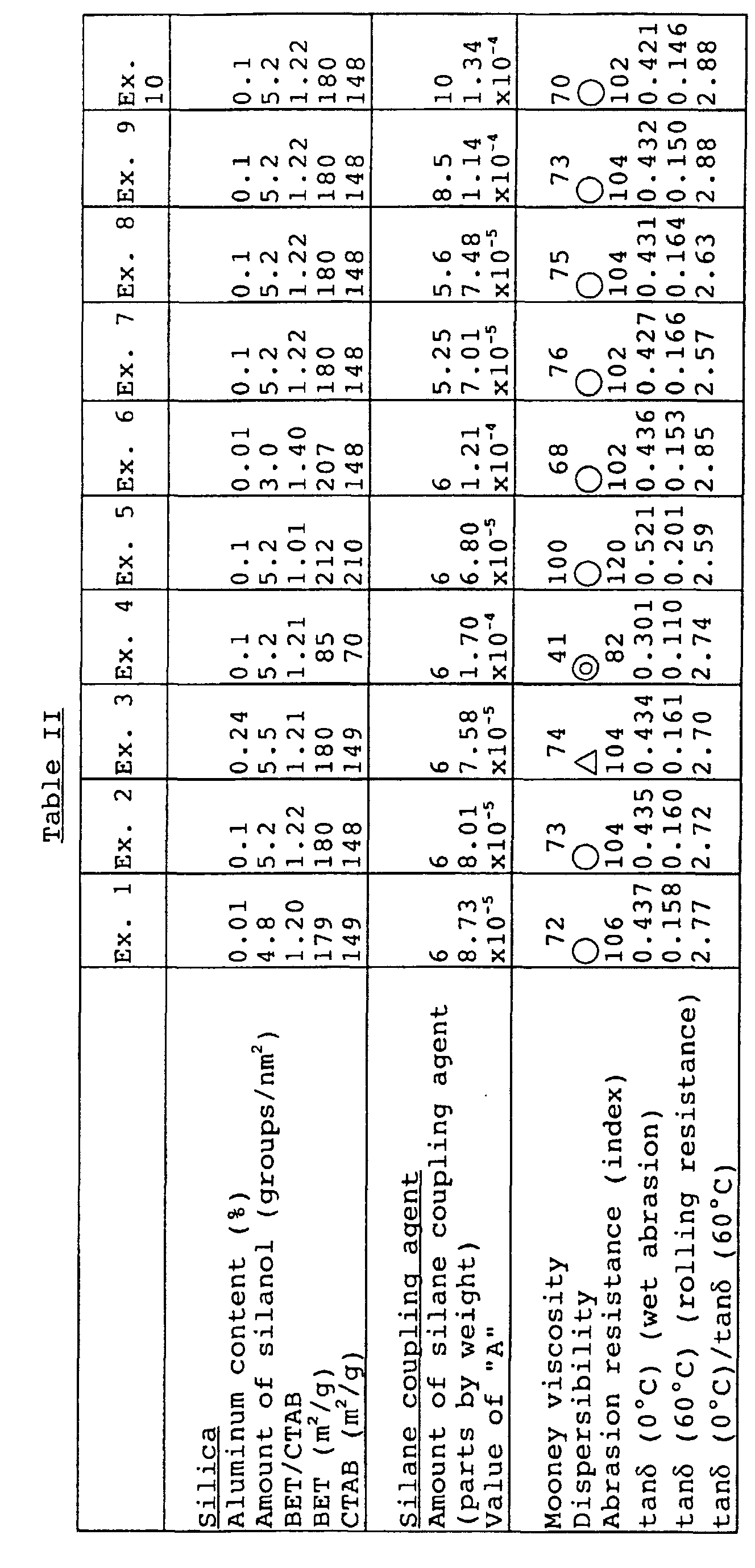
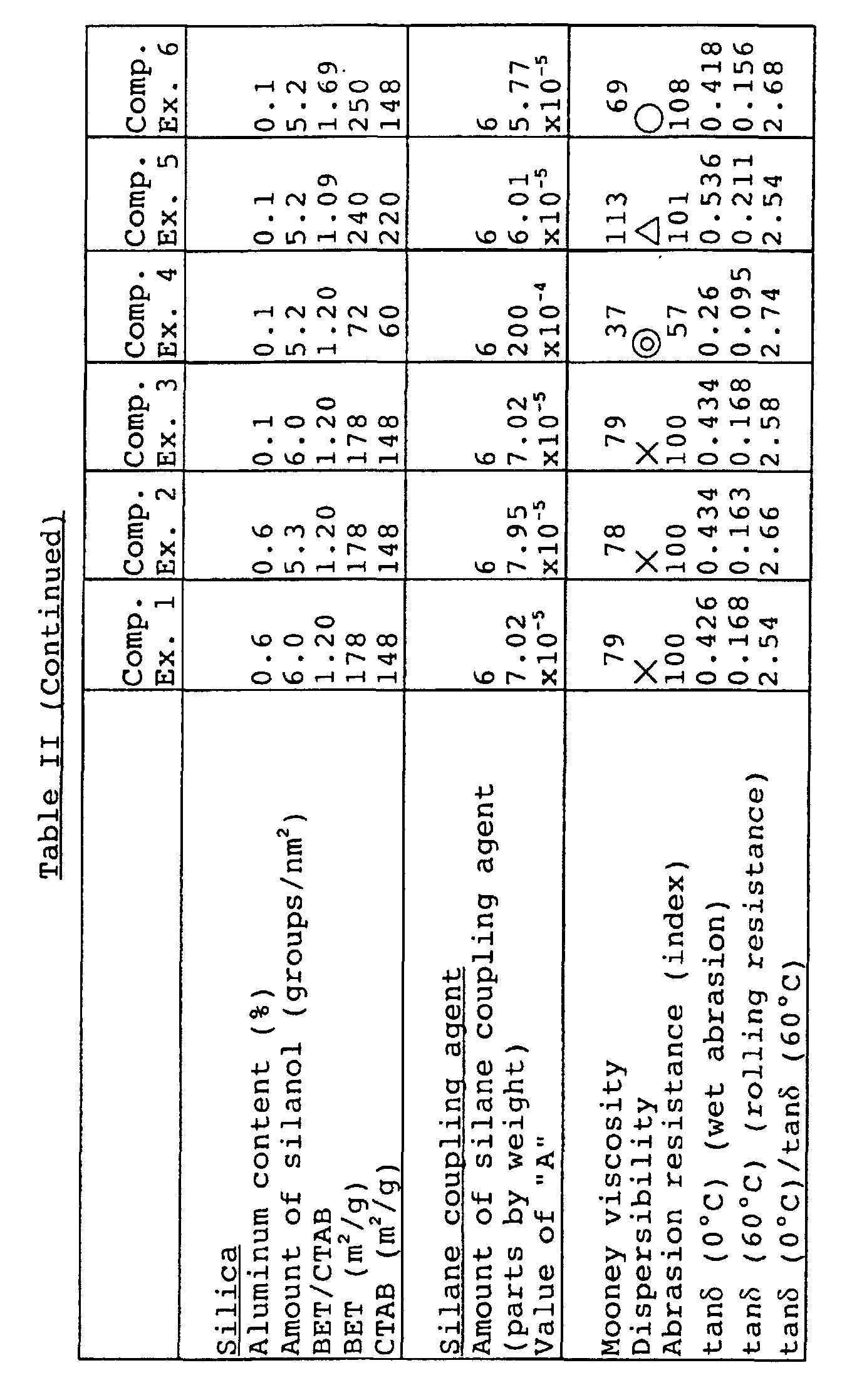
- Examples 1 to 3 and Comparative Examples 1 to 3 are those in which the aluminum content and the amount of silanol were changed. Examples 1 to 3, where the aluminum contents and amounts of silanol are both small, exhibited lower Mooney viscosities and better dispersion compared with Comparative Examples 1 to 3. In Comparative Examples 1 and 3 having high amounts of silanol, the tanδ ratio (0°C/60°C), an indicator of the balance of the rolling resistance and the wet abrasion performance, is also poor. In Example 6, the effect was confirmed until an amount of silanol of 3.0 groups/nm2. Therefore, it is better than the aluminum content be 0.01 to 0.24% by weight and the amount of silanol be not more than 3.0 to 5.5 groups/nm2.
- Examples 4 and 5 and Comparative Examples 4 and 5 are those in which CTAB values of the samples were varied. Comparative Example 4 is very poor in abrasion resistance and is not able to be used in practice. Further, Comparative Example 5 exhibited somewhat poor dispersibility, was high in Mooney viscosity, and poor in tanδ ratio (0°C/60°C), the indicator of the balance of rolling resistance and wet abrasion performance. Therefore, the CTAB should be 70 to 210 m2/g.
- Example 6 and Comparative Example 6 are those in which BET/CTAB values were changed. In Comparative Example 6 where the BET/CTAB value is too high, the tanδ at 0°C and the tanδ ratio (0°C/60°C) is also low. In Example 5, the effects were confirmed until a BET/CTAB ratio of 1.0. Therefore, a BET/CTAB ratio of 1.0 to 1.4 is good.
- As is clear from the results of Table II, it is understood that the rubber composition containing the predetermined silica and predetermined amount of silane coupling agent of the present invention is extremely superior in overall properties of processability, dispersibility, abrasion resistance, wet abrasion performance and low heat buildup.
Claims (4)
- A rubber composition comprising 100 parts by weight of at least one diene-based rubber and 10 to 100 parts by weight of silica having an aluminum content of 0.01 to 0.24% by weight, a CTAB specific surface area of 70 to 210 m2/g, a BET/CTAB ratio of 1.0 to 1.4 and a number of silanol groups per unit area of 3.0 to 5.5 groups/nm2.
- A rubber composition as claimed in claim 1, wherein said diene-based rubber is selected from styrene-butadiene-based copolymer rubber (SBR), polybutadiene rubber (BR), polyisoprene rubber, acrylonitrile-butadiene copolymer rubber (NBR) and butyl rubber (IIR).
- A rubber composition as claimed in claim 1 or 2, further comprising a silane coupling agent in an amount determined by the following formula (I):
- A rubber composition as claimed in any one of claims 1 to 3, wherein at least 60 parts by weight, based upon 100 parts by weight of the diene-based rubber, is natural rubber.
Applications Claiming Priority (3)
| Application Number | Priority Date | Filing Date | Title |
|---|---|---|---|
| JP2001311839 | 2001-10-09 | ||
| JP2001311839 | 2001-10-09 | ||
| PCT/JP2002/009879 WO2003031511A1 (en) | 2001-10-09 | 2002-09-25 | Rubber composition |
Publications (1)
| Publication Number | Publication Date |
|---|---|
| EP1447425A1 true EP1447425A1 (en) | 2004-08-18 |
Family
ID=19130590
Family Applications (1)
| Application Number | Title | Priority Date | Filing Date |
|---|---|---|---|
| EP02768067A Withdrawn EP1447425A1 (en) | 2001-10-09 | 2002-09-25 | Rubber composition |
Country Status (5)
| Country | Link |
|---|---|
| US (1) | US20040054060A1 (en) |
| EP (1) | EP1447425A1 (en) |
| JP (1) | JPWO2003031511A1 (en) |
| CN (1) | CN1476462A (en) |
| WO (1) | WO2003031511A1 (en) |
Families Citing this family (8)
| Publication number | Priority date | Publication date | Assignee | Title |
|---|---|---|---|---|
| US8078100B2 (en) * | 2002-10-15 | 2011-12-13 | Qualcomm Incorporated | Physical layer repeater with discrete time filter for all-digital detection and delay generation |
| JP5082206B2 (en) * | 2005-06-01 | 2012-11-28 | 横浜ゴム株式会社 | Rubber composition for tire |
| JP5016215B2 (en) * | 2005-11-01 | 2012-09-05 | 東洋ゴム工業株式会社 | Pneumatic tire |
| JP5478809B2 (en) * | 2007-03-20 | 2014-04-23 | 東洋ゴム工業株式会社 | Rubber composition and pneumatic tire |
| US10023723B2 (en) * | 2007-06-05 | 2018-07-17 | Momentive Performance Materials Inc. | Process for preparing rubber compositions and articles made therefrom |
| JP5638936B2 (en) * | 2010-12-24 | 2014-12-10 | 住友ゴム工業株式会社 | Rubber composition for tire and studless tire |
| CN104961982A (en) * | 2015-07-28 | 2015-10-07 | 太仓市晨洲塑业有限公司 | Modified butyl rubber |
| FR3047735A1 (en) * | 2016-02-12 | 2017-08-18 | Michelin & Cie | RUBBER COMPOSITION COMPRISING AN ESSENTIALLY SPHERICAL, LITTLE STRUCTURED SILICA |
Family Cites Families (7)
| Publication number | Priority date | Publication date | Assignee | Title |
|---|---|---|---|---|
| FR2589871B1 (en) * | 1985-09-13 | 1987-12-11 | Rhone Poulenc Chim Base | REINFORCING FILLER FOR SILICA-BASED ELASTOMER |
| FR2710630B1 (en) * | 1993-09-29 | 1995-12-29 | Rhone Poulenc Chimie | New precipitated silicas, their preparation process and their use for reinforcing elastomers. |
| US5929157A (en) * | 1996-04-22 | 1999-07-27 | Sumitomo Rubber Industries, Ltd. | Rubber composition for tire sidewall and tire |
| DE19840153A1 (en) * | 1998-09-03 | 2000-04-20 | Degussa | Precipitated silica |
| CA2282629A1 (en) * | 1998-10-15 | 2000-04-15 | The Goodyear Tire & Rubber Company | Preparation of reinforced rubber and use in tires |
| JP4928017B2 (en) * | 1999-12-02 | 2012-05-09 | 株式会社ブリヂストン | Rubber composition and pneumatic tire using the same |
| JP3678627B2 (en) * | 2000-04-11 | 2005-08-03 | 横浜ゴム株式会社 | Rubber composition |
-
2002
- 2002-09-25 CN CNA028031466A patent/CN1476462A/en active Pending
- 2002-09-25 US US10/433,100 patent/US20040054060A1/en not_active Abandoned
- 2002-09-25 EP EP02768067A patent/EP1447425A1/en not_active Withdrawn
- 2002-09-25 WO PCT/JP2002/009879 patent/WO2003031511A1/en not_active Ceased
- 2002-09-25 JP JP2003534489A patent/JPWO2003031511A1/en active Pending
Non-Patent Citations (1)
| Title |
|---|
| See references of WO03031511A1 * |
Also Published As
| Publication number | Publication date |
|---|---|
| WO2003031511A1 (en) | 2003-04-17 |
| US20040054060A1 (en) | 2004-03-18 |
| CN1476462A (en) | 2004-02-18 |
| JPWO2003031511A1 (en) | 2005-01-20 |
Similar Documents
| Publication | Publication Date | Title |
|---|---|---|
| US5714533A (en) | Rubber composition improved in charging property and pneumatic tire produced by making use of the same | |
| EP0748841B1 (en) | Rubber compositions for use in tire tread | |
| JP2796044B2 (en) | High damping rubber composition containing silica for seismic isolation or vibration control | |
| EP1146073B1 (en) | Rubber composition | |
| KR102384417B1 (en) | Rubber composition for tire tread and tire manufactured by using it | |
| US20040054060A1 (en) | Rubber composition | |
| EP0857753A2 (en) | Rubber composition and pneumatic tire made by using the same | |
| JP2008019334A (en) | Rubber composition for tire tread | |
| JP3496420B2 (en) | Rubber composition | |
| JPH1160816A (en) | Rubber composition for tire tread | |
| JP2006131718A (en) | Rubber composition | |
| US5985978A (en) | Rubber composition for tire tread | |
| JP2018131560A (en) | Rubber composition for tire | |
| JP2005041926A (en) | Rubber composition and tire using the same | |
| JP5044903B2 (en) | Rubber composition for tire | |
| JP2005350595A (en) | Pneumatic tire | |
| JP3240770B2 (en) | Method for producing rubber composition | |
| JP2005194418A (en) | Rubber composition for pneumatic tire | |
| EP0718359A1 (en) | Rubber composition for tyre treads | |
| KR100234478B1 (en) | A tire tread composition improved abrasion | |
| JP4030332B2 (en) | Rubber composition | |
| JP2004155959A (en) | Rubber composition | |
| KR102526787B1 (en) | Rubber composition for tire-tread and tire using it | |
| JP5082206B2 (en) | Rubber composition for tire | |
| JPH07102116A (en) | Rubber composition for tire tread |
Legal Events
| Date | Code | Title | Description |
|---|---|---|---|
| PUAI | Public reference made under article 153(3) epc to a published international application that has entered the european phase |
Free format text: ORIGINAL CODE: 0009012 |
|
| 17P | Request for examination filed |
Effective date: 20030603 |
|
| AK | Designated contracting states |
Kind code of ref document: A1 Designated state(s): AT BE BG CH CY CZ DE DK EE ES FI FR GB GR IE IT LI LU MC NL PT SE SK TR |
|
| STAA | Information on the status of an ep patent application or granted ep patent |
Free format text: STATUS: THE APPLICATION HAS BEEN WITHDRAWN |
|
| 18W | Application withdrawn |
Effective date: 20050331 |