EP1447130A1 - Catalyst element and method for manufacture thereof - Google Patents
Catalyst element and method for manufacture thereof Download PDFInfo
- Publication number
- EP1447130A1 EP1447130A1 EP02770291A EP02770291A EP1447130A1 EP 1447130 A1 EP1447130 A1 EP 1447130A1 EP 02770291 A EP02770291 A EP 02770291A EP 02770291 A EP02770291 A EP 02770291A EP 1447130 A1 EP1447130 A1 EP 1447130A1
- Authority
- EP
- European Patent Office
- Prior art keywords
- aggregate
- phases
- raw material
- carrier
- dispersion
- Prior art date
- Legal status (The legal status is an assumption and is not a legal conclusion. Google has not performed a legal analysis and makes no representation as to the accuracy of the status listed.)
- Granted
Links
Images



Classifications
-
- B—PERFORMING OPERATIONS; TRANSPORTING
- B01—PHYSICAL OR CHEMICAL PROCESSES OR APPARATUS IN GENERAL
- B01J—CHEMICAL OR PHYSICAL PROCESSES, e.g. CATALYSIS OR COLLOID CHEMISTRY; THEIR RELEVANT APPARATUS
- B01J35/00—Catalysts, in general, characterised by their form or physical properties
- B01J35/50—Catalysts, in general, characterised by their form or physical properties characterised by their shape or configuration
- B01J35/56—Foraminous structures having flow-through passages or channels, e.g. grids or three-dimensional [3D] monoliths
-
- B—PERFORMING OPERATIONS; TRANSPORTING
- B01—PHYSICAL OR CHEMICAL PROCESSES OR APPARATUS IN GENERAL
- B01J—CHEMICAL OR PHYSICAL PROCESSES, e.g. CATALYSIS OR COLLOID CHEMISTRY; THEIR RELEVANT APPARATUS
- B01J37/00—Processes, in general, for preparing catalysts; Processes, in general, for activation of catalysts
- B01J37/0009—Use of binding agents; Moulding; Pressing; Powdering; Granulating; Addition of materials ameliorating the mechanical properties of the product catalyst
-
- B—PERFORMING OPERATIONS; TRANSPORTING
- B01—PHYSICAL OR CHEMICAL PROCESSES OR APPARATUS IN GENERAL
- B01D—SEPARATION
- B01D53/00—Separation of gases or vapours; Recovering vapours of volatile solvents from gases; Chemical or biological purification of waste gases, e.g. engine exhaust gases, smoke, fumes, flue gases, aerosols
- B01D53/34—Chemical or biological purification of waste gases
- B01D53/74—General processes for purification of waste gases; Apparatus or devices specially adapted therefor
- B01D53/86—Catalytic processes
- B01D53/88—Handling or mounting catalysts
- B01D53/885—Devices in general for catalytic purification of waste gases
-
- B—PERFORMING OPERATIONS; TRANSPORTING
- B01—PHYSICAL OR CHEMICAL PROCESSES OR APPARATUS IN GENERAL
- B01J—CHEMICAL OR PHYSICAL PROCESSES, e.g. CATALYSIS OR COLLOID CHEMISTRY; THEIR RELEVANT APPARATUS
- B01J21/00—Catalysts comprising the elements, oxides, or hydroxides of magnesium, boron, aluminium, carbon, silicon, titanium, zirconium, or hafnium
- B01J21/14—Silica and magnesia
-
- B—PERFORMING OPERATIONS; TRANSPORTING
- B01—PHYSICAL OR CHEMICAL PROCESSES OR APPARATUS IN GENERAL
- B01J—CHEMICAL OR PHYSICAL PROCESSES, e.g. CATALYSIS OR COLLOID CHEMISTRY; THEIR RELEVANT APPARATUS
- B01J23/00—Catalysts comprising metals or metal oxides or hydroxides, not provided for in group B01J21/00
- B01J23/38—Catalysts comprising metals or metal oxides or hydroxides, not provided for in group B01J21/00 of noble metals
- B01J23/54—Catalysts comprising metals or metal oxides or hydroxides, not provided for in group B01J21/00 of noble metals combined with metals, oxides or hydroxides provided for in groups B01J23/02 - B01J23/36
- B01J23/56—Platinum group metals
- B01J23/58—Platinum group metals with alkali- or alkaline earth metals
-
- B—PERFORMING OPERATIONS; TRANSPORTING
- B01—PHYSICAL OR CHEMICAL PROCESSES OR APPARATUS IN GENERAL
- B01J—CHEMICAL OR PHYSICAL PROCESSES, e.g. CATALYSIS OR COLLOID CHEMISTRY; THEIR RELEVANT APPARATUS
- B01J35/00—Catalysts, in general, characterised by their form or physical properties
- B01J35/19—Catalysts containing parts with different compositions
-
- B—PERFORMING OPERATIONS; TRANSPORTING
- B01—PHYSICAL OR CHEMICAL PROCESSES OR APPARATUS IN GENERAL
- B01J—CHEMICAL OR PHYSICAL PROCESSES, e.g. CATALYSIS OR COLLOID CHEMISTRY; THEIR RELEVANT APPARATUS
- B01J37/00—Processes, in general, for preparing catalysts; Processes, in general, for activation of catalysts
- B01J37/0009—Use of binding agents; Moulding; Pressing; Powdering; Granulating; Addition of materials ameliorating the mechanical properties of the product catalyst
- B01J37/0018—Addition of a binding agent or of material, later completely removed among others as result of heat treatment, leaching or washing,(e.g. forming of pores; protective layer, desintegrating by heat)
-
- C—CHEMISTRY; METALLURGY
- C04—CEMENTS; CONCRETE; ARTIFICIAL STONE; CERAMICS; REFRACTORIES
- C04B—LIME, MAGNESIA; SLAG; CEMENTS; COMPOSITIONS THEREOF, e.g. MORTARS, CONCRETE OR LIKE BUILDING MATERIALS; ARTIFICIAL STONE; CERAMICS; REFRACTORIES; TREATMENT OF NATURAL STONE
- C04B35/00—Shaped ceramic products characterised by their composition; Ceramics compositions; Processing powders of inorganic compounds preparatory to the manufacturing of ceramic products
- C04B35/01—Shaped ceramic products characterised by their composition; Ceramics compositions; Processing powders of inorganic compounds preparatory to the manufacturing of ceramic products based on oxide ceramics
- C04B35/16—Shaped ceramic products characterised by their composition; Ceramics compositions; Processing powders of inorganic compounds preparatory to the manufacturing of ceramic products based on oxide ceramics based on silicates other than clay
- C04B35/18—Shaped ceramic products characterised by their composition; Ceramics compositions; Processing powders of inorganic compounds preparatory to the manufacturing of ceramic products based on oxide ceramics based on silicates other than clay rich in aluminium oxide
- C04B35/185—Mullite 3Al2O3-2SiO2
-
- C—CHEMISTRY; METALLURGY
- C04—CEMENTS; CONCRETE; ARTIFICIAL STONE; CERAMICS; REFRACTORIES
- C04B—LIME, MAGNESIA; SLAG; CEMENTS; COMPOSITIONS THEREOF, e.g. MORTARS, CONCRETE OR LIKE BUILDING MATERIALS; ARTIFICIAL STONE; CERAMICS; REFRACTORIES; TREATMENT OF NATURAL STONE
- C04B35/00—Shaped ceramic products characterised by their composition; Ceramics compositions; Processing powders of inorganic compounds preparatory to the manufacturing of ceramic products
- C04B35/01—Shaped ceramic products characterised by their composition; Ceramics compositions; Processing powders of inorganic compounds preparatory to the manufacturing of ceramic products based on oxide ceramics
- C04B35/16—Shaped ceramic products characterised by their composition; Ceramics compositions; Processing powders of inorganic compounds preparatory to the manufacturing of ceramic products based on oxide ceramics based on silicates other than clay
- C04B35/18—Shaped ceramic products characterised by their composition; Ceramics compositions; Processing powders of inorganic compounds preparatory to the manufacturing of ceramic products based on oxide ceramics based on silicates other than clay rich in aluminium oxide
- C04B35/195—Alkaline earth aluminosilicates, e.g. cordierite or anorthite
-
- C—CHEMISTRY; METALLURGY
- C04—CEMENTS; CONCRETE; ARTIFICIAL STONE; CERAMICS; REFRACTORIES
- C04B—LIME, MAGNESIA; SLAG; CEMENTS; COMPOSITIONS THEREOF, e.g. MORTARS, CONCRETE OR LIKE BUILDING MATERIALS; ARTIFICIAL STONE; CERAMICS; REFRACTORIES; TREATMENT OF NATURAL STONE
- C04B35/00—Shaped ceramic products characterised by their composition; Ceramics compositions; Processing powders of inorganic compounds preparatory to the manufacturing of ceramic products
- C04B35/622—Forming processes; Processing powders of inorganic compounds preparatory to the manufacturing of ceramic products
- C04B35/626—Preparing or treating the powders individually or as batches ; preparing or treating macroscopic reinforcing agents for ceramic products, e.g. fibres; mechanical aspects section B
- C04B35/63—Preparing or treating the powders individually or as batches ; preparing or treating macroscopic reinforcing agents for ceramic products, e.g. fibres; mechanical aspects section B using additives specially adapted for forming the products, e.g.. binder binders
- C04B35/6303—Inorganic additives
- C04B35/6306—Binders based on phosphoric acids or phosphates
-
- C—CHEMISTRY; METALLURGY
- C04—CEMENTS; CONCRETE; ARTIFICIAL STONE; CERAMICS; REFRACTORIES
- C04B—LIME, MAGNESIA; SLAG; CEMENTS; COMPOSITIONS THEREOF, e.g. MORTARS, CONCRETE OR LIKE BUILDING MATERIALS; ARTIFICIAL STONE; CERAMICS; REFRACTORIES; TREATMENT OF NATURAL STONE
- C04B35/00—Shaped ceramic products characterised by their composition; Ceramics compositions; Processing powders of inorganic compounds preparatory to the manufacturing of ceramic products
- C04B35/622—Forming processes; Processing powders of inorganic compounds preparatory to the manufacturing of ceramic products
- C04B35/626—Preparing or treating the powders individually or as batches ; preparing or treating macroscopic reinforcing agents for ceramic products, e.g. fibres; mechanical aspects section B
- C04B35/63—Preparing or treating the powders individually or as batches ; preparing or treating macroscopic reinforcing agents for ceramic products, e.g. fibres; mechanical aspects section B using additives specially adapted for forming the products, e.g.. binder binders
- C04B35/632—Organic additives
- C04B35/636—Polysaccharides or derivatives thereof
- C04B35/6365—Cellulose or derivatives thereof
-
- C—CHEMISTRY; METALLURGY
- C04—CEMENTS; CONCRETE; ARTIFICIAL STONE; CERAMICS; REFRACTORIES
- C04B—LIME, MAGNESIA; SLAG; CEMENTS; COMPOSITIONS THEREOF, e.g. MORTARS, CONCRETE OR LIKE BUILDING MATERIALS; ARTIFICIAL STONE; CERAMICS; REFRACTORIES; TREATMENT OF NATURAL STONE
- C04B38/00—Porous mortars, concrete, artificial stone or ceramic ware; Preparation thereof
- C04B38/0006—Honeycomb structures
-
- B—PERFORMING OPERATIONS; TRANSPORTING
- B01—PHYSICAL OR CHEMICAL PROCESSES OR APPARATUS IN GENERAL
- B01J—CHEMICAL OR PHYSICAL PROCESSES, e.g. CATALYSIS OR COLLOID CHEMISTRY; THEIR RELEVANT APPARATUS
- B01J21/00—Catalysts comprising the elements, oxides, or hydroxides of magnesium, boron, aluminium, carbon, silicon, titanium, zirconium, or hafnium
- B01J21/12—Silica and alumina
-
- B—PERFORMING OPERATIONS; TRANSPORTING
- B01—PHYSICAL OR CHEMICAL PROCESSES OR APPARATUS IN GENERAL
- B01J—CHEMICAL OR PHYSICAL PROCESSES, e.g. CATALYSIS OR COLLOID CHEMISTRY; THEIR RELEVANT APPARATUS
- B01J35/00—Catalysts, in general, characterised by their form or physical properties
- B01J35/40—Catalysts, in general, characterised by their form or physical properties characterised by dimensions, e.g. grain size
-
- B—PERFORMING OPERATIONS; TRANSPORTING
- B01—PHYSICAL OR CHEMICAL PROCESSES OR APPARATUS IN GENERAL
- B01J—CHEMICAL OR PHYSICAL PROCESSES, e.g. CATALYSIS OR COLLOID CHEMISTRY; THEIR RELEVANT APPARATUS
- B01J37/00—Processes, in general, for preparing catalysts; Processes, in general, for activation of catalysts
- B01J37/02—Impregnation, coating or precipitation
- B01J37/03—Precipitation; Co-precipitation
- B01J37/038—Precipitation; Co-precipitation to form slurries or suspensions, e.g. a washcoat
-
- C—CHEMISTRY; METALLURGY
- C04—CEMENTS; CONCRETE; ARTIFICIAL STONE; CERAMICS; REFRACTORIES
- C04B—LIME, MAGNESIA; SLAG; CEMENTS; COMPOSITIONS THEREOF, e.g. MORTARS, CONCRETE OR LIKE BUILDING MATERIALS; ARTIFICIAL STONE; CERAMICS; REFRACTORIES; TREATMENT OF NATURAL STONE
- C04B2111/00—Mortars, concrete or artificial stone or mixtures to prepare them, characterised by specific function, property or use
- C04B2111/00034—Physico-chemical characteristics of the mixtures
- C04B2111/00129—Extrudable mixtures
-
- C—CHEMISTRY; METALLURGY
- C04—CEMENTS; CONCRETE; ARTIFICIAL STONE; CERAMICS; REFRACTORIES
- C04B—LIME, MAGNESIA; SLAG; CEMENTS; COMPOSITIONS THEREOF, e.g. MORTARS, CONCRETE OR LIKE BUILDING MATERIALS; ARTIFICIAL STONE; CERAMICS; REFRACTORIES; TREATMENT OF NATURAL STONE
- C04B2235/00—Aspects relating to ceramic starting mixtures or sintered ceramic products
- C04B2235/02—Composition of constituents of the starting material or of secondary phases of the final product
- C04B2235/30—Constituents and secondary phases not being of a fibrous nature
- C04B2235/32—Metal oxides, mixed metal oxides, or oxide-forming salts thereof, e.g. carbonates, nitrates, (oxy)hydroxides, chlorides
- C04B2235/3201—Alkali metal oxides or oxide-forming salts thereof
-
- C—CHEMISTRY; METALLURGY
- C04—CEMENTS; CONCRETE; ARTIFICIAL STONE; CERAMICS; REFRACTORIES
- C04B—LIME, MAGNESIA; SLAG; CEMENTS; COMPOSITIONS THEREOF, e.g. MORTARS, CONCRETE OR LIKE BUILDING MATERIALS; ARTIFICIAL STONE; CERAMICS; REFRACTORIES; TREATMENT OF NATURAL STONE
- C04B2235/00—Aspects relating to ceramic starting mixtures or sintered ceramic products
- C04B2235/02—Composition of constituents of the starting material or of secondary phases of the final product
- C04B2235/30—Constituents and secondary phases not being of a fibrous nature
- C04B2235/32—Metal oxides, mixed metal oxides, or oxide-forming salts thereof, e.g. carbonates, nitrates, (oxy)hydroxides, chlorides
- C04B2235/3205—Alkaline earth oxides or oxide forming salts thereof, e.g. beryllium oxide
- C04B2235/3206—Magnesium oxides or oxide-forming salts thereof
-
- C—CHEMISTRY; METALLURGY
- C04—CEMENTS; CONCRETE; ARTIFICIAL STONE; CERAMICS; REFRACTORIES
- C04B—LIME, MAGNESIA; SLAG; CEMENTS; COMPOSITIONS THEREOF, e.g. MORTARS, CONCRETE OR LIKE BUILDING MATERIALS; ARTIFICIAL STONE; CERAMICS; REFRACTORIES; TREATMENT OF NATURAL STONE
- C04B2235/00—Aspects relating to ceramic starting mixtures or sintered ceramic products
- C04B2235/02—Composition of constituents of the starting material or of secondary phases of the final product
- C04B2235/30—Constituents and secondary phases not being of a fibrous nature
- C04B2235/32—Metal oxides, mixed metal oxides, or oxide-forming salts thereof, e.g. carbonates, nitrates, (oxy)hydroxides, chlorides
- C04B2235/3217—Aluminum oxide or oxide forming salts thereof, e.g. bauxite, alpha-alumina
-
- C—CHEMISTRY; METALLURGY
- C04—CEMENTS; CONCRETE; ARTIFICIAL STONE; CERAMICS; REFRACTORIES
- C04B—LIME, MAGNESIA; SLAG; CEMENTS; COMPOSITIONS THEREOF, e.g. MORTARS, CONCRETE OR LIKE BUILDING MATERIALS; ARTIFICIAL STONE; CERAMICS; REFRACTORIES; TREATMENT OF NATURAL STONE
- C04B2235/00—Aspects relating to ceramic starting mixtures or sintered ceramic products
- C04B2235/02—Composition of constituents of the starting material or of secondary phases of the final product
- C04B2235/30—Constituents and secondary phases not being of a fibrous nature
- C04B2235/32—Metal oxides, mixed metal oxides, or oxide-forming salts thereof, e.g. carbonates, nitrates, (oxy)hydroxides, chlorides
- C04B2235/3217—Aluminum oxide or oxide forming salts thereof, e.g. bauxite, alpha-alumina
- C04B2235/3218—Aluminium (oxy)hydroxides, e.g. boehmite, gibbsite, alumina sol
-
- C—CHEMISTRY; METALLURGY
- C04—CEMENTS; CONCRETE; ARTIFICIAL STONE; CERAMICS; REFRACTORIES
- C04B—LIME, MAGNESIA; SLAG; CEMENTS; COMPOSITIONS THEREOF, e.g. MORTARS, CONCRETE OR LIKE BUILDING MATERIALS; ARTIFICIAL STONE; CERAMICS; REFRACTORIES; TREATMENT OF NATURAL STONE
- C04B2235/00—Aspects relating to ceramic starting mixtures or sintered ceramic products
- C04B2235/02—Composition of constituents of the starting material or of secondary phases of the final product
- C04B2235/30—Constituents and secondary phases not being of a fibrous nature
- C04B2235/32—Metal oxides, mixed metal oxides, or oxide-forming salts thereof, e.g. carbonates, nitrates, (oxy)hydroxides, chlorides
- C04B2235/3217—Aluminum oxide or oxide forming salts thereof, e.g. bauxite, alpha-alumina
- C04B2235/322—Transition aluminas, e.g. delta or gamma aluminas
-
- C—CHEMISTRY; METALLURGY
- C04—CEMENTS; CONCRETE; ARTIFICIAL STONE; CERAMICS; REFRACTORIES
- C04B—LIME, MAGNESIA; SLAG; CEMENTS; COMPOSITIONS THEREOF, e.g. MORTARS, CONCRETE OR LIKE BUILDING MATERIALS; ARTIFICIAL STONE; CERAMICS; REFRACTORIES; TREATMENT OF NATURAL STONE
- C04B2235/00—Aspects relating to ceramic starting mixtures or sintered ceramic products
- C04B2235/02—Composition of constituents of the starting material or of secondary phases of the final product
- C04B2235/30—Constituents and secondary phases not being of a fibrous nature
- C04B2235/32—Metal oxides, mixed metal oxides, or oxide-forming salts thereof, e.g. carbonates, nitrates, (oxy)hydroxides, chlorides
- C04B2235/3231—Refractory metal oxides, their mixed metal oxides, or oxide-forming salts thereof
- C04B2235/3232—Titanium oxides or titanates, e.g. rutile or anatase
-
- C—CHEMISTRY; METALLURGY
- C04—CEMENTS; CONCRETE; ARTIFICIAL STONE; CERAMICS; REFRACTORIES
- C04B—LIME, MAGNESIA; SLAG; CEMENTS; COMPOSITIONS THEREOF, e.g. MORTARS, CONCRETE OR LIKE BUILDING MATERIALS; ARTIFICIAL STONE; CERAMICS; REFRACTORIES; TREATMENT OF NATURAL STONE
- C04B2235/00—Aspects relating to ceramic starting mixtures or sintered ceramic products
- C04B2235/02—Composition of constituents of the starting material or of secondary phases of the final product
- C04B2235/30—Constituents and secondary phases not being of a fibrous nature
- C04B2235/32—Metal oxides, mixed metal oxides, or oxide-forming salts thereof, e.g. carbonates, nitrates, (oxy)hydroxides, chlorides
- C04B2235/3231—Refractory metal oxides, their mixed metal oxides, or oxide-forming salts thereof
- C04B2235/3244—Zirconium oxides, zirconates, hafnium oxides, hafnates, or oxide-forming salts thereof
-
- C—CHEMISTRY; METALLURGY
- C04—CEMENTS; CONCRETE; ARTIFICIAL STONE; CERAMICS; REFRACTORIES
- C04B—LIME, MAGNESIA; SLAG; CEMENTS; COMPOSITIONS THEREOF, e.g. MORTARS, CONCRETE OR LIKE BUILDING MATERIALS; ARTIFICIAL STONE; CERAMICS; REFRACTORIES; TREATMENT OF NATURAL STONE
- C04B2235/00—Aspects relating to ceramic starting mixtures or sintered ceramic products
- C04B2235/02—Composition of constituents of the starting material or of secondary phases of the final product
- C04B2235/30—Constituents and secondary phases not being of a fibrous nature
- C04B2235/32—Metal oxides, mixed metal oxides, or oxide-forming salts thereof, e.g. carbonates, nitrates, (oxy)hydroxides, chlorides
- C04B2235/327—Iron group oxides, their mixed metal oxides, or oxide-forming salts thereof
- C04B2235/3279—Nickel oxides, nickalates, or oxide-forming salts thereof
-
- C—CHEMISTRY; METALLURGY
- C04—CEMENTS; CONCRETE; ARTIFICIAL STONE; CERAMICS; REFRACTORIES
- C04B—LIME, MAGNESIA; SLAG; CEMENTS; COMPOSITIONS THEREOF, e.g. MORTARS, CONCRETE OR LIKE BUILDING MATERIALS; ARTIFICIAL STONE; CERAMICS; REFRACTORIES; TREATMENT OF NATURAL STONE
- C04B2235/00—Aspects relating to ceramic starting mixtures or sintered ceramic products
- C04B2235/02—Composition of constituents of the starting material or of secondary phases of the final product
- C04B2235/30—Constituents and secondary phases not being of a fibrous nature
- C04B2235/32—Metal oxides, mixed metal oxides, or oxide-forming salts thereof, e.g. carbonates, nitrates, (oxy)hydroxides, chlorides
- C04B2235/3289—Noble metal oxides
-
- C—CHEMISTRY; METALLURGY
- C04—CEMENTS; CONCRETE; ARTIFICIAL STONE; CERAMICS; REFRACTORIES
- C04B—LIME, MAGNESIA; SLAG; CEMENTS; COMPOSITIONS THEREOF, e.g. MORTARS, CONCRETE OR LIKE BUILDING MATERIALS; ARTIFICIAL STONE; CERAMICS; REFRACTORIES; TREATMENT OF NATURAL STONE
- C04B2235/00—Aspects relating to ceramic starting mixtures or sintered ceramic products
- C04B2235/02—Composition of constituents of the starting material or of secondary phases of the final product
- C04B2235/30—Constituents and secondary phases not being of a fibrous nature
- C04B2235/34—Non-metal oxides, non-metal mixed oxides, or salts thereof that form the non-metal oxides upon heating, e.g. carbonates, nitrates, (oxy)hydroxides, chlorides
- C04B2235/3427—Silicates other than clay, e.g. water glass
- C04B2235/3436—Alkaline earth metal silicates, e.g. barium silicate
- C04B2235/3445—Magnesium silicates, e.g. forsterite
-
- C—CHEMISTRY; METALLURGY
- C04—CEMENTS; CONCRETE; ARTIFICIAL STONE; CERAMICS; REFRACTORIES
- C04B—LIME, MAGNESIA; SLAG; CEMENTS; COMPOSITIONS THEREOF, e.g. MORTARS, CONCRETE OR LIKE BUILDING MATERIALS; ARTIFICIAL STONE; CERAMICS; REFRACTORIES; TREATMENT OF NATURAL STONE
- C04B2235/00—Aspects relating to ceramic starting mixtures or sintered ceramic products
- C04B2235/02—Composition of constituents of the starting material or of secondary phases of the final product
- C04B2235/30—Constituents and secondary phases not being of a fibrous nature
- C04B2235/34—Non-metal oxides, non-metal mixed oxides, or salts thereof that form the non-metal oxides upon heating, e.g. carbonates, nitrates, (oxy)hydroxides, chlorides
- C04B2235/3427—Silicates other than clay, e.g. water glass
- C04B2235/3463—Alumino-silicates other than clay, e.g. mullite
-
- C—CHEMISTRY; METALLURGY
- C04—CEMENTS; CONCRETE; ARTIFICIAL STONE; CERAMICS; REFRACTORIES
- C04B—LIME, MAGNESIA; SLAG; CEMENTS; COMPOSITIONS THEREOF, e.g. MORTARS, CONCRETE OR LIKE BUILDING MATERIALS; ARTIFICIAL STONE; CERAMICS; REFRACTORIES; TREATMENT OF NATURAL STONE
- C04B2235/00—Aspects relating to ceramic starting mixtures or sintered ceramic products
- C04B2235/02—Composition of constituents of the starting material or of secondary phases of the final product
- C04B2235/30—Constituents and secondary phases not being of a fibrous nature
- C04B2235/34—Non-metal oxides, non-metal mixed oxides, or salts thereof that form the non-metal oxides upon heating, e.g. carbonates, nitrates, (oxy)hydroxides, chlorides
- C04B2235/3427—Silicates other than clay, e.g. water glass
- C04B2235/3463—Alumino-silicates other than clay, e.g. mullite
- C04B2235/3481—Alkaline earth metal alumino-silicates other than clay, e.g. cordierite, beryl, micas such as margarite, plagioclase feldspars such as anorthite, zeolites such as chabazite
-
- C—CHEMISTRY; METALLURGY
- C04—CEMENTS; CONCRETE; ARTIFICIAL STONE; CERAMICS; REFRACTORIES
- C04B—LIME, MAGNESIA; SLAG; CEMENTS; COMPOSITIONS THEREOF, e.g. MORTARS, CONCRETE OR LIKE BUILDING MATERIALS; ARTIFICIAL STONE; CERAMICS; REFRACTORIES; TREATMENT OF NATURAL STONE
- C04B2235/00—Aspects relating to ceramic starting mixtures or sintered ceramic products
- C04B2235/02—Composition of constituents of the starting material or of secondary phases of the final product
- C04B2235/30—Constituents and secondary phases not being of a fibrous nature
- C04B2235/34—Non-metal oxides, non-metal mixed oxides, or salts thereof that form the non-metal oxides upon heating, e.g. carbonates, nitrates, (oxy)hydroxides, chlorides
- C04B2235/349—Clays, e.g. bentonites, smectites such as montmorillonite, vermiculites or kaolines, e.g. illite, talc or sepiolite
-
- C—CHEMISTRY; METALLURGY
- C04—CEMENTS; CONCRETE; ARTIFICIAL STONE; CERAMICS; REFRACTORIES
- C04B—LIME, MAGNESIA; SLAG; CEMENTS; COMPOSITIONS THEREOF, e.g. MORTARS, CONCRETE OR LIKE BUILDING MATERIALS; ARTIFICIAL STONE; CERAMICS; REFRACTORIES; TREATMENT OF NATURAL STONE
- C04B2235/00—Aspects relating to ceramic starting mixtures or sintered ceramic products
- C04B2235/02—Composition of constituents of the starting material or of secondary phases of the final product
- C04B2235/30—Constituents and secondary phases not being of a fibrous nature
- C04B2235/38—Non-oxide ceramic constituents or additives
- C04B2235/3817—Carbides
- C04B2235/3826—Silicon carbides
-
- C—CHEMISTRY; METALLURGY
- C04—CEMENTS; CONCRETE; ARTIFICIAL STONE; CERAMICS; REFRACTORIES
- C04B—LIME, MAGNESIA; SLAG; CEMENTS; COMPOSITIONS THEREOF, e.g. MORTARS, CONCRETE OR LIKE BUILDING MATERIALS; ARTIFICIAL STONE; CERAMICS; REFRACTORIES; TREATMENT OF NATURAL STONE
- C04B2235/00—Aspects relating to ceramic starting mixtures or sintered ceramic products
- C04B2235/02—Composition of constituents of the starting material or of secondary phases of the final product
- C04B2235/30—Constituents and secondary phases not being of a fibrous nature
- C04B2235/38—Non-oxide ceramic constituents or additives
- C04B2235/3852—Nitrides, e.g. oxynitrides, carbonitrides, oxycarbonitrides, lithium nitride, magnesium nitride
- C04B2235/3873—Silicon nitrides, e.g. silicon carbonitride, silicon oxynitride
-
- C—CHEMISTRY; METALLURGY
- C04—CEMENTS; CONCRETE; ARTIFICIAL STONE; CERAMICS; REFRACTORIES
- C04B—LIME, MAGNESIA; SLAG; CEMENTS; COMPOSITIONS THEREOF, e.g. MORTARS, CONCRETE OR LIKE BUILDING MATERIALS; ARTIFICIAL STONE; CERAMICS; REFRACTORIES; TREATMENT OF NATURAL STONE
- C04B2235/00—Aspects relating to ceramic starting mixtures or sintered ceramic products
- C04B2235/02—Composition of constituents of the starting material or of secondary phases of the final product
- C04B2235/50—Constituents or additives of the starting mixture chosen for their shape or used because of their shape or their physical appearance
- C04B2235/54—Particle size related information
- C04B2235/5418—Particle size related information expressed by the size of the particles or aggregates thereof
- C04B2235/5436—Particle size related information expressed by the size of the particles or aggregates thereof micrometer sized, i.e. from 1 to 100 micron
-
- C—CHEMISTRY; METALLURGY
- C04—CEMENTS; CONCRETE; ARTIFICIAL STONE; CERAMICS; REFRACTORIES
- C04B—LIME, MAGNESIA; SLAG; CEMENTS; COMPOSITIONS THEREOF, e.g. MORTARS, CONCRETE OR LIKE BUILDING MATERIALS; ARTIFICIAL STONE; CERAMICS; REFRACTORIES; TREATMENT OF NATURAL STONE
- C04B2235/00—Aspects relating to ceramic starting mixtures or sintered ceramic products
- C04B2235/02—Composition of constituents of the starting material or of secondary phases of the final product
- C04B2235/50—Constituents or additives of the starting mixture chosen for their shape or used because of their shape or their physical appearance
- C04B2235/54—Particle size related information
- C04B2235/5463—Particle size distributions
-
- C—CHEMISTRY; METALLURGY
- C04—CEMENTS; CONCRETE; ARTIFICIAL STONE; CERAMICS; REFRACTORIES
- C04B—LIME, MAGNESIA; SLAG; CEMENTS; COMPOSITIONS THEREOF, e.g. MORTARS, CONCRETE OR LIKE BUILDING MATERIALS; ARTIFICIAL STONE; CERAMICS; REFRACTORIES; TREATMENT OF NATURAL STONE
- C04B2235/00—Aspects relating to ceramic starting mixtures or sintered ceramic products
- C04B2235/70—Aspects relating to sintered or melt-casted ceramic products
- C04B2235/80—Phases present in the sintered or melt-cast ceramic products other than the main phase
-
- Y—GENERAL TAGGING OF NEW TECHNOLOGICAL DEVELOPMENTS; GENERAL TAGGING OF CROSS-SECTIONAL TECHNOLOGIES SPANNING OVER SEVERAL SECTIONS OF THE IPC; TECHNICAL SUBJECTS COVERED BY FORMER USPC CROSS-REFERENCE ART COLLECTIONS [XRACs] AND DIGESTS
- Y10—TECHNICAL SUBJECTS COVERED BY FORMER USPC
- Y10T—TECHNICAL SUBJECTS COVERED BY FORMER US CLASSIFICATION
- Y10T428/00—Stock material or miscellaneous articles
- Y10T428/13—Hollow or container type article [e.g., tube, vase, etc.]
- Y10T428/131—Glass, ceramic, or sintered, fused, fired, or calcined metal oxide or metal carbide containing [e.g., porcelain, brick, cement, etc.]
-
- Y—GENERAL TAGGING OF NEW TECHNOLOGICAL DEVELOPMENTS; GENERAL TAGGING OF CROSS-SECTIONAL TECHNOLOGIES SPANNING OVER SEVERAL SECTIONS OF THE IPC; TECHNICAL SUBJECTS COVERED BY FORMER USPC CROSS-REFERENCE ART COLLECTIONS [XRACs] AND DIGESTS
- Y10—TECHNICAL SUBJECTS COVERED BY FORMER USPC
- Y10T—TECHNICAL SUBJECTS COVERED BY FORMER US CLASSIFICATION
- Y10T428/00—Stock material or miscellaneous articles
- Y10T428/24—Structurally defined web or sheet [e.g., overall dimension, etc.]
- Y10T428/24149—Honeycomb-like
-
- Y—GENERAL TAGGING OF NEW TECHNOLOGICAL DEVELOPMENTS; GENERAL TAGGING OF CROSS-SECTIONAL TECHNOLOGIES SPANNING OVER SEVERAL SECTIONS OF THE IPC; TECHNICAL SUBJECTS COVERED BY FORMER USPC CROSS-REFERENCE ART COLLECTIONS [XRACs] AND DIGESTS
- Y10—TECHNICAL SUBJECTS COVERED BY FORMER USPC
- Y10T—TECHNICAL SUBJECTS COVERED BY FORMER US CLASSIFICATION
- Y10T428/00—Stock material or miscellaneous articles
- Y10T428/24—Structurally defined web or sheet [e.g., overall dimension, etc.]
- Y10T428/24149—Honeycomb-like
- Y10T428/24157—Filled honeycomb cells [e.g., solid substance in cavities, etc.]
-
- Y—GENERAL TAGGING OF NEW TECHNOLOGICAL DEVELOPMENTS; GENERAL TAGGING OF CROSS-SECTIONAL TECHNOLOGIES SPANNING OVER SEVERAL SECTIONS OF THE IPC; TECHNICAL SUBJECTS COVERED BY FORMER USPC CROSS-REFERENCE ART COLLECTIONS [XRACs] AND DIGESTS
- Y10—TECHNICAL SUBJECTS COVERED BY FORMER USPC
- Y10T—TECHNICAL SUBJECTS COVERED BY FORMER US CLASSIFICATION
- Y10T428/00—Stock material or miscellaneous articles
- Y10T428/24—Structurally defined web or sheet [e.g., overall dimension, etc.]
- Y10T428/24149—Honeycomb-like
- Y10T428/24165—Hexagonally shaped cavities
-
- Y—GENERAL TAGGING OF NEW TECHNOLOGICAL DEVELOPMENTS; GENERAL TAGGING OF CROSS-SECTIONAL TECHNOLOGIES SPANNING OVER SEVERAL SECTIONS OF THE IPC; TECHNICAL SUBJECTS COVERED BY FORMER USPC CROSS-REFERENCE ART COLLECTIONS [XRACs] AND DIGESTS
- Y10—TECHNICAL SUBJECTS COVERED BY FORMER USPC
- Y10T—TECHNICAL SUBJECTS COVERED BY FORMER US CLASSIFICATION
- Y10T428/00—Stock material or miscellaneous articles
- Y10T428/24—Structurally defined web or sheet [e.g., overall dimension, etc.]
- Y10T428/24744—Longitudinal or transverse tubular cavity or cell
-
- Y—GENERAL TAGGING OF NEW TECHNOLOGICAL DEVELOPMENTS; GENERAL TAGGING OF CROSS-SECTIONAL TECHNOLOGIES SPANNING OVER SEVERAL SECTIONS OF THE IPC; TECHNICAL SUBJECTS COVERED BY FORMER USPC CROSS-REFERENCE ART COLLECTIONS [XRACs] AND DIGESTS
- Y10—TECHNICAL SUBJECTS COVERED BY FORMER USPC
- Y10T—TECHNICAL SUBJECTS COVERED BY FORMER US CLASSIFICATION
- Y10T428/00—Stock material or miscellaneous articles
- Y10T428/25—Web or sheet containing structurally defined element or component and including a second component containing structurally defined particles
-
- Y—GENERAL TAGGING OF NEW TECHNOLOGICAL DEVELOPMENTS; GENERAL TAGGING OF CROSS-SECTIONAL TECHNOLOGIES SPANNING OVER SEVERAL SECTIONS OF THE IPC; TECHNICAL SUBJECTS COVERED BY FORMER USPC CROSS-REFERENCE ART COLLECTIONS [XRACs] AND DIGESTS
- Y10—TECHNICAL SUBJECTS COVERED BY FORMER USPC
- Y10T—TECHNICAL SUBJECTS COVERED BY FORMER US CLASSIFICATION
- Y10T428/00—Stock material or miscellaneous articles
- Y10T428/25—Web or sheet containing structurally defined element or component and including a second component containing structurally defined particles
- Y10T428/252—Glass or ceramic [i.e., fired or glazed clay, cement, etc.] [porcelain, quartz, etc.]
Definitions
- the present invention relates to a catalyst body used suitably for purification of nitrogen oxides and the like and relates to a method for manufacturing the same. More particularly, the present invention relates to a catalyst body containing an alkali metal and/or an alkaline earth metal having high corrosion resistance to an alkali metal and/or an alkaline earth metal as well as hindering degradation of catalyst performance, and relates to a method for manufacturing the same.
- NO x nitrogen oxides
- alkali metals such as K, Na, Li, and Cs
- alkaline earth metals such as Ba and Ca
- rare earth metals such as La and Y, and the like
- Ba has been widely used from the beginning of practical use of the NO x occlusion catalyst.
- K excelling in the NO x occlusion capability in a high temperature range has been tried in recent investigations.
- Such a NO x occlusion catalyst is usually formed from a catalytic material containing a NO x occlusion component such as an alkali metal and/or an alkaline earth metal (hereinafter referred to as "type of alkali metal") loaded on a carrier of an oxide-type ceramic material such as cordierite or a metallic material such as an Fe-Cr-Al alloy.
- a NO x occlusion component such as an alkali metal and/or an alkaline earth metal (hereinafter referred to as "type of alkali metal" loaded on a carrier of an oxide-type ceramic material such as cordierite or a metallic material such as an Fe-Cr-Al alloy.
- these carriers tend to become degraded by being corroded with a type of alkali metal, particularly with Li, Na, K, Ca, or the like, which is activated by high temperature exhaust gas. If degradation proceeds, a honeycomb carrier may crack. In addition, the catalyst performance decreases over time due to reaction of the carrier material with a type of alkali metal.
- J-P-A-2-83254 is disclosed a honeycomb structure having high thermal shock resistance.
- the honeycomb structure is obtained by forming a honeycomb formed body from a sheet formed body prepared from a raw material containing mullite and at least cordierite added thereto, then firing the honeycomb formed body at a temperature of melting cordierite to bond mullite via molten cordierite.
- the invention disclosed in this patent application does not aim to use it as a carrier but aims to prove a honeycomb structure having high porosity and thermal shock resistance that can be molded at a low temperature inexpensively. Therefore, problems of the honeycomb structure carrying a type of alkali metal catalyst are not disclosed.
- the present invention is for providing a catalyst body in which the reaction of a type of alkali metal with a catalyst carrier is hindered to suppress degradation of the carrier and deterioration in catalyst performance, and providing a method for manufacturing the same.
- the inventors of the present invention have found that when only cordierite is used as a carrier, a type of alkali metal is dissolved in cordierite to form a solid solution, as a result the catalyst performance deteriorates as well as a crack tends to be caused in the carrier by expansion due to increase of lattice constant.
- the inventors have further found that by using cordierite as a binder phase and dispersing ceramic aggregate phases in cordierite, dissolution of a type of alkali metal into cordierite to form a solid solution can be hindered.
- a catalyst body comprising: a catalytic material containing an alkali metal and/or an alkaline earth metal; and a carrier carrying the catalytic material, wherein the carrier comprises a cordierite binder phase and aggregate phases dispersed in the cordierite binder phase.
- a ratio of the aggregate phases to a total of the aggregate phases and the cordierite binder phase is preferably 30 to 90 vol%.
- the aggregate phases preferably comprise aggregate dispersion phases having a distance between one aggregate dispersion phase and another aggregate dispersion phase nearest to the one aggregate dispersion phase being 10 ⁇ m or less.
- a median dispersion diameter of the aggregate phases is preferably 50 ⁇ m or less.
- the aggregate phases preferably contain coarse dispersion phases with a dispersion diameter of 5 ⁇ m or more and fine dispersion phases with a dispersion diameter of less than 5 ⁇ m, a ratio of the fine dispersion phases to a total of the fine dispersion phases and the cordierite binder phase being preferably 20 to 70 vol%.
- a ratio of the fine dispersion phases to a total of the fine dispersion phases and the coarse dispersion phases is preferably 10 vol% or more.
- the carrier is preferably formed from a carrier raw material comprising an aggregate raw material forming the aggregate phases and a binder raw material forming the cordierite binder phase, the aggregate raw material being preferably in a form of particles containing coarse particles with a particle diameter of 5 ⁇ m or more and fine particles with a particle diameter of less than 5 ⁇ m, a ratio of the fine particles to a total of the fine particles and the binder raw material being preferably 20 to 70 vol%. A ratio of the fine particles to a total of the fine particles and the coarse particles is preferably 10 vol% or more.
- the aggregate phases preferably comprise one or more kinds selected from the group consisting of mullite, silicon carbide, alumina, zirconia, titania, titanium phosphate and aluminum titanate.
- the carrier preferably has a honeycomb structure with a number of through-holes surrounded by partition walls. Moreover, the carrier preferably comprises a wall-shaped thin plate, the median dispersion diameter of the aggregate phases being preferably 1/5 or less of the thickness of the thin plate.
- the catalytic material preferably comprises one or more noble metals selected from the group consisting of Pt, Pd, and Rh.
- a method for manufacturing a catalyst body comprising a catalytic material containing an alkali metal and/or an alkaline earth metal, and a carrier carrying the catalytic material, the method comprising steps of: (I) forming a formed body from a carrier raw material containing an aggregate raw material for forming aggregate phases and a binder raw material for forming a cordierite binder phase; (II) firing the formed body to form a carrier containing the cordierite binder phase and the aggregate phases dispersed in the cordierite binder phase; and (III) loading a catalytic material containing an alkali metal and/or an alkaline earth metal on the carrier.
- a median particle diameter of the aggregate raw material is preferably 1 to 50 ⁇ m.
- the aggregate raw material preferably contains coarse particles with a particle diameter of 5 ⁇ m or more and fine particles with a particle diameter of less than 5 ⁇ m, a ratio of the fine particles to a total of the fine particles and the binder raw material being preferably 20 to 70 vol%
- a ratio of the fine particles to a total of the fine particles and the coarse particles is preferably 10 vol% or more.
- a ratio of the aggregate raw material in the carrier raw material to a total of the aggregate raw material and the binder raw material is preferably 30 to 90 vol%.
- the aggregate raw material is preferably one or more kinds selected from the group consisting of mullite, silicon carbide, alumina, zirconia, titania, titanium phosphate and aluminum titanate.
- the step (I) is preferably forming a formed body by extrusion.
- the catalyst body containing an alkali metal and/or an alkaline earth metal and the method for manufacturing the catalyst body of the present invention will be described below in detail for specific embodiments. However, the present invention is not restricted to the following embodiment.
- the carrier carrying a catalytic material containing an alkali metal and/or an alkaline earth metal comprises a cordierite binder phase 1 and aggregate phases 2 dispersed in the cordierite binder phase 1 as shown in Figure 2.
- This carrier constitution makes the catalyst body low in degradation of the carrier and deterioration in catalyst performance.
- the symbol 3 indicates pores.
- Such an effect is considered to be achieved by that the aggregate phases are dispersed in the cordierite binder phase to hinder diffusion of a type of alkali metal into cordierite, furthermore, to inhibit expansion of cracks even if cracks are caused.
- a type of alkali metal particularly potassium
- a stress is generated by increase in the lattice constant of the solid solution phase. This stress is one of the causes for cracks.
- the aggregate phases are present, the length of the cordierite phase linearly extending in any directions is reduced to disperse the stress produced by increase in the lattice constant, whereby the stress is reduced.
- the ratio of the aggregate phases to the cordierite binder phase is preferably 30 to 90 vol%. Although the effect of durability improvement can be achieved to a certain extent with an amount of the aggregate phases in the range of 30% to less than 50% by volume, an amount of 50% by volume or more is more preferable in view of the strength retention rate.
- the amount of the aggregate phases is in the range of more than 85 vol% to 90 vol%, the bonding force tends to be insufficient in case the dispersion diameter of the aggregate phases is small, that is, the surface area is large. Therefore, the amount of 85 vol% or less is more preferable.
- the amount of the aggregate phases in the range of 60 to 85 vol% is most preferable, because there is almost no decrease in the strength after a durability test.
- the distance between one aggregate phase (aggregate dispersion phase) dispersed in the cordierite binder phase and another aggregate dispersion phase nearest to the one aggregate dispersion phase be 10 ⁇ m or less.
- the aggregate phases preferably consist only of aggregate dispersion phases satisfying this requirement.
- the distance between one aggregate dispersion phase and another aggregate dispersion phase indicates the shortest distance between the periphery of one aggregate dispersion phase and the periphery of another aggregate dispersion phase
- “another aggregate dispersion phase nearest to the one aggregate dispersion phase” indicates an aggregate dispersion phase of which the distance from the one aggregate dispersion phase is shortest.
- the median dispersion diameter of the aggregate phases is preferably 1 to 50 ⁇ m, more preferably 1 to 35 ⁇ m. If the maximum dispersion diameter of the aggregate phases is too large, cracks are easily caused at the interface of that area.
- the maximum dispersion diameter is preferably 100 ⁇ m or less, more preferably 70 ⁇ m or less.
- the minimum dispersion diameter of the aggregate phases is preferably 0.5 ⁇ m or more. If the dispersion diameter is too small, it is difficult to achieve the effect of the aggregate, and firing shrinkage increases.
- the dispersion diameter in the present invention refers to the diameter of each aggregate dispersion phase dispersed in the binder phase, whereas the median dispersion diameter refers to the median diameter (median value) of the dispersion diameter distribution.
- the aggregate phases preferably include coarse dispersion phases with a dispersion diameter of 5 ⁇ m or more and fine dispersion phases with a dispersion diameter of less than 5 ⁇ m.
- the ratio of the fine dispersion phases to the total of the fine dispersion phases and the cordierite binder phase is preferably 20 to 70 vol%, and more preferably 30 to 70 vol%. If the ratio is too small, it is difficult to reduce the length of the linearly extending cordierite binder phase; if too large, the ratio of the cordierite binder phase to the surface area of the aggregate phases unduly decreases, whereby a sufficient bonding effect may not be achieved.
- the ratio (vol%) of the fine dispersion phase to the total of the fine dispersion phases and the cordierite binder phase in a specific range, it is preferable to use a material of particles containing coarse particles with a particle diameter of 5 ⁇ m or more and fine particles with a particle diameter of less than 5 ⁇ m as the aggregate raw material for forming the aggregate, and to form the carrier from a carrier raw material containing the material and a binder raw material to form the cordierite binder phase, so that the ratio of the fine particles to the total of the fine particles and the binder raw material may be 20 to 70 vol%.
- the aggregate component can form the aggregate phases retaining the original particle diameter, enabling the ratio of the fine dispersion phases in a desired range.
- the ratio (vol%) of the fine dispersion phases to the total of the fine dispersion phases and the coarse dispersion phases is too small, the length of the linearly extending cordierite binder phase cannot be sufficiently reduced.
- the ratio is preferably 10% or more, more preferably 20% or more.
- the ratio (vol%) of the fine dispersion phases to the total of the fine dispersion phases and the coarse dispersion phases in a specific range, it is also preferable to use a material of particles containing coarse particles with a particle diameter of 5 ⁇ m or more and fine particles with a particle diameter of less than 5 ⁇ m as the aggregate raw material for forming the aggregate, and to form the carrier from a carrier raw material containing the material and a binder raw material to form the cordierite binder phase, so that the ratio (vol%) of the fine particles to the total of the fine particles and the coarse particles may be 10% or more, preferably 20% or more.
- the aggregate phases are preferably formed from one or more types of ceramics except for cordierite, preferably the ceramics having high corrosion resistance to a type of alkali metal.
- a large difference in the coefficient of thermal expansion between the aggregate and cordierite may cause cracks in the interface of the aggregate phases and the cordierite binder phase, as well as may unduly increase the coefficient of thermal expansion as a whole.
- a preferable coefficient of thermal expansion of the aggregate phases is 0.5 ⁇ 10 -6 to 10 ⁇ 10 -6 /°C.
- an aggregate phase formed from one or more kinds selected from the group consisting of mullite, silicon carbide, alumina, zirconia, titania, titanium phosphate, and aluminum titanate can be given.
- Mullite and silicon carbide are particularly preferable.
- the form of the carrier used for the catalyst body of the present invention there are no specific limitations to the form of the carrier used for the catalyst body of the present invention.
- the above-described effect of hindering degradation can be obtained by using any carrier forms such as a monolith honeycomb, pellet, bead, ring, foam, and the like.
- a carrier in the form of honeycomb composed of a number of through-holes (cells) divided by partition walls brings about the largest effect.
- a preferable range of the median dispersion diameter of the aggregate phases also depends on the wall thickness, particularly on the partition wall thickness when the carrier is a honeycomb structure. Too large a median dispersion diameter of the aggregate phases relative to the thickness of the wall is undesirable due to difficulty in obtaining a sufficient bonding effect of the aggregate phases by the binder phase. An additional drawback of an excessively large median dispersion diameter is that in, for example, extrusion, blocking of the die may easily occur. Therefore, the median dispersion diameter of the aggregate phases is preferably 1/5 or less, more preferably 1/10 or less, of the wall thickness.
- the maximum dispersion diameter of the aggregate phases also depends on the wall thickness, particularly on the partition wall thickness when the carrier is a honeycomb structure, and is preferably 1/2 or less, more preferably 1/3 or less, and most preferably 1/5 or less, of the wall thickness.
- the through-hole (cell) of the honeycomb carrier may have any form such as a circle or polygon, or may have a corrugated structure.
- a through-hole with a circular or a polyangular (quadrangular or higher polyangular) cross-section may hinder a large amount of catalyst loading at the corners and make the thickness of the catalyst layer uniform.
- a hexagonal cell is suitable from the viewpoint of the cell density, ratio of open frontal area, and polyangular balance.
- the contour of the honeycomb carrier can be formed into a desired form conforming to the inner shape of an exhaust gas system in which the honeycomb carrier is installed.
- a honeycomb carrier obtained by bonding a plurality of segments into one piece and a honeycomb carrier having a slit are also preferable.
- the thermal stress can be dispersed to hinder cracks due to the thermal stress by bonding a plurality of segments into one piece, or by forming a slit in the honeycomb carrier.
- the cell density of the honeycomb carrier is preferably in the range of 6 to 1,500 cells/square inch (0.9 to 233 cells/cm 2 ) for the catalyst carrier.
- the thickness of partition walls is preferably in the range of 20 to 2,000 ⁇ m.
- the carrier preferably has pores in the present invention. Since an alkali metal and/or an alkaline earth metal can easily diffuse in the carrier through the pores, particularly in the carrier having a high porosity of 10% or more, and preferably 20% or more, a need of the present invention increases, as well as the effect of hindering degradation of the catalyst increases.
- alkali metal and/or alkaline earth metal contained in the catalytic material of the present invention Li, Na, K, Cs, and the like can be given as the alkali metal, and Ca, Ba, Sr, and the like can be given as the alkaline earth metal.
- the effect of the present invention is most remarkable when an alkali metal having high reactivity with cordierite, such as K, is used.
- the catalytic material contain a noble metal such as Pt, Pd, and Rh as a catalyst component, in addition to the alkali metal and/or alkaline earth metal.
- a noble metal such as Pt, Pd, and Rh
- These noble metals can make reaction of NO in exhaust gas with O 2 to form NO 2 before the alkali metal and/or alkaline earth metal occlude NOx.
- the noble metals can also make reaction of NOx with inflammable components in the exhaust gas to form innoxious compounds, when the occluded NOx is released.
- a heat resistant inorganic oxide with a large specific surface area such as alumina is preferable to load the alkali metal and/or alkaline earth metal and the noble metal in a highly dispersed state.
- the catalyst body of the present invention may be used together with other exhaust gas purification materials such as a NOx occlusion catalyst comprising another component, another type of catalyst represented by a three way catalyst, a co-catalyst represented by an oxide of Ce and/or Zr, an HC adsorbent, and the like which can be applied to a exhaust gas purification system.
- a NOx occlusion catalyst comprising another component, another type of catalyst represented by a three way catalyst, a co-catalyst represented by an oxide of Ce and/or Zr, an HC adsorbent, and the like which can be applied to a exhaust gas purification system.
- a NOx occlusion catalyst comprising another component, another type of catalyst represented by a three way catalyst, a co-catalyst represented by an oxide of Ce and/or Zr, an HC adsorbent, and the like which can be applied to a exhaust gas purification system.
- a more preferable manner of use is to load these exhaust
- a carrier raw material containing an aggregate raw material for forming aggregate phases and a binder raw material for forming a cordierite binder phase is formed into a formed body (hereinafter referred to as "forming step").
- the binder raw material for forming the cordierite binder phase refers to cordierite itself or a raw material converted into cordierite by firing.
- the examples of the material converted into cordierite by firing include a mixture selected among talc, kaolin, calcinated kaolin, alumina, aluminum hydroxide, and silica mixed at a predetermined ratio such that a chemical composition in the mixture is in a range of 42 to 56 mass% of SiO 2 , 30 to 45 mass% of Al 2 O 3 , and 12 to 16 mass% of MgO.
- the aggregate raw material for forming the aggregate phases refers to a raw material for the aggregate phase that can be dispersed into the cordierite binder phase by firing. Ceramics other than cordierite, for example, are preferable.
- the aggregate raw material preferably has high corrosion resistance to a type of alkali metal and a low coefficient of thermal expansion.
- the aggregate raw material one or more kinds selected from the group consisting of mullite, silicon carbide, alumina, zirconia, titania, titanium phosphate, and aluminum titanate can be given.
- the median particle diameter of the aggregate raw material there are no specific limitations as to the median particle diameter of the aggregate raw material. Too small a median particle diameter is undesirable, because the surface area of the aggregate phases becomes so large that it is necessary to increase the amount of the cordierite binder phase to obtain a sufficient bonding force. On the other hand, too large a median particle diameter is undesirable, because such a large median particle diameter results in too large a median dispersion diameter of the aggregate phases, which makes it difficult to reduce the stress and increases the risk of crack occurrence at the interface of the aggregate phases and the binder phase.
- a preferable range for the median particle diameter of the aggregate raw material is 1 to 50 ⁇ m, with a more preferable range being 1 to 35 ⁇ m, and the most preferable range being 2 to 25 ⁇ m.
- the median particle diameter refers to a median value of the particle diameters measured by the laser diffraction-scattering method.
- the aggregate raw material preferably includes coarse particles with a particle diameter of 5 ⁇ m or more and fine particles with a particle diameter of less than 5 ⁇ m.
- the ratio of the fine particles to the total of the fine particles and the binder raw material is preferably 20 to 70% by volume. If this ratio is too small, it is difficult to reduce the length of the linearly extending cordierite binder phase; if too large, it is difficult to obtain a sufficient bonding effect of the aggregate phases.
- the ratio (vol%) of the fine particles to the total of the fine particles and the coarse particles is too small, the length of the linearly extending cordierite binder phase cannot be sufficiently reduced.
- the ratio is preferably 10% or more, more preferably 20% or more.
- the amount of the aggregate raw material in the raw material mixture is preferably 30 to 90 vol%, more preferably 50 to 85 vol%, and most preferably 60 to 85 vol%, to the total of the binder raw material and the aggregate raw material.
- the above binder raw material and aggregate raw material are blended in a predetermined ratio.
- a synthetic resin such as PET, PMMA, crosslinked polystyrene, and phenol resin
- a type of methyl cellulose such as PET, PMMA, crosslinked polystyrene, and phenol resin
- a surfactant such as a surfactant; a pore forming agent; and the like
- an appropriate amount of water is added, followed by kneading the mixture to produce kneaded compound.
- the kneaded compound is formed into a formed body with a predetermined shape.
- Extrusion using an extruder is preferable from the viewpoint of mass-production and formability. Extrusion into a honeycomb structure is more preferable.
- step (II) a carrier comprising the cordierite binder phase and the aggregate phases dispersed in the cordierite binder phase is formed (hereinafter referred to as "firing step").
- the carrier comprising the cordierite binder phase and the aggregate phases dispersed in the cordierite binder phase can be formed by drying the formed body obtained in the forming step (I) using dielectric drying, microwave drying, or hot air drying, then degreasing and firing the dried product, for example. If the highest temperature in the firing step is too high, too great an amount of the aggregate phases is melted, making it difficult to obtain aggregate phases dispersed with a specified particle diameter. If the fusing temperature is too low, cordierite will not be melted or it is difficult for the binder raw material to convert into cordierite.
- a preferable highest temperature for firing is a temperature at which the cordierite is melted and the particle diameter of the aggregate raw material is substantially the same as the dispersion diameter of the aggregate phases, and more preferably a temperature at which the cordierite does not become amorphous.
- the specific temperature differs according to the type of the ceramic aggregate, a range of 1,300 to 1,550°C is preferable, with a more preferable range being 1,400 to 1,450°C.
- step (III) the catalytic material containing an alkali metal and/or an alkaline earth metal is loaded on the resulting carrier (hereinafter referred to as "loading step").
- the carrier obtained in the firing step (II) is wash-coated with a wash-coating slurry obtained from a mixture of ⁇ -Al 2 O 3 powder and a solution containing an alkali metal such as potassium and an optional noble metal such as platinum. Then, it is dried, and fired in an electric furnace to load the catalytic material containing an alkali metal and/or an alkaline earth metal on the carrier.
- the catalyst body comprising the catalytic material containing an alkali metal and/or an alkaline earth metal loaded on the carrier can be manufactured in this manner.
- ⁇ -Al 2 O 3 powder (specific surface area: 200 m 2 /g) was dipped in a solution obtained by mixing an aqueous solution of (NH 3 ) 2 Pt(NO 2 ) 2 and an aqueous solution of KNO 3 . The mixture was stirred for two hours in a pot mill and water was evaporated to dryness. The dried product was dry-pulverized and fired in an electric furnace at 600 °C for three hours To the ⁇ -Al 2 O 3 powder containing potassium and platinum ((Pt+K)-predoped ⁇ -Al 2 O 3 ) obtained in this manner were added commercially available Al 2 O 3 sol and water.
- the mixture was wet-pulverized in a pot mill again to obtain a wash-coating slurry.
- the relative amounts of ⁇ -Al 2 O 3 , platinum, and potassium were adjusted in the blending/dipping stage so that the loading amount of Pt may be 30 g/cft (1.06 g/L) (weight of Pt element per honeycomb volume) and the loading amount of K may be 20 g/L (weight of K element per honeycomb volume) for the loading amount of 100 g/L (per honeycomb volume) of the potassium catalyst after firing the honeycomb carrier which had been wash-coated with the slurry.
- the Al 2 O 3 sol was added to give a solid content as Al 2 O 3 of 5 wt%.
- An appropriate amount of water was added to provide the slurry with a viscosity for easy wash-coating.
- cordierite powder As a binder raw material, cordierite powder was prepared by mixing talc powder, kaolin powder, and aluminum hydroxide powder in a ratio to give a cordierite elementary ratio. As an aggregate raw material, mullite powder with a maximum particle diameter of 100 ⁇ m, a minimum particle diameter of 5 ⁇ m, and a median particle diameter of 22 ⁇ m was prepared. To 90 vol% of the cordierite powder was mixed 10 vol% of mullite powder. To 100 parts by weight of the mixture were added 8 parts by weight of hydroxypropyl methylcellulose, 0.5 part by weight of potassium laurate soap, 2 parts by weight of polyether, and 28 parts by weight of water, then they were kneaded.
- the kneaded material was formed by extrusion into a honeycomb formed body. After drying, the resulting formed body was degreased to remove the binder, followed by firing at 1,420 °C to obtain a honeycomb carrier with a partition wall thickness of 300 ⁇ m (12 mil).
- the ratio (vol%) of the fine particles (with a particle diameter of less than 5 ⁇ m) in the aggregate raw material used here to the total of the fine particles and the cordierite binder phase is shown in Table 1 as a fine particle ratio 2.
- the ratio (vol%) of the fine particles to the total of the fine particles and the coarse particles (with a particle diameter of 5 ⁇ m or more) is shown in Table 1 as a fine particle ratio 1.
- the particle diameter was measured using the Laser Diffraction Particle Size Analyzer, SALD-200A, manufactured by Shimadzu Corp. Since the aggregate is not melted under the above-mentioned conditions, the dispersion diameter of the aggregate dispersion phases is presumed to be the same as that of the particle diameter of the raw material.
- the obtained carrier was dipped in the wash-coating slurry obtained in the preparation of the catalyst raw material and an excessive solution in the cells was blown off, following which the catalyst was dried.
- the amount of potassium loaded on the catalyst was adjusted to become 20 g/L (the mass of potassium per volume of the carrier) after firing. When the loading amount was insufficient upon one dip-drying operation, dipping and drying were repeated until a desired amount of potassium was loaded.
- the resulting honeycomb body was fired in an electric furnace at 600 °C for one hour to obtain a catalyst body.
- Catalyst bodies of Examples 2 to 10 were obtained in the same manner as in Example 1, except that the type, amount, and particle diameter distribution of the aggregate raw material were changed as shown in Table 1.
- a catalyst body of Comparative Example 1 was prepared in the same manner as in Example 1, except that the aggregate raw material was not used.
- the bending strength was measured before and after the durability test by a method based on JIS R1601.
- the ratio of the bending strength after the durability test to the bending strength before the durability test (100%) was determined as a strength retention rate. The results are shown in Table 1.
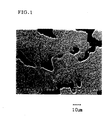
- Figure 7 and Figure 9 are scanning electron micrographs (backscattered electron images) of the section of the catalyst body obtained in Comparative Example 1, respectively before and after the durability test.
- Figures 8(a) to 8(e) and Figures 10(a) to 10(e) are charts showing the concentration distributions of K, Mg, Si, Al, and backscattered electrons along the a-a line, respectively in the photographs of Figure 7 and Figure 9. It can be seen from Figure 7 and Figures 8(a) to 8(e) showing the state before the durability test that potassium (K) is present only in the catalyst phase 28, but not in the carrier 30 of the catalyst body obtained in Comparative Example 1 before the durability test.
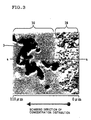
- Figure 3 and Figure 5 are scanning electron micrographs (backscattered electron images) of the section of the catalyst body obtained in Example 3, respectively before and after the durability test.
- Figures 4(a) to 4(e) and Figures 6(a) to 6(e) are charts showing the concentration distributions of K, Mg, Si, Al, and backscattered electrons along the a-a line, respectively in the photographs of Figure 3 and Figure 5. It can be seen from Figure 3 and Figures 4(a) to 4(e) showing the state before the durability test that potassium is present only in the catalyst phase 28 in the same manner as in the catalyst body of Comparative Example 1.
- the mullite aggregate phase was shown to exist near the position of 50 to 70 ⁇ m where almost no Mg was detected and aluminum (Al) and silicon (Si) were detected. In the aggregate phase, no potassium was detected.
- the catalyst bodies obtained in Examples 1 to 4 and 10 exhibited a very good strength retention rate, because of the fact that their aggregate ratio, fine particle ratios 1 and 2, and particle diameter distribution of the aggregate raw material (specifically, the dispersion diameter distribution of the aggregate phases) are in a suitable range.
- the catalyst bodies obtained in Examples 8 and 9 showed some degree of improvement over the catalyst body of Comparative Example 1, the effect was small because in the catalyst body of Example 8, fine particle ratios and a particle diameter distribution of the aggregate raw material were outside the suitable ranges, and in the catalyst body of Example 9, fine particle ratios were outside the suitable ranges.
- the reaction of the type of alkali metal with the carrier is hindered because of the presence of a cordierite binder phase and aggregate phases dispersed in the cordierite binder phase in the carrier.
- the catalyst body exhibits an excellent strength retention rate and superior crack resistance and, therefore, can be expected to maintain excellent catalyst performance.
- the catalyst body can be used for various applications and is particularly useful as a catalyst body for purification of exhaust gas.
- the catalyst body can be suitably manufactured by the method of the present invention.
Landscapes
- Chemical & Material Sciences (AREA)
- Engineering & Computer Science (AREA)
- Materials Engineering (AREA)
- Organic Chemistry (AREA)
- Ceramic Engineering (AREA)
- Chemical Kinetics & Catalysis (AREA)
- Manufacturing & Machinery (AREA)
- Structural Engineering (AREA)
- Inorganic Chemistry (AREA)
- Environmental & Geological Engineering (AREA)
- Health & Medical Sciences (AREA)
- Biomedical Technology (AREA)
- Analytical Chemistry (AREA)
- General Chemical & Material Sciences (AREA)
- Oil, Petroleum & Natural Gas (AREA)
- Catalysts (AREA)
- Exhaust Gas Treatment By Means Of Catalyst (AREA)
- Exhaust Gas After Treatment (AREA)
- Compositions Of Oxide Ceramics (AREA)
Abstract
Description

Claims (19)
- A catalyst body comprising:wherein the carrier comprises a cordierite binder phase and aggregate phases dispersed in the cordierite binder phase.a catalytic material containing an alkali metal and/or an alkaline earth metal; anda carrier carrying the catalytic material;
- The catalyst body according to claim 1, wherein a ratio of the aggregate phases to a total of the aggregate phases and the cordierite binder phase is 30 to 90 vol%.
- The catalyst body according to claim 1 or 2, wherein the aggregate phases comprise aggregate dispersion phases having a distance between one aggregate dispersion phase and another aggregate dispersion phase nearest to the one aggregate dispersion phase being 10 µm or less.
- The catalyst body according to any one of claims 1 to 3, wherein a median dispersion diameter of the aggregate phases is 50 µm or less.
- The catalyst body according to any one of claims 1 to 4, wherein the aggregate phases contain coarse dispersion phases with a dispersion diameter of 5 µm or more and fine dispersion phases with a dispersion diameter of less than 5 µm, a ratio of the fine dispersion phases to a total of the fine dispersion phases and the cordierite binder phase being 20 to 70 vol%.
- The catalyst body according to any one of claims 1 to 5, wherein a ratio of the fine dispersion phases to a total of the fine dispersion phases and the coarse dispersion phases is 10 vol% or more.
- The catalyst body according to any one of claims 1 to 6, wherein the carrier is formed from a carrier raw material comprising:an aggregate raw material forming the aggregate phases; anda binder raw material forming the cordierite binder phase;the aggregate raw material being in a form of particles containing coarse particles with a particle diameter of 5 µm or more and fine particles with a particle diameter of less than 5 µm;a ratio of the fine particles to a total of the fine particles and the binder raw material being 20 to 70 vol%.
- The catalyst body according to any one of claims 1 to 7, wherein a ratio of the fine particles to a total of the fine particles and the coarse particles is 10 vol% or more.
- The catalyst body according to any one of claims 1 to 8, wherein the aggregate phases comprise one or more kinds selected from the group consisting of mullite, silicon carbide, alumina, zirconia, titania, titanium phosphate and aluminum titanate.
- The catalyst body according to any one of claims 1 to 9, wherein the carrier has a honeycomb structure with a number of through-holes surrounded by partition walls.
- The catalyst body according to any one of claims 1 to 10, wherein the carrier comprises a wall-shaped thin plate, the median dispersion diameter of the aggregate phases being 1/5 or less of the thickness of the thin plate.
- The catalyst body according to any one of claims 1 to 11, wherein the catalytic material comprises one or more noble metals selected from the group consisting of Pt, Pd, and Rh.
- A method for manufacturing a catalyst body comprising a catalytic material containing an alkali metal and/or an alkaline earth metal, and a carrier carrying the catalytic material, the method comprising steps of:(I) forming a formed body from a carrier raw material containing an aggregate raw material for forming aggregate phases and a binder raw material for forming a cordierite binder phase;(II) firing the formed body to form a carrier containing the cordierite binder phase and the aggregate phases dispersed in the cordierite binder phase; and(III) loading a catalytic material containing an alkali metal and/or an alkaline earth metal on the carrier.
- The method according to claim 13, wherein a median particle diameter of the aggregate raw material is 1 to 50 µm.
- The method according to claim 13 or 14, wherein the aggregate raw material contains coarse particles with a particle diameter of 5 µm or more and fine particles with a particle diameter of less than 5 µm, a ratio of the fine particles to a total of the fine particles and the binder raw material being 20 to 70 vol%.
- The method according to any one of claims 13 to 15, wherein a ratio of the fine particles to a total of the fine particles and the coarse particles is 10 vol% or more.
- The method according to any one of claims 13 to 16, wherein a ratio of the aggregate raw material in the carrier raw material to a total of the aggregate raw material and the binder raw material is 30 to 90 vol%.
- The method according to any one of claims 13 to 17, wherein the aggregate raw material is one or more kinds selected from the group consisting of mullite, silicon carbide, alumina, zirconia, titania, titanium phosphate and aluminum titanate.
- The method according to any one of claims 13 to 18, wherein the step (I) is forming a formed body by extrusion.
Applications Claiming Priority (3)
| Application Number | Priority Date | Filing Date | Title |
|---|---|---|---|
| JP2001357920A JP4082559B2 (en) | 2001-11-22 | 2001-11-22 | Catalyst body and method for producing the same |
| JP2001357920 | 2001-11-22 | ||
| PCT/JP2002/011189 WO2003043733A1 (en) | 2001-11-22 | 2002-10-29 | Catalyst element and method for manufacture thereof |
Publications (4)
| Publication Number | Publication Date |
|---|---|
| EP1447130A1 true EP1447130A1 (en) | 2004-08-18 |
| EP1447130A9 EP1447130A9 (en) | 2004-10-06 |
| EP1447130A4 EP1447130A4 (en) | 2007-08-29 |
| EP1447130B1 EP1447130B1 (en) | 2010-01-27 |
Family
ID=19169187
Family Applications (1)
| Application Number | Title | Priority Date | Filing Date |
|---|---|---|---|
| EP02770291A Expired - Lifetime EP1447130B1 (en) | 2001-11-22 | 2002-10-29 | Method for manufacture of catalyst element |
Country Status (6)
| Country | Link |
|---|---|
| US (2) | US7491674B2 (en) |
| EP (1) | EP1447130B1 (en) |
| JP (1) | JP4082559B2 (en) |
| AU (1) | AU2002336326A1 (en) |
| DE (1) | DE60235253D1 (en) |
| WO (1) | WO2003043733A1 (en) |
Cited By (4)
| Publication number | Priority date | Publication date | Assignee | Title |
|---|---|---|---|---|
| EP1604740A4 (en) * | 2003-02-25 | 2008-10-08 | Ngk Insulators Ltd | CATALYST AND CATALYST SUPPORT |
| WO2014139864A1 (en) * | 2013-03-12 | 2014-09-18 | Hug Engineering Ag | Method for producing a moulded article and moulded article |
| CN104513064A (en) * | 2013-09-27 | 2015-04-15 | 日本碍子株式会社 | Porous material, manufacturing method of the same, and honeycomb structure |
| EP2832712A4 (en) * | 2012-03-28 | 2015-12-16 | Ngk Insulators Ltd | POROUS MATERIAL, HONEYCOMB STRUCTURE AND PROCESS FOR PRODUCING POROUS MATERIAL |
Families Citing this family (21)
| Publication number | Priority date | Publication date | Assignee | Title |
|---|---|---|---|---|
| JP4082559B2 (en) * | 2001-11-22 | 2008-04-30 | 日本碍子株式会社 | Catalyst body and method for producing the same |
| JP4863904B2 (en) * | 2006-03-31 | 2012-01-25 | イビデン株式会社 | Honeycomb structure and manufacturing method thereof |
| JPWO2008075769A1 (en) * | 2006-12-21 | 2010-04-15 | 株式会社キャタラー | Exhaust gas purification catalyst |
| KR101504776B1 (en) * | 2007-07-19 | 2015-03-20 | 도다 고교 가부시끼가이샤 | Catalyst for decomposing hydrocarbon, process for producing a mixed reformed gas and fuel cell system using the catalyst |
| WO2009041369A1 (en) * | 2007-09-27 | 2009-04-02 | Hitachi Metals, Ltd. | Ceramic honeycomb structure and process for producing the ceramic honeycomb structure |
| FR2922784B1 (en) * | 2007-10-29 | 2011-05-13 | Inst Francais Du Petrole | CATALYST COMPRISING PALLADIUM AND ITS SELECTIVE HYDROGENATION APPLICATION |
| EP2168935A1 (en) | 2008-09-29 | 2010-03-31 | Siemens Aktiengesellschaft | Material compound for producing a fire-retardant material and its application and fire-retardant moulding body and method for its manufacture |
| US8616134B2 (en) | 2009-01-23 | 2013-12-31 | Magnemotion, Inc. | Transport system powered by short block linear synchronous motors |
| US9032880B2 (en) | 2009-01-23 | 2015-05-19 | Magnemotion, Inc. | Transport system powered by short block linear synchronous motors and switching mechanism |
| JP5506220B2 (en) | 2009-03-26 | 2014-05-28 | 日本碍子株式会社 | Ceramic honeycomb structure |
| US8609032B2 (en) * | 2010-11-29 | 2013-12-17 | Corning Incorporated | Porous ceramic honeycomb articles and methods for making the same |
| US8999224B2 (en) * | 2010-11-30 | 2015-04-07 | Corning Incorporated | Cordierite porous ceramic honeycomb articles with delayed microcrack evolution |
| CN102228311A (en) * | 2011-06-01 | 2011-11-02 | 安徽中烟工业公司 | Adsorbent for reducing phenol in mainstream smoke of cigarettes selectively |
| JP6006782B2 (en) * | 2012-03-28 | 2016-10-12 | 日本碍子株式会社 | Porous material and honeycomb structure |
| WO2013147321A1 (en) * | 2012-03-28 | 2013-10-03 | 日本碍子株式会社 | Silicon carbide porous material, honeycomb structure and electric heating-type catalyst carrier |
| US9550700B2 (en) * | 2012-12-05 | 2017-01-24 | Dow Global Technologies Llc | Porous mullite bodies having improved thermal stability |
| JP6633516B2 (en) | 2013-09-21 | 2020-01-22 | マグネモーション インコーポレイテッド | Linear motor transport for packaging and other applications |
| JP6285225B2 (en) * | 2014-03-12 | 2018-02-28 | 日本碍子株式会社 | Honeycomb structure |
| US11365665B2 (en) * | 2016-10-24 | 2022-06-21 | Ngk Insulators, Ltd. | Porous material, honeycomb structure, and method of producing porous material |
| CN122230751A (en) * | 2017-04-11 | 2026-06-19 | 株式会社科特拉 | Catalyst for exhaust purification |
| JP2018193966A (en) * | 2017-05-22 | 2018-12-06 | 株式会社 Acr | Liquid injection nozzle |
Family Cites Families (25)
| Publication number | Priority date | Publication date | Assignee | Title |
|---|---|---|---|---|
| JPS5144913B2 (en) * | 1974-10-03 | 1976-12-01 | ||
| US4033779A (en) | 1976-03-23 | 1977-07-05 | Corning Glass Works | Non-equilibrium cordierite-alumina |
| JPS602270B2 (en) * | 1976-04-08 | 1985-01-21 | 日本碍子株式会社 | Cordierite ceramic honeycomb and its manufacturing method |
| JPS6038179B2 (en) * | 1977-08-26 | 1985-08-30 | 松下電器産業株式会社 | Catalyst for exhaust gas purification |
| US4448833A (en) * | 1981-06-16 | 1984-05-15 | Nippondenso Co., Ltd. | Porous ceramic body and a method of manufacturing the same |
| EP0160267B1 (en) * | 1984-04-24 | 1991-02-27 | Kanto Kagaku Kabushiki Kaisha | Porous cordierite ceramics, a process for producing same and use of the porous cordierite ceramics |
| US4769356A (en) * | 1985-06-20 | 1988-09-06 | Matsushita Electric Industrial Co., Ltd. | Catalyst for purifying exhaust gas |
| US4761332A (en) * | 1985-06-24 | 1988-08-02 | International Business Machines Corporation | Planarized ceramic substrates |
| US4659585A (en) * | 1985-06-24 | 1987-04-21 | International Business Machines Corporation | Planarized ceramic substrates |
| DE3809226C2 (en) * | 1987-03-20 | 1994-10-27 | Toshiba Kawasaki Kk | High temperature combustion catalyst and process for its manufacture |
| JP2680597B2 (en) * | 1988-03-14 | 1997-11-19 | マツダ株式会社 | Exhaust gas purification catalyst |
| JPH0283254A (en) | 1988-09-19 | 1990-03-23 | Inax Corp | Honeycomb structure having thermal shock resistance and production thereof |
| US4950628A (en) * | 1989-04-19 | 1990-08-21 | Corning Incorporated | Material and process to produce low thermal expansion cordierite structures |
| JP3065421B2 (en) * | 1992-01-31 | 2000-07-17 | 旭硝子株式会社 | Cordierite composite material |
| JPH07309707A (en) * | 1994-05-16 | 1995-11-28 | Ngk Insulators Ltd | Lightweight antibacterial ceramics and antibacterial ceramics filter |
| JP2816098B2 (en) * | 1994-08-02 | 1998-10-27 | 日本碍子株式会社 | Honeycomb structure and manufacturing method thereof |
| JPH08309185A (en) * | 1995-05-18 | 1996-11-26 | N E Chemcat Corp | Exhaust gas purification catalyst and exhaust gas purification method |
| KR20010078396A (en) | 1998-11-20 | 2001-08-20 | 알프레드 엘. 미첼슨 | Fabrication of low thermal expansion, high strength cordierite structures |
| JP2001232195A (en) | 1999-12-17 | 2001-08-28 | Ngk Insulators Ltd | Catalyst body |
| JP2001314762A (en) * | 2000-05-11 | 2001-11-13 | Ngk Insulators Ltd | Exhaust gas purification catalyst |
| JP4548968B2 (en) * | 2000-06-05 | 2010-09-22 | 株式会社日本自動車部品総合研究所 | Ceramic support and ceramic catalyst body |
| WO2002007043A1 (en) | 2000-07-14 | 2002-01-24 | Ge Financial Assurance Holdings, Inc. | Electronic application, processing and document retrieval process |
| WO2002070433A1 (en) * | 2001-03-02 | 2002-09-12 | Ngk Insulators,Ltd. | Honeycomb structure |
| JP4082559B2 (en) * | 2001-11-22 | 2008-04-30 | 日本碍子株式会社 | Catalyst body and method for producing the same |
| US6736875B2 (en) * | 2001-12-13 | 2004-05-18 | Corning Incorporated | Composite cordierite filters |
-
2001
- 2001-11-22 JP JP2001357920A patent/JP4082559B2/en not_active Expired - Lifetime
-
2002
- 2002-10-29 EP EP02770291A patent/EP1447130B1/en not_active Expired - Lifetime
- 2002-10-29 AU AU2002336326A patent/AU2002336326A1/en not_active Abandoned
- 2002-10-29 DE DE60235253T patent/DE60235253D1/en not_active Expired - Lifetime
- 2002-10-29 WO PCT/JP2002/011189 patent/WO2003043733A1/en not_active Ceased
- 2002-10-29 US US10/496,093 patent/US7491674B2/en not_active Expired - Lifetime
-
2008
- 2008-10-20 US US12/254,137 patent/US7662739B2/en not_active Expired - Lifetime
Cited By (11)
| Publication number | Priority date | Publication date | Assignee | Title |
|---|---|---|---|---|
| EP1604740A4 (en) * | 2003-02-25 | 2008-10-08 | Ngk Insulators Ltd | CATALYST AND CATALYST SUPPORT |
| EP2832712A4 (en) * | 2012-03-28 | 2015-12-16 | Ngk Insulators Ltd | POROUS MATERIAL, HONEYCOMB STRUCTURE AND PROCESS FOR PRODUCING POROUS MATERIAL |
| US9358529B2 (en) | 2012-03-28 | 2016-06-07 | Ngk Insulators, Ltd. | Porous material, honeycomb structure, and production method for porous material |
| WO2014139864A1 (en) * | 2013-03-12 | 2014-09-18 | Hug Engineering Ag | Method for producing a moulded article and moulded article |
| DE102013204276A1 (en) * | 2013-03-12 | 2014-09-18 | Hug Engineering Ag | Process for producing a shaped article and shaped article |
| CN105102399A (en) * | 2013-03-12 | 2015-11-25 | 虎格工程股份公司 | Method for producing molded article and molded article |
| US10233124B2 (en) | 2013-03-12 | 2019-03-19 | Hug Engineering Ag | Method for producing a molded article and molded article |
| CN111499366A (en) * | 2013-03-12 | 2020-08-07 | 虎格工程股份公司 | Method for producing molded article and molded article |
| EP3789363A1 (en) * | 2013-03-12 | 2021-03-10 | Hug Engineering AG | Method of producing a moulding |
| CN104513064A (en) * | 2013-09-27 | 2015-04-15 | 日本碍子株式会社 | Porous material, manufacturing method of the same, and honeycomb structure |
| EP2860165A3 (en) * | 2013-09-27 | 2015-04-29 | NGK Insulators, Ltd. | Porous material, manufacturing method of the same, and honeycomb structure |
Also Published As
| Publication number | Publication date |
|---|---|
| JP4082559B2 (en) | 2008-04-30 |
| DE60235253D1 (en) | 2010-03-18 |
| US20090131253A1 (en) | 2009-05-21 |
| JP2003154264A (en) | 2003-05-27 |
| US20040266617A1 (en) | 2004-12-30 |
| EP1447130B1 (en) | 2010-01-27 |
| WO2003043733A1 (en) | 2003-05-30 |
| US7662739B2 (en) | 2010-02-16 |
| AU2002336326A1 (en) | 2003-06-10 |
| EP1447130A4 (en) | 2007-08-29 |
| US7491674B2 (en) | 2009-02-17 |
| EP1447130A9 (en) | 2004-10-06 |
Similar Documents
| Publication | Publication Date | Title |
|---|---|---|
| US7662739B2 (en) | Catalyst element and manufacturing method thereof | |
| US6649563B2 (en) | Ceramic carrier and ceramic catalyst body | |
| US8092740B2 (en) | Method of manufacturing a porous material | |
| US7037477B2 (en) | Silicon carbide-based porous material and process for production thereof | |
| US8685363B2 (en) | Honeycomb carrier for exhaust gas clarification catalyst and method for production thereof | |
| US7815994B2 (en) | Method for producing porous body, porous body, and honeycomb structure | |
| EP1566214B1 (en) | Catalyst body | |
| US4295892A (en) | Cordierite ceramic honeycomb and a method for producing the same | |
| AU5869700A (en) | Low expansion, high porosity, high strength cordierite body and method | |
| JPWO2009119748A1 (en) | Porous ceramic member, method for producing the same, and filter | |
| JP3789579B2 (en) | Cordierite honeycomb structure and manufacturing method thereof | |
| US20030109383A1 (en) | Ceramic catalyst body | |
| JPH1157496A (en) | Preparation of cordierite ceramic honeycomb structure body | |
| JP4945056B2 (en) | Honeycomb carrier for exhaust gas purification catalyst and manufacturing method thereof | |
| JP2010142704A (en) | Honeycomb structure and method of manufacturing the same | |
| US6933255B2 (en) | Beta-spodumene ceramics for high temperature applications | |
| JP4302973B2 (en) | Honeycomb structure, catalyst body using the same, catalyst-carrying filter, and manufacturing method thereof | |
| US20050261127A1 (en) | Catalyst carrier and catalyst body | |
| ZA200209674B (en) | Silicon Carbide based porous article and method for preparation thereof. |
Legal Events
| Date | Code | Title | Description |
|---|---|---|---|
| PUAI | Public reference made under article 153(3) epc to a published international application that has entered the european phase |
Free format text: ORIGINAL CODE: 0009012 |
|
| 17P | Request for examination filed |
Effective date: 20040524 |
|
| AK | Designated contracting states |
Kind code of ref document: A1 Designated state(s): AT BE BG CH CY CZ DE DK EE ES FI FR GB GR IE IT LI LU MC NL PT SE SK TR |
|
| AX | Request for extension of the european patent |
Extension state: AL LT LV MK RO SI |
|
| A4 | Supplementary search report drawn up and despatched |
Effective date: 20070801 |
|
| RIC1 | Information provided on ipc code assigned before grant |
Ipc: B01J 35/02 20060101ALI20070726BHEP Ipc: B01J 23/58 20060101AFI20030603BHEP Ipc: B01J 35/00 20060101ALI20070726BHEP |
|
| 17Q | First examination report despatched |
Effective date: 20080606 |
|
| GRAP | Despatch of communication of intention to grant a patent |
Free format text: ORIGINAL CODE: EPIDOSNIGR1 |
|
| RTI1 | Title (correction) |
Free format text: METHOD FOR MANUFACTURE OF CATALYST ELEMENT |
|
| GRAS | Grant fee paid |
Free format text: ORIGINAL CODE: EPIDOSNIGR3 |
|
| GRAA | (expected) grant |
Free format text: ORIGINAL CODE: 0009210 |
|
| AK | Designated contracting states |
Kind code of ref document: B1 Designated state(s): DE FR |
|
| REF | Corresponds to: |
Ref document number: 60235253 Country of ref document: DE Date of ref document: 20100318 Kind code of ref document: P |
|
| PLBE | No opposition filed within time limit |
Free format text: ORIGINAL CODE: 0009261 |
|
| STAA | Information on the status of an ep patent application or granted ep patent |
Free format text: STATUS: NO OPPOSITION FILED WITHIN TIME LIMIT |
|
| 26N | No opposition filed |
Effective date: 20101028 |
|
| REG | Reference to a national code |
Ref country code: FR Ref legal event code: PLFP Year of fee payment: 15 |
|
| REG | Reference to a national code |
Ref country code: FR Ref legal event code: PLFP Year of fee payment: 16 |
|
| PGFP | Annual fee paid to national office [announced via postgrant information from national office to epo] |
Ref country code: FR Payment date: 20170918 Year of fee payment: 16 |
|
| PG25 | Lapsed in a contracting state [announced via postgrant information from national office to epo] |
Ref country code: FR Free format text: LAPSE BECAUSE OF NON-PAYMENT OF DUE FEES Effective date: 20181031 |
|
| PGFP | Annual fee paid to national office [announced via postgrant information from national office to epo] |
Ref country code: DE Payment date: 20210923 Year of fee payment: 20 |
|
| REG | Reference to a national code |
Ref country code: DE Ref legal event code: R071 Ref document number: 60235253 Country of ref document: DE |