EP1446728B1 - Multiply-accumulate (mac) unit for single-instruction/multiple-data (simd) instructions - Google Patents
Multiply-accumulate (mac) unit for single-instruction/multiple-data (simd) instructions Download PDFInfo
- Publication number
- EP1446728B1 EP1446728B1 EP02800879A EP02800879A EP1446728B1 EP 1446728 B1 EP1446728 B1 EP 1446728B1 EP 02800879 A EP02800879 A EP 02800879A EP 02800879 A EP02800879 A EP 02800879A EP 1446728 B1 EP1446728 B1 EP 1446728B1
- Authority
- EP
- European Patent Office
- Prior art keywords
- vectors
- multiply
- vector
- carry
- accumulate
- Prior art date
- Legal status (The legal status is an assumption and is not a legal conclusion. Google has not performed a legal analysis and makes no representation as to the accuracy of the status listed.)
- Expired - Lifetime
Links
Images




Classifications
-
- G—PHYSICS
- G06—COMPUTING OR CALCULATING; COUNTING
- G06F—ELECTRIC DIGITAL DATA PROCESSING
- G06F7/00—Methods or arrangements for processing data by operating upon the order or content of the data handled
- G06F7/38—Methods or arrangements for performing computations using exclusively denominational number representation, e.g. using binary, ternary, decimal representation
- G06F7/48—Methods or arrangements for performing computations using exclusively denominational number representation, e.g. using binary, ternary, decimal representation using non-contact-making devices, e.g. tube, solid state device; using unspecified devices
- G06F7/544—Methods or arrangements for performing computations using exclusively denominational number representation, e.g. using binary, ternary, decimal representation using non-contact-making devices, e.g. tube, solid state device; using unspecified devices for evaluating functions by calculation
- G06F7/5443—Sum of products
-
- G—PHYSICS
- G06—COMPUTING OR CALCULATING; COUNTING
- G06F—ELECTRIC DIGITAL DATA PROCESSING
- G06F7/00—Methods or arrangements for processing data by operating upon the order or content of the data handled
- G06F7/38—Methods or arrangements for performing computations using exclusively denominational number representation, e.g. using binary, ternary, decimal representation
-
- G—PHYSICS
- G06—COMPUTING OR CALCULATING; COUNTING
- G06F—ELECTRIC DIGITAL DATA PROCESSING
- G06F2207/00—Indexing scheme relating to methods or arrangements for processing data by operating upon the order or content of the data handled
- G06F2207/38—Indexing scheme relating to groups G06F7/38 - G06F7/575
- G06F2207/3804—Details
- G06F2207/3808—Details concerning the type of numbers or the way they are handled
- G06F2207/3812—Devices capable of handling different types of numbers
- G06F2207/382—Reconfigurable for different fixed word lengths
-
- G—PHYSICS
- G06—COMPUTING OR CALCULATING; COUNTING
- G06F—ELECTRIC DIGITAL DATA PROCESSING
- G06F2207/00—Indexing scheme relating to methods or arrangements for processing data by operating upon the order or content of the data handled
- G06F2207/38—Indexing scheme relating to groups G06F7/38 - G06F7/575
- G06F2207/3804—Details
- G06F2207/3808—Details concerning the type of numbers or the way they are handled
- G06F2207/3828—Multigauge devices, i.e. capable of handling packed numbers without unpacking them
-
- G—PHYSICS
- G06—COMPUTING OR CALCULATING; COUNTING
- G06F—ELECTRIC DIGITAL DATA PROCESSING
- G06F2207/00—Indexing scheme relating to methods or arrangements for processing data by operating upon the order or content of the data handled
- G06F2207/38—Indexing scheme relating to groups G06F7/38 - G06F7/575
- G06F2207/3804—Details
- G06F2207/386—Special constructional features
- G06F2207/3884—Pipelining
-
- G—PHYSICS
- G06—COMPUTING OR CALCULATING; COUNTING
- G06F—ELECTRIC DIGITAL DATA PROCESSING
- G06F7/00—Methods or arrangements for processing data by operating upon the order or content of the data handled
- G06F7/38—Methods or arrangements for performing computations using exclusively denominational number representation, e.g. using binary, ternary, decimal representation
- G06F7/48—Methods or arrangements for performing computations using exclusively denominational number representation, e.g. using binary, ternary, decimal representation using non-contact-making devices, e.g. tube, solid state device; using unspecified devices
- G06F7/52—Multiplying; Dividing
- G06F7/523—Multiplying only
- G06F7/53—Multiplying only in parallel-parallel fashion, i.e. both operands being entered in parallel
- G06F7/5318—Multiplying only in parallel-parallel fashion, i.e. both operands being entered in parallel with column wise addition of partial products, e.g. using Wallace tree, Dadda counters
-
- G—PHYSICS
- G06—COMPUTING OR CALCULATING; COUNTING
- G06F—ELECTRIC DIGITAL DATA PROCESSING
- G06F7/00—Methods or arrangements for processing data by operating upon the order or content of the data handled
- G06F7/38—Methods or arrangements for performing computations using exclusively denominational number representation, e.g. using binary, ternary, decimal representation
- G06F7/48—Methods or arrangements for performing computations using exclusively denominational number representation, e.g. using binary, ternary, decimal representation using non-contact-making devices, e.g. tube, solid state device; using unspecified devices
- G06F7/52—Multiplying; Dividing
- G06F7/523—Multiplying only
- G06F7/53—Multiplying only in parallel-parallel fashion, i.e. both operands being entered in parallel
- G06F7/5324—Multiplying only in parallel-parallel fashion, i.e. both operands being entered in parallel partitioned, i.e. using repetitively a smaller parallel parallel multiplier or using an array of such smaller multipliers
-
- G—PHYSICS
- G06—COMPUTING OR CALCULATING; COUNTING
- G06F—ELECTRIC DIGITAL DATA PROCESSING
- G06F7/00—Methods or arrangements for processing data by operating upon the order or content of the data handled
- G06F7/38—Methods or arrangements for performing computations using exclusively denominational number representation, e.g. using binary, ternary, decimal representation
- G06F7/48—Methods or arrangements for performing computations using exclusively denominational number representation, e.g. using binary, ternary, decimal representation using non-contact-making devices, e.g. tube, solid state device; using unspecified devices
- G06F7/52—Multiplying; Dividing
- G06F7/523—Multiplying only
- G06F7/533—Reduction of the number of iteration steps or stages, e.g. using the Booth algorithm, log-sum, odd-even
- G06F7/5334—Reduction of the number of iteration steps or stages, e.g. using the Booth algorithm, log-sum, odd-even by using multiple bit scanning, i.e. by decoding groups of successive multiplier bits in order to select an appropriate precalculated multiple of the multiplicand as a partial product
- G06F7/5336—Reduction of the number of iteration steps or stages, e.g. using the Booth algorithm, log-sum, odd-even by using multiple bit scanning, i.e. by decoding groups of successive multiplier bits in order to select an appropriate precalculated multiple of the multiplicand as a partial product overlapped, i.e. with successive bitgroups sharing one or more bits being recoded into signed digit representation, e.g. using the Modified Booth Algorithm
- G06F7/5338—Reduction of the number of iteration steps or stages, e.g. using the Booth algorithm, log-sum, odd-even by using multiple bit scanning, i.e. by decoding groups of successive multiplier bits in order to select an appropriate precalculated multiple of the multiplicand as a partial product overlapped, i.e. with successive bitgroups sharing one or more bits being recoded into signed digit representation, e.g. using the Modified Booth Algorithm each bitgroup having two new bits, e.g. 2nd order MBA
Definitions
- DSPs Digital signal processors
- SIMD Single-Instruction/Multiple-Data
- data parallel processors In SIMD operations, a single instruction is sent to a number of processing elements, which perform the same operation on different data.
- SIMD instructions provide for several types of standard operations including addition, subtraction, multiplication, multiply-accumulate (MAC), and a number of special instructions for performing, for example, clipping and bilinear interpolation operations.
- MAC multiply-accumulate
- 64-bit SIMD instructions may be introduced.
- the 64-bit SIMD instructions may be used to handle media streams more efficiently and reduce register pressure and memory traffic since four 16-bit data items may be loaded into a 64-bit register at one time.
- MAC architectures which are capable of high performance with low power demands may be desirable for use in DSPs.
- WO 01/48595 relates to a multiply-accumulate unit in which Wallace tree and carry look-ahead adder functions are performed simultaneously for different operations.
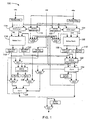
- FIG. 1 is block diagram of a dual multiply-accumulate (MAC) unit according to an embodiment.
- FIG. 2 is a block diagram illustrating a MAC SIMD (Single-Instruction/Multiple-Data) operation according to an embodiment.
- MAC SIMD Single-Instruction/Multiple-Data
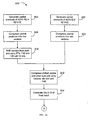
- Figures 3A to 3C are flowcharts describing a MAC SIMD operation according to an embodiment.
- Figures 4A to 4C are block diagrams illustrating pipelined instruction sequences utilizing data forwarding according to an embodiment.
- Figures 5A to 5C are block diagrams illustrating pipelined instruction sequences utilizing intermediate data forwarding according to an embodiment.
- Figures 6A and 6B are flowcharts describing a 32-bit X 32-bit MAC operation performed on a tightly coupled dual 16-bit MAC unit.
- Figure 7 is a block diagram of a mobile video unit including a MAC unit according to an embodiment.
- FIG. 1 illustrates a Multiply-Accumulate (MAC) unit 100 according to an embodiment.
- the MAC unit 100 may be used to perform a number of different SIMD (Single-Instruction/Multiple-Data) operations.
- SIMD Single-Instruction/Multiple-Data
- the MAC unit 100 may have a tightly coupled dual 16-bit MAC architecture.
- a 16-bit MAC SIMD operation 200 which may be performed by such a MAC unit is shown conceptually in Figure 2.
- the contents of two 64-bit registers, 202 (wRn) and 204 (wRm), may be treated as four pairs of 16-bit values, A 0 -A 3 (wRn) and B 0 -B 3 (wRm).
- the first 16 bits to fourth 16 bits of wRn are multiplied by the first 16 bits to fourth 16 bits of wRm, respectively.
- the four multiplied results P 0 -P 3 are then added to the value in 64-bit register 206 (wRd), and the result is sent to a register 206.
- the MAC operation 200 may be implemented in four execution stages: (1) Booth encoding and Wallace Tree compression of B 1 and B 0 ; (2) Booth encoding and Wallace Tree compression of B 3 and B 2 ; (3) 4-to-2 compression, and addition of the low 32-bits of the result; and (4) addition of the upper 32-bits of the result.
- These four stages may be referred to as the CSA0, CSA1, CLA0, and CLA1 stages, respectively.
- Figures 3A to 3C illustrate a flow chart describing an implementation 300 of the MAC operation 200 according to an embodiment.
- a MUX & Booth encoder unit 102 selects B 0 (16 bits) and encodes those bits (block 302). Control signals are generated, each of which select a partial product vector from the set ⁇ 0, -A 0 ,-2A 0 , A 0 , 2A 0 ⁇ .
- Nine partial product vectors, Pa0 to Pa8 are generated and passed to a MUX array 104 (block 304). All nine partial product vectors and the low 32 bits of the value in register 206 (wRd) are compressed into two vectors by a Wallace Tree unit 106 (block 306).
- the two vectors include a sum vector and a carry vector, which are stored in a sum vector flip-flop (FF) 108 and a carry vector FF 110, respectively.
- FF sum vector flip-flop
- a MUX & Booth encoder unit 112 selects B 1 (16 bits) and encodes those bits (block 308). Control signals are generated, each of which select a partial product vector from the set ⁇ 0, -A 1 , -2A 1 , A 1 , 2A 1 ⁇ .
- Nine partial product vectors, Pb0 to Pb8, are generated and passed to a MUX array 114 (block 310). All nine partial product vectors and a zero vector are compressed into two vectors by a Wallace Tree unit 116 (block 312).
- the two vectors include a sum vector and a carry vector, which are stored in a sum vector FF 118 and a carry vector FF 120, respectively.
- a MUX & 4-to-2 compressor unit 122 In the CSA1 stage, four vectors from the sum and carry vectors FFs 108, 110, 118, and 120 from the CSA0 stage are compressed into vectors Vs 0 and Vc 0 by a MUX & 4-to-2 compressor unit 122 (block 314).
- the MUX & Booth encoder unit 102 selects B 2 (16 bits) and encodes those bits (block 316). Control signals are generated, each of which select a partial product vector from the set ⁇ 0, -A 2 , -2A 2 , A 2 , 2A 2 ⁇ .
- Nine partial product vectors are generated (block 318). All nine partial product vectors and vector Vs 0 are then compressed into two vectors by the Wallace Tree unit 106 (block 320).
- the two vectors include a sum vector and a carry vector, which are stored in a sum vector FF 108 and a carry vector FF 110, respectively.
- the MUX & Booth encoder 112 selects B 3 (16 bits) and then encodes those bits (block 322). Control signals are generated, each of which select a partial product vector from the set ⁇ 0, -A 3 , -2A 3 , A 3 , 2A 3 ⁇ . Nine partial product vectors are generated (block 324). All nine partial product vectors and vector Vc 0 are then compressed into two vectors by the Wallace Tree unit 116 (block 326). The two vectors include a sum vector and a carry vector, which are stored in a sum vector FF 118 and a carry vector FF 120, respectively.
- the upper bits of Vs 1 and Vc 1 are sign extended to two 32-bit vectors (block 330).
- the extended vectors and the upper 32-bits of wRd are then compressed into two vectors by a 3-to-2 compressor unit 126 (block 332).
- Two compressed vectors and carry-in bit from the CLA0 unit 124 are added together by CLA unit 128 to generate the upper 32-bits of the final result (block 334).
- the Booth encoding and vectors compressing take two cycles to finish.
- the results from both Wallace Tree units are sent back for further processing in the second cycle.
- all four vectors from FFs 108, 110, 118, and 120 would be sent back to the Wallace trees for further processing in the second cycle.
- the MUX & 4-to-2 compressor unit 122 may perform the 4-to-2 compression of the vectors faster than the MUX & Booth encoder units and the MUX arrays.
- Vs 0 and Vc 0 only two vectors (Vs 0 and Vc 0 ) from the MUX & 4-to-2 compressor unit 122 are sent back to the Wallace Tree units 106 and 116.
- the feedback routings may be reduced and the Wallace Tree units 106, 116 made relatively smaller. Less feedback routings make the layout easier, which is desirable since routing limitations are an issue in MAC design.
- Some conventional MAC implementations perform the 64-bit addition in one cycle.
- such MACs may not be suitable for a very high frequency 64-bit datapath, and their results may not have enough time to return through the bypass logic, which is commonly used for solving data dependency in pipelining.
- the dual MAC architecture shown in Figure 1 may be more readily implemented in very high frequency and low power application.
- the CLA1 stage may have less logic gates than that of CLA0 stage, which enables the final results to have enough time to return through the bypass logic, making this dual MAC architecture suitable for a high speed and low power 64-bit datapath.
- the MAC unit may be used in a pipelined DSP.
- Pipelining which changes the relative timing of instructions by overlapping their execution, may increase the throughput of a DSP compared to a non-pipelined DSP.
- pipelining may introduce data dependencies, or hazards, which may occur whenever the result of a previous instruction is not available and is needed by the current instruction. The current operation may be stalled in the pipeline until the data dependency is solved.
- data forwarding is based on a final result of an operation.
- the result of the previous MAC operation needs to be added to the current MAC operation.
- a MAC operation may take four cycles to complete, and the result of the previous MAC operation may not be available for the current MAC operation.
- a data dependency called an accumulating dependency is introduced.
- Figures 4A-4C show possible accumulating dependency penalties for a standard data forwarding scheme.
- the standard forwarding scheme is used to reduce the accumulating dependency penalty, where EX 402 is the execution stage for other non-MAC instructions. Even if the standard data forwarding is employed, an accumulating dependency penalty is still two cycles in the worst case, which is shown in Figure 4A (note that, although there are three stalls 404 before the final result is available after the CLA1 stage, the first stall 404 in Figure 4A is due to a resource conflict in the Wallace Tree unit, which is not counted as data dependency penalty). Two cycle penalties may be too severe for some DSP applications, and hence it is desirable to eliminate the accumulating dependency penalty.
- the MAC unit 100 may be used to implement a new data forwarding scheme, referred to as intermediate data forwarding, which may eliminate the accumulating dependency penalty. Instead of waiting for a final result from a previous operation, the intermediate data forwarding scheme forwards an intermediate result to solve data dependencies.
- Figures 5A-5C illustrate the sequences shown in Figures 4A-4C, but implemented using an intermediate data forwarding technique.
- the CSA0 stage 500 is segmented into two sub-stages 502 (BE0) and 504 (WT0) for Booth encoding and Wallace tree compressing, respectively, operands B 0 and B 1 .
- the CSA1 stage 506 is segmented into two sub-stages 508 (BE1) and 510 (WT1) for Booth encoding and Wallace tree compressing, respectively, operands B 2 and B 3 .
- the CLA0 stage 512 is segmented into two sub-stages 514 (4T2) and 516 (ADD0) for 4-to-2 compressing of vectors and low 32-bit addition of the final result.
- the CLA1 stage 518 includes the upper 32-bit addition of the final result 520 (ADD1).
- the low 32-bits of intermediate vectors Vs, Vc of the first MAC instruction may be forwarded to the Wallace Tree units 106 and 116 for the second MAC instruction to solve the accumulating dependency.
- the upper 32-bit result of the first MAC instruction from the CLA1 unit 128 is forwarded to the MUX & 3-to-2 compressor unit 126.
- the stall 404 in Figure 5A is due to the Wallace Tree resource conflict, which is not counted as data dependency penalty.
- the final result of the first MAC instruction is not available when it is needed by the second MAC instruction, but the low 32-bit result of the first MAC instruction is available. Instead of waiting for the final result, the low 32-bit result of the first MAC instruction is forwarded to the Wallace Tree unit 106 to solve the accumulating dependency.
- the upper 32-bit result of the first MAC instruction from the CLA1 unit 126 is forwarded to the MUC & 3-to-2 compressor unit 128.
- a tightly coupled dual 16-bit MAC unit such as that shown in Figure 1, may be used for 32-bit X 32-bit instructions as well as 16-bit SIMD instructions.
- Figure 6 is a flow chart describing a 32-bit X 32-bit MAC operation 600.
- the partial product vectors of A[15:0] X B[15:0] are generated by the MUX & Booth encoder unit 102 (block 602).
- the Wallace Tree unit 106 compresses the partial product vectors into two vectors (block 604).
- the two vectors include a sum vector and a carry vector, which are stored in the sum vector FF 108 and the carry vector FF 110, respectively.
- the partial product vectors of A[31:16] X B[15:0] are generated by the MUX & Booth encoder unit 112 (block 606).
- the Wallace Tree unit 116 compresses the partial product vectors into two vectors (block 608).
- the two vectors include a sum vector and a carry vector, which are stored in the sum vector FF 108 and the carry vector FF 110, respectively.
- two vectors from the sum vector FF 118 and carry vector FF 120 are shifted left 16 bits (block 610).
- the MUX & 4-to-2 compressor unit 122 compresses the shifted vectors and the other two vectors from the sum vector FF 108 and carry vector FF 110 into vector Vs 0 and vector Vc 0 (block 612).
- the low 16 bit of Vs 0 and Vc 0 are sent to the CLA0 unit 124.
- the remaining bits are sent back to the Wallace Tree units 106 and 116.
- the final results from bit 0 to bit 15 are then generated by the CLA0 unit 124 (block 614).
- the partial product vectors of A[15:0] X B[31:16] and the feedback vector from Vs 0 are then compressed into two vectors by the Wallace Tree unit 106 (block 616).
- the two vectors include a sum vector and a carry vector, which are stored in the sum vector FF 108 and the carry vector FF 120, respectively.
- the partial product vector of A[31:16] X B[31:16] and the feedback vector from Vs 0 are then compressed into two vectors by the Wallace Tree unit 116 (block 618).
- the two vectors include a sum vector and a carry vector, which are stored in the sum vector FF 118 and the carry vector FF 120, respectively.
- two vectors from the sum vector FF 118 and the carry vector FF 120 are shifted left 16 bits (block 620).
- the MUX & 4-to-2 compressor unit 122 compresses the shifted vectors and the other two vectors from the sum vector FF 108 and the carry vector FF 110 into vector Vs 1 and vector Vc 1 (block 622).
- the low 16 bits of vectors Vs 1 and Vc 1 are added by the CLA0 unit 124.
- the final results from bit 16 to bit 31 are then generated (block 624).
- the upper bits (from bit 16 to bit 47) of vectors Vs 1 and Vc 1 are added by the CLA1 unit 128 to generate the upper 32-bit final results (from bit 32 to bit 63) (block 626).
- the MAC unit 100 may be implemented in a variety of systems including general purpose computing systems, digital processing systems, laptop computers, personal digital assistants (PDAs) and cellular phones.
- the MAC unit may be included in a processor coupled to a memory device, such as a Flash memory device or a static random access memory (SRAM), which stores an operating system or other software applications.
- a memory device such as a Flash memory device or a static random access memory (SRAM), which stores an operating system or other software applications.
- Such a processor may be used in video camcorders, teleconferencing, PC video cards, and High-Definition Television (HDTV).
- the processor may be used in connection with other technologies utilizing digital signal processing such as voice processing used in mobile telephony, speech recognition, and other applications.
- Figure'7 illustrates a mobile video device 700 including a processor 701 including a MAC unit 100 according to an embodiment.
- the mobile video device 700 may be a hand-held device which displays video images produced from an encoded video signal received from an antenna 702 or a digital video storage medium 704, e.g., a digital video disc (DVD) or a memory card.
- the processor 100 may communicate with a cache memory 706, which may store instructions and data for the processor operations, and other devices, for example, an SRAM 708.
Landscapes
- Engineering & Computer Science (AREA)
- General Physics & Mathematics (AREA)
- Theoretical Computer Science (AREA)
- Physics & Mathematics (AREA)
- Computing Systems (AREA)
- Mathematical Analysis (AREA)
- Mathematical Optimization (AREA)
- Pure & Applied Mathematics (AREA)
- General Engineering & Computer Science (AREA)
- Computational Mathematics (AREA)
- Advance Control (AREA)
- Complex Calculations (AREA)
- Compression, Expansion, Code Conversion, And Decoders (AREA)
- Mobile Radio Communication Systems (AREA)
Abstract
Description
- Digital signal processors (DSPs) may operate as SIMD (Single-Instruction/Multiple-Data), or data parallel, processors. In SIMD operations, a single instruction is sent to a number of processing elements, which perform the same operation on different data. SIMD instructions provide for several types of standard operations including addition, subtraction, multiplication, multiply-accumulate (MAC), and a number of special instructions for performing, for example, clipping and bilinear interpolation operations.
- Many DSP applications, including many speech codecs, require high performance 16-bit multiply-accumulate (MAC) operations. To achieve high performance for these 16-bit DSP applications, 64-bit SIMD instructions may be introduced. The 64-bit SIMD instructions may be used to handle media streams more efficiently and reduce register pressure and memory traffic since four 16-bit data items may be loaded into a 64-bit register at one time.
- While high throughput is an important factor for achieving high performance, power consumption may also be an important consideration in designing DSPs for wireless/handheld products. Accordingly, MAC architectures which are capable of high performance with low power demands may be desirable for use in DSPs.
-
WO 01/48595 - In accordance with the invention there is provided: a method in accordance with
claim 1; and an apparatus in accordance with claim 11. - Figure 1 is block diagram of a dual multiply-accumulate (MAC) unit according to an embodiment.
- Figure 2 is a block diagram illustrating a MAC SIMD (Single-Instruction/Multiple-Data) operation according to an embodiment.
- Figures 3A to 3C are flowcharts describing a MAC SIMD operation according to an embodiment.
- Figures 4A to 4C are block diagrams illustrating pipelined instruction sequences utilizing data forwarding according to an embodiment.
- Figures 5A to 5C are block diagrams illustrating pipelined instruction sequences utilizing intermediate data forwarding according to an embodiment.
- Figures 6A and 6B are flowcharts describing a 32-bit X 32-bit MAC operation performed on a tightly coupled dual 16-bit MAC unit.
- Figure 7 is a block diagram of a mobile video unit including a MAC unit according to an embodiment.
- Figure 1 illustrates a Multiply-Accumulate (MAC)
unit 100 according to an embodiment. TheMAC unit 100 may be used to perform a number of different SIMD (Single-Instruction/Multiple-Data) operations. - The
MAC unit 100 may have a tightly coupled dual 16-bit MAC architecture. A 16-bitMAC SIMD operation 200 which may be performed by such a MAC unit is shown conceptually in Figure 2. The contents of two 64-bit registers, 202 (wRn) and 204 (wRm), may be treated as four pairs of 16-bit values, A0-A3 (wRn) and B0-B3 (wRm). The first 16 bits to fourth 16 bits of wRn are multiplied by the first 16 bits to fourth 16 bits of wRm, respectively. The four multiplied results P0-P3 are then added to the value in 64-bit register 206 (wRd), and the result is sent to aregister 206. - The
MAC operation 200 may be implemented in four execution stages: (1) Booth encoding and Wallace Tree compression of B1 and B0; (2) Booth encoding and Wallace Tree compression of B3 and B2; (3) 4-to-2 compression, and addition of the low 32-bits of the result; and (4) addition of the upper 32-bits of the result. These four stages may be referred to as the CSA0, CSA1, CLA0, and CLA1 stages, respectively. - Figures 3A to 3C illustrate a flow chart describing an
implementation 300 of theMAC operation 200 according to an embodiment. In the CSA0 stage, a MUX &Booth encoder unit 102 selects B0 (16 bits) and encodes those bits (block 302). Control signals are generated, each of which select a partial product vector from the set {0, -A0,-2A0, A0, 2A0}. Nine partial product vectors, Pa0 to Pa8, are generated and passed to a MUX array 104 (block 304). All nine partial product vectors and the low 32 bits of the value in register 206 (wRd) are compressed into two vectors by a Wallace Tree unit 106 (block 306). The two vectors include a sum vector and a carry vector, which are stored in a sum vector flip-flop (FF) 108 and acarry vector FF 110, respectively. - A MUX & Booth
encoder unit 112 selects B1 (16 bits) and encodes those bits (block 308). Control signals are generated, each of which select a partial product vector from the set {0, -A1, -2A1, A1, 2A1}. Nine partial product vectors, Pb0 to Pb8, are generated and passed to a MUX array 114 (block 310). All nine partial product vectors and a zero vector are compressed into two vectors by a Wallace Tree unit 116 (block 312). The two vectors include a sum vector and a carry vector, which are stored in asum vector FF 118 and acarry vector FF 120, respectively. - In the CSA1 stage, four vectors from the sum and
carry vectors FFs encoder unit 102 selects B2 (16 bits) and encodes those bits (block 316). Control signals are generated, each of which select a partial product vector from the set {0, -A2, -2A2, A2, 2A2}. Nine partial product vectors are generated (block 318). All nine partial product vectors and vector Vs0 are then compressed into two vectors by the Wallace Tree unit 106 (block 320). The two vectors include a sum vector and a carry vector, which are stored in asum vector FF 108 and acarry vector FF 110, respectively. - The MUX & Booth
encoder 112 selects B3 (16 bits) and then encodes those bits (block 322). Control signals are generated, each of which select a partial product vector from the set {0, -A3, -2A3, A3, 2A3}. Nine partial product vectors are generated (block 324). All nine partial product vectors and vector Vc0 are then compressed into two vectors by the Wallace Tree unit 116 (block 326). The two vectors include a sum vector and a carry vector, which are stored in asum vector FF 118 and acarry vector FF 120, respectively. - In the CLA0 stage, four vectors from
FFs compressor unit 122 to generate vector Vs1 and vector Vc1 (block 327). The lower 32 bits of Vs1 and Vc1 are added by the carry look-ahead (CLA)unit 124 to generate the low 32 bits of the final result(block 328). - In the CLA1 stage, the upper bits of Vs1 and Vc1 are sign extended to two 32-bit vectors (block 330). The extended vectors and the upper 32-bits of wRd are then compressed into two vectors by a 3-to-2 compressor unit 126 (block 332). Two compressed vectors and carry-in bit from the
CLA0 unit 124 are added together byCLA unit 128 to generate the upper 32-bits of the final result (block 334). - As described above, the Booth encoding and vectors compressing take two cycles to finish. In the first cycle, the results from both Wallace Tree units are sent back for further processing in the second cycle. Conventionally, all four vectors from
FFs compressor unit 122 may perform the 4-to-2 compression of the vectors faster than the MUX & Booth encoder units and the MUX arrays. Thus, only two vectors (Vs0 and Vc0) from the MUX & 4-to-2compressor unit 122 are sent back to the Wallace Treeunits units - Some conventional MAC implementations perform the 64-bit addition in one cycle. However, such MACs may not be suitable for a very high frequency 64-bit datapath, and their results may not have enough time to return through the bypass logic, which is commonly used for solving data dependency in pipelining. Compared with conventional architectures, the dual MAC architecture shown in Figure 1 may be more readily implemented in very high frequency and low power application. The CLA1 stage may have less logic gates than that of CLA0 stage, which enables the final results to have enough time to return through the bypass logic, making this dual MAC architecture suitable for a high speed and low power 64-bit datapath.
- The MAC unit may be used in a pipelined DSP. Pipelining, which changes the relative timing of instructions by overlapping their execution, may increase the throughput of a DSP compared to a non-pipelined DSP. However, pipelining may introduce data dependencies, or hazards, which may occur whenever the result of a previous instruction is not available and is needed by the current instruction. The current operation may be stalled in the pipeline until the data dependency is solved.
- Typically, data forwarding is based on a final result of an operation. For many DSP algorithms, the result of the previous MAC operation needs to be added to the current MAC operation. However, a MAC operation may take four cycles to complete, and the result of the previous MAC operation may not be available for the current MAC operation. In this case, a data dependency called an accumulating dependency is introduced.
- Figures 4A-4C show possible accumulating dependency penalties for a standard data forwarding scheme. The standard forwarding scheme is used to reduce the accumulating dependency penalty, where
EX 402 is the execution stage for other non-MAC instructions. Even if the standard data forwarding is employed, an accumulating dependency penalty is still two cycles in the worst case, which is shown in Figure 4A (note that, although there are threestalls 404 before the final result is available after the CLA1 stage, thefirst stall 404 in Figure 4A is due to a resource conflict in the Wallace Tree unit, which is not counted as data dependency penalty). Two cycle penalties may be too severe for some DSP applications, and hence it is desirable to eliminate the accumulating dependency penalty. - The
MAC unit 100 may be used to implement a new data forwarding scheme, referred to as intermediate data forwarding, which may eliminate the accumulating dependency penalty. Instead of waiting for a final result from a previous operation, the intermediate data forwarding scheme forwards an intermediate result to solve data dependencies. Figures 5A-5C illustrate the sequences shown in Figures 4A-4C, but implemented using an intermediate data forwarding technique. - As shown in Figures 5A-5C, the
CSA0 stage 500 is segmented into two sub-stages 502 (BE0) and 504 (WT0) for Booth encoding and Wallace tree compressing, respectively, operands B0 and B1. The CSA1 stage 506 is segmented into two sub-stages 508 (BE1) and 510 (WT1) for Booth encoding and Wallace tree compressing, respectively, operands B2 and B3. TheCLA0 stage 512 is segmented into two sub-stages 514 (4T2) and 516 (ADD0) for 4-to-2 compressing of vectors and low 32-bit addition of the final result. TheCLA1 stage 518 includes the upper 32-bit addition of the final result 520 (ADD1). - In the cases shown in Figures 5A and 5B, the low 32-bits of intermediate vectors Vs, Vc of the first MAC instruction may be forwarded to the
Wallace Tree units CLA1 unit 128 is forwarded to the MUX & 3-to-2compressor unit 126. Thestall 404 in Figure 5A is due to the Wallace Tree resource conflict, which is not counted as data dependency penalty. - In the case shown in Figure 5C, the final result of the first MAC instruction is not available when it is needed by the second MAC instruction, but the low 32-bit result of the first MAC instruction is available. Instead of waiting for the final result, the low 32-bit result of the first MAC instruction is forwarded to the
Wallace Tree unit 106 to solve the accumulating dependency. The upper 32-bit result of the first MAC instruction from theCLA1 unit 126 is forwarded to the MUC & 3-to-2compressor unit 128. - The accumulating data dependency penalty comparisons between the standard data forwarding technique shown in Figures 4A to 4C and the intermediate data forwarding technique shown in Figures 5A to 5C are given in Table 1. As shown in Table 1, intermediate data forwarding may eliminate accumulating dependencies, which may enable relatively high throughput for many DSP applications.
TABLE 1 Penalty for case (A) Penalty for case (B) Penalty for case (C) Standard data forwarding 2 cycles 2 cycles 1 cycle Intermediate data forwarding 0 cycles 0 cycles 0 cycles - A tightly coupled dual 16-bit MAC unit, such as that shown in Figure 1, may be used for 32-bit X 32-bit instructions as well as 16-bit SIMD instructions. A 32-bit X 32-bit operation may be divided into four 16-bit X 16-bit operations, as shown in the following equation:

- Figure 6 is a flow chart describing a 32-bit X 32-
bit MAC operation 600. In the CSA0 stage, the partial product vectors of A[15:0] X B[15:0] are generated by the MUX & Booth encoder unit 102 (block 602). TheWallace Tree unit 106 compresses the partial product vectors into two vectors (block 604). The two vectors include a sum vector and a carry vector, which are stored in thesum vector FF 108 and thecarry vector FF 110, respectively. The partial product vectors of A[31:16] X B[15:0] are generated by the MUX & Booth encoder unit 112 (block 606). TheWallace Tree unit 116 compresses the partial product vectors into two vectors (block 608). The two vectors include a sum vector and a carry vector, which are stored in thesum vector FF 108 and thecarry vector FF 110, respectively. - In the CSA1 stage, two vectors from the
sum vector FF 118 and carryvector FF 120 are shifted left 16 bits (block 610). The MUX & 4-to-2compressor unit 122 compresses the shifted vectors and the other two vectors from thesum vector FF 108 and carryvector FF 110 into vector Vs0 and vector Vc0 (block 612). The low 16 bit of Vs0 and Vc0 are sent to theCLA0 unit 124. The remaining bits are sent back to theWallace Tree units bit 0 to bit 15 are then generated by the CLA0 unit 124 (block 614). The partial product vectors of A[15:0] X B[31:16] and the feedback vector from Vs0 are then compressed into two vectors by the Wallace Tree unit 106 (block 616). The two vectors include a sum vector and a carry vector, which are stored in thesum vector FF 108 and thecarry vector FF 120, respectively. The partial product vector of A[31:16] X B[31:16] and the feedback vector from Vs0 are then compressed into two vectors by the Wallace Tree unit 116 (block 618). The two vectors include a sum vector and a carry vector, which are stored in thesum vector FF 118 and thecarry vector FF 120, respectively. - In the CLA0 stage, two vectors from the
sum vector FF 118 and thecarry vector FF 120 are shifted left 16 bits (block 620). The MUX & 4-to-2compressor unit 122 compresses the shifted vectors and the other two vectors from thesum vector FF 108 and thecarry vector FF 110 into vector Vs1 and vector Vc1 (block 622). The low 16 bits of vectors Vs1 and Vc1 are added by theCLA0 unit 124. The final results frombit 16 to bit 31 are then generated (block 624). - In the CLA1 stage, the upper bits (from
bit 16 to bit 47) of vectors Vs1 and Vc1 are added by theCLA1 unit 128 to generate the upper 32-bit final results (frombit 32 to bit 63) (block 626). - The
MAC unit 100 may be implemented in a variety of systems including general purpose computing systems, digital processing systems, laptop computers, personal digital assistants (PDAs) and cellular phones. In such a system, the MAC unit may be included in a processor coupled to a memory device, such as a Flash memory device or a static random access memory (SRAM), which stores an operating system or other software applications. - Such a processor may be used in video camcorders, teleconferencing, PC video cards, and High-Definition Television (HDTV). In addition, the processor may be used in connection with other technologies utilizing digital signal processing such as voice processing used in mobile telephony, speech recognition, and other applications.
- For example, Figure'7 illustrates a
mobile video device 700 including aprocessor 701 including aMAC unit 100 according to an embodiment. Themobile video device 700 may be a hand-held device which displays video images produced from an encoded video signal received from anantenna 702 or a digitalvideo storage medium 704, e.g., a digital video disc (DVD) or a memory card. Theprocessor 100 may communicate with acache memory 706, which may store instructions and data for the processor operations, and other devices, for example, anSRAM 708. - A number of embodiments have been described. Nevertheless, it will be understood that various modifications may be made without departing from the scope of the invention. For example, blocks in the flowchart may be skipped or performed out of order and still produce desirable results. Furthermore, the size of the operands and number of operands operated on per SIMD instruction may vary. Accordingly, other embodiments are within the scope of the following claims.
Claims (17)
- A method comprising:performing (306, 312, 326, 320) a first compression operation in a first multiply-accumulate operation in a pipeline;generating two or more intermediate vectors (Vs, Vc) in a first compression operation in the first multiply-accumulate operation; characterised byforwarding at least a portion of each of the two or more intermediate vectors (Vs, Vc) to a second multiply-accumulate operation in the pipeline.
- The method of claim 1, wherein said forwarding at least a portion of each of the two or more intermediate vectors (Vs, Vc) comprises forwarding a lower portion of each of the two or more intermediate vectors (Vs, Vc).
- The method of claim 1, wherein said performing (306, 312) the first compression operation comprises compressing (306, 320) a first plurality of partial products (Pa0 to Pa8) into a first sum vector and a first carry vector and compressing (312, 326) a second plurality of partial products (Pb0 to Pb8) into a second sum vector and a second carry vector.
- The method of claim 3, wherein said generating two or more intermediate vectors comprises compressing the first and second sum vectors and the first and second carry vectors into an intermediate sum vector (Vs) and an intermediate carry vector (Vc).
- The method of claim 1, wherein said forwarding comprises forwarding at least a portion of each of the two or more intermediate vectors (Vs, Vc) to a Wallace tree compression unit (106, 116).
- A method in accordance with claim 1 wherein said step of performing comprises:compressing (306) a first plurality of partial products into a first sum vector and a first carry vector and compressing (312) a second plurality of partial products into a second sum vector and a second carry vector in a first Wallace tree compression stage of a multiply-accumulate operation;compressing (314) the first and second sum vectors and the first and second carry vectors into a third sum vector (Vs0) and a third carry vector (Vc0) ; andcompressing (320) the third sum vector (Vs0) and a third plurality of partial products and compressing (326) the third carry vector (Vc0) and a fourth plurality of partial products in a second stage of the multiply-accumulate operation.
- The method of claim 6, wherein the multiply-accumulate operation comprises a single instruction/multiple data (SIMD) operation.
- The method of claim 6, further comprising:generating the first plurality of partial products from a first pair of operands;generating the second plurality of partial products from a second pair of operands;generating the third plurality of partial products from a third pair of operands; andgenerating the fourth plurality of partial products from a fourth pair of operands.
- The method of claim 6, wherein:said second stage of the multiply-accumulate operation results in intermediate sum and carry vectors (Vs1, Vc1); andsaid step of forwarding comprises forwarding the intermediate sum and carry vectors (Vs1, Vc1) to a second multiply-accumulate operation in a pipeline.
- The method of claim 9, wherein said forwarding comprises eliminating an accumulate data dependency in the second multiply-accumulate operation.
- An apparatus comprising:means (106, 116) for performing a first compression operation in a first multiply-accumulate operation in a pipeline;means (122) for generating two or more intermediate vectors (Vs, Vc) in a first compression operation in the first multiply-accumulate operation; characterised bymeans for forwarding at least a portion of each of the two or more intermediate vectors (Vs, Vc) to a second multiply-accumulate operation in the pipeline.
- The apparatus of claim 11, wherein the pipeline comprises first and second Wallace tree compression units (106, 116) operative to compress vectors in first and second stages of a multiply-accumulate operation in which a plurality of vectors output from the first and second Wallace tree units (106, 116) in the first stage of the multiply-accumulate operation are compressed into two intermediate vectors (Vs, Vc); and
said means for forwarding comprises a data path from an output of the compressor to an input of a multiplexer, said multiplexer operative to selectively input one of said intermediate vectors (Vs, Vc) to one of said first and second Wallace tree compression units (106, 116) in the second stage of the multiply-accumulate operation. - The apparatus of claim 11 or claim 12, further comprising a dual multiply-accumulate unit.
- The apparatus of claim 12, wherein the plurality of vectors comprise first and second sum vectors and first and second carry vectors.
- The apparatus of claim 11 or claim 12, wherein the means for generating two or more intermediate vectors comprises a four-to-two vector compressor (122).
- The apparatus of claim 12, wherein the multiplexer comprises a first multiplexer having an output coupled to the first Wallace tree compression unit (106) and a second multiplexer having an output coupled to the second Wallace tree compression unit (116).
- A system comprising:a static random address memory; anda processor coupled to the static random access memory, said processor comprising a dual multiply-accumulate unit, said unit including the apparatus of any one of claims 11 to 16.
Applications Claiming Priority (3)
| Application Number | Priority Date | Filing Date | Title |
|---|---|---|---|
| US09/972,720 US7107305B2 (en) | 2001-10-05 | 2001-10-05 | Multiply-accumulate (MAC) unit for single-instruction/multiple-data (SIMD) instructions |
| US972720 | 2001-10-05 | ||
| PCT/US2002/031412 WO2003032187A2 (en) | 2001-10-05 | 2002-10-03 | Multiply-accumulate (mac) unit for single-instruction/multiple-data (simd) instructions |
Publications (2)
| Publication Number | Publication Date |
|---|---|
| EP1446728A2 EP1446728A2 (en) | 2004-08-18 |
| EP1446728B1 true EP1446728B1 (en) | 2007-08-29 |
Family
ID=25520040
Family Applications (1)
| Application Number | Title | Priority Date | Filing Date |
|---|---|---|---|
| EP02800879A Expired - Lifetime EP1446728B1 (en) | 2001-10-05 | 2002-10-03 | Multiply-accumulate (mac) unit for single-instruction/multiple-data (simd) instructions |
Country Status (10)
| Country | Link |
|---|---|
| US (1) | US7107305B2 (en) |
| EP (1) | EP1446728B1 (en) |
| JP (2) | JP4584580B2 (en) |
| KR (1) | KR100834178B1 (en) |
| CN (1) | CN100474235C (en) |
| AT (1) | ATE371893T1 (en) |
| AU (1) | AU2002334792A1 (en) |
| DE (1) | DE60222163T2 (en) |
| TW (1) | TWI242742B (en) |
| WO (1) | WO2003032187A2 (en) |
Families Citing this family (86)
| Publication number | Priority date | Publication date | Assignee | Title |
|---|---|---|---|---|
| US6581003B1 (en) * | 2001-12-20 | 2003-06-17 | Garmin Ltd. | Systems and methods for a navigational device with forced layer switching based on memory constraints |
| US7532720B2 (en) * | 2003-10-15 | 2009-05-12 | Microsoft Corporation | Utilizing SIMD instructions within montgomery multiplication |
| JP4502662B2 (en) * | 2004-02-20 | 2010-07-14 | アルテラ コーポレイション | Multiplier-accumulator block mode split |
| US7353244B2 (en) | 2004-04-16 | 2008-04-01 | Marvell International Ltd. | Dual-multiply-accumulator operation optimized for even and odd multisample calculations |
| US20060004903A1 (en) * | 2004-06-30 | 2006-01-05 | Itay Admon | CSA tree constellation |
| US8856201B1 (en) | 2004-11-10 | 2014-10-07 | Altera Corporation | Mixed-mode multiplier using hard and soft logic circuitry |
| EP1710691A1 (en) * | 2005-04-07 | 2006-10-11 | STMicroelectronics (Research & Development) Limited | MAC/MUL unit |
| US8620980B1 (en) | 2005-09-27 | 2013-12-31 | Altera Corporation | Programmable device with specialized multiplier blocks |
| CN101359284B (en) * | 2006-02-06 | 2011-05-11 | 威盛电子股份有限公司 | Multiply-accumulate unit and method for handling several different data formats |
| US8041759B1 (en) * | 2006-02-09 | 2011-10-18 | Altera Corporation | Specialized processing block for programmable logic device |
| US8266198B2 (en) | 2006-02-09 | 2012-09-11 | Altera Corporation | Specialized processing block for programmable logic device |
| US8266199B2 (en) * | 2006-02-09 | 2012-09-11 | Altera Corporation | Specialized processing block for programmable logic device |
| US8301681B1 (en) | 2006-02-09 | 2012-10-30 | Altera Corporation | Specialized processing block for programmable logic device |
| US7836117B1 (en) | 2006-04-07 | 2010-11-16 | Altera Corporation | Specialized processing block for programmable logic device |
| US7822799B1 (en) | 2006-06-26 | 2010-10-26 | Altera Corporation | Adder-rounder circuitry for specialized processing block in programmable logic device |
| US7783862B2 (en) * | 2006-08-07 | 2010-08-24 | International Characters, Inc. | Method and apparatus for an inductive doubling architecture |
| US8386550B1 (en) | 2006-09-20 | 2013-02-26 | Altera Corporation | Method for configuring a finite impulse response filter in a programmable logic device |
| US8122078B2 (en) * | 2006-10-06 | 2012-02-21 | Calos Fund, LLC | Processor with enhanced combined-arithmetic capability |
| US8386553B1 (en) | 2006-12-05 | 2013-02-26 | Altera Corporation | Large multiplier for programmable logic device |
| US7930336B2 (en) | 2006-12-05 | 2011-04-19 | Altera Corporation | Large multiplier for programmable logic device |
| US20080140753A1 (en) * | 2006-12-08 | 2008-06-12 | Vinodh Gopal | Multiplier |
| US7814137B1 (en) | 2007-01-09 | 2010-10-12 | Altera Corporation | Combined interpolation and decimation filter for programmable logic device |
| US7865541B1 (en) | 2007-01-22 | 2011-01-04 | Altera Corporation | Configuring floating point operations in a programmable logic device |
| US8650231B1 (en) | 2007-01-22 | 2014-02-11 | Altera Corporation | Configuring floating point operations in a programmable device |
| US8645450B1 (en) | 2007-03-02 | 2014-02-04 | Altera Corporation | Multiplier-accumulator circuitry and methods |
| US7949699B1 (en) | 2007-08-30 | 2011-05-24 | Altera Corporation | Implementation of decimation filter in integrated circuit device using ram-based data storage |
| US8959137B1 (en) | 2008-02-20 | 2015-02-17 | Altera Corporation | Implementing large multipliers in a programmable integrated circuit device |
| US8307023B1 (en) | 2008-10-10 | 2012-11-06 | Altera Corporation | DSP block for implementing large multiplier on a programmable integrated circuit device |
| US8468192B1 (en) | 2009-03-03 | 2013-06-18 | Altera Corporation | Implementing multipliers in a programmable integrated circuit device |
| US8706790B1 (en) | 2009-03-03 | 2014-04-22 | Altera Corporation | Implementing mixed-precision floating-point operations in a programmable integrated circuit device |
| US8645449B1 (en) | 2009-03-03 | 2014-02-04 | Altera Corporation | Combined floating point adder and subtractor |
| US8650236B1 (en) | 2009-08-04 | 2014-02-11 | Altera Corporation | High-rate interpolation or decimation filter in integrated circuit device |
| US20110055303A1 (en) * | 2009-09-03 | 2011-03-03 | Azuray Technologies, Inc. | Function Generator |
| JP5376659B2 (en) * | 2009-09-03 | 2013-12-25 | エヌイーシーコンピュータテクノ株式会社 | Product-sum operation apparatus and method for controlling product-sum operation apparatus |
| US8396914B1 (en) | 2009-09-11 | 2013-03-12 | Altera Corporation | Matrix decomposition in an integrated circuit device |
| US8412756B1 (en) | 2009-09-11 | 2013-04-02 | Altera Corporation | Multi-operand floating point operations in a programmable integrated circuit device |
| US8996845B2 (en) * | 2009-12-22 | 2015-03-31 | Intel Corporation | Vector compare-and-exchange operation |
| US7948267B1 (en) | 2010-02-09 | 2011-05-24 | Altera Corporation | Efficient rounding circuits and methods in configurable integrated circuit devices |
| US8539016B1 (en) | 2010-02-09 | 2013-09-17 | Altera Corporation | QR decomposition in an integrated circuit device |
| US8601044B2 (en) | 2010-03-02 | 2013-12-03 | Altera Corporation | Discrete Fourier Transform in an integrated circuit device |
| US8484265B1 (en) | 2010-03-04 | 2013-07-09 | Altera Corporation | Angular range reduction in an integrated circuit device |
| US8510354B1 (en) | 2010-03-12 | 2013-08-13 | Altera Corporation | Calculation of trigonometric functions in an integrated circuit device |
| US8539014B2 (en) | 2010-03-25 | 2013-09-17 | Altera Corporation | Solving linear matrices in an integrated circuit device |
| US8589463B2 (en) | 2010-06-25 | 2013-11-19 | Altera Corporation | Calculation of trigonometric functions in an integrated circuit device |
| US8862650B2 (en) | 2010-06-25 | 2014-10-14 | Altera Corporation | Calculation of trigonometric functions in an integrated circuit device |
| US8577951B1 (en) | 2010-08-19 | 2013-11-05 | Altera Corporation | Matrix operations in an integrated circuit device |
| US8478969B2 (en) | 2010-09-24 | 2013-07-02 | Intel Corporation | Performing a multiply-multiply-accumulate instruction |
| US8645451B2 (en) | 2011-03-10 | 2014-02-04 | Altera Corporation | Double-clocked specialized processing block in an integrated circuit device |
| US9600278B1 (en) | 2011-05-09 | 2017-03-21 | Altera Corporation | Programmable device using fixed and configurable logic to implement recursive trees |
| US8812576B1 (en) | 2011-09-12 | 2014-08-19 | Altera Corporation | QR decomposition in an integrated circuit device |
| US8949298B1 (en) | 2011-09-16 | 2015-02-03 | Altera Corporation | Computing floating-point polynomials in an integrated circuit device |
| US9053045B1 (en) | 2011-09-16 | 2015-06-09 | Altera Corporation | Computing floating-point polynomials in an integrated circuit device |
| US8762443B1 (en) | 2011-11-15 | 2014-06-24 | Altera Corporation | Matrix operations in an integrated circuit device |
| US8868634B2 (en) * | 2011-12-02 | 2014-10-21 | Advanced Micro Devices, Inc. | Method and apparatus for performing multiplication in a processor |
| CN102520906A (en) * | 2011-12-13 | 2012-06-27 | 中国科学院自动化研究所 | Vector dot product accumulating network supporting reconfigurable fixed floating point and configurable vector length |
| CN107368286B (en) * | 2011-12-19 | 2020-11-06 | 英特尔公司 | SIMD integer multiply-accumulate instruction for multi-precision arithmetic |
| US8543634B1 (en) | 2012-03-30 | 2013-09-24 | Altera Corporation | Specialized processing block for programmable integrated circuit device |
| US9098332B1 (en) | 2012-06-01 | 2015-08-04 | Altera Corporation | Specialized processing block with fixed- and floating-point structures |
| US8996600B1 (en) | 2012-08-03 | 2015-03-31 | Altera Corporation | Specialized processing block for implementing floating-point multiplier with subnormal operation support |
| US9207909B1 (en) | 2012-11-26 | 2015-12-08 | Altera Corporation | Polynomial calculations optimized for programmable integrated circuit device structures |
| US9275014B2 (en) * | 2013-03-13 | 2016-03-01 | Qualcomm Incorporated | Vector processing engines having programmable data path configurations for providing multi-mode radix-2x butterfly vector processing circuits, and related vector processors, systems, and methods |
| US9189200B1 (en) | 2013-03-14 | 2015-11-17 | Altera Corporation | Multiple-precision processing block in a programmable integrated circuit device |
| US9348795B1 (en) | 2013-07-03 | 2016-05-24 | Altera Corporation | Programmable device using fixed and configurable logic to implement floating-point rounding |
| US9684488B2 (en) | 2015-03-26 | 2017-06-20 | Altera Corporation | Combined adder and pre-adder for high-radix multiplier circuit |
| US10489155B2 (en) | 2015-07-21 | 2019-11-26 | Qualcomm Incorporated | Mixed-width SIMD operations using even/odd register pairs for wide data elements |
| CN107977192B (en) * | 2016-10-21 | 2024-09-13 | 超威半导体公司 | Method and system for performing low-power and low-latency multi-precision computations |
| US10942706B2 (en) | 2017-05-05 | 2021-03-09 | Intel Corporation | Implementation of floating-point trigonometric functions in an integrated circuit device |
| GB2568776B (en) * | 2017-08-11 | 2020-10-28 | Google Llc | Neural network accelerator with parameters resident on chip |
| KR102408858B1 (en) * | 2017-12-19 | 2022-06-14 | 삼성전자주식회사 | A nonvolatile memory device, a memory system including the same and a method of operating a nonvolatile memory device |
| US11409525B2 (en) * | 2018-01-24 | 2022-08-09 | Intel Corporation | Apparatus and method for vector multiply and accumulate of packed words |
| EP3844608A4 (en) | 2018-08-31 | 2021-12-08 | Flex Logix Technologies, Inc. | MULTIPLICATOR ADDITION CIRCUIT, LOGICAL TILE ARCHITECTURE FOR MULTIPLICATION ADDITION AND IC WITH LOGICAL TILE MATRIX |
| US11194585B2 (en) | 2019-03-25 | 2021-12-07 | Flex Logix Technologies, Inc. | Multiplier-accumulator circuitry having processing pipelines and methods of operating same |
| US11314504B2 (en) | 2019-04-09 | 2022-04-26 | Flex Logix Technologies, Inc. | Multiplier-accumulator processing pipelines and processing component, and methods of operating same |
| US11288076B2 (en) | 2019-09-13 | 2022-03-29 | Flex Logix Technologies, Inc. | IC including logic tile, having reconfigurable MAC pipeline, and reconfigurable memory |
| US11455368B2 (en) | 2019-10-02 | 2022-09-27 | Flex Logix Technologies, Inc. | MAC processing pipeline having conversion circuitry, and methods of operating same |
| US12015428B2 (en) | 2019-11-05 | 2024-06-18 | Flex Logix Technologies, Inc. | MAC processing pipeline using filter weights having enhanced dynamic range, and methods of operating same |
| US11693625B2 (en) | 2019-12-04 | 2023-07-04 | Flex Logix Technologies, Inc. | Logarithmic addition-accumulator circuitry, processing pipeline including same, and methods of operation |
| US11960856B1 (en) | 2020-01-15 | 2024-04-16 | Flex Logix Technologies, Inc. | Multiplier-accumulator processing pipeline using filter weights having gaussian floating point data format |
| US11442881B2 (en) | 2020-04-18 | 2022-09-13 | Flex Logix Technologies, Inc. | MAC processing pipelines, circuitry to control and configure same, and methods of operating same |
| US12282748B1 (en) | 2020-05-26 | 2025-04-22 | Analog Devices, Inc. | Coarse floating point accumulator circuit, and MAC processing pipelines including same |
| WO2022020164A1 (en) | 2020-07-22 | 2022-01-27 | Flex Logix Technologies, Inc. | Mac processing pipelines having programmable granularity, and methods of operating same |
| WO2022039914A1 (en) | 2020-08-20 | 2022-02-24 | Flex Logix Technologies, Inc. | Configurable mac pipelines for finite-impulse-response filtering, and methods of operating same |
| WO2022169586A1 (en) | 2021-02-02 | 2022-08-11 | Flex Logix Technologies, Inc. | Mac processing pipeline having activation circuitry, and methods of operating same |
| US12461713B2 (en) | 2021-03-03 | 2025-11-04 | Analog Devices, Inc. | MAC processing pipelines, circuitry to configure same, and methods of operating same |
| US12197890B2 (en) * | 2021-07-16 | 2025-01-14 | Google Llc | Multiplier and adder in systolic array |
| TWI889329B (en) * | 2024-05-10 | 2025-07-01 | 英屬開曼群島商意騰科技股份有限公司 | Multiplier-accumulator circuit with path matching |
Family Cites Families (14)
| Publication number | Priority date | Publication date | Assignee | Title |
|---|---|---|---|---|
| JP3435744B2 (en) * | 1993-09-09 | 2003-08-11 | 富士通株式会社 | Multiplication circuit |
| US7395298B2 (en) * | 1995-08-31 | 2008-07-01 | Intel Corporation | Method and apparatus for performing multiply-add operations on packed data |
| US6385634B1 (en) * | 1995-08-31 | 2002-05-07 | Intel Corporation | Method for performing multiply-add operations on packed data |
| US5777679A (en) * | 1996-03-15 | 1998-07-07 | International Business Machines Corporation | Video decoder including polyphase fir horizontal filter |
| JPH10207863A (en) * | 1997-01-21 | 1998-08-07 | Toshiba Corp | Arithmetic processing unit |
| US5847981A (en) | 1997-09-04 | 1998-12-08 | Motorola, Inc. | Multiply and accumulate circuit |
| WO1999038088A1 (en) * | 1998-01-21 | 1999-07-29 | Matsushita Electric Industrial Co., Ltd. | Method and apparatus for arithmetic operation |
| JP2000081966A (en) * | 1998-07-09 | 2000-03-21 | Matsushita Electric Ind Co Ltd | Arithmetic unit |
| US6571268B1 (en) * | 1998-10-06 | 2003-05-27 | Texas Instruments Incorporated | Multiplier accumulator circuits |
| US6542915B1 (en) * | 1999-06-17 | 2003-04-01 | International Business Machines Corporation | Floating point pipeline with a leading zeros anticipator circuit |
| US6532485B1 (en) * | 1999-09-08 | 2003-03-11 | Sun Microsystems, Inc. | Method and apparatus for performing multiplication/addition operations |
| US6574651B1 (en) * | 1999-10-01 | 2003-06-03 | Hitachi, Ltd. | Method and apparatus for arithmetic operation on vectored data |
| US6611856B1 (en) | 1999-12-23 | 2003-08-26 | Intel Corporation | Processing multiply-accumulate operations in a single cycle |
| US6922716B2 (en) * | 2001-07-13 | 2005-07-26 | Motorola, Inc. | Method and apparatus for vector processing |
-
2001
- 2001-10-05 US US09/972,720 patent/US7107305B2/en not_active Expired - Fee Related
-
2002
- 2002-10-03 EP EP02800879A patent/EP1446728B1/en not_active Expired - Lifetime
- 2002-10-03 CN CNB028196473A patent/CN100474235C/en not_active Expired - Fee Related
- 2002-10-03 KR KR1020047005030A patent/KR100834178B1/en not_active Expired - Fee Related
- 2002-10-03 JP JP2003535084A patent/JP4584580B2/en not_active Expired - Fee Related
- 2002-10-03 WO PCT/US2002/031412 patent/WO2003032187A2/en not_active Ceased
- 2002-10-03 AU AU2002334792A patent/AU2002334792A1/en not_active Abandoned
- 2002-10-03 AT AT02800879T patent/ATE371893T1/en not_active IP Right Cessation
- 2002-10-03 DE DE60222163T patent/DE60222163T2/en not_active Expired - Lifetime
- 2002-10-04 TW TW091122994A patent/TWI242742B/en not_active IP Right Cessation
-
2008
- 2008-03-21 JP JP2008073962A patent/JP4555356B2/en not_active Expired - Fee Related
Also Published As
| Publication number | Publication date |
|---|---|
| JP2008217805A (en) | 2008-09-18 |
| US20030069913A1 (en) | 2003-04-10 |
| CN1633637A (en) | 2005-06-29 |
| ATE371893T1 (en) | 2007-09-15 |
| US7107305B2 (en) | 2006-09-12 |
| KR20040048937A (en) | 2004-06-10 |
| DE60222163T2 (en) | 2008-06-12 |
| WO2003032187A3 (en) | 2004-06-10 |
| HK1065127A1 (en) | 2005-02-08 |
| CN100474235C (en) | 2009-04-01 |
| JP2005532601A (en) | 2005-10-27 |
| JP4555356B2 (en) | 2010-09-29 |
| WO2003032187A2 (en) | 2003-04-17 |
| JP4584580B2 (en) | 2010-11-24 |
| DE60222163D1 (en) | 2007-10-11 |
| EP1446728A2 (en) | 2004-08-18 |
| KR100834178B1 (en) | 2008-05-30 |
| TWI242742B (en) | 2005-11-01 |
| AU2002334792A1 (en) | 2003-04-22 |
Similar Documents
| Publication | Publication Date | Title |
|---|---|---|
| US7107305B2 (en) | Multiply-accumulate (MAC) unit for single-instruction/multiple-data (SIMD) instructions | |
| JP5273866B2 (en) | Multiplier / accumulator unit | |
| US6282556B1 (en) | High performance pipelined data path for a media processor | |
| EP0847551B1 (en) | A set of instructions for operating on packed data | |
| US7047272B2 (en) | Rounding mechanisms in processors | |
| KR100715770B1 (en) | Method and a system for performing calculation operations and a device | |
| US6571268B1 (en) | Multiplier accumulator circuits | |
| US20030172101A1 (en) | Processing multiply-accumulate operations in a single cycle | |
| AU717246B2 (en) | An apparatus for performing multiply-add operations on packed data | |
| US6324638B1 (en) | Processor having vector processing capability and method for executing a vector instruction in a processor | |
| Wires et al. | Combined unsigned and two's complement squarers | |
| US6446193B1 (en) | Method and apparatus for single cycle processing of data associated with separate accumulators in a dual multiply-accumulate architecture | |
| US7519646B2 (en) | Reconfigurable SIMD vector processing system | |
| WO2000059112A2 (en) | Multiplier circuit | |
| Shahbahrami et al. | Matrix register file and extended subwords: two techniques for embedded media processors | |
| HK1065127B (en) | Multiply-accumulate (mac) unit for single-instruction/multiple-data (simd) instructions | |
| US20040133618A1 (en) | Method and system for performing a multiplication operation and a device | |
| Furht | Processor architectures for multimedia: a survey | |
| US5457646A (en) | Partial carry-save pipeline multiplier | |
| US20060004903A1 (en) | CSA tree constellation | |
| Brunelli et al. | A flexible multiplier for media processing | |
| Quan et al. | A novel vector/SIMD multiply-accumulate unit based on reconfigurable booth array | |
| Guo et al. | Implementation of a high performance subword parallelism 64-Bit IMAC for multimedia service | |
| Sangireddy et al. | On-chip adaptive circuits for fast media processing | |
| Calderón et al. | Reconfigurable fixed point dense and sparse matrix-vector multiply/add unit |
Legal Events
| Date | Code | Title | Description |
|---|---|---|---|
| PUAI | Public reference made under article 153(3) epc to a published international application that has entered the european phase |
Free format text: ORIGINAL CODE: 0009012 |
|
| 17P | Request for examination filed |
Effective date: 20040430 |
|
| AK | Designated contracting states |
Kind code of ref document: A2 Designated state(s): AT BE BG CH CY CZ DE DK EE ES FI FR GB GR IE IT LI LU MC NL PT SE SK TR |
|
| AX | Request for extension of the european patent |
Extension state: AL LT LV MK RO SI |
|
| RIC1 | Information provided on ipc code assigned before grant |
Ipc: 7G 06F 7/544 A |
|
| REG | Reference to a national code |
Ref country code: HK Ref legal event code: DE Ref document number: 1065127 Country of ref document: HK |
|
| GRAP | Despatch of communication of intention to grant a patent |
Free format text: ORIGINAL CODE: EPIDOSNIGR1 |
|
| GRAS | Grant fee paid |
Free format text: ORIGINAL CODE: EPIDOSNIGR3 |
|
| GRAA | (expected) grant |
Free format text: ORIGINAL CODE: 0009210 |
|
| AK | Designated contracting states |
Kind code of ref document: B1 Designated state(s): AT BE BG CH CY CZ DE DK EE ES FI FR GB GR IE IT LI LU MC NL PT SE SK TR |
|
| REG | Reference to a national code |
Ref country code: GB Ref legal event code: FG4D |
|
| REG | Reference to a national code |
Ref country code: CH Ref legal event code: EP |
|
| REG | Reference to a national code |
Ref country code: IE Ref legal event code: FG4D |
|
| REF | Corresponds to: |
Ref document number: 60222163 Country of ref document: DE Date of ref document: 20071011 Kind code of ref document: P |
|
| PG25 | Lapsed in a contracting state [announced via postgrant information from national office to epo] |
Ref country code: ES Free format text: LAPSE BECAUSE OF FAILURE TO SUBMIT A TRANSLATION OF THE DESCRIPTION OR TO PAY THE FEE WITHIN THE PRESCRIBED TIME-LIMIT Effective date: 20071210 Ref country code: FI Free format text: LAPSE BECAUSE OF FAILURE TO SUBMIT A TRANSLATION OF THE DESCRIPTION OR TO PAY THE FEE WITHIN THE PRESCRIBED TIME-LIMIT Effective date: 20070829 Ref country code: NL Free format text: LAPSE BECAUSE OF FAILURE TO SUBMIT A TRANSLATION OF THE DESCRIPTION OR TO PAY THE FEE WITHIN THE PRESCRIBED TIME-LIMIT Effective date: 20070829 |
|
| NLV1 | Nl: lapsed or annulled due to failure to fulfill the requirements of art. 29p and 29m of the patents act | ||
| PG25 | Lapsed in a contracting state [announced via postgrant information from national office to epo] |
Ref country code: LI Free format text: LAPSE BECAUSE OF FAILURE TO SUBMIT A TRANSLATION OF THE DESCRIPTION OR TO PAY THE FEE WITHIN THE PRESCRIBED TIME-LIMIT Effective date: 20070829 Ref country code: CH Free format text: LAPSE BECAUSE OF FAILURE TO SUBMIT A TRANSLATION OF THE DESCRIPTION OR TO PAY THE FEE WITHIN THE PRESCRIBED TIME-LIMIT Effective date: 20070829 Ref country code: AT Free format text: LAPSE BECAUSE OF FAILURE TO SUBMIT A TRANSLATION OF THE DESCRIPTION OR TO PAY THE FEE WITHIN THE PRESCRIBED TIME-LIMIT Effective date: 20070829 |
|
| REG | Reference to a national code |
Ref country code: CH Ref legal event code: PL |
|
| PG25 | Lapsed in a contracting state [announced via postgrant information from national office to epo] |
Ref country code: BE Free format text: LAPSE BECAUSE OF FAILURE TO SUBMIT A TRANSLATION OF THE DESCRIPTION OR TO PAY THE FEE WITHIN THE PRESCRIBED TIME-LIMIT Effective date: 20070829 |
|
| EN | Fr: translation not filed | ||
| PG25 | Lapsed in a contracting state [announced via postgrant information from national office to epo] |
Ref country code: DK Free format text: LAPSE BECAUSE OF FAILURE TO SUBMIT A TRANSLATION OF THE DESCRIPTION OR TO PAY THE FEE WITHIN THE PRESCRIBED TIME-LIMIT Effective date: 20070829 Ref country code: GR Free format text: LAPSE BECAUSE OF FAILURE TO SUBMIT A TRANSLATION OF THE DESCRIPTION OR TO PAY THE FEE WITHIN THE PRESCRIBED TIME-LIMIT Effective date: 20071130 |
|
| REG | Reference to a national code |
Ref country code: HK Ref legal event code: GR Ref document number: 1065127 Country of ref document: HK |
|
| PG25 | Lapsed in a contracting state [announced via postgrant information from national office to epo] |
Ref country code: PT Free format text: LAPSE BECAUSE OF FAILURE TO SUBMIT A TRANSLATION OF THE DESCRIPTION OR TO PAY THE FEE WITHIN THE PRESCRIBED TIME-LIMIT Effective date: 20080129 Ref country code: MC Free format text: LAPSE BECAUSE OF NON-PAYMENT OF DUE FEES Effective date: 20071031 Ref country code: CZ Free format text: LAPSE BECAUSE OF FAILURE TO SUBMIT A TRANSLATION OF THE DESCRIPTION OR TO PAY THE FEE WITHIN THE PRESCRIBED TIME-LIMIT Effective date: 20070829 Ref country code: SK Free format text: LAPSE BECAUSE OF FAILURE TO SUBMIT A TRANSLATION OF THE DESCRIPTION OR TO PAY THE FEE WITHIN THE PRESCRIBED TIME-LIMIT Effective date: 20070829 |
|
| PG25 | Lapsed in a contracting state [announced via postgrant information from national office to epo] |
Ref country code: SE Free format text: LAPSE BECAUSE OF FAILURE TO SUBMIT A TRANSLATION OF THE DESCRIPTION OR TO PAY THE FEE WITHIN THE PRESCRIBED TIME-LIMIT Effective date: 20071129 |
|
| PLBE | No opposition filed within time limit |
Free format text: ORIGINAL CODE: 0009261 |
|
| STAA | Information on the status of an ep patent application or granted ep patent |
Free format text: STATUS: NO OPPOSITION FILED WITHIN TIME LIMIT |
|
| 26N | No opposition filed |
Effective date: 20080530 |
|
| PG25 | Lapsed in a contracting state [announced via postgrant information from national office to epo] |
Ref country code: IE Free format text: LAPSE BECAUSE OF NON-PAYMENT OF DUE FEES Effective date: 20071003 |
|
| PG25 | Lapsed in a contracting state [announced via postgrant information from national office to epo] |
Ref country code: EE Free format text: LAPSE BECAUSE OF FAILURE TO SUBMIT A TRANSLATION OF THE DESCRIPTION OR TO PAY THE FEE WITHIN THE PRESCRIBED TIME-LIMIT Effective date: 20070829 |
|
| PG25 | Lapsed in a contracting state [announced via postgrant information from national office to epo] |
Ref country code: FR Free format text: LAPSE BECAUSE OF NON-PAYMENT OF DUE FEES Effective date: 20071031 |
|
| PG25 | Lapsed in a contracting state [announced via postgrant information from national office to epo] |
Ref country code: CY Free format text: LAPSE BECAUSE OF FAILURE TO SUBMIT A TRANSLATION OF THE DESCRIPTION OR TO PAY THE FEE WITHIN THE PRESCRIBED TIME-LIMIT Effective date: 20070829 |
|
| PG25 | Lapsed in a contracting state [announced via postgrant information from national office to epo] |
Ref country code: BG Free format text: LAPSE BECAUSE OF FAILURE TO SUBMIT A TRANSLATION OF THE DESCRIPTION OR TO PAY THE FEE WITHIN THE PRESCRIBED TIME-LIMIT Effective date: 20071129 Ref country code: LU Free format text: LAPSE BECAUSE OF NON-PAYMENT OF DUE FEES Effective date: 20071003 |
|
| PG25 | Lapsed in a contracting state [announced via postgrant information from national office to epo] |
Ref country code: TR Free format text: LAPSE BECAUSE OF FAILURE TO SUBMIT A TRANSLATION OF THE DESCRIPTION OR TO PAY THE FEE WITHIN THE PRESCRIBED TIME-LIMIT Effective date: 20070829 |
|
| PG25 | Lapsed in a contracting state [announced via postgrant information from national office to epo] |
Ref country code: IT Free format text: LAPSE BECAUSE OF NON-PAYMENT OF DUE FEES Effective date: 20071031 |
|
| REG | Reference to a national code |
Ref country code: DE Ref legal event code: R082 Ref document number: 60222163 Country of ref document: DE Representative=s name: MAUCHER JENKINS PATENTANWAELTE & RECHTSANWAELT, DE Ref country code: DE Ref legal event code: R082 Ref document number: 60222163 Country of ref document: DE Representative=s name: MAUCHER JENKINS, DE |
|
| PGFP | Annual fee paid to national office [announced via postgrant information from national office to epo] |
Ref country code: GB Payment date: 20170927 Year of fee payment: 16 |
|
| PGFP | Annual fee paid to national office [announced via postgrant information from national office to epo] |
Ref country code: DE Payment date: 20170927 Year of fee payment: 16 |
|
| REG | Reference to a national code |
Ref country code: DE Ref legal event code: R119 Ref document number: 60222163 Country of ref document: DE |
|
| GBPC | Gb: european patent ceased through non-payment of renewal fee |
Effective date: 20181003 |
|
| PG25 | Lapsed in a contracting state [announced via postgrant information from national office to epo] |
Ref country code: DE Free format text: LAPSE BECAUSE OF NON-PAYMENT OF DUE FEES Effective date: 20190501 |
|
| PG25 | Lapsed in a contracting state [announced via postgrant information from national office to epo] |
Ref country code: GB Free format text: LAPSE BECAUSE OF NON-PAYMENT OF DUE FEES Effective date: 20181003 |