EP1445405A2 - Outside handle device for a vehicle door - Google Patents
Outside handle device for a vehicle door Download PDFInfo
- Publication number
- EP1445405A2 EP1445405A2 EP04002770A EP04002770A EP1445405A2 EP 1445405 A2 EP1445405 A2 EP 1445405A2 EP 04002770 A EP04002770 A EP 04002770A EP 04002770 A EP04002770 A EP 04002770A EP 1445405 A2 EP1445405 A2 EP 1445405A2
- Authority
- EP
- European Patent Office
- Prior art keywords
- connector
- handle
- body side
- main body
- signal transmission
- Prior art date
- Legal status (The legal status is an assumption and is not a legal conclusion. Google has not performed a legal analysis and makes no representation as to the accuracy of the status listed.)
- Withdrawn
Links
Images


Classifications
-
- E—FIXED CONSTRUCTIONS
- E05—LOCKS; KEYS; WINDOW OR DOOR FITTINGS; SAFES
- E05B—LOCKS; ACCESSORIES THEREFOR; HANDCUFFS
- E05B81/00—Power-actuated vehicle locks
- E05B81/54—Electrical circuits
- E05B81/64—Monitoring or sensing, e.g. by using switches or sensors
- E05B81/76—Detection of handle operation; Detection of a user approaching a handle; Electrical switching actions performed by door handles
- E05B81/78—Detection of handle operation; Detection of a user approaching a handle; Electrical switching actions performed by door handles as part of a hands-free locking or unlocking operation
-
- B—PERFORMING OPERATIONS; TRANSPORTING
- B60—VEHICLES IN GENERAL
- B60R—VEHICLES, VEHICLE FITTINGS, OR VEHICLE PARTS, NOT OTHERWISE PROVIDED FOR
- B60R25/00—Fittings or systems for preventing or indicating unauthorised use or theft of vehicles
-
- E—FIXED CONSTRUCTIONS
- E05—LOCKS; KEYS; WINDOW OR DOOR FITTINGS; SAFES
- E05B—LOCKS; ACCESSORIES THEREFOR; HANDCUFFS
- E05B47/00—Operating or controlling locks or other fastening devices by electric or magnetic means
- E05B2047/0082—Induction for charging or current transformation
Definitions
- This invention generally relates to an outside handle device and a connector used for the outside handle device.
- the known art refers to a power supply in trunk lid, wherein an inverter device is provided for generating alternate current using a battery as a power source and a primary coil is connected to its output side.
- a trunk lid lamp placed adjacent to the primary coil includes a tail lamp and a secondary coil for supplying power to the lamp.
- the secondary coil faces to the primary coil and a core with narrow gap to make electrical contact by basis of electromagnetic induction.
- an antenna 51 and one end of a wire harness 52 (shown in Fig. 5) are connected under disassembled condition.
- the antenna 51 is fixed to inside of the outside handle 50, and the other end of the wire harness 52 is inserted through a small aperture 50a provided in the vehicle front side of the outside handle 50 (upper direction of Fig. 5).
- a terminal 52a connected to the other end of the wire harness 52 is disposed into a connector 53.
- the connector 53 is inserted through an aperture 60a provided in a door panel 70 and a handle frame 60, and an outside handle 50 is attached to the handle frame 60.
- a wire harness 72 connected with door lock electric inner parts is extended near the handle frame 60.
- the wire harness 72 is to be electrically connected to the wire harness 52.
- a protector 90 or a sub-wire harness formed by rubber tube is necessary to protect the wire harness 72 to prevent an undesirable contact with a moving door glass 80.
- a worker in the assembly plant connects each connector 53, 73 together using hand.
- the connected connectors 53, 73 are manually engaged with a detent means (not shown) provided in the handle frame 60.
- a built-in transmitter has to be housed inside of the outside handle or the handle frame which supports the outside handle.
- Fig. 6 shows the relationship between a door lock ECU provided in the vehicle body side and various electrical (electronic) components provided in the outside handle device. Both Figs. 5 and 6 show that a number of wire connections is necessary for both parts (the vehicle and the outside handle). Accordingly, thickening of wire harness wired from the outside handle 50, or a complicated wiring operation of the wire harness is unavoidable in inside of the door.
- wiring wire harness, workability for removing the wire harness 52 from the outside handle 50 is not considered. Further, assembling operation can not be carried out smoothly since the worker or operator has to insert the connector 53 through aperture 60a manually. In addition, the connector inserting operation and the wiring/engaging operation of the wire harness 52, 72 had to be carried out by error and trial since there is a region which can not be seen directly in some portions. In addition, since positioning relationship between the outside handle 50 and the door lock is different depending on the types of vehicle, it has been required to design wire harnesses 52, 72 for every vehicle type, and accordingly, different parts are required for every vehicle type.
- an outside handle device for a vehicle door comprises a handle main body provided at the outside of the vehicle door for accommodating an electrical component, a handle frame fixed to the vehicle door for supporting the handle main body, a first connector provided at a vehicle body side and electrically connected with an electric signal cable at the vehicle body side, and a second connector provided at the handle main body and electrically connected with the electric component accommodated in the handle main body.
- the first connector includes a primary coil to supply an electric power and a vehicle body side signal transmission device.
- the second connector includes a secondary coil to receive the electric power and a handle main body side signal transmission device. The first connector and the second connector are placed with a predetermined distance when the handle main body is assembled in the handle frame.
- the electric power is supplied from the first connector to the second connector with non-contacting condition using the primary coil and the secondary coil, and a wireless signal transmission is carried out between the first connector and the second connector using the vehicle body side signal transmission device and the handle main body side signal transmission device.
- a connector which is provided at a vehicle body side and a handle main body assembled to handle frame, supplying a electric power and transmitting signal between the vehicle body side and the handle main body side, includes a first connector comprising a primary coil for supplying the electric power and a vehicle body side signal transmission device, attachable to designated place of the vehicle body side, a second connector comprising a secondary coil for accepting the electric power and a handle main body side signal transmission device, attachable to designated place of the handle main body.
- the first connector and the second connector are placed with a predetermined distance when the handle main body is assembled in the handle frame.
- the electric power is supplied from the first connector to the second connector with non-contacting condition using the primary coil and the secondary coil, and a wireless signal transmission is carried out between the first connector and the second connector using the vehicle body side signal transmission device and the handle main body side signal transmission device.
- the vehicle body side signal transmission device and the handle main body side signal transmission device transmit signal each other with infrared signal.
- the handle main body side signal transmission device includes at least an emitting device, and the vehicle body side signal transmission device includes at least an acceptance device.
- the connector includes an electric power acceptable an additional secondary coil presented on a door glass put between the first connector and the second connector with non-contacting condition and presented at corresponding position to the primary coil and the secondary coil when the first connector is attached to the vehicle body side and the second connector is attached to the handle main side, and a operating condition indicator illuminated by a electric power accepted at the additional secondary coil.
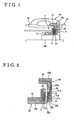
- FIG. 1 A first embodiment of the present invention is explained referring to Figs. 1 to 3.
- an outside handle device includes a handle frame 31 of a door 30, an outside handle (handle main body) 40 built in the door 30 and a connector 1 for supplying electric power and transmitting signal between a vehicle body side and the outside handle side.
- the connector 1 includes of a first connector 10 attached to the vehicle body side of the door 30 (door lock mechanism) and a second connector 20.
- the first connector 10 includes a coil core 11 for supplying electric power and a door-side infrared emitting/accepting device 12 (a vehicle body side signal transmission device).
- the second connector 20 includes a coil core 21 provided in the outside handle 40 for receiving the electric power and a handle-side infrared emitting/accepting device 22 (a handle side signal transmission device).
- both the first connector 10 and the second connector 20 are arranged to face each other with narrow predetermined distance.
- the power supply between the first connector 10 and the second connector 20 is carried out without contacting with a primary coil 11a and a secondary coil 21a, and wireless signal transmission using infrared between the first connector 10 and the second connector 20 is carried out with vehicle body side signal transmission device 12 and handle side signal transmission device 22.
- the first connector 10 is attached to the vehicle body side of the door 30 (a door lock mechanism) using a screw (not shown) or any other fastening device
- the second connector 20 is attached to the outside handle 40 using also a fastening device such as a screw (not shown).
- a key cylinder 41 is attached to the outside handle 40 in addition to the second connector 20.
- the key cylinder 41 and the second connector 20 are also inserted into the inside of the door handle frame.
- the outside door handle 40 is rigidly fixed with the handle frame 31 of the door 30 using screws (not shown) and so on.
- the key cylinder 41 When the outside handle 40 is attached to the handle frame 31, the key cylinder 41 is simultaneously engaged with a key rotor (not shown). Therefore, the door locking/unlocking operation can be mechanically performed by rotating the key cylinder 41 using a key from outside of the door 30.
- the first connector 10 includes a connector body 10a made of resin and L-shaped view from top and a door lock ECU 100 (see Fig. 1) provided at one side of the connector body 10a.
- the connector body 10a is attachable to the vehicle body side (the door lock mechanism).
- the coil core 11 and the infrared emitting/accepting device 12 are attached to a connector opposed face 10c of the connector body 10a.
- the coil core 11 includes the primary coil 11a for supplying electric power and a core body 11b made of ferrite material or the like wherein the primary coil 11a is placed suitably.
- the infrared emitting/accepting device 12 is connected with an infrared transmitting/receiving device (not shown).
- a printed circuit board 13 is provided near the coil core 11 and the infrared emitting/accepting device 12.
- An electric circuit (not shown) on the board and the primary coil 11a and the infrared emitting/accepting device 12 are connected to the infrared transmitting/receiving device.
- the second connector 20 is provided with a connector body 20a made of resin and L-shaped view from top.
- a base 20d of the connector body 20a is attachable to the outside handle 40, and a standing portion 20b projects into the inner side of the vehicle from the outside handle 40.
- the coil core 21 and the infrared emitting/accepting device 22 are attached to a connector opposed face 20c in the standing portion 20b of the second connector 20.
- the coil core 21 includes the secondary coil 21a for supplying electric power and a core body 21b made of ferrite material and so on wherein the secondary coil 21a is placed suitably.
- the infrared emitting/accepting device 22 is connected with an infrared transmitting/receiving device (not shown).
- a printed circuit board 23 is provided near the coil core 21 and the infrared emitting/accepting device 22.
- An electric circuit (not shown) on the board and the secondary coil 21a and the infrared emitting/accepting device 22 are connected to the infrared transmitting/receiving device.
- each connector opposed face 10c, 20c of the connectors 10, 20 is arranged to face each other with a narrow predetermined distance.
- each connector opposed face (10c, 20c) is arranged in this manner, the primary coil 11a of the first connector 10 and the secondary coil 21a of the second connector 20 are also arranged to face each other with a narrow distance.
- the infrared emitting/accepting device 12 of the first connector 10 and the infrared emitting/accepting device 22 of the second connector 20 are also arranged to face each other with a narrow predetermined distance.
- a power cable, a ground cable and a multiple transmission network form a bundle of signal cables.
- the door lock ECU 100 is fixed to the vehicle body side (door lock mechanism) integrally with the first connector 10 and is connected to the bundle of signal cables.
- a switching circuit 101 is included in the door lock ECU 100, alternating current (AC) voltage generated in the switching circuit 101 is applied to the power discharging trans coil 11a (the primary coil). With applying the alternating current, an AC voltage is generated in the secondary coil 21a in the outside handle 40 by an electromagnetic induction. This generated AC voltage is converted to direct current (DC) voltage by a rectification circuit 161 made of diodes and others, and the DC voltage is supplied to each electric part.
- AC alternating current
- DC direct current
- a CPU 102 provided in the door lock ECU 100 is connected with the multiple transmission network by an interface (not shown) to exchange signals with the vehicle body side for door locking/unlocking operation or a smart-key system.
- the CPU 102 receives a signal from the multiple transmission network, the signal is transmitted to an infrared emitting device 12a via a signal transmitter circuit 103, hereby, the signal is transmitted to an infrared accepting device 22a provided in the outside handle 40.
- an infrared acceptance device 12b provided in the door lock ECU 100 receives the signal, and the signal data is inputted to the CPU 102 after demodulating in a receiver circuit 104.
- the DC voltage generated in a rectification circuit 161 of the outside handle 40 is supplied to an LED 162 for illuminating and a transmitter circuit 163.
- a door lock switch 168 is pushed or a door unlock sensor 164 is operated, a signal is transmitted from the infrared emitting device 22b to the infrared acceptance device 12b of the door lock ECU 100 via the transmitter circuit 163.
- the door lock switch 168 is a manual switch to manually lock the door
- the door unlock sensor 164 is a switch which detects a change of capacitance by approaching of a human body or by touching the handle.
- the received AC voltage at the secondary coil 21a is inputted to a modulator circuit 165 as a carrier signal.
- the signal from CPU 102 of the door lock ECU is inputted to a receiving circuit 166 via the infrared acceptance device 22a, modulated to modulation wave, and then transmitted to an antenna 190 of a smart-key system.
- the antenna 190 is of a transmitter antenna type to transmit a signal which requests a certification to a key carried by an owner of the vehicle for door opening/closing operation. Accordingly, the antenna 190 can transmit and receive a signal with key taken by the user with wireless. Since electric power is supplied from the door lock ECU side to the electric circuit of the outside handle without contacting, wireless communication is carried out between the key (not shown) and the antenna 190. Therefore, the user can operate locking or unlocking by only operating the key instead of gripping the outside handle directly.
- the non-contacting connector with electromagnetic induction and the infrared two-way communication are used in the first embodiment of the present invention. Therefore, electric power is supplied from the door to the outside handle 40, at the same time, transmission from the door 30 to the outside handle 40 or from the outside handle 40 to the door 30 can be carried out.
- the door opening/closing system using smart-key can be easily carried out.
- electric connection can be carried out by attaching the outside handle 40 to the handle frame 31 of the door 30 from the outside of the vehicle.
- an outside handle device includes a handle frame 231 of a door 230, an outside handle (handle main body) 240 built in the door 230, a door lock mechanism provided at a side of a vehicle and a connector 2 attached them.
- the connector 2 consists of a first connector 210 attached to vehicle body side of the door 230 (the door lock mechanism), a second connector 220 attached to the outside handle 240 and a secondary coil 281 lied between the first connector 210 and the second connector 220.
- the first connector 210 and the second connector 220 are placed as face to face.
- the distance between first connector 210 and the second connector is broader than that of the first embodiment, and a door glass 280 is put between them.
- Non-contacting electric power supply can be carried out from the first connector 210 to the second connector 220 by a set of a primary coil 211a and a secondary coil 221a as same as the first embodiment. Accordingly, wireless signal transmission between both connectors can be carried out by a set of infrared emitting/accepting device 212, 222.
- a secondary coil (additional secondary coil) 281 made of conductive material is provided on lower part of the door glass 280.
- the provided position of the secondary coil 281 is just intermediate between the primary coil 211a of the first connector and the secondary coil 221a of the second connector 220.
- the secondary coil 281 receives a leakage flux of a magnetic induction generated between the primary coil 211a and the secondary coil 221a.
- the secondary coil 281 placed on the door glass surface is connected to a rectification circuit 282 made of diode and a LED 283.
- the LED 283 is attached on upper part of the door glass 280 as shown in Fig. 4(b). It is possible to use the LED 283 as an illumination.
- the LED 283 can be lighted with synchronizing with a switching circuit.
- the LED 283 can be effectively used as security lighting by placing the LED 283 higher position of the door glass 280.
- the LED 283 can be used as an operation indicator of a smart-key system and an illuminator. According to this composition, door locking/unlocking condition can be confirmed instantly, and forgetting of door locking operation can be prevented.
Landscapes
- Engineering & Computer Science (AREA)
- Mechanical Engineering (AREA)
- Lock And Its Accessories (AREA)
Abstract
Description
When the outside handle is attached to the
Claims (7)
- An outside handle device for a vehicle door, comprising:a handle main body (40) provided at the outside of the vehicle door (30) for accommodating an electrical component ;a handle frame (31) fixed to the vehicle door (30) for supporting the handle main body (40);a first connector (10) provided at a vehicle body side and electrically connected with an electric signal cable at the vehicle body side; anda second connector (20) provided at the handle main body (40) and electrically connected with the electric component accommodated in the handle main body (40); whereinthe electric power is supplied from the first connector (10) to the second connector (20) with non-contacting condition using the primary coil (11a) and the secondary coil (21a), and a wireless signal transmission is carried out between the first connector (10) and the second connector (20) using the vehicle body side signal transmission device (12) and the handle main body side signal transmission device (22).
- An outside handle device for a vehicle door according to claim 1, the first connector (10) includes a primary coil (11a) to supply an electric power and a vehicle body side signal transmission device (12).
- An outside handle device for a vehicle door according to claim 1, the second connector (20) includes a secondary coil (21a) to receive the electric power and a handle main body side signal transmission device (22).
- An outside handle device for a vehicle door according to claim 1, the first connector (10) and the second connector (20) are placed with predetermined distance when the handle main body (40) is assembled in the handle flame (31).
- A connector provided at a vehicle body side and a handle main body (40) assembled to handle frame (31), supplying electric power and transmitting signal between the vehicle body side and the handle side, comprising:a first connector (10) comprising a primary coil (11a) for supplying the electric power and a vehicle body side signal transmission device (12), attachable to designated place of the vehicle body side;a second connector (20) comprising a secondary coil (21a) for accepting the electric power and a handle main body side signal transmission device (22), attachable to designated place of the handle main body (40); whereinthe first connector (10) and the second connector (20) are placed with a predetermined distance when the handle main body (40) is assembled in the handle frame (31); andthe electric power is supplied from the first connector (10) to the second connector (20) with non-contacting condition using the primary coil (11a) and the secondary coil (21a), and a wireless signal transmission is carried out between the first connector (10) and the second connector (20) using the vehicle body side signal transmission device (12) and the handle main body side signal transmission device (22).
- A connector used for an outside handle device according to claim 2, wherein the vehicle body side signal transmission device (12) and the handle main body side signal transmission device (22) transmit signal each other with infrared signal, the handle main body side signal transmission device (22) comprising at least an emitting device (22b), and the vehicle body side signal transmission device (12) comprising at least an acceptance device (12b).
- A connector used for an outside handle device according to claim 3, further comprising an electric power acceptable an additional secondary coil (281) presented on a door glass (280) put between the first connector (210) and the second connector (220) with non-contacting condition and presented at corresponding position to the primary coil (211a) and the secondary coil (221a) when the first connector (210) is attached to the vehicle body side and the second connector (220) is attached to the handle side, and a operating condition indicator (283) illuminated by a electric power accepted at the additional secondary coil (281).
Applications Claiming Priority (2)
| Application Number | Priority Date | Filing Date | Title |
|---|---|---|---|
| JP2003031776A JP2004239008A (en) | 2003-02-07 | 2003-02-07 | Outside handle device and connector used therefor |
| JP2003031776 | 2003-02-07 |
Publications (2)
| Publication Number | Publication Date |
|---|---|
| EP1445405A2 true EP1445405A2 (en) | 2004-08-11 |
| EP1445405A3 EP1445405A3 (en) | 2005-06-22 |
Family
ID=32653031
Family Applications (1)
| Application Number | Title | Priority Date | Filing Date |
|---|---|---|---|
| EP20040002770 Withdrawn EP1445405A3 (en) | 2003-02-07 | 2004-02-09 | Outside handle device for a vehicle door |
Country Status (3)
| Country | Link |
|---|---|
| US (1) | US6976726B2 (en) |
| EP (1) | EP1445405A3 (en) |
| JP (1) | JP2004239008A (en) |
Cited By (3)
| Publication number | Priority date | Publication date | Assignee | Title |
|---|---|---|---|---|
| DE202004017179U1 (en) * | 2004-11-03 | 2006-03-16 | Brose Schließsysteme GmbH & Co.KG | Vehicle locking system comprises a door handle arrangement with the exchangeable component of a control system and an assigned interface |
| FR2917112A1 (en) * | 2007-06-06 | 2008-12-12 | Peugeot Citroen Automobiles Sa | Opening e.g. swinging or sliding lateral door, actuating system for car, has lock mounted on vehicle body, and control device for controlling lock, where device includes manual actuating unit for actuating control order emission unit |
| WO2018229393A1 (en) * | 2017-06-13 | 2018-12-20 | Continental Automotive France | Remote power supply, position sensor and wireless communication device for an extendable door handle |
Families Citing this family (17)
| Publication number | Priority date | Publication date | Assignee | Title |
|---|---|---|---|---|
| US7318616B1 (en) * | 2003-01-31 | 2008-01-15 | Owen Bradley | Vehicle filing cabinet |
| JP2005295473A (en) * | 2004-04-06 | 2005-10-20 | Toko Inc | Antenna coil |
| JP4428388B2 (en) * | 2004-09-28 | 2010-03-10 | アイシン精機株式会社 | Antenna device and door handle device |
| JP2007254993A (en) * | 2006-03-22 | 2007-10-04 | Toyoda Gosei Co Ltd | Door handle for vehicle exterior |
| ATE437277T1 (en) * | 2007-05-08 | 2009-08-15 | Huf Huelsbeck & Fuerst Gmbh | METHOD FOR PRODUCING AN OUTSIDE DOOR HANDLE |
| JP2009203633A (en) * | 2008-02-26 | 2009-09-10 | Panasonic Electric Works Co Ltd | Electric lock |
| JP5107458B2 (en) * | 2009-06-11 | 2012-12-26 | トヨタ自動車株式会社 | Electromagnetic coupling device and vehicle door |
| KR101439007B1 (en) | 2013-02-08 | 2014-09-11 | 현대자동차주식회사 | Pop up device of door outside handle and method thereof |
| TWI565607B (en) * | 2014-01-09 | 2017-01-11 | 鴻海精密工業股份有限公司 | Vehicle movable parts auxiliary system and vehicle |
| US10047548B2 (en) * | 2014-06-17 | 2018-08-14 | Magna Closures Inc. | Latch assembly for latch operation of closure panels for vehicles |
| JP6503914B2 (en) * | 2015-06-19 | 2019-04-24 | アイシン精機株式会社 | Vehicle door handle device |
| US10672208B2 (en) | 2017-03-10 | 2020-06-02 | The Boeing Company | Touch-free operable stowage bin assemblies |
| US10906458B2 (en) | 2017-03-10 | 2021-02-02 | The Boeing Company | Vehicles including electronic stowage bin control systems |
| US10793277B2 (en) * | 2017-03-10 | 2020-10-06 | The Boeing Company | Electronic stowage bin control systems and methods |
| US10647429B2 (en) | 2017-03-10 | 2020-05-12 | The Boeing Company | Vehicle stowage bin assemblies having weight sensors |
| US10864849B2 (en) | 2017-03-10 | 2020-12-15 | The Boeing Company | Illuminated stowage bin assemblies within vehicles |
| DE102018124213A1 (en) | 2018-10-01 | 2020-04-02 | Brose Fahrzeugteile Gmbh & Co. Kommanditgesellschaft, Bamberg | Door module with transmitter and receiver unit for wireless transmission of energy and / or data |
Family Cites Families (9)
| Publication number | Priority date | Publication date | Assignee | Title |
|---|---|---|---|---|
| DE19812349C2 (en) * | 1997-03-21 | 2003-03-27 | Ohi Seisakusho Co Ltd | Control system for the control of electrical devices and control system for use in a motor vehicle |
| JP2000255342A (en) | 1999-03-10 | 2000-09-19 | Harness Syst Tech Res Ltd | Power supply system for vehicle electrical components and vehicle electrical components |
| DE19961370A1 (en) | 1999-12-17 | 2001-07-05 | Bosch Gmbh Robert | Outside door handle arrangement for a motor vehicle door, motor vehicle door and method for assembling an outside door handle |
| JP3714129B2 (en) | 2000-07-14 | 2005-11-09 | アイシン精機株式会社 | Door opener |
| DE10163778B4 (en) | 2001-06-27 | 2008-01-24 | Witte-Velbert Gmbh & Co. Kg | Handle with integrated antenna and sensor electrode |
| DE60223405T2 (en) * | 2001-10-01 | 2008-08-21 | Donnelly Corp., Holland | VEHICLE GRIP ASSEMBLY WITH ANTENNA |
| JP3882595B2 (en) * | 2001-11-28 | 2007-02-21 | アイシン精機株式会社 | Antenna device |
| JP2004232300A (en) * | 2003-01-29 | 2004-08-19 | Aisin Seiki Co Ltd | Outside handle device |
| JP2005076369A (en) * | 2003-09-02 | 2005-03-24 | Honda Motor Co Ltd | Remote door lock control device for vehicle |
-
2003
- 2003-02-07 JP JP2003031776A patent/JP2004239008A/en active Pending
-
2004
- 2004-02-06 US US10/772,343 patent/US6976726B2/en not_active Expired - Fee Related
- 2004-02-09 EP EP20040002770 patent/EP1445405A3/en not_active Withdrawn
Cited By (4)
| Publication number | Priority date | Publication date | Assignee | Title |
|---|---|---|---|---|
| DE202004017179U1 (en) * | 2004-11-03 | 2006-03-16 | Brose Schließsysteme GmbH & Co.KG | Vehicle locking system comprises a door handle arrangement with the exchangeable component of a control system and an assigned interface |
| FR2917112A1 (en) * | 2007-06-06 | 2008-12-12 | Peugeot Citroen Automobiles Sa | Opening e.g. swinging or sliding lateral door, actuating system for car, has lock mounted on vehicle body, and control device for controlling lock, where device includes manual actuating unit for actuating control order emission unit |
| WO2018229393A1 (en) * | 2017-06-13 | 2018-12-20 | Continental Automotive France | Remote power supply, position sensor and wireless communication device for an extendable door handle |
| US10689880B2 (en) | 2017-06-13 | 2020-06-23 | Continental Automotive France | Remote power supply, position sensor and wireless communication device for an extendable door handle |
Also Published As
| Publication number | Publication date |
|---|---|
| US6976726B2 (en) | 2005-12-20 |
| US20040227374A1 (en) | 2004-11-18 |
| EP1445405A3 (en) | 2005-06-22 |
| JP2004239008A (en) | 2004-08-26 |
Similar Documents
| Publication | Publication Date | Title |
|---|---|---|
| US6976726B2 (en) | Outside handle device for a vehicle door | |
| CN102177302B (en) | Electromagnetic coupling device, and door handle and vehicle door both having electromagnetic coupling device | |
| US6084317A (en) | Keyless access control system with wireless, induction-powered keypad module and methods | |
| CN100469625C (en) | switchgear | |
| US10351101B2 (en) | Vehicle door handle with antenna arrangement | |
| JP3696866B2 (en) | Door opener | |
| US10661754B2 (en) | Inside door handle system for a door of a vehicle | |
| US20100077805A1 (en) | Outside actuation for locks on doors, tailgates and the like | |
| US5821632A (en) | Arrangement, in particular in vehicles, for transmitting electric signals by connecting lines | |
| EP2783450A1 (en) | Power supply control device | |
| KR20130065640A (en) | Exterior door handle with passive-entry subassemblies and a lighting subassembly | |
| US20180019616A1 (en) | Automobile power distribution apparatus | |
| US11990953B2 (en) | Light trunking system having data transmission function | |
| US7893884B2 (en) | Embedded door handle antenna apparatus comprising a magnetic core | |
| AU753316B2 (en) | Device for transmitting signals in a vehicle | |
| US12194872B2 (en) | Locking device for illuminating the plug contour of a charging socket of an electric vehicle | |
| JP3639292B1 (en) | Door opener | |
| US20050030197A1 (en) | control system and method for automotive decorative lighting | |
| US8255125B2 (en) | Control unit for earth moving equipment and the similar | |
| WO2005000632A1 (en) | Unite holder for electrical equipment, for example for a lamp assembly | |
| JP3151128B2 (en) | Vehicle key device | |
| KR20020088996A (en) | Apparatus for transferring electricity to a door | |
| JP2022091359A (en) | Door handle device | |
| JPH09117058A (en) | Power supply and signal circuit structure for car door and car body | |
| JP2018022965A (en) | Communication device, communication device, electronic device, mobile device, power supply device, power supply system |
Legal Events
| Date | Code | Title | Description |
|---|---|---|---|
| PUAI | Public reference made under article 153(3) epc to a published international application that has entered the european phase |
Free format text: ORIGINAL CODE: 0009012 |
|
| AK | Designated contracting states |
Kind code of ref document: A2 Designated state(s): AT BE BG CH CY CZ DE DK EE ES FI FR GB GR HU IE IT LI LU MC NL PT RO SE SI SK TR |
|
| AX | Request for extension of the european patent |
Extension state: AL LT LV MK |
|
| PUAL | Search report despatched |
Free format text: ORIGINAL CODE: 0009013 |
|
| AK | Designated contracting states |
Kind code of ref document: A3 Designated state(s): AT BE BG CH CY CZ DE DK EE ES FI FR GB GR HU IE IT LI LU MC NL PT RO SE SI SK TR |
|
| AX | Request for extension of the european patent |
Extension state: AL LT LV MK |
|
| RIC1 | Information provided on ipc code assigned before grant |
Ipc: 7B 60R 16/02 B Ipc: 7B 60R 25/00 B Ipc: 7E 05B 65/20 A |
|
| 17P | Request for examination filed |
Effective date: 20050615 |
|
| AKX | Designation fees paid |
Designated state(s): AT BE BG CH CY CZ DE DK EE ES FI FR GB GR HU IE IT LI LU MC NL PT RO SE SI SK TR |
|
| 17Q | First examination report despatched |
Effective date: 20090914 |
|
| STAA | Information on the status of an ep patent application or granted ep patent |
Free format text: STATUS: THE APPLICATION IS DEEMED TO BE WITHDRAWN |
|
| 18D | Application deemed to be withdrawn |
Effective date: 20100126 |