EP1443694B1 - A method of double weighting parallel interference cancellation - Google Patents
A method of double weighting parallel interference cancellation Download PDFInfo
- Publication number
- EP1443694B1 EP1443694B1 EP02772004A EP02772004A EP1443694B1 EP 1443694 B1 EP1443694 B1 EP 1443694B1 EP 02772004 A EP02772004 A EP 02772004A EP 02772004 A EP02772004 A EP 02772004A EP 1443694 B1 EP1443694 B1 EP 1443694B1
- Authority
- EP
- European Patent Office
- Prior art keywords
- user
- signal
- interference cancellation
- weighting
- result
- Prior art date
- Legal status (The legal status is an assumption and is not a legal conclusion. Google has not performed a legal analysis and makes no representation as to the accuracy of the status listed.)
- Expired - Lifetime
Links
Images


Classifications
-
- H—ELECTRICITY
- H04—ELECTRIC COMMUNICATION TECHNIQUE
- H04B—TRANSMISSION
- H04B1/00—Details of transmission systems, not covered by a single one of groups H04B3/00 - H04B13/00; Details of transmission systems not characterised by the medium used for transmission
- H04B1/69—Spread spectrum techniques
- H04B1/707—Spread spectrum techniques using direct sequence modulation
- H04B1/7097—Interference-related aspects
- H04B1/7103—Interference-related aspects the interference being multiple access interference
- H04B1/7107—Subtractive interference cancellation
- H04B1/71075—Parallel interference cancellation
-
- H—ELECTRICITY
- H04—ELECTRIC COMMUNICATION TECHNIQUE
- H04B—TRANSMISSION
- H04B1/00—Details of transmission systems, not covered by a single one of groups H04B3/00 - H04B13/00; Details of transmission systems not characterised by the medium used for transmission
- H04B1/69—Spread spectrum techniques
- H04B1/707—Spread spectrum techniques using direct sequence modulation
- H04B1/7097—Interference-related aspects
- H04B1/7103—Interference-related aspects the interference being multiple access interference
- H04B1/7107—Subtractive interference cancellation
- H04B2001/71077—Partial interference cancellation
Definitions
- the present invention generally relates to multiple user detection (MUD) technique in CDMA mobile communication system, and more particularly, to a method for double weighting parallel interference cancellation in CDMA system.
- MOD multiple user detection
- multiple user detection is one kind of enhanced technique that can overcome limitations on CDMA system capacity produced by multiple access interference (MAI), in order to improve capacity and performance of the CDMA system.
- MAI multiple access interference
- MUD technique can jointly detect signals from multi-users, in order to reduce influences of MAI on performance of the receiver, and heighten capacity of the system as much as possible.
- MUD comprises maximum likelihood sequence detector that is the best detector, linear multiple user detector and interference cancellation multiple user detector that are second best detectors.
- interference cancellation multiple user detection comprises the step of regarding signal from expected user as useful signal, removing the interference of other users from received signals to obtain signal of expected user, and then detecting the signal of the said expected user. In this way, performance of the system can be largely raised.
- the interference cancellation multiple user detection can be classified into a serial interference cancellation (SIC) and a parallel interference cancellation (PIC) SIC sorts the user signals in power descending order and cancels interference in serial, the method has a better performance compared with single user detection but with longer time delay, and must sort signals of the users according to their power, which needs heavy calculation and is sensitive to the original signals estimation. PIC removes interference of other users in parallel from received signals, which has the advantages of short time delay and simpler calculation.
- SIC serial interference cancellation
- PIC parallel interference cancellation
- Prior PIC methods comprise traditional PIC method, partial PIC method and weighting PIC method that is based on Bayes rule.
- the traditional PIC method can raise system performance in a large extent under high signal-to-noise ratio, but has a lower raise under low signal-to-noise ratio.
- the partial PIC method sets a weight value for each stage of interference cancellation to weight the MAI influence on the expected users, and partially removes the MAI during the interfere cancellation process.
- the traditional PIC method within Gaussian channel removes all the MAI on the expected users from the received signals, of course, the signal estimation on the expected users under this circumstance is biased; on the other hand, partial PIC method merely removes the MAI partially, which can correct estimation biases on the expected users, making decision results more reliable.
- partial PIC method has obviously better performance than that of the traditional PIC method.
- the patent US 5418814 discloses the weighting PIC method that is based on Bayes rule. Although being a weighting method, its weighting principle, which is a symbol-level weighting method that is based on a minimum mean of decision cost, is different from that of the partial PIC method. When creating a decision cost function, the method takes the minimum mean of decision cost as rule, to determine reliability coefficient of the decision result of each symbol, and to make symbol level weighting with the coefficient on the signals regenerated from the symbol. So only part of the interference produced by the symbol of the users is removed during the MAI eliminating process. The method has better performance than that of the traditional PIC method, especially at circumstance of low signal-to-noise ratio, and its improvement in performance is perfectly obvious.
- a method for double weighting parallel interference cancellation in CDMA system for a base band signal comprising a plurality of users comprises following steps of:
- the method disclosed according to the present invention has advantages of not only weighting algorithm based on Bayes rule, which has minimum decision cost in symbol level, but also partial weighting algorithm, which can make up the statistical signal estimation biases on users. What is more, the method enormously improves gains at circumstance of low signal-to-noise ratio without large increases on calculation workload comparing with the weighting PIC based on Bayes rule, and achieves a large improvement on performance of the system according to the present invention when comparing with partial weighting and weighting methods based on Bayes rule.
- a further object of the invention is to provide a double weighting PIC method with a simplified algorithm, which reduces complexity of the algorithm while keeping performance of said double weighting PIC method unchanged.
- a double weighting PIC method for a base band signal comprising a plurality of users, with a simplified algorithm according to the present invention comprises following steps:
- the double weighting PIC method with the simplified algorithm according to the present invention changing a chip level weighting into symbol level weighting, which can reduce complexity of the algorithm while keeping performance of said double weighting PIC method unchanged.
- the method of the present invention integrates both partial weighting and the weighting based on Bayes rule.
- a reliability coefficient of decision result of the symbol is calculated according to the weighting algorithm formula based on Bayes rule, and then regenerated signal of the symbol of the user is weighted with the reliability coefficient.
- the MAI estimating and removing processes the MAI on expected users produced by other users is got by the weighted regenerated signal of other users in chip level; after a weight value is set, the obtained MAI is weighted with the weight value. Finally, the weighted MAI is subtracted from received signals, which means partially removing the MAI on expected users produced by other users. Now above method is applied in each stage of PIC architecture.
- multistage structure in double weighting PIC method is the same with that of traditional PIC method.
- the first stage PIC structure 1 takes base band signals r(t) of the received signal as input of each user for processing, and the obtained output of each user are input of each user in PIC structure of the next stage; after processing on input of each user in the second stage PIC structure, the obtained output become input of each user in PIC structure of the next stage ; stage by stage in this way, after processing on input of each user in PIC structure 2 of the last stage, the obtained output from each user here will be the final result of the multistage PIC structure.
- PIC structure in double weighting PIC method is the same with that of the weighting PIC method based on Bayes rule.
- PIC structure of the last stage of the method is same as that of the traditional PIC method, which is shown in Fig.3.
- Fig.1 shows base band signals r(t) of the received signals enter the first stage PIC structure 1 in parallel mode.
- input signal entering into PIC structure in parallel is transmitted to RAKE receiver 3 of each user respectively.
- RAKE receiver 3 despreads the input signal first, then makes channel estimation according to the result of despreading, and makes multi-path combing at last, then transmits the multi-path combining result to hard decision maker 4 and decision reliability calculator 7 simultaneously, and sends result of the channel estimation to decision reliability calculator 7 and signal regenerator 5 simultaneously.
- Hard decision maker 4 makes hard decision for the input, and transmits the result to signal regenerator 5.
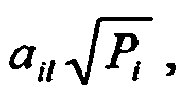
- a il is an estimation value of a il ⁇ P i
- a il is a channel fading value in the l th path of the i th user
- P i refers to a power of user i .
- n i Gaussian White Noise, which obeys normal distribution N (0, ⁇ i 2 ), ⁇ 2 is a noise power of n i ;
- a i ( m ) refers to the m th symbol of user i , whose value is +1 or -1, ⁇ i is a real number relating to channel fading.
- the decision reliability calculator calculates the reliability coefficient of the decision result made by hard decision maker through two input signals, and transmits the reliability coefficient to signal regenerator 5.
- w is a positive real number, which is used to make up errors in noise power estimation.
- the signal regenerator After obtaining regenerated signals of the user from three input signals, the signal regenerator transmits the regenerated signals to device 6 for MAI estimation and partial interference cancellation.
- a il ⁇ n - ⁇ ⁇ f i n ⁇ k ⁇ a ⁇ i n ⁇ k ⁇ p ⁇ t - n ⁇ T b - ⁇ il ⁇ c i ⁇ t - ⁇ il
- p(t) is a signal pulse whose cycle is T b .
- the base band signals r ( t ) of the received signals are also transmitted into MAI estimation and partial interference cancellation device 6, which estimates MAI on each user according to the regenerated signals of each user inputted in parallel; the resulted signal after removing MAI on certain user from the base band signals r ( t ) of the received signals will be the output of the said user in the present stage PIC structure and the input of the said user in next stage of PIC structure.
- weight value of the k th stage PIC structure is p (k) ; the MAI from formula (8) can be weighted and then interference cancellation is made to obtain output r i ( k +1) ( t ) of user i in the k th stage PIC structure according to formula (9).
- r i ( k +1) ( t ) is the input of RAKE receiver of user i in PIC structure of the next stage.
- r i k + 1 t r t - p k ⁇ I ⁇ i k
- Different weight value p ( k ) can be set up for interference cancellations in different stages, and preferably set p (1) ⁇ p (2) ... ⁇ p ( k ) ... ⁇ p ( S ) , wherein k is the k th stage of the interference cancellation, S refers to a stage number of the interference cancellation.
- the present invention provides the double weighting PIC method, which has advantages of not only the weighting algorithm based on Bayes rule, which has advantages of Minimum decision Cost in symbol level, but also advantages of the partial weighting algorithm, which can make up the statistical signal estimation biases on users.
- the method has better performance than that of weighting PIC based on Bayes rule, which can improve gains at circumstance of signal-to-noise ratio without obvious increases in calculation workload and provide a largely improved performance compared with both partial weighting and weighting based on Bayes rule.
- formula (6) comprises the Hyperbolic tangent operation, which is hard to implemented with prior hardware, and needs to develop new arithmetic chips, so the cost is much higher; moreover, p ( k ) Î i ( k ) in formula (9) is chip level multiplication with heavy calculation workload.
- the present invention further provides a double weighting PIC method with simplified algorithm, whose multistage architecture is shown in Fig.1, PIC structure of the simplified algorithm is illustrated in Fig.4, PIC structure of the simplified algorithm in the last stage is shown in Fig.3.
- base band signals r(t) of the received signals enter in parallel to the first stage PIC structure 1 in Fig.1.
- the input signals r(t) entered the PIC structure are transmitted into RAKE receiver 3 of each user respectively.
- RAKE receiver 3 implements channel estimation after dispreading the input signal, and completes multi-path combining at last.
- RAKE receiver 3 transmits the multi-path combining result to soft decision maker 8, and then at the same time sends the channel estimation result to soft decision maker 8 and signal regenerator 5.
- n i Gaussian White Noise, which is subject to normal distribution N (0, ⁇ i 2 );
- a i ( m ) is the mth symbol of user i, whose value is +1 or -1,
- ⁇ i is a real number relating to channel fading.
- â i ( m )( k ) is the decision result on the m th symbol of user i
- â i ( m )( k ) sgn ⁇ Y i ( m )( k ) ⁇
- ⁇ i ( m )( k ) is reliability coefficient of â i ( m )( k ) .
- Soft decision maker 8 transmits the soft decision result to soft decision weighting device 9, which weights the soft decision result with formula (14), and sends the weighted result to signal regenerator 5.
- the weighting operation is symbol level.
- r i ( k +1) ( t ) is the output signal of user i in the k th stage PIC structure, and the input signal into RAKE receiver of user i in PIC structure of the next stage.
- the signal that is obtained after removing MAI on the user from base band signals r ( t ) of the received signals will become output signal of the said user in the present stage PIC structure, as well as input signal of the said user in next stage PIC structure.
- the parallel input signals will be processed in the same way. The operation is carried out stage by stage in this way; when being processed in PIC structure of the last stage, as shown in Fig.3, the parallel input signals are transmitted into RAKE receiver 3 of each user separately, which implements despreading, channel estimation and multi-path combining on the input signal.
- the soft output from each user here will be the final result of the multistage PIC structure.
- the soft output of the user is transmitted to decoder of the said user for decoding.
- Another embodiment of simplified algorithm according to the present invention is as following.
- the base band signals r ( t ) of the received signals are transmitted into the first stage PIC structure 1 in parallel.
- said input signals r ( t ) are respectively transmitted into RAKE receiver 3 of each user, which despreads the input signal first and makes channel estimation, and last implements multi-path combining.
- RAKE receiver 3 transmits the multi-path combining result to soft decision maker 8, and sends channel estimation result to soft decision maker 8 and signal regenerator 5 at the same time.
- n i is Gaussian White Noise, which is subject to normal distribution a i ( m ) is the m th symbol of user i , whose value is +1 or -1. ⁇ i is a real number that is related with channel fading.
- â i ( m )( k ) is a decision result of the m th symbol of user i
- â i ( m )( k ) sgn ⁇ Y i ( m )( k ) ⁇
- ⁇ i ( m )( k ) is a reliability coefficient of â i ( m )( k ) .
- the method of replacing the Hyperbolic tangent decision with the look-up table method is to approach the Hyperbolic tangent function tanh( x ) with the decision function T ( x ) of the look-up table method, whose deducing process is as follows.
- Soft decision maker 8 transmits the soft decision result to soft decision weighting device 9, which weights the soft decision result in symbol level with formula (22), and sends the weighted result to signal regenerator 5.
- ⁇ i m ⁇ k ⁇ i m ⁇ k ⁇ p k
- signal regenerator 5 obtains the regenerated signal from two input signals, and transmits the regenerated signals to MAI estimation and partial interference cancellation device 6;
- a il ⁇ n - ⁇ ⁇ ⁇ i n ⁇ k ⁇ p ⁇ t - n ⁇ T b - ⁇ il ⁇ c i ⁇ t - ⁇ il
- r i ( k ) ( t ) is the output signal of user i in the k th stage PIC structure, and as well as input signal of RAKE receiver of user i in the next stage PIC structure.
- the signal that is obtained after removing MAI on the user from base band signals r ( t ) of the received. signals will become the output signal of the said user in the present stage PIC structure, as well as the input signal of the said user in next stage of PIC structure.
- the parallel input signals will be processed in the same way. The operation is carried out stage by stage in this way; when processed in PIC structure of the last stage, as shown in Fig.3, the parallel input signals are transmitted into RAKE receiver 3 of each user separately, which implements despreading, channel estimation and multi-path combining on the input signal.
- the soft output from each user here will be the final result of the multistage PIC structure.
- the soft output of the user is transmitted to its decoder for decoding.
Landscapes
- Engineering & Computer Science (AREA)
- Computer Networks & Wireless Communication (AREA)
- Signal Processing (AREA)
- Noise Elimination (AREA)
- Mobile Radio Communication Systems (AREA)
Abstract
Description
- The present invention generally relates to multiple user detection (MUD) technique in CDMA mobile communication system, and more particularly, to a method for double weighting parallel interference cancellation in CDMA system.
- Because of the advantages in great capacity, high service quality and excellent secrecy property, CDMA mobile communication system has become tendency of 3G mobile communication developments. Wherein, multiple user detection (MUD) is one kind of enhanced technique that can overcome limitations on CDMA system capacity produced by multiple access interference (MAI), in order to improve capacity and performance of the CDMA system.
- With help of the information of multi-users, MUD technique can jointly detect signals from multi-users, in order to reduce influences of MAI on performance of the receiver, and heighten capacity of the system as much as possible. At present, MUD comprises maximum likelihood sequence detector that is the best detector, linear multiple user detector and interference cancellation multiple user detector that are second best detectors. Wherein, interference cancellation multiple user detection comprises the step of regarding signal from expected user as useful signal, removing the interference of other users from received signals to obtain signal of expected user, and then detecting the signal of the said expected user. In this way, performance of the system can be largely raised.
- The interference cancellation multiple user detection can be classified into a serial interference cancellation (SIC) and a parallel interference cancellation (PIC) SIC sorts the user signals in power descending order and cancels interference in serial, the method has a better performance compared with single user detection but with longer time delay, and must sort signals of the users according to their power, which needs heavy calculation and is sensitive to the original signals estimation. PIC removes interference of other users in parallel from received signals, which has the advantages of short time delay and simpler calculation.
- Prior PIC methods comprise traditional PIC method, partial PIC method and weighting PIC method that is based on Bayes rule.
- Compared with single-user detection, the traditional PIC method can raise system performance in a large extent under high signal-to-noise ratio, but has a lower raise under low signal-to-noise ratio.
- Being different from the traditional PIC method which removes MAI influence on expected users completely from received signals, the partial PIC method sets a weight value for each stage of interference cancellation to weight the MAI influence on the expected users, and partially removes the MAI during the interfere cancellation process. The traditional PIC method within Gaussian channel removes all the MAI on the expected users from the received signals, of course, the signal estimation on the expected users under this circumstance is biased; on the other hand, partial PIC method merely removes the MAI partially, which can correct estimation biases on the expected users, making decision results more reliable. At circumstance of low signal-to-noise ratio, partial PIC method has obviously better performance than that of the traditional PIC method.
- The patent US 5418814 discloses the weighting PIC method that is based on Bayes rule. Although being a weighting method, its weighting principle, which is a symbol-level weighting method that is based on a minimum mean of decision cost, is different from that of the partial PIC method. When creating a decision cost function, the method takes the minimum mean of decision cost as rule, to determine reliability coefficient of the decision result of each symbol, and to make symbol level weighting with the coefficient on the signals regenerated from the symbol. So only part of the interference produced by the symbol of the users is removed during the MAI eliminating process. The method has better performance than that of the traditional PIC method, especially at circumstance of low signal-to-noise ratio, and its improvement in performance is perfectly obvious.
- Although both of the two methods above effectively improve performance of traditional PIC method under low signal-to-noise ratio, the extent is very limited.
- A reference, US 5644592, discloses a method for parallel interference cancellation. The method comprises the step of:
- scaling a combined interference signal with a weighting factor to produce a scaled combined interference signal;
- scaling a composite signal with the weighting factor to produce a scaled composite signal;
- scaling a signal value by the complement of the weighting factor to produce a leakage signal;
- combining the scaled composite signal, the scaled combined interference signal and the leakage signal to produce an estimate of a respective user signal.
- However, in this method, the performance under circumstances with low signal-to-noise ratio is not taken into account.
- It is an object to provide a method for double weighting parallel interference cancellation in CDMA communication system, which improves MUD performance without largely increasing its complexity, especially solves disadvantages of the prior art under circumstances with low signal-to-noise ratio.
- A method for double weighting parallel interference cancellation in CDMA system for a base band signal comprising a plurality of users, according to the present invention comprises following steps of:
- (a) performing a multi-path despreading, channel estimation and a multi-path combining on an input signal of each user by a RAKE receiver;
- (b) performing a hard decision on a result of the multi-path combining;
- (c) calculating a reliability coefficient for a result of the hard decision of each symbol based on the multi-path combining result and a result of the channel estimation;
- (d) weighting the hard decision result using the reliability coefficient, to obtain a weighted signal; regenerating tae weighted signal in chip level for said each user based on the weighted signal and a result of the channel estimation;
- (e) estimating a multiple access interference on said each user based on others users' regenerated weighted signals in chip level, and setting a weight value for an interference, cancellation in each stage, weighting the multiple access interference on said each user using the weight value;
- (f) subtracting the weighted multiple access interference on said each user from the based band signal, to obtain an output signal of said each user, which is also an input signal of said each user to a next stage of the parallel interference cancellation structure;
- Combining the partial PIC and the weighting PIC based on Bayes rule, bringing forward double weighting PIC method, the method disclosed according to the present invention has advantages of not only weighting algorithm based on Bayes rule, which has minimum decision cost in symbol level, but also partial weighting algorithm, which can make up the statistical signal estimation biases on users. What is more, the method enormously improves gains at circumstance of low signal-to-noise ratio without large increases on calculation workload comparing with the weighting PIC based on Bayes rule, and achieves a large improvement on performance of the system according to the present invention when comparing with partial weighting and weighting methods based on Bayes rule.
- A further object of the invention is to provide a double weighting PIC method with a simplified algorithm, which reduces complexity of the algorithm while keeping performance of said double weighting PIC method unchanged.
- A double weighting PIC method for a base band signal comprising a plurality of users, with a simplified algorithm according to the present invention comprises following steps:
- (a) performing a multi-path despreading, channel estimation and a multi-path combining on an input signal of each user by a RAKE receiver;
- (b) performing a soft decision on a result of the multi-path combining and a result of the channel estimation;
- (c) setting a weight value for the soft decision in different stages, and weighting the soft decision in symbol level using the weight value, to obtain a weighted signal;
- (d) regenerating a weighted signal in chip level for said each based on the weighted signal and the channel estimation result;
- (e) estimating a multiple access interference on said each user based on others users' regenerated weighted signals in chip level;
- (f) subtracting the multiple access interference on said each user from the base band signal, to obtain an output signal of said each user, which is also an input signal of said each user to a next stage of the parallel interference cancellation structure;
- The double weighting PIC method with the simplified algorithm according to the present invention, changing a chip level weighting into symbol level weighting, which can reduce complexity of the algorithm while keeping performance of said double weighting PIC method unchanged.
-
- Fig.1 is a schematic block diagram of multiple stages architecture in double weighting PIC receiver.
- Fig.2 is a schematic block diagram of PIC structure in double weighting PIC method.
- Fig.3 is a schematic block diagram of PIC structure of the last stage.
- Fig.4 is a schematic block diagram of PIC structure in simplified double weighting PIC method.
- The present invention will be described in more detail hereinafter with reference to the accompanying drawings and embodiments.
- The method of the present invention integrates both partial weighting and the weighting based on Bayes rule. When decisions on each symbol of the user are made, a reliability coefficient of decision result of the symbol is calculated according to the weighting algorithm formula based on Bayes rule, and then regenerated signal of the symbol of the user is weighted with the reliability coefficient. During the MAI estimating and removing processes, the MAI on expected users produced by other users is got by the weighted regenerated signal of other users in chip level; after a weight value is set, the obtained MAI is weighted with the weight value. Finally, the weighted MAI is subtracted from received signals, which means partially removing the MAI on expected users produced by other users. Now above method is applied in each stage of PIC architecture.
- As shown in Fig.1, multistage structure in double weighting PIC method is the same with that of traditional PIC method. The first
stage PIC structure 1 takes base band signals r(t) of the received signal as input of each user for processing, and the obtained output of each user are input of each user in PIC structure of the next stage; after processing on input of each user in the second stage PIC structure, the obtained output become input of each user in PIC structure of the next stage ; stage by stage in this way, after processing on input of each user inPIC structure 2 of the last stage, the obtained output from each user here will be the final result of the multistage PIC structure. - As shown in Fig.2, PIC structure in double weighting PIC method is the same with that of the weighting PIC method based on Bayes rule. PIC structure of the last stage of the method is same as that of the traditional PIC method, which is shown in Fig.3.
- Now refer to Fig.1, which shows base band signals r(t) of the received signals enter the first
stage PIC structure 1 in parallel mode. As shown in Fig.2, input signal entering into PIC structure in parallel is transmitted to RAKEreceiver 3 of each user respectively.RAKE receiver 3 despreads the input signal first, then makes channel estimation according to the result of despreading, and makes multi-path combing at last, then transmits the multi-path combining result tohard decision maker 4 anddecision reliability calculator 7 simultaneously, and sends result of the channel estimation todecision reliability calculator 7 andsignal regenerator 5 simultaneously.Hard decision maker 4 makes hard decision for the input, and transmits the result to signalregenerator 5. - In fading channel environment, base band signals r(t) of the received signal can be expressed as:

- Where, r(t) refers to the base band signals of the received signals; ail refers to a channel fading value of the ith user in the lth path, L is a path number; τil refers to a delay of the ith user in the lth path; Si(t) refers to a outbound signal of user i, N refers to total users number; Pi refers to a power of user i; bi(t) refers to a symbol flow of user i,

- In the kth stage PIC structure, input of
RAKE receiver 3 of user i is ri (k)(t). When k=1, ri (k)(t) = r(t). - After the RAKE receiver makes multi-path despreading on ri (k)(t), and channel estimation according to the despreading result, multi-path combining is implemented. The lth path despreading result made by RAKE receiver of user i is:

- Where, l=1,.....,L.
- With the maximal ratio combining, the multi-path combining result made by RAKE receiver will be:

- Where,

- Ail is an estimation value of

- The above multi-path combining results of the RAKE receiver can be expressed as Yi (m)(k) = µai (m) + n, wherein, ni is Gaussian White Noise, which obeys normal distribution N(0,σ i 2), σ2 is a noise power of ni ; ai (m) refers to the mth symbol of user i, whose value is +1 or -1, µ i is a real number relating to channel fading.
- The decision result for the mth symbol of the ith user is:

- The decision reliability calculator calculates the reliability coefficient of the decision result made by hard decision maker through two input signals, and transmits the reliability coefficient to signal
regenerator 5. The reliability coefficient calculating formula of âi (m)(k) is expressed as:
- Where, w is a positive real number, which is used to make up errors in noise power estimation. The w values in different signal-to-noise ratios can be determined via experiments, wherein w=1 at higher signal-to-noise ratios.
- After obtaining regenerated signals of the user from three input signals, the signal regenerator transmits the regenerated signals to
device 6 for MAI estimation and partial interference cancellation. Weighted regenerated signal in chip level of user i is:
- Where, p(t) is a signal pulse whose cycle is Tb .
- As shown in Fig.2, the base band signals r(t) of the received signals are also transmitted into MAI estimation and partial
interference cancellation device 6, which estimates MAI on each user according to the regenerated signals of each user inputted in parallel; the resulted signal after removing MAI on certain user from the base band signals r(t) of the received signals will be the output of the said user in the present stage PIC structure and the input of the said user in next stage of PIC structure. - In the kth stage PIC structure, MAI estimation of user i will be:

- Suppose weight value of the kth stage PIC structure is p(k) ; the MAI from formula (8) can be weighted and then interference cancellation is made to obtain output ri (k+1)(t) of user i in the kth stage PIC structure according to formula (9). ri (k+1)(t) is the input of RAKE receiver of user i in PIC structure of the next stage.

- Different weight value p (k) can be set up for interference cancellations in different stages, and preferably set p (1) < p (2) ... < p (k) ... < p (S), wherein k is the kth stage of the interference cancellation, S refers to a stage number of the interference cancellation.
- Same process will be done for parallel input signals in PIC structure of the next stage. The process goes in this way stage by stage, and when it goes PIC structure of the last stage, the parallel input signals will be transmitted respectively into
RAKE receivers 3 of each user. After multi-path dispreading, channel estimation and multi-path combining on the input signal made by RAKE receiver of the user, soft output of the user can be got. Said soft output of each user will be final result of each user in multistage PIC structure. In other words, multi-path dispreading process according to formula (2), and multi-path combining according to formula (3), (4) are made on the input signal of user i. And the soft output of user i obtained through multi-path combining will be final result of user i in the multistage PIC structure. In the receiver, soft output of the user will be transmitted to its decoder for decoding. - Integrating the partial PIC and the weighting PIC based on Bayes rule, the present invention provides the double weighting PIC method, which has advantages of not only the weighting algorithm based on Bayes rule, which has advantages of Minimum decision Cost in symbol level, but also advantages of the partial weighting algorithm, which can make up the statistical signal estimation biases on users. At the same time, the method has better performance than that of weighting PIC based on Bayes rule, which can improve gains at circumstance of signal-to-noise ratio without obvious increases in calculation workload and provide a largely improved performance compared with both partial weighting and weighting based on Bayes rule.
- Through analysis on calculation formula of said double weighting PIC method, it is noticed that, formula (6) comprises the Hyperbolic tangent operation, which is hard to implemented with prior hardware, and needs to develop new arithmetic chips, so the cost is much higher; moreover, p (k) Îi (k) in formula (9) is chip level multiplication with heavy calculation workload.
- In order to solve above disadvantages, the present invention further provides a double weighting PIC method with simplified algorithm, whose multistage architecture is shown in Fig.1, PIC structure of the simplified algorithm is illustrated in Fig.4, PIC structure of the simplified algorithm in the last stage is shown in Fig.3.
- Here is one of embodiments with simplified algorithm according to the present invention:
- As shown in Fig.1, base band signals r(t) of the received signals enter in parallel to the first
stage PIC structure 1 in Fig.1. Referring to Fig.4, the input signals r(t) entered the PIC structure are transmitted intoRAKE receiver 3 of each user respectively.RAKE receiver 3 implements channel estimation after dispreading the input signal, and completes multi-path combining at last.RAKE receiver 3 transmits the multi-path combining result tosoft decision maker 8, and then at the same time sends the channel estimation result tosoft decision maker 8 andsignal regenerator 5. - In the kth stage PIC structure, multi-path combining result of user i can be presented by:

- Where, ni is Gaussian White Noise, which is subject to normal distribution N(0,σi 2); ai (m) is the mth symbol of user i, whose value is +1 or -1, µi is a real number relating to channel fading.
-
Soft decision maker 8 makes soft decision on the input signal, the soft decision on multi-path combining result in RAKE receiver of user i is ζ i (m)(k) = ƒ i (m)(k) âi (m)(k), and ƒ i (m)(k) âi (m)(k) satisfies:
- Where, âi (m)(k) is the decision result on the mth symbol of user i, âi (m)(k) = sgn{Yi (m)(k)}, ƒ i (m)(k) is reliability coefficient of âi (m)(k).
- Replacing the Hyperbolic tangent decision of said double weighting PIC method with a piecewise linear decision, setting a piecewise linear decision function as L(x), the method of replacing the Hyperbolic tangent decision with the piecewise linear decision is to apply the piecewise linear decision function L(x) to approach the Hyperbolic tangent function tanh(x). Deducting process of the piecewise linear decision function is as follows.
- ①.Define the piecewise linear decision function L(x)
Because the Hyperbolic tangent function is an odd function: tanh(-x) = -tanh(x);, define
- ②. Determine a threshold value θ
The Hyperbolic tangent function has following characteristics: when x → ∞, tanh(x) → 1; Therefore, set the threshold value θ > 0 , when x > θ, set L(x) = 1; - ③. Determine a linear parameter Q
When 0 ≤ x ≤ θ, equally divide field [0,θ] into Q small intervals, the qth small interval is [x q-1 ,xq ],
- ④. The expression of L(x) within the qth small interval is as following.
In the interval [x q-1 ,xq ], define L(x) as a line segment connecting between point Cq and Dq. Wherein, coordinate of point Cq is Cq = (x q-1, tanh(x q-1)), coordinate of point Dq is Dq = (xq , tanh(xq )). And approximate the tanh(x) curve within the interval [x q-1, xq ] with said line segment CqDq . The equation of the line segment CqDq is:
- ⑤. With L(-x) = -L(x), the expression of L(x) in the interval [-xq,-x q-1] is:

- ⑥. The expression of the piecewise linear decision function L(x) is:

-
Soft decision maker 8 transmits the soft decision result to softdecision weighting device 9, which weights the soft decision result with formula (14), and sends the weighted result to signalregenerator 5. The weighting operation is symbol level.
-
Signal regenerator 5 obtains the regenerated signal from two input signals according to following formula, and transmits the regenerated signal to MAI estimation and partialinterference cancellation device 6, the weighted regenerated signal in chip level of user i can be expressed with following formula:
- As shown in Fig.4, base band signals r(t) of the received signals are also transmitted to MAI estimation and partial
interference cancellation device 6, which estimates MAI on each user through the regenerated signal of each user inputted in parallel, in the kth stage PIC algorithm, estimation of MAI on user i is:
- After MAI on user i is calculated, the method removes MAI on user i from base band signals r(t) of the received signals, and implements interference cancellation on MAI according to formula (17):

- ri (k+1)(t) is the output signal of user i in the kth stage PIC structure, and the input signal into RAKE receiver of user i in PIC structure of the next stage.
- The signal that is obtained after removing MAI on the user from base band signals r(t) of the received signals will become output signal of the said user in the present stage PIC structure, as well as input signal of the said user in next stage PIC structure. In the next stage of PIC structure, the parallel input signals will be processed in the same way. The operation is carried out stage by stage in this way; when being processed in PIC structure of the last stage, as shown in Fig.3, the parallel input signals are transmitted into
RAKE receiver 3 of each user separately, which implements despreading, channel estimation and multi-path combining on the input signal. The soft output from each user here will be the final result of the multistage PIC structure. In the receiver, the soft output of the user is transmitted to decoder of the said user for decoding. - Another embodiment of simplified algorithm according to the present invention is as following.
- Now refer to Fig.1. The base band signals r(t) of the received signals are transmitted into the first
stage PIC structure 1 in parallel. As shown in Fig.4, said input signals r(t) are respectively transmitted intoRAKE receiver 3 of each user, which despreads the input signal first and makes channel estimation, and last implements multi-path combining.RAKE receiver 3 transmits the multi-path combining result tosoft decision maker 8, and sends channel estimation result tosoft decision maker 8 andsignal regenerator 5 at the same time. In the kth stage PIC structure, the multi-path combining result of user i can be expressed as:
- ni is Gaussian White Noise, which is subject to normal distribution ai (m) is the mth symbol of user i, whose value is +1 or -1. µ i is a real number that is related with channel fading.
-
Soft decision maker 8 makes soft decision on the input signal, the soft decision on the multi-path combining result of RAKE receiver of user i is ζ i (m)(k) = ƒ i (m)(k) âi (m)(k), where ƒ i (m)(k) âi (m)(k) satisfies following formula:
- Where, âi (m)(k) is a decision result of the mth symbol of user i, âi (m)(k) = sgn{Yi (m)(k)}, ƒ i (m)(k) is a reliability coefficient of âi (m)(k).
- When replacing the Hyperbolic tangent decision in the double weighting PIC method with a look-up table method, setting decision function of the look-up table method as T(x), the method of replacing the Hyperbolic tangent decision with the look-up table method is to approach the Hyperbolic tangent function tanh(x) with the decision function T(x) of the look-up table method, whose deducing process is as follows.
- ①.Define decision function T(x) of the look-up table method
Because the Hyperbolic tangent function is an odd function: tanh(- x) = - tanh(x), define
- ②.Determine a threshold value θ
Because the Hyperbolic tangent function has the characteristics of: when x → ∞, tanh(x) → 1; set the threshold value θ > 0 according to the present invention, when x > θ, set T(x) = 1; - ③. Determine a linear parameter Q
When 0≤x≤θ, divide the field [0,θ] into Q small intervals equally, where the qth small interval is [x q-1, x q],
- ④. Expression of the T(x) in small interval q is as following.
In the small interval [xq-1,xq ], set midpoint of the small interval as

- ⑤. By means of T(-x)=-T(x), expression of the T(x) in the interval [-θ,0] can be obtained.
- ⑥. Expression of the decision function T(x) in look-up table method is:

-
Soft decision maker 8 transmits the soft decision result to softdecision weighting device 9, which weights the soft decision result in symbol level with formula (22), and sends the weighted result to signalregenerator 5.
- According to the formula below,
signal regenerator 5 obtains the regenerated signal from two input signals, and transmits the regenerated signals to MAI estimation and partialinterference cancellation device 6; the weighted regenerated signal of user i in chip level can be expressed as:
- As shown in Fig.4, base band signals r(t) of the received signals are also transmitted into MAI estimation and partial
interference cancellation device 6, which estimates MAI on each user based on the regenerated signal inputted in parallel of each user, in the kth stage PIC algorithm, the estimations of MAI on user i is:
- After MAI on user i is calculated, the method removes MAI on user i from base band signals r(t) of the received signals, and implements interference cancellation on MAI according to formula (25):

- ri (k)(t) is the output signal of user i in the kth stage PIC structure, and as well as input signal of RAKE receiver of user i in the next stage PIC structure.
- The signal that is obtained after removing MAI on the user from base band signals r(t) of the received. signals will become the output signal of the said user in the present stage PIC structure, as well as the input signal of the said user in next stage of PIC structure. In PIC structure of the next stage, the parallel input signals will be processed in the same way. The operation is carried out stage by stage in this way; when processed in PIC structure of the last stage, as shown in Fig.3, the parallel input signals are transmitted into
RAKE receiver 3 of each user separately, which implements despreading, channel estimation and multi-path combining on the input signal. The soft output from each user here will be the final result of the multistage PIC structure. In the receiver, the soft output of the user is transmitted to its decoder for decoding.
Claims (10)
- A double weighting parallel interference cancellation method for a base band signal comprising a plurality of users, used in any stages (1) of a PIC parallel interference cancellation structure, comprising:a. performing a multi-path despreading, channel estimation and a multi-path combining on an input signal of each user by a RAKE receiver (3);b. performing a hard decision (4) on a result of the multi-path combining;c. calculating a reliability coefficient (7) for a result of the hard decision of each symbol based on the multi-path combining result and a result of the channel estimation;d. weighting the hard decision result using the reliability coefficient, to obtain a weighted signal; regenerating a weighted signal in chip level (5) for said each user based on the weighted signal and a result of the channel estimation;e. estimating (6) a multiple access interference on said each user based on others users' regenerated weighted signals in chip level, and setting a weight value for an interference cancellation in each stage, weighting the multiple access interference on said each user using the weight value;f. from the base band signal, subtracting the weighted multiple access interference on said each user to obtain an output signal of said each user, which is also an input signal of said each user to a said each next stage of the PIC structure;wherein the reliability coefficient used to weight the hard decision result is a hyperbolic tangent function, characterised in that the argument of said hyperbolic tangent function depends on a signal-to-noise ratio of the multipath combining result.
- A double weighting parallel interference cancellation method according to claim 1, further comprises, supposing the input signal of user i in the k th stage parallel interference cancellation is expressed as ri (k)(t),
in step a, calculating the multi-path combining result of user i by a formula Yi (m)(k) = Re{yi (m)(k)} which can be expressed as Yi (m)(k) = µ iai (m) + ni , where, ni is a Gaussian White Noise, which is subject to a normal distribution of N(0,σi 2) σ2 is a noise power of ni , ai (m) is the m th symbol of user i, whose value is +1 or -1, µ i is a real number that is related with channel fading, yi (m)(k) is a multipath combined despreading result of the m th symbol of user in the k th stage parallel interference cancellation;
In step b, calculating the hard decision result of the m th symbol of user i by a formula âi (m)(k) = sgn{Yi (m)(k)};
In step c, calculating the reliability coefficient of the hard decision result of the m th symbol of user i by
in step d, regenerating the weighted signal of user i in chip level by a formula
in step e, estimating the multiple access interference on user i by a formula
assuming the weight value of the k th stage parallel interference cancellation is p (k), then calculating the output signal of user i in step f by a formula ri (k+1)(t) = r(t) - p (k) Îi (k), where, r(t) is the base band signal. - A double weighting parallel interference cancellation method according to claim 2, wherein step c of calculating the reliability coefficient of the hard decision result of the m th symbol of user i comprises, replacing the Hyperbolic tangent calculation with a piecewise linear calculation, which means approaching a Hyperbolic tangent function tanh(x) with a piecewise linear decision function L(x), an expression of the piecewise linear decision function L(x) is:

- A double weighting parallel interference cancellation method according to claim 2, wherein step c of calculating the reliability coefficient of the hard decision result of the m th symbol of user i comprises, replacing the Hyperbolic tangent calculation with a look-up table, which means approaching a Hyperbolic tangent function tanh(x) with a decision function T(x) of the look-up table, a expression of the decision function T(x) of the look-up table is:

- A double weighting parallel interference cancellation method according to claim 1, 2, 3 or 4, wherein step e comprises, setting a different weight value p (k) for the interference cancellation in different stages, wherein p (1) < p (2)... < p (k)... < p (S), where, k is the k th stage of the interference cancellation, and S is the total stage number of the interference cancellation.
- A double weighting parallel interference cancellation method for a base band signal comprising a plurality of users, used in any stages (1) of a PIC parallel interference cancellation structure, comprising:a. performing a multi-path despreading, channel estimation and a multi-path combining on an input signal of each user by a RAKE receiver (3);b. performing a soft decision (8) on a result of the multi-path combining and a result of the channel estimation;c. setting a weight value for the soft decision in different stages, and weighting (9) the soft decision in symbol level using the weight value, to obtain a weighted signal:d. regenerating (5) a weighted signal in chip level for said each user based on the weighted signal and the channel estimation result;e. estimating a multiple access interference on said each user based on other users' regenerated weighted signals in chip level;f. subtracting (6) the multiple access interference on said each user from the base band signal, to obtain an output signal of said each user, which is also an input signal of said each user to a next stage of the parallel interference cancellation structure;wherein the soft decision is a hyperbolic tangent function, characterised in that the argument of said hyperbolic tangent function depends on a signal-to-noise ratio of the multi-path combining result.
- A double weighting parallel interference cancellation method according to claim 6, further comprises, supposing the input signal of user i in the kth stage parallel interference cancellation is expressed as ri (k)(t),
in step a, calculating the multi-path combining result of user i by a formula Yi (m)(k) = Re{yi (m)(k)}, which can be expressed as Yi (m)(k) = µ iai (m) + ni , where, ni is a Gaussian White Noise, which is subject to a normal distribution of N(0,σ i 2), σ2 is a noise power of ni , ai (m) is the m th symbol of user i, whose value is +1 or -1, µ i is a real number that is related with channel fading, yi (m)(k) is a multipath combined despreading result of the m th symbol of user i in the k th stage parallel interference cancellation;
in step b, expressing the soft decision of the multi-path combining result for user i as ζ i (m)(k) = ƒ i (m)(k) âi (m)(k), calculating the soft decision by a formula
assuming the weight value of the soft decision in the k th stage is p (k), and then in step c weighting the soft decision of user i in symbol level by a formula ρ i (m)(k) = ζ i (m)(k) · p (k);
in step d, regenerating the weighted signal in chip level of user i by a formula

in step e, estimating the multiple access interference on user i by a formula
in step f, calculating the output signal of user i by a formula ri (k+1)(t) = r(t)-Îi (k), where, r(t) is the base band signal. - A double weighting parallel interference cancellation method according to claim 7, wherein step b of calculating the soft decision of the multi-path combining result for user i comprises, replacing the Hyperbolic tangent calculation with a piecewise linear calculation, which means approaching a Hyperbolic tangent function tanh(x) with a piecewise linear decision function L(x), an expression of the piecewise linear decision function L(x) is:

- A double weighting parallel interference cancellation method according to claim 7, wherein step b of calculating the soft decision of the multi-path combining result for user i comprises, replacing the Hyperbolic tangent calculation with a look-up table, which means approaching a Hyperbolic tangent function tanh(x) with a decision function T(x) of the look-up table, a expression of the decision function T(x) of the look-up table is:

- A double weighting parallel interference cancellation method according to claim 6, 7, 8 or 9, wherein step c comprises, setting a different weight value p (k) for the soft decision in different stages, wherein p (1) < p (2)....< p (k)... < p (S), where, k is the kth stage of the interference cancellation, and S is the total stage number of the interference cancellation.
Applications Claiming Priority (3)
| Application Number | Priority Date | Filing Date | Title |
|---|---|---|---|
| CNB011355271A CN1155189C (en) | 2001-10-09 | 2001-10-09 | A Simplified Method of Two-layer Weighted Parallel Interference Cancellation Method |
| CN01135527 | 2001-10-09 | ||
| PCT/CN2002/000711 WO2003032545A1 (en) | 2001-10-09 | 2002-10-09 | A method of double weighting parallel interference cancellation |
Publications (3)
| Publication Number | Publication Date |
|---|---|
| EP1443694A1 EP1443694A1 (en) | 2004-08-04 |
| EP1443694A4 EP1443694A4 (en) | 2005-03-23 |
| EP1443694B1 true EP1443694B1 (en) | 2007-02-21 |
Family
ID=4673181
Family Applications (1)
| Application Number | Title | Priority Date | Filing Date |
|---|---|---|---|
| EP02772004A Expired - Lifetime EP1443694B1 (en) | 2001-10-09 | 2002-10-09 | A method of double weighting parallel interference cancellation |
Country Status (6)
| Country | Link |
|---|---|
| US (1) | US7321581B2 (en) |
| EP (1) | EP1443694B1 (en) |
| CN (1) | CN1155189C (en) |
| AT (1) | ATE354894T1 (en) |
| DE (1) | DE60218329T2 (en) |
| WO (1) | WO2003032545A1 (en) |
Families Citing this family (16)
| Publication number | Priority date | Publication date | Assignee | Title |
|---|---|---|---|---|
| US7386057B2 (en) * | 2003-02-20 | 2008-06-10 | Nec Corporation | Iterative soft interference cancellation and filtering for spectrally efficient high-speed transmission in MIMO systems |
| GB2403104B (en) * | 2003-06-16 | 2006-06-14 | Inmarsat Ltd | Communication method and apparatus |
| BRPI0514916A (en) * | 2005-01-05 | 2008-06-24 | Atc Tech Llc | communication method, system, interference reducer detector for a satellite communication system, portal for a wireless satellite terminal system, interference reducer, one-component transmitter, radiotherminal, and, interference reduction method |
| US8223904B2 (en) * | 2005-08-22 | 2012-07-17 | Qualcomm Incorporated | Multiple hypothesis decoding |
| US20070217429A1 (en) * | 2006-03-14 | 2007-09-20 | International Business Machines Corporation | Method and apparatus for automatic power saving mode insertion when an unknown or an offensive receiver detected in a wireless access system |
| CN101277279B (en) * | 2007-03-30 | 2010-12-08 | 中兴通讯股份有限公司 | A serial interference elimination method and device for a multi-antenna system |
| US8238499B2 (en) * | 2008-08-29 | 2012-08-07 | Telefonaktiebolaget Lm Ericsson (Publ) | Method and apparatus for low-complexity interference cancellation in communication signal processing |
| US8494029B2 (en) * | 2009-05-04 | 2013-07-23 | Qualcomm Incorporated | Method and system for multi-user detection in the presence of multiple spreading factors |
| US8331504B2 (en) * | 2009-05-04 | 2012-12-11 | Qualcomm Incorporated | Method and system for multi-user interference cancellation |
| US8494098B2 (en) | 2009-05-04 | 2013-07-23 | Qualcomm Incorporated | Method and system for inter-cell interference cancellation |
| US8615030B2 (en) * | 2009-05-04 | 2013-12-24 | Qualcomm Incorporated | Method and system for multi-user detection using two-stage processing |
| US8451963B2 (en) * | 2009-06-09 | 2013-05-28 | Qualcomm Incorporated | Method and system for interference cancellation |
| CN102118180B (en) * | 2011-01-04 | 2014-01-01 | 京信通信系统(中国)有限公司 | A Parallel Interference Cancellation Method for CDMA Communication System |
| CN102201835B (en) * | 2011-05-16 | 2016-09-07 | 中兴通讯股份有限公司 | A kind of interference eliminates method, device and the interference cancelling system that multipath selects |
| US9042428B2 (en) * | 2012-05-04 | 2015-05-26 | Telefonaktiebolaget L M Ericsson (Publ) | Efficient frequency domain (FD) MMSE equalization weight updates in a multi-stage parallel interference cancellation receiver |
| CN107749771B (en) * | 2017-09-18 | 2019-11-12 | 哈尔滨工程大学 | A Parallel Interference Elimination Algorithm Based on Likelihood Feedback |
Family Cites Families (9)
| Publication number | Priority date | Publication date | Assignee | Title |
|---|---|---|---|---|
| GB2279851B (en) * | 1993-07-01 | 1997-10-01 | Roke Manor Research | Threshold cancellation means for use in digital mobile radio networks |
| US5644592A (en) * | 1995-04-24 | 1997-07-01 | California Institute Of Technology | Parallel interference cancellation for CDMA applications |
| JP3305639B2 (en) * | 1997-12-24 | 2002-07-24 | 株式会社エヌ・ティ・ティ・ドコモ | RAKE receiver in direct spread CDMA transmission system |
| US6154443A (en) | 1998-08-11 | 2000-11-28 | Industrial Technology Research Institute | FFT-based CDMA RAKE receiver system and method |
| EP1063778B1 (en) * | 1999-05-24 | 2005-01-05 | Texas Instruments Incorporated | Spread spectrum interference cancellation system |
| KR100343773B1 (en) * | 1999-06-28 | 2002-07-19 | 한국전자통신연구원 | Apparatus and method of partial parallel interference cancellation system for CDMA |
| FI20000158A0 (en) * | 2000-01-27 | 2000-01-27 | Nokia Networks Oy | Procedure and recipient in a communication system |
| CN1138369C (en) * | 2000-12-06 | 2004-02-11 | 华为技术有限公司 | An Interference Suppression Method for Code Division Multiple Access System |
| US6931052B2 (en) * | 2001-11-16 | 2005-08-16 | Nortel Networks Limited | Symbol-directed weighting in parallel interference cancellation |
-
2001
- 2001-10-09 CN CNB011355271A patent/CN1155189C/en not_active Expired - Fee Related
-
2002
- 2002-10-09 AT AT02772004T patent/ATE354894T1/en not_active IP Right Cessation
- 2002-10-09 US US10/492,096 patent/US7321581B2/en not_active Expired - Lifetime
- 2002-10-09 WO PCT/CN2002/000711 patent/WO2003032545A1/en not_active Ceased
- 2002-10-09 EP EP02772004A patent/EP1443694B1/en not_active Expired - Lifetime
- 2002-10-09 DE DE60218329T patent/DE60218329T2/en not_active Expired - Lifetime
Also Published As
| Publication number | Publication date |
|---|---|
| EP1443694A1 (en) | 2004-08-04 |
| US20040246927A1 (en) | 2004-12-09 |
| EP1443694A4 (en) | 2005-03-23 |
| CN1155189C (en) | 2004-06-23 |
| DE60218329T2 (en) | 2007-11-15 |
| CN1411189A (en) | 2003-04-16 |
| US7321581B2 (en) | 2008-01-22 |
| ATE354894T1 (en) | 2007-03-15 |
| WO2003032545A1 (en) | 2003-04-17 |
| DE60218329D1 (en) | 2007-04-05 |
Similar Documents
| Publication | Publication Date | Title |
|---|---|---|
| US7321581B2 (en) | Method of double weighting parallel interference cancellation | |
| US8023486B2 (en) | Multicell joint detection method in slotted code division multiple access system | |
| US8041325B2 (en) | Speed-based, hybrid parametric/non-parametric equalization | |
| US7711035B2 (en) | Method and apparatus for suppressing communication signal interference | |
| JP2000083011A (en) | Propagation path estimation method and interference canceller in interference canceller | |
| KR20010085143A (en) | Apparatus and method for detecting a desired signal in CDMA receiver | |
| EP1602182B1 (en) | Optimizing multi-user detection | |
| US8224278B2 (en) | Convolutional impairment covariance estimation method and apparatus | |
| CN100373836C (en) | A parallel interference cancellation method and device thereof | |
| CN102185631B (en) | Method and device for activating code channel | |
| US7929629B2 (en) | Method and apparatus for improved channel estimation for communications signal processing | |
| US8064497B2 (en) | Selecting delay values for a rake receiver | |
| CN101102599A (en) | An interface/signal ratio estimation method and device in communication system | |
| TW200833037A (en) | Method and apparatus for multiple scrambling code impairment compensation | |
| US9287924B2 (en) | Method, apparatus, receiver, computer program and storage medium for joint detection | |
| CN100409707C (en) | Multi-user interference elimination method and unit | |
| CN1194492C (en) | Multi-user Detection Method of Base Station in Code Division Multiple Access Mobile Communication System | |
| CN1140076C (en) | Joint Decision Partially Parallel Interference Cancellation Detection Method | |
| US20050058183A1 (en) | RAKE receiver having MIXR function | |
| CN100391269C (en) | Method for estimating the number of mobile terminal users in mobile communication system | |
| CN1364008A (en) | Method and detector for detecting multiple user signals in DS/CDMA system | |
| JP2002280928A (en) | Spreading factor estimation system and method | |
| Lau et al. | A low-complexity enhancement to suboptimal CDMA receivers | |
| Xin et al. | An improved parallel interference cancellation algorithm in DS/CDMA communication system | |
| Choi et al. | SIR-based group-wise parallel interference cancellation |
Legal Events
| Date | Code | Title | Description |
|---|---|---|---|
| PUAI | Public reference made under article 153(3) epc to a published international application that has entered the european phase |
Free format text: ORIGINAL CODE: 0009012 |
|
| 17P | Request for examination filed |
Effective date: 20040507 |
|
| AK | Designated contracting states |
Kind code of ref document: A1 Designated state(s): AT BE BG CH CY CZ DE DK EE ES FI FR GB GR IE IT LI LU MC NL PT SE SK TR |
|
| AX | Request for extension of the european patent |
Extension state: AL LT LV MK RO SI |
|
| A4 | Supplementary search report drawn up and despatched |
Effective date: 20050204 |
|
| RIC1 | Information provided on ipc code assigned before grant |
Ipc: 7H 04J 13/02 A Ipc: 7H 04B 1/707 B |
|
| GRAP | Despatch of communication of intention to grant a patent |
Free format text: ORIGINAL CODE: EPIDOSNIGR1 |
|
| RTI1 | Title (correction) |
Free format text: A METHOD OF DOUBLE WEIGHTING PARALLEL INTERFERENCE CANCELLATION |
|
| GRAS | Grant fee paid |
Free format text: ORIGINAL CODE: EPIDOSNIGR3 |
|
| GRAA | (expected) grant |
Free format text: ORIGINAL CODE: 0009210 |
|
| AK | Designated contracting states |
Kind code of ref document: B1 Designated state(s): AT BE BG CH CY CZ DE DK EE ES FI FR GB GR IE IT LI LU MC NL PT SE SK TR |
|
| PG25 | Lapsed in a contracting state [announced via postgrant information from national office to epo] |
Ref country code: DK Free format text: LAPSE BECAUSE OF FAILURE TO SUBMIT A TRANSLATION OF THE DESCRIPTION OR TO PAY THE FEE WITHIN THE PRESCRIBED TIME-LIMIT Effective date: 20070221 Ref country code: FI Free format text: LAPSE BECAUSE OF FAILURE TO SUBMIT A TRANSLATION OF THE DESCRIPTION OR TO PAY THE FEE WITHIN THE PRESCRIBED TIME-LIMIT Effective date: 20070221 Ref country code: NL Free format text: LAPSE BECAUSE OF FAILURE TO SUBMIT A TRANSLATION OF THE DESCRIPTION OR TO PAY THE FEE WITHIN THE PRESCRIBED TIME-LIMIT Effective date: 20070221 Ref country code: LI Free format text: LAPSE BECAUSE OF FAILURE TO SUBMIT A TRANSLATION OF THE DESCRIPTION OR TO PAY THE FEE WITHIN THE PRESCRIBED TIME-LIMIT Effective date: 20070221 Ref country code: AT Free format text: LAPSE BECAUSE OF FAILURE TO SUBMIT A TRANSLATION OF THE DESCRIPTION OR TO PAY THE FEE WITHIN THE PRESCRIBED TIME-LIMIT Effective date: 20070221 Ref country code: BE Free format text: LAPSE BECAUSE OF FAILURE TO SUBMIT A TRANSLATION OF THE DESCRIPTION OR TO PAY THE FEE WITHIN THE PRESCRIBED TIME-LIMIT Effective date: 20070221 Ref country code: CH Free format text: LAPSE BECAUSE OF FAILURE TO SUBMIT A TRANSLATION OF THE DESCRIPTION OR TO PAY THE FEE WITHIN THE PRESCRIBED TIME-LIMIT Effective date: 20070221 |
|
| REG | Reference to a national code |
Ref country code: GB Ref legal event code: FG4D |
|
| REG | Reference to a national code |
Ref country code: CH Ref legal event code: EP |
|
| REG | Reference to a national code |
Ref country code: SE Ref legal event code: TRGR |
|
| REF | Corresponds to: |
Ref document number: 60218329 Country of ref document: DE Date of ref document: 20070405 Kind code of ref document: P |
|
| REG | Reference to a national code |
Ref country code: IE Ref legal event code: FG4D |
|
| PG25 | Lapsed in a contracting state [announced via postgrant information from national office to epo] |
Ref country code: BG Free format text: LAPSE BECAUSE OF THE APPLICANT RENOUNCES Effective date: 20070522 |
|
| PG25 | Lapsed in a contracting state [announced via postgrant information from national office to epo] |
Ref country code: ES Free format text: LAPSE BECAUSE OF FAILURE TO SUBMIT A TRANSLATION OF THE DESCRIPTION OR TO PAY THE FEE WITHIN THE PRESCRIBED TIME-LIMIT Effective date: 20070601 |
|
| PG25 | Lapsed in a contracting state [announced via postgrant information from national office to epo] |
Ref country code: PT Free format text: LAPSE BECAUSE OF FAILURE TO SUBMIT A TRANSLATION OF THE DESCRIPTION OR TO PAY THE FEE WITHIN THE PRESCRIBED TIME-LIMIT Effective date: 20070723 |
|
| NLV1 | Nl: lapsed or annulled due to failure to fulfill the requirements of art. 29p and 29m of the patents act | ||
| REG | Reference to a national code |
Ref country code: CH Ref legal event code: PL |
|
| EN | Fr: translation not filed | ||
| PG25 | Lapsed in a contracting state [announced via postgrant information from national office to epo] |
Ref country code: SK Free format text: LAPSE BECAUSE OF FAILURE TO SUBMIT A TRANSLATION OF THE DESCRIPTION OR TO PAY THE FEE WITHIN THE PRESCRIBED TIME-LIMIT Effective date: 20070221 |
|
| PLBE | No opposition filed within time limit |
Free format text: ORIGINAL CODE: 0009261 |
|
| STAA | Information on the status of an ep patent application or granted ep patent |
Free format text: STATUS: NO OPPOSITION FILED WITHIN TIME LIMIT |
|
| PG25 | Lapsed in a contracting state [announced via postgrant information from national office to epo] |
Ref country code: CZ Free format text: LAPSE BECAUSE OF FAILURE TO SUBMIT A TRANSLATION OF THE DESCRIPTION OR TO PAY THE FEE WITHIN THE PRESCRIBED TIME-LIMIT Effective date: 20070221 |
|
| 26N | No opposition filed |
Effective date: 20071122 |
|
| PG25 | Lapsed in a contracting state [announced via postgrant information from national office to epo] |
Ref country code: IT Free format text: LAPSE BECAUSE OF FAILURE TO SUBMIT A TRANSLATION OF THE DESCRIPTION OR TO PAY THE FEE WITHIN THE PRESCRIBED TIME-LIMIT Effective date: 20070221 Ref country code: FR Free format text: LAPSE BECAUSE OF FAILURE TO SUBMIT A TRANSLATION OF THE DESCRIPTION OR TO PAY THE FEE WITHIN THE PRESCRIBED TIME-LIMIT Effective date: 20071012 Ref country code: GR Free format text: LAPSE BECAUSE OF FAILURE TO SUBMIT A TRANSLATION OF THE DESCRIPTION OR TO PAY THE FEE WITHIN THE PRESCRIBED TIME-LIMIT Effective date: 20070522 |
|
| PG25 | Lapsed in a contracting state [announced via postgrant information from national office to epo] |
Ref country code: MC Free format text: LAPSE BECAUSE OF NON-PAYMENT OF DUE FEES Effective date: 20071031 |
|
| PG25 | Lapsed in a contracting state [announced via postgrant information from national office to epo] |
Ref country code: IE Free format text: LAPSE BECAUSE OF NON-PAYMENT OF DUE FEES Effective date: 20071009 |
|
| PG25 | Lapsed in a contracting state [announced via postgrant information from national office to epo] |
Ref country code: FR Free format text: LAPSE BECAUSE OF FAILURE TO SUBMIT A TRANSLATION OF THE DESCRIPTION OR TO PAY THE FEE WITHIN THE PRESCRIBED TIME-LIMIT Effective date: 20070221 |
|
| PG25 | Lapsed in a contracting state [announced via postgrant information from national office to epo] |
Ref country code: EE Free format text: LAPSE BECAUSE OF FAILURE TO SUBMIT A TRANSLATION OF THE DESCRIPTION OR TO PAY THE FEE WITHIN THE PRESCRIBED TIME-LIMIT Effective date: 20070221 |
|
| PG25 | Lapsed in a contracting state [announced via postgrant information from national office to epo] |
Ref country code: CY Free format text: LAPSE BECAUSE OF FAILURE TO SUBMIT A TRANSLATION OF THE DESCRIPTION OR TO PAY THE FEE WITHIN THE PRESCRIBED TIME-LIMIT Effective date: 20070221 |
|
| PG25 | Lapsed in a contracting state [announced via postgrant information from national office to epo] |
Ref country code: LU Free format text: LAPSE BECAUSE OF NON-PAYMENT OF DUE FEES Effective date: 20071009 |
|
| PG25 | Lapsed in a contracting state [announced via postgrant information from national office to epo] |
Ref country code: TR Free format text: LAPSE BECAUSE OF FAILURE TO SUBMIT A TRANSLATION OF THE DESCRIPTION OR TO PAY THE FEE WITHIN THE PRESCRIBED TIME-LIMIT Effective date: 20070221 |
|
| PGFP | Annual fee paid to national office [announced via postgrant information from national office to epo] |
Ref country code: GB Payment date: 20210831 Year of fee payment: 20 Ref country code: SE Payment date: 20210929 Year of fee payment: 20 |
|
| PGFP | Annual fee paid to national office [announced via postgrant information from national office to epo] |
Ref country code: DE Payment date: 20210831 Year of fee payment: 20 |
|
| REG | Reference to a national code |
Ref country code: DE Ref legal event code: R071 Ref document number: 60218329 Country of ref document: DE |
|
| REG | Reference to a national code |
Ref country code: GB Ref legal event code: PE20 Expiry date: 20221008 |
|
| REG | Reference to a national code |
Ref country code: SE Ref legal event code: EUG |
|
| PG25 | Lapsed in a contracting state [announced via postgrant information from national office to epo] |
Ref country code: GB Free format text: LAPSE BECAUSE OF EXPIRATION OF PROTECTION Effective date: 20221008 |