EP1443415A1 - Parallel calculation method - Google Patents
Parallel calculation method Download PDFInfo
- Publication number
- EP1443415A1 EP1443415A1 EP02768061A EP02768061A EP1443415A1 EP 1443415 A1 EP1443415 A1 EP 1443415A1 EP 02768061 A EP02768061 A EP 02768061A EP 02768061 A EP02768061 A EP 02768061A EP 1443415 A1 EP1443415 A1 EP 1443415A1
- Authority
- EP
- European Patent Office
- Prior art keywords
- processors
- orbital
- atomic
- processing
- molecular
- Prior art date
- Legal status (The legal status is an assumption and is not a legal conclusion. Google has not performed a legal analysis and makes no representation as to the accuracy of the status listed.)
- Withdrawn
Links
- XDTMQSROBMDMFD-UHFFFAOYSA-N C1CCCCC1 Chemical compound C1CCCCC1 XDTMQSROBMDMFD-UHFFFAOYSA-N 0.000 description 1
Images



Classifications
-
- G—PHYSICS
- G06—COMPUTING OR CALCULATING; COUNTING
- G06F—ELECTRIC DIGITAL DATA PROCESSING
- G06F17/00—Digital computing or data processing equipment or methods, specially adapted for specific functions
- G06F17/10—Complex mathematical operations
-
- G—PHYSICS
- G06—COMPUTING OR CALCULATING; COUNTING
- G06F—ELECTRIC DIGITAL DATA PROCESSING
- G06F15/00—Digital computers in general; Data processing equipment in general
- G06F15/16—Combinations of two or more digital computers each having at least an arithmetic unit, a program unit and a register, e.g. for a simultaneous processing of several programs
-
- G—PHYSICS
- G06—COMPUTING OR CALCULATING; COUNTING
- G06F—ELECTRIC DIGITAL DATA PROCESSING
- G06F17/00—Digital computing or data processing equipment or methods, specially adapted for specific functions
- G06F17/10—Complex mathematical operations
- G06F17/11—Complex mathematical operations for solving equations, e.g. nonlinear equations, general mathematical optimization problems
- G06F17/13—Differential equations
-
- G—PHYSICS
- G16—INFORMATION AND COMMUNICATION TECHNOLOGY [ICT] SPECIALLY ADAPTED FOR SPECIFIC APPLICATION FIELDS
- G16C—COMPUTATIONAL CHEMISTRY; CHEMOINFORMATICS; COMPUTATIONAL MATERIALS SCIENCE
- G16C20/00—Chemoinformatics, i.e. ICT specially adapted for the handling of physicochemical or structural data of chemical particles, elements, compounds or mixtures
- G16C20/90—Programming languages; Computing architectures; Database systems; Data warehousing
-
- G—PHYSICS
- G16—INFORMATION AND COMMUNICATION TECHNOLOGY [ICT] SPECIALLY ADAPTED FOR SPECIFIC APPLICATION FIELDS
- G16C—COMPUTATIONAL CHEMISTRY; CHEMOINFORMATICS; COMPUTATIONAL MATERIALS SCIENCE
- G16C10/00—Computational theoretical chemistry, i.e. ICT specially adapted for theoretical aspects of quantum chemistry, molecular mechanics, molecular dynamics or the like
Definitions
- the present invention relates to a parallel computing method for total energy and energy gradient by using the multi-configuration self-consistent field (MCSCF) method and the configuration interaction (Cl) method of non-experience molecular-orbital method.
- MCSCF multi-configuration self-consistent field
- Cl configuration interaction
- cd) are a 1-electron integration and a 2-electron integration at a molecular-orbital base and are obtained through h rs and (rs
- h indicates Planck's constant.
- Nuc. stands for Nuclei and indicates the number of atoms.
- Z i indicates the electrical charges of the nuclei and R i indicates the positions of the nuclei.
- the relationship between s molecular orbital ⁇ a and an atomic orbital ⁇ x is shown as below.
- Equations (3) and (4) are transformed from the atomic orbital base to the molecular orbital base according to the relationship, as shown below.
- N indicates the number of atomic orbitals.
- c a is a transformation matrix shown in Equation (5) for transforming the atomic orbital into the molecular orbital and referred to as a molecular-orbital coefficient.
- c sb is another molecular-orbital coefficient.
- the MCSCF method both the electron-configuration coefficient C and the molecular-orbital coefficient c are obtained by the variational method.
- the Cl method is different from the above-described method in that only the coefficient C is obtained.
- the electron-configuration coefficient C is obtained through the following equations.
- CSF is a configuration state function.
- a wave function is given as the linear combination of this asymmetric determinant CSF.
- a predetermined amount is required for determining the molecular-orbital coefficient, as shown below.
- U bd is a matrix relating to linear transformation of the molecular orbital.
- the same result as that of the eight-deep DO loop can be obtained by executing a five-deep DO loop four times, and the operand is shown as nN 4 + n 2 N 3 + n 3 N 2 + n 4 N.
- this method many computer resources are required for storing the 2-electron integrations at the atomic-orbital bases and intermediate data midway through transformation. Therefore, this method is not suitable for calculating large-sized molecules.
- the object of the present invention is to provide a parallel computing method for solving the above-described problems by using a parallel computer having a plurality of processors.
- indexes r and s of an atomic orbital are designated for the plurality of processors and all the combinations of the designated indexes r and s, and indexes t and u are calculated in each of the processors, so that data to be processed is divided for obtaining equalized grain sizes.
- Parallelization is performed by the indexes r and s, and computing for all the combinations of these indexes and the indexes t and u is performed in each of the processors. Therefore, floating-point arithmetic needs to be performed on an average of ten thousand times for one 2-electron integration. Subsequently, each of the processors has to perform 10000N 2 computings, whereby sufficiently large grain sizes can be obtained. The grain sizes need to be equalized and maximized, and the number of transfer between the processors needs to be decreased for increasing parallel-computing performance. This configuration will be illustrated later. According to computing procedures of the present invention, data transfer is not performed between the processors during the 2-electron-integration computing and gathering is performed once after the transformation.
- the secondary-density matrix ⁇ at the molecular-orbital base is transferred to each of the processors and inverse transformation from the molecular-orbital base to the atomic-orbital base is performed. Subsequently, parallelization is performed by the indexes r and s of the atomic orbital, whereby the configuration becomes the same as in the case of the 2-electron-integration computing. In this case, the derivative of only an atomic orbital r with respect to a nuclear coordinate needs to be obtained.
- a repetition solution is widely used for reducing the work area on a main memory. Therefore, intermediate data such as the 2-electron integration at the molecular-orbital base needs to be stored.
- the parallel computer can store the intermediate data due to the above-described advantage given under 2. (Through the use of many local memories of the processors, the computer obtains a large main memory area, as a whole.).
- the repetition computing is unnecessary for the energy-gradient computing, the present invention achieves a parallel algorithm based on basic ideas given under 1) and 2).
- AO stands for an atomic orbital.
- W indicates an amount used for the energy-gradient method. This amount is obtained by calculating the product of orbital energy and the molecular-orbital coefficient. Further, S rs indicates an overlap integration.
- a method for generating a 2-electron integration at a molecular-orbital base is described, where the molecular-orbital base belongs to an active space required for determining the electron-configuration coefficient C.
- Parallelization is performed by the indexes r and s of the atomic orbital.
- tu) at the atomic-orbital base is calculated for all t and u in each of the processors.
- the basic algorithm is shown in Figs. 1 and 2.
- R and S of the indexes of the atomic orbital where the indexes are designated as r and s, indicate an atomic orbital allocated to a predetermined processor.
- An equation is provided as below.
- a and B include only R and S designated for each processor, where the R and S is included in linear-combination components of atomic orbitals r and s with reference to molecular orbitals a and b.
- cd) is gathered, whereby correct (ab
- the computing procedures performed in each of the processors are provided as below.
- Equation (10) is now shown as the atomic-orbital base.
- Y ac(RS) can also be gathered, where it is determined to be a part calculated in each of the processors (CPU: Central Processing Unit). It should be noted that the value of transfer-data amount is N 2 . Subsequently, y ac can be obtained through performing parallelization by r and s and gathering Y ac(RS) calculated in each of the processors. The data flow is shown in Fig. 3. The reason why data is stored, as V cbd(RS) , in each of the processors is shown below. Since a and b in Equation (10) become all the molecular orbitals in principle, the dimension number thereof is N, where the dimension number of x and y is n.
- the size of the first and second terms becomes n 2 N 2 . Since r is stored without being transformed, the number of computings increases. However, the size of the work area is reduced to n 2 N. Further, where (ab
- Equation (11) calculated by each of the processors is added to an array keeping a force applied to an atomic nucleus on the processor, and gathered.
- the size of the array is 3 x the atom number and does not become a bottleneck in transfer.
- the number of computings for the inverse transformation of ⁇ is the same as that of the known methods.
- Tables 1 and 2 illustrate the known computing method, the computing number of this method, and expressions of computings performed in the work area. Although the computing number increases a little due to the parallelization, the size of the work area in each of the processors decreases by a factor of N 2 . Subsequently, this algorithm can effectively use inexpensive local memories.
- the present invention provides a parallel computing method using a parallel computer having a plurality of processors.
- a 2-electron integration is transformed from an atomic-orbital base (rs
- indexes r and s of an atomic orbital to be calculated are designated for the plurality of processors.
- each of the plurality of processors performs processing for all the combinations of designated indexes R and S, and indexes t and u of the atomic orbital to be calculated. Therefore, equalized grain sizes are obtained and many commodity processors can be connected to the parallel computer, with high performance. Therefore, the cost of the high-speed operation computer reduces. Further, since the computer can use inexpensive local memories, it can secure a large main-memory area, as a whole.
Landscapes
- Engineering & Computer Science (AREA)
- Physics & Mathematics (AREA)
- Theoretical Computer Science (AREA)
- General Physics & Mathematics (AREA)
- Mathematical Physics (AREA)
- Data Mining & Analysis (AREA)
- Computational Mathematics (AREA)
- Mathematical Analysis (AREA)
- Mathematical Optimization (AREA)
- Pure & Applied Mathematics (AREA)
- Software Systems (AREA)
- Databases & Information Systems (AREA)
- General Engineering & Computer Science (AREA)
- Computing Systems (AREA)
- Algebra (AREA)
- Crystallography & Structural Chemistry (AREA)
- Chemical & Material Sciences (AREA)
- Operations Research (AREA)
- Life Sciences & Earth Sciences (AREA)
- Bioinformatics & Cheminformatics (AREA)
- Bioinformatics & Computational Biology (AREA)
- Computer Hardware Design (AREA)
- Complex Calculations (AREA)
- Management, Administration, Business Operations System, And Electronic Commerce (AREA)
- Organic Low-Molecular-Weight Compounds And Preparation Thereof (AREA)
- Multi Processors (AREA)
Abstract
Description
- The present invention relates to a parallel computing method for total energy and energy gradient by using the multi-configuration self-consistent field (MCSCF) method and the configuration interaction (Cl) method of non-experience molecular-orbital method.
- Of the non-experience molecular orbital method, the above-described MCSCF method and Cl method have been used as typical computing methods that can use electron correlation. According to the MCSCF method, total energy E and the derivative thereof with respect to an atomic-nucleus coordinate, that is, the energy gradient (a force applied on the atomic nucleus) are given as below.
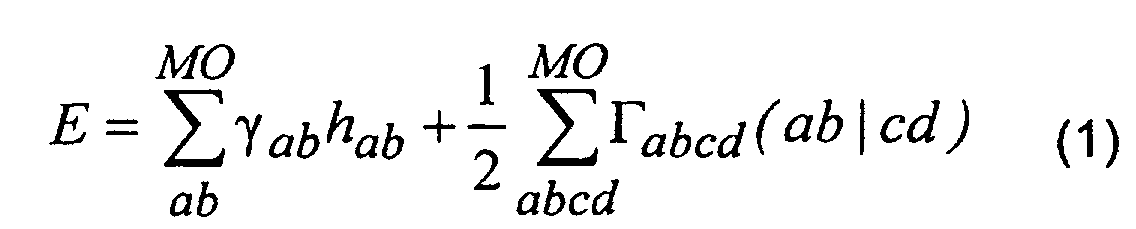 Here, MO indicates a molecular orbital and q indicates any of the nuclei x, y, and z of an atom forming a molecule. y and Γ indicate functions of a coefficient C of an electron configuration obtained through a solution that will be described later. hab and (ab|cd) are a 1-electron integration and a 2-electron integration at a molecular-orbital base and are obtained through hrs and (rs|tu) at an atomic orbital base. The hrs and (rs|tu) are defined as below.
 (where (ℎ = h/2π) )
 Here, h indicates Planck's constant. Further, Nuc. stands for Nuclei and indicates the number of atoms. Zi indicates the electrical charges of the nuclei and Ri indicates the positions of the nuclei. The relationship between s molecular orbital a and an atomic orbital χx is shown as below.
 The integrations of the Equations (3) and (4) are transformed from the atomic orbital base to the molecular orbital base according to the relationship, as shown below.
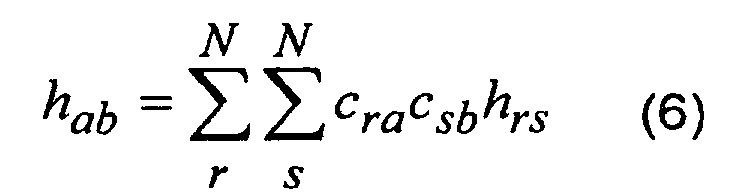 Here, N indicates the number of atomic orbitals. Although the present invention is provided under the assumption that the number of the atomic orbitals is one thousand or more, this method can be used for a case where the number is less than that. ca is a transformation matrix shown in Equation (5) for transforming the atomic orbital into the molecular orbital and referred to as a molecular-orbital coefficient. csb is another molecular-orbital coefficient. According to the MCSCF method, both the electron-configuration coefficient C and the molecular-orbital coefficient c are obtained by the variational method. However, the Cl method is different from the above-described method in that only the coefficient C is obtained.
- The electron-configuration coefficient C is obtained through the following equations.


- Here, CSF is a configuration state function. A wave function is given as the linear combination of this asymmetric determinant CSF. δIJ is Kronecker delta. Where an expression I=J stands, the value of δIJ is one. At all other times, the value thereof is zero.
- A predetermined amount is required for determining the molecular-orbital coefficient, as shown below.Here, Ubd is a matrix relating to linear transformation of the molecular orbital.

- In either the MCSCF method or the Cl method, generation of a 2-electron integration (ab|cd) at the molecular-orbital base constitutes most part of the computing cost. According to the complete active space SCF (CASSCF) method, which is a typical method of the MCSCF method, electron excitation is allowed only within a predetermined molecular-orbital range, so as to simplify the formula Where the number of molecular orbitals in the active space is determined to be n and the number of atomic-orbital bases therein is determined to be N, usually, the relationship between n and N is shown as n < < N. According to a known computing scheme, all the 2-electron integrations at the atomic-orbital bases are stored in a main memory or an external storage medium such as a disk, and transformation shown in Equation (7) is performed. The transformation algorithm is shown in Figs. 5 and 6. In the case of a simple eight-deep DO loop including indexes a, b, c, and d of the molecular orbital and indexes r, s, t, and u of the atomic orbital, n4N4 multiplication is required. However, according to the above-described algorithm, the same result as that of the eight-deep DO loop can be obtained by executing a five-deep DO loop four times, and the operand is shown as nN4 + n2N3 + n3N2 + n4N. For example, where n = 10 and N = 1000, the computing speed increases by about one thousand times. However, according to this method, many computer resources are required for storing the 2-electron integrations at the atomic-orbital bases and intermediate data midway through transformation. Therefore, this method is not suitable for calculating large-sized molecules.
- In recent years, computers have achieved high-speed operation by using parallel processors. Therefore, according to either the MCSCF method or the Cl method, the size of a molecule to be calculated by parallel processing needs to be increased and the computing cost needs to be decreased. The advantages of a parallel computer are shown below.
- 1. A high-speed operation computer can be achieved at low cost by connecting many commodity processors.
- 2. Through the use of many local memories of the processors, the computer obtains a large main-memory area, as a whole.
-
- The 2-electron integration at the atomic-orbital base and that at the molecular-orbital base are independent of each other. Therefore, where these integrations are parallelized based on this characteristic, the following problems arise. That is to say, since all the 2-electron integrations at N4 atomic-orbital bases are required for calculating one 2-electron integration at the molecular-orbital base,
- 1. distribution processing for distributing part of the 2-electron integrations at the atomic-orbital bases to the processors is performed, whereby all the N4 2-electron integrations have to be collected by each of the processors, which generates intercommunications between all the processors and become a bottleneck in communications, even though the integration-computing time can be reduced by parallelization.
- 2. Since all the integrations at the N4 atomic-orbital bases need to be calculated in each of the processors for reducing the bottleneck in communications, the reduction of computing time through the parallelization cannot be achieved.
-
- Thus, the above-described problems are mutually contradictory to each other.
- Further, the computing performed according to Equation (2) and the integration of the molecular-orbital base are required for obtaining the derivative of a 2-electron integration with respect to a nuclear coordinate. In this case, problems same as the above-described problems occur.
- The object of the present invention is to provide a parallel computing method for solving the above-described problems by using a parallel computer having a plurality of processors.
- The parallel computing method according to the present invention will now be described as below.
- (1) A parallel computing method by using a parallel computer having a plurality of processors, wherein when a 2-electron integration is transformed from an atomic-orbital base (rs|tu) to a molecular-orbital base (ab|cd), indexes r and s of an atomic orbital to be calculated are designated for the plurality of processors and each of the plurality of processors performs processing for all combinations of designated indexes R and S, and indexes t and u of the atomic orbital to be calculated.
- (2) A parallel computing method by using a parallel computer having a plurality of processors, wherein when a 2-electron integration is transformed from an atomic-orbital base (rs|tu) to a molecular-orbital base (ab|cd), indexes r and s of an atomic orbital to be calculated are designated for the plurality of processors and each of the plurality of processors performs processing for all combinations of designated indexes r and s, and indexes t and u of the atomic orbital to be calculated, whereby data to be processed is divided so that grain sizes indicating the workload for the plurality of processors are equalized.
- (3) In a parallel computing method according to the processing (1) or the
processing (2),
data transfer is not performed between the plurality of processors during the 2-electron integration computing and gathering is performed only once after the processing performed by the plurality of processors, so as to obtain the sum of data processed by the plurality of processors. - (4) In a parallel computing method according to the processing (1) or the
processing (2),
each of the plurality of processors - 1) calculates a 2-electron integration (RS|tu) at an atomic-orbital base for all combinations of R and S designated for each of the processors, and t and u,
- 2) performs transformation from u to d for the calculated 2-electron integration,
- 3) performs transformation from t to c for the data transformed through the processing 2),
- 4) performs transformation from S to B that is a component of b for the data transformed through the processing 3),
- 5) performs transformation from R to A that is a component of a for the data transformed through the processing 4),
- 6) stores the data transformed through the processing 5) in a local memory of each of the processors, and
- 7) finally performs gathering, thereby obtaining the 2-electron integration (ab|cd) at the molecular-orbital base.
- (5) In a parallel computing method according to the processing (1) or the
processing (2),
each of the plurality of processors - 1) calculates a 2-electron integration (RS|tu) at an atomic-orbital base for all combinations of R and S designated for each of the processors, and t and u,
- 2) performs transformation from u to d for the calculated 2-electron integration,
- 3) performs transformation from t to c for the data transformed through the processing 2),
- 4) performs transformation from S to B that is a component of b for the data transformed through the processing 3),
- 5) does not transform R but stores in a local memory of each of the plurality of processors, as Vcbd(RS), and
- 6) calculates the product sum of a transformation coefficient from R to a, a transformation coefficient between molecular orbitals, and the Vcbd(RS), and stores the computing result in a local memory of each of the plurality of processors in repetition computings for Yac indicating an amount required for determining a molecular-orbital coefficient.
- (6) A parallel computing method by using a parallel computer having a plurality of processors, wherein a secondary density matrix Γ at a molecular-orbital base is transferred to each of the plurality of processors and inversely transformed from the molecular-orbital base to an atomic-orbital base in each of the plurality of processors, whereby indexes r and s of an atomic orbital to be calculated are designated for the plurality of processors, processing is performed for all combinations of the designated indexes R and S, and indexes t and u of the atomic orbital to be calculated, and data to be processed is divided so that grain sizes indicating a workload for the plurality of processors are equalized, where a derivative of a 2-electron integration with respect to an atomic-nuclear coordinate is calculated.
-
-
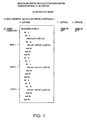
- Fig. 1 illustrates the first-half of distribution processing performed between processors, where the distribution processing is performed for 2-electron-integration transformation according to the present invention.
- Fig. 2 illustrates the latter-half of the distribution processing performed between the processors, where the distribution processing is performed for the 2-electron-integration transformation according to the present invention.
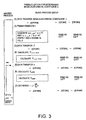
- Fig. 3 illustrates distribution processing performed between the processors, where the distribution processing is performed for molecular-orbital-coefficient determination repetition computing according to the present invention.
- Fig. 4 illustrates a parallel algorithm obtained through inverse transformation of a secondary density matrix Γ from the molecular-orbital base to the atomic-orbital base according to the present invention.
- Fig. 5 illustrates
steps 1 to 3 of 4N5 transformation algorithm used for transforming a 2-electron integration from an atomic-orbital base to a molecular-orbital base. - Fig. 6 illustrates
step 4 of the 4N5 transformation algorithm used for transforming the 2-electron integration from the atomic-orbital base to the molecular-orbital base. -
- Modes of the present invention will now be described.
- According to the inventors of the present invention, since a 2-electron integration at an atomic-orbital base and a derivative with respect to an atomic-nuclear coordinate are independent of each other, parallelization by using indexes r and s of an atomic orbital is required for transformation from the atomic-orbital base to a molecular-orbital base. (That is to say, the indexes r and s of an atomic orbital to be calculated are designated for the plurality of processors and all the combinations of the designated indexes r and s, and indexes t and u are calculated in each of the processors, so that data to be processed is divided for obtaining equalized grain sizes. Parallelization is performed by the indexes r and s, and computing for all the combinations of these indexes and the indexes t and u is performed in each of the processors. Therefore, floating-point arithmetic needs to be performed on an average of ten thousand times for one 2-electron integration. Subsequently, each of the processors has to perform 10000N2 computings, whereby sufficiently large grain sizes can be obtained. The grain sizes need to be equalized and maximized, and the number of transfer between the processors needs to be decreased for increasing parallel-computing performance. This configuration will be illustrated later. According to computing procedures of the present invention, data transfer is not performed between the processors during the 2-electron-integration computing and gathering is performed once after the transformation.
- According to a solution for obtaining a coefficient C of electron configuration, parallelization is performed by the indexes r and s of the atomic orbital. The computing procedures in each of the processors are described below.
- 1) A 2-electron integration (RS|tu) at the atomic-orbital base is calculated for all the combinations of R and S designated for each processor, and t and u.
- 2) Transformation from u to d is performed for the calculated 2-electron integration.
- 3) Transformation from t to c is performed.
- 4) Transformation from S to B is performed.
- 5) Transformation from R to A is performed. The transformation data is stored in a local memory of each of the processors. Finally, gathering is performed for obtaining a 2-electron integration (ab|cd) at the molecular-orbital base.
-
- According to a repetition solution for obtaining a coefficient c of the molecular orbital, parallelization is performed by the indexes r and s of the atomic orbital. The computing procedures performed in each of the processors are described below.
- 1) A 2-electron integration (RS|tu) at the atomic-orbital base is calculated for all the combinations of R and S designated for each processor, and t and u.
- 2) Transformation from u to d is performed for the calculated 2-electron integration.
- 3) Transformation from t to c is performed.
- 4) Transformation from S to B is performed.
- 5) R is not transformed but stored in the local memory, as Vcbd(RS).
- 6) The product sum of a transformation coefficient (CRa) from R to a and a transformation coefficient (ubd) between the molecular orbitals is calculated concurrent with repetition computing of Yac (see Equation (13). Since the local memory of each processor stores Vcbd(RS) having a little amount of data, a work area on the main memory is prevented from being increased due to the repetition computing.
-
- In the energy-gradient computing, the secondary-density matrix Γ at the molecular-orbital base is transferred to each of the processors and inverse transformation from the molecular-orbital base to the atomic-orbital base is performed. Subsequently, parallelization is performed by the indexes r and s of the atomic orbital, whereby the configuration becomes the same as in the case of the 2-electron-integration computing. In this case, the derivative of only an atomic orbital r with respect to a nuclear coordinate needs to be obtained.
- Embodiments of the present invention will now be described.
- According to solutions for obtaining the electron-configuration coefficient C and the molecular-orbital coefficient c according to the MCSCF method and the electron-configuration coefficient C in the Cl method, a repetition solution is widely used for reducing the work area on a main memory. Therefore, intermediate data such as the 2-electron integration at the molecular-orbital base needs to be stored. The parallel computer can store the intermediate data due to the above-described advantage given under 2. (Through the use of many local memories of the processors, the computer obtains a large main memory area, as a whole.). On the other hand, since the repetition computing is unnecessary for the energy-gradient computing, the present invention achieves a parallel algorithm based on basic ideas given under 1) and 2).
- 1) For determining the electron-configuration coefficient C and the molecular-orbital coefficient c, where the relationship between n and N is shown as n << N, intermediate data such as the 2-electron integration at the molecular-orbital base, where the amount of the 2-electron integration is little, is stored on the main memory on each of the processors and used repetitively
- 2) In the energy-gradient computing, γ and Γ of the molecular-orbital
base are inversely transformed to the atomic-orbital base and subjected to
parallel computing based on an equation for the atomic-orbital base, as shown
below.

-
- Here, AO stands for an atomic orbital. W indicates an amount used for the energy-gradient method. This amount is obtained by calculating the product of orbital energy and the molecular-orbital coefficient. Further, Srs indicates an overlap integration.
- First, a method for generating a 2-electron integration at a molecular-orbital base is described, where the molecular-orbital base belongs to an active space required for determining the electron-configuration coefficient C. Parallelization is performed by the indexes r and s of the atomic orbital. Further, a 2-electron integration (RS|tu) at the atomic-orbital base is calculated for all t and u in each of the processors. The basic algorithm is shown in Figs. 1 and 2. Here, R and S of the indexes of the atomic orbital, where the indexes are designated as r and s, indicate an atomic orbital allocated to a predetermined processor. An equation is provided as below.Here, according to the relationship shown in Equation (5), A and B include only R and S designated for each processor, where the R and S is included in linear-combination components of atomic orbitals r and s with reference to molecular orbitals a and b. Finally, (AB|cd) is gathered, whereby correct (ab|cd) is obtained. According to this relationship, the computing procedures performed in each of the processors are provided as below.

- 1) A 2-electron integration (RS|tu) at the atomic-orbital base is calculated for all the combinations of R and S designated for each processor, and t and u.
- 2) Transformation from u to d is performed for the calculated 2-electron integration.
- 3) Transformation from t to c is performed.
- 4) Transformation from S to B is performed.
- 5) Transformation from R to A is performed. It should be noted that no communications between the processors are generated during the steps 1) to 5) are performed and that the number of the 2-electron integrations at the atomic-orbital bases to be calculated in all the processors becomes N4. Finally, (AB|cd) on each of the processors is gathered, so as to obtain (ab|cd). The transfer amount is n4 at most. Since n is the order of 10 and the transfer is performed in one direction to a master processor, the transfer time presents no problem. Further, where the number of the processors is small, R and S may be grouped, as required, for achieving parallelization in a like manner. The number of entire computings according to known methods is nN4 + n2N3 + n3N2 + n4N, as described above. According to this method, however, since computings at
-
- Next, parallelization of Equation (10) necessary for determining the molecular-orbital coefficient c will be described. Part of Equation (10) is now shown as the atomic-orbital base.

- Further, according to Equation (12), Yac(RS) can also be gathered, where it is determined to be a part calculated in each of the processors (CPU: Central Processing Unit). It should be noted that the value of transfer-data amount is N2. Subsequently, yac can be obtained through performing parallelization by r and s and gathering Yac(RS) calculated in each of the processors. The data flow is shown in Fig. 3. The reason why data is stored, as Vcbd(RS), in each of the processors is shown below. Since a and b in Equation (10) become all the molecular orbitals in principle, the dimension number thereof is N, where the dimension number of x and y is n. Subsequently, the size of the first and second terms becomes n2N2. Since r is stored without being transformed, the number of computings increases. However, the size of the work area is reduced to n2N. Further, where (ab|xy) is gathered, the data amount becomes n2N2. However, the amount is cut to N2 by calculating the sum of x and y in each of the processors before the transfer, whereby the transfer data amount reduces.
- Finally, parallelization of 2-electron integrations by an atomic-nuclear coordinate will now be described. This parallelization is performed for the energy-gradient computing. As described above, this computing method does not require repetition computings. Therefore, the parallelization is achieved by transferring Γ whose data amount is as small as n4 to each of the processors and inversely transforming it from the molecular-orbital base to the atomic-orbital base. This inverse-transformation algorithm is shown in Fig. 4. The parallelization is performed by using r and s and computings are performed for all t and u, as in the case of an ordinary 2-electron integration, except that the depth number of the DO loop is seven. The second term of Equation (11) calculated by each of the processors is added to an array keeping a force applied to an atomic nucleus on the processor, and gathered. The size of the array is 3 x the atom number and does not become a bottleneck in transfer. The number of computings for the inverse transformation of Γ is the same as that of the known methods.
- According to the above-described parallel algorithm, the parallelization is performed by the indexes r and s of the atomic orbital. Therefore, the grain sizes are equalized, as the number of processors increases, whereby high scalability is maintained. Further, since the suitable number of processors is N2, this method can be used for one million parallel computers, where N = 1000.
- The following Tables 1 and 2 illustrate the known computing method, the computing number of this method, and expressions of computings performed in the work area. Although the computing number increases a little due to the parallelization, the size of the work area in each of the processors decreases by a factor of N2. Subsequently, this algorithm can effectively use inexpensive local memories.
Comparison between computing amount and work area for 2-electron integration transformation according to known transformation method, and those according to transformation method of the present invention N5 multiplication method This method (Note 1) Computing Amount Work Area Computing Amount Work Area STEP 1 N4n N4+N3n N2n N2+Nn STEP 2 N3n2 N3n+N2n2 Nn2 Nn+n2 STEP 3 N2n3 N2n2+Nn3 n3 n2+n3 STEP 4 Nn4 Nn3+n4 n4 n3+n4 Gathering - - N2n4 Note 1) where N2 processors are used Comparison between computing amount and work area for molecular-orbital coefficient determination according to known transformation method, and those according to transformation method of the present invention N5 multiplication method This method (Note 1) Computing Amount Work Area Computing Amount Work Area STEP 1 N4n N4+N3n N2n N2+Nn STEP 2 N3n2 N3n+N2n2 Nn2 Nn+n2 STEP 3 N3n2 2(N2n2) Nn2 n2+Nn2 STEP 4 N3n2 2(N2n2) N2n2 Nn2+Nn3 Gathering - - N2 Note 1) where N2 processors are used - As has been described, the present invention provides a parallel computing method using a parallel computer having a plurality of processors. According to this method, where a 2-electron integration is transformed from an atomic-orbital base (rs|tu) to a molecular-orbital base (ab|cd), indexes r and s of an atomic orbital to be calculated are designated for the plurality of processors. Further, each of the plurality of processors performs processing for all the combinations of designated indexes R and S, and indexes t and u of the atomic orbital to be calculated. Therefore, equalized grain sizes are obtained and many commodity processors can be connected to the parallel computer, with high performance. Therefore, the cost of the high-speed operation computer reduces. Further, since the computer can use inexpensive local memories, it can secure a large main-memory area, as a whole.
Claims (9)
- A parallel computing method by using a parallel computer having a plurality of processors, wherein when a 2-electron integration is transformed from an atomic-orbital base (rs|tu) to a molecular-orbital base (ab|cd), indexes r and s of an atomic orbital to be calculated are designated for the plurality of processors and each of the plurality of processors performs processing for all combinations of designated indexes R and S, and indexes t and u of the atomic orbital to be calculated.
- A parallel computing method by using a parallel computer having a plurality of processors, wherein when a 2-electron integration is transformed from an atomic-orbital base (rs|tu) to a molecular-orbital base (ab|cd), indexes r and s of an atomic orbital to be calculated are designated for the plurality of processors and each of the plurality of processors performs processing for all combinations of the designated indexes r and s, and indexes t and u of the atomic orbital to be calculated, whereby data to be processed is divided so that grain sizes indicating the workload for the plurality of processors are equalized.
- A parallel computing method according to Claim 1,
wherein data transfer is not performed between the plurality of processors during the 2-electron integration computing and wherein gathering is performed only once after the processing performed by the plurality of processors, so as to obtain the sum of data processed by the plurality of processors. - A parallel computing method according to Claim 2,
wherein data transfer is not performed between the plurality of processors during the 2-electron integration computing and wherein gathering is performed only once after the processing performed by the plurality of processors, so as to obtain the sum of data processed by the plurality of processors. - A parallel computing method according to Claim 1,
wherein each of the plurality of processors(1) calculates a 2-electron integration (RS|tu) at an atomic-orbital base for all combinations of R and S designated for each of the processors, and t and u,(2) performs transformation from u to d for the calculated 2-electron integration,(3) performs transformation from t to c for the data transformed through the processing (2),(4) performs transformation from S to B that is a component of b for the data transformed through the processing (3),(5) performs transformation from R to A that is a component of a for the data transformed through the processing (4),(6) stores the data transformed through the processing (5) in a local memory of each of the processors, and(7) finally performs gathering, thereby obtaining the 2-electron integration (ab|cd) at the molecular-orbital base. - A parallel computing method according to Claim 2,
wherein each of the plurality of processors(1) calculates a 2-electron integration (RS|tu) at an atomic-orbital base for all the combinations of R and S designated for each of the processors, and t and u,(2) performs transformation from u to d for the calculated 2-electron integration,(3) performs transformation from t to c for the data transformed through the processing (2),(4) performs transformation from S to B that is a component of b for the data transformed through the processing (3),(5) performs transformation from R to A that is a component of a for the data transformed through the processing (4),(6) stores the data transformed through the processing (5) in a local memory of each of the processors, and(7) finally performs gathering, thereby obtaining the 2-electron integration (ab|cd) at the molecular-orbital base. - A parallel computing method according to Claim 1,
wherein each of the plurality of processors(1) calculates a 2-electron integration (RS|tu) at an atomic-orbital base for all the combinations of R and S designated for each of the processors, and t and u,(2) performs transformation from u to d for the calculated 2-electron integration,(3) performs transformation from t to c for the data transformed through the processing (2),(4) performs transformation from S to B that is a component of b for the data transformed through the processing (3),(5) does not transform R but stores in a local memory of each of the plurality of processors, as Vcbd(RS), and(6) calculates the product sum of a transformation coefficient from R to a, a transformation coefficient between molecular orbitals, and the Vcbd(RS), and stores the computing result in a local memory of each of the plurality of processors in repetition computings for Yac indicating an amount required for determining a molecular-orbital coefficient. - A parallel computing method according to Claim 2,
wherein each of the plurality of processors(1) calculates a 2-electron integration (RS|tu) at an atomic-orbital base for all combinations of R and S designated for each of the processors, and t and u,(2) performs transformation from u to d for the calculated 2-electron integration,(3) performs transformation from t to c for the data transformed through the processing (2),(4) performs transformation from S to B that is a component of b for the data transformed through the processing (3),(5) does not transform R but stores in a local memory of each of the plurality of processors, as Vcbd(RS), and(6) calculates the product sum of a transformation coefficient from R to a, a transformation coefficient between molecular orbitals, and the Vcbd(RS), and stores the computing result in a local memory of each of the plurality of processors in repetition computings for Yac indicating an amount required for determining a molecular-orbital coefficient. - A parallel computing method by using a parallel computer having a plurality of processors, wherein a secondary density matrix Γ at a molecular-orbital base is transferred to each of the plurality of processors and inversely transformed from the molecular-orbital base to an atomic-orbital base in each of the plurality of processors, whereby indexes r and s of an atomic orbital to be calculated are designated for the plurality of processors, processing is performed for all combinations of the designated indexes R and S, and indexes t and u of the atomic orbital to be calculated, and data to be processed is divided so that grain sizes indicating a workload for the plurality of processors are equalized, where a derivative of a 2-electron integration with respect to an atomic-nuclear coordinate is calculated.
Applications Claiming Priority (3)
| Application Number | Priority Date | Filing Date | Title |
|---|---|---|---|
| JP2001292092A JP3990130B2 (en) | 2001-09-25 | 2001-09-25 | Parallel computing method |
| JP2001292092 | 2001-09-25 | ||
| PCT/JP2002/009871 WO2003027873A1 (en) | 2001-09-25 | 2002-09-25 | Parallel calculation method |
Publications (2)
| Publication Number | Publication Date |
|---|---|
| EP1443415A1 true EP1443415A1 (en) | 2004-08-04 |
| EP1443415A4 EP1443415A4 (en) | 2014-01-08 |
Family
ID=19114126
Family Applications (1)
| Application Number | Title | Priority Date | Filing Date |
|---|---|---|---|
| EP02768061.0A Withdrawn EP1443415A4 (en) | 2001-09-25 | 2002-09-25 | PARALLEL CALCULATION METHOD |
Country Status (6)
| Country | Link |
|---|---|
| US (1) | US7343277B2 (en) |
| EP (1) | EP1443415A4 (en) |
| JP (1) | JP3990130B2 (en) |
| KR (1) | KR100639819B1 (en) |
| CN (1) | CN1714349A (en) |
| WO (1) | WO2003027873A1 (en) |
Cited By (1)
| Publication number | Priority date | Publication date | Assignee | Title |
|---|---|---|---|---|
| WO2015009046A1 (en) * | 2013-07-18 | 2015-01-22 | 주식회사 엘지화학 | Molecular orbital library having exclusive molecular orbital distribution, molecular orbital distribution region evaluation method using same, and system using same |
Families Citing this family (3)
| Publication number | Priority date | Publication date | Assignee | Title |
|---|---|---|---|---|
| JP4612546B2 (en) * | 2003-09-22 | 2011-01-12 | 日本電気株式会社 | Parallel computing method and apparatus |
| US8454748B2 (en) * | 2005-12-27 | 2013-06-04 | Semiconductor Energy Laboratory Co., Ltd. | Method of calculating carrier mobility |
| CN114946189B (en) | 2019-11-13 | 2025-01-14 | Lg电子株式会社 | Transformation-based image coding method and device |
Family Cites Families (4)
| Publication number | Priority date | Publication date | Assignee | Title |
|---|---|---|---|---|
| JPH0950458A (en) * | 1995-08-10 | 1997-02-18 | Hitachi Ltd | Two-electron integral calculation method for molecular orbitals |
| JP3033511B2 (en) * | 1997-03-03 | 2000-04-17 | 富士ゼロックス株式会社 | Large-scale product-sum operation processing method and apparatus |
| JP2000293494A (en) * | 1999-04-09 | 2000-10-20 | Fuji Xerox Co Ltd | Parallel computing device and parallel computing method |
| US20030167159A1 (en) * | 2001-10-04 | 2003-09-04 | California Institute Of Technology | Method for determining molecular surface areas and volumes |
-
2001
- 2001-09-25 JP JP2001292092A patent/JP3990130B2/en not_active Expired - Fee Related
-
2002
- 2002-09-25 US US10/490,703 patent/US7343277B2/en not_active Expired - Fee Related
- 2002-09-25 CN CNA028187067A patent/CN1714349A/en active Pending
- 2002-09-25 KR KR1020047004222A patent/KR100639819B1/en not_active Expired - Fee Related
- 2002-09-25 EP EP02768061.0A patent/EP1443415A4/en not_active Withdrawn
- 2002-09-25 WO PCT/JP2002/009871 patent/WO2003027873A1/en not_active Ceased
Non-Patent Citations (5)
| Title |
|---|
| G D Fletcher ET AL: "DEVELOPMENTS IN PARALLEL ELECTRONIC STRUCTURE THEORY" In: "Advances in Chemical Physics, Volume 110", 1999, John Wiley & Sons, XP055090855, ISBN: 978-0-47-133180-3 pages 267-294, DOI: 10.1002/9780470141694, * page 284 - page 286 * * |
| MARTIN SCHÜTZ ET AL: "An integral direct, distributed-data, parallel MP2 algorithm", THEOR CHIM ACTA, vol. 95, no. 1-2, 1997, pages 13-34, XP055090866, ISSN: 0040-5744, DOI: 10.1007/BF02329239 * |
| See also references of WO03027873A1 * |
| THERESA L WINDUS ET AL: "Parallel algorithm for integral transformations and GUGA MCSCF", THEOR CHIM ACTA, no. 1, 1994, pages 77-88, XP055090868, ISSN: 0040-5744, DOI: 10.1007/BF01123871 * |
| WONG A T ET AL: "Parallel direct four-index transformations", THEORETICA CHIMICA ACTA, SPRINGER VERLAG, DE, vol. 93, no. 6, June 1996 (1996-06), pages 317-331, XP002962980, ISSN: 0040-5744 * |
Cited By (3)
| Publication number | Priority date | Publication date | Assignee | Title |
|---|---|---|---|---|
| WO2015009046A1 (en) * | 2013-07-18 | 2015-01-22 | 주식회사 엘지화학 | Molecular orbital library having exclusive molecular orbital distribution, molecular orbital distribution region evaluation method using same, and system using same |
| KR20150010106A (en) * | 2013-07-18 | 2015-01-28 | 주식회사 엘지화학 | A comprehensive molecular orbitals library having exclusive molecular orbital distributions, the method for estimating the molecular orbitals distributions region using the same and the system using the same |
| US10133851B2 (en) | 2013-07-18 | 2018-11-20 | Lg Chem, Ltd. | Molecular orbital library having exclusive molecular orbital distribution, molecular orbital distribution region evaluation method using same, and system using same |
Also Published As
| Publication number | Publication date |
|---|---|
| JP2003099408A (en) | 2003-04-04 |
| EP1443415A4 (en) | 2014-01-08 |
| KR100639819B1 (en) | 2006-10-30 |
| US7343277B2 (en) | 2008-03-11 |
| KR20040054693A (en) | 2004-06-25 |
| CN1714349A (en) | 2005-12-28 |
| WO2003027873A1 (en) | 2003-04-03 |
| US20040260529A1 (en) | 2004-12-23 |
| JP3990130B2 (en) | 2007-10-10 |
Similar Documents
| Publication | Publication Date | Title |
|---|---|---|
| US8756268B2 (en) | Montgomery multiplier having efficient hardware structure | |
| US11544213B2 (en) | Neural processor | |
| US11899741B2 (en) | Memory device and method | |
| CN115345287B (en) | Methods for computing macro arrangements in memory, computer-readable media and electronic devices | |
| CN115527629B (en) | Data processing method and device for quantum chemical system | |
| EP3968238B1 (en) | Operation method of host processor and accelerator, and electronic device including the same | |
| Date et al. | Level 2 reformulation linearization technique–based parallel algorithms for solving large quadratic assignment problems on graphics processing unit clusters | |
| Morimoto et al. | Hardware acceleration of tensor-structured multilevel ewald summation method on MDGRAPE-4A, a special-purpose computer system for molecular dynamics simulations | |
| US7343277B2 (en) | Parallel computing method for total energy and energy gradient of non experience molecular-orbital method | |
| Scheiber et al. | Reduced Sampling Overhead for Probabilistic Error Cancellation by Pauli Error Propagation | |
| Dupuis | New integral transforms for molecular properties and application to a massively parallel GIAO-SCF implementation | |
| US12229105B2 (en) | Indexing elements in a source array | |
| Foster | Results on gradients of harmonic functions on Lipschitz surfaces: B. Foster | |
| Arbenz et al. | A comparison of eigensolvers for large-scale 3D modal analysis using AMG-preconditioned iterative methods | |
| CN117724847A (en) | Method, device, computing equipment and storage medium for determining VASP software parallel parameters | |
| Almlöf et al. | Computational aspects of direct SCF and MCSCF methods | |
| Qi et al. | MHDiff: Memory-and Hardware-Efficient Diffusion Acceleration via Focal Pixel Aware Quantization | |
| Lacopo et al. | Green computing toward ska era with rick | |
| Yokogawa et al. | GPU‐Accelerated One‐Electron Integral Computation for Quantum Chemistry | |
| Chen et al. | FusionMSM: A Collision-Free and Arithmetic-Optimized FPGA-based Accelerator for Multi-Scalar Multiplication | |
| EP4742052A1 (en) | Memory device and operating method with data format operation | |
| US20260056737A1 (en) | Matrix multiply engine | |
| KR102593034B1 (en) | An in-storage date reorganization accelerator for multidimensional database | |
| US20260133758A1 (en) | Method and apparatus with in-memory operation performing scale cascading | |
| Chen et al. | UACT: A Unified Energy-efficient Computing Architecture for CNN and TCNN |
Legal Events
| Date | Code | Title | Description |
|---|---|---|---|
| PUAI | Public reference made under article 153(3) epc to a published international application that has entered the european phase |
Free format text: ORIGINAL CODE: 0009012 |
|
| 17P | Request for examination filed |
Effective date: 20040420 |
|
| AK | Designated contracting states |
Kind code of ref document: A1 Designated state(s): DE FR GB |
|
| RAP1 | Party data changed (applicant data changed or rights of an application transferred) |
Owner name: NEC CORPORATION Owner name: JAPAN SCIENCE AND TECHNOLOGY AGENCY |
|
| A4 | Supplementary search report drawn up and despatched |
Effective date: 20131209 |
|
| RIC1 | Information provided on ipc code assigned before grant |
Ipc: G06F 17/13 20060101ALI20131203BHEP Ipc: G06F 17/10 20060101AFI20131203BHEP Ipc: G06F 19/16 20110101ALI20131203BHEP |
|
| STAA | Information on the status of an ep patent application or granted ep patent |
Free format text: STATUS: THE APPLICATION HAS BEEN WITHDRAWN |
|
| 18W | Application withdrawn |
Effective date: 20140117 |