EP1443243A2 - Cord lock device and an article including such device - Google Patents
Cord lock device and an article including such device Download PDFInfo
- Publication number
- EP1443243A2 EP1443243A2 EP03028455A EP03028455A EP1443243A2 EP 1443243 A2 EP1443243 A2 EP 1443243A2 EP 03028455 A EP03028455 A EP 03028455A EP 03028455 A EP03028455 A EP 03028455A EP 1443243 A2 EP1443243 A2 EP 1443243A2
- Authority
- EP
- European Patent Office
- Prior art keywords
- cord
- panel
- locking device
- base
- maneuvering member
- Prior art date
- Legal status (The legal status is an assumption and is not a legal conclusion. Google has not performed a legal analysis and makes no representation as to the accuracy of the status listed.)
- Granted
Links
Images

Classifications
-
- F—MECHANICAL ENGINEERING; LIGHTING; HEATING; WEAPONS; BLASTING
- F16—ENGINEERING ELEMENTS AND UNITS; GENERAL MEASURES FOR PRODUCING AND MAINTAINING EFFECTIVE FUNCTIONING OF MACHINES OR INSTALLATIONS; THERMAL INSULATION IN GENERAL
- F16G—BELTS, CABLES, OR ROPES, PREDOMINANTLY USED FOR DRIVING PURPOSES; CHAINS; FITTINGS PREDOMINANTLY USED THEREFOR
- F16G11/00—Means for fastening cables or ropes to one another or to other objects; Caps or sleeves for fixing on cables or ropes
- F16G11/10—Quick-acting fastenings; Clamps holding in one direction only
- F16G11/101—Quick-acting fastenings; Clamps holding in one direction only deforming the cable by moving a part of the fastener
-
- A—HUMAN NECESSITIES
- A41—WEARING APPAREL
- A41D—OUTERWEAR; PROTECTIVE GARMENTS; ACCESSORIES
- A41D2200/00—Components of garments
- A41D2200/20—Hoods
-
- Y—GENERAL TAGGING OF NEW TECHNOLOGICAL DEVELOPMENTS; GENERAL TAGGING OF CROSS-SECTIONAL TECHNOLOGIES SPANNING OVER SEVERAL SECTIONS OF THE IPC; TECHNICAL SUBJECTS COVERED BY FORMER USPC CROSS-REFERENCE ART COLLECTIONS [XRACs] AND DIGESTS
- Y10—TECHNICAL SUBJECTS COVERED BY FORMER USPC
- Y10T—TECHNICAL SUBJECTS COVERED BY FORMER US CLASSIFICATION
- Y10T24/00—Buckles, buttons, clasps, etc.
- Y10T24/39—Cord and rope holders
- Y10T24/3916—One-piece
Definitions
- the invention relates to a cord locking device and to an article, such as a garment, that includes such device.
- the invention relates to cord locks such as those found on goods, such as garments, luggage or shoes, on which a cord is slidably mounted on the goods so as to fulfill a tightening and/or closing function on the goods.
- the lock allows for the adjustment of the useful length of the cord.
- cord locks There are numerous types of cord locks, most of which are designed so as to be slidably mounted on the cord, without any connection to the goods on which the cord is mounted.
- the lock is then often constituted of two pieces that are movably mounted one with respect to the other and that are biased by a spring so as to be wedged on the cord.
- this type of lock is not very easy to use since it requires using both hands, that is, one hand to hold the cord and the other hand to handle the lock and move it with respect to the cord.
- U.S. Patent No. 5,263,202 a one-piece lock is disclosed that is provided to be enclosed in a fold of the garment with which it is associated, and that ensures a locking of the cord through a shearing effect.
- One drawback of this arrangement is that it is not easy to handle the lock to unlock the cord. As a matter of fact, the user does not see the lock and must proceed by trial and error.
- a locking device is disclosed that is adapted to be attached to a surface of a flexible panel, for example, a flap of fabric of a garment.
- This "cord stopper" is composed of three pieces: a base, a cover, and a plate that allows attaching the stopper to the panel in the manner of a rivet. This device is thus costly to produce.
- the locking of the cord is obtained by clamping the cord against a stationary wall, which is generally less efficient than a locking through a shearing effect.
- the invention provides for a lock that is simple and inexpensive to produce, and yet easy for the user to handle.
- the invention proposes a device for locking at least one cord, of the type having a base that is adapted to be attached to a panel and that has one inlet orifice and one outlet orifice for the cord, one of which is aligned with a hole of the flexible panel, and of the type having a maneuvering member that is movable with respect to the base, between a locking position and a sliding position, the maneuvering member being made in one piece with the base.
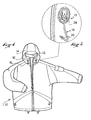
- FIG. 1 shows an example for using a device 10 (or lock) for locking a cord according to the invention.
- a lock can be used on an article, such as a garment, and, more specifically, such as a jacket 12, for example.
- the jacket 12 has a hood 14 that is provided with a tightening cord 16 adapted to adjust the size of the opening 18 for the face.
- the cord 16 runs through a sheath (not shown) that follows the edge of the opening 18.
- the two ends, or end portions, 20 of the cord 16 project from the area of the two ends of the sheath.
- the cord can have various forms depending upon the application envisioned. In the case of the garment shown, it is preferable that a flexible cord be used. In certain cases, one can use an extensible cord. In other cases, a cord having a very low extensibility is preferred, for example, a cord having a core reinforced by polyaramid fibers.
- an arrangement for locking the cord at each of the ends of the sheath can be provided.
- a locking device that is automatic, that is, that automatically locks the cord.
- the locking device 10 encompassed by the invention is adapted to cover the hole corresponding to the opening end of the sheath, such that the cord emerges outside of the sheath by passing through the lock 10.
- the device according to the invention is therefore adapted to be attached to a panel, in this case, a fabric panel, in alignment with a hole provided in this panel and through which the cord passes.
- the lock 10 has a base 22 that is adapted to allow attaching the lock 10 to the panel.
- This base has a portion in the form of a ring 24 that extends in a plane that will hereinafter be considered, for convenience of description, to be horizontal. Indeed, the description that follows will mainly refer to FIGS. 3 and 4, and the geometric terms used, such as horizontal, vertical, longitudinal, transverse, etc., refer to the position of the lock in these figures, without these terms being interpreted as limiting the scope of the invention.
- the ring 24 In its center, the ring 24 reveals an orifice 26 that is adapted to be positioned in alignment with the hole of the panel through which the cord 16 passes.
- the planar, or substantially planar, ring 24 allows for the attachment of the lock 10 on the panel through various techniques; these techniques can vary, depending on the material of the lock 10, or depending on the material of the panel.
- the panel In the example shown in FIG. 1, the panel is a flexible panel made of fabric, and the lock 10 is made by molding a plastic material, for example, polyamide.
- the planar ring 24 has a vertical thickness on the order of 1 millimeter (mm), and attaching the ring on the panel can be achieved by a stitched seam 28, as shown in FIG. 2, but also by gluing or by ultrasonic sealing.
- the ring 24 is not necessarily planar and that it could also extend along a tridimensional surface.
- a wall rises from the inner edge of the ring 24, which forms a dome 30 above the orifice 26, and which closes this orifice 26 such that, when seen from the top, the dome 30 hides the orifice 26 and, consequently, the panel hole.
- a cutout 32 demarcates what will be designated by the term maneuvering member 34. Seen from the top, the cutout 32 has a form that is similar to that of a "U" with two longitudinal edges 36 and a transverse edge 38.
- the maneuvering member 34 that is demarcated by this cutout 32 is therefore attached to the remainder of the wall shaped like a dome 30 by a linking zone 40 that is arranged opposite the transverse edge 38 of the U-shaped cutout, and that forms an articulation having a substantially transverse axis.
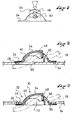
- the maneuvering member 34 is formed substantially at the top of the dome 30 such that it extends substantially along a horizontal direction and, when in use, it can pivot from a sliding position, shown in FIG. 3, to a locking position, shown in FIG. 4.
- the maneuvering member 34 has a transverse wall 42 that extends vertically downward, along the transverse edge 38 of the cutout 32 toward the interior of the dome 30.
- This transverse wall 42 of the maneuvering member 34 has lateral extensions 44 that extend along the longitudinal edges 36 and allow rigidifying the transverse wall 42, and, generally speaking, the entire maneuvering member 34. Facing this transverse wall 42, the dome itself also has a transverse partition 46 that extends vertically downward from the transverse edge 38.
- the transverse wall 42 and the transverse partition 46 are each bored with a passage-hole (48 and 50, respectively) that substantially has the size of the diameter of the cord 16.
- a passage-hole 48 and 50, respectively
- the passage-holes 48, 50 are substantially aligned. In this position, one can insert the cord in the lock, for example, from outside of the dome 30, pass it through the two passage-holes 48, 50, and pull it out through the orifice 26 demarcated by the ring 24. In this sliding position, the cord can slide freely in the lock with very little interfering friction.
- the two holes 48, 50 are off-centered from each other. Since the wall 42 and the partition 46 are very close to each other (their spacing is preferably less than the diameter of the cord), the cord is immobilized by shearing. This shearing is at the outset of the forces of friction between the cord and the lock, which causes the locking. Nevertheless, it is to be understood that if one exerts a very substantial traction force on the cord, one can generate a sliding of the cord with respect to the lock. It has been noted, though, that the locking of the cord through a shearing effect had better results than a locking through a mere flattening of the cord against an immobilized obstacle. In the example shown, the locking position is a position in which the maneuvering member 34 is raised with respect to its sliding position.
- the maneuvering member is in its normal locking position, i.e., it returns automatically to its locking position, whereas, in order to bring it to its sliding position, the user must press vertically downward on the upper surface of the maneuvering member 34 to push the latter toward the ring 24.
- the elastic return of the maneuvering member 34 is ensured without using specific elements, by simply using the elastic property of the linking zone that forms the hinge between the maneuvering member 34 and the base 22.
- the maneuvering member 34 and the base 22 have, in the area of the transverse edge 38 of the U-shaped cutout, abutment surfaces that come into contact with each other when the maneuvering member reaches the sliding position.
- FIGS. 5 and 6 one can see the shape of the lock when it is free, i.e., when it is not subject to any force and when no cord is engaged therein.
- This position corresponds in fact to the molding configuration of the lock.
- the maneuvering member 34 is completely raised, such that even its vertical wall 42 is then outside of the space demarcated by the dome.
- it is by elastic deformation, particularly of the linking zone 40, that the maneuvering member 34 is brought towards its locking position and, even more so, towards its sliding position.
- the wall forming the dome 30 and the maneuvering member 34 can have an excess thickness, in this case a rib 52, so as to rigidify the linking zone 40, which allows increasing the capacity for locking the cord.
- each of the passage-holes 48, 50 has a profile that is circular over half of its contour and V-shaped over the other half of the contour.
- the profiles of the two holes 48, 50 are inverted and provided such that, in the locking position, the cord is pressed against the V-shaped portions of the hole profiles, and that these profiles generate a substantial necking effect on the cord.
- FIGS. 8 and 9 show two possibilities for mounting the lock 10 on a panel 54 having a hole 56 through which the cord 16 runs.
- the lock 10 is mounted above the panel, and it completely covers the hole 56. The lock therefore hides the hole and is completely accessible.
- the lock is mounted through the orifice 56.
- the upper surface of the attaching ring 24 is supported against the lower surface of the panel 54, the contour of the hole 56 substantially having the same shape as the ring 24.
- the dome 30 extends upward through the hole 56, so as to extend above the upper surface of the panel 54.
- the lock is aesthetically integrated completely into the panel 54, since the zone for attaching the lock is, for example, on the inner side of the garment, whereas the maneuvering member 34 is completely visible and accessible from the outside.
- the invention has been described herein in the case where only one cord passes through the lock. Nevertheless, one can easily design the device to receive several cords or several strands of a same cord.
- the lock can then be identical, since all of the cords or all of the strands pass through the orifices 26, 48, 50 of the base and maneuvering member.
- One can also provide for the orifices to be reduced, depending on the number of cords or strands.
- One can further provide for the lock to be equipped with several parallel maneuvering members to control the locking and unlocking of each cord separately.
Landscapes
- Engineering & Computer Science (AREA)
- General Engineering & Computer Science (AREA)
- Mechanical Engineering (AREA)
- Lock And Its Accessories (AREA)
- Details Of Garments (AREA)
- Clamps And Clips (AREA)
- Supports Or Holders For Household Use (AREA)
- Basic Packing Technique (AREA)
- Load-Engaging Elements For Cranes (AREA)
Abstract
Description
Claims (15)
- A device for locking at least one cord, said device comprising:a base adapted to be attached to a panel and comprising an inlet orifice and an outlet orifice for the cord;one orifice of said inlet and outlet orifices is arranged in alignment with a hole of the panel;a maneuvering member movable with respect to the base between a locking position and a sliding position, the maneuvering member being made in one piece with the base.
- A locking device according to claim 1, wherein the base and the maneuvering member are made in one piece as an injection-molded plastic assembly.
- A locking device according to claim 2, wherein the maneuvering member is movable from the locking position to the sliding position through elastic deformation.
- A locking device according to claim 1, wherein the maneuvering member and the base comprise respective abutment surfaces cooperable to determine the sliding position of the maneuvering member.
- A locking device according to claim 1, wherein the maneuvering member comprises a passage through which the cord runs, and wherein the passage is substantially aligned with one of the orifices of the base when the maneuvering member is in the sliding position, and off-set from said orifice when the maneuvering member is in the locking position, so as to lock the cord by shearing.
- A locking device according to claim 5, wherein the passage of the cord in the maneuvering member is inserted in the path of the cord between the inlet and outlet orifices of the base.
- A locking device according to claim 1, wherein one of the orifices of the base is demarcated by a zone for attaching the base to the panel.
- A locking device according to claim 7, wherein the attaching zone forms a closed contour.
- A locking device according to claim 7, wherein the attaching zone is attached to one side of the panel, and wherein at least the gripping member projects from the other side of the panel through the hole.
- A locking device according to claim 1, wherein the panel is a flexible panel.
- A locking device according to claim 1, wherein the base is attached to the panel by gluing, sealing, or stitched seam.
- A locking device according to claim 1, wherein the maneuvering member is movable along a general direction substantially perpendicular to a general plane of the panel to which the device is attached.
- A locking device according to claim 1, wherein the inlet orifice extends in a plane that is substantially perpendicular to a general plane of the panel to which the device is attached.
- A locking device according to claim 1, wherein the device can receive several cords or several strands of a same cord.
- A garment comprising a locking device according to claim 1.
Applications Claiming Priority (2)
| Application Number | Priority Date | Filing Date | Title |
|---|---|---|---|
| US10/355,004 US20040148742A1 (en) | 2003-01-31 | 2003-01-31 | Cord locking device and an article including such device |
| US355004 | 2003-01-31 |
Publications (3)
| Publication Number | Publication Date |
|---|---|
| EP1443243A2 true EP1443243A2 (en) | 2004-08-04 |
| EP1443243A3 EP1443243A3 (en) | 2004-10-06 |
| EP1443243B1 EP1443243B1 (en) | 2006-05-31 |
Family
ID=32655562
Family Applications (1)
| Application Number | Title | Priority Date | Filing Date |
|---|---|---|---|
| EP03028455A Expired - Lifetime EP1443243B1 (en) | 2003-01-31 | 2003-12-12 | Cord lock device and an article including such device |
Country Status (4)
| Country | Link |
|---|---|
| US (1) | US20040148742A1 (en) |
| EP (1) | EP1443243B1 (en) |
| AT (1) | ATE328224T1 (en) |
| DE (1) | DE60305628T2 (en) |
Cited By (1)
| Publication number | Priority date | Publication date | Assignee | Title |
|---|---|---|---|---|
| CN104455204A (en) * | 2014-12-11 | 2015-03-25 | 柳江县练氏科技有限公司 | One-way draw cord device |
Families Citing this family (9)
| Publication number | Priority date | Publication date | Assignee | Title |
|---|---|---|---|---|
| US7350275B2 (en) * | 2005-01-18 | 2008-04-01 | Illinois Tool Works Inc. | Attachment device |
| CN201057812Y (en) * | 2007-05-25 | 2008-05-14 | 利富高(香港)有限公司 | Fixing piece for thread rope |
| TWM336705U (en) * | 2008-02-15 | 2008-07-21 | Nifco Taiwan Corp | Rope fastener |
| US9795189B2 (en) | 2014-08-14 | 2017-10-24 | Thingz, Llc | Drawstring clamping device |
| WO2016117456A1 (en) * | 2015-01-20 | 2016-07-28 | 株式会社ニフコ | Cord lock |
| JP6436897B2 (en) | 2015-01-20 | 2018-12-12 | 株式会社ニフコ | Code lock |
| CN109219713B (en) * | 2016-05-31 | 2020-08-04 | 耐克创新有限合伙公司 | rope lock |
| US10527129B2 (en) | 2016-08-26 | 2020-01-07 | Nike, Inc. | Cord lock |
| US20180110276A1 (en) * | 2016-10-20 | 2018-04-26 | Belinda B. Cuffe | T-tag |
Family Cites Families (18)
| Publication number | Priority date | Publication date | Assignee | Title |
|---|---|---|---|---|
| US1879991A (en) * | 1929-05-31 | 1932-09-27 | William E Pratt Mfg Company | Live decoy halter |
| US3074135A (en) * | 1960-04-12 | 1963-01-22 | John A Di Lorenzo | Releasible lace fastener device |
| US3864790A (en) * | 1974-03-25 | 1975-02-11 | Jr Ernest William Reinwall | Rope lock device |
| JPS5334410U (en) * | 1976-08-31 | 1978-03-25 | ||
| US4270491A (en) * | 1979-10-16 | 1981-06-02 | Cox Jack R | Animal leash |
| SE435091B (en) * | 1983-01-31 | 1984-09-03 | Ergonomen Hb | HANDLE FOR A BAND HANDLE FOR A BAND |
| JPS6137810U (en) * | 1984-08-09 | 1986-03-08 | 日本ノ−シヨン工業株式会社 | string fixing device |
| US4769874A (en) * | 1985-03-20 | 1988-09-13 | Barry R. Schotz | Line retension device |
| US4646394A (en) * | 1986-01-08 | 1987-03-03 | American Cord & Webbing Co., Inc. | Cord lock |
| JPS63272302A (en) * | 1987-04-30 | 1988-11-09 | モリト株式会社 | String regulating and fixing jig and production thereof |
| US4878270A (en) * | 1989-05-09 | 1989-11-07 | Westerkamp Myron M | Rope tie-down apparatus |
| US5193252A (en) * | 1992-04-20 | 1993-03-16 | Svehaug Oswald C | Quick-release cleat |
| US5263202A (en) * | 1992-10-16 | 1993-11-23 | Patagonia, Inc. | Securing apparatus for clothing |
| JP3247020B2 (en) * | 1994-12-26 | 2002-01-15 | ワイケイケイ株式会社 | Cord stopper |
| DE69610684D1 (en) * | 1995-11-22 | 2000-11-23 | Danny Gold | Opening and closing mechanism for one-handed operation |
| JPH10257907A (en) * | 1997-03-17 | 1998-09-29 | Sukoobill Japan Kk | Lace fastening tool fixed to clothes |
| US6305053B1 (en) * | 2000-02-01 | 2001-10-23 | John A. Galbreath | Cord lock |
| US6658704B2 (en) * | 2002-01-03 | 2003-12-09 | Illinois Tool Works Inc. | Locking device |
-
2003
- 2003-01-31 US US10/355,004 patent/US20040148742A1/en not_active Abandoned
- 2003-12-12 EP EP03028455A patent/EP1443243B1/en not_active Expired - Lifetime
- 2003-12-12 AT AT03028455T patent/ATE328224T1/en not_active IP Right Cessation
- 2003-12-12 DE DE60305628T patent/DE60305628T2/en not_active Expired - Lifetime
Cited By (1)
| Publication number | Priority date | Publication date | Assignee | Title |
|---|---|---|---|---|
| CN104455204A (en) * | 2014-12-11 | 2015-03-25 | 柳江县练氏科技有限公司 | One-way draw cord device |
Also Published As
| Publication number | Publication date |
|---|---|
| US20040148742A1 (en) | 2004-08-05 |
| DE60305628T2 (en) | 2007-06-06 |
| ATE328224T1 (en) | 2006-06-15 |
| EP1443243B1 (en) | 2006-05-31 |
| EP1443243A3 (en) | 2004-10-06 |
| DE60305628D1 (en) | 2006-07-06 |
Similar Documents
| Publication | Publication Date | Title |
|---|---|---|
| US4579368A (en) | Seat belt anchoring mechanism for cars | |
| EP1443243B1 (en) | Cord lock device and an article including such device | |
| EP1972225B1 (en) | Slider for double-sided slide fastener with automatic locking device | |
| EP3533353B1 (en) | Locking slide clip | |
| TWI401043B (en) | Zipper with the slider | |
| US8960733B1 (en) | Latch device for screen door | |
| KR970011266A (en) | Slam latch | |
| US5050347A (en) | Vehicle door | |
| US4523785A (en) | Latch mechanism for hinged panels | |
| KR100478643B1 (en) | Slide fastener | |
| US6662982B1 (en) | Device at a roof-mounted load carrier for vehicles | |
| EP0551980B1 (en) | Latch for hinged panel | |
| EP0868861B1 (en) | Slider for slide fastener | |
| US5492377A (en) | Window lock | |
| KR20180022235A (en) | Refrigerator | |
| US20060260203A1 (en) | Window assembly for horse trailer | |
| US3465393A (en) | Seat belt buckle | |
| KR101632531B1 (en) | Buckle device | |
| KR20180022234A (en) | Refrigerator | |
| CN212867224U (en) | Integrated optimization simple and convenient dismouting mechanism of hinge base | |
| US3432879A (en) | Latching hinge | |
| US8910981B2 (en) | Door latch | |
| KR100279572B1 (en) | Door handle grip structure of car | |
| CN111042685A (en) | A simple disassembly and assembly structure of the base of a furniture hinge | |
| GB2287283A (en) | Friction stay with reinforced slider |
Legal Events
| Date | Code | Title | Description |
|---|---|---|---|
| PUAI | Public reference made under article 153(3) epc to a published international application that has entered the european phase |
Free format text: ORIGINAL CODE: 0009012 |
|
| AK | Designated contracting states |
Kind code of ref document: A2 Designated state(s): AT BE BG CH CY CZ DE DK EE ES FI FR GB GR HU IE IT LI LU MC NL PT RO SE SI SK TR |
|
| AX | Request for extension of the european patent |
Extension state: AL LT LV MK |
|
| PUAL | Search report despatched |
Free format text: ORIGINAL CODE: 0009013 |
|
| AK | Designated contracting states |
Kind code of ref document: A3 Designated state(s): AT BE BG CH CY CZ DE DK EE ES FI FR GB GR HU IE IT LI LU MC NL PT RO SE SI SK TR |
|
| AX | Request for extension of the european patent |
Extension state: AL LT LV MK |
|
| 17P | Request for examination filed |
Effective date: 20041223 |
|
| 17Q | First examination report despatched |
Effective date: 20050427 |
|
| AKX | Designation fees paid |
Designated state(s): AT BE BG CH CY CZ DE DK EE ES FI FR GB GR HU IE IT LI LU MC NL PT RO SE SI SK TR |
|
| GRAP | Despatch of communication of intention to grant a patent |
Free format text: ORIGINAL CODE: EPIDOSNIGR1 |
|
| GRAS | Grant fee paid |
Free format text: ORIGINAL CODE: EPIDOSNIGR3 |
|
| GRAA | (expected) grant |
Free format text: ORIGINAL CODE: 0009210 |
|
| AK | Designated contracting states |
Kind code of ref document: B1 Designated state(s): AT BE BG CH CY CZ DE DK EE ES FI FR GB GR HU IE IT LI LU MC NL PT RO SE SI SK TR |
|
| PG25 | Lapsed in a contracting state [announced via postgrant information from national office to epo] |
Ref country code: NL Free format text: LAPSE BECAUSE OF FAILURE TO SUBMIT A TRANSLATION OF THE DESCRIPTION OR TO PAY THE FEE WITHIN THE PRESCRIBED TIME-LIMIT Effective date: 20060531 Ref country code: SK Free format text: LAPSE BECAUSE OF FAILURE TO SUBMIT A TRANSLATION OF THE DESCRIPTION OR TO PAY THE FEE WITHIN THE PRESCRIBED TIME-LIMIT Effective date: 20060531 Ref country code: RO Free format text: LAPSE BECAUSE OF FAILURE TO SUBMIT A TRANSLATION OF THE DESCRIPTION OR TO PAY THE FEE WITHIN THE PRESCRIBED TIME-LIMIT Effective date: 20060531 Ref country code: AT Free format text: LAPSE BECAUSE OF FAILURE TO SUBMIT A TRANSLATION OF THE DESCRIPTION OR TO PAY THE FEE WITHIN THE PRESCRIBED TIME-LIMIT Effective date: 20060531 Ref country code: SI Free format text: LAPSE BECAUSE OF FAILURE TO SUBMIT A TRANSLATION OF THE DESCRIPTION OR TO PAY THE FEE WITHIN THE PRESCRIBED TIME-LIMIT Effective date: 20060531 Ref country code: CZ Free format text: LAPSE BECAUSE OF FAILURE TO SUBMIT A TRANSLATION OF THE DESCRIPTION OR TO PAY THE FEE WITHIN THE PRESCRIBED TIME-LIMIT Effective date: 20060531 Ref country code: LI Free format text: LAPSE BECAUSE OF FAILURE TO SUBMIT A TRANSLATION OF THE DESCRIPTION OR TO PAY THE FEE WITHIN THE PRESCRIBED TIME-LIMIT Effective date: 20060531 Ref country code: BE Free format text: LAPSE BECAUSE OF FAILURE TO SUBMIT A TRANSLATION OF THE DESCRIPTION OR TO PAY THE FEE WITHIN THE PRESCRIBED TIME-LIMIT Effective date: 20060531 Ref country code: CH Free format text: LAPSE BECAUSE OF FAILURE TO SUBMIT A TRANSLATION OF THE DESCRIPTION OR TO PAY THE FEE WITHIN THE PRESCRIBED TIME-LIMIT Effective date: 20060531 Ref country code: FI Free format text: LAPSE BECAUSE OF FAILURE TO SUBMIT A TRANSLATION OF THE DESCRIPTION OR TO PAY THE FEE WITHIN THE PRESCRIBED TIME-LIMIT Effective date: 20060531 Ref country code: IT Free format text: LAPSE BECAUSE OF FAILURE TO SUBMIT A TRANSLATION OF THE DESCRIPTION OR TO PAY THE FEE WITHIN THE PRESCRIBED TIME-LIMIT;WARNING: LAPSES OF ITALIAN PATENTS WITH EFFECTIVE DATE BEFORE 2007 MAY HAVE OCCURRED AT ANY TIME BEFORE 2007. THE CORRECT EFFECTIVE DATE MAY BE DIFFERENT FROM THE ONE RECORDED. Effective date: 20060531 |
|
| REG | Reference to a national code |
Ref country code: GB Ref legal event code: FG4D Ref country code: CH Ref legal event code: EP |
|
| REG | Reference to a national code |
Ref country code: IE Ref legal event code: FG4D |
|
| REF | Corresponds to: |
Ref document number: 60305628 Country of ref document: DE Date of ref document: 20060706 Kind code of ref document: P |
|
| PG25 | Lapsed in a contracting state [announced via postgrant information from national office to epo] |
Ref country code: DK Free format text: LAPSE BECAUSE OF FAILURE TO SUBMIT A TRANSLATION OF THE DESCRIPTION OR TO PAY THE FEE WITHIN THE PRESCRIBED TIME-LIMIT Effective date: 20060831 Ref country code: SE Free format text: LAPSE BECAUSE OF FAILURE TO SUBMIT A TRANSLATION OF THE DESCRIPTION OR TO PAY THE FEE WITHIN THE PRESCRIBED TIME-LIMIT Effective date: 20060831 |
|
| PG25 | Lapsed in a contracting state [announced via postgrant information from national office to epo] |
Ref country code: ES Free format text: LAPSE BECAUSE OF FAILURE TO SUBMIT A TRANSLATION OF THE DESCRIPTION OR TO PAY THE FEE WITHIN THE PRESCRIBED TIME-LIMIT Effective date: 20060911 |
|
| PG25 | Lapsed in a contracting state [announced via postgrant information from national office to epo] |
Ref country code: PT Free format text: LAPSE BECAUSE OF FAILURE TO SUBMIT A TRANSLATION OF THE DESCRIPTION OR TO PAY THE FEE WITHIN THE PRESCRIBED TIME-LIMIT Effective date: 20061031 |
|
| NLV1 | Nl: lapsed or annulled due to failure to fulfill the requirements of art. 29p and 29m of the patents act | ||
| ET | Fr: translation filed | ||
| PG25 | Lapsed in a contracting state [announced via postgrant information from national office to epo] |
Ref country code: IE Free format text: LAPSE BECAUSE OF NON-PAYMENT OF DUE FEES Effective date: 20061212 |
|
| REG | Reference to a national code |
Ref country code: CH Ref legal event code: PL |
|
| PG25 | Lapsed in a contracting state [announced via postgrant information from national office to epo] |
Ref country code: MC Free format text: LAPSE BECAUSE OF NON-PAYMENT OF DUE FEES Effective date: 20061231 |
|
| PLBE | No opposition filed within time limit |
Free format text: ORIGINAL CODE: 0009261 |
|
| STAA | Information on the status of an ep patent application or granted ep patent |
Free format text: STATUS: NO OPPOSITION FILED WITHIN TIME LIMIT |
|
| 26N | No opposition filed |
Effective date: 20070301 |
|
| PG25 | Lapsed in a contracting state [announced via postgrant information from national office to epo] |
Ref country code: GR Free format text: LAPSE BECAUSE OF FAILURE TO SUBMIT A TRANSLATION OF THE DESCRIPTION OR TO PAY THE FEE WITHIN THE PRESCRIBED TIME-LIMIT Effective date: 20060901 |
|
| PG25 | Lapsed in a contracting state [announced via postgrant information from national office to epo] |
Ref country code: EE Free format text: LAPSE BECAUSE OF FAILURE TO SUBMIT A TRANSLATION OF THE DESCRIPTION OR TO PAY THE FEE WITHIN THE PRESCRIBED TIME-LIMIT Effective date: 20060531 Ref country code: BG Free format text: LAPSE BECAUSE OF FAILURE TO SUBMIT A TRANSLATION OF THE DESCRIPTION OR TO PAY THE FEE WITHIN THE PRESCRIBED TIME-LIMIT Effective date: 20060831 |
|
| PG25 | Lapsed in a contracting state [announced via postgrant information from national office to epo] |
Ref country code: LU Free format text: LAPSE BECAUSE OF NON-PAYMENT OF DUE FEES Effective date: 20061212 Ref country code: TR Free format text: LAPSE BECAUSE OF FAILURE TO SUBMIT A TRANSLATION OF THE DESCRIPTION OR TO PAY THE FEE WITHIN THE PRESCRIBED TIME-LIMIT Effective date: 20060531 Ref country code: HU Free format text: LAPSE BECAUSE OF FAILURE TO SUBMIT A TRANSLATION OF THE DESCRIPTION OR TO PAY THE FEE WITHIN THE PRESCRIBED TIME-LIMIT Effective date: 20061201 |
|
| PG25 | Lapsed in a contracting state [announced via postgrant information from national office to epo] |
Ref country code: CY Free format text: LAPSE BECAUSE OF FAILURE TO SUBMIT A TRANSLATION OF THE DESCRIPTION OR TO PAY THE FEE WITHIN THE PRESCRIBED TIME-LIMIT Effective date: 20060531 |
|
| REG | Reference to a national code |
Ref country code: FR Ref legal event code: CA Ref country code: FR Ref legal event code: CJ |
|
| PGFP | Annual fee paid to national office [announced via postgrant information from national office to epo] |
Ref country code: GB Payment date: 20101208 Year of fee payment: 8 |
|
| PGFP | Annual fee paid to national office [announced via postgrant information from national office to epo] |
Ref country code: DE Payment date: 20101208 Year of fee payment: 8 |
|
| PGFP | Annual fee paid to national office [announced via postgrant information from national office to epo] |
Ref country code: FR Payment date: 20111219 Year of fee payment: 9 |
|
| GBPC | Gb: european patent ceased through non-payment of renewal fee |
Effective date: 20121212 |
|
| REG | Reference to a national code |
Ref country code: FR Ref legal event code: ST Effective date: 20130830 |
|
| REG | Reference to a national code |
Ref country code: DE Ref legal event code: R119 Ref document number: 60305628 Country of ref document: DE Effective date: 20130702 |
|
| PG25 | Lapsed in a contracting state [announced via postgrant information from national office to epo] |
Ref country code: DE Free format text: LAPSE BECAUSE OF NON-PAYMENT OF DUE FEES Effective date: 20130702 |
|
| PG25 | Lapsed in a contracting state [announced via postgrant information from national office to epo] |
Ref country code: GB Free format text: LAPSE BECAUSE OF NON-PAYMENT OF DUE FEES Effective date: 20121212 Ref country code: FR Free format text: LAPSE BECAUSE OF NON-PAYMENT OF DUE FEES Effective date: 20130102 |