EP1441502A2 - Recording and reproduction apparatus and method for imperceptible information to be embedded in digital image data - Google Patents
Recording and reproduction apparatus and method for imperceptible information to be embedded in digital image data Download PDFInfo
- Publication number
- EP1441502A2 EP1441502A2 EP04250237A EP04250237A EP1441502A2 EP 1441502 A2 EP1441502 A2 EP 1441502A2 EP 04250237 A EP04250237 A EP 04250237A EP 04250237 A EP04250237 A EP 04250237A EP 1441502 A2 EP1441502 A2 EP 1441502A2
- Authority
- EP
- European Patent Office
- Prior art keywords
- image data
- fields
- codes
- imperceptible
- imperceptible codes
- Prior art date
- Legal status (The legal status is an assumption and is not a legal conclusion. Google has not performed a legal analysis and makes no representation as to the accuracy of the status listed.)
- Withdrawn
Links
Images




Classifications
-
- H—ELECTRICITY
- H04—ELECTRIC COMMUNICATION TECHNIQUE
- H04N—PICTORIAL COMMUNICATION, e.g. TELEVISION
- H04N1/00—Scanning, transmission or reproduction of documents or the like, e.g. facsimile transmission; Details thereof
- H04N1/32—Circuits or arrangements for control or supervision between transmitter and receiver or between image input and image output device, e.g. between a still-image camera and its memory or between a still-image camera and a printer device
- H04N1/32101—Display, printing, storage or transmission of additional information, e.g. ID code, date and time or title
- H04N1/32144—Display, printing, storage or transmission of additional information, e.g. ID code, date and time or title embedded in the image data, i.e. enclosed or integrated in the image, e.g. watermark, super-imposed logo or stamp
-
- H—ELECTRICITY
- H04—ELECTRIC COMMUNICATION TECHNIQUE
- H04N—PICTORIAL COMMUNICATION, e.g. TELEVISION
- H04N2201/00—Indexing scheme relating to scanning, transmission or reproduction of documents or the like, and to details thereof
- H04N2201/32—Circuits or arrangements for control or supervision between transmitter and receiver or between image input and image output device, e.g. between a still-image camera and its memory or between a still-image camera and a printer device
- H04N2201/3201—Display, printing, storage or transmission of additional information, e.g. ID code, date and time or title
- H04N2201/3269—Display, printing, storage or transmission of additional information, e.g. ID code, date and time or title of machine readable codes or marks, e.g. bar codes or glyphs
- H04N2201/327—Display, printing, storage or transmission of additional information, e.g. ID code, date and time or title of machine readable codes or marks, e.g. bar codes or glyphs which are undetectable to the naked eye, e.g. embedded codes
Definitions
- the present invention relates to a recording and a reproduction apparatus, a recording and a reproduction method, and a recording and a reproduction program for information to be embedded in digital image data.
- this invention relates to a recording and a reproduction apparatus, a recording and a reproduction method, and a recording and a reproduction program for imperceptible information to be embedded into digital image data by, for example, electronic watermarking, the embedded information being used for determining whether digital image data has been tampered with, especially, in determination of copyright violation when the embedded information is used as copyright information.
- Japanese Unexamined Patent Publication (1) discloses an image processing system equipped with an image processing unit and an image display device.
- the image processing unit provides an original picture resulting from embedding electronic watermark information that canbeextractedbyusingawatermarkkey, including authentication information which authenticates an image file from a legal server into an original image and provides the watermark key.
- the image display device uses the watermark key served by the image processing unit, extracts the electronic watermark information from the original image, stores the original image whose falsification is discriminated by using the watermark key and the watermark key itself, extracts the electronic watermark information from the served original image by using the watermark key served the by an image management server properly serving the original image and the watermark key to a utility destination, and displays the original image whose falsification is discriminated by using the authentication information of the watermark key for a purpose of browsing.
- the non-patent literature (2) discloses a new watermarking method which is suitable for MPEG bit stream.
- the method based on modifying DCT coefficients are better than the method based on modifying the other domain such as motion vectors or quantizer matrices against erasing copyright information attack using editing or compression.
- the non-patent literature (3) discloses adatahidingmethod which uses a PN sequence in the spread spectrum technique.
- Anarrow band signal to stand for a signature is set to a wideband channel of which an image is spread.
- the signature is embedded in wideband channel, which is low in power. Thus, the signature does not give serious damage to the image.
- electronic watermarking information is recorded through a specific recording or encoding processing so that visual inspection of conversion of image data is almost impossible.
- the recorded electronic watermarking information is extracted through processing which is the inverse of the recording or encoding processing. It is thus determined whether the image data has been tampered with by checking the extracted electronic watermarking information, irrespective of the type of image-data delivery mechanism (via computers network or storage medium).
- electronic watermarking information is usually selectively embedded into some local areas of one frame image not in the entire frame image.
- a uniform code information is used as electronic watermarking information and embedded into image data as it is or after encoded by a certain algorism. Such uniform code information is easily extracted once the embedding technique is detected. The embedded content is thus at a high risk of being detected even if it has been encoded.
- Apurpose of the present invention is to provided a recording apparatus, a recordingmethodanda recording program for embedding imperceptible information into digital image data and also a reproduction apparatus, a reproduction method and a reproduction program for easily and accurately determining whether image data has been tampered with in any fields of one frame image.
- the present invention provides an apparatus for embedding imperceptible codes into digital image data comprising: a data divider to divide, per frame, digital image data into an "N" number of fields ("N” being an integer of 2 or more) ; a code producer to produce an N/m number of combinations of imperceptible codes, each combination having an "m” number of imperceptible codes given by a function, an inverse of a specific function that gives a specific identification code by using the "m” number of imperceptible codes as variables ("m” being an integer of 2 or more and given by dividing "N” by an integer) ; and a code embeder to embed the N/m number of combinations of imperceptible codes into image data divided into the "N” number of fields so that the "m” number of imperceptible codes of each combination are embedded into image data in the "m” number of fields according to a specific rule of positional correspondence to give correlation among the "m” number of fields in the "N” number of fields of one frame.
- the present invention provides an apparatus for extracting imperceptible codesfromdigital image data comprising: a data divider to divide, per frame, input digital image data into an "N" number of fields ("N” being an integer of 2 or more) according to a specific rule of positional correspondence to give correlation among an "m" number of fields in the "N" number of fields of one frame ("m” being an integer of 2 or more and given by dividing "'N” by an integer), the inputdigital image data carrying imperceptible codes that have been embedded into the input digital image data by dividing, per frame, original digital image data into the "N" number of fields, producing an N/m number of combinations of imperceptible codes, each combination having the "m” number of imperceptible codes given by a function, an inverse of a specific function that gives a specific identification code by using the "m" number of imperceptible codes as variables, and embedding the N/m number of combinations of imperceptible codes into image data divided into the "N" number of fields according to a
- the present invention provides a method of embedding imperceptible codes into digital image data comprising the steps of: dividing, per frame, digital image data into an "N" number of fields ("N" being an integer of 2 or more) ; producing an N/m number of combinations of imperceptible codes, each combination having an "m” number of imperceptible codes given by a function, an inverse of a specific function that gives a specific identification code by using the "m" number of imperceptible codes as variables ("m” being an integer of 2 or more and given by dividing "N” by an integer) ; and embedding the N/m number of combinations of imperceptible codes into image data divided into the "N” number of fields so that the "m” number of imperceptible codes of each combination are embedded into image data in the "m” number of fields according to a specific rule of positional correspondence to give correlation among the "m” number of fields in the "N” number of fields of one frame.
- the present invention provides a method of extracting imperceptible codes from digital image data comprising the steps of: dividing, per frame, input digital image data into an "N" number of fields ("N” being an integer of 2 or more) according to a specific rule of positional correspondence to give correlation among an "m" number of fields in the "N" number of fields of one frame ("m” being an integer of 2 or more and given by dividing "N” by an integer), the input digital image data carrying imperceptible codes that have been embedded into the input digital image data by dividing, per frame, original digital image data into the "N" number of fields, producing an N/m number of combinations of imperceptible codes, each combination having the "m” number of imperceptible codes given by a function, an inverse of a specific function that gives a specific identification code by using the "m” number of imperceptible codes as variables, and embedding the N/m number of combinations of imperceptible codes into image data divided into the "N" number of fields according to a specific code embedding
- the present invention provides a computer-implemented method of embedding imperceptible codes into digital image data comprising the steps of: dividing, per frame, digital image data into an "N" number of fields ("N" being an integer of 2 or more); producing an N/m number of combinations of imperceptible codes, each combination having an "m” number of imperceptible codes given by a function, an inverse of a specific function that gives a specific identification code by using the "m" number of imperceptible codes as variables ("m” being an integer of 2 or more and given by dividing "N” by an integer) ; and embedding the N/m number of combinations of imperceptible codes into image data divided into the "N" number of fields so that the "m” number of imperceptible codes of each combination are embedded into image data in the "m” number of fields according to a specific rule of positional correspondence to give correlation among the "m” number of fields in the "N” number of fields of one frame.
- the present invention provides a computer-implemented method of extracting imperceptible codes from digital image data comprising the steps of: dividing, per frame, input digital image data into an "N" number of fields ("N" being an integer of 2 or more) according to a specific rule of positional correspondence to give correlation among an "m" number of fields in the "N" number of fields of one frame ("m” being an integer of 2 or more and given by dividing "N” by an integer) , the input digital image data carrying imperceptible codes that have been embedded into the input digital image data by dividing, per frame, original digital image data into the "N" number of fields, producing an N/m number of combinations of imperceptible codes, each combination having the "m” number of imperceptible codes given by a function, an inverse of a specific function that gives a specific identification code by using the "m" number of imperceptible codes as variables, and embedding the N/m number of combinations of imperceptible codes into image data divided into the "N" number of
- FIG. 1 shows a block diagram of an embodiment of a recording apparatus for embedding imperceptible codes into digital image data.
- a recording apparatus 1 shown in FIG. 1 is equipped with: a video memory 11 for storing at least one-frame digital image data; a data-field setter 12 for dividing the stored image data into 16 pieces of data (each called field image data hereinafter) ; a code producer 13 for receiving externally input imperceptible codes C(1) to C(8) and producing imperceptible codes C(1) to C(16) by using the codes C(1) to C(8) and preset identification code C(ID) ; and a code embeder 14 for embedding the imperceptible codes C(1) to C(16) into the 16 field image data, respectively.
- the data-field setter 12 In operation, once external one-frame image data is stored in the video memory 11, it is divided by the data-field setter 12 into four in a vertical direction and also in a horizontal direction, or 16 field image data in total in 16 fields E(1) to E(16), as illustrated in FIG. 2.
- the data-field setter 12 is equipped with a frame memory for this operation.
- the 16 field image data are read out from the video memory 11 to the code embeder 14 one by one in accordance with field address data (ADD) for the 16 fields used in data division at the data-field setter 12.
- ADD field address data
- the imperceptible codes C(1) to C(8) are externally input to the code producer 13 that is equipped with exclusive-OR circuitry.
- the codes C(1) to C(8) are embedded into the field image data in the fields E(1) to E(8), respectively, as disclosed below in detail.
- the fields E(1) to E(8) and the E(16) toE (9) arecorrelatedwitheachotherashavingpointsymmetry at a point 15, the center of the frame image data.
- an operator "xor” means a logical exclusive-OR operation.
- an ASCII (trademark) -hexadecimal code "0x544552414441” corresponding to a 6-character word "TERADA” as the code C(1) for the field E(1) is exclusive-ORed with an ASCII-hexadecimal code "0x564943544F52" corresponding to a 6-character word "VICTOR” as the identification code C (ID) .
- the resultant code C(16) is embedded in the field image data in the field E(16).
- the code producer 13 employs an exclusive-OR function to perform the formulas (1) for exclusive-OR operation.
- ADD pixel addresses
- the imperceptible codes may be embedded into the field image data according to the known electronic watermarking technologies discussed first. Or, the imperceptible codes may be formed with a bit train of the least significant bit (LSB) or the LSB-side 2 bits of, for example, intensity data in each macroblock of image data in each filed E(i).
- LSB least significant bit
- LSB-side 2 bits of, for example, intensity data in each macroblock of image data in each filed E(i).
- the codes of each pair have correlation with each other so that an exclusive-OR operation between them gives the identification code C(ID).
- the correlation for the exclusive-OR operation is given according to a rule of inframe positional correspondence used at the code embeder 14.
- the code-embedded image data output from the recording apparatus 1 are recorded on storage media and brought into market. Or, they are distributed over a communications network, such as, the Internet.
- FIG. 3 shows a block diagram of an embodiment of a reproduction apparatus for reproducing embedded imperceptible codes from digital image data, which is compatible with the recording apparatus 1 shown in FIG. 1.
- a reproduction apparatus 2 shown in FIG. 3 is equipped with: a video memory 21 for storing at least one-frame digital image data; a data-field setter 22 for dividing the stored image data into 16 pieces of data (each called field image data hereinafter) ; a code extractor 23 for extracting imperceptible codes embedded in the 16 field image data; a code-pair combiner 24 for combining two codes correlated with each other into a code pair among the extracted codes, thus creating several code pairs; an exclusive-OR (EX-OR) operator 25 for performing an exclusive-OR operation between the codes of each pair; a code determiner 26 for determining whether each EX-OR resultant code is equal to the identification code C(ID) disclosed with respect to FIG. 1; and a display 27 for displaying the results given by the code determiner 26.
- a video memory 21 for storing at least one-frame digital image data
- a data-field setter 22 for dividing the stored image data into 16 pieces of data (each called field image data hereinafter) ;
- the imperceptible codes embedded in the fields E(1) to E(16) are exactly the codes C(1) to C(16) when the image data has not been tampered with after output from the recording apparatus 1 shown in FIG. 1.
- the embedded codes are expressed as Cx(1) to Cx(16) because it is not known at this stage whether or not the image data has been tampered with.
- the code extractor 23 sends a request signal to the video memory 21 to read out therefrom the image data in the fields E(1) to E(16) one by one in accordance with field address data (ADD) for the fields E(1) to E(16) used in data division at the data-field setter 22.
- ADD field address data
- the code extractor 23 extracts the embedded imperceptible codes Cx(1) to Cx(16) from the field image data in the fields E(1) to E(16) according to an extraction technique that corresponds to the embedding technique used at the code embeder 14 (FIG. 1) in recording.
- a pair of codes [Cx(1), Cx(16)] are correlated with each other in the exclusive-OR function. This is the same for other code pairs [Cx(2), Cx(15)], [Cx(3), Cx(14)], [Cx(4), Cx(13)], [Cx(5), Cx(12)], [Cx(6), Cx(11)] , [Cx(7), Cx(10)], and [Cx(8), Cx(9)].
- the correlated codes of each pair are those for the fields having point symmetry.
- two correlated codes are combined into one pair according to the rule of inframe positional correspondence used at the code embeder 14 (FIG. 1) in recording.
- This code combination is achieved at the code-pair combiner 24 in accordance with field address data (ADD) for the 16 fields used in data division at the data-field setter 22.
- ADD field address data
- the resultant each code pair is transferred to the EX-OR operator 25.
- the EX-OR operator 25 gives the identification code C(ID) set at the recording apparatus 1 (FIG. 1) for all code pairs through the exclusive-OR operation when the image data provided through the recording apparatus 1 has not been tampered with. Then, the results of exclusive-OR operation at the EX-OR operator 25 are transferred to the code determiner 26.
- the code determiner 26 compares the EX-OR resultant codes from the EX-OR operator 25 and the preset identification code C(ID).
- each EX-OR resultant code and the preset identification code C(ID) are compared with each other per-bit-based exclusive-OR operation.
- the exclusive-OR operation gives "0" when one of bits of each EX-OR resultant code and the corresponding bit of the identification code C(ID) are equal to each other whereas "1" when these bits are different from each other.
- the results of per-bit-based exclusive-OR operations are ORed for all bits. An ORed result "0" indicates that all bits are equal to each other between each EX-OR resultant code and the identification code C(ID).
- the result of determination at the code determiner 26 is transferred to the display 27 and displayed thereon.
- the display 27 displays at least as to whether or not the image data has been tampered with. In addition, it can display any field of tampered frame image data when the image data has been tampered with, thanks to the code determiner 26 that can determine which EX-OR resultant code(s) is(are) not equal to the identification code C(ID).
- one frame of image data is divided into 16 fields in which the imperceptible codes disclosed above are embedded.
- These frame-division and code-embedding techniques thus offer accurate determination of tampering even if a small portion of image data has been tampered with.
- the present invention offers robust protection of image contents against tampering.
- copyright information can be modified as the identification code C(ID) which can prove copyright of image contents.
- Disclosed in the second embodiment is software that achieves several functions of the imperceptible-information recoding and reproduction apparatuses in the first embodiment.
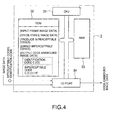
- FIG. 4 shows a block diagram of an embodiment of a microcomputer circuit programmed for embedding imperceptible codes into digital image data.
- a recording microcomputer circuit 3 shown in FIG. 4 is equipped with a CPU 31, a ROM 32, a RAM 33 and an I/O port 34.
- Storedin theROM32 are several programmodules for achieving the functions of the imperceptible-information recoding apparatus shown in FIG. 1.
- a software program that runs on the recording microcomputer circuit 3 is disclosed with respect a flowchart shown in FIG. 5.
- One-frame image data is input and saved in the RAM 33 in step S2.
- a data-field setting program module prestored in the ROM 32 starts in step S3 to divide the saved one-frame image data into 16 pieces of data (each called field image data hereinafter) in fields E(1) to E(16), as illustrated in FIG. 2.
- Animperceptible code C(1) is set for field image data in the field E(1) in step S5.
- An exclusive-OR operation between the code C(1) and the identification code C(ID) is conducted to give an imperceptible code C(16) for field image data in the field E(16) in step S6.
- a code embedding program module prestored in the ROM 32 starts in step S7 to embed the codes C(1) and C(16) into the field image data in the fields E(1) and E(16), respectively.
- the program written in the code embedding program module maybe the known electronic watermarking technique discussed first or a code-forming technique of forming codes with a bit train of the least significant bit (LSB) or the LSB-side 2 bits of, for example, intensity data in each macroblock of image data in each filed E(i), as disclosed in the first embodiment.
- LSB least significant bit
- step S8 It is determined in step S8 whether or not the variable "i" reaches "8". If not, the value "1" is added to the variable "i" in step S9.
- step S6 Since the variable "i" is "1", the value "1" is added to the variable "i”, the process returns to step S5 via step S9 to set an imperceptible code C(2) for field image data in the field E(2) .
- An exclusive-OR operation between the code C(2) and the identification code C(ID) is conducted to give an imperceptible code C(15) for field image data in the field E(15) in step S6.
- the codes C(2) and C(15) are then embedded into the field image data in the fields E(2) and E(15), respectively, in step S7.
- step S8 It is determined in step S8 whether or not the variable "i" reaches "8" . Since the variable "i" does not reach "8” , the process returns to step S5 via step S9 to repeat the imperceptible-code producing and code-embedding programs from step S5 to step S7: setting imperceptible codes C(3) to C(8); obtaining imperceptible codes C(14) to C(9) ; and embedding these codes into the field image data in the fields E(3) to E(8) and E(14) to E(9), respectively.
- Steps S5 to S8 are repeated via step S9 until the variable "i" reaches "8" in step S8.
- the one-frame image data into which the imperceptible codes C(1) to C(16) have been embedded is output from the recording microcomputer circuit 3 via the I/O port 34, as shown in FIG. 4.
- Code-embedded image data output from the recording microcomputer circuit 3, as disclosed above, are recorded on storage media and brought into market. Or, they are distributed over a communications network, such as, the Internet.
- FIG. 6 shows a block diagram of an embodiment of a microcomputer circuit programmed for reproducing embedded imperceptible codes from digital image data, which is compatible with the recording microcomputer circuit 3 shown in FIG. 4.
- a reproduction microcomputer circuit 4 shown in FIG. 6 is equipped with a CPU 41, a ROM 42, a RAM 43, an I/O port 44, a display interface (I/F) 46 and a display 45.
- the reproduction microcomputer circuit 4 receives, via the I/O port 44, digital image data into which imperceptible codes have been embedded through the recording microcomputer circuit 3 (FIG. 4) and determines, based on the embedded codes, whether or the digital image data have been tampered with.
- Storedin the ROM 42 are several programmodules for achieving the functions of the imperceptible-information reproduction apparatus shown in FIG. 3.
- the CPU 41 executes reproduction of the imperceptible codes embedded into the digital image data in accordance with the program modules while utilizing the RAM 43 as a video memory and a work area.
- a software program that runs on the reproduction microcomputer circuit 4 is disclosed with respect a flowchart shown in FIG. 7.
- step S21 one-frame image data is input and saved in the RAM 43.
- a data-field setting program module prestored in the ROM 42 starts in step S22 to divide the saved one-frame image data into 16 pieces of data (each called field image data hereinafter) in fields E(1) to E(16), in the same way as step S3 (FIG. 5) in recording.
- An imperceptible code Cx(1) embedded into field image data in a field E(1) is extracted in step S24.
- an imperceptible code Cx(16) embedded into field image data in a field E(16) is extracted in step S25.
- the program written in the code extraction program module corresponds to the imperceptible-code embedding technique installed in the recording microcomputer circuit 3 shown in FIG. 3.
- the code-pair combining program module corresponds to the code embedding program module installed in the recording microcomputer circuit 3.
- written in the code extraction and code-pair combining program modules are the programs for extracting an imperceptible code Cx(i) embedded into field image data in a region E(i) and then an imperceptible code Cx(17 - i), correlated to the code Cx(i) , embedded into field image data in a region E(17 - i), which are those of a code pair combined according to the rule of inframe positional correspondence installed in the recording microcomputer circuit 3.
- an exclusive-OR (EX-OR) operation program module prestored in the ROM 42 starts to perform an exclusive-OR operation between the codes Cx(1) and Cx(16) in step S26.
- the EX-OR resultant code is saved in the RAM 43 in step S27.
- step S28 It is determined in step S28 whether or not the variable "i" reaches “8” . If not, the value "1" is added to the variable "i” in step S29.
- step S28 It is determined in step S28 whether or not the variable "i" reaches "8". Since the variable "i" does not reach "8", the process returns to step S24 via step S29 to repeat the code extraction and code-pair combining programs from step S24 to step S27: extracting imperceptible codes Cx(3) to Cx(8) embedded into field image data in fields E(3) to E(8), respectively, and the corresponding imperceptible codes Cx(14) to Cx(9) embedded into field image data in fields E(14) to E(9), respectively; performing an exclusive-OR operation between each code pair; and saving each EX-OR resultant code in the RAM 43. Accordingly, eight EX-OR resultant codes are saved in the RAM 43.
- each of the saved EX-OR resultant codes is equal to the identification code C(ID) when the codes Cx(1) to Cx(16) extracted at the reproduction microcomputer circuit 4 (FIG. 6) are equal to the codes C(1) to C(16) embedded at the recording microcomputer circuit 3 (FIG. 4), or when the image data provided through the circuit 3 has not been tampered with.
- each of the saved EX-OR resultant codes is compared with the identification code C(ID) stored in the ROM 42, to give determination that the image data provided through the recording microcomputer circuit 3 has not been tampered with when all saved codes are equal to the code C(ID) whereas it has been tampered with when at least one code is not equal to the code C(ID).
- the result of determination is transferred from the CPU 41 to the display 45 via the I/O port 44 and the display interface 46 and displayed thereon in step S31 or S32.
- the display 45 displays at least as to whether or not the image data has been tampered with. In addition, it can display information on field (s) corresponding to a code pair (pairs) for which the EX-OR resultant code(s) is (are) not equal to the identification code C(ID) when it is determined that the image data has been tampered with.
- the software or each program module disclosed above can be installed in the recording microcomputer circuit 3 or the reproduction microcomputer circuit 4 from a storage medium or downloaded through a network, such as, the Internet.
- one-frame image data is divided into 16 field image data in the first and second embodiments, it can be divided into a larger number of field image data for more robust imperceptible-code recording and preproduction system with higher tamper-determination performance.
- the first and second embodiments employ the exclusive-OR function as disclosed above. Choice is, however, not such function only.
- the minimum requirement for feasible functions is that a function employed in reproduction gives a specific identification code with embedded imperceptible codes of each pair as variables while another function employed in recording, the reverse of the function employed in reproduction, gives those imperceptible codes.
- the rule of positional correspondence in frame image data feasible in this invention is not only based on the point symmetrical relationship employed in the embodiments but also other relationships which give correlation between two codes of each pair or among several codes of combination.
- the N/m number of combinations of imperceptible codes are embedded into image data divided into the "N" number of fields according to a specific code embedding technique so that the "m” number of imperceptible codes of each combination are embedded into image data in the "m” number of fields according to a specific rule of positional correspondence to give correlation among the "m” number of fields in the "N" number of fields of one frame.
- the code-embedded digital image data is divided, per frame, into the "N" number of fields.
- the imperceptible codes are extracted from the image data divided into the "N" number of fields according to a code extraction technique corresponding to the code embedding technique.
- the extracted imperceptible codes are combined into the N/m number of combinations according to the rule of positional correspondence.
- the specific function is executed to conduct a specific operation by using the imperceptible codes of each of the N/m number of combinations as variables.
- tampered digital imagedata is always accurately detected when it is provided, for example, through storage media or over a communications network.
- the present invention offers robust protection of image contents against tampering.
- identification code in this invention can be used as copyright information to prove copyright of image contents.
Landscapes
- Engineering & Computer Science (AREA)
- Multimedia (AREA)
- Signal Processing (AREA)
- Editing Of Facsimile Originals (AREA)
- Image Processing (AREA)
Abstract
Description
Claims (6)
- An apparatus for embedding imperceptible codes into digital image data comprising:a data divider to divide, per frame, digital image data into an "N" number of fields ("N" being an integer of 2 or more) ;a code producer to produce an N/m number of combinations of imperceptible codes, each combination having an "m" number of imperceptible codes given by a function, an inverse of a specific function that gives a specific identification code by using the "m" number of imperceptible codes as variables ("m" being an integer of 2 or more and given by dividing "N" by an integer); anda code embeder to embed the N/m number of combinations of imperceptible codes into image data divided into the "N" number of fields so that the "m" number of imperceptible codes of each combination are embedded into image data in the "m" number of fields according to a specific rule of positional correspondence to give correlation among the "m" number of fields in the "N" number of fields of one frame.
- An apparatus for extracting imperceptible codes fromdigital image data comprising:a data divider to divide, per frame, input digital image data into an "N" number of fields ("N" being an integer of 2 or more) according to a specific rule of positional correspondence to give correlation among an "m" number of fields in the "N" number of fields of one frame ("m" being an integer of 2 or more and given by dividing "N" by an integer), the input digital image data carrying imperceptible codes that have been embedded into the input digital image data by dividing, per frame, original digital image data into the "N" number of fields, producing an N/m number of combinations of imperceptible codes, each combination having the "m" number of imperceptible codes given by a function, an inverse of a specific function that gives a specific identification code by using the "m" number of imperceptible codes as variables, and embedding the N/m number of combinations of imperceptible codes into image data divided into the "N" number of fields according to a specific code embedding technique so that the "m" number of imperceptible codes of each combination are embedded into image data in the "m" number of fields according to the rule of positional correspondence;a code extractor to extract the imperceptible codes embedded into the image data divided into the "N" number of fields according to a code extraction technique corresponding to the code embedding technique;a code-pair combiner to combine the extracted imperceptible codes into the N/m number of combinations according to the rule of positional correspondence;a code operator to execute the specific function to conduct a specific operation by using the imperceptible codes of each of the N/m number of combinations as variables; anda determiner to determine that the input digital image data has not been tampered with only when results of the specific operation is equal to specific identification code for all of the N/m number of combinations.
- Amethod of embedding imperceptible codes into digital image data comprising the steps of:dividing, per frame, digital image data into an "N" number of fields ("N" being an integer of 2 or more);producing an N/m number of combinations of imperceptible codes, each combination having an "m" number of imperceptible codes given by a function, an inverse of a specific function that gives a specific identification code by using the "m" number of imperceptible codes as variables ("m" being an integer of 2 or more and given by dividing "N" by an integer); andembedding the N/m number of combinations of imperceptible codes into image data divided into the "N" number of fields so that the "m" number of imperceptible codes of each combination are embedded into image data in the "m" number of fields according to a specific rule of positional correspondence to give correlation among the "m" number of fields in the "N" number of fields of one frame.
- A method of extracting imperceptible codes from digital image data comprising the steps of:dividing, per frame, input digital image data into an "N" number of fields ("N" being an integer of 2 or more) according to a specific rule of posi tional correspondence to give correlation among an "m" number of fields in the "N" number of fields of one frame ("m" being an integer of 2 or more and given by dividing "N" by an integer), the input digital image data carrying imperceptible codes that have been embedded into the input digital image data by dividing, per frame, original digital image data into the "N" number of fields, producing an N/m number of combinations of imperceptible codes, each combination having the "m" number of imperceptible codes given by a function, an inverse of a specific function that gives a specific identification code by using the "m" number of imperceptible codes as variables, and embedding the N/m number of combinations of imperceptible codes into image data divided into the "N" number of fields according to a specific code embedding technique so that the "m" number of imperceptible codes of each combination are embedded into image data in the "m" number of fields according to the rule of positional correspondence;extracting the imperceptible codes embedded into the image data divided into the "N" number of fields according to a code extraction technique corresponding to the code embedding technique;combining the extracted imperceptible codes into the N/m number of combinations according to the rule of positional correspondence;executing the specific function to conduct a specific operation by using the imperceptible codes of each of the N/m number of combinations as variables; anddetermining that the input digital image data has not been tampered with only when results of the specific operation is equal to specific identification code for all of the N/m number of combinations.
- A computer-implemented method of embedding imperceptible codes into digital image data comprising the steps of:dividing, per frame, digital image data into an "N" number of fields ("N" being an integer of 2 or more);producing an N/m number of combinations of imperceptible codes, each combination having an "m" number of imperceptible codes given by a function, an inverse of a specific function that gives a specific identification code by using the "m" number of imperceptible codes as variables ("m" being an integer of 2 or more and given by dividing "N" by an integer); andembedding the N/m number of combinations of imperceptible codes into image data divided into the "N" number of fields so that the "m" number of imperceptible codes of each combination are embedded into image data in the "m" number of fields according to a specific rule of positional correspondence to give correlation among the "m" number of fields in the "N" number of fields of one frame.
- A computer-implemented method of extracting imperceptible codes from digital image data comprising the steps of:dividing, per frame, input digital image data into an "N" number of fields ("N" being an integer of 2 or more) according to a specific rule of positional correspondence to give correlation among an "m" number of fields in the "N" number of fields of one frame ("m" being an integer of 2 or more and given by dividing "N" by an integer), the input digital image data carrying imperceptible codes that have been embedded into the input digital image data by dividing, per frame, original digital image data into the "N" number of fields, producing an N/m number of combinations of imperceptible codes, each combination having the "m" number of imperceptible codes given by a function, an inverse of a specific function that gives a specific identification code by using the "m" number of imperceptible codes as variables, and embedding the N/m number of combinations of imperceptible codes into image data divided into the "N" number of fields according to a specific code embedding technique so that the "m" number of imperceptible codes of each combination are embedded into image data in the "m" number of fields according to the rule of positional correspondence;extracting the imperceptible codes embedded into the image data divided into the "N" number of fields according to a code extraction technique corresponding to the code embedding technique;combining the extracted imperceptible codes into the N/m number of combinations according to the rule of positional correspondence;executing the specific function to conduct a specific operation by using the imperceptible codes of each of the N/m number of combinations as variables; anddetermining that the input digital image data has not been tampered with only when results of the specific operation is equal to specific identification code for all of the N/m number of combinations.
Applications Claiming Priority (2)
| Application Number | Priority Date | Filing Date | Title |
|---|---|---|---|
| JP2003012544A JP3922369B2 (en) | 2003-01-21 | 2003-01-21 | Embedded information recording apparatus and reproducing apparatus, recording program, and reproducing program |
| JP2003012544 | 2003-01-21 |
Publications (2)
| Publication Number | Publication Date |
|---|---|
| EP1441502A2 true EP1441502A2 (en) | 2004-07-28 |
| EP1441502A3 EP1441502A3 (en) | 2005-08-31 |
Family
ID=32588622
Family Applications (1)
| Application Number | Title | Priority Date | Filing Date |
|---|---|---|---|
| EP04250237A Withdrawn EP1441502A3 (en) | 2003-01-21 | 2004-01-19 | Recording and reproduction apparatus and method for imperceptible information to be embedded in digital image data |
Country Status (3)
| Country | Link |
|---|---|
| US (1) | US7356159B2 (en) |
| EP (1) | EP1441502A3 (en) |
| JP (1) | JP3922369B2 (en) |
Families Citing this family (3)
| Publication number | Priority date | Publication date | Assignee | Title |
|---|---|---|---|---|
| JP3922369B2 (en) * | 2003-01-21 | 2007-05-30 | 日本ビクター株式会社 | Embedded information recording apparatus and reproducing apparatus, recording program, and reproducing program |
| US9055239B2 (en) | 2003-10-08 | 2015-06-09 | Verance Corporation | Signal continuity assessment using embedded watermarks |
| JP4962335B2 (en) | 2008-02-04 | 2012-06-27 | 富士通株式会社 | Method for restoring embedded data |
Family Cites Families (29)
| Publication number | Priority date | Publication date | Assignee | Title |
|---|---|---|---|---|
| US20020009208A1 (en) * | 1995-08-09 | 2002-01-24 | Adnan Alattar | Authentication of physical and electronic media objects using digital watermarks |
| WO1997049235A1 (en) * | 1996-06-20 | 1997-12-24 | Ibm Japan Ltd. | Data hiding method and data extracting method |
| US6069914A (en) * | 1996-09-19 | 2000-05-30 | Nec Research Institute, Inc. | Watermarking of image data using MPEG/JPEG coefficients |
| US5915027A (en) * | 1996-11-05 | 1999-06-22 | Nec Research Institute | Digital watermarking |
| GB9705045D0 (en) | 1997-03-12 | 1997-04-30 | Central Research Lab Ltd | Method and apparatus for coding information |
| US6108434A (en) * | 1997-09-12 | 2000-08-22 | Signafy, Inc. | Counteracting geometric distortions for DCT based watermarking |
| JP4064506B2 (en) * | 1997-09-17 | 2008-03-19 | パイオニア株式会社 | Digital watermark superimposing method, detecting method and apparatus |
| US6233347B1 (en) * | 1998-05-21 | 2001-05-15 | Massachusetts Institute Of Technology | System method, and product for information embedding using an ensemble of non-intersecting embedding generators |
| US6154571A (en) * | 1998-06-24 | 2000-11-28 | Nec Research Institute, Inc. | Robust digital watermarking |
| US6263087B1 (en) * | 1998-06-26 | 2001-07-17 | Signafy, Inc. | Method of encoding bits in a signal |
| US6694040B2 (en) * | 1998-07-28 | 2004-02-17 | Canon Kabushiki Kaisha | Data processing apparatus and method, and memory medium |
| US6141441A (en) | 1998-09-28 | 2000-10-31 | Xerox Corporation | Decoding data from patterned color modulated image regions in a color image |
| US5991426A (en) * | 1998-12-18 | 1999-11-23 | Signafy, Inc. | Field-based watermark insertion and detection |
| US6546113B1 (en) * | 1999-03-02 | 2003-04-08 | Leitch Technology International Inc. | Method and apparatus for video watermarking |
| JP2000287065A (en) | 1999-03-30 | 2000-10-13 | Oki Electric Ind Co Ltd | Image processing system |
| US6971010B1 (en) * | 1999-10-15 | 2005-11-29 | Koninklijke Philips Electronics N.V. | Image and video authentication system |
| US6449380B1 (en) * | 2000-03-06 | 2002-09-10 | Intel Corporation | Method of integrating a watermark into a compressed image |
| JP2002057882A (en) * | 2000-04-21 | 2002-02-22 | Sony Corp | Information embedding device and information embedding method, information processing device and information processing method, content processing device and content processing method, monitoring device and monitoring method, and storage medium |
| JP3681157B2 (en) | 2000-06-27 | 2005-08-10 | 株式会社東芝 | Digital watermark detection method, digital watermark detection apparatus, region determination method, and storage medium |
| JP4220661B2 (en) | 2000-07-21 | 2009-02-04 | 興和株式会社 | Electronic document falsification detection method and apparatus |
| US6674876B1 (en) * | 2000-09-14 | 2004-01-06 | Digimarc Corporation | Watermarking in the time-frequency domain |
| US6512837B1 (en) * | 2000-10-11 | 2003-01-28 | Digimarc Corporation | Watermarks carrying content dependent signal metrics for detecting and characterizing signal alteration |
| FR2816153B1 (en) * | 2000-10-27 | 2002-12-20 | Canon Kk | METHOD FOR PRE-CHECKING THE DETECTABILITY OF A MARKING SIGNAL |
| FR2819331B1 (en) * | 2001-01-10 | 2003-03-28 | Canon Kk | PROCESS AND DEVICE FOR PROCESSING AND MARKING A SET OF COEFFICIENTS REPRESENTATIVE OF A DIGITAL IMAGE |
| JP4151222B2 (en) | 2001-01-25 | 2008-09-17 | 沖電気工業株式会社 | Digital watermark embedding device, falsification detection device, and recording medium |
| US7174030B2 (en) * | 2001-02-06 | 2007-02-06 | Victor Company Of Japan, Ltd. | Method and apparatus for embedding and reproducing watermark into and from contents data |
| US7607016B2 (en) * | 2001-04-20 | 2009-10-20 | Digimarc Corporation | Including a metric in a digital watermark for media authentication |
| JP2002325170A (en) * | 2001-04-24 | 2002-11-08 | Canon Inc | Image processing apparatus and method, program code, and storage medium |
| JP3922369B2 (en) * | 2003-01-21 | 2007-05-30 | 日本ビクター株式会社 | Embedded information recording apparatus and reproducing apparatus, recording program, and reproducing program |
-
2003
- 2003-01-21 JP JP2003012544A patent/JP3922369B2/en not_active Expired - Lifetime
-
2004
- 2004-01-15 US US10/760,012 patent/US7356159B2/en not_active Expired - Lifetime
- 2004-01-19 EP EP04250237A patent/EP1441502A3/en not_active Withdrawn
Also Published As
| Publication number | Publication date |
|---|---|
| US7356159B2 (en) | 2008-04-08 |
| US20040146180A1 (en) | 2004-07-29 |
| EP1441502A3 (en) | 2005-08-31 |
| JP2004228783A (en) | 2004-08-12 |
| JP3922369B2 (en) | 2007-05-30 |
Similar Documents
| Publication | Publication Date | Title |
|---|---|---|
| US6996717B2 (en) | Semi-fragile watermarking system for MPEG video authentication | |
| US7251343B2 (en) | Image protection | |
| Swanson et al. | Multimedia data-embedding and watermarking technologies | |
| US8483388B2 (en) | Digital video protection for authenticity verification | |
| US7216232B1 (en) | Method and device for inserting and authenticating a digital signature in digital data | |
| US6005936A (en) | System for embedding authentication information into an image and an image alteration detecting system | |
| US8107674B2 (en) | Synchronizing rendering of multimedia content | |
| JP3768705B2 (en) | Digital watermark embedding device, output control device, and computer-readable storage medium | |
| JP4568732B2 (en) | Method and system for processing digital images | |
| JP5982806B2 (en) | Digital watermark embedding device, digital watermark embedding method, and digital watermark detection device | |
| CN110896484A (en) | Video watermark adding and extracting method and device, video playing end and storage medium | |
| Yin et al. | A semi-fragile watermarking system for MPEG video authentication | |
| Celik et al. | Localized lossless authentication watermark (LAW) | |
| KR101677110B1 (en) | Watermark extracting and insertion apparatus for video forgery detection and prevention based zero-knowledge and the method thereof | |
| US20260087175A1 (en) | Method, device and non-transitory computer-readable storage medium for video encryption and encryption key hiding | |
| JP5508896B2 (en) | Image processing method | |
| US7356159B2 (en) | Recording and reproduction apparatus, recording and reproduction method, recording and reproduction program for imperceptible information to be embedded in digital image data | |
| JP4107063B2 (en) | Encryption information transmission / reception system, transmission / reception method, encryption information embedding program, and encryption information recording apparatus | |
| JP2003524932A (en) | System and method for digitally marking files with removable marks | |
| Kalra et al. | A review of frame selection and video watermarking techniques to balance quality and security | |
| Miao et al. | Image descriptor based digital semi-blind watermarking for DIBR 3D images | |
| CN117499665B (en) | Image data embedding and extracting method and device based on gray value quantization | |
| AU2002318848B2 (en) | Image Protection | |
| Sagetong et al. | Dynamic wavelet feature-based watermarking for copyright tracking in digital movie distribution systems | |
| KR20180099110A (en) | Method and apparatus for video watermarking based on hash chain |
Legal Events
| Date | Code | Title | Description |
|---|---|---|---|
| PUAI | Public reference made under article 153(3) epc to a published international application that has entered the european phase |
Free format text: ORIGINAL CODE: 0009012 |
|
| AK | Designated contracting states |
Kind code of ref document: A2 Designated state(s): AT BE BG CH CY CZ DE DK EE ES FI FR GB GR HU IE IT LI LU MC NL PT RO SE SI SK TR |
|
| AX | Request for extension of the european patent |
Extension state: AL HR LT LV MK |
|
| PUAL | Search report despatched |
Free format text: ORIGINAL CODE: 0009013 |
|
| AK | Designated contracting states |
Kind code of ref document: A3 Designated state(s): AT BE BG CH CY CZ DE DK EE ES FI FR GB GR HU IE IT LI LU MC NL PT RO SE SI SK TR |
|
| AX | Request for extension of the european patent |
Extension state: AL LT LV MK |
|
| 17P | Request for examination filed |
Effective date: 20050909 |
|
| AKX | Designation fees paid |
Designated state(s): DE FR GB |
|
| 17Q | First examination report despatched |
Effective date: 20070430 |
|
| RAP1 | Party data changed (applicant data changed or rights of an application transferred) |
Owner name: JVC KENWOOD CORPORATION |
|
| STAA | Information on the status of an ep patent application or granted ep patent |
Free format text: STATUS: EXAMINATION IS IN PROGRESS |
|
| STAA | Information on the status of an ep patent application or granted ep patent |
Free format text: STATUS: THE APPLICATION IS DEEMED TO BE WITHDRAWN |
|
| 18D | Application deemed to be withdrawn |
Effective date: 20180801 |
|
| RIC1 | Information provided on ipc code assigned before grant |
Ipc: H04N 1/32 20060101AFI20040429BHEP |