EP1441221A1 - Method and device for observing the atmosphere within an altitude range of about 100 km - 1000 km - Google Patents
Method and device for observing the atmosphere within an altitude range of about 100 km - 1000 km Download PDFInfo
- Publication number
- EP1441221A1 EP1441221A1 EP04001205A EP04001205A EP1441221A1 EP 1441221 A1 EP1441221 A1 EP 1441221A1 EP 04001205 A EP04001205 A EP 04001205A EP 04001205 A EP04001205 A EP 04001205A EP 1441221 A1 EP1441221 A1 EP 1441221A1
- Authority
- EP
- European Patent Office
- Prior art keywords
- particles
- neutral
- ion
- altitude
- air
- Prior art date
- Legal status (The legal status is an assumption and is not a legal conclusion. Google has not performed a legal analysis and makes no representation as to the accuracy of the status listed.)
- Withdrawn
Links
- 238000000034 method Methods 0.000 title claims description 11
- 239000002245 particle Substances 0.000 claims abstract description 156
- 230000007935 neutral effect Effects 0.000 claims abstract description 143
- 238000007599 discharging Methods 0.000 claims abstract description 18
- 229910052743 krypton Inorganic materials 0.000 claims description 4
- DNNSSWSSYDEUBZ-UHFFFAOYSA-N krypton atom Chemical compound [Kr] DNNSSWSSYDEUBZ-UHFFFAOYSA-N 0.000 claims description 4
- 229910052724 xenon Inorganic materials 0.000 claims description 4
- FHNFHKCVQCLJFQ-UHFFFAOYSA-N xenon atom Chemical compound [Xe] FHNFHKCVQCLJFQ-UHFFFAOYSA-N 0.000 claims description 4
- 230000003247 decreasing effect Effects 0.000 description 3
- 238000007796 conventional method Methods 0.000 description 2
- 238000012546 transfer Methods 0.000 description 2
- 238000011109 contamination Methods 0.000 description 1
- 238000005259 measurement Methods 0.000 description 1
- 238000012986 modification Methods 0.000 description 1
- 230000004048 modification Effects 0.000 description 1
Images
Classifications
-
- B—PERFORMING OPERATIONS; TRANSPORTING
- B64—AIRCRAFT; AVIATION; COSMONAUTICS
- B64G—COSMONAUTICS; VEHICLES OR EQUIPMENT THEREFOR
- B64G1/00—Cosmonautic vehicles
- B64G1/10—Artificial satellites; Systems of such satellites; Interplanetary vehicles
-
- B—PERFORMING OPERATIONS; TRANSPORTING
- B64—AIRCRAFT; AVIATION; COSMONAUTICS
- B64G—COSMONAUTICS; VEHICLES OR EQUIPMENT THEREFOR
- B64G1/00—Cosmonautic vehicles
- B64G1/10—Artificial satellites; Systems of such satellites; Interplanetary vehicles
- B64G1/1021—Earth observation satellites
-
- B—PERFORMING OPERATIONS; TRANSPORTING
- B64—AIRCRAFT; AVIATION; COSMONAUTICS
- B64G—COSMONAUTICS; VEHICLES OR EQUIPMENT THEREFOR
- B64G1/00—Cosmonautic vehicles
- B64G1/10—Artificial satellites; Systems of such satellites; Interplanetary vehicles
- B64G1/105—Space science
-
- G—PHYSICS
- G01—MEASURING; TESTING
- G01N—INVESTIGATING OR ANALYSING MATERIALS BY DETERMINING THEIR CHEMICAL OR PHYSICAL PROPERTIES
- G01N33/00—Investigating or analysing materials by specific methods not covered by groups G01N1/00 - G01N31/00
- G01N33/22—Fuels; Explosives
Definitions
- This invention relates to a method for observing high-altitude neutral air and a device for observing high-altitude neutral air which are usable in space operational business enterprise and space weather forecast business enterprise.
- the discharging velocities of the ion particles can be predetermined, and the velocities of the neutral particles can be measured with the neutral particle analyzer. Moreover, the relative position between the ion source and the neutral particle analyzer can be predetermined, and the discharging angles of the ion particles from the ion source and the observing angle of the neutral particle analyzer can be predetermined. Therefore, if the periods of time between the discharging timings of the ion particles and the trapping timings of the neutral particles are measured, at least one of the distances between the high-altitude neutral air and the ion source and between the high-altitude neutral air and the neutral particle analyzer can be determined.
- the space position of the high-altitude neutral air can be determined therefrom.
- the energies of the ion particles and the energies of the neutral particles can be conserved before and after the collision between the ion particles and the neutral particles. Therefore, the kinetic energies of the neutral particles are equal to the kinetic energies of the ion particles. In contrast, if the ion particles are made of different particles from the neutral particles, the kinetic energies of the neutral particles are increased and decreased on the differences in ionization voltage between the ion particles and the neutral particles before and after the collision therebetween.
- the sorts of the ion particles are known, if the increasing and decreasing in kinetic energy of the ion particles are measured, the sorts of particles in the high-altitude neutral air can be determined through the collision, and thus, the composition of the high-altitude neutral air can be determined.
- the ion particles are made of particles which rarely exist on the high and low orbits of the earth.
- the ion particles can be recognized clearly against other particles in the space.
- the ion particles may be made of krypton particles or xenon particles.
- the ion particles may be discharged in pulse or modulation.
- the discharging timings of the ion particles and the trapping timings of the high velocity neutral particles can be recognized clearly, and the distance for the high-altitude neutral air can be measured easily and precisely.
- the space position, the density and the composition of the high-altitude neutral air can be determined precisely. Moreover, when the discharging angles of the ion particles from the ion source and the observing angle of the neutral particle analyzer are controlled appropriately, the density and the composition of the high-altitude neutral air can be determined widely in a short period of time.
Landscapes
- Engineering & Computer Science (AREA)
- Remote Sensing (AREA)
- Physics & Mathematics (AREA)
- Astronomy & Astrophysics (AREA)
- General Physics & Mathematics (AREA)
- Aviation & Aerospace Engineering (AREA)
- Other Investigation Or Analysis Of Materials By Electrical Means (AREA)
- Analysing Materials By The Use Of Radiation (AREA)
Abstract
Ion particles are discharged so as to be trapped with magnetic field
lines of the earth, and collided with high-altitude neutral air to
generate high velocity neutral particles through charge exchange. The
high velocity neutral particles are trapped. In this case, the distance
to the high-altitude neutral air from at least one of the discharging
positions of the ion particles and the trapping positions of the high
velocity neutral particles is determined based on the period of time
between the discharging timings of the ion particles and the trapping
timings of the high velocity neutral particles. Moreover, the direction
of the high-altitude neutral air is determined based on the trapping
direction of the high velocity neutral particles. In addition, the space
position of the high-altitude neutral air is determined based on the
trapping direction of the high velocity neutral particles.
Description
- This invention relates to a method for observing high-altitude neutral air and a device for observing high-altitude neutral air which are usable in space operational business enterprise and space weather forecast business enterprise.
- As has gotten a lot of attention in the falling of the Mir space station at March, 2001, if a large-scaled space structure is plunged into atmosphere and reached to earth, it is concerned that the space structure affects on our social life to some degree. In this point of view, data concerning high-altitude neutral air are very important because the orbit altitude of a space satellite may be decreased due to the atmosphere drag in the high-altitude neutral air and the plunge timing of the space satellite into atmosphere can be predicted from the high-altitude neutral air data.
- In a conventional observation for the high-altitude neutral air, an observing instrument is mounted on a space satellite, which is disposed in the high-altitude neutral air. As a result, since the observing instrument is positioned in a given area of the high-altitude neutral air, the observation for the high-altitude neutral air is carried out at every area where the observing instrument is positioned.
- Since the observing area is contaminated by positioning the space satellite, with the conventional technique, the high-altitude neutral air can not be observed precisely. Moreover, with the conventional technique, only the data concerning a given area of the high-altitude neutral air by positioning the observing instrument in the given area can be obtained, so the total data concerning the high-altitude neutral air can not be obtained simultaneously.
- The data concerning the high-altitude neutral air can be obtained from the Jacchia model (Standard Jacchia Reference Atmosphere 1977) which is a simulated and modeled distribution of high-altitude neutral air on the changes in altitude of many space satellites launched in the past. Since the predictive accuracy of the Jacchia model is poor, however, it can not be employed in a technical field requiring prompt response and accuracy such as the prediction in atmosphere plunge of a space satellite and the like.
- It is an object of the present invention, in this point of view, to observe the high-altitude neutral air widely and precisely.
- In order to achieve the above-mentioned objects, this invention relates to a method for observing high-altitude neutral air, comprising the steps of:
- discharging ion particles so as to be trapped with magnetic field lines of the earth,
- colliding the ion particles with high-altitude neutral air to generate high velocity neutral particles through charge exchange, and
- trapping the high velocity neutral particles to determine the distance to the high-altitude neutral air from at least one of the discharging positions of the ion particles and the trapping positions of the high velocity neutral particles on the period of time between the discharging timings of the ion particles and the trapping timings of the high velocity neutral particles, to determine the direction of the high-altitude neutral air on the trapping direction of the high velocity neutral particles, and to determine the space position of the high-altitude neutral air.
-
- In the present invention, for example, a given ion source is disposed on the orbit of the earth, and then, ion particles are discharged from the ion source so as to be trapped by the magnetic field lines of the earth. When the ion particles are collided with the high-altitude neutral air, high velocity neutral particles are generated through the charge exchange with the ion particles in the high-altitude neutral air. The neutral particles travel inertially without the disturbance of the magnetic field lines of the earth, and trapped with a given neutral particle analyzer disposed on the orbit of the earth.
- The discharging velocities of the ion particles can be predetermined, and the velocities of the neutral particles can be measured with the neutral particle analyzer. Moreover, the relative position between the ion source and the neutral particle analyzer can be predetermined, and the discharging angles of the ion particles from the ion source and the observing angle of the neutral particle analyzer can be predetermined. Therefore, if the periods of time between the discharging timings of the ion particles and the trapping timings of the neutral particles are measured, at least one of the distances between the high-altitude neutral air and the ion source and between the high-altitude neutral air and the neutral particle analyzer can be determined.
- Moreover, since the neutral particles can be trapped with the neutral particle analyzer, the direction of the high-altitude neutral air can be determined from the trapping directions of the neutral particles.
- In addition, in the present invention, since the distance for the high-altitude neutral air and the direction of the high-altitude neutral air are measured as mentioned above, the space position of the high-altitude neutral air can be determined therefrom.
- Herein, the wording "high-altitude neutral air" means an atmosphere within an altitude range of about 100km-1000km.
- Also, the wording "charge exchange" means a reaction where an ion particle "A" is collided with an ion particle "B", causing the charge transfer of the ion particle "A" to the ion particle "B" and thus, generating a high velocity neutral particle "A" and a high velocity neutral particle "B" (A*+B → A+B*).
- In the present invention, since the high velocity neutral particles can be generated from the charge exchange with the ion particles in the high-altitude neutral air, if the trapping frequency of the neutral particles is measured with the neutral particle analyzer, the particle density of the high-altitude neutral density can be determined.
- If the ion particles are made of the same particles as the neutral particles, the energies of the ion particles and the energies of the neutral particles can be conserved before and after the collision between the ion particles and the neutral particles. Therefore, the kinetic energies of the neutral particles are equal to the kinetic energies of the ion particles. In contrast, if the ion particles are made of different particles from the neutral particles, the kinetic energies of the neutral particles are increased and decreased on the differences in ionization voltage between the ion particles and the neutral particles before and after the collision therebetween.
- Since the sorts of the ion particles are known, if the increasing and decreasing in kinetic energy of the ion particles are measured, the sorts of particles in the high-altitude neutral air can be determined through the collision, and thus, the composition of the high-altitude neutral air can be determined.
- It is desired that the ion particles are made of particles which rarely exist on the high and low orbits of the earth. In this case, the ion particles can be recognized clearly against other particles in the space. Concretely, the ion particles may be made of krypton particles or xenon particles.
- The ion particles may be discharged in pulse or modulation. In this case, the discharging timings of the ion particles and the trapping timings of the high velocity neutral particles can be recognized clearly, and the distance for the high-altitude neutral air can be measured easily and precisely.
- In this way, according to the present invention, the space position, the density and the composition of the high-altitude neutral air can be determined precisely. If the discharging angles of the ion particles from the ion source and the observing angle of the neutral particle analyzer are controlled appropriately, the density and the composition of the high-altitude neutral air can be widely determined in a short period of time.
- For better understanding of the present invention, reference is made to the attached drawings, wherein
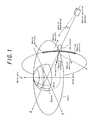
- Fig. 1 is an explanatory view relating to a method for observing high-altitude neutral air according to the present invention.
-
- This invention will be described in detail with reference to the accompanying drawings.
Fig. 1 is an explanatory view relating to a method for observing high-altitude neutral air according to the present invention.
In Fig. 1, an ion cluster source is disposed as an ion source on the orbit above the equator of the earth, and a neutral particle analyzer is disposed in the rear side of the ion cluster source. Ion particles are discharged from the ion cluster source, and trapped with the magnetic field lines generated from the axis of the earth. In this case, the ion particles are rotated along the magnetic field lines, which is defined as "Larmor motion", and moved north and south. If a given condition is satisfied, the mirror confining mechanism is generated, so that the ion particles are moved repeatedly north and south. - In this case, the ion particles are collided with inner particles in the high-altitude neutral air (not shown) at the black points in Fig. 1, causing the charge transfer of the ion particles to the inner particles and thus, generating neutral particles in the directions designated by the arrows. The neutral particles travel inertially at their respective high velocities without the disturbance of the magnetic field lines, and trapped and detected with the neutral particle analyzer.
- The discharging velocities of the ion particles can be predetermined, and the velocities of the neutral particles can be measured with the neutral particle analyzer. On the other hand, the relative position between the ion cluster source and the neutral particle analyzer can be predetermined. In addition, the discharging angles of the ion particles from the ion cluster source can be predetermined and the observing angle of the neutral particle analyzer can be predetermined. Therefore, if the periods of time between the discharging timings of the ion particles and the trapping timings of the neutral particles are measured, at least one of the distances between the high-altitude neutral air and the ion cluster source and between the high-altitude neutral air and the neutral particle analyzer can be determined.
- The direction of the high-altitude neutral air can be determined from the trapping directions of the neutral particles with the neutral particle analyzer.
- As mentioned above, it is desired that the ion particles are made of particles which rarely exist on the orbit of the earth such as krypton particles or xenon particles in order to be distinguished from other particles in nature. In order to enhance the easiness and precision of the measurement of the distance for the high-altitude neutral air, the ion particles may be discharged in pulse or modulation.
- If the trapping frequency of the neutral particles are measured with the neutral particle analyzer, the particle density of the high-altitude neutral air can be determined because the high velocity neutral particles can be generated through the charge exchange with the ion particles in the high-altitude neutral air. If the changes in kinetic energy of the neutral particles are measured, the composition of the high-altitude neutral air can be determined because the sorts of the ion particles are known and thus, the changes in kinetic energy of the neutral particles depend on the sorts of particles in the high-altitude neutral air.
- In this embodiment, since it is not required that the ion cluster source and the neutral particle analyzer are disposed directly in the high-altitude neutral air, the space position, the density and the composition of the high-altitude neutral air can be determined precisely without the contamination of the ion cluster source, the neutral particle analyzer and the like. Moreover, if the discharging angles of the ion particles from the ion cluster source and the observing angle of the neutral particle analyzer are controlled appropriately, the density and the composition of the high-altitude neutral air can be determined widely in a short period of time.
- It may be that the ion cluster source and the neutral particle analyzer can be mounted on a space satellite which is disposed on the orbit of the earth. In this case, if the position of the space satellite is adjusted, the ion cluster source and the neutral particle analyzer can be disposed as illustrated in Fig. 1 to observe the high-altitude neutral air. The ion cluster source and the neutral particle analyzer can be mounted on the same space satellite or respective different space satellites. In the latter case, since the degree of freedom in disposition of the ion cluster source and the neutral particle analyzer can be increased, the high-altitude neutral air can be observed and measured wider.
- Although the present invention was described in detail with reference to the above examples, this invention is not limited to the above disclosure and every kind of variation and modification may be made without departing from the scope of the present invention.
- As mentioned above, according to the present invention, since it is not required that the ion source and the neutral particle analyzer are disposed directly in the high-altitude neutral air, the space position, the density and the composition of the high-altitude neutral air can be determined precisely. Moreover, when the discharging angles of the ion particles from the ion source and the observing angle of the neutral particle analyzer are controlled appropriately, the density and the composition of the high-altitude neutral air can be determined widely in a short period of time.
Claims (14)
- A method for observing high-altitude neutral air, comprising the steps of:discharging ion particles so as to be trapped with magnetic field lines of the earth,colliding said ion particles with high-altitude neutral air to generate high velocity neutral particles through charge exchange, andtrapping said high velocity neutral particles to determine the distance to said high-altitude neutral air from at least one of the discharging positions of said ion particles and the trapping positions of said high velocity neutral particles on the period of time between the discharging timings of said ion particles and the trapping timings of said high velocity neutral particles, to determine the direction of said high-altitude neutral air on the trapping direction of said high velocity neutral particles, and to determine the space position of said high-altitude neutral air.
- The observing method as defined in claim 1, wherein the density of said high-altitude neutral air is determined on the trapping frequency of said high velocity neutral particles.
- The observing method as defined in claim 1 or 2, wherein the composition of said high-altitude neutral air is determined on the changes in kinetic energy of said high velocity neutral particles for said ion particles.
- The observing method as defined in any one of claims 1-3, wherein said ion particles are made of krypton particles and/or xenon particles.
- The observing method as defined in any one of claims 1-4, wherein said ion particles are discharged in pulse.
- The observing method as defined in any one of claims 1-4, wherein said ion particles are discharged in modulation.
- A device for observing high-altitude neutral air, comprising:an ion source disposed on an orbit of the earth, anda neutral particle analyzer disposed on an orbit of the earth.
- The observing device as defined in claim 7, wherein said ion source discharges ion particles so as to be trapped with magnetic field lines of the earth.
- The observing device as defined in claim 8, wherein said ion particles are made of krypton particles and/or xenon particles.
- The observing device as defined in claim 8 or 9, wherein said ion particles are discharged in pulse.
- The observing device as defined in claim 8 or 9, wherein said ion particles are discharged in modulation.
- The observing device as defined in any one of claims 8-11, wherein said neutral particle analyzer traps high velocity neutral particles which are generated from said ion particles through the collision of said ion particles with high-altitude neutral air and the charge exchange with said ion particles.
- The observing device as defined in any one of claims 7-12, wherein said ion source and said neutral particle analyzer are mounted on the same space satellite.
- The observing device as defined in any one of claims 7-12, wherein said ion source and said neutral particle analyzer are mounted on respective difference space satellites.
Applications Claiming Priority (2)
| Application Number | Priority Date | Filing Date | Title |
|---|---|---|---|
| JP2003015829 | 2003-01-24 | ||
| JP2003015829A JP3811776B2 (en) | 2003-01-24 | 2003-01-24 | High-level neutral atmosphere observation method and high-level neutral atmosphere observation device |
Publications (1)
| Publication Number | Publication Date |
|---|---|
| EP1441221A1 true EP1441221A1 (en) | 2004-07-28 |
Family
ID=32588681
Family Applications (1)
| Application Number | Title | Priority Date | Filing Date |
|---|---|---|---|
| EP04001205A Withdrawn EP1441221A1 (en) | 2003-01-24 | 2004-01-21 | Method and device for observing the atmosphere within an altitude range of about 100 km - 1000 km |
Country Status (3)
| Country | Link |
|---|---|
| US (1) | US7038203B2 (en) |
| EP (1) | EP1441221A1 (en) |
| JP (1) | JP3811776B2 (en) |
Families Citing this family (3)
| Publication number | Priority date | Publication date | Assignee | Title |
|---|---|---|---|---|
| JP3811776B2 (en) * | 2003-01-24 | 2006-08-23 | 独立行政法人 宇宙航空研究開発機構 | High-level neutral atmosphere observation method and high-level neutral atmosphere observation device |
| US8809771B2 (en) | 2010-05-17 | 2014-08-19 | Utah State University Research Foundation | Devices, systems, and methods for dispersive energy imaging |
| US12172774B1 (en) * | 2023-11-13 | 2024-12-24 | Akcasa hypersonics, LLC | Efficient method for orbital launch trajectories |
Citations (1)
| Publication number | Priority date | Publication date | Assignee | Title |
|---|---|---|---|---|
| US3207895A (en) | 1961-04-05 | 1965-09-21 | Ontario Research Foundation | Method for measuring low density atmospheres |
Family Cites Families (16)
| Publication number | Priority date | Publication date | Assignee | Title |
|---|---|---|---|---|
| US3657542A (en) * | 1970-05-04 | 1972-04-18 | Atomic Energy Commission | Production of beams of excited energetic neutral particles |
| US3742219A (en) * | 1971-06-23 | 1973-06-26 | Atomic Energy Commission | High energy neutral particle beam source |
| US3790411A (en) * | 1972-03-08 | 1974-02-05 | Bell Telephone Labor Inc | Method for doping semiconductor bodies by neutral particle implantation |
| US3767925A (en) * | 1972-03-08 | 1973-10-23 | Bell Telephone Labor Inc | Apparatus and method for determining the spatial distribution of constituents and contaminants of solids |
| US3757114A (en) * | 1972-03-08 | 1973-09-04 | Bell Telephone Labor Inc | Atoms or molecules apparatus and method for measuring the intensity of a beam of neutral |
| US4053776A (en) * | 1976-05-25 | 1977-10-11 | The United States Of America As Represented By Thesecretary Of The Interior | Sub-micron particle detector |
| US4349505A (en) * | 1980-07-01 | 1982-09-14 | The United States Of America As Represented By The Department Of Energy | Neutral beamline with ion energy recovery based on magnetic blocking of electrons |
| US4434131A (en) * | 1981-04-13 | 1984-02-28 | The United States Of America As Represented By The United States Department Of Energy | Neutral beamline with improved ion energy recovery |
| US4439395A (en) * | 1981-04-13 | 1984-03-27 | The United States Of America As Represented By The United States Department Of Energy | Neutral beamline with improved ion energy recovery |
| US4486665A (en) * | 1982-08-06 | 1984-12-04 | The United States Of America As Represented By The United States Department Of Energy | Negative ion source |
| US4559477A (en) * | 1983-11-10 | 1985-12-17 | The United States Of America As Represented By The United States Department Of Energy | Three chamber negative ion source |
| US6069362A (en) * | 1998-05-14 | 2000-05-30 | The University Of Akron | Multi-density and multi-atomic number detector media for applications |
| US6573510B1 (en) * | 1999-06-18 | 2003-06-03 | The Regents Of The University Of California | Charge exchange molecular ion source |
| JP3650551B2 (en) * | 1999-09-14 | 2005-05-18 | 株式会社日立製作所 | Mass spectrometer |
| AUPR465101A0 (en) * | 2001-04-27 | 2001-05-24 | Varian Australia Pty Ltd | "Mass spectrometer" |
| JP3811776B2 (en) * | 2003-01-24 | 2006-08-23 | 独立行政法人 宇宙航空研究開発機構 | High-level neutral atmosphere observation method and high-level neutral atmosphere observation device |
-
2003
- 2003-01-24 JP JP2003015829A patent/JP3811776B2/en not_active Expired - Lifetime
-
2004
- 2004-01-20 US US10/759,009 patent/US7038203B2/en not_active Expired - Fee Related
- 2004-01-21 EP EP04001205A patent/EP1441221A1/en not_active Withdrawn
Patent Citations (1)
| Publication number | Priority date | Publication date | Assignee | Title |
|---|---|---|---|---|
| US3207895A (en) | 1961-04-05 | 1965-09-21 | Ontario Research Foundation | Method for measuring low density atmospheres |
Non-Patent Citations (6)
| Title |
|---|
| H. D. VOSS ET AL.: "Satellite observations and instrumentation for measuring energetic neutral atoms", OPTICAL ENGINEERING, vol. 32, 1993, pages 3083 - 3089, XP009029841, DOI: doi:10.1117/12.149181 |
| H.D. VOSS ET AL: "Satellite observations and instrumentation for measuring energetic neutral atoms", OPTICAL ENGINEERING, vol. 32, no. 12, 1993, XP009029841 * |
| S. GRAHN ET AL.: "ASTRID - An attempt to make the microsatellite a useful tool for space science", PROCEEDINGS OF THE 11TH ANNUAL AIAA/USU CONFERENCE ON SMALL SATELLITES, 1995 |
| S. GRAHN, A. RATHSMAN: ""ASTRID - An attempt to make the microsatellite a useful tool for space science", PROCEEDINGS OF THE 11TH ANNUAL AIAA/USU CONFERENCE ON SMALL SATELLITES, 1995, Logan, Utah (USA), XP009029828 * |
| T. WEHR ET AL.: "Calibration and First Results of Stellar Occultation Measurements with GOMOS on Envisat", PROCEEDINGS OF IEEE INTERNATIONAL GEOSCIENCE AND REMOTE SENSING SYMPOSIUM IGARSS 2002, vol. 1, 2002, pages 605 - 607, XP010597418 |
| WEHR T ET AL: "Calibration and first results of stellar occultation measurements with GOMOS on envisat", PROCEEDINGS OF IEEE INTERNATIONAL GEOSCIENCE AND REMOTE SENSING SYMPOSIUM IGARSS 2002, TORONTO, ONTARIO, CANADA, vol. 1, 24 June 2002 (2002-06-24), pages 605 - 607, XP010597418 * |
Also Published As
| Publication number | Publication date |
|---|---|
| US20040144921A1 (en) | 2004-07-29 |
| JP2004226293A (en) | 2004-08-12 |
| JP3811776B2 (en) | 2006-08-23 |
| US7038203B2 (en) | 2006-05-02 |
Similar Documents
| Publication | Publication Date | Title |
|---|---|---|
| McComas et al. | The solar wind around Pluto (SWAP) instrument aboard New Horizons | |
| Krüger et al. | Sixteen years of Ulysses interstellar dust measurements in the solar system. I. Mass distribution and gas-to-dust mass ratio | |
| Hanson et al. | Noise analysis for X-ray navigation systems | |
| Futaana et al. | First ENA observations at Mars: ENA emissions from the Martian upper atmosphere | |
| Robertson et al. | Mass analysis of charged aerosol particles in NLC and PMSE during the ECOMA/MASS campaign | |
| Sheikh et al. | Spacecraft navigation and timing using X‐ray pulsars | |
| Hamilton et al. | Development of the space debris sensor | |
| US20040144921A1 (en) | Method for observing high-altitude neutral air and device for observing high-altitude neutral air | |
| Burke et al. | Submicrometer Particle Impact Dynamics and Chemistry | |
| Kretschmer et al. | Line shape diagnostics of Galactic Al | |
| Nouzák et al. | Detection of Dust Particles Using Faraday Cup Instruments | |
| Pilinski et al. | An innovative method for measuring drag on small satellites | |
| Rowland et al. | Imaging low-energy ion outflow in the auroral zone | |
| Feng et al. | Determination of inter-satellite relative position using X-ray pulsars | |
| Drolshagen et al. | Measurements of cosmic dust and micro-debris in GEO | |
| Bowden et al. | Advanced Regional and Global Numerical Modelling of the Ionosphere to Support SSA, HF radar and Communication, and Rocket Launch Monitoring | |
| Dubin | Cosmic debris of interplanetary space | |
| Ershova | A semi-analytical approach to modeling the configuration of dust ejected from atmosphereless bodies | |
| Hawkins | Vehicle charging and return current measurements during electron beam emission experiments from the shuttle orbiter | |
| Hartzell et al. | NIAC Phase I Final Report: On-Orbit, Collision-Free Mapping of Small Orbital Debris | |
| Mei et al. | Plasma Sensor for Detecting Meteoroid Impacts on the Moon | |
| Zou | The composition of salt-rich ice grains emitted by Enceladus' cryo-volcanic plume and implications for the subsurface ocean | |
| Shaw | Analysis of the ion current collection in the plasma wake during the Charging Hazards and Wake Studies (CHAWS) experiment | |
| Knappmiller | Analysis of charged aerosols in the mesosphere during the MASS/ECOMA rocket campaign | |
| Olowookere | Machine Learning: A novel approach to infer plasma parameters from probe measurements |
Legal Events
| Date | Code | Title | Description |
|---|---|---|---|
| PUAI | Public reference made under article 153(3) epc to a published international application that has entered the european phase |
Free format text: ORIGINAL CODE: 0009012 |
|
| 17P | Request for examination filed |
Effective date: 20040121 |
|
| AK | Designated contracting states |
Kind code of ref document: A1 Designated state(s): AT BE BG CH CY CZ DE DK EE ES FI FR GB GR HU IE IT LI LU MC NL PT RO SE SI SK TR |
|
| AX | Request for extension of the european patent |
Extension state: AL LT LV MK |
|
| AKX | Designation fees paid |
Designated state(s): DE FR |
|
| 17Q | First examination report despatched |
Effective date: 20090114 |
|
| STAA | Information on the status of an ep patent application or granted ep patent |
Free format text: STATUS: THE APPLICATION IS DEEMED TO BE WITHDRAWN |
|
| 18D | Application deemed to be withdrawn |
Effective date: 20110802 |