EP1440968A1 - Process to prepare aryltriazolinones and novel intermediates thereto - Google Patents
Process to prepare aryltriazolinones and novel intermediates thereto Download PDFInfo
- Publication number
- EP1440968A1 EP1440968A1 EP04005348A EP04005348A EP1440968A1 EP 1440968 A1 EP1440968 A1 EP 1440968A1 EP 04005348 A EP04005348 A EP 04005348A EP 04005348 A EP04005348 A EP 04005348A EP 1440968 A1 EP1440968 A1 EP 1440968A1
- Authority
- EP
- European Patent Office
- Prior art keywords
- hydrogen
- formula
- chloro
- methyl
- nitro
- Prior art date
- Legal status (The legal status is an assumption and is not a legal conclusion. Google has not performed a legal analysis and makes no representation as to the accuracy of the status listed.)
- Ceased
Links
- 238000000034 method Methods 0.000 title claims abstract description 28
- 239000000543 intermediate Substances 0.000 title description 3
- 150000001875 compounds Chemical class 0.000 claims abstract description 40
- 239000003795 chemical substances by application Substances 0.000 claims abstract description 24
- 229910052736 halogen Inorganic materials 0.000 claims abstract description 24
- XSXHWVKGUXMUQE-UHFFFAOYSA-N osmium dioxide Inorganic materials O=[Os]=O XSXHWVKGUXMUQE-UHFFFAOYSA-N 0.000 claims abstract description 10
- 238000004519 manufacturing process Methods 0.000 claims abstract description 7
- 229910052739 hydrogen Inorganic materials 0.000 claims description 66
- 239000001257 hydrogen Substances 0.000 claims description 66
- 150000002431 hydrogen Chemical class 0.000 claims description 45
- 239000002904 solvent Substances 0.000 claims description 33
- 238000006243 chemical reaction Methods 0.000 claims description 32
- -1 nitro, amino Chemical group 0.000 claims description 25
- 239000003054 catalyst Substances 0.000 claims description 24
- 125000002496 methyl group Chemical group [H]C([H])([H])* 0.000 claims description 24
- 150000002367 halogens Chemical class 0.000 claims description 23
- 125000001309 chloro group Chemical group Cl* 0.000 claims description 20
- 125000003545 alkoxy group Chemical group 0.000 claims description 16
- XLYOFNOQVPJJNP-UHFFFAOYSA-N water Substances O XLYOFNOQVPJJNP-UHFFFAOYSA-N 0.000 claims description 16
- 125000001495 ethyl group Chemical group [H]C([H])([H])C([H])([H])* 0.000 claims description 15
- 125000001436 propyl group Chemical group [H]C([*])([H])C([H])([H])C([H])([H])[H] 0.000 claims description 15
- 125000000217 alkyl group Chemical group 0.000 claims description 14
- UFHFLCQGNIYNRP-UHFFFAOYSA-N Hydrogen Chemical compound [H][H] UFHFLCQGNIYNRP-UHFFFAOYSA-N 0.000 claims description 12
- 239000003960 organic solvent Substances 0.000 claims description 12
- 125000001188 haloalkyl group Chemical group 0.000 claims description 10
- XLJMAIOERFSOGZ-UHFFFAOYSA-N cyanic acid Chemical compound OC#N XLJMAIOERFSOGZ-UHFFFAOYSA-N 0.000 claims description 9
- GKKCIDNWFBPDBW-UHFFFAOYSA-M potassium cyanate Chemical compound [K]OC#N GKKCIDNWFBPDBW-UHFFFAOYSA-M 0.000 claims description 9
- 125000000449 nitro group Chemical group [O-][N+](*)=O 0.000 claims description 7
- 125000003118 aryl group Chemical group 0.000 claims description 6
- 125000000218 acetic acid group Chemical group C(C)(=O)* 0.000 claims description 5
- 125000004656 alkyl sulfonylamino group Chemical group 0.000 claims description 5
- 125000002924 primary amino group Chemical group [H]N([H])* 0.000 claims description 5
- 125000006539 C12 alkyl group Chemical group [H]C([H])([H])C([H])([H])C([H])([H])C([H])([H])C([H])([H])C([H])([H])C([H])([H])C([H])([H])C([H])([H])C([H])([H])C([H])([H])C([H])([H])* 0.000 claims description 4
- GTCAXTIRRLKXRU-UHFFFAOYSA-N methyl carbamate Chemical compound COC(N)=O GTCAXTIRRLKXRU-UHFFFAOYSA-N 0.000 claims description 4
- ZVCDLGYNFYZZOK-UHFFFAOYSA-M sodium cyanate Chemical compound [Na]OC#N ZVCDLGYNFYZZOK-UHFFFAOYSA-M 0.000 claims description 4
- OWIKHYCFFJSOEH-UHFFFAOYSA-N Isocyanic acid Chemical compound N=C=O OWIKHYCFFJSOEH-UHFFFAOYSA-N 0.000 claims description 3
- BSCCSDNZEIHXOK-UHFFFAOYSA-N phenyl carbamate Chemical compound NC(=O)OC1=CC=CC=C1 BSCCSDNZEIHXOK-UHFFFAOYSA-N 0.000 claims description 3
- ZAMOUSCENKQFHK-UHFFFAOYSA-N Chlorine atom Chemical compound [Cl] ZAMOUSCENKQFHK-UHFFFAOYSA-N 0.000 claims description 2
- JOYRKODLDBILNP-UHFFFAOYSA-N Ethyl urethane Chemical compound CCOC(N)=O JOYRKODLDBILNP-UHFFFAOYSA-N 0.000 claims description 2
- OCKPROYBCPQWJO-UHFFFAOYSA-N acetyl isocyanate Chemical compound CC(=O)N=C=O OCKPROYBCPQWJO-UHFFFAOYSA-N 0.000 claims description 2
- 239000000460 chlorine Substances 0.000 claims description 2
- 229910052801 chlorine Inorganic materials 0.000 claims description 2
- 229910052731 fluorine Inorganic materials 0.000 claims description 2
- 239000011737 fluorine Substances 0.000 claims description 2
- NIZHERJWXFHGGU-UHFFFAOYSA-N isocyanato(trimethyl)silane Chemical compound C[Si](C)(C)N=C=O NIZHERJWXFHGGU-UHFFFAOYSA-N 0.000 claims description 2
- DOQQTKLDEQSKIE-UHFFFAOYSA-N silver;isocyanate Chemical compound [Ag+].[N-]=C=O DOQQTKLDEQSKIE-UHFFFAOYSA-N 0.000 claims description 2
- PXGOKWXKJXAPGV-UHFFFAOYSA-N Fluorine Chemical compound FF PXGOKWXKJXAPGV-UHFFFAOYSA-N 0.000 claims 1
- 239000000203 mixture Substances 0.000 abstract description 5
- 125000005843 halogen group Chemical group 0.000 abstract description 3
- 239000004009 herbicide Substances 0.000 abstract description 3
- VEXZGXHMUGYJMC-UHFFFAOYSA-M Chloride anion Chemical compound [Cl-] VEXZGXHMUGYJMC-UHFFFAOYSA-M 0.000 description 51
- YXFVVABEGXRONW-UHFFFAOYSA-N Toluene Chemical compound CC1=CC=CC=C1 YXFVVABEGXRONW-UHFFFAOYSA-N 0.000 description 39
- 150000001411 amidrazones Chemical class 0.000 description 30
- LUYDKQMWOGHCOP-UHFFFAOYSA-N 2-(2,4-dichlorophenyl)-5-methyl-1h-1,2,4-triazol-3-one Chemical compound O=C1NC(C)=NN1C1=CC=C(Cl)C=C1Cl LUYDKQMWOGHCOP-UHFFFAOYSA-N 0.000 description 20
- 239000011541 reaction mixture Substances 0.000 description 20
- VHYFNPMBLIVWCW-UHFFFAOYSA-N 4-Dimethylaminopyridine Chemical compound CN(C)C1=CC=NC=C1 VHYFNPMBLIVWCW-UHFFFAOYSA-N 0.000 description 16
- VLKZOEOYAKHREP-UHFFFAOYSA-N n-Hexane Chemical compound CCCCCC VLKZOEOYAKHREP-UHFFFAOYSA-N 0.000 description 15
- OAKJQQAXSVQMHS-UHFFFAOYSA-N Hydrazine Chemical compound NN OAKJQQAXSVQMHS-UHFFFAOYSA-N 0.000 description 14
- ZTPAUBJZUBGGEY-UHFFFAOYSA-N (2,4-dichlorophenyl)hydrazine Chemical compound NNC1=CC=C(Cl)C=C1Cl ZTPAUBJZUBGGEY-UHFFFAOYSA-N 0.000 description 13
- ZMXDDKWLCZADIW-UHFFFAOYSA-N N,N-Dimethylformamide Chemical compound CN(C)C=O ZMXDDKWLCZADIW-UHFFFAOYSA-N 0.000 description 13
- XEKOWRVHYACXOJ-UHFFFAOYSA-N Ethyl acetate Chemical compound CCOC(C)=O XEKOWRVHYACXOJ-UHFFFAOYSA-N 0.000 description 12
- HEMHJVSKTPXQMS-UHFFFAOYSA-M Sodium hydroxide Chemical compound [OH-].[Na+] HEMHJVSKTPXQMS-UHFFFAOYSA-M 0.000 description 12
- ZMANZCXQSJIPKH-UHFFFAOYSA-N Triethylamine Chemical compound CCN(CC)CC ZMANZCXQSJIPKH-UHFFFAOYSA-N 0.000 description 12
- 239000002253 acid Substances 0.000 description 12
- NROKBHXJSPEDAR-UHFFFAOYSA-M potassium fluoride Chemical compound [F-].[K+] NROKBHXJSPEDAR-UHFFFAOYSA-M 0.000 description 12
- MHABMANUFPZXEB-UHFFFAOYSA-N O-demethyl-aloesaponarin I Natural products O=C1C2=CC=CC(O)=C2C(=O)C2=C1C=C(O)C(C(O)=O)=C2C MHABMANUFPZXEB-UHFFFAOYSA-N 0.000 description 11
- 239000000243 solution Substances 0.000 description 11
- GQHTUMJGOHRCHB-UHFFFAOYSA-N 2,3,4,6,7,8,9,10-octahydropyrimido[1,2-a]azepine Chemical compound C1CCCCN2CCCN=C21 GQHTUMJGOHRCHB-UHFFFAOYSA-N 0.000 description 10
- WYURNTSHIVDZCO-UHFFFAOYSA-N Tetrahydrofuran Chemical compound C1CCOC1 WYURNTSHIVDZCO-UHFFFAOYSA-N 0.000 description 10
- 239000002585 base Substances 0.000 description 10
- BWHMMNNQKKPAPP-UHFFFAOYSA-L potassium carbonate Chemical compound [K+].[K+].[O-]C([O-])=O BWHMMNNQKKPAPP-UHFFFAOYSA-L 0.000 description 10
- QTBSBXVTEAMEQO-UHFFFAOYSA-N Acetic acid Chemical compound CC(O)=O QTBSBXVTEAMEQO-UHFFFAOYSA-N 0.000 description 9
- WEVYAHXRMPXWCK-UHFFFAOYSA-N Acetonitrile Chemical compound CC#N WEVYAHXRMPXWCK-UHFFFAOYSA-N 0.000 description 9
- YMWUJEATGCHHMB-UHFFFAOYSA-N Dichloromethane Chemical compound ClCCl YMWUJEATGCHHMB-UHFFFAOYSA-N 0.000 description 9
- 239000003377 acid catalyst Substances 0.000 description 9
- 238000005810 carbonylation reaction Methods 0.000 description 9
- SBZXBUIDTXKZTM-UHFFFAOYSA-N diglyme Chemical compound COCCOCCOC SBZXBUIDTXKZTM-UHFFFAOYSA-N 0.000 description 9
- 125000004435 hydrogen atom Chemical group [H]* 0.000 description 9
- NLKNQRATVPKPDG-UHFFFAOYSA-M potassium iodide Chemical compound [K+].[I-] NLKNQRATVPKPDG-UHFFFAOYSA-M 0.000 description 9
- CSNNHWWHGAXBCP-UHFFFAOYSA-L Magnesium sulfate Chemical compound [Mg+2].[O-][S+2]([O-])([O-])[O-] CSNNHWWHGAXBCP-UHFFFAOYSA-L 0.000 description 8
- 230000006315 carbonylation Effects 0.000 description 8
- 238000002360 preparation method Methods 0.000 description 7
- 239000007787 solid Substances 0.000 description 7
- WFDIJRYMOXRFFG-UHFFFAOYSA-N Acetic anhydride Chemical compound CC(=O)OC(C)=O WFDIJRYMOXRFFG-UHFFFAOYSA-N 0.000 description 6
- AFVFQIVMOAPDHO-UHFFFAOYSA-N Methanesulfonic acid Chemical compound CS(O)(=O)=O AFVFQIVMOAPDHO-UHFFFAOYSA-N 0.000 description 6
- JUJWROOIHBZHMG-UHFFFAOYSA-N Pyridine Chemical compound C1=CC=NC=C1 JUJWROOIHBZHMG-UHFFFAOYSA-N 0.000 description 6
- CDBYLPFSWZWCQE-UHFFFAOYSA-L Sodium Carbonate Chemical compound [Na+].[Na+].[O-]C([O-])=O CDBYLPFSWZWCQE-UHFFFAOYSA-L 0.000 description 6
- DTQVDTLACAAQTR-UHFFFAOYSA-N Trifluoroacetic acid Chemical compound OC(=O)C(F)(F)F DTQVDTLACAAQTR-UHFFFAOYSA-N 0.000 description 6
- WTEOIRVLGSZEPR-UHFFFAOYSA-N boron trifluoride Chemical compound FB(F)F WTEOIRVLGSZEPR-UHFFFAOYSA-N 0.000 description 6
- 238000006482 condensation reaction Methods 0.000 description 6
- 239000011698 potassium fluoride Substances 0.000 description 6
- 235000003270 potassium fluoride Nutrition 0.000 description 6
- 125000001153 fluoro group Chemical group F* 0.000 description 5
- 238000004817 gas chromatography Methods 0.000 description 5
- WQVCFOZKNFKVMJ-UHFFFAOYSA-N n-(2,4-dichlorophenyl)ethanehydrazonoyl chloride Chemical compound CC(Cl)=NNC1=CC=C(Cl)C=C1Cl WQVCFOZKNFKVMJ-UHFFFAOYSA-N 0.000 description 5
- 229910000027 potassium carbonate Inorganic materials 0.000 description 5
- 235000011181 potassium carbonates Nutrition 0.000 description 5
- XTHFKEDIFFGKHM-UHFFFAOYSA-N Dimethoxyethane Chemical compound COCCOC XTHFKEDIFFGKHM-UHFFFAOYSA-N 0.000 description 4
- YNAVUWVOSKDBBP-UHFFFAOYSA-N Morpholine Chemical compound C1COCCN1 YNAVUWVOSKDBBP-UHFFFAOYSA-N 0.000 description 4
- SECXISVLQFMRJM-UHFFFAOYSA-N N-Methylpyrrolidone Chemical compound CN1CCCC1=O SECXISVLQFMRJM-UHFFFAOYSA-N 0.000 description 4
- NQRYJNQNLNOLGT-UHFFFAOYSA-N Piperidine Chemical compound C1CCNCC1 NQRYJNQNLNOLGT-UHFFFAOYSA-N 0.000 description 4
- WQDUMFSSJAZKTM-UHFFFAOYSA-N Sodium methoxide Chemical compound [Na+].[O-]C WQDUMFSSJAZKTM-UHFFFAOYSA-N 0.000 description 4
- 229910052783 alkali metal Inorganic materials 0.000 description 4
- VSCWAEJMTAWNJL-UHFFFAOYSA-K aluminium trichloride Chemical compound Cl[Al](Cl)Cl VSCWAEJMTAWNJL-UHFFFAOYSA-K 0.000 description 4
- 125000004432 carbon atom Chemical group C* 0.000 description 4
- 229940093499 ethyl acetate Drugs 0.000 description 4
- 235000019439 ethyl acetate Nutrition 0.000 description 4
- 239000000706 filtrate Substances 0.000 description 4
- 229910052943 magnesium sulfate Inorganic materials 0.000 description 4
- 235000019341 magnesium sulphate Nutrition 0.000 description 4
- JIECNMBHVXGCGU-UHFFFAOYSA-N n'-(2,4-dichlorophenyl)acetohydrazide Chemical compound CC(=O)NNC1=CC=C(Cl)C=C1Cl JIECNMBHVXGCGU-UHFFFAOYSA-N 0.000 description 4
- 125000000951 phenoxy group Chemical group [H]C1=C([H])C([H])=C(O*)C([H])=C1[H] 0.000 description 4
- YLQBMQCUIZJEEH-UHFFFAOYSA-N tetrahydrofuran Natural products C=1C=COC=1 YLQBMQCUIZJEEH-UHFFFAOYSA-N 0.000 description 4
- PBKONEOXTCPAFI-UHFFFAOYSA-N 1,2,4-trichlorobenzene Chemical compound ClC1=CC=C(Cl)C(Cl)=C1 PBKONEOXTCPAFI-UHFFFAOYSA-N 0.000 description 3
- RFFLAFLAYFXFSW-UHFFFAOYSA-N 1,2-dichlorobenzene Chemical compound ClC1=CC=CC=C1Cl RFFLAFLAYFXFSW-UHFFFAOYSA-N 0.000 description 3
- YOYAIZYFCNQIRF-UHFFFAOYSA-N 2,6-dichlorobenzonitrile Chemical compound ClC1=CC=CC(Cl)=C1C#N YOYAIZYFCNQIRF-UHFFFAOYSA-N 0.000 description 3
- OISVCGZHLKNMSJ-UHFFFAOYSA-N 2,6-dimethylpyridine Chemical compound CC1=CC=CC(C)=N1 OISVCGZHLKNMSJ-UHFFFAOYSA-N 0.000 description 3
- CSCPPACGZOOCGX-UHFFFAOYSA-N Acetone Chemical compound CC(C)=O CSCPPACGZOOCGX-UHFFFAOYSA-N 0.000 description 3
- 229910015900 BF3 Inorganic materials 0.000 description 3
- UHOVQNZJYSORNB-UHFFFAOYSA-N Benzene Chemical compound C1=CC=CC=C1 UHOVQNZJYSORNB-UHFFFAOYSA-N 0.000 description 3
- BVKZGUZCCUSVTD-UHFFFAOYSA-M Bicarbonate Chemical class OC([O-])=O BVKZGUZCCUSVTD-UHFFFAOYSA-M 0.000 description 3
- RTZKZFJDLAIYFH-UHFFFAOYSA-N Diethyl ether Chemical compound CCOCC RTZKZFJDLAIYFH-UHFFFAOYSA-N 0.000 description 3
- IAZDPXIOMUYVGZ-UHFFFAOYSA-N Dimethylsulphoxide Chemical compound CS(C)=O IAZDPXIOMUYVGZ-UHFFFAOYSA-N 0.000 description 3
- LFQSCWFLJHTTHZ-UHFFFAOYSA-N Ethanol Chemical compound CCO LFQSCWFLJHTTHZ-UHFFFAOYSA-N 0.000 description 3
- LYCAIKOWRPUZTN-UHFFFAOYSA-N Ethylene glycol Chemical compound OCCO LYCAIKOWRPUZTN-UHFFFAOYSA-N 0.000 description 3
- PEDCQBHIVMGVHV-UHFFFAOYSA-N Glycerine Chemical compound OCC(O)CO PEDCQBHIVMGVHV-UHFFFAOYSA-N 0.000 description 3
- KFZMGEQAYNKOFK-UHFFFAOYSA-N Isopropanol Chemical compound CC(C)O KFZMGEQAYNKOFK-UHFFFAOYSA-N 0.000 description 3
- WMFOQBRAJBCJND-UHFFFAOYSA-M Lithium hydroxide Chemical compound [Li+].[OH-] WMFOQBRAJBCJND-UHFFFAOYSA-M 0.000 description 3
- OKKJLVBELUTLKV-UHFFFAOYSA-N Methanol Chemical compound OC OKKJLVBELUTLKV-UHFFFAOYSA-N 0.000 description 3
- LRHPLDYGYMQRHN-UHFFFAOYSA-N N-Butanol Chemical compound CCCCO LRHPLDYGYMQRHN-UHFFFAOYSA-N 0.000 description 3
- KWYUFKZDYYNOTN-UHFFFAOYSA-M Potassium hydroxide Chemical compound [OH-].[K+] KWYUFKZDYYNOTN-UHFFFAOYSA-M 0.000 description 3
- RWRDLPDLKQPQOW-UHFFFAOYSA-N Pyrrolidine Chemical compound C1CCNC1 RWRDLPDLKQPQOW-UHFFFAOYSA-N 0.000 description 3
- 230000008901 benefit Effects 0.000 description 3
- 230000015572 biosynthetic process Effects 0.000 description 3
- BTANRVKWQNVYAZ-UHFFFAOYSA-N butan-2-ol Chemical compound CCC(C)O BTANRVKWQNVYAZ-UHFFFAOYSA-N 0.000 description 3
- 150000004649 carbonic acid derivatives Chemical class 0.000 description 3
- MTHSVFCYNBDYFN-UHFFFAOYSA-N diethylene glycol Chemical compound OCCOCCO MTHSVFCYNBDYFN-UHFFFAOYSA-N 0.000 description 3
- ROORDVPLFPIABK-UHFFFAOYSA-N diphenyl carbonate Chemical compound C=1C=CC=CC=1OC(=O)OC1=CC=CC=C1 ROORDVPLFPIABK-UHFFFAOYSA-N 0.000 description 3
- 238000001914 filtration Methods 0.000 description 3
- 229940098779 methanesulfonic acid Drugs 0.000 description 3
- 230000004048 modification Effects 0.000 description 3
- 238000012986 modification Methods 0.000 description 3
- 239000012044 organic layer Substances 0.000 description 3
- 125000001997 phenyl group Chemical group [H]C1=C([H])C([H])=C(*)C([H])=C1[H] 0.000 description 3
- XHXFXVLFKHQFAL-UHFFFAOYSA-N phosphoryl trichloride Chemical compound ClP(Cl)(Cl)=O XHXFXVLFKHQFAL-UHFFFAOYSA-N 0.000 description 3
- BDERNNFJNOPAEC-UHFFFAOYSA-N propan-1-ol Chemical compound CCCO BDERNNFJNOPAEC-UHFFFAOYSA-N 0.000 description 3
- UMJSCPRVCHMLSP-UHFFFAOYSA-N pyridine Natural products COC1=CC=CN=C1 UMJSCPRVCHMLSP-UHFFFAOYSA-N 0.000 description 3
- 238000010992 reflux Methods 0.000 description 3
- 229910000029 sodium carbonate Inorganic materials 0.000 description 3
- FVAUCKIRQBBSSJ-UHFFFAOYSA-M sodium iodide Chemical compound [Na+].[I-] FVAUCKIRQBBSSJ-UHFFFAOYSA-M 0.000 description 3
- UBOXGVDOUJQMTN-UHFFFAOYSA-N 1,1,2-trichloroethane Chemical compound ClCC(Cl)Cl UBOXGVDOUJQMTN-UHFFFAOYSA-N 0.000 description 2
- WGMHMVLZFAJNOT-UHFFFAOYSA-N 1-ethoxyethylideneazanium;chloride Chemical compound [Cl-].CCOC(C)=[NH2+] WGMHMVLZFAJNOT-UHFFFAOYSA-N 0.000 description 2
- ZWEHNKRNPOVVGH-UHFFFAOYSA-N 2-Butanone Chemical compound CCC(C)=O ZWEHNKRNPOVVGH-UHFFFAOYSA-N 0.000 description 2
- JKFYKCYQEWQPTM-UHFFFAOYSA-N 2-azaniumyl-2-(4-fluorophenyl)acetate Chemical compound OC(=O)C(N)C1=CC=C(F)C=C1 JKFYKCYQEWQPTM-UHFFFAOYSA-N 0.000 description 2
- BSKHPKMHTQYZBB-UHFFFAOYSA-N 2-methylpyridine Chemical compound CC1=CC=CC=N1 BSKHPKMHTQYZBB-UHFFFAOYSA-N 0.000 description 2
- ITQTTZVARXURQS-UHFFFAOYSA-N 3-methylpyridine Chemical compound CC1=CC=CN=C1 ITQTTZVARXURQS-UHFFFAOYSA-N 0.000 description 2
- FKNQCJSGGFJEIZ-UHFFFAOYSA-N 4-methylpyridine Chemical compound CC1=CC=NC=C1 FKNQCJSGGFJEIZ-UHFFFAOYSA-N 0.000 description 2
- KZMGYPLQYOPHEL-UHFFFAOYSA-N Boron trifluoride etherate Chemical compound FB(F)F.CCOCC KZMGYPLQYOPHEL-UHFFFAOYSA-N 0.000 description 2
- 239000004215 Carbon black (E152) Substances 0.000 description 2
- GATVIKZLVQHOMN-UHFFFAOYSA-N Chlorodibromomethane Chemical compound ClC(Br)Br GATVIKZLVQHOMN-UHFFFAOYSA-N 0.000 description 2
- HEDRZPFGACZZDS-UHFFFAOYSA-N Chloroform Chemical compound ClC(Cl)Cl HEDRZPFGACZZDS-UHFFFAOYSA-N 0.000 description 2
- ROSDSFDQCJNGOL-UHFFFAOYSA-N Dimethylamine Chemical compound CNC ROSDSFDQCJNGOL-UHFFFAOYSA-N 0.000 description 2
- QUSNBJAOOMFDIB-UHFFFAOYSA-N Ethylamine Chemical compound CCN QUSNBJAOOMFDIB-UHFFFAOYSA-N 0.000 description 2
- YNQLUTRBYVCPMQ-UHFFFAOYSA-N Ethylbenzene Chemical compound CCC1=CC=CC=C1 YNQLUTRBYVCPMQ-UHFFFAOYSA-N 0.000 description 2
- ZHNUHDYFZUAESO-UHFFFAOYSA-N Formamide Chemical compound NC=O ZHNUHDYFZUAESO-UHFFFAOYSA-N 0.000 description 2
- VEXZGXHMUGYJMC-UHFFFAOYSA-N Hydrochloric acid Chemical compound Cl VEXZGXHMUGYJMC-UHFFFAOYSA-N 0.000 description 2
- TWRXJAOTZQYOKJ-UHFFFAOYSA-L Magnesium chloride Chemical compound [Mg+2].[Cl-].[Cl-] TWRXJAOTZQYOKJ-UHFFFAOYSA-L 0.000 description 2
- BAVYZALUXZFZLV-UHFFFAOYSA-N Methylamine Chemical compound NC BAVYZALUXZFZLV-UHFFFAOYSA-N 0.000 description 2
- FXHOOIRPVKKKFG-UHFFFAOYSA-N N,N-Dimethylacetamide Chemical compound CN(C)C(C)=O FXHOOIRPVKKKFG-UHFFFAOYSA-N 0.000 description 2
- IMNFDUFMRHMDMM-UHFFFAOYSA-N N-Heptane Chemical compound CCCCCCC IMNFDUFMRHMDMM-UHFFFAOYSA-N 0.000 description 2
- ATHHXGZTWNVVOU-UHFFFAOYSA-N N-methylformamide Chemical compound CNC=O ATHHXGZTWNVVOU-UHFFFAOYSA-N 0.000 description 2
- CTQNGGLPUBDAKN-UHFFFAOYSA-N O-Xylene Chemical compound CC1=CC=CC=C1C CTQNGGLPUBDAKN-UHFFFAOYSA-N 0.000 description 2
- URLKBWYHVLBVBO-UHFFFAOYSA-N Para-Xylene Chemical group CC1=CC=C(C)C=C1 URLKBWYHVLBVBO-UHFFFAOYSA-N 0.000 description 2
- OFBQJSOFQDEBGM-UHFFFAOYSA-N Pentane Chemical compound CCCCC OFBQJSOFQDEBGM-UHFFFAOYSA-N 0.000 description 2
- GLUUGHFHXGJENI-UHFFFAOYSA-N Piperazine Chemical compound C1CNCCN1 GLUUGHFHXGJENI-UHFFFAOYSA-N 0.000 description 2
- WCUXLLCKKVVCTQ-UHFFFAOYSA-M Potassium chloride Chemical compound [Cl-].[K+] WCUXLLCKKVVCTQ-UHFFFAOYSA-M 0.000 description 2
- XBDQKXXYIPTUBI-UHFFFAOYSA-M Propionate Chemical compound CCC([O-])=O XBDQKXXYIPTUBI-UHFFFAOYSA-M 0.000 description 2
- KAESVJOAVNADME-UHFFFAOYSA-N Pyrrole Chemical compound C=1C=CNC=1 KAESVJOAVNADME-UHFFFAOYSA-N 0.000 description 2
- SMWDFEZZVXVKRB-UHFFFAOYSA-N Quinoline Chemical compound N1=CC=CC2=CC=CC=C21 SMWDFEZZVXVKRB-UHFFFAOYSA-N 0.000 description 2
- 229910021612 Silver iodide Inorganic materials 0.000 description 2
- KEAYESYHFKHZAL-UHFFFAOYSA-N Sodium Chemical compound [Na] KEAYESYHFKHZAL-UHFFFAOYSA-N 0.000 description 2
- FAPWRFPIFSIZLT-UHFFFAOYSA-M Sodium chloride Chemical compound [Na+].[Cl-] FAPWRFPIFSIZLT-UHFFFAOYSA-M 0.000 description 2
- QAOWNCQODCNURD-UHFFFAOYSA-N Sulfuric acid Chemical compound OS(O)(=O)=O QAOWNCQODCNURD-UHFFFAOYSA-N 0.000 description 2
- 230000002378 acidificating effect Effects 0.000 description 2
- 150000001340 alkali metals Chemical class 0.000 description 2
- 229910052784 alkaline earth metal Inorganic materials 0.000 description 2
- 150000001342 alkaline earth metals Chemical class 0.000 description 2
- 150000003973 alkyl amines Chemical class 0.000 description 2
- 238000004458 analytical method Methods 0.000 description 2
- RDOXTESZEPMUJZ-UHFFFAOYSA-N anisole Chemical compound COC1=CC=CC=C1 RDOXTESZEPMUJZ-UHFFFAOYSA-N 0.000 description 2
- JPOXNPPZZKNXOV-UHFFFAOYSA-N bromochloromethane Chemical compound ClCBr JPOXNPPZZKNXOV-UHFFFAOYSA-N 0.000 description 2
- DIKBFYAXUHHXCS-UHFFFAOYSA-N bromoform Chemical compound BrC(Br)Br DIKBFYAXUHHXCS-UHFFFAOYSA-N 0.000 description 2
- HQABUPZFAYXKJW-UHFFFAOYSA-N butan-1-amine Chemical compound CCCCN HQABUPZFAYXKJW-UHFFFAOYSA-N 0.000 description 2
- MVPPADPHJFYWMZ-UHFFFAOYSA-N chlorobenzene Chemical compound ClC1=CC=CC=C1 MVPPADPHJFYWMZ-UHFFFAOYSA-N 0.000 description 2
- DMEGYFMYUHOHGS-UHFFFAOYSA-N cycloheptane Chemical compound C1CCCCCC1 DMEGYFMYUHOHGS-UHFFFAOYSA-N 0.000 description 2
- 238000000354 decomposition reaction Methods 0.000 description 2
- 125000001028 difluoromethyl group Chemical group [H]C(F)(F)* 0.000 description 2
- 229960001760 dimethyl sulfoxide Drugs 0.000 description 2
- 239000007789 gas Substances 0.000 description 2
- ZQBFAOFFOQMSGJ-UHFFFAOYSA-N hexafluorobenzene Chemical compound FC1=C(F)C(F)=C(F)C(F)=C1F ZQBFAOFFOQMSGJ-UHFFFAOYSA-N 0.000 description 2
- 150000004678 hydrides Chemical class 0.000 description 2
- 229930195733 hydrocarbon Natural products 0.000 description 2
- 150000002430 hydrocarbons Chemical class 0.000 description 2
- 150000004679 hydroxides Chemical class 0.000 description 2
- PQNFLJBBNBOBRQ-UHFFFAOYSA-N indane Chemical compound C1=CC=C2CCCC2=C1 PQNFLJBBNBOBRQ-UHFFFAOYSA-N 0.000 description 2
- PNDPGZBMCMUPRI-UHFFFAOYSA-N iodine Chemical group II PNDPGZBMCMUPRI-UHFFFAOYSA-N 0.000 description 2
- ZXEKIIBDNHEJCQ-UHFFFAOYSA-N isobutanol Chemical compound CC(C)CO ZXEKIIBDNHEJCQ-UHFFFAOYSA-N 0.000 description 2
- 239000010410 layer Substances 0.000 description 2
- AMXOYNBUYSYVKV-UHFFFAOYSA-M lithium bromide Chemical compound [Li+].[Br-] AMXOYNBUYSYVKV-UHFFFAOYSA-M 0.000 description 2
- KWGKDLIKAYFUFQ-UHFFFAOYSA-M lithium chloride Chemical compound [Li+].[Cl-] KWGKDLIKAYFUFQ-UHFFFAOYSA-M 0.000 description 2
- PQXKHYXIUOZZFA-UHFFFAOYSA-M lithium fluoride Chemical compound [Li+].[F-] PQXKHYXIUOZZFA-UHFFFAOYSA-M 0.000 description 2
- HSZCZNFXUDYRKD-UHFFFAOYSA-M lithium iodide Chemical compound [Li+].[I-] HSZCZNFXUDYRKD-UHFFFAOYSA-M 0.000 description 2
- IVSZLXZYQVIEFR-UHFFFAOYSA-N m-xylene Chemical compound CC1=CC=CC(C)=C1 IVSZLXZYQVIEFR-UHFFFAOYSA-N 0.000 description 2
- 229910052751 metal Inorganic materials 0.000 description 2
- 239000002184 metal Substances 0.000 description 2
- BDAGIHXWWSANSR-UHFFFAOYSA-N methanoic acid Natural products OC=O BDAGIHXWWSANSR-UHFFFAOYSA-N 0.000 description 2
- UAEPNZWRGJTJPN-UHFFFAOYSA-N methylcyclohexane Chemical compound CC1CCCCC1 UAEPNZWRGJTJPN-UHFFFAOYSA-N 0.000 description 2
- LQNUZADURLCDLV-UHFFFAOYSA-N nitrobenzene Chemical compound [O-][N+](=O)C1=CC=CC=C1 LQNUZADURLCDLV-UHFFFAOYSA-N 0.000 description 2
- BKIMMITUMNQMOS-UHFFFAOYSA-N nonane Chemical compound CCCCCCCCC BKIMMITUMNQMOS-UHFFFAOYSA-N 0.000 description 2
- AQIXEPGDORPWBJ-UHFFFAOYSA-N pentan-3-ol Chemical compound CCC(O)CC AQIXEPGDORPWBJ-UHFFFAOYSA-N 0.000 description 2
- VLTRZXGMWDSKGL-UHFFFAOYSA-N perchloric acid Chemical compound OCl(=O)(=O)=O VLTRZXGMWDSKGL-UHFFFAOYSA-N 0.000 description 2
- 239000003880 polar aprotic solvent Substances 0.000 description 2
- 239000003495 polar organic solvent Substances 0.000 description 2
- IOLCXVTUBQKXJR-UHFFFAOYSA-M potassium bromide Chemical compound [K+].[Br-] IOLCXVTUBQKXJR-UHFFFAOYSA-M 0.000 description 2
- BDAWXSQJJCIFIK-UHFFFAOYSA-N potassium methoxide Chemical compound [K+].[O-]C BDAWXSQJJCIFIK-UHFFFAOYSA-N 0.000 description 2
- LPNYRYFBWFDTMA-UHFFFAOYSA-N potassium tert-butoxide Chemical compound [K+].CC(C)(C)[O-] LPNYRYFBWFDTMA-UHFFFAOYSA-N 0.000 description 2
- 239000000047 product Substances 0.000 description 2
- 239000003586 protic polar solvent Substances 0.000 description 2
- 239000000376 reactant Substances 0.000 description 2
- HZXJVDYQRYYYOR-UHFFFAOYSA-K scandium(iii) trifluoromethanesulfonate Chemical compound [Sc+3].[O-]S(=O)(=O)C(F)(F)F.[O-]S(=O)(=O)C(F)(F)F.[O-]S(=O)(=O)C(F)(F)F HZXJVDYQRYYYOR-UHFFFAOYSA-K 0.000 description 2
- ADZWSOLPGZMUMY-UHFFFAOYSA-M silver bromide Chemical compound [Ag]Br ADZWSOLPGZMUMY-UHFFFAOYSA-M 0.000 description 2
- 229940045105 silver iodide Drugs 0.000 description 2
- JHJLBTNAGRQEKS-UHFFFAOYSA-M sodium bromide Chemical compound [Na+].[Br-] JHJLBTNAGRQEKS-UHFFFAOYSA-M 0.000 description 2
- PUZPDOWCWNUUKD-UHFFFAOYSA-M sodium fluoride Chemical compound [F-].[Na+] PUZPDOWCWNUUKD-UHFFFAOYSA-M 0.000 description 2
- 239000012312 sodium hydride Substances 0.000 description 2
- 229910000104 sodium hydride Inorganic materials 0.000 description 2
- 239000007858 starting material Substances 0.000 description 2
- 125000001424 substituent group Chemical group 0.000 description 2
- VZGDMQKNWNREIO-UHFFFAOYSA-N tetrachloromethane Chemical compound ClC(Cl)(Cl)Cl VZGDMQKNWNREIO-UHFFFAOYSA-N 0.000 description 2
- 229910052723 transition metal Inorganic materials 0.000 description 2
- 150000003624 transition metals Chemical class 0.000 description 2
- YFNKIDBQEZZDLK-UHFFFAOYSA-N triglyme Chemical compound COCCOCCOCCOC YFNKIDBQEZZDLK-UHFFFAOYSA-N 0.000 description 2
- GETQZCLCWQTVFV-UHFFFAOYSA-N trimethylamine Chemical compound CN(C)C GETQZCLCWQTVFV-UHFFFAOYSA-N 0.000 description 2
- JIAARYAFYJHUJI-UHFFFAOYSA-L zinc dichloride Chemical compound [Cl-].[Cl-].[Zn+2] JIAARYAFYJHUJI-UHFFFAOYSA-L 0.000 description 2
- MIOPJNTWMNEORI-GMSGAONNSA-N (S)-camphorsulfonic acid Chemical compound C1C[C@@]2(CS(O)(=O)=O)C(=O)C[C@@H]1C2(C)C MIOPJNTWMNEORI-GMSGAONNSA-N 0.000 description 1
- AVQQQNCBBIEMEU-UHFFFAOYSA-N 1,1,3,3-tetramethylurea Chemical compound CN(C)C(=O)N(C)C AVQQQNCBBIEMEU-UHFFFAOYSA-N 0.000 description 1
- SCYULBFZEHDVBN-UHFFFAOYSA-N 1,1-Dichloroethane Chemical compound CC(Cl)Cl SCYULBFZEHDVBN-UHFFFAOYSA-N 0.000 description 1
- LZDKZFUFMNSQCJ-UHFFFAOYSA-N 1,2-diethoxyethane Chemical compound CCOCCOCC LZDKZFUFMNSQCJ-UHFFFAOYSA-N 0.000 description 1
- CYSGHNMQYZDMIA-UHFFFAOYSA-N 1,3-Dimethyl-2-imidazolidinon Chemical compound CN1CCN(C)C1=O CYSGHNMQYZDMIA-UHFFFAOYSA-N 0.000 description 1
- KEQGZUUPPQEDPF-UHFFFAOYSA-N 1,3-dichloro-5,5-dimethylimidazolidine-2,4-dione Chemical compound CC1(C)N(Cl)C(=O)N(Cl)C1=O KEQGZUUPPQEDPF-UHFFFAOYSA-N 0.000 description 1
- VDFVNEFVBPFDSB-UHFFFAOYSA-N 1,3-dioxane Chemical compound C1COCOC1 VDFVNEFVBPFDSB-UHFFFAOYSA-N 0.000 description 1
- RYHBNJHYFVUHQT-UHFFFAOYSA-N 1,4-Dioxane Chemical compound C1COCCO1 RYHBNJHYFVUHQT-UHFFFAOYSA-N 0.000 description 1
- SGUVLZREKBPKCE-UHFFFAOYSA-N 1,5-diazabicyclo[4.3.0]-non-5-ene Chemical compound C1CCN=C2CCCN21 SGUVLZREKBPKCE-UHFFFAOYSA-N 0.000 description 1
- VFWCMGCRMGJXDK-UHFFFAOYSA-N 1-chlorobutane Chemical compound CCCCCl VFWCMGCRMGJXDK-UHFFFAOYSA-N 0.000 description 1
- RRQYJINTUHWNHW-UHFFFAOYSA-N 1-ethoxy-2-(2-ethoxyethoxy)ethane Chemical compound CCOCCOCCOCC RRQYJINTUHWNHW-UHFFFAOYSA-N 0.000 description 1
- XNWFRZJHXBZDAG-UHFFFAOYSA-N 2-METHOXYETHANOL Chemical compound COCCO XNWFRZJHXBZDAG-UHFFFAOYSA-N 0.000 description 1
- ZNQVEEAIQZEUHB-UHFFFAOYSA-N 2-ethoxyethanol Chemical compound CCOCCO ZNQVEEAIQZEUHB-UHFFFAOYSA-N 0.000 description 1
- 229940093475 2-ethoxyethanol Drugs 0.000 description 1
- GGDYAKVUZMZKRV-UHFFFAOYSA-N 2-fluoroethanol Chemical compound OCCF GGDYAKVUZMZKRV-UHFFFAOYSA-N 0.000 description 1
- KIPMDPDAFINLIV-UHFFFAOYSA-N 2-nitroethanol Chemical compound OCC[N+]([O-])=O KIPMDPDAFINLIV-UHFFFAOYSA-N 0.000 description 1
- OSWFIVFLDKOXQC-UHFFFAOYSA-N 4-(3-methoxyphenyl)aniline Chemical compound COC1=CC=CC(C=2C=CC(N)=CC=2)=C1 OSWFIVFLDKOXQC-UHFFFAOYSA-N 0.000 description 1
- CSDQQAQKBAQLLE-UHFFFAOYSA-N 4-(4-chlorophenyl)-4,5,6,7-tetrahydrothieno[3,2-c]pyridine Chemical compound C1=CC(Cl)=CC=C1C1C(C=CS2)=C2CCN1 CSDQQAQKBAQLLE-UHFFFAOYSA-N 0.000 description 1
- QCQCHGYLTSGIGX-GHXANHINSA-N 4-[[(3ar,5ar,5br,7ar,9s,11ar,11br,13as)-5a,5b,8,8,11a-pentamethyl-3a-[(5-methylpyridine-3-carbonyl)amino]-2-oxo-1-propan-2-yl-4,5,6,7,7a,9,10,11,11b,12,13,13a-dodecahydro-3h-cyclopenta[a]chrysen-9-yl]oxy]-2,2-dimethyl-4-oxobutanoic acid Chemical compound N([C@@]12CC[C@@]3(C)[C@]4(C)CC[C@H]5C(C)(C)[C@@H](OC(=O)CC(C)(C)C(O)=O)CC[C@]5(C)[C@H]4CC[C@@H]3C1=C(C(C2)=O)C(C)C)C(=O)C1=CN=CC(C)=C1 QCQCHGYLTSGIGX-GHXANHINSA-N 0.000 description 1
- QPBMZCGEAIGPEY-UHFFFAOYSA-N 5-methyl-2-phenyl-1h-1,2,4-triazol-3-one Chemical compound N1C(C)=NC(=O)N1C1=CC=CC=C1 QPBMZCGEAIGPEY-UHFFFAOYSA-N 0.000 description 1
- ZCYVEMRRCGMTRW-UHFFFAOYSA-N 7553-56-2 Chemical compound [I] ZCYVEMRRCGMTRW-UHFFFAOYSA-N 0.000 description 1
- WKBOTKDWSSQWDR-UHFFFAOYSA-N Bromine atom Chemical group [Br] WKBOTKDWSSQWDR-UHFFFAOYSA-N 0.000 description 1
- UXVMQQNJUSDDNG-UHFFFAOYSA-L Calcium chloride Chemical compound [Cl-].[Cl-].[Ca+2] UXVMQQNJUSDDNG-UHFFFAOYSA-L 0.000 description 1
- UNMYWSMUMWPJLR-UHFFFAOYSA-L Calcium iodide Chemical compound [Ca+2].[I-].[I-] UNMYWSMUMWPJLR-UHFFFAOYSA-L 0.000 description 1
- XDTMQSROBMDMFD-UHFFFAOYSA-N Cyclohexane Chemical compound C1CCCCC1 XDTMQSROBMDMFD-UHFFFAOYSA-N 0.000 description 1
- GSNUFIFRDBKVIE-UHFFFAOYSA-N DMF Natural products CC1=CC=C(C)O1 GSNUFIFRDBKVIE-UHFFFAOYSA-N 0.000 description 1
- DOJXGHGHTWFZHK-UHFFFAOYSA-N Hexachloroacetone Chemical compound ClC(Cl)(Cl)C(=O)C(Cl)(Cl)Cl DOJXGHGHTWFZHK-UHFFFAOYSA-N 0.000 description 1
- BZLVMXJERCGZMT-UHFFFAOYSA-N Methyl tert-butyl ether Chemical compound COC(C)(C)C BZLVMXJERCGZMT-UHFFFAOYSA-N 0.000 description 1
- JGFZNNIVVJXRND-UHFFFAOYSA-N N,N-Diisopropylethylamine (DIPEA) Chemical compound CCN(C(C)C)C(C)C JGFZNNIVVJXRND-UHFFFAOYSA-N 0.000 description 1
- AMQJEAYHLZJPGS-UHFFFAOYSA-N N-Pentanol Chemical compound CCCCCO AMQJEAYHLZJPGS-UHFFFAOYSA-N 0.000 description 1
- OHLUUHNLEMFGTQ-UHFFFAOYSA-N N-methylacetamide Chemical compound CNC(C)=O OHLUUHNLEMFGTQ-UHFFFAOYSA-N 0.000 description 1
- UFWIBTONFRDIAS-UHFFFAOYSA-N Naphthalene Chemical compound C1=CC=CC2=CC=CC=C21 UFWIBTONFRDIAS-UHFFFAOYSA-N 0.000 description 1
- ZLMJMSJWJFRBEC-UHFFFAOYSA-N Potassium Chemical compound [K] ZLMJMSJWJFRBEC-UHFFFAOYSA-N 0.000 description 1
- 229910052777 Praseodymium Inorganic materials 0.000 description 1
- FOIXSVOLVBLSDH-UHFFFAOYSA-N Silver ion Chemical compound [Ag+] FOIXSVOLVBLSDH-UHFFFAOYSA-N 0.000 description 1
- UIIMBOGNXHQVGW-DEQYMQKBSA-M Sodium bicarbonate-14C Chemical compound [Na+].O[14C]([O-])=O UIIMBOGNXHQVGW-DEQYMQKBSA-M 0.000 description 1
- DKGAVHZHDRPRBM-UHFFFAOYSA-N Tert-Butanol Chemical compound CC(C)(C)O DKGAVHZHDRPRBM-UHFFFAOYSA-N 0.000 description 1
- 229910052769 Ytterbium Inorganic materials 0.000 description 1
- ZGLFRTJDWWKIAK-UHFFFAOYSA-M [2-[(2-methylpropan-2-yl)oxy]-2-oxoethyl]-triphenylphosphanium;bromide Chemical compound [Br-].C=1C=CC=CC=1[P+](C=1C=CC=CC=1)(CC(=O)OC(C)(C)C)C1=CC=CC=C1 ZGLFRTJDWWKIAK-UHFFFAOYSA-M 0.000 description 1
- KXKVLQRXCPHEJC-UHFFFAOYSA-N acetic acid trimethyl ester Natural products COC(C)=O KXKVLQRXCPHEJC-UHFFFAOYSA-N 0.000 description 1
- 239000007864 aqueous solution Substances 0.000 description 1
- RQPZNWPYLFFXCP-UHFFFAOYSA-L barium dihydroxide Chemical compound [OH-].[OH-].[Ba+2] RQPZNWPYLFFXCP-UHFFFAOYSA-L 0.000 description 1
- 229910001863 barium hydroxide Inorganic materials 0.000 description 1
- SRSXLGNVWSONIS-UHFFFAOYSA-N benzenesulfonic acid Chemical compound OS(=O)(=O)C1=CC=CC=C1 SRSXLGNVWSONIS-UHFFFAOYSA-N 0.000 description 1
- 229940092714 benzenesulfonic acid Drugs 0.000 description 1
- GDTBXPJZTBHREO-UHFFFAOYSA-N bromine Chemical group BrBr GDTBXPJZTBHREO-UHFFFAOYSA-N 0.000 description 1
- 229910052794 bromium Inorganic materials 0.000 description 1
- FMWLUWPQPKEARP-UHFFFAOYSA-N bromodichloromethane Chemical compound ClC(Cl)Br FMWLUWPQPKEARP-UHFFFAOYSA-N 0.000 description 1
- 229950005228 bromoform Drugs 0.000 description 1
- 239000006227 byproduct Substances 0.000 description 1
- 229910001622 calcium bromide Inorganic materials 0.000 description 1
- 239000001110 calcium chloride Substances 0.000 description 1
- 229910001628 calcium chloride Inorganic materials 0.000 description 1
- WGEFECGEFUFIQW-UHFFFAOYSA-L calcium dibromide Chemical compound [Ca+2].[Br-].[Br-] WGEFECGEFUFIQW-UHFFFAOYSA-L 0.000 description 1
- WUKWITHWXAAZEY-UHFFFAOYSA-L calcium difluoride Chemical compound [F-].[F-].[Ca+2] WUKWITHWXAAZEY-UHFFFAOYSA-L 0.000 description 1
- AXCZMVOFGPJBDE-UHFFFAOYSA-L calcium dihydroxide Chemical compound [OH-].[OH-].[Ca+2] AXCZMVOFGPJBDE-UHFFFAOYSA-L 0.000 description 1
- 229910001634 calcium fluoride Inorganic materials 0.000 description 1
- 239000000920 calcium hydroxide Substances 0.000 description 1
- 229910001861 calcium hydroxide Inorganic materials 0.000 description 1
- 229910001640 calcium iodide Inorganic materials 0.000 description 1
- 229940046413 calcium iodide Drugs 0.000 description 1
- 230000003197 catalytic effect Effects 0.000 description 1
- XTHPWXDJESJLNJ-UHFFFAOYSA-N chlorosulfonic acid Substances OS(Cl)(=O)=O XTHPWXDJESJLNJ-UHFFFAOYSA-N 0.000 description 1
- 238000004587 chromatography analysis Methods 0.000 description 1
- 239000002826 coolant Substances 0.000 description 1
- XLJMAIOERFSOGZ-UHFFFAOYSA-M cyanate Chemical compound [O-]C#N XLJMAIOERFSOGZ-UHFFFAOYSA-M 0.000 description 1
- HPXRVTGHNJAIIH-UHFFFAOYSA-N cyclohexanol Chemical compound OC1CCCCC1 HPXRVTGHNJAIIH-UHFFFAOYSA-N 0.000 description 1
- 125000004783 dichloromethoxy group Chemical group ClC(O*)Cl 0.000 description 1
- HPNMFZURTQLUMO-UHFFFAOYSA-N diethylamine Chemical compound CCNCC HPNMFZURTQLUMO-UHFFFAOYSA-N 0.000 description 1
- 229940019778 diethylene glycol diethyl ether Drugs 0.000 description 1
- NKDDWNXOKDWJAK-UHFFFAOYSA-N dimethoxymethane Chemical compound COCOC NKDDWNXOKDWJAK-UHFFFAOYSA-N 0.000 description 1
- GUVUOGQBMYCBQP-UHFFFAOYSA-N dmpu Chemical compound CN1CCCN(C)C1=O GUVUOGQBMYCBQP-UHFFFAOYSA-N 0.000 description 1
- 230000002708 enhancing effect Effects 0.000 description 1
- 239000004210 ether based solvent Substances 0.000 description 1
- 150000002170 ethers Chemical class 0.000 description 1
- JMIAPORGEDIDLT-UHFFFAOYSA-N ethyl ethanimidate Chemical compound CCOC(C)=N JMIAPORGEDIDLT-UHFFFAOYSA-N 0.000 description 1
- 239000000284 extract Substances 0.000 description 1
- 235000019253 formic acid Nutrition 0.000 description 1
- WBJINCZRORDGAQ-UHFFFAOYSA-N formic acid ethyl ester Natural products CCOC=O WBJINCZRORDGAQ-UHFFFAOYSA-N 0.000 description 1
- GNOIPBMMFNIUFM-UHFFFAOYSA-N hexamethylphosphoric triamide Chemical compound CN(C)P(=O)(N(C)C)N(C)C GNOIPBMMFNIUFM-UHFFFAOYSA-N 0.000 description 1
- 150000002429 hydrazines Chemical class 0.000 description 1
- XMBWDFGMSWQBCA-UHFFFAOYSA-N hydrogen iodide Chemical compound I XMBWDFGMSWQBCA-UHFFFAOYSA-N 0.000 description 1
- 229940071870 hydroiodic acid Drugs 0.000 description 1
- 125000002962 imidazol-1-yl group Chemical group [*]N1C([H])=NC([H])=C1[H] 0.000 description 1
- 229910052500 inorganic mineral Inorganic materials 0.000 description 1
- 239000011630 iodine Substances 0.000 description 1
- 229910052740 iodine Inorganic materials 0.000 description 1
- ULYZAYCEDJDHCC-UHFFFAOYSA-N isopropyl chloride Chemical compound CC(C)Cl ULYZAYCEDJDHCC-UHFFFAOYSA-N 0.000 description 1
- SIAPCJWMELPYOE-UHFFFAOYSA-N lithium hydride Chemical compound [LiH] SIAPCJWMELPYOE-UHFFFAOYSA-N 0.000 description 1
- 229910000103 lithium hydride Inorganic materials 0.000 description 1
- OTCKOJUMXQWKQG-UHFFFAOYSA-L magnesium bromide Chemical compound [Mg+2].[Br-].[Br-] OTCKOJUMXQWKQG-UHFFFAOYSA-L 0.000 description 1
- 229910001623 magnesium bromide Inorganic materials 0.000 description 1
- 229910001629 magnesium chloride Inorganic materials 0.000 description 1
- VTHJTEIRLNZDEV-UHFFFAOYSA-L magnesium dihydroxide Chemical compound [OH-].[OH-].[Mg+2] VTHJTEIRLNZDEV-UHFFFAOYSA-L 0.000 description 1
- ORUIBWPALBXDOA-UHFFFAOYSA-L magnesium fluoride Chemical compound [F-].[F-].[Mg+2] ORUIBWPALBXDOA-UHFFFAOYSA-L 0.000 description 1
- 229910001635 magnesium fluoride Inorganic materials 0.000 description 1
- RSHAOIXHUHAZPM-UHFFFAOYSA-N magnesium hydride Chemical compound [MgH2] RSHAOIXHUHAZPM-UHFFFAOYSA-N 0.000 description 1
- 229910012375 magnesium hydride Inorganic materials 0.000 description 1
- 239000000347 magnesium hydroxide Substances 0.000 description 1
- 229910001862 magnesium hydroxide Inorganic materials 0.000 description 1
- BLQJIBCZHWBKSL-UHFFFAOYSA-L magnesium iodide Chemical compound [Mg+2].[I-].[I-] BLQJIBCZHWBKSL-UHFFFAOYSA-L 0.000 description 1
- 229910001641 magnesium iodide Inorganic materials 0.000 description 1
- 239000000463 material Substances 0.000 description 1
- 229910001507 metal halide Inorganic materials 0.000 description 1
- 150000005309 metal halides Chemical class 0.000 description 1
- 229910052987 metal hydride Inorganic materials 0.000 description 1
- 150000004681 metal hydrides Chemical class 0.000 description 1
- 229910000000 metal hydroxide Inorganic materials 0.000 description 1
- 150000004692 metal hydroxides Chemical class 0.000 description 1
- UZKWTJUDCOPSNM-UHFFFAOYSA-N methoxybenzene Substances CCCCOC=C UZKWTJUDCOPSNM-UHFFFAOYSA-N 0.000 description 1
- GYNNXHKOJHMOHS-UHFFFAOYSA-N methyl-cycloheptane Natural products CC1CCCCCC1 GYNNXHKOJHMOHS-UHFFFAOYSA-N 0.000 description 1
- 235000010755 mineral Nutrition 0.000 description 1
- 239000011707 mineral Substances 0.000 description 1
- 239000003607 modifier Substances 0.000 description 1
- PYLWMHQQBFSUBP-UHFFFAOYSA-N monofluorobenzene Chemical compound FC1=CC=CC=C1 PYLWMHQQBFSUBP-UHFFFAOYSA-N 0.000 description 1
- MBHINSULENHCMF-UHFFFAOYSA-N n,n-dimethylpropanamide Chemical compound CCC(=O)N(C)C MBHINSULENHCMF-UHFFFAOYSA-N 0.000 description 1
- HCOVEUUIZWEZBK-UHFFFAOYSA-N n-(2,2-diethoxyethyl)formamide Chemical compound CCOC(OCC)CNC=O HCOVEUUIZWEZBK-UHFFFAOYSA-N 0.000 description 1
- 125000001624 naphthyl group Chemical group 0.000 description 1
- KPSSIOMAKSHJJG-UHFFFAOYSA-N neopentyl alcohol Chemical compound CC(C)(C)CO KPSSIOMAKSHJJG-UHFFFAOYSA-N 0.000 description 1
- 238000006396 nitration reaction Methods 0.000 description 1
- LYGJENNIWJXYER-UHFFFAOYSA-N nitromethane Chemical compound C[N+]([O-])=O LYGJENNIWJXYER-UHFFFAOYSA-N 0.000 description 1
- TVMXDCGIABBOFY-UHFFFAOYSA-N octane Chemical compound CCCCCCCC TVMXDCGIABBOFY-UHFFFAOYSA-N 0.000 description 1
- 125000002524 organometallic group Chemical group 0.000 description 1
- JYVLIDXNZAXMDK-UHFFFAOYSA-N pentan-2-ol Chemical compound CCCC(C)O JYVLIDXNZAXMDK-UHFFFAOYSA-N 0.000 description 1
- WVDDGKGOMKODPV-ZQBYOMGUSA-N phenyl(114C)methanol Chemical compound O[14CH2]C1=CC=CC=C1 WVDDGKGOMKODPV-ZQBYOMGUSA-N 0.000 description 1
- 239000002798 polar solvent Substances 0.000 description 1
- 239000011591 potassium Substances 0.000 description 1
- 229910052700 potassium Inorganic materials 0.000 description 1
- 235000015497 potassium bicarbonate Nutrition 0.000 description 1
- 229910000028 potassium bicarbonate Inorganic materials 0.000 description 1
- 239000011736 potassium bicarbonate Substances 0.000 description 1
- 239000001103 potassium chloride Substances 0.000 description 1
- 235000011164 potassium chloride Nutrition 0.000 description 1
- RPDAUEIUDPHABB-UHFFFAOYSA-N potassium ethoxide Chemical compound [K+].CC[O-] RPDAUEIUDPHABB-UHFFFAOYSA-N 0.000 description 1
- NTTOTNSKUYCDAV-UHFFFAOYSA-N potassium hydride Chemical compound [KH] NTTOTNSKUYCDAV-UHFFFAOYSA-N 0.000 description 1
- 229910000105 potassium hydride Inorganic materials 0.000 description 1
- TYJJADVDDVDEDZ-UHFFFAOYSA-M potassium hydrogencarbonate Chemical compound [K+].OC([O-])=O TYJJADVDDVDEDZ-UHFFFAOYSA-M 0.000 description 1
- PUDIUYLPXJFUGB-UHFFFAOYSA-N praseodymium atom Chemical compound [Pr] PUDIUYLPXJFUGB-UHFFFAOYSA-N 0.000 description 1
- FVSKHRXBFJPNKK-UHFFFAOYSA-N propionitrile Chemical compound CCC#N FVSKHRXBFJPNKK-UHFFFAOYSA-N 0.000 description 1
- 230000035484 reaction time Effects 0.000 description 1
- 238000007363 ring formation reaction Methods 0.000 description 1
- 150000003839 salts Chemical class 0.000 description 1
- 229910052706 scandium Inorganic materials 0.000 description 1
- SIXSYDAISGFNSX-UHFFFAOYSA-N scandium atom Chemical compound [Sc] SIXSYDAISGFNSX-UHFFFAOYSA-N 0.000 description 1
- 239000002002 slurry Substances 0.000 description 1
- 239000011780 sodium chloride Substances 0.000 description 1
- QDRKDTQENPPHOJ-UHFFFAOYSA-N sodium ethoxide Chemical compound [Na+].CC[O-] QDRKDTQENPPHOJ-UHFFFAOYSA-N 0.000 description 1
- 239000011775 sodium fluoride Substances 0.000 description 1
- 235000013024 sodium fluoride Nutrition 0.000 description 1
- 235000009518 sodium iodide Nutrition 0.000 description 1
- 239000000126 substance Substances 0.000 description 1
- HXJUTPCZVOIRIF-UHFFFAOYSA-N sulfolane Chemical compound O=S1(=O)CCCC1 HXJUTPCZVOIRIF-UHFFFAOYSA-N 0.000 description 1
- ZUHZGEOKBKGPSW-UHFFFAOYSA-N tetraglyme Chemical compound COCCOCCOCCOCCOC ZUHZGEOKBKGPSW-UHFFFAOYSA-N 0.000 description 1
- JOXIMZWYDAKGHI-UHFFFAOYSA-N toluene-4-sulfonic acid Chemical compound CC1=CC=C(S(O)(=O)=O)C=C1 JOXIMZWYDAKGHI-UHFFFAOYSA-N 0.000 description 1
- 125000002827 triflate group Chemical class FC(S(=O)(=O)O*)(F)F 0.000 description 1
- ITMCEJHCFYSIIV-UHFFFAOYSA-N triflic acid Chemical compound OS(=O)(=O)C(F)(F)F ITMCEJHCFYSIIV-UHFFFAOYSA-N 0.000 description 1
- NAWDYIZEMPQZHO-UHFFFAOYSA-N ytterbium Chemical compound [Yb] NAWDYIZEMPQZHO-UHFFFAOYSA-N 0.000 description 1
- 239000011592 zinc chloride Substances 0.000 description 1
- 235000005074 zinc chloride Nutrition 0.000 description 1
Classifications
-
- C—CHEMISTRY; METALLURGY
- C07—ORGANIC CHEMISTRY
- C07C—ACYCLIC OR CARBOCYCLIC COMPOUNDS
- C07C251/00—Compounds containing nitrogen atoms doubly-bound to a carbon skeleton
- C07C251/72—Hydrazones
- C07C251/74—Hydrazones having doubly-bound carbon atoms of hydrazone groups bound to hydrogen atoms or to acyclic carbon atoms
- C07C251/76—Hydrazones having doubly-bound carbon atoms of hydrazone groups bound to hydrogen atoms or to acyclic carbon atoms to carbon atoms of a saturated carbon skeleton
-
- C—CHEMISTRY; METALLURGY
- C07—ORGANIC CHEMISTRY
- C07C—ACYCLIC OR CARBOCYCLIC COMPOUNDS
- C07C257/00—Compounds containing carboxyl groups, the doubly-bound oxygen atom of a carboxyl group being replaced by a doubly-bound nitrogen atom, this nitrogen atom not being further bound to an oxygen atom, e.g. imino-ethers, amidines
- C07C257/10—Compounds containing carboxyl groups, the doubly-bound oxygen atom of a carboxyl group being replaced by a doubly-bound nitrogen atom, this nitrogen atom not being further bound to an oxygen atom, e.g. imino-ethers, amidines with replacement of the other oxygen atom of the carboxyl group by nitrogen atoms, e.g. amidines
- C07C257/22—Compounds containing carboxyl groups, the doubly-bound oxygen atom of a carboxyl group being replaced by a doubly-bound nitrogen atom, this nitrogen atom not being further bound to an oxygen atom, e.g. imino-ethers, amidines with replacement of the other oxygen atom of the carboxyl group by nitrogen atoms, e.g. amidines having nitrogen atoms of amidino groups further bound to nitrogen atoms, e.g. hydrazidines
-
- C—CHEMISTRY; METALLURGY
- C07—ORGANIC CHEMISTRY
- C07D—HETEROCYCLIC COMPOUNDS
- C07D249/00—Heterocyclic compounds containing five-membered rings having three nitrogen atoms as the only ring hetero atoms
- C07D249/02—Heterocyclic compounds containing five-membered rings having three nitrogen atoms as the only ring hetero atoms not condensed with other rings
- C07D249/08—1,2,4-Triazoles; Hydrogenated 1,2,4-triazoles
- C07D249/10—1,2,4-Triazoles; Hydrogenated 1,2,4-triazoles with hetero atoms or with carbon atoms having three bonds to hetero atoms with at the most one bond to halogen, e.g. ester or nitrile radicals, directly attached to ring carbon atoms
- C07D249/12—Oxygen or sulfur atoms
Definitions
- the present invention relates generally to the field of process chemistry as used in the preparation of commercially valuable chemical products.
- it pertains to processes related to 1-aryltriazolinone ring formation and to novel intermediates useful in these processes.
- the compound 4,5-dihydro-3-methyl-1-phenyl-1,2,4-triazol-5(1H)-one is a particularly useful 1-aryltriazolinone critical in the manufacture of commercially important herbicides.
- US Patents 4,818,275 and 5,125,958 fully describe conversions of 1-aryltnazolinone intermediates to known herbicides.
- W is halogen or -NHR where R is hydrogen or haloalkyl; X and Y are independently selected from hydrogen, chloro, or fluoro; Z is hydrogen, bromo, iodo, nitro, amino, or methylsulfonylamino; and R 1 is methyl.
- certain compounds of formula (A) used to prepare 1-aryltnazolinones of formula I are also novel and are included among the preferred embodiments of the present invention.
- the "about” range shall be not more than 10% of the absolute value of an end point or 10% of the range recited, whichever is less.
- alkyl As used in this specification and unless otherwise indicated the substituent terms "alkyl”, “alkoxy”, and “haloalkyl”, used alone or as part of a larger moiety, includes straight or branched chains of at least one or two carbon atoms, as appropriate to the substituent, and preferably up to 12 carbon atoms, more preferably up to ten carbon atoms, most preferably up to seven carbon atoms.
- aryl refers to phenyl or naphthyl optionally substituted with one or more halogen, alkyl, alkoxy, or haloalkyl.
- Halogen or “halo” refers to fluorine, bromine, iodine, or chlorine.
- ambient temperature refers to a temperature in the range of about 20° C to about 30° C.
- Certain solvents, catalysts, and the like are known by their acronyms. These include the acronyms “DMAC” meaning N,N-dimethylacetamide, “DMF” meaning N,N-dimethylformamide, “THF” meaning tetrahydrofuran, “DMAP” meaning 4-dimethylaminopyridine, "DBN” meaning 1,5-diazabicyclo[4.3.0]non-5-ene, and "DBU” meaning 1,8-diazabicyclo[5.4.0]undec-7-ene.
- DMAC N,N-dimethylacetamide
- DMF meaning N,N-dimethylformamide
- THF tetrahydrofuran
- DMAP meaning 4-dimethylaminopyridine
- DBN meaning 1,5-diazabicyclo[4.3.0]non-5-ene
- DBU 1,8-diazabicyclo[5.4.0]und
- glycomes refers to a class of solvents comprised of monoglyme, diglyme, triglyme, tetraglyme, and polyglyme.
- GC refers to gas chromatography or gas chromatographic methods of analyses.
- amidrazone or “amidrazone of formula (A)” is synonymous with and refers to a 2-(optionally-substituted phenyl)hydrazidethaneimidic acid, for example, but not limited to 2-(2,4-dichlorophenyl)hydrazidethaneimidic acid.
- hydroazonoyl derivative or “hydrazonoyl derivative of formula (A)” is synonymous with and refers to a N-(optionally-substituted phenyl)ethanehydrazonoyl derivative, for example, but not limited to N-(2,4-dichlorophenyl)ethanehydrazonoyl chloride.
- compound or compounds of formula (A) refers to both amidrazone and hydrazonoyl derivatives.
- compound or compounds of formula I is synonymous with and refers to 1-aryltriazolinone(s), for example, but not limited to 4,5-dihydro-1-(2,4-dichlorophenyl)-3-methyl-1,2,4-triazol-5(1H)-one.
- One embodiment of the present invention relates to a process for preparing a compound of formula I: wherein an amidrazone of formula (A) is carbonylated with at least one carbonylating agent, where formula (A) is: and wherein X and Y are independently selected from hydrogen, halogen, nitro, and amino; Z is selected from hydrogen, halogen, alkyl, alkoxy, nitro, amino, or alkylsulfonylamino; W is -NHR where R is hydrogen, alkyl, or haloalkyl; and, R 1 is hydrogen, alkyl, haloalkyl, alkoxy, acetyl, or aryl.
- Preferred species of amidrazone (A) with which to conduct the carbonylation reaction of the present invention are selected from those wherein X and Y are independently selected from hydrogen, chloro, or fluoro; Z is hvdrogen. bromo, iodo, nitro, amino, or methylsulfbnylaanino; R is hydrogen or difluoromethyl; and R 1 is C 1 to C 12 alkyl.
- More preferred species of amidrazone (A) are selected from those wherein X, Y, and R are hydrogen, Z is hydrogen, 5-nitro, or 5-amino, and R 1 is methyl, ethyl, or propyl; wherein X and R are hydrogen, Y is 4-chloro, Z is hydrogen or 5-nitro, and R 1 is methyl, ethyl, or propyl; wherein X is 2-chloro or 2-fluoro, Y, Z, and R are hydrogen, and R 1 is methyl, ethyl, or propyl; or wherein X is 2-chloro or 2-fluoro, Y is 4-chloro, Z is hydrogen, 5-bromo, 5-iodo, or 5-nitro, R is hydrogen, and R 1 is methyl, ethyl, or propyl.
- amidrazone (A) are selected from those wherein X, Y, Z and R are hydrogen, and R 1 is methyl; or wherein X is 2-fluoro, Y is 4-chloro, Z and R are hydrogen, and R 1 is methyl.
- the use of at least one suitable organic solvent is preferably employed.
- Preferred organic solvents both polar and apolar, useful in the process of the present invention include halogenated solvents, for example, such as, without limitation, chlorobenzene, carbon tetrachloride, bromodichloromethane, dibromochloromethane, bromoform, chloroform, bromochloromethane, butyl chloride, dichloromethane, tetrachloroethylene, trichloroethylene, 1,1,1-trichloroethane, 1,1,2-trichloroethane, 1,1-dichloroethane, 2-chloropropane, hexafluorobenzene, 1,2,4-trichlorobenzene, 1,2-dichlorobenzene, fluorobenzene and other halogenated solvents known in the art.
- halogenated solvents for example, such as, without limitation, chlorobenzene, carbon tetrachloride, bromodichloromethane, dibromochlor
- Preferred polar organic solvents include ethers, for example, such as, without limitation, dimethoxymethane, THF, 1,3-dioxane, 1,4-dioxane, furan, diethyl ether, ethylene glycol dimethyl ether, ethylene glycol diethyl ether, diethylene glycol dimethyl ether, diethylene glycol diethyl ether, triethylene glycol dimethyl ether, tert .-butyl ethyl ether, tert.-butyl methyl ether and other ether solvents known in the art.
- ethers for example, such as, without limitation, dimethoxymethane, THF, 1,3-dioxane, 1,4-dioxane, furan, diethyl ether, ethylene glycol dimethyl ether, ethylene glycol diethyl ether, diethylene glycol dimethyl ether, diethylene glycol diethyl ether, triethylene glycol dimethyl ether
- polar organic solvents useful in the context of the present invention include, for example, without limitation, propionitrile, ethyl formate, methyl acetate, hexachloroacetone, acetone, ethyl methyl ketone, ethyl acetate, nitromethane, nitrobenzene, glymes, and other polar solvents known in the art.
- organic solvents useful herein include polar aprotic solvents, for example, such as, without limitation, DMF, DMAC, 1,3-dimethyl-3,4,5,6-tetrahydro-2(1H)-pyrimidinone, 1,3-dimethyl-2-imidazolidinone, N-methylpyrrolidinone, formamide,, N-methylacetamide, N-methylformamide, acetonitrile, dimethyl sulfoxide, sulfolane, N,N-dimethylpropionamide, tetramethylurea, hexamethylphosphoramide and other polar aprotic solvents known in the art.
- polar aprotic solvents for example, such as, without limitation, DMF, DMAC, 1,3-dimethyl-3,4,5,6-tetrahydro-2(1H)-pyrimidinone, 1,3-dimethyl-2-imidazolidinone, N-methylpyrrolidinone, formamide,, N-methylacetamide, N-
- organic solvents useful for implementation of the present invention include protic solvents, for example, such as, without limitation, water, methanol, ethanol, 2-nitroethanol, 2-fluoroethanol, 2,2,2-trifluoroethahol, ethylene glycol, 1-propanol, 2-propanol, 2-methoxyethanol, 1-butanol, 2-butanol, isobutanol, tert .-butanol, 2-ethoxyethanol, diethylene glycol, 1-,2-,or 3-pentanol, 2,2-dimethyl-1-propanol, tert.- pentanol, cyclohexanol, anisole, benzyl alcohol, glycerol and other protic solvents known in the art.
- protic solvents for example, such as, without limitation, water, methanol, ethanol, 2-nitroethanol, 2-fluoroethanol, 2,2,2-trifluoroethahol, ethylene glycol, 1-propanol, 2-propanol, 2-me
- organic solvents useful in the present invention include: acidic solvents, for example, such as, without limitation, trifluoroacetic acid, acetic acid, formic acid and other acidic solvents known in the art; basic solvents, for example, such as, without limitation, 2-, 3-, or 4-picoline, pyrrole, pyrrolidine, morpholine, pyridine, piperidine, triethylamine and other basic solvents known in the art; and hydrocarbon solvents, for example, such as, without limitation, benzene, cyclohexane, pentane, hexane, toluene, cycloheptane, methylcyclohexane, heptane, ethylbenzene, ortho-, meta-, or para -xylene, octane, indane, nonane, naphthaline and other hydrocarbon solvents known in the art.
- acidic solvents for example, such as, without limitation, trifluoro
- Organic solvents most suitable for conducting the carbonylation of amidrazone (A) are those that are low cost, best enhance the solubility of the starting materials to promote rate of reaction, and offer minimum solvent decomposition. Accordingly, preferred organic solvents include DMF, DMAC, acetonitrile, toluene, THF, and glymes. More preferred solvents include acetonitrile, toluene, tetrahydrofuran, monoglyme, and diglyme. The most preferred organic solvent in which to conduct the carbonylation of amidrazone (A) is toluene.
- a useful ratio of solvent to amidrazone (A) to afford optimum reaction conditions is in the range of about 2.5/1 to about 20/1 wt/wt, preferably about 3/1 to about 15/1.
- an amidrazone of formula (A) is carbonylated with at least one carbonylating agent.
- Useful carbonylating agents are represented by the following formula: wherein R 2 and R 3 are the same and are selected from the group consisting of halogen, alkoxy, dichloromethoxy, trichloromethoxy, imidazol-1-yl, 2-methylimidazol-1-yl, phenoxy or naphthoxy wherein phenoxy and naphthoxy are optionally substituted with halogen, alkoxy, or nitro; or wherein R 2 and R 3 are different where, for example, R 2 is halo, and R 3 is alkoxy; provided that if the carbonylating agent is selected wherein R 2 and R 3 are chloro, at least one other carbonylating agent is also selected.
- Preferred carbonylating agents are those wherein R 2 and R 3 are the same and are selected from the group consisting of dichloromethoxy, trichlommethoxy, imidazol-1-yl, or phenoxy optionally substituted with halogen, alkoxy, or nitro.
- a more preferred carbonylating agent with which to carbonylate amidrazone (A) is that wherein R 2 and R 3 are each phenoxy.
- a preferred mole ratio of carbonylating agent to amidrazone (A) is in the range of about 1/1 to about 2.5/1, more preferably about 1.1/1 to about 1.5/1.
- the carbonylation of an amidrazone of formula (A) to form a compound of formula I is conducted in the presence of an acid or base catalyst.
- the catalyst need not be present in order to form a compound of formula I; however, its presence will generally accelerate the formation of a compound of formula I. Whether or not a catalyst is preferably present may depend upon the compound of formula I being formed, the amidrazone (A) being used as the reactant, the catalyst, the desired reaction time, and the reaction temperature, which one of ordinary skill in the art can readily determine based on general knowledge and this disclosure.
- An acid catalyst useful in the context of the present invention can be a protic (Brontsted) acid or an electron pair-accepting (Lewis)acid.
- Acid catalysts include, for example, mineral, organic, inorganic, and organometallic acids.
- Preferred acid catalysts include, but are not limited to, hydrochloric acid, hydrpbromic acid, hydroiodic acid, sulfuric acid, perchloric acid, acetic acid, trifluoroacetic acid, trifluoromethanesulfonic acid, chlorosulfonic acid, methanesulfonic acid, para -toluenesulfonic acid, camphorsulfonic acid, benzenesulfonic acid, boron trifluoride, boron trifluoride etherate, aluminium chloride, zinc chloride, and lanthanum series trifluoromethanesulfonates such as the trifluoromethanesulfonates of scandium, praseodymium, and y
- Preferred acid catalysts for use in carbonylating an amidrazone of formula (A) include, but are not limited to, boron trifluoride, aluminum chloride, lanthanum series trifluoromethanesulfonates, methanesulfonic acid, para -touluenesulfonic acid, acetic acid, and trifluoroacetic acid.
- Particularly preferred acid catalysts include boron trifluoride, scandium trifluoromethanesulfonate, methanesulfonic acid, and para -touluenesulfonic acid.
- the acid catalyst is present in a mole ratio of acid catalyst to amidrazone (A) in a range of about 0.0001/1 to about 1/1, preferably in a range of about 0.001/1 to about 0.1/1. Additional amounts of acid catalyst can be added if necessary to drive the reaction faster, for example.
- Preferred base catalysts include, but are not limited to, alkali metal, alkaline earth metal, and transition metal halides, hydrides, hydroxides, bicarbonates, carbonates, and the like.
- Metal halides useful in the present context include, but are not limited to, lithium chloride, lithium fluoride, lithium bromide, lithium iodide, sodium chloride, sodium fluoride, sodium bromide, sodium iodide, potassium chloride, potassium fluoride, potassium bromide, potassium iodide, magnesium chloride, magnesium fluoride, magnesium bromide, magnesium iodide, calcium chloride, calcium fluoride, calcium bromide, calcium iodide, silver bromide, and silver iodide.
- Metal hydrides useful in the present context include, but are not limited to, lithium hydride, sodium hydride, potassium hydride, magnesium hydride, calcium hydride, and barium hydride.
- Metal hydroxides useful in the present context include, but are not limited to, lithium hydroxide, sodium hydroxide, potassium hydroxide, magnesium hydroxide, calcium hydroxide, and barium hydroxide.
- Metal bicarbonates useful in the present context include, but are not limited to, sodium bicarbonate, and potassium bicarbonate.
- Metal carbonates useful in the present context include, but are not limited to, sodium carbonate and potassium carbonate.
- One of ordinary skill upon receipt of the teachings hereof, may select other alkali metal, alkaline earth metal, and transition metal halides, hydrides, hydroxides, bicarbonates, and carbonates known in the art as catalysts.
- Useful base catalysts also include alkali metal alkoxides, such as, without limitation, sodium methoxide, sodium ethoxide, potassium methoxide, potassium ethoxide, potassium tert .-butoxide, and other alkali metal alkoxides known in the art.
- alkali metal alkoxides such as, without limitation, sodium methoxide, sodium ethoxide, potassium methoxide, potassium ethoxide, potassium tert .-butoxide, and other alkali metal alkoxides known in the art.
- Other useful base catalysts include organic alkyl amines and cyclic amines, for example, but are not limited to methylamine, ethylamine, dimethylamine, diethylamine, trimethylamine, triethylamine, ethyldiisopropylamine, butylamine, pyridine, DMAP, 2,6-dimethylpyridine, piperidine, piperazine, morpholine, quinoline, DBN, DBU, and other alkyl amines and cyclic amines known in the art.
- Preferred base catalysts for use in carbonylating an amidrazone of formula (A) include sodium carbonate, potassium carbonate, sodium hydride, triethylamine, pyridine, DMAP, DBN, DBU, sodium methoxide, potassium methoxide, and potassium tert -butoxide.
- Particularly preferred base catalysts include sodium carbonate, potassium carbonate, DMAP, DBN, and DBU.
- the base catalyst used in the present invention can be present in a mole ratio of base catalyst to amidrazone (A) in a range of about 0.0001/1 to about 1/1, preferably in a range of about 0.001/1 to about 0.1/1. Additional amounts of base catalyst may be added if necessary to drive the reaction faster, for example.
- the temperature at which and the period for which a chemical reaction such as the carbonylation of amidrazone (A) is conducted will vary according to, among other things, the solvent or solvents in which the reaction is conducted, the reaction format (eg., batch, semi-batch, or continuous), the carbonylating agent, and/or the formula of amidrazone (A) , and whether or not a catalyst is used.
- the carbonylation of amidrazone (A) as set forth herein is generally conducted at a temperature in the range of about 10°C to about 200° C for a period of time of up to about 20 hours, preferably in the range of about ambient temperature to about 160° C for about 10 hours, and more preferably up to about 5 hours.
- a hydrazine derivative for example, 2,4-dichlorophenylhydrazine (1) is first prepared from its hydrochloride salt by treating the salt with a base, such as aqueous sodium hydroxide, giving the free hydrazine (1).
- the free hydrazine (1) is in turn reacted with, for example, ethyl acetimidate at a temperature of about 0° C to about ambient temperature in an appropriate solvent such as methylene chloride, yielding the corresponding amidrazone (A) , 2,4-dichlorophenylhydrazidethaneimidic acid.
- Amidrazone (A) is in turn carbonylated with, for example, diphenyl carbonate at a temperature of about 100° C to about 115° C in a appropriate solvent such as toluene, yielding the corresponding compound of formula (I) , 45-dihydro-1-(2,4-dichlorophenyl)-3-methyl-1,2,4-triazol-5(1H)-one.
- the carbonylation of amidrazone (A) to the compound of formula (I) is routinely aided with a catalyst, such as DMAP.
- a catalyst such as DMAP
- the process for preparing a compound of formula (I) involves a condensation reaction of a hydrazonoyl derivative of formula ( A ) with at least one ring-forming agent, where formula ( A) is: and wherein X and Y are independently selected from hydrogen, halogen, nitro, and amino; Z is selected from hydrogen, halogen, alkyl, alkoxy, nitro, amino, or alkylsulfonylamino; W is halogen, -NCO, -OSO 2 CH 3 , -OSO 2 CF 3 , or -OSO 2 ( p -CH 3 Ph); and R 1 is hydrogen, alkyl, haloalkyl, alkoxy, acetyl, or aryl.
- Preferred species of hydrazonoyl derivative (A) with which to conduct the condensation reaction of the present invention are selected from those wherein W is halogen; X and Y are independently selected from hydrogen, chloro, or fluoro; Z is hydrogen, bromo, iodo, nitro, amino, or methylsulfonylamino; and R 1 is C 1 to C 12 alkyl.
- More preferred species of hydrazonoyl derivative (A) are selected from those wherein W is chloro; X and Y are hydrogen; Z is hydrogen, 5-nitro, or 5-amino; and R 1 is methyl, ethyl, or propyl; wherein W is chloro; X is hydrogen; Y is 4-chloro; Z is hydrogen or 5-nitro; and R 1 is methyl, ethyl, or propyl; wherein W is chloro; X is 2-chloro or 2-fluoro; Y and Z are hydrogen; and R 1 is methyl, ethyl, or propyl; or wherein W is chloro: X is 2-chloro or 2-fluoro, Y is 4-chloro; Z is hydrogen 5-bromo, 5-iodo, or 5-nitro; and R 1 is methyl, ethyl, or propyl.
- hydrazonoyl derivative (A) are selected from those wherein W is chloro; X, Y, and Z are hydrogen; and R 1 is methyl, or wherein W is chloro; X is 2-fluoro; Y is 4-chloro, Z is hydrogen, and R 1 is methyl.
- At least one organic solvent such as those described above, is preferably employed.
- Preferred organic solvents are those that are low cost, best enhance the solubility of the starting materials to promote rate of reaction, and offer minimum solvent decomposition. Accordingly, preferred organic solvents include glymes, DMF, DMAC, 1-methyl-2-pyrrolidinone, and methyl sulfoxide. More preferred solvents are glymes, DMF, and DMAC. Particularly preferred solvents are DMAC and diglyme.
- a useful ratio of solvent to hydrozonoyl derivative (A) to afford optimum reaction conditions is in the range of about 2.5/1 to about 20/1 wt/wt, preferably about 3/1 to about 15/1.
- reaction rate-promoting amount of water is in the range of about 0.001/1 to about 1/1 wt/wt.
- a preferred ratio is about 0.01/1 to about 0.9/1, more preferably about 0.04/1 to about 0.8/1.
- a hydrazonoyl derivative of formula (A) is condensed with at least one ring-forming agent.
- Useful ring-fencing agents in the process of the present invention include, for example, such as, without limitation sodium cyanate, potasium cyanate, silver cyanate, methyl carbamate, ethyl carbamate, phenyl carbamate, cyanic acid, isocyanic acid, acetyl isocyanate, and trimethylsilyl isocyanate.
- Preferred ring-forming agents are sodium cyanate, potassium cyanate, cyanic acid, isocyanic acid, and phenyl carbamate.
- More preferred ring-forming agents are sodium cyanate and potassium cyanate, particularly potassium cyanate.
- the condensation reaction of a hydrazonoyl derivative of formula (A) to form a compound of formula I is conducted in the presence of a catalyst.
- useful catalysts such as those described sbove, for condensing hydrazonoyl derivative (A) include potassium iodide, potassium fluoride, silver bromide, silver iodide, and elemental iodine.
- Preferred catalysts are potassium iodide, potassium fluoride, and elemental iodine, particularly potassium fluoride.
- the catalyst used in the present invention can be present in a mole ratio of catalyst to hydrazonoyl derivative (A) in a range of about 0.001/1 to about 0.1/1, preferably about 0.004/1 to about 0.06/1. Additional amounts of catalyst may be added if necessary to drive the reaction faster, for example.
- the temperature at which and the period for which a chemical reaction such as the condensation reaction of a hydrazonoyl derivative of formula (A) is conducted will vary, as discussed above.
- the condensing of hydrazonoyl derivative (A) as set forth herein is generally conducted at a temperature in the range of about -10° C to about 160° C for a period of time up to about 30 hours, preferably in the range of about 0° C to about 100° C for up to about 20 hours, more preferably up to about 10 hours.
- the hydrazine (2) is then chlorinated with phosphorous oxychloride at a temperature of about 110° C in an appropriate solvent such as toluene, yielding the hydrazonoyl derivative of formula (A), N-(2,4-dichlorophenyl)ethanehydrozonoyl chloride.
- the hydrozonoyl chloride (A) is condensed with a ring forming agent, for example, potassium cyanate at a temperature of about 40° C to about 65° C in an appropriate solvent such as DMAC, yielding the corresponding compound of formula (I) , 45-dihydro-1-(2,4-dichlorophenyl)-3-methyl-1,2,3-triazol-5(1H)-one.
- the hyrazondyl derivative (A) for example, N-(2,4-dichlomphenyl)cdmmhydrozonoyl chloride is conducted at ambient temperature in the solvent diglyme in the presence of a catalytic amount of water.
- a detailed procedure for the preparation, and the water-catalized condensing of the hydrozonoyl chloride (A) with the ring forming agent potassium cyanate in diglyme to yield a compound of formula (I) is set forth in Example 2 hereinbelow.
- a third embodiment of the present invention relates to novel amidrazone and hydrazonoyl derivatives of formula (A) useful in the preparation of compounds of formula I. These compounds are represented by formula (A) : wherein;
- Preferred novel compounds of formula (A) are those wherein W is halogen or -NHR where R is hydrogen or difluoromethyl; X and Y are independently selected from hydrogen, chloro, or fluoro; Z is hydrogen, bromo, iodo, nitro, amino, or methylsulfonylamino; and R 1 is C 1 to C 12 alkyl.
- More preferred novel compounds of formula (A) are those wherein W is chloro or -NHR where R is hydrogen; X and Y are hydrogen; Z is hydrogen, 5-nitro, or 5-amino; and R 1 is methyl, ethyl, or propyl; those wherein W is chloro or -NHR where R is hydrogen; X is hydrogen, Y is 4-chloro, Z is hydrogen or 5-nitro; and R 1 is methyl, ethyl, or propyl; those wherein W is chloro or -NHR where R is hydrogen; X is 2-chloro or 2-fluoro; Y and Z are hydrogen; and R 1 is methyl, ethyl, or propyl; and, those wherein W is chloro or -NHR where R is hydrogen; X is 2-chloro or 2-fluoro, Y is 4-chloro; Z is hydrogen, 5-bromo, 5-iodo, or 5-nitro; and R' is methyl, ethyl, or propyl.
- Most preferred compounds of formula ( A ) are those wherein W is chloro or - NHR where R is hydrogen, X, Y, and Z are hydrogen, and R 1 is methyl; or wherein W is chloro or -NHR where R is hydrogen X is 2-fluoro, Y is 4-chloro, Z is hydrogen, and R 1 is methyl.
- This example illustrates a process for preparing 4,5-dihydro-1-(2,4-dichlorophenyl)-3-methyl-1,2,4-triazol-5(1H)-one (I) from N-(2,4-dichlorophenyl)ethanehydrazonoyl chloride (A) in DMAC solvent
- This example illustrates a process for preparing 4,5-dihydro-1-(2,4-dichlorophenyl)-3-methyl-1,2,4-triazol-5(1H)-one (I) from N-(2,4-dichlorophenyl)eihanehydrazonoyl chloride (A) in diglyme solvent
- This example illustrates a process for prepating 4,5-dihydro-1-(2,4-dichlorophenyl)-3-methyl-1,2,4-triazol-5(1H)-one (I) from 2-(2,4-dichlorophenyl)hydrazidethaneimidic acid (A)
Landscapes
- Chemical & Material Sciences (AREA)
- Organic Chemistry (AREA)
- Organic Low-Molecular-Weight Compounds And Preparation Thereof (AREA)
Abstract
Description
- This application claims benefit of U.S. Provisional Application No. 60/159,247, filed October 13, 1999.
- The present invention relates generally to the field of process chemistry as used in the preparation of commercially valuable chemical products. In particular, it pertains to processes related to 1-aryltriazolinone ring formation and to novel intermediates useful in these processes.
- The compound 4,5-dihydro-3-methyl-1-phenyl-1,2,4-triazol-5(1H)-one, among others, is a particularly useful 1-aryltriazolinone critical in the manufacture of commercially important herbicides. For example, US Patents 4,818,275 and 5,125,958 fully describe conversions of 1-aryltnazolinone intermediates to known herbicides.
- Some known methods for the preparation of 1-aryltriazolinones require formation of a 1-aryltriazolidinone ring followed by conversion of the 1-aryltriazolidinone ring to the desired 1-aryltriazolinone. This requirement is disadvantageous because it adds an additional step to the process of preparing 1-aryltriazolinones. Other known methods provide less than optimum yields of 1-aryhnazolinone because of by-product formation. Given the commercial value of 1-aryltriazolinones, improved processes for their preparation are therefore needed.
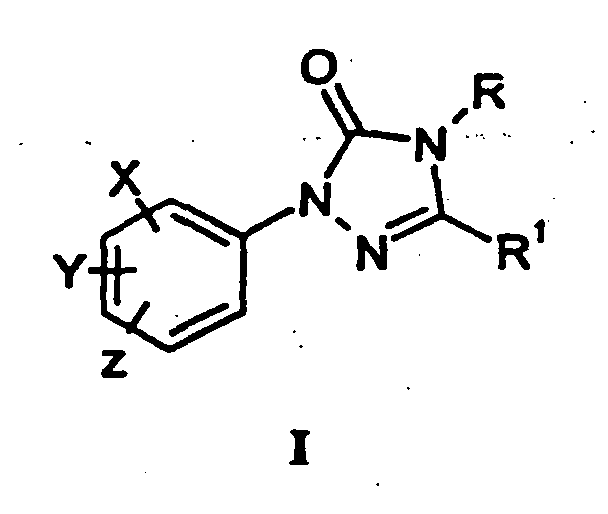
- It has now been found that commercially useful 1-aryltriazolinones of formula Ican be prepared in excellent yield and purity by (i) carbonylating an amidrazone of formula (A) with at least one carbonylating agent, or by (ii) condensing a hydrazonoyl derivative of formula (A) with at least one ring-forming agent, wherein formula (A) is
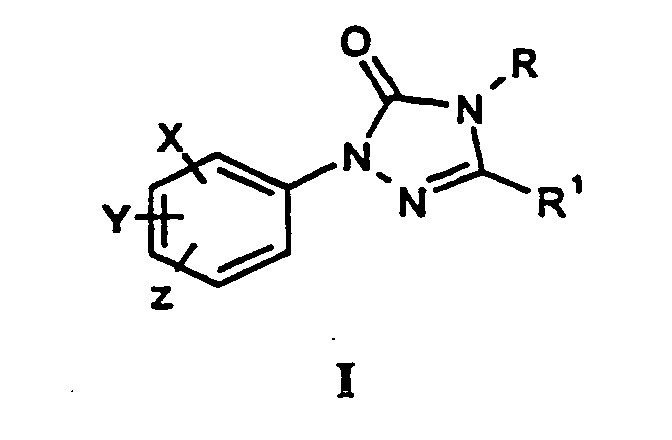 where W, X, Y, Z, and R1 are fully described below. Preferred are those where W is halogen or -NHR where R is hydrogen or haloalkyl; X and Y are independently selected from hydrogen, chloro, or fluoro; Z is hydrogen, bromo, iodo, nitro, amino, or methylsulfonylamino; and R1 is methyl. Additionally, certain compounds of formula (A) used to prepare 1-aryltnazolinones of formula I are also novel and are included among the preferred embodiments of the present invention. These and other features, aspects, and advantages of the present invention will become better understood with reference to the following description and appended claims.
- The modifier "about" is used herein to indicate that certain preferred operating ranges, such as ranges for molar ratios for reactants, material amounts, and temperature, are not fixedly determined. The meaning will often be apparent to one of ordinary skill. For example, a recitation of a temperature range of about 120° C to about 135° C in reference to, for example, an organic chemical reaction would be interpreted to include other like temperatures that can be expected to favor a useful reaction rate for the reaction, such as 105° C or 150° C. Where guidance from the experience of those of ordinary skill is lacking, guidance from the context is lacking, and where a more specific rule is not recited below, the "about" range shall be not more than 10% of the absolute value of an end point or 10% of the range recited, whichever is less.
- As used in this specification and unless otherwise indicated the substituent terms "alkyl", "alkoxy", and "haloalkyl", used alone or as part of a larger moiety, includes straight or branched chains of at least one or two carbon atoms, as appropriate to the substituent, and preferably up to 12 carbon atoms, more preferably up to ten carbon atoms, most preferably up to seven carbon atoms. The term "aryl" refers to phenyl or naphthyl optionally substituted with one or more halogen, alkyl, alkoxy, or haloalkyl. "Halogen" or "halo" refers to fluorine, bromine, iodine, or chlorine. The term "ambient temperature" refers to a temperature in the range of about 20° C to about 30° C. Certain solvents, catalysts, and the like are known by their acronyms. These include the acronyms "DMAC" meaning N,N-dimethylacetamide, "DMF" meaning N,N-dimethylformamide, "THF" meaning tetrahydrofuran, "DMAP" meaning 4-dimethylaminopyridine, "DBN" meaning 1,5-diazabicyclo[4.3.0]non-5-ene, and "DBU" meaning 1,8-diazabicyclo[5.4.0]undec-7-ene. The term "glymes" refers to a class of solvents comprised of monoglyme, diglyme, triglyme, tetraglyme, and polyglyme. The term "GC" refers to gas chromatography or gas chromatographic methods of analyses.
- The term "amidrazone" or "amidrazone of formula (A)" is synonymous with and refers to a 2-(optionally-substituted phenyl)hydrazidethaneimidic acid, for example, but not limited to 2-(2,4-dichlorophenyl)hydrazidethaneimidic acid. The term "hydrazonoyl derivative" or "hydrazonoyl derivative of formula (A)" is synonymous with and refers to a N-(optionally-substituted phenyl)ethanehydrazonoyl derivative, for example, but not limited to N-(2,4-dichlorophenyl)ethanehydrazonoyl chloride. The term "compound or compounds of formula (A)" refers to both amidrazone and hydrazonoyl derivatives. The term "compound or compounds of formula I" is synonymous with and refers to 1-aryltriazolinone(s), for example, but not limited to 4,5-dihydro-1-(2,4-dichlorophenyl)-3-methyl-1,2,4-triazol-5(1H)-one.
- One embodiment of the present invention relates to a process for preparing a compound of formula I:wherein an amidrazone of formula (A) is carbonylated with at least one carbonylating agent, where formula (A) is:
 and wherein X and Y are independently selected from hydrogen, halogen, nitro, and amino; Z is selected from hydrogen, halogen, alkyl, alkoxy, nitro, amino, or alkylsulfonylamino; W is -NHR where R is hydrogen, alkyl, or haloalkyl; and, R1 is hydrogen, alkyl, haloalkyl, alkoxy, acetyl, or aryl.
- Preferred species of amidrazone (A) with which to conduct the carbonylation reaction of the present invention are selected from those wherein X and Y are independently selected from hydrogen, chloro, or fluoro; Z is hvdrogen. bromo, iodo, nitro, amino, or methylsulfbnylaanino; R is hydrogen or difluoromethyl; and R1 is C1 to C12 alkyl.
- More preferred species of amidrazone (A) are selected from those wherein X, Y, and R are hydrogen, Z is hydrogen, 5-nitro, or 5-amino, and R1 is methyl, ethyl, or propyl; wherein X and R are hydrogen, Y is 4-chloro, Z is hydrogen or 5-nitro, and R1 is methyl, ethyl, or propyl; wherein X is 2-chloro or 2-fluoro, Y, Z, and R are hydrogen, and R1 is methyl, ethyl, or propyl; or wherein X is 2-chloro or 2-fluoro, Y is 4-chloro, Z is hydrogen, 5-bromo, 5-iodo, or 5-nitro, R is hydrogen, and R1 is methyl, ethyl, or propyl.
- Most preferred species of amidrazone (A) are selected from those wherein X, Y, Z and R are hydrogen, and R1 is methyl; or wherein X is 2-fluoro, Y is 4-chloro, Z and R are hydrogen, and R1 is methyl.
- For conducting the carbonylation of amidrazone (A), the use of at least one suitable organic solvent is preferably employed.
- Preferred organic solvents, both polar and apolar, useful in the process of the present invention include halogenated solvents, for example, such as, without limitation, chlorobenzene, carbon tetrachloride, bromodichloromethane, dibromochloromethane, bromoform, chloroform, bromochloromethane, butyl chloride, dichloromethane, tetrachloroethylene, trichloroethylene, 1,1,1-trichloroethane, 1,1,2-trichloroethane, 1,1-dichloroethane, 2-chloropropane, hexafluorobenzene, 1,2,4-trichlorobenzene, 1,2-dichlorobenzene, fluorobenzene and other halogenated solvents known in the art.
- Preferred polar organic solvents include ethers, for example, such as, without limitation, dimethoxymethane, THF, 1,3-dioxane, 1,4-dioxane, furan, diethyl ether, ethylene glycol dimethyl ether, ethylene glycol diethyl ether, diethylene glycol dimethyl ether, diethylene glycol diethyl ether, triethylene glycol dimethyl ether, tert.-butyl ethyl ether, tert.-butyl methyl ether and other ether solvents known in the art. Other polar organic solvents useful in the context of the present invention include, for example, without limitation, propionitrile, ethyl formate, methyl acetate, hexachloroacetone, acetone, ethyl methyl ketone, ethyl acetate, nitromethane, nitrobenzene, glymes, and other polar solvents known in the art.
- Other organic solvents useful herein include polar aprotic solvents, for example, such as, without limitation, DMF, DMAC, 1,3-dimethyl-3,4,5,6-tetrahydro-2(1H)-pyrimidinone, 1,3-dimethyl-2-imidazolidinone, N-methylpyrrolidinone, formamide,, N-methylacetamide, N-methylformamide, acetonitrile, dimethyl sulfoxide, sulfolane, N,N-dimethylpropionamide, tetramethylurea, hexamethylphosphoramide and other polar aprotic solvents known in the art.
- Yet other organic solvents useful for implementation of the present invention include protic solvents, for example, such as, without limitation, water, methanol, ethanol, 2-nitroethanol, 2-fluoroethanol, 2,2,2-trifluoroethahol, ethylene glycol, 1-propanol, 2-propanol, 2-methoxyethanol, 1-butanol, 2-butanol, isobutanol, tert.-butanol, 2-ethoxyethanol, diethylene glycol, 1-,2-,or 3-pentanol, 2,2-dimethyl-1-propanol,tert.-pentanol, cyclohexanol, anisole, benzyl alcohol, glycerol and other protic solvents known in the art.
- Further organic solvents useful in the present invention include: acidic solvents, for example, such as, without limitation, trifluoroacetic acid, acetic acid, formic acid and other acidic solvents known in the art; basic solvents, for example, such as, without limitation, 2-, 3-, or 4-picoline, pyrrole, pyrrolidine, morpholine, pyridine, piperidine, triethylamine and other basic solvents known in the art; and hydrocarbon solvents, for example, such as, without limitation, benzene, cyclohexane, pentane, hexane, toluene, cycloheptane, methylcyclohexane, heptane, ethylbenzene, ortho-, meta-, or para-xylene, octane, indane, nonane, naphthaline and other hydrocarbon solvents known in the art.
- Organic solvents most suitable for conducting the carbonylation of amidrazone (A) are those that are low cost, best enhance the solubility of the starting materials to promote rate of reaction, and offer minimum solvent decomposition. Accordingly, preferred organic solvents include DMF, DMAC, acetonitrile, toluene, THF, and glymes. More preferred solvents include acetonitrile, toluene, tetrahydrofuran, monoglyme, and diglyme. The most preferred organic solvent in which to conduct the carbonylation of amidrazone (A) is toluene.
- In the course of conducting chemical reactions, especially large scale organic chemical reactions yielding commercial quantities of desired product, a balance must be met between having to handle too much solvent and yet provide sufficient solvent to afford optimum reaction conditions. A useful ratio of solvent to amidrazone (A) to afford optimum reaction conditions is in the range of about 2.5/1 to about 20/1 wt/wt, preferably about 3/1 to about 15/1.
- In order to form a compound of formula I, an amidrazone of formula (A) is carbonylated with at least one carbonylating agent. Useful carbonylating agents are represented by the following formula:wherein R2 and R3 are the same and are selected from the group consisting of halogen, alkoxy, dichloromethoxy, trichloromethoxy, imidazol-1-yl, 2-methylimidazol-1-yl, phenoxy or naphthoxy wherein phenoxy and naphthoxy are optionally substituted with halogen, alkoxy, or nitro; or wherein R2 and R3 are different where, for example, R2 is halo, and R3 is alkoxy; provided that if the carbonylating agent is selected wherein R2 and R3 are chloro, at least one other carbonylating agent is also selected. Preferred carbonylating agents are those wherein R2 and R3 are the same and are selected from the group consisting of dichloromethoxy, trichlommethoxy, imidazol-1-yl, or phenoxy optionally substituted with halogen, alkoxy, or nitro. A more preferred carbonylating agent with which to carbonylate amidrazone (A) is that wherein R2 and R3 are each phenoxy. A preferred mole ratio of carbonylating agent to amidrazone (A) is in the range of about 1/1 to about 2.5/1, more preferably about 1.1/1 to about 1.5/1.

- Preferably, the carbonylation of an amidrazone of formula (A) to form a compound of formula I is conducted in the presence of an acid or base catalyst. The catalyst need not be present in order to form a compound of formula I; however, its presence will generally accelerate the formation of a compound of formula I. Whether or not a catalyst is preferably present may depend upon the compound of formula I being formed, the amidrazone (A) being used as the reactant, the catalyst, the desired reaction time, and the reaction temperature, which one of ordinary skill in the art can readily determine based on general knowledge and this disclosure.
- An acid catalyst useful in the context of the present invention can be a protic (Brontsted) acid or an electron pair-accepting (Lewis)acid. Acid catalysts include, for example, mineral, organic, inorganic, and organometallic acids. Preferred acid catalysts include, but are not limited to, hydrochloric acid, hydrpbromic acid, hydroiodic acid, sulfuric acid, perchloric acid, acetic acid, trifluoroacetic acid, trifluoromethanesulfonic acid, chlorosulfonic acid, methanesulfonic acid, para-toluenesulfonic acid, camphorsulfonic acid, benzenesulfonic acid, boron trifluoride, boron trifluoride etherate, aluminium chloride, zinc chloride, and lanthanum series trifluoromethanesulfonates such as the trifluoromethanesulfonates of scandium, praseodymium, and ytterbium, and other acid catalysts known in the art.
- Preferred acid catalysts for use in carbonylating an amidrazone of formula (A) include, but are not limited to, boron trifluoride, aluminum chloride, lanthanum series trifluoromethanesulfonates, methanesulfonic acid, para-touluenesulfonic acid, acetic acid, and trifluoroacetic acid. Particularly preferred acid catalysts include boron trifluoride, scandium trifluoromethanesulfonate, methanesulfonic acid, and para-touluenesulfonic acid.
- Preferably, the acid catalyst is present in a mole ratio of acid catalyst to amidrazone (A) in a range of about 0.0001/1 to about 1/1, preferably in a range of about 0.001/1 to about 0.1/1. Additional amounts of acid catalyst can be added if necessary to drive the reaction faster, for example.
- Preferred base catalysts include, but are not limited to, alkali metal, alkaline earth metal, and transition metal halides, hydrides, hydroxides, bicarbonates, carbonates, and the like. Metal halides useful in the present context include, but are not limited to, lithium chloride, lithium fluoride, lithium bromide, lithium iodide, sodium chloride, sodium fluoride, sodium bromide, sodium iodide, potassium chloride, potassium fluoride, potassium bromide, potassium iodide, magnesium chloride, magnesium fluoride, magnesium bromide, magnesium iodide, calcium chloride, calcium fluoride, calcium bromide, calcium iodide, silver bromide, and silver iodide. Metal hydrides useful in the present context include, but are not limited to, lithium hydride, sodium hydride, potassium hydride, magnesium hydride, calcium hydride, and barium hydride. Metal hydroxides useful in the present context include, but are not limited to, lithium hydroxide, sodium hydroxide, potassium hydroxide, magnesium hydroxide, calcium hydroxide, and barium hydroxide. Metal bicarbonates useful in the present context include, but are not limited to, sodium bicarbonate, and potassium bicarbonate. Metal carbonates useful in the present context include, but are not limited to, sodium carbonate and potassium carbonate. One of ordinary skill, upon receipt of the teachings hereof, may select other alkali metal, alkaline earth metal, and transition metal halides, hydrides, hydroxides, bicarbonates, and carbonates known in the art as catalysts.
- Useful base catalysts also include alkali metal alkoxides, such as, without limitation, sodium methoxide, sodium ethoxide, potassium methoxide, potassium ethoxide, potassium tert.-butoxide, and other alkali metal alkoxides known in the art. Other useful base catalysts include organic alkyl amines and cyclic amines, for example, but are not limited to methylamine, ethylamine, dimethylamine, diethylamine, trimethylamine, triethylamine, ethyldiisopropylamine, butylamine, pyridine, DMAP, 2,6-dimethylpyridine, piperidine, piperazine, morpholine, quinoline, DBN, DBU, and other alkyl amines and cyclic amines known in the art.
- Preferred base catalysts for use in carbonylating an amidrazone of formula (A) include sodium carbonate, potassium carbonate, sodium hydride, triethylamine, pyridine, DMAP, DBN, DBU, sodium methoxide, potassium methoxide, and potassium tert-butoxide. Particularly preferred base catalysts include sodium carbonate, potassium carbonate, DMAP, DBN, and DBU.
- The base catalyst used in the present invention can be present in a mole ratio of base catalyst to amidrazone (A) in a range of about 0.0001/1 to about 1/1, preferably in a range of about 0.001/1 to about 0.1/1. Additional amounts of base catalyst may be added if necessary to drive the reaction faster, for example.
- The temperature at which and the period for which a chemical reaction such as the carbonylation of amidrazone (A) is conducted will vary according to, among other things, the solvent or solvents in which the reaction is conducted, the reaction format (eg., batch, semi-batch, or continuous), the carbonylating agent, and/or the formula of amidrazone (A), and whether or not a catalyst is used. The carbonylation of amidrazone (A) as set forth herein is generally conducted at a temperature in the range of about 10°C to about 200° C for a period of time of up to about 20 hours, preferably in the range of about ambient temperature to about 160° C for about 10 hours, and more preferably up to about 5 hours.
- Generally, in a process of carbonylating an amidrazone (A), a hydrazine derivative, for example, 2,4-dichlorophenylhydrazine (1) is first prepared from its hydrochloride salt by treating the salt with a base, such as aqueous sodium hydroxide, giving the free hydrazine (1). The free hydrazine (1) is in turn reacted with, for example, ethyl acetimidate at a temperature of about 0° C to about ambient temperature in an appropriate solvent such as methylene chloride, yielding the corresponding amidrazone (A), 2,4-dichlorophenylhydrazidethaneimidic acid. Amidrazone (A) is in turn carbonylated with, for example, diphenyl carbonate at a temperature of about 100° C to about 115° C in a appropriate solvent such as toluene, yielding the corresponding compound of formula (I), 45-dihydro-1-(2,4-dichlorophenyl)-3-methyl-1,2,4-triazol-5(1H)-one. The carbonylation of amidrazone (A) to the compound of formula (I) is routinely aided with a catalyst, such as DMAP. A detailed procedure for the preparation, and carbonylation of an amidrazone (A) to yield a compound of formula (I) is set forth in Example 3 hereinbelow.
- In a second embodiment of the present invention, the process for preparing a compound of formula (I):involves a condensation reaction of a hydrazonoyl derivative of formula (A) with at least one ring-forming agent, where formula (A) is:
 and wherein X and Y are independently selected from hydrogen, halogen, nitro, and amino; Z is selected from hydrogen, halogen, alkyl, alkoxy, nitro, amino, or alkylsulfonylamino; W is halogen, -NCO, -OSO2CH3, -OSO2CF3, or -OSO2(p-CH3Ph); and R1 is hydrogen, alkyl, haloalkyl, alkoxy, acetyl, or aryl.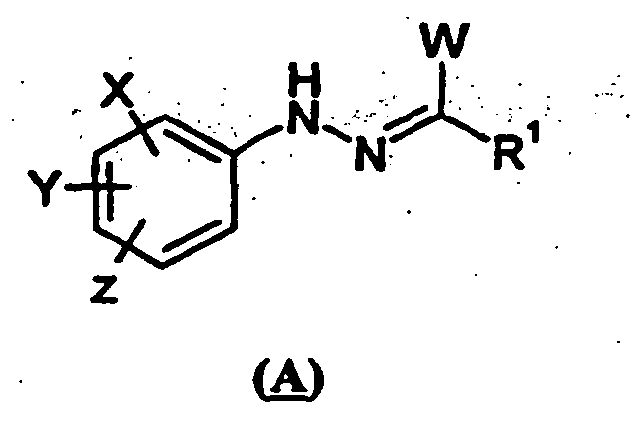
- Preferred species of hydrazonoyl derivative (A) with which to conduct the condensation reaction of the present invention are selected from those wherein W is halogen; X and Y are independently selected from hydrogen, chloro, or fluoro; Z is hydrogen, bromo, iodo, nitro, amino, or methylsulfonylamino; and R1 is C1 to C12 alkyl.
- More preferred species of hydrazonoyl derivative (A) are selected from those wherein W is chloro; X and Y are hydrogen; Z is hydrogen, 5-nitro, or 5-amino; and R1 is methyl, ethyl, or propyl; wherein W is chloro; X is hydrogen; Y is 4-chloro; Z is hydrogen or 5-nitro; and R1 is methyl, ethyl, or propyl; wherein W is chloro; X is 2-chloro or 2-fluoro; Y and Z are hydrogen; and R1 is methyl, ethyl, or propyl; or wherein W is chloro: X is 2-chloro or 2-fluoro, Y is 4-chloro; Z is hydrogen 5-bromo, 5-iodo, or 5-nitro; and R1 is methyl, ethyl, or propyl.
- Most preferred species of hydrazonoyl derivative (A) are selected from those wherein W is chloro; X, Y, and Z are hydrogen; and R1 is methyl, or wherein W is chloro; X is 2-fluoro; Y is 4-chloro, Z is hydrogen, and R1 is methyl.
- For conducting the condensation reaction of a hydrazonoyl derivative of formula (A), at least one organic solvent, such as those described above, is preferably employed. Preferred organic solvents are those that are low cost, best enhance the solubility of the starting materials to promote rate of reaction, and offer minimum solvent decomposition. Accordingly, preferred organic solvents include glymes, DMF, DMAC, 1-methyl-2-pyrrolidinone, and methyl sulfoxide. More preferred solvents are glymes, DMF, and DMAC. Particularly preferred solvents are DMAC and diglyme. A useful ratio of solvent to hydrozonoyl derivative (A) to afford optimum reaction conditions is in the range of about 2.5/1 to about 20/1 wt/wt, preferably about 3/1 to about 15/1.
- Accordingly, when diglyme is the solvent of choice in which to conduct the condensation reaction of a hydrazonoyl derivative of formula (A), the rate of reaction benefits from the inclusion of a reaction rate-promoting amount of water. Inasmuch as the reaction proceeds in an acceptable manner without the presence of water, it is believed that it aids in dissolving the ring-forming agent thereby enhancing its contact with hydrazonoyl derivative (A) causing the reaction to proceed at a faster rate. The ratio of reaction rate-promoting amount of water to solvent as used in the present invention is in the range of about 0.001/1 to about 1/1 wt/wt. A preferred ratio is about 0.01/1 to about 0.9/1, more preferably about 0.04/1 to about 0.8/1.
- In order to form a compound of formula I, a hydrazonoyl derivative of formula (A) is condensed with at least one ring-forming agent. Useful ring-fencing agents in the process of the present invention include, for example, such as, without limitation sodium cyanate, potasium cyanate, silver cyanate, methyl carbamate, ethyl carbamate, phenyl carbamate, cyanic acid, isocyanic acid, acetyl isocyanate, and trimethylsilyl isocyanate. Preferred ring-forming agents are sodium cyanate, potassium cyanate, cyanic acid, isocyanic acid, and phenyl carbamate. More preferred ring-forming agents are sodium cyanate and potassium cyanate, particularly potassium cyanate. A useful mole ratio of ring-forming agent to hydrazonoyl derivative (A) of about 1/1 to about 5/1; preferably about 1.05/1 to about 2/1, and more preferably about 1.1/1 to about 1.3/1.
- Preferably, the condensation reaction of a hydrazonoyl derivative of formula (A) to form a compound of formula I is conducted in the presence of a catalyst. Accordingly, useful catalysts, such as those described sbove, for condensing hydrazonoyl derivative (A) include potassium iodide, potassium fluoride, silver bromide, silver iodide, and elemental iodine. Preferred catalysts are potassium iodide, potassium fluoride, and elemental iodine, particularly potassium fluoride. The catalyst used in the present invention can be present in a mole ratio of catalyst to hydrazonoyl derivative (A) in a range of about 0.001/1 to about 0.1/1, preferably about 0.004/1 to about 0.06/1. Additional amounts of catalyst may be added if necessary to drive the reaction faster, for example.
- The temperature at which and the period for which a chemical reaction such as the condensation reaction of a hydrazonoyl derivative of formula (A) is conducted will vary, as discussed above. The condensing of hydrazonoyl derivative (A) as set forth herein is generally conducted at a temperature in the range of about -10° C to about 160° C for a period of time up to about 30 hours, preferably in the range of about 0° C to about 100° C for up to about 20 hours, more preferably up to about 10 hours.
- Generally in a process of condensing a hydrazonoyl derivative of formula (A) to form a compound of formula (I), the free hydrazine (1) as described above, for example, 2,4-dichlorophenylhydrazine (1) is reacted with acetic anhydride at a temperature of about 10° C in an appropriate solvent such as ethylacetate, yielding the corresponding 1-acetyl-2-(2,4-dichlorophenyl)hydrazine (2). The hydrazine (2) is then chlorinated with phosphorous oxychloride at a temperature of about 110° C in an appropriate solvent such as toluene, yielding the hydrazonoyl derivative of formula (A), N-(2,4-dichlorophenyl)ethanehydrozonoyl chloride. The hydrozonoyl chloride (A) is condensed with a ring forming agent, for example, potassium cyanate at a temperature of about 40° C to about 65° C in an appropriate solvent such as DMAC, yielding the corresponding compound of formula (I), 45-dihydro-1-(2,4-dichlorophenyl)-3-methyl-1,2,3-triazol-5(1H)-one. The condensing of hydrozonoyl chloride (A) to the compound of formula (I) in solvents such as DMAC is routinely aided by the presence of a catalyst, such as potassium fluoride. A detailed procedure for the preparation, and the potassium fluoride-catalized condensing of the hydrozonoyl chloride (A) with the ring forming agent potassium cyanate in DMAC to yield a compound of formula (I) is set forth in Example 1 hereinbelow.
- In a variation of the process of condensing a hydrazonoyl derivative of formula (A) to form a compound of formula (I), the hyrazondyl derivative (A), for example, N-(2,4-dichlomphenyl)cdmmhydrozonoyl chloride is conducted at ambient temperature in the solvent diglyme in the presence of a catalytic amount of water. A detailed procedure for the preparation, and the water-catalized condensing of the hydrozonoyl chloride (A) with the ring forming agent potassium cyanate in diglyme to yield a compound of formula (I) is set forth in Example 2 hereinbelow.
- A third embodiment of the present invention relates to novel amidrazone and hydrazonoyl derivatives of formula (A) useful in the preparation of compounds of formula I. These compounds are represented by formula (A):wherein;

- W is halogen, -NCO, -OSO2CH3, -OSO2CF3, -OSO2(p-CH3Ph); or -NHR where R is hydrogen, alkyl, or haloalkyl; X and Y are independently selected from hydrogen, halogen, nitro, and amino; Z is selected from hydrogen, halogen, alkyl, alkoxy, nitro, amino, or alkylsulfonylamino; and, R1 is hydrogen, alkyl, haloalkyl, alkoxy, acetyl, or aryl.
-
- Preferred novel compounds of formula (A) are those wherein W is halogen or -NHR where R is hydrogen or difluoromethyl; X and Y are independently selected from hydrogen, chloro, or fluoro; Z is hydrogen, bromo, iodo, nitro, amino, or methylsulfonylamino; and R1 is C1 to C12 alkyl.
- More preferred novel compounds of formula (A) are those wherein W is chloro or -NHR where R is hydrogen; X and Y are hydrogen; Z is hydrogen, 5-nitro, or 5-amino; and R1 is methyl, ethyl, or propyl; those wherein W is chloro or -NHR where R is hydrogen; X is hydrogen, Y is 4-chloro, Z is hydrogen or 5-nitro; and R1 is methyl, ethyl, or propyl; those wherein W is chloro or -NHR where R is hydrogen; X is 2-chloro or 2-fluoro; Y and Z are hydrogen; and R1 is methyl, ethyl, or propyl; and, those wherein W is chloro or -NHR where R is hydrogen; X is 2-chloro or 2-fluoro, Y is 4-chloro; Z is hydrogen, 5-bromo, 5-iodo, or 5-nitro; and R' is methyl, ethyl, or propyl.
- Most preferred compounds of formula (A) are those wherein W is chloro or - NHR where R is hydrogen, X, Y, and Z are hydrogen, and R1 is methyl; or wherein W is chloro or -NHR where R is hydrogen X is 2-fluoro, Y is 4-chloro, Z is hydrogen, and R1 is methyl.
- The process of the present invention is carried out in accordance with the procedures shown in the examples below. The examples serve only to illustrate the invention and should not be interpreted as limiting since further modifications of the disclosed invention will be apparent to those skilled in the art. All such modifications are deemed to be within the scope of the invention as defined in the claims.
- This example illustrates a process for preparing 4,5-dihydro-1-(2,4-dichlorophenyl)-3-methyl-1,2,4-triazol-5(1H)-one (I) from N-(2,4-dichlorophenyl)ethanehydrazonoyl chloride (A) in DMAC solvent
- A slurry of 101.4 grams (0.4751 mole) of 2,4-dichlorophenylhydrazine hydrochloride in 600 mL of water was stirred, and a solution of 20.9 grams (0.5225 mole) of sodium hydroxide in 100 mL of water was slowly added. During the addition, the reaction mixture thickened. An additional 50 mL of water was added to aid fluidity. Upon completion of addition of the sodium hydroxide solution, an additional 70 mL of water was added. The reaction mixture was stirred for about 75 minutes, then it was extracted with three 300 mL portions of ethyl acetate. The extracts were combined and dried with magnesium sulfate. The mixture was filtered and the filtrate containing free 2,4-dichlorophenylhydrazine (1) was transferred to an appropriate reaction vessel. The stirred solution was cooled to about 10 °C, and 58.2 grams (0.5701 mole) acetic anhydride was added dropwise. Upon completion of addition, gas chromatographic (GC) analysis of the reaction mixture indicated the reaction was about 99% complete. The cooling medium was removed, and a solution of 62.5 grams of potassium carbonate in 200 mL of water was added to the reaction mixture. The mixture was stirred for about five minutes and the organic layer was separated. The organic layer was concentrated under reduced pressure, yielding 102.0 grams (98% yield) of 1-acetyl-2-(2,4-dichlorophenyl)hydrazine (2).
- A solution of 25.0 grams (0. 1142 mole) of 1-acetyl-2-(2,4-dichlorophenyl)-hydrazine (2) in 120 grams of toluene was stirred, and 17.7 grams (0.1142 mole) of phosphorus oxychloride was added portionwise. Upon completion of addition the reaction mixture was warmed to about 110 °C where it stirred for about 30 minutes. GC analysis of the reaction mixture after this time indicated the reaction was complete. An additional 100 grams of toluene was added to the reaction mixture, and the solution was decanted into a separatory funnel. A residue in the reaction vessel was washed with about 40 grams of toluene, and the wash was also decanted into the separatory funnel. The toluene solution was then washed with an aqueous solution of 10% potassium carbonate. The aqueous layer was backwashed with two 75 gram portions of toluene. The combined toluene layer and washes was dried with magnesium sulfate. The mixture was filtered and the filtrate was concentrated under reduced pressure, yielding 21.3 grams (78 5% yield) of N-(2,4-dichlorophenyl)ethanehydrazonoyl chloride (A).
- A solution of 21.3 grams (0.0896 mole) of N-(2,4-dichlorophenyl)ethane-hydrazonoyl chloride (A) in 500 grams of N,N-dimethylacetamide (DMAC) was stirred and 9.1 grams (0.1127 mole) of potassium cyanate, followed by 0.1 gram (0:0018 mole) of potassium fluoride were added. Upon completion of addition, the heat of reaction caused the reaction mixture temperature to rise to about 60°C. The reaction mixture was stirred for 30 minutes during which time the reaction mixture temperature fell to about 45 °C. GC analysis of the reaction mixture after this time indicated that the reaction was complete. The reaction mixture was concentrated under reduced pressure to a residue. The residue was slurried with about 100 grams of water, and the resultant solid was collected by filtration. The solid was washed with water and dried, yielding 21.2 grams of subject compound (I) (yield from (2) was 77.3%; yield from (A) was 96.8%).
- This example illustrates a process for preparing 4,5-dihydro-1-(2,4-dichlorophenyl)-3-methyl-1,2,4-triazol-5(1H)-one (I) from N-(2,4-dichlorophenyl)eihanehydrazonoyl chloride (A) in diglyme solvent
- A solution of 5.1 grams (0.0214 mole) of N-(2,4-dichlorophenyl)ethane-hydrazonoyl chloride (A), prepared as in Example 1, 2.1 grams (0.0257 mole) potassium cyanate, and 3 mL of water in 51 mL of diglyme was stirred at ambient temperature for about 22 hours. After this time, the reaction mixture was concentrated under reduced pressure to a residue. The residue was dissolved in about 500 mL of ethyl acetate and washed with three 25 mL portions of water. The organic layer was dried with magnesium sulfate and filtered. The filtrate, was concentrated under reduced pressure to a residue. The residue was triturated with hexane and the resultant solid was collected by filtration The solid was dried, yielding 4.5 grams (85.2% yield from (A)) of subject compound (I) .
- This example illustrates a process for prepating 4,5-dihydro-1-(2,4-dichlorophenyl)-3-methyl-1,2,4-triazol-5(1H)-one (I) from 2-(2,4-dichlorophenyl)hydrazidethaneimidic acid (A)
- A stirred solution of 13.6 grams (0:1100 mole) of ethyl acetimidate hydrochloride and 13.2 grams (0.1300 mole) of triethylamine in 100 grams of methylene chloride was cooled to about 0 °C for five minutes, and 17.7 grains (0.1000 mole) of 2,4-dichlorophenylhydrazine (1) was added. Upon completion of addition the reaction mixture stirred at 0 °C for about one hour, then it was allowed to warm to ambient temperature where it stirred for about two hours. GC analysis of the reaction mixture indicated the presence of a small amount of unreacted (1). An additional 0.6 gram of ethyl acetimidate hydrochloride was added (total 14.2 gram-0.1150 mole), and the reaction mixture was stirred for an additional one hour. After this time the reaction mixture was washed with about 20 mL of water and dried with magnesium sulfate. The mixture was filtered, and the filtrate was concentrated under reduced pressure to a semi-solid residue. The residue was triturated with 20 mL of hexane, and the resultant solid was collected by filtration. The solid was washed with 50 mL of hexane and dried, yielding 20.4 grams (93.4% yield) of 2-(2,4-dichlorophenyl)hydrazidethaneimidic acid (A).
- A stirred solution of 7.5 grams (0.0344 mole) of 2-(2,4-dichlorophenyl)-hydrazidethaneimidic acid (A), 7.4 grams (0.0344 mole) of diphenyl carbonate, and 0.2 gram (0.0017 mole) of 4-dimethylaminopyridine (DMAP) in 20 grams of toluene was heated at reflux for about 30 minutes. GC analysis of the reaction mixture after this time indicated the presence of unreacted diphenyl carbonate. An additional 0.3 gram of (A) was added (total 7.8 grams-0.0358 mole), and the reaction mixture was heated at reflux for an additional 30 minutes. After this time the reaction mixture was cooled and concentrated under reduced pressure to a residue. The residue was slurried for about two hours in refluxing hexane, then it was collected by nitration, yielding about 8.1 grams of subject compound (I) (yield from (A) is 93.2%; yield from (1) is 87.0%).
- While this invention has been described with an emphasis upon preferred embodiments, it wilt be obvious to those of ordinary skill in the art that variations of the preferred embodiments may be used and that it is intended that the invention may be practiced otherwise than as specifically described herein. Accordingly this invention includes all modifications encompassed within the spirit and scope as defined by the following claims.
Claims (13)
- A process for preparing a compound of formula I:comprised of condensing a hydrazonoyl derivative of formula (A) with one or more ring-forming agent, wherein formula (A) is:
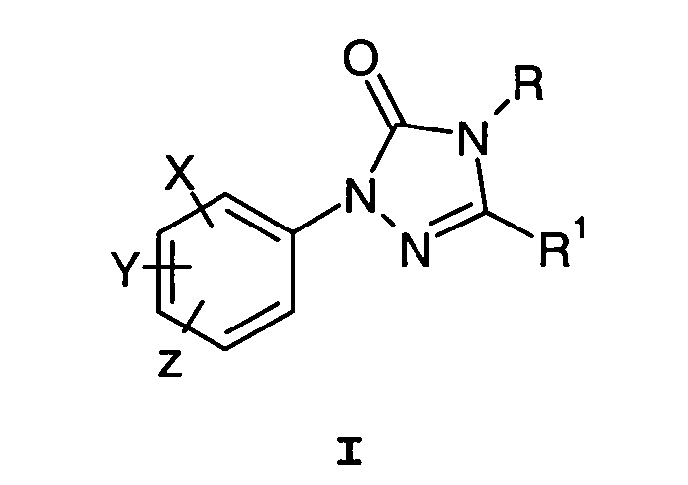 and wherein X and Y are independently selected from hydrogen, halogen, nitro, and amino;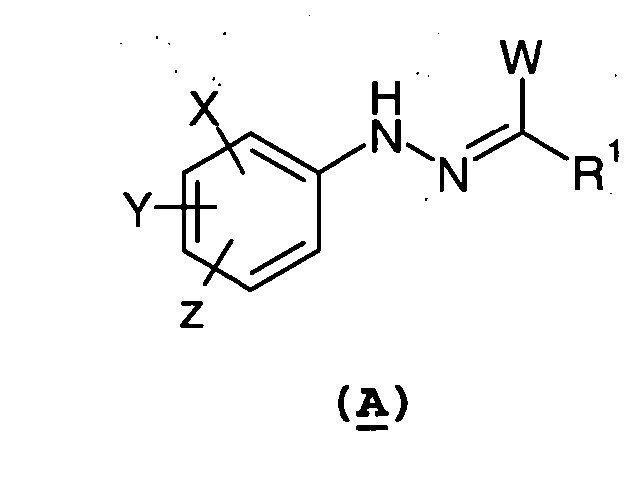
Z is selected from hydrogen, halogen, alkyl, alkoxy, nitro, amino, or alkylsulfonylamino;
W is halogen, -NCO, -OSO2CH3, -OSO2CF3, or -OSO2(p -CH3Ph); and,
R1 is hydrogen, alkyl, haloalkyl, alkoxy, acetyl, or aryl. - The process in accordance with Claim 1 wherein X, Y, Z, and R are hydrogen; and R1 is methyl.
- The process in accordance with Claim 1 wherein X is 2-fluoro; Y is 4-chloro, Z is hydrogen; and R1 is methyl.
- The process in accordance with any of Claims 1 to 3 wherein said condensing is conducted in at least one organic solvent.
- The process in accordance with Claim 4 wherein said solvent contains a reaction rate-promoting amount of water.
- The process in accordance with any of Claims 1 to 5 wherein said condensing is conducted at a temperature in the range of about -20°C to about 200°C.
- The process in accordance with any of Claims 1 to 6 wherein said ring-forming agent is selected from a group consisting of sodium cyanate, potassium cyanate, silver cyanate, methyl carbamate, ethyl carbamate, phenyl carbamate, cyanic acid, isocyanic acid, acetyl isocyanate, and trimethylsilyl isocyanate.
- The process in accordance with any of Claims 1 to 7 wherein said condensing is conducted in the presence of a catalyst.
- A compound of formula (A):wherein:
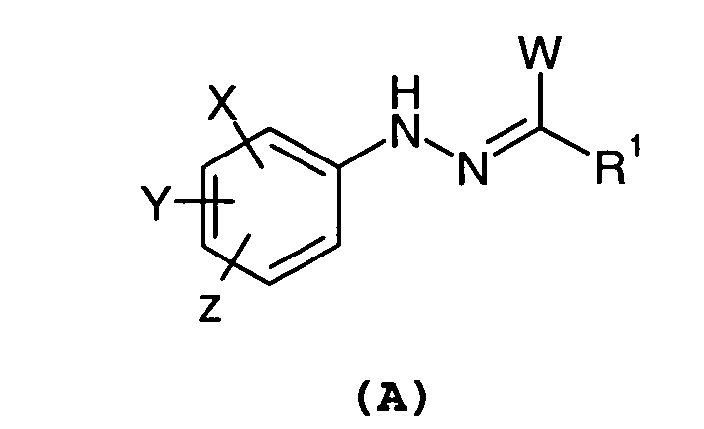 W is halogen, -NCO, -OSO2CH3, -OSO2CF3, -OSO2 (p-CH3Ph) ;X and Y are independently selected from hydrogen, halogen, nitro and amino;Z is selected from hydrogen, halogen, alkyl, alkoxy, nitro, amino, or alkylsulfonylamino; and,R1 is hydrogen, alkyl, haloalkyl, alkoxy, acetyl, or aryl.
 - The compound of Claim 9 wherein W is halogen; X and Y are independently selected from hydrogen, chlorine, or fluorine; Z is hydrogen, bromo, iodo, nitro, amino, or methylsulfonylamino; and R1 is C1 to C12 alkyl.
- The compound of Claim 16 wherein W is chloro; X and Y are hydrogen; Z is hydrogen, 5-nitro, or 5-amino; and R1 is methyl, ethyl, or propyl.
- The compound of Claim 9 wherein W is chloro; X is 2-chloro or 2-fluoro; Y and Z are hydrogen; and R1 is methyl, ethyl, or propyl.
- The compound of Claim 9 wherein W is chloro; X is 2-chloro or 2-fluoro, Y is 4-chloro; Z is hydrogen, 5-bromo, 5-iodo, or 5-nitro; and R1 is methyl, ethyl, or propyl.
Applications Claiming Priority (5)
| Application Number | Priority Date | Filing Date | Title |
|---|---|---|---|
| US15924799P | 1999-10-13 | 1999-10-13 | |
| US159247P | 1999-10-13 | ||
| US663336 | 2000-09-18 | ||
| US09/663,336 US6492527B1 (en) | 1999-10-13 | 2000-09-18 | Process to prepare aryltriazolinones and novel intermediates thereto |
| EP00972109A EP1240149B1 (en) | 1999-10-13 | 2000-10-12 | Process to prepare aryltriazolinones |
Related Parent Applications (1)
| Application Number | Title | Priority Date | Filing Date |
|---|---|---|---|
| EP00972109A Division EP1240149B1 (en) | 1999-10-13 | 2000-10-12 | Process to prepare aryltriazolinones |
Publications (1)
| Publication Number | Publication Date |
|---|---|
| EP1440968A1 true EP1440968A1 (en) | 2004-07-28 |
Family
ID=32600593
Family Applications (1)
| Application Number | Title | Priority Date | Filing Date |
|---|---|---|---|
| EP04005348A Ceased EP1440968A1 (en) | 1999-10-13 | 2000-10-12 | Process to prepare aryltriazolinones and novel intermediates thereto |
Country Status (1)
| Country | Link |
|---|---|
| EP (1) | EP1440968A1 (en) |
Cited By (2)
| Publication number | Priority date | Publication date | Assignee | Title |
|---|---|---|---|---|
| CN120737809A (en) * | 2025-08-14 | 2025-10-03 | 鄂尔多斯市神东天隆化工有限责任公司 | Preparation method of low-chlorine composite environmentally friendly coal transportation antifreeze |
| CN120904120A (en) * | 2024-07-12 | 2025-11-07 | 西北师范大学 | Trifluoromethyl-containing 1,2, 4-triazole derivative and preparation method thereof |
Citations (6)
| Publication number | Priority date | Publication date | Assignee | Title |
|---|---|---|---|---|
| US3786094A (en) * | 1970-09-17 | 1974-01-15 | Roussel Uclaf | Novel phenylhydrazones |
| US3819703A (en) * | 1971-03-23 | 1974-06-25 | Bayer Ag | Alpha-amino-alpha-acyl-carbonyl-phenyl-hydrazones |
| US3870505A (en) * | 1969-11-07 | 1975-03-11 | Upjohn Co | Weed control with substituted phenylhydrazones |
| JPH0291062A (en) * | 1988-09-27 | 1990-03-30 | Kumiai Chem Ind Co Ltd | Triazole derivatives and insecticides |
| EP0371438A2 (en) * | 1988-11-29 | 1990-06-06 | Warner-Lambert Company | 3,5-Di-tertiary-butyl-4-hydroxyphenyl-1,3,4-thiadiazoles, and oxadiazoles and 3,5-di-tertiary-butyl-4-hydroxiphenyl- 1,2,4-thiadiazoles, -oxadiazoles as antiinflammatory agents |
| US5449784A (en) * | 1994-06-22 | 1995-09-12 | Fmc Corporation | Method of preparing aryl triazolinones with trialkyl orthoacetates |
-
2000
- 2000-10-12 EP EP04005348A patent/EP1440968A1/en not_active Ceased
Patent Citations (6)
| Publication number | Priority date | Publication date | Assignee | Title |
|---|---|---|---|---|
| US3870505A (en) * | 1969-11-07 | 1975-03-11 | Upjohn Co | Weed control with substituted phenylhydrazones |
| US3786094A (en) * | 1970-09-17 | 1974-01-15 | Roussel Uclaf | Novel phenylhydrazones |
| US3819703A (en) * | 1971-03-23 | 1974-06-25 | Bayer Ag | Alpha-amino-alpha-acyl-carbonyl-phenyl-hydrazones |
| JPH0291062A (en) * | 1988-09-27 | 1990-03-30 | Kumiai Chem Ind Co Ltd | Triazole derivatives and insecticides |
| EP0371438A2 (en) * | 1988-11-29 | 1990-06-06 | Warner-Lambert Company | 3,5-Di-tertiary-butyl-4-hydroxyphenyl-1,3,4-thiadiazoles, and oxadiazoles and 3,5-di-tertiary-butyl-4-hydroxiphenyl- 1,2,4-thiadiazoles, -oxadiazoles as antiinflammatory agents |
| US5449784A (en) * | 1994-06-22 | 1995-09-12 | Fmc Corporation | Method of preparing aryl triazolinones with trialkyl orthoacetates |
Non-Patent Citations (8)
| Title |
|---|
| AUSTRALIAN JOURNAL OF CHEMISTRY., vol. 51, no. 6, 1998, pages 499 - 510, ISSN: 0004-9425 * |
| CHEMICAL AND PHARMACEUTICAL BULLETIN., vol. 36, no. 2, 1988, PHARMACEUTICAL SOCIETY OF JAPAN. TOKYO., JP, pages 800 - 802, ISSN: 0009-2363 * |
| DATABASE CROSSFIRE XP002165377 * |
| DATABASE CROSSFIRE XP002165378 * |
| DATABASE CROSSFIRE XP002165379 * |
| FUSCO R ET AL: "Nuove sintesi di eterociclici. Nota 1. Triazoli e tiodiazoli", GAZZETTA CHIMICA ITALIANA., vol. 68, 1938, SOCIETA CHIMICA ITALIANA, ROME., IT, pages 147 - 154, XP002165376, ISSN: 0016-5603 * |
| JUSTUS LIEBIGS ANNALEN DER CHEMIE., vol. 591, 1955, VERLAG CHEMIE GMBH. WEINHEIM., DE, pages 200 - 230, ISSN: 0075-4617 * |
| TANAKA K ET AL: "SYNTHESIS OF TRIFLUOROMETHYLTRIAZOLES FROM TRIFLUOROACETOHYDRAZONOYL BROMIDE 1", JOURNAL OF HETEROCYCLIC CHEMISTRY,HETEROCORPORATION. PROVO,US, vol. 24, no. 5, September 1987 (1987-09-01), pages 1391 - 1396, XP000973401, ISSN: 0022-152X * |
Cited By (2)
| Publication number | Priority date | Publication date | Assignee | Title |
|---|---|---|---|---|
| CN120904120A (en) * | 2024-07-12 | 2025-11-07 | 西北师范大学 | Trifluoromethyl-containing 1,2, 4-triazole derivative and preparation method thereof |
| CN120737809A (en) * | 2025-08-14 | 2025-10-03 | 鄂尔多斯市神东天隆化工有限责任公司 | Preparation method of low-chlorine composite environmentally friendly coal transportation antifreeze |
Similar Documents
| Publication | Publication Date | Title |
|---|---|---|
| US6492527B1 (en) | Process to prepare aryltriazolinones and novel intermediates thereto | |
| EP3740469A1 (en) | Processes for the synthesis of sulfentrazone | |
| WO2014158648A1 (en) | Preparation of 1,3-(substituted-diaryl)-1,2,4-triazoles | |
| CA2488828C (en) | Method for the production of 1,2,4-triazolylmethyl-oxiranes | |
| KR20000064495A (en) | Preparation of 9,11B-epoxide steroid | |
| WO2010066668A1 (en) | Process for manufacturing 5-formyl-pyridine-2,3-dicarboxylic acid esters | |
| US6268506B1 (en) | Process for the preparation of a triazolinone herbicide | |
| HK1055114A (en) | Process to prepare aryltriazolinones and novel intermediates thereto | |
| US9376401B2 (en) | Preparation of 1,3-(substituted-diaryl)-1,2,4-triazoles and intermediates therefrom | |
| CN110655491B (en) | Simple preparation method of 2-aminopyrimidine-5-formic ether | |
| EP0611758B1 (en) | Process for synthesizing 4-halo-5(hydroxymethyl) imidazole compounds and certain novel 4-halo-5(hydroxymethyl) imidazole compounds | |
| WO2007090464A1 (en) | Process for preparing letrozole | |
| KR19990015053A (en) | Method for preparing 2- (4-halomethylphenyl) propionic acid | |
| CN1927827A (en) | Process to prepare aryltriazolinones and novel intermediates thereto | |
| WO2019048526A1 (en) | Process for the preparation of 1-[6-halogeno-3-pyridyl]ketones | |
| EP0234350A2 (en) | Process for producing imidazolylthiophenaldehydes | |
| JP2003252869A (en) | Method for producing 3-amino-6-nitrocoumarin | |
| NZ536848A (en) | Preparation of 1,2,4-triazolylmethyloxiranes |
Legal Events
| Date | Code | Title | Description |
|---|---|---|---|
| PUAI | Public reference made under article 153(3) epc to a published international application that has entered the european phase |
Free format text: ORIGINAL CODE: 0009012 |
|
| 17P | Request for examination filed |
Effective date: 20040305 |
|
| AC | Divisional application: reference to earlier application |
Ref document number: 1240149 Country of ref document: EP Kind code of ref document: P |
|
| AK | Designated contracting states |
Kind code of ref document: A1 Designated state(s): AT BE CH CY DE DK ES FI FR GB GR IE IT LI LU MC NL PT SE |
|
| AKX | Designation fees paid |
Designated state(s): AT BE CH CY DE DK ES FI FR GB GR IE IT LI LU MC NL PT SE |
|
| STAA | Information on the status of an ep patent application or granted ep patent |
Free format text: STATUS: THE APPLICATION HAS BEEN REFUSED |
|
| 18R | Application refused |
Effective date: 20060822 |