EP1440689A2 - Treatment of neurotic disorders - Google Patents
Treatment of neurotic disorders Download PDFInfo
- Publication number
- EP1440689A2 EP1440689A2 EP04007520A EP04007520A EP1440689A2 EP 1440689 A2 EP1440689 A2 EP 1440689A2 EP 04007520 A EP04007520 A EP 04007520A EP 04007520 A EP04007520 A EP 04007520A EP 1440689 A2 EP1440689 A2 EP 1440689A2
- Authority
- EP
- European Patent Office
- Prior art keywords
- test
- treatment
- escitalopram
- day
- disorders
- Prior art date
- Legal status (The legal status is an assumption and is not a legal conclusion. Google has not performed a legal analysis and makes no representation as to the accuracy of the status listed.)
- Withdrawn
Links
Classifications
-
- A—HUMAN NECESSITIES
- A61—MEDICAL OR VETERINARY SCIENCE; HYGIENE
- A61K—PREPARATIONS FOR MEDICAL, DENTAL OR TOILETRY PURPOSES
- A61K31/00—Medicinal preparations containing organic active ingredients
- A61K31/33—Heterocyclic compounds
- A61K31/335—Heterocyclic compounds having oxygen as the only ring hetero atom, e.g. fungichromin
- A61K31/34—Heterocyclic compounds having oxygen as the only ring hetero atom, e.g. fungichromin having five-membered rings with one oxygen as the only ring hetero atom, e.g. isosorbide
- A61K31/343—Heterocyclic compounds having oxygen as the only ring hetero atom, e.g. fungichromin having five-membered rings with one oxygen as the only ring hetero atom, e.g. isosorbide condensed with a carbocyclic ring, e.g. coumaran, bufuralol, befunolol, clobenfurol, amiodarone
-
- A—HUMAN NECESSITIES
- A61—MEDICAL OR VETERINARY SCIENCE; HYGIENE
- A61P—SPECIFIC THERAPEUTIC ACTIVITY OF CHEMICAL COMPOUNDS OR MEDICINAL PREPARATIONS
- A61P25/00—Drugs for disorders of the nervous system
-
- A—HUMAN NECESSITIES
- A61—MEDICAL OR VETERINARY SCIENCE; HYGIENE
- A61P—SPECIFIC THERAPEUTIC ACTIVITY OF CHEMICAL COMPOUNDS OR MEDICINAL PREPARATIONS
- A61P25/00—Drugs for disorders of the nervous system
- A61P25/18—Antipsychotics, i.e. neuroleptics; Drugs for mania or schizophrenia
-
- A—HUMAN NECESSITIES
- A61—MEDICAL OR VETERINARY SCIENCE; HYGIENE
- A61P—SPECIFIC THERAPEUTIC ACTIVITY OF CHEMICAL COMPOUNDS OR MEDICINAL PREPARATIONS
- A61P25/00—Drugs for disorders of the nervous system
- A61P25/20—Hypnotics; Sedatives
-
- A—HUMAN NECESSITIES
- A61—MEDICAL OR VETERINARY SCIENCE; HYGIENE
- A61P—SPECIFIC THERAPEUTIC ACTIVITY OF CHEMICAL COMPOUNDS OR MEDICINAL PREPARATIONS
- A61P25/00—Drugs for disorders of the nervous system
- A61P25/22—Anxiolytics
-
- A—HUMAN NECESSITIES
- A61—MEDICAL OR VETERINARY SCIENCE; HYGIENE
- A61P—SPECIFIC THERAPEUTIC ACTIVITY OF CHEMICAL COMPOUNDS OR MEDICINAL PREPARATIONS
- A61P25/00—Drugs for disorders of the nervous system
- A61P25/24—Antidepressants
-
- A—HUMAN NECESSITIES
- A61—MEDICAL OR VETERINARY SCIENCE; HYGIENE
- A61P—SPECIFIC THERAPEUTIC ACTIVITY OF CHEMICAL COMPOUNDS OR MEDICINAL PREPARATIONS
- A61P35/00—Antineoplastic agents
- A61P35/04—Antineoplastic agents specific for metastasis
Definitions
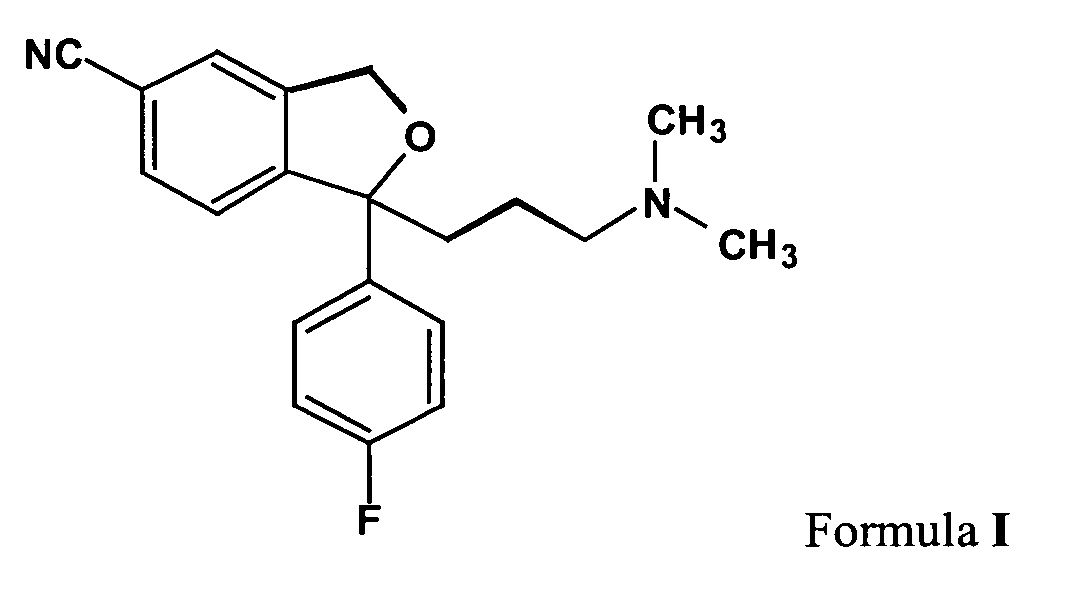
- the present invention relates to the use of the compound escitalopram (RUN-name), which is the S-enantiomer of the well-known antidepressant drug citalopram, i.e. (S)-1-[3-(dimethylamino)propyl]-1-(4-fluorophenyl)-1,3-dihydro-5-isobenzofurancarbonitrile, or a pharmaceutically acceptable salt thereof for the preparation of medicaments for the treatment of neurotic disorders, including anxiety states and panic attacks.
- RUN-name is the S-enantiomer of the well-known antidepressant drug citalopram, i.e. (S)-1-[3-(dimethylamino)propyl]-1-(4-fluorophenyl)-1,3-dihydro-5-isobenzofurancarbonitrile, or a pharmaceutically acceptable salt thereof for the preparation of medicaments for the treatment of neurotic disorders, including anxiety states and panic attacks.
- Citalopram is a well-known antidepressant drug that has now been on the market for some years and has the following structure:
- Escitolopram and a method for its preparation are disclosed in US Patent No 4,943,590.
- the stereo selectivity of citalopram i.e. the 5-HT-reuptake inhibition in the S-enantiomer, and accordingly, the antidepressant effect of said enantiomer is also disclosed.
- S-citalopram is now in development as an antidepressant.
- Escitalopram has now been found to show potent effects in models of neurotic disorders such as anxiolytic effect and prominent effect in the treatment of panic attacks and obsessive compulsive disorder.
- escitalopram namely for the preparation of a medicament useful in the treatment of neurotic disorders.
- neurotic disorders is used to designate a group of mental disorders, including anxiety states, in particular generalised anxiety disorder and social anxiety disorder, post traumatic stress disorder, obsessive compulsive disorder and panic attacks.
- generalised anxiety disorder social anxiety disorder, post traumatic stress disorder and obsessive compulsive disorder are as defined in DSM IV.
- panic attacks contemplates treatment of any disease, which is associated with panic attacks including panic disorder, specific phobias, social phobia and agoraphobia in which panic attacks occur. These disorders are further defined in the DSM IV.
- a panic attack is a discrete period in which there is a sudden onset of intense apprehension, fearfulness or terror, often associated with feelings of impending doom. During the attack, symptoms such as palpitations, sweating, trembling, sensations of shortness of breath, feeling of choking, chest pain or discomfort, nausea, feeling dizzy, feelings of unreality, fear of losing control or going crazy, fear of dying, paresthesias and chills or hot flushes are present.
- Panic disorders are characterised by recurrent unexpected panic attacks about which there is a persistent concern.
- Agoraphobia is anxiety about, or avoidance of, places or situations from which escape might be difficult or in which help may not be available in the event of a panic attack.
- Specific phobia and social phobia (together formerly simple phobia) are characterised by marked and persistent fear that is excessive or unreasonable, cued by the presence or anticipation of a specific object or situation (flying, heights, animals, seeing blood etc.) or social performance situations.
- panic attacks occur are differentiated from each other by the predictability of the occurrence of the attacks, for example, in panic disorder the attacks are unpredictable and not associated with any particular event, whereas in specific phobia the attacks are triggered by specific stimuli.
- treatment of panic disorder means a reduction in the number or prevention of attacks and/or relief of the severity of the attacks.
- generalised anxiety disorder social anxiety disorder, post traumatic stress disorder and obsessive compulsive disorder include the treatment or prevention of these diseases, or the relief of the symptoms thereof.
- escitalopram may be used as the base of the compound or as a pharmaceutically acceptable acid addition salt thereof or as an anhydrate or hydrate of such salt.
- the salts of the compound used in the invention are salts formed with non-toxic organic or inorganic acids, in particular the oxalate.
- Escitalopram has been found to show prominent effects different from the effects of the racemate in the "Inhibition of footshock-induced ultrasonic vocalisation in adult rats" - test, the “Mice Black and White Test” setup, and in the polydipsia test. These models are standard animal models for anxiolytic effect and effect on panic attacks and for obsessive compulsive disorder, respectively.
- escitalopram or a pharmaceutically acceptable salt thereof may be administered in any suitable way e.g. orally or parenterally, and it may be presented in any suitable form for such administration, e.g. in the form of tablets, capsules, powders, syrups or solutions or dispersions for injection.
- the compound of the invention is administered in the form of a solid pharmaceutical entity, suitably as a tablet or a capsule or in the form of a suspension, solution or dispersion for injection.
- Tablets may thus be prepared by mixing the active ingredients with ordinary adjuvants and/or diluents and subsequently compressing the mixture in a convenient tabletting machine.
- adjuvants or diluents comprise: corn starch, lactose, talcum, magnesium stearate, gelatine, lactose, gums, and the like. Any other adjuvant or additive such as colourings, flavourings, preservatives, etc. may also be used provided that they are compatible with the active ingredients.
- the compound of the invention is most conveniently administered orally in unit dosage forms such as tablets or capsules, containing the active ingredient in a dose from about 1.0 mg to 50 mg, preferably 5 mg/day to 40 mg/day, most preferably 10 mg/day to 20 mg/day.
- oxalate of escitalopram may be prepared as described in US Patent No 4,943,590 and the base and other pharmaceutically acceptable salts may be obtained therefrom by standard procedures.
- the acid addition salts used according to the invention may be obtained by treatment of escitalopram with the acid in an inert solvent followed by precipitation, isolation and optionally re-crystallisation by known methods and if desired micronisation of the crystalline product by wet or dry milling or another convenient process, or preparation of particles from a solvent-emulsification process.
- Escitalopram was tested in well recognised and reliable test models of effects on neurotic disorders. Citalopram-racemate was included for comparison purposes.
- test cages 22 cm x 22 cm x 22 cm
- Footshocks were delivered from a two pole shocker and a microphone sensitive to ultrasounds in the range of 20-30 kHz was placed in the centre of the lid of the test cage.
- the ultrasounds were sent from the microphone to a preamplifier and converted from AC signals to DC signals in a signal rectifier.
- the accumulated time in which the voltage of the rectified signal was larger than the voltage of a previously determined treshold level, was recorded.
- the rats were used for a total of 7-8 weeks.
- the animal groups were randomly allocated to treatment with saline or test drug.
- Each treatment group consisted of 8 animals, one saline and 2-4 drug treated groups were included at each session.
- Each drug was tested at least in two separate experiments with overlapping doses.
- mice Male mice (Lundbeck strain, Charles River, Germany) weighing 30-35 g were housed in groups of 4 in macrolon cages type II under a reversed 12 h day /night cycle (lights off 7 p.m.). The mice were adapted to the reversed light/dark cycle for at least 3 weeks prior to testing. The room temperature (21 ⁇ 2°C), relative humidity (55 ⁇ 5%), and air exchange (16 times per h) were automatically controlled. The animals had free access to commercial food pellets and water. The test box used was designed as described by Sánchez (1995) (supra).
- test box 45 cm x 27 cm x 27 cm
- the test box was open-topped and divided into two compartments (ratio 2:3) by a partition which was black on the side facing the black compartment and white on the side facing the white compartment.
- the smaller chamber was made of black perspex.
- the larger chamber was made of white perspex except for the lowest 7.5 cm. This part was made of transparent perspex (outer walls) and black perspex (partition).
- the white compartment was connected to the black compartment by a 7.5 cm x 7.5 cm opening in the partition.
- the floor of the white compartment was divided into 9 fields, and the floor of the black was divided into 6 fields.
- the white compartment was illuminated by means of a Schott KL 1500 electronic lamp emitting cold light corresponding to a light intensity of 560 Lux.
- the mouse test-system was fully automated by 2 rows of 11 infrared light sources and photocells in the transverse direction and 1 row of 16 in the longitudinal direction (lower row).
- the lower row of photocells (2 cm above cage floor) detected horizontal locomotor activity (crossing, entries, and time in each compartment), whereas the upper row of photocells (5 cm above cage floor) detected rearing activity.
- the accumulated data for 1 min intervals were recorded from 4 test boxed simultaneously and stored in a Paradox data base.
- the test boxes were placed in a dark and quiet room. The mice were transported to the test room in a darkened container about 2 h before test.
- the test room was separated into two parts by a black curtain.
- the drug treatment took place in one part of the room using a minimum of red light.
- the mice were placed individually in macrolon type II cages until test.
- the pretreatment time was 30 min.
- the test boxes were placed in the other part of the room.
- the test was started by placing the mouse in the centre of the brightly-lit white compartment facing the opening to the black compartment.
- the test duration was 5 min and the number of rears and line crossings between squares in both the black and the white compartment, number of entries into the black compartment and time spent in the white compartment were assessed.
- Schedule-induced polydipsia is regarded as a model of obsessive-compulsive disorder (Woods et al. 1993).
- mice Male wistar rats (M ⁇ lleg ⁇ rd) housed in pairs and kept on a food-restricted diet (80% of normal body weight) for 2 weeks before the start of testing and throughout the duration of testing.
- a pellet dispenser automatically dispensed one 60 mg food pellet every 60 seconds. Water was available at all times in the test chamber. Rats were tested 4-5 times per week, after 3-4 weeks training 70% of the rats were drinking >10ml per 30 min test session.
- Citalopram 40 mg/kg or Lu 26-054 (20 mg/kg) were administered orally 60 min prior to testing and at 10:00 on the non-test days. The water intake was presented as a percentage of the pre-dosing (baseline) level.
- Escitalopram produced a significant reduction in water intake, whereas citalopram was without effect.
- escitalopram has potent anti neurotic diseases effects, in particular anxiolytic effects and effects on panic attacks and obsessive compulsive disorder.
Landscapes
- Health & Medical Sciences (AREA)
- Life Sciences & Earth Sciences (AREA)
- Chemical & Material Sciences (AREA)
- Veterinary Medicine (AREA)
- Public Health (AREA)
- Medicinal Chemistry (AREA)
- General Health & Medical Sciences (AREA)
- Animal Behavior & Ethology (AREA)
- Pharmacology & Pharmacy (AREA)
- Engineering & Computer Science (AREA)
- Nuclear Medicine, Radiotherapy & Molecular Imaging (AREA)
- General Chemical & Material Sciences (AREA)
- Chemical Kinetics & Catalysis (AREA)
- Organic Chemistry (AREA)
- Bioinformatics & Cheminformatics (AREA)
- Neurosurgery (AREA)
- Biomedical Technology (AREA)
- Neurology (AREA)
- Epidemiology (AREA)
- Psychiatry (AREA)
- Pain & Pain Management (AREA)
- Anesthesiology (AREA)
- Oncology (AREA)
- Pharmaceuticals Containing Other Organic And Inorganic Compounds (AREA)
- Acyclic And Carbocyclic Compounds In Medicinal Compositions (AREA)
- Medicines Containing Material From Animals Or Micro-Organisms (AREA)
- Plural Heterocyclic Compounds (AREA)
- Compounds Of Unknown Constitution (AREA)
Abstract
Description
Briefly, test cages (22 cm x 22 cm x 22 cm) made of grey Perspex and equipped with a metal grid floor were used. Footshocks were delivered from a two pole shocker and a microphone sensitive to ultrasounds in the range of 20-30 kHz was placed in the centre of the lid of the test cage. The ultrasounds were sent from the microphone to a preamplifier and converted from AC signals to DC signals in a signal rectifier. The accumulated time, in which the voltage of the rectified signal was larger than the voltage of a previously determined treshold level, was recorded.
The test box used was designed as described by Sánchez (1995) (supra). Briefly, the test box (45 cm x 27 cm x 27 cm) was open-topped and divided into two compartments (ratio 2:3) by a partition which was black on the side facing the black compartment and white on the side facing the white compartment. The smaller chamber was made of black perspex. The larger chamber was made of white perspex except for the lowest 7.5 cm. This part was made of transparent perspex (outer walls) and black perspex (partition). The white compartment was connected to the black compartment by a 7.5 cm x 7.5 cm opening in the partition. The floor of the white compartment was divided into 9 fields, and the floor of the black was divided into 6 fields. The white compartment was illuminated by means of a Schott KL 1500 electronic lamp emitting cold light corresponding to a light intensity of 560 Lux. The mouse test-system was fully automated by 2 rows of 11 infrared light sources and photocells in the transverse direction and 1 row of 16 in the longitudinal direction (lower row). The lower row of photocells (2 cm above cage floor) detected horizontal locomotor activity (crossing, entries, and time in each compartment), whereas the upper row of photocells (5 cm above cage floor) detected rearing activity. The accumulated data for 1 min intervals were recorded from 4 test boxed simultaneously and stored in a Paradox data base.
The test boxes were placed in a dark and quiet room. The mice were transported to the test room in a darkened container about 2 h before test. The test room was separated into two parts by a black curtain. The drug treatment took place in one part of the room using a minimum of red light. After dosing, the mice were placed individually in macrolon type II cages until test. The pretreatment time was 30 min. The test boxes were placed in the other part of the room. The test was started by placing the mouse in the centre of the brightly-lit white compartment facing the opening to the black compartment. The test duration was 5 min and the number of rears and line crossings between squares in both the black and the white compartment, number of entries into the black compartment and time spent in the white compartment were assessed.
Claims (5)
- Use of escitalopram or a pharmaceutically acceptable salt thereof for the preparation of a medicament useful in the treatment of social anxiety disorder.
- The use according to Claim 1, characterised in, that the medicament is for administration as a unit dose.
- The use according to Claim 1 or 2, characterised in, that the unit dose is containing the active ingredient in an amount from 5 mg/day to 40 mg/day, most preferably 10 mg/day to 20 mg/day.
- The use according to Claim 3, characterised in, that the unit dose is containing the active ingredient in an amount of 10 mg/day.
- The use according to Claim 3, characterised in, that the unit dose is containing the active ingredient in an amount of 5 mg/day.
Applications Claiming Priority (3)
| Application Number | Priority Date | Filing Date | Title |
|---|---|---|---|
| DKPA199900991 | 1999-07-08 | ||
| DK990991 | 1999-07-08 | ||
| EP00943692A EP1200081B1 (en) | 1999-07-08 | 2000-07-07 | Use of escitalopram for the treatment of generalised anxiety disorder |
Related Parent Applications (1)
| Application Number | Title | Priority Date | Filing Date |
|---|---|---|---|
| EP00943692A Division EP1200081B1 (en) | 1999-07-08 | 2000-07-07 | Use of escitalopram for the treatment of generalised anxiety disorder |
Publications (2)
| Publication Number | Publication Date |
|---|---|
| EP1440689A2 true EP1440689A2 (en) | 2004-07-28 |
| EP1440689A3 EP1440689A3 (en) | 2004-08-25 |
Family
ID=8099796
Family Applications (4)
| Application Number | Title | Priority Date | Filing Date |
|---|---|---|---|
| EP04007521A Withdrawn EP1440690A3 (en) | 1999-07-08 | 2000-07-07 | Treatment of neurotic disorders |
| EP04007520A Withdrawn EP1440689A3 (en) | 1999-07-08 | 2000-07-07 | Treatment of neurotic disorders |
| EP04007522A Withdrawn EP1440691A3 (en) | 1999-07-08 | 2000-07-07 | Treatment of neurotic disorders |
| EP00943692A Revoked EP1200081B1 (en) | 1999-07-08 | 2000-07-07 | Use of escitalopram for the treatment of generalised anxiety disorder |
Family Applications Before (1)
| Application Number | Title | Priority Date | Filing Date |
|---|---|---|---|
| EP04007521A Withdrawn EP1440690A3 (en) | 1999-07-08 | 2000-07-07 | Treatment of neurotic disorders |
Family Applications After (2)
| Application Number | Title | Priority Date | Filing Date |
|---|---|---|---|
| EP04007522A Withdrawn EP1440691A3 (en) | 1999-07-08 | 2000-07-07 | Treatment of neurotic disorders |
| EP00943692A Revoked EP1200081B1 (en) | 1999-07-08 | 2000-07-07 | Use of escitalopram for the treatment of generalised anxiety disorder |
Country Status (38)
| Country | Link |
|---|---|
| US (6) | US7271194B2 (en) |
| EP (4) | EP1440690A3 (en) |
| JP (1) | JP4773011B2 (en) |
| KR (1) | KR100604176B1 (en) |
| CN (1) | CN1198610C (en) |
| AR (1) | AR021155A1 (en) |
| AT (1) | ATE339955T1 (en) |
| AU (6) | AU782514B2 (en) |
| BG (4) | BG110467A (en) |
| BR (1) | BR0011578A (en) |
| CA (4) | CA2373757C (en) |
| CL (3) | CL2008003941A1 (en) |
| CO (1) | CO5190674A1 (en) |
| CY (1) | CY1105806T1 (en) |
| CZ (1) | CZ200270A3 (en) |
| DE (1) | DE60030861T2 (en) |
| DK (1) | DK1200081T3 (en) |
| EA (1) | EA006555B1 (en) |
| ES (1) | ES2272298T3 (en) |
| HK (1) | HK1048069B (en) |
| HR (1) | HRP20010820A2 (en) |
| HU (1) | HUP0201791A3 (en) |
| IL (5) | IL146131A0 (en) |
| IS (1) | IS6137A (en) |
| ME (2) | MEP2508A (en) |
| MX (1) | MXPA01011626A (en) |
| MY (1) | MY143278A (en) |
| NO (4) | NO329021B1 (en) |
| PL (1) | PL352030A1 (en) |
| PT (1) | PT1200081E (en) |
| SI (1) | SI1200081T1 (en) |
| SK (1) | SK82002A3 (en) |
| TR (4) | TR200402277T2 (en) |
| TW (1) | TWI232101B (en) |
| UA (1) | UA77645C2 (en) |
| WO (1) | WO2001003694A1 (en) |
| YU (1) | YU78701A (en) |
| ZA (1) | ZA200108856B (en) |
Families Citing this family (17)
| Publication number | Priority date | Publication date | Assignee | Title |
|---|---|---|---|---|
| AR021155A1 (en) * | 1999-07-08 | 2002-06-12 | Lundbeck & Co As H | TREATMENT OF NEUROTIC DISORDERS |
| GB0005477D0 (en) | 2000-03-07 | 2000-04-26 | Resolution Chemicals Limited | Process for the preparation of citalopram |
| CZ2003396A3 (en) * | 2000-07-21 | 2003-05-14 | H. Lundbeck A/S | Glycine transport inhibitors |
| EA200301195A1 (en) * | 2001-05-01 | 2004-04-29 | Х. Лундбекк А/С | APPLICATION OF ENANTIOMERALLY CLEAN ESCYTAL PREMA |
| HRP20031073A2 (en) | 2001-07-31 | 2004-04-30 | Lundbeck & Co As H | Crystalline composition containing escitalopram |
| AU2003237524A1 (en) * | 2002-07-08 | 2004-01-23 | University Of Florida | Use of ssri inhibitors to prevent or ameliorate trauma-related psychological disorders |
| CN100349885C (en) * | 2002-12-23 | 2007-11-21 | H·隆德贝克有限公司 | Crystalline escitalopram hydrobromide and methods for preparing the same |
| US20050137255A1 (en) * | 2002-12-23 | 2005-06-23 | H. Lundbeck A/S | Crystalline escitalopram hydrobromide and methods for preparing the same |
| TR200504022T1 (en) * | 2003-03-24 | 2006-08-21 | Hetero Drugs Limited | New liquid crystal forms of (S) -sitalopram oxalate. |
| US20090093461A1 (en) * | 2003-07-02 | 2009-04-09 | Astrazeneca Ab | Methods of Treating Anxiety and Mood Disorders |
| WO2005053796A1 (en) * | 2003-12-02 | 2005-06-16 | B & B Beheer Nv | Use of d4 and 5-ht2a antagonists, inverse agonists or partial agonists |
| US7884096B2 (en) * | 2003-12-02 | 2011-02-08 | Pharmaneuroboost N.V. | Method of treating mental disorders using of D4 and 5-HT2A antagonists, inverse agonists or partial agonists |
| US7855195B2 (en) * | 2003-12-02 | 2010-12-21 | Pharmaneuroboost N.V. | Method of treating mental disorders using D4 and 5-HT2A antagonists, inverse agonists or partial agonists |
| EP1954257A4 (en) | 2005-10-14 | 2009-05-20 | Lundbeck & Co As H | METHODS OF TREATING CENTRAL NERVOUS SYSTEM DISORDERS WITH LOW ESCITALOPRAM AND BUPROPION DOSE COMBINATION |
| US20070134322A1 (en) * | 2005-12-14 | 2007-06-14 | Forest Laboratories, Inc. | Modified and pulsatile release pharmaceutical formulations of escitalopram |
| FR2912057B1 (en) * | 2007-02-07 | 2009-04-17 | Sanofi Aventis Sa | PHARMACEUTICAL COMPOSITION COMPRISING SAREDUTANT AND A SELECTIVE SEROTONIN RECAPTURE INHIBITOR OR SEROTONIN / NOREPINEPHRINE RECAPTURE INHIBITOR |
| TW200817003A (en) * | 2006-07-31 | 2008-04-16 | Sanofi Aventis | Pharmaceutical composition comprising, in combination, saredutant and a selective serotonin peuptake inhibitor or a serotonin/norepinephrine reuptake inhibitor |
Family Cites Families (48)
| Publication number | Priority date | Publication date | Assignee | Title |
|---|---|---|---|---|
| GB1143703A (en) * | 1965-03-18 | |||
| GB1526331A (en) * | 1976-01-14 | 1978-09-27 | Kefalas As | Phthalanes |
| US4436874A (en) | 1981-11-19 | 1984-03-13 | Societe D'expansion Scientifique "Expansia" | Acrylic copolymers and their use in solid phase peptide synthesis |
| GB8419963D0 (en) * | 1984-08-06 | 1984-09-12 | Lundbeck & Co As H | Intermediate compound and method |
| GB8607313D0 (en) * | 1986-03-25 | 1986-04-30 | Ici Plc | Pharmaceutical compositions |
| GB8814057D0 (en) * | 1988-06-14 | 1988-07-20 | Lundbeck & Co As H | New enantiomers & their isolation |
| US4902710A (en) * | 1988-12-14 | 1990-02-20 | Eli Lilly And Company | Serotonin and norepinephrine uptake inhibitors |
| US5114976A (en) * | 1989-01-06 | 1992-05-19 | Norden Michael J | Method for treating certain psychiatric disorders and certain psychiatric symptoms |
| US4962128A (en) * | 1989-11-02 | 1990-10-09 | Pfizer Inc. | Method of treating anxiety-related disorders using sertraline |
| US5296507A (en) * | 1990-09-06 | 1994-03-22 | H.Lundbeck A/S | Treatment of cerbrovascular disorders |
| DK213290D0 (en) * | 1990-09-06 | 1990-09-06 | Lundbeck & Co As H | TREATMENT OF CEREBROVASCULAR DISORDERS |
| US5708035A (en) * | 1991-02-04 | 1998-01-13 | Sepracor Inc. | Methods of use and compositions of R(-) fluoxetine |
| WO1992018005A1 (en) | 1991-04-16 | 1992-10-29 | National Institutes Of Health | Method of treating trichotillomania and onychophagia |
| WO1993009769A1 (en) | 1991-11-15 | 1993-05-27 | Sepracor, Inc. | Methods and compositions utilizing pure s(+) isomer fluoxetine |
| EP0714663A3 (en) | 1994-11-28 | 1997-01-15 | Lilly Co Eli | Potentiation of a drug by a serotonin 1A receptor antagonist |
| US5627196A (en) * | 1995-01-17 | 1997-05-06 | Eli Lilly And Company | Compounds having effects on serotonin-related systems |
| WO1996024353A1 (en) * | 1995-02-10 | 1996-08-15 | Eli Lilly And Company | Methods of treating or preventing psychiatric disorders |
| US5554383A (en) * | 1995-04-06 | 1996-09-10 | Trustees Of Tufts College | Veterinary method for clinically modifying the behavior of dogs exhibiting canine affective aggression |
| SE9501567D0 (en) * | 1995-04-27 | 1995-04-27 | Astra Ab | A new combination |
| WO1997006792A1 (en) | 1995-08-16 | 1997-02-27 | Eli Lilly And Company | Potentiation of serotonin response |
| US5846982A (en) * | 1996-06-14 | 1998-12-08 | Eli Lilly And Company | Inhibition of serotonin reuptake |
| US5912256A (en) * | 1996-06-20 | 1999-06-15 | Eli Lilly And Company | Compounds having effects on serotonin-related systems |
| US5747494A (en) * | 1996-06-28 | 1998-05-05 | U C B S.A. | Pharmaceutical compositions for the treatment of depressive disorders |
| US5958429A (en) * | 1996-08-16 | 1999-09-28 | Eli Lilly And Company | Potentiation of serotonin response |
| ZA977967B (en) * | 1996-09-23 | 1999-03-04 | Lilly Co Eli | Combination therapy for treatment of psychoses |
| US5776969A (en) * | 1997-02-27 | 1998-07-07 | Eli Lilly And Company | Treatment of sleep disorders |
| US6069177A (en) * | 1997-07-08 | 2000-05-30 | The Hong Kong University Of Science And Technology | 3-Hydroxy-propanamine derived neuronal reuptake inhibitors |
| SE9703379D0 (en) * | 1997-09-18 | 1997-09-18 | Astra Ab | New compounds |
| SE9703375D0 (en) * | 1997-09-18 | 1997-09-18 | Astra Ab | A new combination |
| ES2149734T3 (en) * | 1997-11-11 | 2003-02-16 | Lundbeck & Co As H | METHOD FOR THE PREPARATION OF CITALOPRAM. |
| EP0957099B1 (en) * | 1998-04-15 | 2002-11-20 | Pfizer Products Inc. | Heterocyclic carboxamides |
| JP2002519321A (en) * | 1998-06-30 | 2002-07-02 | イーライ・リリー・アンド・カンパニー | Pyrrolidine and pyrroline derivatives effective on serotonin-related systems |
| ATE355054T1 (en) | 1998-07-13 | 2006-03-15 | Nps Pharma Inc | METHODS AND COMPOUNDS FOR TREATING DEPRESSION |
| US6579899B1 (en) | 1998-07-16 | 2003-06-17 | Massachusetts Institute Of Technology | Composition for treatment of stress |
| EP1096927A4 (en) | 1998-07-16 | 2002-09-04 | Massachusetts Inst Technology | STRESS TREATMENT COMPOSITION |
| US6150376A (en) * | 1998-08-05 | 2000-11-21 | Georgetown University | Bi- and tri-cyclic aza compounds and their uses |
| SE9803158D0 (en) * | 1998-09-16 | 1998-09-16 | Astra Ab | A new composition |
| SE9803157D0 (en) | 1998-09-16 | 1998-09-16 | Astra Ab | A new composition |
| PL199423B1 (en) * | 1998-10-20 | 2008-09-30 | Lundbeck & Co As H | Method for the preparation of citalopram |
| AR021509A1 (en) * | 1998-12-08 | 2002-07-24 | Lundbeck & Co As H | BENZOFURAN DERIVATIVES, ITS PREPARATION AND USE |
| NZ514671A (en) * | 1999-04-14 | 2003-10-31 | H | Method for the preparation of citalopram |
| AR021155A1 (en) * | 1999-07-08 | 2002-06-12 | Lundbeck & Co As H | TREATMENT OF NEUROTIC DISORDERS |
| US6333357B1 (en) * | 1999-11-05 | 2001-12-25 | Be Able, Llc | Behavior chemotherapy |
| UA77650C2 (en) * | 1999-12-06 | 2007-01-15 | Lundbeck & Co As H | Use of serotonin reuptake inhibitor in combination with deramcyclane |
| GB2357762B (en) * | 2000-03-13 | 2002-01-30 | Lundbeck & Co As H | Crystalline base of citalopram |
| EP1276478A2 (en) * | 2000-04-24 | 2003-01-22 | ARYx Therapeutics | (2-aminoethyl) oxime derivatives for the treatment of depression |
| JP2002361405A (en) * | 2000-09-25 | 2002-12-18 | Showa Denko Kk | Heat exchanger manufacturing method |
| EA200301195A1 (en) * | 2001-05-01 | 2004-04-29 | Х. Лундбекк А/С | APPLICATION OF ENANTIOMERALLY CLEAN ESCYTAL PREMA |
-
2000
- 2000-07-06 AR ARP000103442A patent/AR021155A1/en unknown
- 2000-07-07 EP EP04007521A patent/EP1440690A3/en not_active Withdrawn
- 2000-07-07 BR BR0011578-9A patent/BR0011578A/en active Search and Examination
- 2000-07-07 SK SK8-2002A patent/SK82002A3/en not_active Application Discontinuation
- 2000-07-07 CO CO00051031A patent/CO5190674A1/en not_active Application Discontinuation
- 2000-07-07 ME MEP-25/08A patent/MEP2508A/en unknown
- 2000-07-07 JP JP2001508974A patent/JP4773011B2/en not_active Expired - Lifetime
- 2000-07-07 SI SI200030910T patent/SI1200081T1/en unknown
- 2000-07-07 HU HU0201791A patent/HUP0201791A3/en unknown
- 2000-07-07 AT AT00943692T patent/ATE339955T1/en active
- 2000-07-07 DE DE60030861T patent/DE60030861T2/en not_active Expired - Lifetime
- 2000-07-07 CA CA002373757A patent/CA2373757C/en not_active Expired - Lifetime
- 2000-07-07 TR TR2004/02277T patent/TR200402277T2/en unknown
- 2000-07-07 EA EA200200137A patent/EA006555B1/en not_active IP Right Cessation
- 2000-07-07 EP EP04007520A patent/EP1440689A3/en not_active Withdrawn
- 2000-07-07 PL PL00352030A patent/PL352030A1/en not_active Application Discontinuation
- 2000-07-07 CN CNB008100292A patent/CN1198610C/en not_active Expired - Lifetime
- 2000-07-07 YU YU78701A patent/YU78701A/en unknown
- 2000-07-07 CA CA2687394A patent/CA2687394A1/en not_active Abandoned
- 2000-07-07 HR HR20010820A patent/HRP20010820A2/en not_active Application Discontinuation
- 2000-07-07 EP EP04007522A patent/EP1440691A3/en not_active Withdrawn
- 2000-07-07 CA CA2687396A patent/CA2687396A1/en not_active Abandoned
- 2000-07-07 IL IL14613100A patent/IL146131A0/en unknown
- 2000-07-07 AU AU58061/00A patent/AU782514B2/en not_active Expired
- 2000-07-07 TR TR2002/00014T patent/TR200200014T2/en unknown
- 2000-07-07 EP EP00943692A patent/EP1200081B1/en not_active Revoked
- 2000-07-07 CZ CZ200270A patent/CZ200270A3/en unknown
- 2000-07-07 ES ES00943692T patent/ES2272298T3/en not_active Expired - Lifetime
- 2000-07-07 WO PCT/DK2000/000377 patent/WO2001003694A1/en not_active Ceased
- 2000-07-07 MY MYPI20003122A patent/MY143278A/en unknown
- 2000-07-07 ME MEP-2008-25A patent/ME00032B/en unknown
- 2000-07-07 CA CA2687392A patent/CA2687392A1/en not_active Abandoned
- 2000-07-07 KR KR1020017016006A patent/KR100604176B1/en not_active Ceased
- 2000-07-07 TR TR2004/02276T patent/TR200402276T2/en unknown
- 2000-07-07 PT PT00943692T patent/PT1200081E/en unknown
- 2000-07-07 HK HK03100231.6A patent/HK1048069B/en not_active IP Right Cessation
- 2000-07-07 UA UA2001128286A patent/UA77645C2/en unknown
- 2000-07-07 MX MXPA01011626A patent/MXPA01011626A/en not_active Application Discontinuation
- 2000-07-07 DK DK00943692T patent/DK1200081T3/en active
- 2000-07-07 TR TR2004/02275T patent/TR200402275T2/en unknown
- 2000-07-28 TW TW089115110A patent/TWI232101B/en not_active IP Right Cessation
-
2001
- 2001-10-23 IL IL146131A patent/IL146131A/en active IP Right Grant
- 2001-10-26 ZA ZA200108856A patent/ZA200108856B/en unknown
- 2001-10-30 IS IS6137A patent/IS6137A/en unknown
- 2001-12-12 US US10/021,126 patent/US7271194B2/en not_active Expired - Lifetime
-
2002
- 2002-01-04 BG BG11046709A patent/BG110467A/en unknown
- 2002-01-04 BG BG106279A patent/BG106279A/en unknown
- 2002-01-04 BG BG11046609A patent/BG110466A/en unknown
- 2002-01-04 BG BG11046809A patent/BG110468A/en unknown
- 2002-01-07 NO NO20020062A patent/NO329021B1/en not_active IP Right Cessation
-
2003
- 2003-08-07 US US10/637,822 patent/US20040029958A1/en not_active Abandoned
- 2003-08-07 US US10/637,820 patent/US7265151B2/en not_active Expired - Lifetime
- 2003-08-07 US US10/637,821 patent/US20040029957A1/en not_active Abandoned
- 2003-08-20 US US10/644,143 patent/US6960613B2/en not_active Expired - Lifetime
-
2005
- 2005-06-20 AU AU2005202685A patent/AU2005202685B2/en not_active Ceased
- 2005-06-20 AU AU2005202686A patent/AU2005202686B2/en not_active Expired
- 2005-06-20 AU AU2005202684A patent/AU2005202684B2/en not_active Ceased
- 2005-08-09 IL IL170192A patent/IL170192A/en unknown
- 2005-08-09 IL IL170194A patent/IL170194A/en unknown
- 2005-08-09 IL IL170193A patent/IL170193A/en unknown
-
2006
- 2006-11-27 CY CY20061101706T patent/CY1105806T1/en unknown
-
2007
- 2007-08-10 US US11/837,317 patent/US20070276035A1/en not_active Abandoned
-
2008
- 2008-12-24 AU AU2008264188A patent/AU2008264188A1/en not_active Withdrawn
- 2008-12-24 AU AU2008264182A patent/AU2008264182A1/en not_active Withdrawn
- 2008-12-30 CL CL2008003941A patent/CL2008003941A1/en unknown
- 2008-12-30 CL CL2008003938A patent/CL2008003938A1/en unknown
- 2008-12-30 CL CL2008003939A patent/CL2008003939A1/en unknown
-
2010
- 2010-03-10 NO NO20100334A patent/NO20100334L/en not_active Application Discontinuation
- 2010-03-10 NO NO20100333A patent/NO20100333L/en not_active Application Discontinuation
- 2010-03-10 NO NO20100335A patent/NO20100335L/en not_active Application Discontinuation
Also Published As
Similar Documents
| Publication | Publication Date | Title |
|---|---|---|
| US20070276035A1 (en) | Treatment of neurotic disorders |
Legal Events
| Date | Code | Title | Description |
|---|---|---|---|
| PUAI | Public reference made under article 153(3) epc to a published international application that has entered the european phase |
Free format text: ORIGINAL CODE: 0009012 |
|
| PUAL | Search report despatched |
Free format text: ORIGINAL CODE: 0009013 |
|
| AC | Divisional application: reference to earlier application |
Ref document number: 1200081 Country of ref document: EP Kind code of ref document: P |
|
| AK | Designated contracting states |
Kind code of ref document: A2 Designated state(s): AT BE CH CY DE DK ES FI FR GB GR IE IT LI LU MC NL PT SE |
|
| AX | Request for extension of the european patent |
Extension state: AL LT LV MK RO SI |
|
| AK | Designated contracting states |
Kind code of ref document: A3 Designated state(s): AT BE CH CY DE DK ES FI FR GB GR IE IT LI LU MC NL PT SE |
|
| AX | Request for extension of the european patent |
Extension state: AL LT LV MK RO SI |
|
| 17P | Request for examination filed |
Effective date: 20050225 |
|
| AKX | Designation fees paid |
Designated state(s): AT BE CH CY DE DK ES FI FR GB GR IE IT LI LU MC NL PT SE |
|
| AXX | Extension fees paid |
Extension state: SI Payment date: 20050225 Extension state: RO Payment date: 20050225 Extension state: MK Payment date: 20050225 Extension state: LV Payment date: 20050225 Extension state: LT Payment date: 20050225 Extension state: AL Payment date: 20050225 |
|
| STAA | Information on the status of an ep patent application or granted ep patent |
Free format text: STATUS: THE APPLICATION IS DEEMED TO BE WITHDRAWN |
|
| 18D | Application deemed to be withdrawn |
Effective date: 20060502 |