EP1439660A2 - Encryption/decryption method for data limited in value range, apparatus and program therefor - Google Patents
Encryption/decryption method for data limited in value range, apparatus and program therefor Download PDFInfo
- Publication number
- EP1439660A2 EP1439660A2 EP04250117A EP04250117A EP1439660A2 EP 1439660 A2 EP1439660 A2 EP 1439660A2 EP 04250117 A EP04250117 A EP 04250117A EP 04250117 A EP04250117 A EP 04250117A EP 1439660 A2 EP1439660 A2 EP 1439660A2
- Authority
- EP
- European Patent Office
- Prior art keywords
- code
- encryption
- decryption
- value
- object code
- Prior art date
- Legal status (The legal status is an assumption and is not a legal conclusion. Google has not performed a legal analysis and makes no representation as to the accuracy of the status listed.)
- Granted
Links
Images









Classifications
-
- H—ELECTRICITY
- H04—ELECTRIC COMMUNICATION TECHNIQUE
- H04L—TRANSMISSION OF DIGITAL INFORMATION, e.g. TELEGRAPHIC COMMUNICATION
- H04L9/00—Cryptographic mechanisms or cryptographic arrangements for secret or secure communications; Network security protocols
- H04L9/36—Cryptographic mechanisms or cryptographic arrangements for secret or secure communications; Network security protocols with means for detecting characters not meant for transmission
Definitions
- the present invention relates to encryption/decryption of data such as image data including a specified marker code in the format.
- One of the technologies for copyright protection is an "encryption technology”.
- a common key encryption method also called secret key encryption method, symmetrical encryption method or common encryption method
- Such common key encryption method can be divided into a block encryption in which every character train (block) of an appropriate length is encrypted by a same key, and a stream encryption in which the key is changed for every character train or every bit.
- DES data encryption standard
- AES advanced encryption standard
- JPEG 2000 As a high efficiency encoding method for compressing image data, there is widely employed the JPEG method recommended by ISO and ITU-T as an international standard encoding method for a still image.
- the JPEG method is based on a discrete cosine transformation, but is associated with a drawback that a block-shaped distortion is generated when the compression rate is increased. Therefore, in order to meet a requirement for a higher resolution of the image and to realize a higher compression rate, an encoding method utilizing a discrete wavelet transformation, different from the aforementioned discrete cosine transformation, is proposed and is being standardized as JPEG 2000.
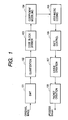
- Fig. 1 is a functional block diagram of a JPEG 2000 encoder.
- An input image is at first subjected to a subband decomposition by a discrete wavelet transformation (DWT) (101), and is then quantized (102).
- a coefficient belonging to a lower resolution level contains information of a lower frequency.
- a quantized wavelet coefficient is encoded by an EBCOT algorithm. Such algorithm will be explained in the following in following five parts of a code block division (103), a coefficient modeling (104), an arithmetic encoding (105) and a rate control (106), a layer formation (107), and a packet generation (108).
- Each subband is divided into square blocks (for example 64 ⁇ 64), called code blocks. Such code blocks are independently encoded.
- a coefficient modeling is executed based on a bit plane. In this manner there is generated an embedded code stream in which coefficient bits are arranged in an order of importance.
- Each of all the bit planes from MSB to LSB is decomposed into three subbit planes (paths) according to the context. A boundary of each subbit plane is called a truncation point, which constitutes a minimum unit for data discarding later.
- An adaptive arithmetic encoding is executed on the embedded code stream generated by the coefficient modeling. Thereafter, the arithmetic coded stream is suitably cut off at the truncation point constituting the boundary of the subbit plane, thereby obtaining a desired bit rate.
- each layer includes a part of the embedded codes of each code block.
- a higher layer includes a more important portion in the image reproduction.
- Each layer is divided into plural units called bodies, and each is given a header information to generate a packet.
- Each body has information of a corresponding resolution level. Therefore a total number of the generated packets is a product of a number of layers and a number of resolution levels.
- the header information includes a length of the arithmetic code stream of each code block, a number of subbit planes etc.
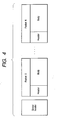
- a final JPEG 2000 code stream is obtained by collecting all the packets and attaching a global header information as shown in Fig. 4.
- JPEG 2000 defines that various header information mentioned in the foregoing and the subbit plane constituting a minimum unit of the data division is a size of an integral multiple of a byte.
- digital image data are associated with a security issue, which can be resolved, in case of encryption of the entire image, by the aforementioned encryption methods such as DES or AES.
- a decrypting operation results in a decryption of the entire image, and a partial protection cannot be obtained.
- the DES or ABS method cannot be simply applied for encrypting the high resolution portion.
- the marker code is a code of a special meaning in the JPEG 2000, and a false marker code, if generated by the encryption, may hinder a proper reproduction. More specifically, in a compressed data portion (body) shown in Fig. 4, a marker code has a function similar to an inhibited code of which generation is inhibited.
- the marker code means a marker having a value of FF90h to FFFFh and a marker segment code.
- the marker is a code storing definition information. It is represented by 2 bytes, of which a first byte is FFh. According to the purpose, the marker is represented by 2-byte code FFxxh.
- the market segment is constituted of a marker and an ensuing parameter. Four markers only, namely SOC (FF4Fh: start of code stream), EOC (FFD9h: end of code stream), SOD (FF93h: start of data) and EPH (FF92h: end of packet header) are independent codes, and any other marker is a part of the marker segment.
- markers and the market segments are collectively called markers.
- a marker in a range of FF90h to FFFFh is given two particular meanings. Firstly, such marker means a partition in a code stream. It is thus possible to define a position of a packet and a packet header. Secondly, such marker does not exist in the compressed data themselves (body shown in Fig. 4).
- the JPEG 2000 encoder is so designed as not to generate such code. Therefore, in the aforementioned partial encryption of the JPEG 2000 data, it is necessary to avoid generation of such 2-byte marker code of FF90h - FFFFh.
- PNG portable network graphics
- PNG is a new image format proposed by a standardizing organization W3C as one of image formats usable in a browser. Specifications of PNG are standardized by http://w3.org/Graphics/PNG/.
- a file format described by PNG is constituted of a PNG signature and an ensuing group of data clusters called chunks.
- An example of the PBG signature is 8-byte data "137 80 78 71 13 10 26 10" (decimal presentation) which are always attached at the beginning of the PNG file.
- a chunk is constituted of a stream of four parts, which are a chunk data length (4 bytes), a chunk format code (4 bytes fixed), chunk data (unfixed length) and a CRC (4 bytes).
- the chunk data length information is 4-byte data indicating a number of bytes of the chunk data area.
- the chunk format is 4-byte code indicating a format, and data defined according to such format are stored in the chunk data area.
- the data length of the chunk data area may also be 0.
- 4-byte CRC data calculated as padding data calculated by CRC (cyclic redundancy check) algorithm for the chunk data area, are attached.
- an object of the present invention is, in case of applying an encrypting or decrypting process on data within a predetermined value range, to always obtain result data within a predetermined value range.
- the present invention relates to an encryption method including an encryption step of encrypting a code, an encryption result discrimination step of discriminating whether, in a code of an encrypted object code obtained by encrypting an object code by the encryption step, there is generated a code of a value within a predetermined range, and an encryption result determination step, which, in case the encryption result discrimination step judges that a code within the predetermined range is not generated, determines the encrypted object code as an encryption result of the object code.
- the present invention relates to a decryption method including a decryption step of decrypting a code, a decryption result discrimination step of discriminating whether, in a code of a decrypted object code obtained by decrypting an object code by the decryption step, there is generated a code of a value within a predetermined range, and a decryption result determination step, which, in case the decryption result discrimination step judges that a code within the predetermined range is not generated, determines the decrypted object code as a decryption result of the object code.
- the present invention relates to an encryption apparatus including encryption means which encrypts a code, encryption result discrimination means which discriminates whether, in a code of an encrypted object code obtained by encrypting an object code by the encryption means, there is generated a code of a value within a predetermined range, and encryption result determination means, which, in case the encryption result discrimination means judges that a code within the predetermined range is not generated, determines the encrypted object code as an encryption result of the object code.
- the present invention relates to a decryption apparatus including decryption means which decrypts a code, decryption result discrimination means which discriminates whether, in a code of a decrypted object code obtained by decrypting an object code by the decryption means, there is generated a code of a value within a predetermined range, and decryption result determination means, which, in case the decryption result discrimination means judges that a code within the predetermined range is not generated, determines the decrypted object code as a decryption result of the object code.
- the present invention relates to a computer readable encryption program including an encryption step of encrypting a code, an encryption result discrimination step of discriminating whether, in a code of an encrypted object code obtained by encrypting an object code by the encryption step, there is generated a code of a value within a predetermined range, and an encryption result determination step, which, in case the encryption result discrimination step judges that a code within the predetermined range is not generated, determines the encrypted object code as an encryption result of the object code.
- the present invention relates to a computer readable decryption program including a decryption step of decrypting a code, a decryption result discrimination step of discriminating whether, in a code of a decrypted object code obtained by decrypting an object code by the decryption step, there is generated a code of a value within a predetermined range, and a decryption result determination step, which, in case the decryption result discrimination step judges that a code within the predetermined range is not generated, determines the decrypted object code as a decryption result of the object code.
- DES is considered as an encryption process to be employed.
- the DES is constituted of basic operations:
- a basic mode of DES is ECB (electronic code block). This mode executes the aforementioned basic operations without change. More specifically, after the data are divided into blocks, each block is encrypted with a secret key, and these blocks are connected in an original order.
- a CBC (cipher block chaining) mode an XOR (exclusive logic sum) of an encrypted preceding block and a yet unencrypted current block is calculated and is encrypted with the secret key.
- the encryption of the blocks is executed in "chained” manner.
- CFB cipher feedback
- a part (m bits) of an encryption result of a preceding block is fed back as a value for calculating an XOR with m bits of a next block.
- a bit error generated in a block affects the encryption in the succeeding blocks.
- OFB output feedback
- a certain initial value is encrypted as a first block to generate a cipher text, and such cipher text (or a part thereof) is employed as an input for a next cipher text and such part (m bits) is used as a random number for calculating an XOR with data of corresponding m bits.
- m bits input bits
- a term "output feedback" is derived from a fact that a cipher output generated in a preceding block is fed back as a parameter to be used in a next block for generating a cipher output.
- Fig. 3 is a block diagram showing a basic configuration of a computer (information processing apparatus) for realizing all the following embodiments, including the present one. In realizing a watermark information processing apparatus, it is not essential to use all the functions shown in Fig. 3.
- a computer 301 is an ordinary personal computer, and is capable of entering an image read by an image input apparatus 317 such as a scanner, and executing an editing or a storage thereof. It can also cause an image entered from the image input apparatus 317 to be printed by a printer 316. Also various instructions from a user are executed by an input operation from a mouse 313 or a keyboard 314.
- an MPU 302 is capable of controlling the functions of various blocks in the computer 301, and executing an internally stored program.
- a main memory apparatus 303 temporarily stores a program or image data to be processed, for a process to be executed by the MPU 302.
- a hard disk (HDD) 304 is capable of in advance storing a program or image data to be transferred to the main memory apparatus 303 etc. or storing image data after processing.
- a scanner interface (I/F) 315 is an I/F connected with a scanner 317 for reading an original or a film thereby generating image data, and capable of entering image data obtained in the scanner 317.
- a printer interface 308 is an I/F connected with a printer 316 for printing image data, and capable of transmitting image data obtained to be printed to the printer 316.
- a CD drive 309 is capable of reading or writing data from or into a CD (CD-R/CD-RW) constituting one of external memory media.
- An FDD drive 311, like the CD drive 309, is capable of reading or writing data from or into an FDD.
- a DVD drive 310 like the FDD drive 311, is capable of reading or writing data from or into a DVD.
- an image editing program or a printer driver is stored in CD, FDD, DVD etc., such program is installed in the HDD 304 and is transferred to the main memory apparatus 303 when required.
- An interface (I/F) 312 is connected with the mouse 313 and the keyboard 314 for accepting an input instruction therefrom.
- a monitor 306 is a display apparatus capable of displaying an extraction result and a process of watermark information. Also a video controller 305 is used for transmitting display data to the monitor 306.
- the present invention may be applied to a system constituted of plural equipment (such as a host computer, an interface equipment, a reader, a printer etc.), or an apparatus constituted of a single equipment (for example a copying apparatus, a facsimile apparatus etc.).
- a system constituted of plural equipment such as a host computer, an interface equipment, a reader, a printer etc.
- an apparatus constituted of a single equipment for example a copying apparatus, a facsimile apparatus etc.
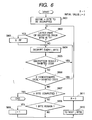
- n bytes to be encrypted in the JPEG 2000 stream (step S501). There are assumed continuous n bytes in compressed data (data of the body shown in Fig. 4) not containing marker codes of FF90h - FFFFh.
- the JPEG 2000 stream constituting the origin may be stored in advance in the hard disk 304, or various memory media connected to the CD drive 309, the DVD drive 310, the FDD drive 311 etc. or may be obtained by executing a JPEG 2000 compression program loaded in the main memory apparatus 303 by the MPU 302 etc., or may be transmitted through a network not shown in Fig. 3.
- step S502 2 bytes are taken out from the head of n bytes, and are encrypted (step S502).
- Such encryption can be achieved by the aforementioned CFB or OFB mode of DES.
- step S503 there is discriminated whether the encryption result is a marker code of FF90h - FFFFh (inhibited code) (step S503).
- the flow returns to the step S502 for executing the encrypting process again on the encryption result.
- a byte in the latter part of the encryption result positioned in front is connected with a byte in the front part of the current encryption result to form a code (hereinafter called frontward concatenated code) and there is discriminated whether such code is an inhibited code (step S504).
- the flow returns to the step S502 for repeating the encryption process. This is to prevent presence of an inhibited code even in a frontward or backward concatenated state since the JPEG 2000 stream has a minimum unit of one byte. Since two bytes in the present case are initial ones without a preceding encryption result, they are not an inhibited code and the flow proceeds to a next step S505. Then there is discriminated whether the second byte is a final n-th byte (step S505). The flow is terminated if it is the n-th byte. If not, there is discriminated whether the second byte is an (n-1)th byte, namely whether there remains one byte (step S506).
- step S502 such 1 byte only is encrypted in the step S502.
- Such 1-byte encryption can be achieved similarly with the aforementioned CFB or OFB mode of DES.
- the encryption result is not a 2-byte code, it is not recognized as an inhibited code in the step S503.
- step S504 there is discriminated whether a frontward concatenated code is an inhibited code.
- the flow returns to the step S502 for executing the encryption process again on the encryption result.
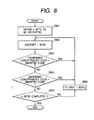
- n bytes to be decrypted in the JPEG 2000 stream are determined at first there are determined n bytes to be decrypted in the JPEG 2000 stream (step S601).
- Such portion to be decrypted is a portion encrypted by the encrypting process shown in Fig. 5, and such portion is assumed to be known prior to the decrypting process shown in Fig. 6.
- the JPEG 2000 stream to be decrypted may be stored in advance in the hard disk 304, or various memory media connected to the CD drive 309, the DVD drive 310, the FDD drive 311 etc. or may be obtained by executing a JPEG 2000 compression program loaded in the main memory apparatus 303 and the encrypting program shown in Fig. 5 by the MPU 302 etc., or may be transmitted through a network not shown in Fig. 3.
- step S602 there is discriminated whether 1 byte in the latter part of preceding 2 bytes prior to decryption is FF (step S602).
- FF FF
- step S604 Such decryption can be achieved by the aforementioned CFB or OFB mode of DES.
- a marker code of FF90h - FFFFh inhibitted code
- step S604 two bytes taken out are decrypted.
- the decryption result is a marker code of FF90h - FFFFh (inhibited code) (step S605)
- the flow returns to the step S604 in order to execute the decryption process again on such decryption result.
- the decryption result is not an inhibited code
- there is discriminated whether a code formed by connecting B in front of a byte in the former part of the decryption result (such being called B concatenated code) is an inhibited code (step S606).
- the flow returns to the step S604 in order to execute a decryption process again on the decryption result. This is to prevent presence of an inhibited code even in a frontward or backward concatenated state since the JPEG 2000 stream has a minimum unit of one byte.
- the second byte is a final n-th byte (step S607).
- the flow is terminated if it is the n-th byte. If not, there is discriminated whether the second byte is an (n-1)th byte, namely whether there remains one byte (step S608).
- n bytes to be encrypted and decrypted are continuous.
- the present embodiment shows a case where n bytes to be encrypted and decrypted are not continuous.
- Such case includes, for example, a case of encrypting and decrypting specific bytes only in the body shown in Fig. 4, and a case of encrypting and decrypting at an interval of m bytes, in order to reduce the amount of process required for encryption and decryption.
- Fig. 7 shows a flow chart of an encryption process. This flow can be realized by executing a program loaded in the main memory apparatus 303 based on an input instruction from the computer shown in Fig. 3, particularly from the mouse 313 or the keyboard 314, for example by the MPU 302.
- n bytes to be encrypted in the JPEG 2000 stream (step S701). There are assumed continuous n bytes in compressed data (data of the body shown in Fig. 4) not containing marker codes of FF90h - FFFFh.
- the JPEG 2000 stream constituting the origin may be stored in advance in the hard disk 304, or various memory media connected to the CD drive 309, the DVD drive 310, the FDD drive 311 etc. or may be obtained by executing a JPEG 2000 compression program loaded in the main memory apparatus 303 by the MPU 302 etc., or may be transmitted through a network not shown in Fig. 3.
- step S702 1 byte is taken out from the n bytes, and is encrypted (step S702).
- Such encryption can be achieved by the aforementioned CFB or OFB mode of DES.
- a concatenated code formed by such encryption result and an unencrypted byte positioned in front (frontward concatenated code), is a marker code of FF90h - FFFFh (inhibited code) (step S703).
- step S704 the flow returns to the step S702 for executing the encryption process again on the encryption result. Then there is discriminated whether a concatenated code, formed by the encryption result and an unencrypted byte positioned behind (backward concatenated code), is an inhibited code (step S704). In case of an inhibited code, the flow returns to the step S702 for executing the encryption process again on the encryption result. Then there is discriminated whether such byte is a last n-th byte (step S705). The flow is terminated in case it is the n-th byte. If not, the flow proceeds to a next byte (step S706). Thereafter the process of the steps S702 to S706 is repeated, and the flow is terminated when n bytes are processed.
- Fig. 8 shows a flow chart of a decryption process. This flow can also be realized by executing a program loaded in the main memory apparatus 303 based on an input instruction from the computer shown in Fig. 3, particularly from the mouse 313 or the keyboard 314, for example by the MPU 302.
- n bytes to be decrypted in the JPEG 2000 stream are determined at first there are determined n bytes to be decrypted in the JPEG 2000 stream (step S801).
- Such portion to be decrypted is a portion encrypted by the encrypting process shown in Fig. 7, and such portion is assumed to be known prior to the decrypting process shown in Fig. 6.
- the JPEG 2000 stream to be decrypted may be stored in advance in the hard disk 304, or various memory media connected to the CD drive 309, the DVD drive 310, the FDD drive 311 etc. or may be obtained by executing a JPEG 2000 compression program loaded in the main memory apparatus 303 by the MPU 302 etc., or may be transmitted through a network not shown in Fig. 3.
- step S802 1 byte taken out is decrypted.
- Such decryption can be achieved by the aforementioned CFB or OFB mode of DES.
- a concatenated code formed by such encryption result and an unencrypted byte positioned in front (frontward concatenated code), is a marker code of FF90h - FFFFh (inhibited code) (step S803).
- step S804 the flow returns to the step S802 for executing the decryption process again on the decryption result. Then there is discriminated whether a concatenated code, formed by the encryption result and an unencrypted byte positioned behind (backward concatenated code), is an inhibited code (step S804). In case of an inhibited code, the flow returns to the step S702 for executing the decryption process again on the decryption result. Then there is discriminated whether such byte is a last n-th byte (step S805). The flow is terminated in case it is the n-th byte. If not, the flow proceeds to a next byte (step S806). Thereafter the process of the steps S802 to S806 is repeated, and the flow is terminated when n bytes are processed.
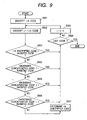
- Fig. 9 shows a flow chart of an encryption process or this embodiment. This flow can be realized by executing a program loaded in the main memory apparatus 303 based on an input instruction from the computer shown in Fig. 3, particularly from the mouse 313 or the keyboard 314, for example by the MPU 302.
- an i-th code at the first data position to be encrypted in the JPEG 2000 stream is encrypted, to obtain an i-th encrypted code (step S901).
- the code herein means 2-byte data which are a unit of the inhibited code of JPEG 2000.
- the JPEG 2000 stream constituting the origin may be stored in advance in the hard disk 304, or various memory media connected to the CD drive 309, the DVD drive 310, the FDD drive 311 etc. or may be obtained by executing a JPEG 2000 compression program loaded in the main memory apparatus 303 by the MPU 302 etc., or may be transmitted through a network not shown in Fig. 3.
- step S902 an (i+1)th code or second code is similarly encrypted (step S902). Then there is discriminated whether the i-th encrypted code is an inhibited code of FF90h - FFFFh (step S903).
- one byte in the latter part of the i-th code is connected with one byte in the front part of the (i+1)th encrypted code to form a code (called backward concatenated code 1), and there is discriminated whether such code constitutes an inhibited code (step S904).
- one byte in the latter part of the i-th encrypted code is connected with one byte in the front part of the (i+1)th code to form a code (called backward concatenated code 2), and there is discriminated whether such code constitutes an inhibited code (step S905).
- one byte in the latter part of the (i-1)th code is connected with one byte in the front part of the i-th encrypted code to form a code (called frontward concatenated code 1), and there is discriminated whether such code constitutes an inhibited code (step S906).
- the (i-1)th code means a code positioned in front of the i-th code to be encrypted in this state, and may be encrypted in a preceding process. However, the process of the step S906 may be dispensed with in case the i-th code is the first code, as the (i-1)th code does not exist.
- the i-th encrypted code is established as an encryption result of the i-th code (step S907).
- the encryption of the i-th code is not executed.
- the encryption result of the i-th code is made same as the i-th code.
- the backward concatenated codes 1, 2 and the frontward concatenated code 1 are inspected in order to prevent presence of an inhibited code even in a frontward or backward concatenated state since the JPEG 2000 stream has a minimum unit of one byte.
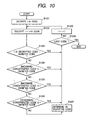
- Fig. 10 shows a flow chart of a decryption process or this embodiment. This flow can also be realized by executing a program loaded in the main memory apparatus 303 based on an input instruction from the computer shown in Fig. 3, particularly from the mouse 313 or the keyboard 314, for example by the MPU 302.
- an i-th code at the first data position to be decrypted in the JPEG 2000 stream is decrypted, to obtain an i-th decrypted code (step S1001).
- the JPEG 2000 steam constituting the origin is a portion encrypted by the encrypting process shown in Fig. 9, and is handled as encrypted data, including a portion not encrypted by the process shown in Fig. 9 (The portion not encrypted in the process shown in Fig. 9 is not decrypted as will be understood from the following description).
- the JPEG 2000 stream constituting the origin may be stored in advance in the hard disk 304, or various memory media connected to the CD drive 309, the DVD drive 310, the FDD drive 311 etc. or may be obtained by executing a JPEG 2000 compression program loaded in the main memory apparatus 303 by the MPU 302 etc., or may be transmitted through a network not shown in Fig. 3. Also the decrypting process can be executed for example by the aforementioned CFB or OFB mode of DES.
- step S1002 an (i+1)th code or second code is similarly decrypted (step S1002). Then there is discriminated whether the i-th decrypted code is an inhibited code of FF90h - FFFFh (step S1003).
- one byte in the latter part of the i-th decrypted code is connected with one byte in the front part of the (i+1)th encrypted code to form a code (called backward concatenated code 4), and there is discriminated whether such code constitutes an inhibited code (step S1004).
- one byte in the latter part of the i-th encrypted code is connected with one byte in the front part of the (i+1)th decrypted code to form a code (called backward concatenated code 5), and there is discriminated whether such code constitutes an inhibited code (step S1005).
- one byte in the latter part of the (i-1)th code is connected with one byte in the front part of the i-th decrypted code to form a code (called frontward concatenated code 2), and there is discriminated whether such code constitutes an inhibited code (step S1006).
- the (i-1)th code means a code positioned in front of the i-th code to be decrypted in this state, and may be or may not be decrypted in a preceding process. However, the process of the step S1006 may be dispensed with in case the i-th code is the first code, as the (i-1) th code does not exist.
- the i-th decrypted code is established as a decryption result of the i-th encrypted code (step S1007).
- the decryption of the i-th encrypted code is not executed.
- the decryption result of the i-th encrypted code is made same as the i-th encrypted code.
- step S1008 there is discriminated whether the i-th encrypted code is a last code of the object of decryption, and, if it is the last code, the flow is terminated (step S1008).
- the processes of the steps S1002, S1004 and S1006 can be dispensed with as the succeeding (i+1)th encrypted code does not exist.
- encryption and decryption can be executed by calculating EXOR on the input data with same random number data.
- the encryption and the decryption become a same process. Therefore, the code encrypted in the process of Fig. 9 is encrypted again in the process of Fig. 10 to return to the original code. Therefore, the discriminations in the steps S903 to S906 are same as those in the steps S1003 to S1006, and the code not encrypted in the process of Fig. 9 is not decrypted in the process of Fig. 10.
- the codes decrypted in the process of Fig. 10 are only those encrypted in the process of Fig. 9, so that the code subjected to the process of Fig. 9 can be returned to the original code by the process of Fig. 10.
- Fig. 11 shows a flow chart of an encryption process in the present embodiment. This flow can be realized by executing a program loaded in the main memory apparatus 303 based on an input instruction from the computer shown in Fig. 3, particularly from the mouse 313 or the keyboard 314, for example by the MPU 302.
- the i-th code is encrypted to obtain an i-th encrypted code (step S1102).
- the object of encryption is compressed data (data of the body shown in Fig. 4) not containing marker codes of FF90h - FFFFh (hereinafter called inhibited code), and the encryption is executed at an interval of s codes (s > 1).
- the code herein means 2-byte data which are a unit of the inhibited code of JPEG 2000.
- the JPEG 2000 stream constituting the origin may be stored in advance in the hard disk 304, or various memory media connected to the CD drive 309, the DVD drive 310, the FDD drive 311 etc. or may be obtained by executing a JPEG 2000 compression program loaded in the main memory apparatus 303 by the MPU 302 etc., or may be transmitted through a network not shown in Fig. 3.
- the encryption process can be executed by the aforementioned CFB or OFB mode of DES.
- step S1103 there is discriminated whether the i-th encrypted code is an inhibited code of FF90h - FFFFh (step S1103).
- the i-th encrypted code is not an inhibited code
- one byte in the latter part of the i-th code is connected with one byte in the front part of the (i+1)th data to form a code (called backward concatenated code 2), and there is discriminated whether such code constitutes an inhibited code (step S1104).
- one byte in the latter part of the (i-1)th code is connected with one byte in the front part of the i-th encrypted code to form a code (called frontward concatenated code 1), and there is discriminated whether such code constitutes an inhibited code (step S1105).
- the (i-1) th code means a code positioned in front of the i-th code to be encrypted in this state, and may be encrypted in a preceding process. However, the process of the step S1105 may be dispensed with in case the i-th code is the first code, as the (i-1)th code does not exist.
- the i-th encrypted code is established as an encryption result of the i-th code (step S1106).
- the encryption of the i-th code is not executed.
- the encryption result of the i-th code is made same as the i-th code.
- the inspection is made on the backward concatenated code 2 and the frontward concatenated code 1 only in contrast to the process of Fig. 9, because s is equal to or larger than 2 to execute the encryption in discrete manner so that the codes in front of and behind the i-th code are not encrypted.
- Fig. 12 shows a flow chart of a decryption process corresponding to the encryption process shown in Fig. 11.
- This flow can be realized by executing a program loaded in the main memory apparatus 303 based on an input instruction from the computer shown in Fig. 3, particularly from the mouse 313 or the keyboard 314, for example by the MPU 302.
- the flow goes to an i-th encrypted code which is in data position to be decrypted in the JPEG 2000 stream (step S1201). Then the i-th encrypted code is decrypted to obtain an i-th decrypted code (step S1202).
- the JPEG 2000 steam constituting the origin is data encrypted by the process shown in Fig. 11, and is handled as encrypted data, including a portion not encrypted by the process shown in Fig. 11 (The portion not encrypted in the process shown in Fig. 11 is not decrypted as will be understood from the following description).
- the JPEG 2000 stream constituting the origin may be stored in advance in the hard disk 304, or various memory media connected to the CD drive 309, the DVD drive 310, the FDD drive 311 etc. or may be obtained by executing a JPEG 2000 compression program loaded in the main memory apparatus 303 by the MPU 302 etc., or may be transmitted through a network not shown in Fig. 3. Also the decryption process can be executed by the aforementioned CFB or OFB mode of DES.
- step S1203 there is discriminated whether the i-th decrypted code is an inhibited code of FF90h - FFFFh (step S1203).
- the i-th decrypted code is not an inhibited code, one byte in the latter part of the i-th decrypted code is connected with one byte in the front part of the (i+1)th data to form a code (called backward concatenated code 4), and there is discriminated whether such code constitutes an inhibited code (step S1204).
- one byte in the latter part of the (i-1)th data is connected with one byte in the front part of the i-th dedcrypted code to form a code (called frontward concatenated code 2), and there is discriminated whether such code constitutes an inhibited code (step S1205).
- the (i-1)th code means a code positioned in front of the i-th code to be decrypted in this state, and may be or may not be decrypted in a preceding process. However, the process of the step S1205 may be dispensed with in case the i-th code is the first code, as the (i-1)th code does not exist.
- the i-th decrypted code is established as a decryption result of the i-th encrypted code (step S1206).
- the decryption of the i-th encrypted code is not executed.
- the decryption result of the i-th encrypted code is made same as the i-th encrypted code.
- encryption and decryption can be executed by calculating EXOR on the input data with same random number data.
- the encryption and the decryption become a same process. Therefore, the code encrypted in the process of Fig. 11 is encrypted again in the process of Fig. 12 to return to the original code. Therefore, the discriminations in the steps S1103 to S1106 are same as those in the steps S1203 to S1206, and the code not encrypted in the process of Fig. 11 is not decrypted in the process of Fig. 12.
- the codes decrypted in the process of Fig. 12 are only those encrypted in the process of Fig. 11, so that the code subjected to the process of Fig. 11 can be returned to the original code by the process of Fig. 12.
- the present invention is not limited to DES and is naturally applicable to a common key cipher such as AES, MISTY or Camellia.
- the strength of the encryption and decryption of the present invention has a safety corresponding to the employed cipher process.
- the encryption mode is not limited to CFB or OFB, but there may be employed any method capable of encrypting data of an arbitrary length.
- the inhibited code is a marker code of FF90h - FFFFh, but the inhibited code can also be a code containing such marker code or a code containing a part thereof such as FF.
- the encryption is executed by each byte, and is executed by executing an XOR calculation on the encryption object data and a pseudo random number.
- Fig. 13 shows an information processing apparatus for executing an encryption process.
- Encryption object data and key data are entered into an information processing apparatus 201.
- the encryption object data are entered into a data input module 202, while the key data are entered into a pseudo random number creation module 204.
- the pseudo random number creation module 204 generates a pseudo random number based on the entered key data, and enters it into an encryption process unit 203.
- the encryption process unit 203 encrypts the simultaneously entered encryption object data by the pseudo random number, and the encrypted data are outputted from the information processing apparatus 201 through a data output module 205.
- the apparatus for the encryption process can be same as the apparatus for the decryption process.
- the apparatus for encryption process shown in Fig. 13 is same as the apparatus for decryption process.
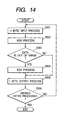
- Fig. 14 shows a flow chart of an encryption process for processing by every byte.
- a step S301 cuts out 1 byte in succession from the encryption object data and the flow proceeds to a step S302.
- a step S302 executes an XOR process by an encryption process unit 203.
- a step S303 discriminates whether the data are out of a range in the unit of a byte, and the flow proceeds to a step S304 or S305 respectively in case the data are out of the range or within the range.
- a step S304 executes a similar process with the pseudo random number employed in the step S302.
- a step S305 outputs the encrypted data to an HDD 304 or the like, and the flow proceeds to a step S306.
- a step S306 discriminates whether information of all the encryption object data has been processed, and, if not, the flow proceeds to the step S301. The flow is terminated in case the step S306 identifies that the process has been completed.
- This process has an advantage that the encryption object data can be stored in a same area in the steps S301, S302 and S304.
- the input data are copied in such area A in the step S301.
- step S302 data after the exclusive logic sum process can be added to the area A.
- step S304 data after the exclusive logic sum process can be added to the area A.
- Fig. 15 shows an example in which a value range is assumed from 00 to FE (hexadecimal), and a value out of range is FF only.
- encryption object data 401 and pseudo random number data 402 are shown in the step S302.
- An exclusive logic sum calculation is executed for every byte, to obtain encrypted data as indicated by 403.
- a first byte is processed as follows. Since the encryption object data are 00 while the pseudo random number is F0, the data after the exclusive logic sum calculation are F0, which are within the range and are therefore taken as the encrypted data.
- a second byte is processed similarly to obtain 88.
- a third byte provides, after the exclusive logic sum calculation, data FF which are detected as out of range by the step S303, so that the step S304 executes an exclusive logic sum calculation on FF and FD to obtain encrypted data of 02.
- the encryption object data "00010203" provide encrypted data "F0880203".
- Fig. 16 shows a decryption process for the encryption process shown in Fig. 15.
- encrypted data 501 and pseudo random number data 502 to be used in the step S302.
- a first byte is processed as follows. Since the encrypted data are F0 while the pseudo random number is F0, the data after the exclusive logic sum calculation are F0, which is within the range and are therefore taken as the decrypted data.
- a second byte is processed similarly to obtain 01.
- a third byte provides, after the exclusive logic sum calculation, data FF which are detected as out of range by the step S303, so that the step S304 executes an exclusive logic sum calculation on FF and FD to obtain decrypted data of 02.
- the encrypted data "F0880203" provides decrypted data "00010203".
- a step S2202 discriminates whether data entered in a step S2201 are data out of range. In case of the data out of range, the subsequent process is suspended and the flow is terminated. In case of absence of such function, the flow chart shown in Fig. 14 cannot achieve a proper process in case improper data which are output of the range are inputted. In case the input data are improper data, it is also possible to suspend the encryption and to inform such effect.
- the sequence after a step S2203 is similar to that after the step S302 in Fig. 14 and will not therefore be explained.
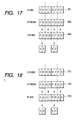
- FIG. 17 shows an example in which data out of range are F0 to FF.
- a first byte is processed as follows. Since the encryption object data are 00 while the pseudo random number is F0, the data after the exclusive logic sum calculation are F0, which are detected as out of range by the step S303, so that the step S304 executes an exclusive logic sum calculation on F0 and F0 to obtain encrypted data of 00. As a result of a similar process, the encryption object data "00010203" provide encrypted data "00880203".
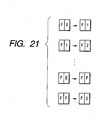
- the encrypted data may show limited scrambled portions in comparison with the data prior to encryption. Therefore, there will be explained a process having a 1-to-1 conversion table from data within the range to data out of the range as shown in Fig. 22 and executing encryption and decryption utilizing such table.
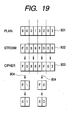
- Fig. 19 shows an example of the process.
- the process is same as that shown in Fig. 17, but a following process is added.
- a first byte, F0, is converted into F1 according to Fig. 21.
- F1 is subjected to an XOR process in the step S304 to obtain encrypted data 01.
- the encryption object data "00010203" provide encrypted data "01880B03".
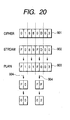
- an inverse converting operation 904 is added, utilizing the conversion table shown in Fig. 21.
- F1 is obtained in the same manner as in Fig. 18, then it is subjected to an inverse conversion (904) with the table shown in Fig. 21 to obtain F0, which is finally subjected to the XOR process in the step S304 to obtain 00.
- the encrypted data "01880B03" provide decrypted data "00010203".
- the conversion table shown in Fig. 21 may be fixed, or may be varied according to the number of bytes of the object data or according to the result of a preceding encryption process as in the CBC mode in the block cipher system.
- the present embodiment explained a method of executing a process corresponding to a limited value range in JPEG 2000 (data out of range being FF90 to FFFF).
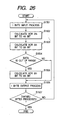
- Fig. 24 represents a conversion method satisfying the rule 2, wherein 1301 represents bits of 1-byte (8-bit) data processed by the step S301 among the encryption object data. Also 1302 represents bits of 1-byte pseudo random number data subjected to an XOR data in the step S302.
- a step S1501 enters encryption object data.
- a step S1502 processes 2nd to 4th bits, and applies an XOR process on the 2nd to 4th bits among the data 1302.
- a step S1503 processes 5th to 8th bits and applies an XOR process on the 5th to 8th bits of the data 1302.
- a step S1504 discriminates whether data out of range are present, and, if out of range, executes an XOR process as in the step S1502 or S1503.
- a step S1506 discriminates whether all the encryption object data have been processed, and, if not, the flow is transferred to the step S1501. The flow is terminated in case the step S1506 identifies that the process has been completed.
- the above-explained conversion process allows to satisfy the rule 2 and to achieve conversion into the defined value range of JPEG 2000.
- Embodiments of the present invention may comprise a system constituted of plural equipment (for example a computer itself, an interface device, a display etc.) or an apparatus constituted of a single equipment.
- Embodiments may also be realised by supplying program codes of a software realizing the aforementioned functions to a computer in a system or an apparatus connected with various devices in order to control such devices so as to realize the aforementioned functions.
- the aforementioned functions are realized by the computer (CPU or MPU) of the above-mentioned system or apparatus reading and executing the program codes.
- the program codes themselves therefore realize the functions of the aforementioned embodiments, and the program codes themselves and the carrier carrying the program codes such as a memory medium storing the program code or a signal carrying the program code constitute embodiments of the present invention.
- the memory medium storing such program codes can be, for example, a floppy disk, a hard disk, an optical disk, a magnetooptical disk, a CD-ROM, a CD-R, a magnetic tape, a non-volatile memory card, or a ROM.
- the signal may be an electrical, magnetic or optical signal for example.
- the aforementioned embodiments can be realized not only by the execution of the program codes read by the computer but also a case where an operating system or an application software functioning on the computer realize the functions of the aforementioned embodiments under the control of such program codes.
- program codes may be read from the carrier and stored in a function expansion board inserted into the computer or a function expansion unit connected to the computer, and a CPU provided in the function expansion board or the function expansion unit executes all the process or a part thereof under the control of such program codes, thereby realizing the functions of the aforementioned embodiments.
- the program code causes the executing apparatus to perform the operations in the aforementioned flow charts.
Landscapes
- Engineering & Computer Science (AREA)
- Computer Security & Cryptography (AREA)
- Computer Networks & Wireless Communication (AREA)
- Signal Processing (AREA)
- Storage Device Security (AREA)
- Compression Or Coding Systems Of Tv Signals (AREA)
- Facsimile Transmission Control (AREA)
Abstract
Description
Four markers only, namely SOC (FF4Fh: start of code stream), EOC (FFD9h: end of code stream), SOD (FF93h: start of data) and EPH (FF92h: end of packet header) are independent codes, and any other marker is a part of the marker segment. Hereafter, the markers and the market segments are collectively called markers. IN JPEG 2000, a marker in a range of FF90h to FFFFh is given two particular meanings. Firstly, such marker means a partition in a code stream. It is thus possible to define a position of a packet and a packet header. Secondly, such marker does not exist in the compressed data themselves (body shown in Fig. 4). The JPEG 2000 encoder is so designed as not to generate such code. Therefore, in the aforementioned partial encryption of the JPEG 2000 data, it is necessary to avoid generation of such 2-byte marker code of FF90h - FFFFh.
A
char input_data[MAX_SIZE]; /*step301*/
for (i=0; I<MAX_SIZE; i++){
input_data[i] ^= steam_data[i];/*step302*/
if (IsStrictData(input_data[i] ^=
stream_data[i];/*step304*/}
Claims (34)
- An encryption method comprising:an encryption step of encrypting a code;an encryption result judgment step of judging whether a code, concerning an encrypted object code obtained by encrypting an object code by said encryption step, generates a code of a value within a predetermined range; andan encryption result determination step which, in case said encryption result judgment step identifies that a code of a value within the predetermined range is not generated, determines said encrypted object code as an encryption result of said object code.
- An encryption method according to claim 1, further comprising a re-encryption step which, in case said encryption result judgment step identifies that a code of a value within the predetermined range is generated, re-encrypts said encrypted object code.
- An encryption method according to claim 1, wherein said judgment step includes:a first encryption result judgment step of judging whether said encrypted object code is a code of a value within a predetermined range; anda second encryption result judgment step of judging whether a concatenated result of an encrypted code immediately preceding said encrypted object code and said encrypted object code generates a code of a value within said predetermined range.
- An encryption method according to claim 1, wherein said encryption step executes an encryption for every predetermined number of codes.
- An encryption method according to claim 1, wherein, in case said encryption result judgment step identifies that a code of a value within said predetermined range is generated, said encryption result determination step determines said object code itself as an encryption result of said object code.
- An encryption method according to claim 1, wherein said encryption result judgment step includes:a third encryption result judgment step of judging whether said encrypted object code is a code of a value within a predetermined range;a fourth encryption result judgment step of judging whether a combination of symbols of a predetermined number from the end of said encrypted object code and symbols of a predetermined number from the beginning of a code immediately after said object code is a code of a value within a predetermined range; anda fifth encryption result judgment step of judging whether a combination of symbols of a predetermined number from the end of a code immediately in front of said object code and symbols of a predetermined number from the beginning of said encrypted object code is a code of a value within a predetermined range.
- An encryption method according to claim 6, wherein said encryption result judgment step further includes:a sixth encryption result judgment step of judging whether a combination of symbols of a predetermined number from the end of said object code and symbols of a predetermined number from the beginning of a code obtained by encrypting a code immediate after said object code is a code of a value within a predetermined range.
- An encryption method according to claim 1, wherein said encryption step executes encryption by a common key cipher method.
- An encryption method according to claim 1, wherein the code of a value of said predetermined range includes a part of marker codes in JPEG 2000.
- An encryption method according to claim 1, wherein said encryption step executes encryption by determining an exclusive logic sum of the object code and pseudo random number data.
- An encryption method according to claim 10, wherein said encryption step executes an encryption process, for every 8 bits, on a bit train excluding a top bit.
- An encryption method according to claim 11, wherein said encryption step applies an exclusive logic sum calculation on every two portions from 2nd to 4th bits and from 5th to 8th bits counted from the beginning.
- An encryption method according to claim 1, further comprising:a conversion step which, in case said encryption result judgment step identifies that a code of a value of a predetermined range is generated, converts the code of the value of such predetermined range into another code of a value of the predetermined range; anda second encryption step of encrypting another code converted by said conversion step.
- A decryption method comprising:a decryption step for decrypting an encrypted code;a decryption result judgment step of discriminating whether a code, concerning a decrypted object code obtained by decrypting an object code by said decryption step, generates a code of a value within a predetermined range; anda decryption result determination step which, in case said decryption result discriminating step identifies that a code of a value within the predetermined range is not generated, determines said decrypted object code as a decryption result of said object code.
- A decryption method according to claim 14, further comprising a re-decryption step which, in case said decryption result discriminating step identifies that a code of a value within the predetermined range is generated, re-decrypts said decrypted object code.
- A decryption method according to claim 14, wherein said decryption result judgment step includes:a first decryption result judgment step of judging whether said decrypted object code is a code of a value within a predetermined range; anda second decryption result judgment step of judging whether a concatenated result of a decrypted code immediately preceding said decrypted object code and said decrypted object code generates a code of a value within said predetermined range.
- A decryption method according to claim 14, wherein said decryption step executes a decryption for every predetermined number of codes.
- A decryption method according to claim 14, wherein, in case said decryption result judgment step identifies that a code of a value within said predetermined range is generated, said decryption result determination step determines said object code itself as a decryption result of said object code.
- A decryption method according to claim 14, wherein said decryption result judgment step includes:a third decryption result judgment step of judging whether said encrypted object code is a code of a value within a predetermined range;a fourth decryption result judgment step of judging whether a combination of symbols of a predetermined number from the end of said encrypted object code and symbols of a predetermined number from the beginning of a code immediately after said object code is a code of a value within a predetermined range; anda fifth decryption result judgment step of judging whether a combination of symbols of a predetermined number from the end of a code immediately in front of said object code and symbols of a predetermined number from the beginning of said encrypted object code is a code of a value within a predetermined range.
- A decryption method according to claim 19, wherein said decryption result judgment step further includes:a sixth decryption result judgment step of judging whether a combination of symbols of a predetermined number from the end of said object code and symbols of a predetermined number from the beginning of a code obtained by encrypting a code immediate after said object code is a code of a value within a predetermined range.
- A decryption method according to claim 14, wherein said decryption step executes decryption by a common key cipher method.
- A decryption method according to claim 14, wherein the code of a value of said predetermined range includes a part of marker codes in JPEG 2000.
- A decryption method according to claim 14, wherein said decryption step executes decryption by determining an exclusive logic sum of the object code and pseudo random number data.
- A decryption method according to claim 23, wherein said decryption step executes a decryption process, for every 8 bits, on a bit train excluding a top bit.
- A decryption method according to claim 24, wherein said decryption step applies an exclusive logic sum calculation on every two portions from 2nd to 4th bits and from 5th to 8th bits counted from the beginning.
- A decryption method according to claim 14, further comprising:a conversion step which, in case said judgment step identifies that a code of a value of a predetermined range is generated, converts the code of the value of such predetermined range into another code of a value of the predetermined range; anda second decryption step of decrypting another code converted by said conversion step.
- An encryption apparatus comprising:encryption means which encrypts a code;encryption result judgment means which judges whether a code, concerning an encrypted object code obtained by encrypting an object code by said encryption means, generates a code of a value within a predetermined range; andencryption result determination means which, in case said encryption result judgment means identifies that a code of a value within the predetermined range is not generated, determines said encrypted object code as an encryption result of said object code.
- A decryption apparatus comprising:decryption means which decrypts a code;decryption result judgment means which judges whether a code, concerning a decrypted object code obtained by decrypting an object code by said decryption means, generates a code of a value within a predetermined range; anddecryption result determination means which, in case said decryption result judgment means identifies that a code of a value within the predetermined range is not generated, determines said decrypted object code as a decryption result of said object code.
- A computer readable program for encryption comprising:an encryption step for encrypting a code;an encryption result judgment step of judging whether a code, concerning an encrypted object code obtained by encrypting an object code by said encryption step, generates a code of a value within a predetermined range; andan encryption result determination step which, in case said encryption result judgment step identifies that a code of a value within the predetermined range is not generated, determines said encrypted object code as an encryption result of said object code.
- A computer readable program for decryption comprising:a decryption step of decrypting a code;a decryption result judgment step of judging whether a code, concerning a decrypted object code obtained by decrypting an object code by said decryption step, generates a code of a value within a predetermined range; and
- An encryption method comprising:encrypting image data for at least part of an image encoded in accordance with a predetermined format;testing at least part of the encrypted data to determine whether the encryption process has generated data inhibited by the predetermined format; andin the event that inhibited data has been generated, performing processing to generate encrypted data that does not contain an inhibited value.
- A decryption method comprising:a decryption step for decrypting encrypted image data for at least part of an image encoded in accordance with a predetermined format;testing at least part of the decrypted data to determine whether it contains data inhibited by the predetermined format; andin the event that inhibited data has been generated, performing processing to generate decrypted data that does not contain an inhibited value.
- A storage medium storing computer program instructions to program a programmable processing apparatus to become operable to perform a method as set out in at least one of claims 1 to 26, 31 and 32.
- A signal carrying computer program instructions to program a programmable processing apparatus to become operable to perform a method as set out in at least one of claims 1 to 26, 31 and 32.
Applications Claiming Priority (6)
| Application Number | Priority Date | Filing Date | Title |
|---|---|---|---|
| JP2003006372 | 2003-01-14 | ||
| JP2003006372A JP4371663B2 (en) | 2003-01-14 | 2003-01-14 | Information processing apparatus and information processing method |
| JP2003061617 | 2003-03-07 | ||
| JP2003061617A JP2004274339A (en) | 2003-03-07 | 2003-03-07 | Data processing method |
| JP2003184941A JP4672971B2 (en) | 2003-06-27 | 2003-06-27 | Encryption / decryption method and apparatus |
| JP2003184941 | 2003-06-27 |
Publications (3)
| Publication Number | Publication Date |
|---|---|
| EP1439660A2 true EP1439660A2 (en) | 2004-07-21 |
| EP1439660A3 EP1439660A3 (en) | 2005-02-09 |
| EP1439660B1 EP1439660B1 (en) | 2012-04-11 |
Family
ID=32600731
Family Applications (1)
| Application Number | Title | Priority Date | Filing Date |
|---|---|---|---|
| EP04250117A Expired - Lifetime EP1439660B1 (en) | 2003-01-14 | 2004-01-12 | Encryption/decryption method for data limited in value range, apparatus and program therefor |
Country Status (3)
| Country | Link |
|---|---|
| US (1) | US7512811B2 (en) |
| EP (1) | EP1439660B1 (en) |
| CN (1) | CN100342683C (en) |
Cited By (1)
| Publication number | Priority date | Publication date | Assignee | Title |
|---|---|---|---|---|
| EP2627095B1 (en) * | 2012-02-08 | 2016-06-29 | ViXS Systems Inc. | Device and method for partial encryption |
Families Citing this family (16)
| Publication number | Priority date | Publication date | Assignee | Title |
|---|---|---|---|---|
| JP4632413B2 (en) * | 2004-09-01 | 2011-02-16 | キヤノン株式会社 | Information encryption device, information distribution device, control method therefor, computer program, and computer-readable storage medium |
| US7769168B2 (en) * | 2005-03-31 | 2010-08-03 | Microsoft Corporation | Locally interative encryption generating compliant ciphertext for general syntax specifications |
| US7953224B2 (en) * | 2005-05-20 | 2011-05-31 | Microsoft Corporation | MPEG-4 encryption enabling transcoding without decryption |
| US8081755B2 (en) * | 2005-05-20 | 2011-12-20 | Microsoft Corporation | JPEG2000 syntax-compliant encryption with full scalability |
| US7684566B2 (en) * | 2005-05-27 | 2010-03-23 | Microsoft Corporation | Encryption scheme for streamed multimedia content protected by rights management system |
| US8321690B2 (en) | 2005-08-11 | 2012-11-27 | Microsoft Corporation | Protecting digital media of various content types |
| JP2007081482A (en) * | 2005-09-09 | 2007-03-29 | Canon Inc | Terminal authentication method, apparatus thereof, and program |
| JP4993674B2 (en) * | 2005-09-09 | 2012-08-08 | キヤノン株式会社 | Information processing apparatus, verification processing apparatus, control method thereof, computer program, and storage medium |
| US7851758B1 (en) | 2005-09-29 | 2010-12-14 | Flir Systems, Inc. | Portable multi-function inspection systems and methods |
| US20080024332A1 (en) * | 2006-07-27 | 2008-01-31 | George Simonson | Method and Apparatus for Protecting Data |
| JP2008059561A (en) * | 2006-08-04 | 2008-03-13 | Canon Inc | Information processing apparatus, data processing apparatus, and methods thereof |
| JP5270894B2 (en) * | 2007-10-01 | 2013-08-21 | キヤノン株式会社 | Information processing apparatus, control method therefor, information processing system, and program |
| CN101996298A (en) * | 2009-08-14 | 2011-03-30 | 鸿富锦精密工业(深圳)有限公司 | Encrypting method and decrypting method corresponding to same |
| US9256762B1 (en) * | 2011-12-20 | 2016-02-09 | Amazon Technologies, Inc. | Securing a remote database |
| SG11201508780UA (en) | 2013-04-24 | 2015-11-27 | Nec Europe Ltd | Method and system for encrypting data |
| CN115643001B (en) * | 2022-12-25 | 2023-03-14 | 武汉恩为科技有限公司 | Image encryption method, system and readable storage medium based on bit plane |
Family Cites Families (2)
| Publication number | Priority date | Publication date | Assignee | Title |
|---|---|---|---|---|
| US7270193B2 (en) * | 2000-02-14 | 2007-09-18 | Kabushiki Kaisha Toshiba | Method and system for distributing programs using tamper resistant processor |
| US6647149B2 (en) * | 2001-01-03 | 2003-11-11 | Electronics For Imaging, Inc. | Methods and apparatus for securely transmitting and processing digital image data |
-
2004
- 2004-01-09 US US10/753,319 patent/US7512811B2/en not_active Expired - Fee Related
- 2004-01-12 EP EP04250117A patent/EP1439660B1/en not_active Expired - Lifetime
- 2004-01-14 CN CNB200410001836XA patent/CN100342683C/en not_active Expired - Fee Related
Cited By (1)
| Publication number | Priority date | Publication date | Assignee | Title |
|---|---|---|---|---|
| EP2627095B1 (en) * | 2012-02-08 | 2016-06-29 | ViXS Systems Inc. | Device and method for partial encryption |
Also Published As
| Publication number | Publication date |
|---|---|
| EP1439660B1 (en) | 2012-04-11 |
| CN100342683C (en) | 2007-10-10 |
| CN1520085A (en) | 2004-08-11 |
| US20040170277A1 (en) | 2004-09-02 |
| US7512811B2 (en) | 2009-03-31 |
| EP1439660A3 (en) | 2005-02-09 |
Similar Documents
| Publication | Publication Date | Title |
|---|---|---|
| EP1439660B1 (en) | Encryption/decryption method for data limited in value range, apparatus and program therefor | |
| US7961871B2 (en) | Encryption process, encryption device, and computer-readable medium storing encryption program | |
| US9083506B2 (en) | Cryptographic processing apparatus and cryptographic processing method, and computer program | |
| KR101229498B1 (en) | Method and apparatus for importing transport stream | |
| KR100579673B1 (en) | Encryption / Decryption System, Encryption System and Decryption System | |
| JP2001274786A (en) | Contents information transmission method, contents information recording method, contents information transmitter, contents information recorder, transmission medium and recording medium | |
| JP2002244929A (en) | Digital copy method and digital content recording device | |
| JP4989055B2 (en) | Character code encryption processing program and character code encryption processing method | |
| CN102224704A (en) | Content decoding apparatus, content decoding method and integrated circuit | |
| JPH11109856A (en) | Decryption device | |
| CN100508451C (en) | Apparatus and method for generating data for detecting false alteration of encrypted data during processing | |
| JP2002190798A (en) | Ciphering device and deciphering device | |
| JP4703805B2 (en) | ENCRYPTION DEVICE, ENCRYPTION METHOD, DECRYPTION DEVICE, DECRYPTION METHOD, AND COMMUNICATION SYSTEM | |
| JP2010145691A (en) | Content encrypting apparatus, content decrypting apparatus, and data conversion method | |
| Kadhim | A new audio steganography system based on auto-key generator | |
| JP4672971B2 (en) | Encryption / decryption method and apparatus | |
| Geetha et al. | Implementation of ETAS (embedding text in audio signal) model to ensure secrecy | |
| JPH11225140A (en) | Data encryption device and decryption device, and program recording medium therefor | |
| JP2004219669A (en) | Information processing method | |
| JP2009187535A (en) | Server, image forming apparatus, image processing system, image processing method, and image processing program | |
| Dassanayaka | Sound Conveyors for Stealthy Data Transmission | |
| Sendhooran et al. | Data Hiding with Encrypted Multi Secret Sharing using Modified LSB Technique | |
| JP2006196988A (en) | Electronic media communication device | |
| JP2004184516A (en) | Digital data transmission terminal | |
| JP2009124456A (en) | Information processing apparatus, information processing method, information processing program, and information recording medium |
Legal Events
| Date | Code | Title | Description |
|---|---|---|---|
| PUAI | Public reference made under article 153(3) epc to a published international application that has entered the european phase |
Free format text: ORIGINAL CODE: 0009012 |
|
| AK | Designated contracting states |
Kind code of ref document: A2 Designated state(s): AT BE BG CH CY CZ DE DK EE ES FI FR GB GR HU IE IT LI LU MC NL PT RO SE SI SK TR |
|
| AX | Request for extension of the european patent |
Extension state: AL LT LV MK |
|
| RIN1 | Information on inventor provided before grant (corrected) |
Inventor name: SUGA, YUJI,C/O CANON KABUSHIKI KAISHA Inventor name: IWAMURA, KEIICHI,C/O CANON KABUSHIKI KAISHA |
|
| PUAL | Search report despatched |
Free format text: ORIGINAL CODE: 0009013 |
|
| AK | Designated contracting states |
Kind code of ref document: A3 Designated state(s): AT BE BG CH CY CZ DE DK EE ES FI FR GB GR HU IE IT LI LU MC NL PT RO SE SI SK TR |
|
| AX | Request for extension of the european patent |
Extension state: AL LT LV MK |
|
| 17P | Request for examination filed |
Effective date: 20050701 |
|
| AKX | Designation fees paid |
Designated state(s): DE FR GB |
|
| GRAP | Despatch of communication of intention to grant a patent |
Free format text: ORIGINAL CODE: EPIDOSNIGR1 |
|
| GRAC | Information related to communication of intention to grant a patent modified |
Free format text: ORIGINAL CODE: EPIDOSCIGR1 |
|
| GRAS | Grant fee paid |
Free format text: ORIGINAL CODE: EPIDOSNIGR3 |
|
| GRAA | (expected) grant |
Free format text: ORIGINAL CODE: 0009210 |
|
| AK | Designated contracting states |
Kind code of ref document: B1 Designated state(s): DE FR GB |
|
| REG | Reference to a national code |
Ref country code: GB Ref legal event code: FG4D |
|
| REG | Reference to a national code |
Ref country code: DE Ref legal event code: R096 Ref document number: 602004037258 Country of ref document: DE Effective date: 20120606 |
|
| PLBE | No opposition filed within time limit |
Free format text: ORIGINAL CODE: 0009261 |
|
| STAA | Information on the status of an ep patent application or granted ep patent |
Free format text: STATUS: NO OPPOSITION FILED WITHIN TIME LIMIT |
|
| 26N | No opposition filed |
Effective date: 20130114 |
|
| REG | Reference to a national code |
Ref country code: DE Ref legal event code: R097 Ref document number: 602004037258 Country of ref document: DE Effective date: 20130114 |
|
| REG | Reference to a national code |
Ref country code: FR Ref legal event code: PLFP Year of fee payment: 13 |
|
| REG | Reference to a national code |
Ref country code: FR Ref legal event code: PLFP Year of fee payment: 14 |
|
| REG | Reference to a national code |
Ref country code: FR Ref legal event code: PLFP Year of fee payment: 15 |
|
| PGFP | Annual fee paid to national office [announced via postgrant information from national office to epo] |
Ref country code: GB Payment date: 20180130 Year of fee payment: 15 |
|
| PGFP | Annual fee paid to national office [announced via postgrant information from national office to epo] |
Ref country code: FR Payment date: 20180125 Year of fee payment: 15 |
|
| PGFP | Annual fee paid to national office [announced via postgrant information from national office to epo] |
Ref country code: DE Payment date: 20180329 Year of fee payment: 15 |
|
| REG | Reference to a national code |
Ref country code: DE Ref legal event code: R119 Ref document number: 602004037258 Country of ref document: DE |
|
| GBPC | Gb: european patent ceased through non-payment of renewal fee |
Effective date: 20190112 |
|
| PG25 | Lapsed in a contracting state [announced via postgrant information from national office to epo] |
Ref country code: FR Free format text: LAPSE BECAUSE OF NON-PAYMENT OF DUE FEES Effective date: 20190131 Ref country code: DE Free format text: LAPSE BECAUSE OF NON-PAYMENT OF DUE FEES Effective date: 20190801 |
|
| PG25 | Lapsed in a contracting state [announced via postgrant information from national office to epo] |
Ref country code: GB Free format text: LAPSE BECAUSE OF NON-PAYMENT OF DUE FEES Effective date: 20190112 |