EP1439592A2 - Methods and apparatus for assembling solid oxide fuel cells - Google Patents
Methods and apparatus for assembling solid oxide fuel cells Download PDFInfo
- Publication number
- EP1439592A2 EP1439592A2 EP03257759A EP03257759A EP1439592A2 EP 1439592 A2 EP1439592 A2 EP 1439592A2 EP 03257759 A EP03257759 A EP 03257759A EP 03257759 A EP03257759 A EP 03257759A EP 1439592 A2 EP1439592 A2 EP 1439592A2
- Authority
- EP
- European Patent Office
- Prior art keywords
- manifold
- fuel cell
- fuel
- wall
- stack
- Prior art date
- Legal status (The legal status is an assumption and is not a legal conclusion. Google has not performed a legal analysis and makes no representation as to the accuracy of the status listed.)
- Withdrawn
Links
Images



Classifications
-
- H—ELECTRICITY
- H01—ELECTRIC ELEMENTS
- H01M—PROCESSES OR MEANS, e.g. BATTERIES, FOR THE DIRECT CONVERSION OF CHEMICAL ENERGY INTO ELECTRICAL ENERGY
- H01M8/00—Fuel cells; Manufacture thereof
- H01M8/24—Grouping of fuel cells, e.g. stacking of fuel cells
- H01M8/241—Grouping of fuel cells, e.g. stacking of fuel cells with solid or matrix-supported electrolytes
- H01M8/2425—High-temperature cells with solid electrolytes
-
- H—ELECTRICITY
- H01—ELECTRIC ELEMENTS
- H01M—PROCESSES OR MEANS, e.g. BATTERIES, FOR THE DIRECT CONVERSION OF CHEMICAL ENERGY INTO ELECTRICAL ENERGY
- H01M8/00—Fuel cells; Manufacture thereof
- H01M8/10—Fuel cells with solid electrolytes
- H01M8/12—Fuel cells with solid electrolytes operating at high temperature, e.g. with stabilised ZrO2 electrolyte
- H01M8/1231—Fuel cells with solid electrolytes operating at high temperature, e.g. with stabilised ZrO2 electrolyte with both reactants being gaseous or vaporised
-
- H—ELECTRICITY
- H01—ELECTRIC ELEMENTS
- H01M—PROCESSES OR MEANS, e.g. BATTERIES, FOR THE DIRECT CONVERSION OF CHEMICAL ENERGY INTO ELECTRICAL ENERGY
- H01M8/00—Fuel cells; Manufacture thereof
- H01M8/24—Grouping of fuel cells, e.g. stacking of fuel cells
-
- H—ELECTRICITY
- H01—ELECTRIC ELEMENTS
- H01M—PROCESSES OR MEANS, e.g. BATTERIES, FOR THE DIRECT CONVERSION OF CHEMICAL ENERGY INTO ELECTRICAL ENERGY
- H01M8/00—Fuel cells; Manufacture thereof
- H01M8/24—Grouping of fuel cells, e.g. stacking of fuel cells
- H01M8/241—Grouping of fuel cells, e.g. stacking of fuel cells with solid or matrix-supported electrolytes
- H01M8/2425—High-temperature cells with solid electrolytes
- H01M8/2432—Grouping of unit cells of planar configuration
-
- H—ELECTRICITY
- H01—ELECTRIC ELEMENTS
- H01M—PROCESSES OR MEANS, e.g. BATTERIES, FOR THE DIRECT CONVERSION OF CHEMICAL ENERGY INTO ELECTRICAL ENERGY
- H01M8/00—Fuel cells; Manufacture thereof
- H01M8/24—Grouping of fuel cells, e.g. stacking of fuel cells
- H01M8/2465—Details of groupings of fuel cells
- H01M8/2483—Details of groupings of fuel cells characterised by internal manifolds
-
- H—ELECTRICITY
- H01—ELECTRIC ELEMENTS
- H01M—PROCESSES OR MEANS, e.g. BATTERIES, FOR THE DIRECT CONVERSION OF CHEMICAL ENERGY INTO ELECTRICAL ENERGY
- H01M8/00—Fuel cells; Manufacture thereof
- H01M8/10—Fuel cells with solid electrolytes
- H01M8/12—Fuel cells with solid electrolytes operating at high temperature, e.g. with stabilised ZrO2 electrolyte
- H01M8/124—Fuel cells with solid electrolytes operating at high temperature, e.g. with stabilised ZrO2 electrolyte characterised by the process of manufacturing or by the material of the electrolyte
- H01M8/1246—Fuel cells with solid electrolytes operating at high temperature, e.g. with stabilised ZrO2 electrolyte characterised by the process of manufacturing or by the material of the electrolyte the electrolyte consisting of oxides
- H01M8/1253—Fuel cells with solid electrolytes operating at high temperature, e.g. with stabilised ZrO2 electrolyte characterised by the process of manufacturing or by the material of the electrolyte the electrolyte consisting of oxides the electrolyte containing zirconium oxide
-
- Y—GENERAL TAGGING OF NEW TECHNOLOGICAL DEVELOPMENTS; GENERAL TAGGING OF CROSS-SECTIONAL TECHNOLOGIES SPANNING OVER SEVERAL SECTIONS OF THE IPC; TECHNICAL SUBJECTS COVERED BY FORMER USPC CROSS-REFERENCE ART COLLECTIONS [XRACs] AND DIGESTS
- Y02—TECHNOLOGIES OR APPLICATIONS FOR MITIGATION OR ADAPTATION AGAINST CLIMATE CHANGE
- Y02E—REDUCTION OF GREENHOUSE GAS [GHG] EMISSIONS, RELATED TO ENERGY GENERATION, TRANSMISSION OR DISTRIBUTION
- Y02E60/00—Enabling technologies; Technologies with a potential or indirect contribution to GHG emissions mitigation
- Y02E60/30—Hydrogen technology
- Y02E60/50—Fuel cells
-
- Y—GENERAL TAGGING OF NEW TECHNOLOGICAL DEVELOPMENTS; GENERAL TAGGING OF CROSS-SECTIONAL TECHNOLOGIES SPANNING OVER SEVERAL SECTIONS OF THE IPC; TECHNICAL SUBJECTS COVERED BY FORMER USPC CROSS-REFERENCE ART COLLECTIONS [XRACs] AND DIGESTS
- Y02—TECHNOLOGIES OR APPLICATIONS FOR MITIGATION OR ADAPTATION AGAINST CLIMATE CHANGE
- Y02P—CLIMATE CHANGE MITIGATION TECHNOLOGIES IN THE PRODUCTION OR PROCESSING OF GOODS
- Y02P70/00—Climate change mitigation technologies in the production process for final industrial or consumer products
- Y02P70/50—Manufacturing or production processes characterised by the final manufactured product
-
- Y—GENERAL TAGGING OF NEW TECHNOLOGICAL DEVELOPMENTS; GENERAL TAGGING OF CROSS-SECTIONAL TECHNOLOGIES SPANNING OVER SEVERAL SECTIONS OF THE IPC; TECHNICAL SUBJECTS COVERED BY FORMER USPC CROSS-REFERENCE ART COLLECTIONS [XRACs] AND DIGESTS
- Y10—TECHNICAL SUBJECTS COVERED BY FORMER USPC
- Y10T—TECHNICAL SUBJECTS COVERED BY FORMER US CLASSIFICATION
- Y10T29/00—Metal working
- Y10T29/49—Method of mechanical manufacture
- Y10T29/49002—Electrical device making
- Y10T29/49108—Electric battery cell making
Definitions
- This invention relates generally to power generation, and more specifically, to methods and apparatus for assembling solid oxide fuel cells.
- Known power generation systems use fuel cells to produce power.
- Known fuel cells typically include an anode, also known as a fuel electrode, a cathode, also known as an oxidant electrode, and an electrolyte.
- Such fuel cells are electrochemical devices, similar to batteries, which react fuel and oxidant to produce electricity.
- fuel such as hydrogen and oxidant such as air are supplied continuously to the fuel cell such that it continues to produce power so long as such reactants are provided.
- a fuel cell produces electricity by catalyzing fuel and oxidant into ionized atomic hydrogen and oxygen at, respectively, the anode and cathode.
- the electrons removed from hydrogen in the ionization process at the anode are conducted to the cathode where they ionize the oxygen.
- the oxygen ions are conducted through the electrolyte where they combine with ionized hydrogen to form water as a waste product and complete the process.
- the electrolyte is otherwise impermeable to both fuel and oxidant and merely conducts oxygen ions.
- This series of electrochemical reactions is the sole means of generating electric power within the fuel cell. It is therefore desirable to reduce or eliminate any mixing of the reactants, as such mixing would result in a different combination such as combustion which produces no electric power and therefore reduces the efficiency of the fuel cell.
- an interconnecting member is used to connect the adjacent fuel cells together in electrical series. Often the interconnecting member also performs the function of separating the reactants flowing through the fuel cell stack. The number of fuel cells that may be coupled together and/or an operating efficiency of the fuel stack may be adversely impacted by the interconnecting member. For example, at least some known fuel cell interconnecting members may not adequately maintain a separation of the reactants flowing through the fuel cell when the fuel cell is operated at high temperatures, such as between approximately 600° Celsius (C) and 1000° C.
- At least some known fuel cells have seal assemblies.
- at least some known fuel cell seals are fabricated using glass or glass ceramics, however glass or glass-ceramic seals may not be reliable under thermal cycling.
- Other known fuel cells have seals fabricated using mica materials, metallic, ceramic or composite materials. Although such seals generally withstand the thermal cycling better than the seals fabricated with glass, such seals have not proven to provide substantially leak tight seals.
- a fuel cell comprises at least one hollow manifold, an anode, an electrolyte, and a cathode.
- the at least one hollow manifold comprises a wall that extends between a first end and a second end, such that a chamber is defined therein by said wall. At least one opening extends through the manifold wall and is in flow communication with the chamber.
- the anode is formed on the manifold wall.
- the electrolyte is deposited on the anode, and the cathode is deposited on the electrolyte.
- a fuel cell assembly in another aspect of the invention, includes a first fuel cell and a second fuel cell.
- the first fuel cell and the second fuel cell are electrically coupled together such that at least one sealed passage extends between the first and the second fuel cells.
- the first and second fuel cells each comprise a hollow manifold, an anode, an electrolyte, and a cathode.
- the manifold comprises a continuous wall extending between a first end and a second end, such that a chamber is defined therein.
- the wall includes at least one opening extending therethrough in flow communication with the chamber.
- the anode is on the manifold wall.
- the electrolyte is on the anode, and the cathode is on the electrolyte.
- a method for fabricating a fuel cell assembly comprises forming a fuel cell including a hollow manifold formed from a wall such that a chamber is defined therein, forming at least one opening to extend through the manifold wall and forming an anode on the manifold wall, such that the anode extends over the at least one opening.
- the method also comprises depositing an electrolyte on the anode, and depositing a cathode on the electrolyte.
- a method for fabricating a fuel cell assembly comprises forming a first fuel cell and a second fuel cell, wherein the first and second fuel cells each include a hollow manifold formed from a wall such that a chamber is defined therein and forming at least one opening to extend through each manifold wall.
- the method also comprises forming an anode on each manifold wall, such that the anode extends over each respective manifold wall opening, depositing an electrolyte on each anode, and depositing a cathode on each electrolyte.
- Figure 1 is a cross-sectional view of an exemplary fuel cell stack 10 that includes a plurality of fuel cells 12. Adjacent fuel cells 12 are separated by a plurality of inlet seal passages 14 and a plurality of exit seal passages 15. Seal passages 14 and 15 typically comprise a hollow electrical insulator (not shown) that may be fabricated from, but is not limited to, a ceramic material. In one embodiment, the insulator is coupled to manifolds 20 and end plates 16 and 18 by seals that may be fabricated from, but are not limited to, a glass or a glass ceramic material. Alternatively, the insulators may be coupled to manifolds 20 and end plates 16 and 18 by other fabrication processes, such as, but not limited to brazing. Fuel cell stack 10 includes a top stack plate 16, a bottom stack plate 18, and a plurality of manifolds 20 that are positioned between top stack plate 16 and bottom stack plate 18. Each manifold 20 includes an outer surface 22.
- top stack plate 16, bottom stack plate 18, and manifolds 20, are each sized identically. In an alternative embodiment, at least one of top stack plate 16, bottom stack plate 18, and/or manifolds 20 is sized differently than the remaining fuel cell stack components.
- Top stack plate 16 is substantially solid and bottom stack plate 18 is substantially hollow.
- Stack plates 16 and 18 are both fabricated from an electrically-conductive material. For example, stack plates 16 and 18 may be fabricated from conductive materials capable of operating at higher temperatures as described herein, such as, any material that is electrically conductive, or any material that if subject to oxidation, its oxide is conductive.
- Each manifold 20 is also fabricated from an electrically conductive material, such as, but not limited to, conductive materials capable of operating at higher temperatures as described herein, such as, but not limited to, a stainless steel.
- FIG. 2 is a portion of a fuel cell 12 that may be used with fuel cell stack 10 (shown in Figure 1). More specifically, Figure 2 illustrates a fuel manifold 20 in an initial fabrication stage.
- Each fuel manifold 20 includes a top wall 30, a bottom wall 32, and a pair of sidewalls 34 that connect top and bottom walls 30 and 32, respectively.
- manifold 20 is substantially rectangular, and sidewalls 34 extend substantially perpendicularly between top wall 30 and bottom wall 32.
- manifold 20 is non-rectangular and at least sidewall 34 extends obliquely between top and bottom walls 30 and 32, respectively.
- Fuel manifold 20 is hollow and includes a channel 36 that extends from a first end 38 of fuel manifold 20 to a second end 40 of manifold 20. More specifically, in the exemplary embodiment, channel 36 is defined by an inner surface 42, 44, and 48, of each respective top wall 30, bottom wall 32, and sidewalls 34. Accordingly, in the exemplary embodiment, channel 36 has a substantially rectangular cross-sectional profile. In another embodiment, channel 36 has a non-rectangular cross-sectional profile. In another embodiment, fuel manifold 20 contains at least one of flow guides, baffles, or channeling features to facilitate distributing fuel within fuel manifold 20.
- Figure 3 is a portion of fuel cell 12 shown during a first fabrication stage.
- a supply opening 50 and a return opening 52 are formed within fuel manifold 20. More specifically, supply opening 50 and return opening 52 each extend through fuel manifold top wall 30, through channel 36, and through fuel manifold bottom wall 32.
- openings 50 and 52 are sized identically. Alternatively, opening 50 and opening 52 are sized differently. Additionally, in the exemplary embodiment, openings 50 and 52 each have a substantially circular cross-sectional profile. Alternatively, at least one of opening 50 and/or opening 52 has a non-circular cross-sectional profile.
- At least one opening 54 is also formed in fuel manifold 20 during this fabrication stage. More specifically, in the exemplary embodiment, a plurality of openings 54 extend through fuel manifold top wall 30 into channel 36, but unlike openings 50 and 52, openings 52 do not extend through manifold bottom wall 32.
- openings 54 are arranged in a substantially colinear configuration, i.e. openings 54 are arranged in a plurality of rows 56, wherein each row 56 includes a plurality of openings 54 arranged in a linear sequence.
- each opening 54 has a substantially circular cross-sectional profile.
- each opening 54 has a non-circular cross-sectional profile.
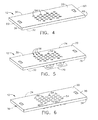
- Figure 4 is a portion of a fuel cell 12 shown during a second fabrication stage.
- a pair of identical end plates 60 and 62 are mechanically coupled to manifold first end 38 and second end 40, respectively. More specifically, in the exemplary embodiment, each end plate 60 and 62 is coupled to manifold 20 such that end plates 60 and 62 extend substantially perpendicularly between manifold top wall 30 and bottom wall 32. In an alternative embodiment, at least one of end plate 60 and/or end plate 62 is obliquely coupled to manifold 20 with respect to top wall 30 and/or bottom walls 32.
- End plates 60 and 62 are fabricated from an electrically conductive material, such as, but not limited to, conductive materials capable of operating at higher temperatures as described herein, such as, but not limited to, a stainless steel. In an alternative embodiment, end plates 60 and 62 are fabricated from non-electrically conductive material.
- FIG. 5 is a portion of fuel cell 12 during a third fabrication stage.
- a cathode flow field 70 including a plurality of dividers 72, is coupled to manifold bottom wall 32.
- cathode flow field 70 is mechanically coupled to manifold 20.
- Dividers 72 extend between sidewalls 34 along bottom wall 32, such that each divider 72 is oppositely disposed from, and substantially parallel between adjacent respective rows 56 of openings 54.
- dividers 72 function as an electrical interconnect between adjacent manifolds 20.
- dividers 72 are configured such that when fuel cells 12 are in a stacked arrangement (shown in Figure 1), dividers 72 conduct electricity from an anode of one cell 12 to a cathode of an adjacent cell 12.
- dividers 72 are fabricated from an electrically conductive material, such as, but not limited to, conductive materials capable of operating at higher temperatures as described herein, such as, but not limited to, a stainless steel.
- dividers 72 are formed integrally with bottom wall 32.
- Figure 6 is a portion of fuel cell 12 during a fourth fabrication stage.
- an expendable material 80 i.e. a fugitive mask, is inserted within openings 54 such that material 80 within openings 54 is substantially planar with manifold top wall 30 outer surface 22.
- expendable material 80 includes, but is not limited to including, an epoxy material.
- Figure 7 is a portion of fuel cell 12 during a fifth subsequent fabrication stage.
- an anode 82 is formed across manifold top wall 30, and across exposed portions of expendable material 80 formed in openings 54. More specifically, because openings 54 (shown in Figures 3-6) are filled with expendable material 80 (shown in Figure 6), anode 82 remains formed across manifold top wall 30 and is not deposited within openings 54 and/or channel 36. Anode 82 extends generally over openings 54 but does not extend over surface 22 to openings 50 and 52. Furthermore, anode 82 does not extend to an outer perimeter of manifold top wall 30 adjacent sidewalls 34.
- anode 82 is formed across manifold 20 and openings 54, but expendable material 80 is not inserted into openings 54 prior to forming anode 82.
- anode 82 may be fabricated from a porous material, such as, but is not limited to, yttrium-stabilized zirconia (YSZ) that includes a nickel oxide material.
- YSZ yttrium-stabilized zirconia
- FIG 8 is a portion of fuel cell 12 shown during a sixth fabrication stage.
- an electrolyte layer 84 is formed on anode 82.
- electrolyte layer 84 is formed to have a surface area that is at least co-extensive with, or greater than a surface area of anode 82, such that layer 84 is bonded directly to at least a portion of manifold top wall surface 22. More specifically, electrolyte layer 84 is bonded to surface 22 between anode 82 and each opening 50 and 52, and is also bonded to surface 22 between anode 82 and sidewalls 34. In the exemplary embodiment, electrolyte layer 84 is extended across surface 22 to the outer perimeter formed adjacent sidewalls 34.
- electrolyte layer 84 may be fabricated from a material such as, but is not limited to, yttrium-stabilized zirconia (YSZ).
- YSZ yttrium-stabilized zirconia
- Figure 9 is a portion of fuel cell 12 shown during a seventh fabrication stage.
- Figure 10 is a cross-sectional view of fuel cell 12 taken along line 10-10 (shown in Figure 9).
- a cathode 86 is formed on electrolyte layer 84.
- cathode 86 is formed with a surface area that is less than a surface area of electrolyte layer 84, such that cathode 86 is only bonded to electrolyte layer 84.
- Cathode 86 may include, but is not limited to, Lanthanum Strontium Manganate (LSM).
- LSM Lanthanum Strontium Manganate
- Figure 11 is a cross-sectional view of fuel cell stack 10 including a plurality of manifolds 20 fabricated as described above. Adjacent fuel cells 12 are separated by a plurality of inlet and exit seals 14 and 15, respectively, such that fuel cells 12 form a planar arrangement of solid oxide fuel cells, i.e. a fuel stack 10, wherein adjacent fuel cells 12 define an oxidant flow area 100 therebetween.
- seals 14 and 15 are installed under compression to facilitate enhanced sealing and enhanced hermeticity. Additionally, because manifold sealing is entirely metal to metal, an overall length of seals 14 and 15 is reduced, as seals 14 and 15 extend only around openings 50 and 52. Accordingly, seals 14 and 15 facilitate reducing assembly costs of stack 10.
- a fuel such as, but not limited to, a prereformed fuel, and/or a hydrocarbon which is reformed within fuel cell stack 10, is supplied to fuel cell stack 10 through an inlet connection 90. After entering inlet connection 90, fuel is routed through each inlet seal 14 and enters each fuel manifold 20 through a respective opening 50.
- fuel is then routed into each respective manifold channel 36.
- Fuel flows over and reacts with each anode 82 prior to being discharged from fuel stack 10 through openings 52 into an outlet connection 92.
- connections 90 and 92 are welded to stack 10.
- Fuel and oxidant react in each fuel cell 12, which are connected in series within stack 10, to build voltage to useful levels. More specifically, the fuel reacts electrochemically with oxygen, supplied to stack 10, to generate direct current (DC) electricity with water as the main product.
- An oxidant surrounding stack 10 flows over cathode 86 and is channeled through flowfield 70 which functions as an interconnect.
- stack 10 is arranged such that the directions of reactant flowing through adjacent manifolds 20 are substantially parallel and in opposite flow directions.
- stack 10 is arranged such that the directions of reactant flowing through adjacent manifolds 20 are substantially parallel and in the same flow direction.
- manifolds 20 are arranged within stack 10 such that the directions of reactant flowing through adjacent manifolds 20 are substantially perpendicular to each other.
- Endplate 96 is substantially similar to bottom stack plate 18 (shown in Figure1) and does not include cathode flow channels 70.
- end plate 96 is a positive endplate.
- Endplate 98 is substantially similar to top stack plate 16 and is substantially solid, such that a channel 36 does not extend therethrough.
- Fuel cells 12 are assembled to form a vertical stack 10. More specifically, cells 12 are assembled in a planar stack 10 to facilitate interconnecting adjacent fuel cell anodes 82, electrolytes 84, and cathodes 86. Accordingly, each manifold 20 includes at least two manifold openings 50 and 52 which extend through the plane of each interconnect. End plates 96 and 98 substantially seal stack 10 and such that current may be collected therein. Fuel flowing through interconnected manifolds 20, which are separated by seals 14 and 15, wets anode 82 through openings 54 formed in each manifold 20. In one embodiment, fuel cell 12 includes an internal reformer positioned upstream from each respective anode area to form H 2 and CO from a hydrocarbon.
- Stack 10 distributes fuel flow substantially equally to each fuel cell 12 coupled in series within 10.
- passages are formed in, or defined by components coupled to, each manifold 20 to enable oxidant from outside stack 10 to be channeled through cathode flow field 70 and across cathode 86 prior to being discharged from the opposite side of stack 10.
- oxidant surrounds stack 10 and is channeled through stack 10 through flow area openings 100.
- electrolyte 84 is deposited such that anode 82 is overlapped, and such that electrolyte 84 is sealed directly to fuel manifold 20.
- Electrolyte 84 is substantially impermeable to gases, and facilitates conducting oxygen ions between cathode 86 and anode 82.
- Seals 14 and 15, positioned around openings 50 and 52, respectively, facilitate sealing individual fuel cells 12. Additionally, seals 14 and 15 facilitate electrically isolating adjacent fuel cells 12 to prevent short-circuiting between cells 12.
- stack 10 facilitates reducing a quantity of seals used in comparison to at least some other known planar fuel cell configurations.
- substantially planar manifolded design of stack 10 permits separated exhaust recycling, and multiple staging of stacks 10. Accordingly, the number of manifolds 20 coupled in series is variably selected to facilitate optimizing heat transfer within stack 10. Additionally, operating costs associated with stack 10 are facilitated to be reduced in comparison to other known fuel cell stacks because the longest current path is through highly conductive metal. Accordingly, fuel cell stack 10 may be used with fuel cells fabricated by sintered and non-sintered assembly processes.
- Figure 12 is a side perspective exploded view of an alternative of a manifold that may be used with the fuel cell stack shown in Figures 1 and 11. More specifically, manifold 200 is substantially similar to manifold 20 shown in Figure 4, but is assembled using an alternative fabrication method. More specifically, manifold 200 is also fabricated from an electrically conductive material, such as, but not limited to, conductive materials capable of operating at higher temperatures as described herein, such as, but not limited to, a stainless steel.
- an electrically conductive material such as, but not limited to, conductive materials capable of operating at higher temperatures as described herein, such as, but not limited to, a stainless steel.
- Fuel manifold 200 is initially substantially solid and includes a top wall 202, a bottom wall 204, and a pair of sidewalls 206 that connect top and bottom walls 202 and 204, respectively. Manifold 200 also includes a pair of end walls 208 that extend between top and bottom walls 202 and 204, respectively. In the exemplary embodiment, manifold 20 is substantially rectangular, and sidewalls 206 and end walls 208 extend substantially perpendicularly between top wall 202 and bottom wall 204. In an alternative embodiment, manifold 200 is non-rectangular.
- a cavity 220 is formed within manifold 200 that extends from top wall 202 towards bottom wall 204.
- Cavity 200 has a cross-sectional area that is smaller than a cross-sectional area of top wall 200. Because cavity 200 is substantially centered with respect to top wall 200, cavity 200 does not extend to sidewalls 206 or end walls 208.
- manifold cavity 200 is formed by stamping. In an alternative embodiment, manifold cavity 200 is formed by machining.
- a supply opening 230 and a return opening 232 are formed within fuel manifold 200 and each extends through fuel manifold bottom wall 204 into fuel manifold cavity 220.
- openings 230 and 232 are sized identically.
- opening 230 and opening 232 are sized differently.
- openings 230 and 232 each have a substantially circular cross-sectional profile.
- at least one of opening 230 and/or opening 232 has a non-circular cross-sectional profile.
- a sealing plate 240 having a cross-sectional profile that is substantially sized identically to fuel manifold top wall 202 is coupled to top wall 202.
- Sealing plate 240 includes a center opening 242 that permits communication with an anode (not shown in Figure 12), and also includes a supply opening 244 and a return opening 246 that are sized substantially identically with respective openings 230 and 232. Accordingly, after sealing plate 240 is coupled to top wall 202, fuel manifold 200 and a respective fuel cell (not shown in Figure 12) are assembled as described above in Figures 5-11.
- fuel manifold 200 is assembled using more than two layers.
- fuel manifold 200 sealing plate 240 is coupled to an annular sidewall wall assembly (not shown) which is then coupled to a lower sealing plate that is substantially similar to sealing plate 240, but does not include center opening 242.
- FIG 13 is a side view of an alternative embodiment of a fuel cell stack 300.
- Fuel cell stack 300 is substantially similar to fuel cell stack 10 shown in Figures 1 and 11, and components in stack 300 that are identical to components in stack 10 are identified in Figure 13 using the same reference numerals used in Figures 1 and 11.
- fuel cell stack 300 includes a plurality of manifolds 302 separated by a plurality of inlet seals 14 and a plurality of exit seals 15.
- Manifolds 302 are similar to manifolds 20 (shown in Figures 1 and 11, however each manifold 302 is formed integrally with a first electrode, such that each manifold 302 functions as the first electrode.
- manifold 302 includes a plurality of internal guides that channel fluid flow therethrough.
- An electrolyte layer 306, similar to electrolyte layer 84 (shown in Figure 8) is formed on manifold 302, and a second electrode 310 is formed across electrolyte layer 306.
- manifold 302 is the anode and the first reactant is fuel.
- manifold 302 is the cathode, and the first reactant is the oxidant.
- An electrical interconnect 320 is formed across second electrolyte layer 310 and interacts with flow dividers 72 that extend within a flow field 70 and are coupled to a bottom wall 322 of manifold 302.
- interconnect 320 is substantially planar.
- An upper and a lower stack current terminal 330 and 332, respectively, are also coupled to fuel cell stack 300, and function in a similar manner as top stack plate 96 and bottom stack plate 98, (shown in Figure 11). As current is generated as the fuel and oxidant react, a voltage potential is generated across stack terminals 330 and 332.
- terminal 330 is sized substantially identically to terminal 332, and includes a pair of openings (not shown) to permit flow into supply and return openings (not shown) formed within manifolds 302.
- the above-described fuel stack is assembled with a plurality of fuel cells that are coupled in series using a substantially planar manifolded design such that the cathode of one fuel cell is in contact with the conductive fuel tube of an adjacent fuel cell.
- Surface features on the fuel tubes permit a small gap through which oxidant can flow over the cathode.
- Fuel is supplied to appropriate parts of the stack through an internal manifold formed from a series of substantially co-linear openings in the fuel stack.
- An insulated series of members separate adjacent fuel cells and provide sealing between adjacent fuel cells. As a result, the fuel cells facilitate manufacturing fuel stacks in a cost-effective and reliable manner.
- fuel cell stacks are described above in detail.
- the fuel cell stacks are not limited to the specific embodiments described herein, but rather, components of each assembly may be utilized independently and separately from other components described herein.
- Each fuel cell stack component can also be used in combination with other fuel cell stack components.
- the relative positions of the anode and the cathode within the stack may be exchanged, and similarly passages defined for fuel flow and oxidant may also be exchanged.
Landscapes
- Life Sciences & Earth Sciences (AREA)
- Engineering & Computer Science (AREA)
- Manufacturing & Machinery (AREA)
- Sustainable Development (AREA)
- Sustainable Energy (AREA)
- Chemical & Material Sciences (AREA)
- Chemical Kinetics & Catalysis (AREA)
- Electrochemistry (AREA)
- General Chemical & Material Sciences (AREA)
- Fuel Cell (AREA)
Abstract
Description
Claims (10)
- A fuel cell (12) comprising:at least one hollow manifold (20) comprising a wall extending between a first end (38) and a second end (40), said wall defining a chamber (36) therein, said wall comprising at least one opening (54) extending therethrough in flow communication with said chamber;an anode (82) on said manifold wall;an electrolyte (84) on said anode; anda cathode (86) on said electrolyte.
- A fuel cell (12) in accordance with Claim 1 wherein said at least one manifold wall comprises a top wall (30), a bottom wall (32), and a plurality of sidewalls (34), said plurality of sidewalls extending substantially perpendicularly between said top wall and said bottom wall, said manifold opening (54) extending through said top wall.
- A fuel cell (12) in accordance with Claim 1 wherein said at least one hollow manifold (20) further comprises an electrically conductive material.
- A fuel cell (12) in accordance with Claim 1 wherein said anode (82) is bonded directly to said at least one manifold (20).
- A fuel cell (12) in accordance with Claim 1 wherein said electrolyte (84) is at least coextensive with said anode (82), said electrolyte is bonded directly to said at least one manifold (20).
- A fuel cell (12) in accordance with Claim 1 wherein said electrolyte (84) is substantially impermeable to a gas, and is configured to conduct oxygen ions between said cathode (86) and said anode (82).
- A manifold (20) for use with a fuel cell assembly (10), said manifold comprising a body defining a chamber (36) therein, said body extending between a first end (38) and a second end (40), said body comprising at least one of an interconnect (320) and an electrode (82), and at least one opening (54) extending therethrough in flow communication with said chamber.
- A manifold (20) in accordance with Claim 7 further comprising a top wall (30), a bottom wall (32), and at least one sidewall (34) extending substantially perpendicularly between said top and bottom walls, said at least one manifold opening (54) extending through said top wall.
- A manifold (20) in accordance with Claim 8 wherein said sidewall (34) is substantially continuous and circumscribes said bottom wall (32).
- A manifold (20) in accordance with Claim 7 further comprising an electrically conductive material.
Applications Claiming Priority (2)
| Application Number | Priority Date | Filing Date | Title |
|---|---|---|---|
| US315750 | 2002-12-10 | ||
| US10/315,750 US7329471B2 (en) | 2002-12-10 | 2002-12-10 | Methods and apparatus for assembling solid oxide fuel cells |
Publications (2)
| Publication Number | Publication Date |
|---|---|
| EP1439592A2 true EP1439592A2 (en) | 2004-07-21 |
| EP1439592A3 EP1439592A3 (en) | 2007-10-24 |
Family
ID=32468787
Family Applications (1)
| Application Number | Title | Priority Date | Filing Date |
|---|---|---|---|
| EP03257759A Withdrawn EP1439592A3 (en) | 2002-12-10 | 2003-12-10 | Methods and apparatus for assembling solid oxide fuel cells |
Country Status (8)
| Country | Link |
|---|---|
| US (1) | US7329471B2 (en) |
| EP (1) | EP1439592A3 (en) |
| JP (1) | JP4764597B2 (en) |
| KR (1) | KR20040050872A (en) |
| CN (1) | CN1507096A (en) |
| AU (1) | AU2003262352A1 (en) |
| CA (1) | CA2451060A1 (en) |
| SG (1) | SG123585A1 (en) |
Cited By (2)
| Publication number | Priority date | Publication date | Assignee | Title |
|---|---|---|---|---|
| WO2019034855A1 (en) * | 2017-08-16 | 2019-02-21 | Ceres Intellectual Property Company Limited | Metal supported solid oxide fuel cell unit and its method of manufacture |
| US11271235B2 (en) | 2017-08-16 | 2022-03-08 | Ceres Intellectual Property Company Limited | Solid oxide fuel cell unit |
Families Citing this family (25)
| Publication number | Priority date | Publication date | Assignee | Title |
|---|---|---|---|---|
| DE10238859A1 (en) * | 2002-08-24 | 2004-03-04 | Bayerische Motoren Werke Ag | Fuel Cell Stack |
| US20050221138A1 (en) * | 2004-04-01 | 2005-10-06 | General Electric Company | Fuel cell system |
| JP4696545B2 (en) | 2004-12-08 | 2011-06-08 | トヨタ自動車株式会社 | Fuel cell |
| CN101292374B (en) * | 2005-08-17 | 2011-03-09 | Utc电力公司 | Solid-oxide fuel cell stack for portable power generation |
| CN101283467B (en) * | 2005-10-07 | 2010-05-19 | 精工电子有限公司 | The fuel cell |
| US8153318B2 (en) | 2006-11-08 | 2012-04-10 | Alan Devoe | Method of making a fuel cell device |
| CN101346848B (en) * | 2005-11-08 | 2014-08-06 | A·德沃 | Solid oxide fuel cell device comprising slender substrate having hot part and cold part |
| US20070141435A1 (en) * | 2005-12-20 | 2007-06-21 | Hasz Wayne C | Fuel cell with a brazed interconnect and method of assembling the same |
| EP1978585A4 (en) * | 2006-01-19 | 2011-10-26 | Toyota Motor Co Ltd | FUEL CELL |
| US8293415B2 (en) | 2006-05-11 | 2012-10-23 | Alan Devoe | Solid oxide fuel cell device and system |
| US20080000611A1 (en) * | 2006-06-28 | 2008-01-03 | Ronald Scott Bunker | Method for Forming Casting Molds |
| US8278013B2 (en) | 2007-05-10 | 2012-10-02 | Alan Devoe | Fuel cell device and system |
| US8227128B2 (en) * | 2007-11-08 | 2012-07-24 | Alan Devoe | Fuel cell device and system |
| US8343684B2 (en) * | 2008-03-07 | 2013-01-01 | Alan Devoe | Fuel cell device and system |
| EP2351133A1 (en) | 2008-10-28 | 2011-08-03 | Alan Devoe | Fuel cell device and system |
| US9190674B2 (en) | 2008-10-28 | 2015-11-17 | Seiko Instruments Inc. | Fuel cell and fuel cell system |
| DE112009002388B4 (en) * | 2008-10-28 | 2018-04-26 | Seiko Instruments Inc. | Fuel cell and fuel cell system |
| US9209474B2 (en) | 2009-03-06 | 2015-12-08 | Alan Devoe | Fuel cell device |
| EP2502298B1 (en) * | 2009-11-16 | 2018-11-14 | Alan Devoe | Fuel cell device |
| JP6219856B2 (en) | 2012-02-24 | 2017-10-25 | アラン・デヴォー | Method for making a fuel cell device |
| US9023555B2 (en) | 2012-02-24 | 2015-05-05 | Alan Devoe | Method of making a fuel cell device |
| CN105070934B (en) * | 2015-07-20 | 2017-05-24 | 清华大学 | Positioning method of flat plate type high-temperature solid oxide electrolysis cell stack |
| JP7203668B2 (en) * | 2019-03-29 | 2023-01-13 | 大阪瓦斯株式会社 | Electrochemical modules, electrochemical devices and energy systems |
| JP7203669B2 (en) * | 2019-03-29 | 2023-01-13 | 大阪瓦斯株式会社 | Electrochemical modules, electrochemical devices and energy systems |
| WO2025249510A1 (en) * | 2024-05-31 | 2025-12-04 | 京セラ株式会社 | Electrochemical cell, electrochemical cell device, module, and module storage device |
Family Cites Families (23)
| Publication number | Priority date | Publication date | Assignee | Title |
|---|---|---|---|---|
| US6488739B1 (en) | 1987-03-13 | 2002-12-03 | Bp Corporation North America Inc. | Oxygen production process |
| JPH0237454U (en) * | 1988-09-02 | 1990-03-12 | ||
| JPH0672160U (en) * | 1993-03-22 | 1994-10-07 | 三菱重工業株式会社 | Flat plate solid oxide fuel cell |
| EP0757398A1 (en) | 1995-07-25 | 1997-02-05 | DORNIER GmbH | Fuel cell module comprising multiple fuel cell stacks |
| DE69601838T2 (en) | 1995-07-28 | 1999-10-14 | Nippon Telegraph And Telephone Corp. | Fuel cell with solid oxide electrolytes |
| US5549983A (en) | 1996-01-22 | 1996-08-27 | Alliedsignal Inc. | Coflow planar fuel cell stack construction for solid electrolytes |
| US5851689A (en) * | 1997-01-23 | 1998-12-22 | Bechtel Corporation | Method for operating a fuel cell assembly |
| EP0960448B1 (en) | 1997-02-11 | 2002-04-10 | Fucellco, Incorporated | Fuel cell stack with solid electrolytes and their arrangement |
| AUPO724997A0 (en) | 1997-06-10 | 1997-07-03 | Ceramic Fuel Cells Limited | A fuel cell assembly |
| US5770327A (en) * | 1997-08-15 | 1998-06-23 | Northwestern University | Solid oxide fuel cell stack |
| US6096449A (en) * | 1997-11-20 | 2000-08-01 | Avista Labs | Fuel cell and method for controlling same |
| US6030718A (en) | 1997-11-20 | 2000-02-29 | Avista Corporation | Proton exchange membrane fuel cell power system |
| US6387556B1 (en) | 1997-11-20 | 2002-05-14 | Avista Laboratories, Inc. | Fuel cell power systems and methods of controlling a fuel cell power system |
| US6638654B2 (en) * | 1999-02-01 | 2003-10-28 | The Regents Of The University Of California | MEMS-based thin-film fuel cells |
| US6296962B1 (en) | 1999-02-23 | 2001-10-02 | Alliedsignal Inc. | Design for solid oxide fuel cell stacks |
| JP4517415B2 (en) * | 1999-03-15 | 2010-08-04 | ソニー株式会社 | Power generation device |
| US6110612A (en) | 1999-04-19 | 2000-08-29 | Plug Power Inc. | Structure for common access and support of fuel cell stacks |
| US6322919B1 (en) | 1999-08-16 | 2001-11-27 | Alliedsignal Inc. | Fuel cell and bipolar plate for use with same |
| US6489050B1 (en) * | 1999-11-01 | 2002-12-03 | Technology Management, Inc. | Apparatus and method for cooling high-temperature fuel cell stacks |
| US6479178B2 (en) * | 1999-11-16 | 2002-11-12 | Northwestern University | Direct hydrocarbon fuel cells |
| US6468682B1 (en) | 2000-05-17 | 2002-10-22 | Avista Laboratories, Inc. | Ion exchange membrane fuel cell |
| US6376117B1 (en) * | 2000-07-18 | 2002-04-23 | Sofco L.P. | Internal fuel staging for improved fuel cell performance |
| JP5437546B2 (en) | 2000-08-18 | 2014-03-12 | ヴァーサ パワー システムズ リミテッド | High temperature gas seal |
-
2002
- 2002-12-10 US US10/315,750 patent/US7329471B2/en not_active Expired - Lifetime
-
2003
- 2003-11-18 AU AU2003262352A patent/AU2003262352A1/en not_active Abandoned
- 2003-11-27 CA CA002451060A patent/CA2451060A1/en not_active Abandoned
- 2003-12-09 KR KR1020030088902A patent/KR20040050872A/en not_active Abandoned
- 2003-12-09 JP JP2003409747A patent/JP4764597B2/en not_active Expired - Fee Related
- 2003-12-10 EP EP03257759A patent/EP1439592A3/en not_active Withdrawn
- 2003-12-10 CN CNA2003101203880A patent/CN1507096A/en active Pending
- 2003-12-10 SG SG200307470A patent/SG123585A1/en unknown
Cited By (4)
| Publication number | Priority date | Publication date | Assignee | Title |
|---|---|---|---|---|
| WO2019034855A1 (en) * | 2017-08-16 | 2019-02-21 | Ceres Intellectual Property Company Limited | Metal supported solid oxide fuel cell unit and its method of manufacture |
| US11258088B2 (en) | 2017-08-16 | 2022-02-22 | Ceres Intellectual Property Company Limited | Metal supported solid oxide fuel cell unit and its method of manufacture |
| US11271235B2 (en) | 2017-08-16 | 2022-03-08 | Ceres Intellectual Property Company Limited | Solid oxide fuel cell unit |
| USRE50583E1 (en) | 2017-08-16 | 2025-09-09 | Ceres Intellectual Property Company Limited | Solid oxide fuel cell unit |
Also Published As
| Publication number | Publication date |
|---|---|
| KR20040050872A (en) | 2004-06-17 |
| CN1507096A (en) | 2004-06-23 |
| JP4764597B2 (en) | 2011-09-07 |
| US20040110054A1 (en) | 2004-06-10 |
| EP1439592A3 (en) | 2007-10-24 |
| US7329471B2 (en) | 2008-02-12 |
| JP2004193125A (en) | 2004-07-08 |
| CA2451060A1 (en) | 2004-06-10 |
| SG123585A1 (en) | 2006-07-26 |
| AU2003262352A1 (en) | 2004-07-01 |
Similar Documents
| Publication | Publication Date | Title |
|---|---|---|
| US7329471B2 (en) | Methods and apparatus for assembling solid oxide fuel cells | |
| JP4790577B2 (en) | Solid oxide fuel cell module, fuel cell using the same, and manufacturing method thereof | |
| EP1293006A2 (en) | Fuel cell stack assembly | |
| EP3046171B1 (en) | Fuel cell and fuel cell stack | |
| US12506169B2 (en) | Fuel plenum and fuel cell stack including same | |
| EP0536925A1 (en) | Cell units for solid oxide fuel cells and power generators using such cell units | |
| WO2004030136A9 (en) | Solid oxide fuel cell stack assembly having tapered diffusion layers | |
| KR102905930B1 (en) | Solid oxide fuel cells and solid oxide electrolysis cells | |
| AU2004300389A1 (en) | Fuel cell and fuel cell stack | |
| CN116111159A (en) | Fuel cell manifold with embedded dielectric layer and method of manufacture | |
| WO2005064718A2 (en) | Fuel cell and fuel cell stack | |
| EP1695404B1 (en) | Fuel cell and fuel cell stack | |
| EP1685621B1 (en) | Multi-cell fuel layer and system | |
| US20150030956A1 (en) | Cell stack device, fuel cell module, fuel cell device, and method of fabricating cell stack device | |
| JP2018185916A (en) | Electrochemical reaction cell stack | |
| WO2006049314A2 (en) | Separator of a fuel cell including a stopper | |
| US8192894B2 (en) | Plate-laminating type fuel cell | |
| EP1852929B1 (en) | Solid oxide fuel cell | |
| JP4228895B2 (en) | Solid oxide fuel cell | |
| JP2019216029A (en) | Electrochemical reaction cell stack | |
| JP2018125200A (en) | Electrochemical reaction unit and electrochemical reaction cell stack | |
| JP2019200879A (en) | Electrochemical reaction unit and electrochemical reaction cell stack | |
| JP2007305558A (en) | Fuel cell and stack structure | |
| JP2018200764A (en) | Electrochemical reaction unit and electrochemical reaction cell stack |
Legal Events
| Date | Code | Title | Description |
|---|---|---|---|
| PUAI | Public reference made under article 153(3) epc to a published international application that has entered the european phase |
Free format text: ORIGINAL CODE: 0009012 |
|
| AK | Designated contracting states |
Kind code of ref document: A2 Designated state(s): AT BE BG CH CY CZ DE DK EE ES FI FR GB GR HU IE IT LI LU MC NL PT RO SE SI SK TR |
|
| AX | Request for extension of the european patent |
Extension state: AL LT LV MK |
|
| PUAL | Search report despatched |
Free format text: ORIGINAL CODE: 0009013 |
|
| AK | Designated contracting states |
Kind code of ref document: A3 Designated state(s): AT BE BG CH CY CZ DE DK EE ES FI FR GB GR HU IE IT LI LU MC NL PT RO SE SI SK TR |
|
| AX | Request for extension of the european patent |
Extension state: AL LT LV MK |
|
| RIC1 | Information provided on ipc code assigned before grant |
Ipc: H01M 8/12 20060101ALI20070918BHEP Ipc: H01M 8/04 20060101ALI20070918BHEP Ipc: H01M 8/24 20060101ALI20070918BHEP Ipc: H01M 8/02 20060101AFI20040525BHEP |
|
| AKX | Designation fees paid | ||
| REG | Reference to a national code |
Ref country code: DE Ref legal event code: 8566 |
|
| STAA | Information on the status of an ep patent application or granted ep patent |
Free format text: STATUS: THE APPLICATION IS DEEMED TO BE WITHDRAWN |
|
| 18D | Application deemed to be withdrawn |
Effective date: 20080425 |