EP1439549A1 - Method for producing oxide magnetic material based permanent magnet - Google Patents
Method for producing oxide magnetic material based permanent magnet Download PDFInfo
- Publication number
- EP1439549A1 EP1439549A1 EP02802007A EP02802007A EP1439549A1 EP 1439549 A1 EP1439549 A1 EP 1439549A1 EP 02802007 A EP02802007 A EP 02802007A EP 02802007 A EP02802007 A EP 02802007A EP 1439549 A1 EP1439549 A1 EP 1439549A1
- Authority
- EP
- European Patent Office
- Prior art keywords
- binder
- water content
- molding
- permanent magnet
- oxide magnetic
- Prior art date
- Legal status (The legal status is an assumption and is not a legal conclusion. Google has not performed a legal analysis and makes no representation as to the accuracy of the status listed.)
- Withdrawn
Links
- 239000000696 magnetic material Substances 0.000 title claims abstract description 37
- 238000004519 manufacturing process Methods 0.000 title claims abstract description 18
- 238000000465 moulding Methods 0.000 claims abstract description 77
- 239000011230 binding agent Substances 0.000 claims abstract description 60
- 238000000034 method Methods 0.000 claims abstract description 59
- XLYOFNOQVPJJNP-UHFFFAOYSA-N water Substances O XLYOFNOQVPJJNP-UHFFFAOYSA-N 0.000 claims abstract description 49
- 239000000203 mixture Substances 0.000 claims abstract description 42
- 239000000843 powder Substances 0.000 claims abstract description 37
- 239000002994 raw material Substances 0.000 claims abstract description 24
- 239000002245 particle Substances 0.000 claims abstract description 22
- 238000005245 sintering Methods 0.000 claims abstract description 22
- 238000002156 mixing Methods 0.000 claims abstract description 19
- 230000005415 magnetization Effects 0.000 claims abstract description 12
- -1 fatty acid ester Chemical class 0.000 claims abstract description 11
- 235000014113 dietary fatty acids Nutrition 0.000 claims abstract description 10
- 239000000194 fatty acid Substances 0.000 claims abstract description 10
- 229930195729 fatty acid Natural products 0.000 claims abstract description 10
- 238000003825 pressing Methods 0.000 claims abstract description 4
- 239000000463 material Substances 0.000 claims description 21
- 239000001993 wax Substances 0.000 claims description 9
- 238000001354 calcination Methods 0.000 claims description 3
- 239000012178 vegetable wax Substances 0.000 claims description 3
- 238000013329 compounding Methods 0.000 claims description 2
- 238000005520 cutting process Methods 0.000 abstract description 3
- 230000008569 process Effects 0.000 description 37
- UQSXHKLRYXJYBZ-UHFFFAOYSA-N Iron oxide Chemical compound [Fe]=O UQSXHKLRYXJYBZ-UHFFFAOYSA-N 0.000 description 8
- 239000003795 chemical substances by application Substances 0.000 description 6
- 230000000694 effects Effects 0.000 description 6
- 235000021355 Stearic acid Nutrition 0.000 description 5
- 239000000654 additive Substances 0.000 description 5
- 239000006247 magnetic powder Substances 0.000 description 5
- QIQXTHQIDYTFRH-UHFFFAOYSA-N octadecanoic acid Chemical compound CCCCCCCCCCCCCCCCCC(O)=O QIQXTHQIDYTFRH-UHFFFAOYSA-N 0.000 description 5
- OQCDKBAXFALNLD-UHFFFAOYSA-N octadecanoic acid Natural products CCCCCCCC(C)CCCCCCCCC(O)=O OQCDKBAXFALNLD-UHFFFAOYSA-N 0.000 description 5
- 239000008117 stearic acid Substances 0.000 description 5
- 229910000859 α-Fe Inorganic materials 0.000 description 5
- 230000009471 action Effects 0.000 description 4
- 230000000052 comparative effect Effects 0.000 description 4
- HQKMJHAJHXVSDF-UHFFFAOYSA-L magnesium stearate Chemical compound [Mg+2].CCCCCCCCCCCCCCCCCC([O-])=O.CCCCCCCCCCCCCCCCCC([O-])=O HQKMJHAJHXVSDF-UHFFFAOYSA-L 0.000 description 4
- 230000006866 deterioration Effects 0.000 description 3
- 230000002401 inhibitory effect Effects 0.000 description 3
- 230000005764 inhibitory process Effects 0.000 description 3
- DSSYKIVIOFKYAU-XCBNKYQSSA-N (R)-camphor Chemical compound C1C[C@@]2(C)C(=O)C[C@@H]1C2(C)C DSSYKIVIOFKYAU-XCBNKYQSSA-N 0.000 description 2
- VTYYLEPIZMXCLO-UHFFFAOYSA-L Calcium carbonate Chemical compound [Ca+2].[O-]C([O-])=O VTYYLEPIZMXCLO-UHFFFAOYSA-L 0.000 description 2
- CURLTUGMZLYLDI-UHFFFAOYSA-N Carbon dioxide Chemical compound O=C=O CURLTUGMZLYLDI-UHFFFAOYSA-N 0.000 description 2
- 241000723346 Cinnamomum camphora Species 0.000 description 2
- VYPSYNLAJGMNEJ-UHFFFAOYSA-N Silicium dioxide Chemical compound O=[Si]=O VYPSYNLAJGMNEJ-UHFFFAOYSA-N 0.000 description 2
- 238000004220 aggregation Methods 0.000 description 2
- 230000002776 aggregation Effects 0.000 description 2
- QVQLCTNNEUAWMS-UHFFFAOYSA-N barium oxide Chemical compound [Ba]=O QVQLCTNNEUAWMS-UHFFFAOYSA-N 0.000 description 2
- CJZGTCYPCWQAJB-UHFFFAOYSA-L calcium stearate Chemical compound [Ca+2].CCCCCCCCCCCCCCCCCC([O-])=O.CCCCCCCCCCCCCCCCCC([O-])=O CJZGTCYPCWQAJB-UHFFFAOYSA-L 0.000 description 2
- 239000008116 calcium stearate Substances 0.000 description 2
- 235000013539 calcium stearate Nutrition 0.000 description 2
- 229960000846 camphor Drugs 0.000 description 2
- 229930008380 camphor Natural products 0.000 description 2
- 238000003763 carbonization Methods 0.000 description 2
- 230000007423 decrease Effects 0.000 description 2
- 230000002542 deteriorative effect Effects 0.000 description 2
- 239000002612 dispersion medium Substances 0.000 description 2
- BDAGIHXWWSANSR-NJFSPNSNSA-N hydroxyformaldehyde Chemical compound O[14CH]=O BDAGIHXWWSANSR-NJFSPNSNSA-N 0.000 description 2
- 239000007788 liquid Substances 0.000 description 2
- 235000019359 magnesium stearate Nutrition 0.000 description 2
- 238000002844 melting Methods 0.000 description 2
- 230000008018 melting Effects 0.000 description 2
- 239000012188 paraffin wax Substances 0.000 description 2
- 230000002829 reductive effect Effects 0.000 description 2
- 150000003839 salts Chemical class 0.000 description 2
- 239000007787 solid Substances 0.000 description 2
- 229910052712 strontium Inorganic materials 0.000 description 2
- 229910000018 strontium carbonate Inorganic materials 0.000 description 2
- IATRAKWUXMZMIY-UHFFFAOYSA-N strontium oxide Chemical compound [O-2].[Sr+2] IATRAKWUXMZMIY-UHFFFAOYSA-N 0.000 description 2
- 239000000126 substance Substances 0.000 description 2
- XOOUIPVCVHRTMJ-UHFFFAOYSA-L zinc stearate Chemical class [Zn+2].CCCCCCCCCCCCCCCCCC([O-])=O.CCCCCCCCCCCCCCCCCC([O-])=O XOOUIPVCVHRTMJ-UHFFFAOYSA-L 0.000 description 2
- OKTJSMMVPCPJKN-UHFFFAOYSA-N Carbon Chemical compound [C] OKTJSMMVPCPJKN-UHFFFAOYSA-N 0.000 description 1
- 230000002159 abnormal effect Effects 0.000 description 1
- 230000000996 additive effect Effects 0.000 description 1
- 239000000853 adhesive Substances 0.000 description 1
- 230000001070 adhesive effect Effects 0.000 description 1
- 229910052782 aluminium Inorganic materials 0.000 description 1
- CEGOLXSVJUTHNZ-UHFFFAOYSA-K aluminium tristearate Chemical compound [Al+3].CCCCCCCCCCCCCCCCCC([O-])=O.CCCCCCCCCCCCCCCCCC([O-])=O.CCCCCCCCCCCCCCCCCC([O-])=O CEGOLXSVJUTHNZ-UHFFFAOYSA-K 0.000 description 1
- 229940063655 aluminum stearate Drugs 0.000 description 1
- 229910052785 arsenic Inorganic materials 0.000 description 1
- QVGXLLKOCUKJST-UHFFFAOYSA-N atomic oxygen Chemical compound [O] QVGXLLKOCUKJST-UHFFFAOYSA-N 0.000 description 1
- 229910052788 barium Inorganic materials 0.000 description 1
- AYJRCSIUFZENHW-UHFFFAOYSA-L barium carbonate Chemical compound [Ba+2].[O-]C([O-])=O AYJRCSIUFZENHW-UHFFFAOYSA-L 0.000 description 1
- 229910052796 boron Inorganic materials 0.000 description 1
- 229910052791 calcium Inorganic materials 0.000 description 1
- 239000011575 calcium Substances 0.000 description 1
- 229910000019 calcium carbonate Inorganic materials 0.000 description 1
- 239000004204 candelilla wax Substances 0.000 description 1
- 235000013868 candelilla wax Nutrition 0.000 description 1
- 229940073532 candelilla wax Drugs 0.000 description 1
- 229910052799 carbon Inorganic materials 0.000 description 1
- 229910002092 carbon dioxide Inorganic materials 0.000 description 1
- 239000001569 carbon dioxide Substances 0.000 description 1
- 239000004203 carnauba wax Substances 0.000 description 1
- 235000013869 carnauba wax Nutrition 0.000 description 1
- 150000003841 chloride salts Chemical class 0.000 description 1
- 229910052804 chromium Inorganic materials 0.000 description 1
- 230000015271 coagulation Effects 0.000 description 1
- 238000005345 coagulation Methods 0.000 description 1
- 239000011248 coating agent Substances 0.000 description 1
- 238000000576 coating method Methods 0.000 description 1
- 229910052681 coesite Inorganic materials 0.000 description 1
- 238000005056 compaction Methods 0.000 description 1
- 229910052906 cristobalite Inorganic materials 0.000 description 1
- 239000013078 crystal Substances 0.000 description 1
- 238000000354 decomposition reaction Methods 0.000 description 1
- 230000003247 decreasing effect Effects 0.000 description 1
- 238000001035 drying Methods 0.000 description 1
- 238000005516 engineering process Methods 0.000 description 1
- 230000002349 favourable effect Effects 0.000 description 1
- 239000010419 fine particle Substances 0.000 description 1
- 229910052732 germanium Inorganic materials 0.000 description 1
- 238000010438 heat treatment Methods 0.000 description 1
- IUJAMGNYPWYUPM-UHFFFAOYSA-N hentriacontane Chemical compound CCCCCCCCCCCCCCCCCCCCCCCCCCCCCCC IUJAMGNYPWYUPM-UHFFFAOYSA-N 0.000 description 1
- 230000002452 interceptive effect Effects 0.000 description 1
- 239000012182 japan wax Substances 0.000 description 1
- 229910052745 lead Inorganic materials 0.000 description 1
- 239000006249 magnetic particle Substances 0.000 description 1
- 238000005259 measurement Methods 0.000 description 1
- 239000000155 melt Substances 0.000 description 1
- 229910052751 metal Inorganic materials 0.000 description 1
- 239000002184 metal Substances 0.000 description 1
- 229910052750 molybdenum Inorganic materials 0.000 description 1
- 239000006199 nebulizer Substances 0.000 description 1
- 230000003287 optical effect Effects 0.000 description 1
- 239000012168 ouricury wax Substances 0.000 description 1
- AJCDFVKYMIUXCR-UHFFFAOYSA-N oxobarium;oxo(oxoferriooxy)iron Chemical compound [Ba]=O.O=[Fe]O[Fe]=O.O=[Fe]O[Fe]=O.O=[Fe]O[Fe]=O.O=[Fe]O[Fe]=O.O=[Fe]O[Fe]=O.O=[Fe]O[Fe]=O AJCDFVKYMIUXCR-UHFFFAOYSA-N 0.000 description 1
- 239000001301 oxygen Substances 0.000 description 1
- 229910052760 oxygen Inorganic materials 0.000 description 1
- 230000036961 partial effect Effects 0.000 description 1
- 239000012165 plant wax Substances 0.000 description 1
- 238000002360 preparation method Methods 0.000 description 1
- 230000009467 reduction Effects 0.000 description 1
- 238000007873 sieving Methods 0.000 description 1
- 229910052710 silicon Inorganic materials 0.000 description 1
- 239000000377 silicon dioxide Substances 0.000 description 1
- 239000002002 slurry Substances 0.000 description 1
- 229910052708 sodium Inorganic materials 0.000 description 1
- 230000006641 stabilisation Effects 0.000 description 1
- 238000011105 stabilization Methods 0.000 description 1
- 229910052682 stishovite Inorganic materials 0.000 description 1
- CIOAGBVUUVVLOB-UHFFFAOYSA-N strontium atom Chemical compound [Sr] CIOAGBVUUVVLOB-UHFFFAOYSA-N 0.000 description 1
- 229910052719 titanium Inorganic materials 0.000 description 1
- 229910052905 tridymite Inorganic materials 0.000 description 1
- 229910052721 tungsten Inorganic materials 0.000 description 1
- 235000013311 vegetables Nutrition 0.000 description 1
Classifications
-
- H—ELECTRICITY
- H01—ELECTRIC ELEMENTS
- H01F—MAGNETS; INDUCTANCES; TRANSFORMERS; SELECTION OF MATERIALS FOR THEIR MAGNETIC PROPERTIES
- H01F1/00—Magnets or magnetic bodies characterised by the magnetic materials therefor; Selection of materials for their magnetic properties
- H01F1/01—Magnets or magnetic bodies characterised by the magnetic materials therefor; Selection of materials for their magnetic properties of inorganic materials
- H01F1/03—Magnets or magnetic bodies characterised by the magnetic materials therefor; Selection of materials for their magnetic properties of inorganic materials characterised by their coercivity
- H01F1/032—Magnets or magnetic bodies characterised by the magnetic materials therefor; Selection of materials for their magnetic properties of inorganic materials characterised by their coercivity of hard-magnetic materials
- H01F1/10—Magnets or magnetic bodies characterised by the magnetic materials therefor; Selection of materials for their magnetic properties of inorganic materials characterised by their coercivity of hard-magnetic materials non-metallic substances, e.g. ferrites, e.g. [(Ba,Sr)O(Fe2O3)6] ferrites with hexagonal structure
- H01F1/11—Magnets or magnetic bodies characterised by the magnetic materials therefor; Selection of materials for their magnetic properties of inorganic materials characterised by their coercivity of hard-magnetic materials non-metallic substances, e.g. ferrites, e.g. [(Ba,Sr)O(Fe2O3)6] ferrites with hexagonal structure in the form of particles
- H01F1/113—Magnets or magnetic bodies characterised by the magnetic materials therefor; Selection of materials for their magnetic properties of inorganic materials characterised by their coercivity of hard-magnetic materials non-metallic substances, e.g. ferrites, e.g. [(Ba,Sr)O(Fe2O3)6] ferrites with hexagonal structure in the form of particles in a bonding agent
- H01F1/117—Flexible bodies
-
- H—ELECTRICITY
- H01—ELECTRIC ELEMENTS
- H01F—MAGNETS; INDUCTANCES; TRANSFORMERS; SELECTION OF MATERIALS FOR THEIR MAGNETIC PROPERTIES
- H01F41/00—Apparatus or processes specially adapted for manufacturing or assembling magnets, inductances or transformers; Apparatus or processes specially adapted for manufacturing materials characterised by their magnetic properties
- H01F41/02—Apparatus or processes specially adapted for manufacturing or assembling magnets, inductances or transformers; Apparatus or processes specially adapted for manufacturing materials characterised by their magnetic properties for manufacturing cores, coils, or magnets
- H01F41/0253—Apparatus or processes specially adapted for manufacturing or assembling magnets, inductances or transformers; Apparatus or processes specially adapted for manufacturing materials characterised by their magnetic properties for manufacturing cores, coils, or magnets for manufacturing permanent magnets
- H01F41/0273—Imparting anisotropy
-
- C—CHEMISTRY; METALLURGY
- C04—CEMENTS; CONCRETE; ARTIFICIAL STONE; CERAMICS; REFRACTORIES
- C04B—LIME, MAGNESIA; SLAG; CEMENTS; COMPOSITIONS THEREOF, e.g. MORTARS, CONCRETE OR LIKE BUILDING MATERIALS; ARTIFICIAL STONE; CERAMICS; REFRACTORIES; TREATMENT OF NATURAL STONE
- C04B35/00—Shaped ceramic products characterised by their composition; Ceramics compositions; Processing powders of inorganic compounds preparatory to the manufacturing of ceramic products
- C04B35/01—Shaped ceramic products characterised by their composition; Ceramics compositions; Processing powders of inorganic compounds preparatory to the manufacturing of ceramic products based on oxide ceramics
- C04B35/26—Shaped ceramic products characterised by their composition; Ceramics compositions; Processing powders of inorganic compounds preparatory to the manufacturing of ceramic products based on oxide ceramics based on ferrites
- C04B35/2683—Other ferrites containing alkaline earth metals or lead
-
- C—CHEMISTRY; METALLURGY
- C04—CEMENTS; CONCRETE; ARTIFICIAL STONE; CERAMICS; REFRACTORIES
- C04B—LIME, MAGNESIA; SLAG; CEMENTS; COMPOSITIONS THEREOF, e.g. MORTARS, CONCRETE OR LIKE BUILDING MATERIALS; ARTIFICIAL STONE; CERAMICS; REFRACTORIES; TREATMENT OF NATURAL STONE
- C04B35/00—Shaped ceramic products characterised by their composition; Ceramics compositions; Processing powders of inorganic compounds preparatory to the manufacturing of ceramic products
- C04B35/622—Forming processes; Processing powders of inorganic compounds preparatory to the manufacturing of ceramic products
- C04B35/626—Preparing or treating the powders individually or as batches ; preparing or treating macroscopic reinforcing agents for ceramic products, e.g. fibres; mechanical aspects section B
- C04B35/62605—Treating the starting powders individually or as mixtures
- C04B35/62625—Wet mixtures
- C04B35/6263—Wet mixtures characterised by their solids loadings, i.e. the percentage of solids
-
- C—CHEMISTRY; METALLURGY
- C04—CEMENTS; CONCRETE; ARTIFICIAL STONE; CERAMICS; REFRACTORIES
- C04B—LIME, MAGNESIA; SLAG; CEMENTS; COMPOSITIONS THEREOF, e.g. MORTARS, CONCRETE OR LIKE BUILDING MATERIALS; ARTIFICIAL STONE; CERAMICS; REFRACTORIES; TREATMENT OF NATURAL STONE
- C04B35/00—Shaped ceramic products characterised by their composition; Ceramics compositions; Processing powders of inorganic compounds preparatory to the manufacturing of ceramic products
- C04B35/622—Forming processes; Processing powders of inorganic compounds preparatory to the manufacturing of ceramic products
- C04B35/626—Preparing or treating the powders individually or as batches ; preparing or treating macroscopic reinforcing agents for ceramic products, e.g. fibres; mechanical aspects section B
- C04B35/63—Preparing or treating the powders individually or as batches ; preparing or treating macroscopic reinforcing agents for ceramic products, e.g. fibres; mechanical aspects section B using additives specially adapted for forming the products, e.g.. binder binders
-
- C—CHEMISTRY; METALLURGY
- C04—CEMENTS; CONCRETE; ARTIFICIAL STONE; CERAMICS; REFRACTORIES
- C04B—LIME, MAGNESIA; SLAG; CEMENTS; COMPOSITIONS THEREOF, e.g. MORTARS, CONCRETE OR LIKE BUILDING MATERIALS; ARTIFICIAL STONE; CERAMICS; REFRACTORIES; TREATMENT OF NATURAL STONE
- C04B35/00—Shaped ceramic products characterised by their composition; Ceramics compositions; Processing powders of inorganic compounds preparatory to the manufacturing of ceramic products
- C04B35/622—Forming processes; Processing powders of inorganic compounds preparatory to the manufacturing of ceramic products
- C04B35/626—Preparing or treating the powders individually or as batches ; preparing or treating macroscopic reinforcing agents for ceramic products, e.g. fibres; mechanical aspects section B
- C04B35/63—Preparing or treating the powders individually or as batches ; preparing or treating macroscopic reinforcing agents for ceramic products, e.g. fibres; mechanical aspects section B using additives specially adapted for forming the products, e.g.. binder binders
- C04B35/632—Organic additives
-
- C—CHEMISTRY; METALLURGY
- C04—CEMENTS; CONCRETE; ARTIFICIAL STONE; CERAMICS; REFRACTORIES
- C04B—LIME, MAGNESIA; SLAG; CEMENTS; COMPOSITIONS THEREOF, e.g. MORTARS, CONCRETE OR LIKE BUILDING MATERIALS; ARTIFICIAL STONE; CERAMICS; REFRACTORIES; TREATMENT OF NATURAL STONE
- C04B35/00—Shaped ceramic products characterised by their composition; Ceramics compositions; Processing powders of inorganic compounds preparatory to the manufacturing of ceramic products
- C04B35/622—Forming processes; Processing powders of inorganic compounds preparatory to the manufacturing of ceramic products
- C04B35/626—Preparing or treating the powders individually or as batches ; preparing or treating macroscopic reinforcing agents for ceramic products, e.g. fibres; mechanical aspects section B
- C04B35/63—Preparing or treating the powders individually or as batches ; preparing or treating macroscopic reinforcing agents for ceramic products, e.g. fibres; mechanical aspects section B using additives specially adapted for forming the products, e.g.. binder binders
- C04B35/632—Organic additives
- C04B35/634—Polymers
-
- H—ELECTRICITY
- H01—ELECTRIC ELEMENTS
- H01F—MAGNETS; INDUCTANCES; TRANSFORMERS; SELECTION OF MATERIALS FOR THEIR MAGNETIC PROPERTIES
- H01F1/00—Magnets or magnetic bodies characterised by the magnetic materials therefor; Selection of materials for their magnetic properties
- H01F1/01—Magnets or magnetic bodies characterised by the magnetic materials therefor; Selection of materials for their magnetic properties of inorganic materials
- H01F1/03—Magnets or magnetic bodies characterised by the magnetic materials therefor; Selection of materials for their magnetic properties of inorganic materials characterised by their coercivity
- H01F1/032—Magnets or magnetic bodies characterised by the magnetic materials therefor; Selection of materials for their magnetic properties of inorganic materials characterised by their coercivity of hard-magnetic materials
- H01F1/10—Magnets or magnetic bodies characterised by the magnetic materials therefor; Selection of materials for their magnetic properties of inorganic materials characterised by their coercivity of hard-magnetic materials non-metallic substances, e.g. ferrites, e.g. [(Ba,Sr)O(Fe2O3)6] ferrites with hexagonal structure
- H01F1/11—Magnets or magnetic bodies characterised by the magnetic materials therefor; Selection of materials for their magnetic properties of inorganic materials characterised by their coercivity of hard-magnetic materials non-metallic substances, e.g. ferrites, e.g. [(Ba,Sr)O(Fe2O3)6] ferrites with hexagonal structure in the form of particles
- H01F1/113—Magnets or magnetic bodies characterised by the magnetic materials therefor; Selection of materials for their magnetic properties of inorganic materials characterised by their coercivity of hard-magnetic materials non-metallic substances, e.g. ferrites, e.g. [(Ba,Sr)O(Fe2O3)6] ferrites with hexagonal structure in the form of particles in a bonding agent
-
- H—ELECTRICITY
- H01—ELECTRIC ELEMENTS
- H01F—MAGNETS; INDUCTANCES; TRANSFORMERS; SELECTION OF MATERIALS FOR THEIR MAGNETIC PROPERTIES
- H01F41/00—Apparatus or processes specially adapted for manufacturing or assembling magnets, inductances or transformers; Apparatus or processes specially adapted for manufacturing materials characterised by their magnetic properties
- H01F41/02—Apparatus or processes specially adapted for manufacturing or assembling magnets, inductances or transformers; Apparatus or processes specially adapted for manufacturing materials characterised by their magnetic properties for manufacturing cores, coils, or magnets
- H01F41/0253—Apparatus or processes specially adapted for manufacturing or assembling magnets, inductances or transformers; Apparatus or processes specially adapted for manufacturing materials characterised by their magnetic properties for manufacturing cores, coils, or magnets for manufacturing permanent magnets
- H01F41/0266—Moulding; Pressing
-
- C—CHEMISTRY; METALLURGY
- C04—CEMENTS; CONCRETE; ARTIFICIAL STONE; CERAMICS; REFRACTORIES
- C04B—LIME, MAGNESIA; SLAG; CEMENTS; COMPOSITIONS THEREOF, e.g. MORTARS, CONCRETE OR LIKE BUILDING MATERIALS; ARTIFICIAL STONE; CERAMICS; REFRACTORIES; TREATMENT OF NATURAL STONE
- C04B2235/00—Aspects relating to ceramic starting mixtures or sintered ceramic products
- C04B2235/02—Composition of constituents of the starting material or of secondary phases of the final product
- C04B2235/30—Constituents and secondary phases not being of a fibrous nature
- C04B2235/32—Metal oxides, mixed metal oxides, or oxide-forming salts thereof, e.g. carbonates, nitrates, (oxy)hydroxides, chlorides
- C04B2235/3201—Alkali metal oxides or oxide-forming salts thereof
- C04B2235/3203—Lithium oxide or oxide-forming salts thereof
-
- C—CHEMISTRY; METALLURGY
- C04—CEMENTS; CONCRETE; ARTIFICIAL STONE; CERAMICS; REFRACTORIES
- C04B—LIME, MAGNESIA; SLAG; CEMENTS; COMPOSITIONS THEREOF, e.g. MORTARS, CONCRETE OR LIKE BUILDING MATERIALS; ARTIFICIAL STONE; CERAMICS; REFRACTORIES; TREATMENT OF NATURAL STONE
- C04B2235/00—Aspects relating to ceramic starting mixtures or sintered ceramic products
- C04B2235/02—Composition of constituents of the starting material or of secondary phases of the final product
- C04B2235/30—Constituents and secondary phases not being of a fibrous nature
- C04B2235/32—Metal oxides, mixed metal oxides, or oxide-forming salts thereof, e.g. carbonates, nitrates, (oxy)hydroxides, chlorides
- C04B2235/3205—Alkaline earth oxides or oxide forming salts thereof, e.g. beryllium oxide
- C04B2235/3213—Strontium oxides or oxide-forming salts thereof
-
- C—CHEMISTRY; METALLURGY
- C04—CEMENTS; CONCRETE; ARTIFICIAL STONE; CERAMICS; REFRACTORIES
- C04B—LIME, MAGNESIA; SLAG; CEMENTS; COMPOSITIONS THEREOF, e.g. MORTARS, CONCRETE OR LIKE BUILDING MATERIALS; ARTIFICIAL STONE; CERAMICS; REFRACTORIES; TREATMENT OF NATURAL STONE
- C04B2235/00—Aspects relating to ceramic starting mixtures or sintered ceramic products
- C04B2235/02—Composition of constituents of the starting material or of secondary phases of the final product
- C04B2235/30—Constituents and secondary phases not being of a fibrous nature
- C04B2235/32—Metal oxides, mixed metal oxides, or oxide-forming salts thereof, e.g. carbonates, nitrates, (oxy)hydroxides, chlorides
- C04B2235/3205—Alkaline earth oxides or oxide forming salts thereof, e.g. beryllium oxide
- C04B2235/3215—Barium oxides or oxide-forming salts thereof
-
- C—CHEMISTRY; METALLURGY
- C04—CEMENTS; CONCRETE; ARTIFICIAL STONE; CERAMICS; REFRACTORIES
- C04B—LIME, MAGNESIA; SLAG; CEMENTS; COMPOSITIONS THEREOF, e.g. MORTARS, CONCRETE OR LIKE BUILDING MATERIALS; ARTIFICIAL STONE; CERAMICS; REFRACTORIES; TREATMENT OF NATURAL STONE
- C04B2235/00—Aspects relating to ceramic starting mixtures or sintered ceramic products
- C04B2235/02—Composition of constituents of the starting material or of secondary phases of the final product
- C04B2235/30—Constituents and secondary phases not being of a fibrous nature
- C04B2235/32—Metal oxides, mixed metal oxides, or oxide-forming salts thereof, e.g. carbonates, nitrates, (oxy)hydroxides, chlorides
- C04B2235/3217—Aluminum oxide or oxide forming salts thereof, e.g. bauxite, alpha-alumina
-
- C—CHEMISTRY; METALLURGY
- C04—CEMENTS; CONCRETE; ARTIFICIAL STONE; CERAMICS; REFRACTORIES
- C04B—LIME, MAGNESIA; SLAG; CEMENTS; COMPOSITIONS THEREOF, e.g. MORTARS, CONCRETE OR LIKE BUILDING MATERIALS; ARTIFICIAL STONE; CERAMICS; REFRACTORIES; TREATMENT OF NATURAL STONE
- C04B2235/00—Aspects relating to ceramic starting mixtures or sintered ceramic products
- C04B2235/02—Composition of constituents of the starting material or of secondary phases of the final product
- C04B2235/30—Constituents and secondary phases not being of a fibrous nature
- C04B2235/32—Metal oxides, mixed metal oxides, or oxide-forming salts thereof, e.g. carbonates, nitrates, (oxy)hydroxides, chlorides
- C04B2235/3231—Refractory metal oxides, their mixed metal oxides, or oxide-forming salts thereof
- C04B2235/3232—Titanium oxides or titanates, e.g. rutile or anatase
-
- C—CHEMISTRY; METALLURGY
- C04—CEMENTS; CONCRETE; ARTIFICIAL STONE; CERAMICS; REFRACTORIES
- C04B—LIME, MAGNESIA; SLAG; CEMENTS; COMPOSITIONS THEREOF, e.g. MORTARS, CONCRETE OR LIKE BUILDING MATERIALS; ARTIFICIAL STONE; CERAMICS; REFRACTORIES; TREATMENT OF NATURAL STONE
- C04B2235/00—Aspects relating to ceramic starting mixtures or sintered ceramic products
- C04B2235/02—Composition of constituents of the starting material or of secondary phases of the final product
- C04B2235/30—Constituents and secondary phases not being of a fibrous nature
- C04B2235/32—Metal oxides, mixed metal oxides, or oxide-forming salts thereof, e.g. carbonates, nitrates, (oxy)hydroxides, chlorides
- C04B2235/3231—Refractory metal oxides, their mixed metal oxides, or oxide-forming salts thereof
- C04B2235/3241—Chromium oxides, chromates, or oxide-forming salts thereof
-
- C—CHEMISTRY; METALLURGY
- C04—CEMENTS; CONCRETE; ARTIFICIAL STONE; CERAMICS; REFRACTORIES
- C04B—LIME, MAGNESIA; SLAG; CEMENTS; COMPOSITIONS THEREOF, e.g. MORTARS, CONCRETE OR LIKE BUILDING MATERIALS; ARTIFICIAL STONE; CERAMICS; REFRACTORIES; TREATMENT OF NATURAL STONE
- C04B2235/00—Aspects relating to ceramic starting mixtures or sintered ceramic products
- C04B2235/02—Composition of constituents of the starting material or of secondary phases of the final product
- C04B2235/30—Constituents and secondary phases not being of a fibrous nature
- C04B2235/32—Metal oxides, mixed metal oxides, or oxide-forming salts thereof, e.g. carbonates, nitrates, (oxy)hydroxides, chlorides
- C04B2235/3231—Refractory metal oxides, their mixed metal oxides, or oxide-forming salts thereof
- C04B2235/3256—Molybdenum oxides, molybdates or oxide forming salts thereof, e.g. cadmium molybdate
-
- C—CHEMISTRY; METALLURGY
- C04—CEMENTS; CONCRETE; ARTIFICIAL STONE; CERAMICS; REFRACTORIES
- C04B—LIME, MAGNESIA; SLAG; CEMENTS; COMPOSITIONS THEREOF, e.g. MORTARS, CONCRETE OR LIKE BUILDING MATERIALS; ARTIFICIAL STONE; CERAMICS; REFRACTORIES; TREATMENT OF NATURAL STONE
- C04B2235/00—Aspects relating to ceramic starting mixtures or sintered ceramic products
- C04B2235/02—Composition of constituents of the starting material or of secondary phases of the final product
- C04B2235/30—Constituents and secondary phases not being of a fibrous nature
- C04B2235/32—Metal oxides, mixed metal oxides, or oxide-forming salts thereof, e.g. carbonates, nitrates, (oxy)hydroxides, chlorides
- C04B2235/3231—Refractory metal oxides, their mixed metal oxides, or oxide-forming salts thereof
- C04B2235/3258—Tungsten oxides, tungstates, or oxide-forming salts thereof
-
- C—CHEMISTRY; METALLURGY
- C04—CEMENTS; CONCRETE; ARTIFICIAL STONE; CERAMICS; REFRACTORIES
- C04B—LIME, MAGNESIA; SLAG; CEMENTS; COMPOSITIONS THEREOF, e.g. MORTARS, CONCRETE OR LIKE BUILDING MATERIALS; ARTIFICIAL STONE; CERAMICS; REFRACTORIES; TREATMENT OF NATURAL STONE
- C04B2235/00—Aspects relating to ceramic starting mixtures or sintered ceramic products
- C04B2235/02—Composition of constituents of the starting material or of secondary phases of the final product
- C04B2235/30—Constituents and secondary phases not being of a fibrous nature
- C04B2235/32—Metal oxides, mixed metal oxides, or oxide-forming salts thereof, e.g. carbonates, nitrates, (oxy)hydroxides, chlorides
- C04B2235/327—Iron group oxides, their mixed metal oxides, or oxide-forming salts thereof
- C04B2235/3272—Iron oxides or oxide forming salts thereof, e.g. hematite, magnetite
- C04B2235/3274—Ferrites
-
- C—CHEMISTRY; METALLURGY
- C04—CEMENTS; CONCRETE; ARTIFICIAL STONE; CERAMICS; REFRACTORIES
- C04B—LIME, MAGNESIA; SLAG; CEMENTS; COMPOSITIONS THEREOF, e.g. MORTARS, CONCRETE OR LIKE BUILDING MATERIALS; ARTIFICIAL STONE; CERAMICS; REFRACTORIES; TREATMENT OF NATURAL STONE
- C04B2235/00—Aspects relating to ceramic starting mixtures or sintered ceramic products
- C04B2235/02—Composition of constituents of the starting material or of secondary phases of the final product
- C04B2235/30—Constituents and secondary phases not being of a fibrous nature
- C04B2235/32—Metal oxides, mixed metal oxides, or oxide-forming salts thereof, e.g. carbonates, nitrates, (oxy)hydroxides, chlorides
- C04B2235/3287—Germanium oxides, germanates or oxide forming salts thereof, e.g. copper germanate
-
- C—CHEMISTRY; METALLURGY
- C04—CEMENTS; CONCRETE; ARTIFICIAL STONE; CERAMICS; REFRACTORIES
- C04B—LIME, MAGNESIA; SLAG; CEMENTS; COMPOSITIONS THEREOF, e.g. MORTARS, CONCRETE OR LIKE BUILDING MATERIALS; ARTIFICIAL STONE; CERAMICS; REFRACTORIES; TREATMENT OF NATURAL STONE
- C04B2235/00—Aspects relating to ceramic starting mixtures or sintered ceramic products
- C04B2235/02—Composition of constituents of the starting material or of secondary phases of the final product
- C04B2235/30—Constituents and secondary phases not being of a fibrous nature
- C04B2235/32—Metal oxides, mixed metal oxides, or oxide-forming salts thereof, e.g. carbonates, nitrates, (oxy)hydroxides, chlorides
- C04B2235/3298—Bismuth oxides, bismuthates or oxide forming salts thereof, e.g. zinc bismuthate
-
- C—CHEMISTRY; METALLURGY
- C04—CEMENTS; CONCRETE; ARTIFICIAL STONE; CERAMICS; REFRACTORIES
- C04B—LIME, MAGNESIA; SLAG; CEMENTS; COMPOSITIONS THEREOF, e.g. MORTARS, CONCRETE OR LIKE BUILDING MATERIALS; ARTIFICIAL STONE; CERAMICS; REFRACTORIES; TREATMENT OF NATURAL STONE
- C04B2235/00—Aspects relating to ceramic starting mixtures or sintered ceramic products
- C04B2235/02—Composition of constituents of the starting material or of secondary phases of the final product
- C04B2235/30—Constituents and secondary phases not being of a fibrous nature
- C04B2235/34—Non-metal oxides, non-metal mixed oxides, or salts thereof that form the non-metal oxides upon heating, e.g. carbonates, nitrates, (oxy)hydroxides, chlorides
- C04B2235/3409—Boron oxide, borates, boric acids, or oxide forming salts thereof, e.g. borax
-
- C—CHEMISTRY; METALLURGY
- C04—CEMENTS; CONCRETE; ARTIFICIAL STONE; CERAMICS; REFRACTORIES
- C04B—LIME, MAGNESIA; SLAG; CEMENTS; COMPOSITIONS THEREOF, e.g. MORTARS, CONCRETE OR LIKE BUILDING MATERIALS; ARTIFICIAL STONE; CERAMICS; REFRACTORIES; TREATMENT OF NATURAL STONE
- C04B2235/00—Aspects relating to ceramic starting mixtures or sintered ceramic products
- C04B2235/02—Composition of constituents of the starting material or of secondary phases of the final product
- C04B2235/30—Constituents and secondary phases not being of a fibrous nature
- C04B2235/34—Non-metal oxides, non-metal mixed oxides, or salts thereof that form the non-metal oxides upon heating, e.g. carbonates, nitrates, (oxy)hydroxides, chlorides
- C04B2235/3418—Silicon oxide, silicic acids or oxide forming salts thereof, e.g. silica sol, fused silica, silica fume, cristobalite, quartz or flint
-
- C—CHEMISTRY; METALLURGY
- C04—CEMENTS; CONCRETE; ARTIFICIAL STONE; CERAMICS; REFRACTORIES
- C04B—LIME, MAGNESIA; SLAG; CEMENTS; COMPOSITIONS THEREOF, e.g. MORTARS, CONCRETE OR LIKE BUILDING MATERIALS; ARTIFICIAL STONE; CERAMICS; REFRACTORIES; TREATMENT OF NATURAL STONE
- C04B2235/00—Aspects relating to ceramic starting mixtures or sintered ceramic products
- C04B2235/02—Composition of constituents of the starting material or of secondary phases of the final product
- C04B2235/30—Constituents and secondary phases not being of a fibrous nature
- C04B2235/44—Metal salt constituents or additives chosen for the nature of the anions, e.g. hydrides or acetylacetonate
- C04B2235/449—Organic acids, e.g. EDTA, citrate, acetate, oxalate
-
- C—CHEMISTRY; METALLURGY
- C04—CEMENTS; CONCRETE; ARTIFICIAL STONE; CERAMICS; REFRACTORIES
- C04B—LIME, MAGNESIA; SLAG; CEMENTS; COMPOSITIONS THEREOF, e.g. MORTARS, CONCRETE OR LIKE BUILDING MATERIALS; ARTIFICIAL STONE; CERAMICS; REFRACTORIES; TREATMENT OF NATURAL STONE
- C04B2235/00—Aspects relating to ceramic starting mixtures or sintered ceramic products
- C04B2235/02—Composition of constituents of the starting material or of secondary phases of the final product
- C04B2235/50—Constituents or additives of the starting mixture chosen for their shape or used because of their shape or their physical appearance
- C04B2235/54—Particle size related information
- C04B2235/5409—Particle size related information expressed by specific surface values
-
- C—CHEMISTRY; METALLURGY
- C04—CEMENTS; CONCRETE; ARTIFICIAL STONE; CERAMICS; REFRACTORIES
- C04B—LIME, MAGNESIA; SLAG; CEMENTS; COMPOSITIONS THEREOF, e.g. MORTARS, CONCRETE OR LIKE BUILDING MATERIALS; ARTIFICIAL STONE; CERAMICS; REFRACTORIES; TREATMENT OF NATURAL STONE
- C04B2235/00—Aspects relating to ceramic starting mixtures or sintered ceramic products
- C04B2235/60—Aspects relating to the preparation, properties or mechanical treatment of green bodies or pre-forms
- C04B2235/605—Making or treating the green body or pre-form in a magnetic field
-
- C—CHEMISTRY; METALLURGY
- C04—CEMENTS; CONCRETE; ARTIFICIAL STONE; CERAMICS; REFRACTORIES
- C04B—LIME, MAGNESIA; SLAG; CEMENTS; COMPOSITIONS THEREOF, e.g. MORTARS, CONCRETE OR LIKE BUILDING MATERIALS; ARTIFICIAL STONE; CERAMICS; REFRACTORIES; TREATMENT OF NATURAL STONE
- C04B2235/00—Aspects relating to ceramic starting mixtures or sintered ceramic products
- C04B2235/60—Aspects relating to the preparation, properties or mechanical treatment of green bodies or pre-forms
- C04B2235/608—Green bodies or pre-forms with well-defined density
-
- C—CHEMISTRY; METALLURGY
- C04—CEMENTS; CONCRETE; ARTIFICIAL STONE; CERAMICS; REFRACTORIES
- C04B—LIME, MAGNESIA; SLAG; CEMENTS; COMPOSITIONS THEREOF, e.g. MORTARS, CONCRETE OR LIKE BUILDING MATERIALS; ARTIFICIAL STONE; CERAMICS; REFRACTORIES; TREATMENT OF NATURAL STONE
- C04B2235/00—Aspects relating to ceramic starting mixtures or sintered ceramic products
- C04B2235/70—Aspects relating to sintered or melt-casted ceramic products
- C04B2235/74—Physical characteristics
- C04B2235/77—Density
Definitions
- the present invention relates to a method for manufacturing a permanent magnet based on oxide magnetic material, and more particularly to the method for manufacturing a permanent magnet based on oxide magnetic material molded through so-called dry molding.
- Anisotropic oxide permanent magnets made of magneto-plumbites such as Sr ferrite and Ba ferrite are manufactured by sintering after molding in a magnetic field. Molding in the magnetic field is broadly divided into dry molding and wet molding in terms of the method being used. Wet molding provides excellent magnetic material orientation and therefore allows excellent magnetic properties to be obtained since permanent magnet material particles can readily rotate in a dispersion medium. However, it is necessary to discharge the dispersion medium out of the molding space (out of the mold's cavity) during pressure molding, thus resulting in reduced productivity. Further, molds large in structure must be used, thus leading to increased equipment cost.
- dry molding is a molding method in which dry permanent magnet material powder is charged into the molding space (cavity) for molding in a magnetic field. Therefore, dry molding does not provide excellent magnetic material orientation as compared with wet molding; however, it has the prominent advantages of high productivity and low equipment cost.
- Permanent magnet material charged into a mold in dry molding contains a binder.
- binders are excellent material particle bonding action and property of not inhibiting material particles from becoming magnetically aligned in the direction of axis of easy magnetization.
- Some of the reasons for poor orientation are (1) magnetic inhibition of material particles, that is, inhibition of material particles from becoming magnetically aligned in the direction of axis of easy magnetization due to excessively strong bonding action between material particles and binder and (2) friction during molding, that is, friction caused by contact between particles and low moldability caused by insufficient pressure compaction as a result of friction produced between particles and the mold.
- To improve such an aggravation of orientation attempts are being made in dry molding to select a low-friction binder which does not cause magnetic inhibition and add that binder to the permanent magnet material.
- paraffin wax, stearic acid, camphor and the like are used to be contained in magnet material as binder for molding by dry molding.
- camphor Although paraffin wax and stearic acid offer excellent bonding action, their extremely strong bonding action tends to inhibit material particles from becoming magnetically aligned in the direction of axis of easy magnetization.
- camphor although camphor is effective as adhesive for use during molding when a magnetic field is applied, it sublimes, thus changing the camphor-ferrite-powder mixture ratio over time. For this reason, it has the disadvantage of interfering with molding process or reducing the molded body strength.
- the present invention was conceived under such circumstances with a view toward improving orientation and sintered body's density to provide permanent magnets based on oxide magnetic material with excellent magnetic properties while cutting down on costs during the manufacture of permanent magnets based on oxide magnetic material using dry molding.
- the present invention provides a method for manufacturing a permanent magnet based on oxide magnetic material, comprising a binder addition step for adding a binder to raw material powder containing oxide magnetic materials for mixing; a water content adjustment step for adjusting the water content of a molding mixture containing the raw material powder and the binder; an in-magnetic-field dry molding step for charging the molding mixture with adjusted water content into a mold and pressing it in a magnetic field applied while aligning the directions of easy magnetization of oxide magnetic material powder particles; and a sintering step for sintering the molded body; wherein the binder in the binder addition step is a wax based on fatty acid ester, and wherein the molding mixture charged into the mold in the in-magnetic-field dry molding step contains aggregates, in which the percentage of existence of aggregates in size of 500 ⁇ m or more is 0.01 to 0.80wt%.
- the water content of the mixture in the water content adjustment step is 0.20 to 0.80wt%.
- the wax based on fatty acid ester is a vegetable wax.
- the raw material powder of the oxide magnetic materials is prepared by compounding and mixing raw oxide materials, and then calcining the raw oxide materials and thereafter crushing them.
- the water content adjustment step includes adjusting the water content of the mixture while controlling the humidity.
- the binder content of the molding mixture is 0.2 to 1.5wt%.
- a crushing step is further provided which follows the water content adjustment step, for crushing aggregates in the molding mixture.
- the water content of the mixture is 0.20 to 0.80wt% at the completion of the crushing step.
- the method for manufacturing the permanent magnet based on oxide magnetic material according to the present invention is comprised of a binder addition process, in which a binder is added to raw material powder containing oxide magnetic materials for mixing, a water content adjustment process in which water is added to the molding mixture containing the raw material powder and the binder for adjustment of water content of the mixture, an in-magnetic-field dry molding process in which the molding mixture with adjusted water content is introduced into a mold and pressed in a magnetic field applied while aligning the directions of easy magnetization of oxide magnetic material powder particles and a sintering process in which the molded body is sintered, as main processes.
- a binder addition process in which a binder is added to raw material powder containing oxide magnetic materials for mixing
- a water content adjustment process in which water is added to the molding mixture containing the raw material powder and the binder for adjustment of water content of the mixture
- an in-magnetic-field dry molding process in which the molding mixture with adjusted water content is introduced into a mold and pressed in a magnetic field applied
- Powder of raw material or oxide magnetic material made available prior to the binder addition process is normally prepared by the following procedure.
- iron oxide (Fe 2 O 3 ,) powder and barium carbonate (BaCO 3 ) powder are generally used as main raw materials while main raw materials of strontium ferrite are commonly iron oxide (Fe 2 O 3 ) powder and strontium carbonate (SrCO 3 ) powder, in which these materials are weighed such that the prescribed composition is obtained, then they are further compounded after addition of prescribed additives and finally mixed using a ball mill and the like.
- Oxides and chlorides of Bi, As, B, Si, Ge, Na, Al, Cr, Ti, W and Mo are among those used as additives. These additives are used to promote sintering or prevent excessive growth of crystal grains.
- These mixtures are calcined at around 1000°C. This calcination allows decomposition and divergence of carbon dioxide content, thereby causing the combination between barium oxide and iron oxide or between strontium oxide and iron oxide to proceed.
- the sintered materials are sufficiently crushed by a ball mill and the like. After crushing, additives may be further added as necessary.
- a binder is added to the raw material powder containing oxide magnetic materials and prepared by the procedure described above for mixing. It is preferable that wax based on fatty acid ester, and particularly wax based on fatty acid ester whose molecular weight is 300 to 800 be emulsified and added as a binder.
- wax based on fatty acid ester and particularly wax based on fatty acid ester whose molecular weight is 300 to 800 be emulsified and added as a binder.
- vegetable or plant wax e.g., Carnauba wax, Candelilla wax, Japan wax, Ouricury wax
- vegetable or plant wax are preferable even among wax based on fatty acid ester.
- the amount of binder added be 0.2 to 1.5wt%, particularly 0.25 to 1.2wt% and further 0.3 to 0.9wt%. If only an excessively small amount of binder is added, no effects as binder appear, resulting in poor moldability. On the other hand, if an excessively large amount of binder is added, the sintered body declines in density as a result of carbonization of organic substances, thus deteriorating the Br and other magnetic properties.
- a molding assistant agent may be further added.
- Stearic acid and stearates are among suitable examples of the molding assistant agent for molding.
- Addition of molding assistant agent provides effects such as improved moldability, improved molding flow property and reduced molding friction, as a result of which magnetic properties can be further improved. It is preferable that the amount of addition be 0.04 to 0.4wt%. No effects as molding assistant agent appear if only an excessively small amount of additive agent for pressing is added while addition of an excessively large amount causes the sintered body to decline in density as a result of carbonization of organic substances, thus deteriorating the magnetic property of Br.
- the water content of the molding mixture containing the raw material powder and the binder is adjusted by adding water to the mixture or reducing water.
- the post-mixing amount of water in the molding mixture can substantially affect moldability and magnetic properties. It is preferable that the water content be 0.20 to 0.80wt% and particularly 0.25 to 0.35wt%. If the water content is less than 0.20wt%, it is difficult to maintain the desired form in the next process or molding process. If the water content is more than 0.80wt%, aggregation of magnetic powder occurs, thus inhibiting material particles from becoming magnetically aligned in the direction of axis of easy magnetization and decreasing the magnetic property of Br. Note also that reduction in sintering density, crushing and pinholes tend to occur.
- water content adjustment prcess, it is possible to achieve a desired amount of water by controlling the temperature and the humidity. It is desirable that water content be adjusted by leaving the mixture standing at room temperature or that water be added by fine steam (on the order of several to several tens of microns) from a thermo-hygrostat, nebulizer and the like. For example, use of an atomizer and the like which produces larger water particles leads to the aggregation of the magnetic particles, thus resulting in a tendency to disturb the orientation during molding.
- a crushing process in which aggregates in the molding mixture are crushed, be provided after this water content adjustment process. Provision of a crushing process, for example, allows aggregates produced by drying to be removed (crushed into fine particles). In the presence of aggregates, it is difficult to achieve orientation when a magnetic field is applied during in-magnetic-field dry molding process which is described later, thus causing deterioration of magnetic properties. If this crushing process is operated after the water content adjustment process, it is preferable that the water content of the mixture at the completion of the crushing process be 0.20 to 0.80wt%. The reason for this is the same as that described in the water content adjustment process.
- the molding mixture whose water content has been adjusted is introduced into a mold and pressed in a magnetic field. This makes it possible to align the directions of easy magnetization of the raw material powder (magnetic powder particles) and improve the magnetic properties.
- the percentage of existence of aggregates in size of 500 ⁇ m or more, in the molding mixture charged into a mold during the in-magnetic-field dry molding process is commonly 0.01 to 0.80wt% and preferably 0.01 to 0.78wt%. If this value exceeds 0.80wt%, it becomes difficult to achieve orientation when a magnetic field is applied during in-magnetic-field dry molding process, thus causing deterioration of the magnetic properties.
- the lower limit may be zero; however, 0.01wt% is conceivably appropriate with the current technical level.
- the percentage of existence of aggregates in size of 500 ⁇ m or more was determined by the procedure described below. That is, the molding mixture was sifted through an automatic sieving machine for three minutes of vibration first, then the percentage of aggregates in size of 500 ⁇ m or more was measured, and the percentage of existence of aggregates in size of 500 ⁇ m or more was calculated based on the measurement.
- orientation magnetic field and the molding pressure used during the in-magnetic-field dry molding process are commonly on the order of 3 to 12 kOe (239 to 955 kA/m) and 0.1 to 5 tons/cm 2 , respectively.
- the molded body thus formed is sintered in the next process or sintering process.
- the molded body formed in the in-magnetic-field dry molding process is sintered in this process.
- the sintering temperature is preferably in the range of 1200-1260°C. If the sintering temperature is set to be below 1200°C, it is difficult to obtain sufficient sintering density. On the other hand, if the sintering temperature exceeds 1260°C, abnormal particle growth readily occurs, thus resulting in a tendency to reduce the iHc value.
- the stabilization time for sintering is commonly around 0.5 to 4.0 hours.
- the sintering atmosphere may be in air, however, sintering by controlling a partial pressure of oxygen, provides magnets with even higher density and high magnetic properties.
- thermo-hydrostat As shown in Table 1.
- this permanent magnet material was dry molded in a magnetic field of approximately 7.5 kOe.
- a molding pressure of 1 ton/cm 2 was used.
- the molded body thus obtained was sintered at 1240°C for one hour in atmosphere, as a result of which a magnet sample about 26 mm in diameter and 10 mm in height was obtained.
- the magnet sample thus obtained was subjected to evaluate the magnetic properties of Br and iHc by using the B-H Tracer (Toei Kogyo Kabushiki Kaisha: DC magnetization characteristic measuring device TRF-5BH).
- a density of the molded body (dp) and a density of the sintered body (df) were measured by the following procedure:
- the density of the sintered body (df) was calculated based on the values obtained using the Archimedes process.
- the molded body was visually checked to make judgments.
- the sample for comparative example 5 is a sample which an attempt was made to mold after the binder had been added and the raw material left standing for one week.
- the present invention is a method for manufacturing a permanent magnet based on oxide magnetic material comprising a binder addition process, in which a binder is added to raw material powder containing oxide magnetic materials for mixing, a water content adjustment process in which the water content of the molding mixture containing the raw material powder and the binder is adjusted, an in-magnetic-field dry molding process in which the molding mixture with adjusted water content is introduced into a mold and pressed in a magnetic field applied while aligning the directions of easy magnetization of oxide magnetic material powder particles and a sintering process in which the molded body is sintered, in which fatty acid ester based wax is used as binder in the binder addition process and in which molding mixture loaded into a mold in the in-magnetic-field dry molding process is prepared such that a percentage of existence of aggregates in size of 500 ⁇ m or more in the molding mixture is 0.01 to 0.80wt%, thus providing oxide magnetic material based permanent magnets with excellent magnetic properties while cutting down on
- the present invention can be used to manufacture a permanent magnet based on oxide magnetic material.
Landscapes
- Engineering & Computer Science (AREA)
- Chemical & Material Sciences (AREA)
- Manufacturing & Machinery (AREA)
- Ceramic Engineering (AREA)
- Power Engineering (AREA)
- Materials Engineering (AREA)
- Structural Engineering (AREA)
- Organic Chemistry (AREA)
- Inorganic Chemistry (AREA)
- Magnetic Ceramics (AREA)
- Hard Magnetic Materials (AREA)
Abstract
The present invention provides a method for
manufacturing a permanent magnet based on oxide magnetic
material, comprising a binder addition step for adding a
binder to raw material powder containing oxide magnetic
materials for mixing; a water content adjustment step for
adjusting the water content of a molding mixture containing
the raw material powder and the binder; an in-magnetic-field
dry molding step for loading the molding mixture with
adjusted water content into a mold and pressing it in a
magnetic field applied while aligning the directions of
easy magnetization of oxide magnetic material powder
particles; and a sintering step for sintering the molded
body; wherein the binder in the binder addition step is a
wax based on fatty acid ester, and wherein the molding
mixture charged into the mold in the in-magnetic-field dry
molding step contains aggregates, in which the percentage
of existence of aggregates in size of 500µm or more is 0.01
to 0.80wt%, thus obtaining the permanent magnet based on
oxide magnetic material with excellent magnetic properties
while cutting down on costs.
Description
- The present invention relates to a method for manufacturing a permanent magnet based on oxide magnetic material, and more particularly to the method for manufacturing a permanent magnet based on oxide magnetic material molded through so-called dry molding.
- Anisotropic oxide permanent magnets made of magneto-plumbites such as Sr ferrite and Ba ferrite are manufactured by sintering after molding in a magnetic field. Molding in the magnetic field is broadly divided into dry molding and wet molding in terms of the method being used. Wet molding provides excellent magnetic material orientation and therefore allows excellent magnetic properties to be obtained since permanent magnet material particles can readily rotate in a dispersion medium. However, it is necessary to discharge the dispersion medium out of the molding space (out of the mold's cavity) during pressure molding, thus resulting in reduced productivity. Further, molds large in structure must be used, thus leading to increased equipment cost.
- On the other hand, dry molding is a molding method in which dry permanent magnet material powder is charged into the molding space (cavity) for molding in a magnetic field. Therefore, dry molding does not provide excellent magnetic material orientation as compared with wet molding; however, it has the prominent advantages of high productivity and low equipment cost.
- Permanent magnet material charged into a mold in dry molding contains a binder. Among ideal characteristics required of binders are excellent material particle bonding action and property of not inhibiting material particles from becoming magnetically aligned in the direction of axis of easy magnetization. Some of the reasons for poor orientation are (1) magnetic inhibition of material particles, that is, inhibition of material particles from becoming magnetically aligned in the direction of axis of easy magnetization due to excessively strong bonding action between material particles and binder and (2) friction during molding, that is, friction caused by contact between particles and low moldability caused by insufficient pressure compaction as a result of friction produced between particles and the mold. To improve such an aggravation of orientation, attempts are being made in dry molding to select a low-friction binder which does not cause magnetic inhibition and add that binder to the permanent magnet material.
- That is, paraffin wax, stearic acid, camphor and the like are used to be contained in magnet material as binder for molding by dry molding.
- Although paraffin wax and stearic acid offer excellent bonding action, their extremely strong bonding action tends to inhibit material particles from becoming magnetically aligned in the direction of axis of easy magnetization. On the other hand, although camphor is effective as adhesive for use during molding when a magnetic field is applied, it sublimes, thus changing the camphor-ferrite-powder mixture ratio over time. For this reason, it has the disadvantage of interfering with molding process or reducing the molded body strength.
- To solve these problems, binders using metallic salt of stearic acid (M = Ca, Ba, Sr, Pb when M is metal) (Japanese Patent Application Kokoku Publication No. Sho47-21197), binders using magnesium stearate (Japanese Patent Application Kokoku Publication No. 62-176102) and others have been suggested for use with ferrite magnet powder for dry magnetic field molding. However, since it is difficult to coat the surfaces of individual particles uniformly with such a binder using metallic salt of stearic acid, there is no alternative but to increase the amount of binder added. This leads to increased amount of carbon contained in magnet after sintering, resulting in deterioration of magnetic properties and crushing of the sintered body after sintering.
- Note that coating of particle surfaces with a binder in gaseous state through heating or depressurization is one way for mixing a binder. However, this method not only entails large-scale equipment and large number of man-hours but also makes it impossible to reduce costs.
- The present invention was conceived under such circumstances with a view toward improving orientation and sintered body's density to provide permanent magnets based on oxide magnetic material with excellent magnetic properties while cutting down on costs during the manufacture of permanent magnets based on oxide magnetic material using dry molding.
- In order to solve the above problems, the present invention provides a method for manufacturing a permanent magnet based on oxide magnetic material, comprising a binder addition step for adding a binder to raw material powder containing oxide magnetic materials for mixing; a water content adjustment step for adjusting the water content of a molding mixture containing the raw material powder and the binder; an in-magnetic-field dry molding step for charging the molding mixture with adjusted water content into a mold and pressing it in a magnetic field applied while aligning the directions of easy magnetization of oxide magnetic material powder particles; and a sintering step for sintering the molded body; wherein the binder in the binder addition step is a wax based on fatty acid ester, and wherein the molding mixture charged into the mold in the in-magnetic-field dry molding step contains aggregates, in which the percentage of existence of aggregates in size of 500µm or more is 0.01 to 0.80wt%.
- In a preferred mode of the present invention, the water content of the mixture in the water content adjustment step is 0.20 to 0.80wt%.
- In a preferred mode of the present invention, the wax based on fatty acid ester is a vegetable wax.
- In a preferred mode of the present invention, the raw material powder of the oxide magnetic materials is prepared by compounding and mixing raw oxide materials, and then calcining the raw oxide materials and thereafter crushing them.
- In a preferred mode of the present invention, the water content adjustment step includes adjusting the water content of the mixture while controlling the humidity.
- In a preferred mode of the present invention, the binder content of the molding mixture is 0.2 to 1.5wt%.
- In a preferred mode of the present invention, a crushing step is further provided which follows the water content adjustment step, for crushing aggregates in the molding mixture.
- In a preferred mode of the present invention, the water content of the mixture is 0.20 to 0.80wt% at the completion of the crushing step.
- A method for manufacturing a permanent magnet based on oxide magnetic material according to the present invention will now be described in detail.
- The method for manufacturing the permanent magnet based on oxide magnetic material according to the present invention is comprised of a binder addition process, in which a binder is added to raw material powder containing oxide magnetic materials for mixing, a water content adjustment process in which water is added to the molding mixture containing the raw material powder and the binder for adjustment of water content of the mixture, an in-magnetic-field dry molding process in which the molding mixture with adjusted water content is introduced into a mold and pressed in a magnetic field applied while aligning the directions of easy magnetization of oxide magnetic material powder particles and a sintering process in which the molded body is sintered, as main processes.
- Powder of raw material or oxide magnetic material made available prior to the binder addition process is normally prepared by the following procedure.
- In the case of barium ferrite, for example, iron oxide (Fe2O3,) powder and barium carbonate (BaCO3) powder are generally used as main raw materials while main raw materials of strontium ferrite are commonly iron oxide (Fe2O3) powder and strontium carbonate (SrCO3) powder, in which these materials are weighed such that the prescribed composition is obtained, then they are further compounded after addition of prescribed additives and finally mixed using a ball mill and the like. Oxides and chlorides of Bi, As, B, Si, Ge, Na, Al, Cr, Ti, W and Mo are among those used as additives. These additives are used to promote sintering or prevent excessive growth of crystal grains. These mixtures are calcined at around 1000°C. This calcination allows decomposition and divergence of carbon dioxide content, thereby causing the combination between barium oxide and iron oxide or between strontium oxide and iron oxide to proceed.
- The sintered materials are sufficiently crushed by a ball mill and the like. After crushing, additives may be further added as necessary.
- A binder is added to the raw material powder containing oxide magnetic materials and prepared by the procedure described above for mixing. It is preferable that wax based on fatty acid ester, and particularly wax based on fatty acid ester whose molecular weight is 300 to 800 be emulsified and added as a binder. With the present invention, controlling the percentage of existence of aggregates 500µm or more in size within the prescribed range in particular along with use of wax based on fatty acid ester provides an exceptionally outstanding effect heretofore unavailable with conventional technologies, that is, a significantly excellent effect of not inhibiting material particles from becoming magnetically aligned in the direction of axis of easy magnetization appears.
- In particular, vegetable or plant wax (e.g., Carnauba wax, Candelilla wax, Japan wax, Ouricury wax) are preferable even among wax based on fatty acid ester.
- It is preferable that the amount of binder added be 0.2 to 1.5wt%, particularly 0.25 to 1.2wt% and further 0.3 to 0.9wt%. If only an excessively small amount of binder is added, no effects as binder appear, resulting in poor moldability. On the other hand, if an excessively large amount of binder is added, the sintered body declines in density as a result of carbonization of organic substances, thus deteriorating the Br and other magnetic properties.
- In this binder addition process, a molding assistant agent may be further added.
- Stearic acid and stearates (calcium stearate, zinc stearate, magnesium stearate, aluminum stearate and the like) are among suitable examples of the molding assistant agent for molding. Addition of molding assistant agent provides effects such as improved moldability, improved molding flow property and reduced molding friction, as a result of which magnetic properties can be further improved. It is preferable that the amount of addition be 0.04 to 0.4wt%. No effects as molding assistant agent appear if only an excessively small amount of additive agent for pressing is added while addition of an excessively large amount causes the sintered body to decline in density as a result of carbonization of organic substances, thus deteriorating the magnetic property of Br.
- When the raw material powder containing magnetic powder is mixed with a binder, mixing is conducted in liquid or solid form. When a liquid binder is used, coagulation readily occurs, as a result of which magnetic powder's orientation tends to decrease. On the other hand, when a solid binder is used, the difficulty of achieving uniform mixing is observed. Henschel mixer, blender and the like are used to sufficiently agitate the binder during mixing. When the binder is mixed, it is preferable that mixing be conducted in a temperature range at or below the melting point of the binder. If mixing is conducted at a temperature range at or beyond the melting point of the binder, the binder melts, thus making it difficult for the binder to uniformly coat magnetic powder particles.
- In this water content adjustment process, the water content of the molding mixture containing the raw material powder and the binder is adjusted by adding water to the mixture or reducing water.
- The post-mixing amount of water in the molding mixture can substantially affect moldability and magnetic properties. It is preferable that the water content be 0.20 to 0.80wt% and particularly 0.25 to 0.35wt%. If the water content is less than 0.20wt%, it is difficult to maintain the desired form in the next process or molding process. If the water content is more than 0.80wt%, aggregation of magnetic powder occurs, thus inhibiting material particles from becoming magnetically aligned in the direction of axis of easy magnetization and decreasing the magnetic property of Br. Note also that reduction in sintering density, crushing and pinholes tend to occur.
- As for water content adjustment prcess, it is possible to achieve a desired amount of water by controlling the temperature and the humidity. It is desirable that water content be adjusted by leaving the mixture standing at room temperature or that water be added by fine steam (on the order of several to several tens of microns) from a thermo-hygrostat, nebulizer and the like. For example, use of an atomizer and the like which produces larger water particles leads to the aggregation of the magnetic particles, thus resulting in a tendency to disturb the orientation during molding.
- It is preferable that a crushing process, in which aggregates in the molding mixture are crushed, be provided after this water content adjustment process. Provision of a crushing process, for example, allows aggregates produced by drying to be removed (crushed into fine particles). In the presence of aggregates, it is difficult to achieve orientation when a magnetic field is applied during in-magnetic-field dry molding process which is described later, thus causing deterioration of magnetic properties. If this crushing process is operated after the water content adjustment process, it is preferable that the water content of the mixture at the completion of the crushing process be 0.20 to 0.80wt%. The reason for this is the same as that described in the water content adjustment process.
- The molding mixture whose water content has been adjusted is introduced into a mold and pressed in a magnetic field. This makes it possible to align the directions of easy magnetization of the raw material powder (magnetic powder particles) and improve the magnetic properties.
- In the present invention, the percentage of existence of aggregates in size of 500µm or more, in the molding mixture charged into a mold during the in-magnetic-field dry molding process (charged raw material) is commonly 0.01 to 0.80wt% and preferably 0.01 to 0.78wt%. If this value exceeds 0.80wt%, it becomes difficult to achieve orientation when a magnetic field is applied during in-magnetic-field dry molding process, thus causing deterioration of the magnetic properties. The lower limit may be zero; however, 0.01wt% is conceivably appropriate with the current technical level.
- The percentage of existence of aggregates in size of 500µm or more, was determined by the procedure described below. That is, the molding mixture was sifted through an automatic sieving machine for three minutes of vibration first, then the percentage of aggregates in size of 500µm or more was measured, and the percentage of existence of aggregates in size of 500µm or more was calculated based on the measurement.
- The orientation magnetic field and the molding pressure used during the in-magnetic-field dry molding process are commonly on the order of 3 to 12 kOe (239 to 955 kA/m) and 0.1 to 5 tons/cm2, respectively.
- The molded body thus formed is sintered in the next process or sintering process.
- The molded body formed in the in-magnetic-field dry molding process is sintered in this process. The sintering temperature is preferably in the range of 1200-1260°C. If the sintering temperature is set to be below 1200°C, it is difficult to obtain sufficient sintering density. On the other hand, if the sintering temperature exceeds 1260°C, abnormal particle growth readily occurs, thus resulting in a tendency to reduce the iHc value. The stabilization time for sintering is commonly around 0.5 to 4.0 hours. The sintering atmosphere may be in air, however, sintering by controlling a partial pressure of oxygen, provides magnets with even higher density and high magnetic properties.
- The present invention is described below in detail by referring to specific examples.
- 100 parts by weight of calcined Sr ferrite powder, 0.5 part by weight of SiO2 and 1 part by weight of CaCO3 were dry crushed into fine powder using water such that the specific surface of calcined powder is 7.0 m2/g. Then, the slurry was dried for use as the experimental raw material powder.
- After the binders shown in Table 1 were added to the raw material powder thus obtained, mixing was conducted using a blender for ten minutes at 75°C. After mixing, the molding assistant agent(calcium stearate) shown in Table 1 was added in prescribed amounts.
- Next, the water content in this mixture powder was adjusted using a thermo-hydrostat as shown in Table 1.
- Later, this mixture powder was crushed as necessary using an atomizer as shown in Table 1 for use as permanent magnet material.
- Next, this permanent magnet material was dry molded in a magnetic field of approximately 7.5 kOe. A molding pressure of 1 ton/cm2 was used. The molded body thus obtained was sintered at 1240°C for one hour in atmosphere, as a result of which a magnet sample about 26 mm in diameter and 10 mm in height was obtained.
- The magnet sample thus obtained was subjected to evaluate the magnetic properties of Br and iHc by using the B-H Tracer (Toei Kogyo Kabushiki Kaisha: DC magnetization characteristic measuring device TRF-5BH).
- Moreover, a density of the molded body (dp) and a density of the sintered body (df) were measured by the following procedure:
- The density of the molded body was determined by dividing the weight W by the volume V after determining the volume V from its actual dimensions and measuring the weight W. dp = W/V
- The density of the sintered body (df) was calculated based on the values obtained using the Archimedes process.
- Further, moldability and pinholes were evaluated based on the criteria given below.
- The molded body was visually checked to make judgments.
-
- ○: Provides a perfect molded product.
- Δ: Partially cracked.
- ×: Cannot be treated as a molded product.
-
- The cross section of sintered samples was polished to a mirror-smooth state and the composition observed after magnification by 50 times by an optical microscope. As a result, those samples with obvious pinholes which were not of practical use were marked "x" in Table 1. Samples with no pinholes found were marked "○" in Table 1. Those marked "-" were the samples which could not be molded.
- Note that the percentage of existence of aggregates in size of 500µm or more in the molding mixture in Table 1 was measured as described above.
- The results are shown below in Table 1.
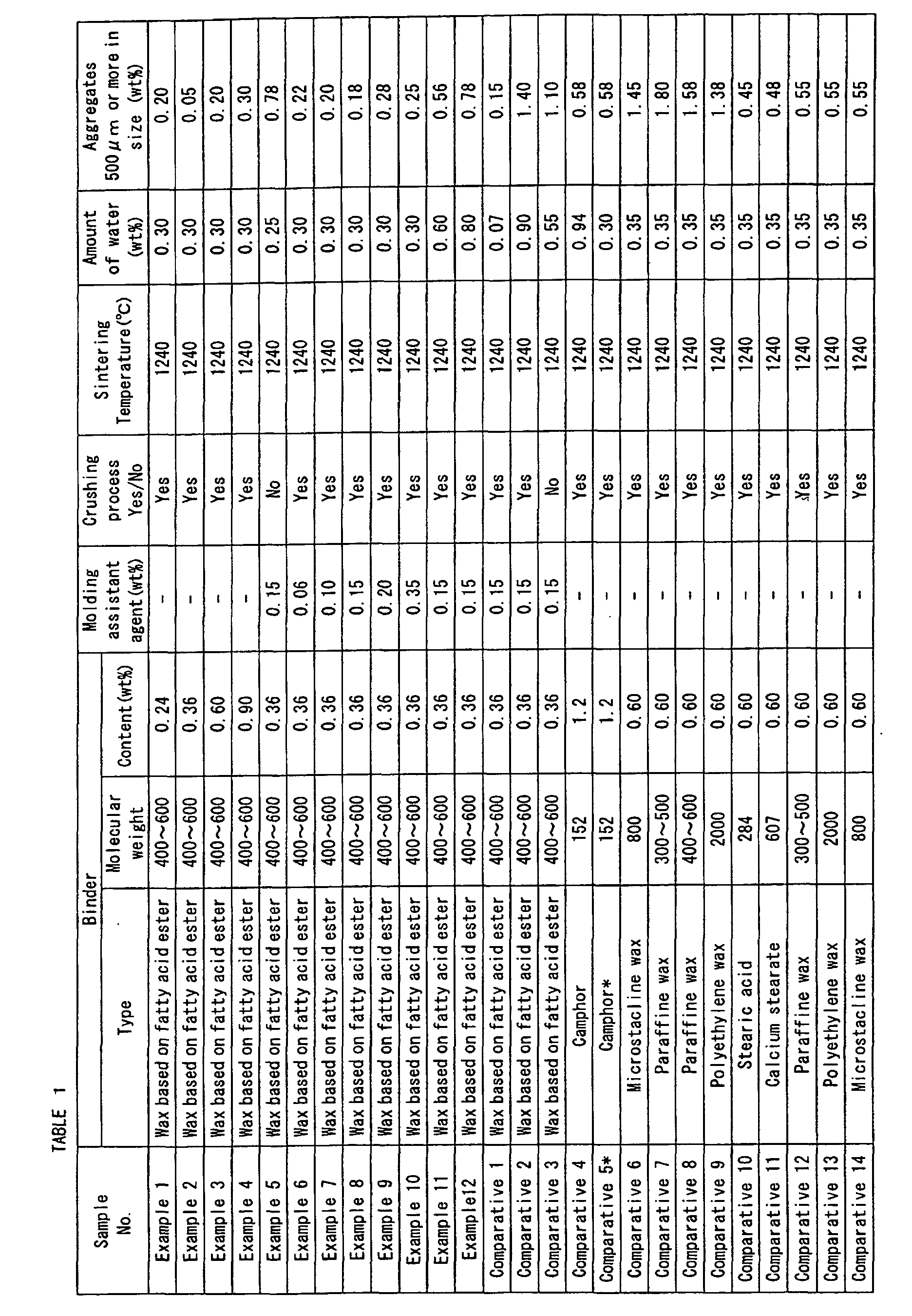

- The sample for comparative example 5 is a sample which an attempt was made to mold after the binder had been added and the raw material left standing for one week.
- The results of comparative example 4 are favorable, however, they turn to the unfavorable results as shown in comparative example 5* unless molding is conducted immediately after mixing of a binder. Therefore, the sample for comparative example 4 offers poor secular stability after mixing of a binder and is extremely inconvenient to handle.
- The effect of the present invention is obvious from the above results. That is, the present invention is a method for manufacturing a permanent magnet based on oxide magnetic material comprising a binder addition process, in which a binder is added to raw material powder containing oxide magnetic materials for mixing, a water content adjustment process in which the water content of the molding mixture containing the raw material powder and the binder is adjusted, an in-magnetic-field dry molding process in which the molding mixture with adjusted water content is introduced into a mold and pressed in a magnetic field applied while aligning the directions of easy magnetization of oxide magnetic material powder particles and a sintering process in which the molded body is sintered, in which fatty acid ester based wax is used as binder in the binder addition process and in which molding mixture loaded into a mold in the in-magnetic-field dry molding process is prepared such that a percentage of existence of aggregates in size of 500µm or more in the molding mixture is 0.01 to 0.80wt%, thus providing oxide magnetic material based permanent magnets with excellent magnetic properties while cutting down on costs.
- The present invention can be used to manufacture a permanent magnet based on oxide magnetic material.
Claims (8)
- A method for manufacturing a permanent magnet based on oxide magnetic material, comprising:wherein the molding mixture charged into the mold in the in-magnetic-field dry molding step contains aggregates, in which the percentage of existence of aggregates in size of 500µm or more is 0.01 to 0.80wt%.a binder addition step for adding a binder to raw material powder containing oxide magnetic materials for mixing;a water content adjustment step for adjusting a water content of a molding mixture containing the raw material powder and the binder;an in-magnetic-field dry molding step for loading the molding mixture with adjusted water content into a mold and pressing it in a magnetic field applied while aligning the directions of easy magnetization of oxide magnetic material powder particles: anda sintering step for sintering the molded body; wherein the binder in the binder addition step is a wax based on fatty acid ester, and
- The method for manufacturing a permanent magnet based on oxide magnetic material as defined in claim 1, wherein the water content of the mixture in the water content adjustment step is 0.20 to 0.80wt%.
- The method for manufacturing a permanent magnet based on oxide magnetic material as defined in claim 1, wherein the wax based on the fatty acid ester is a vegetable wax.
- The method for manufacturing a permanent magnet based on oxide magnetic material as defined in claim 1, wherein the raw material powder of the oxide magnetic materials is prepared by compounding and mixing raw oxide materials, and then calcining the raw oxide materials and thereafter crushing them.
- The method for manufacturing a permanent magnet based on oxide magnetic material as defined in claim 1, wherein the water content adjustment step includes adjusting the water content of the mixture while controlling the humidity.
- The method for manufacturing a permanent magnet based on oxide magnetic material as defined in claim 1, wherein the binder content of the molding mixture is 0.2 to 1.5wt%.
- The method for manufacturing a permanent magnet based on oxide magnetic material defined in claim 1, further comprising a crushing step which follows the water content adjustment step, for crushing aggregates in the molding mixture.
- The method for manufacturing a permanent magnet based on oxide magnetic material as defined in claim 7, wherein the water content of the mixture is 0.20 to 0.80wt% at the completion of the crushing step.
Applications Claiming Priority (5)
| Application Number | Priority Date | Filing Date | Title |
|---|---|---|---|
| JP2001325836 | 2001-10-24 | ||
| JP2001325836 | 2001-10-24 | ||
| JP2002263575A JP3632020B2 (en) | 2001-10-24 | 2002-09-10 | Method for producing oxide magnetic material based permanent magnet |
| JP2002263575 | 2002-09-10 | ||
| PCT/JP2002/010530 WO2003036662A1 (en) | 2001-10-24 | 2002-10-10 | Method for producing oxide magnetic material based permanent magnet |
Publications (1)
| Publication Number | Publication Date |
|---|---|
| EP1439549A1 true EP1439549A1 (en) | 2004-07-21 |
Family
ID=26624065
Family Applications (1)
| Application Number | Title | Priority Date | Filing Date |
|---|---|---|---|
| EP02802007A Withdrawn EP1439549A1 (en) | 2001-10-24 | 2002-10-10 | Method for producing oxide magnetic material based permanent magnet |
Country Status (6)
| Country | Link |
|---|---|
| US (1) | US20040046152A1 (en) |
| EP (1) | EP1439549A1 (en) |
| JP (1) | JP3632020B2 (en) |
| KR (1) | KR100507027B1 (en) |
| CN (1) | CN1215493C (en) |
| WO (1) | WO2003036662A1 (en) |
Families Citing this family (2)
| Publication number | Priority date | Publication date | Assignee | Title |
|---|---|---|---|---|
| CN110483072B (en) * | 2019-08-07 | 2022-04-22 | 海安南京大学高新技术研究院 | Permanent magnetic ferrite and method for forming biomass binder for permanent magnetic ferrite |
| CN110715836A (en) * | 2019-10-09 | 2020-01-21 | 国合通用测试评价认证股份公司 | Preparation method of magnetic material detection sample |
Family Cites Families (10)
| Publication number | Priority date | Publication date | Assignee | Title |
|---|---|---|---|---|
| US3442668A (en) * | 1965-08-16 | 1969-05-06 | Gen Motors Corp | Method of manufacturing ceramics |
| US3564654A (en) * | 1968-03-19 | 1971-02-23 | Magnetfab Bonn Gmbh | Automatic pressing tool for anisotropic permanent magnets |
| US4297250A (en) * | 1980-01-07 | 1981-10-27 | Westinghouse Electric Corp. | Method of producing homogeneous ZnO non-linear powder compositions |
| US4649003A (en) * | 1983-01-24 | 1987-03-10 | Sumitomo Chemical Company, Limited | Method for producing an inorganic sintered body |
| JPS60144905A (en) * | 1984-01-06 | 1985-07-31 | Nippon Kouatsu Electric Co | Molded composition of ferrite |
| US4702986A (en) * | 1984-08-30 | 1987-10-27 | Canon Kabushiki Kaisha | Electrophotographic method uses toner of polyalkylene and non-magnetic inorganic fine powder |
| US5648015A (en) * | 1995-01-26 | 1997-07-15 | Ferronics Incorporated | Process for preparing a ferromagnetic material |
| CN1122287C (en) * | 1995-06-26 | 2003-09-24 | 住友特殊金属株式会社 | Process for producing sintered earth magnet |
| JP2999968B2 (en) * | 1996-03-21 | 2000-01-17 | ティーディーケイ株式会社 | Oxide permanent magnet and method of manufacturing the same |
| JP3846835B2 (en) * | 1998-10-14 | 2006-11-15 | 株式会社Neomax | R-T-B sintered permanent magnet |
-
2002
- 2002-09-10 JP JP2002263575A patent/JP3632020B2/en not_active Expired - Fee Related
- 2002-10-10 EP EP02802007A patent/EP1439549A1/en not_active Withdrawn
- 2002-10-10 US US10/451,407 patent/US20040046152A1/en not_active Abandoned
- 2002-10-10 WO PCT/JP2002/010530 patent/WO2003036662A1/en not_active Ceased
- 2002-10-10 CN CNB028032799A patent/CN1215493C/en not_active Expired - Fee Related
- 2002-10-10 KR KR10-2002-7017169A patent/KR100507027B1/en not_active Expired - Fee Related
Non-Patent Citations (1)
| Title |
|---|
| See references of WO03036662A1 * |
Also Published As
| Publication number | Publication date |
|---|---|
| KR100507027B1 (en) | 2005-08-08 |
| WO2003036662A1 (en) | 2003-05-01 |
| CN1215493C (en) | 2005-08-17 |
| US20040046152A1 (en) | 2004-03-11 |
| JP3632020B2 (en) | 2005-03-23 |
| CN1479928A (en) | 2004-03-03 |
| JP2003203809A (en) | 2003-07-18 |
| KR20030055180A (en) | 2003-07-02 |
Similar Documents
| Publication | Publication Date | Title |
|---|---|---|
| KR101613649B1 (en) | Ferrite magnetic material, ferrite magnet, ferrite sintered magnet | |
| CN106977191B (en) | Ferrite sintered magnet | |
| EP2453449A1 (en) | Ferrite magnetic material | |
| JP5510345B2 (en) | Ferrite sintered magnet manufacturing method, magnetic powder, kneaded product and molded body | |
| KR101913024B1 (en) | Ferrite sintered magnet | |
| JPH10149910A (en) | Ferrite magnet and its manufacturing method | |
| US6419847B1 (en) | Ferrite magnet powder and magnet using said magnet powder, and method for preparing them | |
| JP7087465B2 (en) | A method for manufacturing a ferrite sintered magnet, a method for manufacturing ferrite particles, and a method for manufacturing a bonded magnet. | |
| CN113470912A (en) | Ferrite sintered magnet and rotating electrical machine | |
| JP4674370B2 (en) | Ferrite magnetic powder for bonded magnets | |
| JP3506174B2 (en) | Method for producing ferrite magnet and powder thereof | |
| US20040046152A1 (en) | Method for producing oxide magnetic material based on permanent magnet | |
| JP4301539B2 (en) | Manufacturing method of dry-formed sintered magnet | |
| KR20020026346A (en) | Method for making m-type hexaferrite powders or wafers | |
| KR100656962B1 (en) | Process for producing oxide magnetic material based permanent magnet | |
| JP3644548B2 (en) | High permeability Mn-Zn ferrite | |
| JP2005072079A (en) | Method of manufacturing oxide magnetic material-based permanent magnet | |
| JP2005072026A (en) | Method of manufacturing oxide magnetic material-based permanent magnet | |
| CN113470913A (en) | Ferrite sintered magnet and rotating electrical machine | |
| CN118830036B (en) | Granulated powder for MnZn ferrite and method for producing the same, and MnZn ferrite and method for producing the same | |
| CN113436822A (en) | Ferrite sintered magnet | |
| JP7773329B2 (en) | Hexagonal ferrite magnetic powder for bonded magnets and its manufacturing method, and bonded magnets and its manufacturing method | |
| JP5218716B2 (en) | Ferrite magnetic material | |
| JPH07142228A (en) | Ferrite resin | |
| JPH09312211A (en) | Oxide permanent magnet and manufacture thereof |
Legal Events
| Date | Code | Title | Description |
|---|---|---|---|
| PUAI | Public reference made under article 153(3) epc to a published international application that has entered the european phase |
Free format text: ORIGINAL CODE: 0009012 |
|
| 17P | Request for examination filed |
Effective date: 20030918 |
|
| AK | Designated contracting states |
Kind code of ref document: A1 Designated state(s): DE FR GB NL |
|
| STAA | Information on the status of an ep patent application or granted ep patent |
Free format text: STATUS: THE APPLICATION HAS BEEN WITHDRAWN |
|
| 18W | Application withdrawn |
Effective date: 20071206 |