EP1439434A1 - Timepiece external part and method of manufacturing the part - Google Patents
Timepiece external part and method of manufacturing the part Download PDFInfo
- Publication number
- EP1439434A1 EP1439434A1 EP02799365A EP02799365A EP1439434A1 EP 1439434 A1 EP1439434 A1 EP 1439434A1 EP 02799365 A EP02799365 A EP 02799365A EP 02799365 A EP02799365 A EP 02799365A EP 1439434 A1 EP1439434 A1 EP 1439434A1
- Authority
- EP
- European Patent Office
- Prior art keywords
- wristwatch
- decorative article
- brazing filler
- filler metal
- wristwatch case
- Prior art date
- Legal status (The legal status is an assumption and is not a legal conclusion. Google has not performed a legal analysis and makes no representation as to the accuracy of the status listed.)
- Granted
Links
Images




Classifications
-
- G—PHYSICS
- G04—HOROLOGY
- G04B—MECHANICALLY-DRIVEN CLOCKS OR WATCHES; MECHANICAL PARTS OF CLOCKS OR WATCHES IN GENERAL; TIME PIECES USING THE POSITION OF THE SUN, MOON OR STARS
- G04B37/00—Cases
- G04B37/14—Suspending devices, supports or stands for time-pieces insofar as they form part of the case
- G04B37/1486—Arrangements for fixing to a bracelet
-
- G—PHYSICS
- G04—HOROLOGY
- G04B—MECHANICALLY-DRIVEN CLOCKS OR WATCHES; MECHANICAL PARTS OF CLOCKS OR WATCHES IN GENERAL; TIME PIECES USING THE POSITION OF THE SUN, MOON OR STARS
- G04B37/00—Cases
- G04B37/08—Hermetic sealing of openings, joints, passages or slits
- G04B37/081—Complete encasings for wrist or pocket watches also comprising means for hermetic sealing of the winding stem and crown
- G04B37/082—Complete encasings for wrist or pocket watches also comprising means for hermetic sealing of the winding stem and crown without special hermetic sealing pieces
-
- G—PHYSICS
- G04—HOROLOGY
- G04B—MECHANICALLY-DRIVEN CLOCKS OR WATCHES; MECHANICAL PARTS OF CLOCKS OR WATCHES IN GENERAL; TIME PIECES USING THE POSITION OF THE SUN, MOON OR STARS
- G04B37/00—Cases
- G04B37/22—Materials or processes of manufacturing pocket watch or wrist watch cases
Definitions
- This invention relates to a decorative article of a wristwatch, made of a metal such as titanium, titanium alloy, stainless steel, and so forth, that is sturdy in construction, and is excellent in corrosion resistance as well as waterproof, having design variation in abundance, and also to a method of manufacturing the same.
- titanium includes pure titanium, and titanium alloy
- stainless steel as the constituent material thereof.
- titanium includes pure titanium, and titanium alloy
- a share of titanium for use in the wristwatch parts has lately increased because of its sturdiness, excellent corrosion resistance, light weight, and good biocompatibility causing no allergic reaction to metal to occur to a human body.
- titanium has been in widespread use not only for wristwatches but also in various industrial sectors in order to utilize its excellent characteristics such as light weight, high strength, and excellent corrosion resistance.
- a pure titanium crystal is hexagonal close-packed structure at room temperature, but turns into a body-centered cobic structure at a temperature not lower than 882°C, that is, the transformation point thereof (temperature at which transformation occurs). Accordingly, if this temperature (that is, 882°C) is exceeded in the process of manufacturing a wristwatch part, a surface condition of the wristwatch part undergoes a change following transformation of its crystals, so that re-polishing and so forth needs to be performed. Because of a risk of an increase in the number of process steps to that extent, it is regarded desirable to treat titanium at a temperature not higher than the transformation point thereof.
- stainless steel is moderately weighty, and excellent in corrosion resistance, it is most widely used as the constituent material of ° wristwatch parts.
- Various kinds of stainless steels are available, but as the constituent material of the wristwatch parts, much use is being made of an austenitic stainless steel such as SUS 304, SUS 316L, and so forth from the viewpoint of corrosion resistance.
- a conventional wristwatch case as a wristwatch part is generally manufactured by forming a wristwatch case body integrally with an end-piece (the end-piece is a part for linking a watch band with the wristwatch case body).
- the end-piece is a part for linking a watch band with the wristwatch case body.
- it is difficult to manufacture parts of a complex design by a forging method in comparison with a case of using a casting method, however, it has lately become a general practice to manufacture the wristwatch parts by the forging method such as hot forging, cold forging, and so forth.
- the wristwatch parts there has lately increased a demand from a design point of view for providing diverse variation in surface finishing thereof by applying surface processing such as mirror finishing, hair-line finishing, honing, and so forth on a portion-by-portion basis.
- the mirror finishing means shining mirror finish by polishing
- the hair-line finishing means surface finishing with minute hair-line-like directional lines.
- the honing means surface finishing with fine asperities, avoiding use of plating, and is also called mat.
- the wristwatch parts there is also a demand for exhibiting diverse variation such as color variation, pattern variation, and so forth by applying a film-depositing process such as plating, IP (ion plating), or coating besides applying the surface processing.
- the wristwatch parts each are small in whole size, so that, for example, in the case of a wristwatch case, if the wristwatch case is manufactured by integrating an end-piece with a wristwatch case body at the outset, it will become extremely difficult to finish up the surface thereof beautifully (by exhibiting variation in surface finishing) by applying thereafter the surface processing and film-depositing process, varying by portions.
- an end-piece of a wristwatch case is desired to exhibit a design feature by forming the end-piece in a complex shape, and in such a case as well, if the wristwatch case is manufactured by integrating the end-piece with the wristwatch case body at the outset, it will become difficult to work on the end-piece later.
- the wristwatch case body and the end-piece are separately formed, and processing as desired is applied thereto, respectively, to be thereby integrated with each other by engaging one with the other or connecting together.
- processing as desired can be applied to respective parts of the wristwatch case, so that the wristwatch case is provided with design variation in abundance.
- brazing has a problem of brazing filler metal flow, however, with this method, surface finishing even after connecting the wristwatch case body with the end-piece can be relatively excellent.
- brazing has a shortcoming in respect of corrosion resistance at connection portions.
- titanium as the constituent material of the wristwatch case body and the end-piece
- silver solder for example, JIS: BAg - 8, and so forth
- the silver solder has very poor corrosion resistance, there is the risk of discoloration, rust, etc. occurring to connected parts with the passage of long time after connection, thereby considerably impairing visual quality of the wristwatch case.
- respective parts can be also connected with each other by welding besides brazing. If connected by welding, however, burn-like marks are left out, thereby impairing visual decorativeness.
- projection welding is available for melting minute juts called projections, but the applicable parts are limited because parts to be welded undergo, for example, a change in size (shape) upon welding, thereby imposing restriction on the wristwatch parts from a design point of view.
- the invention has been developed in order to resolve such problems as described, encountered by the conventional wristwatch parts, and it is an aspect of the invention to provide a decorative article of a wristwatch, made up of two or more parts such as a wristwatch case made up of a wristwatch case body and an end-piece, and a method of manufacturing the same, wherein there are provided not only sturdiness sufficient to be able to maintain a condition of engagement or connection of the respective parts with each other for long duration but also corrosion resistance as well as waterproof while keeping visual decorativeness in excellent state, and having design variation in abundance.
- a decorative article of a wristwatch having a construction in which a first part is fixedly attached to a second part, wherein a solid phase diffusion joining portion and a brazed connection portion are formed in a portion where the second part is in intimate contact with the first part.
- a decorative article of a wristwatch having a construction in which a first part is fixedly attached to a second part, wherein a hole portion corresponding to the second part is formed in the first part, and a solid phase diffusion joining portion and a brazed connection portion are formed in a portion where the second part is fitted into, and is in intimate contact with the hole portion.
- the second part has a small diameter portion while the hole portion has a small diameter portion corresponding to the small diameter portion of the second part, and the solid phase diffusion joining portion is formed in a portion where the small diameter portion of the second part is in intimate contact with the small diameter portion of the hole portion, the brazed connection portion being formed in a portion other than the portion where the small diameter portion of the second part is in intimate contact with the small diameter portion of the hole portion.
- a decorative article of a wristwatch having a construction in which a first part is fixedly attached to a second part, wherein a recess is formed in the first part while a protrusion corresponding to the recess is formed in the second part, and a solid phase diffusion joining portion and a brazed connection portion are formed in a portion where the protrusion is fitted into, and is in intimate contact with the recess.
- a third part in intimate contact with the recess and the protrusion is preferably provided, and the solid phase diffusion joining portion is preferably formed in portions where the third part is in intimate contact with the recess and the protrusion, respectively, while the brazed connection portion is preferably formed in a portion where the protrusion is in intimate contact with the recess.
- a metal film is deposited on respective surfaces of the protrusion, and the protrusion is in intimate contact with the recess through the intermediary of the respective metal films.
- the constituent material of the first part and the second part is preferably either stainless steel or titanium.
- first part is a wristwatch case body and the second part is a crown pipe
- first part is a wristwatch case body and the second part is an end-piece
- brazed connection portion is preferably formed with a low-melting brazing filler metal.
- the brazed connection portion is formed with a brazing filler metal mainly containing palladium, platinum, nickel, and phosphorus, or a brazing filler metal mainly containing palladium, copper, nickel, and phosphorus.
- the brazed connection portion may be formed with a brazing filler metal mainly containing gold, silver, copper, germanium, and palladium.
- the brazed connection portion may be formed with a brazing filler metal mainly containing gold, silver, copper, palladium, and nickel, and also containing at least one of gallium, indium, and tin.
- the invention further provides a method of manufacturing a decorative article of a wristwatch by fixedly attaching a first part to a second part, comprising a step of feeding a brazing filler metal on the second part, and a step of forming a solid phase diffusion joining portion and a brazed connection portion in a portion where the second part is in intimate contact with the first part.
- the invention provides a method of manufacturing a decorative article of a wristwatch by fixedly attaching a first part to a second part, comprising a step of feeding a brazing filler metal on the second part, a press-contact step of pressing the first part into contact with portions of the second part other than a portion, with the brazing filler metal fed thereon, a face-to-face contact step of bringing the portion of the second part with the brazing filler metal fed thereon, into face-to-face contact with the first part, and an annealing step of heating the first part and second part after the press-contact step and the face-to-face contact step.
- the invention provides a method of manufacturing a decorative article of a wristwatch by fixedly attaching a first part to a second part, comprising, a step of feeding a brazing filler metal on the second part; a press-contact step of pressing a third part into contact with a portion of the second part other than a portion thereof, with the brazing filler metal fed thereon and with the first part, a face-to-face contact step of bringing the portion of the second part with the brazing filler metal fed thereon, into face-to-face contact with the first part, and an annealing step of heating the first part, second part, and third part after the press-contact step and the face-to-face contact step.
- the press-contact step may be executed by press-fitting the second part into the first part. Further, the press-contact step may also be executed by press-fitting the third part into the first part and second part.
- the step of feeding the brazing filler metal is preferably executed by feeding the brazing filler metal in a paste state by use of a dispenser.
- a temperature for heating in the annealing step is preferably in a range of about 600°C to 850°C.
- a temperature for heating in the annealing step is preferably in a range of about 600°C to 900°C.
- a step of depositing a metal film on portions of the second part other than the portion thereof on which the brazing filler metal is to be fed may be provided prior to the step of feeding the brazing filler metal on the second part.
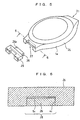
- a wristwatch case 11 shown in Fig. 1 is described.
- the wristwatch case 11 is a decorative article of a wristwatch, and is manufactured by fixedly attaching a wristwatch case body 1 as a first part to a crown pipe 3 as a second part.
- the wristwatch case 11 is characterized in that two connection portions, that is, a solid phase diffusion joining portion 4a and a brazed connection portion 5a, as described later in the description, are formed at an intimate contact portion 7 where the crown pipe 3 is in intimate contact with the wristwatch case body 1.
- Fig. 1 is a perspective view of the wristwatch case 11 showing the wristwatch case body 1 and the crown pipe 3, as exploded.
- Fig. 2 is a sectional view of the portion 7 formed by bringing the crown pipe 3 into intimate contact with the wristwatch case body 1, taken on line 2 - 2 of Fig. 1.
- Fig. 9 is a sectional view showing a section taken on line 2 - 2 of Fig. 1, which is partly omitted.
- the wristwatch case body 1 has a housing space for housing a movement, a dial, and so forth, inside a sidewall portion 1a thereof, and a stem hole 2 is formed in the sidewall portion 1a.
- the stem hole 2 is bored in a shape corresponding to the crown pipe 3, and is formed so as to link the housing space of the wristwatch case body 1 with outside.
- the stem hole 2 has a small diameter portion 2a on the inner side thereof and a larger diameter portion 2b on the outer side thereof, with an annular butting surface 2c provided therebetween.
- the small diameter portion 2a, larger diameter portion 2b, and butting surface 2c compose a hole portion corresponding to the outer shape of the crown pipe 3.
- the crown pipe 3 is a cylindrical part for use in attaching a crown (not shown) to the wristwatch case body 1 in order to ensure waterproof, and has a small diameter portion 3a and a larger diameter portion 3b, an annular butting surface 3c being provided between the small diameter portion 3a and the larger diameter portion 3b.
- the small diameter portion 3a is formed in a shape corresponding to the small diameter portion 2a of the stem hole 2, but is slightly larger in diameter than the small diameter portion 2a.
- the wristwatch case 11 is manufactured by feeding a suitable amount of low-melting brazing filler metal paste on the butting surface 3c of the crown pipe 3 beforehand, and pushing the crown pipe 3 into the stem hole 2 with a strong force applied from outside. That is, the wristwatch case 11 is manufactured by press-fitting the crown pipe 3 into the winding stem hole 2. Thereupon, the periphery of the small diameter portion 3a comes into face-to-face contact (is pressed into contact) with the inner circumferential surface of the small diameter portion 2a with stress acting on the contact portion while the butting surface 3c and the butting surface 2c face each other, thereby forming the intimate contact portion 7.
- the brazing filler metal fed on the butting surface 3c is spread evenly to a degree in a gap between the butting surface 3c of the crown pipe 3 and the butting surface 2c (partly in a gap between the larger diameter portion 3b and the larger diameter portion 2b). Then, in that state, the wristwatch case 11 and the crown pipe 3 are placed in a vacuum apparatus (not shown), and an annealing process for heating them in a vacuum atmosphere is applied. Whereupon solid phase diffusion joining and brazing concurrently proceed, so that the wristwatch case body 1 and the crown pipe 3 are fixedly attached to each other to be thereby integrated.
- the solid phase diffusion joining portion 4a is formed at a face-to-face contact portion between the small diameter portion 2a and the small diameter portion 3a.
- the solid phase diffusion connection means connection of objects that occurs at a temperature not higher than a melting point thereof by butting the objects for the connection against each other and applying pressure and heat to a degree hardly causing plastic deformation so as to be able to utilize diffusion of atoms occurring between connection surfaces.
- the small diameter portion 2a is in face-to-face contact with the small diameter portion 3a and at an interface therebetween, there occurs micro-diffusion of the constituent material (for example, titanium) of the respective portions, on an atomic level, causing internal diffusion of oxygen of an oxide film existing at the outset to thereby form a solid solution.
- the constituent material for example, titanium
- the interface will no longer permit even steam to pass therethrough.
- the brazed connection portion 5a is formed by the low-melting brazing filler metal in the paste state, fed on the butting surface 3c, being spread in a gap between the crown pipe 3 and the stem hole 2 upon press-fitting the winding crown pipe 3 into the latter.
- the low-melting brazing filler metal melts in an annealing process for heating the wristwatch case body 1 and the crown pipe 3, and is spread so as to fill up microscopic gaps between the butting surfaces 2c and 3c in a face-to-face contact portion due to capillarity (partly spread also in a gap between the larger diameter portion 2b and the larger diameter portion 3b).
- the brazed connection portion 5a is formed in such a way as to surround the solid phase diffusion joining portion 4a.
- the low-melting brazing filler metal means a brazing filler metal which melting point is lower than the transformation point or crystallization temperature of the constituent material of parts to be brazed, having no effect on a finished condition of the surfaces of the parts to be brazed even after connection thereof by brazing.
- the crown pipe 3 is fixedly attached to the wristwatch case body 1 by providing the solid phase diffusion joining portion 4a, internal waterproof of the wristwatch case 11, including hermeticity thereof, is maintained in an excellent condition with a fairly high probability.
- portions to be connected (the small diameter portions 2a and 3a) need be in intimate contact with each other with no gap in-between.
- the small diameter portions 2a and 3a have poor surface accuracy for some reason, so that both the portions are not exactly circular in cross section, or the inner circumferential surface of the small diameter portion 2a is not smooth due to adhesion and so forth occurring when forming the stem hole 2 by boring with a drill.
- the brazed connection portion 5a is formed on the outer side of the wristwatch case 11 in such a way as to surround the solid phase diffusion joining portion 4a.
- the wristwatch case 11 obtains sturdiness and perfect waterproof by implementing connection with no gap in-between by use of the brazing filler metal applied on the outer side thereof.
- a wristwatch case 11 was manufactured by fixedly attaching a wristwatch case body 1 made of pure titanium to a crown pipe 3 made of a titanium alloy (Ti - 6A1 - 4V).
- a stem hole 2 of the wristwatch case body 1 has a small diameter portion 2a of about 1.80 mm ⁇ in the bore, and the crown pipe 3 had a small diameter portion 3a of 1.83 mm ⁇ in outside diameter.
- the outside diameter of the small diameter portion 3a was rendered slightly larger than the bore of the small diameter portion 2a so as to enable the crown pipe 3 to be press-fitted into the stem hole 2.
- a Pd-Pt-Ni-P base brazing filler metal in a paste state, mainly containing palladium, platinum, nickel, and phosphorus with a composition ratio of Pd : Pt : Ni : P at 34 : 53 : 8 : 5 (wt. %).
- the brazing filler metal is a low-melting brazing filler metal which melting point is lower than the transformation point of the constituent material (with this example, titanium) of the wristwatch case body 1 and the crown pipe 3, the melting point thereof being at about 699°C.
- the brazing filler metal may not be in a paste state, however, use of the brazing filler metal in the paste state is preferable because it is easier to handle if the same is in the paste state.
- the brazing filler metal was fed on a butting surface 2c of the stem hole 2 or a butting surface 3c of the crown pipe 3 by dropping about 2 ⁇ liter thereof, using a dispenser.
- the wristwatch case body 1, together with the crown pipe 3, was housed in a vacuum apparatus (not shown).
- a pressure inside the vacuum apparatus was maintained at around 5 ⁇ 10 -6 Torr (about 6.7 ⁇ 10 -4 Pa) to produce a vacuum atmosphere, and then annealing was applied in the apparatus.
- a temperature (annealing temperature) applied at the annealing was set at about 750°C, and time for applying the annealing (annealing time) was set to on the order of one hour.
- two connection portions that is, a solid phase diffusion joining portion 4a and a brazed connection portion 5a were formed, whereupon the crown pipe 3 was fixedly attached to the wristwatch case body 1.
- the press-fit allowance and annealing temperature vary depending on the constituent material and size of the wristwatch case 11 and the crown pipe 3, so that both the press-fit allowance and annealing temperature are adjusted so as to enable the solid phase diffusion joining portion 4a to be formed.
- the annealing temperature is preferably in a range of about 600°C to 850°C.
- the annealing temperature lower than 600°C is undesirable because there is a risk that the brazing filler metal used in brazing does not melt sufficiently and fails to fill up the gaps completely. Also, in that case, there is a possibility that sufficient diffusion does not occur at the solid phase diffusion joining portion 4a, and microscopic cavities are left out at the interface thereof, resulting in insufficient strength.
- the annealing temperature in excess of 850°C is undesirable either because, in that case, the annealing temperature is close to the transformation point of titanium, so that the surface condition of a wristwatch case may a change.
- the wristwatch case 11 manufactured according to Working Example 1 is referred to as a test piece C.
- a wristwatch case body 1 was connected to a crown pipe 3 with a brazing filler metal different from the brazing filler metal used for Working Example 1.
- a brazing filler metal different from the brazing filler metal used for Working Example 1.
- This brazing filler metal as well is a low-melting brazing filler metal which melting point is lower than the transformation point of the constituent material (titanium) of the wristwatch case body 1 and the crown pipe 3, the melting point thereof being at about 604°C.
- an annealing temperature was changed to about 700°C, and an annealing time was set to on the order of one hour. Otherwise, conditions for an annealing process were the same as those for Working Example 1.
- a wristwatch case 11 manufactured according to Working Example 2 is referred to as a test piece D.
- a wristwatch case according to a comparative example was manufactured in accordance with a conventional procedure.
- this comparative example use was made of a wristwatch case body and a crown pipe, which constituent materials were the same as those for Working Examples 1 and 2, but differed in dimensions, and brazing with silver solder using silver solder paste (JIS: BAg - 8, melting point at 780°C) was applied thereto, thereby connecting the crown pipe to the wristwatch case body.
- a brazing temperature was set to about 820°C, and the brazing was applied while the wristwatch case body and the crown pipe were placed in a vacuum furnace for about 10 minutes.
- a wristwatch case manufactured according to Comparative Example 1 is referred to as a test piece A.
- test piece was immersed in a CASS test solution for 48 hours, and if no corrosion occurred thereto, the same was evaluated as acceptable (based on ISO 3770).
- test piece As to “waterproof capability”, evaluation on the test piece was made by conducting a waterproof test at 10 atm in a waterproof test apparatus and conducting a moisture resistancy test by setting relative humidity to 90% at a temperature about 40°C.
- connection strength the highest strength (connection strength) at which a connection condition can be maintained.
- test pieces A to D according to Comparative Examples 1, 2, and Working Examples 1, 2, respectively, were relatively evaluated in respect of the four items for the evaluation, and results of such evaluation were marked by symbols ⁇ , ⁇ , ⁇ , respectively, in decreasing order of excellence as shown in Table 1.
- test piece B With reference to the test piece B according to Comparative Example 2, wherein connection was implemented by the projection welding, it was found that the test piece B was low in "waterproof capability" and poor waterproof slightly occurred. Furthermore, since the outside diameter of the crown pipe thereof is large, outward decorativeness was found undesirable.
- the wristwatch case 11 has sturdiness capable of maintaining the connection condition thereof over a long term as well as excellent waterproof because the respective parts are strongly connected with each other. Further, because connection is implemented by use of the low-melting brazing filler metal, the wristwatch case 11 has excellent corrosion resistance and is excellent in outward decorativeness. Still further, since the wristwatch case 11 can be manufactured by preparing the wristwatch case body 1 and the crown pipe 3 individually, applying the surface processing and film-depositing process to each part, as desired, and subsequently, fixedly attaching both the parts with each other, so that an abundance of design variation can be provided.
- a wristwatch case 21 shown in Fig. 3 is described.
- the wristwatch case 21 is manufactured by fixedly attaching a wristwatch case body 14 as a first part to an end-piece 15 as a second part through the intermediary of a metal pipe 16 as a third part.
- the end-piece 15 is brought into intimate contact with the wristwatch case body 14 through the intermediary of the metal pipe 16 to thereby form a portion 17 where two connection portions, that is, a solid phase diffusion joining portion 4b and a brazed connection portion 5b are formed.
- Fig. 3 is a perspective view of the wristwatch case 21 showing the wristwatch case body 14, the end-piece 15, and the metal pipe 16, as exploded.
- Fig. 4 is a sectional view of the portion 17 formed by bringing the end-piece 15 into intimate contact with the wristwatch case body 14 through the intermediary of the metal pipe 16, taken on line 4 - 4 of Fig. 3, and Fig. 10 is a sectional view showing a section taken on line 4 - 4 of Fig. 3, which is partly omitted.
- the wristwatch case body 14 is the same in construction as the wristwatch case body 1 except that a cut-out recess 10 is formed in the wristwatch case body 14. In Fig. 3, a stem hole is not shown.
- the cut-out recess 10 is formed opposite to a spot of a sidewall portion 1a of the wristwatch case body 14, where the stem hole is not formed.
- the cut-out recess 10 has a butting surface 10a, and substantially at the center thereof, there is formed a fitting hole 9.
- the fitting hole 9 is bored so as to be oriented in a direction orthogonal to the butting surface 10a, and has a peripheral wall surface 9a and a bottom 9b. That is, the fitting hole 9 is not a through-hole.
- a protrusion 20 is formed on a side thereof, opposite from a band engagement portion 15a.
- the protrusion 20 is formed so as to correspond to the cut-out recess 10, and has a butting surface 20a. And substantially at the center thereof, there is formed a fitting hole 12.
- the fitting hole 12 is bored so as to be oriented in a direction orthogonal to the butting surface 20a, and has a peripheral wall surface 12a and a bottom 12b. That is, the fitting hole 12 is not a through-hole either.
- the fitting hole 9 and the fitting hole 12 are equal to each other in bore and depth, and are formed at respective positions opposing each other when the protrusion 20 is fitted into the cut-out recess 10.
- the metal pipe 16 is a cylindrical member having end faces 16a, 16b, and a peripheral wall surface 16c.
- the metal pipe 16 is formed such that an outside diameter thereof is slightly larger than the bore of the fitting hole 9 as well as the fitting hole 12, and a length thereof is somewhat shorter than the sum of the depth of the fitting hole 9 and that of the fitting hole 12. Accordingly, when the metal pipe 16 is press-fitted into the fitting hole 9 and the fitting hole 12, the peripheral wall surface 16c comes into face-to-face contact (is pressed into contact) with the peripheral wall surfaces 9a, 12a, with stress acting. Further, the metal pipe 16 is disposed such that the end faces 16a, 16b are opposed to the bottoms 9b, 12b, respectively, and is fully housed in both the fitting hole 9 and the fitting hole 12 in such a way as to be extended across both the holes.
- the fitting holes 9 and 12 have the bottoms 9b, 12b, respectively, once the metal pipe 16 is fitted into the fitting hole 9 and the fitting hole 12, the metal pipe 16 is no longer visible from outside. Accordingly, the wristwatch case 21 is excellent in outward decorativeness and is desirable in configuration.
- the solid phase diffusion joining portion 4b is formed at a portion of the portion 17, where the peripheral wall surface 16c of the metal pipe 16 is in face-to-face contact with the peripheral wall surfaces 9a, 12a of the fitting holes 9 and 12.
- a face-to-face contact portion between the peripheral wall surface 16c and the peripheral wall surfaces 9a, 12a undergoes tight and strong connection with no gap in-between.
- a low-melting brazing filler metal fed on the butting surface 20a melts in an annealing process, and is spread so as to fill up microscopic gaps existing at a face-to-face contact portion between the butting surfaces 20a and 10a, thereby connecting the end-piece 15 to the wristwatch case body 14.
- the wristwatch case 21 since the wristwatch case body 14 and the end-piece 15 are strongly connected with each other by virtue of the solid phase diffusion joining portion 4b, the wristwatch case 21 has sturdiness capable of maintaining a connection condition of both the parts over a long term. Further, since the brazed connection portion 5b is formed with the low-melting brazing filler metal, the wristwatch case 21 has excellent corrosion resistance, and even in case that solid phase diffusion connection is not reliably implemented, the wristwatch case 21 has sturdiness capable of maintaining the connection condition over a long term.
- the wristwatch case 21 is manufactured as follows. First, a suitable amount of a low-melting brazing filler metal in a paste state is fed on the butting surface 20a of the protrusion 20. Then, while the metal pipe 16 is being fitted into the fitting hole 9 and the fitting hole 12, the protrusion 20 is fitted into the cut-out recess 10, and the end-piece 15 is pushed into the cut-out recess 10 with a strong force applied from outside, whereupon the metal pipe 16 is press-fitted into the fitting holes 9, 12. Further, the butting surface 20a and the butting surface 10a are opposed to each other.
- the brazing filler metal fed on the butting surface 20a is spread evenly to a degree from a gap formed between the butting surface 20a and the butting surface 10a throughout a gap formed between the cut-out recess 10 and the protrusion 20.
- the wristwatch case body 14, the end-piece 15, and the metal pipe 16 are housed in a hydrogen furnace (not shown), and an annealing process for heating them in a reducing atmosphere is applied, whereupon solid phase diffusion connection and brazing concurrently proceed, so that the wristwatch case body 14 is fixedly attached to the end-piece 15 through the intermediary of the metal pipe 16, thereby integrating these parts with each other.
- a wristwatch case 21 was manufactured by fixedly attaching a wristwatch case body 14 to an end-piece 15, both parts being made of a stainless steel (SUS 316L), through the intermediary of a metal pipe 16 made of a free-cutting stainless steel (SUS 316F).
- the metal pipe 16 was about 4 mm in total length, and the fitting hole 9 and the fitting hole 12 each were 2.1 mm in depth. Accordingly, the sum of the depth of the fitting hole 9 and that of the fitting hole 12 was 4.2 mm. Since the length of the metal pipe 16 is somewhat shorter than the sum of the depths, the metal pipe 16 was completely housed inside the fitting holes 9, 12.
- brazing filler metal in a paste state, mainly containing gold, silver, copper, germanium, and palladium with a composition ratio of Au : Ag : Cu : Ge : Pd at 45.5 : 32 : 5 : 12.5 : 5 (wt. %).
- the brazing filler metal was a low-melting brazing filler metal which melting point is lower than the recrystallization temperature of a constituent material (with this example, stainless steel) of the wristwatch case body 14 and the metal pipe 16, and the melting point thereof is at about 635°C.
- the brazing filler metal was first fed on the butting surface 20a by dropping about 2 ⁇ liter thereof, using a dispenser.
- the metal pipe 16 was being fitted into the fitting hole 9 and the fitting hole 12
- the protrusion 20 was press-fitted into the cut-out recess 10, and subsequently, annealing in a hydrogen atmosphere at a high temperature, which is a reducing atmosphere, was applied to the wristwatch case body 14, the end-piece 15, and the metal pipe 16 in a treatment furnace.
- an annealing temperature was set to about 850°C
- annealing time was set to about 20 minutes.
- the two connection portions namely, a solid phase diffusion joining portion 4b and the brazed connection portion 5b were formed, so that the wristwatch case body 14, the end-piece 15, and the metal pipe 16 were fixedly attached to one another.
- the brazing filler metal melted during heating at about 850°C and is spread so as to fill up microscopic gaps existing at the face-to-face contact portion between the butting surfaces 20a and 10a due to capillarity. Thereafter, upon cooling of the wristwatch case body 14, the end-piece 15, and the metal pipe 16, the butting surface 20a and the butting surface 10a are connected with each other.
- the annealing temperature is preferably in a range of about 600°C to 900°C.
- the annealing temperature lower than 600°C is undesirable because there is a risk that the brazing filler metal does not melt sufficiently and fails to fill up the gaps completely. Also, in that case, there is a possibility that sufficient diffusion does not occur at the solid phase diffusion joining portion 4a, and microscopic cavities are left out at the interface thereof, resulting in insufficient strength.
- the annealing temperature in excess of 900°C is undesirable either because, the annealing temperature approaches the recrystallization temperature of stainless steel, and the structure of stainless steel becomes coarser, so that the surface condition thereof may change.
- a wristwatch case 31 shown in Fig. 5 is described.
- the wristwatch case 31 is manufactured by fixedly attaching a wristwatch case body 24 as a first part and an end-piece 25 as a second part with each other. With the wristwatch case 31, the end-piece 25 is brought into intimate contact with the wristwatch case body 24 to thereby form a portion 28 where solid phase diffusion joining portions 4c and a brazed connection portion 5c are formed.
- Fig. 5 is a perspective view of the wristwatch case 31 showing the wristwatch case body 24 and the end-piece 25, as exploded.
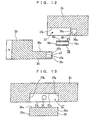
- Fig. 6 is a sectional view of the portion formed by bringing the end-piece 25 into intimate contact with the wristwatch case body 24, taken on line 6 - 6 of Fig. 5, and Fig. 11 is a sectional view showing the wristwatch case body 24 and the end-piece 25 in Fig. 6, as exploded, together with a partly enlarged view of the end-piece 25.
- the wristwatch case body 24 is the same in construction as the wristwatch case body 14 except that no fitting hole is formed in a cut-out recess 27. In Fig. 5 as well, a stem hole is not shown.
- the cut-out recess 27 has a butting surface 27a, and sidewall surfaces 27b, 27b on both sides thereof.
- the end-piece 25 differs therefrom in respect of the shape of a protrusion 26.
- the protrusion 26 is formed so as to be slightly larger in longitudinal dimension than the cut-out recess 27, having a butting surface 26a, and sidewall surfaces 26b, 26b on both sides thereof.
- the sidewall surfaces 26b, 26b each are provided with a metal film 30 deposited thereon. Accordingly, the protrusion 26 is press
- the solid phase diffusion joining portion 4c is formed at each of face-to-face contact portions where the sidewall surfaces 26b, 26b of the protrusion 26 and the sidewall surfaces 27b, 27b of the cut-out recess 27 are in face-to-face contact with each other, respectively, through the intermediary of each of the metal films 30, 30.
- the solid phase diffusion joining portions 4c there exist the sidewall surfaces 26b, 26b in a state of face-to-face contact with, and pressed against the sidewall surfaces 27b, 27b, respectively, through the intermediary of the respective metal films 30 (that is, the sidewall surfaces 26b, 26b are pressed into contact with the sidewall surfaces 27b, 27b, respectively, through the intermediary of the respective metal films 30).
- a low-melting brazing filler metal fed on the butting surface 26a melts in an annealing process, and is spread so as to fill up microscopic gaps existing at a face-to-face contact portion between the butting surfaces 26a and 27a, thereby connecting the end-piece 25 to the wristwatch case body 24.
- the wristwatch case 31 since the wristwatch case body 24 and the end-piece 25 are strongly connected with each other by virtue of the solid phase diffusion joining portion 4c, the wristwatch case 31 has sturdiness capable of maintaining a connection condition of both the parts over a long term. Further, since the brazed connection portion 5c is formed with the low-melting brazing filler metal, the wristwatch case 31 has excellent corrosion resistance, and also has sturdiness capable of maintaining the connection condition over a long term even in case that solid phase diffusion connection is not reliably implemented. Furthermore, since both the solid phase diffusion joining portions 4c and the brazed connection portion 5c are not visible from outside, the wristwatch case 31 is excellent in outward decorativeness.
- the solid phase diffusion joining portions 4c are formed through the intermediary of the metal films 30, solid phase diffusion characteristics at low temperature are improved as compared with a case where the sidewall surfaces 26b, 26b are directly in face-to-face contact with the sidewall surfaces 27b, 27b, so that it is possible to lessen pores at respective interfaces between both the sidewall surfaces.
- the protrusion 26 and the wristwatch case body 24 are made of titanium, and the metal films 30 are deposited of copper, or the case where the protrusion 26 and the wristwatch case body 24 are made of stainless steel and the metal films 30 are deposited of palladium, solid phase diffusion characteristics at low temperature are improved as compared with a case where the metal films 30 are not deposited.
- the metal films 30 are deposited of a relatively soft metal (Pt, Cu, Au, etc.), plastic deformation occurs upon press-fitting of the protrusion 26, and consequently, stress that can occur at the interfaces is mitigated so as to be substantially evened out throughout the interfaces. Accordingly, microscopic gaps due to difference in roundness, and so forth, are filled up, thereby rendering connection easier.
- a relatively soft metal Pt, Cu, Au, etc.
- the wristwatch case 31 is manufactured as follows. First, the metal film 30 is deposited on the surfaces of the sidewall surfaces 26b, 26b of the protrusion 26. Next, a suitable amount of the low-melting brazing filler metal in a paste state is fed on the butting surface 26a. Then, the protrusion 26 is fitted in the cut-out recess 27 from outside, and the end-piece 25 is pushed into the cut-out recess 27 with a strong force applied from outside, whereupon the protrusion 26 is press-fitted into the cut-out recess 27. Then, the butting surface 26a and the butting surface 27a are opposed to each other.
- the brazing filler metal fed on the butting surface 26a is spread evenly to a degree in a gap formed between the butting surface 26a and the butting surface 27a. Then, in that state, the wristwatch case body 24 and the end-piece 25 are placed in a vacuum apparatus (not shown), and an annealing process for heating them in a vacuum atmosphere is applied, whereupon solid phase diffusion connection and brazing concurrently proceed, so that the wristwatch case body 24 and the end-piece 25 are fixedly attached to each other to be thereby integrated.
- a wristwatch case 31 was manufactured by fixedly attaching a wristwatch case body 24 and an end-piece 25, both being made of a stainless steel (SUS 304), with each other.
- a cut-out recess 27 was about 10 mm in longitudinal dimension
- the end-piece 25 had a protrusion 26 about 10.05 mm in longitudinal dimension.
- Sidewall surfaces 26b, 26b of the protrusion 26 were each provided with a Ni-P plating film to serve as a metal film 30, deposited thereon beforehand by masking plating.
- the film had a thickness about 3 ⁇ m.
- a brazing filler metal mainly containing gold, silver, copper, palladium, and nickel together with at least one or more elements selected from the group consisting of gallium, indium, and tin.
- a brazing filler metal mainly containing gold, silver, copper, palladium, and nickel together with at least one or more elements selected from the group consisting of gallium, indium, and tin.
- an Au-Ag-Cu-Pd-Ni-Ga-In base brazing filler metal in a paste state, containing gallium and indium, as additional major constituents, and with a composition ratio of Au : Ag : Cu : Pd : Ni : Ga : In at 41 : 30 : 8 : 10 : 4 : 4 : 3 (wt. %).
- the brazing filler metal is a low-melting brazing filler metal which melting point is lower than the recrystallization temperature of the constituent material (stainless) of the wristwatch case body 24 and the end-piece 25, and the melting point thereof is at about 605°C.
- the brazing filler metal was first fed on the butting surface 26a by dropping about 2 ⁇ litre thereof, using a dispenser.
- the wristwatch case body 24, together with the end-piece 25 was housed in a vacuum apparatus, and a pressure inside the vacuum apparatus was maintained at around 5 ⁇ 10 -5 Torr (about 6.7 ⁇ 10 -3 Pa) to produce a vacuum atmosphere, in which annealing was applied.
- An annealing temperature at this time was set to about 800°C, and annealing time was set to about 30 minutes.
- the solid phase diffusion joining portions 4c and the brazed connection portion 5c were concurrently formed, whereupon the end-piece 25 was fixedly attached to the wristwatch case body 24.
- the wristwatch case 31 obtained as above can be manufactured by applying honing to the visible surface of the wristwatch case body 24, except a portion thereof, around the portion 28, beforehand, and applying mirror finishing to the surface of the end-piece 25, thereby fixedly attaching both parts with each other.
- a honed surface of the wristwatch case body 24 is adjacent to a mirror-like surface of the end-piece 25 with a sharp interface therebetween, so that a novel design can be obtained, thereby providing design variation in abundance.
- the CASS test as an artificial sweat test was conducted on the wristwatch case 31 for 48 hours to evaluate discoloration, initiation of rust, etc., however, test results were found satisfactory. That is, the intimate contact portion 28 was found excellent in corrosion resistance. This is because particular elements causing corrosion are not included in the portion 28 (constituent materials of the wristwatch case body 24, and the end-piece 25, and the constituent material of the metal films 30).
- the Ni-P film is used as the metal films 30, however, a film deposited of Pd, Pt, Cu, Ni, Au, or alloy thereof may be used instead. Further, as to a method of depositing the films, use may be made of vapor deposition, IP (ion plating), sputtering, or CVD besides a plating method. Further, when depositing the metal film 30 on the sidewall surfaces 26b, 26b only, a mask may be deposited on unnecessary portions other than those sidewall surfaces to be lifted off thereafter, or after depositing a film on the entire surface, etching may be applied to unnecessary portions (portions other than the sidewall surfaces 26b, 26b) to be thereby removed.
- the brazed connection portion 5c may be formed by depositing the same metal film as the metal film 30 on the butting surface 26a.
- the wettability of the brazing filler metal can be improved to thereby lessen flow of the brazing filler metal (solder flow).
- the wettability of the brazing filler metal is generally affected by an annealing temperature (the higher the temperature, the better the wettability becomes).
- a wristwatch case 41 shown in Fig. 7 is described.
- the wristwatch case 41 is manufactured by fixedly attaching a wristwatch case body 34 as a first part and an end-piece 35 as a second part with each other through the intermediary of a metal pipe 16.
- the end-piece 35 thereof is brought into intimate contact with the wristwatch case body 34 through the intermediary of the metal pipe 16 to thereby form a intimate contact portion 38 where two connection portions, that is, a solid phase diffusion joining portion 4d and a brazed connection portion 5d are formed.
- Fig. 7 is a perspective view of the wristwatch case 41 showing the wristwatch case body 34, the end-piece 35, and the metal pipe 16, as exploded.
- Fig. 8 is a sectional view of the intimate contact portion 38 formed by bringing the end-piece 35 into intimate contact with the wristwatch case body 34 through the intermediary of the metal pipe 16, taken on line 8 - 8 of Fig. 7, and Fig. 13 is a sectional view showing a portion forming the intimate contact portion of the wristwatch case body 34 and the end-piece 35, shown in Fig. 7, taken on line 13 - 13 of Fig. 8.
- the wristwatch case body 34 is the same in construction as the wristwatch case body 14 except a way in which a cut-out recess 37 is formed.
- the cut-out recess 37 is the same as the cut-out recess 10 except that a fitting hole 39 is formed at a different position. In Fig. 7 as well, a stem hole is not shown.
- the cut-out recess 37 has a butting surface 37a, sidewall surfaces 37b, 37b and a rear surface 37c, and substantially at the center of the rear surface 37c, a fitting hole 39 is formed.
- the fitting hole 39 is bored so as to oriented in a direction orthogonal to the rear surface 37c, having a peripheral sidewall surface 39a and a bottom 39b.
- a protrusion 36 is formed.
- the protrusion 36 is formed so as to be slightly larger in longitudinal dimension than the cut-out recess 37. Accordingly, the protrusion 36 is press-fitted into the cut-out recess 37, whereupon sidewall surfaces 36b, 36b of the protrusion 36 come into face-to-face contact (are pressed into contact) with the sidewall surfaces 37b, 37b, respectively, with stress acting.
- the protrusion 36 has a butting surface 36a, the sidewall surfaces 36b, 36b, and a front surface 36c, and substantially at the center of the front surface 36c, there is formed a fitting hole 42.
- the fitting hole 42 is bored so as to be oriented in a direction orthogonal to the front surface 36c, and has a peripheral wall surface 42a and a bottom 42b.
- the fitting hole 39 and the fitting hole 42 are equal to each other in bore and depth, and are formed at respective positions opposing each other when the protrusion 36 is fitted into the cut-out recess 37.
- the metal pipe 16 has an outside diameter somewhat larger than the bore of the fitting hole 39 as well as the fitting hole 42, when the metal pipe 16 is press-fitted into the fitting hole 39 and the fitting hole 42, a peripheral wall surface 16c of the metal pipe 16 comes into face-to-face contact (is pressed into contact) with the peripheral wall surfaces 39a, 42a, with stress acting. Further, since the metal pipe 16 is shorter in length than the sum of a depth of the fitting hole 39 and that of the fitting hole 42, the metal pipe 16 is disposed such that end faces 16a, 16b thereof are opposed to the bottoms 39b, 42b, respectively, and is fully housed in the fitting holes 39 and 42 in such a way as to be extended across both the holes.
- a solid phase diffusion joining portion 4d is formed in the following portions. More specifically, the solid phase diffusion joining portion 4d is formed in a portion of the intimate contact portion 38, where the peripheral wall surface 16c of the metal pipe 16 is in face-to-face contact with the peripheral wall surfaces 39a, 42a of the fitting holes 39, 42, respectively, and in portions of the intimate contact portion 38, where the sidewall surfaces 36b, 36b of the protrusion 36 are in face-to-face contact with the sidewall surfaces 37b, 37b of the cut-out recess 37, respectively.
- a low-melting brazing filler metal fed on the front surface 36c melts in an annealing process and is spread so as to fill up microscopic gaps existing at a face-to-face contact portion between the front surface 36c and the rear surface 37c, thereby connecting the end-piece 35 to the wristwatch case body 34.
- the wristwatch case 41 since the wristwatch case body 34 and the end-piece 35 are strongly connected with each other by virtue of the solid phase diffusion joining portions 4d, the wristwatch case 41 has sturdiness capable of maintaining a connection condition of both the parts over a long term. Further, since the brazed connection portion 5d is formed with the low-melting brazing filler metal, the wristwatch case 41 has excellent corrosion resistance, and even in case that solid phase diffusion connection is not reliably implemented, the wristwatch case 41 has sturdiness capable of maintaining the connection condition over a long term.
- the wristwatch case 41 is manufactured as follows. First, a suitable amount of a low-melting brazing filler metal in a paste state is fed on the front surface 36c of the protrusion 36 beforehand. Then, while the metal pipe 16 is being fitted into the fitting holes 39, 42, the protrusion 36 is fitted into the cut-out recess 37, and the end-piece 35 is pushed into the cut-out recess 37 with a strong force applied from outside, whereupon the metal pipe 16 is press-fitted into the wristwatch case body 34 and the end-piece 35. Then, the front surface 36c and the rear surface 37c are opposed to each other.
- the brazing filler metal fed on the front surface 36c is spread evenly to a degree in a gap formed between the front surface 36c and the rear surface 37c.
- the protrusion 36 is press-fitted into the cut-out recess 37.
- the wristwatch case body 34, the end-piece 35, and the metal pipe 16 are housed in a vacuum apparatus (not shown), and an annealing process for heating them in a vacuum atmosphere is applied, whereupon solid phase diffusion joining and brazed connection proceed, so that the wristwatch case body 34 is fixedly attached to the end-piece 35 through the intermediary of the metal pipe 16, thereby integrating these parts with each other.
- a wristwatch case 41 was manufactured by fixedly attaching a wristwatch case body 34 and an end-piece 35, both parts being made of a stainless steel (SUS 304), to a metal pipe 16 made of a free-cutting stainless steel (SUS 316F).
- the metal pipe 16 was about 4 mm in total length, and the fitting holes 39, 42 each were 2.1 mm in depth. Accordingly, the sum of the depth of the fitting hole 39 and that of the fitting hole 42 was 4.2 mm. Since the length of the metal pipe 16 is somewhat shorter than the sum of the depths, the metal pipe 16 was completely housed inside the fitting holes 39,42.
- a brazing filler metal mainly containing gold, silver, copper, palladium, and nickel together with at least one or more elements selected from the group consisting of gallium, indium, and tin.
- a brazing filler metal mainly containing gold, silver, copper, palladium, and nickel together with at least one or more elements selected from the group consisting of gallium, indium, and tin.
- an Au-Ag-Cu-Pd-Ni-In-Sn base brazing filler metal in a paste state, containing indium and tin, as additional major constituents, and with a composition ratio of Au : Ag : Cu : Pd : Ni : In : Sn at 56 : 18 : 8 : 5 : 5 : 3 : 5 (wt. %).
- the brazing filler metal was a low-melting brazing filler metal which melting point is lower than the recrystallization temperature of the constituent material (stainless) of the wristwatch case body 34 and the end-piece 35, and the melting point thereof is at about 660°C.
- the brazing filler metal was first fed on the front surface 36c by dropping about 2 ⁇ liter thereof, using a dispenser.
- the wristwatch case body 34, together with the end-piece 35 was housed in a vacuum apparatus, and a pressure inside the vacuum apparatus was maintained at around 5 ⁇ 10 -5 Torr (about 6.7 ⁇ 10 -3 Pa) to produce a vacuum atmosphere, in which annealing was applied.
- An annealing temperature at this time was set to about 800°C, and annealing time was set to about 30 minutes.
- two connection portions namely, a solid phase diffusion joining portion 4d and a brazed connection portion 5d were concurrently formed, whereupon the end-piece 35 was fixedly attached to the wristwatch case body 34.
- the wristwatch case 41 obtained as above can be manufactured by applying honing to the visible surface of the wristwatch case body 34 except a portion around the intimate contact portion 38, beforehand, and applying mirror finishing to the surface of the end-piece 35, then fixedly attaching both parts with each other.
- a honed surface of the wristwatch case body 34 is adjacent to a mirror-like surface of the end-piece 35 with a sharp interface therebetween, so that a novel design can be obtained, thereby providing design variation in abundance.
- the annealing temperature may be the same as that for the third embodiment.
- the wristwatch cases as decorative articles of a wristwatch, manufactured by fixedly attaching a crown pipe to a wristwatch case body, and by fixedly attaching an end-piece to the wristwatch case body, respectively, by way of example, however, the decorative article of the wristwatch according to the invention, is not limited thereto.
- the present invention is also applicable to a decorative article of a wristwatch manufactured by fixedly attaching a back cover to a wristwatch case body, a decorative article of a wristwatch manufactured by fixedly attaching a bezel to a wristwatch case body, a decorative article of a wristwatch manufactured by fixedly attaching a back cover to a casing ring, a decorative article of a wristwatch manufactured by fixedly attaching band parts together, and so forth.
- the brazing filler metal composed of Pd-Pt-Ni-P, Pd-Cu-Ni-P, Au-Ag-Cu-Ge-Pd, Au-Ag-Cu-Pd-Ni-Ga-In, and Au-Ag-Cu-Pd-Ni-In-Sn, respectively, as the low-melting brazing filler metal, however, the low-melting brazing filler metal is not limited thereto.
- brazing filler metal composed of Pd-Cu-Pt- Ni-P
- a brazing filler metal composed of Au-Ag-Cu-Pd-Ni-Ga-Sn as Au-Ag-Cu-Pd-Ni with addition of one or more element selected from the group consisting of Ga, In, and Sn.
Landscapes
- Physics & Mathematics (AREA)
- General Physics & Mathematics (AREA)
- Engineering & Computer Science (AREA)
- Manufacturing & Machinery (AREA)
- Pressure Welding/Diffusion-Bonding (AREA)
- Electric Clocks (AREA)
Abstract
Description
- fitted into the cut-
out recess 27, whereupon the sidewall surfaces 26b, 26b come into face-to-face contact (are pressed into contact) with the sidewall surfaces 27b, 27b, respectively, through the intermediary of themetal film 30, with stress acting on the face-to-face contact portion.
| Corrosion resistance | Waterproof capability | Fixing force | Outward appearance | |
| Comparative Example 1, Test piece A Conventional procedure Brazing with silver solder | × | ○ | ○ | Δ |
| Comparative Example 2, Test piece B Conventional procedure Projection welding | ○ | Δ | ○ | × |
| Example 1, Test piece C Solid phase diffusion joining and Brazed connection | ○ | ○ | ○ | ○ |
| Example 2, Test piece D Solid phase diffusion joining and Brazed connection | ○ | ○ | ○ | ○ |
Claims (37)
- A decorative article of a wristwatch, having a construction in which a first part is fixedly attached to a second part,
wherein a solid phase diffusion joining portion and a brazed connection portion are formed in a portion where the second part is in intimate contact with the first part. - A decorative article of a wristwatch, having a construction in which a first part is fixedly attached to a second part,
wherein a hole portion corresponding to the second part is formed in the first part, and
a solid phase diffusion joining portion and a brazed connection portion are formed in a portion where the second part is fitted into, and is in intimate contact with the hole portion. - The decorative article of a wristwatch according to claim 2,
wherein the second part has a small diameter portion while the hole portion has a small diameter portion corresponding to the small diameter portion of the second part, and
the solid phase diffusion joining portion is formed in a portion where the small diameter portion of the second part is in intimate contact with the small diameter portion of the hole portion, the brazed connection portion being formed in a portion other than the portion where the small diameter portion of the second part is in intimate contact with the small diameter portion of the hole portion. - A decorative article of a wristwatch, having a construction in which a first part is fixedly attached to a second part,
wherein a recess is formed in the first part while a protrusion corresponding to the recess is formed in the second part, and
a solid phase diffusion joining portion and a brazed connection portion are formed in a portion where the protrusion is fitted into, and is in intimate contact with the recess. - The decorative article of a wristwatch according to claim 4, further comprising:a third part in intimate contact with the recess and the protrusion, wherein the solid phase diffusion joining portion is formed in a portion where the third part is in intimate contact with the recess and the protrusion, respectively, while the brazed connection portion is formed in a portion where the protrusion is in intimate contact with the recess.
- The decorative article of a wristwatch according to claim 4,
wherein a metal film is deposited on respective surfaces of the protrusion, and the protrusion is in intimate contact with the recess through the intermediary of the respective metal films. - The decorative article of a wristwatch according to claim 1, wherein the constituent material of the first part and the second part, respectively, is either stainless steel or titanium.
- The decorative article of a wristwatch according to claim 2, wherein the constituent material of the first part and the second part, respectively, is either stainless steel or titanium.
- The decorative article of a wristwatch according to claim 4, wherein the constituent material of the first part and the second part, respectively, is either stainless steel or titanium.
- The decorative article of a wristwatch according to claim 1, wherein the first part is a wristwatch case body and the second part is a crown pipe.
- The decorative article of a wristwatch according to claim 2, wherein the first part is a wristwatch case body and the second part is a crown pipe.
- The decorative article of a wristwatch according to claim 1, wherein the first part is a wristwatch case body and the second part is an end-piece.
- The decorative article of a wristwatch according to claim 4, wherein the first part is a wristwatch case body and the second part is an end-piece.
- The decorative article of a wristwatch according to claim 1, wherein the brazed connection portion is formed with a low-melting brazing filler metal.
- The decorative article of a wristwatch according to claim 2, wherein the brazed connection portion is formed with a low-melting brazing filler metal.
- The decorative article of a wristwatch according to claim 4, wherein the brazed connection portion is formed with a low-melting brazing filler metal.
- The decorative article of a wristwatch according to claim 1, wherein the brazed connection portion is formed with a brazing filler metal mainly containing palladium, platinum, nickel, and phosphorus or a brazing filler metal mainly containing palladium, copper, nickel, and phosphorus.
- The decorative article of a wristwatch according to claim 2, wherein the brazed connection portion is formed with a brazing filler metal mainly containing palladium, platinum, nickel, and phosphorus or a brazing filler metal mainly containing palladium, copper, nickel, and phosphorus.
- The decorative article of a wristwatch according to claim 1, wherein the brazed connection portion is formed with a brazing filler metal mainly containing gold, silver, copper, germanium, and palladium.
- The decorative article of a wristwatch according to claim 4, wherein the brazed connection portion is formed with a brazing filler metal mainly containing gold, silver, copper, germanium, and palladium.
- The decorative article of a wristwatch according to claim 1, wherein the brazed connection portion is formed with a brazing filler metal mainly containing gold, silver, copper, palladium, and nickel with addition of at least one or more elements selected from the group consisting of gallium, indium, and tin.
- The decorative article of a wristwatch according to claim 4, wherein the brazed connection portion is formed with a brazing filler metal mainly containing gold, silver, copper, palladium, and nickel with addition of at least one or more elements selected from the group consisting of gallium, indium, and tin.
- A method of manufacturing a decorative article of a wristwatch by fixedly attaching a first part to a second part, said method comprising:a step of feeding a brazing filler metal on the second part; anda step of forming a solid phase diffusion joining portion and a brazed connection portion in a portion where the second part is in intimate contact with the first part.
- A method of manufacturing a decorative article of a wristwatch by fixedly attaching a first part to a second part, said method comprising:a step of feeding a brazing filler metal on the second part;a press-contact step of pressing a portion of the second part, other than a portion thereof, with the brazing filler metal fed thereon, into contact with the first part;a face-to-face contact step of bringing the portion of the second part, with the brazing filler metal fed thereon, into face-to-face contact with the first part; andan annealing step of heating the first part and second part after the press-contact step and the face-to-face contact step.
- A method of manufacturing a decorative article of a wristwatch by fixedly attaching a first part to a second part, said method comprising:a step of feeding a brazing filler metal on the second part;a press-contact step of pressing a third part into contact with a portion of the second part, other than a portion thereof, with the brazing filler metal fed thereon, and with the first part;a face-to-face contact step of bringing the portion of the second part, with the brazing filler metal fed thereon, into face-to-face contact with the first part; andan annealing step of heating the first part, second part, and third part after the press-contact step and the face-to-face contact step.
- The method of manufacturing a decorative article of a wristwatch according to claim 24, wherein the press-contact step is executed by press-fitting the second part into the first part.
- The method of manufacturing a decorative article of a wristwatch according to claim 25, wherein the press-contact step is executed by press-fitting the third part into the first part and second part.
- The method of manufacturing a decorative article of a wristwatch according to claim 23, wherein the step of feeding the brazing filler metal is executed by feeding the brazing filler metal in a paste state by use of a dispenser.
- The method of manufacturing a decorative article of a wristwatch according to claim 24, wherein the step of feeding the brazing filler metal is executed by feeding the brazing filler metal in a paste state by use of a dispenser.
- The method of manufacturing a decorative article of a wristwatch according to claim 25, wherein the step of feeding the brazing filler metal is executed by feeding the brazing filler metal in a paste state by use of a dispenser.
- The method of manufacturing a decorative article of a wristwatch according to claim 23,
wherein titanium is used as the constituent material of the first part and the second part, and
a temperature for heating in an annealing step is in a range of about 600°C to 850°C. - The method of manufacturing a decorative article of a wristwatch according to claim 24,
wherein titanium is used as the constituent material of the first part, and the second part, and
a temperature for heating in the annealing step is in a range of about 600°C to 850°C. - The method of manufacturing a decorative article of a wristwatch according to claim 25,
wherein titanium is used as the constituent material of the first part and the second part, and
a temperature for heating in the annealing step is in a range of about 600°C to 850°C. - The method of manufacturing a decorative article of a wristwatch according to claim 23,
wherein stainless steel is used as the constituent material of the first part and the second part, and
a temperature for heating in an annealing step is in a range of about 600°C to 900°C. - The method of manufacturing a decorative article of a wristwatch, according to claim 24,
wherein stainless steel is used as the constituent material of the first part and the second part, and
a temperature for heating in the annealing step is in a range of about 600°C to 900°C. - The method of manufacturing a decorative article of a wristwatch according to claim 25,
wherein stainless steel is used as the constituent material of the first part and the second part, and
a temperature for heating in the annealing step is in a range of about 600°C to 900°C. - The method of manufacturing a decorative article of a wristwatch according to claim 24, further comprising:a step of depositing a metal film on a portion of the second part, other than the portion thereof on which the brazing filler metal is to be fed, prior to the step of feeding the brazing filler metal on the second part.
Applications Claiming Priority (3)
| Application Number | Priority Date | Filing Date | Title |
|---|---|---|---|
| JP2001288392 | 2001-09-21 | ||
| JP2001288392 | 2001-09-21 | ||
| PCT/JP2002/009374 WO2003027777A1 (en) | 2001-09-21 | 2002-09-12 | Timepiece external part and method of manufacturing the part |
Publications (3)
| Publication Number | Publication Date |
|---|---|
| EP1439434A1 true EP1439434A1 (en) | 2004-07-21 |
| EP1439434A4 EP1439434A4 (en) | 2005-02-16 |
| EP1439434B1 EP1439434B1 (en) | 2007-08-15 |
Family
ID=19111052
Family Applications (1)
| Application Number | Title | Priority Date | Filing Date |
|---|---|---|---|
| EP02799365A Expired - Lifetime EP1439434B1 (en) | 2001-09-21 | 2002-09-12 | Timepiece external part and method of manufacturing the part |
Country Status (6)
| Country | Link |
|---|---|
| US (1) | US6935774B2 (en) |
| EP (1) | EP1439434B1 (en) |
| JP (1) | JP4176636B2 (en) |
| CN (1) | CN100407078C (en) |
| DE (1) | DE60221874T2 (en) |
| WO (1) | WO2003027777A1 (en) |
Cited By (4)
| Publication number | Priority date | Publication date | Assignee | Title |
|---|---|---|---|---|
| EP1857213A3 (en) * | 2006-05-15 | 2008-06-25 | Continental Automotive GmbH | Method for manufacturing a body |
| EP2431825A1 (en) * | 2010-09-16 | 2012-03-21 | Thomas Gneuss | Watch case |
| EP2667265A1 (en) * | 2012-05-22 | 2013-11-27 | The Swatch Group Research and Development Ltd. | Brazed bi-metal timepiece external component |
| EP2672337A1 (en) * | 2012-06-06 | 2013-12-11 | Glashütter Uhrenbetrieb GmbH | Removable, pivoting attachment device for watch strap |
Families Citing this family (15)
| Publication number | Priority date | Publication date | Assignee | Title |
|---|---|---|---|---|
| CN100590552C (en) * | 2006-06-01 | 2010-02-17 | 杨带珍 | Synthetic crystal glass case with independent case lugs and manufacturing method thereof |
| US20100267361A1 (en) * | 2009-03-20 | 2010-10-21 | Guardianlion Wireless, LLC | Monitoring device and system |
| WO2012042675A1 (en) * | 2010-10-01 | 2012-04-05 | パイオニア株式会社 | Speaker device |
| CN102266993B (en) * | 2011-07-13 | 2013-07-17 | 中山源谥真空科技有限公司 | Treatment method for joint between titanium or titanium alloy watch parts |
| EP2628607B1 (en) * | 2012-02-15 | 2016-08-03 | Omega SA | Device for anchoring a metal incrustation |
| EP2728422A1 (en) * | 2012-11-06 | 2014-05-07 | The Swatch Group Research and Development Ltd. | Soldered bi-metal clock-covering component |
| CN103345140A (en) * | 2013-07-05 | 2013-10-09 | 长兴兰红手工艺绣品厂 | Bamboo weaving craft wall clock |
| CN104407509A (en) * | 2014-01-24 | 2015-03-11 | 珠海罗西尼表业有限公司 | Watch and manufacturing method thereof |
| WO2018053743A1 (en) * | 2016-09-22 | 2018-03-29 | 华为技术有限公司 | Watch strap connecting piece, watch strap and watch |
| CN106873351A (en) * | 2016-12-19 | 2017-06-20 | 深圳金王金技术开发有限公司 | A kind of preparation method of watch parts and its watch parts of preparation |
| EP3432084B1 (en) * | 2017-07-20 | 2020-09-16 | Omega SA | Safety valve for a watch |
| US10809666B2 (en) * | 2018-05-22 | 2020-10-20 | Fitbit, Inc. | Low-profile band latch mechanism |
| JP6913306B2 (en) * | 2019-04-01 | 2021-08-04 | カシオ計算機株式会社 | Exterior parts, cases and watches |
| JP2023182120A (en) * | 2022-06-14 | 2023-12-26 | セイコーエプソン株式会社 | Watch parts, methods of manufacturing watches and watch parts |
| JP7586149B2 (en) * | 2022-08-09 | 2024-11-19 | カシオ計算機株式会社 | Case member, electronic watch, and method of manufacturing case member |
Family Cites Families (24)
| Publication number | Priority date | Publication date | Assignee | Title |
|---|---|---|---|---|
| FR2370545A1 (en) * | 1976-11-12 | 1978-06-09 | Snecma | ASSEMBLY PROCESS BY BRAZING-DIFFUSION AND ARTICLES OBTAINED |
| JPS5520403A (en) * | 1978-07-20 | 1980-02-13 | Seiko Epson Corp | Soldering material of armor part for portable watch |
| JPS55120803A (en) * | 1979-03-10 | 1980-09-17 | Citizen Watch Co Ltd | Adhering of watch case and band |
| JPS55161293U (en) * | 1979-05-04 | 1980-11-19 | ||
| JPS55161293A (en) | 1979-06-01 | 1980-12-15 | Nippon Musical Instruments Mfg | Effect sound generator |
| JPS56103380A (en) * | 1980-01-22 | 1981-08-18 | Seiko Instr & Electronics Ltd | Production of timepiece parts |
| GB2094034B (en) * | 1981-02-20 | 1985-01-30 | Citizen Watch Co Ltd | Structure of watch case |
| JPS58160373U (en) * | 1982-04-20 | 1983-10-25 | シチズン時計株式会社 | Waterproof watch case back cover structure |
| JPS5975181A (en) * | 1982-10-22 | 1984-04-27 | Citizen Watch Co Ltd | Jointing method of outward parts of timepiece |
| JPS60228666A (en) | 1984-04-25 | 1985-11-13 | Citizen Watch Co Ltd | Manufacture of external decorative parts for watch |
| DE3535541A1 (en) * | 1984-10-08 | 1986-04-10 | Nippon Gakki Seizo K.K., Hamamatsu, Shizuoka | PLATED MATERIAL FOR ORNAMENTAL APPLICATIONS AND METHOD FOR THE PRODUCTION THEREOF |
| JPS61160685A (en) | 1985-01-08 | 1986-07-21 | Katsunori Tanada | Hydraulic lock valve |
| JPS61180685A (en) * | 1985-02-04 | 1986-08-13 | Yamamoto Seisakusho:Kk | Method of joining accessory parts to base body of facing for decoration |
| JPS63168585A (en) * | 1986-12-29 | 1988-07-12 | Namiki Precision Jewel Co Ltd | Raw working material for timepiece frame |
| JP2917423B2 (en) | 1990-06-11 | 1999-07-12 | 大同特殊鋼株式会社 | Vacuum melting furnace |
| JPH0443288U (en) * | 1990-08-16 | 1992-04-13 | ||
| JP2733634B2 (en) * | 1991-07-22 | 1998-03-30 | セイコーインスツルメンツ株式会社 | Joint or joining method of titanium or titanium alloy and gold alloy |
| JPH05220849A (en) * | 1992-02-17 | 1993-08-31 | Seiko Instr Inc | Joined body and joining method |
| JPH07231802A (en) * | 1993-12-27 | 1995-09-05 | Citizen Watch Co Ltd | Connection structure in wristwatch |
| US6027575A (en) * | 1997-10-27 | 2000-02-22 | Ford Motor Company | Metallic adhesive for forming electronic interconnects at low temperatures |
| JP3685371B2 (en) * | 1999-01-22 | 2005-08-17 | トヨタ自動車株式会社 | Two-member joining method |
| EP1076273B1 (en) * | 1999-02-26 | 2010-04-28 | Citizen Holdings Co., Ltd. | Wristwatch case |
| JP3493328B2 (en) * | 1999-11-19 | 2004-02-03 | 京セラ株式会社 | Clock frame |
| US6920692B2 (en) * | 2000-09-13 | 2005-07-26 | Citizen Watch Co., Ltd. | Wristwatch case and method of fixing pipe to wristwatch case |
-
2002
- 2002-09-12 EP EP02799365A patent/EP1439434B1/en not_active Expired - Lifetime
- 2002-09-12 WO PCT/JP2002/009374 patent/WO2003027777A1/en not_active Ceased
- 2002-09-12 JP JP2003531260A patent/JP4176636B2/en not_active Expired - Lifetime
- 2002-09-12 US US10/490,288 patent/US6935774B2/en not_active Expired - Fee Related
- 2002-09-12 CN CN028183673A patent/CN100407078C/en not_active Expired - Fee Related
- 2002-09-12 DE DE60221874T patent/DE60221874T2/en not_active Expired - Lifetime
Cited By (8)
| Publication number | Priority date | Publication date | Assignee | Title |
|---|---|---|---|---|
| EP1857213A3 (en) * | 2006-05-15 | 2008-06-25 | Continental Automotive GmbH | Method for manufacturing a body |
| EP2431825A1 (en) * | 2010-09-16 | 2012-03-21 | Thomas Gneuss | Watch case |
| EP2667265A1 (en) * | 2012-05-22 | 2013-11-27 | The Swatch Group Research and Development Ltd. | Brazed bi-metal timepiece external component |
| WO2013174749A2 (en) | 2012-05-22 | 2013-11-28 | The Swatch Group Research And Development Ltd | Brazed bimetal timepiece exterior component |
| WO2013174749A3 (en) * | 2012-05-22 | 2014-04-24 | The Swatch Group Research And Development Ltd | Brazed bimetal timepiece exterior component |
| US9733622B2 (en) | 2012-05-22 | 2017-08-15 | The Swatch Group Research And Development Ltd | Brazed bimetal external part of a timepiece |
| EP2672337A1 (en) * | 2012-06-06 | 2013-12-11 | Glashütter Uhrenbetrieb GmbH | Removable, pivoting attachment device for watch strap |
| WO2013182397A1 (en) * | 2012-06-06 | 2013-12-12 | Glashütter Uhrenbetrieb GmbH | Removable and pivotable attachment device for a watchstrap |
Also Published As
| Publication number | Publication date |
|---|---|
| EP1439434B1 (en) | 2007-08-15 |
| JPWO2003027777A1 (en) | 2005-01-13 |
| CN1556940A (en) | 2004-12-22 |
| JP4176636B2 (en) | 2008-11-05 |
| DE60221874D1 (en) | 2007-09-27 |
| DE60221874T2 (en) | 2008-01-17 |
| WO2003027777A1 (en) | 2003-04-03 |
| US6935774B2 (en) | 2005-08-30 |
| US20040233795A1 (en) | 2004-11-25 |
| CN100407078C (en) | 2008-07-30 |
| EP1439434A4 (en) | 2005-02-16 |
Similar Documents
| Publication | Publication Date | Title |
|---|---|---|
| US6935774B2 (en) | Timepiece external part and method of manufacturing the part | |
| US20220151348A1 (en) | Multi-coated metallic products and methods of making the same | |
| WO2002016663A1 (en) | Soft metal and method of manufacturing the soft metal, and decorative part and method of manufacturing the decorative part | |
| CN107203122A (en) | The method for decorating timepiece | |
| US20180024502A1 (en) | Component for a timepiece movement | |
| CN104321704B (en) | The bimetallic external part of the watch of soldering | |
| CA2609431A1 (en) | High-pressure/high-temperature seals between glass fibers and metals, downhole optical feedthroughs containing the same, and methods of preparing such seals | |
| CN104937503B (en) | The bimetallic external clock part of welding | |
| US20050166401A1 (en) | Wear-resistant composite rings for jewelry, medical or industrial devices and manufacturing method therefor | |
| US10620586B2 (en) | Economical timepiece display component | |
| JPH05301314A (en) | Clad wire rod | |
| US20180024503A1 (en) | Component for a timepiece movement | |
| JP4588292B2 (en) | Watch case | |
| WO2020148626A1 (en) | Method for brazing clock-making components | |
| JP4754122B2 (en) | Manufacturing method for watch parts | |
| JP2818995B2 (en) | Clad wire | |
| HK1050733B (en) | Wristwatch case and method of fixing pipe to wristwatch case | |
| JPWO2002016663A1 (en) | Soft metal and its manufacturing method, decorative part and its manufacturing method | |
| HK1206439B (en) | Brazed bimetal external part of a timepiece | |
| JPH11106988A (en) | Ornament parts, ornaments, electronic devices and mobile watches | |
| JP2007262483A (en) | Ornamental component | |
| HK1244323B (en) | Method for decorating a timepiece component |
Legal Events
| Date | Code | Title | Description |
|---|---|---|---|
| PUAI | Public reference made under article 153(3) epc to a published international application that has entered the european phase |
Free format text: ORIGINAL CODE: 0009012 |
|
| 17P | Request for examination filed |
Effective date: 20040421 |
|
| AK | Designated contracting states |
Kind code of ref document: A1 Designated state(s): AT BE BG CH CY CZ DE DK EE ES FI FR GB GR IE IT LI LU MC NL PT SE SK TR |
|
| A4 | Supplementary search report drawn up and despatched |
Effective date: 20050107 |
|
| RIC1 | Information provided on ipc code assigned before grant |
Ipc: 7B 23K 20/00 B Ipc: 7B 23K 1/00 B Ipc: 7G 04B 37/22 A Ipc: 7G 04B 37/08 B |
|
| GRAP | Despatch of communication of intention to grant a patent |
Free format text: ORIGINAL CODE: EPIDOSNIGR1 |
|
| GRAS | Grant fee paid |
Free format text: ORIGINAL CODE: EPIDOSNIGR3 |
|
| GRAA | (expected) grant |
Free format text: ORIGINAL CODE: 0009210 |
|
| AK | Designated contracting states |
Kind code of ref document: B1 Designated state(s): CH DE FR GB IT LI |
|
| REG | Reference to a national code |
Ref country code: GB Ref legal event code: FG4D |
|
| RAP2 | Party data changed (patent owner data changed or rights of a patent transferred) |
Owner name: CITIZEN HOLDINGS CO., LTD. |
|
| REG | Reference to a national code |
Ref country code: CH Ref legal event code: EP |
|
| REF | Corresponds to: |
Ref document number: 60221874 Country of ref document: DE Date of ref document: 20070927 Kind code of ref document: P |
|
| REG | Reference to a national code |
Ref country code: CH Ref legal event code: NV Representative=s name: NOVAGRAAF INTERNATIONAL SA |
|
| ET | Fr: translation filed | ||
| PLBE | No opposition filed within time limit |
Free format text: ORIGINAL CODE: 0009261 |
|
| STAA | Information on the status of an ep patent application or granted ep patent |
Free format text: STATUS: NO OPPOSITION FILED WITHIN TIME LIMIT |
|
| 26N | No opposition filed |
Effective date: 20080516 |
|
| REG | Reference to a national code |
Ref country code: CH Ref legal event code: PFA Owner name: CITIZEN HOLDINGS CO., LTD. Free format text: CITIZEN HOLDINGS CO., LTD.#1-12, TANASHICHO 6-CHOME#NISHITOKYO-SHI, TOKYO (JP) -TRANSFER TO- CITIZEN HOLDINGS CO., LTD.#1-12, TANASHICHO 6-CHOME#NISHITOKYO-SHI, TOKYO (JP) |
|
| REG | Reference to a national code |
Ref country code: FR Ref legal event code: PLFP Year of fee payment: 15 |
|
| REG | Reference to a national code |
Ref country code: CH Ref legal event code: PFA Owner name: CITIZEN WATCH CO., LTD., JP Free format text: FORMER OWNER: CITIZEN HOLDINGS CO., LTD., JP Ref country code: DE Ref legal event code: R082 Ref document number: 60221874 Country of ref document: DE Representative=s name: PRUEFER & PARTNER MBB PATENTANWAELTE RECHTSANW, DE Ref country code: DE Ref legal event code: R081 Ref document number: 60221874 Country of ref document: DE Owner name: CITIZEN WATCH CO., LTD., NISHITOKYO-SHI, JP Free format text: FORMER OWNER: CITIZEN HOLDINGS CO., LTD., TOKYO, JP |
|
| REG | Reference to a national code |
Ref country code: FR Ref legal event code: CD Owner name: CITIZEN WATCH CO., LTD., JP Effective date: 20170623 |
|
| REG | Reference to a national code |
Ref country code: FR Ref legal event code: PLFP Year of fee payment: 16 |
|
| PGFP | Annual fee paid to national office [announced via postgrant information from national office to epo] |
Ref country code: DE Payment date: 20170905 Year of fee payment: 16 Ref country code: IT Payment date: 20170925 Year of fee payment: 16 Ref country code: GB Payment date: 20170906 Year of fee payment: 16 Ref country code: FR Payment date: 20170810 Year of fee payment: 16 |
|
| REG | Reference to a national code |
Ref country code: DE Ref legal event code: R119 Ref document number: 60221874 Country of ref document: DE |
|
| GBPC | Gb: european patent ceased through non-payment of renewal fee |
Effective date: 20180912 |
|
| PG25 | Lapsed in a contracting state [announced via postgrant information from national office to epo] |
Ref country code: IT Free format text: LAPSE BECAUSE OF NON-PAYMENT OF DUE FEES Effective date: 20180912 Ref country code: DE Free format text: LAPSE BECAUSE OF NON-PAYMENT OF DUE FEES Effective date: 20190402 |
|
| PG25 | Lapsed in a contracting state [announced via postgrant information from national office to epo] |
Ref country code: FR Free format text: LAPSE BECAUSE OF NON-PAYMENT OF DUE FEES Effective date: 20180930 |
|
| PG25 | Lapsed in a contracting state [announced via postgrant information from national office to epo] |
Ref country code: GB Free format text: LAPSE BECAUSE OF NON-PAYMENT OF DUE FEES Effective date: 20180912 |
|
| PGFP | Annual fee paid to national office [announced via postgrant information from national office to epo] |
Ref country code: CH Payment date: 20190913 Year of fee payment: 18 |
|
| REG | Reference to a national code |
Ref country code: CH Ref legal event code: PL |
|
| PG25 | Lapsed in a contracting state [announced via postgrant information from national office to epo] |
Ref country code: CH Free format text: LAPSE BECAUSE OF NON-PAYMENT OF DUE FEES Effective date: 20200930 Ref country code: LI Free format text: LAPSE BECAUSE OF NON-PAYMENT OF DUE FEES Effective date: 20200930 |