EP1439171A1 - Process for preparation of ethene derivatives - Google Patents
Process for preparation of ethene derivatives Download PDFInfo
- Publication number
- EP1439171A1 EP1439171A1 EP02800719A EP02800719A EP1439171A1 EP 1439171 A1 EP1439171 A1 EP 1439171A1 EP 02800719 A EP02800719 A EP 02800719A EP 02800719 A EP02800719 A EP 02800719A EP 1439171 A1 EP1439171 A1 EP 1439171A1
- Authority
- EP
- European Patent Office
- Prior art keywords
- carbons
- optionally substituted
- formula
- heterocyclic group
- process according
- Prior art date
- Legal status (The legal status is an assumption and is not a legal conclusion. Google has not performed a legal analysis and makes no representation as to the accuracy of the status listed.)
- Withdrawn
Links
Classifications
-
- C—CHEMISTRY; METALLURGY
- C07—ORGANIC CHEMISTRY
- C07D—HETEROCYCLIC COMPOUNDS
- C07D277/00—Heterocyclic compounds containing 1,3-thiazole or hydrogenated 1,3-thiazole rings
- C07D277/02—Heterocyclic compounds containing 1,3-thiazole or hydrogenated 1,3-thiazole rings not condensed with other rings
- C07D277/20—Heterocyclic compounds containing 1,3-thiazole or hydrogenated 1,3-thiazole rings not condensed with other rings having two or three double bonds between ring members or between ring members and non-ring members
- C07D277/22—Heterocyclic compounds containing 1,3-thiazole or hydrogenated 1,3-thiazole rings not condensed with other rings having two or three double bonds between ring members or between ring members and non-ring members with only hydrogen atoms, hydrocarbon or substituted hydrocarbon radicals, directly attached to ring carbon atoms
- C07D277/30—Radicals substituted by carbon atoms having three bonds to hetero atoms with at the most one bond to halogen, e.g. ester or nitrile radicals
-
- C—CHEMISTRY; METALLURGY
- C07—ORGANIC CHEMISTRY
- C07D—HETEROCYCLIC COMPOUNDS
- C07D277/00—Heterocyclic compounds containing 1,3-thiazole or hydrogenated 1,3-thiazole rings
- C07D277/02—Heterocyclic compounds containing 1,3-thiazole or hydrogenated 1,3-thiazole rings not condensed with other rings
- C07D277/20—Heterocyclic compounds containing 1,3-thiazole or hydrogenated 1,3-thiazole rings not condensed with other rings having two or three double bonds between ring members or between ring members and non-ring members
Definitions
- the present invention relates to processes for the preparation of ethene derivatives of enol form that is a partial structure useful when the derivatives are used as intermediates for producing agrochemicals and drugs.
- it relates to processes for producing enol O-acyl compounds and the like and stereoselective processes for producing them.
- a process for the preparation of enol O-acyl compounds and the like is disclosed, for example, in Japanese Patent Laid-open No. 2001-106665 that an enol compound is reacted with a thiocarbonyl chloride (R'X') or the like in an organic solvent with an alkali metal, alkali metal carbonate, alkali metal hydride or tertiary amine as a base, according to the reaction scheme shown below. (wherein, Q' and T' are each independently optionally substituted phenyl or heterocyclic group, or the like).
- E alkylcarbonyl having 1 to 10 carbons, alkylthiocarbonyl or (alkylthio)carbonyl
- A optionally substituted phenyl, benzyl or aromatic heterocyclic group
- D optionally substituted phenyl or pyrazolyl.
- the present invention is particularly useful for producing compounds where B is a CN group.
- Y is chlorine, bromine or CN.
- reactions of some of the compounds may not proceed or target compounds not be produced, depending on a group of E.
- substituents of the optionally substituted groups such as hydrocarbon, phenyl and heterocyclic, include alkyl having 1 to 4 carbons, halogen, alkoxy having 1 to 4 carbons, or haloalkyl having 1 to 4 carbons.
- a reaction is carried out in an organic solvent or a heterogeneous system of water and an organic solvent.
- examples of processes include that [1] a compound of Formula (III) and a base are added in sequence to an organic solvent containing a compound of Formula (II); [2] a compound of Formula (II) and a compound of Formula (III) are added one by one to an organic solvent containing a base: [3] a mixture of a compound of Formula (II) and a compound of Formula (III) is added to an organic solvent containing a base; [4] a compound of Formula (III) and a base are added simultaneously to an organic solvent containing a compound of Formula (II); [5] a compound of Formula (II) and a compound of Formula (III) are added at the same time to an organic solvent containing a base; and [6] a compound of Formula (III) is added to a solution containing a compound of Formula (II) and a tertiary amine, and further a heterocyclic compound containing nitrogen is added Each compound can be mixed with
- a reaction temperature is between -10 to 50°C, preferably 30°C or lower. If a reaction is carried out at 50°C or higher, a ratio of isomers tends to decrease. If below -10°C, there is a tendency of a slow reaction rate and low yield. Any base can be used. Preferred is a tertiary amine.
- An amount of a base used depends on how much a pyridine derivative of Formula (IV) is used.
- a total amount of a base and a pyridine derivative to a volume of a compound of Formula (II) is preferably an equivalent or more, more preferably between 1.05 and 1.50 equivalents, in mole ratio. If less than 1.05 equivalents, the reaction does not complete so that starting materials remain unreacted. If more than 1.50 equivalents, the occurrence of hydrolysis of a compound of Formula (III) may result in an incompletion of the reaction.
- R 6 is hydrocarbon having 1 to 9 carbons, and n is 0 or an integer of 1 to 3. When n is 2 or more, R 6 may be the same or different. Actual examples of R 6 include methyl, ethyl, n-propyl, isopropyl, n-butyl, s-butyl, t-butyl and n-pentyl.
- pyridine derivatives of Formula (IV) pyridine, ⁇ -picoline, ⁇ -picoline, ⁇ -picoline, 3,5-lutidine, 2,4-lutidine, s-collidine, ⁇ -collidine and 4-benzylpyridine are actually exemplified.
- a pyridine derivative is preferably used at a catalytic amount to an amount of a compound of Formula (II).
- a catalytic amount refers to an equivalent mole or less to an amount of a compound of Formula (II). It is favorable to use a pyridine derivative in a range of 0.05 to 60 mole%, more favorably between 0.1 and 20 mole%. There are no restrictions on organic solvents for use, if they are inactive in the reactions, and dissolve starting materials, products and others to some extent.
- halogen solvents such as methylene chloride, chloroform, dichloroethane and chlorobenzene
- hydrocarbon solvents such as benzene, toluene, xylene, hexane and cyclohexane
- ester solvents such as methyl acetate, ethyl acetate, isopropyl acetate and butyl acetate
- ketone solvents such as acetone and methyl isobutyl ketone
- ether solvents such as diethyl ether, nitrile solvents such as acetonitrile and benzonitrile
- nitro solvents such as nitrobenzene
- DMF and DMSO DMF and DMSO.
- a more preferable embodiment to implement the present invention is that a reaction is carried out in a heterogeneous system of water and an organic solvent.
- usable bases are inorganic bases including alkali metal hydroxides such as sodium hydroxide and alkali metal carbonates such as potassium carbonate; or organic bases such as tertiary amines. Further, a combined use of inorganic and organic bases may improve isomer ratios in some cases. It is also possible to use an alkali metal salt of a compound of Formula (II) as a substitute of a base. The same amines as those exemplified for the reactions in organic solvents can be used as tertiary amines.
- Any solvent can be used for the reaction, if it is inactive to a compound of Formula (III).
- Preferred are those having low solubility in water, and dissolving a compound of Formula (II) to some extent
- halogen solvents such as methylene chloride, chloroform, dichloroethane and chlorobenzene
- hydrocarbon solvents such as benzene, toluene, xylene, hexane and cyclohexane
- ester solvents such as methyl acetate, ethyl acetate, isopropyl acetate and butyl acetate
- ketone solvents such as methyl isobutyl ketone
- ether solvents such as diethyl ether, nitrile solvents such as benzonitrile
- nitro solvents such as nitrobenzene.
- Solvents that have polar groups so as to be considered to have high affinity with water can be used in the reaction, if non-polar groups share a large portion in a molecule.
- a total amount of water and an organic solvent to use may be determined at discretion within a range that a compound of Formula (II) is dissolved or can be stirred in a reaction system.
- Water can be mixed with an organic solvent at any ratio. An increase of an organic solvent may sometimes improve selectivity. In the case of the reaction in the heterogeneous system, a further use of a phase-transfer catalyst may improve the reaction selectivity in some cases.
- phase-transfer catalysts include onium salts such as quaternary ammonium salts and quaternary phosphonium salts, and crown compounds; and, in more detail, tetrabutyl ammonium chloride, benzyltributyl ammonium chloride, tetraethyl phosphonium chloride, tetraphenyl phosphonium bromide and 18-crown-6.
- An amount of a phase-transfer catalyst to use is an equivalent or less in mole ratio to a volume of a compound of Formula (II), and preferably in a range of 0.5 to 30 mole%.
- any of the following reaction methods can be adopted: [1] a compound of Formula (II) is mixed with a compound of Formula (III) in a mixed solvent of an organic solvent and water, and a base is added; [2] a compound of Formula (III) is mixed with a base in a mixed solvent of an organic solvent and water, and a compound of Formula (II) is added; [3] a compound of Formula (II) is mixed with a base in a mixed solvent of an organic solvent and water, and a compound of Formula (III) is added; [4] a mixture of a compound of Formula (II) and a compound of Formula (III) or a solution containing both of the compounds is added to an aqueous solution of a base or a mixed solution of a base, water and an organic solvent, and [5] a compound of Formula (II) and a compound of Formula (III) or a solution containing one of them and a solution containing the other are simultaneously added to an aqueous solution of a base or
- Method [2], [3] or [4] is preferred. Any method can be applied to mix or add individual compounds to solvents. The following methods can be adopted: one component is gradually dropped into the other, all ingredients are added together, or a component is added little by little over a few times, within a range of the reaction conditions such as temperature. A phase-transfer catalyst, if used, can be added at any time and by any means.
- a reaction is performed favorably at a temperature between -10 and 50°C, more favorably 40°C or below, and most favorably 30°C or lower, throughout the course. If a reaction is carried out at 50°C or higher, the compound of Formula (II), a starting material, remains unreacted If 5°C or lower, there is a tendency that a reaction rate is slow, degradation of the compound of Formula (III) progresses, and starting materials remain unreacted. Usual post treatments after the completion of the reaction give the target compound whether the reaction is performed in an organic solvent or in a heterogeneous system of water and an organic solvent.
- A1 to A9, D1 to D6 and E1 to E6 are as defined above.
- a compound of Formula (II) may exist as a single compound, or be an equilibrium mixture shown in the following equation when it is a mixture containing stereoisomers with regard to the double bond.
- the target compound may be obtained as a mixture of two geometrical isomers.
- the main product (abbreviated as A) refers to the product with a shorter retention time in measurements by reversed-phase liquid chromatography (HPLC).
- the other geometrical isomer (abbreviated as B) has a longer retention time.
- the production ratio of A to B is represented by a ratio of two peak areas obtained by the chromatography.
- Example 13 was repeated except that tri-n-butylamine was used in place of triethylamine.
Landscapes
- Chemical & Material Sciences (AREA)
- Organic Chemistry (AREA)
- Pyridine Compounds (AREA)
- Thiazole And Isothizaole Compounds (AREA)
- Plural Heterocyclic Compounds (AREA)
Abstract
The invention aims at providing a process by which ethene derivatives of enol form represented by
the general formula (I) can be obtained in high yield with the configuration of enolic double bond
being retained: (I) [wherein E is C(=X)R4, S(O)nR4, P(=X)R4R5, or the like] and which comprises
reacting a compound represented by the general formula (II): (II) with a compound represented by the
general formula (III): EY ...(III) [wherein E is as defined above; and Y is chloro, bromo, or CN] in the
presence of a base and a pyridine derivative represented by the general formula (IV): (IV) [wherein
R6 is alkyl or the like].
Description
The present invention relates to processes for the preparation of ethene derivatives of enol
form that is a partial structure useful when the derivatives are used as intermediates for producing
agrochemicals and drugs. In more detail, it relates to processes for producing enol O-acyl
compounds and the like and stereoselective processes for producing them.
A process for the preparation of enol O-acyl compounds and the like is disclosed, for example,
in Japanese Patent Laid-open No. 2001-106665 that an enol compound is reacted with a thiocarbonyl
chloride (R'X') or the like in an organic solvent with an alkali metal, alkali metal carbonate, alkali
metal hydride or tertiary amine as a base, according to the reaction scheme shown below.
 (wherein, Q' and T' are each independently optionally substituted phenyl or heterocyclic
group, or the like).
(wherein, Q' and T' are each independently optionally substituted phenyl or heterocyclic
group, or the like).
A method according to the following reaction scheme is disclosed in Japanese Patent Laid-open
No. Sho 55-154962.
 (wherein, B+ is an ammonium salt or an alkali metal cation).
In either case, however, the yields are not satisfactory, and the reactions do not always
proceed selectively when the yields are taken into account despite of the descriptions of
stereoselective productions of the products.
As for reactions similar to those of the present invention, a process for the preparation of O-acyl
compounds of cyclohexan-1,3-dione enols according to the following reaction scheme is
disclosed in Japanese Patent Laid-open No. Sho 54-27547.

There exist, however, no stereoisomers of these compounds with regard to the enolic double
bond, as it is obvious from the above reaction equation.
It is an object of the present invention to provide a process for the preparation of an ethene
derivative of enol form in high yield and for producing an ethene derivative by retaining the
configuration of the enolic double bond
The inventors studied in earnest to achieve the above object. As a result it was found that the
object was achieved by selections of appropriate types of base and catalyst for use and further by
adjustments of reaction methods. Thus, the present invention has been completed.
The present invention relates to a process for the preparation of an ethene derivative
represented by Formula (I)
 (wherein, A is optionally substituted hydrocarbon having 1 to 20 carbons, optionally
substituted heterocyclic group, or a group represented by Formula R1O, R1S or R1 1H2-1N; R1 is
optionally substituted hydrocarbon having 1 to 20 carbons or optionally substituted heterocyclic
group; I is 1 or 2; and when 1 is 2, R1 may be the same or different; B is optionally substituted
hydrocarbon having 1 to 20 carbons, optionally substituted heterocyclic group, CN, isonitrile, NO2,
N3, CHO, or a group represented by Formula C(=X)R2, S(O)mR2 or P(=X)R2R3; R2 and R3 are each
independently optionally substituted heterocyclic group, optionally substituted hydrocarbon having 1
to 20 carbons, or a group represented by Formula R20O, R20S or R20 kH2-kN; R20 is optionally
substituted hydrocarbon having 1 to 20 carbons, or optionally substituted heterocyclic group; X is
oxygen, sulfur, selenium, or a group represented by Formula NR21; R21 is optionally substituted
hydrocarbon having 1 to 20 carbons, optionally substituted heterocyclic group, hydroxyl, or a group
represented by Formula R22O or R22 tH2-tN; R22 is optionally substituted hydrocarbon having 1 to 20
carbons, or optionally substituted heterocyclic group; m is 0, 1 or 2; k is 1 or 2; and when k is 2, R20
may be the same or different; t is 1 or 2; and when t is 2, R22 may be the same or different; D is
optionally substituted hydrocarbon having 1 to 20 carbons, or optionally substituted heterocyclic
group; E is a group represented by Formula C(=X)R4, S(O)nR4 or P(=X)R4R5, alkoxymethyl having
1 to 6 carbons, alkylcarbonyloxymethyl having 1 to 6 carbons, cycloalkylcarbonyloxymethyl having
3 to 6 carbons, alkoxycarbonyloxymethyl having 1 to 6 carbons, optionally substituted
phenylcarbonyloxymethyl, alkylthiomethyl having 1 to 6 carbons, alkylcarbonylthiomethyl having 1
to 6 carbons, cycloalkylcarbonylthiomethyl having 3 to 6 carbons, alkoxycarbonylthiomethyl having
1 to 6 carbons, optionally substituted phenylcarbonylthiomethyl, or optionally substituted
phenylmethyl; R4 and R5 are each independently optionally substituted heterocyclic group,
optionally substituted hydrocarbon having 1 to 20 carbons, or a group represented by Formula R40O,
R40S or R40 qH2-qN; R40 is optionally substituted hydrocarbon having 1 to 20 carbons, or optionally
substituted heterocyclic group; X is oxygen, sulfur, selenium, or a group represented by Formula
NR51; R51 is optionally substituted hydrocarbon having 1 to 20 carbons, or hydroxyl; n is 0, 1 or 2; q
is 1 or 2; when q is 2, R40 may be the same or different), characterized in that a compound
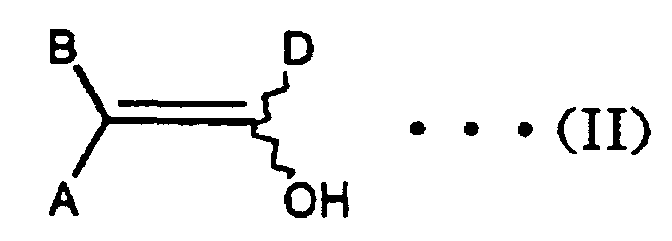
represented by Formula (II)
(wherein, A is optionally substituted hydrocarbon having 1 to 20 carbons, optionally
substituted heterocyclic group, or a group represented by Formula R1O, R1S or R1 1H2-1N; R1 is
optionally substituted hydrocarbon having 1 to 20 carbons or optionally substituted heterocyclic
group; I is 1 or 2; and when 1 is 2, R1 may be the same or different; B is optionally substituted
hydrocarbon having 1 to 20 carbons, optionally substituted heterocyclic group, CN, isonitrile, NO2,
N3, CHO, or a group represented by Formula C(=X)R2, S(O)mR2 or P(=X)R2R3; R2 and R3 are each
independently optionally substituted heterocyclic group, optionally substituted hydrocarbon having 1
to 20 carbons, or a group represented by Formula R20O, R20S or R20 kH2-kN; R20 is optionally
substituted hydrocarbon having 1 to 20 carbons, or optionally substituted heterocyclic group; X is
oxygen, sulfur, selenium, or a group represented by Formula NR21; R21 is optionally substituted
hydrocarbon having 1 to 20 carbons, optionally substituted heterocyclic group, hydroxyl, or a group
represented by Formula R22O or R22 tH2-tN; R22 is optionally substituted hydrocarbon having 1 to 20
carbons, or optionally substituted heterocyclic group; m is 0, 1 or 2; k is 1 or 2; and when k is 2, R20
may be the same or different; t is 1 or 2; and when t is 2, R22 may be the same or different; D is
optionally substituted hydrocarbon having 1 to 20 carbons, or optionally substituted heterocyclic
group; E is a group represented by Formula C(=X)R4, S(O)nR4 or P(=X)R4R5, alkoxymethyl having
1 to 6 carbons, alkylcarbonyloxymethyl having 1 to 6 carbons, cycloalkylcarbonyloxymethyl having
3 to 6 carbons, alkoxycarbonyloxymethyl having 1 to 6 carbons, optionally substituted
phenylcarbonyloxymethyl, alkylthiomethyl having 1 to 6 carbons, alkylcarbonylthiomethyl having 1
to 6 carbons, cycloalkylcarbonylthiomethyl having 3 to 6 carbons, alkoxycarbonylthiomethyl having
1 to 6 carbons, optionally substituted phenylcarbonylthiomethyl, or optionally substituted
phenylmethyl; R4 and R5 are each independently optionally substituted heterocyclic group,
optionally substituted hydrocarbon having 1 to 20 carbons, or a group represented by Formula R40O,
R40S or R40 qH2-qN; R40 is optionally substituted hydrocarbon having 1 to 20 carbons, or optionally
substituted heterocyclic group; X is oxygen, sulfur, selenium, or a group represented by Formula
NR51; R51 is optionally substituted hydrocarbon having 1 to 20 carbons, or hydroxyl; n is 0, 1 or 2; q
is 1 or 2; when q is 2, R40 may be the same or different), characterized in that a compound
represented by Formula (II)
 (wherein, A, B and D are as defined above) is reacted with a compound represented by
Formula (III)
(wherein, A, B and D are as defined above) is reacted with a compound represented by
Formula (III)
EY
(wherein, E is as defined above; and Y is chlorine, bromine or CN; however, Y is chlorine or
bromine when E is alkoxymethyl having 1 to 6 carbons, alkylcarbonyloxymethyl having 1 to 6
carbons, cycloalkylcarbonyloxymethyl having 3 to 6 carbons, alkoxycarbonyloxymethyl having 1 to
6 carbons, optionally substituted phenylcarbonyloxymethyl, alkylthiomethyl having 1 to 6 carbons,
alkylcarbonylthiomethyl having 1 to 6 carbons, cycloalkylcarbonylthiomethyl having 3 to 6 carbons,
alkoxycarbonylthiomethyl having 1 to 6 carbons, optionally substituted phenylcarbonylthiomethyl,
or optionally substituted phenylmethyl) in the presence of a base and a pyridine derivative
represented by Formula (IV)
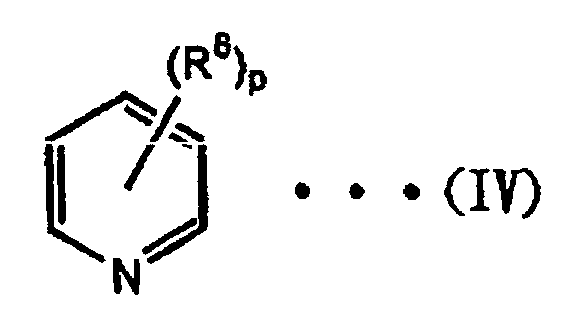 (wherein, R6 is hydrocarbon having 1 to 9 carbons; p is 0 or an integer of 1 to 3; and when p is
2 or more, R6 may be the same or different).
(wherein, R6 is hydrocarbon having 1 to 9 carbons; p is 0 or an integer of 1 to 3; and when p is
2 or more, R6 may be the same or different).
Examples of substituents represented by E, A and D are shown in the following.
E: alkylcarbonyl having 1 to 10 carbons, alkylthiocarbonyl or (alkylthio)carbonyl;
A: optionally substituted phenyl, benzyl or aromatic heterocyclic group;
D: optionally substituted phenyl or pyrazolyl.
E: alkylcarbonyl having 1 to 10 carbons, alkylthiocarbonyl or (alkylthio)carbonyl;
A: optionally substituted phenyl, benzyl or aromatic heterocyclic group;
D: optionally substituted phenyl or pyrazolyl.
Their actual examples are shown below:


| E1 | -COCH3 | E2 | -COC(CH3)3 | E3 | -COSCH3 |
| E4 | -COC(CH3)2-C2H5 | E5 | -COC(CH3)2-C3H7 | E6 | -CSCH3 |
The present invention is particularly useful for producing compounds where B is a CN group.
In the compounds of Formula (II), Y is chlorine, bromine or CN. When Y is CN, reactions of
some of the compounds may not proceed or target compounds not be produced, depending on a
group of E. In the above definitions, examples of substituents of the optionally substituted groups,
such as hydrocarbon, phenyl and heterocyclic, include alkyl having 1 to 4 carbons, halogen, alkoxy
having 1 to 4 carbons, or haloalkyl having 1 to 4 carbons.
A reaction is carried out in an organic solvent or a heterogeneous system of water and an
organic solvent.
In case that a reaction is performed in an organic solvent, examples of processes include that
[1] a compound of Formula (III) and a base are added in sequence to an organic solvent containing a
compound of Formula (II); [2] a compound of Formula (II) and a compound of Formula (III) are
added one by one to an organic solvent containing a base: [3] a mixture of a compound of Formula
(II) and a compound of Formula (III) is added to an organic solvent containing a base; [4] a
compound of Formula (III) and a base are added simultaneously to an organic solvent containing a
compound of Formula (II); [5] a compound of Formula (II) and a compound of Formula (III) are
added at the same time to an organic solvent containing a base; and [6] a compound of Formula (III)
is added to a solution containing a compound of Formula (II) and a tertiary amine, and further a
heterocyclic compound containing nitrogen is added Each compound can be mixed with a solvent or
added to it by any method. Usable methods are that one component is gradually dropped into the
other, all ingredients are added together, or a component is added little by little over a few times,
within a range of the reaction conditions such as temperature.
A reaction temperature is between -10 to 50°C, preferably 30°C or lower. If a reaction is
carried out at 50°C or higher, a ratio of isomers tends to decrease. If below -10°C, there is a
tendency of a slow reaction rate and low yield. Any base can be used. Preferred is a tertiary amine.
Actual examples of usable tertiary amines include 1,8-diazabicyclo[5.4.0]undec-7ene, 1,5-diazabicyclo[4.3.0]non-5-ene,
6-dibutylamino-1,8-diazabicyclo[5.4.0]undec-7-ene,
triethylenediamine, N,N-dimethylaminopyridine, trimethylamine, triethylamine, tri-n-butylamine,
N,N-dimethylcyclohexylamine, N,N-diethylaniline, quinoline and diisopropylethylamine. These can
be uses alone or as a mixture of two or more. An amount of a base used depends on how much a
pyridine derivative of Formula (IV) is used. A total amount of a base and a pyridine derivative to a
volume of a compound of Formula (II) is preferably an equivalent or more, more preferably between
1.05 and 1.50 equivalents, in mole ratio. If less than 1.05 equivalents, the reaction does not complete
so that starting materials remain unreacted. If more than 1.50 equivalents, the occurrence of
hydrolysis of a compound of Formula (III) may result in an incompletion of the reaction.
For the pyridine derivatives of Formula (IV) that are used in the present invention, R6 is
hydrocarbon having 1 to 9 carbons, and n is 0 or an integer of 1 to 3. When n is 2 or more, R6 may
be the same or different. Actual examples of R6 include methyl, ethyl, n-propyl, isopropyl, n-butyl,
s-butyl, t-butyl and n-pentyl. As for the pyridine derivatives of Formula (IV), pyridine, α-picoline, β-picoline,
γ-picoline, 3,5-lutidine, 2,4-lutidine, s-collidine, γ-collidine and 4-benzylpyridine are
actually exemplified.
A pyridine derivative is preferably used at a catalytic amount to an amount of a compound of
Formula (II). "A catalytic amount" refers to an equivalent mole or less to an amount of a compound
of Formula (II). It is favorable to use a pyridine derivative in a range of 0.05 to 60 mole%, more
favorably between 0.1 and 20 mole%. There are no restrictions on organic solvents for use, if they
are inactive in the reactions, and dissolve starting materials, products and others to some extent.
Their actual examples include halogen solvents such as methylene chloride, chloroform,
dichloroethane and chlorobenzene; hydrocarbon solvents such as benzene, toluene, xylene, hexane
and cyclohexane; ester solvents such as methyl acetate, ethyl acetate, isopropyl acetate and butyl
acetate; ketone solvents such as acetone and methyl isobutyl ketone; ether solvents such as diethyl
ether, nitrile solvents such as acetonitrile and benzonitrile; nitro solvents such as nitrobenzene; and
DMF and DMSO. These can be used alone or as a mixture of two or more.
A more preferable embodiment to implement the present invention is that a reaction is carried
out in a heterogeneous system of water and an organic solvent. In this case, usable bases are
inorganic bases including alkali metal hydroxides such as sodium hydroxide and alkali metal
carbonates such as potassium carbonate; or organic bases such as tertiary amines. Further, a
combined use of inorganic and organic bases may improve isomer ratios in some cases. It is also
possible to use an alkali metal salt of a compound of Formula (II) as a substitute of a base. The same
amines as those exemplified for the reactions in organic solvents can be used as tertiary amines.
Any solvent can be used for the reaction, if it is inactive to a compound of Formula (III).
Preferred are those having low solubility in water, and dissolving a compound of Formula (II) to
some extent Actual examples include halogen solvents such as methylene chloride, chloroform,
dichloroethane and chlorobenzene; hydrocarbon solvents such as benzene, toluene, xylene, hexane
and cyclohexane; ester solvents such as methyl acetate, ethyl acetate, isopropyl acetate and butyl
acetate; ketone solvents such as methyl isobutyl ketone; ether solvents such as diethyl ether, nitrile
solvents such as benzonitrile; and nitro solvents such as nitrobenzene. These can be used alone or as
a mixture of two or more. Solvents that have polar groups so as to be considered to have high
affinity with water can be used in the reaction, if non-polar groups share a large portion in a
molecule. A total amount of water and an organic solvent to use may be determined at discretion
within a range that a compound of Formula (II) is dissolved or can be stirred in a reaction system.
Water can be mixed with an organic solvent at any ratio. An increase of an organic solvent may
sometimes improve selectivity. In the case of the reaction in the heterogeneous system, a further use
of a phase-transfer catalyst may improve the reaction selectivity in some cases. Actual examples of
usable phase-transfer catalysts include onium salts such as quaternary ammonium salts and
quaternary phosphonium salts, and crown compounds; and, in more detail, tetrabutyl ammonium
chloride, benzyltributyl ammonium chloride, tetraethyl phosphonium chloride, tetraphenyl
phosphonium bromide and 18-crown-6.
An amount of a phase-transfer catalyst to use is an equivalent or less in mole ratio to a volume
of a compound of Formula (II), and preferably in a range of 0.5 to 30 mole%.
Any of the following reaction methods can be adopted: [1] a compound of Formula (II) is
mixed with a compound of Formula (III) in a mixed solvent of an organic solvent and water, and a
base is added; [2] a compound of Formula (III) is mixed with a base in a mixed solvent of an organic
solvent and water, and a compound of Formula (II) is added; [3] a compound of Formula (II) is
mixed with a base in a mixed solvent of an organic solvent and water, and a compound of Formula
(III) is added; [4] a mixture of a compound of Formula (II) and a compound of Formula (III) or a
solution containing both of the compounds is added to an aqueous solution of a base or a mixed
solution of a base, water and an organic solvent, and [5] a compound of Formula (II) and a
compound of Formula (III) or a solution containing one of them and a solution containing the other
are simultaneously added to an aqueous solution of a base or a mixed solution of a base, water and
an organic solvent. When the stability of the compound of Formula (III) is taken into account,
Method [2], [3] or [4] is preferred. Any method can be applied to mix or add individual compounds
to solvents. The following methods can be adopted: one component is gradually dropped into the
other, all ingredients are added together, or a component is added little by little over a few times,
within a range of the reaction conditions such as temperature. A phase-transfer catalyst, if used, can
be added at any time and by any means.
A reaction is performed favorably at a temperature between -10 and 50°C, more favorably
40°C or below, and most favorably 30°C or lower, throughout the course. If a reaction is carried out
at 50°C or higher, the compound of Formula (II), a starting material, remains unreacted If 5°C or
lower, there is a tendency that a reaction rate is slow, degradation of the compound of Formula (III)
progresses, and starting materials remain unreacted. Usual post treatments after the completion of
the reaction give the target compound whether the reaction is performed in an organic solvent or in a
heterogeneous system of water and an organic solvent.
Representative examples of compounds produced according to the processes of the present
invention are listed below. A1 to A9, D1 to D6 and E1 to E6 are as defined above.

A compound of Formula (II) may exist as a single compound, or be an equilibrium mixture
shown in the following equation when it is a mixture containing stereoisomers with regard to the
double bond.

The present invention is described in detail in reference to Examples. The scope of the present
invention is not limited to the examples.
In Examples 1 through 17 and Comparative Example 1, the target compound may be obtained
as a mixture of two geometrical isomers. The main product (abbreviated as A) refers to the product
with a shorter retention time in measurements by reversed-phase liquid chromatography (HPLC).
The other geometrical isomer (abbreviated as B) has a longer retention time. The production ratio of
A to B is represented by a ratio of two peak areas obtained by the chromatography.
- Mobile phase
- CH3CN / H2O / 10% H3PO4
770 ml / 230 ml / 1.0 ml - Column
- : Inertsil ODS-3 (GL Science Co., Ltd.)
- Column temperature
- : 40°C
- Detection wavelength
- : 254 nm
- Flow rate
- : 1.0 ml/minute
- Retention time
- : A≒20 minutes, B≒22 minutes

The above represents the target
compound of the examples described
below.
To a mixture of 2.5g of 2-[4-(2,6-difluorophenyl)-thiazol-2-yl]-3-hydroxy-3-(2-tnfluoromethylphenyl)-acrylonitnle,
20 ml of an aqueous solution of sodium hydroxide (containing
0.26g of NaOH) and 20 ml of toluene was added 0.13g of 3,5-lutidine, and then 1.09g of 2,2-dimethylpentanoyl
chloride was dropped at 30°C. The resulting solution was stirred for an hour at
the same temperature A quantitative analysis by high-performance liquid chromatography (HPLC)
showed that the reaction solution contained 3.07g of the target compound. Yield: 99.3% (production
ratio A:B = 95.3:4.7)
To a mixture of 2.5g of 2-[4-(2,6-difluorophenyl)-thiazol-2-yl]-3-hydroxy-3-(2-trifluoromethylphenyl)-acrylonitrile,
10 ml of water and 30 ml of toluene were added 0.85g of
potassium carbonate and 0.26g of 3,5-lutidine, and then 1.19g of 2,2-dimethylpentanoyl chloride
was dropped at 30°C. The resulting solution was stirred for an hour at the same temperature. A
quantitative analysis by HPLC showed that the reaction solution contained 3.17g of the target
compound. Yield: 99.6% (production ratio A:B = 93.2:6.8)
To a mixture of 2.5g of 2-[4-(2,6-difluorophenyl)-thiazol-2-yl]-3-hydroxy-3-(2-trifluoromethylphenyl)-acrylonitrile,
30 ml of toluene and 5 ml of water were added 0.79g of
diisopropylethylamine and 0.26g of 3,5-lutidine, and then 1.19g of 2,2-dimethylpentanoyl chloride
was dropped at 30°C. The resulting solution was stirred for 2 hours at the same temperature. A
quantitative analysis by HPLC showed that the reaction solution contained 3. 10g of the target
compound. Yield: 97.3% (production ratio A:B = 95.4:4.6)
To a mixture of 2.5g of 2-[4-(2,6-difluorophenyl)-thiazol-2-yl]-3-hydroxy-3-(2-trifluoromethylphenyl)-acrylonitrile,
30 ml of toluene and 5 ml of water were added 0.62g of
triethylamine and 0.26g of 3,5-lutidine, and then 1.19g of 2,2-dimethylpentanoyl chloride was
dropped at 30°C. The resulting solution was stirred for an hour at the same temperature. A
quantitative analysis by HPLC showed that the reaction solution contained 3.17g of the target
compound. Yield: 99.5% (production ratio A:B = 96.2:3.8)
To a mixture of 2.5g of 2-[4-(2,6-difluorophenyl)-thiazol-2-yl]-3-hydroxy-3-(2-trifluoromethylphenyl)-acrylonitrile,
15 ml of toluene and 15 ml of an aqueous solution of sodium
hydroxide (containing 0.26g of NaOH) was added 0.11g of γ-picoline, and then 1.19g of 2,2-dimethylpentanoyl
chloride was dropped at 30°C. The resulting solution was stirred for an hour at
the same temperature. A quantitative analysis by HPLC showed that the reaction solution contained
3.17g of the target compound. Yield: 99.5% (production ratio A:B = 94.4:5.6)
To a mixture of 2.5g of 2-[4-(2,6-difluorophenyl)-thiazol-2-yl]-3-hydroxy-3-(2-trifluoromethylphenyl)-acrylonitrile
and 20 ml of toluene were added 0.74g of triethylamine and
1.19g of 2,2-dimethylpentanoyl chloride. To the obtained mixture was dropped a solution of 0.11g of
γ-picoline in 10 ml of water at 10°C. The resulting solution was stirred for an hour at 10 to 22°C. A
quantitative analysis by HPLC showed that the reaction solution contained 3.18g of the target
compound. Yield: 99.9% (production ratio A:B = 98.8:1.2)
Example 6 was repeated except that chloroform was used in place of toluene. A quantitative
analysis by HPLC showed that the reaction solution contained 3.17g of the target compound. Yield:
99.5% (production ratio A:B = 99.4:0.6)
Example 6 was repeated except that butyl acetate was used in place of toluene. A quantitative
analysis by HPLC showed that the reaction solution contained 3.18g of the target compound. Yield:
99.9% (production ratio A:B = 99.9:0.1)
To a mixture of 2.5g of 2-[4-(2,6-difluorophenyl)-thiazol-2-yl]-3-hydroxy-3-(2-trifluoromethylphenyl)-acrylonitrile,
8 ml of toluene and 15 ml of water was added 1.19g of 2,2-dimethylpentanoyl
chloride, and then 7 ml of a toluene solution containing 0.74g of triethylamine
and 0.11g of γ-picoline was dropped at 25°C over 25 minutes. The resulting solution was further
stirred for 30 minutes at 25 to 30°C. A quantitative analysis by HPLC showed that the reaction
solution contained 3.18g of the target compound. Yield: 99.7% (production ratio A:B = 89:11)
To a mixture of 1.98g of 2-[4-(2,6-difluorophenyl)-thiazol-2-yl]-3-hydroxy-3-(2-trifluoromethylphenyl)-acrylonitrile
and 15 ml of chlorofrm were added 0.59g of triethylamine and
0.94g of 2,2-dimethylpentanoyl chloride. To the obtained mixture was added 0.09g of γ-picoline at
10 to 15°C. The resulting solution was stirred for 5 minutes at 10 to 15°C. A quantitative analysis by
HPLC showed that the reaction solution contained 2.45g of the target compound. Yield: 96.8%
(production ratio A:B = 99.5:0.5)
To a mixture of 1.98g of 2-[4-(2,6-difluorophenyl)-thiazol-2-yl]-3-hydroxy-3-(2-trifluoromethylphenyl)-acrylonitrile
and 15 ml of toluene were added 0.59g of triethylamine and
0.09g of γ-picoline. To the obtained mixture was added 0.94g of 2,2-dimethylpentanoyl chloride at
10 to 15°C. The resulting solution was stirred for 3 hours at 10 to 15°C. A quantitative analysis by
HPLC showed that the reaction solution contained 2.53g of the target compound. Yield: 99.9%
(production ratio A:B = 98.5:1.5)
Example 10 was repeated except that γ-picoline was not used. A quantitative analysis by
HPLC showed that the reaction solution contained 1.75g of the target compound. Yield: 54.8%
(production ratio A:B = 88:12)
To a mixture of 1.98g of 2-[4-(2,6-difluorophenyl)-thiazol-2-yl]-3-hydroxy-3-(2-trifluoromethylphenyl)-acrylonitrile,
15 ml of toluene, 5.5 ml of water and 0.20g of sodium
hydroxide was added 0.94g of 2,2-dimethylpentanoyl chloride at a temperature range of 10 to 15°C,
and then 0.30g of benzyl-n-butyl ammonium chloride (BTBAC) and 0.09g of γ-picoline were added
at the same temperature. The resulting solution was stirred for 30 minutes at the same temperature. A
quantitative analysis by HPLC showed that the reaction solution contained 2.45g of the target
compound. Yield: 98.0% (production ratio A:B = 96.6:3.4)
To a mixture of 1.98g of 2-[4-(2,6-difluorophenyl)-thiazol-2-yl]-3-hydroxy-3-(2-trifluoromethylphenyl)-acrylonitrile,
15 ml of toluene and 5 ml of water were added 0.71 g of an
aqueous solution of sodium hydroxide (containing 0.20g of NaOH) and 0.94g of 2,2-dimethylpentanoyl
chloride at a temperature range of 10 to 15°C, and then 0.10g of triethylamine
and 0.09g of γ-picoline were added at the same temperature. The resulting solution was stirred for an
hour at the same temperature. A quantitative analysis by HPLC showed that the reaction solution
contained 2.53g of the target compound. Yield: 100% (production ratio A:B = 98.2:1.8)
Example 13 was repeated except that tri-n-butylamine was used in place of triethylamine. A
quantitative analysis by HPLC showed that the reaction solution contained 2.50g of the target
compound. Yield: 99% (production ratio A:B = 99.4:0.6)
To a mixture of 0.69g of an aqueous solution of sodium hydroxide (containing 0.194g of
NaOH), 0.045g of γ-picoline, 0.18g of tri-n-butylamine and 5 ml of chloroform was dropped a
mixed solution of 1.98g of 2-[4-(2,6-difluorophenyl)-thiazol-2-yl]-3-hydroxy-3-(2-trifluoromethylphenyl)-acrylonitrile
and 0.94g of 2,2-dimethylpentanoyl chloride in 10 ml of
chloroform at a temperature range of 10 to 15°C. The resulting solution was stirred for 1.5 hours at
the same temperature. A quantitative analysis by HPLC showed that the reaction solution contained
2.52g of the target compound. Yield: 99.9% (production ratio A:B = 99.8:0.2)
To a mixture of 0.27g of sodium hydroxide, 0.12g of γ-picoline and 0.27g of tri-n-butylamine
in 20 ml of chloroform and 7 ml of water was dropped a mixed solution of 2.5g of 2-[4-(2,6-difluorophenyl)-thiazol-2-yl]-3-hydroxy-3-(2-trifluoromethylphenyl)-acrylonitrile
and 1.28g of 2,2-dimethylpentanoyl
chloride at a temperature range of 10 to 15°C. The resulting solution was stirred
for an hour at the same temperature. A quantitative analysis by HPLC showed that the reaction
solution contained 3.13g of the target compound. Yield: 98.1% (production ratio A:B = 99:1)
To a mixture of 0 98g of an aqueous solution of sodium hydroxide (containing 0.20g of
NaOH), 0.023g of y-picoline, 0.45g of tri-n-butylamine and 10 ml of chloroform was dropped a
mixed solution of 1.98g of 2-[4-(2,6-difluorophenyl)-thiazol-2-yl]-3-hydroxy-3-(2-trifluoromethylphenyl)-acrylonitrile
and 0.94g of 2,2-dimethylpentanoyl chloride in 10 ml of
chloroform at a temperature range of 10 to 15°C. The resulting solution was stirred for 1.5 hours at
the same temperature. A quantitative analysis by HPLC showed that the reaction solution contained
2.52g of the target compound. Yield: 100% (production ratio A:B = 99.5:0.5)
Use of the processes of the present invention makes it possible to produce O-acyl derivatives
of compounds of enol form stereoselectively in a short time in high yield. These compounds are
useful as intermediates for producing agrochemicals and drugs, and as final products. The processes
of the present invention are valuable in industrial applications.
Claims (12)
- A process for the preparation of an ethene derivative represented by Formula (I)(wherein, A is optionally substituted hydrocarbon having 1 to 20 carbons, optionally substituted heterocyclic group, or a group represented by Formula R1O, R1S or R1 1H2-1N; R1 is optionally substituted hydrocarbon having 1 to 20 carbons or optionally substituted heterocyclic group; 1 is 1 or 2; and when 1 is 2, R1 may be the same or different; B is optionally substituted hydrocarbon having 1 to 20 carbons, optionally substituted heterocyclic group, CN, isonitrile, NO2, N3, CHO, or a group represented by Formula C(=X)R2, S(O)mR2 or P(=X)R2R3; R2 and R3 are each independently optionally substituted heterocyclic group, optionally substituted hydrocarbon having 1 to 20 carbons, or a group represented by Formula R20O, R20S or R20 kH2-kN;R20 is optionally substituted hydrocarbon having 1 to 20 carbons, or optionally substituted heterocyclic group; X is oxygen, sulfur, selenium, or a group represented by Formula NR21; R21 is optionally substituted hydrocarbon having 1 to 20 carbons, optionally substituted heterocyclic group, hydroxyl, or a group represented by Formula R22O or R22 tH2-tN; R22 is optionally substituted hydrocarbon having 1 to 20 carbons, or optionally substituted heterocyclic group; m is 0, 1 or 2; k is 1 or 2; and when k is 2, R20 may be the same or different; t is 1 or 2; and when t is 2, R22 may be the same or different; D is optionally substituted hydrocarbon having 1 to 20 carbons, or optionally substituted heterocyclic group; E is a group represented by Formula C(=X)R4, S(O)nR4 or P(=X)R4R5, alkoxymethyl having 1 to 6 carbons, alkylcarbonyloxymethyl having 1 to 6 carbons, cycloalkylcarbonyloxymethyl having 3 to 6 carbons, alkoxycarbonyloxymethyl having 1 to 6 carbons, optionally substituted phenylcarbonyloxymethyl, alkylthiomethyl having 1 to 6 carbons, alkylcarbonylthiomethyl having 1 to 6 carbons, cycloalkylcarbonylthiomethyl having 3 to 6 carbons, alkoxycarbonylthiomethyl having 1 to 6 carbons, optionally substituted phenylcarbonylthiomethyl, or optionally substituted phenylmethyl; R4 and R5 are each independently optionally substituted heterocyclic group, optionally substituted hydrocarbon having 1 to 20 carbons, or a group represented by Formula R40O, R40S or R40 qH2-qN; R40 is optionally substituted hydrocarbon having 1 to 20 carbons, or optionally substituted heterocyclic group; X is oxygen, sulfur, selenium, or a group represented by Formula NR51; R51 is optionally substituted hydrocarbon having 1 to 20 carbons, or hydroxyl; n is 0, 1 or 2; q is 1 or 2; when q is 2, R40 may be the same or different), characterized in that a compound represented by Formula (II)
 (wherein, A, B and D are as defined above) is reacted with a compound represented by Formula (III)
 (wherein, R6 is hydrocarbon having 1 to 9 carbons; p is 0 or an integer of 1 to 3; and when p is 2 or more, R6 may be the same or different).
- A process according to Claim 1, in which E is alkylcarbonyl having 1 to 10 carbons or (alkylthio)carbonyl.
- A process according to Claim 1 or 2, in which A is optionally substituted phenyl, benzyl or aromatic heterocyclic group.
- A process according to one of Claims 1 to 3, in which D is optionally substituted phenyl or pyrazolyl.
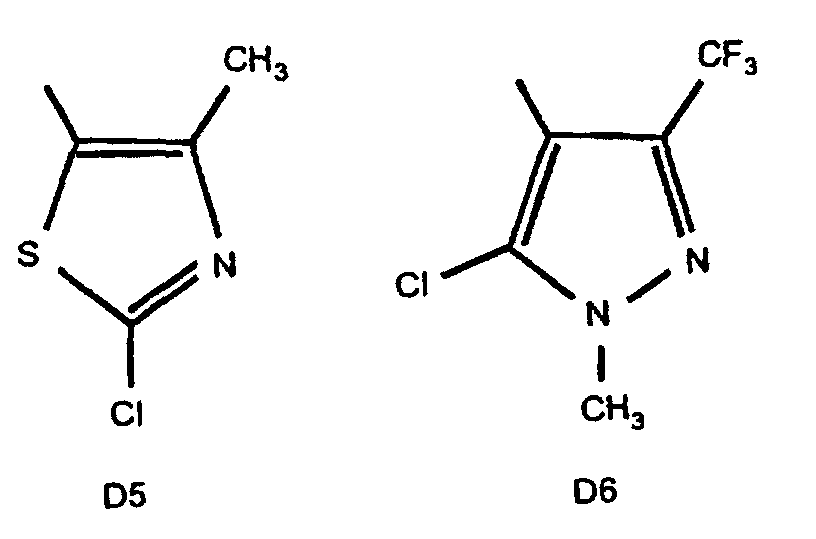
- A process according to one of Claims 1 to 4, in which A, D and E are groups represented by the following formulae, respectively:A:

 D:
D: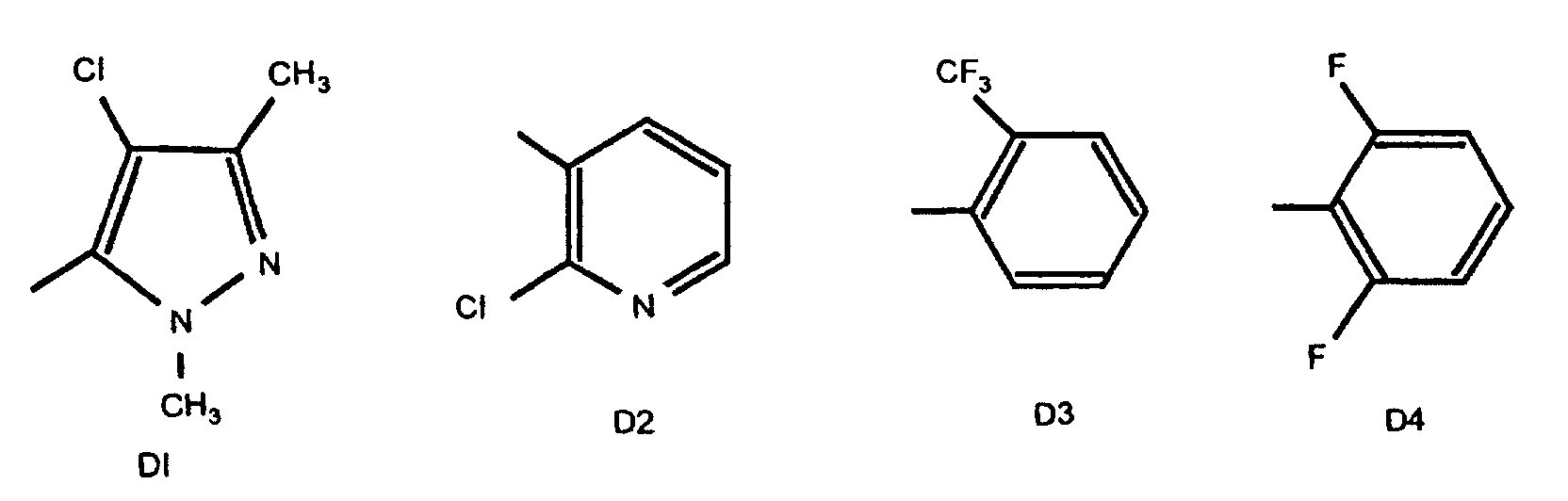
 E:
E:E1 -COCH3 E2 -COC(CH3)3 E3 -COSCH3 E4 -COC(CH3)2-C2H5 E5 -COC(CH3)3-C3H7 E6 -CSCH3 - A process according to one of Claims 1 to 5, in which B is a CN group.
- A process according to one of Claims 1 to 6, in which the reaction is carried out in an organic solvent
- A process according to one of Claims 1 to 7, in which the base is a tertiary amine.
- A process according to one of Claims 1 to 6, in which the reaction is carried out in a heterogeneous system of water and an organic solvent.
- A process according to one of Claims 1 to 6 and 9, in which the base is an alkali metal hydroxide or a tertiary amine.
- A process according to one of Claims 1 to 6, 9 and 10, in which the base is an alkali metal salt or a tertiary amine.
- A process according to one of Claims 1 to 11, in which the pyridine derivative of Formula (IV) is lutidine or γ-picoline.
Applications Claiming Priority (3)
| Application Number | Priority Date | Filing Date | Title |
|---|---|---|---|
| JP2001306243 | 2001-10-02 | ||
| JP2001306243 | 2001-10-02 | ||
| PCT/JP2002/010207 WO2003031421A1 (en) | 2001-10-02 | 2002-10-01 | Process for preparation of ethene derivatives |
Publications (2)
| Publication Number | Publication Date |
|---|---|
| EP1439171A1 true EP1439171A1 (en) | 2004-07-21 |
| EP1439171A4 EP1439171A4 (en) | 2004-12-22 |
Family
ID=19125913
Family Applications (1)
| Application Number | Title | Priority Date | Filing Date |
|---|---|---|---|
| EP02800719A Withdrawn EP1439171A4 (en) | 2001-10-02 | 2002-10-01 | Process for preparation of ethene derivatives |
Country Status (6)
| Country | Link |
|---|---|
| US (1) | US20040242933A1 (en) |
| EP (1) | EP1439171A4 (en) |
| JP (1) | JP4414759B2 (en) |
| KR (1) | KR20040047880A (en) |
| CN (1) | CN1561335A (en) |
| WO (1) | WO2003031421A1 (en) |
Cited By (1)
| Publication number | Priority date | Publication date | Assignee | Title |
|---|---|---|---|---|
| WO2007100161A1 (en) * | 2006-03-03 | 2007-09-07 | Nissan Chemical Industries, Ltd. | Method for preferential production of geometric isomers and isolation method |
Families Citing this family (1)
| Publication number | Priority date | Publication date | Assignee | Title |
|---|---|---|---|---|
| KR200453613Y1 (en) * | 2010-07-29 | 2011-05-16 | 김재진 | Automatic shooting signs |
Family Cites Families (10)
| Publication number | Priority date | Publication date | Assignee | Title |
|---|---|---|---|---|
| JPS5822464B2 (en) * | 1977-08-02 | 1983-05-09 | 日本曹達株式会社 | Method for producing O-acylated products of cyclohexane-1,3-dione enols |
| JPS6011452A (en) * | 1983-06-30 | 1985-01-21 | Showa Denko Kk | Alpha-cyanoketone derivative and herbicide |
| US5463060A (en) * | 1992-05-21 | 1995-10-31 | Eli Lilly And Company | One-pot process |
| JP3404558B2 (en) * | 1994-04-28 | 2003-05-12 | ケイ・アイ化成株式会社 | Biofouling agent attached to water |
| TW513285B (en) * | 1997-02-14 | 2002-12-11 | Ishihara Sangyo Kaisha | Acrylonitrile compounds, process and intermediates for their production, method for controlling pests comprising using them and pesticides, fungicides and marine antifouling agents containing them |
| WO1999044993A1 (en) * | 1998-03-06 | 1999-09-10 | Ishihara Sangyo Kaisha Ltd. | Acryronitrile-based compound, method for producing the same and pest controlling agent comprising the same |
| JP2000001460A (en) * | 1998-06-11 | 2000-01-07 | Sumitomo Chem Co Ltd | Acrylic acid derivatives and their uses |
| CA2341722A1 (en) * | 1998-09-17 | 2000-03-30 | Hidemitsu Takahashi | Thiazolylcinnamonitriles and pest controlling agents |
| US6624179B1 (en) * | 1999-07-30 | 2003-09-23 | Ishihara Sangyo Kaisha Ltd. | Geometrical isomers of acrylonitrile compounds, mixture thereof, and process for producing these |
| WO2002088099A1 (en) * | 2001-04-27 | 2002-11-07 | Nippon Soda Co.,Ltd. | Thiazolylcinnamonitrile compound and pest control agent |
-
2002
- 2002-10-01 KR KR10-2004-7004751A patent/KR20040047880A/en not_active Ceased
- 2002-10-01 CN CNA028192818A patent/CN1561335A/en active Pending
- 2002-10-01 WO PCT/JP2002/010207 patent/WO2003031421A1/en not_active Ceased
- 2002-10-01 US US10/489,681 patent/US20040242933A1/en not_active Abandoned
- 2002-10-01 JP JP2003534404A patent/JP4414759B2/en not_active Expired - Fee Related
- 2002-10-01 EP EP02800719A patent/EP1439171A4/en not_active Withdrawn
Cited By (1)
| Publication number | Priority date | Publication date | Assignee | Title |
|---|---|---|---|---|
| WO2007100161A1 (en) * | 2006-03-03 | 2007-09-07 | Nissan Chemical Industries, Ltd. | Method for preferential production of geometric isomers and isolation method |
Also Published As
| Publication number | Publication date |
|---|---|
| US20040242933A1 (en) | 2004-12-02 |
| CN1561335A (en) | 2005-01-05 |
| KR20040047880A (en) | 2004-06-05 |
| JP4414759B2 (en) | 2010-02-10 |
| EP1439171A4 (en) | 2004-12-22 |
| JPWO2003031421A1 (en) | 2005-01-20 |
| WO2003031421A1 (en) | 2003-04-17 |
Similar Documents
| Publication | Publication Date | Title |
|---|---|---|
| IL175024A (en) | 2-dihaloacyl-3-amino-acrylic acid esters, a process for their preparation, their use for producing 3-dihalomethyl-1h-pyrazole-4-carboxylic acid esters and 3-dichloromethylpyrazole-4-carboxylic acid esters | |
| CA2861493A1 (en) | Methods and compounds useful in the synthesis of orexin-2 receptor antagonists | |
| Guchhait et al. | One-pot preparation of isocyanides from amines and their multicomponent reactions: crucial role of dehydrating agent and base | |
| US20100179319A1 (en) | Process for production of optically active mirtazapine | |
| WO2024038436A1 (en) | Process for preparing cyantraniliprole via amino-cyano-benzene derivative | |
| US20040242933A1 (en) | Process for preparation of ethene derivatives | |
| JP6289177B2 (en) | Method for producing nitrogen-containing heterocyclic compound | |
| WO2011141414A1 (en) | Process for the preparation of 5-substituted 3-aryl-3-(trifluoromethyl)-3,4-dihydro-2h-pyrroles | |
| KR100586671B1 (en) | Method for preparing 5-substituted oxazole compound and 5-substituted imidazole compound | |
| TWI788289B (en) | Method for preparing cis-alkoxy-substituted spirocyclic 1-h-pyrrolidine-2,4-dione derivatives | |
| WO2024167810A1 (en) | Ligand-enabled transannular c-h functionalization of cycloalkane carboxylic acids | |
| JP2003286262A (en) | Method for producing 2-halogenoalkylnicotinic acid and 2-halogenoalkylnicotinic acid derivative, intermediate product and compound of the kind | |
| JP3253245B2 (en) | Method for producing guanidine derivative, novel intermediate and method for producing the same | |
| KR20050053784A (en) | Process for producing aromatic nitrile compound | |
| Yao et al. | One-pot synthesis of densely functionalized cyclic β-aminoesters containing four stereocenters, based on a Et 3 N-promoted pseudo five-component reaction | |
| CA3103332A1 (en) | Compound and use thereof in synthesis of brivaracetam intermediate and crude drug | |
| Graham | Electrophilic Cyanation of Alkenyl Tosylates, Ketones and Amines using Disubstituted Malononitriles | |
| RU2300526C2 (en) | Method for preparing phenoxy-substituted 2-pyridone compounds | |
| JP2000191554A (en) | Production of acrylic acid derivative having functional group having high reaction activity | |
| JP3445191B2 (en) | Method for producing oxazole compound | |
| KR100371590B1 (en) | Process for the preparation of 2-chloropyridine | |
| JP4693261B2 (en) | Method for producing 5-substituted oxazole compound | |
| JP2011026201A (en) | Stereo-selective method of producing optically active pyrrolyl-succinimide derivative | |
| WO2004108654A1 (en) | Chain lactic acid oligomer derivative and process for producing the same | |
| JP2015508067A (en) | Process for preparing N-hydroxy-1- (1-alkyl-1H-tetrazol-5-yl) -1-phenylmethanimine derivatives |
Legal Events
| Date | Code | Title | Description |
|---|---|---|---|
| PUAI | Public reference made under article 153(3) epc to a published international application that has entered the european phase |
Free format text: ORIGINAL CODE: 0009012 |
|
| 17P | Request for examination filed |
Effective date: 20040423 |
|
| AK | Designated contracting states |
Kind code of ref document: A1 Designated state(s): AT BE BG CH CY CZ DE DK EE ES FI FR GB GR IE IT LI LU MC NL PT SE SK TR |
|
| AX | Request for extension of the european patent |
Extension state: AL LT LV MK RO SI |
|
| A4 | Supplementary search report drawn up and despatched |
Effective date: 20041105 |
|
| STAA | Information on the status of an ep patent application or granted ep patent |
Free format text: STATUS: THE APPLICATION IS DEEMED TO BE WITHDRAWN |
|
| 18D | Application deemed to be withdrawn |
Effective date: 20050121 |