EP1439165A1 - Abscisic acid biosynthesis inhibitor - Google Patents
Abscisic acid biosynthesis inhibitor Download PDFInfo
- Publication number
- EP1439165A1 EP1439165A1 EP02800771A EP02800771A EP1439165A1 EP 1439165 A1 EP1439165 A1 EP 1439165A1 EP 02800771 A EP02800771 A EP 02800771A EP 02800771 A EP02800771 A EP 02800771A EP 1439165 A1 EP1439165 A1 EP 1439165A1
- Authority
- EP
- European Patent Office
- Prior art keywords
- group
- abscisic acid
- compound
- substituted
- general formula
- Prior art date
- Legal status (The legal status is an assumption and is not a legal conclusion. Google has not performed a legal analysis and makes no representation as to the accuracy of the status listed.)
- Withdrawn
Links
Classifications
-
- C—CHEMISTRY; METALLURGY
- C07—ORGANIC CHEMISTRY
- C07C—ACYCLIC OR CARBOCYCLIC COMPOUNDS
- C07C217/00—Compounds containing amino and etherified hydroxy groups bound to the same carbon skeleton
- C07C217/54—Compounds containing amino and etherified hydroxy groups bound to the same carbon skeleton having etherified hydroxy groups bound to carbon atoms of at least one six-membered aromatic ring and amino groups bound to acyclic carbon atoms or to carbon atoms of rings other than six-membered aromatic rings of the same carbon skeleton
- C07C217/56—Compounds containing amino and etherified hydroxy groups bound to the same carbon skeleton having etherified hydroxy groups bound to carbon atoms of at least one six-membered aromatic ring and amino groups bound to acyclic carbon atoms or to carbon atoms of rings other than six-membered aromatic rings of the same carbon skeleton with amino groups linked to the six-membered aromatic ring, or to the condensed ring system containing that ring, by carbon chains not further substituted by singly-bound oxygen atoms
- C07C217/62—Compounds containing amino and etherified hydroxy groups bound to the same carbon skeleton having etherified hydroxy groups bound to carbon atoms of at least one six-membered aromatic ring and amino groups bound to acyclic carbon atoms or to carbon atoms of rings other than six-membered aromatic rings of the same carbon skeleton with amino groups linked to the six-membered aromatic ring, or to the condensed ring system containing that ring, by carbon chains not further substituted by singly-bound oxygen atoms linked by carbon chains having at least three carbon atoms between the amino groups and the six-membered aromatic ring or the condensed ring system containing that ring
-
- A—HUMAN NECESSITIES
- A01—AGRICULTURE; FORESTRY; ANIMAL HUSBANDRY; HUNTING; TRAPPING; FISHING
- A01N—PRESERVATION OF BODIES OF HUMANS OR ANIMALS OR PLANTS OR PARTS THEREOF; BIOCIDES, e.g. AS DISINFECTANTS, AS PESTICIDES OR AS HERBICIDES; PEST REPELLANTS OR ATTRACTANTS; PLANT GROWTH REGULATORS
- A01N33/00—Biocides, pest repellants or attractants, or plant growth regulators containing organic nitrogen compounds
- A01N33/02—Amines; Quaternary ammonium compounds
- A01N33/08—Amines; Quaternary ammonium compounds containing oxygen or sulfur
- A01N33/10—Amines; Quaternary ammonium compounds containing oxygen or sulfur having at least one oxygen or sulfur atom directly attached to an aromatic ring system
-
- A—HUMAN NECESSITIES
- A01—AGRICULTURE; FORESTRY; ANIMAL HUSBANDRY; HUNTING; TRAPPING; FISHING
- A01N—PRESERVATION OF BODIES OF HUMANS OR ANIMALS OR PLANTS OR PARTS THEREOF; BIOCIDES, e.g. AS DISINFECTANTS, AS PESTICIDES OR AS HERBICIDES; PEST REPELLANTS OR ATTRACTANTS; PLANT GROWTH REGULATORS
- A01N37/00—Biocides, pest repellants or attractants, or plant growth regulators containing organic compounds containing a carbon atom having three bonds to hetero atoms with at the most two bonds to halogen, e.g. carboxylic acids
- A01N37/44—Biocides, pest repellants or attractants, or plant growth regulators containing organic compounds containing a carbon atom having three bonds to hetero atoms with at the most two bonds to halogen, e.g. carboxylic acids containing at least one carboxylic group or a thio analogue, or a derivative thereof, and a nitrogen atom attached to the same carbon skeleton by a single or double bond, this nitrogen atom not being a member of a derivative or of a thio analogue of a carboxylic group, e.g. amino-carboxylic acids
-
- A—HUMAN NECESSITIES
- A01—AGRICULTURE; FORESTRY; ANIMAL HUSBANDRY; HUNTING; TRAPPING; FISHING
- A01N—PRESERVATION OF BODIES OF HUMANS OR ANIMALS OR PLANTS OR PARTS THEREOF; BIOCIDES, e.g. AS DISINFECTANTS, AS PESTICIDES OR AS HERBICIDES; PEST REPELLANTS OR ATTRACTANTS; PLANT GROWTH REGULATORS
- A01N39/00—Biocides, pest repellants or attractants, or plant growth regulators containing aryloxy- or arylthio-aliphatic or cycloaliphatic compounds, containing the group or, e.g. phenoxyethylamine, phenylthio-acetonitrile, phenoxyacetone
- A01N39/02—Aryloxy-carboxylic acids; Derivatives thereof
- A01N39/04—Aryloxy-acetic acids; Derivatives thereof
-
- A—HUMAN NECESSITIES
- A01—AGRICULTURE; FORESTRY; ANIMAL HUSBANDRY; HUNTING; TRAPPING; FISHING
- A01N—PRESERVATION OF BODIES OF HUMANS OR ANIMALS OR PLANTS OR PARTS THEREOF; BIOCIDES, e.g. AS DISINFECTANTS, AS PESTICIDES OR AS HERBICIDES; PEST REPELLANTS OR ATTRACTANTS; PLANT GROWTH REGULATORS
- A01N43/00—Biocides, pest repellants or attractants, or plant growth regulators containing heterocyclic compounds
- A01N43/02—Biocides, pest repellants or attractants, or plant growth regulators containing heterocyclic compounds having rings with one or more oxygen or sulfur atoms as the only ring hetero atoms
- A01N43/04—Biocides, pest repellants or attractants, or plant growth regulators containing heterocyclic compounds having rings with one or more oxygen or sulfur atoms as the only ring hetero atoms with one hetero atom
- A01N43/06—Biocides, pest repellants or attractants, or plant growth regulators containing heterocyclic compounds having rings with one or more oxygen or sulfur atoms as the only ring hetero atoms with one hetero atom five-membered rings
- A01N43/08—Biocides, pest repellants or attractants, or plant growth regulators containing heterocyclic compounds having rings with one or more oxygen or sulfur atoms as the only ring hetero atoms with one hetero atom five-membered rings with oxygen as the ring hetero atom
-
- A—HUMAN NECESSITIES
- A01—AGRICULTURE; FORESTRY; ANIMAL HUSBANDRY; HUNTING; TRAPPING; FISHING
- A01N—PRESERVATION OF BODIES OF HUMANS OR ANIMALS OR PLANTS OR PARTS THEREOF; BIOCIDES, e.g. AS DISINFECTANTS, AS PESTICIDES OR AS HERBICIDES; PEST REPELLANTS OR ATTRACTANTS; PLANT GROWTH REGULATORS
- A01N43/00—Biocides, pest repellants or attractants, or plant growth regulators containing heterocyclic compounds
- A01N43/34—Biocides, pest repellants or attractants, or plant growth regulators containing heterocyclic compounds having rings with one nitrogen atom as the only ring hetero atom
- A01N43/40—Biocides, pest repellants or attractants, or plant growth regulators containing heterocyclic compounds having rings with one nitrogen atom as the only ring hetero atom six-membered rings
-
- C—CHEMISTRY; METALLURGY
- C07—ORGANIC CHEMISTRY
- C07C—ACYCLIC OR CARBOCYCLIC COMPOUNDS
- C07C215/00—Compounds containing amino and hydroxy groups bound to the same carbon skeleton
- C07C215/46—Compounds containing amino and hydroxy groups bound to the same carbon skeleton having hydroxy groups bound to carbon atoms of at least one six-membered aromatic ring and amino groups bound to acyclic carbon atoms or to carbon atoms of rings other than six-membered aromatic rings of the same carbon skeleton
- C07C215/48—Compounds containing amino and hydroxy groups bound to the same carbon skeleton having hydroxy groups bound to carbon atoms of at least one six-membered aromatic ring and amino groups bound to acyclic carbon atoms or to carbon atoms of rings other than six-membered aromatic rings of the same carbon skeleton with amino groups linked to the six-membered aromatic ring, or to the condensed ring system containing that ring, by carbon chains not further substituted by hydroxy groups
- C07C215/52—Compounds containing amino and hydroxy groups bound to the same carbon skeleton having hydroxy groups bound to carbon atoms of at least one six-membered aromatic ring and amino groups bound to acyclic carbon atoms or to carbon atoms of rings other than six-membered aromatic rings of the same carbon skeleton with amino groups linked to the six-membered aromatic ring, or to the condensed ring system containing that ring, by carbon chains not further substituted by hydroxy groups linked by carbon chains having two carbon atoms between the amino groups and the six-membered aromatic ring or the condensed ring system containing that ring
-
- C—CHEMISTRY; METALLURGY
- C07—ORGANIC CHEMISTRY
- C07C—ACYCLIC OR CARBOCYCLIC COMPOUNDS
- C07C217/00—Compounds containing amino and etherified hydroxy groups bound to the same carbon skeleton
- C07C217/54—Compounds containing amino and etherified hydroxy groups bound to the same carbon skeleton having etherified hydroxy groups bound to carbon atoms of at least one six-membered aromatic ring and amino groups bound to acyclic carbon atoms or to carbon atoms of rings other than six-membered aromatic rings of the same carbon skeleton
- C07C217/56—Compounds containing amino and etherified hydroxy groups bound to the same carbon skeleton having etherified hydroxy groups bound to carbon atoms of at least one six-membered aromatic ring and amino groups bound to acyclic carbon atoms or to carbon atoms of rings other than six-membered aromatic rings of the same carbon skeleton with amino groups linked to the six-membered aromatic ring, or to the condensed ring system containing that ring, by carbon chains not further substituted by singly-bound oxygen atoms
- C07C217/58—Compounds containing amino and etherified hydroxy groups bound to the same carbon skeleton having etherified hydroxy groups bound to carbon atoms of at least one six-membered aromatic ring and amino groups bound to acyclic carbon atoms or to carbon atoms of rings other than six-membered aromatic rings of the same carbon skeleton with amino groups linked to the six-membered aromatic ring, or to the condensed ring system containing that ring, by carbon chains not further substituted by singly-bound oxygen atoms with amino groups and the six-membered aromatic ring, or the condensed ring system containing that ring, bound to the same carbon atom of the carbon chain
-
- C—CHEMISTRY; METALLURGY
- C07—ORGANIC CHEMISTRY
- C07C—ACYCLIC OR CARBOCYCLIC COMPOUNDS
- C07C217/00—Compounds containing amino and etherified hydroxy groups bound to the same carbon skeleton
- C07C217/54—Compounds containing amino and etherified hydroxy groups bound to the same carbon skeleton having etherified hydroxy groups bound to carbon atoms of at least one six-membered aromatic ring and amino groups bound to acyclic carbon atoms or to carbon atoms of rings other than six-membered aromatic rings of the same carbon skeleton
- C07C217/56—Compounds containing amino and etherified hydroxy groups bound to the same carbon skeleton having etherified hydroxy groups bound to carbon atoms of at least one six-membered aromatic ring and amino groups bound to acyclic carbon atoms or to carbon atoms of rings other than six-membered aromatic rings of the same carbon skeleton with amino groups linked to the six-membered aromatic ring, or to the condensed ring system containing that ring, by carbon chains not further substituted by singly-bound oxygen atoms
- C07C217/60—Compounds containing amino and etherified hydroxy groups bound to the same carbon skeleton having etherified hydroxy groups bound to carbon atoms of at least one six-membered aromatic ring and amino groups bound to acyclic carbon atoms or to carbon atoms of rings other than six-membered aromatic rings of the same carbon skeleton with amino groups linked to the six-membered aromatic ring, or to the condensed ring system containing that ring, by carbon chains not further substituted by singly-bound oxygen atoms linked by carbon chains having two carbon atoms between the amino groups and the six-membered aromatic ring or the condensed ring system containing that ring
-
- C—CHEMISTRY; METALLURGY
- C07—ORGANIC CHEMISTRY
- C07C—ACYCLIC OR CARBOCYCLIC COMPOUNDS
- C07C217/00—Compounds containing amino and etherified hydroxy groups bound to the same carbon skeleton
- C07C217/78—Compounds containing amino and etherified hydroxy groups bound to the same carbon skeleton having amino groups and etherified hydroxy groups bound to carbon atoms of six-membered aromatic rings of the same carbon skeleton
- C07C217/80—Compounds containing amino and etherified hydroxy groups bound to the same carbon skeleton having amino groups and etherified hydroxy groups bound to carbon atoms of six-membered aromatic rings of the same carbon skeleton having amino groups and etherified hydroxy groups bound to carbon atoms of non-condensed six-membered aromatic rings
- C07C217/82—Compounds containing amino and etherified hydroxy groups bound to the same carbon skeleton having amino groups and etherified hydroxy groups bound to carbon atoms of six-membered aromatic rings of the same carbon skeleton having amino groups and etherified hydroxy groups bound to carbon atoms of non-condensed six-membered aromatic rings of the same non-condensed six-membered aromatic ring
- C07C217/84—Compounds containing amino and etherified hydroxy groups bound to the same carbon skeleton having amino groups and etherified hydroxy groups bound to carbon atoms of six-membered aromatic rings of the same carbon skeleton having amino groups and etherified hydroxy groups bound to carbon atoms of non-condensed six-membered aromatic rings of the same non-condensed six-membered aromatic ring the oxygen atom of at least one of the etherified hydroxy groups being further bound to an acyclic carbon atom
-
- C—CHEMISTRY; METALLURGY
- C07—ORGANIC CHEMISTRY
- C07C—ACYCLIC OR CARBOCYCLIC COMPOUNDS
- C07C229/00—Compounds containing amino and carboxyl groups bound to the same carbon skeleton
- C07C229/02—Compounds containing amino and carboxyl groups bound to the same carbon skeleton having amino and carboxyl groups bound to acyclic carbon atoms of the same carbon skeleton
- C07C229/04—Compounds containing amino and carboxyl groups bound to the same carbon skeleton having amino and carboxyl groups bound to acyclic carbon atoms of the same carbon skeleton the carbon skeleton being acyclic and saturated
- C07C229/06—Compounds containing amino and carboxyl groups bound to the same carbon skeleton having amino and carboxyl groups bound to acyclic carbon atoms of the same carbon skeleton the carbon skeleton being acyclic and saturated having only one amino and one carboxyl group bound to the carbon skeleton
- C07C229/10—Compounds containing amino and carboxyl groups bound to the same carbon skeleton having amino and carboxyl groups bound to acyclic carbon atoms of the same carbon skeleton the carbon skeleton being acyclic and saturated having only one amino and one carboxyl group bound to the carbon skeleton the nitrogen atom of the amino group being further bound to acyclic carbon atoms or to carbon atoms of rings other than six-membered aromatic rings
- C07C229/14—Compounds containing amino and carboxyl groups bound to the same carbon skeleton having amino and carboxyl groups bound to acyclic carbon atoms of the same carbon skeleton the carbon skeleton being acyclic and saturated having only one amino and one carboxyl group bound to the carbon skeleton the nitrogen atom of the amino group being further bound to acyclic carbon atoms or to carbon atoms of rings other than six-membered aromatic rings to carbon atoms of carbon skeletons containing rings
-
- C—CHEMISTRY; METALLURGY
- C07—ORGANIC CHEMISTRY
- C07D—HETEROCYCLIC COMPOUNDS
- C07D213/00—Heterocyclic compounds containing six-membered rings, not condensed with other rings, with one nitrogen atom as the only ring hetero atom and three or more double bonds between ring members or between ring members and non-ring members
- C07D213/02—Heterocyclic compounds containing six-membered rings, not condensed with other rings, with one nitrogen atom as the only ring hetero atom and three or more double bonds between ring members or between ring members and non-ring members having three double bonds between ring members or between ring members and non-ring members
- C07D213/04—Heterocyclic compounds containing six-membered rings, not condensed with other rings, with one nitrogen atom as the only ring hetero atom and three or more double bonds between ring members or between ring members and non-ring members having three double bonds between ring members or between ring members and non-ring members having no bond between the ring nitrogen atom and a non-ring member or having only hydrogen or carbon atoms directly attached to the ring nitrogen atom
- C07D213/24—Heterocyclic compounds containing six-membered rings, not condensed with other rings, with one nitrogen atom as the only ring hetero atom and three or more double bonds between ring members or between ring members and non-ring members having three double bonds between ring members or between ring members and non-ring members having no bond between the ring nitrogen atom and a non-ring member or having only hydrogen or carbon atoms directly attached to the ring nitrogen atom with substituted hydrocarbon radicals attached to ring carbon atoms
- C07D213/36—Radicals substituted by singly-bound nitrogen atoms
- C07D213/38—Radicals substituted by singly-bound nitrogen atoms having only hydrogen or hydrocarbon radicals attached to the substituent nitrogen atom
-
- C—CHEMISTRY; METALLURGY
- C07—ORGANIC CHEMISTRY
- C07D—HETEROCYCLIC COMPOUNDS
- C07D307/00—Heterocyclic compounds containing five-membered rings having one oxygen atom as the only ring hetero atom
- C07D307/02—Heterocyclic compounds containing five-membered rings having one oxygen atom as the only ring hetero atom not condensed with other rings
- C07D307/04—Heterocyclic compounds containing five-membered rings having one oxygen atom as the only ring hetero atom not condensed with other rings having no double bonds between ring members or between ring members and non-ring members
- C07D307/10—Heterocyclic compounds containing five-membered rings having one oxygen atom as the only ring hetero atom not condensed with other rings having no double bonds between ring members or between ring members and non-ring members with substituted hydrocarbon radicals attached to ring carbon atoms
- C07D307/14—Radicals substituted by nitrogen atoms not forming part of a nitro radical
Definitions
- the present invention relates to a compound having inhibitory action against abscisic acid biosynthesis or a salt thereof, and also to an inhibitor against the abscisic acid biosynthesis or a plant growth regulator comprising said compound or a salt thereof as an active ingredient.
- Abscisic acid is a plant hormone that involves in plant responses to various environmental stresses. For example, when a plant is suffered from dry stress, abscisic acid is rapidly accumulated, and then, pore closing and expression of stress-related genes such as rab18, kin1, and rd29B are promoted.
- a major pathway involves, via a carotenoid of a compound comprising 40 carbon atoms, use of xanthoxin having 15 carbon atoms as a precursor, which is generated by the degradation of the carotenoid, and oxidation of the hydroxyl group at the 3'-position, the isomerization of the double bond derived from the epoxy cleavage; and the oxidation of the aldehyde into carboxylic acid.
- NASH no-cis-epoxycarotenoid dioxygenase
- abscisic acid which is a plant hormone essential for plant growth
- methods has been used so far wherein abscisic acid is directly applied to a plant, or wherein a mutant whose gene for the abscisic acid biosynthesis is destroyed is used to analyze expressed physiological phenomena.
- abscisic acid which already exists in the plant body
- the methods using the mutants, which are in deficient stage of abscisic acid are useful for investigation of the functions of abscisic acid by comparison with wild strains in physiological phenomena and morphologic states.
- the methods have disadvantages in that they are inapplicable to various plants and the abscisic acid deficient state cannot be controlled in a desired growth period.
- inhibitors against the abscisic acid biosynthesis can be utilized.
- agents inhibiting the biosynthesis of carotenoid, which is an intermediate of the abscisic acid biosynthesis have already been used; however, such agents have potent whitening action, and accordingly, they are inappropriate for investigation of an abscisic acid deficient state without involvement of side effects.
- a specific inhibitor against abscisic acid can be provided, various plants can easily be introduced in an abscisic acid deficient state, and analytical studies of abscisic acid functions can be expectedly progressed.
- an abscisic acid biosynthesis inhibitor can be utilized as a plant growth regulator which is effective for various growth processes of plants. It has been reported that NDGA [4,4'-(2,3-dimethyl-1,4-butanediyl)bis-1,2-benzenediol] which is known as a peroxidase inhibitor has inhibitory action on the abscisic acid biosynthesis on the basis of the results of inhibitory test of pore closing activity and the analysis of the amount of inherent abscisic acid production (Plant Physiology (1992) 99,1258-1260).
- An object of the present invention is to provide a compound having inhibitory action against the abscisic acid biosynthesis.
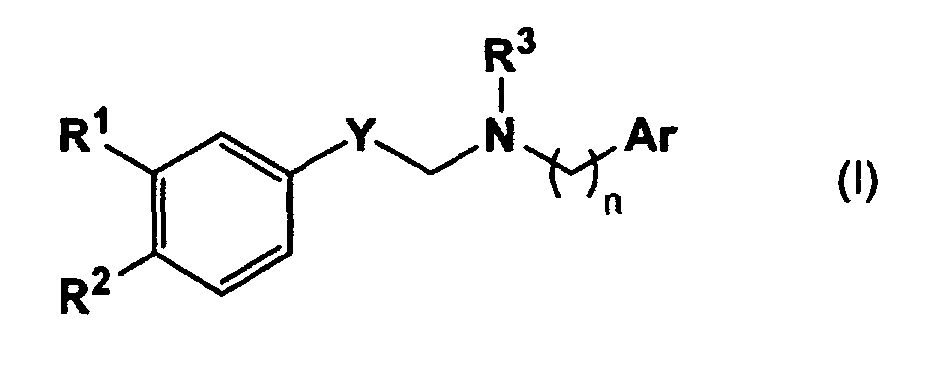
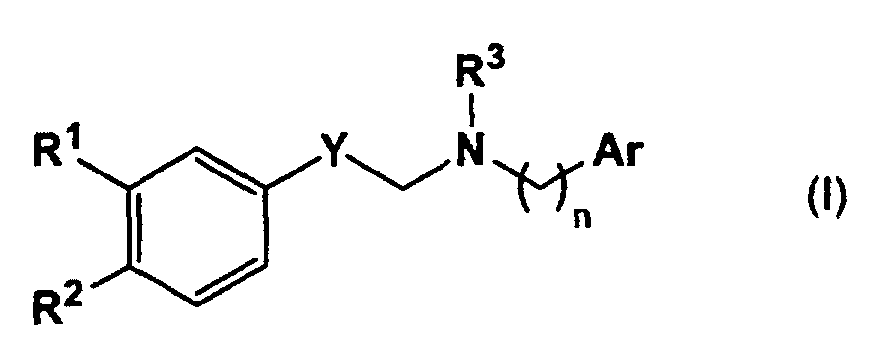
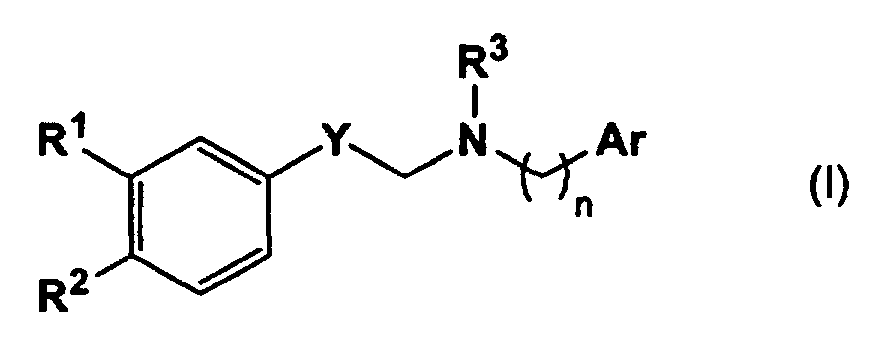
- the inventors of the present invention conducted intensive studies to achieve the foregoing object. As a result, they found that the compounds represented by the following general formula (I) or salts thereof have inhibitory action against the abscisic acid biosynthesis, and that they were useful as plant growth regulators. The present invention was achieved on the basis of these findings.
- R 1 represents hydrogen atom, hydroxyl group, or an alkoxy group
- R 2 represents hydroxyl group or an alkoxy group which may be substituted
- R 3 represents hydrogen atom or an alkyl group which may be substituted
- n represents 0 or 1
- Ar represents an aryl group which may be substituted or a heteroaryl group which may be substituted or a salt thereof.
- an inhibitor against the abscisic acid biosynthesis which comprises the compound represented by the aforementioned general formula (I) or a salt thereof as an active ingredient; an epoxycarotenoid dioxygenase inhibitor which comprises the compound represented by the aforementioned general formula (I) or a salt thereof as an active ingredient; a plant growth regulator which comprises the compound represented by the aforementioned general formula (I) or a salt thereof as an active ingredient; and a use of the compound represented by the aforementioned general formula (I) or a salt thereof for the manufacture of the aforementioned inhibitor or the aforementioned regulator.
- the present invention further provides a method for inhibiting the abscisic acid biosynthesis in a plant body, which comprises the step of applying the compound represented by the aforementioned general formula (I) or a salt thereof to a plant; a method for inhibiting epoxycarotenoid dioxygenase in a plant body, which comprises the step of applying the compound represented by the aforementioned general formula (I) or a salt thereof to a plant; and a method for regulating plant growth, which comprises the step of applying the compound represented by the aforementioned general formula (I) or a salt thereof to a plant.
- alkoxy group represented by R 1 for example, a linear or branched alkoxy group having 1 to about 6 carbon atoms can be used. Preferably, an alkoxy group such as methoxy group, ethoxy group and n-propoxy group can be used, and more preferably, methoxy group can be used.
- R 1 hydrogen atom or methoxy group is preferred.
- R 2 which has the same definition as the above, methoxy group can preferably be used. When the alkoxy group represented by R 2 is substituted, types, numbers, and substituting positions of substituents are not particularly limited.
- substituents containing oxygen atom such as an alkoxycarbonyl group, carboxyl group and hydroxyl group are preferred.
- R 2 substituents containing oxygen atom such as an alkoxycarbonyl group, carboxyl group and hydroxyl group are preferred.
- R 2 substituents containing oxygen atom such as an alkoxycarbonyl group, carboxyl group and hydroxyl group are preferred.
- R 2 substituents containing oxygen atom such as an alkoxycarbonyl group, carboxyl group and hydroxyl group is preferred.
- R 2 for example, an alkoxycarbonyl-substituted alkoxy group is preferred, and more preferably, methoxycarbonyl-substituted methoxy group can be used.
- R 2 hydroxyl group, methoxy group, or methoxycarbonylmethoxy group is preferred.
- the alkyl group represented by R 3 for example, a linear or branched alkyl group having 1 to about 6 carbon atoms can be used.
- an alkyl group such as methyl group, ethyl group and n-propyl group can be used, and more preferably, methyl group can be used.
- types, numbers, and substituting positions of substituents are not particularly limited.
- substituents containing oxygen atom such as an alkoxycarbonyl group, carboxyl group and hydroxyl group are preferred.
- R 3 hydrogen atom, methyl group, or methoxycarbonylmethyl group is preferred.
- Examples of the aryl group represented by Ar include phenyl group, naphthyl group and the like, and preferably, phenyl group can be used.
- a 5-10 membered heteroaryl group which contains one or more heteroatoms selected from the group consisting of nitrogen atom, oxygen atom, and sulfur atom as the ring constituting atoms can be used. More preferably, a 5- or 6-membered heteroaryl group which contains one or two nitrogen atoms or oxygen atoms as the ring constituting atoms can be used, and further preferably, a 5- or 6-membered heteroaryl group which contains one nitrogen atom or oxygen atom as the ring constituting atom can be used.
- pyridyl group, furyl group or the like is preferred as the heteroaryl group.
- the aryl group or the heteroaryl group represented by Ar is substituted, types, numbers, and substituting positions of substituents are not particularly limited.
- the aryl group or the heteroaryl group is preferably substituted with 1 or about 2 substituents such as hydroxyl groups, alkoxy groups (for example, methoxy group), halogen atoms (for example, fluorine atom, chlorine atom and bromine atom).
- substituents include hydroxyl group, methoxy group, and fluorine atom.
- Ar is phenyl group
- the phenyl group is preferably substituted at the 3- and/or 4-position.
- the compounds represented by the general formula (I) may sometimes have one or more asymmetric carbon atoms depending on the type of the substituent. Accordingly, any optical isomer in an optically pure form based on the one or more asymmetric carbon atoms, any mixture of optical isomers, racemates, diastereoisomers in pure forms, mixtures of the diastereoisomers, and the like fall within the scope of the present invention.
- the compounds represented by the general formula (I) may sometimes exist as base addition salts such as sodium salt and potassium salt, or acid addition salts such as hydrochloride, sulfate and p-toluenesulfonate. Any of these salts falls within the scope of the present invention.
- the compound in a free form or that in a form of a salt may sometimes exist as a hydrate or a solvate, and these substances naturally fall within the scope of the present invention.
- the compound represented by the aforementioned general formula (I) can easily prepared by, for example, condensing the corresponding amine compound with an aldehyde to synthesize an imine, and reducing the synthesized imine with an appropriate reducing agent. Specific examples will be shown in the examples of the specification.
- the condensation can be performed without solvent, and also can advantageously be preformed in suitable combination of an appropriate solvent with an acid catalyst.
- the reducing agent sodium borohydride can be used; however, the reducing agent is not limited thereto.
- the amine generated from the reduction can be modified by, for example, alkylation which is performed by reacting the amine with an appropriate alkyl halide in the presence of a strong base such as sodium hydride.
- the compounds represented by the aforementioned general formula (I) or salts thereof have inhibitory action against the abscisic acid biosynthesis, and are useful as, for example, active ingredients of plant growth regulators.
- the compounds of the present invention or salts thereof can be used as specific inhibitors against epoxycarotenoid dioxygenase.
- plant growth regulation used in this specification should be construed in its broadest sense, including, for example, regulation of plant elongation, pollen growth regulation, retention of flower freshness, enhancement of the plant anti-stress property against stresses such as heat, dryness, coldness, diseases and the like, weed control by regulation of reproduction, suppression of plant retrogradation, control of hypertrophy of root.
- the compounds of the present invention or salts thereof can also be used as, for example, biochemical reagents in the studies for elucidation of the biosynthetic path or the functions of abscisic acid.
- the inhibitor against the abscisic acid biosynthesis, the specific inhibitor against epoxycarotenoid dioxygenase, and the plant growth regulator provided by the present invention can be formulated, for example, as an agricultural composition by using formulation additives well known in the art.
- Forms of the agricultural composition are not particularly limited, and any form that can be used in the art may be chosen.
- compositions in the forms of emulsions, liquids, oils, water soluble powders, wettable powders, flowables, powders, subtilized granules, granules, aerosols, fumigants, pastes and the like can be used.
- the methods for manufacturing the agricultural composition are also not particularly limited, and any method available to those skilled in the art can be appropriately employed.
- the active ingredient of the inhibitors of the present invention two or more of the compounds represented by the aforementioned general formula (I) or salts thereof may be used in combination. Further, other active ingredients of agricultural chemicals such as insecticides, fungicides, insecticidal and fungicidal agents, herbicides and the like may be mixed.
- Methods of application and doses of the inhibitors of the present invention can be suitably chosen by those skilled in the art depending on conditions including a purpose of application, a dosage form, a plot to be treated and the like. The concentration to obtain the optimal action can properly be decided by those skilled in the art by referring to the following examples.
- Example 2 Compound SY94 [ ⁇ (3,4-dimethoxy-benzyl)-[2-(4-methoxycarbonylmethoxyphenyl)-ethyl]-amino ⁇ -acetic acid methyl ester]
- Inhibitory tests against pore closing were carried out by using the aforementioned compounds.
- plants in the state that their pores are open are treated with the compounds, and closings of the pores are examined when the plants are transferred into a mannose solution of high concentration to make the pores closed.
- Pore closing is caused by the effect of abscisic acid biosynthesized in the body of a plant that has detected the change of the mannose concentration.
- the test was carried out according to the method described in the literature of Plant Physiology (1992) 99, 1258-1260 and by using spinach as a material.
- NCED inhibitory activity of the compounds of the present invention was studied. As a result, each of the compounds, SY109, 87, 94, 99, 96, 97, and 95, was found to have 30 to 100% NCED inhibitory activity at the concentration of 100 ⁇ M.
- the compounds of the present invention were applied to plant bodies. Hypocotyls of Mung bean on the 6th-day after seeding, that were grown at 25°C, were cut in water with razor, and the hypocotyl parts were soaked by 2 cm in solutions of the compounds at a given concentration. On the 6th day after the soaking, the lengths of the roots were measured. The following results were shown as an average length per root. Compound Length (cm) SY87 0.6 SY88 >0.1 SY90 >0.1 SY94 2.1 SY95 0.6 SY96 1.5 SY97 0.7 SY99 0.4 SY106 >0.1 SY107 >0.1 SY109 1.5 Control >0.1
- the compounds of the present invention have inhibitory action against the abscisic acid biosynthesis, and are useful as plant growth regulators for promoting plant growth, taking root, germination and the like.
Landscapes
- Chemical & Material Sciences (AREA)
- Organic Chemistry (AREA)
- Life Sciences & Earth Sciences (AREA)
- Dentistry (AREA)
- Wood Science & Technology (AREA)
- Plant Pathology (AREA)
- Health & Medical Sciences (AREA)
- Engineering & Computer Science (AREA)
- Agronomy & Crop Science (AREA)
- General Health & Medical Sciences (AREA)
- Pest Control & Pesticides (AREA)
- Zoology (AREA)
- Environmental Sciences (AREA)
- Organic Low-Molecular-Weight Compounds And Preparation Thereof (AREA)
- Agricultural Chemicals And Associated Chemicals (AREA)
- Pyridine Compounds (AREA)
- Cultivation Of Plants (AREA)
- Furan Compounds (AREA)
Abstract
Description
| Compound No. | R1 | R2 | Y | R3 | n | Ar |
| SY87 | CH3O- | CH3O- | -CH=CH- | H- | 0 | Ph(4-OCH3) |
| SY88 | H- | HO- | -CH2- | H- | 1 | Ph(3,4-di-OCH3) |
| SY90 | H- | HO- | -CH2- | H- | 1 | Ph(3,4-di-OH) |
| SY94 | H- | CH3O-CO-CH2-O- | -CH2- | CH3O-CO-CH2- | 1 | Ph(3,4-di-OCH3) |
| SY95 | CH3O- | CH3O- | -CH=CH- | H- | 1 | Ph(4-F) |
| SY96 | H- | CH3O- | -CH2- | CH3- | 1 | Ph(3,4-di-OCH3) |
| SY97 | CH3O- | CH3O- | -CH=CH- | CH3O-CO-CH2- | 1 | Ph(4-F) |
| SY99 | CH3O- | CH3O- | -CH=CH- | CH3- | 1 | Ph(4-F) |
| SY106 | H- | HO- | -CH2- | H- | 1 | 4-Pyridyl |
| SY107 | H- | HO- | -CH2- | H- | 1 | 3-Furyl |
| SY109 | H- | HO- | -CH2- | H- | 1 | Ph(2-OH) |
1H-NMR (MeOH-d6) δ 7.25 (1H, s), 7.36-7.23 (2H, m), 7.06 (2H, d), 6.85 (2H, m), 6.72 (2H, d), 4.90 (2H, br s), 3.82 (2H, t), 2.92 (2H, t)
1H-NMR (CDCl3+Acetone-d6) δ 7.08 (1H, t), 6.97 (2H, d), 6.91 (2H, d), 6.74 (2H, d), 6.76-6.67 (2H, m), 3.91 (2H, s), 2.87 (2H, t), 2.72 (2H, t)
1H-NMR (Acetone-d6) δ 8.14 (1H, s), 7.46 (1H, s), 7.19 (1H, d), 7.09 (2H, d), 6.99 (1H, d), 6.77 (2H, d), 3.86 (3H, s), 3.85 (3H, s), 3.74 (2H, t), 2.87 (2H, t)
1H-NMR (CDCl3+Acetone-d6) δ 6.98 (2H, d), 6.73 (1H, s), 6.67-6.63 (4H, m), 3.73 (3H, s), 3.72 (3H, s), 3.61 (2H, s), 2.75-2.70 (2H, m), 2.64-2.60 (2H, m)
1H-NMR (CDCl3) δ 7.08 (2H, d), 6.87 (1H, s), 6.78 (2H, d), 6.76 (2H, m), 4.59 (2H, s), 3.85 (3H, s), 3.83 (3H, s), 3.78 (3H, s), 3.75 (2H, s), 3.67 (3H, s), 3.35 (2H, s), 2.80-2.85 (2H, m), 2.76-2.71 (2H, m)
Compound SY72 [4-{[2-(4-hydroxy-phenyl)-ethylimino]-methyl}-benzene-1,2-diol
1H-NMR (Acetone-d6+DMSO-d6) δ 8.03 (1H, s), 7.31 (1H, s), 7.06 (2H, d), 6.90 (1H, d), 6.80 (1H, d), 6.72 (2H, d), 3.68 (2H, t), 3.15 (3H, br s), 2.82 (2H, t)
Compound SY76 [3-(3,4-dimethoxy-phenyl)-prop-2-ene-1-ol]
1H-NMR (Acetone-d6) δ 7.08 (1H, s), 7.07-6.87 (2H, m), 6.54 (1H, d), 6.29 (1H, td), 4.23 (2H, d), 3.84 (3H, s), 3.80 (3H, s), 3.05(1H, br s)
Compound SY78 [3-(3,4-dimethoxy-phenyl)-propenal]
1H-NMR (CDCl3) δ 7.44 (1H, d), 7.17 (1H, d), 7.09 (1H, s), 6.93 (1H, d), 6.63 (1H, dd), 3.96 (3H, s), 3.95 (3H, s), 9.68 (1H, d)
Compound SY83 [[3-(3,4-dimethoxy-phenyl)-allylidene]-(4-methoxy-phenyl)-amine]
1H-NMR (Acetone-d6) δ 8.37 (1H, s), 7.33 (1H, s), 7.32-7.15 (4H, m), 7.05-6.94 (4H, m), 3.93 (3H, s), 3.87 (3H, s), 3.83 (3H, s)
Compound SY93 [[3-(3,4-dimethoxy-phenyl)-allylidene]-(4-fluoro-benzyl)-amine]
1H-NMR (Acetone-d6) δ 8.19 (1H, d), 7.42-7.26 (3H, m), 7.15-6.83 (6H, m), 4.67 (2H, s), 3.89 (3H, s), 3.85 (3H, m)
Compound SY104 [4-{2-[(pyridin-4-ylmethylene)-amino]-ethyl}-phenol]
1H-NMR (Acetone-d6) δ 8.68 (2H, d), 8.26 (1H, s), 7.67 (2H, d), 7.09 (2H, d), 6.76 (2H, d), 3.86 (2H, t), 2.94 (1H, br s), 2.91 (2H, t)
Compound SY105 [4-{2-[(furan-3-ylmethylene)-amino]-ethyl}-phenol]
1H-NMR (Acetone-d6) δ 8.19 (1H, s), 7.91 (1H, s), 7.59 (1H, s), 7.06 (2H, d), 6.81 (1H, s), 6.75 (2H, d), 3.71 (2H, t), 2.89 (1H, br s), 2.843 (2H, t)
Compound SY87 [[3-(3,4-dimethoxy-phenyl)-allyl]-(4-methoxy-phenyl)-amine]
1H-NMR (MeOH-d6) δ 7.44 (2H, d), 7.14-6.94 (5H, m), 6.78 (1H, d), 6.19 (1H, td), 4.89 (1H, br s), 4.14·(2H, d), 3.87 (9H, s)
Compound SY90 [4-{[2-(4-hydroxy-phenyl)-ethylamino]-methyl}-benzene-1,2-diol]
1H-NMR (MeOH-d6) δ 7.09 (2H, d), 7.01 (1H, s), 6.87 (2H, m), 6.79 (2H, d), 4.95 (4H, br s), 4.06 (2H, s), 3.17 (2H, m), 2.81 (2H, m)
Compound SY95 [[3-(3,4-dimethoxy-phenyl)-allyl]-(4-fluoro-benzyl)-amine]
1H-NMR (MeOH-d6) δ 7.58 (2H, m), 7.27-7.05 (4H, m), 6.97 (1H, d), 6.84 (1H,d), 6.20 (1H, td), 4.89 (1H, br s), 4.26 (2H, s), 3.88 (3H, s), 3.87 (3H, s), 3.84 (2H, d)
Compound SY96 [(3,4-dimethoxy-benzyl)-[2-(4-methoxy-phenyl)-ethyl]-methyl-amine]
1H-NMR (CDCl3) δ 7.12 (2H, d), 7.86 (2H,d), 6.86 (3H, m), 3.89 (3H, s), 3.87 (3H, m), 3.80 (3H, s), 3.51 (2H, s), 2.82-2.77 (2H, m), 2.65-2.60 (2H, m), 2.30 (3H, s)
Compound SY97 [[[3-(3,4-dimethoxy-phenyl)-allyl]-(4-fluoro-benzyl)-amino]-acetic acid methyl ester]
1H-NMR (CDCl3) δ 7.34 (2H, m), 7.03-6.87 (4H, m), 6.79 (1H, d), 6.47 (1H, d), 6.22-6.12 (1H, td), 3.89 (3H, s), 3.86 (3H, s), 3.77 (2H, s), 3.66 (3H, s), 3.38 (2H, d), 3.34 (2H, s)
Compound SY99 [[3-(3,4-dimethoxy-phenyl)-allyl]-(4-fluoro-benzyl)-methyl-amine]
1H-NMR (CDCl3) δ 7.31 (2H, m), 7.05-6.97 (4H, m), 6.82 (1H, d), 6.48 (1H, d), 6.22-6.12 (1H, td), 3.90 (3H, s), 3.88 (3H, s), 3.52 (2H, s), 3.17 (2H, d), 2.23 (3H, s)
Compound SY106 [4-{2-[(pyridin-4-ylmethyl)-2-amino]-ethyl}-phenol]
1H-NMR (Acetone-d6) δ 8.47 (2H, d), 7.33 (2H, d), 7.05 (2H, d), 6.75 (2H, d), 3.83 (2H, s), 2.88 (2H, br s), 2.82-2.77 (2H, m), 2.74-2.69 (2H, m)
Compound SY107 [4-{2-[(furan-3-ylmethyl)-amino]-ethyl}-phenol]
1H-NMR (Acetone-d6) δ 7.45 (2H, d), 7.05 (2H, d), 6.75 (2H, d), 6.42(1H, s), 3.63 (2H, s), 2.90 (2H, br s), 2.81-2.76 (2H, m), 2.72-2.61 (2H, m)
| Compound | Length (cm) |
| SY87 | 0.6 |
| SY88 | >0.1 |
| SY90 | >0.1 |
| SY94 | 2.1 |
| SY95 | 0.6 |
| SY96 | 1.5 |
| SY97 | 0.7 |
| SY99 | 0.4 |
| SY106 | >0.1 |
| SY107 | >0.1 |
| SY109 | 1.5 |
| Control | >0.1 |
| Compound | Germination rate (%) |
| SY87 | 40 |
| SY88 | 8 |
| SY90 | 12 |
| SY94 | 52 |
| SY95 | 29 |
| SY96 | 21 |
| SY97 | 18 |
| SY99 | 15 |
| SY106 | 9 |
| SY107 | 10 |
| SY109 | 35 |
| Control | 9 |
Claims (4)
- A compound represented by the following general formula (I) or a salt thereof:wherein R1 represents hydrogen atom, hydroxyl group, or an alkoxy group; R2 represents hydroxyl group or an alkoxy group which may be substituted; R3 represents hydrogen atom or an alkyl group which may be substituted; Y represents -CH=CH- or -CH2-; n represents 0 or 1; Ar represents an aryl group which may be substituted or a heteroaryl group which may be substituted.

- An inhibitor against an abscisic acid biosynthesis which comprises the compound represented by the general formula (I) according to claim 1 or a salt thereof as an active ingredient.
- An epoxycarotenoid dioxygenase inhibitor which comprises the compound represented by the general formula (I) according to claim 1 or a salt thereof as an active ingredient.
- A plant growth regulator which comprises the compound represented by the general formula (I) according to claim 1 or a salt thereof as an active ingredient.
Applications Claiming Priority (3)
| Application Number | Priority Date | Filing Date | Title |
|---|---|---|---|
| JP2001309508A JP4029960B2 (en) | 2001-10-05 | 2001-10-05 | Abscisic acid biosynthesis inhibitor |
| JP2001309508 | 2001-10-05 | ||
| PCT/JP2002/010364 WO2003031389A1 (en) | 2001-10-05 | 2002-10-04 | Abscisic acid biosynthesis inhibitor |
Publications (2)
| Publication Number | Publication Date |
|---|---|
| EP1439165A1 true EP1439165A1 (en) | 2004-07-21 |
| EP1439165A4 EP1439165A4 (en) | 2005-11-09 |
Family
ID=19128646
Family Applications (1)
| Application Number | Title | Priority Date | Filing Date |
|---|---|---|---|
| EP02800771A Withdrawn EP1439165A4 (en) | 2001-10-05 | 2002-10-04 | INHIBITOR OF BIOSYNTHESIS OF ABSCISSIC ACID |
Country Status (5)
| Country | Link |
|---|---|
| US (2) | US7098365B2 (en) |
| EP (1) | EP1439165A4 (en) |
| JP (1) | JP4029960B2 (en) |
| CA (1) | CA2462689A1 (en) |
| WO (1) | WO2003031389A1 (en) |
Cited By (1)
| Publication number | Priority date | Publication date | Assignee | Title |
|---|---|---|---|---|
| CN102344398A (en) * | 2003-12-18 | 2012-02-08 | 因赛特公司 | 3-cycloalkylaminopyrrolidine derivatives as modulators of chemokine receptors |
Families Citing this family (7)
| Publication number | Priority date | Publication date | Assignee | Title |
|---|---|---|---|---|
| JP2006117608A (en) * | 2004-10-25 | 2006-05-11 | Institute Of Physical & Chemical Research | Rice disease protectant |
| CA2647900C (en) * | 2008-12-23 | 2017-05-16 | National Research Council Of Canada | Inhibitors of a 9-cis-epoxycarotenoid dioxygenase |
| JP5337838B2 (en) * | 2011-04-28 | 2013-11-06 | 日本製紙株式会社 | Adventitious root formation promoter, rooting medium containing the adventitious root formation promoter, and method for producing clone seedling using the adventitious root formation promoter |
| JP5866710B2 (en) * | 2012-02-04 | 2016-02-17 | 国立大学法人 千葉大学 | Plant drying tolerance imparting method and plant drying tolerance imparting agent used therefor |
| US10048420B2 (en) | 2012-12-21 | 2018-08-14 | Merck Patent Gmbh | Reactive mesogens |
| US10126877B1 (en) * | 2017-02-01 | 2018-11-13 | Sentons Inc. | Update of reference data for touch input detection |
| CN111387185A (en) * | 2020-05-08 | 2020-07-10 | 兰州大学 | Application of naftifine analogue in preventing and treating agricultural plant diseases |
Family Cites Families (11)
| Publication number | Priority date | Publication date | Assignee | Title |
|---|---|---|---|---|
| DE2716943C2 (en) | 1976-04-28 | 1986-08-14 | Sandoz-Patent-GmbH, 7850 Lörrach | N- (3-Phenyl-2-propenyl) -N- (1-naphthylmethyl) amines, their use and preparation |
| HU175454B (en) * | 1977-07-25 | 1980-08-28 | Chinoin Gyogyszer Es Vegyeszet | Process for producing new saturated and partly saturated n-acyl-pyrrol-2,5-dion derivatives |
| US4282551A (en) * | 1979-04-11 | 1981-08-04 | Hitachi, Ltd. | PCM Recording and reproducing apparatus |
| FI832128A0 (en) | 1983-06-14 | 1983-06-14 | Farmos Oy | FOERFARANDE FOER FRAMSTAELLNING AV EN AMIN |
| DE3801113A1 (en) * | 1987-07-23 | 1989-02-02 | Bayer Ag | SUBSTITUTED TRIAZINE |
| HUT58201A (en) * | 1989-03-03 | 1992-02-28 | Sandoz Ag | Process for producing antiphlogistic pharmaceutical composition containing naphtalene-methan-amino derivatives |
| JP3159995B2 (en) * | 1990-12-17 | 2001-04-23 | 弘義 日高 | Toluidine derivative and method for producing the same |
| US5399564A (en) | 1991-09-03 | 1995-03-21 | Dowelanco | N-(4-pyridyl or 4-quinolinyl) arylacetamide and 4-(aralkoxy or aralkylamino) pyridine pesticides |
| DE19522137A1 (en) * | 1995-06-19 | 1997-01-02 | Hoechst Schering Agrevo Gmbh | 2-Amino-1,3,5-triazines, process for their preparation and their use as herbicides and plant growth regulators |
| GB9519268D0 (en) * | 1995-09-21 | 1995-11-22 | Chiroscience Ltd | Preparation of alkaloids |
| JPH10251234A (en) * | 1997-03-10 | 1998-09-22 | Tokuyama Corp | Imidazolidine oxide compound and method for producing the same |
-
2001
- 2001-10-05 JP JP2001309508A patent/JP4029960B2/en not_active Expired - Fee Related
-
2002
- 2002-10-04 CA CA002462689A patent/CA2462689A1/en not_active Abandoned
- 2002-10-04 US US10/490,214 patent/US7098365B2/en not_active Expired - Fee Related
- 2002-10-04 WO PCT/JP2002/010364 patent/WO2003031389A1/en not_active Ceased
- 2002-10-04 EP EP02800771A patent/EP1439165A4/en not_active Withdrawn
-
2006
- 2006-02-27 US US11/362,415 patent/US7432228B2/en not_active Expired - Fee Related
Cited By (2)
| Publication number | Priority date | Publication date | Assignee | Title |
|---|---|---|---|---|
| CN102344398A (en) * | 2003-12-18 | 2012-02-08 | 因赛特公司 | 3-cycloalkylaminopyrrolidine derivatives as modulators of chemokine receptors |
| CN102344398B (en) * | 2003-12-18 | 2015-02-25 | 因赛特公司 | 3-cycloalkylaminopyrrolidine derivatives as modulators of chemokine receptors |
Also Published As
| Publication number | Publication date |
|---|---|
| US20060148650A1 (en) | 2006-07-06 |
| US20050014651A1 (en) | 2005-01-20 |
| JP4029960B2 (en) | 2008-01-09 |
| CA2462689A1 (en) | 2003-04-17 |
| EP1439165A4 (en) | 2005-11-09 |
| US7098365B2 (en) | 2006-08-29 |
| US7432228B2 (en) | 2008-10-07 |
| JP2003113148A (en) | 2003-04-18 |
| WO2003031389A1 (en) | 2003-04-17 |
Similar Documents
| Publication | Publication Date | Title |
|---|---|---|
| US3989737A (en) | 2-Cyclohexene-1-one derivatives | |
| US5141941A (en) | Aralkylamine derivatives, and fungicides containing the same | |
| US4620867A (en) | 1-carbalkoxyalkyl-3-aryloxy-4-(substituted-2'-carboxyphenyl)-azet-2-ones as plant growth regulators and herbicides | |
| EP0239414B1 (en) | N-benzyl-2-(4-fluoro-3-trifluoromethylphenoxy) butanoic amide and herbicidal composition containing the same | |
| HU227487B1 (en) | Fungicidal compositions based on (n-phenylacetyl-n-2,6-xylyl)methyl alaninate (benalaxyl), use thereof | |
| JPH039899B2 (en) | ||
| CN103145700A (en) | 2-(2-benzyl hydrazono)-4-(benzofuran-5-yl) thiazole and preparation method and application thereof | |
| US7432228B2 (en) | Inhibitor against biosynthesis of abscisic acid | |
| US5438065A (en) | Diaminoethylene compounds | |
| HU198372B (en) | Insecticide compositions containing carbaminic acid derivatives as active components and process for producing th the active components | |
| US4517367A (en) | Azolyl-pentene derivatives and biocidal compositions containing the same | |
| JPS59139346A (en) | Optically active n-(1'-methyl-2'-methoxyethyl)- n-chloroacetyl-2,6-dimethylaniline, manufacture and herbicidal composition | |
| CN104557888B (en) | Application of furan phenol allyl alcohol derivative used as herbicide | |
| JP6902748B2 (en) | Plant growth regulator | |
| US6642179B2 (en) | Inhibition of vegetative growth | |
| EP1104756A1 (en) | Brassionosteroid biosynthesis inhibitors | |
| JP3762949B2 (en) | Brassinosteroid biosynthesis inhibitor | |
| US4221582A (en) | Plant growth regulating compounds, compositions and methods | |
| HU209801B (en) | Fungicidal composition containing aryl-propyl- amines and process for preparation of the active ingredient | |
| US3988328A (en) | 5-Amino-2,3,7,8-tetrathiaalkane-1,9-dioic acids, esters and salts | |
| US4744813A (en) | Herbicidal imidazolidine-2-ones and methods of use | |
| US3972899A (en) | α-Pyrone derivatives | |
| EP0847396B1 (en) | 3(2h)-furanone derivatives | |
| JP5900877B2 (en) | Amide compounds | |
| KR810000834B1 (en) | Method for preparing 3-phenyl-5-substituted-4 (1H) -pyridone (thione) |
Legal Events
| Date | Code | Title | Description |
|---|---|---|---|
| PUAI | Public reference made under article 153(3) epc to a published international application that has entered the european phase |
Free format text: ORIGINAL CODE: 0009012 |
|
| 17P | Request for examination filed |
Effective date: 20040414 |
|
| AK | Designated contracting states |
Kind code of ref document: A1 Designated state(s): AT BE BG CH CY CZ DE DK EE ES FI FR GB GR IE IT LI LU MC NL PT SE SK TR |
|
| A4 | Supplementary search report drawn up and despatched |
Effective date: 20050928 |
|
| 17Q | First examination report despatched |
Effective date: 20061228 |
|
| 17Q | First examination report despatched |
Effective date: 20061228 |
|
| GRAP | Despatch of communication of intention to grant a patent |
Free format text: ORIGINAL CODE: EPIDOSNIGR1 |
|
| STAA | Information on the status of an ep patent application or granted ep patent |
Free format text: STATUS: THE APPLICATION IS DEEMED TO BE WITHDRAWN |
|
| 18D | Application deemed to be withdrawn |
Effective date: 20090929 |