EP1439158A1 - Method of depolymerizing aromatic polycarbonate - Google Patents
Method of depolymerizing aromatic polycarbonate Download PDFInfo
- Publication number
- EP1439158A1 EP1439158A1 EP02777926A EP02777926A EP1439158A1 EP 1439158 A1 EP1439158 A1 EP 1439158A1 EP 02777926 A EP02777926 A EP 02777926A EP 02777926 A EP02777926 A EP 02777926A EP 1439158 A1 EP1439158 A1 EP 1439158A1
- Authority
- EP
- European Patent Office
- Prior art keywords
- carbon atoms
- reaction
- aromatic
- carbonate
- bisphenol
- Prior art date
- Legal status (The legal status is an assumption and is not a legal conclusion. Google has not performed a legal analysis and makes no representation as to the accuracy of the status listed.)
- Withdrawn
Links
- NQRYJNQNLNOLGT-UHFFFAOYSA-N C1CCNCC1 Chemical compound C1CCNCC1 NQRYJNQNLNOLGT-UHFFFAOYSA-N 0.000 description 1
- 0 CC(C)(C)*(Oc1ccc(C(C)(C)c(cc2)ccc2OC(C)(C)C)cc1)=O Chemical compound CC(C)(C)*(Oc1ccc(C(C)(C)c(cc2)ccc2OC(C)(C)C)cc1)=O 0.000 description 1
Images
Classifications
-
- C—CHEMISTRY; METALLURGY
- C08—ORGANIC MACROMOLECULAR COMPOUNDS; THEIR PREPARATION OR CHEMICAL WORKING-UP; COMPOSITIONS BASED THEREON
- C08J—WORKING-UP; GENERAL PROCESSES OF COMPOUNDING; AFTER-TREATMENT NOT COVERED BY SUBCLASSES C08B, C08C, C08F, C08G or C08H
- C08J11/00—Recovery or working-up of waste materials
- C08J11/04—Recovery or working-up of waste materials of polymers
- C08J11/10—Recovery or working-up of waste materials of polymers by chemically breaking down the molecular chains of polymers or breaking of crosslinks, e.g. devulcanisation
-
- C—CHEMISTRY; METALLURGY
- C08—ORGANIC MACROMOLECULAR COMPOUNDS; THEIR PREPARATION OR CHEMICAL WORKING-UP; COMPOSITIONS BASED THEREON
- C08G—MACROMOLECULAR COMPOUNDS OBTAINED OTHERWISE THAN BY REACTIONS ONLY INVOLVING UNSATURATED CARBON-TO-CARBON BONDS
- C08G64/00—Macromolecular compounds obtained by reactions forming a carbonic ester link in the main chain of the macromolecule
- C08G64/42—Chemical after-treatment
-
- C—CHEMISTRY; METALLURGY
- C07—ORGANIC CHEMISTRY
- C07C—ACYCLIC OR CARBOCYCLIC COMPOUNDS
- C07C37/00—Preparation of compounds having hydroxy or O-metal groups bound to a carbon atom of a six-membered aromatic ring
- C07C37/01—Preparation of compounds having hydroxy or O-metal groups bound to a carbon atom of a six-membered aromatic ring by replacing functional groups bound to a six-membered aromatic ring by hydroxy groups, e.g. by hydrolysis
- C07C37/055—Preparation of compounds having hydroxy or O-metal groups bound to a carbon atom of a six-membered aromatic ring by replacing functional groups bound to a six-membered aromatic ring by hydroxy groups, e.g. by hydrolysis the substituted group being bound to oxygen, e.g. ether group
- C07C37/0555—Preparation of compounds having hydroxy or O-metal groups bound to a carbon atom of a six-membered aromatic ring by replacing functional groups bound to a six-membered aromatic ring by hydroxy groups, e.g. by hydrolysis the substituted group being bound to oxygen, e.g. ether group being esterified hydroxy groups
-
- C—CHEMISTRY; METALLURGY
- C07—ORGANIC CHEMISTRY
- C07C—ACYCLIC OR CARBOCYCLIC COMPOUNDS
- C07C68/00—Preparation of esters of carbonic or haloformic acids
- C07C68/06—Preparation of esters of carbonic or haloformic acids from organic carbonates
-
- C—CHEMISTRY; METALLURGY
- C08—ORGANIC MACROMOLECULAR COMPOUNDS; THEIR PREPARATION OR CHEMICAL WORKING-UP; COMPOSITIONS BASED THEREON
- C08J—WORKING-UP; GENERAL PROCESSES OF COMPOUNDING; AFTER-TREATMENT NOT COVERED BY SUBCLASSES C08B, C08C, C08F, C08G or C08H
- C08J2369/00—Characterised by the use of polycarbonates; Derivatives of polycarbonates
-
- Y—GENERAL TAGGING OF NEW TECHNOLOGICAL DEVELOPMENTS; GENERAL TAGGING OF CROSS-SECTIONAL TECHNOLOGIES SPANNING OVER SEVERAL SECTIONS OF THE IPC; TECHNICAL SUBJECTS COVERED BY FORMER USPC CROSS-REFERENCE ART COLLECTIONS [XRACs] AND DIGESTS
- Y02—TECHNOLOGIES OR APPLICATIONS FOR MITIGATION OR ADAPTATION AGAINST CLIMATE CHANGE
- Y02P—CLIMATE CHANGE MITIGATION TECHNOLOGIES IN THE PRODUCTION OR PROCESSING OF GOODS
- Y02P20/00—Technologies relating to chemical industry
- Y02P20/50—Improvements relating to the production of bulk chemicals
- Y02P20/54—Improvements relating to the production of bulk chemicals using solvents, e.g. supercritical solvents or ionic liquids
-
- Y—GENERAL TAGGING OF NEW TECHNOLOGICAL DEVELOPMENTS; GENERAL TAGGING OF CROSS-SECTIONAL TECHNOLOGIES SPANNING OVER SEVERAL SECTIONS OF THE IPC; TECHNICAL SUBJECTS COVERED BY FORMER USPC CROSS-REFERENCE ART COLLECTIONS [XRACs] AND DIGESTS
- Y02—TECHNOLOGIES OR APPLICATIONS FOR MITIGATION OR ADAPTATION AGAINST CLIMATE CHANGE
- Y02W—CLIMATE CHANGE MITIGATION TECHNOLOGIES RELATED TO WASTEWATER TREATMENT OR WASTE MANAGEMENT
- Y02W30/00—Technologies for solid waste management
- Y02W30/50—Reuse, recycling or recovery technologies
- Y02W30/62—Plastics recycling; Rubber recycling
Definitions
- the present invention relates to a method for depolymerization of an aromatic polycarbonate. More specifically, it relates to a method of depolymerizing an aromatic polycarbonate to recover effective components such as an aromatic bisphenol.
- Aromatic polycarbonate resins are materials of extremely high added value used for various applications such as lenses, compact disks, construction materials, auto parts, the chassis of OA equipment and camera bodies because they have high transparency, excellent optical properties and strong physical properties. Therefore, demand for the above resins is growing. After these products are used, most of them are burnt or buried in the ground as waste. This causes not only the waste of resources but also global-scale social problems such as the pollution of environment and the discharge of carbonic acid gas. Therefore, a so-called chemical recycling method for depolymerizing an aromatic polycarbonate resin which becomes waste and recycling it as a monomer is strongly desired. However, several methods have been proposed up till now but an effective method has yet to be found.
- JP-B 39-19159 a method of hydrolyzing an aromatic polycarbonate in the presence of a nitrogen-containing compound such as ammonia water to obtain bisphenol A
- JP-B 39-28648 a method of reacting an aromatic polycarbonate with an alcohol in the presence of an ester exchange catalyst to obtain bisphenol A and a carbonic acid diester corresponding to the used alcohol
- JP-B 39-28648 a method of hydrolyzing an aromatic polycarbonate using an alkali aqueous solution to obtain bisphenol A
- JP-B 40-16536 a method of depolymerizing an aromatic polycarbonate using a polar neutral solvent such as dimethyl sulfoxide and a hydroxy compound
- JP-A 4-505930 the term "JP-A” as used herein means an "unexamined published Japanese patent application”
- JP-B 6-4549 proposes a method of depolymerizing an aromatic polycarbonate in a polar neutral solvent in the presence of an alkoxide or hydroxide catalyst.
- JP-A 5-255153 discloses a method of reacting an aromatic polycarbonate with an alcohol in the presence of o-dichlorobenzene as a solvent and a tin compound as a catalyst in a distillation column.
- depolymerization is carried out at a relatively low temperature without using a pressure reactor and the carbonyl component is obtained as a carbonic acid ester such as dimethyl carbonate together with a bisphenol at the same time.
- a catalyst is needed and a higher reaction rate is required to carry out depolymerization economically.
- the depolymerization reaction of an aromatic polycarbonate using an aliphatic monohydric alcohol proceeds more easily than a hydrolytic reaction using water, the carbonyl component is recovered as a dialkyl carbonate, and the possibility of a reverse reaction (polymerization reaction) which is seen in depolymerization using a phenol is low. Therefore, the above method is considered as one of the most preferred depolymerization methods.
- the depolymerization of an aromatic polycarbonate using a monohydric alcohol is mainly carried out in the presence of a solvent and a catalyst at normal pressure or a low pressure and a sufficiently high reaction rate is not obtained.
- the method cannot be carried out on an industrial scale because an azeotropic mixture of the monohydric alcohol and the formed dialkyl carbonate is formed and the separation and purification of these components are difficult.
- first depolymerization method comprises reacting an aromatic polycarbonate with at least one hydroxy compound selected from the group consisting of water, an aliphatic alcohol having 1 to 6 carbon atoms and a phenol which may be substituted by a hydrocarbon group having 1 to 10 carbon atoms in the critical fluid of carbon dioxide.
- a method for depolymerization of an aromatic polycarbonate (may be referred to as "second depolymerization method" hereinafter) which comprises reacting an aromatic polycarbonate with at least one critical fluid selected from the group consisting of an aliphatic alcohol having 1 to 6 carbon atoms and a phenol which may be substituted by a hydrocarbon group having 1 to 10 carbon atoms.
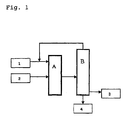
- Fig. 1 is a diagram for explaining the steps of a method which is carried out in Example 1.
- the aromatic polycarbonate to be depolymerized in the present invention comprises a carbonic acid ester of an aromatic bisphenol as a recurring unit.
- the aromatic bisphenol include dihydroxy benzene, dihydroxybiphenyl, dihydroxydiphenyl ether, dihydroxydiphenyl sulfide, dihydroxydiphenyl sulfone, bis(4-hydroxyphenyl)methane (bisphenol F), 1,1-bis(4-hydroxyphenyl)ethane (bisphenol E), 2,2-bis(4-hydroxyphenyl)propane (bisphenol A), 2,2-bis(4-hydroxy-3-methylphenyl)propane (bisphenol C), 1,1-bis(4-hydroxyphenyl)cyclohexane (bisphenol Z), 3,3,5-trimethyl-1,1-bis(4-hydroxyphenyl)cyclahexane, ⁇ , ⁇ '-bis(4-hydroxyphenyl)diisopropylbenzene (bisphenol M), 9,9-bis(4
- bisphenol A bisphenol Z
- bisphenol M 3,3,5-trimethyl-1,1-bis(4-hydroxyphenyl)cyclohexane, 9,9-bis ⁇ (4-hydroxy-3-methyl)phenyl ⁇ fluorene and YP-90 are preferred, and bisphenol A is particularly preferred.
- the aromatic polycarbonate to be depolymerized in the present invention is obtained by polymerizing or copolymerizing the above bisphenol, and any polymerization method is used.
- any polymerization method is used.
- either the interfacial polymerization method using phosgene or the melt polymerization method using diphenyl carbonate may be used, and the present invention is not limited to these methods.
- the degree of polymerization which differs according to application is generally 5,000 to 200,000.
- the present invention is not limited to the above range if the aromatic polycarbonate is thermoplastic. Since an aromatic polycarbonate which becomes unnecessary and scrapped is depolymerized in the present invention, it may contain impurities according to application. Therefore, these impurities are preferably removed by a predetermined method in advance. For example, in the case of a scrapped optical disk which has a metal compound recording material on a polycarbonate resin substrate as a thin film, the metal compound recording material can be removed by alkali cleaning or the like after grinding as described in JP-A 7-256639. When an aromatic polycarbonate contains insoluble contaminants, they are removed by filtration or the like after molten.
- an aromatic polycarbonate is reacted with at least one hydroxy compound selected from the group consisting of water, an aliphatic alcohol having 1 to 6 carbon atoms and a phenol which may be substituted by a hydrocarbon group having 1 to 10 carbon atoms in the critical fluid of carbon dioxide.
- This reaction can be carried out without adding a catalyst to a reaction system.
- a reaction using water as the hydroxy compound can be represented by the following formula when the aromatic polycarbonate is a bisphenol A-based polycarbonate:
- n is an integer of 20 to 800.
- the carbon dioxide itself is formed in a stoichiometric amount as the reaction product and its existence and introduction do not cause any contamination. It is extremely easily separated from the bisphenol and can be recycled.
- the critical point of carbon dioxide is at a temperature Tc of 31.1°C and a pressure Pc of 7.38 MPa. At a temperature higher than the critical temperature, a critical state that it is not liquefied is maintained at a high pressure.
- the critical point of water is at an extremely high temperature Tc of 374.2°C and at an extremely high pressure Pc of 21.8 MPa. It is known that the movement and diffusion of a material are high in a critical fluid having a density close to that of a liquid like a low-density gas and the dielectric constant thereof becomes small, thereby improving dissolving power and chemical reactivity.
- the aromatic polycarbonate is generally supplied into a reactor after it is ground. It may be supplied after it is molten by heating when the reaction is to be carried out continuously.
- the critical fluid of carbon dioxide can be formed by introducing carbon dioxide into a pressure vessel containing water and an aromatic polycarbonate to be reacted with each other under pressure while stirring and by heating it. Further, a hydrolytic reaction is carried out by maintaining a fixed pressure at a fixed temperature using a pressure control valve at the outlet of the reactor to maintain the density of the critical fluid of carbon dioxide at a constant value, and a product which is soluble in the critical fluid and formed by the reaction can be taken out from the outlet of the pressure control valve continuously.
- a predetermined amount of solid carbon dioxide dry ice
- the pressure vessel is sealed up and heated to form a critical fluid so that the reaction can be carried out therein.
- the reaction can be carried out in the critical fluid having a desired density by controlling the amount of carbon dioxide.
- Water as a reactant may be introduced into the reactor together with the aromatic polycarbonate.
- the raw material aromatic polycarbonate can be easily introduced under pressure continuously like the method in which the aromatic polycarbonate is introduced after it is molten and like carbon dioxide. That is, the raw material polymer, water and carbon dioxide are continuously supplied into the reactor under reaction conditions to carry out the depolymerization reaction of the present invention continuously.
- the amount of water as a reactant is 1 mol or more, preferably 2 mols or more, more preferably 5 mols or more based on 1 mol of the recurring unit of the aromatic polycarbonate.
- the upper limit of the amount is not particularly limited but 50 mols or less, preferably 30 mols or less based on 1 mol of the recurring unit of the aromatic polycarbonate so that the most of the reaction volume is not filled with liquid phase under the reaction conditions.
- a too large amount of water is economically unpreferred when depolymerization is carried out on an industrial scale because of its large latent heat.
- the reaction of the first depolymerization method is carried out at preferably 200° C or more, more preferably 220°C or more.
- the reaction temperature is lower than 200°C, the reaction becomes slow and it takes long to complete the reaction.
- the upper limit of reaction temperature is 350°C, preferably 300° C. The main reason for this is the durability and safety of the reactor.
- the formed bisphenol may be decomposed into phenol or the like disadvantageously.
- the pressure of the reaction system is preferably 7.0 MPa or more, more preferably 7.3 to 35 MPa, particularly preferably 8 to 25 MPa.
- the depolymerization reaction of the aromatic polycarbonate in the critical fluid of carbon dioxide is generally carried out without a catalyst but may be carried out in the presence of a catalyst to accelerate the reaction rate and increase selectivity.
- Catalysts used for the hydrolysis of an ester or an ester exchange reaction are used as the catalyst.
- the catalyst include hydroxides and salts of alkali metals and alkali earth metals, and oxides and salts of zinc, germanium, tin, lead, titanium, zirconium, antimony and rare earth metals.
- aromatic dihydroxy compound aromatic bisphenol which is a product formed after the reaction and a monomer of the aromatic polycarbonate is separated as follows, for example, after the depolymerization reaction of the present invention and purified, thus making possible recycling from waste which is the object of the present invention.
- a bisphenol of interest may be obtained through crystallization by cooling the reaction product directly or further adding a suitable solvent.
- the present invention can be used as a separation/purification method. This method is effective according to the types of impurities.
- Recycling of the bisphenol may also be accomplished by extracting and separating the bisphenol from the reaction product using a solvent which selectively dissolves the bisphenol and purifying the separated bisphenol by distillation, crystallization or the like.
- This solvent is identical to the above organic solvent.
- a reaction using an aliphatic alcohol having 1 to 6 carbon atoms as the hydroxy compound can be expressed by the following formula when the aromatic polycarbonate is a bisphenol A-based polycarbonate:
- R 1 is an alkyl group having 1 to 6 carbon atoms, and n is an integer of 20 to 800.
- This reaction is carried out by reacting the aromatic polycarbonate with the aliphatic alcohol having 1 to 6 carbon atoms in the critical fluid of carbon dioxide at a temperature of 150°C or more to produce an aromatic bisphenol and a di (alkyl having 1 to 6 carbon atoms) carbonate which are constituent components of the aromatic polycarbonate.
- Examples of the aliphatic alcohol having 1 to 6 carbon atoms include methanol, ethanol, propanol, butanol and hexanol. Out of these, methanol and ethanol are preferred, and methanol is the most preferred.
- the amount of the aliphatic alcohol having 1 to 6 carbon atoms is preferably 1 to 500 mols, more preferably 2 to 100 mols, particularly preferably 5 to 20 mols based on 1 mol of the recurring unit of the aromatic polycarbonate.
- the depolymerization reaction of the aromatic polycarbonate in the critical fluid of carbon dioxide is carried out by reacting the aromatic polycarbonate with the aliphatic alcohol under pressure at a temperature of 150°C or more. It is carried out at the above temperature and a pressure close to the steam pressure of an alcohol using a closed vessel, preferably a reaction temperature of 200°C or more, more preferably 150°C or more and 350°C or less.
- a reaction temperature is lower than 150°C, the reaction becomes slow and it takes long to complete the reaction disadvantageously.
- a side reaction such as alkylation may occur disadvantageously.
- the reaction temperature is particularly preferably 220 to 280° C, including the critical temperature of an alcohol.
- the pressure of the reaction system is preferably 7.0 MPa or more, more preferably 7.3 to 35 MPa, particularly preferably 8 to 25 MPa.
- the aromatic bisphenol and the di(alkyl having 1 to 6 carbon atoms) carbonate can be separated from the reaction system by extracting a carbon dioxide phase continuously because the reaction product containing the aromatic bisphenol and the di(alkyl having 1 to 6 carbon atoms) carbonate is selectively dissolved in the critical fluid of carbon dioxide and an unreacted polymer and oligomer do not dissolve in the fluid and are phase separated after the end of the reaction.
- reaction product containing the aromatic bisphenol and the di(alkyl having 1 to 6 carbon atoms) carbonate is subjected to distillation to remove an alcohol having 1 to 6 carbon atoms and the residue after distillation is further subjected to distillation or extraction with an organic solvent to isolate the aromatic bisphenol and the di(alkyl having 1 to 6 carbon atoms) carbonate.
- Examples of the formed di(alkyl having 1 to 6 carbon atoms) carbonate include dimethyl carbonate and diethyl carbonate.
- any distillation device may be used but a device having a small amount of residence and a short time of residence is used to reduce cost and prevent deterioration.
- a dropping liquid film evaporator, thin film evaporator, spiral tube evaporator, or circulating or rising film evaporator is preferably used.
- the residue after distillation may be directly used in the depolymerization reaction of an aromatic polycarbonate.
- Examples of the organic solvent are identical to those of the organic solvent in (i).
- a reaction using a phenol which may be substituted by a hydrocarbon group having 1 to 10 carbon atoms as the hydroxy compound can be represented by the following formula when the aromatic polycarbonate is a bisphenol A-based polycarbonate:
- R 2 is a hydrocarbon group having 1 to 10 carbon atoms, m is an integer of 0 to 5, and n is an integer of 20 to 800.
- This reaction is carried out by reacting the aromatic polycarbonate with the phenol which may be substituted by a hydrocarbon group having 1 to 10 carbon atoms in the critical fluid of carbon dioxide at a temperature of 150°C or more to form an aromatic bisphenol and a di(phenyl which may be substituted by a hydrocarbon group having 1 to 10 carbon atoms) carbonate which are the constituent components of the aromatic polycarbonate.
- hydrocarbon group having 1 to 10 carbon atoms which may substitute the phenol examples include alkyl groups such as methyl, ethyl, propyl, butyl, hexyl, octyl and decyl.
- phenol examples include phenol, orthocresol, metacresol, paracresol, xylenol and isopropylphenol. Out of these, phenol is particularly preferred.
- the phenol is used in an amount of preferably 1 to 500 mols, more preferably 2 to 100 mols, particularly preferably 5 to 20 mols based on 1 mol of the recurring unit of the aromatic polycarbonate.
- the depolymerization reaction of the aromatic polycarbonate is carried out by reacting the aromatic polycarbonate with the above phenol at a temperature of 150° C or more under pressure.
- the reaction temperature is preferably 150 to 350°C, more preferably 200 to 300°C.
- the reaction pressure is preferably 7.0 MPa or more, more preferably 7.3 to 35 MPa, particularly preferably 8 to 25 MPa.
- the aromatic bisphenol and the di(phenyl which may be substituted by a hydrocarbon group having 1 to 10 carbon atoms) carbonate (may be referred to as "diaryl carbonate” hereinafter) can be separated from the reaction system by extracting a carbon dioxide phase continuously because the reaction product containing the aromatic bisphenol and the diaryl carbonate is selectively dissolved in the critical fluid of carbon dioxide and an unreacted polymer and oligomer do not dissolve in the fluid and are phase separated.
- the reaction product containing the aromatic bisphenol and the diaryl carbonate is subjected to distillation to remove a phenol which may be substituted by a hydrocarbon group having 1 to 10 carbon atoms and the residue after distillation is further subjected to distillation or extraction with an organic solvent to isolate the aromatic bisphenol and the diaryl carbonate, respectively.
- Examples of the formed diaryl carbonate include diphenyl carbonate, ditolyl carbonate and dixylyl carbonate.
- extraction of the above product with an organic solvent is carried out using an organic solvent having a solubility parameter ( ⁇ s ) of 10.5 or less to isolate the aromatic bisphenol from the extraction solution by crystallization, and further the mother liquor is subjected to distillation or an organic solvent having a solubility parameter ( ⁇ s ) of 13.0 or more is added to the mother liquor to isolate the diaryl carbonate.
- an organic solvent having a solubility parameter ( ⁇ s ) of 10.5 or less to isolate the aromatic bisphenol from the extraction solution by crystallization
- ⁇ s solubility parameter
- the solubility parameter ( ⁇ s ) is a value obtained from K.L. Hoy's concept of mol traction force (J. Paint Technol., 42 , 76, 1970).
- Organic solvents having a ⁇ s of 10.5 or less include aromatic hydrocarbon solvents such as benzene ( ⁇ s ; 9.1), toluene ( ⁇ s ; 8.8) and xylenes ( ⁇ s ; 8.5 to 8.8), halogenated hydrocarbons such as methylene chloride and chloroform ( ⁇ s ; 9.2), carbon tetrachloride ( ⁇ s ; 8.6) and chlorobenzene ( ⁇ s ; 9.3), and saturated aliphatic hydrocarbon compounds such as hexane ( ⁇ s ; 7.32), heptane ( ⁇ s ; 7.44) and pentane ( ⁇ s ; 7.37).
- aromatic hydrocarbon solvents such as benzene ( ⁇ s ; 9.1), toluene ( ⁇ s ; 8.8) and xylenes ( ⁇ s ; 8.5 to 8.8)
- halogenated hydrocarbons such as methylene chloride and chloroform ( ⁇ s
- solvents having a solubility parameter ( ⁇ s ) of 10.5 or less solvents having a relatively low boiling point which are chemically stable and easily recovered and recycled and from which predicted impurities can be removed without contaminating the finally targeted materials are the most preferred, and benzene, toluene, methylene chloride and chloroform are particularly preferred.
- the amount of the solvent is determined by the solubility for an aromatic bisphenol and diaryl carbonate of the solvent and the amounts of a decomposed aromatic polycarbonate (oligomer) and the residual phenol.
- a solvent having low solubility for an aromatic bisphenol (for example, solubility in 100 g of the solvent at room temperature is 1 or less) and relatively high solubility for a diaryl carbonate (for example, solubility in 100 g of the solvent at room temperature is 10 or more) is selected as the solvent having a solubility parameter ⁇ s of 10.5 or less used herein.
- the solvent is used in an amount that the diaryl carbonate can retain its solubility. Therefore, the amount of the solvent actually used which differs according to the solubility (solubility difference) of the solvent, the treating temperature (difference) and the total amount of impurities is 50 to 200 parts by weight based on 100 parts by weight of the above reaction product when toluene is used. Crystallization may be carried out by general means and an aromatic bisphenol having higher purity can be separated and recovered by repeating crystallization and supplied to the next step together with the mother liquor.
- the mother liquor is subjected to distillation or crystallization using a solvent having a solubility parameter ⁇ s of 13.0 or more to separate and recover the diaryl carbonate. That is, in this step, the diaryl carbonate is separated and recovered by evaporating and collecting the solvent used in the previous step and subjecting the residue to distillation in high vacuum or by adding a solvent having a solubility parameter ⁇ s of 13.0 or more to the residue for crystallization.
- any distillation device may be used but a device having a small amount of residence and a short time of residence is used to reduce cost and prevent deterioration.
- a dropping liquid film evaporator, thin film evaporator, spiral tube evaporator, or circulating or rising film evaporator is preferred.
- the residue after distillation can be directly used in the depolymerization reaction of the aromatic polycarbonate.
- methanol or ethanol is preferably used as the solvent.
- Methanol is particularly preferred.
- the solubility in methanol of bisphenol A is 409 parts by weight based on 100 parts by weight of methanol at room temperature and the solubility in methanol of diphenyl carbonate is only 10 parts by weight. Therefore, the amount of the solvent used for crystallization in this step is relatively smaller than that of the solvent used in the previous step.
- the mother liquor after crystallization can be used in the depolymerization reaction of the aromatic polycarbonate or as the solvent in the previous step after methanol is completely removed therefrom.
- the aromatic polycarbonate to be depolymerized is identical to the aromatic polycarbonate in the first depolymerization method.
- the aromatic polycarbonate is reacted with at least one critical fluid selected from the group consisting of an aliphatic alcohol having 1 to 6 carbon atoms and a phenol which may be substituted by a hydrocarbon group having 1 to 10 carbon atoms.
- Examples of the aliphatic alcohol having 1 to 6 carbon atoms and the phenol which may be substituted by a hydrocarbon group having 1 to 10 carbon atoms are the same as those enumerated in the first depolymerization method.
- the aromatic polycarbonate is reacted with the critical fluid of at least one compound selected from the aliphatic alcohol and the phenol.
- the critical temperature (Tc, °K) and the critical pressure (Pc, MPa) are given after the names of the compounds.
- the reaction between the aromatic polycarbonate and the critical fluid of the above compound is identical to the reaction between the aromatic polycarbonate and the same compound in the first depolymerization method.
- This reaction is carried out (i) by reacting the aromatic polycarbonate with the critical fluid of an aliphatic alcohol having 1 to 6 carbon atoms to form an aromatic bisphenol and a di(alkyl having 1 to 6 carbon atoms) carbonate which are the constituent components of the aromatic polycarbonate, or (ii) by reacting the aromatic polycarbonate with the critical fluid of a phenol which may be substituted by a hydrocarbon group having 1 to 10 carbon atoms to form an aromatic bisphenol and a di(phenyl which may be substituted by a hydrocarbon group having 1 to 10 carbon atoms) carbonate (diaryl carbonate) which are the constituent components of the aromatic polycarbonate.
- the solvent-added decomposition reaction of the aromatic polycarbonate proceeds at an extremely high rate without a catalyst.
- the reaction conditions close to this critical point are the most advantageous. Under the conditions, the reaction is completed in a very short period of time and the aromatic bisphenol and the dialkyl carbonate which are formed by the reaction are obtained in a dissolved state in the critical fluid of the alcohol.
- the dialkyl carbonate and the aromatic bisphenol are acquired by separating from the reaction mixture.
- the following method is preferably carried out: after the end of the reaction, the aliphatic alcohol having 1 to 6 carbon atoms in the reaction system is made in a non-critical state by reducing the inside pressure of the reaction system and then the reaction product is subjected to distillation so as to distill off the dialkyl (1 to 6 carbon atoms) carbonate and acquire the aromatic bisphenol as the residue while the aliphatic alcohol having 1 to 6 carbon atoms is distilled off as an azeotropic mixture with the di(alkyl having 1 to 6 carbon atoms) carbonate.
- the azeotropic mixture preferably contains a small amount of the dialkyl carbonate.
- the azeotropic mixture comprises the aliphatic alcohol having 1 to 6 carbon atoms and the di(alkyl having 1 to 6 carbon atoms) carbonate in a weight ratio of 70:30 to 99:1.
- an azeotropic mixture comprising methanol and dimethyl carbonate in a weight ratio of about 93:7 is obtained at 1.5 MPa. Therefore, a methanol fraction having a low content of dimethyl carbonate is obtained from the top of a distillation column by distillation and separation at a high pressure and dimethyl carbonate can be distilled out from the lower portion of the column. Simultaneously, an aromatic bisphenol such as bisphenol A having the highest boiling point can be obtained from the bottom of the distillation column. Further, the bisphenol A can be further purified by distillation or crystallization as required.
- the methanol fraction obtained from the top of the column contains a small amount of dimethyl carbonate as a component of the azeotropic mixture and is recycled to the depolymerization reactor.
- the distillation column is preferably operated at a higher pressure.
- the ratio of methanol to dimethyl carbonate is about 93/7 at 1.5 MPa, about 96/4 at 2.0 MPa and about 98.5/1.5 at 3.0 MPa.
- the amount of dimethyl carbonate recycled together with methanol is small and the ratio of dimethyl carbonate acquired from the lower portion of the distillation column improves.
- the operation pressure of the distillation column is preferably lower than the reaction pressure of the depolymerization reaction and as high as possible to improve energy efficiency as a whole.
- the operation pressure of the distillation column is preferably selected from the viewpoint of total energy efficiency to ensure that that the temperature becomes lower than the temperature of the depolymerization reaction.
- the vapor pressure at 200°C of dimethyl carbonate is about 1.4 MPa and that at 250° C is about 3.1 MPa. Therefore, the operation pressure of the distillation column is preferably lower than the vapor pressure of the dialkyl carbonate at the temperature of the depolymerization reaction, generally 4.0 MPa or less.
- the following method is preferably carried out: after the end of the reaction, the phenol which may be substituted by a hydrocarbon group having 1 to 10 carbon atoms in the reaction system is made in a non-critical state by reducing the inside pressure of the reaction system, the reaction product is subjected to distillation to distill off the phenol which may be substituted by a hydrocarbon group having 1 to 10 carbon atoms, the residue after distillation is crystallized with an organic solvent having a solubility parameter ( ⁇ s ) of 10.5 or less to isolate the aromatic bisphenol, and further the mother liquor is subjected to distillation or an organic solvent having a solubility parameter ( ⁇ s ) of 13.0 or more is added to the mother liquor so as to isolate the diaryl carbonate.
- ⁇ s solubility parameter
- Distillation may be carried out under pressure or without pressure.
- the distillation temperature is, for example, 100 to 400°C.
- the crystallization of the residue after distillation, the distillation of the mother liquor and the used organic solvent are the same as in the first depolymerization method.
- This method is preferably carried out by depolymerizing the aromatic polycarbonate with phenol, tert-butylphenol or cumylphenol to obtain a reaction product containing an aromatic bisphenol and a diaryl carbonate, (i) subjecting this reaction product to distillation to remove phenol, tert-butylphenol or cumylphenol and (ii) crystallizing the residue after distillation with an organic solvent having a solubility parameter ( ⁇ s ) of 10.5 or less to isolate the aromatic bisphenol and subjecting the mother liquor to distillation or adding an organic solvent having a solubility parameter ( ⁇ s ) of 13.0 or more to the mother liquor to isolate the diaryl carbonate.
- ⁇ s solubility parameter
- Example 1 Like Example 1, 5.0 g of polycarbonate resin pellets, 10 ml of water and 25 g of carbon dioxide were fed to an autoclave having a total capacity of 113 ml, stirred while the autoclave was sealed up, heated at 230°C and maintained at that temperature for 4 hours. The pressure was 202 atm. After the reaction, the autoclave was cooled to discharge carbon dioxide and the contents were taken out and divided into a methanol-soluble portion and methanol-insoluble portion. When the methanol-soluble portion was analyzed by gas chromatography, 0.77 g of bisphenol A was obtained (yield of 16.5 %).
- the methanol-insoluble portion was dried and when 4.02 g of the portion was used for the measurement of viscosity in E sol, the viscosity ⁇ sp/c was 0.171. ( ⁇ sp/c of the original polycarbonate was 0.47 which was reduced by depolymerization.)
- Example 2 Like Example 2, 5.0 g of polycarbonate resin pellets and 10 ml of water were fed to a 113 ml autoclave, stirred while the autoclave was sealed up, heated at 230°C and maintained at that temperature for 4 hours. After the reaction, the autoclave was cooled and its contents were taken out. The polycarbonate pellets almost remained unchanged and the formation of bisphenol A was not observed. When the solution viscosity of the collected polymer was measured, ⁇ sp/c was 0.417 which means that depolymerization proceeded just a little. ( ⁇ sp/c of the original polycarbonate was 0.47.)
- Example 3 The method carried out in Example 3 is shown in the process diagram of the attached Fig. 1.
- 5.0 g of polycarbonate resin 2 ground product of a compact disk
- a magnetic stirrer When the temperature reached 245°C, preheated methanol was continuously added to the autoclave at a rate of 2.5 ml/min to carry out a reaction. After 30 minutes, the introduction of methanol was stopped to complete the reaction. The pressure at this point was 8.3 MPa.
- reaction product was then transferred to a pressure distillation column B and subjected to distillation at 150°C and 1.5 MPa, an azeotropic mixture obtained from the top of the column was returned to the autoclave A together with methanol, dimethyl carbonate 3 was taken out from the middle portion of the column, and bisphenol A4 was taken out from the bottom of the column.
- an azeotropic mixture obtained from the top of the column was returned to the autoclave A together with methanol
- dimethyl carbonate 3 was taken out from the middle portion of the column
- bisphenol A4 was taken out from the bottom of the column.
- Example 3 Like Example 3, 5.0 g of a polycarbonate resin (ground product of a compact disk whose deposited product on the surface has been removed: for example, polycarbonate resin disclosed by JP-A 7-256639) was fed to a 113 ml autoclave and heated under agitation with a magnetic stirrer. When the temperature reached 235°C, preheated methanol was continuously introduced into the autoclave at a rate of 2.5 ml/min to carry out a reaction. After 30 minutes, the introduction of methanol was stopped to complete the reaction. The pressure at this point was 6.6 MPa. After the reaction, the autoclave was cooled to room temperature quickly, and then its contents were taken out. When the contents were analyzed by gas chromatography, it was found that 1.7 g of dimethyl carbonate and 4.2 g (yield of 93 %) of bisphenol A were formed.
- a polycarbonate resin ground product of a compact disk whose deposited product on the surface has been removed: for example, polycarbonate resin
- This reaction mixture was transferred to a 1,000 ml flask which was then mounted on a rotary evaporator on a water bath for vacuum evaporation. About 280 g of phenol was recovered at a water bath temperature of 90°C and a vacuum degree of 3 mmHg. After the phenol was distilled out almost completely, 200 ml of toluene was added, stirred for about 10 minutes under heating and left to stand at room temperature.
- Crystals were separated by filtration and cleaned with a small amount (about 30 ml) of toluene to obtain about 330 g of a toluene solution consisting of about 105 g of crystals, cleaning liquid and mother liquor.
- the crystals were bisphenol A having a purity of about 96 % and the toluene solution contained 91 g of diphenyl carbonate and 4.3 g of bisphenol A.
- About 100 ml of toluene was added to the crystals, stirred for 1 hour, left to stand for several hours and filtered to produce about 99 . 3 g of bisphenol A having a purity of 99 % or more as crystals.
Landscapes
- Chemical & Material Sciences (AREA)
- Organic Chemistry (AREA)
- Health & Medical Sciences (AREA)
- Chemical Kinetics & Catalysis (AREA)
- Medicinal Chemistry (AREA)
- Polymers & Plastics (AREA)
- Life Sciences & Earth Sciences (AREA)
- Sustainable Development (AREA)
- General Chemical & Material Sciences (AREA)
- Separation, Recovery Or Treatment Of Waste Materials Containing Plastics (AREA)
- Organic Low-Molecular-Weight Compounds And Preparation Thereof (AREA)
- Polyesters Or Polycarbonates (AREA)
Abstract
An aromatic polycarbonate depolymerization method
comprising reacting an aromatic polycarbonate with water, an
aliphatic alcohol having 1 to 6 carbon atoms or a phenol which
may be substituted by a hydrocarbon group having 1 to 10 carbon
atoms in the critical fluid of carbon dioxide or with the
critical fluid of an aliphatic alcohol having 1 to 6 carbon
atoms or a phenol which may be substituted by a hydrocarbon
group having 1 to 10 carbon atoms.
With this depolymerization method, the aromatic
polycarbonate is depolymerized at a high reaction rate and
effective components formed by depolyemrization can be
recovered at a high rate. Therefore, the effective components
are recovered from the scrapped or used aromatic polycarbonate
by this method and recycled.
Description
The present invention relates to a method for
depolymerization of an aromatic polycarbonate. More
specifically, it relates to a method of depolymerizing an
aromatic polycarbonate to recover effective components such
as an aromatic bisphenol.
Aromatic polycarbonate resins are materials of
extremely high added value used for various applications such
as lenses, compact disks, construction materials, auto parts,
the chassis of OA equipment and camera bodies because they
have high transparency, excellent optical properties and
strong physical properties. Therefore, demand for the above
resins is growing. After these products are used, most of them
are burnt or buried in the ground as waste. This causes not
only the waste of resources but also global-scale social
problems such as the pollution of environment and the discharge
of carbonic acid gas. Therefore, a so-called chemical
recycling method for depolymerizing an aromatic polycarbonate
resin which becomes waste and recycling it as a monomer is
strongly desired. However, several methods have been
proposed up till now but an effective method has yet to be
found.
As for the depolymerization reaction of an aromatic
polycarbonate, a method of hydrolyzing an aromatic
polycarbonate in the presence of a nitrogen-containing
compound such as ammonia water to obtain bisphenol A is
proposed by JP-B 39-19159 (the term "JP-B" as used herein means
an "examined Japanese patent publication"), a method of
reacting an aromatic polycarbonate with an alcohol in the
presence of an ester exchange catalyst to obtain bisphenol
A and a carbonic acid diester corresponding to the used alcohol
is proposed by JP-B 39-28648, a method of hydrolyzing an
aromatic polycarbonate using an alkali aqueous solution to
obtain bisphenol A is proposed by JP-B 40-16536, a method of
depolymerizing an aromatic polycarbonate using a polar
neutral solvent such as dimethyl sulfoxide and a hydroxy
compound is proposed by JP-A 4-505930 (the term "JP-A" as used
herein means an "unexamined published Japanese patent
application"), and a method of subjecting an aromatic
polycarbonate to an ester exchange reaction with a phenol to
form a bisphenol and a diaryl carbonate is proposed by JP-A
6-56985. However, these methods have a defect that a
relatively large amount of an ester exchange catalyst such
as an alkali is required as the depolymerization rate is low
with the result that the recycling, neutralization and the
like of the catalyst become complicated, thereby greatly
reducing economic efficiency in most cases. In the case of
depolymerization using a phenol, the depolymerization rate
is low, it is difficult to separate a bisphenol from a diaryl
carbonate, and a repolymerization reaction is caused by the
removal of the phenol when the phenol is distilled out too
much by thermal separation. Therefore, as means of separating
the bisphenol from the diaryl carbonate while an excessive
amount of the residual phenol is left in the reaction product,
it is proposed that an adduct of the bisphenol and the phenol
in a ratio of 1:1 is crystallized and separated by controlling
the amount of the residual phenol and then the diaryl carbonate
is flash distilled out from the mother liquor. However, the
diaryl carbonate itself tends to form an adduct with the phenol
in a ratio of 1:1 and cannot be separated completely. To obtain
a high-purity bisphenol, the separation of the bisphenol from
the phenol by crystallization must be repeated. In addition,
it is necessary to separate and recover the phenol as an adduct
and to purify the bisphenol by distillation or the like in
the end. Thus, the method is very complicated and greatly
impairs economic efficiency.
An aromatic polycarbonate is hardly hydrolyzed and
almost never hydrolyzed at 230°C or less in the absence of
a catalyst ("Chemical Engineering", pp. 689, Sept., 1999).
Meanwhile, it is known that an aromatic polycarbonate
is hydrolyzed to form bisphenol A in the absence of a catalyst
at a high temperature and a high pressure near the critical
point of water. It is considered that it is extremely
difficult to carry out the hydrolysis of an aromatic
polycarbonate economically because a device and facility
become bulky due to the super strong acidity of water itself
under the critical water condition in addition to a temperature
higher than 300°C and a pressure higher than 200 atm.
Hydrolysis using water has a defect that a carbonyl component
which is one of the monomer components of a polycarbonate is
lost as carbon dioxide.
To cope with this, attempts are being made to recover
the carbonyl component as a carbonic acid ester of a monohydric
alcohol by depolymerization using the monohydric alcohol.
JP-B 6-4549 proposes a method of depolymerizing an aromatic
polycarbonate in a polar neutral solvent in the presence of
an alkoxide or hydroxide catalyst. JP-A 5-255153 discloses
a method of reacting an aromatic polycarbonate with an alcohol
in the presence of o-dichlorobenzene as a solvent and a tin
compound as a catalyst in a distillation column. In these
methods, depolymerization is carried out at a relatively low
temperature without using a pressure reactor and the carbonyl
component is obtained as a carbonic acid ester such as dimethyl
carbonate together with a bisphenol at the same time. However,
it is considered that a catalyst is needed and a higher reaction
rate is required to carry out depolymerization economically.
The depolymerization reaction of an aromatic
polycarbonate using an aliphatic monohydric alcohol proceeds
more easily than a hydrolytic reaction using water, the
carbonyl component is recovered as a dialkyl carbonate, and
the possibility of a reverse reaction (polymerization
reaction) which is seen in depolymerization using a phenol
is low. Therefore, the above method is considered as one of
the most preferred depolymerization methods.
However, as described above, the depolymerization of an
aromatic polycarbonate using a monohydric alcohol is mainly
carried out in the presence of a solvent and a catalyst at
normal pressure or a low pressure and a sufficiently high
reaction rate is not obtained. In addition, the method cannot
be carried out on an industrial scale because an azeotropic
mixture of the monohydric alcohol and the formed dialkyl
carbonate is formed and the separation and purification of
these components are difficult.
It is an object of the present invention to provide a
novel method of depolymerizing an aromatic polycarbonate.
It is another object of the present invention to provide
a method of separating and recovering a carbonyl group as a
carbonate of a monohydroxy compound together with an aromatic
bisphenol from an aromatic polycarbonate industrially
efficiently and economically.
It is still another object of the present invention to
provide a depolymerization method capable of depolymerizing
an aromatic polycarbonate at a high reaction rate and
recovering the above effective components formed by
depolymerization at a high rate.
It is a further object of the present invention to
provide a depolymerization method capable of recovering and
recycling the above effective components from a scrapped or
used aromatic polycarbonate.
Other objects and advantages of the present invention
will become apparent from the following description.
According to the present invention, firstly, the above
objects and advantages of the present invention are attained
by a method for depolymerization of an aromatic polycarbonate
(may be referred to as "first depolymerization method"
hereinafter) which comprises reacting an aromatic
polycarbonate with at least one hydroxy compound selected from
the group consisting of water, an aliphatic alcohol having
1 to 6 carbon atoms and a phenol which may be substituted by
a hydrocarbon group having 1 to 10 carbon atoms in the critical
fluid of carbon dioxide.
According to the present invention, secondly, the above
objects and advantages of the present invention are attained
by a method for depolymerization of an aromatic polycarbonate
(may be referred to as "second depolymerization method"
hereinafter) which comprises reacting an aromatic
polycarbonate with at least one critical fluid selected from
the group consisting of an aliphatic alcohol having 1 to 6
carbon atoms and a phenol which may be substituted by a
hydrocarbon group having 1 to 10 carbon atoms.
Fig. 1 is a diagram for explaining the steps of a method
which is carried out in Example 1.
The present invention will be described in detail
hereinunder. A description is first given of the first
depolymerization method.
The aromatic polycarbonate to be depolymerized in the
present invention comprises a carbonic acid ester of an
aromatic bisphenol as a recurring unit. Examples of the
aromatic bisphenol include dihydroxy benzene,
dihydroxybiphenyl, dihydroxydiphenyl ether,
dihydroxydiphenyl sulfide, dihydroxydiphenyl sulfone,
bis(4-hydroxyphenyl)methane (bisphenol F),
1,1-bis(4-hydroxyphenyl)ethane (bisphenol E),
2,2-bis(4-hydroxyphenyl)propane (bisphenol A),
2,2-bis(4-hydroxy-3-methylphenyl)propane (bisphenol C),
1,1-bis(4-hydroxyphenyl)cyclohexane (bisphenol Z),
3,3,5-trimethyl-1,1-bis(4-hydroxyphenyl)cyclahexane,
α,α'-bis(4-hydroxyphenyl)diisopropylbenzene (bisphenol M),
9,9-bis(4-hydroxyphenyl)fluorene,
9,9-bis{(4-hydroxy-3-methyl)phenyl}fluorene,
1,3-bis(4-hydroxyphenyl)-5,7-dimethyladamantane,
2,2-bis(4-hydroxyphenyl)adamantane,
1,3-bis(4-hydroxyphenyl)-p-menthane (YP-90),
2,8-bis(4-hydroxyphenyl)-p-menthane,
1,8-bis(4-hydroxyphenyl)-p-menthane and bisphenol mixtures
thereof. Out of these, bisphenol A, bisphenol Z, bisphenol
M, 3,3,5-trimethyl-1,1-bis(4-hydroxyphenyl)cyclohexane,
9,9-bis{(4-hydroxy-3-methyl)phenyl}fluorene and YP-90 are
preferred, and bisphenol A is particularly preferred.
The aromatic polycarbonate to be depolymerized in the
present invention is obtained by polymerizing or
copolymerizing the above bisphenol, and any polymerization
method is used. In general, either the interfacial
polymerization method using phosgene or the melt
polymerization method using diphenyl carbonate may be used,
and the present invention is not limited to these methods.
The degree of polymerization which differs according to
application is generally 5,000 to 200,000. The present
invention is not limited to the above range if the aromatic
polycarbonate is thermoplastic. Since an aromatic
polycarbonate which becomes unnecessary and scrapped is
depolymerized in the present invention, it may contain
impurities according to application. Therefore, these
impurities are preferably removed by a predetermined method
in advance. For example, in the case of a scrapped optical
disk which has a metal compound recording material on a
polycarbonate resin substrate as a thin film, the metal
compound recording material can be removed by alkali cleaning
or the like after grinding as described in JP-A 7-256639. When
an aromatic polycarbonate contains insoluble contaminants,
they are removed by filtration or the like after molten.
In the first depolymerization method of the present
invention, an aromatic polycarbonate is reacted with at least
one hydroxy compound selected from the group consisting of
water, an aliphatic alcohol having 1 to 6 carbon atoms and
a phenol which may be substituted by a hydrocarbon group having
1 to 10 carbon atoms in the critical fluid of carbon dioxide.
This reaction can be carried out without adding a
catalyst to a reaction system.

The carbon dioxide itself is formed in a stoichiometric
amount as the reaction product and its existence and
introduction do not cause any contamination. It is extremely
easily separated from the bisphenol and can be recycled.
The critical point of carbon dioxide is at a temperature
Tc of 31.1°C and a pressure Pc of 7.38 MPa. At a temperature
higher than the critical temperature, a critical state that
it is not liquefied is maintained at a high pressure. The
critical point of water is at an extremely high temperature
Tc of 374.2°C and at an extremely high pressure Pc of 21.8
MPa. It is known that the movement and diffusion of a material
are high in a critical fluid having a density close to that
of a liquid like a low-density gas and the dielectric constant
thereof becomes small, thereby improving dissolving power and
chemical reactivity. However, when water is used in the
hydrolysis (depolymerization) of an aromatic polycarbonate,
though the reaction proceeds at a high rate in critical water,
it requires extremely high temperature and pressure and the
critical water shows super high acidity, whereby an economic
burden is large and practical utility is low. Further, a
higher-order side-reaction also readily occurs due to the
super high acidity of the critical water. Since the aromatic
polycarbonate is chemically inactive in the critical fluid
of carbon dioxide and the crystallization of the aromatic
polycarbonate is promoted, the effect of the critical fluid
of carbon dioxide as a medium for a depolymerization reaction
is apprehended. The inventors of the present invention have
studied the effect in detail and have found that the reaction
proceeds in the critical fluid of carbon dioxide at a higher
rate than a depolymerization reaction using water alone at
the same temperature without a catalyst.
In the first depolymerization method, the aromatic
polycarbonate is generally supplied into a reactor after it
is ground. It may be supplied after it is molten by heating
when the reaction is to be carried out continuously.
The critical fluid of carbon dioxide can be formed by
introducing carbon dioxide into a pressure vessel containing
water and an aromatic polycarbonate to be reacted with each
other under pressure while stirring and by heating it.
Further, a hydrolytic reaction is carried out by maintaining
a fixed pressure at a fixed temperature using a pressure
control valve at the outlet of the reactor to maintain the
density of the critical fluid of carbon dioxide at a constant
value, and a product which is soluble in the critical fluid
and formed by the reaction can be taken out from the outlet
of the pressure control valve continuously.
As for the simple method of introducing carbon dioxide,
a predetermined amount of solid carbon dioxide (dry ice) is
fed to the pressure vessel, and the pressure vessel is sealed
up and heated to form a critical fluid so that the reaction
can be carried out therein. Also in this case, the reaction
can be carried out in the critical fluid having a desired
density by controlling the amount of carbon dioxide.
Water as a reactant may be introduced into the reactor
together with the aromatic polycarbonate. However, when the
reaction is to be carried out continuously, the raw material
aromatic polycarbonate can be easily introduced under
pressure continuously like the method in which the aromatic
polycarbonate is introduced after it is molten and like carbon
dioxide. That is, the raw material polymer, water and carbon
dioxide are continuously supplied into the reactor under
reaction conditions to carry out the depolymerization
reaction of the present invention continuously. The amount
of water as a reactant is 1 mol or more, preferably 2 mols
or more, more preferably 5 mols or more based on 1 mol of the
recurring unit of the aromatic polycarbonate. The upper limit
of the amount is not particularly limited but 50 mols or less,
preferably 30 mols or less based on 1 mol of the recurring
unit of the aromatic polycarbonate so that the most of the
reaction volume is not filled with liquid phase under the
reaction conditions. A too large amount of water is
economically unpreferred when depolymerization is carried out
on an industrial scale because of its large latent heat.
The reaction of the first depolymerization method is
carried out at preferably 200° C or more, more preferably 220°C
or more. When the reaction temperature is lower than 200°C,
the reaction becomes slow and it takes long to complete the
reaction. The upper limit of reaction temperature is 350°C,
preferably 300° C. The main reason for this is the durability
and safety of the reactor. At a temperature higher than 300° C,
the formed bisphenol may be decomposed into phenol or the like
disadvantageously.
The pressure of the reaction system is preferably 7.0
MPa or more, more preferably 7.3 to 35 MPa, particularly
preferably 8 to 25 MPa.
The depolymerization reaction of the aromatic
polycarbonate in the critical fluid of carbon dioxide is
generally carried out without a catalyst but may be carried
out in the presence of a catalyst to accelerate the reaction
rate and increase selectivity. Catalysts used for the
hydrolysis of an ester or an ester exchange reaction are used
as the catalyst. Examples of the catalyst include hydroxides
and salts of alkali metals and alkali earth metals, and oxides
and salts of zinc, germanium, tin, lead, titanium, zirconium,
antimony and rare earth metals.
An aromatic dihydroxy compound (aromatic bisphenol)
which is a product formed after the reaction and a monomer
of the aromatic polycarbonate is separated as follows, for
example, after the depolymerization reaction of the present
invention and purified, thus making possible recycling from
waste which is the object of the present invention.
When bisphenol is selectively dissolved in the critical
fluid of carbon dioxide as described above, an unreacted
polymer and oligomer do not dissolve in the fluid and are phase
separated. Therefore, they can be separated by extracting a
carbon dioxide phase continuously. After the end of the
reaction, the reaction system is opened to remove carbon
dioxide therefrom and the reaction product which contains an
aromatic bisphenol can be separated. This reaction product
containing an aromatic bisphenol is subjected to distillation
or extraction with an organic solvent to isolate the aromatic
bisphenol. Examples of the organic solvent include alcohols
such as methanol, ethanol and isopropanol, ethers such as
diethyl ether, and halogen solvents such as chloroform and
chlorobenzene.
After the depolymerization reaction of the present
invention, a bisphenol of interest may be obtained through
crystallization by cooling the reaction product directly or
further adding a suitable solvent. The present invention can
be used as a separation/purification method. This method is
effective according to the types of impurities.
Recycling of the bisphenol may also be accomplished by
extracting and separating the bisphenol from the reaction
product using a solvent which selectively dissolves the
bisphenol and purifying the separated bisphenol by
distillation, crystallization or the like. This solvent is
identical to the above organic solvent.

This reaction is carried out by reacting the aromatic
polycarbonate with the aliphatic alcohol having 1 to 6 carbon
atoms in the critical fluid of carbon dioxide at a temperature
of 150°C or more to produce an aromatic bisphenol and a di (alkyl
having 1 to 6 carbon atoms) carbonate which are constituent
components of the aromatic polycarbonate.
Examples of the aliphatic alcohol having 1 to 6 carbon
atoms include methanol, ethanol, propanol, butanol and
hexanol. Out of these, methanol and ethanol are preferred,
and methanol is the most preferred.
The amount of the aliphatic alcohol having 1 to 6 carbon
atoms is preferably 1 to 500 mols, more preferably 2 to 100
mols, particularly preferably 5 to 20 mols based on 1 mol of
the recurring unit of the aromatic polycarbonate.
The depolymerization reaction of the aromatic
polycarbonate in the critical fluid of carbon dioxide is
carried out by reacting the aromatic polycarbonate with the
aliphatic alcohol under pressure at a temperature of 150°C
or more. It is carried out at the above temperature and a
pressure close to the steam pressure of an alcohol using a
closed vessel, preferably a reaction temperature of 200°C or
more, more preferably 150°C or more and 350°C or less. When
the reaction temperature is lower than 150°C, the reaction
becomes slow and it takes long to complete the reaction
disadvantageously. At a temperature higher than 350° C, a side
reaction such as alkylation may occur disadvantageously. The
reaction temperature is particularly preferably 220 to 280° C,
including the critical temperature of an alcohol.
The pressure of the reaction system is preferably 7.0
MPa or more, more preferably 7.3 to 35 MPa, particularly
preferably 8 to 25 MPa.
After the end of the reaction, the aromatic bisphenol
and the di(alkyl having 1 to 6 carbon atoms) carbonate can
be separated from the reaction system by extracting a carbon
dioxide phase continuously because the reaction product
containing the aromatic bisphenol and the di(alkyl having 1
to 6 carbon atoms) carbonate is selectively dissolved in the
critical fluid of carbon dioxide and an unreacted polymer and
oligomer do not dissolve in the fluid and are phase separated
after the end of the reaction.
The reaction product containing the aromatic bisphenol
and the di(alkyl having 1 to 6 carbon atoms) carbonate is
subjected to distillation to remove an alcohol having 1 to
6 carbon atoms and the residue after distillation is further
subjected to distillation or extraction with an organic
solvent to isolate the aromatic bisphenol and the di(alkyl
having 1 to 6 carbon atoms) carbonate.
Examples of the formed di(alkyl having 1 to 6 carbon
atoms) carbonate include dimethyl carbonate and diethyl
carbonate.
When distillation is carried out, any distillation
device may be used but a device having a small amount of
residence and a short time of residence is used to reduce cost
and prevent deterioration. For example, a dropping liquid
film evaporator, thin film evaporator, spiral tube evaporator,
or circulating or rising film evaporator is preferably used.
The residue after distillation may be directly used in the
depolymerization reaction of an aromatic polycarbonate.
Examples of the organic solvent are identical to those
of the organic solvent in (i).
As for what is not described herein, it should be
understood that the above description in (i) is applied
directly or with modifications obvious to one of ordinary skill
in the art.

This reaction is carried out by reacting the aromatic
polycarbonate with the phenol which may be substituted by a
hydrocarbon group having 1 to 10 carbon atoms in the critical
fluid of carbon dioxide at a temperature of 150°C or more to
form an aromatic bisphenol and a di(phenyl which may be
substituted by a hydrocarbon group having 1 to 10 carbon atoms)
carbonate which are the constituent components of the aromatic
polycarbonate.
Examples of the hydrocarbon group having 1 to 10 carbon
atoms which may substitute the phenol include alkyl groups
such as methyl, ethyl, propyl, butyl, hexyl, octyl and decyl.
Examples of the phenol include phenol, orthocresol,
metacresol, paracresol, xylenol and isopropylphenol. Out of
these, phenol is particularly preferred.
The phenol is used in an amount of preferably 1 to 500
mols, more preferably 2 to 100 mols, particularly preferably
5 to 20 mols based on 1 mol of the recurring unit of the aromatic
polycarbonate.
The depolymerization reaction of the aromatic
polycarbonate is carried out by reacting the aromatic
polycarbonate with the above phenol at a temperature of 150° C
or more under pressure. The reaction temperature is
preferably 150 to 350°C, more preferably 200 to 300°C.
The reaction pressure is preferably 7.0 MPa or more, more
preferably 7.3 to 35 MPa, particularly preferably 8 to 25 MPa.
After the end of the reaction, the aromatic bisphenol
and the di(phenyl which may be substituted by a hydrocarbon
group having 1 to 10 carbon atoms) carbonate (may be referred
to as "diaryl carbonate" hereinafter) can be separated from
the reaction system by extracting a carbon dioxide phase
continuously because the reaction product containing the
aromatic bisphenol and the diaryl carbonate is selectively
dissolved in the critical fluid of carbon dioxide and an
unreacted polymer and oligomer do not dissolve in the fluid
and are phase separated.
The reaction product containing the aromatic bisphenol
and the diaryl carbonate is subjected to distillation to remove
a phenol which may be substituted by a hydrocarbon group having
1 to 10 carbon atoms and the residue after distillation is
further subjected to distillation or extraction with an
organic solvent to isolate the aromatic bisphenol and the
diaryl carbonate, respectively.
Examples of the formed diaryl carbonate include diphenyl
carbonate, ditolyl carbonate and dixylyl carbonate.
Preferably, extraction of the above product with an
organic solvent is carried out using an organic solvent having
a solubility parameter (δs) of 10.5 or less to isolate the
aromatic bisphenol from the extraction solution by
crystallization, and further the mother liquor is subjected
to distillation or an organic solvent having a solubility
parameter (δs) of 13.0 or more is added to the mother liquor
to isolate the diaryl carbonate.
The solubility parameter (δs) is a value obtained from
K.L. Hoy's concept of mol traction force (J. Paint Technol.,
42, 76, 1970).
Organic solvents having a δs of 10.5 or less include
aromatic hydrocarbon solvents such as benzene (δs; 9.1),
toluene (δs; 8.8) and xylenes (δs; 8.5 to 8.8), halogenated
hydrocarbons such as methylene chloride and chloroform (δs;
9.2), carbon tetrachloride (δs; 8.6) and chlorobenzene (δs;
9.3), and saturated aliphatic hydrocarbon compounds such as
hexane (δs; 7.32), heptane (δs; 7.44) and pentane (δs; 7.37).
Out of these, organic solvents having a δs of 10.0 to 8.0 are
preferred. These organic solvents dissolve an aromatic
bisphenol and are excellent in crystallization selectivity.
Out of the above solvents having a solubility parameter
(δs) of 10.5 or less, solvents having a relatively low boiling
point which are chemically stable and easily recovered and
recycled and from which predicted impurities can be removed
without contaminating the finally targeted materials are the
most preferred, and benzene, toluene, methylene chloride and
chloroform are particularly preferred. The amount of the
solvent is determined by the solubility for an aromatic
bisphenol and diaryl carbonate of the solvent and the amounts
of a decomposed aromatic polycarbonate (oligomer) and the
residual phenol. A solvent having low solubility for an
aromatic bisphenol (for example, solubility in 100 g of the
solvent at room temperature is 1 or less) and relatively high
solubility for a diaryl carbonate (for example, solubility
in 100 g of the solvent at room temperature is 10 or more)
is selected as the solvent having a solubility parameter δs
of 10.5 or less used herein. The solvent is used in an amount
that the diaryl carbonate can retain its solubility.
Therefore, the amount of the solvent actually used which
differs according to the solubility (solubility difference)
of the solvent, the treating temperature (difference) and the
total amount of impurities is 50 to 200 parts by weight based
on 100 parts by weight of the above reaction product when
toluene is used. Crystallization may be carried out by
general means and an aromatic bisphenol having higher purity
can be separated and recovered by repeating crystallization
and supplied to the next step together with the mother liquor.
After the aromatic bisphenol which is one of the monomer
components is separated and recovered, the mother liquor is
subjected to distillation or crystallization using a solvent
having a solubility parameter δs of 13.0 or more to separate
and recover the diaryl carbonate. That is, in this step, the
diaryl carbonate is separated and recovered by evaporating
and collecting the solvent used in the previous step and
subjecting the residue to distillation in high vacuum or by
adding a solvent having a solubility parameter δs of 13.0 or
more to the residue for crystallization.
In the case of distillation, any distillation device may
be used but a device having a small amount of residence and
a short time of residence is used to reduce cost and prevent
deterioration. For example, a dropping liquid film
evaporator, thin film evaporator, spiral tube evaporator, or
circulating or rising film evaporator is preferred. The
residue after distillation can be directly used in the
depolymerization reaction of the aromatic polycarbonate.
When separation by crystallization is carried out using
a solvent having a solubility parameter δs of 13.0 or more,
methanol or ethanol is preferably used as the solvent.
Methanol is particularly preferred. The solubility in
methanol of bisphenol A is 409 parts by weight based on 100
parts by weight of methanol at room temperature and the
solubility in methanol of diphenyl carbonate is only 10 parts
by weight. Therefore, the amount of the solvent used for
crystallization in this step is relatively smaller than that
of the solvent used in the previous step. The mother liquor
after crystallization can be used in the depolymerization
reaction of the aromatic polycarbonate or as the solvent in
the previous step after methanol is completely removed
therefrom.
A description is subsequently given of the second
depolymerization method.
The aromatic polycarbonate to be depolymerized is
identical to the aromatic polycarbonate in the first
depolymerization method.
In the second depolymerization method of the present
invention, the aromatic polycarbonate is reacted with at least
one critical fluid selected from the group consisting of an
aliphatic alcohol having 1 to 6 carbon atoms and a phenol which
may be substituted by a hydrocarbon group having 1 to 10 carbon
atoms.
Examples of the aliphatic alcohol having 1 to 6 carbon
atoms and the phenol which may be substituted by a hydrocarbon
group having 1 to 10 carbon atoms are the same as those
enumerated in the first depolymerization method.
In the second depolymerization method, the aromatic
polycarbonate is reacted with the critical fluid of at least
one compound selected from the aliphatic alcohol and the
phenol.
These compounds have the following critical points.
The critical temperature (Tc, °K) and the critical pressure
(Pc, MPa) are given after the names of the compounds.
Methanol 512.6, 8.09; ethanol 516.2, 6.38; n-propanol 536.7,
5.17; isopropanol 508.3, 4.76; n-butanol 562.9, 4.42;
sec-butanol 536.0, 4.19; iso-butanol 547.7, 4.30;
tert-butanol 506.2, 3.97; n-pentanol 586.0, 3.85;
2-methyl-1-butanol 571.0, 3.85; 3-methyl-1-butanol 579.5,
3.85; 2-methyl-2-butanol 545.0, 3.95;
2,2-dimethyl-1-propanol 549.0, 3.95; n-hexanol 610.0, 4.05;
cyclohexanol 625.0, 3.75; phenol 694.2, 6.13; o-cresol 697.6,
5.00; m-cresol 705.8, 4.56; p-cresol 704.6, 5.15;
o-ethylphenol 703.0, 3.42; m-ethylphenol 716.4, 3.42;
p-ethylphenol 716.4, 3.42; 2,3-xylenol 722.8, 3.42;
2,4-xylenol 707.6, 3.42; 2,5-xylenol 723.0, 3.42; 2,6-xylenol
701.0, 3.42; 3,4-xylenol 729.8, 3.42; and 3,5-xylenol 715.6,
3.42.
The reaction between the aromatic polycarbonate and the
critical fluid of the above compound is identical to the
reaction between the aromatic polycarbonate and the same
compound in the first depolymerization method.
This reaction is carried out (i) by reacting the aromatic
polycarbonate with the critical fluid of an aliphatic alcohol
having 1 to 6 carbon atoms to form an aromatic bisphenol and
a di(alkyl having 1 to 6 carbon atoms) carbonate which are
the constituent components of the aromatic polycarbonate, or
(ii) by reacting the aromatic polycarbonate with the critical
fluid of a phenol which may be substituted by a hydrocarbon
group having 1 to 10 carbon atoms to form an aromatic bisphenol
and a di(phenyl which may be substituted by a hydrocarbon group
having 1 to 10 carbon atoms) carbonate (diaryl carbonate) which
are the constituent components of the aromatic polycarbonate.
All the above reactions (i) and (ii) are carried out at
a temperature of (Tc)(temperature at which the aliphatic
alcohol or the phenol forms a critical fluid)±30°C and a
pressure of (Pc)(pressure at which the aliphatic alcohol or
the phenol forms a critical fluid)±2 MPa.
As for the reaction (i), since methanol and ethanol show
high dissolving power and high dispersibility at the same time
though the densities at the critical point of methanol and
ethanol are 0.272 g/cc and 0.276 g/cc which are about 1/3 the
densities of methanol and ethanol in a liquid state, the
solvent-added decomposition reaction of the aromatic
polycarbonate proceeds at an extremely high rate without a
catalyst. The reaction conditions close to this critical
point are the most advantageous. Under the conditions, the
reaction is completed in a very short period of time and the
aromatic bisphenol and the dialkyl carbonate which are formed
by the reaction are obtained in a dissolved state in the
critical fluid of the alcohol.
After the end of the reaction, the dialkyl carbonate and
the aromatic bisphenol are acquired by separating from the
reaction mixture. For example, the following method is
preferably carried out: after the end of the reaction, the
aliphatic alcohol having 1 to 6 carbon atoms in the reaction
system is made in a non-critical state by reducing the inside
pressure of the reaction system and then the reaction product
is subjected to distillation so as to distill off the dialkyl (1
to 6 carbon atoms) carbonate and acquire the aromatic bisphenol
as the residue while the aliphatic alcohol having 1 to 6 carbon
atoms is distilled off as an azeotropic mixture with the
di(alkyl having 1 to 6 carbon atoms) carbonate.
In order to obtain the dialkyl carbonate separate from
the azeotropic mixture as much as possible, the azeotropic
mixture preferably contains a small amount of the dialkyl
carbonate.
Preferably, the azeotropic mixture comprises the
aliphatic alcohol having 1 to 6 carbon atoms and the di(alkyl
having 1 to 6 carbon atoms) carbonate in a weight ratio of
70:30 to 99:1.
When distillation is carried out under pressure, the
composition of the azeotropic mixture changes. As the
pressure becomes higher, the content of a low-boiling point
component in the azeotropic mixture tends to increase.
When the aliphatic alcohol is methanol, an azeotropic
mixture comprising methanol and dimethyl carbonate in a weight
ratio of about 93:7 is obtained at 1.5 MPa. Therefore, a
methanol fraction having a low content of dimethyl carbonate
is obtained from the top of a distillation column by
distillation and separation at a high pressure and dimethyl
carbonate can be distilled out from the lower portion of the
column. Simultaneously, an aromatic bisphenol such as
bisphenol A having the highest boiling point can be obtained
from the bottom of the distillation column. Further, the
bisphenol A can be further purified by distillation or
crystallization as required. The methanol fraction obtained
from the top of the column contains a small amount of dimethyl
carbonate as a component of the azeotropic mixture and is
recycled to the depolymerization reactor.
Accordingly, as the content of the dialkyl carbonate in
the alcohol distilling out from the top of the column becomes
smaller as the operation pressure of the distillation column
increases, the distillation column is preferably operated at
a higher pressure. For instance, when methanol is used as the
alcohol, the ratio of methanol to dimethyl carbonate is about
93/7 at 1.5 MPa, about 96/4 at 2.0 MPa and about 98.5/1.5 at
3.0 MPa. Thus, the amount of dimethyl carbonate recycled
together with methanol is small and the ratio of dimethyl
carbonate acquired from the lower portion of the distillation
column improves.
Since the depolymerization reaction is carried out at
a high temperature under pressure as described above, the
operation pressure of the distillation column is preferably
lower than the reaction pressure of the depolymerization
reaction and as high as possible to improve energy efficiency
as a whole. Further, as the distillation temperature of the
dialkyl carbonate which distills out from the lower portion
of the column is determined by the operation pressure of the
distillation column, the operation pressure of the
distillation column is preferably selected from the viewpoint
of total energy efficiency to ensure that that the temperature
becomes lower than the temperature of the depolymerization
reaction. For example, the vapor pressure at 200°C of
dimethyl carbonate is about 1.4 MPa and that at 250° C is about
3.1 MPa. Therefore, the operation pressure of the
distillation column is preferably lower than the vapor
pressure of the dialkyl carbonate at the temperature of the
depolymerization reaction, generally 4.0 MPa or less.
As for (ii), after the end of the reaction, the aromatic
bisphenol and the diaryl carbonate are acquired by separating
from the reaction mixture.
For example, the following method is preferably carried
out: after the end of the reaction, the phenol which may be
substituted by a hydrocarbon group having 1 to 10 carbon atoms
in the reaction system is made in a non-critical state by
reducing the inside pressure of the reaction system, the
reaction product is subjected to distillation to distill off
the phenol which may be substituted by a hydrocarbon group
having 1 to 10 carbon atoms, the residue after distillation
is crystallized with an organic solvent having a solubility
parameter (δs) of 10.5 or less to isolate the aromatic bisphenol,
and further the mother liquor is subjected to distillation
or an organic solvent having a solubility parameter (δs) of
13.0 or more is added to the mother liquor so as to isolate
the diaryl carbonate.
Distillation may be carried out under pressure or
without pressure.
The distillation temperature is, for example, 100 to
400°C.
The crystallization of the residue after distillation,
the distillation of the mother liquor and the used organic
solvent are the same as in the first depolymerization method.
According to the present invention, there is provided
a method of isolating useful substances such as an aromatic
bisphenol and a diaryl carbonate from the depolymerized
product of an aromatic polycarbonate as described above.
This method is preferably carried out by depolymerizing
the aromatic polycarbonate with phenol, tert-butylphenol or
cumylphenol to obtain a reaction product containing an
aromatic bisphenol and a diaryl carbonate, (i) subjecting this
reaction product to distillation to remove phenol,
tert-butylphenol or cumylphenol and (ii) crystallizing the
residue after distillation with an organic solvent having a
solubility parameter (δs) of 10.5 or less to isolate the
aromatic bisphenol and subjecting the mother liquor to
distillation or adding an organic solvent having a solubility
parameter (δs) of 13.0 or more to the mother liquor to isolate
the diaryl carbonate.
As for what is not described of the second
depolymerization method and the above method, it should be
understood that the description of the first depolymerization
method is applied directly or with modifications obvious to
one of ordinary skill in the art.
The following examples are provided for the purpose of
further illustrating the present invention but are in no way
to be taken as limiting.
5.0 g of polycarbonate resin pellets (AD-5503 of Teijin
Chemicals, Ltd., average molecular weight of 15,000) and 10
ml of water were fed to an autoclave having a total capacity
of 113 ml, 15 g of solid carbon dioxide (dry ice) was fed to
the autoclave, and the autoclave was sealed up and heated under
agitation with a magnetic stirrer. After the temperature
reached 250°C, that temperature was maintained for 4 hours.
The pressure was 228 atm. After the reaction, the autoclave
was cooled to room temperature quickly, carbon dioxide was
discharged, and the contents of the autoclave were taken out.
When the contents were analyzed by gas chromatography, 3.49
g of bisphenol A was obtained (yield of 78 %). The product
was all soluble in methanol and the raw material polymer was
almost inexistent.
Like Example 1, 5.0 g of polycarbonate resin pellets,
10 ml of water and 25 g of carbon dioxide were fed to an autoclave
having a total capacity of 113 ml, stirred while the autoclave
was sealed up, heated at 230°C and maintained at that
temperature for 4 hours. The pressure was 202 atm. After the
reaction, the autoclave was cooled to discharge carbon dioxide
and the contents were taken out and divided into a
methanol-soluble portion and methanol-insoluble portion.
When the methanol-soluble portion was analyzed by gas
chromatography, 0.77 g of bisphenol A was obtained (yield of
16.5 %). The methanol-insoluble portion was dried and when
4.02 g of the portion was used for the measurement of viscosity
in E sol, the viscosity ηsp/c was 0.171. (ηsp/c of the original
polycarbonate was 0.47 which was reduced by
depolymerization.)
Like Example 2, 5.0 g of polycarbonate resin pellets and
10 ml of water were fed to a 113 ml autoclave, stirred while
the autoclave was sealed up, heated at 230°C and maintained
at that temperature for 4 hours. After the reaction, the
autoclave was cooled and its contents were taken out. The
polycarbonate pellets almost remained unchanged and the
formation of bisphenol A was not observed. When the solution
viscosity of the collected polymer was measured, ηsp/c was
0.417 which means that depolymerization proceeded just a
little. (ηsp/c of the original polycarbonate was 0.47.)
The method carried out in Example 3 is shown in the
process diagram of the attached Fig. 1. 5.0 g of polycarbonate
resin 2 (ground product of a compact disk) was fed to a 113
ml autoclave A and heated at 245°C under agitation with a
magnetic stirrer. When the temperature reached 245°C,
preheated methanol was continuously added to the autoclave
at a rate of 2.5 ml/min to carry out a reaction. After 30
minutes, the introduction of methanol was stopped to complete
the reaction. The pressure at this point was 8.3 MPa. The
reaction product was then transferred to a pressure
distillation column B and subjected to distillation at 150°C
and 1.5 MPa, an azeotropic mixture obtained from the top of
the column was returned to the autoclave A together with
methanol, dimethyl carbonate 3 was taken out from the middle
portion of the column, and bisphenol A4 was taken out from
the bottom of the column. When the quenched contents taken
out from the autoclave A was analyzed by gas chromatography,
it was found that 1.6 g of dimethyl carbonate and 4.1 g (yield
of 92 %) of bisphenol A were formed.
Like Example 3, 5.0 g of a polycarbonate resin (ground
product of a compact disk whose deposited product on the
surface has been removed: for example, polycarbonate resin
disclosed by JP-A 7-256639) was fed to a 113 ml autoclave and
heated under agitation with a magnetic stirrer. When the
temperature reached 235°C, preheated methanol was
continuously introduced into the autoclave at a rate of 2.5
ml/min to carry out a reaction. After 30 minutes, the
introduction of methanol was stopped to complete the reaction.
The pressure at this point was 6.6 MPa. After the reaction,
the autoclave was cooled to room temperature quickly, and then
its contents were taken out. When the contents were analyzed
by gas chromatography, it was found that 1.7 g of dimethyl
carbonate and 4.2 g (yield of 93 %) of bisphenol A were formed.
5.0 g of a polycarbonate resin (ground product of a
compact disk whose deposited product on the surface has been
removed: for example, polycarbonate resin disclosed by JP-A
7-256639) and 20 g of methanol were fed to a 113 ml autoclave,
and the autoclave was sealed up. The autoclave was heated
under agitation with a magnetic stirrer and a valve at the
inlet was opened while the temperature was raised to introduce
liquid carbon dioxide until a predetermined reaction
temperature of 200°C and a predetermined reaction pressure
of 20 MPa were achieved. After the predetermined temperature
and pressure were reached, they were maintained for 1 hour.
After the reaction, the autoclave was cooled to room
temperature quickly, and then its contents were taken out.
When the contents were analyzed by gas chromatography, it was
found that 1.6 g of dimethyl carbonate and 3.9 g (yield of
87 %) of bisphenol A were formed.
128 g of polycarbonate resin pellets (AD-5503 of Teijin
Chemicals, Ltd., average molecular weight of 15,000) and 380
ml of phenol were fed to a 500 ml autoclave and heated under
agitation with a magnetic stirrer. After the temperature
reached 250°C, that temperature was maintained for 4 hours.
The pressure was 0.1 MPa. After the reaction, the autoclave
was cooled to room temperature quickly, and then its contents
were taken out. When the contents were analyzed by gas
chromatography, it was found that 104.3 g of bisphenol A, 96.7
g (yield of 90 %) of diphenyl carbonate and 299 g of phenol
were contained.
This reaction mixture was transferred to a 1,000 ml flask
which was then mounted on a rotary evaporator on a water bath
for vacuum evaporation. About 280 g of phenol was recovered
at a water bath temperature of 90°C and a vacuum degree of
3 mmHg. After the phenol was distilled out almost completely,
200 ml of toluene was added, stirred for about 10 minutes under
heating and left to stand at room temperature.
Crystals were separated by filtration and cleaned with
a small amount (about 30 ml) of toluene to obtain about 330
g of a toluene solution consisting of about 105 g of crystals,
cleaning liquid and mother liquor. When they were analyzed
by gas chromatography, the crystals were bisphenol A having
a purity of about 96 % and the toluene solution contained 91
g of diphenyl carbonate and 4.3 g of bisphenol A. About 100
ml of toluene was added to the crystals, stirred for 1 hour,
left to stand for several hours and filtered to produce about
99 . 3 g of bisphenol A having a purity of 99 % or more as crystals.
After the above toluene solutions were mixed together
to distill off toluene, 100 ml of methanol was added, stirred,
left to stand for one night at room temperature and filtered
to produce about 91 g of crystals. When the crystals were
analyzed by gas chromatography, they were diphenyl carbonate
having a purity of about 92 %.
5.0 g of a polycarbonate resin (ground product of a
compact disk whose deposited product on the surface has been
removed: for example, polycarbonate resin disclosed by JP-A
7-256639) and 20 g of phenol were fed to a 113 ml autoclave
and the autoclave was sealed up. The autoclave was heated
under agitation with a magnetic stirrer and a valve at the
inlet was opened under heating to introduce liquid carbon
dioxide until a predetermined reaction temperature of 250°C
and a predetermined reaction pressure of 20 MPa were achieved.
After the predetermined temperature and pressure were reached,
they were maintained for 1 hour. After the reaction, the
autoclave was cooled to room temperature quickly, and then
its contents were taken out. When the contents were analyzed
by gas chromatography, it was found that 3.9 g of diphenyl
carbonate and 4.2 g (yield of 93 %) of bisphenol A were formed.
Claims (20)
- A method for depolymerization of an aromatic polycarbonate, which comprises reacting an aromatic polycarbonate with at least one hydroxy compound selected from the group consisting of water, an aliphatic alcohol having 1 to 6 carbon atoms and a phenol which may be substituted by a hydrocarbon group having 1 to 10 carbon atoms in the critical fluid of carbon dioxide.
- The method of claim 1, wherein the reaction is carried out without adding a catalyst to a reaction system.
- The method of claim 1, wherein the aromatic polycarbonate is reacted with water in the critical fluid of carbon dioxide at a temperature of 200°C or more to form an aromatic bisphenol which is a constituent component of the aromatic polycarbonate.
- The method of claim 1, wherein the aromatic polycarbonate is reacted with an aliphatic alcohol having 1 to 6 carbon atoms in the critical fluid of carbon dioxide at a temperature of 150°C or more to form an aromatic bisphenol and a di(alkyl having 1 to 6 carbon atoms) carbonate which are the constituent components of the aromatic polycarbonate.
- The method of claim 1, wherein the aromatic polycarbonate is reacted with a phenol which may be substituted by a hydrocarbon group having 1 to 10 carbon atoms in the critical fluid of carbon dioxide at a temperature of 150°C or more to form an aromatic bisphenol and a di(phenyl which may be substituted by a hydrocarbon group having 1 to 10 carbon atoms) carbonate which are the constituent components of the aromatic polycarbonate.
- The method of claim 3, wherein carbon dioxide is removed from the reaction system by opening the reaction system and the reaction product containing an aromatic bisphenol is separated after the end of the reaction.
- The method of claim 4, wherein carbon dioxide is removed from the reaction system and the reaction product containing an aromatic bisphenol and a di (alkyl having 1 to 6 carbon atoms) carbonate is separated after the end of the reaction.
- The method of claim 5, wherein carbon dioxide is removed from the reaction system by opening the reaction system and the reaction product containing an aromatic bisphenol and a di(phenyl which may be substituted by a hydrocarbon group having 1 to 10 carbon atoms) carbonate is separated after the end of the reaction.
- The method of claim 6, wherein the reaction product containing an aromatic bisphenol is subjected to distillation or extraction with an organic solvent to isolate the aromatic bisphenol.
- The method of claim 7, wherein the reaction product containing an aromatic bisphenol and a di(alkyl having 1 to 6 carbon atoms) carbonate is subjected to distillation to remove an alcohol having 1 to 6 carbon atoms and the residue after distillation is further subjected to distillation or extraction with an organic solvent to isolate the aromatic bisphenol and the di(alkyl having 1 to 6 carbon atoms) carbonate.
- The method of claim 8, wherein the reaction product containing an aromatic bisphenol and a di(phenyl which may be substituted by a hydrocarbon group having 1 to 10 carbon atoms) carbonate is subjected to distillation to remove a phenol which may be substituted by a hydrocarbon group having 1 to 10 carbon atoms and the residue after distillation is further subjected to distillation or extraction with an organic solvent to isolate the aromatic bisphenol and the di(phenyl which may be substituted by a hydrocarbon group having 1 to 10 carbon atoms) carbonate.
- The method of claim 11, wherein extraction with an organic solvent is carried out using an organic solvent having a solubility parameter (δs) of 10.5 or less to isolate the aromatic bisphenol from the extraction solution by crystallization and further the mother liquor is subjected to distillation or an organic solvent having a solubility parameter (δs) of 13.0 or more is added to the mother liquor to isolate the di(phenyl which may be substituted by a hydrocarbon group having 1 to 10 carbon atoms) carbonate.
- A method for depolymerization of an aromatic polycarbonate, which comprises reacting an aromatic polycarbonate with at least one critical fluid selected from the group consisting of an aliphatic alcohol having 1 to 6 carbon atoms and a phenol which may be substituted by a hydrocarbon group having 1 to 10 carbon atoms.
- The method of claim 13, wherein the aromatic polycarbonate is reacted with the critical fluid of an aliphatic alcohol having 1 to 6 carbon atoms to form an aromatic bisphenol and a di(alkyl having 1 to 6 carbon atoms) carbonate which are the constituent components of the aromatic polycarbonate.
- The method of claim 13, wherein the aromatic polycarbonate is reacted with the critical fluid of a phenol which may be substituted by a hydrocarbon group having 1 to 10 carbon atoms to form an aromatic bisphenol and a di(phenyl which may be substituted by a hydrocarbon group having 1 to 10 carbon atoms) carbonate which are the constituent components of the aromatic polycarbonate.
- The method of claim 14, wherein after the end of the reaction, the aliphatic alcohol having 1 to 6 carbon atoms in the reaction system is made in a non-critical state by reducing the inside pressure of the reaction system and then the reaction product is subjected to distillation so as to distill off the dialkyl(1 to 6 carbon atoms) carbonate and acquire the aromatic bisphenol as the residue while the aliphatic alcohol having 1 to 6 carbon atoms is distilled off as an azeotropic mixture with the di(alkyl having 1 to 6 carbon atoms) carbonate.
- The method of claim 16, wherein the azeotropic mixture contains the aliphatic alcohol having 1 to 6 carbon atoms and the di(alkyl having 1 to 6 carbon atoms) carbonate in a weight ratio of 70:30 to 99:1,
- The method of claim 16, wherein the aliphatic alcohol having 1 to 6 carbon atoms is methanol and the non-critical state maintains the reaction system under pressure.
- The method of claim 15, wherein after the end of the reaction, the phenol which may be substituted by a hydrocarbon group having 1 to 10 carbon atoms in the reaction system is made in a non-critical state by reducing the inside pressure of the reaction system, the reaction product is subjected to distillation to distill off the phenol which may be substituted by a hydrocarbon group having 1 to 10 carbon atoms, the residue after distillation is crystallized with an organic solvent having a solubility parameter (δs) of 10.5 or less to isolate the aromatic bisphenol, and further the mother liquor is subjected to distillation or an organic solvent having a solubility parameter (δs) of 13.0 or more is added to the mother liquor to isolate the di(phenyl which may be substituted by a hydrocarbon group having 1 to 10 carbon atoms) carbonate.
- A method of isolating useful substances from the depolymerized product of an aromatic polycarbonate, which comprises (i) subjecting a reaction product containing an aromatic bisphenol and a diaryl carbonate obtained by depolymerizing an aromatic polycarbonate with phenol, tert-butylphenol or cumylphenol to distillation to remove the phenol, tert-butylphenol or cumylphenol, (ii) crystallizing the residue after distillation with an organic solvent having a solubility parameter (δs) of 10.5 or less to isolate the aromatic bisphenol and further subjecting the mother liquor to distillation or adding an organic solvent having a solubility parameter (δs) of 13.0 or more to the mother liquor to isolate the diaryl carbonate.
Applications Claiming Priority (7)
| Application Number | Priority Date | Filing Date | Title |
|---|---|---|---|
| JP2001328742 | 2001-10-26 | ||
| JP2001328739 | 2001-10-26 | ||
| JP2001328739 | 2001-10-26 | ||
| JP2001328742 | 2001-10-26 | ||
| JP2001328743 | 2001-10-26 | ||
| JP2001328743 | 2001-10-26 | ||
| PCT/JP2002/010950 WO2003035592A1 (en) | 2001-10-26 | 2002-10-22 | Method of depolymerizing aromatic polycarbonate |
Publications (2)
| Publication Number | Publication Date |
|---|---|
| EP1439158A1 true EP1439158A1 (en) | 2004-07-21 |
| EP1439158A4 EP1439158A4 (en) | 2005-01-05 |
Family
ID=27347736
Family Applications (1)
| Application Number | Title | Priority Date | Filing Date |
|---|---|---|---|
| EP02777926A Withdrawn EP1439158A4 (en) | 2001-10-26 | 2002-10-22 | Method of depolymerizing aromatic polycarbonate |
Country Status (7)
| Country | Link |
|---|---|
| US (1) | US20040054238A1 (en) |
| EP (1) | EP1439158A4 (en) |
| JP (1) | JPWO2003035592A1 (en) |
| KR (1) | KR20040055726A (en) |
| CN (1) | CN1481347A (en) |
| TW (1) | TWI229100B (en) |
| WO (1) | WO2003035592A1 (en) |
Cited By (4)
| Publication number | Priority date | Publication date | Assignee | Title |
|---|---|---|---|---|
| US8680227B1 (en) | 2012-12-21 | 2014-03-25 | Saudi Basic Industries Corporation | Manufacture of dihydroxy aromatic compounds by alcoholysis of polycarbonate-containing compositions |
| US8680226B1 (en) | 2012-12-21 | 2014-03-25 | Saudi Basic Industries Corporation | Method for alcoholysis of acrylonitrile-butadiene-styrene-containing polycarbonate compositions |
| US8846858B2 (en) | 2012-12-21 | 2014-09-30 | Saudi Basic Industries Corporation | Method for alcoholysis of polycarbonate compositions containing flame retardant or acrylonitrile-butadiene-styrene |
| US9428627B2 (en) | 2012-12-21 | 2016-08-30 | Sabic Global Technologies B.V. | Manufacture of dihydroxy aromatic compounds by alcoholysis of flame retardant-containing polycarbonate compositions |
Families Citing this family (13)
| Publication number | Priority date | Publication date | Assignee | Title |
|---|---|---|---|---|
| US6919383B2 (en) * | 2001-04-10 | 2005-07-19 | North Carolina State University | CO2-assisted deploymerization, purification and recycling of step-growth polymers |
| TW200536879A (en) * | 2004-02-12 | 2005-11-16 | Teijin Ltd | Method for decomposing polycarbonate |
| JP4579584B2 (en) * | 2004-06-04 | 2010-11-10 | 日機装株式会社 | Recovery method of bisphenol A |
| US7365149B2 (en) * | 2005-12-12 | 2008-04-29 | Hans-Peter Brack | Equipment cleaning in the manufacture of polycarbonates |
| JP2008195646A (en) * | 2007-02-13 | 2008-08-28 | Teijin Chem Ltd | Method for recovering bisphenol compounds |
| JP2010254924A (en) * | 2009-04-28 | 2010-11-11 | Nippon Polyurethane Ind Co Ltd | Method for decomposing polymethylene polyphenylene polyisocyanate-based polyurea compound |
| US9328046B2 (en) | 2013-10-15 | 2016-05-03 | Saudi Basic Industries Corporation | Method for direct ammonolysis of polycarbonate-containing materials and products |
| KR102773828B1 (en) * | 2020-10-14 | 2025-02-26 | 주식회사 엘지화학 | Method for decomposing of polycarbonate using ethanol |
| WO2023038271A1 (en) * | 2021-09-13 | 2023-03-16 | 주식회사 엘지화학 | Monomer composition for synthesizing recycled plastic, preparation method therefor, and recycled plastic and molded product which use same |
| CN116239449B (en) * | 2023-01-04 | 2024-12-03 | 万华化学集团股份有限公司 | A method for preparing a solid superbase and using it to catalyze the degradation of waste polycarbonate |
| KR20250017877A (en) * | 2023-07-28 | 2025-02-04 | 주식회사 엘지화학 | Preparation method of monomer composition for synthesising recycled plastic, and monomer composition for synthesising recycled plastic, recycled plastic, molded product using the same |
| WO2026095223A1 (en) * | 2024-10-31 | 2026-05-07 | 주식회사 엘지화학 | Method for preparing monomer for synthesizing recycled plastic, monomer for synthesizing recycled plastic using same, recycled plastic, and molded article |
| CN121159826B (en) * | 2025-11-24 | 2026-02-13 | 江苏恒泽复合材料科技有限公司 | Preparation method of regenerated low-melting-point copolyester |
Family Cites Families (13)
| Publication number | Priority date | Publication date | Assignee | Title |
|---|---|---|---|---|
| US3220975A (en) * | 1959-03-19 | 1965-11-30 | Eastman Kodak Co | Tri-isoamylamine catalyst in a process for preparing a polycarbonate |
| DE4220412C2 (en) * | 1992-06-22 | 1995-12-07 | Bayer Ag | Process for splitting polycarbonates into bisphenols and diaryl carbonates |
| DE4312037A1 (en) * | 1993-04-13 | 1994-10-20 | Bayer Ag | Process for cleaving polycarbonates |
| US5336814A (en) * | 1993-09-07 | 1994-08-09 | General Electric Company | Method for recovering bis hydroxy aromatic organic values and bis aryl carbonate values from scrap aromatic polycarbonate |
| JP3659717B2 (en) * | 1995-11-30 | 2005-06-15 | 株式会社神戸製鋼所 | Chemical plant waste decomposition method and apparatus |
| DE19605167A1 (en) * | 1996-02-13 | 1997-08-14 | Bayer Ag | Process for the extractive separation of diaryl carbonates and the underlying aromatic hydroxy compounds from reaction solutions |
| JP2000178375A (en) * | 1998-12-15 | 2000-06-27 | Asahi Chem Ind Co Ltd | Apparatus and process for decomposing polycondensation polymer |
| US6262294B1 (en) * | 1999-02-17 | 2001-07-17 | Agency Of Industrial Science And Technology | Process for continuously producing monomer components from aromatic polyester |
| JP2001247520A (en) * | 2000-03-08 | 2001-09-11 | Nippon Mitsubishi Oil Corp | Method for producing carbonate compound |
| CN1422242A (en) * | 2000-04-07 | 2003-06-04 | 帝人株式会社 | Separation and recovery method and preparation method of aromatic carbonate |
| JP2002114722A (en) * | 2000-10-06 | 2002-04-16 | Mitsubishi Heavy Ind Ltd | Reactional vessel and method for monomerizing polyester |
| US6919383B2 (en) * | 2001-04-10 | 2005-07-19 | North Carolina State University | CO2-assisted deploymerization, purification and recycling of step-growth polymers |
| JP2003041049A (en) * | 2001-08-02 | 2003-02-13 | Kansai Research Institute | How to recycle polycarbonate resin |
-
2002
- 2002-10-22 JP JP2003538109A patent/JPWO2003035592A1/en active Pending
- 2002-10-22 KR KR10-2003-7007824A patent/KR20040055726A/en not_active Withdrawn
- 2002-10-22 CN CNA028033264A patent/CN1481347A/en active Pending
- 2002-10-22 WO PCT/JP2002/010950 patent/WO2003035592A1/en not_active Ceased
- 2002-10-22 EP EP02777926A patent/EP1439158A4/en not_active Withdrawn
- 2002-10-22 US US10/451,779 patent/US20040054238A1/en not_active Abandoned
- 2002-10-25 TW TW91125252A patent/TWI229100B/en not_active IP Right Cessation
Cited By (4)
| Publication number | Priority date | Publication date | Assignee | Title |
|---|---|---|---|---|
| US8680227B1 (en) | 2012-12-21 | 2014-03-25 | Saudi Basic Industries Corporation | Manufacture of dihydroxy aromatic compounds by alcoholysis of polycarbonate-containing compositions |
| US8680226B1 (en) | 2012-12-21 | 2014-03-25 | Saudi Basic Industries Corporation | Method for alcoholysis of acrylonitrile-butadiene-styrene-containing polycarbonate compositions |
| US8846858B2 (en) | 2012-12-21 | 2014-09-30 | Saudi Basic Industries Corporation | Method for alcoholysis of polycarbonate compositions containing flame retardant or acrylonitrile-butadiene-styrene |
| US9428627B2 (en) | 2012-12-21 | 2016-08-30 | Sabic Global Technologies B.V. | Manufacture of dihydroxy aromatic compounds by alcoholysis of flame retardant-containing polycarbonate compositions |
Also Published As
| Publication number | Publication date |
|---|---|
| EP1439158A4 (en) | 2005-01-05 |
| US20040054238A1 (en) | 2004-03-18 |
| WO2003035592A1 (en) | 2003-05-01 |
| TWI229100B (en) | 2005-03-11 |
| CN1481347A (en) | 2004-03-10 |
| KR20040055726A (en) | 2004-06-26 |
| JPWO2003035592A1 (en) | 2005-02-10 |
Similar Documents
| Publication | Publication Date | Title |
|---|---|---|
| US20040054238A1 (en) | Method for depolymerizing aromatic polycarbonate | |
| US5391802A (en) | Process for cleaving polycarbonates into bisphenols and diaryl carbonates | |
| TW574257B (en) | A process for producing polycarbonate | |
| EP4269379B1 (en) | Method for producing bisphenol a and method for producing polycarbonate resin | |
| JP7604889B2 (en) | Method for producing bisphenol A and method for producing polycarbonate resin | |
| EP0641758B1 (en) | Method for recovering bis hydroxy aromatic organic values and bis aryl carbonate values from scrap aromatic polycarbonate | |
| CN105593199A (en) | Needle retraction mechanism for autoinjector | |
| US5929192A (en) | Process for producing aromatic polycarbonate resin | |
| EP1657272B2 (en) | Process for producing aromatic polycarbonate | |
| JP4577820B2 (en) | Method and apparatus for producing bisphenol A | |
| JPH083308A (en) | Chemical regeneration of polycarbonate | |
| CN101466766A (en) | Process for producing aromatic polycarbonate resin | |
| JP3426318B2 (en) | Recycling method of waste aromatic polycarbonate resin | |
| JP3361882B2 (en) | Recycling method of waste aromatic polycarbonate resin | |
| JP2004323374A (en) | Depolymerization method of aromatic polycarbonate | |
| JP2003171324A (en) | Chemical recycling method of aromatic polycarbonate | |
| JP2004323373A (en) | Depolymerization method of aromatic polycarbonate | |
| JP7767983B2 (en) | Method for producing isopropenylphenol-containing solution, method for producing bisphenol A-containing solution, method for producing bisphenol A, and method for producing polycarbonate resin | |
| JP2004339389A (en) | Depolymerization method of aromatic polycarbonate | |
| JP4861128B2 (en) | Continuous production method of 9,9-bis (4-hydroxyphenyl) fluorenes | |
| JP2004339147A (en) | Depolymerization method of aromatic polycarbonate | |
| JP4871703B2 (en) | Continuous production method using clathrate crystals of 9,9-bis (4-hydroxyphenyl) fluorenes | |
| JP2571715B2 (en) | Production method of polycarbonate |
Legal Events
| Date | Code | Title | Description |
|---|---|---|---|
| PUAI | Public reference made under article 153(3) epc to a published international application that has entered the european phase |
Free format text: ORIGINAL CODE: 0009012 |
|
| 17P | Request for examination filed |
Effective date: 20040407 |
|
| AK | Designated contracting states |
Kind code of ref document: A1 Designated state(s): AT BE BG CH CY CZ DE DK EE ES FI FR GB GR IE IT LI LU MC NL PT SE TR |
|
| AX | Request for extension of the european patent |
Extension state: AL LT LV MK RO SI |
|
| A4 | Supplementary search report drawn up and despatched |
Effective date: 20041119 |
|
| STAA | Information on the status of an ep patent application or granted ep patent |
Free format text: STATUS: THE APPLICATION IS DEEMED TO BE WITHDRAWN |
|
| 18D | Application deemed to be withdrawn |
Effective date: 20060502 |