EP1439157A2 - Method for producing Suzuki coupling compound catalysed by a nickel compound - Google Patents
Method for producing Suzuki coupling compound catalysed by a nickel compound Download PDFInfo
- Publication number
- EP1439157A2 EP1439157A2 EP04250196A EP04250196A EP1439157A2 EP 1439157 A2 EP1439157 A2 EP 1439157A2 EP 04250196 A EP04250196 A EP 04250196A EP 04250196 A EP04250196 A EP 04250196A EP 1439157 A2 EP1439157 A2 EP 1439157A2
- Authority
- EP
- European Patent Office
- Prior art keywords
- compound
- group
- substituted
- formula
- nickel
- Prior art date
- Legal status (The legal status is an assumption and is not a legal conclusion. Google has not performed a legal analysis and makes no representation as to the accuracy of the status listed.)
- Granted
Links
Classifications
-
- C—CHEMISTRY; METALLURGY
- C07—ORGANIC CHEMISTRY
- C07F—ACYCLIC, CARBOCYCLIC OR HETEROCYCLIC COMPOUNDS CONTAINING ELEMENTS OTHER THAN CARBON, HYDROGEN, HALOGEN, OXYGEN, NITROGEN, SULFUR, SELENIUM OR TELLURIUM
- C07F15/00—Compounds containing elements of Groups 8, 9, 10 or 18 of the Periodic Table
- C07F15/04—Nickel compounds
-
- C—CHEMISTRY; METALLURGY
- C07—ORGANIC CHEMISTRY
- C07B—GENERAL METHODS OF ORGANIC CHEMISTRY; APPARATUS THEREFOR
- C07B37/00—Reactions without formation or introduction of functional groups containing hetero atoms, involving either the formation of a carbon-to-carbon bond between two carbon atoms not directly linked already or the disconnection of two directly linked carbon atoms
- C07B37/04—Substitution
-
- C—CHEMISTRY; METALLURGY
- C07—ORGANIC CHEMISTRY
- C07C—ACYCLIC OR CARBOCYCLIC COMPOUNDS
- C07C1/00—Preparation of hydrocarbons from one or more compounds, none of them being a hydrocarbon
- C07C1/32—Preparation of hydrocarbons from one or more compounds, none of them being a hydrocarbon starting from compounds containing hetero-atoms other than or in addition to oxygen or halogen
- C07C1/321—Preparation of hydrocarbons from one or more compounds, none of them being a hydrocarbon starting from compounds containing hetero-atoms other than or in addition to oxygen or halogen the hetero-atom being a non-metal atom
-
- C—CHEMISTRY; METALLURGY
- C07—ORGANIC CHEMISTRY
- C07C—ACYCLIC OR CARBOCYCLIC COMPOUNDS
- C07C17/00—Preparation of halogenated hydrocarbons
- C07C17/26—Preparation of halogenated hydrocarbons by reactions involving an increase in the number of carbon atoms in the skeleton
- C07C17/263—Preparation of halogenated hydrocarbons by reactions involving an increase in the number of carbon atoms in the skeleton by condensation reactions
-
- C—CHEMISTRY; METALLURGY
- C07—ORGANIC CHEMISTRY
- C07C—ACYCLIC OR CARBOCYCLIC COMPOUNDS
- C07C253/00—Preparation of carboxylic acid nitriles
- C07C253/30—Preparation of carboxylic acid nitriles by reactions not involving the formation of cyano groups
-
- C—CHEMISTRY; METALLURGY
- C07—ORGANIC CHEMISTRY
- C07C—ACYCLIC OR CARBOCYCLIC COMPOUNDS
- C07C29/00—Preparation of compounds having hydroxy or O-metal groups bound to a carbon atom not belonging to a six-membered aromatic ring
- C07C29/32—Preparation of compounds having hydroxy or O-metal groups bound to a carbon atom not belonging to a six-membered aromatic ring increasing the number of carbon atoms by reactions without formation of -OH groups
-
- C—CHEMISTRY; METALLURGY
- C07—ORGANIC CHEMISTRY
- C07C—ACYCLIC OR CARBOCYCLIC COMPOUNDS
- C07C29/00—Preparation of compounds having hydroxy or O-metal groups bound to a carbon atom not belonging to a six-membered aromatic ring
- C07C29/32—Preparation of compounds having hydroxy or O-metal groups bound to a carbon atom not belonging to a six-membered aromatic ring increasing the number of carbon atoms by reactions without formation of -OH groups
- C07C29/34—Preparation of compounds having hydroxy or O-metal groups bound to a carbon atom not belonging to a six-membered aromatic ring increasing the number of carbon atoms by reactions without formation of -OH groups by condensation involving hydroxy groups or the mineral ester groups derived therefrom, e.g. Guerbet reaction
-
- C—CHEMISTRY; METALLURGY
- C07—ORGANIC CHEMISTRY
- C07C—ACYCLIC OR CARBOCYCLIC COMPOUNDS
- C07C41/00—Preparation of ethers; Preparation of compounds having groups, groups or groups
- C07C41/01—Preparation of ethers
- C07C41/18—Preparation of ethers by reactions not forming ether-oxygen bonds
- C07C41/30—Preparation of ethers by reactions not forming ether-oxygen bonds by increasing the number of carbon atoms, e.g. by oligomerisation
-
- C—CHEMISTRY; METALLURGY
- C07—ORGANIC CHEMISTRY
- C07C—ACYCLIC OR CARBOCYCLIC COMPOUNDS
- C07C45/00—Preparation of compounds having >C = O groups bound only to carbon or hydrogen atoms; Preparation of chelates of such compounds
- C07C45/61—Preparation of compounds having >C = O groups bound only to carbon or hydrogen atoms; Preparation of chelates of such compounds by reactions not involving the formation of >C = O groups
- C07C45/67—Preparation of compounds having >C = O groups bound only to carbon or hydrogen atoms; Preparation of chelates of such compounds by reactions not involving the formation of >C = O groups by isomerisation; by change of size of the carbon skeleton
- C07C45/68—Preparation of compounds having >C = O groups bound only to carbon or hydrogen atoms; Preparation of chelates of such compounds by reactions not involving the formation of >C = O groups by isomerisation; by change of size of the carbon skeleton by increase in the number of carbon atoms
-
- C—CHEMISTRY; METALLURGY
- C07—ORGANIC CHEMISTRY
- C07C—ACYCLIC OR CARBOCYCLIC COMPOUNDS
- C07C67/00—Preparation of carboxylic acid esters
- C07C67/28—Preparation of carboxylic acid esters by modifying the hydroxylic moiety of the ester, such modification not being an introduction of an ester group
- C07C67/293—Preparation of carboxylic acid esters by modifying the hydroxylic moiety of the ester, such modification not being an introduction of an ester group by isomerisation; by change of size of the carbon skeleton
-
- C—CHEMISTRY; METALLURGY
- C07—ORGANIC CHEMISTRY
- C07D—HETEROCYCLIC COMPOUNDS
- C07D213/00—Heterocyclic compounds containing six-membered rings, not condensed with other rings, with one nitrogen atom as the only ring hetero atom and three or more double bonds between ring members or between ring members and non-ring members
- C07D213/02—Heterocyclic compounds containing six-membered rings, not condensed with other rings, with one nitrogen atom as the only ring hetero atom and three or more double bonds between ring members or between ring members and non-ring members having three double bonds between ring members or between ring members and non-ring members
- C07D213/04—Heterocyclic compounds containing six-membered rings, not condensed with other rings, with one nitrogen atom as the only ring hetero atom and three or more double bonds between ring members or between ring members and non-ring members having three double bonds between ring members or between ring members and non-ring members having no bond between the ring nitrogen atom and a non-ring member or having only hydrogen or carbon atoms directly attached to the ring nitrogen atom
- C07D213/24—Heterocyclic compounds containing six-membered rings, not condensed with other rings, with one nitrogen atom as the only ring hetero atom and three or more double bonds between ring members or between ring members and non-ring members having three double bonds between ring members or between ring members and non-ring members having no bond between the ring nitrogen atom and a non-ring member or having only hydrogen or carbon atoms directly attached to the ring nitrogen atom with substituted hydrocarbon radicals attached to ring carbon atoms
- C07D213/28—Radicals substituted by singly-bound oxygen or sulphur atoms
- C07D213/30—Oxygen atoms
-
- C—CHEMISTRY; METALLURGY
- C07—ORGANIC CHEMISTRY
- C07D—HETEROCYCLIC COMPOUNDS
- C07D307/00—Heterocyclic compounds containing five-membered rings having one oxygen atom as the only ring hetero atom
- C07D307/02—Heterocyclic compounds containing five-membered rings having one oxygen atom as the only ring hetero atom not condensed with other rings
- C07D307/34—Heterocyclic compounds containing five-membered rings having one oxygen atom as the only ring hetero atom not condensed with other rings having two or three double bonds between ring members or between ring members and non-ring members
- C07D307/38—Heterocyclic compounds containing five-membered rings having one oxygen atom as the only ring hetero atom not condensed with other rings having two or three double bonds between ring members or between ring members and non-ring members with substituted hydrocarbon radicals attached to ring carbon atoms
- C07D307/40—Radicals substituted by oxygen atoms
- C07D307/42—Singly bound oxygen atoms
-
- C—CHEMISTRY; METALLURGY
- C07—ORGANIC CHEMISTRY
- C07D—HETEROCYCLIC COMPOUNDS
- C07D307/00—Heterocyclic compounds containing five-membered rings having one oxygen atom as the only ring hetero atom
- C07D307/77—Heterocyclic compounds containing five-membered rings having one oxygen atom as the only ring hetero atom ortho- or peri-condensed with carbocyclic rings or ring systems
- C07D307/78—Benzo [b] furans; Hydrogenated benzo [b] furans
- C07D307/79—Benzo [b] furans; Hydrogenated benzo [b] furans with only hydrogen atoms, hydrocarbon or substituted hydrocarbon radicals, directly attached to carbon atoms of the hetero ring
-
- C—CHEMISTRY; METALLURGY
- C07—ORGANIC CHEMISTRY
- C07F—ACYCLIC, CARBOCYCLIC OR HETEROCYCLIC COMPOUNDS CONTAINING ELEMENTS OTHER THAN CARBON, HYDROGEN, HALOGEN, OXYGEN, NITROGEN, SULFUR, SELENIUM OR TELLURIUM
- C07F15/00—Compounds containing elements of Groups 8, 9, 10 or 18 of the Periodic Table
- C07F15/04—Nickel compounds
- C07F15/045—Nickel compounds without a metal-carbon linkage
-
- C—CHEMISTRY; METALLURGY
- C07—ORGANIC CHEMISTRY
- C07C—ACYCLIC OR CARBOCYCLIC COMPOUNDS
- C07C2523/00—Catalysts comprising metals or metal oxides or hydroxides, not provided for in group C07C2521/00
- C07C2523/70—Catalysts comprising metals or metal oxides or hydroxides, not provided for in group C07C2521/00 of the iron group metals or copper
- C07C2523/74—Iron group metals
- C07C2523/755—Nickel
-
- C—CHEMISTRY; METALLURGY
- C07—ORGANIC CHEMISTRY
- C07C—ACYCLIC OR CARBOCYCLIC COMPOUNDS
- C07C2531/00—Catalysts comprising hydrides, coordination complexes or organic compounds
- C07C2531/16—Catalysts comprising hydrides, coordination complexes or organic compounds containing coordination complexes
- C07C2531/22—Organic complexes
-
- C—CHEMISTRY; METALLURGY
- C07—ORGANIC CHEMISTRY
- C07C—ACYCLIC OR CARBOCYCLIC COMPOUNDS
- C07C2601/00—Systems containing only non-condensed rings
- C07C2601/12—Systems containing only non-condensed rings with a six-membered ring
- C07C2601/14—The ring being saturated
Definitions
- the invention relates to a method for producing a coupling compound and to a cross-coupling catalyst.
- Coupling compounds are useful as pharmaceuticals, agricultural chemicals, liquid crystal materials, organic EL materials, or synthetic intermediates thereof.
- Suzuki cross-coupling reactions between aryl halide compounds and aryl boron compounds catalyzed by palladium phosphine complexes and also a coupling reaction between aryl halide compounds and aryl boron compounds catalyzed by nickel phosphine compounds or a nickel catalyst containing nickel compounds and triethylamine or bipyridyl (e.g. Tetrahedron 55(1999) 11889-11894).
- a halide compound in which carbon atoms at the ⁇ and ⁇ positions relative to X 1 are sp 3 carbon atoms can be effectively used in a coupling reaction with an organic boron compound of which boron atom is bonded with a sp 2 carbon atom thereof in the presence of a nickel catalyst of the invention.
- the present invention provides:
- nickel compound used in the inventive method examples include, for example, compounds of divalent or zero-valent nickel, and specifically a nickel salt, a complex salt of a divalent nickel compound, nickel hydroxide, a ⁇ complex compound of divalent or zero-valent nickel.
- the nickel salt is a salt of nickel and an inorganic or organic acid.
- the nickel salt of the inorganic acid include, for example, a nickel halide such as nickel(II) chloride, nickel(II) bromide and nickel(II) iodide, nickel(II) nitrate, nickel(II) sulfate, nickel(II) ammonium sulfate, and nickel(II) hypophosphite.
- nickel salt of the organic acid examples include, for example, for example, nickel(II) acetate, nickel(II) formate, nickel(II) stearate, nickel(II) cyclohexanebutyrate, nickel(II) citrate, and nickel(II) naphthenate.
- the complex salt of the divalent nickel compound examples include, for example, an amine complex of divalent nickel such as nickel(II) hexaamine chloride or nickel(II) hexaamine iodide, and an acetylacetone complex salt of divalent nickel such as nickel acetylacetonate.
- an amine complex of divalent nickel such as nickel(II) hexaamine chloride or nickel(II) hexaamine iodide
- an acetylacetone complex salt of divalent nickel such as nickel acetylacetonate.
- nickel hydroxide examples include, for example, for example, nickel(II) hydroxide.
- Examples of the ⁇ complex compound of divalent nickel include, for example, bis ( ⁇ 3 -allyl)nickel(II), bis ( ⁇ -cyclopentadienyl)nickel(II) and allynickel chloride dimer.
- Examples of the ⁇ complex compound of zero-valent nickel include, for example, bis(1,5-cyclooctadiene)nickel(0) and nickelcarbonyl(0).
- Such nickel compounds may be an anhydride or a hydrate.
- Preferred nickel compound are nickel chloride, nickel bromide, nickel iodide, nickel nitrate, nickel acetate, and bis(1,5-cyclooctadiene)nickel(0).
- the nickel compound may be used in an amount of 0.00001 mole to 1 mole, preferably in a catalytically effective amount such 0.00001 mole to 0.2 mole, per mole of the halogen atom of the organic halide to be reacted.
- the compound of formula (i) may be supported on a carrier such as a reaction solvent-insoluble resin so that the reaction can be carried out in a heterogeneous system.
- the compound of formula (i) is used, for example, in an amount of about at least 0.1 mol, and preferably 1 to 10 moles, per mol of the nickel atom of the nickel compound.
- the compound of formula (i) may be used in combination with any phosphine compound.
- the catalyst may be prepared by contacting the nickel compound and the compound of formula (i) and isolating the resulting compound comprising the nickel compound and the compound of formula (i), which is typically coordinated thereto.
- a catalyst preparation in a solution form prepared by contacting the components in a suitable solvent, may be used in the coupling reaction as it is.
- nickel compound and the compound of formula (i) may each independently be added, as catalyst components, to the reactants of formula (1) and (2), typically in a suitable solvent.
- a reducing agent may be reacted with the divalent nickel compound, as the catalyst component, or the catalyst comprising the nickel compound.
- Any reducing agent may be used without limitation, and preferred examples thereof include, for example, sodium borohydride, lithium aluminum hydride, sodium hydride, diisobutylaluminum hydride, an alkyl Grignard reagent, alkyl lithium, and zinc metal.
- the catalyst may be typically prepared by adding the divalent nickel compound, the compound of formula (i) and the reducing agent, and optionally a suitable solvent, which is inert to the reducing agent, in an optional order.
- the solvent include, for example, those solvents that may be used in the coupling reaction as shown below, and an ether solvent or a hydrocarbon solvent is preferably used.
- the nickel compound may be used, for example, in a completely dissolved form or suspended form in the reaction system containing the reactants and optionally a suitable solvent employed.
- the nickel compound may be used as it is or may be supported on a material such as carbon, silica or alumina that are insoluble to the reaction solvent and reactants.
- Examples of the substituted or unsubstituted alkyl group represented by R 3 include, for example, an alkyl group having 1 to 4 carbon atoms such as methyl, ethyl, propyl, isopropyl, or butyl. Methyl is particularly preferred.
- Examples of the substituted or unsubstituted alkyl group represented by R 4 include, for example, an alkyl group having 1 to 4 carbon atoms such as methyl, ethyl, propyl, isopropyl, or butyl.
- the hydrogen atom is particularly preferred as R 4 .
- compound of formula (i) include, for example, bis(N-methylimidazole-2-yl)methane, bis(1,2-(N-methylimidazole-2-yl))ethane, bis(1,3-(N-methylimidazole-2-yl))propane.
- the integer represented by 1 is preferably 1.
- X 1 is eliminated in the reaction with the boron compound, whereby a new carbon-carbon bond is formed between the carbon atoms, which were bonded with the boron atom and the halogen atom respectively.
- the sp 3 carbon atom at ⁇ position relative to X 1 means an sp 3 carbon atom bonded with the halogen atom
- the sp 3 carbon atom at ⁇ position relative to X 1 is an sp 3 carbon atom bonded with the sp 3 ⁇ carbon atom. More preferably, the carbon atoms at ⁇ , ⁇ and ⁇ positions relative to the halogen atom are sp 3 carbon atoms.
- X 1 preferably represents a bromine or iodine atom.
- Examples of the substituted or unsubstituted, linear, branched or cyclic hydrocarbon group in which ⁇ and ⁇ carbon atoms relative to X 1 are sp 3 carbon atoms, represented by R 1 include, for example, a linear, branched or cyclic C 2-30 alkyl group, and specific examples thereof include, for example, ethyl, propyl, isopropyl, butyl, pentyl, hexyl, heptyl, octyl, nonyl, decyl, undecyl, dodecyl, tridecyl, tetradecyl, octadecyl, hexadecyl, heptadecyl, octadecyl, nonadecyl, icosyl, henicosyl, docosyl, tricosyl, tetracosyl, pentacosyl, hexacosyl, hept
- Examples of the substituted or unsubstituted, linear, branched or cyclic hydrocarbon group of which ⁇ and ⁇ carbon atoms relative to X 1 are sp 3 carbon atoms, represented by R 1 include, for example, a linear, branched or cyclic C 4-30 alkenyl group, and specific examples thereof include, for example, butenyl, pentenyl, hexenyl, heptenyl, octenyl, nonenyl, decenyl, undecenyl, dodecenyl, tridecenyl, tetradecenyl, octadecenyl, hexadecenyl, heptadecenyl, octadecenyl, nonadecenyl, icosenyl, henicosenyl, docosenyl, tricosenyl, tetracosenyl, penta
- Examples of the substituent of the substituted linear, branched or cyclic hydrocarbon group of which ⁇ and ⁇ carbon atoms relative to X 1 are sp 3 carbon atoms include, for example, a fluorine atom, a hydroxyl group, an alkoxyl group such as ethoxy and tert-butoxy, an aryloxy group such as phenoxy group, a mercapto group, an alkylthio group such as methylthio, an arylthio group such as phenylthio, a cyano group, a nitro group, an amino group, an mono- or di-alkylamino group such as dimethylamino or cyclohexylamino, an alyl- or aryl-carbamate group such as tert-butylcarbamate, methylcarbamate, or phenylcarbamate, an aryl- or alkyl-sulfonamide group such as benzenesulfonamide
- alkyl contained in the substituents in the preceding paragraph typically means C 1-8 alkyl group such as methyl, ethyl, propyl, butyl, pentyl, hexyl, heptyl, or octyl
- aryl contained in the substituents in the preceding paragraph typically means C 6-10 aryl group such as phenyl, naphthyl, tolyl, xylyl or anisyl.
- R 1 Two substituents on adjacent carbon atoms of R 1 may be bonded to form a condensed ring together with R 1 . Any of these substituents may also be substituted.
- organic halide examples include, for example, 1-chlorobutane, 1-chloropentane, 1-chlorohexane, 1-chloroheptane, 1-chlorooctane, 1-chlorononane, 1-chlorodecane, 1-chlorododecane, 1-chlorotridecane, 1- chlorotetradecane, 1-chloropentadecane, 1-chlorohexadecane, 1-chlorooctadecane, 1-chloroeicosane, 1-chlorodocosane, 2-chloropropane, 1-bromo-2-methylpropane, 2-bromopentane, 3-bromopentane, (S)-(+)-1-bromo-2-methylbutane, 1-bromo-3-methylbutane, 1-bromo-2,2-dimethylpropane, 1-bromo-2-ethylethane, 2-bromoheptane, 2-
- examples of the substituted or unsubstituted aryl group represented by R 2 include, for example, any aryl group including those having one to four aryl rings, and preferably having 6 to 16 carbon atoms.
- unsubstituted aryl group examples include, for example, phenyl, naphthyl, anthracenyl, phenanthryl, indenyl, fluorenyl, and pyrenyl.
- Examples of the unsubstituted heteroaryl group represented by R 2 include, for example, pyridyl, quinazolyl, quinolyl, pyrimidyl, furyl, thienyl, pyrrolyl, imidazolyl, and tetrazolyl.
- Examples of the alkenyl group represented by R 2 include, for example, vinyl, 1-propenyl and those shown as the examples of the alkenyl group represented by R 1 of the organic halide of formula (1).
- Preferred alkenyl group are a substituted or unsubstituted C 2 to C 10 alkenyl group having one or more double bonds.
- substituted aryl, heteroaryl and alkenyl groups include, for example, the aryl, heteroaryl and alkenyl groups substituted with at least one group selected from those substituent groups as exemplified for the substituent group of the substituted linear, branched or cyclic hydrocarbon group represented by R 1 .
- alkoxy group represented by X 2 examples include, for example, methoxy, ethoxy propoxy, butoxy, pentyloxy, hexyloxy, heptyloxy, or octyloxy.
- two alkoxyl groups are bonded to form, for example, an alkylendioxy(e.g. dimethylenedioxy, trimethylenedioxy or pinacoloxy ) or arylenedioxy group(e.g. catecholoxy), and specific examples thereof include, boronic acid-pinacol ester or boronic acid-catechol ester.
- R 2 groups form a residue of a boronic acid trimer anhydride
- X 2 2 represent -O-B(R 2 )-O-B(R 2 )-O-.
- R 2 group represents the substituted aryl or heteroaryl group or represents an ortho-condensed, or ortho and peri-condensed polycyclic aromatic ring
- one of the ortho positions of the BX 2 2 group preferably is unsubstituted.
- a preferred boron compound of formula (2) wherein R 2 is an aryl group is a compound of formula (4): wherein R 5 represents a hydrogen atom, X 2 groups independently represent a hydroxy group or an alkoxy group, or the alkoxy groups together form an alkylenedioxy group(e.g.
- R 20 represents the phenyl residue as defined in connection with formula (4) above
- r represents an integer of 0 to 4
- s represents 0 or 1
- R 6 groups are the same or different and independently represent a substituted or unsubstituted aryl group, a substituted or unsubstituted heteroaryl group, or a substituted or unsubstituted linear, branched or cyclic alkenyl group
- R 6 groups on adjacent carbon atoms of the benzene ring are optionally bonded to form a condensed polycyclic aromatic ring, for example, in which the R 6 groups are ortho-condensed (e.g.
- the ortho position of the BX 2 2 group is unsubstituted, that is, a hydrogen atom.
- the boron compound of formula (2) may form an acid anhydride of formula (5) below. wherein R 2 is as defined in connection with formula (2).
- Examples of the boron compound (2) include, for example, phenylboronic acid, 2-methylphenylboronic acid, 3-methylphenylboronic acid, 4-methylphenylboronic acid, 2,3-dimethylphenylboronic acid, 4-dimethylphenylboronic acid, 2,5-dimethylphenylboronic acid, 2-ethylphenylboronic acid, 4-n-propylphenylboronic acid, 4-isopropylphenylboronic acid, 4-n-butylphenylboronic acid, 4-tert-butylphenylboronic acid, 1-naphthylboronic acid, 2-naphthylboronic acid, 2-biphenylboronic acid, 3-biphenylboronic acid, 4-biphenylboronic acid, 2-fluoro-4-biphenylboronic acid, 2-fluorenylboronic acid, 9-fluorenylboronic acid, 9-phenanthrenylboronic acid, 9-an
- Examples of the base that may be used include, for example, an inorganic base such as a hydroxide, carbonate, hydrogencarbonate, phosphate, carboxylate, or alkoxide of an alkali metal(e.g., sodium, potassium, lithium) or alkaline earth metal(e.g. barium, calcium).
- the base may be an anhydrous or hydrate form.
- the base is preferably a hydroxide, carbonate, hydrogencarbonate, phosphate, or carboxylate of the alkali metal or the alkaline earth metal, and more preferably a carbonate or phosphate of the alkali metal or the alkaline earth metal.
- alkali metal or alkaline earth metal salt examples include, for example, lithium carbonate, sodium carbonate, potassium carbonate, cesium carbonate, calcium carbonate, barium carbonate, lithium phosphate, sodium phosphate, and potassium phosphate.
- Sodium carbonate, potassium carbonate or potassium phosphate is more preferred.
- the base is usually used in an amount of about 0.1 to 20 moles, preferably 1 to 5 moles, per mol of the boron atom of the boron compound (2). Two or more bases may be used in combination.
- the embodiments of the process of the present invention is generally performed using a solvent such as an organic solvent or water or mixtures thereof, preferably in the organic solvent.
- organic solvent examples include, for example, an alcohol solvent such as methanol or ethanol; an aprotic polar organic solvent such as N-methylpyrolidone, N,N-dimethylformamide, N,N-dimethylacetamide, dimethylsulfoxide, and acetonitrile; an ether solvent such as diethyl ether, diisopropyl ether, ethylene glycol dimethyl ether, diethylene glycol dimethyl ether, 1,4-dioxane, and tetrahydrofuran; an aromatic hydrocarbon solvent such as benzene, toluene and xylene; and an aliphatic hydrocarbon solvent such as hexane and heptane.
- an alcohol solvent such as methanol or ethanol
- an aprotic polar organic solvent such as N-methylpyrolidone, N,N-dimethylformamide, N,N-dimethylacetamide, dimethylsulfoxide, and acetonitrile
- One of these solvents may be used alone, or two or more of these solvents may be used in combination.
- the solvent is used in an amount of generally 1 to 200 times, preferably 5 to 100 times as much as the weight of the organic halide.
- the ether or aprotic polar solvent is preferred.
- the reaction temperature is generally from 0°C to 200°C, preferably from 20°C to 140°C, depending on the structure of the organic halide.
- the reaction is preferably performed under an inert gas atmosphere so that deactivation of the catalyst due to oxygen can be prevented.
- the inert gas may be nitrogen or argon.
- the reaction may be performed under any pressure(e.g. from pressurized pressure to reduced pressure), but generally under atmospheric pressure.
- the organic halide (1), the boron compound (2), the compound of formula (i), and the nickel compound, and the base, and optionally an appropriate solvent are used and may be added in any order.
- the materials should be added in such order that the reducing agent can be prevented from reacting with the halide or the boron compound.
- such a process may be conducted by adding the organic halide, the boron compound and the base, and optionally an appropriate solvent in any order and then adding, to such a system, a mixture prepared from the nickel compound, the compound of formula (i) and the reducing agent.
- such a process may be conducted, for example, by preparing a mixture of the nickel compound, the compound of formula (i) and the reducing agent, and then adding to the resulting mixture the organic halide, the boron compound and the base, and optionally an appropriate solvent in optional order.
- a compound comprising the nickel compound and the compound of formula (i) coordinated thereto may be used in place of the mixture of the nickel compound and the compound of formula (i).
- the resulting coupling compound can be separated from the reaction mixture typically by adding an aqueous solution of mineral acid such as dilute hydrochloric acid or dilute sulfuric acid to the reaction liquid to acidify it, then typically performing extraction with an organic solvent, washing with water, and removing the solvent by distillation. If desired, the resulting coupling compound may further be purified by any method such as distillation, recrystallization and/or a variety of chromatography.
- mineral acid such as dilute hydrochloric acid or dilute sulfuric acid
- Examples of the coupling compound (3) include, for example, 1-isopropyl-4-n-nonylbenzene, 2-(2,5-difluorophenyl)butane, 1,6-diphenylhexane, 1-(N,N-dimethylaminophenyl)heptadecafluorooctane, 1-cyclohexyl-2-trifluorophenylbenzene, 12-(4-cyanophenyl)-1-dodecanol, 2-(4-methylenedioxyphenyl)ethyl methyl ether, 6-(9-anthracenyl)-1-hexene, 1-(3-acetylphenyl)-2-methylpropane, 1-(2-ethoxyphenyl)pentane, and 1-(4-methylenedioxyphenyl)butane.
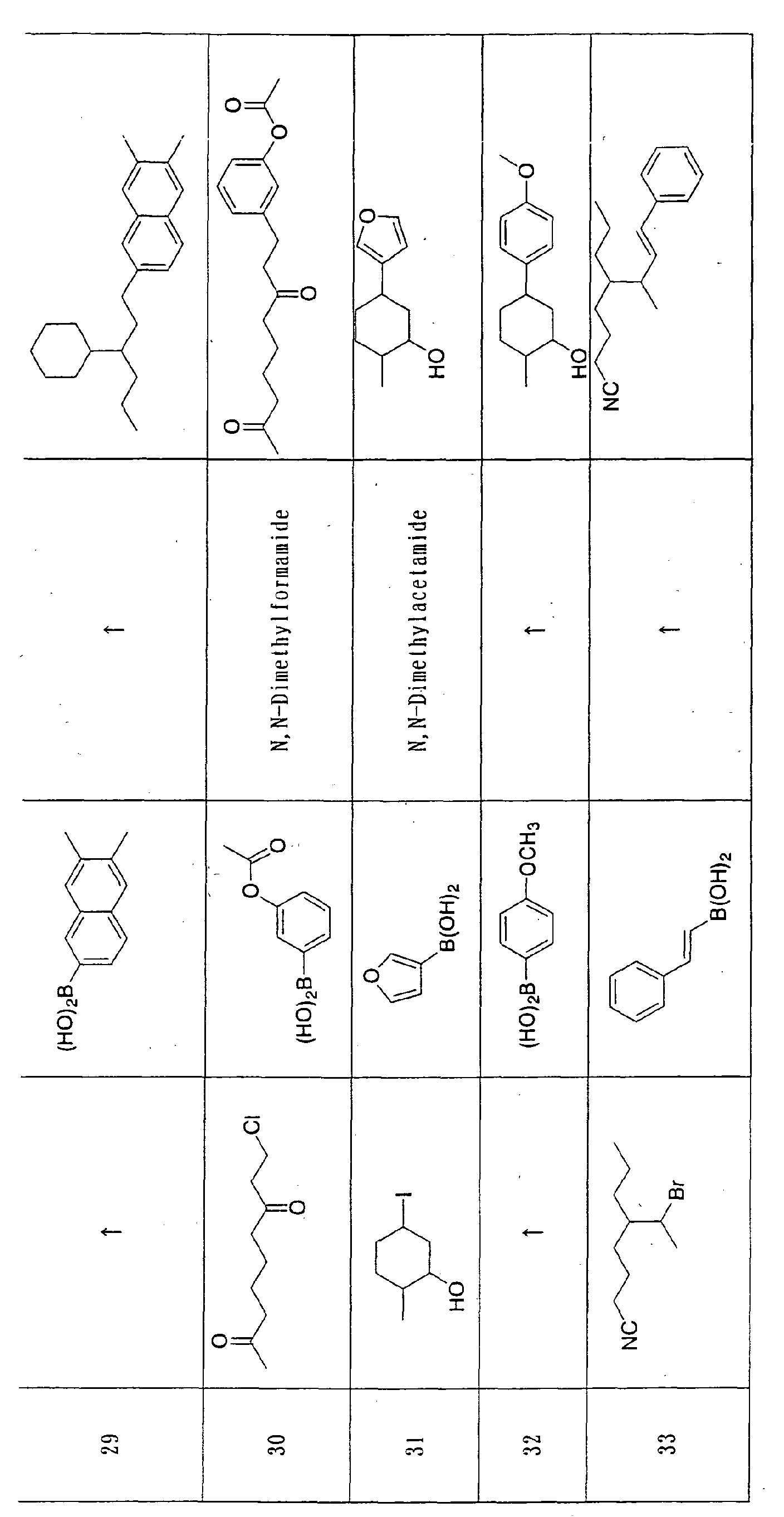
- Example 1 The process of Example 1 was repeated in a similar manner except that 0.4 mmol of each of the boron compounds as shown in Table 1 was used in place of p-methoxyphenylboronic acid and 0.30 mmol of each organic halide as shown in Table 1 was used in place of 1-bromooctane and reaction was conducted for the noted period of time in Table 1.
- Example 2 The process of Example 1 was repeated in a similar manner except that 0.40 mmol of phenylboronic acid was used in place of p-methoxyphenylboronic acid and that 1 ml of each solvent as shown in Table 2 was used in place of N,N-, dimethylacetamide. The result is shown in Table 2.
- Table 2 The result is shown in Table 2.
- Ethyleneglycol dimethyl ether ⁇ 61 16 N,N-dimethylacetamide 2hr 87 17 N,N-dimethylacetamide 2hr 79 18 Ethanol 4hr 48
- Example 1 The process of Example 1 is repeated in a similar manner except that 0.40 mmol of boron compound as listed in Table 3 is used in place of p-methoxyphenylboronic acid and that 0.30 mmol of the organic halide compound as shown in Table 3 is used in place of 1-bromooctane, and each solvent as shown in Table 3 is used in place of N,N-dimethylacetamide, thereby the desired compounds as listed in Table 3 are obtained.
- the obtained ethylene glycol dimethyl ether solution was removed from the liquid preparation of catalyst, and the resulting solid material was subjected to infrared absorption spectrum analysis. As a result, a specific peak was observed at 1663 cm -1 .
- the liquid preparation of catalyst or the solid material is used in the reaction process under the same conditions as those for Example 1, so that the desired product is obtained.
- Example 1 The process of Example 1 was conducted in a similar manner except that 0.015 mmol (6.5 mg) of 1,4-bis(dicyclohexylphosphino)propane was used in place of bis(N-methylimidazole-2-yl)methane.
- the recovery rate of unreacted 1-bromooctane was 100%, thus the conversion rate was 0%.
Landscapes
- Chemical & Material Sciences (AREA)
- Organic Chemistry (AREA)
- Chemical Kinetics & Catalysis (AREA)
- Organic Low-Molecular-Weight Compounds And Preparation Thereof (AREA)
- Low-Molecular Organic Synthesis Reactions Using Catalysts (AREA)
- Furan Compounds (AREA)
- Pyridine Compounds (AREA)
- Catalysts (AREA)
Abstract
a substituted or unsubstituted, linear, branched, or cyclic hydrocarbon group, and
n and n' each represent 1 or 2,
provided that when n and n' are the same, both n and n' are not 2,
R2 represents a substituted or unsubstituted aryl, substituted or unsubstituted heteroaryl or substituted or unsubstituted alkenyl group,
and
Y represents R2 or X1, wherein R2 is as defined above, and X1 represents a chlorine, bromine or iodine atom,
which method comprises reacting
an organic halide of formula (1):
with a boron compound of formula (2):
X2 independently represents a hydroxyl group or an alkoxy or aryloxy group, or X2 2 together form an alkoxy or aryloxy group, and m represents 1 or 2, and m≤n, and the boron atom is bonded with an sp2 carbon atom of R2 group, or a boronic acid trimer anhydride thereof,
in the presence of a base and a catalyst comprising a nickel compound and a compound of formula (i):
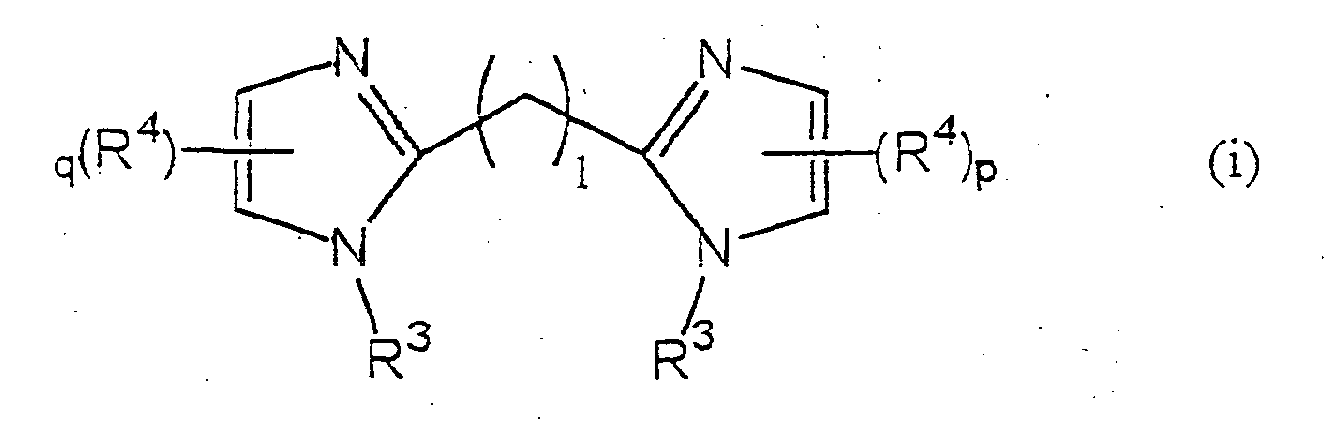
R4 represents a hydrogen atom or a substituted or unsubstituted alkyl group,
1 represents an integer of 1 to 3, and
p and q each represents an integer of 0 to 2; and a catalyst.
Description
a substituted or unsubstituted, linear, branched, or cyclic hydrocarbon group, and
n and n' each represent 1 or 2,
provided that when n and n' are the same, both n and n' are not 2,
R2 represents a substituted or unsubstituted aryl, heteroaryl or alkenyl group,
and
Y represents R2 or X1, wherein R2 is as defined above, and X1 represents a chlorine, bromine or iodine atom,
which method comprises reacting
an organic halide of formula (1):
with a boron compound of formula (2):
X2 independently represents a hydroxyl group or an alkoxy or aryloxy group, or X2 2 together form an alkylendioxy or arylenedioxy group, and m represents 1 or 2, and m≤n, and the boron atom is bonded with a sp2 carbon atom of R2 group, or a boronic acid trimer anhydride thereof,
in the presence of a base and a catalyst comprising a nickel compound and a compound of formula (i):

R4 represents a hydrogen atom or an substituted or unsubstituted alkyl group,
l represents an integer of 1 to 3, and
p and q each represents an integer of 0 to 2; and the catalyst.
when n=n' =1,
when n=1 and n'=2,
an alkoxyl group such as ethoxy and tert-butoxy,
an aryloxy group such as phenoxy group,
a mercapto group,
an alkylthio group such as methylthio,
an arylthio group such as phenylthio,
a cyano group, a nitro group, an amino group,
an mono- or di-alkylamino group such as dimethylamino or cyclohexylamino,
an alyl- or aryl-carbamate group such as tert-butylcarbamate, methylcarbamate, or phenylcarbamate,
an aryl- or alkyl-sulfonamide group such as benzenesulfonamide or methanesulfonamide,
an aryl- or alkyl-imino or imide group such as phthalimide,
a formyl group, a carboxyl group,
an alkoxycarbonyl group such as methoxycarbonyl,
an aryloxycarbonyl group such as p-methoxyphenoxycarbonyl or phenoxycarbonyl,
a carbamoyl,
an N-alkyl- or N-aryl-carbamoyl such as N-phenylcarbamoyl,
a heterocylic group such as pyridyl, quinazolinyl, pyrimidyl, furyl, thienyl, pyrrolyl, and imidazolyl, and
an aryl group such as phenyl, or naphthyl. The term "alkyl" contained in the substituents in the preceding paragraph typically means C1-8 alkyl group such as methyl, ethyl, propyl, butyl, pentyl, hexyl, heptyl, or octyl, and the term "aryl" contained in the substituents in the preceding paragraph typically means C6-10 aryl group such as phenyl, naphthyl, tolyl, xylyl or anisyl.
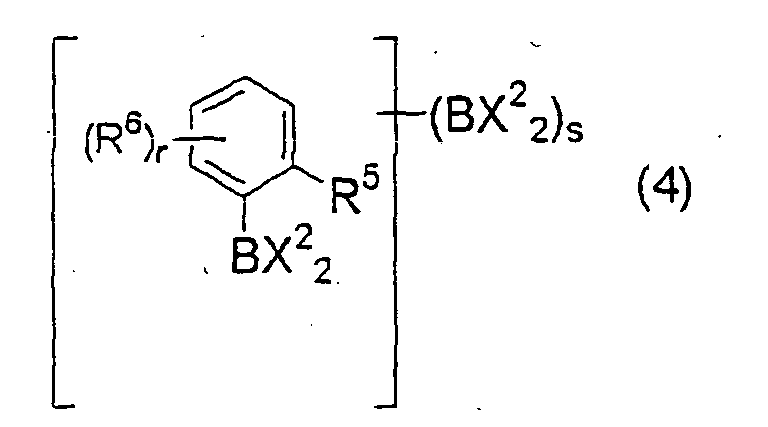
X2 groups independently represent a hydroxy group or an alkoxy group, or the alkoxy groups together form an alkylenedioxy group(e.g. dimethylene, trimethylene or pinacol alcohol residue), or
X2 2 represent -O-B(R20)-O-B(R20)-O-, wherein R20 represents the phenyl residue as defined in connection with formula (4) above,
r represents an integer of 0 to 4,
s represents 0 or 1,
r+s≤4 when the benzene ring does not form a condensed aromatic ring,
R6 groups are the same or different and independently represent a substituted or unsubstituted aryl group, a substituted or unsubstituted heteroaryl group, or a substituted or unsubstituted linear, branched or cyclic alkenyl group, or
R6 groups on adjacent carbon atoms of the benzene ring are optionally bonded to form a condensed polycyclic aromatic ring, for example, in which the R6 groups are ortho-condensed (e.g. naphthalene, anthracene, phenanthrene), or ortho and peri-condensed with the benzene ring (e.g. pyrene). Preferably, the ortho position of the BX2 2 group is unsubstituted, that is, a hydrogen atom.


| Ex. No | Solvent | Reaction Time | Yield (%) |
| 14 | Tetrahydrofuran | 4hr | 59 |
| 15 | Ethyleneglycol dimethyl ether | ↑ | 61 |
| 16 | N,N-dimethylacetamide | 2hr | 87 |
| 17 | N,N-dimethylacetamide | 2hr | 79 |
| 18 | Ethanol | 4hr | 48 |



Claims (6)
- A method for producing a cross-coupling compound of formula (3):
a substituted or unsubstituted, linear, branched, or cyclic hydrocarbon group, and
n and n' each represent 1 or 2,
provided that when n and n' are the same, both n and n' are not 2,
R2 represents a substituted or unsubstituted aryl, substituted or unsubstituted heteroaryl or substituted or unsubstituted alkenyl group, and
Y represents R2 or X1, wherein R2 is as defined above, and X1 represents a chlorine, bromine or iodine atom,
which method comprises reacting
an organic halide of formula (1):
with a boron compound of formula (2):
X2 independently represents a hydroxyl group or an alkoxy or aryloxy group, or X2 2 together form an alkylenedioxy or arylenedioxy group, and m represents 1 or 2, and m≤n, and the boron atom is bonded with an sp2 carbon atom of R2 group, or aboronic acid trimer anhydride thereof,
in the presence of a base and a catalyst comprising a nickel compound and a compound of formula (i):wherein R3 represents a substituted or unsubstituted alkyl group,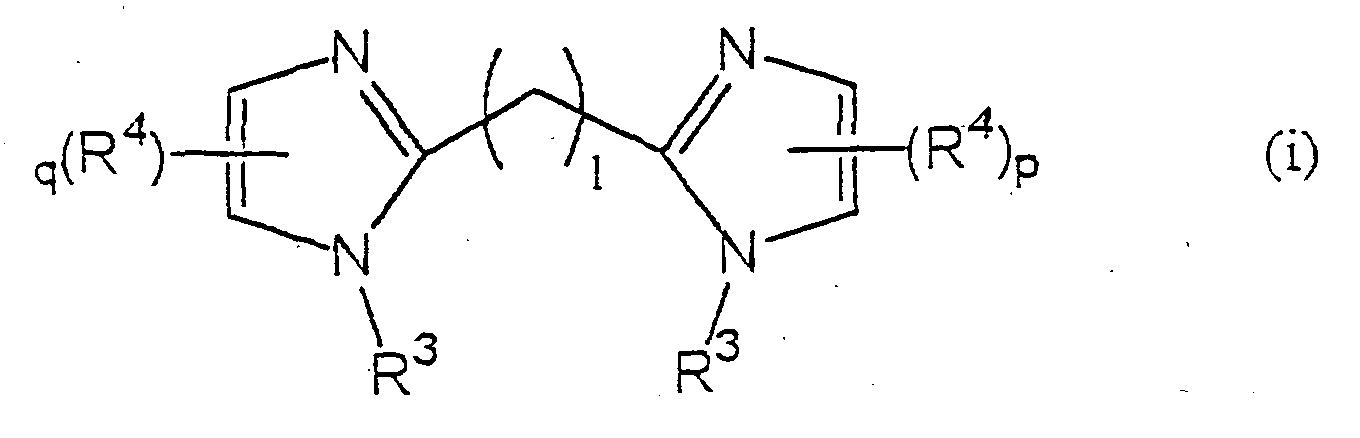
R4 represents a hydrogen atom or a substituted or unsubstituted alkyl group,
l represents an integer of 1 to 3, and
p and q independently represent an integer of 0 to 2. - A method according to Claim 1, wherein R3 is methyl in the compound of formula (i).
- A method according to Claim 1 or 2, wherein the boron compound of formula (2) is a compound of formula (4):wherein R5 represents a hydrogen atom,
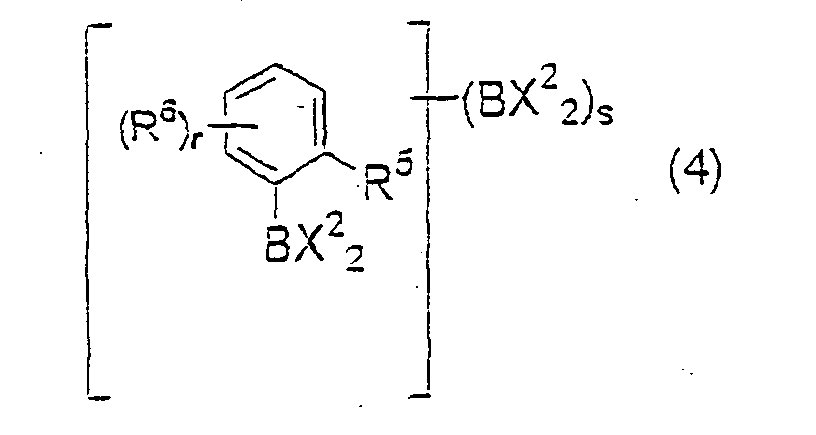
X2 groups independently represent a hydroxyl group or an alkoxy group, or the alkoxy groups together form an alkylenedioxy group, or
X2 2 represent -O-B(R20)-O-B(R20)-O- , wherein R20 represents the phenyl residue as defined in connection with formula (4) above,
r represents an integer of 0 to 4,
s represents 0 or 1, r+s≤4 when the benzene ring does not form a condensed aromatic ring,
R6 groups are the same or different and each independently represent a substituted or unsubstituted aryl group,
a substituted or unsubstituted heteroaryl group, or
a substituted or unsubstituted linear or cyclic alkenyl group, or
R6 groups connected with the adjacent carbon atoms of the benzene ring are bonded to form an ortho-condensed, or ortho and peri-condensed polycyclic aromatic ring. - A method according to any one of claims 1 to 3, wherein the nickel compound is a nickel salt or a π complex compound of zero-valent or divalent nickel.
- A catalyst comprising a nickel compound and the compound of formula (i) as defined in claim 1.
- A catalyst according to Claim 5, wherein the nickel compound is a nickel salt or a π complex compound of zero-valent or divalent nickel.
Applications Claiming Priority (4)
| Application Number | Priority Date | Filing Date | Title |
|---|---|---|---|
| JP2003009637 | 2003-01-17 | ||
| JP2003009637 | 2003-01-17 | ||
| JP2003111282 | 2003-04-16 | ||
| JP2003111282A JP4311069B2 (en) | 2003-01-17 | 2003-04-16 | Method for producing coupling compound |
Publications (3)
| Publication Number | Publication Date |
|---|---|
| EP1439157A2 true EP1439157A2 (en) | 2004-07-21 |
| EP1439157A3 EP1439157A3 (en) | 2004-10-20 |
| EP1439157B1 EP1439157B1 (en) | 2007-07-11 |
Family
ID=32599323
Family Applications (1)
| Application Number | Title | Priority Date | Filing Date |
|---|---|---|---|
| EP04250196A Expired - Lifetime EP1439157B1 (en) | 2003-01-17 | 2004-01-15 | Method for producing Suzuki coupling compound catalysed by a nickel compound |
Country Status (4)
| Country | Link |
|---|---|
| US (2) | US7217677B2 (en) |
| EP (1) | EP1439157B1 (en) |
| JP (1) | JP4311069B2 (en) |
| DE (1) | DE602004007415T2 (en) |
Families Citing this family (5)
| Publication number | Priority date | Publication date | Assignee | Title |
|---|---|---|---|---|
| JP5019990B2 (en) * | 2007-08-07 | 2012-09-05 | 東ソー株式会社 | Method for producing cross-coupling compound |
| WO2009055730A1 (en) | 2007-10-25 | 2009-04-30 | Genentech, Inc. | Process for making thienopyrimidine compounds |
| SG172951A1 (en) * | 2009-03-24 | 2011-08-29 | Sumitomo Chemical Co | Method for manufacturing a boronic acid ester compound |
| JP2017122072A (en) * | 2016-01-08 | 2017-07-13 | Dic株式会社 | Production method of compound |
| CN115448816B (en) * | 2022-09-16 | 2024-04-12 | 中国石油大学(华东) | Synthesis method of beta-fluoro alkenyl alcohol |
Family Cites Families (11)
| Publication number | Priority date | Publication date | Assignee | Title |
|---|---|---|---|---|
| DE152547C (en) | ||||
| US4912276A (en) | 1988-10-25 | 1990-03-27 | Eastman Kodak Company | Preparation of biaryl compounds |
| US6194599B1 (en) | 1997-04-08 | 2001-02-27 | Catalytica, Inc. | Process for preparing biaryl compounds |
| US5922898A (en) | 1997-04-08 | 1999-07-13 | Catalytica Pharmaceuticals, Inc. | Process for preparing biaryl compounds |
| AUPO748097A0 (en) | 1997-06-20 | 1997-07-17 | Commonwealth Scientific And Industrial Research Organisation | Alkene borates |
| US6395916B1 (en) | 1998-07-10 | 2002-05-28 | Massachusetts Institute Of Technology | Ligands for metals and improved metal-catalyzed processes based thereon |
| CA2372526A1 (en) | 1999-05-10 | 2000-11-16 | Michael D. Wyrsta | Methods and compositions for controlled polypeptide synthesis |
| WO2001066248A2 (en) | 2000-02-22 | 2001-09-13 | University Of New Orleans Research And Technology Foundation | C-c and c-n coupling catalyst comprising transition metal and carbene |
| US7041856B2 (en) | 2001-10-23 | 2006-05-09 | Sumitomo Chemical Company, Limited | Coupling catalyst and process using the same |
| EP1312605B1 (en) | 2001-11-19 | 2007-04-25 | Sumitomo Chemical Company, Limited | Method for producing biaryl compounds |
| EP1449580B1 (en) * | 2003-02-19 | 2005-12-28 | Sumitomo Chemical Company, Limited | Production method of a cross-coupling compound from an alkyl halide and an organoboron compound |
-
2003
- 2003-04-16 JP JP2003111282A patent/JP4311069B2/en not_active Expired - Fee Related
-
2004
- 2004-01-14 US US10/757,148 patent/US7217677B2/en not_active Expired - Fee Related
- 2004-01-15 EP EP04250196A patent/EP1439157B1/en not_active Expired - Lifetime
- 2004-01-15 DE DE602004007415T patent/DE602004007415T2/en not_active Expired - Lifetime
-
2006
- 2006-08-17 US US11/465,167 patent/US7553988B2/en not_active Expired - Fee Related
Also Published As
| Publication number | Publication date |
|---|---|
| DE602004007415D1 (en) | 2007-08-23 |
| JP2004269486A (en) | 2004-09-30 |
| EP1439157B1 (en) | 2007-07-11 |
| US7217677B2 (en) | 2007-05-15 |
| US20060281925A1 (en) | 2006-12-14 |
| JP4311069B2 (en) | 2009-08-12 |
| EP1439157A3 (en) | 2004-10-20 |
| US7553988B2 (en) | 2009-06-30 |
| DE602004007415T2 (en) | 2008-03-20 |
| US20040161404A1 (en) | 2004-08-19 |
Similar Documents
| Publication | Publication Date | Title |
|---|---|---|
| Jin et al. | Highly Active, Well‐Defined (Cyclopentadiene)(N‐heterocyclic carbene) palladium Chloride Complexes for Room‐Temperature Suzuki–Miyaura and Buchwald–Hartwig Cross‐Coupling Reactions of Aryl Chlorides and Deboronation Homocoupling of Arylboronic Acids | |
| Percec et al. | Aryl mesylates in metal catalyzed homo-and cross-coupling reactions. 4. Scope and limitations of aryl mesylates in nickel catalyzed cross-coupling reactions | |
| Sahoo et al. | Cross‐Coupling of Triallyl (aryl) silanes with Aryl Bromides and Chlorides: An Alternative Convenient Biaryl Synthesis | |
| US7238832B2 (en) | Production method of a coupling compound | |
| EP1439157B1 (en) | Method for producing Suzuki coupling compound catalysed by a nickel compound | |
| US7041856B2 (en) | Coupling catalyst and process using the same | |
| JP4427946B2 (en) | Method for producing coupling compound | |
| CN104496736B (en) | A kind of cross-coupling reaction based on rare earth compound and application | |
| EP2287141B1 (en) | Method for producing unsaturated organic compound | |
| JP4552451B2 (en) | Method for producing coupling compound | |
| Shi et al. | Highly efficient and stable palladium/imidazolium salt-phosphine catalysts for Suzuki–Miyaura cross-coupling of aryl bromides | |
| JP4321131B2 (en) | Method for producing coupling compound | |
| US6590100B2 (en) | Process for preparing a polyaromatic compound | |
| US6566571B1 (en) | Method of producing biaryls | |
| JP4581321B2 (en) | Method for producing unsaturated organic compound derivative | |
| US6548684B2 (en) | Coupling of nucleophiles, vinyl compounds or CO with water, alcohols or amines to organic compounds | |
| JP2922289B2 (en) | Method for producing biaryl compound | |
| Yu et al. | Unsymmetric-1, 3-disubstituted imidazolium salt for palladium-catalyzed Suzuki–Miyaura cross-coupling reactions of aryl bromides | |
| US6800784B1 (en) | Process for preparing a polyaromatic compound | |
| EP1707263B1 (en) | Catalyst composition comprising an alkylene diamine-nickel complex and process for producing a cross-coupled compound using the same | |
| JPH10330307A (en) | Method for producing aromatic aldehydes |
Legal Events
| Date | Code | Title | Description |
|---|---|---|---|
| PUAI | Public reference made under article 153(3) epc to a published international application that has entered the european phase |
Free format text: ORIGINAL CODE: 0009012 |
|
| AK | Designated contracting states |
Kind code of ref document: A2 Designated state(s): AT BE BG CH CY CZ DE DK EE ES FI FR GB GR HU IE IT LI LU MC NL PT RO SE SI SK TR |
|
| AX | Request for extension of the european patent |
Extension state: AL LT LV MK |
|
| PUAL | Search report despatched |
Free format text: ORIGINAL CODE: 0009013 |
|
| AK | Designated contracting states |
Kind code of ref document: A3 Designated state(s): AT BE BG CH CY CZ DE DK EE ES FI FR GB GR HU IE IT LI LU MC NL PT RO SE SI SK TR |
|
| AX | Request for extension of the european patent |
Extension state: AL LT LV MK |
|
| RAP1 | Party data changed (applicant data changed or rights of an application transferred) |
Owner name: SUMITOMO CHEMICAL COMPANY, LIMITED |
|
| 17P | Request for examination filed |
Effective date: 20050401 |
|
| AKX | Designation fees paid |
Designated state(s): CH DE FR GB LI |
|
| RBV | Designated contracting states (corrected) |
Designated state(s): CH DE FR GB LI |
|
| GRAP | Despatch of communication of intention to grant a patent |
Free format text: ORIGINAL CODE: EPIDOSNIGR1 |
|
| GRAS | Grant fee paid |
Free format text: ORIGINAL CODE: EPIDOSNIGR3 |
|
| GRAA | (expected) grant |
Free format text: ORIGINAL CODE: 0009210 |
|
| AK | Designated contracting states |
Kind code of ref document: B1 Designated state(s): CH DE FR GB LI |
|
| REG | Reference to a national code |
Ref country code: GB Ref legal event code: FG4D |
|
| REG | Reference to a national code |
Ref country code: CH Ref legal event code: EP |
|
| REF | Corresponds to: |
Ref document number: 602004007415 Country of ref document: DE Date of ref document: 20070823 Kind code of ref document: P |
|
| ET | Fr: translation filed | ||
| REG | Reference to a national code |
Ref country code: CH Ref legal event code: NV Representative=s name: A. BRAUN, BRAUN, HERITIER, ESCHMANN AG PATENTANWAE |
|
| PLBE | No opposition filed within time limit |
Free format text: ORIGINAL CODE: 0009261 |
|
| STAA | Information on the status of an ep patent application or granted ep patent |
Free format text: STATUS: NO OPPOSITION FILED WITHIN TIME LIMIT |
|
| 26N | No opposition filed |
Effective date: 20080414 |
|
| REG | Reference to a national code |
Ref country code: CH Ref legal event code: PFA Owner name: SUMITOMO CHEMICAL COMPANY, LIMITED Free format text: SUMITOMO CHEMICAL COMPANY, LIMITED#27-1, SHINKAWA 2-CHOME, CHUO-KU#TOKYO 104-8260 (JP) -TRANSFER TO- SUMITOMO CHEMICAL COMPANY, LIMITED#27-1, SHINKAWA 2-CHOME, CHUO-KU#TOKYO 104-8260 (JP) |
|
| PGFP | Annual fee paid to national office [announced via postgrant information from national office to epo] |
Ref country code: GB Payment date: 20130109 Year of fee payment: 10 Ref country code: CH Payment date: 20130114 Year of fee payment: 10 Ref country code: FR Payment date: 20130204 Year of fee payment: 10 |
|
| REG | Reference to a national code |
Ref country code: CH Ref legal event code: PCAR Free format text: NEW ADDRESS: HOLBEINSTRASSE 36-38, 4051 BASEL (CH) |
|
| REG | Reference to a national code |
Ref country code: CH Ref legal event code: PL |
|
| GBPC | Gb: european patent ceased through non-payment of renewal fee |
Effective date: 20140115 |
|
| PG25 | Lapsed in a contracting state [announced via postgrant information from national office to epo] |
Ref country code: CH Free format text: LAPSE BECAUSE OF NON-PAYMENT OF DUE FEES Effective date: 20140131 Ref country code: LI Free format text: LAPSE BECAUSE OF NON-PAYMENT OF DUE FEES Effective date: 20140131 |
|
| REG | Reference to a national code |
Ref country code: FR Ref legal event code: ST Effective date: 20140930 |
|
| PG25 | Lapsed in a contracting state [announced via postgrant information from national office to epo] |
Ref country code: GB Free format text: LAPSE BECAUSE OF NON-PAYMENT OF DUE FEES Effective date: 20140115 Ref country code: FR Free format text: LAPSE BECAUSE OF NON-PAYMENT OF DUE FEES Effective date: 20140131 |
|
| PGFP | Annual fee paid to national office [announced via postgrant information from national office to epo] |
Ref country code: DE Payment date: 20180103 Year of fee payment: 15 |
|
| REG | Reference to a national code |
Ref country code: DE Ref legal event code: R119 Ref document number: 602004007415 Country of ref document: DE |
|
| PG25 | Lapsed in a contracting state [announced via postgrant information from national office to epo] |
Ref country code: DE Free format text: LAPSE BECAUSE OF NON-PAYMENT OF DUE FEES Effective date: 20190801 |