EP1437910A2 - A cellular radio communication system and method for call restoration or handover - Google Patents
A cellular radio communication system and method for call restoration or handover Download PDFInfo
- Publication number
- EP1437910A2 EP1437910A2 EP03104091A EP03104091A EP1437910A2 EP 1437910 A2 EP1437910 A2 EP 1437910A2 EP 03104091 A EP03104091 A EP 03104091A EP 03104091 A EP03104091 A EP 03104091A EP 1437910 A2 EP1437910 A2 EP 1437910A2
- Authority
- EP
- European Patent Office
- Prior art keywords
- call
- communication system
- radio communication
- accordance
- handover
- Prior art date
- Legal status (The legal status is an assumption and is not a legal conclusion. Google has not performed a legal analysis and makes no representation as to the accuracy of the status listed.)
- Granted
Links
Images



Classifications
-
- H—ELECTRICITY
- H04—ELECTRIC COMMUNICATION TECHNIQUE
- H04W—WIRELESS COMMUNICATION NETWORKS
- H04W4/00—Services specially adapted for wireless communication networks; Facilities therefor
- H04W4/06—Selective distribution of broadcast services, e.g. multimedia broadcast multicast service [MBMS]; Services to user groups; One-way selective calling services
- H04W4/10—Push-to-Talk [PTT] or Push-On-Call services
-
- H—ELECTRICITY
- H04—ELECTRIC COMMUNICATION TECHNIQUE
- H04W—WIRELESS COMMUNICATION NETWORKS
- H04W36/00—Hand-off or reselection arrangements
- H04W36/0005—Control or signalling for completing the hand-off
- H04W36/0055—Transmission or use of information for re-establishing the radio link
-
- H—ELECTRICITY
- H04—ELECTRIC COMMUNICATION TECHNIQUE
- H04W—WIRELESS COMMUNICATION NETWORKS
- H04W76/00—Connection management
- H04W76/40—Connection management for selective distribution or broadcast
- H04W76/45—Connection management for selective distribution or broadcast for Push-to-Talk [PTT] or Push-to-Talk over cellular [PoC] services
-
- H—ELECTRICITY
- H04—ELECTRIC COMMUNICATION TECHNIQUE
- H04W—WIRELESS COMMUNICATION NETWORKS
- H04W36/00—Hand-off or reselection arrangements
- H04W36/24—Reselection being triggered by specific parameters
- H04W36/32—Reselection being triggered by specific parameters by location or mobility data, e.g. speed data
-
- H—ELECTRICITY
- H04—ELECTRIC COMMUNICATION TECHNIQUE
- H04W—WIRELESS COMMUNICATION NETWORKS
- H04W56/00—Synchronisation arrangements
-
- H—ELECTRICITY
- H04—ELECTRIC COMMUNICATION TECHNIQUE
- H04W—WIRELESS COMMUNICATION NETWORKS
- H04W72/00—Local resource management
- H04W72/30—Resource management for broadcast services
-
- H—ELECTRICITY
- H04—ELECTRIC COMMUNICATION TECHNIQUE
- H04W—WIRELESS COMMUNICATION NETWORKS
- H04W84/00—Network topologies
- H04W84/02—Hierarchically pre-organised networks, e.g. paging networks, cellular networks, WLAN [Wireless Local Area Network] or WLL [Wireless Local Loop]
- H04W84/04—Large scale networks; Deep hierarchical networks
- H04W84/08—Trunked mobile radio systems
-
- H—ELECTRICITY
- H04—ELECTRIC COMMUNICATION TECHNIQUE
- H04W—WIRELESS COMMUNICATION NETWORKS
- H04W88/00—Devices specially adapted for wireless communication networks, e.g. terminals, base stations or access point devices
- H04W88/14—Backbone network devices
Definitions
- the present invention relates to cellular radio communication systems.
- Portable and mobile radios are normally arranged to communicate with one another through a base station (BS).
- the radios and the base station are referred to as a Private Mobile Radio (PMR) system.
- PMR Private Mobile Radio
- An example of such a system is the European Terrrestrial Trunked Radio (TETRA) PMR system.
- TETRA European Terrrestrial Trunked Radio
- the system's coverage area is normally subdivided into 'cells'. Each cell is a region served by a base station.
- a radio may communicate with another radio in the same or a different cell, via the base station.
- Several base stations therefore link together to form a radio communications network.
- a radio or phone can communicate with any other that is within communication range of one of the base stations of the network.
- Such communication will also be used by third and fourth generation communication systems, referred to as '3G' and '4G' systems.
- MS mobile station'
- mobile station will cover portable- or mobile PMR radios, mobile telephones, and 3G or 4G communication devices, wirelessly linked lap-top computers, or wirelessly linked personal digital assistants (PDA).
- PMR radios mobile telephones
- 3G or 4G communication devices wirelessly linked lap-top computers
- PDA personal digital assistants
- Figure 1 illustrates as an example the general scheme of a PMR radio system 10.
- Portable radios 2, 4 and 6 of figure 1 can communicate with a base station 8.
- Radios 2, 4 and 6 could equally well be mobile radios mounted in vehicles. Each of the radios shown in figure 1 can communicate through base station 8 with one or more other radios. Several base stations 8 are all linked to a central controller 12. Calls may be routed via controller 12. If radios 2, 4 and 6 are capable of direct mode operation, then they may communicate directly with one another or with other radios, without the communication link passing through a base station 8.
- Cellular mobile phone systems, and 3G and 4G systems, have the same general arrangement as shown in Figure 1.
- Portable and mobile radios are also known which can place calls through a base station to telephone subscribers. These calls may be between the radio and either a 'POTS' landline telephone, or a mobile telephone.
- a mobile station in a radio communication system will normally be able to place or receive a call through the base station that is nearest to its current location. To enable movement between cells, each mobile station must clearly be able to establish communication with more than one base station. As base stations do not all operate on the same frequency, the mobile station must be able to communicate on a number of different frequencies.
- Some radio communication systems employ encryption of the transmitted signals. This encryption makes interception of a call by an unauthorised party significantly more difficult, and so enhances security.
- the end-to-end service is seen as an application layer service, using the underlying connectivity supplied by the standard TETRA infrastructure.
- the recognition by the transport layer of the presence of an end-to-end encryption service is achieved by the carrying of a flag associated with call control signalling. The flag indicates an end-to-end encrypted call.
- a stolen frame data transport service is available to the encryption application.
- the end-to-end service uses this facility to transmit in-band synchronization data, also referred to as User-plane (or U-plane).
- This synchronization data is used to synchronise the decrypting Mobile Station (MS), and is typically sent at the start of a call, replacing the first few ACELP frames.
- MS decrypting Mobile Station
- This synchronisation data also occurs at periodic intervals after the start, approximately once per second. There may be some random variance in this timing, introduced due to the use of a voice activity detector in choosing the most appropriate frame to steal. Sending synchronization data more than once a second, during the call, will result in a noticeable degradation to audio quality.
- Figure 2 shows the use of a voice activity detector to select a time point for a synchronisation signal. This is done by voice activity detection.
- Trace 210 shows the level of voice activity plotted against time.
- Box 212 shows the window of opportunity for stealing, in order to send synchronisation data.
- Frame 214 shows the insertion of synchronization information, in place of an ACELP speech frame. The line from '26' to '34' on figure 2 shows the number of ACELP frames since the last stealing occurrence.
- a mobile station When a mobile station is involved in restoration or handover of a call, the mobile station must wait for a SYNC frame and successfully process it, before end-to-end encrypted audio can be decoded. It may take a whole second for the next SYNC frame to be sent. Therefore, for end-to-end encrypted calls, a mobile station involved in restoration or handover of a call will experience larger additional handover delays. These handover delays appear as audio gaps.
- the end-to-end encrypted audio is generated by the source vocoder.
- the source vocoder is part of the 'Switching and Management Infrastructure', otherwise called the 'SwMI', of the radio communication system.
- Prior art patent application GB-A-2362783 provides a mechanism for coping with infrastructure delay changes in a radio communications network.
- a signalling mechanism tells the transmitting party to send more synchronisation information.
- This prior art patent application deals with communication between two mobile stations.
- the system may recognise that there is delay in the network, e.g. because data packets from a transmitting mobile station arrive too late at a base station for timely transmission to a receiving mobile.
- the base station then alerts the receiving mobile.
- the message to the receiving mobile may be introduced as a packet in place of a packet which normally contains audio data.
- the system may contact the sending mobile, and request a new synchronisation sequence value.
- the invention comprises a cellular radio communication system with the features of appended claim 1.
- the invention further comprises a method for call restoration or handover in accordance with appended claim 16. Further aspects of advantageous embodiments of the invention are apparent from the appended dependent claims.
- the present invention speeds up call restoration or handover when a mobile station moves from one cell to another during a call.
- the invention can be used with a variety of call types. These include console-to-group call, a call from the console to an individual mobile station, or a telephone interconnect call.
- the present invention reduces the duration of the loss of audio by a receiving mobile station. This may be at the expense of an increased bandwidth requirement whilst audio and additional synchronisation frames are being sent at the same time.
- the inventor has considered that current cellular radio communication systems make the decision to replace ACELP with synchronisation information at the cryptographic device.
- ACELP synchronisation information
- the SwMI cryptographic device operates without information concerning some events in the radio communication system's network. In particular, if a mobile station performs call restoration or handover somewhere in the network, the cryptographic device will not have cognisance of this. The SwMI will continue to transmit SYNC at the usual "periodic" intervals defined for use during the call, see figure 2. This "periodic" interval does not lend itself for the purposes of the mobile station achieving synchronisation at the earliest opportunity.
- a further consideration is that most existing infrastructures implementing End-to-End encryption have used circuit-based switching infrastructures. These infrastructures had a fixed bandwidth allocated for a particular call.
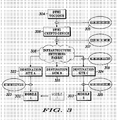
- FIG. 3 shows a prior art infrastructure functioning as generally described above.
- the SwMI vocoder is shown at 304, with the cryptographic device at 306.
- Infrastructure 308 transmits call information to base stations 322, 320, 324.
- a mobile station 302 arrives within the coverage area of base station 322, it receives the same sync information as is being sent to mobile 303.
- Mobile 303 is a mobile in continuous communication with one base station, 324.
- the signal comprises ACELP frames only.
- the signal comprises ACELP frames with SYNC frames periodically present.
- the prior art infrastructure makes a decision to replace, or steal, ACELP with SYNC information at the SwMI cryptographic device 306.
- the present invention applies to SwMI vocoded calls that support call restoration or handover during the call.
- These are, for example, telephone interconnect calls, calls from the system's console to an individual mobile station, and calls from the console to a group of mobile stations.
- the invention is of particular benefit to these latter console-group calls.
- the concept of this invention requires that the vocoder generate parallel "logical" application streams of information, for every associated TDMA frame dedicated to a particular 'End to End' call. This generation of parallel streams is required upon indication of call restoration or handover, cell re-selection, by a mobile station. These streams are:
- the present invention can reduce the duration of the loss of audio by a receiving mobile station. This may be at the expense of an increased bandwidth requirement whilst audio and additional synchronisation frames are being sent at the same time.
- An implementation of this invention may choose to prioritise the additional synchronisation information below the normal traffic stream such that the momentary increases in the bandwidth requirement, which cannot be satisfied because the sitelinks are completely utilised, do not jeopardise audio for the designated call or adjacent calls at the site.
- the base station may signal to the SwMI vocoder, using infrastructure signalling mechanisms, that call handover is occurring, or a call is being restored.
- destination base stations may then determine which of the two streams to transmit over the air to the mobile station.
- This arrangement effectively leaves the U-plane stealing decision to each of the sites involved in the End-to-End encrypted call.
- the SwMI vocoder determines when to steal.
- the prior art arrangement is forced to do this, because the SwMI in the prior art arrangement has no knowledge of when and where a mobile station is performing call restoration or handover.
- Figure 4 shows a mobile station that may be used with the present invention.
- Control unit 20, receiver circuit 28, transmission circuit 22, switch 24 and antenna 26 co-operate to provide transmission and reception of calls.
- Microphone 34 provides speech input for calls.
- Audio circuit 38 and loudspeaker 40 provide sound output.
- the display 42 and keypad 44 provide further parts of the user interface.
- ROM 32 provides permanent information storage, and may form the 'codeplug' of a PMR radio.
- Data terminal 36 allows data to form part of the call information.
- Cryptographic devices 30 and 46 provide transmission encryption and decryption respectively.
- the cellular radio communication system comprises a controller 512, at least one base station 520, 522 and at least one mobile station 502.
- the controller 512 is adapted to generate user plane information for a call to at least one mobile station 502.
- the controller is adapted to generate, temporarily, both user plane information for a call, and additional synchronization data.
- the base station When call restoration or handover is occurring, the base station may be adapted to perform frame stealing, in order to transmit the additional synchronization data to the mobile station. When call restoration or handover is occurring, the base station may be adapted to transmit the additional synchronization data, and not to transmit the user plane information.
- Figure 5 shows two ways in which controller 512 may be made aware that call restoration or handover is occurring. These ways can be seen by reference to base stations 520 and 522 respectively.
- base station 522 may be adapted to signal, 552, to controller 512 when a mobile station 502 registers with that base station, and the mobile station commences call restoration or handover with the base station.
- base station 520 may be adapted to signal, 550, to the controller 512 when a mobile station 502 performs cell re-selection with that base station.
- Controller 512 here comprises a zone controller 510, SwMI vocoder 504 and cryptographic device 506.
- the SwMI vocoder 504 may supply the parallel streams of user-plane information, representing circuit mode voice or circuit mode data, and additional end-to-end encryption synchronization data, to the site(s) involved with the call for either:
- the controller 512 is adapted to generate the additional synchronization data either only until indication by the mobile station of successful call restoration or handover, or for only a predetermined time period from the start of call restoration or handover.
- the SwMI vocoder may chose to route both logical streams to all sites in the system associated with the call. This is particularly suited to packet-switched IP based infrastructures, where momentarily parallel circuit mode voice (e.g. ACELP) and additional end-to-end encryption synchronisation data streams are routed via the multicast IP "tree" to all the destination sites. Alternatively, the controller may chose to route both logical streams to just the sites performing call restoration or handover.
- momentarily parallel circuit mode voice e.g. ACELP
- additional end-to-end encryption synchronisation data streams are routed via the multicast IP "tree" to all the destination sites.
- the controller may chose to route both logical streams to just the sites performing call restoration or handover.
- the controller may be adapted to route the additional synchronization data only to base stations performing call restoration or handover.
- the base station itself may be adapted to transmit the circuit mode voice or circuit mode data, but not to transmit the additional end-to-end encryption synchronization data.
- a destination site that is performing the call restoration or handover is thus able to choose to transmit the SYNC information provided, and ignore the ACELP, in order for the mobile station to gain synchronisation at the earliest opportunity.
- a destination site that is not performing the call restoration or handover, but that is receiving both streams of frames, is able to choose to ignore the additional SYNC information provided, since synchronisation is already achieved and no audio degradation is desired.
- the user plane information for a call is normally circuit mode voice or circuit mode data, e.g. ACELP.
- the additional synchronization data is additional signalling for end-to-end encryption synchronization. This additional synchronization data may itself constitute part of the user-plane.
- Figure 6 shows a radio communication system in accordance with the present invention, for direct comparison with prior art figure 3.
- Element 604 is the vocoder, and 606 is the cryptographic device. These provide the ACELP frames with periodic synchronisation for the call, plus the second stream, comprising the additional synchronisation data.
- the switching system 608 is analogous to 308 in figure 3.
- Base station 622 is now able to transmit the additional synchronisation data to mobile 602, which enters its coverage area from that of base station 620. This provides more rapid call restoration or handover for mobile 602 than was possible for mobile 302 in figure 3.
- Mobile 603 can continue to receive call information only, since base station 624 need only broadcast the call information to it.
- the signal comprises ACELP frames only.
- the signal comprises ACELP frames with SYNC frames periodically present plus additional synchronisation frames.
- the signal comprises, during call restoration or handover, synchronisation frames with higher priority than ACELP.
- the signal comprises ACELP frames with synchronisation SYNC frames only periodically present.
- the invention may be of particular advantage for an end-to-end encrypted console-to-group call, a call from the console to an individual mobile station, or a telephone interconnect call.
- the SwMI vocoder cryptographic device associated with the controller 12 may be adapted to provide the data streams.
- the cellular radio communication system may be compliant with the TETRA standard, and a packet switched IP infrastructure.
- the effective parallel streaming technique of the invention will result in more information being sent between the SwMI-vocoder and destination site(s) across the switching fabric that constitutes the central network entity (CNE). However, this only occurs momentarily during these handover periods, and when an end-to-end encrypted call is being restored to a site.
- CNE central network entity
- Packet switched infrastructures compared with circuit switched infrastructures, typically have spare capacity during normal load conditions. This is in order to be able to tolerate momentary increases in data rates.
- the SwMI vocoder implementation incorporating this invention could simply utilise the existing multicast IP tree to route both logical streams to the destination site(s).
- this invention allows the SwMI end-to-end encryption crypto-device to send parallel streams of audio and synchronisation data for momentary periods of time that correspond with an mobile station performing call restoration or handover on a new cell.
- the invention thus facilitates the destination base stations into making the more appropriate decision whether or not to transmit audio or synchronisation data to the mobile station.
- the inventor has determined that the base stations are the ideal place at which to make the decision to steal audio or to send synchronisation data to the mobile station, not the SwMI crypto-device.
- This invention will provide optimal synchronisation performance concerning call handover of SwMI-vocoded end-to-end encryption calls, when using a packet-based switching infrastructure.
- the period that a mobile station may be considered out-of-sync with the SwMI is of major importance to users of the cellular radio communication system.
- the invention comprises a method for call restoration or handover in a cellular radio communication system.
- the controller 512 generates user plane information for a call to at least one mobile station 502,602.
- the controller When call restoration or handover occurs for the at least one mobile station, the controller generates, temporarily, both user plane information for a call and additional synchronization data.
- the user plane information for a call is normally data and/or ACELP speech.
- the additional synchronization data is additional signalling for end-to-end encryption synchronization.
- This additional synchronization data may itself be in the user plane.
- this additional synchronisation data allows a mobile station in the system to achieve synchronisation immediately it arrives at a site and call restoration or handover is necessary.
- the controller 512 may generate the additional synchronization data only until indication by the mobile station of successful call restoration or handover. Alternatively, the controller 512 may generate the additional synchronization data for only a predetermined time period.
- the base station may transmit the additional synchronization data, but not transmit the user plane information for the call.
- the base station may perform frame stealing in order to transmit the additional synchronization data.
- the controller 512 may route the additional synchronization data only to base stations 8 performing call restoration or handover.
Landscapes
- Engineering & Computer Science (AREA)
- Computer Networks & Wireless Communication (AREA)
- Signal Processing (AREA)
- Multimedia (AREA)
- Mobile Radio Communication Systems (AREA)
Abstract
Description
Claims (21)
- A cellular radio communication system, the cellular radio communication system comprising a controller (512), at least one base station (520,522) and at least one mobile station (502), wherein:a) the controller (512) is adapted to generate information for a call to at least one mobile station, the information for the call comprising circuit mode voice and/or circuit mode data; andb) when call restoration or handover is occurring for the at least one mobile station (502), the controller is adapted to generate, temporarily, both information for a call, comprising circuit mode voice and/or circuit mode data, and additional synchronization data.
- A cellular radio communication system in accordance with claim 1, wherein the information for the call is TETRA user-plane information.
- A cellular radio communication system in accordance with claim 1 or claim 2, wherein the controller (512), is adapted to generate the additional synchronization data only until indication by the mobile station of successful call restoration or handover.
- A cellular radio communication system in accordance with claim 1 or claim 2, wherein the controller (512), is adapted to generate the additional synchronization data for only a predetermined time period from the start of call restoration or handover.
- A cellular radio communication system in accordance with any previous claim, wherein, when call restoration or handover is occurring, the base station is adapted to transmit the additional synchronization data, and not to transmit the circuit mode voice or circuit mode data information for the call.
- A cellular radio communication system in accordance with any previous claim wherein, when call restoration or handover is occurring, the base station is adapted to perform frame stealing in order to transmit the additional synchronization data.
- A cellular radio communication system in accordance with any previous claim, the cellular communication system comprising at least one further base station (520,522), wherein the controller (512) is adapted to route the additional synchronization data only to base stations (520,522) performing call restoration or handover.
- A cellular radio communication system in accordance with any of claims 1-6, the cellular communication system comprising at least one further base station (520,522), wherein, when the at least one further base station is not performing call restoration or handover, the at least one further base station is adapted to transmit the circuit mode voice or circuit mode data information for the call, but not to transmit the additional synchronization data.
- A cellular radio communication system in accordance with any previous claim, wherein the call is a console-to-group call, a call from the console to an individual mobile station, or a telephone interconnect call.
- A cellular radio communication system in accordance with any previous claim, wherein the call is an End-to-End encrypted call.
- A cellular radio communication system in accordance with any previous claim, wherein the SwMI vocoder and cryptographic device of the controller (502) is adapted to perform a) and b) of claim 1, and the cellular radio communication system is compliant with the TETRA standard and has a packet switched IP infrastructure.
- A cellular radio communication system in accordance with any previous claim, wherein:(a) the circuit mode voice is ACELP; and(b) the additional synchronization data represents additional application signalling constituting part of the user plane, for end-to-end encryption synchronization.
- A cellular radio communication system in accordance with any previous claim, wherein the at least one base station (520,522) is adapted to signal to the controller when a mobile station (502) registers with that base station and the mobile station commences call restoration or handover with the base station.
- A cellular radio communication system in accordance with any previous claim, wherein the at least one base station (520,522) is adapted to signal to the controller when a mobile station (502) performs cell re-selection with that base station.
- A method for call restoration or handover in a cellular radio communication system, the cellular radio communication system comprising a controller (512), at least one base station (520,522) and at least one mobile station (502), wherein, in accordance with the method:a) the controller (512) generates information for a call to at least one mobile station, the information for the call comprising circuit mode voice and/or circuit mode data; andb) when call restoration or handover occurs for the at least one mobile station (502), the controller generates, temporarily, both information for a call, comprising circuit mode voice and/or circuit mode data, and additional synchronization data.
- A method in accordance with claim 15, wherein the information for the call is TETRA user-plane information.
- A method in accordance with claim 15 or claim 16, wherein the controller (512) generates the additional synchronization data only until indication by the mobile station (502) of successful call restoration or handover.
- A method in accordance with claim 15 or claim 16, wherein the controller (512) generates the additional synchronization data for only a predetermined time period.
- A method in accordance with any one of claims 15 to 18, wherein, when call restoration or handover occurs, the base station transmits the additional synchronization data, and does not transmit the circuit mode voice or circuit mode data information for the call.
- A method in accordance with any one of claims 15 to 19 wherein, when call restoration or handover occurs, the base station performs frame stealing in order to transmit the additional synchronization data.
- A method in accordance with any one of claims 15 to 19, wherein the controller (512) routes the additional synchronization data only to base stations (520,522) performing call restoration or handover.
Applications Claiming Priority (2)
| Application Number | Priority Date | Filing Date | Title |
|---|---|---|---|
| GB0230299 | 2002-12-30 | ||
| GB0230299A GB2396995B (en) | 2002-12-30 | 2002-12-30 | A cellular radio communication system and method for call restoration or handover |
Publications (3)
| Publication Number | Publication Date |
|---|---|
| EP1437910A2 true EP1437910A2 (en) | 2004-07-14 |
| EP1437910A3 EP1437910A3 (en) | 2006-12-06 |
| EP1437910B1 EP1437910B1 (en) | 2009-04-01 |
Family
ID=9950519
Family Applications (1)
| Application Number | Title | Priority Date | Filing Date |
|---|---|---|---|
| EP03104091A Expired - Lifetime EP1437910B1 (en) | 2002-12-30 | 2003-11-05 | A cellular radio communication system and method for call restoration or handover |
Country Status (5)
| Country | Link |
|---|---|
| EP (1) | EP1437910B1 (en) |
| AT (1) | ATE427633T1 (en) |
| DE (1) | DE60326923D1 (en) |
| ES (1) | ES2321596T3 (en) |
| GB (1) | GB2396995B (en) |
Cited By (4)
| Publication number | Priority date | Publication date | Assignee | Title |
|---|---|---|---|---|
| WO2009051687A3 (en) * | 2007-10-15 | 2010-01-21 | Thomson Licensing | Apparatus and method for encoding and decoding signals |
| GB2483806A (en) * | 2011-06-17 | 2012-03-21 | Airwave Solutions Ltd | Synchronization of signals distributed over a cable network |
| EP2648449A3 (en) * | 2012-04-05 | 2016-04-20 | Cassidian Finland OY | Cell reselection in telecommunications system |
| WO2018037235A1 (en) * | 2016-08-26 | 2018-03-01 | Sepura Plc | Interworking between tetra and mcptt systems during end-to-end encrypted speech calls. |
Families Citing this family (2)
| Publication number | Priority date | Publication date | Assignee | Title |
|---|---|---|---|---|
| MX2009012392A (en) | 2007-05-16 | 2009-12-01 | Thomson Licensing | Apparatus and method for encoding and decoding signals. |
| KR101490877B1 (en) | 2007-10-15 | 2015-02-06 | 톰슨 라이센싱 | Preamble for a digital television system |
Family Cites Families (4)
| Publication number | Priority date | Publication date | Assignee | Title |
|---|---|---|---|---|
| FR2709893B1 (en) * | 1993-09-06 | 1996-02-16 | Alcatel Mobile Comm France | Method of channel sharing by flight of controlled time intervals in a multiplexed radio communication system, corresponding terminal and infrastructure. |
| US5546464A (en) * | 1994-09-16 | 1996-08-13 | Ericsson Inc. | Method of and apparatus for selective resynchronization in a digital cellular communications system |
| JP3121541B2 (en) * | 1996-04-24 | 2001-01-09 | 株式会社エヌ・ティ・ティ・ドコモ | Synchronization establishment method, base station apparatus and mobile station apparatus in CDMA mobile communication system |
| FI20002608A7 (en) * | 2000-11-28 | 2002-05-29 | Nokia Corp | Maintaining end-to-end synchronization over a data connection |
-
2002
- 2002-12-30 GB GB0230299A patent/GB2396995B/en not_active Expired - Fee Related
-
2003
- 2003-11-05 DE DE60326923T patent/DE60326923D1/en not_active Expired - Lifetime
- 2003-11-05 ES ES03104091T patent/ES2321596T3/en not_active Expired - Lifetime
- 2003-11-05 EP EP03104091A patent/EP1437910B1/en not_active Expired - Lifetime
- 2003-11-05 AT AT03104091T patent/ATE427633T1/en not_active IP Right Cessation
Cited By (7)
| Publication number | Priority date | Publication date | Assignee | Title |
|---|---|---|---|---|
| WO2009051687A3 (en) * | 2007-10-15 | 2010-01-21 | Thomson Licensing | Apparatus and method for encoding and decoding signals |
| GB2483806A (en) * | 2011-06-17 | 2012-03-21 | Airwave Solutions Ltd | Synchronization of signals distributed over a cable network |
| US9065567B2 (en) | 2011-06-17 | 2015-06-23 | Airwave Solutions Limited | Communications system, apparatus and method |
| US9094124B2 (en) | 2011-06-17 | 2015-07-28 | Airwave Solutions Limited | Communications system, apparatus and method |
| EP2648449A3 (en) * | 2012-04-05 | 2016-04-20 | Cassidian Finland OY | Cell reselection in telecommunications system |
| WO2018037235A1 (en) * | 2016-08-26 | 2018-03-01 | Sepura Plc | Interworking between tetra and mcptt systems during end-to-end encrypted speech calls. |
| GB2554809B (en) * | 2016-08-26 | 2020-04-01 | Sepura Ltd | Mobile communications system |
Also Published As
| Publication number | Publication date |
|---|---|
| EP1437910B1 (en) | 2009-04-01 |
| GB2396995A (en) | 2004-07-07 |
| DE60326923D1 (en) | 2009-05-14 |
| ATE427633T1 (en) | 2009-04-15 |
| ES2321596T3 (en) | 2009-06-09 |
| EP1437910A3 (en) | 2006-12-06 |
| GB0230299D0 (en) | 2003-02-05 |
| GB2396995B (en) | 2005-03-16 |
Similar Documents
| Publication | Publication Date | Title |
|---|---|---|
| US7483699B2 (en) | Overhead message update with decentralized control | |
| US20090031362A1 (en) | Method of transmitting and accessing network service data | |
| US20050232292A1 (en) | Transmission efficiency for broadcast/multicast services in cellular networks | |
| WO2006102462A1 (en) | Methods and apparatus for using multiple wireless links with a wireless terminal | |
| US8311553B2 (en) | Base station, mobile station and target cell determination method | |
| KR101138046B1 (en) | A communication controller and method for managing the traffic flow of a communication connection during a cell reselection | |
| EP1437910B1 (en) | A cellular radio communication system and method for call restoration or handover | |
| JP4774047B2 (en) | Communication decoding method and apparatus | |
| JPH1174825A (en) | Base station having diversity antenna for unidirectional channel transmission, and method of transmitting unidirectional channel by base station | |
| JP5505423B2 (en) | Method, base station, and user equipment for reducing cognitive pilot channel bandwidth | |
| US7840008B2 (en) | Method and apparatus for decrypting a communication | |
| JP3976287B2 (en) | Mobile station equipment | |
| US20050018625A1 (en) | Radio communication system and communication method | |
| EP1583380B1 (en) | Call encryption in a TETRA network | |
| KR101170181B1 (en) | Mobile terminal for receiving packet-oriented radio signals | |
| JP4846895B2 (en) | Updating overhead messages with distributed control | |
| EP1641175B1 (en) | Receiver and method of receiving an encrypted communication | |
| Sree et al. | Literature Survey on Voice Equalization and Amplification for Effective Audio in the Cellular Conference Call | |
| GB2362783A (en) | Minimisation of synchronisation errors in mobile communications systems | |
| GB2366138A (en) | Overhead message updating | |
| KR100861484B1 (en) | Overhead Message Updates by Distributed Control | |
| GB2364219A (en) | Varying period between control signalling opportunities | |
| JP2000500306A (en) | Digital telephone using control messages transmitted in time slots for RF frequency allocation | |
| GB2458445A (en) | Mobile communication system and a processor, base station and method for use in the system |
Legal Events
| Date | Code | Title | Description |
|---|---|---|---|
| PUAI | Public reference made under article 153(3) epc to a published international application that has entered the european phase |
Free format text: ORIGINAL CODE: 0009012 |
|
| AK | Designated contracting states |
Kind code of ref document: A2 Designated state(s): AT BE BG CH CY CZ DE DK EE ES FI FR GB GR HU IE IT LI LU MC NL PT RO SE SI SK TR |
|
| AX | Request for extension of the european patent |
Extension state: AL LT LV MK |
|
| PUAL | Search report despatched |
Free format text: ORIGINAL CODE: 0009013 |
|
| AK | Designated contracting states |
Kind code of ref document: A3 Designated state(s): AT BE BG CH CY CZ DE DK EE ES FI FR GB GR HU IE IT LI LU MC NL PT RO SE SI SK TR |
|
| AX | Request for extension of the european patent |
Extension state: AL LT LV MK |
|
| 17P | Request for examination filed |
Effective date: 20070606 |
|
| AKX | Designation fees paid |
Designated state(s): AT BE BG CH CY CZ DE DK EE ES FI FR GB GR HU IE IT LI LU MC NL PT RO SE SI SK TR |
|
| 17Q | First examination report despatched |
Effective date: 20071001 |
|
| GRAP | Despatch of communication of intention to grant a patent |
Free format text: ORIGINAL CODE: EPIDOSNIGR1 |
|
| GRAS | Grant fee paid |
Free format text: ORIGINAL CODE: EPIDOSNIGR3 |
|
| GRAA | (expected) grant |
Free format text: ORIGINAL CODE: 0009210 |
|
| AK | Designated contracting states |
Kind code of ref document: B1 Designated state(s): AT BE BG CH CY CZ DE DK EE ES FI FR GB GR HU IE IT LI LU MC NL PT RO SE SI SK TR |
|
| REG | Reference to a national code |
Ref country code: GB Ref legal event code: FG4D |
|
| REG | Reference to a national code |
Ref country code: CH Ref legal event code: EP |
|
| REG | Reference to a national code |
Ref country code: IE Ref legal event code: FG4D |
|
| REF | Corresponds to: |
Ref document number: 60326923 Country of ref document: DE Date of ref document: 20090514 Kind code of ref document: P |
|
| REG | Reference to a national code |
Ref country code: ES Ref legal event code: FG2A Ref document number: 2321596 Country of ref document: ES Kind code of ref document: T3 |
|
| PG25 | Lapsed in a contracting state [announced via postgrant information from national office to epo] |
Ref country code: SI Free format text: LAPSE BECAUSE OF FAILURE TO SUBMIT A TRANSLATION OF THE DESCRIPTION OR TO PAY THE FEE WITHIN THE PRESCRIBED TIME-LIMIT Effective date: 20090401 |
|
| NLV1 | Nl: lapsed or annulled due to failure to fulfill the requirements of art. 29p and 29m of the patents act | ||
| PG25 | Lapsed in a contracting state [announced via postgrant information from national office to epo] |
Ref country code: EE Free format text: LAPSE BECAUSE OF FAILURE TO SUBMIT A TRANSLATION OF THE DESCRIPTION OR TO PAY THE FEE WITHIN THE PRESCRIBED TIME-LIMIT Effective date: 20090401 Ref country code: FI Free format text: LAPSE BECAUSE OF FAILURE TO SUBMIT A TRANSLATION OF THE DESCRIPTION OR TO PAY THE FEE WITHIN THE PRESCRIBED TIME-LIMIT Effective date: 20090401 Ref country code: AT Free format text: LAPSE BECAUSE OF FAILURE TO SUBMIT A TRANSLATION OF THE DESCRIPTION OR TO PAY THE FEE WITHIN THE PRESCRIBED TIME-LIMIT Effective date: 20090401 Ref country code: PT Free format text: LAPSE BECAUSE OF FAILURE TO SUBMIT A TRANSLATION OF THE DESCRIPTION OR TO PAY THE FEE WITHIN THE PRESCRIBED TIME-LIMIT Effective date: 20090902 |
|
| PG25 | Lapsed in a contracting state [announced via postgrant information from national office to epo] |
Ref country code: NL Free format text: LAPSE BECAUSE OF FAILURE TO SUBMIT A TRANSLATION OF THE DESCRIPTION OR TO PAY THE FEE WITHIN THE PRESCRIBED TIME-LIMIT Effective date: 20090401 Ref country code: SE Free format text: LAPSE BECAUSE OF FAILURE TO SUBMIT A TRANSLATION OF THE DESCRIPTION OR TO PAY THE FEE WITHIN THE PRESCRIBED TIME-LIMIT Effective date: 20090701 |
|
| PG25 | Lapsed in a contracting state [announced via postgrant information from national office to epo] |
Ref country code: CZ Free format text: LAPSE BECAUSE OF FAILURE TO SUBMIT A TRANSLATION OF THE DESCRIPTION OR TO PAY THE FEE WITHIN THE PRESCRIBED TIME-LIMIT Effective date: 20090401 Ref country code: DK Free format text: LAPSE BECAUSE OF FAILURE TO SUBMIT A TRANSLATION OF THE DESCRIPTION OR TO PAY THE FEE WITHIN THE PRESCRIBED TIME-LIMIT Effective date: 20090401 Ref country code: RO Free format text: LAPSE BECAUSE OF FAILURE TO SUBMIT A TRANSLATION OF THE DESCRIPTION OR TO PAY THE FEE WITHIN THE PRESCRIBED TIME-LIMIT Effective date: 20090401 |
|
| PLBE | No opposition filed within time limit |
Free format text: ORIGINAL CODE: 0009261 |
|
| STAA | Information on the status of an ep patent application or granted ep patent |
Free format text: STATUS: NO OPPOSITION FILED WITHIN TIME LIMIT |
|
| PG25 | Lapsed in a contracting state [announced via postgrant information from national office to epo] |
Ref country code: BE Free format text: LAPSE BECAUSE OF FAILURE TO SUBMIT A TRANSLATION OF THE DESCRIPTION OR TO PAY THE FEE WITHIN THE PRESCRIBED TIME-LIMIT Effective date: 20090401 Ref country code: SK Free format text: LAPSE BECAUSE OF FAILURE TO SUBMIT A TRANSLATION OF THE DESCRIPTION OR TO PAY THE FEE WITHIN THE PRESCRIBED TIME-LIMIT Effective date: 20090401 |
|
| 26N | No opposition filed |
Effective date: 20100105 |
|
| PG25 | Lapsed in a contracting state [announced via postgrant information from national office to epo] |
Ref country code: BG Free format text: LAPSE BECAUSE OF FAILURE TO SUBMIT A TRANSLATION OF THE DESCRIPTION OR TO PAY THE FEE WITHIN THE PRESCRIBED TIME-LIMIT Effective date: 20090701 |
|
| PG25 | Lapsed in a contracting state [announced via postgrant information from national office to epo] |
Ref country code: MC Free format text: LAPSE BECAUSE OF NON-PAYMENT OF DUE FEES Effective date: 20091130 |
|
| REG | Reference to a national code |
Ref country code: CH Ref legal event code: PL |
|
| REG | Reference to a national code |
Ref country code: IE Ref legal event code: MM4A |
|
| REG | Reference to a national code |
Ref country code: FR Ref legal event code: ST Effective date: 20100730 |
|
| PG25 | Lapsed in a contracting state [announced via postgrant information from national office to epo] |
Ref country code: GR Free format text: LAPSE BECAUSE OF FAILURE TO SUBMIT A TRANSLATION OF THE DESCRIPTION OR TO PAY THE FEE WITHIN THE PRESCRIBED TIME-LIMIT Effective date: 20090702 Ref country code: CH Free format text: LAPSE BECAUSE OF NON-PAYMENT OF DUE FEES Effective date: 20091130 Ref country code: FR Free format text: LAPSE BECAUSE OF NON-PAYMENT OF DUE FEES Effective date: 20091130 Ref country code: LI Free format text: LAPSE BECAUSE OF NON-PAYMENT OF DUE FEES Effective date: 20091130 Ref country code: IE Free format text: LAPSE BECAUSE OF NON-PAYMENT OF DUE FEES Effective date: 20091105 |
|
| PG25 | Lapsed in a contracting state [announced via postgrant information from national office to epo] |
Ref country code: IT Free format text: LAPSE BECAUSE OF FAILURE TO SUBMIT A TRANSLATION OF THE DESCRIPTION OR TO PAY THE FEE WITHIN THE PRESCRIBED TIME-LIMIT Effective date: 20090401 |
|
| PG25 | Lapsed in a contracting state [announced via postgrant information from national office to epo] |
Ref country code: LU Free format text: LAPSE BECAUSE OF NON-PAYMENT OF DUE FEES Effective date: 20091105 |
|
| PG25 | Lapsed in a contracting state [announced via postgrant information from national office to epo] |
Ref country code: HU Free format text: LAPSE BECAUSE OF FAILURE TO SUBMIT A TRANSLATION OF THE DESCRIPTION OR TO PAY THE FEE WITHIN THE PRESCRIBED TIME-LIMIT Effective date: 20091002 |
|
| PG25 | Lapsed in a contracting state [announced via postgrant information from national office to epo] |
Ref country code: TR Free format text: LAPSE BECAUSE OF FAILURE TO SUBMIT A TRANSLATION OF THE DESCRIPTION OR TO PAY THE FEE WITHIN THE PRESCRIBED TIME-LIMIT Effective date: 20090401 |
|
| REG | Reference to a national code |
Ref country code: ES Ref legal event code: PC2A Owner name: MOTOROLA SOLUTIONS, INC. Effective date: 20110907 |
|
| PG25 | Lapsed in a contracting state [announced via postgrant information from national office to epo] |
Ref country code: CY Free format text: LAPSE BECAUSE OF FAILURE TO SUBMIT A TRANSLATION OF THE DESCRIPTION OR TO PAY THE FEE WITHIN THE PRESCRIBED TIME-LIMIT Effective date: 20090401 |
|
| REG | Reference to a national code |
Ref country code: DE Ref legal event code: R082 Ref document number: 60326923 Country of ref document: DE Representative=s name: HUBER & SCHUESSLER, DE |
|
| REG | Reference to a national code |
Ref country code: DE Ref legal event code: R081 Ref document number: 60326923 Country of ref document: DE Owner name: MOTOROLA SOLUTIONS, INC., US Free format text: FORMER OWNER: MOTOROLA, INC., SCHAUMBURG, US Effective date: 20120113 Ref country code: DE Ref legal event code: R082 Ref document number: 60326923 Country of ref document: DE Representative=s name: SCHUMACHER & WILLSAU PATENTANWALTSGESELLSCHAFT, DE Effective date: 20120113 Ref country code: DE Ref legal event code: R081 Ref document number: 60326923 Country of ref document: DE Owner name: MOTOROLA SOLUTIONS, INC., SCHAUMBURG, US Free format text: FORMER OWNER: MOTOROLA, INC., SCHAUMBURG, ILL., US Effective date: 20120113 Ref country code: DE Ref legal event code: R081 Ref document number: 60326923 Country of ref document: DE Owner name: MOTOROLA SOLUTIONS, INC., CHICAGO, US Free format text: FORMER OWNER: MOTOROLA, INC., SCHAUMBURG, ILL., US Effective date: 20120113 |
|
| REG | Reference to a national code |
Ref country code: DE Ref legal event code: R082 Ref document number: 60326923 Country of ref document: DE Representative=s name: SCHUMACHER & WILLSAU PATENTANWALTSGESELLSCHAFT, DE |
|
| REG | Reference to a national code |
Ref country code: DE Ref legal event code: R082 Ref document number: 60326923 Country of ref document: DE Representative=s name: SCHUMACHER & WILLSAU PATENTANWALTSGESELLSCHAFT, DE Ref country code: DE Ref legal event code: R081 Ref document number: 60326923 Country of ref document: DE Owner name: MOTOROLA SOLUTIONS, INC., CHICAGO, US Free format text: FORMER OWNER: MOTOROLA SOLUTIONS, INC., SCHAUMBURG, ILL., US |
|
| PGFP | Annual fee paid to national office [announced via postgrant information from national office to epo] |
Ref country code: ES Payment date: 20191219 Year of fee payment: 17 |
|
| PGFP | Annual fee paid to national office [announced via postgrant information from national office to epo] |
Ref country code: GB Payment date: 20201126 Year of fee payment: 18 |
|
| PGFP | Annual fee paid to national office [announced via postgrant information from national office to epo] |
Ref country code: DE Payment date: 20210128 Year of fee payment: 18 |
|
| REG | Reference to a national code |
Ref country code: ES Ref legal event code: FD2A Effective date: 20220131 |
|
| PG25 | Lapsed in a contracting state [announced via postgrant information from national office to epo] |
Ref country code: ES Free format text: LAPSE BECAUSE OF NON-PAYMENT OF DUE FEES Effective date: 20201106 |
|
| REG | Reference to a national code |
Ref country code: DE Ref legal event code: R119 Ref document number: 60326923 Country of ref document: DE |
|
| GBPC | Gb: european patent ceased through non-payment of renewal fee |
Effective date: 20211105 |
|
| PG25 | Lapsed in a contracting state [announced via postgrant information from national office to epo] |
Ref country code: GB Free format text: LAPSE BECAUSE OF NON-PAYMENT OF DUE FEES Effective date: 20211105 Ref country code: DE Free format text: LAPSE BECAUSE OF NON-PAYMENT OF DUE FEES Effective date: 20220601 |