EP1437905A2 - Method and hierarchical radio network operations system for controlling a mobile communications network - Google Patents
Method and hierarchical radio network operations system for controlling a mobile communications network Download PDFInfo
- Publication number
- EP1437905A2 EP1437905A2 EP03029758A EP03029758A EP1437905A2 EP 1437905 A2 EP1437905 A2 EP 1437905A2 EP 03029758 A EP03029758 A EP 03029758A EP 03029758 A EP03029758 A EP 03029758A EP 1437905 A2 EP1437905 A2 EP 1437905A2
- Authority
- EP
- European Patent Office
- Prior art keywords
- radio network
- operations system
- data
- network operations
- controlling
- Prior art date
- Legal status (The legal status is an assumption and is not a legal conclusion. Google has not performed a legal analysis and makes no representation as to the accuracy of the status listed.)
- Withdrawn
Links
Images



Classifications
-
- H—ELECTRICITY
- H04—ELECTRIC COMMUNICATION TECHNIQUE
- H04W—WIRELESS COMMUNICATION NETWORKS
- H04W24/00—Supervisory, monitoring or testing arrangements
Definitions
- the present invention relates to a hierarchical radio network operations system (OS) and a method for controlling a mobile communications network by a hierarchical radio network OS, the hierarchical radio network OS comprising at least one radio network OS on a subordinate level, also referred to as subordinate network, and a radio network OS on a superior level, also referred to as superior network.
- OS radio network operations system
- CM Configuration Management
- 3GPP third generation partnership project
- 3G network 3G mobile communications network
- OS operations system
- NR network resources
- NEs network elements
- NRs network resources
- NEs network elements
- MO managed object
- CM actions may be requested as part of an implementation programme (e.g.
- CM actions are initiated either as single actions on single NEs of the 3G network, or as part of a complex procedure involving actions on many resources/objects in one or several NEs. They are executed by a set of controls defined in the 3GPP technical specification (TS) 32.600.
- TS 3GPP technical specification
- the management of a network is accomplished by a package of end-user functions, provided by the so-called network manager (NM).
- NM network manager
- EM element manager
- the communication between the NM and the NE via the EM or via direct access is based on an open standardized interface (Itf-N).
- the Itf-N is an object oriented interface, i.e. all resources of the 3G network whose management is standardized are represented as managed object instances (MOl) of a network resource model (NRM).
- MOl managed object instances
- NPM network resource model
- the CM is addressed to the management of 3G networks on a regional level only, i.e. it defines the specifications for internally controlling a radio network supported by a single provider.
- operators should be able to control radio networks on a higher level, that is to say initiating controlling actions on the part of the superior radio network OS affecting one or a plurality of radio networks on the regional level, e.g. GSM networks or/and 3G networks. Therefore, data necessary for controlling the regional radio networks, e.g. managed objects, managed objects parameters and their values, have to be synchronized between the radio network OSs on the regional level and the radio network OS on the superior level.
- the regional radio network OS has an accurate and up to date picture of how the actual radio network is set up there is presently no such specification facilitating a configuration management on a superior level, e.g. provisioning and changing radio network parameters of neighbouring radio network cells supported by different manufacturer's equipment and supported by different providers at the same time.
- MCCM mobile common configuration management
- the proposed MCCM solution is based on a regular upload, e.g. of radio network parameter data from radio network OSs on a regional level to a radio network OS on a superior level.
- the upload operation thereby comprises the steps of regularly fetching radio network data from all regional radio network OSs stored in their regional data bases (DB), exporting these data by the regional radio network OS, importing the data by the superior radio network OS and storing these data in a data base on the superior level.
- DB regional data bases
- DB regional data bases
- the regular upload solution proposed by the 3GPP MCCM architecture implicates that the superior radio network OS has to handle a huge amount of data within a short period of time. Thus, it requires an equipment with large memory and computing power. Since the loading time is a non-operative time the regional radio network OSs and the superior radio network OS, as well, are out of normal order for too long. Therefore, the loading operation reasonably can only be scheduled during night, i.e. once a day. Accordingly, the data is in average 12 hours old which may restrict the usability of the data for some applications or controlling actions.
- a further drawback of the 3GPP MCCM solution is that due to the huge amount of data, actually, not all data available in the radio network OS on regional level can be uploaded, so that a filtering process appears to be essential to reduce the amount of data to a reasonable volume. Consequently, only a subset of managed object parameters and their values are available for controlling or managing the radio networks restraining the controlling actions and controlling functions available for the superior radio network OS. Therefore, management tools available for radio network OSs on the regional level provided by respective vendors suffer losses in functionality or can not at all be used on the superior level.
- the cost for the superior radio network OS can be reduced.
- a fourth object of the present invention is to provide a hierarchical radio network OS and a method for controlling a mobile communications network by a hierarchical radio network OS that maximizes the reusability of the controlling applications already developed for the regional radio network OSs also for the superior radio network OS.
- a method for controlling a mobile communications network by a hierarchical radio network operations system with at least one radio network operations system on a subordinate level and a radio network operations system on a superior level comprising the steps of initiating a controlling action on the part of the radio network operations system on the superior level, generating a call for data depending on the controlling action, forwarding the call to at least one of the radio network operations systems on the subordinate level affected by the controlling action, providing data on the part of the radio network operations systems on the regional level affected by the controlling action in response to the call, and forwarding the data to the radio network operations system on the superior level.
- the controlling action is executed on the basis of the retrieved data.
- the method further comprises the steps of retrieving data by the radio network operations system on the superior level from at least one of the radio network operations systems on the subordinate level, exporting the retrieved data by the radio network operations system on the subordinate level, importing the data by the radio network operations system on the superior level, and storing the imported data to data storing means in the radio network operations system on the superior level.
- the method further comprises the steps of ascertaining whether the call for data demanded depending on the controlling action is to be forwarded to the radio network operations system on the subordinate level affected by the controlling action, forwarding the call for data to the data storing means when the call is not to be forwarded to the radio network operations system on the subordinate level, providing data on the part of the data storing means in response to the call, and forwarding the data within the radio network operations system on the superior level.
- the method further comprises the steps of ascertaining whether the data demanded depending on the controlling action can be received from the radio network operations system on the subordinate level affected by the controlling action within a predetermined latency, and forwarding the call for data to the data storing means when the data can not be received within a predetermined latency before providing data on the part of the data storing means.
- the controlling action comprises monitoring and controlling a configuration of radio network elements and/or radio network resources.
- the data demanded depending on the controlling action comprise network elements parameters and/or network resources parameters of the radio network on the subordinate level.
- the data demanded depending on the controlling action comprise topology data of the radio network on the subordinate level.
- said radio network operations system on a subordinate level is an operations system for managing a regional radio network.
- the objects are achieved by a hierarchical radio network operations system for controlling a mobile communications network, the hierarchical radio network operations system comprising at least one radio network operations system on a subordinate level, a radio network operations system on a superior level, initiating means being part of the radio network operations system on the superior level arranged for initiating a controlling action, call generating means arranged for generating a call for data depending on the controlling action, forwarding means arranged for forwarding the call to at least one of the radio network operations systems on the subordinate level affected by the controlling action, first providing means being part of the radio network operations system on the subordinate level arranged for providing data in response to the call, and second forwarding means being arranged for forwarding the data to the radio network operations system on the superior level.
- the hierarchical radio network OS further comprises executing means arranged for executing the controlling action on the basis of the retrieved data.
- the hierarchical radio network OS further comprises retrieving means being part of the radio network operations system on the superior level arranged for retrieving data from at least one of the radio network operations systems on the subordinate level, exporting means being part of the radio network operations system on the subordinate level arranged for exporting the retrieved data, importing means being part of the radio network operations system on the superior level arranged for importing the data, and data storing means being part of the radio network operations system on the superior level arranged for storing the imported data.
- the hierarchical radio network OS further comprises first ascertaining means being part of the radio network operations system on the superior level arranged for ascertaining whether the call for data demanded depending on the controlling action is to be forwarded to the radio network operations system on the subordinate level affected by the controlling action, said first forwarding means further being arranged for forwarding the call for data to the data storing means when the call is not to be forwarded to said radio network operations system on the subordinate level, second providing means being part of the radio network operations system on the superior level arranged for providing data stored in the data storing means in response to the call, and third forwarding means being arranged for forwarding the data within the radio network operations system on the superior level.
- the hierarchical radio network OS further comprises second ascertaining means being part of the radio network operations system on the superior level arranged for ascertaining whether the data demanded depending on the controlling action can be received from the radio network operations system on the subordinate level affected by the controlling action within a predetermined latency, said first forwarding means further being arranged for forwarding the call for data to said data storing means when the data can not be received within a predetermined latency.
- the hierarchical radio network OS further comprises monitoring means arranged for monitoring configuration of radio network elements and/or radio network resources and controlling means arranged for controlling configuration of radio network elements and/or radio network resources.
- said call generating means, said first to third forwarding means, and said first and second providing means are arranged for generating and forwarding a call for network elements parameters and/or network resources parameters of the radio network operations system on the subordinate level and for forwarding and providing said parameters.
- the call generating means, said first to third forwarding means, and said first and second providing means are arranged for generating and forwarding a call for topology data of the radio network operations system on the subordinate level and for forwarding and providing said topology data.
- the first to third forwarding means and said first and second providing means comprise topology reading means and managed object reading means.
- the hierarchical radio network OS further comprises second data storing means being part of the radio network operations system on the superior level arranged for storing planned data, third providing means being part of the radio network operations system on the superior level arranged for providing said planned data, and fourth forwarding means being arranged for forwarding said planned data within the radio network operations system on the superior level.
- said radio network operations system on a subordinate level is an operations system for managing a regional radio network.
- Controlling herein means e.g. modifying, monitoring the actual set-up and/or planning a future set-up of one or several mobile communication networks.
- the controlling action based on the retrieved data can either be executed on the part of the superior radio network OS, the subordinate radio network OS or both.
- the radio network OS on the subordinate level preferably is a regional radio network OS for managing operator's mobile network regions such as operator's GSM networks or 3G networks for example, but may also be any other even higher ranking OS.
- the hierarchical radio network operations system according to the invention comprises a plurality of such subordinate radio network OSs and one superior radio network OS.
- the method and system according to the invention overcomes the above-mentioned problems directly accessing the actual data from the regional radio network OSs, by generating a specific call for data.
- the call is generated in response to a controlling action initiated e.g. by the operator or by functions of the superior radio network OS. Consequently, it is possible to fetch data from regional radio network OS only of those radio networks which are affected by the controlling action.
- the remote calls from the superior radio network OS are made only on demand.
- the data transfer to the superior network OS occurs on demand, too. Thereby, the dataflow is reduced to an amount actually requested reducing the performance requirements for controlling actions and the non-operative time for controlling actions in the total hierarchical radio network OS.
- a first preferred embodiment of a hierarchical radio network OS 100 and a method for controlling a mobile communications networks by a hierarchical radio network OS 100 according to the present invention illustrated in Fig. 1 applies to the most simple case when communication between the regional radio network OS(s) (only one regional OS is exemplified) and the superior radio network OS proceeds via a first (unified) interface 14 described in more detail below in conjunction with Fig. 3.
- a first step S102 when in a first step S102 the operator or functions in an operations system in the superior network initiates via initiating means 10 a controlling action a call is generated in step S104 by call generating means 12 requesting for data.
- These data are typically topology data (like MOs), MO parameters and MO parameter values required for the execution of the controlling action.
- the CM actions are executed by a set of controls such as e.g. defined in the 3GPP TS 32.600.
- the initiating means 10 can be any of these controls.
- the initiating means 10 further stand for e.g. a command or a subroutine in management tool further including one or several of these controls initiating a CM action. They further may be implemented as a command or subroutine belonging to any other CM tool, in particular to a CM tool for modifying, monitoring the actual set-up and/or planning a future set-up of one or several mobile communications networks such as GSM or/and 3G mobile communication networks.
- the call generating means 12 can be implemented as e.g. a request or a loading command within such a control or CM tool addressed to those radio network OS(s) on the regional level which are affected by the controlling action.
- the call is forwarded (by first forwarding means) via the first interface 14 to respective regional network OS(s), only.
- the regional network OS(s) receiving the call then provide the requested data which are stored in regional DBs (not shown in Fig. 1) in step S108 by first providing means 16.
- the first providing means 16 typically comprise a loader for reading out data contained in said regional DB (not shown in Fig. 1).
- the first providing means may further be arranged to implement the first interface 14 in the regional network OS in order to forward the data between the OSs.
- the first interface 14 may be implemented by separate (second) forwarding means such as a message program for example.
- second forwarding means such as a message program for example.
- the data provided by the first providing means 16 in response to the call is received in the superior radio network OS in step S110 via the first interface 14.
- the data are forwarded in step S110 (by second forwarding means) via the same first (unified) interface 14 back to the superior radio network OS.
- the controlling action is executed in step S112 based on the received actual data by executing means 22 such as the above mentioned set of controls as defined in the 3GPP TS 32.600 or any other management application for e.g.
- step S112 may initiate a new controlling action, thus a call requesting the controlling action will be generated and forwarded to regional OS(s).
- a regional OS performs CM actions mentioned above on the regional level.
- the controlling action can be based on planned data retrieved e.g. from a network planning tool, from a DB belonging to the superior radio network OS and/or from one or a plurality of DBs belonging to any of the regional radio network OSs affected by the controlling action.
- the data stored in the regional OSs providing an accurate and up to date picture of how the actual radio networks are set up in the particular regions are available on demand also for the superior radio network OS.
- the network data (also referred as actual data or actual status) stored in the regional OS is typically up to date because of regular network data uploads and/or because the network sends events to the regional OS indicating changes in the network set-up, that is e.g. changes in network topology or in network parameters.
- data storing means such as e.g. a data base (DB) and the corresponding tools for operating such a data base, being part of the superior level OS are arranged for storing network data of at least one predetermined regional radio network received e.g. in a regular upload method as suggested by the MCCM solution mentioned above.
- the decision whether or not regional network data are to be stored in the superior database via regular upload as well as the decision whether a call for data is to be forwarded to the appointed regional network OS or to the superior DB will preferably be made in advance, e.g. by a system manager or by a network operator.
- a device 200 for controlling a hierarchical radio network OS comprises first ascertaining means 24' within the superior radio network OS for ascertaining in step S214 whether the call generated in steps S202, S204 in the same manner as described in conjunction with Fig. 1 above (S102, S104) is to be forwarded to the regional radio network OS(s) it is addressed to.
- Ascertaining in this regard may mean retrieving whether or not a flag is set by a system manager or by a network operator indicating that the call is not to be forwarded to the regional network OS(s) e.g. due to a lack of compatibility and/or due to a high DCN latency. Consequently, the first ascertaining means 24' may be implemented as a corresponding request or read command and a decision-making procedure.
- a reason for not to forward the call to one or several regional network OS(s) may also be that network data of regional radio network(s) required for the controlling action is already available in the superior radio network OS and stored e.g. in superior DB or in a temporary memory means in the superior OS (not shown in figures).
- Ascertaining in this regard may mean comparing time stamps of the stored data to a threshold value(s) set in the superior radio network OS by a system manager or by a network operator.
- the superior network can also be fixedly set up.
- the set up typically executed during the installation of the superior network OS or during the integration of a subordinate OS then includes one or several configuration files providing information how to fetch data from each regional network connected to the superior network.
- the respective decisions have to be made in advance.
- the first ascertaining means 24' simply determine the parameters set in the configuration file(s). Therefore they may be implemented as a corresponding read command and a decision-making procedure.
- a call for data is not to be forwarded to the regional radio network OS(s) it is addressed to the call is forwarded in step S216 (by said first forwarding means) via a second interface 18' to second providing means 26' belonging to the superior radio network OS.
- the second providing means 26' receiving the call then provides the requested data stored in superior radio network OS DB (not shown in Fig. 2) in step S218.
- the second providing means 26' typically comprise a loader (not shown in Fig. 2) for reading out data contained in said superior DB.
- the second providing means 26' may further implement the second interface 18'.
- the second interface 18' may be implemented by separate (third) forwarding means such as a message program for example.
- the data provided by the second providing means 26' is forwarded within the superior radio network OS in step S220 (by third forwarding means) via the second (unified) interface 18' to executing means 22'.
- the controlling action is executing in step S212 by said executing means 22' based then on the regularly uploaded data, thereby accepting the drawbacks mentioned above.
- the executing means 22' can be implemented as the above mentioned set of controls as defined in the 3GPP TS 32.600 or any other management application for e.g. modifying, monitoring the actual set-up and/or planning a future set-up of one or several mobile communications networks such as GSM or/and 3G mobile communication networks.
- the second interface 18' (first and third forwarding means) and second providing means 26' see Figs. 3 and 4 and the corresponding description.
- step S206 the call is forwarded in step S206 via first (unified) interface 14' to said regional radio network OS(s).
- This step and the following steps S208, S210, S212 take place according to the method as described in conjunction with Fig. 1: first Providing means 16' provide the retrieved data which are forwarded via the first (unified) interface 14', e.g. by the second forwarding means and received by the OS on the superior level to be used by the executing means 22'.
- second ascertaining means may be provided within the superior network OS ascertaining after step S214 whether or not the demanded data can be received from the appointed regional radio network OS(s) within a predetermined latency. Accordingly, an additional decision whether or not the call for data is to be forwarded to an appointed regional network is made in real time by second ascertaining means being implemented as e.g. a time out command within the superior radio network OS itself.
- the call will again be forwarded (by said first forwarding means) via the second interface 18' in a next step to said second providing means 26'.
- the second providing means 26' will provide the retrieved data which are forwarded (by said third forwarding means) via said second interface 18' within the superior network OS for finally executing the controlling action by executing means 22' such as management applications, for example. If the data can be received within the predetermined latency in step S208 the next steps comply with steps S210 and S212.
- Both, first and second interfaces 14' and 18' may be identically implemented. Particularly, both interfaces may use the same language, codes, and/or communication protocols. In this case they are referred to as unified or uniform interfaces.
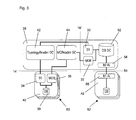
- the second embodiment of the present invention described in conjunction with Fig. 2 is partially illustrated in more detail in Fig. 3.
- the data to be transferred is split in two parts: topology data and managed object (MO) data, respectively. Consequently, the data handling components, i.e. providing means and, if present, separate forwarding means implementing the interfaces have to be adapted.
- the demand for data generated in the manner described above will be forwarded via (unified) interface 14' either implemented by topology reader 42 or by managed object (MO) reader 44 (also referred to as first forwarding means) to that regional network OSs 60 to which it is addressed, in the illustrated example to regional network OS 40. That is to say, the topology reader 42 when it forwards the call invokes the topology reader 34 installed in the regional network OS 40.
- the MO reader 44 when it forwards the call invokes the MO reader 36 in the regional network OS 40.
- the topology reader 42 and the MO reader 44 are separate modules on the side of the superior OS implementing interface 14' and being responsible for forwarding the call to and receiving the data of the regional network OSs 60.
- the interface may further be implemented as modules integrated in other data processing tools such as said ascertaining means 24' (not shown in Fig. 3), CM applications or single controls being part of CM applications, for example.
- Topology reader 34 and MO reader 36 are functional elements responsible for readout of topology and MO data from regional data base 39. According to Fig. 3, they further exemplify possible implementations of said first providing means 16'.
- the reader modules 34, 36 may implement communication functionality for the first (unified) interface 14' on the side of the subordinate OS. Naturally the communication functionality can be implemented as separate forwarding means within the subordinate OS, thus the separate module can serve both of the reader modules for example.
- first (unified) interface 14' and the first providing mans 16' as topology reader 34, 42 and MO reader 36, 44, respectively, are applicable in the same manner to the first (unified) interface 14 and providing means 16 of the first embodiment shown in Fig. 1.
- the interfaces, if present, forwarding means, and providing means may alike comprise single reader modules.
- the interfaces, forwarding means, and providing means may be subdivided into three or more reader modules depending on the diversity of data to be handled.
- the invention can be applied to sets of data other than topology data and MO data.
- the demand for data will be forwarded via interface 18' either by the topology reader 42 or the managed object reader 44 in response to the output result of the first ascertaining means 24', not shown in Fig. 3. That is to say, the topology reader 42 when it forwards the call invokes a topology reader 30 and the MO reader 44 when it forwards the call invokes a MO reader 32. In this case the data will be received from a superior database (DB) 52.
- DB superior database
- topology reader 30 and MO reader 32 are functional elements responsible for readout of topology and MO data from superior data base 52.
- the reader modules 30, 32 may implement communication functionality for the second (unified) interface 18'.
- the communication functionality can be implemented as separate forwarding means within the superior OS, thus the separate module can serve both of the reader modules for example.
- the forwarding means, if present, and the providing means 26' implementing the second interface 18' may alike comprise single reader modules in superior level OS or may be subdivided into three or more reader modules depending on the diversity of data to be handled, so that again the invention can be applied to sets of data other than topology data and MO data.
- the data stored in DB 52 are typically updated once a day during night. This regular update process is communicated via the aforementioned Itf-N interface 54 described in the introductory part of the present document.
- Data retrieved by the DB 52 are exported by exporting means 56 on the regional level and then imported by importing means 58 on the side of the superior level. Both, exporting means 56 and importing means 58 implement the Bulk CM part of the above-mentioned Itf-N interface. Subsequently, the data are stored in the DB 52.
- the method and OS according to the second embodiment of the present invention differentiates between two kinds of regional network OSs: firstly regional network OSs 60 which are able to communicate data on demand using the interface 14', and such regional network OSs 62 which are not able to communicate data on demand, therefore, using the regular upload interface 54 as suggested by MCCM.
- the method and OS according to the second embodiment of the present invention allows the communication within the hierarchical radio network operations system comprising both kinds of regional radio network OSs. It is sort of an universal controlling method and device. It further allows to apply in a simple manner the same CM tools in the superior radio network OS 38 and in the regional network OSs 60 in so far data are communicated via interface 14'.
- the invention overcomes the aforementioned problems at least accessing directly the actual data stored in the regional network OSs 60 and providing it in its entirety.
- these regional networks OSs 60 no unnecessary load to the superior radio network OS 38 due to export/import operations is generated.
- the computing load and memory consumption is distributed across these regions 60 so that system hardware does not require a different dimensioning in the superior network OS 38 compared with the regional network OSs 60.
- the hierarchical OS 400 schematically shown in Fig. 4 exemplifies how the invention can be applied to a specific set of data stored in a DB 64 on the superior level for management of a mobile communications network.
- the set of data contains actual data representing the actual status of regional networks not able to communicate via the unified interface (not explicitly shown in Fig. 4) and plan data representing information on the planned radio network configuration.
- plan data representing information on the planned radio network configuration.
- DB 64 being part of data storing means in the superior network OS 80 is arranged for storing actual data of regional data bases not able to communicate via said unified interface (not explicitly shown in Fig. 4) as well as for storing plan data.
- DB 64 Connected to the DB 64 one can find an actual data DB loader 66 as second providing means and a plan data DB loader 68 as third providing means. Both providing means 66, 68 invoke configuration forwarder 70 and 72, respectively, each of which implements said unified interface (not explicitly shown in Fig. 4).
- a further providing means 86 the so called compound loader accumulates data received from forwarders 72, 84 and provides the mixed actual and plan data to a further configuration forwarder 88 which is arranged to communicate with controlling applications 90, 92, 94 implementing the same unified interface standard as described above in conjunction with Figs. 1 to 3.
- said interface is utilized throughout each level of the hierarchical radio network OS 400 shown in Fig. 4. Said data are collected on demand in order to execute one or several applications activated e.g. by an operator or an operating function in the superior radio network OS.
- the present invention is not restricted to the above preferred embodiments but may be used for controlling a mobile communications network by a hierarchical radio network operations system of any other kind.
- the hierarchical radio network operations system may also comprise three or even more management levels.
- the radio network OS on a subordinate level according to any of the above embodiments may be an OS for controlling a regional radio network or may be a higher ranking OS.
- the unified interface is not restricted to a subdivision as shown in Fig. 3. The providing means and forwarding means therein may be subdivided into three or more elements depending on the diversity of data to be handled.
- Separate means for forwarding and/or receiving calls and data implementing said (unified) interfaces and providing means may comprise software as well as hardware components installed for the handling of data.
- the unified interface may be conceived as an open interface offered for applications outside of CM applications, too.
- the invention can further be applied to sets of data other than a set comprising actual data and plan data as exemplified by Fig. 4.
Landscapes
- Engineering & Computer Science (AREA)
- Computer Networks & Wireless Communication (AREA)
- Signal Processing (AREA)
- Mobile Radio Communication Systems (AREA)
Abstract
Description
- Fig. 1
- shows a flow diagram of a first embodiment of the method and OS according to the present invention;
- Fig. 2
- shows a flow diagram of a second embodiment of the method and OS according to the present invention;
- Fig. 3
- shows a schematic partial illustration of the second embodiment of the OS according to the present invention; and
- Fig. 4
- shows schematic illustration of an OS according to a further embodiment of the present invention.
Claims (32)
- A method for controlling a mobile communications network by a hierarchical radio network operations system with at least one radio network operations system on a subordinate level and a radio network operations system on a superior level comprising the steps ofinitiating a controlling action on the part of the radio network operations system on the superior level,generating a call for data depending on the controlling action,forwarding the call to at least one of the radio network operations systems on the subordinate level affected by the controlling action,providing data on the part of the radio network operations system on the subordinate level affected by the controlling action in response to the call, andforwarding the data to the radio network operations system on the superior level.
- A method for controlling a mobile communications network by a hierarchical radio network operations system according to claim 1 which further comprises the steps ofexecuting the controlling action on the basis of the retrieved data.
- A method for controlling a mobile communications network by a hierarchical radio network operations system according to claim 1 which further comprises the steps ofretrieving data by the radio network operations system on the superior level from at least one of the radio network operations systems on the subordinate level,exporting the retrieved data by the radio network operations system on the subordinate level,importing the data by the radio network operations system on the superior level, andstoring the imported data to data storing means in the radio network operations system on the superior level.
- A method for controlling a mobile communications network by a hierarchical radio network operations system according to claim 3 which further comprises the steps ofascertaining whether the call for data demanded depending on the controlling action is to be forwarded to the radio network operations system on the subordinate level affected by the controlling actionforwarding the call for data to the data storing means when the call is not to be forwarded to the radio network operations system on the subordinate level,providing data on the part of the data storing means in response to the call, andforwarding the data within the radio network operations system on the superior level.
- A method for controlling a mobile communications network by a hierarchical radio network operations system according to claim 4 which further comprises the steps ofascertaining whether the data demanded depending on the controlling action can be received from the radio network operations system on the subordinate level affected by the controlling action within a predetermined latency, andforwarding the call for data to the data storing means when the data can not be received within a predetermined latency before providing data on the part of the data storing means.
- A method for controlling a mobile communications network by a hierarchical radio network operations system according to claim 1,
wherein the controlling action comprises monitoring and controlling a configuration of radio network elements and/or radio network resources. - A method for controlling a mobile communications network by a hierarchical radio network operations system according to claim 1,
wherein the data demanded depending on the controlling action comprise network elements parameters and/or network resources parameters of the radio network on the subordinate level. - A method for controlling a mobile communications network by a hierarchical radio network operations system according to claim 1,
wherein the data demanded depending on the controlling action comprise topology data of the radio network on the subordinate level. - A method for controlling a mobile communications network by a hierarchical radio network operations system according to claim 1,
wherein said radio network operations system on a subordinate level is an operations system for managing a regional radio network. - A hierarchical radio network operations system for controlling a mobile communications network, the hierarchical radio network operations system comprisingat least one radio network operations system on a subordinate level,a radio network operations system on a superior level,initiating means being part of the radio network operations system on the superior level arranged for initiating a controlling action,call generating means arranged for generating a call for data depending on the controlling action,first forwarding means arranged for forwarding the call to at least one of the radio network operations systems on the subordinate level affected by the controlling action,first providing means being part of the radio network operations system on the subordinate level arranged for providing data in response to the call, andsecond forwarding means arranged for forwarding said data to the radio network operations system on the superior level.
- A hierarchical radio network operations system for controlling a mobile communications network according to claim 10 which further comprises executing means arranged for executing the controlling action on the basis of the retrieved data.
- A hierarchical radio network operations system for controlling a mobile communications network according to claim 10 which further comprisesretrieving means being part of the radio network operations system on the superior level arranged for retrieving data from at least one of the radio network operations systems on the subordinate level,exporting means being part of the radio network operations system on the subordinate level arranged for exporting the retrieved data,importing means being part of the radio network operations system on the superior level arranged for importing the data, anddata storing means being part of the radio network operations system on the superior level arranged for storing the imported data.
- A hierarchical radio network operations system for controlling a mobile communications network according to claim 12 which further comprisesfirst ascertaining means being part of the radio network operations system on the superior level arranged for ascertaining whether the call for data demanded depending on the controlling action is to be forwarded to the radio network operations system on the subordinate level affected by the controlling action, said first forwarding means further being arranged for forwarding the call for data to the data storing means when the call is not to be forwarded to said radio network operations system on the subordinate level,second providing means being part of the radio network operations system on the superior level arranged for providing data stored in the data storing means in response to the call, andthird forwarding means being arranged for forwarding the data within the radio network operations system on the superior level.
- A hierarchical radio network operations system for controlling a mobile communications network according to claim 13 which further comprises second ascertaining means being part of the radio network operations system on the superior level arranged for ascertaining whether the data demanded depending on the controlling action can be received from the radio network operations system on the subordinate level affected by the controlling action within a predetermined latency, said first forwarding means further being arranged for forwarding the call for data to said data storing means when the data can not be received within a predetermined latency.
- A hierarchical radio network operations system for controlling a mobile communications network according to claim 10 which further comprisesmonitoring means arranged for monitoring configuration of radio network elements and/or radio network resources andcontrolling means arranged for controlling configuration of radio network elements and/or radio network resources.
- A hierarchical radio network operations system for controlling a mobile communications network according to claim 13
wherein said call generating means, said first to third forwarding means, and said first and second providing means are arranged for generating and forwarding a call for network elements parameters and/or network resources parameters of the radio network operations system on the subordinate level and for forwarding and providing said parameters. - A hierarchical radio network operations system for controlling a mobile communications network according to claim 13
wherein said call generating means, said first to third forwarding means, and said first and second providing means are arranged for generating and forwarding a call for topology data of the radio network operations system on the subordinate level and for forwarding and providing said topology data. - A hierarchical radio network operations system for controlling a mobile communications network according to claim 17
wherein said first to third forwarding means and said first and second providing means comprise topology reading means and managed object reading means. - A hierarchical radio network operations system for controlling a mobile communications network according to claim 10 which further comprisessecond data storing means being part of the radio network operations system on the superior level arranged for storing planned data;third providing means being part of the radio network operations system on the superior level arranged for providing said planned data, andfourth forwarding means being arranged for forwarding said planned data within the radio network operations system on the superior level.
- A hierarchical radio network operations system for controlling a mobile communications network according to claim 10
wherein said radio network operations system on a subordinate level is an operations system for managing a regional radio network. - A hierarchical radio network operations system for controlling a mobile communications network, the hierarchical radio network operations system comprisingat least one radio network operations system on a subordinate level,a radio network operations system on a superior level,initiating means being part of the radio network operations system on the superior level arranged for initiating a controlling action,call generating means arranged for generating a call for data depending on the controlling action,a first interface between said radio network operations system on the subordinate level and said radio network operations system on the superior level arranged for forwarding the call to at least one of the radio network operations systems on the subordinate level affected by the controlling action and for forwarding data to the radio network operations system on the superior level, andfirst providing means being part of the radio network operations system on the subordinate level arranged for providing data in response to the call.
- A hierarchical radio network operations system for controlling a mobile communications network according to claim 21 which further comprises executing means arranged for executing the controlling action on the basis of the retrieved data.
- A hierarchical radio network operations system for controlling a mobile communications network according to claim 21 which further comprisesretrieving means being part of the radio network operations system on the superior level arranged for retrieving data from at least one of the radio network operations systems on the subordinate level,exporting means being part of the radio network operations system on the subordinate level arranged for exporting the retrieved data,importing means being part of the radio network operations system on the superior level arranged for importing the data, anddata storing means being part of the radio network operations system on the superior level arranged for storing the imported data.
- A hierarchical radio network operations system for controlling a mobile communications network according to claim 23 which further comprisesfirst ascertaining means being part of the radio network operations system on the superior level arranged for ascertaining whether the call for data demanded depending on the controlling action is to be forwarded to the radio network operations system on the subordinate level affected by the controlling action,second providing means being part of the radio network operations system on the superior level arranged for providing data stored in the data storing means in response to the call, anda second interface within said radio network operations system on the superior level further being arranged for forwarding the call for data to said second providing means when the call is not to be forwarded to said radio network operations system on the subordinate level and for forwarding the data provided by said providing means within the radio network operations system on the superior level.
- A hierarchical radio network operations system for controlling a mobile communications network according to claim 24 wherein said first and second interfaces are uniform interfaces.
- A hierarchical radio network operations system for controlling a mobile communications network according to claim 24 which further comprises second ascertaining means being part of the radio network operations system on the superior level arranged for ascertaining whether the data demanded depending on the controlling action can be received from the radio network operations system on the subordinate level affected by the controlling action within a predetermined latency, said second interface further being arranged for forwarding the call for data to said second providing means when the data can not be received within a predetermined latency.
- A hierarchical radio network operations system for controlling a mobile communications network according to claim 21 which further comprisesmonitoring means arranged for monitoring configuration of radio network elements and/or radio network resources andcontrolling means arranged for controlling configuration of radio network elements and/or radio network resources.
- A hierarchical radio network operations system for controlling a mobile communications network according to claim 24
wherein said call generating means, said first and second interfaces, and said first and second providing means are arranged for generating and forwarding a call for network elements parameters and/or network resources parameters and for forwarding and providing said parameters. - A hierarchical radio network operations system for controlling a mobile communications network according to claim 24
wherein said call generating means, said first and second interfaces, and said first and second providing means are arranged for generating and forwarding a call for topology data and for forwarding and providing said topology data. - A hierarchical radio network operations system for controlling a mobile communications network according to claim 29
wherein said first and second interfaces and said first and second providing means comprise topology reading means and managed object reading means. - A hierarchical radio network operations system for controlling a mobile communications network according to claim 24 which further comprisessecond data storing means being part of the radio network operations system on the superior level arranged for storing planned data;third providing means being part of the radio network operations system on the superior level arranged for providing said planned data, anda third interface arranged for forwarding the call for data to said third providing means and for providing said planned data within the radio network operations system on the superior level.
- A hierarchical radio network operations system for controlling a mobile communications network according to claim 21
wherein said radio network operations system on a subordinate level is an operations system for managing a regional radio network.
Applications Claiming Priority (6)
| Application Number | Priority Date | Filing Date | Title |
|---|---|---|---|
| US736632 | 2000-12-14 | ||
| US43850303P | 2003-01-08 | 2003-01-08 | |
| US438503P | 2003-01-08 | ||
| US10/347,383 US20040131024A1 (en) | 2003-01-08 | 2003-01-21 | Method and hierarchical radio network operations system for controlling a mobile communications network |
| US347383 | 2003-01-21 | ||
| US10/736,632 US8817803B2 (en) | 2003-01-08 | 2003-12-17 | Method and hierarchical radio network operations system for controlling a mobile communications network |
Publications (2)
| Publication Number | Publication Date |
|---|---|
| EP1437905A2 true EP1437905A2 (en) | 2004-07-14 |
| EP1437905A3 EP1437905A3 (en) | 2006-08-02 |
Family
ID=32512252
Family Applications (1)
| Application Number | Title | Priority Date | Filing Date |
|---|---|---|---|
| EP03029758A Withdrawn EP1437905A3 (en) | 2003-01-08 | 2003-12-23 | Method and hierarchical radio network operations system for controlling a mobile communications network |
Country Status (2)
| Country | Link |
|---|---|
| US (1) | US8817803B2 (en) |
| EP (1) | EP1437905A3 (en) |
Families Citing this family (3)
| Publication number | Priority date | Publication date | Assignee | Title |
|---|---|---|---|---|
| US20100214952A1 (en) * | 2009-02-25 | 2010-08-26 | Mark Gallagher | System and method for organizing a network |
| WO2013138457A1 (en) | 2012-03-15 | 2013-09-19 | Newlans, Inc. | Software-defined radio with broadband amplifiers and antenna matching |
| EP2934039B1 (en) * | 2014-04-15 | 2019-03-20 | Telefonaktiebolaget LM Ericsson (publ) | Technique for event reporting |
Family Cites Families (12)
| Publication number | Priority date | Publication date | Assignee | Title |
|---|---|---|---|---|
| JP3173102B2 (en) * | 1992-03-17 | 2001-06-04 | 株式会社日立製作所 | Network management operation system and management operation processing method |
| US6732170B2 (en) * | 1996-02-13 | 2004-05-04 | Hitachi, Ltd. | Network managing method, medium and system |
| GB2320653A (en) * | 1996-12-23 | 1998-06-24 | Northern Telecom Ltd | Mobile Communications Network Using Alternative Protocols |
| SE510485C2 (en) * | 1997-02-24 | 1999-05-25 | Ericsson Telefon Ab L M | An apparatus, system and method for handling communication |
| GB2332335A (en) * | 1997-12-10 | 1999-06-16 | Northern Telecom Ltd | Network management system |
| US6549533B1 (en) * | 1998-12-30 | 2003-04-15 | Objective Systems Integrators | Managing switched virtual circuits in a network |
| US6601195B1 (en) * | 1999-09-09 | 2003-07-29 | International Business Machines Corporation | Switch adapter testing |
| DE19953877A1 (en) * | 1999-11-09 | 2001-05-23 | Siemens Ag | Method and communication system for managing a communication network |
| EP1269691B1 (en) * | 2000-03-29 | 2007-12-26 | OpenCell Corp. | Operations and maintenance architecture for multiprotocol distributed system |
| KR100366538B1 (en) * | 2000-04-26 | 2002-12-31 | 주식회사 하이닉스반도체 | Device and method for administrating mobile communication network using tmn in imt-2000 system |
| EP1152625A1 (en) * | 2000-05-04 | 2001-11-07 | Siemens Aktiengesellschaft | Updating of manufacturer specific harware informations at the manufacturer independent OMC-NMC interface of a mobile radio network |
| US7260397B2 (en) * | 2002-12-27 | 2007-08-21 | Nokia Corporation | Reconfiguration of a mobile telecommunications network element |
-
2003
- 2003-12-17 US US10/736,632 patent/US8817803B2/en not_active Expired - Fee Related
- 2003-12-23 EP EP03029758A patent/EP1437905A3/en not_active Withdrawn
Also Published As
| Publication number | Publication date |
|---|---|
| US20040180663A1 (en) | 2004-09-16 |
| US8817803B2 (en) | 2014-08-26 |
| EP1437905A3 (en) | 2006-08-02 |
Similar Documents
| Publication | Publication Date | Title |
|---|---|---|
| EP1958377B1 (en) | A method and a system relating to network management | |
| US7991878B2 (en) | Method, system and terminal for maintaining capability management object and for managing capability | |
| US20200296571A1 (en) | Service Registration in a Communications Network | |
| CN111865900B (en) | RPC protocol-based cross-network regional proxy access method and system | |
| US20110280157A1 (en) | Communicating a Network Event | |
| EP1793529A1 (en) | A method and system for configuring network devices through an operations support system interface | |
| EP1361761A1 (en) | Telecommunications network management system and method for service monitoring | |
| CN1367987A (en) | Distributed communications network management and control system | |
| EP1508223B1 (en) | Operator-defined consistency checking in a network management system | |
| US6654799B1 (en) | Network management system uses managed object instances which are hierarchically organized in inclusion relation for recursively creating processing object and recuresively returning information | |
| CN105052076A (en) | Interface management service entity, functional service entity and network element management method | |
| CN113190513A (en) | Data integration system and method | |
| US8817803B2 (en) | Method and hierarchical radio network operations system for controlling a mobile communications network | |
| CN113359642A (en) | Multi-brand fusion dyeing and finishing control method, device, system and processor | |
| CN113055490B (en) | Data storage method and device | |
| US20040131024A1 (en) | Method and hierarchical radio network operations system for controlling a mobile communications network | |
| US20030177214A1 (en) | Dynamic SNMP network device | |
| US20060235673A1 (en) | Radio communication network cell configuration model optimization device | |
| CN119862084A (en) | Method and device for determining monitoring policy, storage medium and electronic device | |
| CN101242298B (en) | A network performance management interface method and system | |
| CN101399706A (en) | Method for information transmission through standard communication interface | |
| CN118779115B (en) | Mass data decision engine system and method based on java | |
| US8112512B2 (en) | Method and system for dynamic plugging of varbinds | |
| CN120596086A (en) | Method, device, electronic device and storage medium for constructing a portal system | |
| WO2025203090A1 (en) | System and method for query builder |
Legal Events
| Date | Code | Title | Description |
|---|---|---|---|
| PUAI | Public reference made under article 153(3) epc to a published international application that has entered the european phase |
Free format text: ORIGINAL CODE: 0009012 |
|
| AK | Designated contracting states |
Kind code of ref document: A2 Designated state(s): AT BE BG CH CY CZ DE DK EE ES FI FR GB GR HU IE IT LI LU MC NL PT RO SE SI SK TR |
|
| AX | Request for extension of the european patent |
Extension state: AL LT LV MK |
|
| PUAL | Search report despatched |
Free format text: ORIGINAL CODE: 0009013 |
|
| AK | Designated contracting states |
Kind code of ref document: A3 Designated state(s): AT BE BG CH CY CZ DE DK EE ES FI FR GB GR HU IE IT LI LU MC NL PT RO SE SI SK TR |
|
| AX | Request for extension of the european patent |
Extension state: AL LT LV MK |
|
| 17P | Request for examination filed |
Effective date: 20060823 |
|
| AKX | Designation fees paid |
Designated state(s): AT BE BG CH CY CZ DE DK EE ES FI FR GB GR HU IE IT LI LU MC NL PT RO SE SI SK TR |
|
| 17Q | First examination report despatched |
Effective date: 20080409 |
|
| STAA | Information on the status of an ep patent application or granted ep patent |
Free format text: STATUS: THE APPLICATION IS DEEMED TO BE WITHDRAWN |
|
| 18D | Application deemed to be withdrawn |
Effective date: 20110412 |