EP1437738A1 - Method for creating and accessing a menu for audio content without using a display - Google Patents
Method for creating and accessing a menu for audio content without using a display Download PDFInfo
- Publication number
- EP1437738A1 EP1437738A1 EP20030300170 EP03300170A EP1437738A1 EP 1437738 A1 EP1437738 A1 EP 1437738A1 EP 20030300170 EP20030300170 EP 20030300170 EP 03300170 A EP03300170 A EP 03300170A EP 1437738 A1 EP1437738 A1 EP 1437738A1
- Authority
- EP
- European Patent Office
- Prior art keywords
- audio
- cluster
- tracks
- track
- menu
- Prior art date
- Legal status (The legal status is an assumption and is not a legal conclusion. Google has not performed a legal analysis and makes no representation as to the accuracy of the status listed.)
- Granted
Links
- 238000000034 method Methods 0.000 title claims abstract description 30
- 239000000284 extract Substances 0.000 claims description 9
- 230000006870 function Effects 0.000 description 4
- 230000008520 organization Effects 0.000 description 3
- 230000008447 perception Effects 0.000 description 3
- 230000003993 interaction Effects 0.000 description 2
- 230000002040 relaxant effect Effects 0.000 description 2
- 230000033764 rhythmic process Effects 0.000 description 2
- 238000013473 artificial intelligence Methods 0.000 description 1
- 230000006399 behavior Effects 0.000 description 1
- 230000008901 benefit Effects 0.000 description 1
- 230000015572 biosynthetic process Effects 0.000 description 1
- 230000006835 compression Effects 0.000 description 1
- 238000007906 compression Methods 0.000 description 1
- 230000008451 emotion Effects 0.000 description 1
- 238000005516 engineering process Methods 0.000 description 1
- 239000012634 fragment Substances 0.000 description 1
- 230000004048 modification Effects 0.000 description 1
- 238000012986 modification Methods 0.000 description 1
- 230000036651 mood Effects 0.000 description 1
- 230000008569 process Effects 0.000 description 1
- 238000003672 processing method Methods 0.000 description 1
- 230000003595 spectral effect Effects 0.000 description 1
- 230000000007 visual effect Effects 0.000 description 1
Images

Classifications
-
- G—PHYSICS
- G10—MUSICAL INSTRUMENTS; ACOUSTICS
- G10H—ELECTROPHONIC MUSICAL INSTRUMENTS; INSTRUMENTS IN WHICH THE TONES ARE GENERATED BY ELECTROMECHANICAL MEANS OR ELECTRONIC GENERATORS, OR IN WHICH THE TONES ARE SYNTHESISED FROM A DATA STORE
- G10H1/00—Details of electrophonic musical instruments
- G10H1/0008—Associated control or indicating means
-
- G—PHYSICS
- G11—INFORMATION STORAGE
- G11B—INFORMATION STORAGE BASED ON RELATIVE MOVEMENT BETWEEN RECORD CARRIER AND TRANSDUCER
- G11B27/00—Editing; Indexing; Addressing; Timing or synchronising; Monitoring; Measuring tape travel
- G11B27/10—Indexing; Addressing; Timing or synchronising; Measuring tape travel
- G11B27/102—Programmed access in sequence to addressed parts of tracks of operating record carriers
- G11B27/105—Programmed access in sequence to addressed parts of tracks of operating record carriers of operating discs
-
- G—PHYSICS
- G11—INFORMATION STORAGE
- G11B—INFORMATION STORAGE BASED ON RELATIVE MOVEMENT BETWEEN RECORD CARRIER AND TRANSDUCER
- G11B27/00—Editing; Indexing; Addressing; Timing or synchronising; Monitoring; Measuring tape travel
- G11B27/10—Indexing; Addressing; Timing or synchronising; Measuring tape travel
- G11B27/19—Indexing; Addressing; Timing or synchronising; Measuring tape travel by using information detectable on the record carrier
- G11B27/28—Indexing; Addressing; Timing or synchronising; Measuring tape travel by using information detectable on the record carrier by using information signals recorded by the same method as the main recording
-
- G—PHYSICS
- G11—INFORMATION STORAGE
- G11B—INFORMATION STORAGE BASED ON RELATIVE MOVEMENT BETWEEN RECORD CARRIER AND TRANSDUCER
- G11B27/00—Editing; Indexing; Addressing; Timing or synchronising; Monitoring; Measuring tape travel
- G11B27/10—Indexing; Addressing; Timing or synchronising; Measuring tape travel
- G11B27/34—Indicating arrangements
-
- G—PHYSICS
- G10—MUSICAL INSTRUMENTS; ACOUSTICS
- G10H—ELECTROPHONIC MUSICAL INSTRUMENTS; INSTRUMENTS IN WHICH THE TONES ARE GENERATED BY ELECTROMECHANICAL MEANS OR ELECTRONIC GENERATORS, OR IN WHICH THE TONES ARE SYNTHESISED FROM A DATA STORE
- G10H2210/00—Aspects or methods of musical processing having intrinsic musical character, i.e. involving musical theory or musical parameters or relying on musical knowledge, as applied in electrophonic musical tools or instruments
- G10H2210/031—Musical analysis, i.e. isolation, extraction or identification of musical elements or musical parameters from a raw acoustic signal or from an encoded audio signal
- G10H2210/071—Musical analysis, i.e. isolation, extraction or identification of musical elements or musical parameters from a raw acoustic signal or from an encoded audio signal for rhythm pattern analysis or rhythm style recognition
-
- G—PHYSICS
- G10—MUSICAL INSTRUMENTS; ACOUSTICS
- G10H—ELECTROPHONIC MUSICAL INSTRUMENTS; INSTRUMENTS IN WHICH THE TONES ARE GENERATED BY ELECTROMECHANICAL MEANS OR ELECTRONIC GENERATORS, OR IN WHICH THE TONES ARE SYNTHESISED FROM A DATA STORE
- G10H2210/00—Aspects or methods of musical processing having intrinsic musical character, i.e. involving musical theory or musical parameters or relying on musical knowledge, as applied in electrophonic musical tools or instruments
- G10H2210/031—Musical analysis, i.e. isolation, extraction or identification of musical elements or musical parameters from a raw acoustic signal or from an encoded audio signal
- G10H2210/081—Musical analysis, i.e. isolation, extraction or identification of musical elements or musical parameters from a raw acoustic signal or from an encoded audio signal for automatic key or tonality recognition, e.g. using musical rules or a knowledge base
-
- G—PHYSICS
- G10—MUSICAL INSTRUMENTS; ACOUSTICS
- G10H—ELECTROPHONIC MUSICAL INSTRUMENTS; INSTRUMENTS IN WHICH THE TONES ARE GENERATED BY ELECTROMECHANICAL MEANS OR ELECTRONIC GENERATORS, OR IN WHICH THE TONES ARE SYNTHESISED FROM A DATA STORE
- G10H2240/00—Data organisation or data communication aspects, specifically adapted for electrophonic musical tools or instruments
- G10H2240/075—Musical metadata derived from musical analysis or for use in electrophonic musical instruments
- G10H2240/085—Mood, i.e. generation, detection or selection of a particular emotional content or atmosphere in a musical piece
-
- G—PHYSICS
- G10—MUSICAL INSTRUMENTS; ACOUSTICS
- G10H—ELECTROPHONIC MUSICAL INSTRUMENTS; INSTRUMENTS IN WHICH THE TONES ARE GENERATED BY ELECTROMECHANICAL MEANS OR ELECTRONIC GENERATORS, OR IN WHICH THE TONES ARE SYNTHESISED FROM A DATA STORE
- G10H2240/00—Data organisation or data communication aspects, specifically adapted for electrophonic musical tools or instruments
- G10H2240/121—Musical libraries, i.e. musical databases indexed by musical parameters, wavetables, indexing schemes using musical parameters, musical rule bases or knowledge bases, e.g. for automatic composing methods
- G10H2240/131—Library retrieval, i.e. searching a database or selecting a specific musical piece, segment, pattern, rule or parameter set
- G10H2240/135—Library retrieval index, i.e. using an indexing scheme to efficiently retrieve a music piece
Definitions
- This invention relates to an audio management system that allows a user to browse through stored audio files in a very natural way.
- the invention concerns large-capacity digital storage-playback systems for audio content like MPEG audio layer 3 (MP3) players.
- MP3 MPEG audio layer 3
- the problem of managing very big collections of audio files becomes predominant.
- the current generation of MP3 players contains a 10 GB hard disk drive which enables users to store e.g. more than 300 hours of MP3PRO music, meaning more than 4.000 titles.
- the present invention is directed to overcoming these drawbacks.
- the present invention deals with a process and system for navigating through a large amount of audio files, e.g. MP3 files, using brief representatives of the audio content.
- audio thumbnail Before a user selects a music track, he can benefit from hearing a brief representative excerpt, in the following referred to as "audio thumbnail".
- An audio thumbnail is of sufficient length to recognize the music, e.g. 5 or 6 seconds.
- the stored audio files are preprocessed in order to extract some relevant and objective descriptors.
- these descriptors are used to cluster the music tracks into perceptually homogeneous groups. From each cluster a relevant track is selected automatically or manually, or semi-automatically, and from said selected track an audio thumbnail is extracted. Then these audio thumbnails being key phrases are arranged in a tree data structure, or table of contents, that enables the user to navigate without any visual navigation means, like display.
- the audio thumbnails allow the user to navigate perceptually through the audio database, without having to remember textual elements, like title or artist names. It is particularly suited to enable users without precise idea of what they want to hear to browse their database, and to select perceptually from clusters of songs. Perceptually means here that the thumbnails address to the perception, and not memory, of users. Also, said clusters are perceptive, meaning that the structuring of the clusters is relevant for users, and thus said structuring meets real user needs.
- the present invention describes a method for creating, organizing and using audio representations for audio content.
- the structure of the invention is shown in Figure 1.
- Audio tracks usually music, are stored in a storage means S.
- the tracks are classified in a classifier CL and associated to a cluster of tracks C1,C2,C3.
- For each cluster a representative example is selected in a representative selector R.
- an extractor X extracts a characteristic sample, or thumbnail, from said example, and the thumbnail is associated to a table of contents T.
- the user uses an interface I to select a first cluster represented by a first thumbnail, listen to the selected thumbnail, and decide whether to select another cluster, or select said first cluster related to said first thumbnail and then select a track belonging to said cluster, which track is then read from the storage means S and reproduced.
- An audio-based indexing system combines two methods that are known from other content search systems, namely the 'table-of-contents' method and the 'radio-like navigation' method.
- the 'table-of-contents' method relates to a books table of contents, where short representative sequences summing up the actual text are grouped according to the structure of the books contents. This usually correlates with a logical classification into topics.
- Using this method for audio content means extracting parameters, or descriptors, from the audio file, following objective criteria defined below, and then group together homogeneous tracks in clusters. From a user's point of view, these clusters make sense because their content-based nature is going farther than the a priori classification in genres. E.g. all the fragments of guitar music, coming from all genres, may be grouped together in a cluster. All the relaxing music can constitute another cluster. According to the invention, the different clusters constitute the "table of contents" of the database.
- the 'radio-like navigation' method relates to typical user behavior when listening to the radio.
- Content browsing in this context is e.g. the user scanning the FM band on a car radio, and listening to a track or switching to the next station.
- the invention uses this concept, with a radio station corresponding to a cluster of tracks. Then 'switch to another station' corresponds to 'select another cluster', and 'listen to a track' corresponds to 'listen to this track or to a similar track from the same cluster'.
- descriptors are extracted from the audio track. Three types of descriptors are used, trying to be objective and still relevant for the user.
- the first type of descriptors is low-level descriptors, or physical features, as being typical for signal processing methods. Examples are spectral centroid, short-time energy or short-time average zero-crossing.
- the second type of descriptors is medium-level descriptors, or perceptual features, as being typically used by a musician.
- Examples are rhythm, e.g. binary or ternary rhythm, tonality, the kind of formation, e.g. voice or special instruments.
- the third type of descriptors is high-level descriptors, or psychological and social features of the track, as being normal for the average user. Trying to minimize the subjective nature of these features, it is e.g. possible to classify music as being happy or anxious, calm or energetic. These characteristics can be assigned to a certain degree, or with a certain probability, to a piece of music, when e.g. descriptors of the previously described types are used. Also, a song can be highly memorable, can convey a certain mood or emotion, can remind the user of something, etc. This may be done automatically using supervised algorithms, i.e. with algorithms that require user interaction.
- the second step consists of clustering the music tracks.
- the tracks can be classified into homogeneous classes. These classes are more valuable to a user than classifying music by artist or title.
- Unsupervised algorithms may be used to cluster the tracks into packets with similar properties. Examples of such algorithms are the K-means or Self Organizing Maps.
- a new cluster may be automatically generated when the dissimilarity of a newly added track, compared to existing clusters, reaches a certain minimum level, and in that case the newly added track will be associated with the new cluster.
- the tracks are classified and therefore it is possible to create a table of contents.
- There is no sharp classification required e.g. it is possible to have the same track in any number of clusters.
- one cluster may be for guitar music, while another cluster may be for calm music, and a track matching both characteristics may be associated with both clusters.
- both clusters may contain a link to said audio track, but the track itself needs to be stored only once.
- the third step consists of automatically selecting a representative track for each cluster.
- the most representative track for a cluster is selected, using classical medoid selection.
- a medoid is that object of a cluster whose average dissimilarity to all objects of the cluster is minimal. Said dissimilarity can e.g. be determined using the descriptors that were extracted during the first step.
- an audio thumbnail is created and stored for the medoid track.
- an audio thumbnail may be created and stored also for other tracks.
- For thumbnail creation it is evaluated which criteria are the best to characterize an audio track by a short audio sequence, the audio sequence being long enough to recognize the track, e.g. 5 or 6 seconds.
- the length of thumbnails is constant, in a second embodiment the length of thumbnails can be modified, and in a third embodiment the length of thumbnails can vary from track to track, according to the tracks descriptors.
- a thumbnail is an original sample from the track, or in another embodiment it is automatically synthesized from said track.
- the audio thumbnails are listed in a virtual table, which can be scanned through by the user, like scanning through different radio stations.
- the table may be organized such that within a cluster the most relevant track, or medoid, will be found first when scanning through the table. Other tracks within a cluster may be sorted, e.g. according to relevance.
- no graphical or textual display is required for scanning through the table of contents.
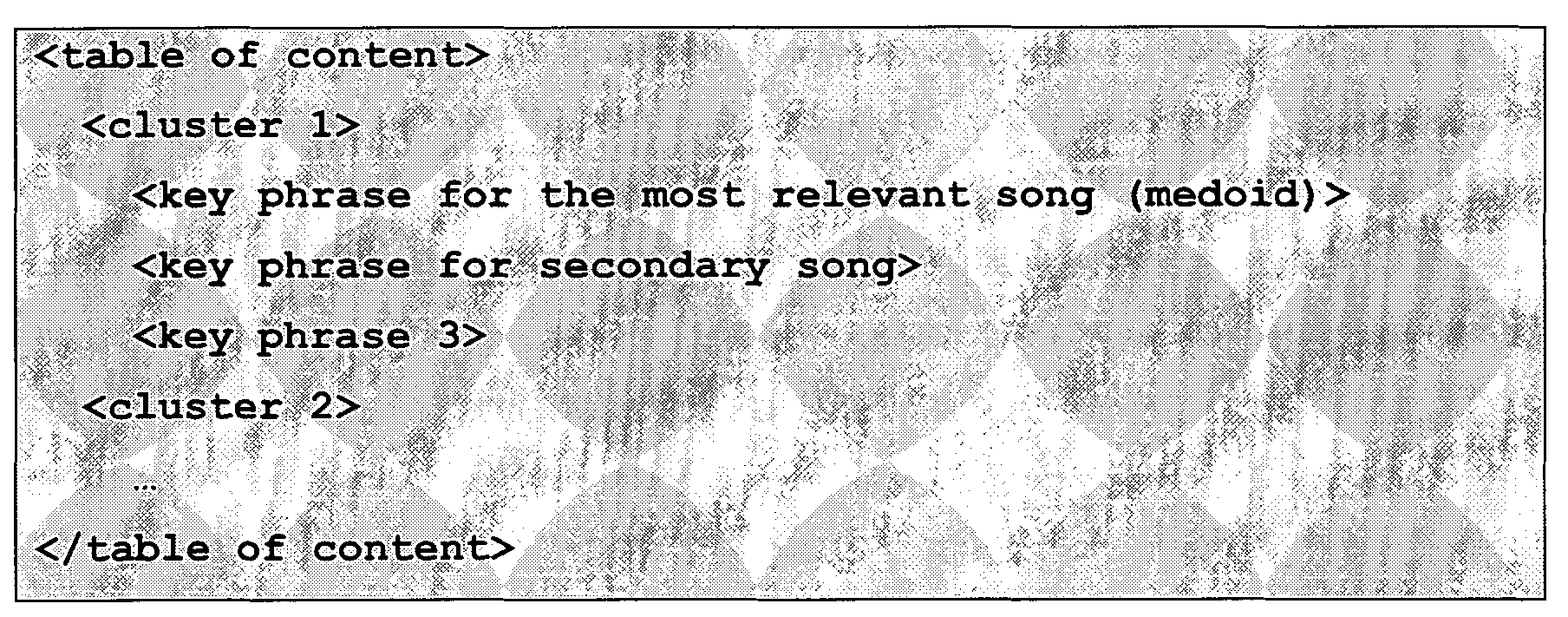
- the structure of the table of contents may be as follows:
- a user may decide to listen to the current track, or to another track belonging to the same cluster and therefore being similar to said current track. Alternatively the user may decide to listen to a track from another cluster.
- only one button, or other means of command input is required to operate the navigation system, namely for 'Switch Cluster'. More comfortable to the user is a device with three buttons, as shown in Figure 2.
- One button SD is for 'Switch to a Near Cluster'
- one button SU is for 'Switch to a Distant Cluster'
- one button M is for 'Switch to another track from the Current Cluster'.
- Other functions controlled by user input could be e.g. random track selection or random cluster selection mode. Another function could be to successively reproduce the representatives of all clusters until the user selects one cluster, said function being advantageous because the user needs not manually scan through the table of contents.
- an audio track belongs to only one cluster, while in another embodiment an audio track may belong to more than one cluster, when the respective class criteria are not excluding each other.
- the table of contents has only one level of clustering, like in the previously described example, while in another embodiment the table of contents can have more hierarchical levels of clusters.
- the classification rules for audio tracks are final, while in another embodiment said rules may be modified. Said modification may happen either by an update, e.g. via internet, or by any form of user interaction, e.g. upload to PC, edit and download from PC, or by statistical or self learning methods as used e.g. by artificial intelligence. This may be implemented such that an automatic or semi-automatic reclassification with modified or enhanced rules may be performed when e.g. the number of tracks associated with one cluster is much higher than the number of tracks associated with any other cluster.
- thumbnails may be created only for tracks representing a cluster. In another embodiment of the invention thumbnails may be created also for other tracks, e.g. tracks that fulfill a certain condition like being selected very often or very rarely, or being very long. In a third embodiment thumbnails are created for all tracks.
- the tracks within a cluster may have a constant order, so that the user can learn after a while when a certain track comes.
- the order can follow the tracks relevance, or any other parameter, e.g. storage time, or frequency of selection.
- the tracks within a cluster may be unordered, or appear randomly when the user selects a cluster.
- the described method for perception based classification and retrieval of audio contents can be used in devices, preferably portable devices, for storage and reproduction of music or other audio data, e.g. MP3 players.
Landscapes
- Physics & Mathematics (AREA)
- Engineering & Computer Science (AREA)
- Acoustics & Sound (AREA)
- Multimedia (AREA)
- Information Retrieval, Db Structures And Fs Structures Therefor (AREA)
- Management Or Editing Of Information On Record Carriers (AREA)
Abstract
Description
- This invention relates to an audio management system that allows a user to browse through stored audio files in a very natural way. The invention concerns large-capacity digital storage-playback systems for audio content like MPEG audio layer 3 (MP3) players.
- Driven by the recent advances in the technologies of digital storage and audio compression, the problem of managing very big collections of audio files becomes predominant. For instance, the current generation of MP3 players contains a 10 GB hard disk drive which enables users to store e.g. more than 300 hours of MP3PRO music, meaning more than 4.000 titles.
- Reliable tools are required to make those collections accessible to the users.
- The classical way of indexing audio files is based on textual meta-information like title, artist, album or genre, like e.g. ID3 tags for MP3 audio files.
There are some drawbacks with this kind of organization: - 1. The metadata are textual and not audio, and therefore cannot give a precise representation of an audio content, like a representative extract of the content can do.
- 2. Organization sorted by genre or by artist allows users to locate a particular piece of music. This presupposes that users have well-defined goals, knowing exactly what they want to hear. The users searching strategy must be goal-driven and deterministic.
- 3. There are a lot of genres: for instance, the music archive mp3.com currently lists its titles under 180 different sub-genres, organized in 16 main genres. It is difficult for a user to navigate in such organization.
- 4. Genres are sometimes subjective because they are established a priori and not deduced from the content itself. Sometimes they are difficult to interpret.
- 5. A classification by genres is not able to satisfy very simple user needs like for instance "This piece of music is relaxing me. I would like to hear more like this".
-
- The present invention is directed to overcoming these drawbacks.
- The present invention deals with a process and system for navigating through a large amount of audio files, e.g. MP3 files, using brief representatives of the audio content. Before a user selects a music track, he can benefit from hearing a brief representative excerpt, in the following referred to as "audio thumbnail". An audio thumbnail is of sufficient length to recognize the music, e.g. 5 or 6 seconds.
- The stored audio files are preprocessed in order to extract some relevant and objective descriptors. According to the invention, these descriptors are used to cluster the music tracks into perceptually homogeneous groups. From each cluster a relevant track is selected automatically or manually, or semi-automatically, and from said selected track an audio thumbnail is extracted. Then these audio thumbnails being key phrases are arranged in a tree data structure, or table of contents, that enables the user to navigate without any visual navigation means, like display.
- Furthermore, the audio thumbnails allow the user to navigate perceptually through the audio database, without having to remember textual elements, like title or artist names. It is particularly suited to enable users without precise idea of what they want to hear to browse their database, and to select perceptually from clusters of songs. Perceptually means here that the thumbnails address to the perception, and not memory, of users. Also, said clusters are perceptive, meaning that the structuring of the clusters is relevant for users, and thus said structuring meets real user needs.
- Using this invention, users can create play lists beyond the classical music categories like pop or country.
- Exemplary embodiments of the invention are described with reference to the accompanying drawings, which show in
- Fig.1 an exemplary architecture of an audio reproduction system using an audio menu;
- Fig.2 an exemplary user interface without display.
-
- The present invention describes a method for creating, organizing and using audio representations for audio content. The structure of the invention is shown in Figure 1. Audio tracks, usually music, are stored in a storage means S. The tracks are classified in a classifier CL and associated to a cluster of tracks C1,C2,C3. For each cluster a representative example is selected in a representative selector R. Further, an extractor X extracts a characteristic sample, or thumbnail, from said example, and the thumbnail is associated to a table of contents T. The user uses an interface I to select a first cluster represented by a first thumbnail, listen to the selected thumbnail, and decide whether to select another cluster, or select said first cluster related to said first thumbnail and then select a track belonging to said cluster, which track is then read from the storage means S and reproduced.
- Advantageously, this approach is more perception based than previous methods, and therefore more convenient to the user. An audio-based indexing system according to the invention combines two methods that are known from other content search systems, namely the 'table-of-contents' method and the 'radio-like navigation' method.
- The 'table-of-contents' method relates to a books table of contents, where short representative sequences summing up the actual text are grouped according to the structure of the books contents. This usually correlates with a logical classification into topics. Using this method for audio content means extracting parameters, or descriptors, from the audio file, following objective criteria defined below, and then group together homogeneous tracks in clusters. From a user's point of view, these clusters make sense because their content-based nature is going farther than the a priori classification in genres. E.g. all the fragments of guitar music, coming from all genres, may be grouped together in a cluster. All the relaxing music can constitute another cluster. According to the invention, the different clusters constitute the "table of contents" of the database. And, like in a book's table of contents, there may be different levels of details, like e.g. chapter 1, chapter 1.1, etc. Like the reader can navigate from chapter to chapter, and may decide to read a chapter more in detail, the listener can navigate from cluster to cluster, or may decide to listen to more, similar music from a cluster.
- The 'radio-like navigation' method relates to typical user behavior when listening to the radio. Content browsing in this context is e.g. the user scanning the FM band on a car radio, and listening to a track or switching to the next station. The invention uses this concept, with a radio station corresponding to a cluster of tracks. Then 'switch to another station' corresponds to 'select another cluster', and 'listen to a track' corresponds to 'listen to this track or to a similar track from the same cluster'.
- In the following, the afore mentioned steps in creating and organizing audio representations are described in detail, the steps being performed when a track is newly added to the database, or when the database is reorganized.
- In a first step descriptors are extracted from the audio track. Three types of descriptors are used, trying to be objective and still relevant for the user.
- The first type of descriptors is low-level descriptors, or physical features, as being typical for signal processing methods. Examples are spectral centroid, short-time energy or short-time average zero-crossing.
- The second type of descriptors is medium-level descriptors, or perceptual features, as being typically used by a musician. Examples are rhythm, e.g. binary or ternary rhythm, tonality, the kind of formation, e.g. voice or special instruments.
- The third type of descriptors is high-level descriptors, or psychological and social features of the track, as being normal for the average user. Trying to minimize the subjective nature of these features, it is e.g. possible to classify music as being happy or anxious, calm or energetic. These characteristics can be assigned to a certain degree, or with a certain probability, to a piece of music, when e.g. descriptors of the previously described types are used. Also, a song can be highly memorable, can convey a certain mood or emotion, can remind the user of something, etc. This may be done automatically using supervised algorithms, i.e. with algorithms that require user interaction.
- The second step consists of clustering the music tracks. Using the descriptors defined in the first step, the tracks can be classified into homogeneous classes. These classes are more valuable to a user than classifying music by artist or title. Unsupervised algorithms may be used to cluster the tracks into packets with similar properties. Examples of such algorithms are the K-means or Self Organizing Maps. A new cluster may be automatically generated when the dissimilarity of a newly added track, compared to existing clusters, reaches a certain minimum level, and in that case the newly added track will be associated with the new cluster.
- At this point, the tracks are classified and therefore it is possible to create a table of contents. There is no sharp classification required, e.g. it is possible to have the same track in any number of clusters. For example, one cluster may be for guitar music, while another cluster may be for calm music, and a track matching both characteristics may be associated with both clusters. In this case, both clusters may contain a link to said audio track, but the track itself needs to be stored only once.
- The third step consists of automatically selecting a representative track for each cluster. Advantageously, the most representative track for a cluster is selected, using classical medoid selection. A medoid is that object of a cluster whose average dissimilarity to all objects of the cluster is minimal. Said dissimilarity can e.g. be determined using the descriptors that were extracted during the first step.
- In the fourth step an audio thumbnail is created and stored for the medoid track. In another embodiment of the invention an audio thumbnail may be created and stored also for other tracks. For thumbnail creation it is evaluated which criteria are the best to characterize an audio track by a short audio sequence, the audio sequence being long enough to recognize the track, e.g. 5 or 6 seconds. In one embodiment of the invention the length of thumbnails is constant, in a second embodiment the length of thumbnails can be modified, and in a third embodiment the length of thumbnails can vary from track to track, according to the tracks descriptors. Further, in one embodiment of the invention a thumbnail is an original sample from the track, or in another embodiment it is automatically synthesized from said track.
- In the fifth step the audio thumbnails are listed in a virtual table, which can be scanned through by the user, like scanning through different radio stations. The table may be organized such that within a cluster the most relevant track, or medoid, will be found first when scanning through the table. Other tracks within a cluster may be sorted, e.g. according to relevance. Advantageously, no graphical or textual display is required for scanning through the table of contents. The structure of the table of contents may be as follows:
- A user may decide to listen to the current track, or to another track belonging to the same cluster and therefore being similar to said current track. Alternatively the user may decide to listen to a track from another cluster. Advantageously, only one button, or other means of command input, is required to operate the navigation system, namely for 'Switch Cluster'. More comfortable to the user is a device with three buttons, as shown in Figure 2. One button SD is for 'Switch to a Near Cluster', one button SU is for 'Switch to a Distant Cluster', and one button M is for 'Switch to another track from the Current Cluster'. Alternatively, it is sufficient to have only one button, if the button has more than one function, or other means of user input. Other functions controlled by user input could be e.g. random track selection or random cluster selection mode. Another function could be to successively reproduce the representatives of all clusters until the user selects one cluster, said function being advantageous because the user needs not manually scan through the table of contents.
- Further embodiments are described in the following.
- In one embodiment of the invention an audio track belongs to only one cluster, while in another embodiment an audio track may belong to more than one cluster, when the respective class criteria are not excluding each other.
- In one embodiment of the invention the table of contents has only one level of clustering, like in the previously described example, while in another embodiment the table of contents can have more hierarchical levels of clusters.
- In one embodiment of the invention the classification rules for audio tracks are final, while in another embodiment said rules may be modified. Said modification may happen either by an update, e.g. via internet, or by any form of user interaction, e.g. upload to PC, edit and download from PC, or by statistical or self learning methods as used e.g. by artificial intelligence. This may be implemented such that an automatic or semi-automatic reclassification with modified or enhanced rules may be performed when e.g. the number of tracks associated with one cluster is much higher than the number of tracks associated with any other cluster.
- In one embodiment of the invention thumbnails may be created only for tracks representing a cluster. In another embodiment of the invention thumbnails may be created also for other tracks, e.g. tracks that fulfill a certain condition like being selected very often or very rarely, or being very long. In a third embodiment thumbnails are created for all tracks.
- In one embodiment of the invention the tracks within a cluster may have a constant order, so that the user can learn after a while when a certain track comes. The order can follow the tracks relevance, or any other parameter, e.g. storage time, or frequency of selection. In another embodiment of the invention the tracks within a cluster may be unordered, or appear randomly when the user selects a cluster.
- In one embodiment of the invention there is a representative track selected for each cluster, while in another embodiment it may be useful to have no representative track for one of said clusters, e.g. a cluster for favorites or a cluster for tracks not being classifiable by the employed methods.
- Advantageously the described method for perception based classification and retrieval of audio contents can be used in devices, preferably portable devices, for storage and reproduction of music or other audio data, e.g. MP3 players.
Claims (18)
- A method for creating and accessing a menu for audio content stored in a storage means (S), the content consisting of audio tracks, and the menu containing representations of said audio tracks, characterized inclassifying (CL) the audio tracks into groups, or clusters (C1,...,C3) wherein said classification is performed according to characteristic parameters of said audio tracks;selecting (R) automatically an audio track being a representative for the cluster, wherein said selection is performed according to characteristic parameters of said audio track and of the other audio tracks of said cluster;generating (X) as said representation a reproducible audio extract from said representative audio track; andassociating said audio extract to a menu list (T).
- Method according to claim 1, wherein said characteristic parameters used for classification of audio content comprise one or more audio descriptors, the audio descriptors being either physical features, or perceptual features, or psychological or social features of the audio content.
- Method according to any of claims 1-2, wherein an audio track can be classified into more than one cluster (C1,...,C3).
- Method according to any of claims 1-3, wherein the audio tracks within a cluster (C1,...,C3) have variable order, so that the user listens to a randomly selected track when having selected a cluster (C1,...,C3), with said track belonging to said cluster.
- Method according to any of claims 1-4, wherein a user can modify the result of automatic classification of audio tracks.
- Method according to any of claims 1-5, wherein a user can modify the classification rules for automatic classification of audio tracks.
- Method according to any of claims 1-6, wherein the actual audio data are clustered within said storage means (S) according to said menu.
- Method according to any of claims 1-7, wherein the audio extract is a sample from the audio track, or an audio sequence being synthesized from the actual audio track.
- Method according to any of claims 1-8, wherein audio extracts are created additionally for audio tracks not being representatives of clusters.
- Method according to any of claims 1-9, wherein the length of audio extracts is not predetermined.
- Method according to any of claims 1-10, wherein one of said clusters has no representative track.
- Method according to any of claims 1-11, wherein said menu is hierarchical, such that a cluster may contain one or more subclusters.
- Method according to any of claims 1-12, wherein the classification rules are modified automatically if a defined precondition is detected, and a reclassification may be performed.
- Method according to claim 13, wherein said precondition comprises that the difference between the number of tracks in a cluster and the number of tracks in another cluster reaches a maximum limit value.
- Method according to claim 13, wherein said precondition comprises that all stored tracks were classified into one cluster, and the total number of tracks reaches a maximum limit value.
- An apparatus for creating or accessing a menu for audio content stored on a storage means (S), the content consisting of audio tracks, and the menu containing representations of audio tracks, characterized bymeans for automatically classifying (CL) the audio tracks into groups, or clusters (C1,...,C3) wherein said classification is performed according to characteristic parameters of said audio tracks;means for automatically selecting (R) an audio track being a representative for the cluster, wherein said selection is performed according to characteristic parameters of said audio track and of the other audio tracks of said cluster;means for generating (X) a reproducible audio extract from said representative audio track; andmeans for associating said audio extract to a menu list (T).
- Apparatus according to claim 16, further characterized bymeans for selecting and reproducing a first audio representation from a first cluster;means for a first user input (M,SU,SD), the input controlling whether the cluster associated with the currently selected audio thumbnail is selected or not; andmeans for a second user input (M,SU,SD), the input controlling whether another cluster is selected or not.
- Apparatus according to any of claims 16 or 17, further characterized in that an audio track of the selected cluster is read from said storage means (S) for playback.
Priority Applications (1)
| Application Number | Priority Date | Filing Date | Title |
|---|---|---|---|
| EP03300170.2A EP1437738B1 (en) | 2003-01-06 | 2003-10-20 | Method for creating and accessing a menu for audio content without using a display |
Applications Claiming Priority (3)
| Application Number | Priority Date | Filing Date | Title |
|---|---|---|---|
| EP03290019 | 2003-01-06 | ||
| EP03290019A EP1435620A1 (en) | 2003-01-06 | 2003-01-06 | Method for creating and accessing a menu for audio content without using a display |
| EP03300170.2A EP1437738B1 (en) | 2003-01-06 | 2003-10-20 | Method for creating and accessing a menu for audio content without using a display |
Publications (2)
| Publication Number | Publication Date |
|---|---|
| EP1437738A1 true EP1437738A1 (en) | 2004-07-14 |
| EP1437738B1 EP1437738B1 (en) | 2018-11-07 |
Family
ID=32510149
Family Applications (1)
| Application Number | Title | Priority Date | Filing Date |
|---|---|---|---|
| EP03300170.2A Expired - Lifetime EP1437738B1 (en) | 2003-01-06 | 2003-10-20 | Method for creating and accessing a menu for audio content without using a display |
Country Status (1)
| Country | Link |
|---|---|
| EP (1) | EP1437738B1 (en) |
Cited By (5)
| Publication number | Priority date | Publication date | Assignee | Title |
|---|---|---|---|---|
| EP1750269A3 (en) * | 2005-08-03 | 2008-01-02 | Delphi Technologies, Inc. | Reducing genre metadata indicating the type of music |
| WO2008117232A3 (en) * | 2007-03-27 | 2008-11-20 | Koninkl Philips Electronics Nv | Apparatus for creating a multimedia file list |
| EP1898392A3 (en) * | 2006-09-07 | 2009-06-17 | Sony Corporation | Reproduction apparatus, reproduction method and reproduction program |
| EP1869574A4 (en) * | 2005-03-04 | 2009-11-11 | Resonance Media Services Inc | SCANNING RESUME FOR CONSTRUCTING READING LISTS |
| WO2012134854A1 (en) * | 2011-03-29 | 2012-10-04 | Bose Corporation | Multimedia analysis and cluster formation |
Citations (2)
| Publication number | Priority date | Publication date | Assignee | Title |
|---|---|---|---|---|
| FR2602352A1 (en) * | 1986-07-31 | 1988-02-05 | Kempf Bertrand | Audio-visual data base |
| DE19608514A1 (en) * | 1996-03-05 | 1997-09-11 | Siemens Ag | Table of contents for sequential storage device, e.g. music or video cassette, CD etc. |
Family Cites Families (1)
| Publication number | Priority date | Publication date | Assignee | Title |
|---|---|---|---|---|
| JP3719645B2 (en) * | 2000-08-28 | 2005-11-24 | アルパイン株式会社 | Audio player |
-
2003
- 2003-10-20 EP EP03300170.2A patent/EP1437738B1/en not_active Expired - Lifetime
Patent Citations (2)
| Publication number | Priority date | Publication date | Assignee | Title |
|---|---|---|---|---|
| FR2602352A1 (en) * | 1986-07-31 | 1988-02-05 | Kempf Bertrand | Audio-visual data base |
| DE19608514A1 (en) * | 1996-03-05 | 1997-09-11 | Siemens Ag | Table of contents for sequential storage device, e.g. music or video cassette, CD etc. |
Non-Patent Citations (3)
| Title |
|---|
| PAMPALK, E. ET AL: "Content-based Organization and Visualization of Music Archives", PROCEEDINGS OF THE 10TH ACM INTERNATIONAL CONFERENCE ON MULTIMEDIA, 1 December 2002 (2002-12-01) - 6 December 2002 (2002-12-06), Juan-les-Pins, France, pages 570 - 579, XP002247539 * |
| PYE D: "Content-based methods for the management of digital music", PROCEEDINGS OF 2000 INTERNATIONAL CONFERENCE ON ACOUSTICS, SPEECH AND SIGNAL PROCESSING, vol. 6, 5 June 2000 (2000-06-05) - 9 June 2000 (2000-06-09), Istanbul, Turkey, pages 2437 - 2440, XP010504797 * |
| RAUBER, A. ET AL: "Automatically Analyzing and Organizing Music Archives", 5TH EUROPEAN CONFERENCE ON RESEARCH AND ADVANCED TECHNOLOGY FOR DIGITAL LIBRARIES (ECDL 2001), 4 September 2001 (2001-09-04) - 8 September 2001 (2001-09-08), Darmstadt, Germany, pages 402 - 414, XP002247540 * |
Cited By (6)
| Publication number | Priority date | Publication date | Assignee | Title |
|---|---|---|---|---|
| EP1869574A4 (en) * | 2005-03-04 | 2009-11-11 | Resonance Media Services Inc | SCANNING RESUME FOR CONSTRUCTING READING LISTS |
| EP1750269A3 (en) * | 2005-08-03 | 2008-01-02 | Delphi Technologies, Inc. | Reducing genre metadata indicating the type of music |
| EP1898392A3 (en) * | 2006-09-07 | 2009-06-17 | Sony Corporation | Reproduction apparatus, reproduction method and reproduction program |
| US8588945B2 (en) | 2006-09-07 | 2013-11-19 | Sony Corporation | Reproduction apparatus, reproduction method and reproduction program |
| WO2008117232A3 (en) * | 2007-03-27 | 2008-11-20 | Koninkl Philips Electronics Nv | Apparatus for creating a multimedia file list |
| WO2012134854A1 (en) * | 2011-03-29 | 2012-10-04 | Bose Corporation | Multimedia analysis and cluster formation |
Also Published As
| Publication number | Publication date |
|---|---|
| EP1437738B1 (en) | 2018-11-07 |
Similar Documents
| Publication | Publication Date | Title |
|---|---|---|
| US7912565B2 (en) | Method for creating and accessing a menu for audio content without using a display | |
| US20060085383A1 (en) | Network-based data collection, including local data attributes, enabling media management without requiring a network connection | |
| KR101540429B1 (en) | Content Playlist Recommendation Method and Apparatus | |
| US20060282789A1 (en) | Browsing method and apparatus using metadata | |
| US20040010415A1 (en) | Apparatus and method for searching digital audio data file from media where digital audio data files are recorded | |
| EP1425745A2 (en) | Playlist generation, delivery and navigation | |
| KR101090388B1 (en) | Method for navigation within a set of audio documents by means of a graphic interface and receiver for navigation by said method | |
| JP5226240B2 (en) | Apparatus and method for searching media content using metadata | |
| WO2009044341A2 (en) | Classifying a set of content items | |
| EP1437738B1 (en) | Method for creating and accessing a menu for audio content without using a display | |
| CN103383694B (en) | A kind of tissue, management, mark music file system and method | |
| JP5393977B2 (en) | Information processing apparatus, information processing method, content transfer system, and computer program | |
| US20030147628A1 (en) | Apparatus and method for recording digital audio data file | |
| KR100408128B1 (en) | Apparatus and method for searching digital audio data file from media where digital audio data files are recorded | |
| KR100608066B1 (en) | How to Retrieve Audio Data Files | |
| CN101055752B (en) | A storage method of the video/audio disk data | |
| KR100401228B1 (en) | Apparatus and method for recording digital audio data file | |
| KR100361028B1 (en) | Method For Designation Of File Name For Digital Audio data | |
| Smoliar et al. | Indexing the content of multimedia documents | |
| JP2004030116A (en) | Device, method, and program for information reproduction | |
| KR100746042B1 (en) | Method and device for browsing content files | |
| KR20030044954A (en) | Apparatus and method for searching digital audio data file from media where digital audio data files are recorded | |
| CN112836083A (en) | Selection method based on RTOS system and convenient for randomly searching played content |
Legal Events
| Date | Code | Title | Description |
|---|---|---|---|
| PUAI | Public reference made under article 153(3) epc to a published international application that has entered the european phase |
Free format text: ORIGINAL CODE: 0009012 |
|
| AK | Designated contracting states |
Kind code of ref document: A1 Designated state(s): AT BE BG CH CY CZ DE DK EE ES FI FR GB GR HU IE IT LI LU MC NL PT RO SE SI SK TR |
|
| AX | Request for extension of the european patent |
Extension state: AL LT LV MK |
|
| AKX | Designation fees paid | ||
| REG | Reference to a national code |
Ref country code: DE Ref legal event code: 8566 |
|
| 17P | Request for examination filed |
Effective date: 20050405 |
|
| RBV | Designated contracting states (corrected) |
Designated state(s): DE FR GB IT |
|
| RAP1 | Party data changed (applicant data changed or rights of an application transferred) |
Owner name: THOMSON LICENSING |
|
| 17Q | First examination report despatched |
Effective date: 20090420 |
|
| RAP1 | Party data changed (applicant data changed or rights of an application transferred) |
Owner name: THOMSON LICENSING |
|
| GRAP | Despatch of communication of intention to grant a patent |
Free format text: ORIGINAL CODE: EPIDOSNIGR1 |
|
| INTG | Intention to grant announced |
Effective date: 20180511 |
|
| GRAS | Grant fee paid |
Free format text: ORIGINAL CODE: EPIDOSNIGR3 |
|
| GRAA | (expected) grant |
Free format text: ORIGINAL CODE: 0009210 |
|
| AK | Designated contracting states |
Kind code of ref document: B1 Designated state(s): DE FR GB IT |
|
| REG | Reference to a national code |
Ref country code: GB Ref legal event code: FG4D |
|
| REG | Reference to a national code |
Ref country code: DE Ref legal event code: R096 Ref document number: 60351610 Country of ref document: DE |
|
| RIC2 | Information provided on ipc code assigned after grant |
Ipc: G10H 1/00 20060101ALI20040512BHEP Ipc: G06F 17/30 20060101ALI20040512BHEP Ipc: G11B 27/34 20060101ALI20040512BHEP Ipc: G11B 27/10 20060101AFI20040512BHEP |
|
| PG25 | Lapsed in a contracting state [announced via postgrant information from national office to epo] |
Ref country code: IT Free format text: LAPSE BECAUSE OF FAILURE TO SUBMIT A TRANSLATION OF THE DESCRIPTION OR TO PAY THE FEE WITHIN THE PRESCRIBED TIME-LIMIT Effective date: 20181107 |
|
| REG | Reference to a national code |
Ref country code: DE Ref legal event code: R097 Ref document number: 60351610 Country of ref document: DE |
|
| PLBE | No opposition filed within time limit |
Free format text: ORIGINAL CODE: 0009261 |
|
| STAA | Information on the status of an ep patent application or granted ep patent |
Free format text: STATUS: NO OPPOSITION FILED WITHIN TIME LIMIT |
|
| 26N | No opposition filed |
Effective date: 20190808 |
|
| PGFP | Annual fee paid to national office [announced via postgrant information from national office to epo] |
Ref country code: DE Payment date: 20191009 Year of fee payment: 17 |
|
| PGFP | Annual fee paid to national office [announced via postgrant information from national office to epo] |
Ref country code: FR Payment date: 20191031 Year of fee payment: 17 |
|
| GBPC | Gb: european patent ceased through non-payment of renewal fee |
Effective date: 20191020 |
|
| PG25 | Lapsed in a contracting state [announced via postgrant information from national office to epo] |
Ref country code: GB Free format text: LAPSE BECAUSE OF NON-PAYMENT OF DUE FEES Effective date: 20191020 |
|
| REG | Reference to a national code |
Ref country code: DE Ref legal event code: R119 Ref document number: 60351610 Country of ref document: DE |
|
| PG25 | Lapsed in a contracting state [announced via postgrant information from national office to epo] |
Ref country code: DE Free format text: LAPSE BECAUSE OF NON-PAYMENT OF DUE FEES Effective date: 20210501 Ref country code: FR Free format text: LAPSE BECAUSE OF NON-PAYMENT OF DUE FEES Effective date: 20201031 |
|
| P01 | Opt-out of the competence of the unified patent court (upc) registered |
Effective date: 20230527 |