EP1435698A2 - Method and apparatus for controlling power of radio links using combined transmit power control commands - Google Patents
Method and apparatus for controlling power of radio links using combined transmit power control commands Download PDFInfo
- Publication number
- EP1435698A2 EP1435698A2 EP03028718A EP03028718A EP1435698A2 EP 1435698 A2 EP1435698 A2 EP 1435698A2 EP 03028718 A EP03028718 A EP 03028718A EP 03028718 A EP03028718 A EP 03028718A EP 1435698 A2 EP1435698 A2 EP 1435698A2
- Authority
- EP
- European Patent Office
- Prior art keywords
- radio link
- reliability
- transmit power
- power control
- quality
- Prior art date
- Legal status (The legal status is an assumption and is not a legal conclusion. Google has not performed a legal analysis and makes no representation as to the accuracy of the status listed.)
- Withdrawn
Links
Images


Classifications
-
- H—ELECTRICITY
- H04—ELECTRIC COMMUNICATION TECHNIQUE
- H04W—WIRELESS COMMUNICATION NETWORKS
- H04W52/00—Power management, e.g. Transmission Power Control [TPC] or power classes
- H04W52/04—Transmission power control [TPC]
- H04W52/38—TPC being performed in particular situations
- H04W52/40—TPC being performed in particular situations during macro-diversity or soft handoff
-
- H—ELECTRICITY
- H04—ELECTRIC COMMUNICATION TECHNIQUE
- H04W—WIRELESS COMMUNICATION NETWORKS
- H04W52/00—Power management, e.g. Transmission Power Control [TPC] or power classes
- H04W52/04—Transmission power control [TPC]
- H04W52/54—Signalisation aspects of the TPC commands, e.g. frame structure
-
- H—ELECTRICITY
- H04—ELECTRIC COMMUNICATION TECHNIQUE
- H04W—WIRELESS COMMUNICATION NETWORKS
- H04W52/00—Power management, e.g. Transmission Power Control [TPC] or power classes
- H04W52/04—Transmission power control [TPC]
- H04W52/06—TPC algorithms
- H04W52/08—Closed loop power control
-
- H—ELECTRICITY
- H04—ELECTRIC COMMUNICATION TECHNIQUE
- H04W—WIRELESS COMMUNICATION NETWORKS
- H04W52/00—Power management, e.g. Transmission Power Control [TPC] or power classes
- H04W52/04—Transmission power control [TPC]
- H04W52/18—TPC being performed according to specific parameters
- H04W52/24—TPC being performed according to specific parameters using SIR [Signal to Interference Ratio] or other wireless path parameters
Definitions
- Embodiments of the present invention may relate to a method for controlling power of radio links. More particularly, embodiments of the present invention may relate to a method for efficiently deciding and combining transmit power control (TPC) commands from different radio links.
- TPC transmit power control
- a Universal Mobile Terrestrial System is a third generation mobile communication system (IMT-2000) developed from a global system for mobile communications (GSM).
- GSM global system for mobile communications
- the UMTS is intended to provide more improved mobile communication services on the basis of a GSM core network and Wideband Code Division Multiple Access (WCDMA).
- WCDMA Wideband Code Division Multiple Access
- the ETSI in Europe, the A-RIB/TTC in Japan, the TI in the USA and the TTA in Korea organized the third generation partnership project (3GPP), and attempted to make detailed specifications of the UMTS.
- 3GPP third generation partnership project
- the 3GPP divides the standardization works of the UMTS into five technical specification groups (TSG) in consideration of network components and operation independency of the components. Each of the TSG develops, approves and manages specifications in the related areas.
- TSG for the radio access network (TSG-RAN) develops the specification of functions, requirements and interfaces of a Universal Mobile Telecommunications Network Terrestrial Radio Access Network (UTRAN), which is a new RAN for supporting the WCDMA in the UMTS.
- UTRAN Universal Mobile Telecommunications Network Terrestrial Radio Access Network
- the TSG-RAN is composed of a plenary group and four working groups.
- a first working group WG1 relates to the specification of a physical layer (first layer), and a second working group WG2 relates to functions of a data link layer (second layer) and a network layer (third layer).
- a third working group relates to interfaces between a base station, a radio network controller (RNC) and a core network in the UTRAN.
- RNC radio network controller
- a fourth working group relates to requirements for radio link performance and items for managing radio resources.
- Fig. 1 is a structure diagram illustrating a radio access protocol between a terminal (operated based on the 3GPP RAN specification) and a UTRAN.
- the radio access interface protocol includes a physical layer (PHY), a data link layer and a network layer, and is divided into a control plane for transmitting a control signal and a user plane for transmitting data information.
- the user plane is an area for transmitting traffic information of a user such as voice or IP packets
- the control plane is an area for transmitting control information for maintaining a network interface or call.
- the plane may be divided into the user plane and the control plane to efficiently manage various traffics.
- the protocol layer can be divided into a first layer Layer1, a second layer Layer2 and a third layer Layer3 on the basis of three lower layers of an open system interconnection (OSI) standard model that is well known in the art of communication systems.
- OSI open system interconnection
- the first layer is operated as a physical layer for radio interface, and is connected to a medium access control (MAC) layer through at least one transmission channel.
- the first layer (or physical layer) performs coding, modulation, spreading and interleaving processes, and transmits or receives a primitive to be easily processed in the upper layer.
- the primitive used to display mutual interactions implies software type parameter transmission.
- the primitive between the physical layer and the MAC layer is divided into a request primitive and an indication primitive.
- 'Request' is a primitive transmitted from the upper layer to the lower layer
- 'Indication' is a primitive transmitted from the lower layer to the upper layer.
- the primitive transmitted from the physical layer to the MAC layer is divided into forward channel information and backward channel information according to its channel information.
- a forward channel is an information channel transmitted from a base station to a terminal and is the channel that first receives information among the physical layers, and transmits the information to the upper layers.
- a backward channel is an information channel transmitted from the terminal to the base station.
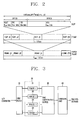
- Fig. 2 is a structure diagram illustrating a downlink dedicated physical channel (DPCH) frame.
- DPCH downlink dedicated physical channel
- a dedicated channel and a common channel can be distinguished by whether only one subscriber can use one resource at a given point of time. For example, the channel used in a traffic status is regarded as the dedicated channel.
- the DPCH is one of the information channels and will now be explained with reference to Fig. 2.
- the DPCH is divided into a dedicated physical control channel (DPCCH) and a dedicated physical data channel (DPDCH).
- the DPCCH is a channel for transmitting control information generated in the first layer
- the DPDCH is a channel for transmitting data information of the user.
- the two channels are time-multiplexed in one physical channel.
- An uplink DPCCH and an uplink DPDCH serve to carry a dedicated channel transmission channel.
- a TPC command is one of the fields of the DPCCH and that experiences the same downlink channel as a common pilot channel (CPICH). Accordingly, if quality of the CPICH is deteriorated, then quality of the DPCCH is also reduced. As a result, reliability of the demodulated TPC command decreases. If the less reliable TPC command is used, then uplink power control may be badly performed. This may have detrimental effects.
- CPICH common pilot channel
- the 3GPP TS 25.214 V3.7.0(2001-06) 5.1 describes uplink power control for controlling the transmit power of the terminal.
- the uplink power control for controlling the transmit power of the terminal is divided into algorithm 1 and algorithm 2.
- the specification suggests conditions that must be satisfied according to a method for combining TPC commands from radio links of different radio link sets in a process for performing uplink power control in soft handover.
- the contents relating to combination of the TPC commands from the radio links of the different radio link sets are suggested in the 3GPP TS 25.214 V3.7.0(2001-06) 5.1.2.2.2.3 and are summarized as follows.
- TPC_cmd has a value of 1 or -1.
- the ⁇ function must satisfy the following conditions. When the TPC commands from the whole radio link sets have a reliable value of 1, then the output of the ⁇ function becomes 1. When the TPC command from any of the radio link sets has a reliable value of 0, then the output of the ⁇ function becomes -1.
- An object of the invention is to solve at least the above problems and/or disadvantages and to provide at least the advantages described hereinafter.
- Embodiments of the present invention may provide a method for controlling power of radio links that can reliably decide and combine transmit power control commands from each radio link to control transmit power of a terminal in a soft handover.
- Embodiments may provide a method for controlling power of radio links that includes deciding reliability of transmit power control commands from different radio link sets. Embodiments may provide a method for combining the transmit power control command in a process for deciding the transmit power control commands from each radio link set to control transmit power of a terminal in a soft handover.
- Power of radio links may be controlled by checking reliability of each radio link and confirming a quality of each radio link before combining the transmit power control commands in order to prevent reliability of the transmit power control commands from being reduced due to low quality of a common pilot channel.
- Control of the power of radio links may include setting transmit power control command values of each radio link by comparing a quality of each radio link with a threshold value; and setting a combined transmit power control command value by deciding whether the set transmit power control command values are identical for all of the radio links.
- the quality of each radio link may be represented by Eb/No, which is a signal to interference ratio.
- Eb/No is a signal to interference ratio.
- the transmit power control commands of each radio link are 1.
- the transmit power control commands of each radio link is 0.
- the threshold value may be a preset reference value for estimating quality.
- the method for controlling power of the radio links may further include repeating the procedure until reliability of the radio links of the whole radio link set is decided.
- the combined transmit power control command may be set to be 1.
- the combined transmit power control command may be set to 0.
- Fig. 1 is a structure diagram illustrating a radio access protocol between a terminal (operated based on the 3GPP RAN specification) and a UTRAN;
- Fig. 2 is a structure diagram illustrating a downlink DPCH frame
- Fig. 3 is a block diagram illustrating a rake receiver according to an example embodiment of the present invention.
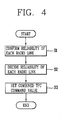
- Fig. 4 is a flowchart showing a method for controlling power of radio links according to an example embodiment of the present invention.
- Fig. 5 is a flowchart showing a method for combining TPC commands from radio links according to an example embodiment of the present invention.
- the following process for processing TPC commands from different radio link sets includes a process for deciding the TPC commands in transmit power control of a terminal in soft handover having conditions discussed in 5.1.2.2.2 and 5.1.2.2.3 of the 3GPP TS 25.214 V3.7.0(2001-06), for example.
- Embodiments of the present invention may provide a method for deciding reliability of TPC commands from each radio link set and for combining the TPC commands.
- Fig. 3 is a block diagram illustrating a rake receiver according to an example embodiment of the present invention. Other embodiments and configurations are also within the scope of the present invention.
- Fig. 3 shows that the rake receiver includes a square root raised cosine (SRRC) filter 10, a finger 20, a time compensating buffer 30 and a combining unit 40.
- SRRC filter 10 receives a signal from an A/D converter, and the SRRC filter 10 filters the signal. Therefore, the SRRC filter 10 detects the signal without symbol interferences.
- SRRC square root raised cosine
- the finger 20 may include a plurality of fingers 21 to 24.
- the finger 20 separates signals inputted through multiple paths according to the output of the SRRC filter 10, and demodulates the signals by paths.
- each of the fingers 21 to 24 includes a tracking loop, a data demodulator, a frequency error tracking circuit, a signal size regulating circuit and related control circuits.
- the fingers 21 to 24 track a common pilot channel (CPICH) of each radio link.
- CPICH common pilot channel
- the time compensating buffer 30 outputs the outputs from the finger 20 by controlling time differences. That is, the time compensating buffer 30 is provided to every output to control time differences of the tracking result outputs from the fingers 21 to 24.
- the combining unit 40 combines the outputs from the time compensating buffer 30, and outputs the combined value to a channel decoder.
- the signal passing through multiple path fading channels is regarded as a combination of elements of paths having different amplitude and phase.
- the rake receiver may maintain the multiple path power elements as much as possible, form the plurality of fingers in parallel (as shown in Fig. 3) to collectively demodulate the elements, and transmit the output through the combining unit 40.
- Fig. 4 is a flowchart showing operations of a method for controlling power of radio links according to an example embodiment of the present invention. Other operations, orders of operation and embodiments are also within the scope of the present invention.
- a reliability of each radio link is confirmed based on quality (S1).
- the reliability may be confirmed by checking the quality of each radio link (i.e., a signal to interference ratio) and comparing the ratio with a preset reference value.
- the reliability of each radio link may be decided according to the decision result of S1 (S2).
- the decided reliability of each radio link is set to be 0 or 1, for example.
- a combined TPC command value may be set according to the result (S3). That is, the combined TPC command of the power control commands from each radio link may be used to control the transmit power of the terminal.
- Fig. 5 is a flowchart showing operations of a method for combining TPC commands from radio links according to an example embodiment of the present invention. Other operations, orders of operation and embodiments are also within the scope of the present invention.
- the method for combining the TPC commands may include a first process (S10 ⁇ S60) for checking a quality of each radio link rl_idx in each finger, comparing the checked quality with a preset threshold value, and deciding the TPC command values of each radio link, and a second process (S70 ⁇ S90) for confirming whether the TPC command values of each radio link is 1, and deciding a combined TPC command value TPC_cmd.
- a first process S10 ⁇ S60
- S70 ⁇ S90 for confirming whether the TPC command values of each radio link is 1, and deciding a combined TPC command value TPC_cmd.
- the quality of each radio link is measured (S10).
- the measured quality of each radio link is compared with a preset threshold value (S20).
- S20 a preset threshold value
- the reliability of each radio link is set to be 1 (S30).
- S40 the reliability of each radio link is set to be 0 (S40).
- the second process it is confirmed whether the reliability of each radio link obtained in the first process is 1 (S70).
- the reliability of each radio link is 1, the combined TPC command value is set to be 1 (S80).
- the reliability of any of the radio links obtained in the first process is not 1, then the combined TPC command value is set to be -1 (S90).
- the plurality of fingers may check the quality of each radio link according to the signals inputted from the A/D converter and filtered by the SRRC filter before combining the TPC commands. This may confirm the reliability of each radio link.
- the Eb/No (or a signal to interference ratio (SIR)) may be measured to show the quality of each radio link, output from the finger so as to track the CPICH of each radio link (S10).
- the measured Eb/No may be compared with the preset threshold value.
- the threshold value may be a reference value for distinguishing high quality radio links from low quality radio links.
- the reliability of each radio link becomes 1. That is, when the value of the CPICH of the radio link received in the terminal is greater than the threshold value and the channel status is good (e.g., reliable), the radio link is deemed to have high quality and the demodulated TPC command is used (S30).
- the reliability of each radio link becomes 0. That is, when the value of the CPICH of the radio link received in the terminal is smaller than the threshold value and the channel status is good, the radio link is deemed to have low quality and the TPC command is replaced by a preset value (S40).
- the following operations may decide the TPC commands according to the quality checked results of all the radio links. If checking of the quality of all the radio links is not finished, the routine feeds back to the first operation to repeat the first process (S10 ⁇ S60) until checking of the quality of all the radio links is finished (S60). If checking of the quality of all the radio links is finished, it is confirmed whether reliability of each radio link, (i.e., the TPC commands from each radio link is 1) (S70). If reliability of any of the radio links is 0, (i.e., if any of the TPC commands from the radio links is 0), the combined TPC command is set to be -1 (S90). However, if the reliability of all the radio links is 1, the combined TPC command is set to be 1 (S80).
- Setting the combined TPC command as 1 implies that the current transmit power of the terminal must be increased by unit power size. Setting the combined TPC command as -1 implies that the current transmit power of the terminal must be decreased by unit power size.
- the transmit power may be changed by unit power size, such as 1dBm, for example. If the combined TPC command has a value of 1, the transmit power increases by 1dBm. If the combined TPC command has a value of -1, the transmit power decreases by 1dBm. As a result, the uplink power control for controlling the transmit power of the terminal may be adjusted based on the TPC commands controlled by reliability.
- Embodiments of the present invention may be provided within a mobile communication device having a processor device and a transmitting/receiving device.
- the processor device may perform the various operations discussed above including determining a reliability of each of a plurality of radio links based on quality of each of the links and setting a transmit power control value based on the determined reliability of each radio link.
- a transmitting device may transmit signals based on the set transmit power control value.
- Embodiments of the present invention may provide a method for controlling power of the radio links by controlling the transmit power of the terminal according to reliability of the TPC commands.
- the transmit power is changed in proportion to reliability.
- the unit power size can be freely set or restricted.
- the method for controlling power of the radio links may reliably decide and combine the TPC commands from the radio links of different radio link sets to control the transmit power of the terminal in a soft handover, thereby properly controlling power of the radio links.
- the method for controlling power of the radio links may involve confirming quality of each radio link before combining the TPC commands, and checking reliability of each radio link based on the quality checking results to prevent reliability of the TPC commands from being reduced due to low quality of the CPICH.
- the method for controlling power of the radio links may suggest realistic embodiments of the method for combining the TPC commands whose conditions have been theoretically defined, and facilitates technical developments of the method for combining the TPC commands in the soft handover.
Landscapes
- Engineering & Computer Science (AREA)
- Computer Networks & Wireless Communication (AREA)
- Signal Processing (AREA)
- Mobile Radio Communication Systems (AREA)
Abstract
Description
Claims (31)
- A method for controlling power of radio links comprising:determining reliability of a plurality of radio links according to a quality of each radio link; andsetting a combined transmit power control command value based on the determined reliability of each of the plurality of radio links.
- The method of claim 1, wherein determining the reliability comprises:measuring the quality of each of the plurality of radio links; andcomparing the measured quality of each radio link with a predetermined reference value.
- The method of claim 2, wherein when the quality of one radio link is greater than the reference value, determining the reliability includes setting the reliability of the one radio link to 1.
- The method of claim 2, wherein when the quality of one radio link is smaller than the reference value, determining the reliability includes setting the reliability of the one radio link to 0.
- The method of claim 1, wherein the quality of each radio link is determined based on a signal to interference ratio (Eb/No).
- The method of claim 1, wherein the reliability of each radio link may be represented as a transmit power control command value (TPC_cmd[rl_idx]) of each radio link.
- The method of claim 1, wherein determining the reliability of each radio link is repeated until the reliability of all the radio links is decided.
- The method of claim 1, wherein when the reliability of the radio links is 1, setting the combined transmit power control command value includes setting the combined transmit power control command value as 1.
- The method of claim 8, further comprising increasing a transmit power based on the set combined transmit power control command value.
- The method of claim 1, wherein when the reliability of the radio links is 0, setting the combined transmit power control command value includes setting the combined transmit power control command value as -1.
- The method of claim 10, further comprising increasing a transmit power based on the set combined transmit power control command value.
- A method for controlling power of radio links in a mobile communication system comprising:measuring a quality of a radio link;setting a reliability of the radio link based on the measured quality of the radio link;repeating measuring the quality of the radio link and setting the reliability of the radio link until the reliability of all the radio links are set; anddetermining a combined transmit power control command value based on the reliability of each radio link.
- The method of claim 12, wherein the quality of each radio link is determined based on a signal to interference ratio (Eb/No).
- The method of claim 12, wherein the reliability of each radio link corresponds to a transmit power control command value of each radio link.
- The method of claim 12, wherein setting the reliability of each radio link comprises:comparing the measured quality of the radio link with a predetermined reference value; andsetting the reliability of each radio link based on the comparison.
- The method of claim 15, wherein when the quality of each radio link is greater than the reference value, the reliability of each radio link is 1.
- The method of claim 15, wherein when the quality of each radio link is smaller than the reference value, the reliability of each radio link is 0.
- The method of claim 12, wherein when the reliability of all the radio links is 1, the combined transmit power control command value is determined to be 1.
- The method of claim 18, further comprising increasing a transmit power based on the determined combined transmit power control command value.
- The method of claim 12, wherein when the reliability of any of the radio links is 0, the combined transmit power control command value is determined to be - 1.
- The method of claim 20, further comprising decreasing a transmit power based on the determined transmit power control command value.
- A mobile communication system comprising:a processor device to determine a reliability of each of a plurality of radio links based on quality of each of the links and to set a transmit power control value based on the determined reliability of each radio link; anda transmitting device to transmit signals based on the set transmit power control value.
- The mobile communication device of claim 22, wherein the processor device determines the reliability by measuring the quality of each radio link and comparing the measured quality of each radio link with a predetermined reference value.
- The mobile communication device of claim 22, wherein when the quality of one radio link is greater than the reference value, the processor device sets the reliability of the one radio link to 1.
- The mobile communication device of claim 22, wherein when the quality of one radio link is smaller than the reference value, the processor device sets the reliability of the one radio link to 0.
- The mobile communication device of claim 22, wherein the processor device determines the quality of each radio link based on a signal to interference ratio (Eb/No).
- The mobile communication device of claim 22, wherein the processor device repeats determining the reliability of each radio link until the reliability of the radio links of all the radio links is decided.
- The mobile communication device of claim 22, wherein when the reliability of the radio links is 1, the processor device sets the combined transmit power control command value as 1.
- The mobile communication device of claim 28, wherein the processor device increases a transmit power of the transmitting device based on the set transmit power control value.
- The mobile communication device of claim 22, wherein when the reliability of the radio links is 0, the processor device sets the combined transmit power control command value as -1.
- The mobile communication device of claim 30, wherein the processor device decreases a transmit power of the transmitting device based on the set transmit power control value.
Applications Claiming Priority (2)
| Application Number | Priority Date | Filing Date | Title |
|---|---|---|---|
| KR2002086823 | 2002-12-30 | ||
| KR1020020086823A KR20040060274A (en) | 2002-12-30 | 2002-12-30 | method for controlling a power of the radio links |
Publications (2)
| Publication Number | Publication Date |
|---|---|
| EP1435698A2 true EP1435698A2 (en) | 2004-07-07 |
| EP1435698A3 EP1435698A3 (en) | 2006-12-13 |
Family
ID=32501454
Family Applications (1)
| Application Number | Title | Priority Date | Filing Date |
|---|---|---|---|
| EP03028718A Withdrawn EP1435698A3 (en) | 2002-12-30 | 2003-12-12 | Method and apparatus for controlling power of radio links using combined transmit power control commands |
Country Status (5)
| Country | Link |
|---|---|
| US (1) | US7248837B2 (en) |
| EP (1) | EP1435698A3 (en) |
| JP (1) | JP2004215260A (en) |
| KR (1) | KR20040060274A (en) |
| CN (1) | CN1520061A (en) |
Cited By (5)
| Publication number | Priority date | Publication date | Assignee | Title |
|---|---|---|---|---|
| WO2005069673A1 (en) * | 2004-01-05 | 2005-07-28 | Nokia Corporation | Radio network relocation |
| DE102005006160A1 (en) * | 2005-02-10 | 2006-08-17 | Siemens Ag | Method for transmitting data |
| WO2007099699A1 (en) | 2006-03-01 | 2007-09-07 | Nec Corporation | Wireless communication system, communication terminal, transmission power control method and program for the comunication terminal |
| EP1777840A4 (en) * | 2004-09-13 | 2010-01-13 | Panasonic Corp | MOBILE STATION DEVICE AND UPSTREAM CIRCUIT POWER CONTROL METHOD |
| WO2012050507A1 (en) * | 2010-10-12 | 2012-04-19 | Telefonaktiebolaget L M Ericsson (Publ) | Uplink power control |
Families Citing this family (15)
| Publication number | Priority date | Publication date | Assignee | Title |
|---|---|---|---|---|
| JP4323521B2 (en) * | 2004-07-27 | 2009-09-02 | 富士通株式会社 | Interrogator used in RFID system |
| US20060223447A1 (en) * | 2005-03-31 | 2006-10-05 | Ali Masoomzadeh-Fard | Adaptive down bias to power changes for controlling random walk |
| US7546136B2 (en) * | 2005-04-29 | 2009-06-09 | Telefonaktiebolaget L M Ericsson (Publ) | Variable transmit power control strategies for high-speed downlink packet access systems |
| EP1753133A1 (en) * | 2005-08-12 | 2007-02-14 | STMicroelectronics Belgium N.V. | Receiver with improved sample granularity |
| US8731593B2 (en) * | 2006-02-15 | 2014-05-20 | Broadcom Corporation | Method and apparatus for processing transmit power control (TPC) commands in a wideband CDMA (WCDMA) network |
| US7706827B2 (en) * | 2006-02-15 | 2010-04-27 | Broadcom Corporation | Method and apparatus for processing transmit power control (TPC) commands in a wideband CDMA (WCDMA) network based on a sign metric |
| US7809395B2 (en) * | 2006-02-15 | 2010-10-05 | Broadcom Corporation | Method and system for controlling transmit circuitry in a wide band CDMA network |
| US7907961B2 (en) * | 2006-06-07 | 2011-03-15 | Broadcom Corporation | Method and apparatus for improving noise power estimate in a WCDMA network |
| US7634235B2 (en) * | 2006-05-30 | 2009-12-15 | Broadcom Corporation | Method and apparatus to improve closed loop transmit diversity modes performance via interference suppression in a WCDMA network equipped with a rake receiver |
| WO2008024357A2 (en) * | 2006-08-24 | 2008-02-28 | Interdigital Technology Corporation | Power control for improving link reliability in hsdpa |
| US20080232326A1 (en) * | 2007-03-19 | 2008-09-25 | Bengt Lindoff | Method and Apparatus for Reducing Interference in Wireless Communication Networks by Enabling More Opportune Handover |
| WO2008136651A2 (en) * | 2007-05-08 | 2008-11-13 | Samsung Electronics Co., Ltd. | A method and system for transmit power control management in hspa |
| KR100895576B1 (en) * | 2007-05-11 | 2009-04-29 | 주식회사 팬택 | How to transmit data by selecting antenna in multi-input multi-output wireless LAN environment |
| RU2459384C2 (en) * | 2007-10-09 | 2012-08-20 | Телефонактиеболагет Л М Эрикссон (Пабл) | Method to control upstream capacity in system of telecommunications network, which supports both general and separate tpc commands |
| CN102752842B (en) * | 2012-06-21 | 2016-03-09 | 华为技术有限公司 | Transmitting power control merging method during mobile terminal soft handover and mobile terminal |
Family Cites Families (30)
| Publication number | Priority date | Publication date | Assignee | Title |
|---|---|---|---|---|
| US5469471A (en) | 1994-02-01 | 1995-11-21 | Qualcomm Incorporated | Method and apparatus for providing a communication link quality indication |
| US6144861A (en) * | 1998-04-07 | 2000-11-07 | Telefonaktiebolaget Lm Ericsson | Downlink power control in a cellular mobile radio communications system |
| JP4047461B2 (en) * | 1998-08-27 | 2008-02-13 | 松下電器産業株式会社 | Transmission power control device and transmission / reception device |
| JP3199238B2 (en) * | 1998-09-18 | 2001-08-13 | 日本電気株式会社 | Transmission power control system and transmission power control method in code division multiple access system |
| JP3745622B2 (en) * | 1998-12-07 | 2006-02-15 | ノキア コーポレイション | Power control method and system in mobile communication network |
| US6269239B1 (en) | 1998-12-11 | 2001-07-31 | Nortel Networks Corporation | System and method to combine power control commands during soft handoff in DS/CDMA cellular systems |
| ES2229559T3 (en) * | 1998-12-18 | 2005-04-16 | Nokia Corporation | METHOD FOR THE CONTROL OF TRAFFIC LOAD IN A TELECOMMUNICATIONS NETWORK. |
| FI107505B (en) * | 1999-02-16 | 2001-08-15 | Nokia Networks Oy | Access control procedure |
| US6334047B1 (en) * | 1999-04-09 | 2001-12-25 | Telefonaktiebolaget Lm Ericsson (Publ) | Adaptive power control in a mobile radio communications system |
| JP3346332B2 (en) * | 1999-04-16 | 2002-11-18 | 日本電気株式会社 | Code division multiple access mobile communication system |
| US6445917B1 (en) * | 1999-05-19 | 2002-09-03 | Telefonaktiebolaget Lm Ericsson (Publ) | Mobile station measurements with event-based reporting |
| JP3660171B2 (en) | 1999-09-22 | 2005-06-15 | 松下電器産業株式会社 | Communication apparatus and communication method |
| JP3621310B2 (en) * | 1999-10-07 | 2005-02-16 | 松下電器産業株式会社 | Wireless communication apparatus and transmission power control method |
| US6760596B1 (en) * | 1999-12-03 | 2004-07-06 | Telefonaktiebolaget Lm Ericsson (Publ) | Method and system for bit-rate adaptation to improve coverage |
| US6553016B1 (en) * | 1999-12-20 | 2003-04-22 | Telfonaktiebolaget Lm Ericsson (Publ) | Downlink power control at soft handover |
| US6456826B1 (en) * | 2000-02-25 | 2002-09-24 | Nokia Mobile Phones Ltd. | User equipment and procedure for handling possible out-of-synchronization condition in UMTS terrestrial radio access network for time division duplexing mode |
| US6823193B1 (en) * | 2000-02-28 | 2004-11-23 | Telefonaktiebolaget Lm Ericsson (Publ) | Downlink transmit power synchronization during diversity communication with a mobile station |
| WO2001067638A1 (en) | 2000-03-09 | 2001-09-13 | Motorola Inc. | Method and apparatus for changing assignment of receiver fingers |
| US6473624B1 (en) * | 2000-03-21 | 2002-10-29 | Telefonaktiebolaget Lm Ericsson (Publ) | Determining a reference power level for diversity handover base stations |
| JP2001285089A (en) | 2000-03-31 | 2001-10-12 | Matsushita Electric Ind Co Ltd | Wireless communication device and transmission power control method |
| US6650905B1 (en) * | 2000-06-30 | 2003-11-18 | Nokia Mobile Phones, Ltd. | Universal mobile telecommunications system (UMTS) terrestrial radio access (UTRA) frequency division duplex (FDD) downlink shared channel (DSCH) power control in soft handover |
| CN1276596C (en) * | 2000-07-03 | 2006-09-20 | 松下电器产业株式会社 | Base station apparatus and radio communication method |
| US6594499B1 (en) * | 2000-09-25 | 2003-07-15 | Telefonaktiebolaget Lm Ericsson (Publ) | Downlink power control in a cellular telecommunications network |
| JP3552038B2 (en) | 2000-12-25 | 2004-08-11 | 日本電気株式会社 | Transmission power control method, reception method, mobile communication system and mobile terminal |
| US7010318B2 (en) * | 2001-01-13 | 2006-03-07 | Samsung Electronics Co., Ltd. | Power control apparatus and method for a W-CDMA communication system employing a high-speed downlink packet access scheme |
| KR100694397B1 (en) | 2001-02-22 | 2007-03-12 | 엘지전자 주식회사 | Dedicated Channel Joining Method for Uplink Synchronous Transmission |
| US6850770B2 (en) * | 2001-05-17 | 2005-02-01 | Nokia Corporation | Transmit power control (TPC) pattern information in radio link (RL) addition |
| KR100426622B1 (en) | 2001-11-16 | 2004-04-13 | 한국전자통신연구원 | Apparatus for Combining Multi-path Signals in the Mobile Station Receiver and its Method |
| US6717931B2 (en) * | 2002-01-02 | 2004-04-06 | Nokia Corporation | Adaptive spreading factor based on power control |
| US6760598B1 (en) * | 2002-05-01 | 2004-07-06 | Nokia Corporation | Method, device and system for power control step size selection based on received signal quality |
-
2002
- 2002-12-30 KR KR1020020086823A patent/KR20040060274A/en not_active Ceased
-
2003
- 2003-12-12 EP EP03028718A patent/EP1435698A3/en not_active Withdrawn
- 2003-12-15 US US10/734,626 patent/US7248837B2/en not_active Expired - Fee Related
- 2003-12-24 JP JP2003428481A patent/JP2004215260A/en active Pending
- 2003-12-30 CN CNA2003101220937A patent/CN1520061A/en active Pending
Cited By (11)
| Publication number | Priority date | Publication date | Assignee | Title |
|---|---|---|---|---|
| WO2005069673A1 (en) * | 2004-01-05 | 2005-07-28 | Nokia Corporation | Radio network relocation |
| US7389121B2 (en) | 2004-01-05 | 2008-06-17 | Nokia Corporation | Radio network relocation |
| US8019374B2 (en) | 2004-01-05 | 2011-09-13 | Nokia Corporation | Radio network relocation |
| EP1777840A4 (en) * | 2004-09-13 | 2010-01-13 | Panasonic Corp | MOBILE STATION DEVICE AND UPSTREAM CIRCUIT POWER CONTROL METHOD |
| DE102005006160A1 (en) * | 2005-02-10 | 2006-08-17 | Siemens Ag | Method for transmitting data |
| WO2007099699A1 (en) | 2006-03-01 | 2007-09-07 | Nec Corporation | Wireless communication system, communication terminal, transmission power control method and program for the comunication terminal |
| JP4867988B2 (en) * | 2006-03-01 | 2012-02-01 | 日本電気株式会社 | Wireless communication system, communication terminal apparatus, transmission power control method thereof, and program |
| EP1990934A4 (en) * | 2006-03-01 | 2013-01-02 | Nec Corp | Wireless communication system, communication terminal, transmission power control method and program for the comunication terminal |
| US8417278B2 (en) | 2006-03-01 | 2013-04-09 | Nec Corporation | Wireless communication system, communication terminal device, method of controlling transmission power thereof, and program |
| WO2012050507A1 (en) * | 2010-10-12 | 2012-04-19 | Telefonaktiebolaget L M Ericsson (Publ) | Uplink power control |
| US8855700B2 (en) | 2010-10-12 | 2014-10-07 | Telefonaktiebolaget L M Ericsson (Publ) | Uplink power control |
Also Published As
| Publication number | Publication date |
|---|---|
| US20040136330A1 (en) | 2004-07-15 |
| EP1435698A3 (en) | 2006-12-13 |
| CN1520061A (en) | 2004-08-11 |
| KR20040060274A (en) | 2004-07-06 |
| JP2004215260A (en) | 2004-07-29 |
| US7248837B2 (en) | 2007-07-24 |
Similar Documents
| Publication | Publication Date | Title |
|---|---|---|
| US7248837B2 (en) | Method and apparatus for controlling power of radio links | |
| JP5185161B2 (en) | Power control for channels having multiple formats in a wireless communication system | |
| US5987326A (en) | Transmit power reduction for a high speed CDMA link in soft handoff | |
| US6973289B2 (en) | Radio communication device and method of controlling transmission rate | |
| EP1676379B1 (en) | Apparatus and methods for determination of gain factors for wireless communication transmission power | |
| KR100855424B1 (en) | Power Control Based on Combined Transmission Quality Estimation | |
| US6414948B1 (en) | Electric power controlling system for variable bit rate CDMA transmission and mobile telephone system | |
| EP1522154B1 (en) | Adaptive gain adjustment control with feedback | |
| US7860042B2 (en) | Reverse power control method and apparatus in a mobile communication system in which mobile station determines reverse data rate | |
| EP1570699B1 (en) | Discontinuous transmission (dtx) frame detection in wireless communication systems | |
| US7242953B2 (en) | Transmitting a control message on a forward access channel (FACH) in a network for mobile telecommunications | |
| US20070019589A1 (en) | Reverse link transmit power control in a wireless communication system | |
| US20030156554A1 (en) | Method for regulating transmission power in a radiocommunications system | |
| US20060034226A1 (en) | Radio resource control in HSUPA system | |
| EP1325577B1 (en) | Simplified quality indicator bit test procedures | |
| EP1825629B1 (en) | Power step control for high-speed downlink shared channel packet access | |
| AU2001296701A1 (en) | Simplified quality indicator bit test procedures | |
| JP2006304355A (en) | Device and method for determining gain factor of transmission power of radio communication | |
| HK1104156A (en) | Method and apparatus for power control in a wireless communication system |
Legal Events
| Date | Code | Title | Description |
|---|---|---|---|
| PUAI | Public reference made under article 153(3) epc to a published international application that has entered the european phase |
Free format text: ORIGINAL CODE: 0009012 |
|
| 17P | Request for examination filed |
Effective date: 20031212 |
|
| AK | Designated contracting states |
Kind code of ref document: A2 Designated state(s): AT BE BG CH CY CZ DE DK EE ES FI FR GB GR HU IE IT LI LU MC NL PT RO SE SI SK TR |
|
| AX | Request for extension of the european patent |
Extension state: AL LT LV MK |
|
| RIN1 | Information on inventor provided before grant (corrected) |
Inventor name: WOO, KYONG-HO,GONGJAK APT. 207-303 |
|
| PUAL | Search report despatched |
Free format text: ORIGINAL CODE: 0009013 |
|
| AK | Designated contracting states |
Kind code of ref document: A3 Designated state(s): AT BE BG CH CY CZ DE DK EE ES FI FR GB GR HU IE IT LI LU MC NL PT RO SE SI SK TR |
|
| AX | Request for extension of the european patent |
Extension state: AL LT LV MK |
|
| AKX | Designation fees paid |
Designated state(s): AT BE BG CH CY CZ DE DK EE ES FI FR GB GR HU IE IT LI LU MC NL PT RO SE SI SK TR |
|
| 17Q | First examination report despatched |
Effective date: 20080422 |
|
| STAA | Information on the status of an ep patent application or granted ep patent |
Free format text: STATUS: THE APPLICATION IS DEEMED TO BE WITHDRAWN |
|
| 18D | Application deemed to be withdrawn |
Effective date: 20150414 |