EP1435605A2 - Method and apparatus for speech recognition - Google Patents
Method and apparatus for speech recognition Download PDFInfo
- Publication number
- EP1435605A2 EP1435605A2 EP03258236A EP03258236A EP1435605A2 EP 1435605 A2 EP1435605 A2 EP 1435605A2 EP 03258236 A EP03258236 A EP 03258236A EP 03258236 A EP03258236 A EP 03258236A EP 1435605 A2 EP1435605 A2 EP 1435605A2
- Authority
- EP
- European Patent Office
- Prior art keywords
- word
- alternative
- user
- selection
- list
- Prior art date
- Legal status (The legal status is an assumption and is not a legal conclusion. Google has not performed a legal analysis and makes no representation as to the accuracy of the status listed.)
- Granted
Links
Images




Classifications
-
- G—PHYSICS
- G10—MUSICAL INSTRUMENTS; ACOUSTICS
- G10L—SPEECH ANALYSIS TECHNIQUES OR SPEECH SYNTHESIS; SPEECH RECOGNITION; SPEECH OR VOICE PROCESSING TECHNIQUES; SPEECH OR AUDIO CODING OR DECODING
- G10L15/00—Speech recognition
- G10L15/01—Assessment or evaluation of speech recognition systems
-
- G—PHYSICS
- G10—MUSICAL INSTRUMENTS; ACOUSTICS
- G10L—SPEECH ANALYSIS TECHNIQUES OR SPEECH SYNTHESIS; SPEECH RECOGNITION; SPEECH OR VOICE PROCESSING TECHNIQUES; SPEECH OR AUDIO CODING OR DECODING
- G10L15/00—Speech recognition
- G10L15/22—Procedures used during a speech recognition process, e.g. man-machine dialogue
-
- G—PHYSICS
- G10—MUSICAL INSTRUMENTS; ACOUSTICS
- G10L—SPEECH ANALYSIS TECHNIQUES OR SPEECH SYNTHESIS; SPEECH RECOGNITION; SPEECH OR VOICE PROCESSING TECHNIQUES; SPEECH OR AUDIO CODING OR DECODING
- G10L15/00—Speech recognition
- G10L15/06—Creation of reference templates; Training of speech recognition systems, e.g. adaptation to the characteristics of the speaker's voice
Definitions
- the present invention relates to speech recognition, and more particularly, to a method and apparatus for enhancing the performance of speech recognition by adaptively changing a process of determining a final, recognized word depending on a user's selection in a list of alternative words represented by a result of speech recognition.
- Speech recognition refers to a technique by which a computer analyzes and recognizes or understands human speech.
- Human speech sounds have specific frequencies according to the shape of a human mouth and positions of a human tongue during utterance.
- human speech sounds are converted into electric signals and frequency characteristics of the speech sounds are extracted from the electric signals, in order to recognize human utterances.
- Such speech recognition technology is adopted in a wide variety of fields such as telephone dialing, control of electronic toys, language learning, control of electric home appliances, and so forth.
- U.S. Patent. No. 4,866,778 suggests a technique by which the most effectively searched probable alternative word is displayed and if the probable alternative word is wrong, the next alternative word is displayed to find the correct recognition result. According to this technique, a user must separately answer a series of YES/NO questions presented by a speech recognition system and cannot predict which words will appear in the next question.
- 5,027,406 and 5,884,258 present a technique by which alternative words derived from speech recognition are arrayed and recognition results are determined depending on user's selections from the alternative words via a graphic user interface or voice. According to this technique, since the user must perform additional manipulations to select the correct alternative word in each case after he or she speaks, he or she experiences inconvenience and is tired of the iterative operations.
- U.S. Patent. No. 6,314,397 shows a technique by which user's utterances are converted into texts based on the best recognition results and corrected through a user review during which an alternative word is selected from a list of alternative words derived from previously considered recognition results. This technique suggests a smooth speech recognition task.
- U.S. Patent. No. 6,347,296 discloses a technique by which during a series of speech recognition tasks, an indefinite recognition result of a specific utterance is settled by automatically selecting an alternative word from a list of alternative words with reference to a recognition result of a subsequent utterance.
- the present invention provides a speech recognition method of determining a first alternative word as a final, recognized word after a predetermined standby time in a case where a user does not select an alternative word from a list of alternative words derived from speech recognition of the user's utterance, determining a selected alternative word as a final, recognized word when the user selects the alternative word, or determining an alternative word selected after an adjusted standby time as a final, recognized word.
- the present invention also provides an apparatus for performing the speech recognition method.
- a speech recognition method comprising: inputting speech uttered by a user; recognizing the input speech and creating a predetermined number of alternative words to be recognized in the order of similarity; and displaying a list of alternative words that arranges a predetermined number of alternative words in a predetermined order and determines an alternative word that a cursor currently indicates as a final, recognized word if a user's selection from the list of alternative words has not been changed within a predetermined standby time.
- the speech recognition method further comprises adjusting the predetermined standby time and returning to the determination whether the user's selection from the list of alternative words has been changed within the predetermined standby time, if the user's selection has been changed within the predetermined standby time. More preferably, the speech recognition method further comprises determining an alternative word from the list of alternative words that is selected by the user as a final, recognized word, if the user's selection is changed within the predetermined standby time.
- a speech recognition apparatus comprising: a speech input unit that inputs speech uttered by a user; a speech recognizer that recognizes the speech input from the speech input unit and creates a predetermined number of alternative words to be recognized in the order of similarity; and a post-processor that displays a list of alternative words that arranges the predetermined number of alternative words in a predetermined order and determines an alternative word that a cursor currently indicates as a final, recognized word if a user's selection from the list of alternative words has not been changed within a predetermined standby time.
- the post-processor comprises: a window generator that generates a window for a graphic user interface comprising the list of alternative words; a standby time setter that sets a standby time from when the window is displayed to when the alternative word on the list of alternative words currently indicated by the cursor is determined as the final, recognized word; and a final, recognized word determiner that determines a first alternative word from the list of alternative words that is currently indicated by the cursor as a final, recognized word if the user's selection from the list of alternative words has not been changed within the predetermined standby time, adjusts the predetermined standby time if the user's selection from the list of alternative words has been changed within the predetermined standby time, and determines an alternative word on the list of alternative words selected by the user as a final, recognized word if the user's selection has not been changed within the adjusted standby time.
- a window generator that generates a window for a graphic user interface comprising the list of alternative words
- a standby time setter that sets a standby time
- the post-processor comprises: a window generator that generates a window for a graphic user interface comprising a list of alternative words that arranges the predetermined number of alternative words in a predetermined order; a standby time setter that sets a standby time from when the window is displayed to when an alternative word on the list of alternative words currently indicated by the cursor is determined as a final, recognized word; and a final, recognized word determiner that determines a first alternative word on the list of alternative words currently indicated by the cursor as a final, recognized word if a user's selection from the list of alternative words has not been changed within the standby time and determines an alternative word on the list of alternative words selected by the user as a final, recognized word if the user's selection from the list of alternative words has been changed.
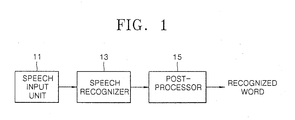
- FIG. 1 is a block diagram of a speech recognition apparatus according to an embodiment of the present invention.
- the speech recognition apparatus includes a speech input unit 11, a speech recognizer 13, and a post-processor 15.
- the speech input unit 11 includes microphones and so forth, receives speech from a user, removes a noise signal from the user speech, amplifies the user speech to a predetermined level, and transmits the user speech to the speech recognizer 13.
- the speech recognizer 13 detects a starting point and an ending point of the user speech, samples speech feature data from sound sections except soundless sections before and after the user speech, and vector-quantizes the speech feature data in real-time. Next, the speech recognizer 13 performs a viterbi search to choose the closest acoustic word to the user speech from words stored in a DB using the speech feature data. To this end, Hidden Markov Models (HMMs) may be used. Feature data of HMMs, which are built by training words, is compared with that of currently input speech and the difference between the two feature data is used to determine the most probable candidate word. The speech recognizer 13 completes the viterbi search, determines a predetermined number, for example, 3 of the closest acoustic words to currently input speech as recognition results in the order of similarity, and transmits the recognition results to the post-processor 15.
- HMMs Hidden Markov Models
- the post-processor 15 receives the recognition results from the speech recognizer 13, converts the recognition results into text signals, and creates a window for a graphic user interface.
- the window displays the text signals in the order of similarity.
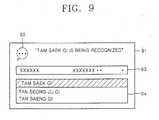
- An example of the window is shown in FIG. 9.
- a window 91 includes a message area 92 for displaying a message "A first alternative word, herein, 'Tam Saek Gi', is being recognized", an area 93 for displaying a time belt, and an area 94 for displaying a list of alternative words.
- the window 91 is displayed on a screen until the time belt 93 corresponding to a predetermined standby time is over.
- the first alternative word is determined as a final, recognized word.
- a final, recognized word is determined through a process shown in FIG. 7 or 8 which will be explained later.
- FIG. 2 is a detailed block diagram of the post-processor 15 of FIG. 1.
- the post-processor 15 includes a standby time setter 21, a dexterity manager 22, a dexterity DB 23, a window generator 24, an erroneous word pattern manager 25, an erroneous word pattern DB 26, and a final, recognized word determiner 27.
- the standby time setter 21 sets a standby time from a point in time when the window 91 for the graphic user interface is displayed to a point in time when an alternative word currently indicated by a curser is determined as a final, recognized word.
- the standby time is represented by the time belt 93 in the window 91.
- the standby time may be equally assigned to all of the alternative words on the list of alternative words.
- the standby time may also be assigned differentially to each of the alternative words from the most acoustically similar alternative word to the least acoustically similar alternative word.
- the standby time may be equally assigned to users or may be assigned differentially to the user depending on the user's dexterity at handling the speech recognition apparatus.
- the standby time setter 21 provides the window generator 24 with the standby time and the recognition results input from the speech recognizer 13.
- the dexterity manager 22 adds a predetermined spare time to a selection time determined based on information on a user's dexterity stored in the dexterity DB 23, adjusts the standby time to the addition value, and provides the standby time setter 21 with the adjusted standby time.
- the dexterity manager 22 adjusts the standby time through a process shown FIG. 6 which will be explained later.
- the standby time may be equally assigned to all of the alternative words or may be assigned differentially to each of the alternative words from the most acoustically similar alternative word to the least acoustically similar alternative word.
- the dexterity DB 23 stores different selection times determined based on the user's dexterity.
- 'dexterity' is a variable in inverse proportion to a selection time required for determining a final, recognized word after the window for the graphic user interface is displayed. In other words, an average value of selection times required for a predetermined number of times a final, recognized word is determined is determined as the user's dexterity.
- the window generator 24 generates the window 91 including the message area 92, the time belt 93, and the alternative word list 94 as shown in FIG. 9.
- the message area 92 displays a current situation
- the time belt 93 corresponds to the standby time set by the standby time setter 21
- the alternative word list 94 lists the recognition results, i.e., the alternative words, in the order of similarity.
- the order of listing the alternative words may be determined based on erroneous word patterns appearing in previous speech recognition history as well as the similarity.
- the erroneous word pattern manager 25 receives a recognized word determined as the first alternative word by the speech recognizer 13 and the final, recognized word provided by the final, recognized word determiner 27. If the erroneous word pattern DB 26 stores the combination of the recognized words corresponding to the first alternative word and the final, recognized word, the erroneous word pattern manager 25 adjusts scores of the recognition results supplied from the speech recognizer 13 via the standby time setter 21 and the window generator 24 to be provided to the window generator 24. The window generator 24 then changes the listing order of the alternative word list 94 based on the adjusted scores.
- an erroneous word pattern table includes a first alternative word 41 resulting from speech recognition, a final, recognized word 42, first through n th user utterance features 43, an utterance propensity 43, and a number of times errors occur, i.e., a history n 45.
- the final, recognized word determiner 27 determines the final, recognized word depending on whether the user makes an additional selection from the alternative word list 94 in the window 91 within the standby time represented by the time belt 93. In other words, when the user does not additionally press the alternative word selection key or button within the standby time after the window 91 is displayed, the final, recognized word determiner 27 determines the first alternative word currently indicated by the cursor as the final, recognized word. When the user presses the alternative word selection key or button within the standby time, the final, recognized word determiner 27 determines the final, recognized word through the process of FIG. 7 or 8.
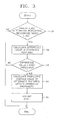
- FIG. 3 is a flowchart for explaining a process of updating the erroneous word pattern DB 26 by the erroneous word pattern manager 25 of FIG. 2.
- step 31 a determination is made as to whether the erroneous word pattern DB 26 stores a pair of the first alternative word and the final, recognized word provided by the final, recognized word determiner 27. If in step 301, it is determined that the erroneous word pattern DB 26 does not store the pair of the first alternative word and the final, recognized word, the process ends.
- step 31 If in step 31, it is determined that the erroneous word pattern DB 26 stores the pair of the first alternative word and the final, recognized word, in step 32, a difference value in utterance features is calculated.
- the difference value is a value obtained by adding absolute values of differences between the first through n th utterance features 43 of the erroneous word patterns stored in the erroneous word pattern DB 26 and first through n th utterance features of currently input speech.
- step 33 the difference value is compared with a first threshold, that is, a predetermined reference value for update.
- the first threshold may be set to an optimum value experimentally or through a simulation. If in step 33, it is determined that the difference value is greater than or equal to the first threshold, the process ends. If in step 33, the difference value is less than the first threshold, i.e., if it is determined that an error occurs for the same reason such as a cold, voice change in the mornings, background noise, or the like as the erroneous word pattern, in step 34, respective average values of the first through n th utterance features including those of the currently input speech are calculated to update the utterance propensity 44. In step 35, a value of a history n is increased by 1 to update the history 45.
- FIG. 5 is a flowchart for explaining a process of changing an order of listing alternative words via the erroneous word pattern manager 25 of FIG. 2.
- step 51 a determination is made as to whether the erroneous word pattern DB 26 stores a pair of a first alternative word and a second alternative word as the final, recognized word or a pair of a first alternative word and a third alternative word as the final, recognized word, with reference to the recognition results and scores of Table 1 provided to the window generator 24 via the speech recognizer 13. If in step 51, it is determined that the erroneous word pattern DB 26 does not store the pair of the first alternative word and the second alternative word or the pair of the first alternative word and the third alternative word, the process ends.
- Table 1 shows scores of a first to a third alternate words. Recognition Result Scores Hwang Gil Du 10 Hong Gi Su 9 Hong Gil Dong 8
- step 52 a difference value in first through n th utterance features are calculated.
- the difference value is a value obtained by adding absolute values of differences between the first through n th utterance features stored in the erroneous word pattern DB 26 and first through n th utterance features of currently input speech, with regard to each pair.
- step 53 the difference value is compared with a second threshold, that is, a predetermined reference value for changing the order of listing the alternative words.
- the second threshold may be set to an optimum value experimentally or through a simulation. If in step 53, it is determined that the difference value in each pair is greater than or equal to the second threshold, i.e., an error does not occur for the same reason as the erroneous word pattern, the process ends. If in step 53, it is determined that the difference value in each pair is less than the second threshold, i.e., the error occurs for the same reason as the erroneous word pattern, in step 54, a score of a corresponding alternative word is adjusted.
- the recognition results and the scores shown in Table 1 are changed into recognition results and scores shown in Table 2.
- a changed score "9.2” is obtained by adding a value resulting from multiplication of the weight "0.4" by a history "3" to an original score "8".
- the first through n th utterance features 43 used in the processes shown in FIGS. 3 through 5 are information generated when the speech recognizer 13 analyzes speech.
- the information may be information, a portion of which is used for determining speech recognition results and a remaining portion of which is used only as reference data.
- the information may also be measured using additional methods as follows.
- a time required for uttering a corresponding number of syllables is defined as an utterance speed.
- a voice tone is defined.
- the voice tone may be the cause of an error. For example, a low-pitched voice is hidden by noise and a high-pitched voice is not partially received by hardware. As a result, a voice signal may be distorted.
- a basic noise level which is measured in a state when no voice signal is input or in a space between syllables, is defined as a signal-to-noise ratio (SNR).
- SNR signal-to-noise ratio
- the change of voice is defined in a specific situation where a portion of voice varies due to cold or a problem with the vocal chords that occurs in the mornings. In addition, various other utterance features may be used.
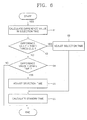
- FIG. 6 is a flowchart for explaining a process of adjusting the standby time via the dexterity manager 22 of FIG. 2.
- a difference value in a selection time is calculated by subtracting a time required for determining a final, recognized word from the selection time assigned as an initialization value stored in the dexterity DB 23.
- the difference value is compared with a third threshold, that is, a predetermined reference value for changing the standby time.
- the third threshold may be set to an optimum value experimentally or through a simulation.
- step 63 the selection time is modified.
- the modified selection time is calculated by subtracting a value resulting from multiplication of the difference value by the predetermined weight from the selection time stored in the dexterity DB 23. For example, when the selection time stored in the dexterity DB 23 is 0.8 seconds, the difference value is 0.1 seconds, and the predetermined weight is 0.1, the modified selection time is 0.79 seconds.
- the modified selection time is stored in the dexterity DB 23 so as to update a selection time for the user.
- step 64 the difference value is compared with a predetermined spare time. If in step 64, it is determined that the difference value is greater than or equal to the spare time, the process ends.
- step 65 the selection time is modified.
- the modified selection time is calculated by adding a predetermined extra time to the selection time stored in the dexterity DB 23. For example, when the selection time stored in the dexterity DB 23 is 0.8 seconds and the extra time is 0.02 seconds, the modified selection time is 0.82 seconds.
- the modified selection time is stored in the dexterity DB 23 so as to update a selection time for a user. The extra time is to prevent a potential error from occurring in a subsequent speech recognition process, and herein, is set to 0.02 seconds.
- a standby time for the user is calculated by adding a predetermined amount of extra time to the selection time modified in step 63 or 65, and the standby time setter 21 is informed of the calculated standby time.
- the extra time is to prevent a user's selection from being determined regardless of the user's intension, and herein, is set to 0.3 seconds.
- FIG. 7 is a flowchart for explaining a speech recognition method, according to an embodiment of the present invention.
- the speech recognition method includes step 71 of displaying a list of alternative words, steps of 72, 73, and 78 performed in a case of no change in a user's selection, and steps 74, 75, 76, and 77 performed in a case where a user's selection changes.
- step 71 the window 91 including the alternative word list 94 listing the recognition results of the speech recognizer 13 is displayed.
- the cursor is set to indicate the first alternative word on the alternative word list 94 when the window 91 is displayed.
- the time belt 93 starts from when the window 91 is displayed.
- step 72 a determination is made as to whether an initial standby time set by the standby time setter 21 has elapsed without additional user input with the alternative word selection key or button.
- step 72 If in step 72, it is determined that the initial standby time has elapsed, in step 73, a first alternative word currently indicated by the cursor is determined as a final, recognized word. In step 78, a function corresponding to the final, recognized words is performed. If in step 72, it is determined that the initial standby time has not elapsed, in step 74, a determination is made as to whether a user's selection has been changed by the additional user input with the alternative word selection key or button.
- step 75 the initial standby time is reset.
- the adjusted standby time may be equal to or different from the initial standby time according to an order of listing the alternative words. If in step 74, it is determined that the user's selection has not been changed, the process moves on to step 76. For example, if the user's selection is changed into 'Tan Seong Ju Gi' shown in FIG. 9, the message area 92 of the window 91 shows a message "The 'Tan Seong Ju Gi' is being recognized" and concurrently, the time belt 93 starts according to the adjusted standby time.
- step 76 a determination is made as to whether the standby time adjusted in step 75 or the initial standby time has elapsed. If in step 76, it is determined that the adjusted standby time or the initial standby time has not elapsed, the process returns to step 74 to iteratively determine whether the user's selection has been changed. If in step 76, it is determined that the adjusted standby time or the initial standby time has elapsed, in step 77, an alternative word that the cursor currently indicates from a change in the user's selection is determined as a final, recognized word. In step 78, a function corresponding to the final, recognized word is performed.
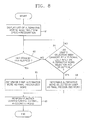
- FIG. 8 is a flowchart for explaining a speech recognition method, according to another embodiment of the present invention.
- the speech recognition method includes step 81 of displaying a list of alternative words, steps 82, 83, and 86 performed in a case where there is no change in a user's selection, and steps 84, 85, and 86 performed in a case where there is a change in a user's selection.
- step 81 the window 91 including the alternative word list 94 listing the recognition results of the speech recognizer 13 is displayed.
- the time belt 93 starts from when the window 91 is displayed.
- step 82 a determination is made as to whether an initial standby time set by the standby time setter 21 has elapsed without an additional user input via the alternative word selection key or button.
- step 82 If in step 82, it is determined that the initial standby time has elapsed, in step 83, a first alternative word currently indicated by the cursor is determined as a final, recognized word. In step 86, a function corresponding to the final, recognized word is performed. If in step 82, it is determined that the initial standby time has not elapsed, in step 84, a determination is made as to whether a user's selection has been changed by the additional user input via the alternative word key or button. If in step 84, it is determined that the user's selection has been changed, in step 85, an alternative word that the cursor currently indicates due to the change in the user's selection is determined as the final, recognized word. In step 86, a function corresponding to the final, recognized word is performed. If in step 84, it is determined that the user's selection has not been changed, the process returns to step 82.
- Table 3 shows comparisons of existing speech recognition methods and a speech recognition method of the present invention, in respect to success rates of speech recognition tasks and a number of times an additional task is performed in various recognition environments.
- a number of times a user performs an additional task and psychological pressure put on the user can be minimized, even in a poor speech recognition environment, and a final success rate of speech recognition performed via a voice command can be maximized. As a result, efficiency of speech recognition can be improved.
- a subsequent task can be automatically performed.
- a number of times the user manipulates a button for speech recognition can be minimized.
- a standby time can be adaptively adjusted to a user.
- a speed for performing speech recognition tasks can be reduced.
- the present invention can be realized as a computer-readable code on a computer-readable recording medium.
- a speech recognition method can be accomplished as first and second programs to be recorded on a computer-readable recording medium.
- the first program includes the following tasks of: recognizing speech uttered by a user and displaying a list of alternative words to list a predetermined number of recognition results in a predetermined order.
- the second program includes the following tasks of: determining whether a user's selection from the list of alternative words has been changed within a predetermined standby time; if the user's selection has not been changed within the predetermined standby time, determining an alternative word from the list of the alternative words currently indicated by a cursor, as a final, recognized word; if the user's selection has been changed within the predetermined standby time, the standby time is adjusted; iteratively determining whether the user's selection has been changed within the adjusted standby time; and if the user's selection has not been changed within the adjusted standby time, determining an alternative word selected by the user as a final, recognized word.
- the second program may be replaced with a program including the following tasks of: determining whether a user's selection from a list of alternative words has been changed within a predetermined standby time; if the user's selection has not been changed within the predetermined standby time, determining an alternative word from the list of alternative words currently indicated by a cursor, as a final, recognized word; and if the user's selection has been changed within the predetermined standby time, determining an alternative word selected by the user as a final, recognized word.
- a computer-readable medium may be any kind of recording medium in which computer-readable data is stored. Examples of such computer-readable media include ROMs, RAMs, CD-ROMs, magnetic tapes, floppy discs, optical data storing devices, and carrier waves (e.g., transmission via the Internet), and so forth. Also, the computer-readable code can be stored on the computer-readable media distributed in computers connected via a network. Furthermore, functional programs, codes, and code segments for realizing the present invention can be easily analogized by programmers skilled in the art.
- a speech recognition method and apparatus can be applied to various platforms of personal mobile communication devices such as personal computers, portable phones, personal digital assistants (PDA), and so forth. As a result, success rates of speech recognition tasks can be improved.
- personal mobile communication devices such as personal computers, portable phones, personal digital assistants (PDA), and so forth.
Landscapes
- Engineering & Computer Science (AREA)
- Computational Linguistics (AREA)
- Health & Medical Sciences (AREA)
- Audiology, Speech & Language Pathology (AREA)
- Human Computer Interaction (AREA)
- Physics & Mathematics (AREA)
- Acoustics & Sound (AREA)
- Multimedia (AREA)
- Artificial Intelligence (AREA)
- User Interface Of Digital Computer (AREA)
- Machine Translation (AREA)
Abstract
Description
| Recognition Result | Scores |
| Hwang Gil Du | 10 |
| Hong Gi Su | 9 |
| Hong Gil Dong | 8 |
| Recognition Result | Score |
| Hwang Gil Du | 10 |
| Hong Gi Su | 9.2 |
| Hong Gil Dong | 9 |
| Suggestion Method of Alternative Word | 90% Recognition Environment | 70% Recognition Environment | ||||||
| Additional Task 0 Time | Additional Task 1 Time | Additional Task 2 Time | Total | Additional Task 0 Time | Additional Task 1 Time | Additional Task 2 Time | Total | |
| | 90% | 0% | 0% | 90% | 70% | 0% | 0% | 70% |
| Existing method 2 | 0% | 90% | 0% | 90% | 0% | 70% | 0% | 70% |
| Existing method 3 | 0% | 99.9% | 0% | 99.9% | 0% | 97.3% | 0% | 97.3% |
| Present Invention | 90% | 9% | 0.9% | 99.9% | 70% | 21% | 6.3% | 97.3% |
Claims (25)
- A speech recognition method comprising:inputting speech uttered by a user;recognizing the input speech and creating a predetermined number of alternative words to be recognized in the order of similarity; anddetermining an alternative word that a cursor currently indicates as a final, recognized word if a user's selection from a list of alternative words has not been changed within a predetermined standby time, the list of alternative words arranging a predetermined number of alternative words in a predetermined order.
- The speech recognition method of claim 1, further comprising:adjusting the predetermined standby time if the user's selection from the list of alternative words has been changed within the standby time.
- The speech recognition method of claim 1, further comprising:determining an alternative word from the list of alternative words that is selected by the user as a final, recognized word, if the user's selection is changed within the standby time.
- The speech recognition method of claim 1, wherein the determination further comprises:updating erroneous word patterns using a pair of a first alternative word and a final, recognized word resulting from the recognition of the speech; andadjusting the predetermined order of listing the alternative words using the erroneous word patterns.
- The speech recognition method of claim 4, wherein the updating of erroneous word patterns comprises:calculating a difference value in at least one utterance feature if a predetermined erroneous word pattern database stores a pair of a first alternative word and a final, recognized word resulting from the recognition of the speech;comparing the difference value with a first threshold; andcalculating an average value of the utterance feature including that of currently input speech to update an utterance propensity and increasing a value of a history of a corresponding erroneous word pattern by 1 to update the history, if the difference value is smaller than the first threshold.
- The speech recognition method of claim 4, wherein the adjustment of the predetermined order comprises:calculating a difference value in utterance features if a predetermined erroneous word pattern database stores at least one of a pair of first and second alternative words and a pair of first and third alternative words derived from the recognition of the speech;comparing the difference value with a second threshold in each pair; andmodifying a score of a corresponding alternative word if the difference value is smaller than the second threshold.
- The speech recognition method of claim 6, wherein the modified recognition score is calculated by adding a value resulting from multiplication of an original score by a history value of the corresponding alternative word by a predetermined weight.
- The speech recognition method of claim 1, further comprising adjusting the standby time according to user dexterity.
- The speech recognition method of claim 8, wherein the adjustment of the standby time according to the user dexterity comprises:calculating a difference value in a selection time by subtracting a time for determining a final, recognized word from a predetermined selection time stored in a dexterity database;comparing the difference value in the selection time with a third threshold;modifying the selection time if the difference value in the selection time is greater than the third threshold;comparing the difference value in the selection time with a predetermined spare time if the difference value in the selection time is less than or equal to the third threshold;modifying the selection time if the difference value in the selection time is less than the spare time; andcalculating a standby time by adding a predetermined extra time to the modified selection time.
- The speech recognition method of claim 9, wherein in the modification of the selection time if the difference value in the selection time is greater than the third threshold, the selection time is modified by subtracting a value resulting from multiplication of the difference value in the selection time by a predetermined weight from the selection time stored in the dexterity database.
- The speech recognition method of claim 9, wherein in the modification of the selection time if the difference value in the selection time is less than the spare time, the selection time is modified by adding a predetermined extra time to the selection time stored in the dexterity database.
- The speech recognition method of claim 1, wherein the standby time is equally assigned to all of the alternative words on the list of alternative words.
- The speech recognition method of claim 1, wherein the standby time is assigned differentially to each of the alternative words on the list of alternative words according to the predetermined order of listing the alternative words.
- A computer-readable recording medium comprising:a first program that recognizes speech uttered by a user and displays a list of alternative words to list a predetermined number of alternative words derived from the recognition of the speech in a predetermined order; anda second program that determines whether a user's selection from the list of alternative words has been changed within a predetermined standby time and determines an alternative word on the list of alternative words that a cursor currently indicates, as a final, recognized words, if the user's selection has not been changed.
- The computer-readable recording medium of claim 14, wherein the second program further comprises:adjusting the standby time if the user's selection has been changed within the predetermined standby time;determining whether the user's selection has been changed within the adjusted standby time; anddetermining an alternative word on the list of alternative words selected by the user as a final, recognized word if it is determined that the user's selection has not been changed within the adjusted standby time.
- The computer-readable recording medium of claim 14, wherein the second program further comprises:determining an alternative word on the list of alternative words selected by the user as a final, recognized word if it is determined that the user's selection has been changed within the predetermined standby time.
- A speech recognition apparatus comprising:a speech input unit that inputs speech uttered by a user;a speech recognizer that recognizes the speech input from the speech input unit and creates a predetermined number of alternative words to be recognized in the order of similarity; anda post-processor that determines an alternative word that a cursor currently indicates as a final, recognized word, if a user's selection from a list of alternative words has not been changed within a predetermined standby time, the list of alternative words arranging a predetermined number of alternative words in a predetermined order.
- The speech recognition apparatus of claim 17, wherein the post-processor comprises:a window generator that generates a window for a graphic user interface comprising the list of alternative words;a standby time setter that sets a standby time from when the window is displayed to when the alternative word on the list of alternative words currently indicated by the cursor is determined as the final, recognized word; anda final, recognized word determiner that determines a first alternative word from the list of alternative words that is currently indicated by the cursor as a final, recognized word if the user's selection from the list of alternative words has not been changed within the predetermined standby time, adjusts the predetermined standby time if the user's selection from the list of alternative words has been changed within the predetermined standby time, and determines an alternative word on the list of alternative words selected by the user as a final, recognized word if the user's selection has not been changed within the adjusted standby time.
- The speech recognition apparatus of claim 17, wherein the post-processor comprises:a window generator that generates a window for a graphic user interface comprising a list of alternative words that arranges the predetermined number of alternative words in a predetermined order;a standby time setter that sets a standby time from when the window is displayed to when an alternative word on the list of alternative words currently indicated by the cursor is determined as a final, recognized word; anda final, recognized word determiner that determines a first alternative word on the list of alternative words currently indicated by the cursor as a final, recognized word if a user's selection from the list of alternative words has not been changed within the standby time and determines an alternative word on the list of alternative words selected by the user as a final, recognized word if the user's selection from the list of alternative words has been changed.
- The speech recognition apparatus of claim 18, wherein the post-processor further comprises:an erroneous word pattern database that turns a recognized word determined as a first alternative word by the speech recognizer, a final, recognized word provided by the final, recognized word determiner, at least one user utterance feature, a utterance propensity, and a history into data; andan erroneous word pattern manager that receives recognition results and scores from the speech recognizer, adjusts a score of a recognized word corresponding to an erroneous word pattern, and informs the window generator of the adjusted score so as to change the order of listing the alternative words.
- The speech recognition apparatus of claim 18, wherein the post-processor further comprises:a dexterity database that turns a selection time on the user's dexterity into data; anda dexterity manager that adjusts the standby time to a value obtained by adding a predetermined spare time to the selection time stored in the dexterity database and informs the standby time setter of the adjusted standby time.
- The speech recognition apparatus of claim 18, wherein the post-processor further comprises:a dexterity database that turns a selection time on the user's dexterity into data; anda dexterity manager that adjusts the standby time to a value obtained by adding a predetermined spare time to the selection time stored in the dexterity database and informs the standby time setter of the adjusted standby time.
- The speech recognition apparatus of claim 18, wherein the standby time is determined depending on the dexterity of the user.
- The speech recognition apparatus of claim 18, wherein the adjusted standby time is equally assigned to all of the alternative words on the list of alternative words.
- The speech recognition apparatus of claim 18, wherein the adjusted standby time is assigned differentially to each the alternative words on the list of alternative words according to an order of listing the alternative words on the list of alternative words.
Applications Claiming Priority (2)
| Application Number | Priority Date | Filing Date | Title |
|---|---|---|---|
| KR1020020087943A KR100668297B1 (en) | 2002-12-31 | 2002-12-31 | Voice recognition method and device |
| KR2002087943 | 2002-12-31 |
Publications (3)
| Publication Number | Publication Date |
|---|---|
| EP1435605A2 true EP1435605A2 (en) | 2004-07-07 |
| EP1435605A3 EP1435605A3 (en) | 2005-05-04 |
| EP1435605B1 EP1435605B1 (en) | 2006-11-22 |
Family
ID=32501464
Family Applications (1)
| Application Number | Title | Priority Date | Filing Date |
|---|---|---|---|
| EP03258236A Expired - Lifetime EP1435605B1 (en) | 2002-12-31 | 2003-12-30 | Method and apparatus for speech recognition |
Country Status (5)
| Country | Link |
|---|---|
| US (1) | US7680658B2 (en) |
| EP (1) | EP1435605B1 (en) |
| JP (1) | JP4643911B2 (en) |
| KR (1) | KR100668297B1 (en) |
| DE (1) | DE60309822T2 (en) |
Cited By (6)
| Publication number | Priority date | Publication date | Assignee | Title |
|---|---|---|---|---|
| WO2006016308A1 (en) * | 2004-08-06 | 2006-02-16 | Philips Intellectual Property & Standards Gmbh | A method for a system of performing a dialogue communication with a user |
| WO2007098329A1 (en) * | 2006-02-16 | 2007-08-30 | Honeywell International Inc. | Enhanced system and method for air traffic control |
| WO2008053290A1 (en) * | 2006-11-03 | 2008-05-08 | Nokia Corporation | Improved input method and device |
| WO2009106031A1 (en) * | 2008-02-29 | 2009-09-03 | Navigon Ag | Method for operating an electronic assistance system |
| US7590536B2 (en) * | 2005-10-07 | 2009-09-15 | Nuance Communications, Inc. | Voice language model adjustment based on user affinity |
| US20130024187A1 (en) * | 2011-07-18 | 2013-01-24 | At&T Intellectual Property I, Lp | Method and apparatus for social network communication over a media network |
Families Citing this family (97)
| Publication number | Priority date | Publication date | Assignee | Title |
|---|---|---|---|---|
| US7346509B2 (en) * | 2002-09-27 | 2008-03-18 | Callminer, Inc. | Software for statistical analysis of speech |
| US8725505B2 (en) * | 2004-10-22 | 2014-05-13 | Microsoft Corporation | Verb error recovery in speech recognition |
| JP2006201749A (en) * | 2004-12-21 | 2006-08-03 | Matsushita Electric Ind Co Ltd | Voice selection device and selection method |
| US7941316B2 (en) * | 2005-10-28 | 2011-05-10 | Microsoft Corporation | Combined speech and alternate input modality to a mobile device |
| US7831425B2 (en) * | 2005-12-15 | 2010-11-09 | Microsoft Corporation | Time-anchored posterior indexing of speech |
| KR100717385B1 (en) * | 2006-02-09 | 2007-05-11 | 삼성전자주식회사 | Recognition reliability measurement method and recognition reliability measurement system using dictionary distance of recognition candidates |
| JP2007286356A (en) * | 2006-04-17 | 2007-11-01 | Funai Electric Co Ltd | Electronic equipment |
| JP2007293595A (en) * | 2006-04-25 | 2007-11-08 | Canon Inc | Information processing apparatus and information processing method |
| US20080091426A1 (en) * | 2006-10-12 | 2008-04-17 | Rod Rempel | Adaptive context for automatic speech recognition systems |
| US20080114597A1 (en) * | 2006-11-14 | 2008-05-15 | Evgeny Karpov | Method and apparatus |
| KR101422020B1 (en) * | 2007-11-27 | 2014-07-23 | 엘지전자 주식회사 | Method and apparatus for speech recognition |
| US8468019B2 (en) * | 2008-01-31 | 2013-06-18 | Qnx Software Systems Limited | Adaptive noise modeling speech recognition system |
| KR20090107365A (en) * | 2008-04-08 | 2009-10-13 | 엘지전자 주식회사 | Mobile terminal and its menu control method |
| DE102009025530B4 (en) | 2009-06-19 | 2019-05-23 | Volkswagen Ag | Method for operating a vehicle by means of an automated voice dialogue and a correspondingly designed voice dialogue system and vehicle |
| KR20110010939A (en) * | 2009-07-27 | 2011-02-08 | 삼성전자주식회사 | Apparatus and method for improving speech recognition performance in portable terminal |
| DE102009058151B4 (en) | 2009-12-12 | 2020-08-20 | Volkswagen Ag | Method for operating a speech dialogue system with semantic evaluation and speech dialogue system in addition |
| US8494852B2 (en) | 2010-01-05 | 2013-07-23 | Google Inc. | Word-level correction of speech input |
| US20110184736A1 (en) * | 2010-01-26 | 2011-07-28 | Benjamin Slotznick | Automated method of recognizing inputted information items and selecting information items |
| JP2011232668A (en) * | 2010-04-30 | 2011-11-17 | Clarion Co Ltd | Navigation device with voice recognition function and detection result presentation method thereof |
| US9634855B2 (en) | 2010-05-13 | 2017-04-25 | Alexander Poltorak | Electronic personal interactive device that determines topics of interest using a conversational agent |
| KR101897492B1 (en) * | 2011-06-07 | 2018-09-13 | 삼성전자주식회사 | Display apparatus and Method for executing hyperlink and Method for recogniting voice thereof |
| DE102011106271B4 (en) * | 2011-07-01 | 2013-05-08 | Volkswagen Aktiengesellschaft | Method and device for providing a voice interface, in particular in a vehicle |
| CN102323858B (en) * | 2011-08-29 | 2016-04-13 | 上海量明科技发展有限公司 | Identify the input method of modification item in input, terminal and system |
| US20130132079A1 (en) * | 2011-11-17 | 2013-05-23 | Microsoft Corporation | Interactive speech recognition |
| US9084058B2 (en) | 2011-12-29 | 2015-07-14 | Sonos, Inc. | Sound field calibration using listener localization |
| US9106192B2 (en) | 2012-06-28 | 2015-08-11 | Sonos, Inc. | System and method for device playback calibration |
| KR101732137B1 (en) * | 2013-01-07 | 2017-05-02 | 삼성전자주식회사 | Remote control apparatus and method for controlling power |
| KR102057284B1 (en) * | 2013-01-23 | 2020-01-22 | 엘지전자 주식회사 | Electronic Device And Method Of Controlling The Same |
| US10055681B2 (en) * | 2013-10-31 | 2018-08-21 | Verint Americas Inc. | Mapping actions and objects to tasks |
| WO2015105994A1 (en) | 2014-01-08 | 2015-07-16 | Callminer, Inc. | Real-time conversational analytics facility |
| KR102117082B1 (en) | 2014-12-29 | 2020-05-29 | 삼성전자주식회사 | Method and apparatus for speech recognition |
| KR102396983B1 (en) | 2015-01-02 | 2022-05-12 | 삼성전자주식회사 | Method for correcting grammar and apparatus thereof |
| EP3089159B1 (en) | 2015-04-28 | 2019-08-28 | Google LLC | Correcting voice recognition using selective re-speak |
| US9772817B2 (en) | 2016-02-22 | 2017-09-26 | Sonos, Inc. | Room-corrected voice detection |
| US9811314B2 (en) | 2016-02-22 | 2017-11-07 | Sonos, Inc. | Metadata exchange involving a networked playback system and a networked microphone system |
| US10264030B2 (en) | 2016-02-22 | 2019-04-16 | Sonos, Inc. | Networked microphone device control |
| US9947316B2 (en) | 2016-02-22 | 2018-04-17 | Sonos, Inc. | Voice control of a media playback system |
| US10095470B2 (en) | 2016-02-22 | 2018-10-09 | Sonos, Inc. | Audio response playback |
| US9763018B1 (en) | 2016-04-12 | 2017-09-12 | Sonos, Inc. | Calibration of audio playback devices |
| US9978390B2 (en) | 2016-06-09 | 2018-05-22 | Sonos, Inc. | Dynamic player selection for audio signal processing |
| US10134399B2 (en) | 2016-07-15 | 2018-11-20 | Sonos, Inc. | Contextualization of voice inputs |
| US10372406B2 (en) | 2016-07-22 | 2019-08-06 | Sonos, Inc. | Calibration interface |
| US10115400B2 (en) | 2016-08-05 | 2018-10-30 | Sonos, Inc. | Multiple voice services |
| US9942678B1 (en) | 2016-09-27 | 2018-04-10 | Sonos, Inc. | Audio playback settings for voice interaction |
| US10181323B2 (en) | 2016-10-19 | 2019-01-15 | Sonos, Inc. | Arbitration-based voice recognition |
| JP2018116206A (en) * | 2017-01-20 | 2018-07-26 | アルパイン株式会社 | Speech recognition apparatus, speech recognition method, and speech recognition system |
| US11183181B2 (en) | 2017-03-27 | 2021-11-23 | Sonos, Inc. | Systems and methods of multiple voice services |
| KR102391298B1 (en) * | 2017-04-24 | 2022-04-28 | 삼성전자주식회사 | electronic device providing speech recognition service and method thereof |
| KR102406718B1 (en) | 2017-07-19 | 2022-06-10 | 삼성전자주식회사 | An electronic device and system for deciding a duration of receiving voice input based on context information |
| KR102412469B1 (en) | 2017-08-01 | 2022-06-23 | 삼성디스플레이 주식회사 | Color conversion panel and display device including the same |
| US10475449B2 (en) | 2017-08-07 | 2019-11-12 | Sonos, Inc. | Wake-word detection suppression |
| US10048930B1 (en) | 2017-09-08 | 2018-08-14 | Sonos, Inc. | Dynamic computation of system response volume |
| US10446165B2 (en) | 2017-09-27 | 2019-10-15 | Sonos, Inc. | Robust short-time fourier transform acoustic echo cancellation during audio playback |
| US10482868B2 (en) | 2017-09-28 | 2019-11-19 | Sonos, Inc. | Multi-channel acoustic echo cancellation |
| US10051366B1 (en) | 2017-09-28 | 2018-08-14 | Sonos, Inc. | Three-dimensional beam forming with a microphone array |
| US10466962B2 (en) | 2017-09-29 | 2019-11-05 | Sonos, Inc. | Media playback system with voice assistance |
| US10880650B2 (en) | 2017-12-10 | 2020-12-29 | Sonos, Inc. | Network microphone devices with automatic do not disturb actuation capabilities |
| US10818290B2 (en) | 2017-12-11 | 2020-10-27 | Sonos, Inc. | Home graph |
| KR102550932B1 (en) | 2017-12-29 | 2023-07-04 | 삼성전자주식회사 | Method and apparatus for personalizing speech recognition model |
| US11343614B2 (en) | 2018-01-31 | 2022-05-24 | Sonos, Inc. | Device designation of playback and network microphone device arrangements |
| US11175880B2 (en) | 2018-05-10 | 2021-11-16 | Sonos, Inc. | Systems and methods for voice-assisted media content selection |
| US10959029B2 (en) | 2018-05-25 | 2021-03-23 | Sonos, Inc. | Determining and adapting to changes in microphone performance of playback devices |
| US10681460B2 (en) | 2018-06-28 | 2020-06-09 | Sonos, Inc. | Systems and methods for associating playback devices with voice assistant services |
| US10461710B1 (en) | 2018-08-28 | 2019-10-29 | Sonos, Inc. | Media playback system with maximum volume setting |
| US11076035B2 (en) | 2018-08-28 | 2021-07-27 | Sonos, Inc. | Do not disturb feature for audio notifications |
| US10878811B2 (en) | 2018-09-14 | 2020-12-29 | Sonos, Inc. | Networked devices, systems, and methods for intelligently deactivating wake-word engines |
| US10587430B1 (en) | 2018-09-14 | 2020-03-10 | Sonos, Inc. | Networked devices, systems, and methods for associating playback devices based on sound codes |
| US11024331B2 (en) | 2018-09-21 | 2021-06-01 | Sonos, Inc. | Voice detection optimization using sound metadata |
| US10811015B2 (en) * | 2018-09-25 | 2020-10-20 | Sonos, Inc. | Voice detection optimization based on selected voice assistant service |
| US11100923B2 (en) | 2018-09-28 | 2021-08-24 | Sonos, Inc. | Systems and methods for selective wake word detection using neural network models |
| US10692518B2 (en) | 2018-09-29 | 2020-06-23 | Sonos, Inc. | Linear filtering for noise-suppressed speech detection via multiple network microphone devices |
| US11899519B2 (en) | 2018-10-23 | 2024-02-13 | Sonos, Inc. | Multiple stage network microphone device with reduced power consumption and processing load |
| EP3654249A1 (en) | 2018-11-15 | 2020-05-20 | Snips | Dilated convolutions and gating for efficient keyword spotting |
| US11183183B2 (en) | 2018-12-07 | 2021-11-23 | Sonos, Inc. | Systems and methods of operating media playback systems having multiple voice assistant services |
| US11132989B2 (en) | 2018-12-13 | 2021-09-28 | Sonos, Inc. | Networked microphone devices, systems, and methods of localized arbitration |
| US10602268B1 (en) | 2018-12-20 | 2020-03-24 | Sonos, Inc. | Optimization of network microphone devices using noise classification |
| US10867604B2 (en) | 2019-02-08 | 2020-12-15 | Sonos, Inc. | Devices, systems, and methods for distributed voice processing |
| US11120794B2 (en) | 2019-05-03 | 2021-09-14 | Sonos, Inc. | Voice assistant persistence across multiple network microphone devices |
| CN110347996B (en) * | 2019-07-15 | 2023-06-20 | 北京百度网讯科技有限公司 | Text modification method and device, electronic equipment and storage medium |
| US10871943B1 (en) | 2019-07-31 | 2020-12-22 | Sonos, Inc. | Noise classification for event detection |
| US11138969B2 (en) | 2019-07-31 | 2021-10-05 | Sonos, Inc. | Locally distributed keyword detection |
| US11189286B2 (en) | 2019-10-22 | 2021-11-30 | Sonos, Inc. | VAS toggle based on device orientation |
| US11200900B2 (en) | 2019-12-20 | 2021-12-14 | Sonos, Inc. | Offline voice control |
| CN111028830B (en) * | 2019-12-26 | 2022-07-15 | 大众问问(北京)信息科技有限公司 | A method, device and device for updating a local hot word database |
| US11562740B2 (en) | 2020-01-07 | 2023-01-24 | Sonos, Inc. | Voice verification for media playback |
| US11556307B2 (en) | 2020-01-31 | 2023-01-17 | Sonos, Inc. | Local voice data processing |
| US11308958B2 (en) | 2020-02-07 | 2022-04-19 | Sonos, Inc. | Localized wakeword verification |
| US11482224B2 (en) | 2020-05-20 | 2022-10-25 | Sonos, Inc. | Command keywords with input detection windowing |
| US11308962B2 (en) | 2020-05-20 | 2022-04-19 | Sonos, Inc. | Input detection windowing |
| US12387716B2 (en) | 2020-06-08 | 2025-08-12 | Sonos, Inc. | Wakewordless voice quickstarts |
| US11698771B2 (en) | 2020-08-25 | 2023-07-11 | Sonos, Inc. | Vocal guidance engines for playback devices |
| US12283269B2 (en) | 2020-10-16 | 2025-04-22 | Sonos, Inc. | Intent inference in audiovisual communication sessions |
| US11984123B2 (en) | 2020-11-12 | 2024-05-14 | Sonos, Inc. | Network device interaction by range |
| KR102309505B1 (en) * | 2021-02-10 | 2021-10-06 | 김재성 | User-customized augmentative and alternative communication apparatus using speech recognition and intelligence and method thereof |
| US12327556B2 (en) | 2021-09-30 | 2025-06-10 | Sonos, Inc. | Enabling and disabling microphones and voice assistants |
| WO2023056258A1 (en) | 2021-09-30 | 2023-04-06 | Sonos, Inc. | Conflict management for wake-word detection processes |
| US12327549B2 (en) | 2022-02-09 | 2025-06-10 | Sonos, Inc. | Gatekeeping for voice intent processing |
Family Cites Families (22)
| Publication number | Priority date | Publication date | Assignee | Title |
|---|---|---|---|---|
| US486678A (en) * | 1892-11-22 | Child s carriage | ||
| US4866778A (en) * | 1986-08-11 | 1989-09-12 | Dragon Systems, Inc. | Interactive speech recognition apparatus |
| US5027406A (en) * | 1988-12-06 | 1991-06-25 | Dragon Systems, Inc. | Method for interactive speech recognition and training |
| US5329609A (en) * | 1990-07-31 | 1994-07-12 | Fujitsu Limited | Recognition apparatus with function of displaying plural recognition candidates |
| JPH0535293A (en) * | 1991-08-01 | 1993-02-12 | Fujitsu Ltd | A method for setting the number of recognition candidates in a voice recognition device |
| GB2292500A (en) * | 1994-08-19 | 1996-02-21 | Ibm | Voice response system |
| JPH0950291A (en) * | 1995-08-04 | 1997-02-18 | Sony Corp | Speech recognition device and navigation device |
| US5754176A (en) * | 1995-10-02 | 1998-05-19 | Ast Research, Inc. | Pop-up help system for a computer graphical user interface |
| JPH1091309A (en) * | 1996-09-12 | 1998-04-10 | Toshiba Corp | Information input / output device and information input / output method |
| US5884258A (en) * | 1996-10-31 | 1999-03-16 | Microsoft Corporation | Method and system for editing phrases during continuous speech recognition |
| US5829000A (en) * | 1996-10-31 | 1998-10-27 | Microsoft Corporation | Method and system for correcting misrecognized spoken words or phrases |
| US5864805A (en) * | 1996-12-20 | 1999-01-26 | International Business Machines Corporation | Method and apparatus for error correction in a continuous dictation system |
| US5909667A (en) * | 1997-03-05 | 1999-06-01 | International Business Machines Corporation | Method and apparatus for fast voice selection of error words in dictated text |
| US6233560B1 (en) | 1998-12-16 | 2001-05-15 | International Business Machines Corporation | Method and apparatus for presenting proximal feedback in voice command systems |
| US6314397B1 (en) * | 1999-04-13 | 2001-11-06 | International Business Machines Corp. | Method and apparatus for propagating corrections in speech recognition software |
| JP2000348141A (en) * | 1999-06-08 | 2000-12-15 | Toshiba Corp | Input information prediction method and apparatus, and program storage medium |
| US6347296B1 (en) * | 1999-06-23 | 2002-02-12 | International Business Machines Corp. | Correcting speech recognition without first presenting alternatives |
| WO2001075555A2 (en) * | 2000-03-06 | 2001-10-11 | Conita Technologies, Inc. | Personal virtual assistant |
| KR100330504B1 (en) | 2000-04-29 | 2002-04-03 | 정명식 | Method for controlling movement of position indicator automatically |
| WO2002080143A1 (en) * | 2001-03-29 | 2002-10-10 | Koninklijke Philips Electronics N.V. | Synchronise an audio cursor and a text cursor during editing |
| US6839667B2 (en) * | 2001-05-16 | 2005-01-04 | International Business Machines Corporation | Method of speech recognition by presenting N-best word candidates |
| US20030191629A1 (en) * | 2002-02-04 | 2003-10-09 | Shinichi Yoshizawa | Interface apparatus and task control method for assisting in the operation of a device using recognition technology |
-
2002
- 2002-12-31 KR KR1020020087943A patent/KR100668297B1/en not_active Expired - Fee Related
-
2003
- 2003-12-30 DE DE60309822T patent/DE60309822T2/en not_active Expired - Lifetime
- 2003-12-30 EP EP03258236A patent/EP1435605B1/en not_active Expired - Lifetime
- 2003-12-31 US US10/748,105 patent/US7680658B2/en not_active Expired - Fee Related
-
2004
- 2004-01-05 JP JP2004000411A patent/JP4643911B2/en not_active Expired - Fee Related
Cited By (10)
| Publication number | Priority date | Publication date | Assignee | Title |
|---|---|---|---|---|
| WO2006016308A1 (en) * | 2004-08-06 | 2006-02-16 | Philips Intellectual Property & Standards Gmbh | A method for a system of performing a dialogue communication with a user |
| US7590536B2 (en) * | 2005-10-07 | 2009-09-15 | Nuance Communications, Inc. | Voice language model adjustment based on user affinity |
| WO2007098329A1 (en) * | 2006-02-16 | 2007-08-30 | Honeywell International Inc. | Enhanced system and method for air traffic control |
| JP2009527822A (en) * | 2006-02-16 | 2009-07-30 | ハネウェル・インターナショナル・インコーポレーテッド | Improved system and method for air traffic control |
| US7580377B2 (en) | 2006-02-16 | 2009-08-25 | Honeywell International Inc. | Systems and method of datalink auditory communications for air traffic control |
| WO2008053290A1 (en) * | 2006-11-03 | 2008-05-08 | Nokia Corporation | Improved input method and device |
| US8355913B2 (en) | 2006-11-03 | 2013-01-15 | Nokia Corporation | Speech recognition with adjustable timeout period |
| WO2009106031A1 (en) * | 2008-02-29 | 2009-09-03 | Navigon Ag | Method for operating an electronic assistance system |
| US20130024187A1 (en) * | 2011-07-18 | 2013-01-24 | At&T Intellectual Property I, Lp | Method and apparatus for social network communication over a media network |
| US8825493B2 (en) * | 2011-07-18 | 2014-09-02 | At&T Intellectual Property I, L.P. | Method and apparatus for social network communication over a media network |
Also Published As
| Publication number | Publication date |
|---|---|
| US7680658B2 (en) | 2010-03-16 |
| JP4643911B2 (en) | 2011-03-02 |
| KR20040061659A (en) | 2004-07-07 |
| EP1435605B1 (en) | 2006-11-22 |
| JP2004213016A (en) | 2004-07-29 |
| US20040153321A1 (en) | 2004-08-05 |
| KR100668297B1 (en) | 2007-01-12 |
| DE60309822T2 (en) | 2007-10-11 |
| EP1435605A3 (en) | 2005-05-04 |
| DE60309822D1 (en) | 2007-01-04 |
Similar Documents
| Publication | Publication Date | Title |
|---|---|---|
| US7680658B2 (en) | Method and apparatus for speech recognition | |
| CN1280782C (en) | Extensible speech recognition system that provides user audio feedback | |
| US7848926B2 (en) | System, method, and program for correcting misrecognized spoken words by selecting appropriate correction word from one or more competitive words | |
| US7716049B2 (en) | Method, apparatus and computer program product for providing adaptive language model scaling | |
| US7826945B2 (en) | Automobile speech-recognition interface | |
| US9640175B2 (en) | Pronunciation learning from user correction | |
| CN101535983B (en) | System and method for a cooperative conversational voice user interface | |
| JP4263614B2 (en) | Remote control device and information terminal device | |
| US9495956B2 (en) | Dealing with switch latency in speech recognition | |
| US7386454B2 (en) | Natural error handling in speech recognition | |
| US9058810B2 (en) | System and method of performing user-specific automatic speech recognition | |
| JP5706384B2 (en) | Speech recognition apparatus, speech recognition system, speech recognition method, and speech recognition program | |
| US20020178004A1 (en) | Method and apparatus for voice recognition | |
| US20180053509A1 (en) | Method and apparatus for speech recognition using device usage pattern of user | |
| JP2006515073A (en) | Method, system, and programming for performing speech recognition | |
| US8126715B2 (en) | Facilitating multimodal interaction with grammar-based speech applications | |
| US20040199386A1 (en) | Method of speech recognition using variational inference with switching state space models | |
| KR20060050277A (en) | Method and system for speech recognition of names in multiple languages | |
| US6801890B1 (en) | Method for enhancing recognition probability in voice recognition systems | |
| US20070129946A1 (en) | High quality speech reconstruction for a dialog method and system | |
| JP2003177788A (en) | Spoken dialogue system and method | |
| JP4408665B2 (en) | Speech recognition apparatus for speech recognition, speech data collection method for speech recognition, and computer program | |
| JP4254753B2 (en) | Speaker recognition method | |
| KR20060109865A (en) | Voice recognition method and device | |
| WO2007067837A2 (en) | Voice quality control for high quality speech reconstruction |
Legal Events
| Date | Code | Title | Description |
|---|---|---|---|
| PUAI | Public reference made under article 153(3) epc to a published international application that has entered the european phase |
Free format text: ORIGINAL CODE: 0009012 |
|
| AK | Designated contracting states |
Kind code of ref document: A2 Designated state(s): AT BE BG CH CY CZ DE DK EE ES FI FR GB GR HU IE IT LI LU MC NL PT RO SE SI SK TR |
|
| AX | Request for extension of the european patent |
Extension state: AL LT LV MK |
|
| PUAL | Search report despatched |
Free format text: ORIGINAL CODE: 0009013 |
|
| AK | Designated contracting states |
Kind code of ref document: A3 Designated state(s): AT BE BG CH CY CZ DE DK EE ES FI FR GB GR HU IE IT LI LU MC NL PT RO SE SI SK TR |
|
| AX | Request for extension of the european patent |
Extension state: AL LT LV MK |
|
| RIC1 | Information provided on ipc code assigned before grant |
Ipc: 7G 10L 15/26 A Ipc: 7G 10L 15/20 B Ipc: 7G 10L 15/22 B |
|
| 17P | Request for examination filed |
Effective date: 20050831 |
|
| AKX | Designation fees paid |
Designated state(s): DE FR GB |
|
| GRAP | Despatch of communication of intention to grant a patent |
Free format text: ORIGINAL CODE: EPIDOSNIGR1 |
|
| GRAS | Grant fee paid |
Free format text: ORIGINAL CODE: EPIDOSNIGR3 |
|
| GRAA | (expected) grant |
Free format text: ORIGINAL CODE: 0009210 |
|
| AK | Designated contracting states |
Kind code of ref document: B1 Designated state(s): DE FR GB |
|
| REG | Reference to a national code |
Ref country code: GB Ref legal event code: FG4D |
|
| REF | Corresponds to: |
Ref document number: 60309822 Country of ref document: DE Date of ref document: 20070104 Kind code of ref document: P |
|
| ET | Fr: translation filed | ||
| PLBE | No opposition filed within time limit |
Free format text: ORIGINAL CODE: 0009261 |
|
| STAA | Information on the status of an ep patent application or granted ep patent |
Free format text: STATUS: NO OPPOSITION FILED WITHIN TIME LIMIT |
|
| 26N | No opposition filed |
Effective date: 20070823 |
|
| REG | Reference to a national code |
Ref country code: FR Ref legal event code: PLFP Year of fee payment: 13 |
|
| REG | Reference to a national code |
Ref country code: FR Ref legal event code: PLFP Year of fee payment: 14 |
|
| REG | Reference to a national code |
Ref country code: FR Ref legal event code: PLFP Year of fee payment: 15 |
|
| PGFP | Annual fee paid to national office [announced via postgrant information from national office to epo] |
Ref country code: DE Payment date: 20201120 Year of fee payment: 18 Ref country code: GB Payment date: 20201125 Year of fee payment: 18 Ref country code: FR Payment date: 20201125 Year of fee payment: 18 |
|
| REG | Reference to a national code |
Ref country code: DE Ref legal event code: R119 Ref document number: 60309822 Country of ref document: DE |
|
| GBPC | Gb: european patent ceased through non-payment of renewal fee |
Effective date: 20211230 |
|
| PG25 | Lapsed in a contracting state [announced via postgrant information from national office to epo] |
Ref country code: GB Free format text: LAPSE BECAUSE OF NON-PAYMENT OF DUE FEES Effective date: 20211230 Ref country code: DE Free format text: LAPSE BECAUSE OF NON-PAYMENT OF DUE FEES Effective date: 20220701 |
|
| PG25 | Lapsed in a contracting state [announced via postgrant information from national office to epo] |
Ref country code: FR Free format text: LAPSE BECAUSE OF NON-PAYMENT OF DUE FEES Effective date: 20211231 |