EP1435369A1 - composition for preparing porous dielectric films - Google Patents
composition for preparing porous dielectric films Download PDFInfo
- Publication number
- EP1435369A1 EP1435369A1 EP20030257179 EP03257179A EP1435369A1 EP 1435369 A1 EP1435369 A1 EP 1435369A1 EP 20030257179 EP20030257179 EP 20030257179 EP 03257179 A EP03257179 A EP 03257179A EP 1435369 A1 EP1435369 A1 EP 1435369A1
- Authority
- EP
- European Patent Office
- Prior art keywords
- group
- bromide
- composition according
- precursor
- solvent
- Prior art date
- Legal status (The legal status is an assumption and is not a legal conclusion. Google has not performed a legal analysis and makes no representation as to the accuracy of the status listed.)
- Granted
Links
Classifications
-
- C—CHEMISTRY; METALLURGY
- C08—ORGANIC MACROMOLECULAR COMPOUNDS; THEIR PREPARATION OR CHEMICAL WORKING-UP; COMPOSITIONS BASED THEREON
- C08G—MACROMOLECULAR COMPOUNDS OBTAINED OTHERWISE THAN BY REACTIONS ONLY INVOLVING UNSATURATED CARBON-TO-CARBON BONDS
- C08G77/00—Macromolecular compounds obtained by reactions forming a linkage containing silicon with or without sulfur, nitrogen, oxygen or carbon in the main chain of the macromolecule
- C08G77/04—Polysiloxanes
-
- H—ELECTRICITY
- H10—SEMICONDUCTOR DEVICES; ELECTRIC SOLID-STATE DEVICES NOT OTHERWISE PROVIDED FOR
- H10P—GENERIC PROCESSES OR APPARATUS FOR THE MANUFACTURE OR TREATMENT OF DEVICES COVERED BY CLASS H10
- H10P14/00—Formation of materials, e.g. in the shape of layers or pillars
- H10P14/60—Formation of materials, e.g. in the shape of layers or pillars of insulating materials
- H10P14/69—Inorganic materials
- H10P14/692—Inorganic materials composed of oxides, glassy oxides or oxide-based glasses
- H10P14/6921—Inorganic materials composed of oxides, glassy oxides or oxide-based glasses containing silicon
- H10P14/6922—Inorganic materials composed of oxides, glassy oxides or oxide-based glasses containing silicon the material containing Si, O and at least one of H, N, C, F or other non-metal elements, e.g. SiOC, SiOC:H or SiONC
-
- H—ELECTRICITY
- H10—SEMICONDUCTOR DEVICES; ELECTRIC SOLID-STATE DEVICES NOT OTHERWISE PROVIDED FOR
- H10P—GENERIC PROCESSES OR APPARATUS FOR THE MANUFACTURE OR TREATMENT OF DEVICES COVERED BY CLASS H10
- H10P14/00—Formation of materials, e.g. in the shape of layers or pillars
- H10P14/60—Formation of materials, e.g. in the shape of layers or pillars of insulating materials
- H10P14/63—Formation of materials, e.g. in the shape of layers or pillars of insulating materials characterised by the formation processes
- H10P14/6326—Deposition processes
- H10P14/6342—Liquid deposition, e.g. spin-coating, sol-gel techniques or spray coating
-
- H—ELECTRICITY
- H10—SEMICONDUCTOR DEVICES; ELECTRIC SOLID-STATE DEVICES NOT OTHERWISE PROVIDED FOR
- H10P—GENERIC PROCESSES OR APPARATUS FOR THE MANUFACTURE OR TREATMENT OF DEVICES COVERED BY CLASS H10
- H10P14/00—Formation of materials, e.g. in the shape of layers or pillars
- H10P14/60—Formation of materials, e.g. in the shape of layers or pillars of insulating materials
- H10P14/66—Formation of materials, e.g. in the shape of layers or pillars of insulating materials characterised by the type of materials
- H10P14/665—Porous materials
-
- H—ELECTRICITY
- H10—SEMICONDUCTOR DEVICES; ELECTRIC SOLID-STATE DEVICES NOT OTHERWISE PROVIDED FOR
- H10P—GENERIC PROCESSES OR APPARATUS FOR THE MANUFACTURE OR TREATMENT OF DEVICES COVERED BY CLASS H10
- H10P14/00—Formation of materials, e.g. in the shape of layers or pillars
- H10P14/60—Formation of materials, e.g. in the shape of layers or pillars of insulating materials
- H10P14/66—Formation of materials, e.g. in the shape of layers or pillars of insulating materials characterised by the type of materials
- H10P14/668—Formation of materials, e.g. in the shape of layers or pillars of insulating materials characterised by the type of materials the materials being characterised by the deposition precursor materials
- H10P14/6681—Formation of materials, e.g. in the shape of layers or pillars of insulating materials characterised by the type of materials the materials being characterised by the deposition precursor materials the precursor containing a compound comprising Si
- H10P14/6684—Formation of materials, e.g. in the shape of layers or pillars of insulating materials characterised by the type of materials the materials being characterised by the deposition precursor materials the precursor containing a compound comprising Si the compound comprising silicon and oxygen
- H10P14/6686—Formation of materials, e.g. in the shape of layers or pillars of insulating materials characterised by the type of materials the materials being characterised by the deposition precursor materials the precursor containing a compound comprising Si the compound comprising silicon and oxygen the compound being a molecule comprising at least one silicon-oxygen bond and the compound having hydrogen or an organic group attached to the silicon or oxygen, e.g. a siloxane
-
- Y—GENERAL TAGGING OF NEW TECHNOLOGICAL DEVELOPMENTS; GENERAL TAGGING OF CROSS-SECTIONAL TECHNOLOGIES SPANNING OVER SEVERAL SECTIONS OF THE IPC; TECHNICAL SUBJECTS COVERED BY FORMER USPC CROSS-REFERENCE ART COLLECTIONS [XRACs] AND DIGESTS
- Y10—TECHNICAL SUBJECTS COVERED BY FORMER USPC
- Y10S—TECHNICAL SUBJECTS COVERED BY FORMER USPC CROSS-REFERENCE ART COLLECTIONS [XRACs] AND DIGESTS
- Y10S428/00—Stock material or miscellaneous articles
- Y10S428/922—Static electricity metal bleed-off metallic stock
- Y10S428/923—Physical dimension
- Y10S428/924—Composite
-
- Y—GENERAL TAGGING OF NEW TECHNOLOGICAL DEVELOPMENTS; GENERAL TAGGING OF CROSS-SECTIONAL TECHNOLOGIES SPANNING OVER SEVERAL SECTIONS OF THE IPC; TECHNICAL SUBJECTS COVERED BY FORMER USPC CROSS-REFERENCE ART COLLECTIONS [XRACs] AND DIGESTS
- Y10—TECHNICAL SUBJECTS COVERED BY FORMER USPC
- Y10S—TECHNICAL SUBJECTS COVERED BY FORMER USPC CROSS-REFERENCE ART COLLECTIONS [XRACs] AND DIGESTS
- Y10S428/00—Stock material or miscellaneous articles
- Y10S428/922—Static electricity metal bleed-off metallic stock
- Y10S428/9265—Special properties
- Y10S428/931—Components of differing electric conductivity
-
- Y—GENERAL TAGGING OF NEW TECHNOLOGICAL DEVELOPMENTS; GENERAL TAGGING OF CROSS-SECTIONAL TECHNOLOGIES SPANNING OVER SEVERAL SECTIONS OF THE IPC; TECHNICAL SUBJECTS COVERED BY FORMER USPC CROSS-REFERENCE ART COLLECTIONS [XRACs] AND DIGESTS
- Y10—TECHNICAL SUBJECTS COVERED BY FORMER USPC
- Y10T—TECHNICAL SUBJECTS COVERED BY FORMER US CLASSIFICATION
- Y10T428/00—Stock material or miscellaneous articles
- Y10T428/31504—Composite [nonstructural laminate]
- Y10T428/31652—Of asbestos
- Y10T428/31663—As siloxane, silicone or silane
Definitions
- the present invention relates to a composition for preparing porous dielectric thin film containing novel pore-generating material. More specifically, the present invention relates to a composition comprising siloxane-based gemini detergent, fourth alkyl ammonium or mixtures thereof as a pore-generating material, so as to form porous interlayer dielectric thin film with good mechanical property and hydroscopic resistance.
- Substances having nano-pores have been known to be useful for absorbents, carriers for catalysts, thermal insulators and electric insulators in various fields. In particular, they have been recently reported useful as materials for insulating films between interconnect layers in semiconductor devices. As the integration level has been increased in semiconductor devices, the performance of the devices is determined by the speed of wires. Accordingly, the storage capacity of interconnect thin film is required to be lowered to decrease the resistance and capacity in wires. For this purpose, there have been attempts to use materials with low dielectric constant in the insulating film. For example, US Patent Nos.
- 3,615,272, 4,399,266 and 4,999,397 disclose polysilsesquioxanes with a dielectric constant of 2.5-3.1 which can be used in Spin On Deposition(SOD), as an alternative for SiO 2 with a dielectric constant of 4.0 which has been used in Chemical Vapor Deposition(CVD).
- SOD Spin On Deposition
- CVD Chemical Vapor Deposition
- US Patent No. 5,965,679 describes organic high molecules with a dielectric constant of 2.65 ⁇ 2.70, polyphenylenes.
- the dielectric constants of the previous matrix materials are not sufficiently low to achieve a very low dielectric constant less than 2.50 required for high-speed devices.
- 6,107,357 and 6,093,636 disclose a method for preparing very low dielectric constant (k ⁇ 3.0) substances comprising the steps of mixing a the vinyl-based high molecular dendrimer pore-generating material such as polystyrene, polymethacrylate and polyester which are degradable in the heating step to form a thin film; making a thin film by mixing these and the like along with the organic or inorganic matrix; and decomposing the pore-generating materials contained in the mixture at a high temperature to form nano-pores.
- a the vinyl-based high molecular dendrimer pore-generating material such as polystyrene, polymethacrylate and polyester which are degradable in the heating step to form a thin film
- making a thin film by mixing these and the like along with the organic or inorganic matrix
- decomposing the pore-generating materials contained in the mixture at a high temperature to form nano-pores.
- a composition for preparing porous dielectric thin film comprising: (1) a pore generating material of gemini detergent represented by the formula (8), quaternary alkylammonium salt represented by the formula(9) or a mixture thereof; (2) thermo-stable organic or inorganic matrix precursor; and (3) a solvent for dissolving both the said material and the matrix precursor.
- R 1 and R 2 are independently methyl group or ethyl group
- R 3 is C 5 ⁇ 40 alkyl group
- X is halogen atom.
- r is independently hydrogen atom, methyl group or C 1 ⁇ 10 alkoxy group, j is 0 or 1, n is an integer ranging from 1 to 12, m is an integer ranging from 0 to 10.
- NL 1 L 2 L 3 L 4 X In the above formula (9), N is nitrogen atom, X is halogen atom, L 1 , L 2 , L 3 , and L 4 are independently C 1 ⁇ 30 alkyl group.
- a method for forming interlayer insulating film between interconnect layers in semiconductor devices comprising spreading onto a substrate with said composition on said substrate; evaporating the solvent from said substrate and heating said substrate at 150 ⁇ 600°C under inert gas atmosphere or vacuum condition.
- Still another aspect of the present invention is a material with pores produced by said composition.
- Another aspect of the present invention there is provided the use of substances having pores as heat resisting materials, electric insulators, absorbents, carriers for catalysts, and so on.
- thermo-stable matrix precursors used in the composition of the present invention may be organic or inorganic high molecules having a glass transition temperature higher than 400°C.
- Examples of the inorganic high molecule include, without limitation, (1) silsesquioxane, (2) alkoxy silane sol with a number average molecular weight of 500-20,000, derived from partial condensation of at least silane monomer such as SiOR 4 , RSiOR 3 or R 2 SiOR 2 (R is organic substituent), etc., (3) a polysiloxane with a number average molecular weight of 1000-1,000,000, derived from partial condensation of at least one kind of cyclic or cage structure-siloxane monomer such as SiOR 4 , RSiOR 3 or R 2 SiOR 2 (R is organic substituent).
- the silsesquioxane can be exemplified by hydrogen silsesquioxane, alkyl silsesquioxane, aryl silsesquioxane, and copolymer of these silsesquioxanes.
- organic high molecules which cure into stable reticular structure at a high temperature, are also preferred as the matrix precursor.
- organic high molecule include polyimide-based polymers, which can undergo imidization, such as poly (amic acid), poly (amic acid ester), etc.; polybenzocyclobutene-based polymers; and polyarylene-based polymers such as polyphenylene, poly (arylene ether), etc.
- the further preferred matrix precursor is an organic polysiloxane, which has good solubility and at least 10mol%, preferably 25mol% or more Si-OH content.
- the organic polysiloxane is prepared through hydrolysis and polycondensation of siloxane monomers having cyclic or cage structure selectively mixed with more a silane monomer such as SiOR 4 , RSiOR 3 or R 2 SiOR 2 in a solvent in the present of acidic catalyst and water in the presence of a solvent.
- the ratio of siloxane monomers having either cyclic or cage structure to silnae monomer is 0.99:0.01 - 0.01:0.99, preferably 0.8:0.2 - 0.1:0.9, more preferably 0.6:0.4 - 0.2:0.8.
- the siloxane monomer having cyclic structure can be represented by the formula (1).
- R is hydrogen atom, C 1 ⁇ 3 alkyl group, C 3 ⁇ 10 cycloalkyl group, or C 6 ⁇ 15 aryl group;
- X 1 , X 2 and X 3 are independently C 1 ⁇ 3 alkyl group, C 1 ⁇ 10 alkoxy group, or halogen atom; and at least one of them is hydrolysable;
- p is an integer ranging from 3 to 8;
- m is an integer ranging from 0 to 10.
- silicon atoms are linked to each other through oxygen atoms to form cyclic structure, and the end of each branch comprises organic groups constituting a hydrolyzable substituent.
- the method for preparing the cyclic siloxane monomers is not specifically limited, but hydrosililation reaction using a metal catalyst is preferred.
- the siloxane monomer having cage structure can be represented by the following formulae (2) to (4).
- X 1 , X 2 and X 3 are independently hydrogen atom, C 1 ⁇ 3 alkyl group, C 1 ⁇ 10 alkoxy group, or halogen atom, and at least one of them is hydrolyzable and; n is an integer ranging from 1 to 10.
- the method of preparing siloxane monomers having cage structure is not specially limited, but prepared by hydrosililation using metallic catalyst as previously known methods in the art.
- silane-based monomers can be represented by the following formulae (5) ⁇ (7).
- R is hydrogen atom, C 1 ⁇ 3 alkyl group, C 3 ⁇ 10 cycloalkyl group, or C 6 ⁇ 15 aryl group; and X 1 , X 2 and X 3 are independently C 1 ⁇ 10 alkoxy group, or halogen atom.
- the catalyst used in the condensation reaction for preparing matrix precursor is not specifically limited, but preferably hydrochloric acid, benzenesulfonic acid, oxalic acid, formic acid, or a mixture.
- water is added at 1.0 ⁇ 100.0 equivalents, preferably 1.0-10.0 equivalents per one equivalent of reactive groups in the monomers, and then the reaction is carried out at 0 ⁇ 200°C, preferably 50 ⁇ 110°C, for 1 ⁇ 100hrs, preferably 5-24hrs.
- the organic solvent used in this reaction is preferably aromatic hydrocarbon solvent such as toluene, xylene, mesitylene, etc.; ketone-based solvent such as methyl isobutyl ketone, acetone, etc.; ether-based solvent such as tetrahydrofuran, isopropyl ether, etc.; acetate-based solvent such as propylene glycol monomethyl ether acetate; amide-based solvent such as dimethylacetamide, dimethylformamide, etc.; ⁇ -butyrolactone; silicon solvent or a mixture thereof.
- aromatic hydrocarbon solvent such as toluene, xylene, mesitylene, etc.
- ketone-based solvent such as methyl isobutyl ketone, acetone, etc.
- ether-based solvent such as tetrahydrofuran, isopropyl ether, etc.
- acetate-based solvent such as propylene glycol monomethyl ether acetate
- thermo-unstable pore-generating materials used in the present invention are gemini detergent represented by the formula(8), quaternary alkylammonuim salt represented by the formula(9) or a mixture thereof.
- R 1 and R 2 are independently methyl group or ethyl group; R3 is C 5 ⁇ 40 alkyl group; X is halogen atom; r is independently hydrogen atom, methyl group or C 1 ⁇ 10 alkoxy group; j is 0 or 1; n is an integer ranging from 1 to 12; and m is an integer ranging from 0 to 10.
- N is nitrogen atom
- X is halogen atom
- L 1 , L 2 , L 3 , and L 4 are independently C 1 ⁇ 30 alkyl group.
- the gemini detergent in the above is prepared by the reaction of the materials represented by the formula(10) and the formula (11) in a solvent such as ethanol, acetonitrile, toluene, etc. at the temperature of 30°C ⁇ 120°C, preferably 60°C ⁇ 90°C for 1 ⁇ 100hr, preferably for 24 ⁇ 72.
- a solvent such as ethanol, acetonitrile, toluene, etc.
- R 1 and R 2 are independently methyl group or ethyl group; and R 3 is C 5 ⁇ 40 alkyl group.
- the mole ratio of the material represented by the following formula (10) to the following formula f (11) is 1:2 ⁇ 1:3.
- the fourth alkylammonate can be obtained commercially, and the particular examples include, but not limited to, tetramethylammonium bromide, tetraethylammonium bromide, tetrapropylammonium bromide, tetrabutylammonium bromide, tetrapentylammonium bromide, tetrahexylammonium bromide, tetraheptylammonium bromide, tetraoctylammonium bromide, tetrahexadecylammonium bromide, tetraoctadecylammonium bromide, diethyldimethylammonium bromide, dipropyldimethylammonium bromide, dibutyldimethylammonium bromide, dipentyldimethylammonium bromide, dihexyldimethylammonium bromide, diheptyld
- a cyclodextrin-based derivatives represented by the following formula (12) may be further added as a porogen in order to improve the dielectric constant and to elevate hygroscopicity in addition to the gemini detergent, fourth alkylammonate, or a mixture thereof.
- q is an integer ranging from 6 to 12;
- R 1 , R 2 and R 3 are independently halogen atom, C 0 ⁇ 10 amino group or azido group, C 3 ⁇ 20 imidazole group or pyridino group, C 1 ⁇ 10 cyano group, C 2 ⁇ 10 carbonate group, C 1 ⁇ 10 carbamate group, or -OR 4 , wherein R 4 is hydrogen atom, C 2 ⁇ 30 acyl group, C 1 ⁇ 20 alkyl group, C 3 ⁇ 10 alkene group, C 3 ⁇ 20 alkyne group, C 7 ⁇ 20 tosyl group, C 1 ⁇ 10 mesyl group, C 0 ⁇ 10 phosphorous group, C 3 ⁇ 10 cycloalkyl group, C 6 ⁇ 30 aryl group, C 1 ⁇ 20 hydroxy alkyl group, or carboxyl group, C 1 ⁇ 20 carboxy alkyl group, glucosyl group or maltosyl group, or a silicon compound represented by Sir 1 r 2 r 3 , wherein
- Examples of the pore-generating material used in the present invention include ⁇ -, ⁇ - and ⁇ - cyclodextrins represented by the following formulas (13) to (15), all of which have limited 3D structure with maximum radius of about 13-17 ⁇ .
- R 1 , R 2 and R 3 are the same as those determined in the formula (12).
- R 1 , R 2 and R 3 are preferably C 2 ⁇ 30 acyl group, C 1 ⁇ 20 alkyl group, C 3 ⁇ 10 alkene group, C 3 ⁇ 20 alkyne group, C 3 ⁇ 10 cycloalkyl group, C 6 ⁇ 30 aryl group, or a silicon compound represented by Sir 1 r 2 r 3 , wherein r 1 , r 2 and r 3 are independently C 1 ⁇ 5 alkyl group, C 1 ⁇ 5 alkoxy group, or C 6 ⁇ 20 aryl group.
- cyclodextrin derivatives include, but not limited to, hexakis (2,3,6-tri-O-acetyl)- ⁇ -cyclodextrin, heptakis (2,3,6-tri-O-acetyl)- ⁇ -cyclodextrin, octakis (2,3,6-tri-O-acetyl)- ⁇ -cyclodextrin, heptakis (2,3,6-tri-O-propanoyl)- ⁇ -cyclodextrin, heptakis (2,3,6-tri-O-butanoyl)- ⁇ -cyclodextrin, heptakis (2,3,6-tri-O-pentanoyl)- ⁇ -cyclodextrin, hexakis (2,3,6-tri-O-benzoyl)- ⁇ -cyclodextrin, heptakis (2,3,6-tri-O-benzoyl)- ⁇ -cyclodextrin,
- the content of the cyclodextrin derivative is preferably 5.0 ⁇ 95 wt.%, more preferably 20 ⁇ 80 wt.% of the whole pore-generating material.
- the composition for producing substances having pores may be prepared by dissolving the above mentioned thermo-stable matrix precursor and the thermo-unstable pore-generating material in an appropriate solvent.
- this solvent examples include, but not limited to, aromatic hydrocarbons such as anisole, mesitylene and xylene; ketones such as methyl isobutyl ketone and acetone; ethers such as tetrahydrofuran and isopropyl ether; acetates such as propylene glycol methyl ether acetate; amides such as dimethylacetamide and dimethylformamide; ⁇ -butyolactone; silicon solvents; and a mixture thereof.
- aromatic hydrocarbons such as anisole, mesitylene and xylene
- ketones such as methyl isobutyl ketone and acetone
- ethers such as tetrahydrofuran and isopropyl ether
- acetates such as propylene glycol methyl ether acetate
- amides such as dimethylacetamide and dimethylformamide
- ⁇ -butyolactone silicon solvents
- the solvent should be used in sufficient amount to coat a substrate fully with the two solid components (matrix precursor + cyclodextrin derivative), and may be present in the range of 20 ⁇ 99.9 wt.%, preferably 50 ⁇ 95wt.%, in the composition (matrix precursor + pore-generating material + solvent).
- matrix precursor + cyclodextrin derivative a solid component
- matrix precursor + pore-generating material + solvent a solvent
- content of the pore-generating material is preferably 0.1 ⁇ 95 wt.%, more preferably 10 ⁇ 70 wt.% of the solid components (matrix precursor + pore-generating material).
- the thin film having pores formed on a substrate by the use of the composition of the present invention serves as a good interlayer insulating film required for semiconductor devices.
- the composition of the present invention is first coated onto a substrate through spin-coating, dip-coating, spray-coating, flow-coating, screen-printing and so on. More preferably, the coating step is carried out by spin-coating at 1000 ⁇ 5000 rpm. Following the coating, the solvent is evaporated from the substrate for a resinous film to deposit on the substrate. At this time, the evaporation may be carried out by simple air-drying, or by subjecting the substrate, at the beginning of curing step, to vacuum condition or mild heating( ⁇ 100°C).
- the resulting resinous coating film may be cured by heating at a temperature of 150 ⁇ 600°C, more preferably 200 ⁇ 450°C wherein pyrolysis of the pore-generating material occurs, so as to provide insoluble film without crack.
- film without crack is meant a film without any crack observed with an optical microscope at a magnification of 1000X.
- insoluble film is meant a film, which is substantially insoluble in any solvent described as being useful for the coating and deposition of the siloxane-based resin.
- the heat-curing of the coating film may be performed under inert gas atmosphere or vacuum condition for even 10hrs, preferably 30min to 1hrs. After curing process, pore-generating materials are decomposed to generate pores.
- the thin film obtained from the above has a low dielectric constant (k ⁇ 2.5). Further, in the case that about 30 weight parts of the cyclodextrin-based pore-generating material are mixed with 70 weight parts of the matrix precursor (i.e., content of the porogen is 30wt.% of the solid mixture), very low dielectric constant (k ⁇ 2.2) may be also achieved.
- the material with pores generated by the above compositions can be further applied in the various field, particularly used as absorbents, carriers for catalysts, thermal insulators and electric insulators, low dielectric materials.
- Precursor A Homopolymerization of monomer A
- dil. HCl solution (1.18mmol hydrochloride) prepared by mixing of 8.8ml conc. HCl (35wt.% hydrochloride) with 100ml D.I.-water was slowly added thereto at -78°C, followed by addition of more D.I.-water, so that total amount of water including the inherent water in the above added dil. HCl solution amounted to 393.61mmol(7.084g). Thereafter, the flask was slowly warmed to 70°C, and allowed to react for 16hrs.
- reaction mixture was transferred to a separatory funnel 90ml of diethylether was added thereto, and then rinsed with 5X100ml D.I.-water. Subsequently, 5g of anhydrous sodium sulfate was added thereto and stirred at room temperature for 10hrs to remove a trace of water, and then filtered out to provide a clear colorless solution. Any volatile materials were evaporated from this solution under reduced pressure of about 0.1torr to afford 5.3g of precursor A as white powder.
- Precursor B Copolymerization of monomer A and methyltrimethoxysilane
- dil. HCl solution (0.0159mmol hydrochloride) prepared by dilution of 0.12ml conc. HCl (35wt.% hydrochloride) with 100ml D.I.-water was slowly added thereto at -78°C, followed by addition of more D.I.-water, so that total amount of water including the inherent water in the above added dil. HCl solution amounted to 529.67mmol(9.534g).
- the flask was slowly warmed to 70°C, and allowed to react for 16hrs. Then, the reaction mixture was transferred to a separatory funnel, 100ml diethylether was added thereto, and then rinsed with 5X100ml D.I.-water. Subsequently, 5g of anhydrous sodium sulfate was added thereto and stirred at room temperature for 10hrs to remove a trace of water, and then filtered out to provide a clear colorless solution. Any volatile materials were evaporated from this solution under reduced pressure of about 0.1torr to afford 5.5g of precursor B as white powder.
- the siloxane-based resinous precursors thus prepared were analyzed for molecular weight (hereinafter, referred to as "MW") and molecular weight distribution (hereinafter, referred to as "MWD”) by means of gel permeation chromatography (Waters Co.), and the Si-OH, Si-OCH 3 and Si-CH 3 contents (%) of their terminal groups were analyzed by means of NMR (Bruker Co.). The results are set forth in the following Table 1.
- Example 4-1 Gemini detergent pore-generating material(a-1)
- Recrystallized material was filterd, and rinsed with 3X ethylacetate. Recrystallization, filtering, and rinsing were repeated two more times. The solvent was evaporated completely from the material obtained above by drying in a vacuum oven at 50°C, for 12hr to prepare C 14 H 29 N (CH 3 ) 2 CH 2 Si (CH 3 ) 2 OSi (CH 3 ) 2 CH 2 N (CH 3 ) 2 C 14 H 29 Cl.
- Example 4-2 Gemini detergent pore-generating material (a-2)
- Example 5 Determination of thickness and refractive index of the thin film comprising the substance having nano-pores
- compositions for preparing a thin film were prepared by mixing the siloxane-based resinous matrix precursor obtained from the above Example 2 together with pore-generating material and propylene glycol methyl ether acetate (PGMEA) in accordance with the particular ratios as described in the following Table 2. These compositions were applied to spin-coating at 3000rpm onto p-type silicon wafers doped with boron. The substrates thus coated were then subjected to a series of soft baking on a hot plate for 1min at 150°C and another minute at 250°C, so that the organic solvent might be sufficiently removed. Then, the substrates were cured in a Linberg furnace at 420°C for 60min under vacuum condition.
- PMEA propylene glycol methyl ether acetate
- Example 5-1 Precursor (A) 25.0 - 8250 1.4353
- Example 5-2 Precursor (A) 25.0 20wt.% 10200 1.3760
- Example 5-3 Precursor (A) (a-2) 25.0 20wt.% 9800 2.3646
- Example 5-4 Precursor (A) (a-1) +(b-2) 25.0 (a-1):10wt.% +(b-2) :20wt.% 10300 1.3360
- Example 5-5 Precur sor (A) (a-1) +(c) 25.0 (a-1):20 wt.% +(c ):10 wt.% 9500 1.3360
- Example 5-6 Precursor (A) (a-1) +(c) 25.0 (a-1):20 wt.% +(c ):10 wt.%
- Example 6 Preparing the thin film determiner of dielectric constant and determination of dielectric constant
- the prepared determiner-thin film prepared in the above Example 5 were put in the D.I.water for 4days, taken out the film, and then water was removed from the thin film through blowing the nitrogen for 1min. Thereafter, the hydroscopicity was measured through the variation of capacitance which was gauged at 100kHz frequency using PRECISION LCR METER (HP4284A) with Probe station (Micromanipulator 6200 probe station).
- Example 7-1 Precursor (A) - 25.0 - 22.14 22.72
- Example 7-2 Precursor (A) (a-1) 25.0 20wt.% 22.85 23.31
- Example 7-3 Precursor (A) (a-2) 25.0 20wt.% 27.82 27.48
- Example 7-4 Precursor (A) (a-1) +(b-2) 25.0 (a-1): 10wt.% +(b-2) :20wt.% 27.85 24.82
- Example 7-5 Precursor (A) (a-1) +(c) 25.0 (a-1) :20wt.% +(c ):10wt.% 25.22 24.09
- Example 7-6 Precursor (A) (a-1) +(c) 25.0 (a-1):10 wt.% +(c) :20 wt.% 24.43 24.90
- Example 7-6 Precursor (A) (a-1) +(c) 25.0 (a-1):10
- Example 8 Measurement of Mechanical Properties - Hardness and Modulus of the Thin-film
- Hardness and modulus of the thin-film prepared in the same process as in Example 5 were measured by Nanointender II of MS Co. Hardness and modulus were measured when the intent depth was 10% of whole thin film thickness. Further, each sample of the thin films was indented to 6 point and the hardness and modulus of the thin film were determined from the mean value in order to ensure the confidence. And the thickness of the thin film was measured by the prism coupler. The results are described in Table 5. Example No. Precursor Pore-generating material Mat.
- Example 8-1 Precursor (A) - 25.0 - 8400 9.84 0.86 Exampl 8-2 Precursor (A) (a-1) 25.0 10wt.% 9100 6.74 0.76
- Example 8-3 Precursor (A) (a-1) 25.0 20wt.% 9900 5.41 0.61
- Example 8-4 Precursor (A) (a-1) 25.0 30wt.% 10300 3.41 0.47
- Example 8-5 Precursor (A) (a-2) 25.0 30wt.% 9800 3.42 0.48
- Example 8-6 Precursor (A) (a-1)+(c) 25.0 (a-1): 10wt.%+ (c):20wt.% 10020 3.35 0.39
- Example 8-7 Precursor (A) (a-1)+(c) 25.0 (a-1): 20wt.%+ (c):10wt.% 9700 3.34 0.38
- Example 8-7 Precursor (A) (a-1)+(c) 25.0 (a-1): 20
- Example 8-25 Precursor (B) (b-1)+ (c) 30.0 (b-1): 10wt% +(c):20wt% 10050 3.18 0.43
- Example 8-26 Precursor (B) (b-1)+ (c) 30.0 (b-1): 20wt% +(c):10wt% 11000 3.44 0.42
- materials having pores produced by the use of the composition of the present invention and their use as heat resisting materials, electric insulators, absorbents, carriers for catalysts.
- these substances may be useful for insulating films between interconnect layers in semi-conductor devices, since their dielectric constant, k is as sufficiently low as 2.5 or less.
Landscapes
- Chemical & Material Sciences (AREA)
- Health & Medical Sciences (AREA)
- Chemical Kinetics & Catalysis (AREA)
- Medicinal Chemistry (AREA)
- Polymers & Plastics (AREA)
- Organic Chemistry (AREA)
- Silicon Polymers (AREA)
- Internal Circuitry In Semiconductor Integrated Circuit Devices (AREA)
- Formation Of Insulating Films (AREA)
- Paints Or Removers (AREA)
- Manufacture Of Porous Articles, And Recovery And Treatment Of Waste Products (AREA)
Abstract
Description
- The present invention relates to a composition for preparing porous dielectric thin film containing novel pore-generating material. More specifically, the present invention relates to a composition comprising siloxane-based gemini detergent, fourth alkyl ammonium or mixtures thereof as a pore-generating material, so as to form porous interlayer dielectric thin film with good mechanical property and hydroscopic resistance.
- Substances having nano-pores have been known to be useful for absorbents, carriers for catalysts, thermal insulators and electric insulators in various fields. In particular, they have been recently reported useful as materials for insulating films between interconnect layers in semiconductor devices. As the integration level has been increased in semiconductor devices, the performance of the devices is determined by the speed of wires. Accordingly, the storage capacity of interconnect thin film is required to be lowered to decrease the resistance and capacity in wires. For this purpose, there have been attempts to use materials with low dielectric constant in the insulating film. For example, US Patent Nos. 3,615,272, 4,399,266 and 4,999,397 disclose polysilsesquioxanes with a dielectric constant of 2.5-3.1 which can be used in Spin On Deposition(SOD), as an alternative for SiO2 with a dielectric constant of 4.0 which has been used in Chemical Vapor Deposition(CVD). In addition, US Patent No. 5,965,679 describes organic high molecules with a dielectric constant of 2.65∼2.70, polyphenylenes. However, the dielectric constants of the previous matrix materials are not sufficiently low to achieve a very low dielectric constant less than 2.50 required for high-speed devices.
- To solve this problem, there have been various trials to incorporate air bubbles into these organic and inorganic matrixes at a nano-scale. In this connection, US Patent No. 6,231,989 B1 describes a use of lactone-based denriric polymer as a porogen, which may be decomposed by heating. Further, US Patent Nos. 6,107,357 and 6,093,636 disclose a method for preparing very low dielectric constant (k<3.0) substances comprising the steps of mixing a the vinyl-based high molecular dendrimer pore-generating material such as polystyrene, polymethacrylate and polyester which are degradable in the heating step to form a thin film; making a thin film by mixing these and the like along with the organic or inorganic matrix; and decomposing the pore-generating materials contained in the mixture at a high temperature to form nano-pores.
- Preparing the materials having pores with gemini detergent and fourth alkylammonium as pore-generating material, we completed this invention by discovering the material that has sufficiently low dielectric constant and satisfactory physical property of matter in physical property and hygroscopic resistance.
- In accordance with one aspect of the present invention, there is provided A composition for preparing porous dielectric thin film, said composition comprising: (1) a pore generating material of gemini detergent represented by the formula (8), quaternary alkylammonium salt represented by the formula(9) or a mixture thereof; (2) thermo-stable organic or inorganic matrix precursor; and (3) a solvent for dissolving both the said material and the matrix precursor.In the above formula(8),

R1 and R2 are independently methyl group or ethyl group,
R3 is C5∼40 alkyl group,
X is halogen atom.
r is independently hydrogen atom, methyl group or C1∼10 alkoxy group,
j is 0 or 1,
n is an integer ranging from 1 to 12,
m is an integer ranging from 0 to 10.
N is nitrogen atom,
X is halogen atom,
L1, L2, L3, and L4 are independently C1∼30 alkyl group. - In another aspect of the present invention, there is provided a method for forming interlayer insulating film between interconnect layers in semiconductor devices, said method comprising spreading onto a substrate with said composition on said substrate; evaporating the solvent from said substrate and heating said substrate at 150∼600°C under inert gas atmosphere or vacuum condition.
- Still another aspect of the present invention is a material with pores produced by said composition.
- Another aspect of the present invention, there is provided the use of substances having pores as heat resisting materials, electric insulators, absorbents, carriers for catalysts, and so on.
- Hereinafter, the present invention will be explained in more detail in the following Examples with reference to the accompanying drawings.
- The thermo-stable matrix precursors used in the composition of the present invention may be organic or inorganic high molecules having a glass transition temperature higher than 400°C.
- Examples of the inorganic high molecule include, without limitation, (1) silsesquioxane, (2) alkoxy silane sol with a number average molecular weight of 500-20,000, derived from partial condensation of at least silane monomer such as SiOR4, RSiOR3 or R2SiOR2(R is organic substituent), etc., (3) a polysiloxane with a number average molecular weight of 1000-1,000,000, derived from partial condensation of at least one kind of cyclic or cage structure-siloxane monomer such as SiOR4, RSiOR3 or R2SiOR2(R is organic substituent).
- Particularly, the silsesquioxane can be exemplified by hydrogen silsesquioxane, alkyl silsesquioxane, aryl silsesquioxane, and copolymer of these silsesquioxanes.
- In addition, organic high molecules, which cure into stable reticular structure at a high temperature, are also preferred as the matrix precursor. Non-limiting examples of the organic high molecule include polyimide-based polymers, which can undergo imidization, such as poly (amic acid), poly (amic acid ester), etc.; polybenzocyclobutene-based polymers; and polyarylene-based polymers such as polyphenylene, poly (arylene ether), etc.
- In the present invention, the further preferred matrix precursor is an organic polysiloxane, which has good solubility and at least 10mol%, preferably 25mol% or more Si-OH content. The organic polysiloxane is prepared through hydrolysis and polycondensation of siloxane monomers having cyclic or cage structure selectively mixed with more a silane monomer such as SiOR4, RSiOR3 or R2SiOR2 in a solvent in the present of acidic catalyst and water in the presence of a solvent. When a silane monomer is mixed, the ratio of siloxane monomers having either cyclic or cage structure to silnae monomer is 0.99:0.01 - 0.01:0.99, preferably 0.8:0.2 - 0.1:0.9, more preferably 0.6:0.4 - 0.2:0.8.
- The siloxane monomer having cyclic structure can be represented by the formula (1).

- In the above formula (1),
R is hydrogen atom, C1∼3 alkyl group, C3∼10 cycloalkyl group, or C6∼15 aryl group;
X1, X2 and X3 are independently C1∼3 alkyl group, C1∼10 alkoxy group, or halogen atom; and at least one of them is hydrolysable;
p is an integer ranging from 3 to 8; and
m is an integer ranging from 0 to 10. - As can be seen from the above formula (1), silicon atoms are linked to each other through oxygen atoms to form cyclic structure, and the end of each branch comprises organic groups constituting a hydrolyzable substituent.
- The method for preparing the cyclic siloxane monomers is not specifically limited, but hydrosililation reaction using a metal catalyst is preferred.
- The siloxane monomer having cage structure can be represented by the following formulae (2) to (4).
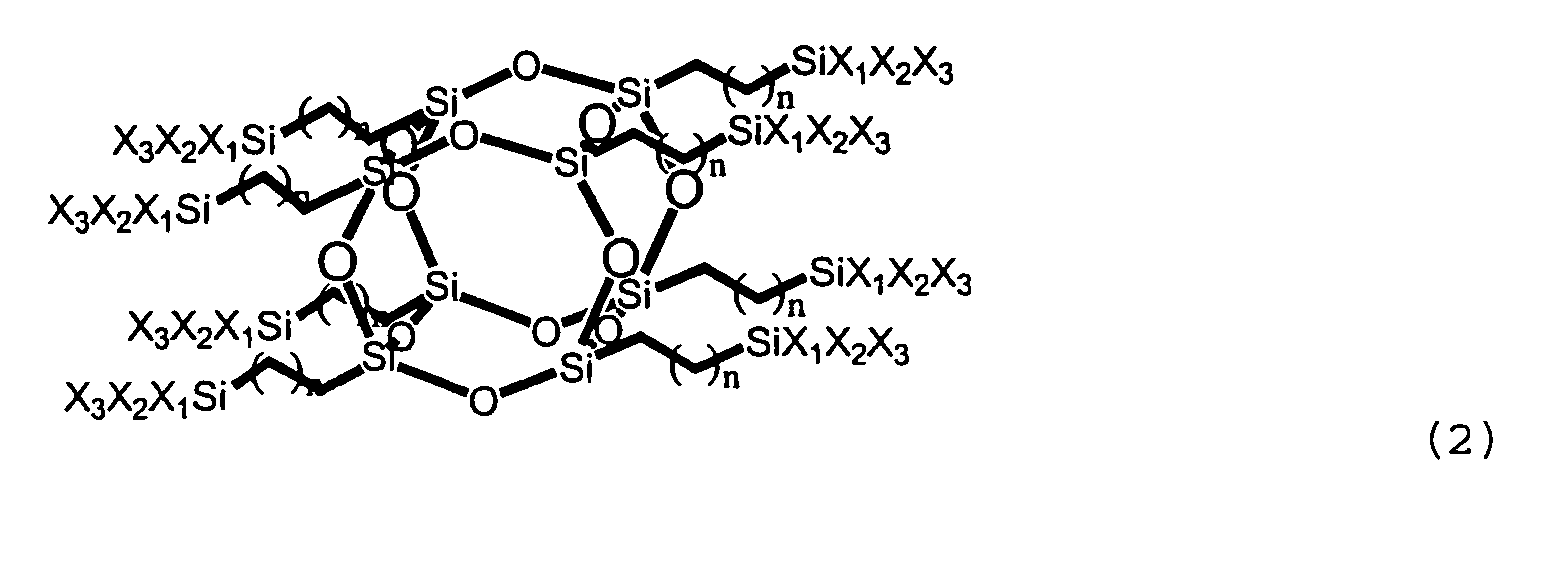
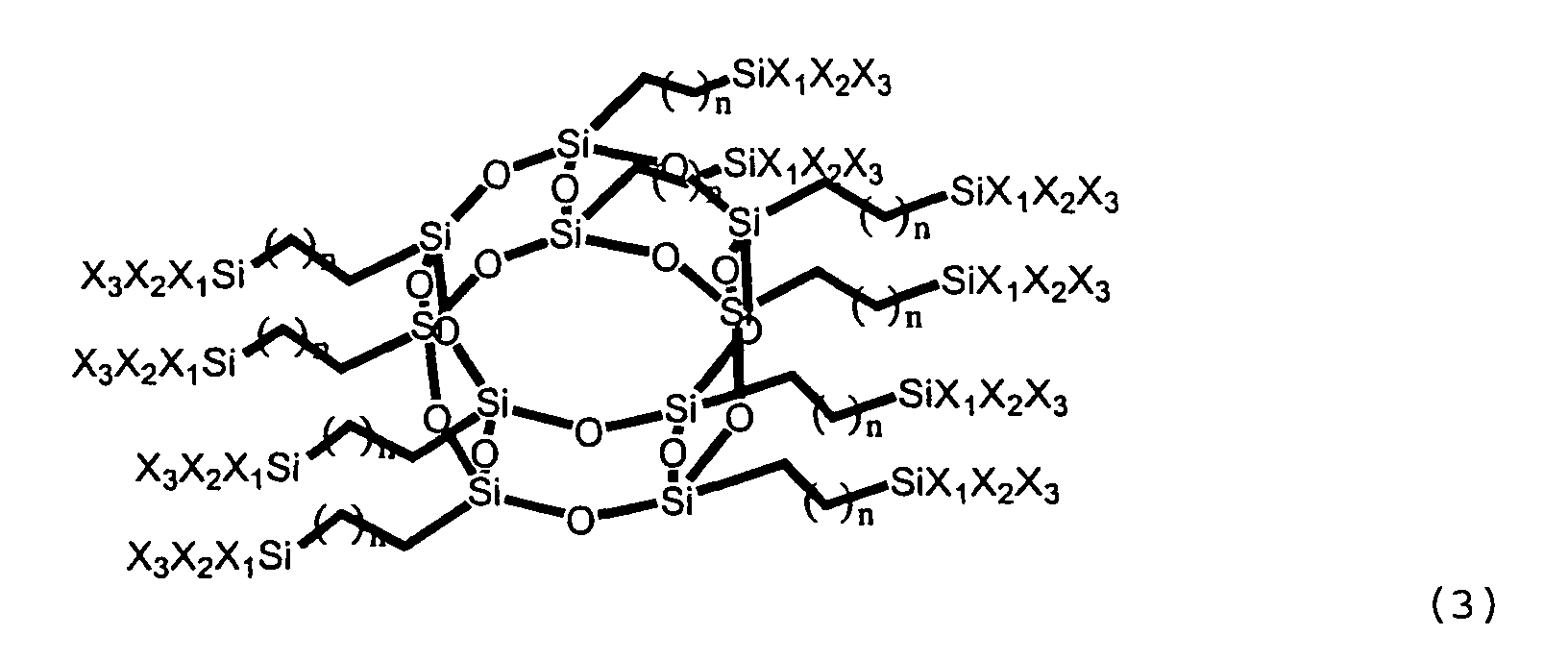 In the above formulae (2) to (4),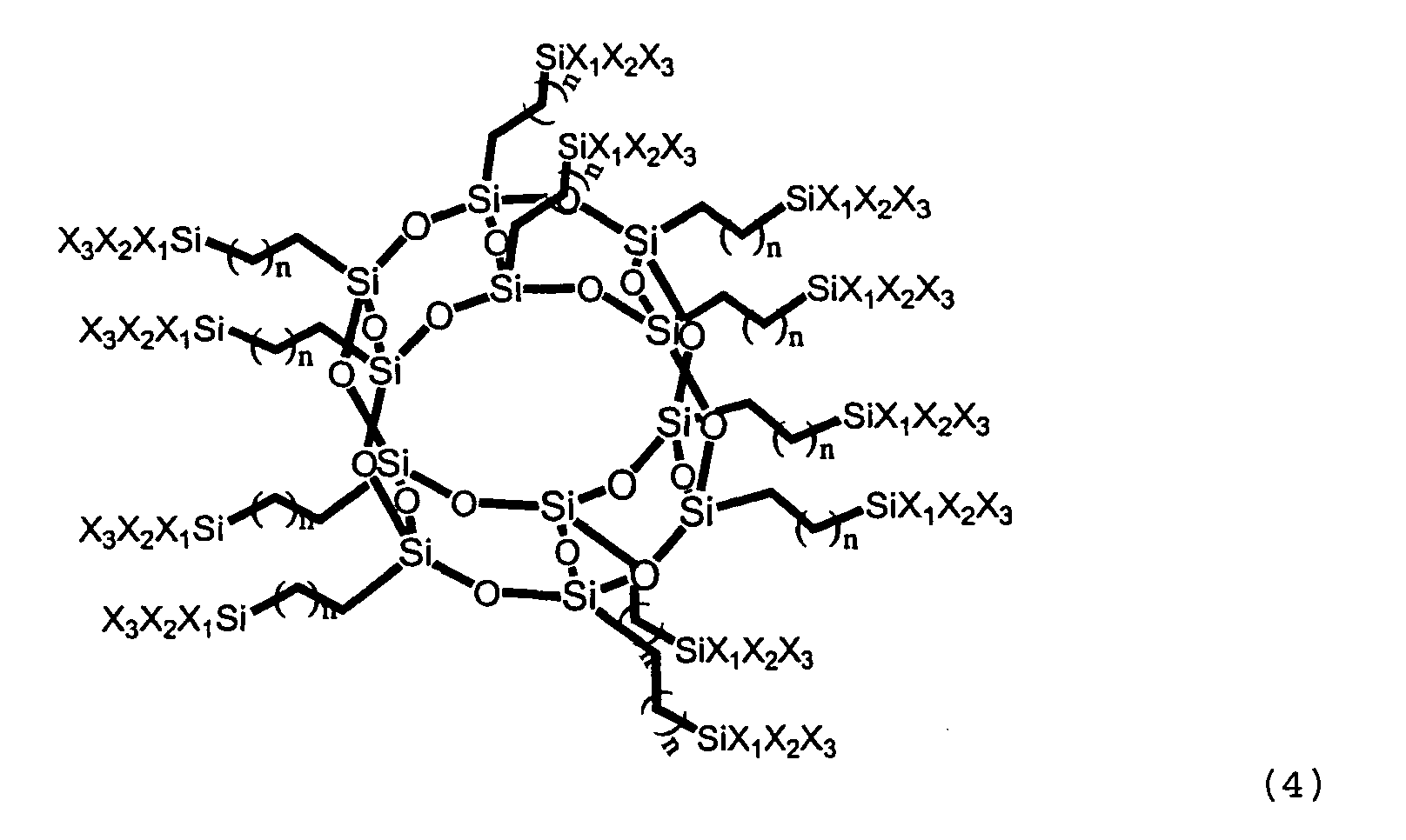
X1, X2 and X3 are independently hydrogen atom, C1∼3 alkyl group, C1∼10 alkoxy group, or halogen atom, and at least one of them is hydrolyzable and;
n is an integer ranging from 1 to 10. - The method of preparing siloxane monomers having cage structure is not specially limited, but prepared by hydrosililation using metallic catalyst as previously known methods in the art.
- The silane-based monomers can be represented by the following formulae (5) ∼(7).
- In the above formulae (5) to (7),
R is hydrogen atom, C1∼3 alkyl group, C3∼10 cycloalkyl group, or C6∼15 aryl group; and
X1, X2 and X3 are independently C1∼10 alkoxy group, or halogen atom. - The catalyst used in the condensation reaction for preparing matrix precursor is not specifically limited, but preferably hydrochloric acid, benzenesulfonic acid, oxalic acid, formic acid, or a mixture.
- In the hydrolysis and polycondensation reaction, water is added at 1.0∼100.0 equivalents, preferably 1.0-10.0 equivalents per one equivalent of reactive groups in the monomers, and then the reaction is carried out at 0∼200°C, preferably 50∼110°C, for 1∼100hrs, preferably 5-24hrs.
- The organic solvent used in this reaction is preferably aromatic hydrocarbon solvent such as toluene, xylene, mesitylene, etc.; ketone-based solvent such as methyl isobutyl ketone, acetone, etc.; ether-based solvent such as tetrahydrofuran, isopropyl ether, etc.; acetate-based solvent such as propylene glycol monomethyl ether acetate; amide-based solvent such as dimethylacetamide, dimethylformamide, etc.; γ-butyrolactone; silicon solvent or a mixture thereof.
- The thermo-unstable pore-generating materials used in the present invention are gemini detergent represented by the formula(8), quaternary alkylammonuim salt represented by the formula(9) or a mixture thereof.

- In the above formula (8),
R1 and R2 are independently methyl group or ethyl group;
R3 is C5∼40 alkyl group;
X is halogen atom;
r is independently hydrogen atom, methyl group or C1∼10 alkoxy group;
j is 0 or 1;
n is an integer ranging from 1 to 12; and
m is an integer ranging from 0 to 10. - In the above formula (9),
N is nitrogen atom;
X is halogen atom; and
L1, L2, L3, and L4 are independently C1∼30 alkyl group. - The gemini detergent in the above is prepared by the reaction of the materials represented by the formula(10) and the formula (11) in a solvent such as ethanol, acetonitrile, toluene, etc. at the temperature of 30°C ∼ 120°C, preferably 60°C∼ 90°C for 1∼100hr, preferably for 24∼72.

- In the above formula (10),
X is halogen atom;
r is independently hydrogen atom, methyl group or C1∼10 alkoxy group,
j is 0 or 1;
n is an integer ranging from 1 to 12; and
m is an integer ranging from 0 to 10 - In the above formula (11),
R1 and R2 are independently methyl group or ethyl group; and
R3 is C5∼40 alkyl group. - In this reaction, the mole ratio of the material represented by the following formula (10) to the following formula f (11) is 1:2 ∼ 1:3.
- The fourth alkylammonate can be obtained commercially, and the particular examples include, but not limited to, tetramethylammonium bromide, tetraethylammonium bromide, tetrapropylammonium bromide, tetrabutylammonium bromide, tetrapentylammonium bromide, tetrahexylammonium bromide, tetraheptylammonium bromide, tetraoctylammonium bromide, tetrahexadecylammonium bromide, tetraoctadecylammonium bromide, diethyldimethylammonium bromide, dipropyldimethylammonium bromide, dibutyldimethylammonium bromide, dipentyldimethylammonium bromide, dihexyldimethylammonium bromide, diheptyldimethylammonium bromide, dioctyldimethylammonium bromide, didecyldimethylammonium bromide, etc.
- In the composition of the present invention, a cyclodextrin-based derivatives represented by the following formula (12) may be further added as a porogen in order to improve the dielectric constant and to elevate hygroscopicity in addition to the gemini detergent, fourth alkylammonate, or a mixture thereof.

- In the above formula (12),
q is an integer ranging from 6 to 12;
R1, R2 and R3 are independently halogen atom, C0∼10 amino group or azido group, C3∼20 imidazole group or pyridino group, C1∼10 cyano group, C2∼10 carbonate group, C1∼10 carbamate group, or -OR4, wherein R4 is hydrogen atom, C2∼30 acyl group, C1∼20 alkyl group, C3∼10 alkene group, C3∼20 alkyne group, C7∼20 tosyl group, C1∼10 mesyl group, C0∼10 phosphorous group, C3∼10 cycloalkyl group, C6∼30 aryl group, C1∼20 hydroxy alkyl group, or carboxyl group, C1∼20 carboxy alkyl group, glucosyl group or maltosyl group, or a silicon compound represented by Sir1r2r3, wherein r1, r2 and r3 are independently C1∼5 alkyl group, C1∼5 alkoxy group, or C6∼20 aryl group. - Examples of the pore-generating material used in the present invention include α-, β- and γ- cyclodextrins represented by the following formulas (13) to (15), all of which have limited 3D structure with maximum radius of about 13-17Å.
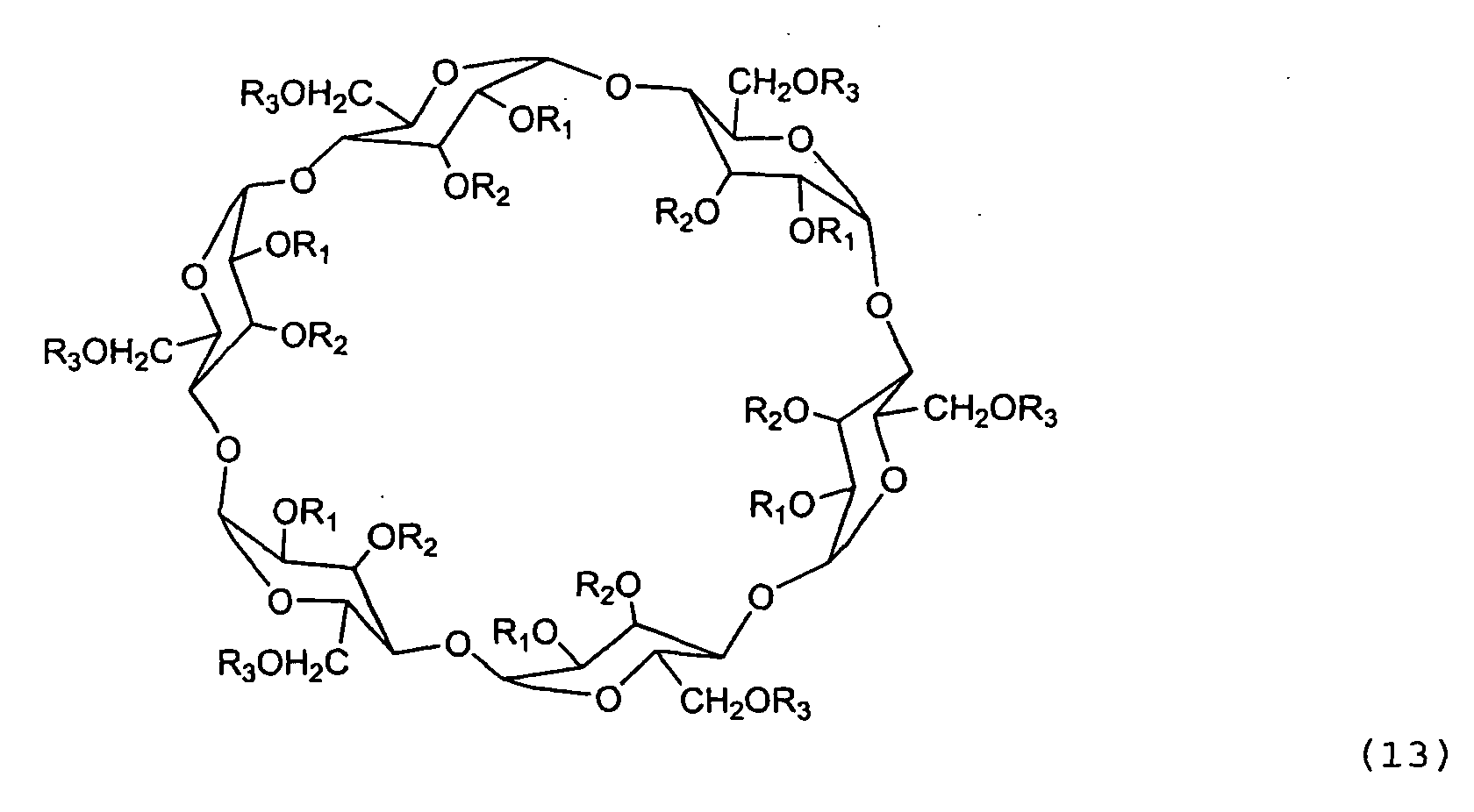
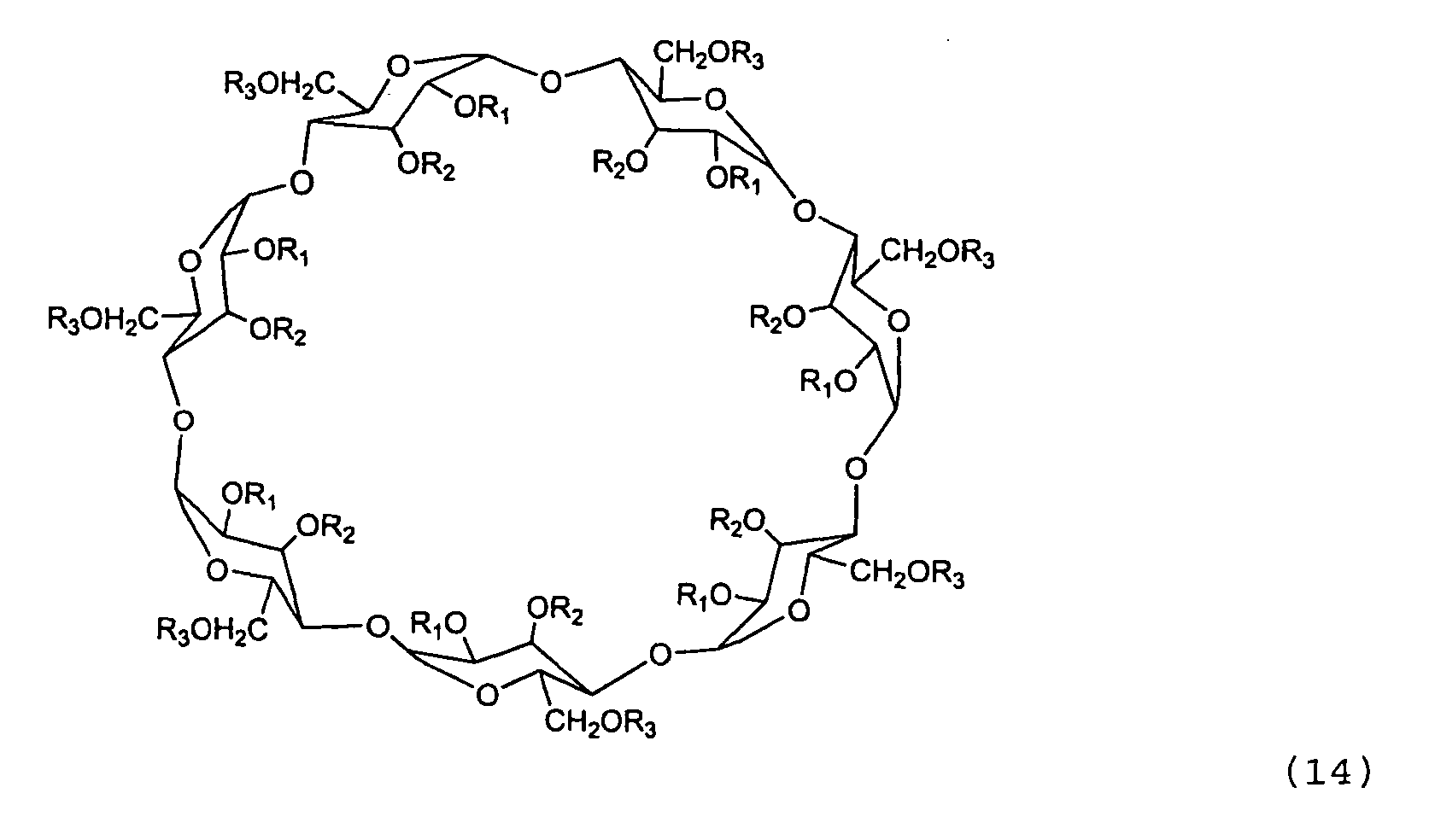
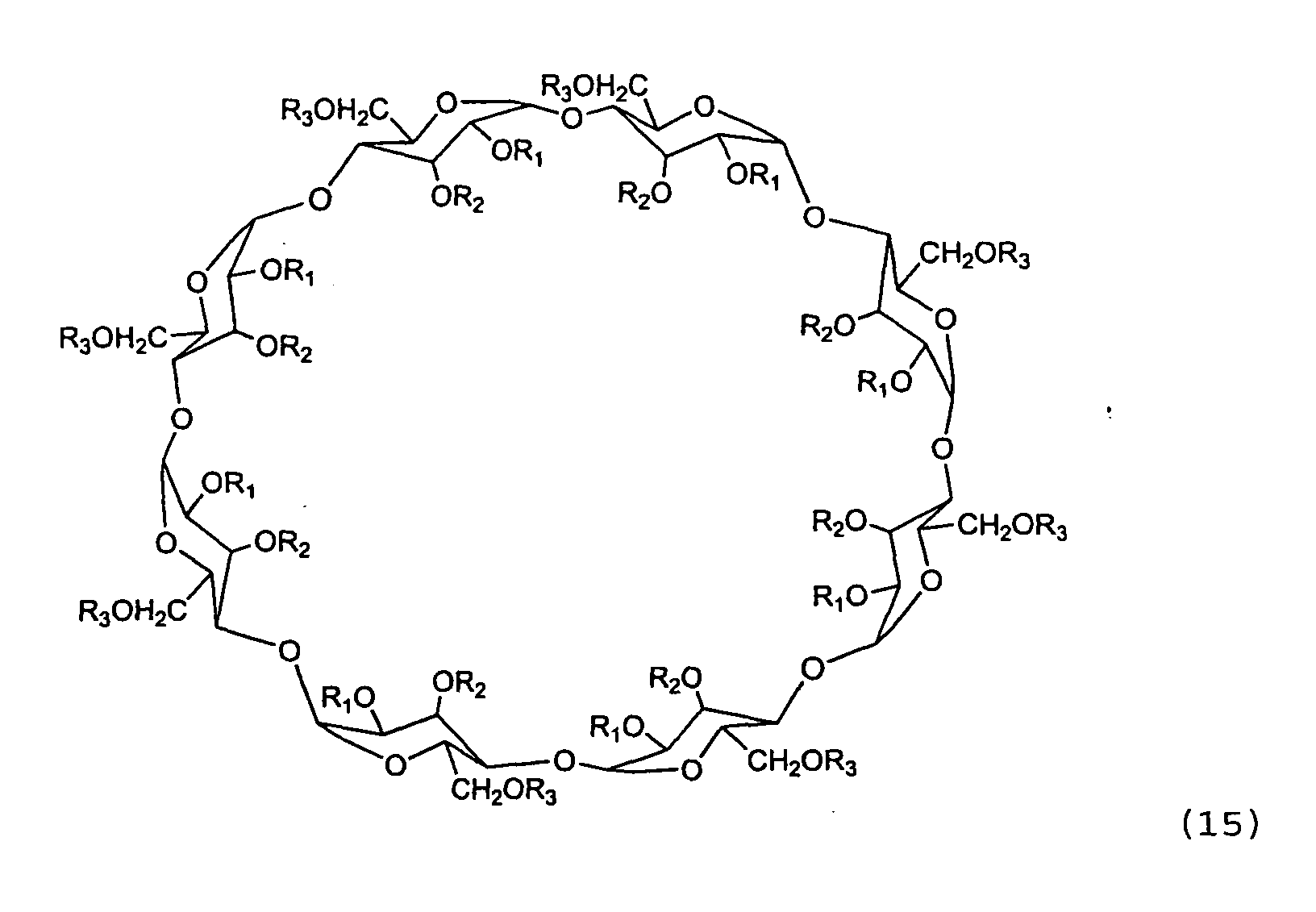
- In the above formulae (13) to (15);
R1, R2 and R3 are the same as those determined in the formula (12). - In the above α-, β- and γ- cyclodextrin derivatives, R1, R2 and R3 are preferably C2∼30 acyl group, C1∼20 alkyl group, C3∼10 alkene group, C3∼20 alkyne group, C3∼10 cycloalkyl group, C6∼30 aryl group, or a silicon compound represented by Sir1r2r3, wherein r1, r2 and r3 are independently C1∼5 alkyl group, C1∼5 alkoxy group, or C6∼20 aryl group.
- Specific examples of the cyclodextrin derivatives include, but not limited to, hexakis (2,3,6-tri-O-acetyl)-α-cyclodextrin, heptakis (2,3,6-tri-O-acetyl)-β-cyclodextrin, octakis (2,3,6-tri-O-acetyl)-γ-cyclodextrin, heptakis (2,3,6-tri-O-propanoyl)-β-cyclodextrin, heptakis (2,3,6-tri-O-butanoyl)-β-cyclodextrin, heptakis (2,3,6-tri-O-pentanoyl)-β-cyclodextrin, hexakis (2,3,6-tri-O-benzoyl)-α-cyclodextrin, heptakis (2,3,6-tri-O-benzoyl)-β-cyclodextrin, octakis (2,3,6-tri-O-benzoyl)-γ-cyclodextrin, hexakis(2,3,6-tri-O-methyl)-α-cyclodextrin, heptakis(2,3,6-tri-O-methyl)-β-cyclodextrin, hexakis(6-O-tosyl)-α-cyclodextrin, hexakis(6-amino-6-O-deoxy)-α-cyclodextrin, heptakis(6-amino-6-deoxy)-β-cyclodextrin, bis(6-azido-6-deoxy)-β-cyclodextrin, hexakis(2,3-O-acetyl-6-bromo-6-deoxy)-α-cyclodextrin, heptakis(2,3-O-acetyl-6-bromo-6-deoxy)-β-cyclodextrin, mono(2-O-phosphoryl)-α-cyclodextrin, mono(2-O-phosphoryl)-β-cyclodextrin, hexakis(6-deoxy-6-(1-imdazolyl))-β-cyclodextrin, and mono(2,(3)-O-carboxymethyl)-α-cyclodextrin, heptakis (2,3,6-tri-O-trimethylsilyl)-β-cyclodextrin, heptakis(2,3,6-tri-O-dimethylsilyl)-β-cyclodextrin, etc.
- The content of the cyclodextrin derivative is preferably 5.0∼95 wt.%, more preferably 20∼80 wt.% of the whole pore-generating material.
- In the present invention, the composition for producing substances having pores may be prepared by dissolving the above mentioned thermo-stable matrix precursor and the thermo-unstable pore-generating material in an appropriate solvent.
- Examples of this solvent include, but not limited to, aromatic hydrocarbons such as anisole, mesitylene and xylene; ketones such as methyl isobutyl ketone and acetone; ethers such as tetrahydrofuran and isopropyl ether; acetates such as propylene glycol methyl ether acetate; amides such as dimethylacetamide and dimethylformamide; γ-butyolactone; silicon solvents; and a mixture thereof.
- The solvent should be used in sufficient amount to coat a substrate fully with the two solid components (matrix precursor + cyclodextrin derivative), and may be present in the range of 20∼99.9 wt.%, preferably 50∼95wt.%, in the composition (matrix precursor + pore-generating material + solvent). There is a problem that a thin film is not formed uniformly if the solvent is used less than 20 wt.% because of high viscosity, to the contrary, the thickness is too thin if the solvent is used more than 99.9wt. %.
- Further, content of the pore-generating material is preferably 0.1∼95 wt.%, more preferably 10∼70 wt.% of the solid components (matrix precursor + pore-generating material). There is a problem that the mechanical properties of the film are deteriorated if the pore-generating material is used more than 95 wt.%. To the contrary, the dielectric constant of the film is not lowered due to poor formation of pores if pore-generating material is used less than 10wt.%.
- According to the present invention, the thin film having pores formed on a substrate by the use of the composition of the present invention serves as a good interlayer insulating film required for semiconductor devices. The composition of the present invention is first coated onto a substrate through spin-coating, dip-coating, spray-coating, flow-coating, screen-printing and so on. More preferably, the coating step is carried out by spin-coating at 1000∼5000 rpm. Following the coating, the solvent is evaporated from the substrate for a resinous film to deposit on the substrate. At this time, the evaporation may be carried out by simple air-drying, or by subjecting the substrate, at the beginning of curing step, to vacuum condition or mild heating(≤100°C).
- The resulting resinous coating film may be cured by heating at a temperature of 150∼600°C, more preferably 200∼450°C wherein pyrolysis of the pore-generating material occurs, so as to provide insoluble film without crack. As used herein, by "film without crack" is meant a film without any crack observed with an optical microscope at a magnification of 1000X. As used herein, by "insoluble film" is meant a film, which is substantially insoluble in any solvent described as being useful for the coating and deposition of the siloxane-based resin. The heat-curing of the coating film may be performed under inert gas atmosphere or vacuum condition for even 10hrs, preferably 30min to 1hrs. After curing process, pore-generating materials are decomposed to generate pores.
- The thin film obtained from the above has a low dielectric constant (k≤2.5). Further, in the case that about 30 weight parts of the cyclodextrin-based pore-generating material are mixed with 70 weight parts of the matrix precursor (i.e., content of the porogen is 30wt.% of the solid mixture), very low dielectric constant (k≤2.2) may be also achieved.
- The material with pores generated by the above compositions can be further applied in the various field, particularly used as absorbents, carriers for catalysts, thermal insulators and electric insulators, low dielectric materials.
- Hereinafter, the present invention will be described in more detail with reference to the following Examples. However, these Examples are given for the purpose of illustration and are not to be construed as limiting the scope of the invention.
- To a flask were added 29.014mmol(10.0g) of 2,4,6,8-tetramethyl-2,4,6,8-tetravinylcyclotetrasiloxane and 0.164g of platinum (O)-1,3-divinyl-1,1,3,3-tetramethyldisiloxane complex(solution in xylene), and then diluted with 300ml of diethylether. Next, the flask was cooled to -78°C, 127.66mmol(17.29g) trichlorosilane was slowly added thereto, and then it was slowly warmed to room temperature. The reaction was continued at room temperature for 20hrs, and any volatile materials were removed from the reaction mixture under reduced pressure of about 0.1torr. To the mixture was added 100ml pentane and stirred for 1hr, and then the mixture was filtered through celite to provide a clear colorless solution. The pentane was evaporated from the solution under reduced pressure of about 0.1 torr to afford a colorless liquid compound, [-Si (CH3) (CH2CH2Cl3)O-]4 in a yield of 95%.
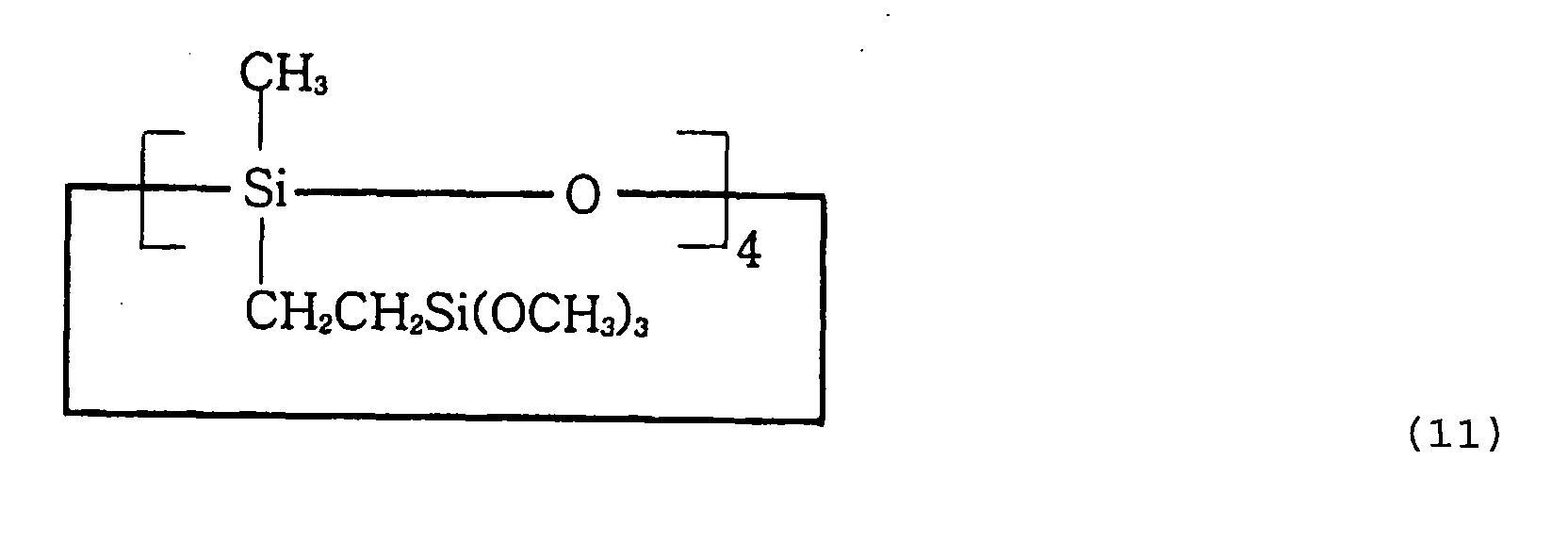
- 11.28mmol(10.0g) of the compound was diluted with 500ml of tetrahydrofuran, and 136.71mmol(13.83g) of triethylamine was added thereto. Thereafter, the mixture was cooled to -78°C, 136.71mmol(4.38g) of methyl alcohol was slowly added thereto, and it was slowly warmed again to room temperature. The reaction was continued at room temperature for 15hrs, filtered through celite, and then volatile materials were evaporated from the filtrate under reduced pressure of about 0.1torr. Subsequently, 100ml of pentane was added thereto and stirred for 1hr, and then the mixture was filtered through celite to provide a clear colorless solution. The pentane was evaporated from this solution under reduced pressure of about 0.1torr to afford monomer A represented by the following formula (11) as a colorless liquid in a yield of 94%:
- To a flask was added 9.85mmol(8.218g) of monomer A, and then diluted with 90ml of tetrahydrofuran. Next, dil. HCl solution (1.18mmol hydrochloride) prepared by mixing of 8.8ml conc. HCl (35wt.% hydrochloride) with 100ml D.I.-water was slowly added thereto at -78°C, followed by addition of more D.I.-water, so that total amount of water including the inherent water in the above added dil. HCl solution amounted to 393.61mmol(7.084g). Thereafter, the flask was slowly warmed to 70°C, and allowed to react for 16hrs. Then, the reaction mixture was transferred to a separatory funnel 90ml of diethylether was added thereto, and then rinsed with 5X100ml D.I.-water. Subsequently, 5g of anhydrous sodium sulfate was added thereto and stirred at room temperature for 10hrs to remove a trace of water, and then filtered out to provide a clear colorless solution. Any volatile materials were evaporated from this solution under reduced pressure of about 0.1torr to afford 5.3g of precursor A as white powder.
- To a flask were added 37.86mmol(5.158g) of methyltrimethoxysilane and 3.79mmol(3.162g) of monomer A, and then diluted with 100ml of tetrahydrofuran. Next, dil. HCl solution (0.0159mmol hydrochloride) prepared by dilution of 0.12ml conc. HCl (35wt.% hydrochloride) with 100ml D.I.-water was slowly added thereto at -78°C, followed by addition of more D.I.-water, so that total amount of water including the inherent water in the above added dil. HCl solution amounted to 529.67mmol(9.534g). Thereafter, the flask was slowly warmed to 70°C, and allowed to react for 16hrs. Then, the reaction mixture was transferred to a separatory funnel, 100ml diethylether was added thereto, and then rinsed with 5X100ml D.I.-water. Subsequently, 5g of anhydrous sodium sulfate was added thereto and stirred at room temperature for 10hrs to remove a trace of water, and then filtered out to provide a clear colorless solution. Any volatile materials were evaporated from this solution under reduced pressure of about 0.1torr to afford 5.5g of precursor B as white powder.
- The siloxane-based resinous precursors thus prepared were analyzed for molecular weight (hereinafter, referred to as "MW") and molecular weight distribution (hereinafter, referred to as "MWD") by means of gel permeation chromatography (Waters Co.), and the Si-OH, Si-OCH3 and Si-CH3 contents (%) of their terminal groups were analyzed by means of NMR (Bruker Co.). The results are set forth in the following Table 1.
Precursor MW MWD Si-OH (mol%) Si-OCH3 (mol%) Si-CH3 (mol%) Precursor (A) 60800 6.14 35.0 1.2 63.8 Precursor (B) 4020 2.77 39.8 0.5 59.7 ·Si-OH (%) =Area (Si-OH) ÷ [Area (Si-OH) + Area (Si-OCH3)/3 +Area (Si-CH3)/3]×100 ·Si-OCH3 (%) =Area (Si-OCH3) ÷ [Area (Si-OH) +Area (Si-OCH3) /3 +Area (Si-CH3)/3]×100 ·Si-CH3(%)=Area(Si-CH3)÷[Area(Si-OH)+Area(Si-OCH3)/3 +Area(Si-CH3)/3]×100 - In a flask were mixed 100ml acetonitrile and 10.0g of bis (chloromethyl) tetramethyldisiloxane (A), and then added 21.4g of tetradecyldimethylamine (n = 14, B). The mole ratio of A to B was set to 1:2.05. The obtained solution was heated at 82°C, for 24hr in the condition of reflex. The rotary evaporator removed the solvent, acetonitrile to provide solid- form product. To the solid product was added 2ml of chloroform and dissolved, and then added 500ml of ethyl acetate. Subsequently, the solution was retained at 0°C, for 12hr to recrystallization. Recrystallized material was filterd, and rinsed with 3X ethylacetate. Recrystallization, filtering, and rinsing were repeated two more times. The solvent was evaporated completely from the material obtained above by drying in a vacuum oven at 50°C, for 12hr to prepare C14H29N (CH3) 2CH2Si (CH3)2OSi (CH3) 2CH2N (CH3) 2C14H29Cl.
- In a flask were mixed 200ml of ethanol and 7.24g of BrCH2CH2CH2OSi (CH3)2OSi (CH3)2OSi (CH3)2OCH2CH2CH2Br (A) , and then 9.15g of octadecyldimethylamine(B) were added thereto. The mole ratio of A to B was set to 1:2.05 in the reactants. The obtained solution was heated for 48hr in the condition of reflex. The solvent, ethanol was removed by the rotary evaporator to provide solid- form product. The solid component was added to 2ml chloroform and dissolved, and then added 500ml ethyl acetate. Subsequently, the solution was retained at 0°C, for 12hr for recrystallization. Recrystallized materials were filtered, and rinsed with 3X ethylacetate. Recrystallization, filtering, and rinsing were repeated two more times. The solvent was evaporated completely from the material obtained above by vacuum oven at 50°C, for 12hr to prepare C18H37N (CH3) 2BrCH2CH2CH2OSi (CH3) 2OSi (CH3) 2OSi (CH3) 2OCH2CH2CH2BrN ( CH3) 2C18H37.
- The compositions for preparing a thin film were prepared by mixing the siloxane-based resinous matrix precursor obtained from the above Example 2 together with pore-generating material and propylene glycol methyl ether acetate (PGMEA) in accordance with the particular ratios as described in the following Table 2. These compositions were applied to spin-coating at 3000rpm onto p-type silicon wafers doped with boron. The substrates thus coated were then subjected to a series of soft baking on a hot plate for 1min at 150°C and another minute at 250°C, so that the organic solvent might be sufficiently removed. Then, the substrates were cured in a Linberg furnace at 420°C for 60min under vacuum condition. Thereafter, the thickness of each resulting low dielectric film and the refractive index were determined by using prism coupler. The results are set forth in the following Table 2.
Example No. Precursor Pore-generati ng material Mat. (wt.%) Pore-generating material (wt.%) Thickness (A) Refractive Index Example 5-1 Precursor (A) 25.0 - 8250 1.4353 Example 5-2 Precursor (A) 25.0 20wt.% 10200 1.3760 Example 5-3 Precursor (A) (a-2) 25.0 20wt.% 9800 2.3646 Example 5-4 Precursor (A) (a-1) +(b-2) 25.0 (a-1):10wt.% +(b-2) :20wt.% 10300 1.3360 Example 5-5 Precur sor (A) (a-1) +(c) 25.0 (a-1):20 wt.% +(c ):10 wt.% 9500 1.3360 Example 5-6 Precursor (A) (a-1) +(c) 25.0 (a-1):10 wt.% +(c) :20 wt.% 9900 1.3296 Example 5-7 Precursor (A) (a-2) +(c) 25.0 (a-2):10 wt.% +(c):20 wt.% 10050 1.3382 Example 5-8 Precursor (B) - 30.0 - 9800 1.4147 Example 5-9 Precursor (B) (a-1) 30.0 20 wt.% 11030 1.3379 Example 5-10 Precursor(B) (a-1) 30.0 30 wt.% 11500 1.3011 Example 5-11 Precursor (B) (a-1) + (b-1) 30.0 (a-1):10 wt.% + (b-1) :20wt.% 11000 1.3087 Example 5-12 Precursor (B) (a-1) +(c) 30.0 (a-1):10 wt.% +(c):20 wt.% 10700 1.3077 Example 5-13 Precursor (B) (a-1) +(c) 30.0 (a-1):10 wt.% +(c):20 wt.% 11200 1.3144 Example 5-14 Precursor (A) (b-1) 30.0 20 wt.% 9500 1.3314 Example 5-15 Precursor (A) (b-1) +(c) 30.0 (b-1):10 wt.% +(c):20 wt.% 9400 1.3297 Example 5-16 Precursor (B) (b-1) 30.0 20 wt.% 9600 1.3378 Example 5-17 Precursor (B) (b-1) +(c) 30.0 (b-1): 10wt.% +(c):20wt.% 11000 1.3110 - To determine the dielectric constant of the porous thin film, 3000Å thickness of thermally-oxidized silicon film were applied onto p-type silicon wafers doped with boron, then 100Å titanium, 2000Å aluminum are deposited by metal evaporator and then low dielectric films in composition of Table 3 were coated in the same manner as in Example 5. Thereafter, 1mm diameter of circular aluminum thin film was deposited at 2000Å thickness by the hard mask, which was designed to have 1mm electrode diameter, in order to be completed MIM(Metal- insulator-metal)-dielectric constant determiner capacitance of these thin films was measured using PRECISION LCR METER (HP4284A) with Probe station (Micromanipulator 6200 probe station) at 100Hz frequency. The thickness of the thin films was also measured using prism coupler. The dielectric constant was measured according to the following equation.
- k =
- (C X d) / (ε0 X A)
- k :
- dielectric constant
- C :
- capacitance
- A :
- the contact area of electrode
- ε0 :
- dielectric constant of vacuum
- d :
- the thickness of the low dielectric thin film
- To measure hydroscopic degree of the porous thin film, the prepared determiner-thin film prepared in the above Example 5 were put in the D.I.water for 4days, taken out the film, and then water was removed from the thin film through blowing the nitrogen for 1min. Thereafter, the hydroscopicity was measured through the variation of capacitance which was gauged at 100kHz frequency using PRECISION LCR METER (HP4284A) with Probe station (Micromanipulator 6200 probe station).
- Generally, if an adsorption happens, the capacitance adsorption test increases more than 10% afterwards the submersion under water compared with that of before. But in the present invention, it can be recognized that the adsorption does not happen from that the change of capacitance is very small.
Example No. Precursor Pore-generat ing material Mat. (wt.%) Pore-generating material (wt.%) CP before submersion (pF) CP after submersion submersion (pF) Example 7-1 Precursor (A) - 25.0 - 22.14 22.72 Example 7-2 Precursor (A) (a-1) 25.0 20wt.% 22.85 23.31 Example 7-3 Precursor (A) (a-2) 25.0 20wt.% 27.82 27.48 Example 7-4 Precursor (A) (a-1) +(b-2) 25.0 (a-1): 10wt.% +(b-2) :20wt.% 27.85 24.82 Example 7-5 Precursor (A) (a-1) +(c) 25.0 (a-1) :20wt.% +(c ):10wt.% 25.22 24.09 Example 7-6 Precursor (A) (a-1) +(c) 25.0 (a-1):10 wt.% +(c) :20 wt.% 24.43 24.90 Example 7-7 Precursor (A) (a-2) +(c) 25.0 (a-2):10 wt.% +(c) :20 wt.% 9.68 9.65 Example 7-8 Precursor (B) - 30.0 - 6.49 6.55 Example 7-9 Precursor (B) (a-1) 30.0 20 wt.% 5.47 5.55 Example 7-10 Precursor (B) (a-1) 30.0 30 wt.% 6.04 6.12 Example 7-11 Precursor (B) (a-1) +(b-1) 30.0 (a-1) :10 wt.% +(b-1) :20wt.% 6.64 6.72 Example 7-12 Precursor (B) (a-1) +(c) 30.0 (a-1):10 wt.% +(c) :20 wt.% 8.33 8.15 Example 7-13 Precursor (B) (a-1) +(c) 30.0 (a-1):20 wt.% +(c) :10 wt.% 8.81 8.41 Example 7-14 Precursor (A) (b-1) 25.0 20 wt.% 22.35 22.55 Example 7-15 Precursor (A) (b-1) +(c) 25.0 (b-1):10 wt.% +(c):20 wt.% 24.04 24.11 Example 7-16 Precursor (B) (b-1) 30.0 20 wt.% 5.44 5.43 Example 7-17 Precursor (B) (b-1) +(c) 30.0 (b-1): 10wt.% +(c ):20wt.% 7.22 7.21 - Hardness and modulus of the thin-film prepared in the same process as in Example 5 were measured by Nanointender II of MS Co. Hardness and modulus were measured when the intent depth was 10% of whole thin film thickness. Further, each sample of the thin films was indented to 6 point and the hardness and modulus of the thin film were determined from the mean value in order to ensure the confidence. And the thickness of the thin film was measured by the prism coupler. The results are described in Table 5.
Example No. Precursor Pore-generating material Mat. (wt.%) Pore-generating material (wt.%) Thickness (Å) Hardness (Gpa ) Modulous (Gpa) Example 8-1 Precursor (A) - 25.0 - 8400 9.84 0.86 Exampl 8-2 Precursor (A) (a-1) 25.0 10wt.% 9100 6.74 0.76 Example 8-3 Precursor (A) (a-1) 25.0 20wt.% 9900 5.41 0.61 Example 8-4 Precursor (A) (a-1) 25.0 30wt.% 10300 3.41 0.47 Example 8-5 Precursor (A) (a-2) 25.0 30wt.% 9800 3.42 0.48 Example 8-6 Precursor (A) (a-1)+(c) 25.0 (a-1): 10wt.%+ (c):20wt.% 10020 3.35 0.39 Example 8-7 Precursor (A) (a-1)+(c) 25.0 (a-1): 20wt.%+ (c):10wt.% 9700 3.34 0.38 Example 8-8 Precursor (A) (a-1)+(b-1) 25.0 (a-1):20wt.%+ (b-1):10wt.% 9800 3.43 0.48 Example 8-9 Precursor (A) (a-2)+(b-1) 25.0 (a-1):20wt.%+ (b-1) : 10wt.% 11000 3.45 0.47 Example 8-10 Precursor (B) - 30.0 - 9600 9.68 0.87 Example 8-11 Precursor (B) (a-1) 30.0 20wt.% 11030 4.71 0.57 Example 8-12 Precursor (B) (a-1) 30.0 30wt.% 11500 3.31 0.41 Example 8-13 Precursor (B) (a-1)+(b-1) 30.0 (a-1) :10wt.% + (b-1): 20wt.% 11000 3.40 0.45 Example 8-14 Precursor (B) (a-1)+(c) 30.0 (a-1):10wt.% +(c):20wt.% 10700 3.19 0.40 Example 8-15 Precursor (B) (a-1)+(c) 30.0 (a-1):20wt.% +(c) :10wt.% 11200 3.31 0.37 Example 8-16 Precursor (A) (b-1) 25.0 20wt% 9500 5.51 0.62 Example 8-17 Precursor (A) (b-1)+(c ) 30.0 (b-1): 10wt% +(c) :20wt% 9400 3.47 0.41 Example 8-18 Precursor (B) - 30.0 - 9600 9.68 0.87 Example 8-19 Precursor (B) (b-1) 30.0 10wt% 10100 6.46 0.74 Example 8-20 Precursor (B) (b-1) 30.0 20wt% 11000 4.92 0.59 Example 8-21 Precursor (B) (b-1) 30.0 30wt% 11700 3.36 0.45 Example 8-22 Precursor (B) (b-2) 30.0 10wt% 9500 5.88 0.80 Example 8-23 Precursor (B) (b-2) 30.0 20wt% 9900 4.70 0.53 Example 8-24 Precursor (B) (b-2) 30.0 30wt% 10100 3.20 0.42. Example 8-25 Precursor (B) (b-1)+ (c) 30.0 (b-1): 10wt% +(c):20wt% 10050 3.18 0.43 Example 8-26 Precursor (B) (b-1)+ (c) 30.0 (b-1): 20wt% +(c):10wt% 11000 3.44 0.42 - There is provided materials having pores produced by the use of the composition of the present invention, and their use as heat resisting materials, electric insulators, absorbents, carriers for catalysts. In particular, these substances may be useful for insulating films between interconnect layers in semi-conductor devices, since their dielectric constant, k is as sufficiently low as 2.5 or less.
| Example No. | Precursor | Pore-generating material | Mat. (wt.%) | Pore-generating material (wt.%) | Dielectric constant |
| Example 6-1 | Precursor (A) | - | 25.0 | - | 2.715 |
| Example 6-2 | Precursor (A) | (a-1) | 25.0 | 20wt.% | 2.398 |
| Example 6-3 | Precursor (A) | (a-2) | 25.0 | 20wt.% | 2.369 |
| Example 6-4 | Precursor (A) | (a-1)+(b-2) | 25.0 | (a-1):10 wt.% +(b-2):20 wt.% | 2.226 |
| Example 6-5 | Precursor (A) | (a-1)+(c) | 25.0 | (a-1) :20 wt.% +(c) :10 wt.% | 2.201 |
| Example 6-6 | Precursor (A) | (a-1)+(c ) | 25.0 | (a-1):10 wt.% +(c) :20 wt.% | 2.196 |
| Example 6-7 | Precursor (A) | (a-2)+(c ) | 25.0 | (a-2):10 wt.% +(c):20 wt.% | 2.237 |
| Example 6-8 | Precursor (B) | - | 30.0 | - | 3.653 |
| Example 6-9 | Precursor (B) | (a-1) | 30.0 | 20 wt.% | 2.353 |
| Example 6-10 | Precursor (B) | (a-1) | 30.0 | 30 wt.% | 2.202 |
| Example 6-11 | Precursor (B) | (a-1)+(b-1) | 30.0 | (a-1):10 wt.% +(b-1) :20 wt.% | 2.184 |
| Example 6-12 | Precursor (B) | (a-1)+(c) | 30.0 | (a-1):10 wt.% +(c):20 wt.% | 2.102 |
| Example 6-13 | Precursor (B) | (a-1)+(c) | 30.0 | (a-1):20 wt.% +(c):10 wt.% | 2.178 |
| Example 6-14 | Precursor (A) | (b-1) | 30.0 | 20 wt.% | 2.314 |
| Example 6-15 | Precursor (A) | (b-1)+(c) | 30.0 | (b-1):10 wt.% +(c) :20 wt.% | 2.204 |
| Example 6-16 | Precursor (B) | (b-1) | 30.0 | 20 wt.% | 2.317 |
| Example 6-17 | Precursor (B) | (b-1)+(c) | 30.0 | (b-1):10wt.% +(c ):20wt.% | 2.191 |
Claims (20)
- A composition for preparing porous dielectric thin film, said composition comprising:wherein,(1) a pore generating material of gemini detergent represented by the formula (8), quaternary alkylammonium salt represented by the formula(9) or a mixture thereof;(2) thermo-stable organic or inorganic matrix precursor; and(3) a solvent for dissolving both the said material and the matrix precursor:

R1 and R2 are independently methyl group or ethyl group;
R3 is C5∼40 alkyl group;
X is a halogen atom;
r is independently hydrogen atom, methyl group or C1∼10 alkoxy group;
j is 0 or 1;
n is an integer ranging from 1 to 12; and
m is an integer ranging from 0 to 10, and
N is nitrogen atom;
X is a halogen atom; and
L1, L2, L3, and L4 are independently C1∼30 alkyl group. - The composition according to claim 1, wherein the content of the pore-generating material is 0.1∼95 wt.% of the solid components (the pore-generating material + the matrix precursor).
- The composition according to claim 1 or 2, wherein the content of the solvent is 20.0∼99.9 wt.% of the composition (the matrix precursor + the pore-generating material + the matrix precursor).
- The composition according to any of claims 1 to 3, wherein the pore-generating material further comprises a cyclodextrin derivative represented by the formula (12).wherein,

q is an integer ranging from 6 to 12;
R1, R2 and R3 are independently halogen atom, C0∼10 amino group or azido group, C3∼20 imidazole group or pyridino group, C1∼10 cyano group, C2∼10 carbonate group, C1∼10 carbamate group or functional group represented -OR4,
R4 is hydrogen atom, C2∼30 acyl group, C1∼20 alkyl group, C3∼10 alkene group, C2 alkyne group, C7∼20 tosyl group, C1∼10 mesyl group, C0∼10 phosphorous group, C3∼10 cycloalkyl group, C6∼30 aryl group, C1∼20 hydroxy alkyl group, carboxyl group, C1∼20 carboxy alkyl group, glucosyl group or maltosyl group, or silicon compounds represented by Sir1r2r3, wherein r1, r2 and r3 are independently C1∼5 alkyl group, C1∼5 alkoxy group, or C6∼20 aryl group. - The composition according to claim 4, wherein the cyclodextrin derivative is selected from α-, β- or γ-cyclodextrin derivatives represented by the formulae (13) to (15):
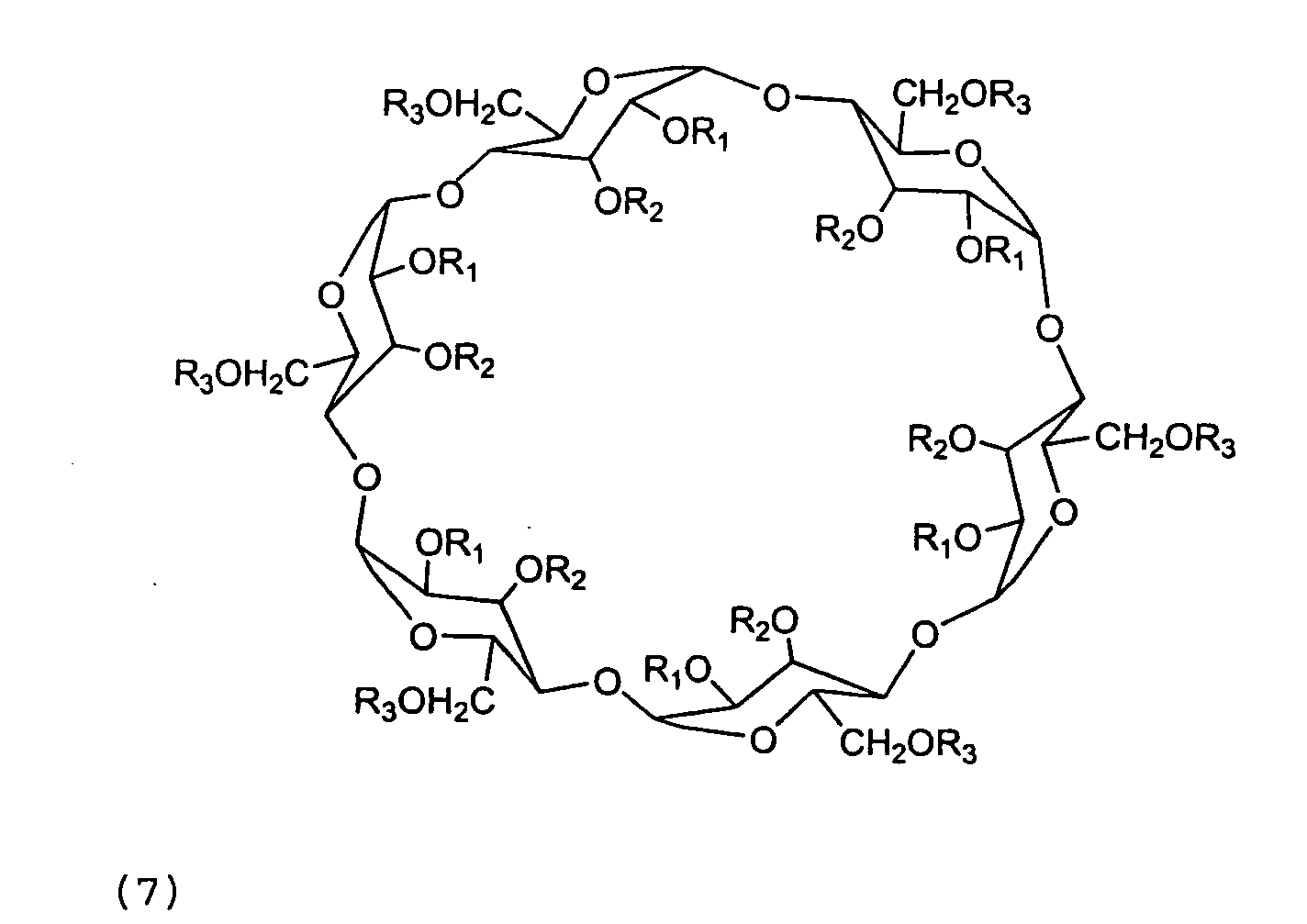
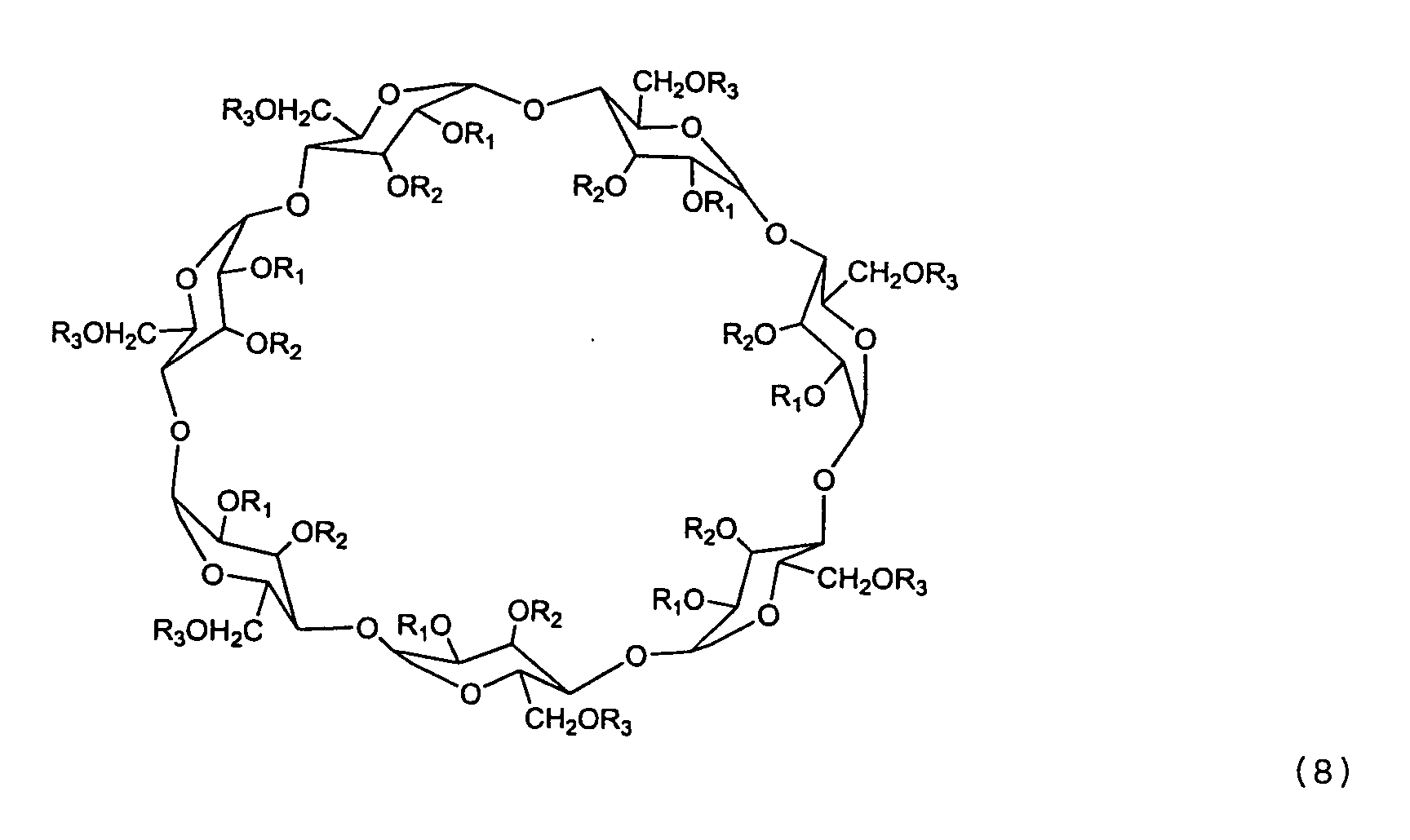 wherein,
R1, R2 and R3 are independently halogen atom, C0∼10 amino group or azido group, C3∼20 imidazole group or pyridino group, C1∼10 cyano group, C2∼10 carbonate group, C1∼10 carbamate group or functional group represented -OR4, R4 is hydrogen atom, C2∼30 acyl group, C1∼20 alkyl group, C3∼10 alkene group, C2 alkyne group, C7∼20 tosyl group, C1∼10 mesyl group, C0∼10 phosphorous group, C3∼10 cycloalkyl group, C6∼30 aryl group, C1∼20 hydroxy alkyl group, carboxyl group, C1∼20 carboxy alkyl group, glucosyl group or maltosyl group, or silicon compounds represented by Sir1r2r3, wherein r1, r2 and r3 are independently C1∼5 alkyl group, C1∼5 alkoxy group, or C6∼20 aryl group. - The composition according to claim 4 or 5, wherein the content of the cyclodextrin derivative is 5∼95wt.% of the total pore-generating material.
- The composition according to any of claims 1 to 6, wherein the quaternary alkylammonate is selected from tetramethylammonium bromide, tetraethylammonium bromide, tetrapropylammonium bromide, tetrabutylammonium bromide, tetrapentylammonium bromide, tetrahexylammonium bromide, tetraheptylammonium bromide, tetraoctylammonium bromide, tetrahexadecylammonium bromide, tetraoctadecylammonium bromide, diethyldimethylammonium bromide, dipropyldimethylammonium bromide, dibutyldimethylammonium bromide, dipentyldimethylammonium bromide, dihexyldimethylammonium bromide, diheptyldimethylammonium bromide, dioctyldimethylammonium bromide, didecyldimethylammonium bromide.
- The composition according to any of claims 1 to 7, wherein the matrix precursor is silsesquioxane, alkoxysilane sol or a, siloxane-based polymer.
- The composition according to claim 8, wherein the silsesquioxane is hydrogen silsesquioxane, alkyl silsesquioxane, aryl silsesquioxane, or a copolymer thereof.
- The composition according to any of claims 1 to 7, wherein the matrix precursor is a siloxane-based resin which is prepared by hydrolysis and polycondensation of one or more monomer selected from compounds represented by the following formulae (1) to (4) in an organic solvent in the presence of a catalyst and water:wherein,

R is hydrogen atom, C1∼3 alkyl group, C3∼10 cycloalkyl group, or C6∼15 aryl group;
X1, X2 and X3 are independently C1∼3 alkyl group, C1∼10 alkoxy group, or halogen atom; at least one thereof is hydrolysable; and
p is an integer ranging from 3 to 8; m is an integer ranging from 0 to 10, and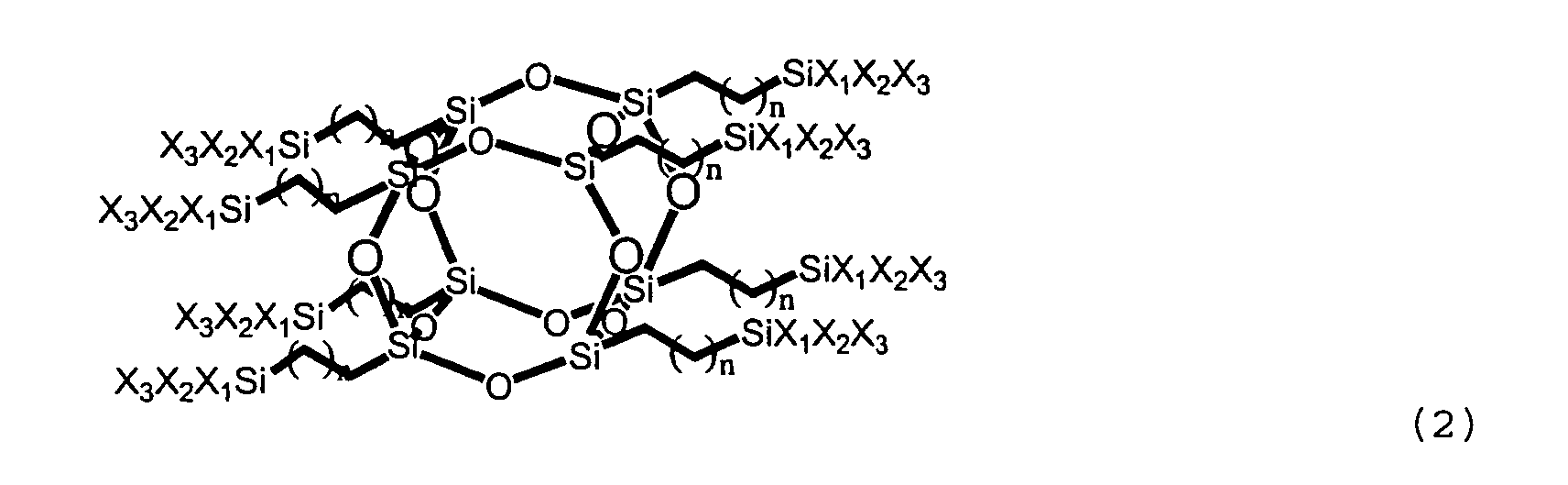
 wherein,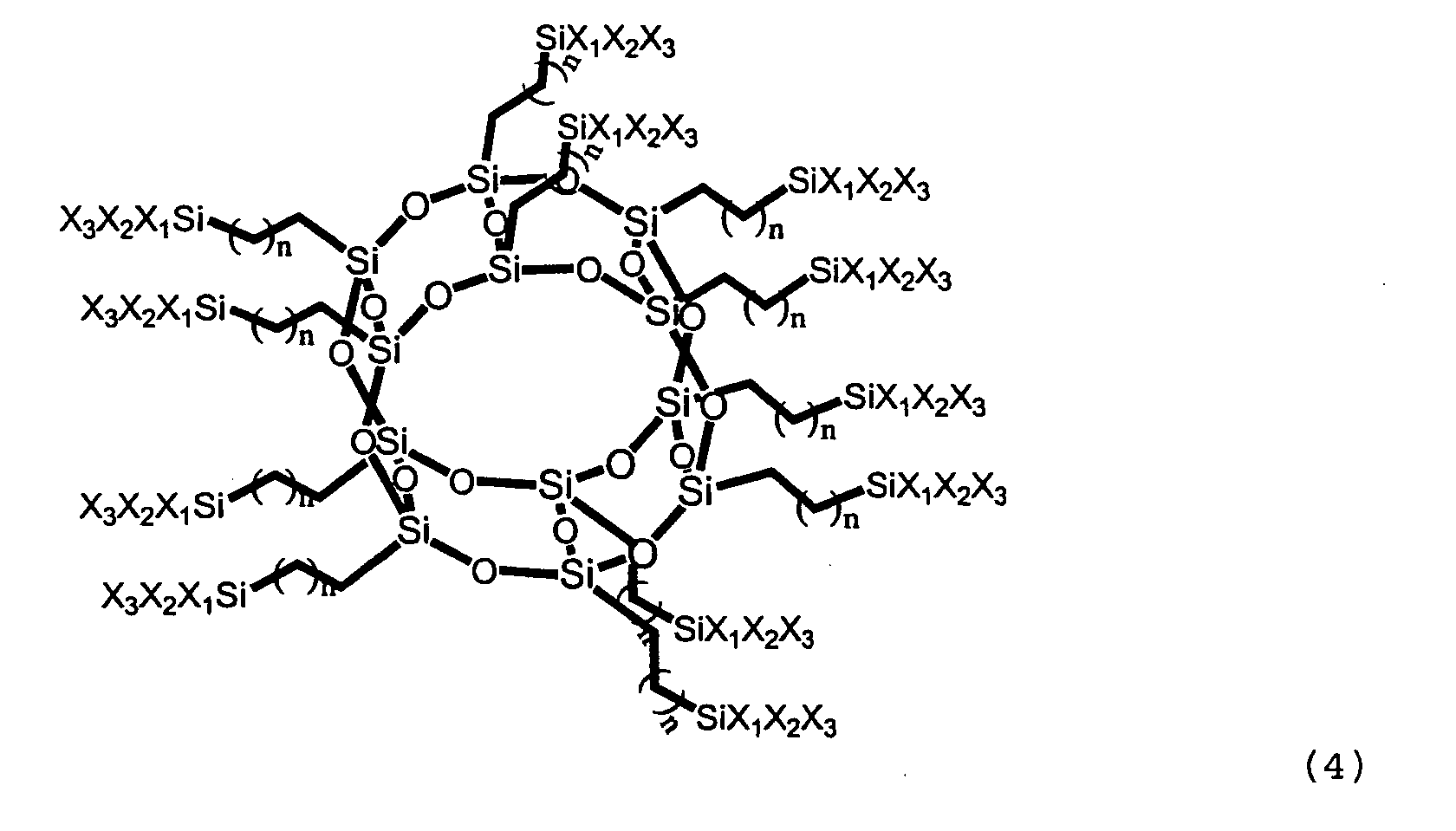
R is hydrogen atom;
X1, X2 and X3 are independently hydrogen atom, C1∼3 alkyl group, C1∼10 alkoxy group, or halogen atom; at least one thereof is hydrolysable and n is an integer ranging from 1 to 10. - The composition according to any of claims 1 to 7, wherein the matrix precursor is a siloxane-based resin which is prepared by hydrolysis and polycondensation of one or more monomers selected from compounds represented by the formulae (1) to (4)as defined in claim 10 together with one or more silane-based monomers selected from the group consisting of compounds represented by the following formulas (5) to (7) in an organic solvent in the presence of a catalyst and water:
R is as defined in claim 10,
R1 and R2 are independently hydrogen atom, C1∼3 alkyl group, C3∼10 cycloalkyl group, or C6∼15 aryl group;
X1, X2 and X3 are independently C1∼3 alkyl group, C1∼10 alkoxy group, or halogen atom. - The composition according to claim 10, wherein the content of Si-OH of the matrix precursor is more than 10 mol%.
- The composition according to claim 11, wherein the content of Si-OH of the matrix precursor is more than 10 mol%.
- The composition according to claim 11 or 13, wherein the molar ratio of siloxane monomers having cyclic or cage structure to the silane-based monomers is 0.99:0.01∼0.01:0.99.
- The composition according to any of claims 1 to 7, wherein the matrix precursor is polyimide, polybenzocyclobutene, polyarylene, or a mixture thereof.
- The composition according to any of claims 1 to 15, wherein the solvent is aromatic hydrocarbon-based solvent, ketone-based solvent, ether-based solvent, acetate-based solvent, amide-based solvent, γ-butyrolactone, acohol-based solvent, silicon-based solvent, or a mixture thereof.
- A method for forming interlayer insulating films between interconnect layers in semiconductor devices, said method comprising:coating the composition according to any of claims 1 to 16 on a substrate;evaporating the solvent therefrom; andheating the coating film at 150∼600°C under inert gas atmosphere or vacuum condition.
- The method according to claim 17, wherein the coating is carried out by spin-coating at 1000∼5000rpm.
- A substance having nano-pores, said substance being prepared by using the composition according to claim 1.
- A method for using the substance having nano-pores according to claim 19 as heat-resistant materials, electric insulators, absorbents, or carriers for catalysts.
Applications Claiming Priority (2)
| Application Number | Priority Date | Filing Date | Title |
|---|---|---|---|
| KR10-2002-0076275A KR100533538B1 (en) | 2002-12-03 | 2002-12-03 | Compsoition for Preparing Porous Interlayer Dielectric Thin Film, Containing Novel Pore-Generating Material |
| KR2002076275 | 2002-12-03 |
Publications (2)
| Publication Number | Publication Date |
|---|---|
| EP1435369A1 true EP1435369A1 (en) | 2004-07-07 |
| EP1435369B1 EP1435369B1 (en) | 2007-02-07 |
Family
ID=32464487
Family Applications (1)
| Application Number | Title | Priority Date | Filing Date |
|---|---|---|---|
| EP20030257179 Expired - Lifetime EP1435369B1 (en) | 2002-12-03 | 2003-11-13 | composition for preparing porous dielectric films |
Country Status (6)
| Country | Link |
|---|---|
| US (1) | US7169477B2 (en) |
| EP (1) | EP1435369B1 (en) |
| JP (1) | JP4465181B2 (en) |
| KR (1) | KR100533538B1 (en) |
| CN (1) | CN100460468C (en) |
| DE (1) | DE60311635T2 (en) |
Families Citing this family (19)
| Publication number | Priority date | Publication date | Assignee | Title |
|---|---|---|---|---|
| US7851457B2 (en) * | 2004-01-29 | 2010-12-14 | Innovative Biologics, Inc. | β-Cyclodextrin derivatives |
| KR100589123B1 (en) * | 2004-02-18 | 2006-06-14 | 학교법인 서강대학교 | Cyclodextrin derivatives useful as pore forming templates and low dielectrics prepared using the same |
| JP4878779B2 (en) * | 2004-06-10 | 2012-02-15 | 富士フイルム株式会社 | Film forming composition, insulating film and electronic device |
| WO2006083678A2 (en) * | 2005-01-28 | 2006-08-10 | Pinnacle Pharmaceuticals, Inc. | β-CYCLODEXTRIN DERIVATIVES AS ANTIBACTERIAL AGENTS |
| KR100723401B1 (en) * | 2005-01-29 | 2007-05-30 | 삼성전자주식회사 | Surface Plasmon Resonance Device Using Nano-sized Porous Materials and Manufacturing Method Thereof |
| KR101156426B1 (en) * | 2005-08-25 | 2012-06-18 | 삼성모바일디스플레이주식회사 | An silsesquioxane-based compound and an organic light emitting device comprising the same |
| JP2009070722A (en) * | 2007-09-14 | 2009-04-02 | Fujifilm Corp | Composition for forming insulating film and electronic device |
| KR100950063B1 (en) | 2007-11-27 | 2010-03-31 | 전남대학교산학협력단 | Aminoalkylsiloxane Resin Composition and Charge Trap Membrane for Electronic Device Using the Same |
| KR100953721B1 (en) | 2008-06-30 | 2010-04-19 | 재단법인서울대학교산학협력재단 | Soft PCC Composition |
| CN101348568B (en) * | 2008-08-22 | 2013-01-02 | 东华大学 | Accurate structure POSS hybridization low dielectric material preparation |
| US8518530B2 (en) * | 2009-05-20 | 2013-08-27 | Industry-University Cooperation Foundation Sogang University | Production method for an ultra-low-dielectric-constant film, and an ultra-low-dielectric-constant film produced thereby |
| KR101011251B1 (en) * | 2010-10-29 | 2011-01-26 | 협성개발(주) | Safety measuring device for maintenance of common ball |
| CN102418289A (en) * | 2011-09-20 | 2012-04-18 | 西南大学 | Silk reactive dye dyeing accelerator dihexyldimethylammonium bromide and its synthesis method |
| CN102418288A (en) * | 2011-09-20 | 2012-04-18 | 西南大学 | Dioctyl dimethyl ammonium bromide as dyeing accelerant for silk reactive dye and synthetic method thereof |
| KR101401419B1 (en) | 2012-11-30 | 2014-05-30 | 한국과학기술연구원 | Low dielectric interlayer material and method for preparing the same |
| US10676571B2 (en) | 2013-12-02 | 2020-06-09 | Sabic Global Technologies B.V. | Polyetherimides with improved melt stability |
| JP6803842B2 (en) | 2015-04-13 | 2020-12-23 | ハネウェル・インターナショナル・インコーポレーテッドHoneywell International Inc. | Polysiloxane formulations and coatings for optoelectronic applications |
| US20200031999A1 (en) * | 2018-07-27 | 2020-01-30 | 1-Material Inc. | Hybrid Organic-inorganic Polymeric Matrix in Light Valve Devices and Method for Making the Same |
| KR102939204B1 (en) | 2021-10-13 | 2026-03-13 | 삼성전자주식회사 | Semiconductor device including peripheral contact |
Citations (2)
| Publication number | Priority date | Publication date | Assignee | Title |
|---|---|---|---|---|
| EP0672702A1 (en) * | 1994-02-23 | 1995-09-20 | Wacker-Chemie GmbH | Process for the preparation of organyloxy groups containing organopolysiloxanes |
| US6270846B1 (en) * | 2000-03-02 | 2001-08-07 | Sandia Corporation | Method for making surfactant-templated, high-porosity thin films |
Family Cites Families (18)
| Publication number | Priority date | Publication date | Assignee | Title |
|---|---|---|---|---|
| US3615272A (en) | 1968-11-04 | 1971-10-26 | Dow Corning | Condensed soluble hydrogensilsesquioxane resin |
| EP0046695B1 (en) | 1980-08-26 | 1986-01-08 | Japan Synthetic Rubber Co., Ltd. | Ladder-like lower alkylpolysilsesquioxanes and process for their preparation |
| JP2527361B2 (en) * | 1988-03-19 | 1996-08-21 | 富士写真フイルム株式会社 | Radiation image reading and reproducing device |
| US4999397A (en) | 1989-07-28 | 1991-03-12 | Dow Corning Corporation | Metastable silane hydrolyzates and process for their preparation |
| US5965679A (en) | 1996-09-10 | 1999-10-12 | The Dow Chemical Company | Polyphenylene oligomers and polymers |
| JPH11322992A (en) * | 1998-05-18 | 1999-11-26 | Jsr Corp | Porous membrane |
| US6093636A (en) | 1998-07-08 | 2000-07-25 | International Business Machines Corporation | Process for manufacture of integrated circuit device using a matrix comprising porous high temperature thermosets |
| US6231989B1 (en) | 1998-11-20 | 2001-05-15 | Dow Corning Corporation | Method of forming coatings |
| KR100605543B1 (en) * | 1999-01-14 | 2006-07-28 | 소켄 케미칼 앤드 엔지니어링 캄파니, 리미티드 | Resin composition for forming dielectric layer and film for forming dielectric layer |
| US6423770B1 (en) * | 1999-07-15 | 2002-07-23 | Lucent Technologies Inc. | Silicate material and process for fabricating silicate material |
| US6107357A (en) | 1999-11-16 | 2000-08-22 | International Business Machines Corporatrion | Dielectric compositions and method for their manufacture |
| WO2001075957A1 (en) * | 2000-04-03 | 2001-10-11 | Ulvac, Inc. | Method for preparing porous sog film |
| KR100373210B1 (en) * | 2000-04-28 | 2003-02-25 | 주식회사 엘지화학 | Method for preparing dielectrics material with low dielectric constant using organic spacer |
| KR100545125B1 (en) * | 2000-09-25 | 2006-01-24 | 주식회사 동진쎄미켐 | Semiconductor insulating film made of organic-inorganic composite and manufacturing method thereof |
| KR100373215B1 (en) * | 2001-02-01 | 2003-02-25 | 주식회사 엘지화학 | Method for preparing low dielectric materials for semiconductor ic device |
| US6787601B2 (en) * | 2001-03-26 | 2004-09-07 | Shipley Company, L.L.C. | Polymer synthesis |
| DE60135540D1 (en) * | 2001-03-27 | 2008-10-09 | Samsung Electronics Co Ltd | noporen |
| KR100554327B1 (en) * | 2001-09-14 | 2006-02-24 | 삼성전자주식회사 | Siloxane-based resin and method of forming a semiconductor interlayer insulating film using the same |
-
2002
- 2002-12-03 KR KR10-2002-0076275A patent/KR100533538B1/en not_active Expired - Fee Related
-
2003
- 2003-11-13 DE DE2003611635 patent/DE60311635T2/en not_active Expired - Lifetime
- 2003-11-13 EP EP20030257179 patent/EP1435369B1/en not_active Expired - Lifetime
- 2003-12-02 US US10/724,732 patent/US7169477B2/en not_active Expired - Fee Related
- 2003-12-03 CN CNB2003101248190A patent/CN100460468C/en not_active Expired - Fee Related
- 2003-12-03 JP JP2003404319A patent/JP4465181B2/en not_active Expired - Fee Related
Patent Citations (2)
| Publication number | Priority date | Publication date | Assignee | Title |
|---|---|---|---|---|
| EP0672702A1 (en) * | 1994-02-23 | 1995-09-20 | Wacker-Chemie GmbH | Process for the preparation of organyloxy groups containing organopolysiloxanes |
| US6270846B1 (en) * | 2000-03-02 | 2001-08-07 | Sandia Corporation | Method for making surfactant-templated, high-porosity thin films |
Also Published As
| Publication number | Publication date |
|---|---|
| CN100460468C (en) | 2009-02-11 |
| CN1511881A (en) | 2004-07-14 |
| JP2004200673A (en) | 2004-07-15 |
| KR20040049065A (en) | 2004-06-11 |
| US7169477B2 (en) | 2007-01-30 |
| DE60311635T2 (en) | 2007-11-22 |
| JP4465181B2 (en) | 2010-05-19 |
| DE60311635D1 (en) | 2007-03-22 |
| US20040110854A1 (en) | 2004-06-10 |
| EP1435369B1 (en) | 2007-02-07 |
| KR100533538B1 (en) | 2005-12-05 |
Similar Documents
| Publication | Publication Date | Title |
|---|---|---|
| EP1435369B1 (en) | composition for preparing porous dielectric films | |
| EP1245628B1 (en) | Composition for preparing substances having nano-pores | |
| EP1416501A2 (en) | Composition for preparing porous dielectric thin film containing saccharides porogen | |
| US20040024164A1 (en) | Siloxane-based resin and method for forming insulating film between interconnect layuers in semiconductor devices by using the same | |
| US6632748B2 (en) | Composition for preparing substances having nano-pores | |
| EP1510537A1 (en) | Siloxane-based resin and interlayer insulating film formed using the same | |
| CN100393730C (en) | Polyfunctional cyclic silicate (or ester) compound, siloxane-based polymer prepared from the same and method for producing insulating film using the same | |
| US20040047988A1 (en) | Poly(methylsilsesquioxane) copolymers and preparation method thereof | |
| EP1484354A1 (en) | Siloxane-based resin and interlayer insulating film for semiconductor device made using the same | |
| EP1498443A1 (en) | Siloxane-based resin containing germanium and interlayer insulating film for semiconductor device using the same | |
| KR101157230B1 (en) | Composition for preparing materials having nano-porosity | |
| KR20060090483A (en) | A composition for forming a low dielectric thin film containing fullerene, a method of manufacturing a low dielectric thin film and a low dielectric thin film using the same | |
| US6908977B2 (en) | Siloxane-based resin and method of forming an insulating film between interconnect layers of a semiconductor device using the same | |
| US20070027225A1 (en) | Composition for preparing porous dielectric thin films | |
| KR101083228B1 (en) | Composition comprising calix-arene derivatives for preparing materials having nano-porosity | |
| US20060135633A1 (en) | Porous low-dielectric constant (k) thin film with controlled solvent diffusion | |
| KR20040108446A (en) | Composition for pore-generating, preparing porous semiconductor dielectric thin film | |
| US20060115658A1 (en) | Method of producing porous low dielectric thin film | |
| KR100585940B1 (en) | Nanoporous composition comprising polycaprolactone derivative and method for forming interlayer insulating film for semiconductor using same |
Legal Events
| Date | Code | Title | Description |
|---|---|---|---|
| PUAI | Public reference made under article 153(3) epc to a published international application that has entered the european phase |
Free format text: ORIGINAL CODE: 0009012 |
|
| AK | Designated contracting states |
Kind code of ref document: A1 Designated state(s): AT BE BG CH CY CZ DE DK EE ES FI FR GB GR HU IE IT LI LU MC NL PT RO SE SI SK TR |
|
| AX | Request for extension of the european patent |
Extension state: AL LT LV MK |
|
| RIN1 | Information on inventor provided before grant (corrected) |
Inventor name: LEE, KWANG HEE Inventor name: YIM, JIN HEONG Inventor name: CHANG, SEOK Inventor name: LYU, YI YEOL Inventor name: KIM, JI MAN Inventor name: PARK, JAE GEUN |
|
| 17P | Request for examination filed |
Effective date: 20040818 |
|
| AKX | Designation fees paid |
Designated state(s): DE FI FR GB SE |
|
| GRAP | Despatch of communication of intention to grant a patent |
Free format text: ORIGINAL CODE: EPIDOSNIGR1 |
|
| GRAS | Grant fee paid |
Free format text: ORIGINAL CODE: EPIDOSNIGR3 |
|
| GRAA | (expected) grant |
Free format text: ORIGINAL CODE: 0009210 |
|
| AK | Designated contracting states |
Kind code of ref document: B1 Designated state(s): DE FI FR GB SE |
|
| PG25 | Lapsed in a contracting state [announced via postgrant information from national office to epo] |
Ref country code: FI Free format text: LAPSE BECAUSE OF FAILURE TO SUBMIT A TRANSLATION OF THE DESCRIPTION OR TO PAY THE FEE WITHIN THE PRESCRIBED TIME-LIMIT Effective date: 20070207 |
|
| REG | Reference to a national code |
Ref country code: GB Ref legal event code: FG4D |
|
| REF | Corresponds to: |
Ref document number: 60311635 Country of ref document: DE Date of ref document: 20070322 Kind code of ref document: P |
|
| PG25 | Lapsed in a contracting state [announced via postgrant information from national office to epo] |
Ref country code: SE Free format text: LAPSE BECAUSE OF FAILURE TO SUBMIT A TRANSLATION OF THE DESCRIPTION OR TO PAY THE FEE WITHIN THE PRESCRIBED TIME-LIMIT Effective date: 20070507 |
|
| ET | Fr: translation filed | ||
| PLBE | No opposition filed within time limit |
Free format text: ORIGINAL CODE: 0009261 |
|
| STAA | Information on the status of an ep patent application or granted ep patent |
Free format text: STATUS: NO OPPOSITION FILED WITHIN TIME LIMIT |
|
| 26N | No opposition filed |
Effective date: 20071108 |
|
| PGFP | Annual fee paid to national office [announced via postgrant information from national office to epo] |
Ref country code: GB Payment date: 20131023 Year of fee payment: 11 Ref country code: DE Payment date: 20131024 Year of fee payment: 11 Ref country code: FR Payment date: 20131024 Year of fee payment: 11 |
|
| REG | Reference to a national code |
Ref country code: DE Ref legal event code: R119 Ref document number: 60311635 Country of ref document: DE |
|
| GBPC | Gb: european patent ceased through non-payment of renewal fee |
Effective date: 20141113 |
|
| REG | Reference to a national code |
Ref country code: FR Ref legal event code: ST Effective date: 20150731 |
|
| PG25 | Lapsed in a contracting state [announced via postgrant information from national office to epo] |
Ref country code: GB Free format text: LAPSE BECAUSE OF NON-PAYMENT OF DUE FEES Effective date: 20141113 Ref country code: DE Free format text: LAPSE BECAUSE OF NON-PAYMENT OF DUE FEES Effective date: 20150602 |
|
| PG25 | Lapsed in a contracting state [announced via postgrant information from national office to epo] |
Ref country code: FR Free format text: LAPSE BECAUSE OF NON-PAYMENT OF DUE FEES Effective date: 20141201 |