EP1435364A2 - Tertiary amino alkyl amide polyurethane catalysts derived from long chain alkyl or fatty carboxylic acids - Google Patents
Tertiary amino alkyl amide polyurethane catalysts derived from long chain alkyl or fatty carboxylic acids Download PDFInfo
- Publication number
- EP1435364A2 EP1435364A2 EP03029980A EP03029980A EP1435364A2 EP 1435364 A2 EP1435364 A2 EP 1435364A2 EP 03029980 A EP03029980 A EP 03029980A EP 03029980 A EP03029980 A EP 03029980A EP 1435364 A2 EP1435364 A2 EP 1435364A2
- Authority
- EP
- European Patent Office
- Prior art keywords
- acid
- group
- amide
- catalyst composition
- oil fatty
- Prior art date
- Legal status (The legal status is an assumption and is not a legal conclusion. Google has not performed a legal analysis and makes no representation as to the accuracy of the status listed.)
- Withdrawn
Links
Classifications
-
- C—CHEMISTRY; METALLURGY
- C08—ORGANIC MACROMOLECULAR COMPOUNDS; THEIR PREPARATION OR CHEMICAL WORKING-UP; COMPOSITIONS BASED THEREON
- C08G—MACROMOLECULAR COMPOUNDS OBTAINED OTHERWISE THAN BY REACTIONS ONLY INVOLVING UNSATURATED CARBON-TO-CARBON BONDS
- C08G18/00—Polymeric products of isocyanates or isothiocyanates
- C08G18/06—Polymeric products of isocyanates or isothiocyanates with compounds having active hydrogen
- C08G18/28—Polymeric products of isocyanates or isothiocyanates with compounds having active hydrogen characterised by the compounds used containing active hydrogen
- C08G18/40—High-molecular-weight compounds
- C08G18/4009—Two or more macromolecular compounds not provided for in one single group of groups C08G18/42 - C08G18/64
- C08G18/4072—Mixtures of compounds of group C08G18/63 with other macromolecular compounds
-
- C—CHEMISTRY; METALLURGY
- C08—ORGANIC MACROMOLECULAR COMPOUNDS; THEIR PREPARATION OR CHEMICAL WORKING-UP; COMPOSITIONS BASED THEREON
- C08G—MACROMOLECULAR COMPOUNDS OBTAINED OTHERWISE THAN BY REACTIONS ONLY INVOLVING UNSATURATED CARBON-TO-CARBON BONDS
- C08G18/00—Polymeric products of isocyanates or isothiocyanates
- C08G18/06—Polymeric products of isocyanates or isothiocyanates with compounds having active hydrogen
- C08G18/08—Processes
- C08G18/16—Catalysts
- C08G18/18—Catalysts containing secondary or tertiary amines or salts thereof
- C08G18/1841—Catalysts containing secondary or tertiary amines or salts thereof having carbonyl groups which may be linked to one or more nitrogen or oxygen atoms
-
- C—CHEMISTRY; METALLURGY
- C08—ORGANIC MACROMOLECULAR COMPOUNDS; THEIR PREPARATION OR CHEMICAL WORKING-UP; COMPOSITIONS BASED THEREON
- C08G—MACROMOLECULAR COMPOUNDS OBTAINED OTHERWISE THAN BY REACTIONS ONLY INVOLVING UNSATURATED CARBON-TO-CARBON BONDS
- C08G18/00—Polymeric products of isocyanates or isothiocyanates
- C08G18/06—Polymeric products of isocyanates or isothiocyanates with compounds having active hydrogen
- C08G18/28—Polymeric products of isocyanates or isothiocyanates with compounds having active hydrogen characterised by the compounds used containing active hydrogen
- C08G18/65—Low-molecular-weight compounds having active hydrogen with high-molecular-weight compounds having active hydrogen
- C08G18/6552—Compounds of group C08G18/63
- C08G18/6558—Compounds of group C08G18/63 with compounds of group C08G18/32 or polyamines of C08G18/38
- C08G18/6564—Compounds of group C08G18/63 with compounds of group C08G18/32 or polyamines of C08G18/38 with compounds of group C08G18/3203
-
- C—CHEMISTRY; METALLURGY
- C08—ORGANIC MACROMOLECULAR COMPOUNDS; THEIR PREPARATION OR CHEMICAL WORKING-UP; COMPOSITIONS BASED THEREON
- C08G—MACROMOLECULAR COMPOUNDS OBTAINED OTHERWISE THAN BY REACTIONS ONLY INVOLVING UNSATURATED CARBON-TO-CARBON BONDS
- C08G2110/00—Foam properties
- C08G2110/0008—Foam properties flexible
-
- C—CHEMISTRY; METALLURGY
- C08—ORGANIC MACROMOLECULAR COMPOUNDS; THEIR PREPARATION OR CHEMICAL WORKING-UP; COMPOSITIONS BASED THEREON
- C08G—MACROMOLECULAR COMPOUNDS OBTAINED OTHERWISE THAN BY REACTIONS ONLY INVOLVING UNSATURATED CARBON-TO-CARBON BONDS
- C08G2110/00—Foam properties
- C08G2110/0083—Foam properties prepared using water as the sole blowing agent
Definitions
- the present invention relates to the use of tertiary amino alkyl amides as catalysts for producing polyurethane foams.
- the present invention relates to tertiary amino alkyl amide catalysts for producing polyurethane foams.
- Polyurethane foams are widely known and used in automotive, housing and other industries. Such foams are produced by reaction of a polyisocyanate with a polyol in the presence of various additives.
- One such additive is a chlorofluoro-carbon (CFC) blowing agent that vaporizes as a result of the reaction exotherm causing the polymerizing mass to form a foam.
- CFC chlorofluoro-carbon
- the ability of the tertiary amine catalyst to selectively promote either blowing or gelling is an important consideration in selecting a catalyst for the production of a particular polyurethane foam. If a catalyst promotes the blowing reaction to a too high degree, much of the CO 2 will be evolved before sufficient reaction of isocyanate with polyol has occurred, and the CO 2 will bubble out of the formulation, resulting in collapse of the foam. A foam of poor quality will be produced. In contrast, if a catalyst too strongly promotes the gelling reaction, a substantial portion of the CO 2 will be evolved after a significant degree of polymerization has occurred. Again, a poor quality foam will be produced, this time characterized by high density, broken or poorly defined cells, and other undesirable features.
- Tertiary amine catalysts generally are malodorous and offensive and many have high volatility due to their low molecular weight. Release of the tertiary amine during the foam processing may present significant safety and toxicity problems, and release of residual amine from customer products is generally undesirable.
- Amine catalysts which contain amide functionality derived from carboxylic acids with long chain alkyl groups (C 6 or higher) and fatty acids have an increased molecular weight and hydrogen bonding ability and reduced volatility and odor when compared with related structures which lack this functionality. Furthermore, catalysts which contain amide functionality chemically bond into the polyurethane polymer during the reaction and are not released from the finished product. Catalyst structures that embody this concept are typically of low to moderate activity and promote both the blowing (water-isocyanate) and the gelling (polyol-isocyanate) reactions to varying extents.
- U.S. 4,242,467 discloses the use of morpholino and piperazino substituted ureas as catalysts for producing polyurethane foams.
- U.S. 4,644,017 discloses the use of certain diffusion stable amino alkyl ureas having tertiary amino groups in the production of a polyisocyanate addition product that does not discolor or change the constitution of surrounding materials. Specifically taught are Catalyst A and Catalyst D which are reaction products of dimethylamino-propylamine and urea.
- U.S. 4,007,140 discloses the use of N, N'-bis(3-dimethylaminopropyl)urea as a low odor catalyst for the production of polyurethanes.
- the use of N-(3-dimethylaminopropyl)formamide is also described as a catalyst to make polyurethane foams.
- U.S. 4,012,445 discloses the use of beta-amino carbonyl compounds as catalysts for the production of polyurethane foams.
- the beta-amino part is present as a dialkylamino or a N-morpholino or a N, N'-piperazino heterocyclic nucleus and the carbonyl part is present as an amido or ester group.
- U.S. 4,735,970 discloses a process for the production of cellular polyurethanes using special amine-CO 2 adducts and homogeneous mixtures of these adducts.
- the use of N-(3-dimethylaminopropyl)-formamide is also described as a catalyst to make polyurethane foams.
- U.S. 5,200,434 discloses the use of amide derivatives of alkylene oxide polyethers and their uses in polyurethane foam formulation.
- U.S. 5,302,303, 5,374,486, and 5,124,367 disclose the use of fatty amido amines as a component necessary for the stabilization of isocyanate compositions containing flame-retardants.
- the shelf-life stability of isocyanate-reactive compositions is often adversely affected by the addition of flame-retardants, especially those based on phosphorous, zinc, antimony, and aluminum.
- the use of fatty amino amides improves the storage stability of these isocyanate mixtures.
- the present invention relates to a method for preparing polyurethane foams, which comprises reacting an organic polyisocyanate and a polyol in the presence of water as a blowing agent, a cell stabilizer, and a tertiary amino alkyl amide catalyst composition.
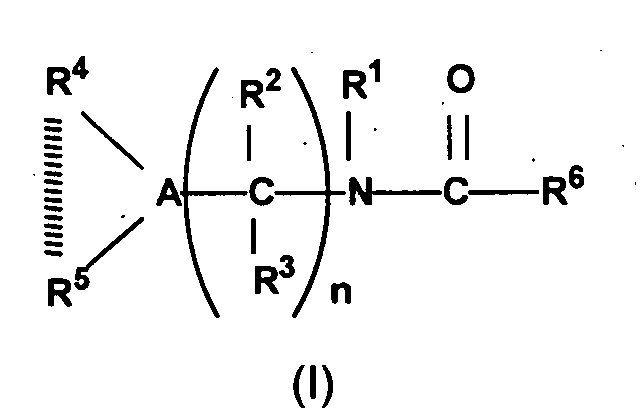
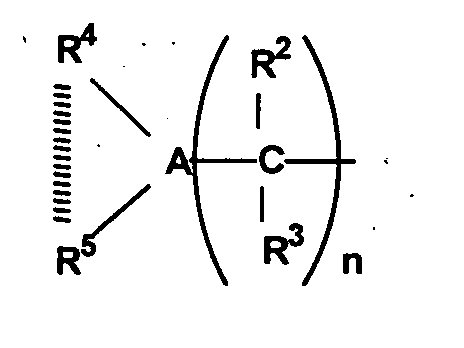
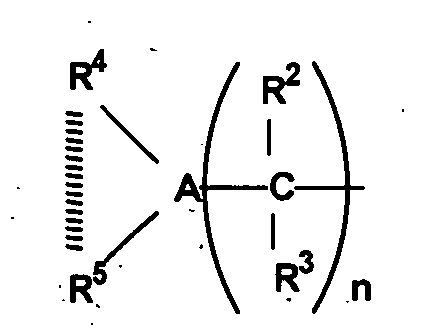
- the catalyst composition is represented by the formula I: wherein A represents CH or N; R 1 represents hydrogen or n is an integer from 1 to 3; R 2 and R 3 each represent hydrogen or a C 1 -C 6 linear or branched alkyl group; R 4 and R 5 each represent a C 1 -C 6 linear or branched alkyl group when A represents N, or together R 4 and R 5 represent a C 2 -C 5 alkylene group when A represents N; or together R 4 and R 5 may be a C 2 -C 5 alkylene group containing NR 7 when A represents CH or N, where R 7 is selected from the group consisting of hydrogen, a C 1 -C 4 linear or branched alkyl group, and and; R 6 represents a C 5 -C 35 linear or branched alkyl, alkenyl, or aryl group.
- the present invention provides a reactive catalyst composition for making a water blown flexible polyurethane foam.
- the reactive catalysts contain amide functionality, which enables the catalyst to react into the polyurethane matrix.
- These reactive catalysts can be used as gelling catalysts or blowing catalysts with complementary blowing or gelling co-catalysts, respectively, which may or may not contain reactive functional groups to produce polyurethane foam materials.
- the reactive catalysts produce polyurethane foams, which have no amine emissions.
- these catalysts in conjunction with complementary gelling or blowing co-catalysts improves physical properties and enhances processibility of the foam.
- these amide catalysts in conjunction with blowing co-catalysts improve the airflow of the foam. Improved airflow means improved porosity and openness of the foam, which is an indication of improved dimensional stability of the foam.
- these amide catalysts in conjunction with blowing co-catalysts also improve, i.e., reduce, the force-to-crush of the foam. Reduced force-to-crush means the foam is more easily compressed which is an important advantage for minimizing foam shrinkage during processing.
- these amide catalysts in conjunction with gelling co-catalysts improve the load bearing properties of the foam. That such high molecular weight compounds have good catalytic activity in the production of a polyurethane is surprising, since the prior art suggests that they will react at the time of mixing and be incorporated into the polymer matrix early in the polyurethane process thus limiting their mobility.
- Another embodiment of the invention provides the reactive catalysts of the present invention as blocked with different acids to yield delay action catalysts.
- Such acid-blocked catalysts are expected to yield, in addition to the inherent benefits of the present composition, a delay action, which can be of advantage in flexible molded and rigid polyurethane foams.
- the present invention provides a method for making polyurethane foams using a reactive catalyst composition that comprises a tertiary amino alkyl amide.
- the amide is derived from a carboxylic acid of the type R 6 -CO 2 H, where R 6 is a C 5 -C 35 linear or branched alkyl, alkenyl, or aryl group.
- the catalyst is typically used in the presence of a gelling catalyst but combinations of blowing and gelling catalysts are also possible.
- the catalysts may contain reactive N-H groups from an amide functionality, which enables the catalyst to react with, and be immobilized into, the polyurethane matrix.
- These catalysts can be used as gelling catalysts or blowing catalysts with the aid (or not) of complementary tertiary amine blowing or gelling co-catalysts, which may or may not contain reactive functional groups to produce polyurethane foam materials.
- the reactive catalysts produce polyurethane foams, which have no amine odor or emissions.
- the reactive catalyst composition of the present invention may be represented by three parts: the tertiary amine portion, the amide portion, and the long chain alkyl portion (R 6 ).
- the tertiary amine portion provides catalysis for producing polyurethane foams.
- the amide portion provides functionality, which enables the catalyst to react into the polyurethane matrix such that the resulting polyurethane foams have no amine odor or emissions.
- the long chain alkyl portion enables the catalyst to improve its performance by providing foams with better dimensional stability, i.e., air-flow through the foam improves with the length of the long chain alkyl portion.
- Example 7 shows that conventional dialkyl amino amides, where the amide portion is derived from a simple carboxylic acid, such as formic acid or acetic acid, do not perform as well as their long chain alkyl chain or fatty acid counterparts.
- Amino amide catalysts such as N-(3-dimethylaminopropyl)-formamide or N-(3-dimethylaminopropyl)-acetamide, do not perform by themselves according to the current industry standards (DABCO® BLV catalyst).
- DABCO® BLV catalyst the current industry standards
- N-(3-dimethylaminopropyl)-2-ethylhexamide or N-(3-dimethylaminopropyl)-lauramide would be expected to perform like N-(3-dimethylaminopropyl)-formamide and N-(3-dimethylaminopropyl)-acetamide with the additional limitation of having higher molecular weights that typically results in high usage levels.
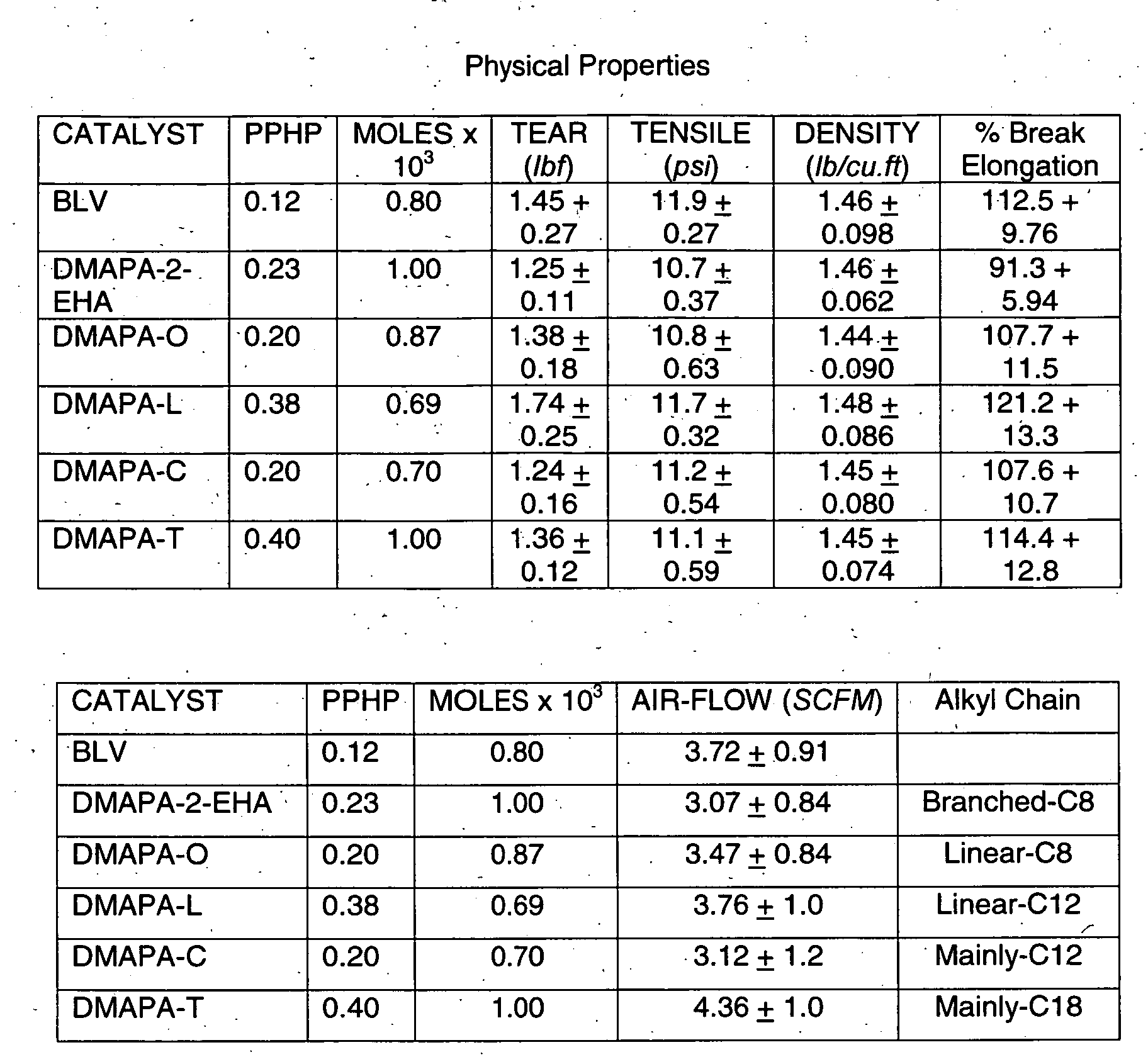
- Example 10 illustrates how air-flow can be systematically changed according to the catalyst composition selected.
- Example 10 shows that air-flow through the foam progressively improves with the length of the alkyl chain portion associated with the amide functionality. Thus, increasing the size of the alkyl chain or fatty group associated with the amide moiety can systematically increase air-flow.
- Example 10 shows that systematic air-flow improvements can be accomplished by appropriate choice of the reactive catalyst composition or by its usage level (see also Example 11).
- catalyst usage remained modest even though the molecular weights of the fatty acid catalysts are much larger than the molecular weight of the standards. Although the higher activity of the present catalyst compositions can explain their modest usage level, the reason for this enhanced activity is not obvious and not clearly understood. In addition, the benefit is not limited to a kinetic rate matching but also to a systematic improvement in the quality of the foams as evidence by the air-flow values.
- the catalyst compositions according to the present invention catalyze the reaction between an isocyanate functionality and an active hydrogen-containing compound, i.e., an alcohol, a polyol, an amine, or water.
- the catalyst compositions also catalyze the urethane (gelling) reaction of polyol hydroxyl groups with isocyanate to make polyurethanes and the blowing reaction of water with isocyanate to release carbon dioxide for making foamed polyurethanes.
- the flexible polyurethane foam products are prepared using any suitable organic polyisocyanates known in the art including, for example, hexamethylene discarnate, phenylene discarnate, toluene discarnate (TDI) and 4, 4'-diphenylmethane discarnate (MDI). Especially suitable are the 2, 4- and 2, 6-TDI's individually or together as their commercially available mixtures.
- Other suitable isocyanates are mixtures of diisocyanates known commercially as "crude MDI", marketed as PAPI by Dow Chemicals, which contains about 60% of 4, 4'-diphenylmethane discarnate along with other isomeric and analogous higher polyisocyanates.
- prepolymers of these polyisocyanates comprising a partially prereacted mixture of a polyisocyanate and a polyether or polyester polyol.
- suitable polyols as a component of the polyurethane composition are the polyalkylene ether and polyester polyols.
- the polyalkylene ether polyols include the poly(alkylene oxide) polymers such as poly(ethylene oxide) and poly(propylene oxide) polymers and copolymers with terminal hydroxyl groups derived from polyhydric compounds, including diols and triols; for example, ethylene glycol, propylene glycol, 1,3-butane diol, 1,4-butane diol, 1,6-hexane diol, neopentyl glycol, diethylene glycol, dipropylene glycol, pentaerythritol, glycerol, diglycerol, trimethylol propane and similar low molecular weight polyols.
- a single high molecular weight polyether polyol may be used.
- a mixture of high molecular weight polyether polyols such as mixtures of di- and tri-functional materials and/or different molecular weight or different chemical composition materials may be used.
- Useful polyester polyols include those produced by reacting a dicarboxylic acid with an excess of a diol, for example, adipic acid with ethylene glycol or butanediol, or reaction of a lactone with an excess of a diol such as caprolactone with propylene glycol.
- the master batches, or premix compositions frequently contain a polymer polyol.
- Polymer polyols are used in polyurethane foams to increase the foam's resistance to deformation, i.e., to increase the load-bearing properties of the foam.
- the first type described as a graft polyol, consists of a triol in which vinyl monomers are graft copolymerized. Styrene and acrylonitrile are the usual monomers of choice.
- the second type is a polyol containing a polyurea dispersion formed by the reaction of a diamine and TDI. Since TDI is used in excess, some of the TDI may react with both the polyol and polyurea.
- This second type of polymer polyol has a variant called PIPA polyol, which is formed by the in-situ polymerization of TDI and alkanolamine in the polyol.
- polymer polyols may comprise 20-80% of the polyol portion of the master batch.
- chain extenders such as ethylene glycol and butane diol
- cross-linkers such as diethanolamine, diisopropanolamine triethanolamine and tripropanolamine
- blowing agents such as water, CFCs, HCFCs, HFCs, pentane, and the like
- cell stabilizers such as silicone surfactants.
- a general polyurethane flexible foam formulation containing a gelling and a blowing catalyst according to the invention would comprise the following components in parts by weight (pbw): Polyol 20-100 Polymer Polyol 80-0 Silicone Surfactant 1-2.5 Blowing agent 2-4.5 Crosslinker 0.5-2 Catalyst 0.25-2 Isocyanate Index 70-115
- the catalyst composition comprises a tertiary amino alkyl amide composition represented by the formula I: wherein A represents CH or N; R 1 represents hydrogen or n is an integer from 1 to 3; R 2 and R 3 each represent hydrogen or a C 1 -C 6 linear or branched alkyl group; R 4 and R 5 each represent a C 1 -C 6 linear or branched alkyl group when A represents N, or together R 4 and R 5 represent a C 2 -C 5 alkylene group when A represents N; or together R 4 and R 5 may be a C 2 -C 5 alkylene group containing NR 7 when A represents CH or N, where R 7 is selected from the group consisting of hydrogen, a C 1 -C 4 linear or branched alkyl group, and and; R 6 represents a C 5 -C 35 linear or branched alkyl, alkenyl, or aryl group.
- A represents CH or N
- R 1 represents hydrogen or n is an integer from 1 to 3
- R 1 , R 2 , and R 3 each represent hydrogen and R 4 and R 5 each represent a methyl group when A represents N.
- R 4 and R 5 together may represent -CH 2 CH 2 N(CH 3 )CH 2 - when A represents CH.
- n represents 2 or 3.
- dialkylamino amides derived from higher alkyl and fatty acids are: the N-(3-dimethylaminopropyl)-amides, the N-(2-dimethylaminoethyl)-amides, the N-methyl-3-aminoethyl pyrrolidine amides, the 4, 10-diaza-4, 10, 10-trimethyl-7-oxa-undecaamine amides, and any dimethylamino- or dialkylamino-alkyl, or alkylsubstituted amides derived from 2-ethylhexanoic, coconut oil fatty, tall oil fatty, caproic, heptylic, caprylic, pelargonic, capric, hendecanoic, lauric, tridecanoic, myristic, pentadecanoic, palmitic, margaric, stearic, oleic, linoleic, linolenic, ricin
- the preferred amides are N-(3-dimethylaminopropyl)-amides.
- the preferred acids are selected from the group consisting of 2-ethylhexanoic, coconut oil fatty, and tall oil fatty acids.
- the amides are prepared by reacting a carboxylic acid and the corresponding tertiary alkyl amine in the appropriate molar ratios at elevated temperatures of from 80°C to 300°C, preferably 100°C to 200°C, with water being driven off.
- the amides can be further purified by distillation or chromatography as known in the art.
- the amides can be used in conjunction with a gelling catalyst, such as a tertiary amine or a suitable transition metal catalyst, and/or a blowing catalyst depending upon the processing advantages desired.
- a gelling catalyst such as a tertiary amine or a suitable transition metal catalyst, and/or a blowing catalyst depending upon the processing advantages desired.
- tertiary amine gelling catalysts include, but are not restricted to, diazabicyclooctane (triethylenediamine), supplied commercially as DABCO 33LV® catalyst by Air Products and Chemicals Inc., quinuclidine and substituted quinuclidines, substituted pyrrolidines and pyrrolizidines.
- tertiary amine blowing catalysts include, but are not restricted to, bis-dimethylaminoethyl ether, commercially supplied as DABCO® BL11 catalyst by Air Products and Chemicals, Inc., pentamethyl-diethylenetriamine and related compositions, higher permethylated polyamines, 2-[N-(dimethylaminoethoxyethyl)-N-methylamino]ethanol and related structures, alkoxylated polyamines, imidazole-boron compositions and amino propyl-bis(amino-ethyl)ether compositions.
- the reactive catalysts of the present invention can be blocked with different acids to yield delay action catalysts.
- Such acid-blocked catalysts are expected to yield, in addition to the inherent benefits of the present composition, a delay action, which can be of advantage in flexible molded and rigid polyurethane foams.
- the acid-blocked catalysts can simply be obtained by reacting the catalyst composition with carboxylic acids such as formic acid, acetic acids, 2-ethyl-hexanoic acid, gluconic acid, N-(2-hydroxyethyl)-iminodiacetic acid, and the like as is well known in the art.
- Acid-blocked catalysts of the present invention can find their main applications in molded flexible and rigid foams where delaying the onset of the reaction is desired. This delay causes the viscosity to increase slowly allowing the proper filling of a mold while maintaining the overall molding time as short as possible to maintain maximum productivity.
- a catalytically effective amount of the catalyst composition comprising the amide and a tertiary amine gelling or blowing catalyst may be used in the polyurethane formulation. More specifically suitable amounts of the catalyst composition may range from about 0.01 to 10 parts by wt per 100 parts polyol (pphp) in the polyurethane formulation, preferably 0.05 to 2 pphp.
- the catalyst composition may be used in combination with, or also comprise, other tertiary amines, organotin or carboxylate urethane catalysts well known in the urethane art.
- Rigid polyurethane foams can be distinguished from flexible polyurethane foams by the presence of higher isocyanurate levels in the rigid foam.
- Flexible foams typically use polymer polyol as part of the overall polyol content in the foam composition, along with conventional triols of 4000-5000 weight average molecular weight (Mw) and hydroxyl number (OH#) of 28-35.
- rigid polyurethane foam compositions use 500-1000 Mw polyol with 3-8 hydroxyl functionalities and OH# of 160-700.
- Rigid foams can also be distinguished from the flexible foams by the isocyanate (NCO) index of the foam composition.
- Rigid foam compositions typically use a 100-300 NCO index whereas flexible foam compositions typically require a 70-115 NCO index.
- a general polyurethane rigid insulating foam formulation containing the catalyst composition according to the invention would comprise the following components in parts by weight (pbw): Polyol 100 Silicone Surfactant 1-3 Blowing agent 0-50 Water 0-8 Catalyst 0.5-15 Isocyanate Index 80-300
- the NCO index is typically 100-300; for making open cell foam the NCO index is typically 100-120 and the foam is usually all water blown.
- a typical semiflexible foam formulation containing the catalyst composition according to the invention comprise the following components in parts by weight (pbw): SPECFLEX NC 630 Polyol 80.0 SPECFLEX NC 710 Copolymer 20.0 Cross-linker 1.5 Water 2.2 Catalyst 0.5-10 Black Colorant 0.3 Adhesion Promoter 2.0 Cell Opener 1.0 Polymeric MDI, Index 105
- the two main components are the base polyol and copolymer polyol (CPP).
- the base polyol is utilized at levels between 70-100%.
- the molecular weight of base polyols range from 4500 to 6000 for triols and 2000 to 4000 for diols.
- Ethylene-oxide-capped polyether polyols have replaced most polyester polyols as the base polyol.
- the primary hydroxyl content is usually grater than 75% and the capping range is typically 10-20%.
- the other major component is CPP, which are used at levels of 0 to 20%.
- the base polyol and CPP are blended with low molecular weight cross linkers to build hardness and promote faster demolding. The level of cross linker varies depending on the hardness requirement of the finished part.
- Water levels are chosen to give free rise densities from 3 to 6 pounds.
- Cell openers are also utilized in semiflexible foams to reduce the internal foam pressure during the cure cycle and thus reduce pressure-relief voids and "parting lines”.
- Adhesion promoters can be added, depending upon the quality of the vinyl skin, to improve the adhesion between the polyurethane foam and the vinyl skin.
- the use of the catalyst composition of the present invention can reduce the discoloration of the vinyl skin typically observed with conventional amine catalysts because the N-H group of the amide functionality can react with the isocyanate to form a covalent bond with the polyurethane polymer.
- DMAPA 3-dimethylaminopropylamine
- Excess acetic acid 210 g was slowly added to the reaction mixture while the temperature was monitored with a thermocouple. At the end of the addition, the liquid was heated to reflux for five hours and the progress of the reaction was monitored by GC. Excess acetic acid was removed by distillation to give 118 g of N,N-dimethylaminopropylamino-acetamide as a pale yellow liquid.
- DMAPA coconut oil-fatty acid (100 g) was slowly added to the reaction mixture while the temperature was monitored with a thermocouple and at the end of the addition, the liquid was heated to reflux. Water was periodically removed as the reaction proceeded. Once finished, the excess DMAPA was removed under reduced pressure to give 147 g of amide product as a pale yellow liquid that slowly solidified when sitting on the bench.
- polyurethane foams were prepared in a conventional manner.
- the polyurethane formulation in parts by weight was: COMPONENT PARTS VORANOL® 3512A 100.00 WATER 4.60 DABCO® DC 5982 0.90 CATALYST 0.12(DABCO®BLV) DABCO® T-10 0.52 TDI 56.20 Index 108
- the catalyst was added to 159 g of the above premix in a 32 oz (951 ml) paper cup and the formulation was mixed for 10 sec at 6,000 RPM using an overhead stirrer fitted with a 2 in (5.1 cm) diameter stirring paddle.
- the 32 oz (951 ml) cup was dropped through a hole in the bottom of a 128 oz (3804 ml) paper cup on a stand. The hole was sized to catch the lip of the 32 oz cup.
- the total volume of the foam container was 160 oz (4755 ml). Foams approximated this volume at the end of the foam forming process. Maximum foam height was recorded.
- the catalyst was added to 339.2 g of the above premix in a 32 oz (951 ml) paper cup and the formulation was mixed for 10 sec at 6,000 RPM using an overhead stirrer fitted with a 2 in (5.1 cm) diameter stirring paddle.
- the content was poured into a 3.5 gallon container. Foams approximated this volume at the end of the foam forming process. Maximum foam height was recorded and the physical properties evaluated.
- the catalysts evaluated were all amides derived from DMAPA (3-N, N-dimethylamino-propylamine):
- foams were made using different loading of DMAPA-TOFA catalyst and the physical properties were evaluated. Foams were made according to the formulation of Example 10: Physical Properties DMAPA-TOFA Amide CATALYST PPHP MOLES x 10 3 TEAR ( lbf ) TENSILE ( psi ) DENSITY ( Ib / cu.ft ) AIR-FLOW ( SCFM ) BLV 0.12 0.8 1.22 9.9 1.64 2.63 DMAPA-TOFA 0.24 0.6 1.61 10.5 1.52 2.13 DMAPA-TOFA 0.36 1.0 1.35 10.5 1.53 3.30 DMAPA-TOFA 0.71 1.9 1.45 8.96 1.55 3.88
Landscapes
- Chemical & Material Sciences (AREA)
- Health & Medical Sciences (AREA)
- Chemical Kinetics & Catalysis (AREA)
- Medicinal Chemistry (AREA)
- Polymers & Plastics (AREA)
- Organic Chemistry (AREA)
- Polyurethanes Or Polyureas (AREA)
Abstract

Description
R1 represents hydrogen or

R2 and R3 each represent hydrogen or a C1-C6 linear or branched alkyl group;
R4 and R5 each represent a C1-C6 linear or branched alkyl group when A represents N, or together R4 and R5 represent a C2-C5 alkylene group when A represents N; or together R4 and R5 may be a C2-C5 alkylene group containing NR7 when A represents CH or N, where R7 is selected from the group consisting of hydrogen, a C1-C4 linear or branched alkyl group, and

| Polyol | 20-100 |
| Polymer Polyol | 80-0 |
| Silicone Surfactant | 1-2.5 |
| Blowing agent | 2-4.5 |
| Crosslinker | 0.5-2 |
| Catalyst | 0.25-2 |
| Isocyanate Index | 70-115 |

R1 represents hydrogen or
R2 and R3 each represent hydrogen or a C1-C6 linear or branched alkyl group;
R4 and R5 each represent a C1-C6 linear or branched alkyl group when A represents N, or together R4 and R5 represent a C2-C5 alkylene group when A represents N; or together R4 and R5 may be a C2-C5 alkylene group containing NR7 when A represents CH or N, where R7 is selected from the group consisting of hydrogen, a C1-C4 linear or branched alkyl group, and
| Polyol | 100 |
| Silicone Surfactant | 1-3 |
| Blowing agent | 0-50 |
| Water | 0-8 |
| Catalyst | 0.5-15 |
| Isocyanate Index | 80-300 |
| SPECFLEX NC 630 Polyol | 80.0 |
| SPECFLEX NC 710 Copolymer | 20.0 |
| Cross-linker | 1.5 |
| Water | 2.2 |
| Catalyst | 0.5-10 |
| Black Colorant | 0.3 |
| Adhesion Promoter | 2.0 |
| Cell Opener | 1.0 |
| Polymeric MDI, Index | 105 |
| COMPONENT | PARTS |
| VORANOL® 3512A | 100.00 |
| WATER | 4.60 |
| DABCO® DC 5982 | 0.90 |
| CATALYST | 0.12(DABCO®BLV) |
| DABCO® T-10 | 0.52 |
| TDI | 56.20 |
| Index | 108 |
| Catalyst = DMAPA-Formamide | ||||
| PARAMETER | BLV | FORMAMIDE | FORMAMIDE | FORMAMIDE |
| PPHP | 0.12 | 0.093 | 0.11 | 0.126 |
| MOLES x 103 | 0.80 | 0.71 | 1.6 | 0.97 |
| MIXING TIME [s] | 12 | 12 | 12 | 12 |
| TEST TIME [s] | 300 | 300 | 300 | 300 |
| RISE HEIGHT [mm] | 394 | 383.4 | 388.6 | 378.8 |
| RISE TIME [s] | 103.6 | 133.8 | 122.8 | 134.8 |
| MAX HEIGHT [mm] | 399.5 | 388.6 | 393.8 | 383.9 |
| FINAL HEIGHT [mm] | 398.9 | 388.2 | 393.2 | 383.2 |
| SHRINKAGE [%] | 2.4 | 2.6 | 2.3 | 2.4 |
| Catalyst = DMAPA-Acetamide | ||||
| PARAMETER | BLV | ACETAMIDE | ACETAMIDE | ACETAMIDE |
| PPHP | 0.12 | 0.14 | 0.17 | 0.22 |
| MOLES x 103 | 0.80 | 0.97 | 1.2 | 1.52 |
| MIXING TIME [s] | 12 | 12 | 12 | 12 |
| TEST TIME [s] | 300 | 300 | 300 | 300 |
| RISE HEIGHT [mm] | 283.6 | 284.4 | 277.5 | 274.5 |
| RISE TIME [s] | 103.3 | 116.5 | 109.9 | 102.3 |
| MAX HEIGHT [mm] | 289.2 | 289.9 | 282.7 | 279.9 |
| FINAL HEIGHT [mm] | 287.8 | 288.3 | 281.0 | 278.1 |
| SHRINKAGE [%] | 0.5 | 0.6 | 0.7 | 0.7 |
| DMAPA-Lauramide (52% DPG Solution) And DMAPA-2-Ethylhexamide vs. BLV | ||||
| PARAMETER | DABCO®BLV | 2-ETHYL HEXAMIDE | LAURAMIDE | BLV |
| PPHP | 0.12 | 0.14 | 0.38 | 0.12 |
| MOLES x 103 | 0.80 | 0.6 | 0.7 | 5.6 |
| MIXING TIME [s] | 12 | 12 | 12 | 12 |
| TEST TIME [s] | 300 | 300 | 300 | 300 |
| RISE HEIGHT [mm] | 407.1 | 400.2 | 399.3 | 398.1 |
| RISE TIME [s] | 108.1 | 107.2 | 113.7 | 113.2 |
| MAX HEIGHT [mm] | 412.8 | 408.4 | 404.9 | 403.6 |
| FINAL HEIGHT [mm] | 411.9 | 407.8 | 404.2 | 403.2 |
| SHRINKAGE [%] | 2.3 | 1.5 | 2.1 | 2.0 |
| DMAPA Amide Of Tall Oil Fatty Acid vs. BLV | ||
| PARAMETER | BLV | TALL OIL FATTY ACIDS |
| PPHP | 0.12 | 0.24 |
| MOLES x 103 | 0.80 | 0.66 |
| MIXING TIME [s] | 12 | 12 |
| TEST TIME [s] | 300 | 300 |
| RISE HEIGHT [mm] | 298.4 | 303.0 |
| RISE TIME [s] | 104.9 | 105.7 |
| MAX HEIGHT [mm] | 304.5 | 309.2 |
| FINAL HEIGHT [mm] | 304:5 | 309.2 |
| SHRINKAGE [%] | 2.3 | 2.1 |
| COMPONENT | PARTS |
| VORANOL® 3512A | 100.00 |
| WATER | 4.60 |
| DABCO® DC 5982 | 0.90 |
| AMINE CATALYST | VARIABLE |
| DABCO® T-104 | 0.42 |
| TDI | 56.20 |
| Index | 108 |
| Physical Properties DMAPA-TOFA Amide | ||||||
| CATALYST | PPHP | MOLES x 103 | TEAR (lbf) | TENSILE (psi) | DENSITY (Ib/cu.ft) | AIR-FLOW (SCFM) |
| BLV | 0.12 | 0.8 | 1.22 | 9.9 | 1.64 | 2.63 |
| DMAPA-TOFA | 0.24 | 0.6 | 1.61 | 10.5 | 1.52 | 2.13 |
| DMAPA-TOFA | 0.36 | 1.0 | 1.35 | 10.5 | 1.53 | 3.30 |
| DMAPA-TOFA | 0.71 | 1.9 | 1.45 | 8.96 | 1.55 | 3.88 |
Claims (16)
- A method for preparing a polyurethane foam which comprises reacting an organic polyisocyanate and a polyol in the presence of water as a blowing agent, a cell stabilizer, and a tertiary amino alkyl amide catalyst composition represented by the formula I:wherein A represents CH or N;
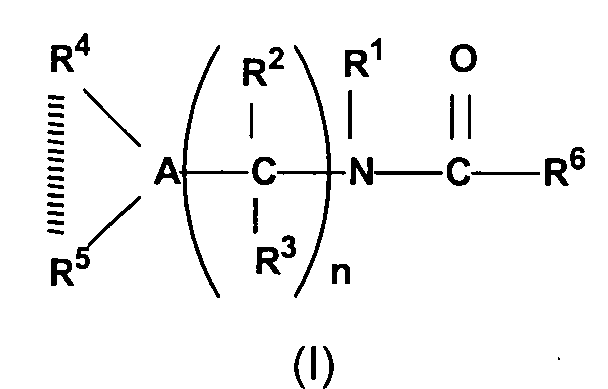
R1 represents hydrogen orn is an integer from 1 to 3;
R2 and R3 each represent hydrogen or a C1-C6 linear or branched alkyl group;
R4 and R5 each represent a C1-C6 linear or branched alkyl group when A represents N, or together R4 and R5 represent a C2-C5 alkylene group when A represents N; or together R4 and R5 may be a C2-C5 alkylene group containing NR7 when A represents CH or N, where R7 is selected from the group consisting of hydrogen, a C1-C4 linear or branched alkyl group, andand; R6 represents a C5-C35 linear or branched alkyl, alkenyl, or aryl group.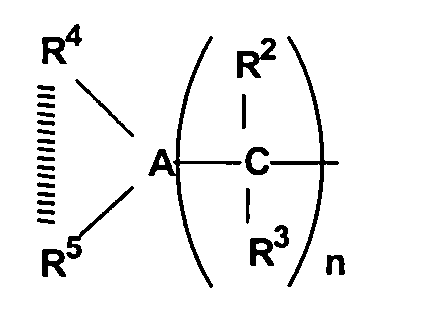
- The method of claim 1, wherein R1, R2, and R3 each represent hydrogen.
- The method of claim 1, wherein R4 and R5 each represent a methyl group when A represents N.
- The method of claim 1, wherein R4 and R5 together represent -CH2CH2N(CH3)CH2- when A represents CH.
- The method of claim 1, wherein n represents 2 or 3.
- The method of claim 1, wherein the tertiary amino alkyl amide catalyst composition is an N-(3-dimethylaminopropyl)-amide derived from an acid selected from the group consisting of 2-ethylhexanoic, coconut oil fatty, tall oil fatty, caproic, heptylic, caprylic, pelargonic, capric, hendecanoic, lauric, tridecanoic, myristic, pentadecanoic, palmitic, margaric, stearic, oleic, linoleic, linolenic, ricinoleic, nonadecanoic, arachidic, heneicosanoic, behenic, tricosanoic, lignoceric, pentacosanoic, cerotic, heptacosanoic, montanic, nonacosanoic, melissic, hentriacontanoic, dotriacontanoic, tritriacontanoic, tetracontanoic, hexatriacontanoic, 9-phenylstearic, and 10-phenylstearic acid.
- The method of claim 1, wherein the tertiary amino alkyl amide catalyst composition is an N-(2-dimethylaminoethyl)-amide derived from an acid selected from the group consisting of 2-ethylhexanoic, coconut oil fatty, tall oil fatty, caproic, heptylic, caprylic, pelargonic, capric, hendecanoic, lauric, tridecanoic, myristic, pentadecanoic, palmitic, margaric, stearic, oleic, linoleic, linolenic, ricinoleic, nonadecanoic, arachidic, heneicosanoic, behenic, tricosanoic, lignoceric, pentacosanoic, cerotic, heptacosanoic, montanic, nonacosanoic, melissic, hentriacontanoic, dotriacontanoic, tritriacontanoic, tetracontanoic, hexatriacontanoic, 9-phenylstearic, and 10-phenylstearic acid.
- The method of claim 1, wherein the tertiary amino alkyl amide catalyst composition is an N-methyl-3-aminoethyl pyrrolidine amide derived from an acid selected from the group consisting of 2-ethylhexanoic, coconut oil fatty, tall oil fatty, caproic, heptylic, caprylic, pelargonic, capric, hendecanoic, lauric, tridecanoic, myristic, pentadecanoic, palmitic, margaric, stearic, oleic, linoleic, linolenic, ricinoleic, nonadecanoic, arachidic, heneicosanoic, behenic, tricosanoic, lignoceric, pentacosanoic, cerotic, heptacosanoic, montanic, nonacosanoic, melissic, hentriacontanoic, dotriacontanoic, tritriacontanoic, tetracontanoic, hexatriacontanoic, 9-phenylstearic, and 10-phenylstearic acid.
- The method of claim 1, wherein the tertiary amino alkyl amide catalyst composition is a 4, 10-diaza-4, 10, 10-trimethyl-7-oxa-undecaamine amide derived from an acid selected from the group consisting of 2-ethylhexanoic, coconut oil fatty, tall oil fatty, caproic, heptylic, caprylic, pelargonic, capric, hendecanoic, lauric, tridecanoic, myristic, pentadecanoic, palmitic, margaric, stearic, oleic, linoleic, linolenic, ricinoleic, nonadecanoic, arachidic, heneicosanoic, behenic, tricosanoic, lignoceric, pentacosanoic, cerotic, heptacosanoic, montanic, nonacosanoic, melissic, hentriacontanoic, dotriacontanoic, tritriacontanoic, tetracontanoic, hexatriacontanoic, 9-phenylstearic, and 10-phenylstearic acid.
- The method of one of claims 6 to 9, wherein the acid is selected from the group consisting of 2-ethylhexanoic, coconut oil fatty, and tall oil fatty acids.
- The method of claim 1, wherein the tertiary amino alkyl amide catalyst composition is N-(3-dimethylaminopropyl)-2-ethyl-hexamide, N-(3-dimethylaminopropyl)-cocoamide or N-(3-dimethylaminopropyl)-tall oil amide.
- The method of claim 1, which comprises reacting the following components in parts by weight (pbw):
Polyol 20-100 Polymer Polyol 80-0 Silicone Surfactant 1-2.5 Blowing agent 2-4.5 Crosslinker 0.5-2 Catalyst 0.25-2 Isocyanate Index 70-115 - Use of a tertiary amino alkyl amide catalyst composition represented by the formula I:wherein A represents CH or N;
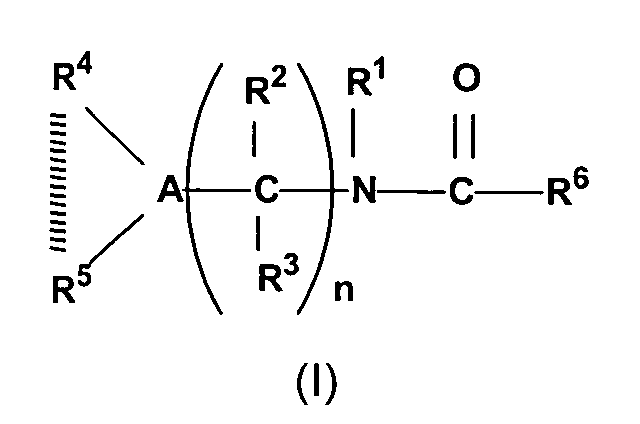
R1 represents hydrogen orn is an integer from 1 to 3;
R2 and R3 each represent hydrogen or a C1-C6 linear or branched alkyl group;
R4 and R5 each represent a C1-C6 linear or branched alkyl group when A represents N, or together R4 and R5 represent a C2-C5 alkylene group when A represents N; or together R4 and R5 may be a C2-C5 alkylene group containing NR7 when A represents CH or N, where R7 is selected from the group consisting of hydrogen, a C1-C4 linear or branched alkyl group, andand; R6 represents a C5-C35 linear or branched alkyl, alkenyl, or aryl group, for controlling and improving the porosity and openness of the foam in in a method for preparing a polyurethane foam which method comprises reacting an organic polyisocyanate and a polyol in the presence of water as a blowing agent, a cell stabilizer, and the catalyst composition.
- The method of Claim 1 in which the catalyst composition is acid-blocked.
- The method of Claim 14, which is acid-blocked with a carboxylic acid.
- The method of Claim 15 in which the carboxylic acid is formic acid, acetic acid, 2-ethyl-hexanoic acid, or N-(2-hydroxyethyl)-imino diacetic acid.
Applications Claiming Priority (8)
| Application Number | Priority Date | Filing Date | Title |
|---|---|---|---|
| US724888 | 1996-10-03 | ||
| US10/336,371 US6762211B1 (en) | 2003-01-03 | 2003-01-03 | Tertiary amino alkyl amide polyurethane catalysts derived from long chain alkyl and fatty carboxylic acids |
| US10/336,555 US6737446B1 (en) | 2003-01-03 | 2003-01-03 | Tertiary amino alkyl amide catalysts for improving the physical properties of polyurethane foams |
| US336371 | 2003-01-03 | ||
| US336555 | 2003-01-03 | ||
| US338184 | 2003-01-06 | ||
| US10/338,184 US6759447B1 (en) | 2003-01-06 | 2003-01-06 | Physical properties of polyurethane foams using tertiary amino alkyl amide catalysts |
| US10/724,888 US7192990B2 (en) | 2003-01-03 | 2003-12-02 | Tertiary amino alkyl amide polyurethane catalysts derived from long chain alkyl and fatty carboxylic acids |
Publications (2)
| Publication Number | Publication Date |
|---|---|
| EP1435364A2 true EP1435364A2 (en) | 2004-07-07 |
| EP1435364A3 EP1435364A3 (en) | 2005-11-23 |
Family
ID=32512542
Family Applications (1)
| Application Number | Title | Priority Date | Filing Date |
|---|---|---|---|
| EP03029980A Withdrawn EP1435364A3 (en) | 2003-01-03 | 2003-12-30 | Tertiary amino alkyl amide polyurethane catalysts derived from long chain alkyl or fatty carboxylic acids |
Country Status (1)
| Country | Link |
|---|---|
| EP (1) | EP1435364A3 (en) |
Cited By (10)
| Publication number | Priority date | Publication date | Assignee | Title |
|---|---|---|---|---|
| DE102006047619A1 (en) * | 2006-10-09 | 2008-04-10 | Clariant International Limited | Process for the preparation of basic fatty acid amides |
| EP1970392A1 (en) * | 2007-03-15 | 2008-09-17 | Bayer MaterialScience LLC | Water-blown polyurethane foams and a process for their production |
| US8067635B2 (en) | 2006-10-09 | 2011-11-29 | Clariant Finance (Bvi) Limited | Method for producing tertiary amides of alkylphenyl carboxylic acids |
| US8067612B2 (en) | 2006-10-09 | 2011-11-29 | Clariant Finance (Bvi) Limited | Method for producing bisbenzoxazoles |
| US8101785B2 (en) | 2006-10-09 | 2012-01-24 | Clariant Finance (Bvi) Limited | Method for producing fatty acid alkanol amides |
| US8884040B2 (en) | 2008-04-04 | 2014-11-11 | Clariant Finance (Bvi) Limited | Continuous method for producing fatty acid amides |
| US9039870B2 (en) | 2006-10-09 | 2015-05-26 | Clariant Finance (Bvi) Limited | Method for producing alkaline (meth)acrylamides |
| US9221938B2 (en) | 2010-12-30 | 2015-12-29 | Clariant Finance (Bvi) Limited | Polymers carrying hydroxyl groups and ester groups and method for the production thereof |
| US9243116B2 (en) | 2010-12-30 | 2016-01-26 | Clariant International Ltd. | Method for modifying polymers comprising hydroxyl groups |
| US9302245B2 (en) | 2009-09-22 | 2016-04-05 | Clariant International Ltd. | Apparatus for continuously carrying out heterogeneously catalyzed chemical reactions at elevated temperatures |
Families Citing this family (2)
| Publication number | Priority date | Publication date | Assignee | Title |
|---|---|---|---|---|
| DE102009031059A1 (en) | 2009-06-30 | 2011-01-05 | Clariant International Ltd. | Apparatus for continuously carrying out chemical reactions at high temperatures |
| DE102009042522A1 (en) | 2009-09-22 | 2011-04-07 | Clariant International Ltd. | Continuous transesterification process |
Family Cites Families (5)
| Publication number | Priority date | Publication date | Assignee | Title |
|---|---|---|---|---|
| DE3607964A1 (en) * | 1986-03-11 | 1987-09-17 | Bayer Ag | METHOD FOR PRODUCING A CELLED POLYURETHANE |
| DE4223597A1 (en) * | 1992-07-17 | 1994-01-20 | Bayer Ag | Storage-stable polyol mixtures containing mold release agents |
| DE4339702A1 (en) * | 1993-11-22 | 1995-05-24 | Bayer Ag | Process for the production of rigid polyurethane foams |
| US6232356B1 (en) * | 1997-05-05 | 2001-05-15 | Air Products And Chemicals, Inc. | Reactive catalyst compositions for improving water blown polyurethane foam performance |
| US6458860B1 (en) * | 2001-06-01 | 2002-10-01 | Huntsman Petrochemical Corporation | Advances in urethane foam catalysis |
-
2003
- 2003-12-30 EP EP03029980A patent/EP1435364A3/en not_active Withdrawn
Cited By (11)
| Publication number | Priority date | Publication date | Assignee | Title |
|---|---|---|---|---|
| DE102006047619A1 (en) * | 2006-10-09 | 2008-04-10 | Clariant International Limited | Process for the preparation of basic fatty acid amides |
| DE102006047619B4 (en) * | 2006-10-09 | 2008-11-13 | Clariant International Limited | Process for the preparation of basic fatty acid amides |
| US8067635B2 (en) | 2006-10-09 | 2011-11-29 | Clariant Finance (Bvi) Limited | Method for producing tertiary amides of alkylphenyl carboxylic acids |
| US8067612B2 (en) | 2006-10-09 | 2011-11-29 | Clariant Finance (Bvi) Limited | Method for producing bisbenzoxazoles |
| US8101785B2 (en) | 2006-10-09 | 2012-01-24 | Clariant Finance (Bvi) Limited | Method for producing fatty acid alkanol amides |
| US9039870B2 (en) | 2006-10-09 | 2015-05-26 | Clariant Finance (Bvi) Limited | Method for producing alkaline (meth)acrylamides |
| EP1970392A1 (en) * | 2007-03-15 | 2008-09-17 | Bayer MaterialScience LLC | Water-blown polyurethane foams and a process for their production |
| US8884040B2 (en) | 2008-04-04 | 2014-11-11 | Clariant Finance (Bvi) Limited | Continuous method for producing fatty acid amides |
| US9302245B2 (en) | 2009-09-22 | 2016-04-05 | Clariant International Ltd. | Apparatus for continuously carrying out heterogeneously catalyzed chemical reactions at elevated temperatures |
| US9221938B2 (en) | 2010-12-30 | 2015-12-29 | Clariant Finance (Bvi) Limited | Polymers carrying hydroxyl groups and ester groups and method for the production thereof |
| US9243116B2 (en) | 2010-12-30 | 2016-01-26 | Clariant International Ltd. | Method for modifying polymers comprising hydroxyl groups |
Also Published As
| Publication number | Publication date |
|---|---|
| EP1435364A3 (en) | 2005-11-23 |
Similar Documents
| Publication | Publication Date | Title |
|---|---|---|
| US6201033B1 (en) | Reactive catalyst compositions for improving water blown polyurethane foam performance | |
| US6835757B2 (en) | Tertiary amino alkyl amide catalysts for improving the physical properties of polyurethane foams | |
| EP1332167B1 (en) | Process to improve polyurethane foam performance | |
| US6759447B1 (en) | Physical properties of polyurethane foams using tertiary amino alkyl amide catalysts | |
| EP1714989B1 (en) | Polyurethane foams made with blowing catalyst compositions containing primary hydroxyl groups and high ethylenediamine backbones | |
| US7026512B2 (en) | Tertiary alkanolamines containing surface active alkyl groups | |
| EP1457507B1 (en) | Tertiary alkanolamine polyurethane catalysts derived from long chain alkyl and fatty carboxylic acids | |
| US7192990B2 (en) | Tertiary amino alkyl amide polyurethane catalysts derived from long chain alkyl and fatty carboxylic acids | |
| US6747069B1 (en) | Tertiary alkanolamine polyurethane catalysts derived from long chain alkyl and fatty carboxylic acids | |
| EP1435365B1 (en) | Tertiary amino alkyl amide catalysts for improving the physical properties of polyurethane foams | |
| JP4004463B2 (en) | Method for improving the physical properties of polyurethane foams using tertiary aminoalkylamide catalysts | |
| EP1435363B1 (en) | Improving the physical properties of polyurethane foams using tertiary amino alkyl amide catalysts | |
| JP4004464B2 (en) | Method for improving the physical properties of polyurethane foams using tertiary aminoalkylamide catalysts | |
| KR100523420B1 (en) | Tertiary amino alkyl amide polyurethane catalysts derived from long chain alkyl and fatty carboxylic acids | |
| EP1457480B1 (en) | Tertiary alkanolamines containing surface active alkyl groups | |
| MXPA98003525A (en) | Compositions of aminometil pyrrolidine urea parala polyurette production |
Legal Events
| Date | Code | Title | Description |
|---|---|---|---|
| PUAI | Public reference made under article 153(3) epc to a published international application that has entered the european phase |
Free format text: ORIGINAL CODE: 0009012 |
|
| AK | Designated contracting states |
Kind code of ref document: A2 Designated state(s): AT BE BG CH CY CZ DE DK EE ES FI FR GB GR HU IE IT LI LU MC NL PT RO SE SI SK TR |
|
| AX | Request for extension of the european patent |
Extension state: AL LT LV MK |
|
| PUAL | Search report despatched |
Free format text: ORIGINAL CODE: 0009013 |
|
| AK | Designated contracting states |
Kind code of ref document: A3 Designated state(s): AT BE BG CH CY CZ DE DK EE ES FI FR GB GR HU IE IT LI LU MC NL PT RO SE SI SK TR |
|
| AX | Request for extension of the european patent |
Extension state: AL LT LV MK |
|
| 17P | Request for examination filed |
Effective date: 20051213 |
|
| AKX | Designation fees paid |
Designated state(s): AT BE BG CH CY CZ DE DK EE ES FI FR GB GR HU IE IT LI LU MC NL PT RO SE SI SK TR |
|
| 17Q | First examination report despatched |
Effective date: 20061011 |
|
| STAA | Information on the status of an ep patent application or granted ep patent |
Free format text: STATUS: THE APPLICATION IS DEEMED TO BE WITHDRAWN |
|
| 18D | Application deemed to be withdrawn |
Effective date: 20100701 |