EP1434121A2 - Techniques for implementing security on a small footprint device using a context barrier - Google Patents
Techniques for implementing security on a small footprint device using a context barrier Download PDFInfo
- Publication number
- EP1434121A2 EP1434121A2 EP04005586A EP04005586A EP1434121A2 EP 1434121 A2 EP1434121 A2 EP 1434121A2 EP 04005586 A EP04005586 A EP 04005586A EP 04005586 A EP04005586 A EP 04005586A EP 1434121 A2 EP1434121 A2 EP 1434121A2
- Authority
- EP
- European Patent Office
- Prior art keywords
- context
- access
- small footprint
- principal
- zero
- Prior art date
- Legal status (The legal status is an assumption and is not a legal conclusion. Google has not performed a legal analysis and makes no representation as to the accuracy of the status listed.)
- Granted
Links
Images








Classifications
-
- G—PHYSICS
- G06—COMPUTING OR CALCULATING; COUNTING
- G06F—ELECTRIC DIGITAL DATA PROCESSING
- G06F9/00—Arrangements for program control, e.g. control units
- G06F9/06—Arrangements for program control, e.g. control units using stored programs, i.e. using an internal store of processing equipment to receive or retain programs
- G06F9/46—Multiprogramming arrangements
-
- G—PHYSICS
- G06—COMPUTING OR CALCULATING; COUNTING
- G06F—ELECTRIC DIGITAL DATA PROCESSING
- G06F21/00—Security arrangements for protecting computers, components thereof, programs or data against unauthorised activity
- G06F21/50—Monitoring users, programs or devices to maintain the integrity of platforms, e.g. of processors, firmware or operating systems
- G06F21/52—Monitoring users, programs or devices to maintain the integrity of platforms, e.g. of processors, firmware or operating systems during program execution, e.g. stack integrity ; Preventing unwanted data erasure; Buffer overflow
- G06F21/54—Monitoring users, programs or devices to maintain the integrity of platforms, e.g. of processors, firmware or operating systems during program execution, e.g. stack integrity ; Preventing unwanted data erasure; Buffer overflow by adding security routines or objects to programs
-
- G—PHYSICS
- G06—COMPUTING OR CALCULATING; COUNTING
- G06F—ELECTRIC DIGITAL DATA PROCESSING
- G06F21/00—Security arrangements for protecting computers, components thereof, programs or data against unauthorised activity
- G06F21/50—Monitoring users, programs or devices to maintain the integrity of platforms, e.g. of processors, firmware or operating systems
- G06F21/52—Monitoring users, programs or devices to maintain the integrity of platforms, e.g. of processors, firmware or operating systems during program execution, e.g. stack integrity ; Preventing unwanted data erasure; Buffer overflow
-
- G—PHYSICS
- G06—COMPUTING OR CALCULATING; COUNTING
- G06F—ELECTRIC DIGITAL DATA PROCESSING
- G06F9/00—Arrangements for program control, e.g. control units
- G06F9/06—Arrangements for program control, e.g. control units using stored programs, i.e. using an internal store of processing equipment to receive or retain programs
- G06F9/46—Multiprogramming arrangements
- G06F9/468—Specific access rights for resources, e.g. using capability register
Definitions
- the invention relates to computer security and more particularly to techniques for implementing a security on small footprint devices, such as smart cards.
- a number of object oriented programming languages are well known in the art. Examples of these include the C++ language and the Smalltalk language.
- JAVATM language Another such object oriented language is the JAVATM language. This language is described in the book JavaTM Language Specification, by James Gosling et al. and published by Addison-Wesley. The JAVATM language is particularly well suited to run on a JavaTM Virtual Machine. Such a machine is described in the book JavaTM Virtual Machine Specification, by Tim Lindholm and Frank Yellin which is also published by Addison-Wesley.
- a mumber of small footprint devices are also well known in the art. These include smart cards, cellular telephones, and various other small or miniature devices.
- Smart cards are similar in size and shape to a credit card but contain, typically, data processing capabilities within the card (e.g. a processor or logic performing processing functions) and a set of contacts through which programs, data and other communications with the smart card may be achieved.
- the set of contacts includes a power source connection and a return as well as a clock input, a reset input and a data port through which data communications can be achieved.
- a card acceptance device is typically a peripheral attached to a host computer and contains a card port, such as a slot, in to which a smart card can be inserted. Once inserted, contacts or brushes from a connector press against the surface connection area on the smart card to provide power and to permit communications with the processor and memory typically found on a smart card.
- firewalls to separate authorized from unauthorized users is well known in the network environment.
- a firewall is diseased in U.S. Patent Application US-2002169980 A, filed December 1, 1999 and entitled "AUTHENTICATED FIREWALL TUNNELLING FRAMEWORK" in the name of inventor David Brownell.
- Java CardTM platform A subset of the full JavaTM platform capabilities has been defined for small footprint devices, such as smart cards. This subset is called the Java CardTM platform. The uses of the Java CardTM platform are described in the following publications.
- a working draft of ISO 7816 - Part 11 has been circulated for comment. That draft specifies standards for permitting separate execution contexts to operate on a smart card. Parts of that working draft are hereby incorporated.
- sandbox model One layer of security protection utilized by the JavaTM platform is commonly referred to as a sandbox model. Untrusted code is placed into a “sandbox” where it can “play” safely without doing any damage to the "real world” or full JavaTM environment. In such an environment, JavaTM applets don't communicate, but each has its own name space.
- Some smart card operating systems don't permit execution contexts to communicate directly, but do permit communications through an operating system, or through a server.
- a second problem associated with small footprint devices is the fact that different small footprint device manufacturers can utilize different operating systems. As a result, applications developed for one operating system are not necessarily portable to small footprint devices manufactured by a different manufacturer.
- the invention is directed to providing a context barrier (sometimes referred to as a firewall) for providing separation and isolation of one context from another and to provide controlled access across the barrier when that is needed.
- a context barrier sometimes referred to as a firewall
- two execution contexts e.g. each containing one or more applets, running in the same logical (i.e., virtual or real) machine, protected from each other, can share information in a controlled, secure way, using language mechanisms, such as object-oriented language mechanisms.
- Security can be, for example, object by object.
- an enhanced JavaTM Virtual Machine provides certain run-time checks of attempted access across execution contexts in the VM. Checks can be automatic by the VM or coded by the programmer with support from the VM. This can be done using language-level communication mechanisms. In this way, one can express object access across execution contexts in the same way as other object accesses using the language are made. These run-time checks provide a second dimension of defense/security beyond that which the JavaTM language and platform already provide.
- the invention is also directed to computer program products and carrier waves related to the other aspects of the invention.
- a procedure is here, and generally, conceived to be a self-consistent sequence of steps leading to a desired result. These steps are those requiring physical manipulations of physical quantities. Usually, though not necessarily, these quantities take the form of electrical or magnetic signals capable of being stored, transferred, combined, compared, and otherwise manipulated. It proves convenient at times, principally for reasons of common usage, to refer to these signals as bits, values, elements, symbols, characters, terms, numbers, or the like. It should be noted, however, that all of these and similar terms are to be associated with the appropriate physical quantities and are merely convenient labels applied to these quantities.
- the manipulations performed are often referred to in terms, such as adding or comparing, which are commonly associated with mental operations performed by a human operator. No such capability of a human operator is necessary, or desirable in most cases, in any of the operations described herein which form part of the present invention; the operations are machine operations.
- Useful machines for performing the operation of the present invention include general purpose digital computers or other computational devices.
- the present invention also relates to apparatus for performing these operations.
- This apparatus may be specially constructed for the required purpose or it may comprise a general purpose computer as selectively activated or reconfigured by a computer program stored in the computer.
- the procedures presented herein are not inherently related to a particular computer or other apparatus.
- Various general purpose machines may be used with programs written in accordance with the teachings herein, or it may prove more convenient to construct more specialized apparatus to perform the required method steps. The required structure for a variety of these machines will appear from the description given.
- Figure 1 is an illustration of a computer 120 equipped with a card acceptance device 110 and a smart card 100 for use with the card acceptance device 110.
- the smart card 100 is inserted into card acceptance device 110 and power and data connections applied through a set of contacts 105 accessible at the surface of the smart card 100.
- mating contacts from the card acceptance device 110 interconnect with the surface contacts 105 to power-up the card and permit communications with the onboard processor and memory storage.
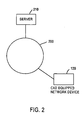
- FIG 2 is an illustration of a computer equipped with a card acceptance device, such as 120 in Figure 1 , connected to a network 200 . Also connected to a network are a plurality of other computing devices, such as server 210. It is possible to load data and software onto a smart card over the network 200 using card equipped device 120. Downloads of this nature can include applets or other programs to be loaded onto a smart card as well as digital cash and other information used in accordance with a variety of electronic commerce and other applications.
- the instructions and data used to control processing elements of the card acceptance device and of the smart card may be stored in volatile or non-volatile memory or may be received directly over a communications link, e.g., as a carrier wave containing the instructions and/or data.
- the network can be a LAN or a WAN such as the Internet or other network.
- FIG 3 is an exemplary hardware architecture of a small footprint device, such as a smart card, of the prior art.
- a processor 300 interconnects with primary storage 310 which may include read only memory 315 and/or random access memory 316 .
- the processor also connects with a secondary storage 320 such as EEPROM and with an input/output 330 , such as a serial port.
- primary storage 310 may include read only memory 315 and/or random access memory 316 .
- the processor also connects with a secondary storage 320 such as EEPROM and with an input/output 330 , such as a serial port.
- EEPROM electrically erasable programmable read only memory
- input/output 330 such as a serial port
- Figure 4 illustrates objects being accessed by principals as done in the prior art.
- physical device 400 such as the small footprint device may have contained within it one or more processing machines (virtual or physical) which are running an execution context 420.
- the execution context may be, for example, a context associated with a particular applet.
- One or more principals 430 e.g., applets or applications
- the execution context may seek to access other objects within the execution context. As long as the access occurs within the execution context, the accesses will be permitted and everything will function normally.
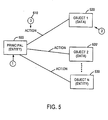
- Figure 5 is an exemplary security model which can be used in explaining the various embodiments of the invention. It is just one of many models which might be utilized but is a convenient model for this purpose.
- a principal (sometimes called entity) 500 proposes to take an action 510 on an object, such as object 520. Security checks may be imposed on the principal, on the object, and/or on the action proposed to be taken.
- FIG 5 two types of objects are shown on which action may be taken by a principal. These include data objects, (e.g. data1 and data2 (520, 520' )) and entity 530. A principal may operate or attempt to operate on any of these objects.
- data objects e.g. data1 and data2 (520, 520' )
- entity 530 entity 530.
- a principal may operate or attempt to operate on any of these objects.
- an entity 530 While data is passive, an entity 530 is active.
- the diagram line from Principal to an active entity is also labeled "action,” but this could be a more sophisticated and arbitrarily complex action, such as making a function or method call or sending a message as compared with action on a data object.
- action a security check enforced by the operating system may use the identity of the principal, the identity of the entity, and/or the type of action.
- the entity, being active can perform its own additional security checks. These can be as arbitrarily complex as one desires, and can make use of the identity of the Principal, the identity of the entity itself, the action, and/or any other information that is available.
- objects are typically a combination of data and entity.
- object-oriented system such as the Java CardTM platform
- objects are typically a combination of data and entity.
- a Principal tries to access a field of an object this is a data access--a fairly simple action protected by a fairly simple security check.
- a Principal tries to access a method of an object this is an entity access, which can be arbitrarily complex both in action and in security check.
- FIG. 6 is a block diagram showing separation of execution contexts by a firewall or context barrier in accordance with one aspect of the invention.
- the physical device 400 and the machine 410 correspond to the same items shown in Figure 4 .
- An execution context 420 shows one principal 430 attempting to access object 440 within the context. This access would normally succeed. However, execution context 420 also shows a principal 630 attempting to access object 640 of execution context 620, across a context barrier 600. Normally, this access would be prohibited as indicated by the X 636 where the action 635 crosses the context barrier 600.
- FIG. 7 is a representation of a software architecture useful in carrying out the invention.
- This software architecture is shown as a run time environment 700.
- An operating system 710 for the small footprint device is commonly used.
- a virtual machine 720 in an exemplary embodiment of the invention, is implemented over the operating system.
- the virtual machine could be a Java CardTM virtual machine or other virtual machine.
- the capabilities of a standard virtual machine can be expanded to provide the additional functionality described herein or the functionality can be provided as separate modules.
- the virtual machine 720 may include an interpreter or native implementation 730 which provides access to a run time system 740.
- the run time system includes object system 750 for managing the objects of an object oriented implementation. Three contexts, 760, 770 and 780 , are shown.
- Context 760 is, in one specific embodiment, a supercontext. That is, context 760 has privileges and capabilities not available to subordinate contexts 770 and 780 , potentially including privileges to create entry point objects or global data structures, and to access objects in subordinate contexts 770 and 780 .
- Every object is associated with one particular context. That context is said to own each object that is associated with it.
- the runtime system 740 provides a means for uniquely identifying contexts, and a means for specifying and identifying the currently executing context.
- the object system 750 provides a mechanism for associating objects with their owning contexts.
- the runtime 740 can identify contexts with a unique name, and correspondingly the object system 750 can associate objects with that context by recording the context's name in the objects header. Information in the object's header cannot be accessed by programs written in the object-oriented language, but is only available to the virtual machine 720 itself.
- the runtime system 740 can identify contexts by dividing the memory space into separate regions, each for a particular context, and correspondingly the object system 750 can associate objects with that context by allocating the object's storage in that context's memory space.
- Figure 8 is a flow chart of a security enforcement process implementing a context barrier in accordance with one aspect of the invention.
- a principal invokes an action on an object (800) a check is made to determine whether the object is within the context of the principal ( 810 ). If it is not, the action is disallowed ( 840 ). Otherwise, the action is permitted ( 830 ).
- the action is disallowed ( 840 ) by throwing a security exception if the object is outside of the namespace or the memory space of the context requesting access.
- Figure 9 is a block diagram showing object access across a firewall in accordance with one aspect of the invention.
- Figure 9 is substantially similar to Figure 6 .
- Figure 9 also shows principal 900 seeking to access object 910 in order to perform action 905 on the object 910.
- action 905 is permitted to occur across the firewall through access point 920 so that principal 900 can perform action 905 on object 910 notwithstanding the fact that the principal and the object are in different execution contexts.
- the mechanisms behind access point 920 are described below with reference to Figures 12-18.
- access point 920 can coexist with obstructed accesses such as X 636.
- access point 920 provides fine-grain control of sharing (object by object security) across context barrier 600.
- the current context setting is context 420. If the object 910 is a data object, the action 905 is a simple data access, and no code is executed in the second context 620 . If the object 910 is an entity object, and the action 905 results in that object's code being executed, that code is executed in the second context 620. To execute the code of object 910 in the correct context 620, the virtual machine 410 performs a context switch. The context switch changes the current context setting to be context 620 , and the previous value of the current context setting is stored so that it can be restored later. From that point on code will execute in the new current context. When the action 905 completes, control is returned to the point following access 900. During the return, the virtual machine 410 must restore the value of the current context setting to its previous value.
- Figure 10 is a block diagram showing cascaded object accesses across a firewall.
- Figure 10 shows three execution contexts , 1000, 1010 and 1020 .
- Principal 1030 in execution context 1 seeks to invoke an action 1035 on object 1050 in execution context 2 and does so through access point 1070 in context barrier 600.
- Object 1050 in execution context 2 has an object access 1040 which seeks to perform an action 1045 on the object 1060 in execution context 3. It achieves this by using access point 1080 in context barrier 600' separating execution contexts 2 and 3.
- Object 1050 in execution context 2 also has another object access 1090 which invokes an action 1095 on an object 1099 in the same execution context, that is, in execution context 2.
- Both actions 1035 and 1045 result in context switches as described in the explanation of Figure 9. But as action 1095 does not cross the context barrier, a context switch is not required for its execution, and therefore does not occur.
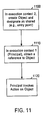
- Figure 11 is a flow chart of a process for permitting access by a principal in one context across a firewall into another context. There are essentially three steps to this process.
- execution context 2 an object to be accessed is created and designated as shared ( 1100 ).
- execution context 1 the principal obtains a reference to the object in execution context 2 ( 1110 ).
- the principal in execution context 1 then invokes an action upon the object designated as shared in context 2 ( 1120 ).
- Information in an object's header cannot be accessed by programs written in the object-oriented language, but is only available to the VM itself.
- Obtaining a reference to an object in another context is a special case of accessing an object in another context.
- a mechanism that provides access to an object in another context can make other objects available also. For instance, invoking a method on an object in another context may return a reference to a second object in a different context.
- An additional mechanism is required to allow an initial reference to an object in a different context to be obtained.
- references to certain well-known entry point objects can be obtained using a public API. Once the initial reference to an object in a different context is obtained, further references can be obtained from that object, and so on.
- FIG 12 is a block diagram illustrating the use of entry point objects to permit access across a context barrier.
- some object 1200 in context 770 desires access to information in supercontext 760.
- a supercontext 760 contains at least one entry point object 1210.
- the entry point object 1210 can be published as part of a public API, or can be made available indirectly through a published API (e.g., in accordance with the mechanisms described previously with reference to Figure 11), so that each context subordinate to the supercontext may communicate with the entry point object of the supercontext. (It will be appreciated that in other embodiments, entry point objects may be housed by a context other than the supercontext.)
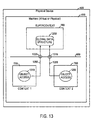
- FIG. 13 is a block diagram illustrating the use of global data structures to permit access across a firewall.
- supercontext 760 creates a global data structure such as a global array.
- supercontext 760 is the only context permitted to create such a global data structure.
- global data may be housed by a context other than the supercontext.
- each of the contexts 770 and 780 may read and write to the global data structure.
- information written into the global data structure by one context can be read by another context.
- this mechanism can be used to pass binary data or references to objects between contexts.
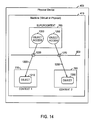
- Figure 14 is a block diagram illustrating the use of supercontext privileges to permit access across a context barrier.
- an object in supercontext 760 seeks access to context 780 across the context barrier separating the two.
- Supercontext 760 can invoke any of the methods of context 780 and can access any of the data contained within context 780 , by virtue of the privileges associated with the supercontext.
- Figure 15 is a block diagram illustrating the use of shareable interface objects to permit access across a firewall.
- a shareable interface defines a set of shareable interface methods.
- a shareable interface object is an object that implements at least the set of methods defined in a shareable interface.
- object 1210 in context 2 (780) is a shareable interface object.
- An object access 1200 in another context 770 can invoke any of the shareable interface methods on the object 1210 if the principal of the object access 1200 is authorized to do so by the object 1210 itself. This authorization is further discussed with reference to Figure 18 below.
- a virtual machine consistent with the invention provides functionality beyond that of earlier virtual machines, such as the virtual machine described in the JavaTM Virtual Machine Specification.
- the virtual machine provides functionality to implement or to facilitate a security enforcement process that permits access across a firewall. This process is described next with reference to Figures 16-18 . Note that it is applicable to any approach for providing access across the firewall, including but not limited to the four approaches described with reference to Figures 12-15 above.
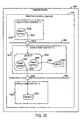
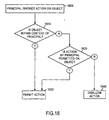
- Figure 16 is a flow chart of a security enforcement process permitting access across a firewall.
- a principal attempts to invoke action on an object 1600
- a check is made to determine if the object is within the context of the principal ( 1610 ). If it is, ( 1610-Y ), the action is permitted ( 1630 ). If it is not, ( 1610-N ), a check is made to see if the action by the principal is permitted on the object (1620). If it is, (1620-Y), the action is permitted ( 1630 ). If it is not, ( 1620-N ), the action is disallowed. In the specific embodiment a security exception is thrown ( 1640 ).
- Figure 17 is the flow chart of Figure 16 showing further details of block 1620. If the object is not within the context of the principal (1610-N), a plurality of tests, 1621 , 1622,1623... 1629 are undertaken to see if the action by the principal is permitted on the object. These tests can be done by the virtual machine alone or by the virtual machine plus the object, in a virtual machine object oriented implementation. If any of the tests results in a pass, the action is permitted ( 1630 ). However, if all tests result in a negative determination ( 162X-No ), the action will be disallowed. In a specific embodiment, a security exception will be thrown ( 1640 ). These tests relate to the permitted access discussed in conjunction with Figures 12-15.
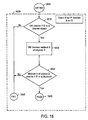
- Figure 18 is a flow chart showing an exemplary implementation of block 1629 of Figure 1 7 for use with access method described in Figure 15.
- a virtual machine checks if the object is a shared object 1810. If it is not ( 1810-No ), the test will fail. However, if it is (1810-Yes), the virtual machine will invoke the method A on object O (1820). If the method A on object O determines that the principal is authorized (1830), the test will be passed (1840) and access permitted. Otherwise, the test will fail ( 1850 ). This allows the authorization text to be programmed into the code of the object itself.
- Devices with a small footprint are generally considered to be those that are restricted or limited in memory or in computing power or speed.
- Such small footprint devices may include boundary scan devices, field programmable devices, pagers and cellular phones among many others.
- small footprint devices are resource constrained computational devices and systems where secure interoperation of execution contexts is a concern. Such small devices impose constraints on the implementation of security measures because of their limited resources. Because of resource constraints, in a virtual machine implementation, a single virtual or physical machine must be used as opposed to multiple virtual machines.
- the invention may also be applied to devices with larger footprints where the characteristics of the invention may prove beneficial.
- the invention may prove advantageous when using servlets if there is object sharing between them. Even some desktop systems may profitably utilize the techniques of the invention.
- JavaTM language and platform are suitable for the invention, any language or platform having certain characteristics would be well suited for implementing the invention. These characteristics include type safety, pointer safety, object-oriented, dynamically linked, and virtual-machine based. Not all of these characteristics need to be present in a particular implementation. In some embodiments, languages or platforms lacking one or more of these characteristics may be utilized.
- a "virtual machine” could be implemented either in bits (virtual machine) or in silicon (real/physical machines).
Landscapes
- Engineering & Computer Science (AREA)
- Software Systems (AREA)
- Theoretical Computer Science (AREA)
- Computer Security & Cryptography (AREA)
- Physics & Mathematics (AREA)
- General Engineering & Computer Science (AREA)
- General Physics & Mathematics (AREA)
- Computer Hardware Design (AREA)
- Storage Device Security (AREA)
- Burglar Alarm Systems (AREA)
- Alarm Systems (AREA)
Abstract
Description















Claims (32)
- A small footprint device comprising:at least one processing element configured to execute groups of one or more program modules in separate contexts, said one or more program modules comprising zero or more sets of executable instructions and zero or more sets of data definitions, said zero or more sets of executable instructions and said zero or more data definitions grouped as object definitions, each context comprising a protected object instance space such that at least one of said object definitions is instantiated in association with a particular context;a memory comprising instances of objects; anda context barrier for separating and isolating said contexts, said context barrier configured for controlling execution of at least one instruction of one of said zero or more sets of instructions comprised by a program module based at least in part on whether said at least one instruction is executed for an object instance associated with a first one of said one or more separate contexts and whether said at least one instruction is requesting access to an instance of an object definition associated with a second one of said one or more separate contexts, said context barrier further configured to prevent said access if said access is unauthorized and enable said access if said access is authorized.
- The small footprint device of claim 1 wherein an object instance is associated with a context by recording the name of said context in a header of said object instance, information in said header inaccessible to said one or more program modules.
- The small footprint device of claim 1 or 2 wherein said memory comprises object header data, said object header data comprising information associated with at least one of said instances of objects; and
said controlling execution is based at least in part on said object header data. - The small footprint device of any preceding claim wherein said memory is partitioned into a plurality of memory spaces with instances of objects allocated for storage in one of said plurality of storage spaces; and
said controlling execution is based at least in part on determining the storage space allocated to an executing object instance and an accessed object instance. - The small footprint device of any preceding claim in which said at least one processing element is a virtual machine running on a processor.
- The small footprint device of claim 5 in which said virtual machine runs on top of a card operating system.
- The small footprint device of any preceding claim in which said context barrier allocates separate respective name spaces for each context.
- The small footprint device of any preceding claim in which said context barrier allocates separate respective memory spaces for each context.
- The small footprint device of claim 8 in which at least one security check is based on memory space agreement between a principal and an object.
- The small footprint device of claim 8 in which at least one security check is based on partial name agreement between a principal and an object.
- The small footprint device of any preceding claim in which at least one program module comprises a plurality of applets.
- The small footprint device of any preceding claim in which said context barrier enforces at least one security check on at least one of principal, object or action to prevent access from a principal in one context to an object in a different context.
- A method of operating a small footprint device that includes a processing machine, wherein program modules are executed on the processing machine, the method comprising:executing groups of one or more program modules in separate contexts, said one or more program modules comprising zero or more sets of executable instructions and zero or more sets of data definitions, said zero or more sets of executable instructions and said zero or more data definitions grouped as object definitions, each context comprising a protected object instance space such that at least one of said object definitions is instantiated in association with a particular context; andproviding a context barrier for separating and isolating said contexts and for controlling execution of at least one instruction of one of said zero or more sets of instructions comprised by a program module based at least in part on whether said at least one instruction is executed for an object instance associated with a first one of said one or more separate contexts and whether said at least one instruction is requesting access to an instance of an object definition associated with a second one of said one or more separate contexts, said providing further comprising:preventing said access if said access is unauthorized; andenabling said access if said access is authorized.
- The method of claim 13 wherein an object instance is associated with a context by recording the name of said context in a header of said object instance, information in said header inaccessible to said one or more program modules.
- The method of claim 13 or 14 wherein said controlling execution is based at least in part on object header data comprising information associated with at least one of said instances of objects.
- The method of any of claims 13 to 15 wherein a memory of said small footprint device is partitioned into a plurality of memory spaces with instances of objects allocated for storage in one of said plurality of storage spaces; and
said controlling execution is based at least in part on determining the storage space allocated to an executing object instance and an accessed object instance. - The method of any of claims 13 to 16 in which the context barrier is implemented using a virtual machine.
- The method of any of claims 13 to 17 in which the context barrier will not permit a principal to access an object unless both principal and object are part of the same name space.
- The method of any of claims 13 to 18 in which the context barrier will not permit a principal to access an object unless both principal and object are part of the same memory space.
- The method of any of claims 13 to 19 in which the context barrier will not permit a principal to perform an action on an object unless both principal and object are part of the same context.
- The method of claim 20 in which the context barrier will permit a principal to perform an action on an object when they are not part of the same context if the principal is authorized to perform the action on the object.
- The method of claim 21 in which the principal is authorized if it passes at least one security check.
- The method of claim 22 in which said at least one security check is one of a plurality of security checks.
- The method of claim 21 in which, if a principal in a first context is authorized to perform one or more actions on an object in a second context, when the action is performed it will execute within the second context.
- The method of claim 24 in which, when action is undertaken in the second context that requires access to an object in a third context, the action will execute within the third context.
- The method of claim 24 in which, when one or more actions are authorized in the second context, subsequent actions will be authorized based on executing in the second context, and a principal in the second context will be able to access objects in the second context.
- The method of claim 25 in which, when one or more actions complete in the second context, execution will return to the first context.
- The method of claim 27 in which switches to a new context will occur any time action is authorized on an object in a new context.
- A computer program product, comprising:a computer controlling element comprising instructions for implementing a context barrier on a small footprint device, said small footprint device comprising:at least one processing element configured to execute groups of one or more program modules in separate contexts, said one or more program modules comprising zero or more sets of executable instructions and zero or more sets of data definitions, said zero or more sets of executable instructions and said zero or more data definitions grouped as object definitions, each context comprising a protected object instance space such that at least one of said object definitions is instantiated in association with a particular context;a memory comprising instances of objects; anda context barrier for separating and isolating said contexts, said context barrier configured for controlling execution of at least one instruction of one of said zero or more sets of instructions comprised by a program module based at least in part on whether said at least one instruction is executed for an object instance associated with a first one of said one or more separate contexts and whether said at least one instruction is requesting access to an instance of an object definition associated with a second one of said one or more separate contexts, said context barrier further configured to prevent said access if said access is unauthorized and enable said access if said access is authorized.
- The computer program product of claim 29, wherein said computer controlling element comprises instructions for separating a plurality of programs on the small footprint device.
- A computer program for implementing the method of any of claims 13 to 28.
- A method of shipping code over a network, comprising transmitting a block of code from a server, said block of code comprising instructions over a communications link for separating a plurality of programs on a small footprint device, said small footprint device comprising:at least one processing element configured to execute groups of one or more program modules in separate contexts, said one or more program modules comprising zero or more sets of executable instructions and zero or more sets of data definitions, said zero or more sets of executable instructions and said zero or more data definitions grouped as object definitions, each context comprising a protected object instance space such that at least one of said object definitions is instantiated in association with a particular context;a memory comprising instances of objects; anda context barrier for separating and isolating said contexts, said context barrier configured for controlling execution of at least one instruction of one of said zero or more sets of instructions comprised by a program module based at least in part on whether said at least one instruction is executed for an object instance associated with a first one of said one or more separate contexts and whether said at least one instruction is requesting access to an instance of an object definition associated with a second one of said one or more separate contexts, said context barrier further configured to prevent said access if said access is unauthorized and enable said access if said access is authorized.
Applications Claiming Priority (3)
| Application Number | Priority Date | Filing Date | Title |
|---|---|---|---|
| US09/235,158 US6823520B1 (en) | 1999-01-22 | 1999-01-22 | Techniques for implementing security on a small footprint device using a context barrier |
| US235158 | 1999-01-22 | ||
| EP00904409A EP1155365B1 (en) | 1999-01-22 | 2000-01-20 | Techniques for implementing security on a small footprint device using a context barrier |
Related Parent Applications (1)
| Application Number | Title | Priority Date | Filing Date |
|---|---|---|---|
| EP00904409A Division EP1155365B1 (en) | 1999-01-22 | 2000-01-20 | Techniques for implementing security on a small footprint device using a context barrier |
Publications (3)
| Publication Number | Publication Date |
|---|---|
| EP1434121A2 true EP1434121A2 (en) | 2004-06-30 |
| EP1434121A3 EP1434121A3 (en) | 2006-04-12 |
| EP1434121B1 EP1434121B1 (en) | 2015-11-18 |
Family
ID=22884338
Family Applications (2)
| Application Number | Title | Priority Date | Filing Date |
|---|---|---|---|
| EP04005586.5A Expired - Lifetime EP1434121B1 (en) | 1999-01-22 | 2000-01-20 | Techniques for implementing security on a small footprint device using a context barrier |
| EP00904409A Revoked EP1155365B1 (en) | 1999-01-22 | 2000-01-20 | Techniques for implementing security on a small footprint device using a context barrier |
Family Applications After (1)
| Application Number | Title | Priority Date | Filing Date |
|---|---|---|---|
| EP00904409A Revoked EP1155365B1 (en) | 1999-01-22 | 2000-01-20 | Techniques for implementing security on a small footprint device using a context barrier |
Country Status (10)
| Country | Link |
|---|---|
| US (2) | US6823520B1 (en) |
| EP (2) | EP1434121B1 (en) |
| JP (1) | JP4996787B2 (en) |
| KR (1) | KR100688396B1 (en) |
| CN (2) | CN1157655C (en) |
| AT (1) | ATE266227T1 (en) |
| AU (1) | AU772045B2 (en) |
| DE (2) | DE60010433T2 (en) |
| HK (1) | HK1041334B (en) |
| WO (1) | WO2000043875A1 (en) |
Families Citing this family (22)
| Publication number | Priority date | Publication date | Assignee | Title |
|---|---|---|---|---|
| US6633984B2 (en) * | 1999-01-22 | 2003-10-14 | Sun Microsystems, Inc. | Techniques for permitting access across a context barrier on a small footprint device using an entry point object |
| GB2370659A (en) * | 2000-12-29 | 2002-07-03 | Nokia Mobile Phones Ltd | Method of controlling access to a data file held by a smart card |
| FR2864398A1 (en) * | 2003-12-23 | 2005-06-24 | France Telecom | Computing device e.g. personal computer, for executing e.g. banking application, has operation profile/virtual machine execution spaces accommodated by processing device that is arranged to be non separable into two parts |
| US8214799B2 (en) * | 2004-07-08 | 2012-07-03 | Microsoft Corporation | Providing information to an isolated hosted object via system-created variable objects |
| US20060010423A1 (en) * | 2004-07-08 | 2006-01-12 | Microsoft Corporation | Variable namespaces and scoping for variables in an object model |
| KR100772455B1 (en) * | 2005-06-22 | 2007-11-01 | 한국전자통신연구원 | Process classification / execution control apparatus and method for strengthening DC |
| JP4627266B2 (en) * | 2006-02-16 | 2011-02-09 | 株式会社日立ソリューションズ | Information leakage prevention system due to unknown malware |
| US20080309665A1 (en) * | 2007-06-13 | 2008-12-18 | 3D Systems, Inc., A California Corporation | Distributed rapid prototyping |
| KR101049718B1 (en) | 2008-12-29 | 2011-07-19 | 에스케이 텔레콤주식회사 | How to perform software separation, device, and computer-readable recording media |
| US9117071B2 (en) * | 2009-06-03 | 2015-08-25 | Apple Inc. | Methods and apparatuses for secure compilation |
| US8677329B2 (en) | 2009-06-03 | 2014-03-18 | Apple Inc. | Methods and apparatuses for a compiler server |
| US8578487B2 (en) * | 2010-11-04 | 2013-11-05 | Cylance Inc. | System and method for internet security |
| US8335921B2 (en) | 2010-12-17 | 2012-12-18 | Google, Inc. | Writing application data to a secure element |
| US8352749B2 (en) * | 2010-12-17 | 2013-01-08 | Google Inc. | Local trusted services manager for a contactless smart card |
| US8646059B1 (en) | 2010-12-17 | 2014-02-04 | Google Inc. | Wallet application for interacting with a secure element application without a trusted server for authentication |
| US8255687B1 (en) | 2011-09-15 | 2012-08-28 | Google Inc. | Enabling users to select between secure service providers using a key escrow service |
| US8171525B1 (en) | 2011-09-15 | 2012-05-01 | Google Inc. | Enabling users to select between secure service providers using a central trusted service manager |
| US8313036B1 (en) | 2011-09-16 | 2012-11-20 | Google Inc. | Secure application directory |
| US8385553B1 (en) | 2012-02-28 | 2013-02-26 | Google Inc. | Portable secure element |
| US8429409B1 (en) | 2012-04-06 | 2013-04-23 | Google Inc. | Secure reset of personal and service provider information on mobile devices |
| CN105302666A (en) * | 2015-10-13 | 2016-02-03 | 东信和平科技股份有限公司 | JAVA CARD based backup and recovery method for data in application |
| US10671407B2 (en) | 2018-06-07 | 2020-06-02 | Oracle International Corporation | Suspending and resuming a card computing device |
Family Cites Families (38)
| Publication number | Priority date | Publication date | Assignee | Title |
|---|---|---|---|---|
| JPS61177585A (en) | 1985-02-04 | 1986-08-09 | Toshiba Corp | Sealing body of portable electronic device |
| US4816654A (en) | 1986-05-16 | 1989-03-28 | American Telephone And Telegraph Company | Improved security system for a portable data carrier |
| JP2514954B2 (en) * | 1987-03-13 | 1996-07-10 | 三菱電機株式会社 | IC card |
| JPH01277993A (en) | 1988-04-28 | 1989-11-08 | Toshiba Corp | Portable electronic device |
| JPH02156357A (en) | 1988-12-08 | 1990-06-15 | Fujitsu Ltd | Program destruction preventing method |
| US5057997A (en) * | 1989-02-13 | 1991-10-15 | International Business Machines Corp. | Interruption systems for externally changing a context of program execution of a programmed processor |
| US5204663A (en) | 1990-05-21 | 1993-04-20 | Applied Systems Institute, Inc. | Smart card access control system |
| EP0466969B1 (en) | 1990-07-20 | 1994-01-12 | Siemens Nixdorf Informationssysteme Aktiengesellschaft | Method for preventing unauthorised deviations from an application development protocol in a data exchange system |
| JP3007425B2 (en) | 1991-02-14 | 2000-02-07 | 凸版印刷 株式会社 | IC card |
| US5204897A (en) | 1991-06-28 | 1993-04-20 | Digital Equipment Corporation | Management interface for license management system |
| DE4126213C2 (en) | 1991-08-08 | 2000-06-15 | Deutsche Telekom Ag | Chip card for several service providers |
| FR2683357A1 (en) * | 1991-10-30 | 1993-05-07 | Philips Composants | MICROCIRCUIT FOR PROTECTED PROGRAMMABLE MEMORY CHIP CARD. |
| JPH05224956A (en) * | 1992-02-14 | 1993-09-03 | Nippon Telegr & Teleph Corp <Ntt> | Inter-process message communication method |
| DE69332889T2 (en) | 1992-10-26 | 2004-03-04 | Intellect Australia Pty. Ltd. | HOST USER TRANSACTION SYSTEM |
| US5446901A (en) | 1993-06-30 | 1995-08-29 | Digital Equipment Corporation | Fault tolerant distributed garbage collection system and method for collecting network objects |
| US5649118A (en) | 1993-08-27 | 1997-07-15 | Lucent Technologies Inc. | Smart card with multiple charge accounts and product item tables designating the account to debit |
| US5544246A (en) | 1993-09-17 | 1996-08-06 | At&T Corp. | Smartcard adapted for a plurality of service providers and for remote installation of same |
| US5481715A (en) * | 1993-12-15 | 1996-01-02 | Sun Microsystems, Inc. | Method and apparatus for delegated communications in a computer system using trusted deputies |
| ATE152539T1 (en) | 1994-02-08 | 1997-05-15 | Belle Gate Invest Bv | DATA EXCHANGE SYSTEM WITH PORTABLE DATA PROCESSING UNITS |
| US5930363A (en) | 1995-03-17 | 1999-07-27 | Transmo Limited | Card charging systems |
| US5594227A (en) | 1995-03-28 | 1997-01-14 | Microsoft Corporation | System and method for protecting unauthorized access to data contents |
| DE69624693T2 (en) * | 1995-04-07 | 2003-07-31 | Dreamtechnologies Co., Ltd. | METHOD AND DEVICE FOR IMPLEMENTING AN APPLICATION PROGRAM |
| CA2173695A1 (en) | 1995-04-14 | 1996-10-15 | Panagiotis Kougiouris | Method and system for providing interoperability among processes written to execute on different operating systems |
| ES2153455T3 (en) | 1995-08-04 | 2001-03-01 | Belle Gate Invest B V | DATA EXCHANGE SYSTEM THAT INCLUDES PORTABLE DATA PROCESSING UNITS. |
| US5768385A (en) | 1995-08-29 | 1998-06-16 | Microsoft Corporation | Untraceable electronic cash |
| US5721781A (en) | 1995-09-13 | 1998-02-24 | Microsoft Corporation | Authentication system and method for smart card transactions |
| DE19536169A1 (en) * | 1995-09-29 | 1997-04-03 | Ibm | Multifunctional chip card |
| FR2743910B1 (en) * | 1996-01-19 | 1998-02-27 | Solaic Sa | METHOD FOR IMPLEMENTING A SECURE PROGRAM IN A MICROPROCESSOR CARD AND MICROPROCESSOR CARD COMPRISING A SECURE PROGRAM |
| US5742756A (en) | 1996-02-12 | 1998-04-21 | Microsoft Corporation | System and method of using smart cards to perform security-critical operations requiring user authorization |
| US5781723A (en) | 1996-06-03 | 1998-07-14 | Microsoft Corporation | System and method for self-identifying a portable information device to a computing unit |
| DE69714752C5 (en) | 1996-10-25 | 2015-08-13 | Gemalto Sa | USING A HIGH PROGRAMMING LANGUAGE IN A MICROCONTROLLER |
| US5884316A (en) | 1996-11-19 | 1999-03-16 | Microsoft Corporation | Implicit session context system with object state cache |
| WO1998043212A1 (en) | 1997-03-24 | 1998-10-01 | Visa International Service Association | A system and method for a multi-application smart card which can facilitate a post-issuance download of an application onto the smart card |
| US6220510B1 (en) * | 1997-05-15 | 2001-04-24 | Mondex International Limited | Multi-application IC card with delegation feature |
| US6212633B1 (en) | 1998-06-26 | 2001-04-03 | Vlsi Technology, Inc. | Secure data communication over a memory-mapped serial communications interface utilizing a distributed firewall |
| US6349336B1 (en) * | 1999-04-26 | 2002-02-19 | Hewlett-Packard Company | Agent/proxy connection control across a firewall |
| US6292874B1 (en) * | 1999-10-19 | 2001-09-18 | Advanced Technology Materials, Inc. | Memory management method and apparatus for partitioning homogeneous memory and restricting access of installed applications to predetermined memory ranges |
| ITMI20121303A1 (en) * | 2012-07-25 | 2014-01-26 | Wilic Sarl | ROTOR OF A LARGE DIAMETER ROTARY ELECTRIC MACHINE AND ROTARY ELECTRIC MACHINE |
-
1999
- 1999-01-22 US US09/235,158 patent/US6823520B1/en not_active Expired - Lifetime
-
2000
- 2000-01-20 DE DE60010433T patent/DE60010433T2/en not_active Expired - Lifetime
- 2000-01-20 WO PCT/US2000/001233 patent/WO2000043875A1/en not_active Ceased
- 2000-01-20 CN CNB008029881A patent/CN1157655C/en not_active Expired - Lifetime
- 2000-01-20 AT AT00904409T patent/ATE266227T1/en not_active IP Right Cessation
- 2000-01-20 CN CNB200410038220XA patent/CN100507797C/en not_active Expired - Lifetime
- 2000-01-20 KR KR1020017009173A patent/KR100688396B1/en not_active Expired - Lifetime
- 2000-01-20 DE DE1155365T patent/DE1155365T1/en active Pending
- 2000-01-20 HK HK02103031.3A patent/HK1041334B/en not_active IP Right Cessation
- 2000-01-20 EP EP04005586.5A patent/EP1434121B1/en not_active Expired - Lifetime
- 2000-01-20 AU AU26172/00A patent/AU772045B2/en not_active Expired
- 2000-01-20 JP JP2000595235A patent/JP4996787B2/en not_active Expired - Lifetime
- 2000-01-20 EP EP00904409A patent/EP1155365B1/en not_active Revoked
-
2004
- 2004-11-22 US US10/996,266 patent/US7478389B2/en not_active Expired - Lifetime
Also Published As
| Publication number | Publication date |
|---|---|
| US20050091659A1 (en) | 2005-04-28 |
| EP1155365A1 (en) | 2001-11-21 |
| KR100688396B1 (en) | 2007-03-09 |
| CN1338069A (en) | 2002-02-27 |
| HK1041334A1 (en) | 2002-07-05 |
| DE1155365T1 (en) | 2003-03-06 |
| HK1041334B (en) | 2005-04-22 |
| DE60010433T2 (en) | 2004-09-09 |
| US7478389B2 (en) | 2009-01-13 |
| US6823520B1 (en) | 2004-11-23 |
| AU2617200A (en) | 2000-08-07 |
| DE60010433D1 (en) | 2004-06-09 |
| CN100507797C (en) | 2009-07-01 |
| JP2003522986A (en) | 2003-07-29 |
| EP1434121B1 (en) | 2015-11-18 |
| WO2000043875A1 (en) | 2000-07-27 |
| EP1434121A3 (en) | 2006-04-12 |
| CN1157655C (en) | 2004-07-14 |
| AU772045B2 (en) | 2004-04-08 |
| CN1619455A (en) | 2005-05-25 |
| KR20010108114A (en) | 2001-12-07 |
| JP4996787B2 (en) | 2012-08-08 |
| ATE266227T1 (en) | 2004-05-15 |
| EP1155365B1 (en) | 2004-05-06 |
Similar Documents
| Publication | Publication Date | Title |
|---|---|---|
| US7607175B2 (en) | Techniques for permitting access across a context barrier on a small footprint device using an entry point object | |
| US7395535B2 (en) | Techniques for permitting access across a context barrier in a small footprint device using global data structures | |
| EP1434121B1 (en) | Techniques for implementing security on a small footprint device using a context barrier | |
| US6922835B1 (en) | Techniques for permitting access across a context barrier on a small footprint device using run time environment privileges | |
| EP1151378B1 (en) | Techniques for permitting access across a context barrier in a small footprint device using shared object interfaces | |
| HK1067904A (en) | Techniques for permitting access across a context barrier in a small footprint device using global data structures | |
| AU2004200637A1 (en) | Techniques for permitting access across a context barrier on a small footprint device using run time environment privileges |
Legal Events
| Date | Code | Title | Description |
|---|---|---|---|
| PUAI | Public reference made under article 153(3) epc to a published international application that has entered the european phase |
Free format text: ORIGINAL CODE: 0009012 |
|
| AC | Divisional application: reference to earlier application |
Ref document number: 1155365 Country of ref document: EP Kind code of ref document: P |
|
| AK | Designated contracting states |
Kind code of ref document: A2 Designated state(s): AT DE FR GB IE |
|
| PUAL | Search report despatched |
Free format text: ORIGINAL CODE: 0009013 |
|
| AK | Designated contracting states |
Kind code of ref document: A3 Designated state(s): AT DE FR GB IE |
|
| RIC1 | Information provided on ipc code assigned before grant |
Ipc: G07F 7/10 20060101ALI20060223BHEP Ipc: G06F 9/46 20060101AFI20060223BHEP Ipc: G06F 1/00 20060101ALI20060223BHEP |
|
| 17P | Request for examination filed |
Effective date: 20060928 |
|
| AKX | Designation fees paid |
Designated state(s): DE FR GB |
|
| 17Q | First examination report despatched |
Effective date: 20091022 |
|
| RAP1 | Party data changed (applicant data changed or rights of an application transferred) |
Owner name: ORACLE AMERICA, INC. |
|
| REG | Reference to a national code |
Ref country code: DE Ref legal event code: R079 Ref document number: 60049132 Country of ref document: DE Free format text: PREVIOUS MAIN CLASS: G06F0009460000 Ipc: G06F0021520000 |
|
| RIC1 | Information provided on ipc code assigned before grant |
Ipc: G06F 9/46 20060101ALI20150624BHEP Ipc: G06F 21/52 20130101AFI20150624BHEP Ipc: G06F 21/54 20130101ALI20150624BHEP |
|
| GRAP | Despatch of communication of intention to grant a patent |
Free format text: ORIGINAL CODE: EPIDOSNIGR1 |
|
| INTG | Intention to grant announced |
Effective date: 20150821 |
|
| GRAS | Grant fee paid |
Free format text: ORIGINAL CODE: EPIDOSNIGR3 |
|
| GRAA | (expected) grant |
Free format text: ORIGINAL CODE: 0009210 |
|
| AC | Divisional application: reference to earlier application |
Ref document number: 1155365 Country of ref document: EP Kind code of ref document: P |
|
| AK | Designated contracting states |
Kind code of ref document: B1 Designated state(s): DE FR GB |
|
| REG | Reference to a national code |
Ref country code: GB Ref legal event code: FG4D |
|
| REG | Reference to a national code |
Ref country code: FR Ref legal event code: PLFP Year of fee payment: 17 |
|
| REG | Reference to a national code |
Ref country code: DE Ref legal event code: R096 Ref document number: 60049132 Country of ref document: DE |
|
| REG | Reference to a national code |
Ref country code: DE Ref legal event code: R097 Ref document number: 60049132 Country of ref document: DE |
|
| PLBE | No opposition filed within time limit |
Free format text: ORIGINAL CODE: 0009261 |
|
| STAA | Information on the status of an ep patent application or granted ep patent |
Free format text: STATUS: NO OPPOSITION FILED WITHIN TIME LIMIT |
|
| 26N | No opposition filed |
Effective date: 20160819 |
|
| REG | Reference to a national code |
Ref country code: FR Ref legal event code: PLFP Year of fee payment: 18 |
|
| REG | Reference to a national code |
Ref country code: FR Ref legal event code: PLFP Year of fee payment: 19 |
|
| PGFP | Annual fee paid to national office [announced via postgrant information from national office to epo] |
Ref country code: FR Payment date: 20181213 Year of fee payment: 20 |
|
| PGFP | Annual fee paid to national office [announced via postgrant information from national office to epo] |
Ref country code: DE Payment date: 20190108 Year of fee payment: 20 Ref country code: GB Payment date: 20190116 Year of fee payment: 20 |
|
| REG | Reference to a national code |
Ref country code: DE Ref legal event code: R071 Ref document number: 60049132 Country of ref document: DE |
|
| REG | Reference to a national code |
Ref country code: GB Ref legal event code: PE20 Expiry date: 20200119 |
|
| PG25 | Lapsed in a contracting state [announced via postgrant information from national office to epo] |
Ref country code: GB Free format text: LAPSE BECAUSE OF EXPIRATION OF PROTECTION Effective date: 20200119 |