EP1434087A2 - A multilayer photographic film base and an imaging element made of said base - Google Patents
A multilayer photographic film base and an imaging element made of said base Download PDFInfo
- Publication number
- EP1434087A2 EP1434087A2 EP03078834A EP03078834A EP1434087A2 EP 1434087 A2 EP1434087 A2 EP 1434087A2 EP 03078834 A EP03078834 A EP 03078834A EP 03078834 A EP03078834 A EP 03078834A EP 1434087 A2 EP1434087 A2 EP 1434087A2
- Authority
- EP
- European Patent Office
- Prior art keywords
- polyester
- film base
- pet
- glycol
- acid
- Prior art date
- Legal status (The legal status is an assumption and is not a legal conclusion. Google has not performed a legal analysis and makes no representation as to the accuracy of the status listed.)
- Withdrawn
Links
- 238000003384 imaging method Methods 0.000 title claims description 15
- LYCAIKOWRPUZTN-UHFFFAOYSA-N ethylene glycol Natural products OCCO LYCAIKOWRPUZTN-UHFFFAOYSA-N 0.000 claims abstract description 144
- YIMQCDZDWXUDCA-UHFFFAOYSA-N [4-(hydroxymethyl)cyclohexyl]methanol Chemical compound OCC1CCC(CO)CC1 YIMQCDZDWXUDCA-UHFFFAOYSA-N 0.000 claims abstract description 76
- WGCNASOHLSPBMP-UHFFFAOYSA-N hydroxyacetaldehyde Natural products OCC=O WGCNASOHLSPBMP-UHFFFAOYSA-N 0.000 claims abstract description 55
- 238000000034 method Methods 0.000 claims abstract description 46
- 238000005520 cutting process Methods 0.000 claims abstract description 30
- -1 poly(alkylene glycol Chemical compound 0.000 claims abstract description 26
- OFOBLEOULBTSOW-UHFFFAOYSA-N Malonic acid Chemical compound OC(=O)CC(O)=O OFOBLEOULBTSOW-UHFFFAOYSA-N 0.000 claims abstract description 19
- 125000003118 aryl group Chemical class 0.000 claims abstract description 19
- 229920000728 polyester Polymers 0.000 claims description 128
- 239000000463 material Substances 0.000 claims description 101
- 229920000139 polyethylene terephthalate Polymers 0.000 claims description 100
- KKEYFWRCBNTPAC-UHFFFAOYSA-N Terephthalic acid Chemical compound OC(=O)C1=CC=C(C(O)=O)C=C1 KKEYFWRCBNTPAC-UHFFFAOYSA-N 0.000 claims description 46
- 239000002253 acid Substances 0.000 claims description 30
- 230000008569 process Effects 0.000 claims description 30
- QQVIHTHCMHWDBS-UHFFFAOYSA-N isophthalic acid Chemical compound OC(=O)C1=CC=CC(C(O)=O)=C1 QQVIHTHCMHWDBS-UHFFFAOYSA-N 0.000 claims description 28
- 229920001515 polyalkylene glycol Polymers 0.000 claims description 22
- 229920001225 polyester resin Polymers 0.000 claims description 11
- 239000004645 polyester resin Substances 0.000 claims description 11
- DNIAPMSPPWPWGF-UHFFFAOYSA-N Propylene glycol Chemical compound CC(O)CO DNIAPMSPPWPWGF-UHFFFAOYSA-N 0.000 claims description 9
- 125000001273 sulfonato group Chemical group [O-]S(*)(=O)=O 0.000 claims description 9
- 239000000839 emulsion Substances 0.000 claims description 7
- 229910052751 metal Inorganic materials 0.000 claims description 7
- 239000002184 metal Substances 0.000 claims description 7
- MTHSVFCYNBDYFN-UHFFFAOYSA-N diethylene glycol Chemical compound OCCOCCO MTHSVFCYNBDYFN-UHFFFAOYSA-N 0.000 claims description 6
- RXOHFPCZGPKIRD-UHFFFAOYSA-N naphthalene-2,6-dicarboxylic acid Chemical compound C1=C(C(O)=O)C=CC2=CC(C(=O)O)=CC=C21 RXOHFPCZGPKIRD-UHFFFAOYSA-N 0.000 claims description 5
- SLCVBVWXLSEKPL-UHFFFAOYSA-N neopentyl glycol Chemical compound OCC(C)(C)CO SLCVBVWXLSEKPL-UHFFFAOYSA-N 0.000 claims description 4
- 150000003839 salts Chemical group 0.000 claims description 4
- ZLMJMSJWJFRBEC-UHFFFAOYSA-N Potassium Chemical group [K] ZLMJMSJWJFRBEC-UHFFFAOYSA-N 0.000 claims description 3
- XNGIFLGASWRNHJ-UHFFFAOYSA-N phthalic acid Chemical compound OC(=O)C1=CC=CC=C1C(O)=O XNGIFLGASWRNHJ-UHFFFAOYSA-N 0.000 claims description 3
- 239000011591 potassium Chemical group 0.000 claims description 3
- 239000011734 sodium Substances 0.000 claims description 3
- BWVAOONFBYYRHY-UHFFFAOYSA-N [4-(hydroxymethyl)phenyl]methanol Chemical compound OCC1=CC=C(CO)C=C1 BWVAOONFBYYRHY-UHFFFAOYSA-N 0.000 claims description 2
- CDQSJQSWAWPGKG-UHFFFAOYSA-N butane-1,1-diol Chemical compound CCCC(O)O CDQSJQSWAWPGKG-UHFFFAOYSA-N 0.000 claims description 2
- 229920001451 polypropylene glycol Polymers 0.000 claims description 2
- QYQADNCHXSEGJT-UHFFFAOYSA-N cyclohexane-1,1-dicarboxylate;hydron Chemical compound OC(=O)C1(C(O)=O)CCCCC1 QYQADNCHXSEGJT-UHFFFAOYSA-N 0.000 claims 2
- DGAQECJNVWCQMB-PUAWFVPOSA-M Ilexoside XXIX Chemical group C[C@@H]1CC[C@@]2(CC[C@@]3(C(=CC[C@H]4[C@]3(CC[C@@H]5[C@@]4(CC[C@@H](C5(C)C)OS(=O)(=O)[O-])C)C)[C@@H]2[C@]1(C)O)C)C(=O)O[C@H]6[C@@H]([C@H]([C@@H]([C@H](O6)CO)O)O)O.[Na+] DGAQECJNVWCQMB-PUAWFVPOSA-M 0.000 claims 1
- HBBGRARXTFLTSG-UHFFFAOYSA-N Lithium ion Chemical group [Li+] HBBGRARXTFLTSG-UHFFFAOYSA-N 0.000 claims 1
- 239000002202 Polyethylene glycol Substances 0.000 claims 1
- 229910001416 lithium ion Chemical group 0.000 claims 1
- 229920001223 polyethylene glycol Polymers 0.000 claims 1
- 229910001414 potassium ion Inorganic materials 0.000 claims 1
- 229910001415 sodium ion Inorganic materials 0.000 claims 1
- 125000000542 sulfonic acid group Chemical group 0.000 claims 1
- ZIBGPFATKBEMQZ-UHFFFAOYSA-N triethylene glycol Chemical compound OCCOCCOCCO ZIBGPFATKBEMQZ-UHFFFAOYSA-N 0.000 claims 1
- 229920006267 polyester film Polymers 0.000 abstract description 17
- 239000010410 layer Substances 0.000 description 110
- 239000005020 polyethylene terephthalate Substances 0.000 description 94
- 229920001634 Copolyester Polymers 0.000 description 33
- 229920005989 resin Polymers 0.000 description 30
- 239000011347 resin Substances 0.000 description 30
- 229920000642 polymer Polymers 0.000 description 26
- 239000000203 mixture Substances 0.000 description 21
- 238000012360 testing method Methods 0.000 description 16
- 239000000178 monomer Substances 0.000 description 15
- 229920002284 Cellulose triacetate Polymers 0.000 description 14
- NNLVGZFZQQXQNW-ADJNRHBOSA-N [(2r,3r,4s,5r,6s)-4,5-diacetyloxy-3-[(2s,3r,4s,5r,6r)-3,4,5-triacetyloxy-6-(acetyloxymethyl)oxan-2-yl]oxy-6-[(2r,3r,4s,5r,6s)-4,5,6-triacetyloxy-2-(acetyloxymethyl)oxan-3-yl]oxyoxan-2-yl]methyl acetate Chemical compound O([C@@H]1O[C@@H]([C@H]([C@H](OC(C)=O)[C@H]1OC(C)=O)O[C@H]1[C@@H]([C@@H](OC(C)=O)[C@H](OC(C)=O)[C@@H](COC(C)=O)O1)OC(C)=O)COC(=O)C)[C@@H]1[C@@H](COC(C)=O)O[C@@H](OC(C)=O)[C@H](OC(C)=O)[C@H]1OC(C)=O NNLVGZFZQQXQNW-ADJNRHBOSA-N 0.000 description 13
- 238000012545 processing Methods 0.000 description 12
- 239000000126 substance Substances 0.000 description 12
- 230000000052 comparative effect Effects 0.000 description 9
- 238000001125 extrusion Methods 0.000 description 9
- 230000004888 barrier function Effects 0.000 description 8
- 229920001577 copolymer Polymers 0.000 description 8
- 238000004519 manufacturing process Methods 0.000 description 8
- QVGXLLKOCUKJST-UHFFFAOYSA-N atomic oxygen Chemical compound [O] QVGXLLKOCUKJST-UHFFFAOYSA-N 0.000 description 7
- 239000001301 oxygen Substances 0.000 description 7
- 229910052760 oxygen Inorganic materials 0.000 description 7
- 239000002952 polymeric resin Substances 0.000 description 7
- 229920003002 synthetic resin Polymers 0.000 description 7
- 229920002799 BoPET Polymers 0.000 description 6
- 238000001816 cooling Methods 0.000 description 6
- 150000002148 esters Chemical class 0.000 description 6
- 238000003860 storage Methods 0.000 description 6
- 230000015572 biosynthetic process Effects 0.000 description 5
- 238000005266 casting Methods 0.000 description 5
- 238000006116 polymerization reaction Methods 0.000 description 5
- 238000009864 tensile test Methods 0.000 description 5
- PXGZQGDTEZPERC-UHFFFAOYSA-N 1,4-cyclohexanedicarboxylic acid Chemical compound OC(=O)C1CCC(C(O)=O)CC1 PXGZQGDTEZPERC-UHFFFAOYSA-N 0.000 description 4
- 150000007513 acids Chemical class 0.000 description 4
- 238000002425 crystallisation Methods 0.000 description 4
- 230000008025 crystallization Effects 0.000 description 4
- WOZVHXUHUFLZGK-UHFFFAOYSA-N dimethyl terephthalate Chemical compound COC(=O)C1=CC=C(C(=O)OC)C=C1 WOZVHXUHUFLZGK-UHFFFAOYSA-N 0.000 description 4
- 238000009998 heat setting Methods 0.000 description 4
- 238000006068 polycondensation reaction Methods 0.000 description 4
- VYPSYNLAJGMNEJ-UHFFFAOYSA-N Silicium dioxide Chemical compound O=[Si]=O VYPSYNLAJGMNEJ-UHFFFAOYSA-N 0.000 description 3
- 230000000875 corresponding effect Effects 0.000 description 3
- 230000009477 glass transition Effects 0.000 description 3
- 150000002334 glycols Chemical class 0.000 description 3
- 239000010954 inorganic particle Substances 0.000 description 3
- 238000002844 melting Methods 0.000 description 3
- 230000008018 melting Effects 0.000 description 3
- 238000002156 mixing Methods 0.000 description 3
- 238000004806 packaging method and process Methods 0.000 description 3
- 230000000704 physical effect Effects 0.000 description 3
- 238000002360 preparation method Methods 0.000 description 3
- 238000011084 recovery Methods 0.000 description 3
- PUPZLCDOIYMWBV-UHFFFAOYSA-N (+/-)-1,3-Butanediol Chemical compound CC(O)CCO PUPZLCDOIYMWBV-UHFFFAOYSA-N 0.000 description 2
- KJCVRFUGPWSIIH-UHFFFAOYSA-N 1-naphthol Chemical compound C1=CC=C2C(O)=CC=CC2=C1 KJCVRFUGPWSIIH-UHFFFAOYSA-N 0.000 description 2
- JAHNSTQSQJOJLO-UHFFFAOYSA-N 2-(3-fluorophenyl)-1h-imidazole Chemical compound FC1=CC=CC(C=2NC=CN=2)=C1 JAHNSTQSQJOJLO-UHFFFAOYSA-N 0.000 description 2
- OEPOKWHJYJXUGD-UHFFFAOYSA-N 2-(3-phenylmethoxyphenyl)-1,3-thiazole-4-carbaldehyde Chemical compound O=CC1=CSC(C=2C=C(OCC=3C=CC=CC=3)C=CC=2)=N1 OEPOKWHJYJXUGD-UHFFFAOYSA-N 0.000 description 2
- OFNISBHGPNMTMS-UHFFFAOYSA-N 3-methylideneoxolane-2,5-dione Chemical compound C=C1CC(=O)OC1=O OFNISBHGPNMTMS-UHFFFAOYSA-N 0.000 description 2
- FNYDIAAMUCQQDE-UHFFFAOYSA-N 4-methylbenzene-1,3-diol Chemical compound CC1=CC=C(O)C=C1O FNYDIAAMUCQQDE-UHFFFAOYSA-N 0.000 description 2
- IJGRMHOSHXDMSA-UHFFFAOYSA-N Atomic nitrogen Chemical compound N#N IJGRMHOSHXDMSA-UHFFFAOYSA-N 0.000 description 2
- KAKZBPTYRLMSJV-UHFFFAOYSA-N Butadiene Chemical compound C=CC=C KAKZBPTYRLMSJV-UHFFFAOYSA-N 0.000 description 2
- VTYYLEPIZMXCLO-UHFFFAOYSA-L Calcium carbonate Chemical compound [Ca+2].[O-]C([O-])=O VTYYLEPIZMXCLO-UHFFFAOYSA-L 0.000 description 2
- NBIIXXVUZAFLBC-UHFFFAOYSA-N Phosphoric acid Chemical compound OP(O)(O)=O NBIIXXVUZAFLBC-UHFFFAOYSA-N 0.000 description 2
- PPBRXRYQALVLMV-UHFFFAOYSA-N Styrene Chemical compound C=CC1=CC=CC=C1 PPBRXRYQALVLMV-UHFFFAOYSA-N 0.000 description 2
- GWEVSGVZZGPLCZ-UHFFFAOYSA-N Titan oxide Chemical compound O=[Ti]=O GWEVSGVZZGPLCZ-UHFFFAOYSA-N 0.000 description 2
- 239000000654 additive Substances 0.000 description 2
- 239000003963 antioxidant agent Substances 0.000 description 2
- 238000013459 approach Methods 0.000 description 2
- 230000008901 benefit Effects 0.000 description 2
- WERYXYBDKMZEQL-UHFFFAOYSA-N butane-1,4-diol Chemical compound OCCCCO WERYXYBDKMZEQL-UHFFFAOYSA-N 0.000 description 2
- FUSUHKVFWTUUBE-UHFFFAOYSA-N buten-2-one Chemical compound CC(=O)C=C FUSUHKVFWTUUBE-UHFFFAOYSA-N 0.000 description 2
- 239000003054 catalyst Substances 0.000 description 2
- YCIMNLLNPGFGHC-UHFFFAOYSA-N catechol Chemical compound OC1=CC=CC=C1O YCIMNLLNPGFGHC-UHFFFAOYSA-N 0.000 description 2
- 239000007795 chemical reaction product Substances 0.000 description 2
- 150000001805 chlorine compounds Chemical class 0.000 description 2
- MVPPADPHJFYWMZ-UHFFFAOYSA-N chlorobenzene Chemical compound ClC1=CC=CC=C1 MVPPADPHJFYWMZ-UHFFFAOYSA-N 0.000 description 2
- 239000000084 colloidal system Substances 0.000 description 2
- 239000012792 core layer Substances 0.000 description 2
- 230000032798 delamination Effects 0.000 description 2
- 230000001627 detrimental effect Effects 0.000 description 2
- JXTHNDFMNIQAHM-UHFFFAOYSA-N dichloroacetic acid Chemical compound OC(=O)C(Cl)Cl JXTHNDFMNIQAHM-UHFFFAOYSA-N 0.000 description 2
- 230000000694 effects Effects 0.000 description 2
- 230000032050 esterification Effects 0.000 description 2
- 238000005886 esterification reaction Methods 0.000 description 2
- 239000003112 inhibitor Substances 0.000 description 2
- QQVIHTHCMHWDBS-UHFFFAOYSA-L isophthalate(2-) Chemical compound [O-]C(=O)C1=CC=CC(C([O-])=O)=C1 QQVIHTHCMHWDBS-UHFFFAOYSA-L 0.000 description 2
- FPYJFEHAWHCUMM-UHFFFAOYSA-N maleic anhydride Chemical compound O=C1OC(=O)C=C1 FPYJFEHAWHCUMM-UHFFFAOYSA-N 0.000 description 2
- LVHBHZANLOWSRM-UHFFFAOYSA-N methylenebutanedioic acid Natural products OC(=O)CC(=C)C(O)=O LVHBHZANLOWSRM-UHFFFAOYSA-N 0.000 description 2
- 239000003607 modifier Substances 0.000 description 2
- KYTZHLUVELPASH-UHFFFAOYSA-N naphthalene-1,2-dicarboxylic acid Chemical compound C1=CC=CC2=C(C(O)=O)C(C(=O)O)=CC=C21 KYTZHLUVELPASH-UHFFFAOYSA-N 0.000 description 2
- 239000005022 packaging material Substances 0.000 description 2
- 229910052700 potassium Inorganic materials 0.000 description 2
- 230000001737 promoting effect Effects 0.000 description 2
- WQGWDDDVZFFDIG-UHFFFAOYSA-N pyrogallol Chemical compound OC1=CC=CC(O)=C1O WQGWDDDVZFFDIG-UHFFFAOYSA-N 0.000 description 2
- 239000012925 reference material Substances 0.000 description 2
- 238000011160 research Methods 0.000 description 2
- GHMLBKRAJCXXBS-UHFFFAOYSA-N resorcinol Chemical compound OC1=CC=CC(O)=C1 GHMLBKRAJCXXBS-UHFFFAOYSA-N 0.000 description 2
- BDHFUVZGWQCTTF-UHFFFAOYSA-M sulfonate Chemical compound [O-]S(=O)=O BDHFUVZGWQCTTF-UHFFFAOYSA-M 0.000 description 2
- 238000010998 test method Methods 0.000 description 2
- 125000002348 vinylic group Chemical group 0.000 description 2
- 238000004804 winding Methods 0.000 description 2
- DNIAPMSPPWPWGF-VKHMYHEASA-N (+)-propylene glycol Chemical compound C[C@H](O)CO DNIAPMSPPWPWGF-VKHMYHEASA-N 0.000 description 1
- ZAFBPXUQKNWAEZ-UHFFFAOYSA-N (3-chloro-3-hydroxypropyl) 2-methylprop-2-enoate Chemical compound CC(=C)C(=O)OCCC(O)Cl ZAFBPXUQKNWAEZ-UHFFFAOYSA-N 0.000 description 1
- 229920002818 (Hydroxyethyl)methacrylate Polymers 0.000 description 1
- DYLIWHYUXAJDOJ-OWOJBTEDSA-N (e)-4-(6-aminopurin-9-yl)but-2-en-1-ol Chemical compound NC1=NC=NC2=C1N=CN2C\C=C\CO DYLIWHYUXAJDOJ-OWOJBTEDSA-N 0.000 description 1
- WBYWAXJHAXSJNI-VOTSOKGWSA-M .beta-Phenylacrylic acid Natural products [O-]C(=O)\C=C\C1=CC=CC=C1 WBYWAXJHAXSJNI-VOTSOKGWSA-M 0.000 description 1
- YPFDHNVEDLHUCE-UHFFFAOYSA-N 1,3-propanediol Substances OCCCO YPFDHNVEDLHUCE-UHFFFAOYSA-N 0.000 description 1
- PQUXFUBNSYCQAL-UHFFFAOYSA-N 1-(2,3-difluorophenyl)ethanone Chemical compound CC(=O)C1=CC=CC(F)=C1F PQUXFUBNSYCQAL-UHFFFAOYSA-N 0.000 description 1
- XLPJNCYCZORXHG-UHFFFAOYSA-N 1-morpholin-4-ylprop-2-en-1-one Chemical compound C=CC(=O)N1CCOCC1 XLPJNCYCZORXHG-UHFFFAOYSA-N 0.000 description 1
- KTRAEKUHPXFQHU-UHFFFAOYSA-N 1-sulfonaphthalene-2,6-dicarboxylic acid Chemical compound OS(=O)(=O)C1=C(C(O)=O)C=CC2=CC(C(=O)O)=CC=C21 KTRAEKUHPXFQHU-UHFFFAOYSA-N 0.000 description 1
- FQXGHZNSUOHCLO-UHFFFAOYSA-N 2,2,4,4-tetramethyl-1,3-cyclobutanediol Chemical compound CC1(C)C(O)C(C)(C)C1O FQXGHZNSUOHCLO-UHFFFAOYSA-N 0.000 description 1
- GZZLQUBMUXEOBE-UHFFFAOYSA-N 2,2,4-trimethylhexane-1,6-diol Chemical compound OCCC(C)CC(C)(C)CO GZZLQUBMUXEOBE-UHFFFAOYSA-N 0.000 description 1
- CWWYEELVMRNKHZ-UHFFFAOYSA-N 2,3-dimethylbut-2-enamide Chemical compound CC(C)=C(C)C(N)=O CWWYEELVMRNKHZ-UHFFFAOYSA-N 0.000 description 1
- UFBJCMHMOXMLKC-UHFFFAOYSA-N 2,4-dinitrophenol Chemical compound OC1=CC=C([N+]([O-])=O)C=C1[N+]([O-])=O UFBJCMHMOXMLKC-UHFFFAOYSA-N 0.000 description 1
- SMZOUWXMTYCWNB-UHFFFAOYSA-N 2-(2-methoxy-5-methylphenyl)ethanamine Chemical compound COC1=CC=C(C)C=C1CCN SMZOUWXMTYCWNB-UHFFFAOYSA-N 0.000 description 1
- ZOQOPXVJANRGJZ-UHFFFAOYSA-N 2-(trifluoromethyl)phenol Chemical compound OC1=CC=CC=C1C(F)(F)F ZOQOPXVJANRGJZ-UHFFFAOYSA-N 0.000 description 1
- NIXOWILDQLNWCW-UHFFFAOYSA-N 2-Propenoic acid Natural products OC(=O)C=C NIXOWILDQLNWCW-UHFFFAOYSA-N 0.000 description 1
- DSKYSDCYIODJPC-UHFFFAOYSA-N 2-butyl-2-ethylpropane-1,3-diol Chemical compound CCCCC(CC)(CO)CO DSKYSDCYIODJPC-UHFFFAOYSA-N 0.000 description 1
- BUYHVRZQBLVJOO-UHFFFAOYSA-N 2-ethyl-2,4-dimethylhexane-1,3-diol Chemical compound CCC(C)C(O)C(C)(CC)CO BUYHVRZQBLVJOO-UHFFFAOYSA-N 0.000 description 1
- QNKRHLZUPSSIPN-UHFFFAOYSA-N 2-ethyl-2-(2-methylpropyl)propane-1,3-diol Chemical compound CCC(CO)(CO)CC(C)C QNKRHLZUPSSIPN-UHFFFAOYSA-N 0.000 description 1
- HFHFGHLXUCOHLN-UHFFFAOYSA-N 2-fluorophenol Chemical compound OC1=CC=CC=C1F HFHFGHLXUCOHLN-UHFFFAOYSA-N 0.000 description 1
- OMIGHNLMNHATMP-UHFFFAOYSA-N 2-hydroxyethyl prop-2-enoate Chemical compound OCCOC(=O)C=C OMIGHNLMNHATMP-UHFFFAOYSA-N 0.000 description 1
- UGEJOEBBMPOJMT-UHFFFAOYSA-N 3-(trifluoromethyl)phenol Chemical compound OC1=CC=CC(C(F)(F)F)=C1 UGEJOEBBMPOJMT-UHFFFAOYSA-N 0.000 description 1
- SJTBRFHBXDZMPS-UHFFFAOYSA-N 3-fluorophenol Chemical compound OC1=CC=CC(F)=C1 SJTBRFHBXDZMPS-UHFFFAOYSA-N 0.000 description 1
- CFKMVGJGLGKFKI-UHFFFAOYSA-N 4-chloro-m-cresol Chemical compound CC1=CC(O)=CC=C1Cl CFKMVGJGLGKFKI-UHFFFAOYSA-N 0.000 description 1
- JQVAPEJNIZULEK-UHFFFAOYSA-N 4-chlorobenzene-1,3-diol Chemical compound OC1=CC=C(Cl)C(O)=C1 JQVAPEJNIZULEK-UHFFFAOYSA-N 0.000 description 1
- RHMPLDJJXGPMEX-UHFFFAOYSA-N 4-fluorophenol Chemical compound OC1=CC=C(F)C=C1 RHMPLDJJXGPMEX-UHFFFAOYSA-N 0.000 description 1
- NDWUBGAGUCISDV-UHFFFAOYSA-N 4-hydroxybutyl prop-2-enoate Chemical compound OCCCCOC(=O)C=C NDWUBGAGUCISDV-UHFFFAOYSA-N 0.000 description 1
- HRPVXLWXLXDGHG-UHFFFAOYSA-N Acrylamide Chemical compound NC(=O)C=C HRPVXLWXLXDGHG-UHFFFAOYSA-N 0.000 description 1
- 239000005995 Aluminium silicate Substances 0.000 description 1
- 229930185605 Bisphenol Natural products 0.000 description 1
- WBYWAXJHAXSJNI-SREVYHEPSA-N Cinnamic acid Chemical compound OC(=O)\C=C/C1=CC=CC=C1 WBYWAXJHAXSJNI-SREVYHEPSA-N 0.000 description 1
- 239000004593 Epoxy Substances 0.000 description 1
- JIGUQPWFLRLWPJ-UHFFFAOYSA-N Ethyl acrylate Chemical compound CCOC(=O)C=C JIGUQPWFLRLWPJ-UHFFFAOYSA-N 0.000 description 1
- 108010010803 Gelatin Proteins 0.000 description 1
- VEXZGXHMUGYJMC-UHFFFAOYSA-N Hydrochloric acid Chemical group Cl VEXZGXHMUGYJMC-UHFFFAOYSA-N 0.000 description 1
- WOBHKFSMXKNTIM-UHFFFAOYSA-N Hydroxyethyl methacrylate Chemical compound CC(=C)C(=O)OCCO WOBHKFSMXKNTIM-UHFFFAOYSA-N 0.000 description 1
- WHXSMMKQMYFTQS-UHFFFAOYSA-N Lithium Chemical compound [Li] WHXSMMKQMYFTQS-UHFFFAOYSA-N 0.000 description 1
- CERQOIWHTDAKMF-UHFFFAOYSA-N Methacrylic acid Chemical compound CC(=C)C(O)=O CERQOIWHTDAKMF-UHFFFAOYSA-N 0.000 description 1
- VVQNEPGJFQJSBK-UHFFFAOYSA-N Methyl methacrylate Chemical compound COC(=O)C(C)=C VVQNEPGJFQJSBK-UHFFFAOYSA-N 0.000 description 1
- WHNWPMSKXPGLAX-UHFFFAOYSA-N N-Vinyl-2-pyrrolidone Chemical compound C=CN1CCCC1=O WHNWPMSKXPGLAX-UHFFFAOYSA-N 0.000 description 1
- ALQSHHUCVQOPAS-UHFFFAOYSA-N Pentane-1,5-diol Chemical compound OCCCCCO ALQSHHUCVQOPAS-UHFFFAOYSA-N 0.000 description 1
- ISWSIDIOOBJBQZ-UHFFFAOYSA-N Phenol Chemical compound OC1=CC=CC=C1 ISWSIDIOOBJBQZ-UHFFFAOYSA-N 0.000 description 1
- BZHJMEDXRYGGRV-UHFFFAOYSA-N Vinyl chloride Chemical compound ClC=C BZHJMEDXRYGGRV-UHFFFAOYSA-N 0.000 description 1
- XDODWINGEHBYRT-UHFFFAOYSA-N [2-(hydroxymethyl)cyclohexyl]methanol Chemical compound OCC1CCCCC1CO XDODWINGEHBYRT-UHFFFAOYSA-N 0.000 description 1
- LUSFFPXRDZKBMF-UHFFFAOYSA-N [3-(hydroxymethyl)cyclohexyl]methanol Chemical compound OCC1CCCC(CO)C1 LUSFFPXRDZKBMF-UHFFFAOYSA-N 0.000 description 1
- 239000006096 absorbing agent Substances 0.000 description 1
- 125000004018 acid anhydride group Chemical group 0.000 description 1
- 150000008065 acid anhydrides Chemical class 0.000 description 1
- 125000005396 acrylic acid ester group Chemical group 0.000 description 1
- 239000000853 adhesive Substances 0.000 description 1
- 230000001070 adhesive effect Effects 0.000 description 1
- 229910000147 aluminium phosphate Inorganic materials 0.000 description 1
- 235000012211 aluminium silicate Nutrition 0.000 description 1
- 125000003368 amide group Chemical group 0.000 description 1
- 150000008064 anhydrides Chemical class 0.000 description 1
- 238000000137 annealing Methods 0.000 description 1
- 230000003078 antioxidant effect Effects 0.000 description 1
- 239000011324 bead Substances 0.000 description 1
- 239000011230 binding agent Substances 0.000 description 1
- IISBACLAFKSPIT-UHFFFAOYSA-N bisphenol A Chemical compound C=1C=C(O)C=CC=1C(C)(C)C1=CC=C(O)C=C1 IISBACLAFKSPIT-UHFFFAOYSA-N 0.000 description 1
- CQEYYJKEWSMYFG-UHFFFAOYSA-N butyl acrylate Chemical compound CCCCOC(=O)C=C CQEYYJKEWSMYFG-UHFFFAOYSA-N 0.000 description 1
- 229910000019 calcium carbonate Inorganic materials 0.000 description 1
- 235000010216 calcium carbonate Nutrition 0.000 description 1
- 239000001506 calcium phosphate Substances 0.000 description 1
- 229910000389 calcium phosphate Inorganic materials 0.000 description 1
- 235000011010 calcium phosphates Nutrition 0.000 description 1
- 239000006229 carbon black Substances 0.000 description 1
- 125000002915 carbonyl group Chemical group [*:2]C([*:1])=O 0.000 description 1
- 125000003178 carboxy group Chemical group [H]OC(*)=O 0.000 description 1
- 230000008859 change Effects 0.000 description 1
- 239000003795 chemical substances by application Substances 0.000 description 1
- RNFNDJAIBTYOQL-UHFFFAOYSA-N chloral hydrate Chemical compound OC(O)C(Cl)(Cl)Cl RNFNDJAIBTYOQL-UHFFFAOYSA-N 0.000 description 1
- 229960002327 chloral hydrate Drugs 0.000 description 1
- 229930016911 cinnamic acid Natural products 0.000 description 1
- 235000013985 cinnamic acid Nutrition 0.000 description 1
- 239000003086 colorant Substances 0.000 description 1
- 238000013329 compounding Methods 0.000 description 1
- 150000001875 compounds Chemical class 0.000 description 1
- 239000000470 constituent Substances 0.000 description 1
- 238000007334 copolymerization reaction Methods 0.000 description 1
- LDHQCZJRKDOVOX-NSCUHMNNSA-N crotonic acid Chemical compound C\C=C\C(O)=O LDHQCZJRKDOVOX-NSCUHMNNSA-N 0.000 description 1
- 239000013078 crystal Substances 0.000 description 1
- 230000007547 defect Effects 0.000 description 1
- 125000001142 dicarboxylic acid group Chemical group 0.000 description 1
- 150000001991 dicarboxylic acids Chemical class 0.000 description 1
- 229960005215 dichloroacetic acid Drugs 0.000 description 1
- 238000000113 differential scanning calorimetry Methods 0.000 description 1
- 208000028659 discharge Diseases 0.000 description 1
- 125000003700 epoxy group Chemical group 0.000 description 1
- BEFDCLMNVWHSGT-UHFFFAOYSA-N ethenylcyclopentane Chemical compound C=CC1CCCC1 BEFDCLMNVWHSGT-UHFFFAOYSA-N 0.000 description 1
- SUPCQIBBMFXVTL-UHFFFAOYSA-N ethyl 2-methylprop-2-enoate Chemical compound CCOC(=O)C(C)=C SUPCQIBBMFXVTL-UHFFFAOYSA-N 0.000 description 1
- 238000011156 evaluation Methods 0.000 description 1
- 239000003063 flame retardant Substances 0.000 description 1
- 235000013305 food Nutrition 0.000 description 1
- 239000012634 fragment Substances 0.000 description 1
- 239000007789 gas Substances 0.000 description 1
- 229920000159 gelatin Polymers 0.000 description 1
- 239000008273 gelatin Substances 0.000 description 1
- 235000019322 gelatine Nutrition 0.000 description 1
- 235000011852 gelatine desserts Nutrition 0.000 description 1
- 239000011521 glass Substances 0.000 description 1
- VOZRXNHHFUQHIL-UHFFFAOYSA-N glycidyl methacrylate Chemical compound CC(=C)C(=O)OCC1CO1 VOZRXNHHFUQHIL-UHFFFAOYSA-N 0.000 description 1
- 125000003827 glycol group Chemical group 0.000 description 1
- XXMIOPMDWAUFGU-UHFFFAOYSA-N hexane-1,6-diol Chemical compound OCCCCCCO XXMIOPMDWAUFGU-UHFFFAOYSA-N 0.000 description 1
- 230000002209 hydrophobic effect Effects 0.000 description 1
- 238000010348 incorporation Methods 0.000 description 1
- 239000011261 inert gas Substances 0.000 description 1
- 230000000977 initiatory effect Effects 0.000 description 1
- 239000011229 interlayer Substances 0.000 description 1
- NLYAJNPCOHFWQQ-UHFFFAOYSA-N kaolin Chemical compound O.O.O=[Al]O[Si](=O)O[Si](=O)O[Al]=O NLYAJNPCOHFWQQ-UHFFFAOYSA-N 0.000 description 1
- 229910052744 lithium Inorganic materials 0.000 description 1
- VZCYOOQTPOCHFL-UPHRSURJSA-N maleic acid Chemical compound OC(=O)\C=C/C(O)=O VZCYOOQTPOCHFL-UPHRSURJSA-N 0.000 description 1
- 239000011976 maleic acid Substances 0.000 description 1
- 238000005259 measurement Methods 0.000 description 1
- 125000005397 methacrylic acid ester group Chemical group 0.000 description 1
- WBYWAXJHAXSJNI-UHFFFAOYSA-N methyl p-hydroxycinnamate Natural products OC(=O)C=CC1=CC=CC=C1 WBYWAXJHAXSJNI-UHFFFAOYSA-N 0.000 description 1
- MGJXBDMLVWIYOQ-UHFFFAOYSA-N methylazanide Chemical compound [NH-]C MGJXBDMLVWIYOQ-UHFFFAOYSA-N 0.000 description 1
- YPHQUSNPXDGUHL-UHFFFAOYSA-N n-methylprop-2-enamide Chemical compound CNC(=O)C=C YPHQUSNPXDGUHL-UHFFFAOYSA-N 0.000 description 1
- XFHJDMUEHUHAJW-UHFFFAOYSA-N n-tert-butylprop-2-enamide Chemical compound CC(C)(C)NC(=O)C=C XFHJDMUEHUHAJW-UHFFFAOYSA-N 0.000 description 1
- XOOMNEFVDUTJPP-UHFFFAOYSA-N naphthalene-1,3-diol Chemical compound C1=CC=CC2=CC(O)=CC(O)=C21 XOOMNEFVDUTJPP-UHFFFAOYSA-N 0.000 description 1
- ABMFBCRYHDZLRD-UHFFFAOYSA-N naphthalene-1,4-dicarboxylic acid Chemical compound C1=CC=C2C(C(=O)O)=CC=C(C(O)=O)C2=C1 ABMFBCRYHDZLRD-UHFFFAOYSA-N 0.000 description 1
- FZZQNEVOYIYFPF-UHFFFAOYSA-N naphthalene-1,6-diol Chemical compound OC1=CC=CC2=CC(O)=CC=C21 FZZQNEVOYIYFPF-UHFFFAOYSA-N 0.000 description 1
- WPUMVKJOWWJPRK-UHFFFAOYSA-N naphthalene-2,7-dicarboxylic acid Chemical compound C1=CC(C(O)=O)=CC2=CC(C(=O)O)=CC=C21 WPUMVKJOWWJPRK-UHFFFAOYSA-N 0.000 description 1
- 229910052757 nitrogen Inorganic materials 0.000 description 1
- OEIJHBUUFURJLI-UHFFFAOYSA-N octane-1,8-diol Chemical compound OCCCCCCCCO OEIJHBUUFURJLI-UHFFFAOYSA-N 0.000 description 1
- 230000003287 optical effect Effects 0.000 description 1
- RPQRDASANLAFCM-UHFFFAOYSA-N oxiran-2-ylmethyl prop-2-enoate Chemical compound C=CC(=O)OCC1CO1 RPQRDASANLAFCM-UHFFFAOYSA-N 0.000 description 1
- 229940070805 p-chloro-m-cresol Drugs 0.000 description 1
- PNJWIWWMYCMZRO-UHFFFAOYSA-N pent‐4‐en‐2‐one Natural products CC(=O)CC=C PNJWIWWMYCMZRO-UHFFFAOYSA-N 0.000 description 1
- WVDDGKGOMKODPV-ZQBYOMGUSA-N phenyl(114C)methanol Chemical compound O[14CH2]C1=CC=CC=C1 WVDDGKGOMKODPV-ZQBYOMGUSA-N 0.000 description 1
- AQSJGOWTSHOLKH-UHFFFAOYSA-N phosphite(3-) Chemical class [O-]P([O-])[O-] AQSJGOWTSHOLKH-UHFFFAOYSA-N 0.000 description 1
- OXNIZHLAWKMVMX-UHFFFAOYSA-N picric acid Chemical compound OC1=C([N+]([O-])=O)C=C([N+]([O-])=O)C=C1[N+]([O-])=O OXNIZHLAWKMVMX-UHFFFAOYSA-N 0.000 description 1
- 239000000049 pigment Substances 0.000 description 1
- 229920003023 plastic Polymers 0.000 description 1
- 239000004033 plastic Substances 0.000 description 1
- 239000004014 plasticizer Substances 0.000 description 1
- 229920000515 polycarbonate Polymers 0.000 description 1
- 239000004417 polycarbonate Substances 0.000 description 1
- 229920000166 polytrimethylene carbonate Polymers 0.000 description 1
- 239000000047 product Substances 0.000 description 1
- 229940079877 pyrogallol Drugs 0.000 description 1
- 230000009467 reduction Effects 0.000 description 1
- 239000011342 resin composition Substances 0.000 description 1
- 238000005096 rolling process Methods 0.000 description 1
- 239000000377 silicon dioxide Substances 0.000 description 1
- 229910052709 silver Inorganic materials 0.000 description 1
- 239000004332 silver Substances 0.000 description 1
- 239000012748 slip agent Substances 0.000 description 1
- 229910052708 sodium Inorganic materials 0.000 description 1
- 229940047670 sodium acrylate Drugs 0.000 description 1
- 125000004436 sodium atom Chemical group 0.000 description 1
- NNMHYFLPFNGQFZ-UHFFFAOYSA-M sodium polyacrylate Chemical compound [Na+].[O-]C(=O)C=C NNMHYFLPFNGQFZ-UHFFFAOYSA-M 0.000 description 1
- IAAKNVCARVEIFS-UHFFFAOYSA-M sodium;4-hydroxynaphthalene-1-sulfonate Chemical compound [Na+].C1=CC=C2C(O)=CC=C(S([O-])(=O)=O)C2=C1 IAAKNVCARVEIFS-UHFFFAOYSA-M 0.000 description 1
- 238000000807 solvent casting Methods 0.000 description 1
- 239000011877 solvent mixture Substances 0.000 description 1
- 229940075582 sorbic acid Drugs 0.000 description 1
- 235000010199 sorbic acid Nutrition 0.000 description 1
- 239000004334 sorbic acid Substances 0.000 description 1
- 239000003381 stabilizer Substances 0.000 description 1
- 125000001424 substituent group Chemical group 0.000 description 1
- 238000005496 tempering Methods 0.000 description 1
- ISIJQEHRDSCQIU-UHFFFAOYSA-N tert-butyl 2,7-diazaspiro[4.5]decane-7-carboxylate Chemical compound C1N(C(=O)OC(C)(C)C)CCCC11CNCC1 ISIJQEHRDSCQIU-UHFFFAOYSA-N 0.000 description 1
- YODZTKMDCQEPHD-UHFFFAOYSA-N thiodiglycol Chemical compound OCCSCCO YODZTKMDCQEPHD-UHFFFAOYSA-N 0.000 description 1
- 239000010936 titanium Substances 0.000 description 1
- 239000004408 titanium dioxide Substances 0.000 description 1
- 235000010215 titanium dioxide Nutrition 0.000 description 1
- VZCYOOQTPOCHFL-UHFFFAOYSA-N trans-butenedioic acid Natural products OC(=O)C=CC(O)=O VZCYOOQTPOCHFL-UHFFFAOYSA-N 0.000 description 1
- LDHQCZJRKDOVOX-UHFFFAOYSA-N trans-crotonic acid Natural products CC=CC(O)=O LDHQCZJRKDOVOX-UHFFFAOYSA-N 0.000 description 1
- 230000007704 transition Effects 0.000 description 1
- QORWJWZARLRLPR-UHFFFAOYSA-H tricalcium bis(phosphate) Chemical compound [Ca+2].[Ca+2].[Ca+2].[O-]P([O-])([O-])=O.[O-]P([O-])([O-])=O QORWJWZARLRLPR-UHFFFAOYSA-H 0.000 description 1
- YNJBWRMUSHSURL-UHFFFAOYSA-N trichloroacetic acid Chemical compound OC(=O)C(Cl)(Cl)Cl YNJBWRMUSHSURL-UHFFFAOYSA-N 0.000 description 1
- 239000013638 trimer Substances 0.000 description 1
- NLVXSWCKKBEXTG-UHFFFAOYSA-N vinylsulfonic acid Chemical compound OS(=O)(=O)C=C NLVXSWCKKBEXTG-UHFFFAOYSA-N 0.000 description 1
- XLYOFNOQVPJJNP-UHFFFAOYSA-N water Substances O XLYOFNOQVPJJNP-UHFFFAOYSA-N 0.000 description 1
Classifications
-
- B—PERFORMING OPERATIONS; TRANSPORTING
- B32—LAYERED PRODUCTS
- B32B—LAYERED PRODUCTS, i.e. PRODUCTS BUILT-UP OF STRATA OF FLAT OR NON-FLAT, e.g. CELLULAR OR HONEYCOMB, FORM
- B32B27/00—Layered products comprising a layer of synthetic resin
- B32B27/36—Layered products comprising a layer of synthetic resin comprising polyesters
-
- B—PERFORMING OPERATIONS; TRANSPORTING
- B32—LAYERED PRODUCTS
- B32B—LAYERED PRODUCTS, i.e. PRODUCTS BUILT-UP OF STRATA OF FLAT OR NON-FLAT, e.g. CELLULAR OR HONEYCOMB, FORM
- B32B27/00—Layered products comprising a layer of synthetic resin
- B32B27/34—Layered products comprising a layer of synthetic resin comprising polyamides
-
- B—PERFORMING OPERATIONS; TRANSPORTING
- B32—LAYERED PRODUCTS
- B32B—LAYERED PRODUCTS, i.e. PRODUCTS BUILT-UP OF STRATA OF FLAT OR NON-FLAT, e.g. CELLULAR OR HONEYCOMB, FORM
- B32B27/00—Layered products comprising a layer of synthetic resin
- B32B27/06—Layered products comprising a layer of synthetic resin as the main or only constituent of a layer, which is next to another layer of the same or of a different material
- B32B27/08—Layered products comprising a layer of synthetic resin as the main or only constituent of a layer, which is next to another layer of the same or of a different material of synthetic resin
-
- G—PHYSICS
- G03—PHOTOGRAPHY; CINEMATOGRAPHY; ANALOGOUS TECHNIQUES USING WAVES OTHER THAN OPTICAL WAVES; ELECTROGRAPHY; HOLOGRAPHY
- G03C—PHOTOSENSITIVE MATERIALS FOR PHOTOGRAPHIC PURPOSES; PHOTOGRAPHIC PROCESSES, e.g. CINE, X-RAY, COLOUR, STEREO-PHOTOGRAPHIC PROCESSES; AUXILIARY PROCESSES IN PHOTOGRAPHY
- G03C1/00—Photosensitive materials
- G03C1/76—Photosensitive materials characterised by the base or auxiliary layers
- G03C1/795—Photosensitive materials characterised by the base or auxiliary layers the base being of macromolecular substances
- G03C1/7954—Polyesters
-
- B—PERFORMING OPERATIONS; TRANSPORTING
- B32—LAYERED PRODUCTS
- B32B—LAYERED PRODUCTS, i.e. PRODUCTS BUILT-UP OF STRATA OF FLAT OR NON-FLAT, e.g. CELLULAR OR HONEYCOMB, FORM
- B32B2367/00—Polyesters, e.g. PET, i.e. polyethylene terephthalate
-
- Y—GENERAL TAGGING OF NEW TECHNOLOGICAL DEVELOPMENTS; GENERAL TAGGING OF CROSS-SECTIONAL TECHNOLOGIES SPANNING OVER SEVERAL SECTIONS OF THE IPC; TECHNICAL SUBJECTS COVERED BY FORMER USPC CROSS-REFERENCE ART COLLECTIONS [XRACs] AND DIGESTS
- Y10—TECHNICAL SUBJECTS COVERED BY FORMER USPC
- Y10T—TECHNICAL SUBJECTS COVERED BY FORMER US CLASSIFICATION
- Y10T428/00—Stock material or miscellaneous articles
- Y10T428/31504—Composite [nonstructural laminate]
- Y10T428/31786—Of polyester [e.g., alkyd, etc.]
Definitions
- This invention relates to a PET-based polyester film base material comprising repeat units derived from 1,4-cyclohexane dimethanol, a sulfonic-acid-substituted aromatic dicarboxylic acid, and a polyalkylene glycol.
- the film base made from said material has good cutting-related properties and post-process curl characteristics in photographic film applications.
- Silver-halide photographic elements comprise one or more light-sensitive layers coated on a support.
- the support comprises a sheet of a transparent or translucent film, commonly referred to as a film base.
- Other layers, such as backing or subbing layers, may be laminated onto either side of the film base.
- Common film-base materials for photographic elements are cellulose triacetate (CTA) and poly(ethylene terephthalate) (PET). More recently it has been proposed to use poly(ethylene naphthalate) (PEN) as a film base for photographic elements which are intended for use in a cartridge of reduced diameter requiring rolling the film more tightly than previously.
- CTA has generally a good mix of physical properties for various types of photographic films.
- its manufacturing process involves high levels of gaseous emissions, and it is relatively costly.
- the manufacturing process for PET film base is environmentally benign.
- PET films exhibit excellent properties for use as photographic film base with regard to transparency, dimensional stability, mechanical strength, and resistance to thermal deformation.
- PET films are extremely tough and, therefore, not well suited for finishing operations, i.e., slitting, chopping and/or perforating processes, which are required in the manufacture or preparation of photographic films.
- such films are difficult to cut in various steps of the photofinishing process such as splicing, notching, and sleeving.
- PET materials being considered unusable as a film base in certain consumer photographic film applications, such as 35 mm film, especially consumer films requiring non-centralized external processing or mini-lab processing where finishing must be easily handled.
- PET materials are presently used in photographic films which are not wound tightly around a small core and in which decentralized processing is not required , for example, X-ray films, motion picture films, and graphic arts films. With respect to the latter types of films, adjustments to processing can be more easily made to handle cutting and the like.
- PET film base Another general problem with PET film base is its tendency to take up high levels of curl during storage in cartridges at high temperatures and its inability to sufficiently lower this curl during photoprocessing as commonly exhibited by CTA-based photographic films.
- a solution to the latter problem was proposed in US Patent No. 5,556,739 to Nakanishi et al., US Patent No. 5,387,501 to Yajima et al., and US Patent No. 5,288,601 to Greener et al. in which multilayered supports comprising polyesters modified by sulfonate and other hydrophilic moieties to facilitate, in wet processing, recovery of curl imposed on the film during storage in a cartridge.
- Another general approach to lowering the tendency of a polyester film base to take up curl (core-set) during storage is through annealing at elevated temperature and/or by raising the glass transition temperature (Tg) of the polyester but these approaches may be expensive to implement in film manufacturing.
- US Patent No. 3,326,689 to Murayama discloses glow discharge treatment for improved curl of a film base made from a polyester material, preferably a PEN material.
- the polyester material comprises a PET-based material in which 25 mol % of the glycol repeat units are derived from 1,4-cyclohexane dimethanol (CHDM).
- CHDM 1,4-cyclohexane dimethanol
- US Patent No. 5,294,473 to Kawamoto similarly discloses a PET polyester film base in which 25 mol % of the glycol component repeat units are derived from CHDM, with improved (reduced) curl.
- US Patent No. 5,925,507 to Massa et al. discloses a PET film base material having less tendency to core set, comprising polyester containing at least 30 weight % CHDM, which polyester is blended with a polycarbonate that contains bisphenol.
- US Patent No. 4,141,735 to Schrader et al. discloses a polyester film base having improved core-set curl, involving the use of heat tempering, in one example using poly(1,4-cyclohexylene dimethylene terephthalate).
- this polymer crystallizes rapidly, therefore the making of its oriented film is difficult. Also, the polymer becomes opaque or hazy and useless for photographic applications where transparency is required.
- US Patent No. 5,034,263 to Maier et al. discloses a laminated film comprising a PET core and, on at least one surface thereof, a layer of a poly(1,4-cyclohexylene dimethylene terephthalate) polyester, in order to allow the laminated film to be readily slit and perforated using techniques commonly employed with consumer film.
- Maier et al. states that the CHDM component should comprise at least 70mol % of the glycol component of the polyester.
- such laminates have been found prone to delamination.
- PEN-based polyester films The blending or copolymerizing of conventional polyester with other polyester constituents (polymers or comonomers), in order to improve the cutting performance of a film, has also been proposed for PEN-based polyester films, as disclosed in US Patent No. 6,232,054 B1 to Okutu et al.
- PEN is generally considerably more costly and more difficult to manufacture than PET, so a clear need exists for improving the cuttability of PET-based polyester supports.
- PET and PEN are valuable commercial semicrystalline polyesters, which are widely used for packaging materials due to the combination of desirable properties that they possess.
- the high oxygen barrier properties of these polyesters render them particularly valuable for packaging oxygen-sensitive food and other goods and materials.
- PEN has advantages over PET due to its higher Tg and higher oxygen barrier properties, although PEN, as mentioned above, is considerably more costly and is somewhat harder to process than PET.
- the toughness and cutting difficulty of PET and similar polyesters is generally attributed to the crystal structure and molecular orientation of the film. It is known that changes in these factors, driven either by formulary changes or by modified process conditions, can be used to lower the toughness and improve the cutting performance of PET. Generally, the crystallinity of PET can be lowered or altogether eliminated by adding suitable crystallization modifiers. Crystallization modifiers like isophthalic acid (IPA) and CHDM are often copolymerized into PET and PEN polyesters to form copolyesters that have better processing properties. Modest levels of IPA slow down crystallization and raise the oxygen barrier properties.
- IPA isophthalic acid
- CHDM are often copolymerized into PET and PEN polyesters to form copolyesters that have better processing properties. Modest levels of IPA slow down crystallization and raise the oxygen barrier properties.
- Amorphous copolyesters are generally defined as copolyesters that do not show a substantial melting point by differential scanning calorimetry. These copolyesters are typically based on terephthalic acid (TPA), IPA, ethylene glycol (EG), neopentyl glycol and CHDM. It is known that amorphous copolyesters possess a combination of desirable properties, such as excellent clarity and color, toughness, chemical resistance and ease of processing. Accordingly, such copolyesters are known to be useful for the manufacture of extruded sheets, packaging materials, and parts for medical devices. For example, US Patent Nos. 5,385,773 and 5,340,907 to Yau et al.
- polyesters containing CHDM in an amount of 10-95 mol % of the glycol component, and a process for producing such copolymers by esterification.
- US Patent No. 6,183,848 B1 to Turner et al. discloses amorphous copolyesters comprising various amounts of comonomers derived from CHDM which, because of improved gas barrier properties, are useful for packaging of perishable goods.
- the copolyester is disclosed as a biaxially oriented sheet. Film and sheet made from various amorphous PET-based polyesters comprising repeat units from CHDM are sold by Eastman Chemical Company under the trademarks EASTAPAK and EASTAR copolyesters.
- US Patent No. 5,387,501 to Yajima et al. discloses a multilayer polyester with CHDM in only one layer not containing sulfonate moiety.
- the level of CHDM is not specified.
- the CHDM is incorporated in a layer nearer to the imaging layer.
- WO 01/34391 to Moskala et al. discloses a multilayer film for packaging applications containing CHDM in one or more layers but said layers do not contain sulfonate moiety.
- CHDM may be present in both the core and the outer layers, but, in preferred embodiments, PET is placed in the core layer and a thin, amorphous, CHDM-containing amorphous polyester is coated as a thin outer layer.
- a preferred composition of the outer layer is 31 mol % CHDM of total glycol content, which renders the modified PET amorphous.
- US Patent No. 5,288,601 to Greener et al. discloses a multilayer photographic film base with the outer layer containing a polyester modified with a sulfonate moiety. Although the possibility of using CHDM is mentioned it is not considered for use in the layer containing the sulfonated polyester. In a preferred embodiment the sulfonate-containing polyester is on the side of the emulsion layer.
- US Patent No. 5,556,739 to Nakanishi et al. is directed to the use of polyesters containing sodiosulfo isophthalate (SIP) in both layers with a difference of not more than 5.5 mol % based on total acid content between the layers.
- SIP sodiosulfo isophthalate
- Nakanishi et al. mentions the possibility of having SIP in both layers with CHDM, but no examples or levels are provided. There is no teaching of CHDM in both the core and outer layer.
- US Patent No. 5,631,124 to Ikuhara et al. discloses a PEN polyester with a relatively high Tg. Ikuhara's multilayer film base does not employ SIP and CHDM in the same layer and does not employ CHDM in both the core and the outer layers.
- PET-based polyester film base with improved physical properties.
- this invention relates to a multilayer PET-based polyester film base material comprising repeat units derived from 1,4-cyclohexane dimethanol (CHDM), a sulfonic-acid-substituted aromatic dicarboxylate and a polyalkylene glycol (PEG).
- CHDM 1,4-cyclohexane dimethanol
- PEG polyalkylene glycol
- the desired level of CHDM in the film base can be obtained either by the addition/blending of polyester polymers containing CHDM monomeric units to PET-based material and/or the synthetic incorporation of CHDM monomer units into a PET-based polyester backbone at appropriate levels.
- the film base comprises a multilayer structure, wherein a specified amount of monomeric units derived from sulfonic acid-substituted aromatic dicarboxylate, e.g., sodiosulfoisophthalate (SIP), and PEG is used in one or more outer layers, such that the multilayer film base has a specified curl-related property.
- SIP sodiosulfoisophthalate
- PEG sulfonic acid-substituted aromatic dicarboxylate
- This invention provides an improved PET-based polyester multilayer film base for photographic film or other imaging elements, having excellent dimensional stability, optical clarity and mechanical strength while also possessing an improved cuttability and curl characteristics.
- a further embodiment of the invention is directed towards a photographic element comprising at least one light sensitive silver halide-containing emulsion layer and a PET-based polyester multilayer film base produced in accordance with the above embodiments.
- CHDM 1,4-cyclohexane dimethanol
- terephthalic acid or "TPA”
- suitable synthetic equivalents such as dimethyl terephthalate
- TPA dimethyl terephthalate
- dicarboxylic acids of any type, not only TPA, includes the corresponding acid anhydrides, esters and acid chlorides for these acids.
- the total levels of glycol or acid components in a polyester or material of this invention are equal to a total of 100mol %.
- PET poly(ethylene terephthalate) resin
- PET resin refers to a polyester comprising at least 98 mol % terephthalic acid comonomer units, based on the total acid component, and comprising at least 98 mol % of ethylene glycol comonomer units, based on the total glycol component.
- PET resins consisting essentially of 100 mol % terephthalic acid comonomer units, based on the total acid component, and consisting essentially of 100 mol % of ethylene glycol comonomer units, based on the total glycol component.
- modified PET polymer is a polyester comprising at least 70 mol % terephthalic acid comonomer units, based on the total acid component, that has been modified so that either the acid component is less than 98 mol % of terephthalic acid (TPA) comonomer units or the glycol component is less than 98 mol % of ethylene glycol (EG) comonomer units, or both the EG and TPA comonomer units are in an amount less than 98 mol %.
- TPA terephthalic acid
- EG ethylene glycol
- the modified PET polymer is modified with, or copolymerized with, one or more comonomers other than terephthalic acid comonomers and/or ethylene glycol comonomers in an amount of greater than 2 mol % (including greater than 5 mol %), of either the acid component and/or the glycol component, for example, to improve the cuttability of a film base or otherwise change the properties of the film base in which it is used.
- the "modified PET resin” does not necessarily need to contain any ethylene glycol comonomer units, and it does not necessarily need to contain any acid component other than terephthalic acid comonomer units.
- the "modified PET polymer” is a polyester comprising at least 80 mol % terephthalic acid comonomer units, based on the total acid component, and at least 60 mol % EG comonomer units, further modified with or copolymerized with one or more additional types of comonomers, preferably in the amount of greater than 5 mol % of the acid component and/or glycol component.
- CHDM-modified PET or "CHDM-modified PET polyester” refers to a "modified PET polymer” modified by the inclusion of at least 2mol % (including at least 3.5 mol %) of CHDM comonomer units.
- CHDM-modified polyester refers to a polyester comprising at least 2 mol % (including at least 3.5 mol %) CHDM-comonomer units, based on total glycol component, but not necessarily comprising any specific amount of terephthalic acid component.
- PET-based polyester material is a semicrystalline material comprising one or more polymers wherein at least 70 % by weight of the material is one or more polymers that are either a PET polymer or a modified PET polymer.
- the material may also include addenda such as silica particles, beads, plasticizers, and the like.
- a film base is made using a PET-based polyester material in the present invention.
- a PET-based polyester material in the present invention.
- preferably greater than 80 % by weight, more preferably greater than 90 % by weight, of the PET-based polyester material used in this invention are one or more polymers that are either a PET polymer or a modified PET polymer.
- the present invention relates to an imaging element comprising at least one light-sensitive or heat-sensitive imaging layer over a support that comprises a biaxially stretched, semicrystalline multilayer film base comprising at least two layers.
- the multilayer film can be manufactured with conventional multilayer sheet-forming co-extrusion and biaxial stretching film-forming techniques, well known to the skilled artisan.
- the main layer is made of a first PET-based polyester material comprising one or more polyester resins, optionally comprising repeat units derived from CHDM. Adjacent on at least one side of the main layer is an outer layer.
- the multilayer film can be a two-layer or a three-layer film, not including any tie layers. Additional layers can be added.
- the main layer is nearer than the outer layer to said imaging layer.
- the outer layer comprising a second PET-based polyester material comprising one or more polyester resins, in which material the total level of repeat units derived from CHDM is 2 to 100 mol % based on the total glycol component, the total level of repeat units derived from poly(alkylene glycol) is 3 to 10 wt % based on the total polyester material, the total level of repeat units derived from a salt of a sulfonic-acid-substituted aromatic dicarboxylate is 2 to 10 mol % based on the total acid component in the material. At least the polyester material in the outer layer is semi-crystalline.
- the total thickness of the film base is 50 to 180 ⁇ m and the ratio of the thickness of the main layer to the sum of the other layers is from 0.5 to 10, more preferably from 0.7 to 5 and most preferably from 1 to 3.
- the cutting index, as defined below, of said multilayer film base is less than 4.2.
- the multilayer photographic film base having at least two layers, where the main layer is PET-based polyester and the outer layer comprises CHDM in the range of 2 to 100 mol % of total glycol content, PEG in the range of 3 to 10 wt % of the total polyester material, and SIP (sodiosulfo isophthalate) in the range of 2 to 10 mol % of the total acid component.
- CHDM in the range of 2 to 100 mol % of total glycol content
- PEG in the range of 3 to 10 wt % of the total polyester material
- SIP sodium sulfo isophthalate
- a tie layer of less than 20 ⁇ m in thickness, preferably less than 10 ⁇ m, separating the main layer and the outer layer.
- the tie layer provides a desired interlayer adhesion with peel strength being of at least twice the peel strength of the film in the absence of the tie layer, preferably at least 20 Newtons/meter.
- the above-mentioned main layer and outer layers or the like can be referred to as "support layers,” to distinguish these layers from tie layers.
- a s upport layer contributes to the cutting properties and rigidity of the film base and is usually thicker than an adjacent tie layer.
- the thickness of a support layer is, typically, greater than 10 ⁇ m, preferably greater than 20 ⁇ m.
- the multilayer photographic film base has at least three layers, including a main layer that is a PET-based polyester and first and second outer layers both of which are adjacent to the main layer and independently comprise: CHDM in the range of 2 to 100 mol% of total glycol component, poly(alkylene glycol) in the range of 3 to 10 wt% based on the total polyester material and a salt of a sulfonic-acid-substituted aromatic dicarboxylate in the range of 2 to 10 mol % based on the total acid component.
- CHDM in the range of 2 to 100 mol% of total glycol component
- poly(alkylene glycol) in the range of 3 to 10 wt% based on the total polyester material
- a salt of a sulfonic-acid-substituted aromatic dicarboxylate in the range of 2 to 10 mol % based on the total acid component.
- an imaging element comprises at least one light-sensitive or heat-sensitive imaging layer over a support comprising a biaxially stretched, semicrystalline multilayer film base comprising at least three layers, including a main layer of a first PET-based polyester material; and on both sides of the main layer, first and second outer layers of a second and third PET-based polyester material independently comprising one or more polyester resins, in which material: (a) the total level of repeat units derived from CHDM is 2 to 100 mol %, based on the total glycol component in the material; (b) the total level of repeat units that are a salt of a sulfonic-acid-substituted aromatic dicarboxylate is between 2 and 10 mol % based on the total acid component in the material; and (c) the total level of repeat units that is a poly(alkylene glycol) having an average molecular weight of 300 to 20000 is between 3 and 10 wt % of the total polyester material.
- the second and third polyester materials can be the same or different, preferably the same.
- the main layer is preferably nearer than the outer layer to the imaging layer and at least the polyester material in the outer layer is semicrystalline.
- the first PET-based polyester material comprises one or more polyester resins, in which material the total level of repeat units derived from CHDM is 5 to 10 or 90 to 100 mol %, based on the total glycol component for material in the outer layer.
- the first PET-based polyester material is PET polymer.
- the second PET-based polyester material comprises copolymerizedTPA, sulfonated aromatic dicarboxylic acid, CHDM, and polyalkylene glycol; further comprising a glycol selected from the group consisting of ethylene glycol, propylene glycol, butanediol, neopentyl glycol, diethylene glycol and p-xylene glycol, polyalkylene glycols and the like, and combinations thereof; and an aromatic dicarboxylic acid selected from the group consisting of 2,6-naphthalene dicarboxylic acid (NDA), IPA, orthophthalic acid, 1,4-cyclohexane dicarboxylic acid (CHDA), paraphenylene dicarboxylic acid (PPDA) and the like, and combinations thereof.
- NDA 2,6-naphthalene dicarboxylic acid
- IPA orthophthalic acid
- CHDA 1,4-cyclohexane dicarboxylic acid
- PPDA paraphenylene dicarboxy
- the aromatic dibasic acids and glycols described above may have one or more substituents.
- copolymerized polyester preferred is copolymerized PET comprising TPA and EG as main constitutional components.
- aromatic dicarboxylic acid having a metal sulfonate group there may be used 5-sodium sulfoisophthalic acid, 2-sodium sulfoisophthalic acid, 4-sodium sulfoisophthalic acid, 4-sodium sulfo-2,6-naphthalene dicarboxylic acid, or ester-forming derivatives shown below: and wherein X represents: R and R' each represent -- (CH 2 ) n -- where n represents an integer of 1 to 20; and a compound in which each of these sodium atoms is substituted by another metal (e.g. potassium and lithium).
- another metal e.g. potassium and lithium
- the amount of the copolymer component comprising the aromatic dicarboxylic acid having a metal sulfonate group is 2 to 10 mol % based on total acid component. If the amount is less than 2 mol %, sufficient recovery from core-set curl cannot be attained, while if it exceeds 10 mol %, mechanical strength is too low and melt processibility is difficult.
- a poly(alkylene glycol) is further contained as a copolymer component in an amount of 3 to 10% by weight based on the total weight of the polyester. If the amount of the poly(alkylene glycol) is less than 3% by weight, sufficient recovery from core-set curl cannot be attained, while if it exceeds 10 % by weight, mechanical strength and dimensional stability are poor.
- poly(alkylene glycol) there may be used PEG, polytetramethylene glycol, and polypropylene glycol, and among them, PEG is preferred.
- PEG polytetramethylene glycol
- polypropylene glycol and among them, PEG is preferred.
- Its number average molecular weight is not particularly limited, but it is preferably 300 to 20,000, more preferably 400 to 6,000.
- copolyesters to be used in the support for an imaging element of the present invention may be further copolymerized with other components or may be blended with other polymers, within the range, which does not impair the effect of the present invention.
- the copolyesters to be used in the present invention may be obtained according to a conventionally known method. That is, the copolyesters can be obtained by subjecting an aromatic dibasic acid component and a glycol component to ester interchange, followed by polycondensation at high temperature under reduced pressure. In the preparation, the aromatic dicarboxylic acid having a metal sulfonate group and poly(alkylene glycol), which are copolymer components are preferably added to the ester interchange product and then the polycondensation is carried out.
- the first and/or the second and/or the third (if present) polyester materials comprise a blend of at least two polyesters.
- the second PET-based polyester material in the outer layer can comprise a blend of at least two polyesters, a first polyester being a high-CHDM-modified PET polyester in which material the level of CHDM comonomer units is above 95 mol %, and a second polyester comprising repeat units derived from CHDM, wherein the total repeat units derived from CHDM in the PET-based polyester material is at a level of 65 to 100 mol % based on the total glycol component in the material.
- the first polyester can comprise 100 mol % of CHDM monomer, based on the total glycol component in the first polyester
- the second polyester is a CHDM-modified-PET polyester, wherein the total repeat units derived from CHDM in the PET-based polyester material is at a level of 65 to 100 mol % based on the total glycol component in the polyester material.
- the first and/or the second and/or (if present) the third polyester material each independently comprise a miscible blend of at least two polyesters.
- the second PET-based polyester material in the outer layer can be a blend of at least two polyesters, a first polyester that is a PET-based polyester or a modified-PET polyester and a second polyester, the second polyester comprising repeat units derived from CHDM such that the total repeat units derived from CHDM in the polyester material is at a level between 3.5 to 25 mol % based on the total glycol component in the polyester material.
- Such a blend is desired to be miscible, that is, the blended material must be clear and possess a single glass transition temperature intermediate between the glass transition temperatures of the blended polyesters.
- the first and/or second polyester materials are each formed by blending a PET resin with polyester resins containing a sufficient level of CHDM comonomer and/or other moieties described above using a suitable compounding method. The blended materials are then used to prepare a multilayer, biaxially stretched and heat-set film or sheet material under conditions similar to those used for preparing a conventional PET film base.
- the PET-based polyesters used in making the articles of this invention preferably have 100 mol % of a dicarboxylic acid portion and 100 mol % of a glycol portion. Less than 30 mol %, preferably not more than 20 mol % of the dicarboxylic acid repeat units may be from other conventional acids such as succinic, glutaric, adipic, azaleic, sebacic, fumaric, maleic, itaconic, 1,4-cyclohexane dicarboxylic, phthalic, isophthalic, naphthalene dicarboxylic acid and the like.
- the glycol component may optionally include less than 35 mol %, preferably not more than 10 mol % of other conventional glycols such as propylene glycol, 1,3-propanediol; 2,4-dimethyl-2-ethylhexane-1,3-diol, 2,2-dimethyl-1,3-propanediol, 2-ethyl-2-butyl-1,3-propanediol, 2-ethyl-2-isobutyl-1,3-propanediol, 1,3-butanediol, 1,4-butanediol, 1,5-pentanediol, 1,6-hexanediol, 1,8-octanediol, 2,2,4-trimethyl-1,6-hexanediol, thiodiethanol, 1,2-cyclohexane dimethanol, 1,3-cyclohexane dimethanol, 2,2,4,4-tetra
- the first and/or the second polyester and/or (in the case of a three-layer film base) third polyester material can each comprise a single polyester polymer rather than a blend of polyesters.
- the desired composition of the polyester is achieved through the copolymerization of different comonomers.
- the copolyester to be used in an outer layer of a multilayer film base of the present invention is a copolyester comprising, as its acid component, comonomers of an aromatic dicarboxylic acid having a metal sulfonate group and TPA and, as its glycol component, CHDM, EG and PEG.
- Both the polyester and the copolyester to be used in the support for a photographic element of the present invention may contain phosphoric acid, phosphorous acid and esters thereof, phosphites, and inorganic particles (e.g. silica, kaolin, calcium carbonate, calcium phosphate and titanium dioxide) during polymerization, and/or the inorganic particles may be blended with the polymer after polymerization.
- the inorganic particles can be larger than, but may have a size in at least one dimension ranging from 0.1 to 100 nm.
- a dye, a UV absorber or an antioxidant may also be added at any stage of the polymerization process and/or after polymerization.
- Photographic film requires a strict control of the thickness uniformity and surface flatness.
- One method of control is through stretching of a polymer sheet into a semicrystalline state.
- CHDM-modified polyester only when the concentration of CHDM comonomer units relative to the total glycol content is less than 30 mol % or greater than 65 mol % is the resulting polyester crystalline.
- the material does not become sufficiently crystalline for dimensional stability and thickness uniformity until the concentration of CHDM comonomer relative to total glycol content is less than 25 mol %.
- Amorphous polyester film or insufficiently crystalline film presents dimensional stability and thickness uniformity problems, and it possesses relatively low stiffness.
- the multilayer film base is useful in a photographic element comprising at least one silver-halide imaging layer over a support comprising a multilayer film base.
- a photographic element can be a photographic film or a photothermographic film.
- the support can further comprise one or more photographically acceptable subbing layers, backing layers, tie layers, magnetic layers and the like.
- Subbing layers are used for the purpose of providing an adhesive force between the polyester support and an overlying photographic emulsion comprising a binder such as gelatin, because a polyester film is of a very strongly hydrophobic nature and the emulsion is a hydrophilic colloid. If the adhesion between the photographic layers and the support is insufficient, several practical problems arise such as delamination of the photographic layers from the support at the cut edges of the photographic material, which can generate many small fragments of chipped-off emulsion layers, which then cause spot defects in the imaging areas of the photographic material.
- a photographic support may be initially treated with an adhesion promoting agent such as, for example, one containing at least one of resorcinol, catechol, pyrogallol, 1-naphthol, 2,4-dinitrophenol, 2,4,6-trinitrophenol, 4-chlororesorcinol, 2,4-dihydroxy toluene, 1,3-naphthalenediol, 1,6-naphthalenediol, acrylic acid, sodium salt of 1-naphthol-4-sulfonic acid, benzyl alcohol, trichloroacetic acid, dichloroacetic acid, o-hydroxybenzotrifluoride, m-hydroxybenzotrifluoride, o-fluorophenol, m-fluorophenol, p-fluorophenol, chloralhydrate, and p-chloro-m-cre
- an adhesion promoting agent such as, for example, one containing at least one of resorcinol, catechol, pyrogallol
- Polymers are also known and used in what is referred to as a subbing layer for promoting adhesion between a support and an emulsion layer.
- suitable polymers for this purpose are disclosed in US Patent Nos. 2,627,088; 2,968,241; 2,764,520; 2,864,755; 2,864,756; 2,972,534; 3,057,792; 3,071,466; 3,072,483; 3,143,421; 3,145,105; 3,145,242; 3,360,448; 3,376,208; 3,462,335; 3,475,193; 3,501,301; 3,944,699; 4,087,574; 4,098,952; 4,363,872; 4,394,442; 4,689,359; 4,857,396; British Patent Nos.
- Additional examples are polymers of, for example, acrylic acid esters such as ethyl acrylate or butyl acrylate, methacrylic acid esters such as methyl methacrylate or ethyl methacrylate or copolymers of these monomers with other vinylic monomers; or copolymers of polycarboxylic acids such as itaconic acid, itaconic anhydride, maleic acid or maleic anhydride with vinylic monomers such as styrene, vinyl chloride, vinylidene chloride or butadiene, or trimers of these monomers with other ethylenically unsaturated monomers.
- Materials used in adhesion-promoting layers often comprise a copolymer containing a chloride group such as vinylidene chloride.
- composition of the PET-based polyester materials comprising the multilayer film base of the present invention can be prepared by conventional processes.
- polyesters comprise the reaction product of at least one dicarboxylic acid and at least one glycol component.
- the dicarboxylic acid component can typically comprise residues of terephthalic acid, isophthalic acid, 1,4-cyclohexanedicarboxylic acid, 2,6-naphthalenedicarboxylic acid, and/or mixtures thereof.
- cis, trans, or cis/trans mixtures of 1,4-cyclohexanedicarboxylic acid may be employed.
- suitable naphthalene dicarboxylic acid isomers include 1,4-naphthalene dicarboxylic acid, 2,6-naphthalene dicarboxylic acid, 2,7-naphthalene dicarboxylic acid or mixtures thereof.
- the polyester used in the present invention can be prepared by a process comprising reacting the dicarboxylic acid component and the glycol component at temperatures sufficient to effect esterification or ester exchange and polycondensing the reaction product under an absolute pressure of less than 10 mm Hg for a time of less than 2 hours in the presence of a catalyst and inhibitor system.
- a catalyst and inhibitor system is 0-150 ppm Mn, 0-150 ppm Zn, 0-300 Sb, 0-200 ppm Ge, 0-100 ppm Ti, 0-1000 ppm Na in addition to metal in the SIP, and 150 ppm P, all parts by weight based on the weight of the polyester.
- terephthalic acid component, monomer, repeat unit, or portion is meant to include either the acid or ester form.
- glycols CHDM and ethylene glycol are also commercially available. Either the cis or trans isomer of CHDM, or mixture thereof, may be used in accordance with the present invention.
- the copolyesters may be produced using conventional polyesterification procedures described, for example, in US Patent Nos. 3,305,604 and 2,901,460.
- the amorphous or semi-crystalline copolyesters according to the invention are prepared by conventional polymerization processes known in the art, such as disclosed by US Patent Nos. 4,093,603 and 5,681,918.
- Examples of polycondensation processes useful in making the PET material of the present invention include melt phase processes conducted with the introduction of an inert gas stream, such as nitrogen, to shift the equilibrium and advance to high molecular weight or the more conventional vacuum melt phase polycondensations, at temperatures ranging from 240°C to 300°C or higher which are practiced commercially.
- additives may be added to the copolyester materials of the invention in typical amounts.
- additives include pigments, colorants, stabilizers, antioxidants, extrusion aids, slip agents, carbon black, flame-retardants and mixtures thereof.
- modified-PET polyesters comprising repeat units from CHDM, which can be used in the present invention, are commercially available from Eastman Chemical Company (Kingsport, Tenn.) under the trademark EASTAPAK and EASTAR copolyester, as described at http://www.eastman.com.
- Photographic elements of this invention can have the structures and components shown in Research Disclosure Item 37038 and can be imagewise exposed and processed using known techniques and compositions, including those described in the Research Disclosure Item 37038 cited above.
- the multilayer film base may be manufactured by a process of multilayer sheet co-extrusion, casting, biaxial stretching and heat-setting.
- the process for making polyester multilayer film base typically comprises the steps of casting molten polyester resins through a specialized multilayer sheet-forming co-extrusion die onto a casting surface along the machine direction to form a continuous sheet, drafting the sheet by stretching in the machine direction, tentering the sheet by stretching in the transverse direction, heat-setting the drafted and tentered sheet, and cooling the heat-set sheet to form a stretched, heat-set polyester film, such as described in, e.g., US Patent No. 4,141,735 to Schrader et al. Alternately, the stretching of the film in the machine and transverse directions can be performed simultaneously using appropriate machinery.
- the process for preparing films from the resin compositions of this invention comprises the following steps:
- the film In many roll film applications, such as in 35 mm photography, the film is typically wound around a small diameter spool in a standard cartridge and stored in a wound state for long times. Such a winding step produces high levels of core-set curl in the film, which can be detrimental to the efficacy and quality of the photofinishing operation.
- the high curl acquired during film storage is substantially reduced during photoprocessing due to the capacity of the CTA base to absorb significant amount of moisture during the process.
- standard PET-based supports such a reduction in curl is not possible.
- PPC post-process curl
- the PPC be as low as possible (no higher than 85 1/m) in order to perform acceptably in the post-process steps of the photofinishing flow.
- PPC can be measured by first winding the film on a standard-sized spool under certain conditions to simulate long storage times and then unwind the film and immerse the curled film in a warm water bath under conditions typical of standard photo-processing.
- the curled film can be processed in a standard minilab processor.
- the curl of the film after processing or PPC can be measured, e.g., in accordance with Test Method A in ANSI P41.29-1985.
- C 0.5* W t / W tr + 0.5* G c / G cr
- C is the cutting index
- W t tensile toughness
- G c fracture toughness
- W tr and G cr are the corresponding properties of a reference material, where CTA is selected as the reference material of this invention.
- the cutting indices of commonly used film base materials such as PET, PEN and CTA correspond well to their practical cutting performance. Generally, it is desirable for C to be close to 1 (CTA value).
- polyester films having the properties set forth above and prepared by the process described above are less likely to fail and more likely to produce cleaner cut surfaces in various cutting operations.
- the films prepared in accordance with this invention compare favorably with CTA, which has been the traditional film base of choice in the photographic industry because of its special physical characteristics.
- PET poly(ethylene terephthalate)
- IP-1 a modified-PET polyester comprising approximately 5.8 mol % of sodiosulfoisophthalate (SIP) of its acid component and 6.7 wt% (of total polyester) of PEG in its glycol component.
- SIP sodiosulfoisophthalate
- PEG polyglycerol
- IP-2 IP-1 and EASTAR Copolyester 6763 (Trademark of Eastman Chemical Company, USA) were mixed at a weight ratio of 82:18, dried at 66°C for 24 hrs and then melt-kneaded and extruded at 277°C using a twin screw extruder, resulting in a miscible polyester blend comprising approximately 5 mol % of CHDM in its glycol component.
- IP-3 a modified-PET polyester comprising approximately 5.8 mol % of SIP in its acid component and 10 mol % of CHDM and 6.7 wt% (of total polyester) of PEG in its glycol component.
- the molecular weight of the PEG is 4000.
- IP-4 a modified-PET polyester comprising approximately 5.8 mol % of SIP in its acid component and 10 mol % of CHDM and 6.7 wt% (of total polyester) of PEG in its glycol component.
- the number-average molecular weight of the PEG is 400.
- IP-5 a modified-PET polyester comprising approximately 5.8 mol % of SIP and 20 mol % of isophthalic acid in its acid component, and 6.7 wt % (of total polyester) of PEG and a balance of CHDM in its glycol component.
- the number-average molecular weight of the PEG is 400.
- Polyester-7 (P-7): EASTAR Copolyester 5445 (Trademark of Eastman Chemical Company, USA) and IP-8 were blended at a ratio of 92:8 by weight, dried at 66°C for 24 hrs and then melt-kneaded and extruded at 277°C using a twin screw extruder, resulting in a polyester blend comprising approximately 57 mol % of CHDM monomer units in its glycol component.
- IP-2 and P-2 resins were used to form a two-layer film via a process of melt co-extrusion and biaxial stretching.
- the resins were extruded from two single-screw extruders through a sheet-forming co-extrusion die at about 280°C.
- the sheet was cast onto a cooling surface at about 60°C to form a continuous two-layered cast sheet. After removal from the cooling surface the sheet was drafted and tentered at about 90°C to about 3.4 times its original dimensions in the machine and transverse directions.
- the layer thicknesses of the multilayer film are listed in Table 1.
- Example 1 The process of Example 1 was repeated except that IP-2 resin was co-extruded with P-4 resin to form a two-layered laminate.
- the polymer resins were extruded at about 280°C.
- the laminate was drafted and tentered at about 85°C to about 3.4 times its original dimensions in the machine and transverse directions.
- the layer thicknesses of the multilayer film are listed in Table 1.
- Example 1 The process of Example 1 was repeated except that IP-3 resin was co-extruded with P-4 resin to form a two-layered laminate.
- the polymers were extruded at about 280°C.
- the laminate was drafted and tentered at about 90°C to about 3.4 times its original dimensions in the machine and transverse directions.
- the layer thicknesses of the multilayer film are listed in Table 1.
- Example 1 The process of Example 1 was repeated except that IP-4 resin was co-extruded with P-2 resin to form a three-layered laminate
- the polymer resins were extruded at about 280°C.
- the laminate was drafted and tentered at about 90°C to about 3.4 times its original dimensions in the machine and transverse directions.
- the layer thicknesses of the multilayer film are listed in Table 1.
- Example 1 The process of Example 1 was repeated except that IP-4 resin was co-extruded with P-4 resin to form a three-layered laminate.
- the polymer resins were extruded at about 280°C.
- the laminate was drafted and tentered at about 90°C to about 3.4 times its original dimensions in the machine and transverse directions.
- the layer thicknesses of the multilayer film are listed in Table 1.
- Example 1 The process of Example 1 was repeated except that IP-4 resin was co-extruded with P-6 resin to form a three-layered laminate.
- the polymer resins were extruded at about 280°C.
- the laminate was drafted and tentered at about 90°C to about 3.4 times its original dimensions in the machine and transverse directions.
- the layer thicknesses of the multilayer film are listed in Table 1.
- Example 1 The process of Example 1 was repeated except that IP-4 resin was co-extruded with P-7 resin to form a three-layered laminate.
- the polymer resins were extruded at about 270°C.
- the laminate was drafted and tentered at about 90°C, to about 3.4 times its original dimensions in both the machine and transverse directions.
- the layer thicknesses of the multilayer film are listed in Table 1.
- Example 1 The process of Example 1 was repeated except that IP-5 resin was co-extruded with P-5 resin to form a three-layered laminate.
- the polymer resins were extruded at about 270°C.
- the laminate was drafted and tentered at about 90°C to about 3.4 times its original dimensions in the machine and transverse directions.
- the layer thicknesses of the multilayer film are listed in Table 1.
- Example 1 The process of Example 1 was repeated except that P-1 resin was co-extruded with IP-1 resin to form a three-layered laminate.
- the polymer resins were extruded at about 280°C and cast onto a cooling surface at about 60°C to form a continuous two-layered cast sheet (laminate).
- the laminate was drafted and tentered at about 100°C to about 3.4 times its original dimensions in the machine and transverse directions.
- the layer thicknesses of the multilayer film are listed in Table 1.
- P-1 resin was converted into film using the process of melt extrusion and biaxial stretching.
- the resin was extruded at about 280°C through the sheet-forming co-extrusion die used in the above examples and cast onto a cooling surface at about 60°C to form a continuous cast sheet with a homogeneous composition.
- the laminate was drafted and tentered at about 100°C to about 3.4 times its original dimensions in both the machine and transverse directions.
- Comparative Example 11 is a conventional cellulose triacetate (CTA) film used as a support for traditional 35mm photographic elements. This film is traditionally manufactured by a solvent-casting process.
- CTA cellulose triacetate
- Tensile Toughness All tests are performed in accordance with ASTM D 882-80a in a standard environment of 50% RH and 23°C. The tensile test is conducted using a Sintech®2 mechanical testing system with Testworks® version 4.5 software. The specimen size is 1.5 cm wide by 10.2 cm long (gauge length). The crosshead speed is 5.1 cm/min. Five specimens are tested per film sample. The reported tensile toughness is the area under the stress-strain curve.
- Tear Strength All tear tests are performed in accordance with ASTM D1938 in a standard environment of 50% RH and 23°C. The tear test is conducted using a Sintech®2 mechanical testing system with Testworks® version 4.5 software. The specimen size is 2.5 cm wide by 7.6 cm long. A 2.5 cm long cut is first made in the specimen at the center of the width using a pair of sharp scissors, creating two distinct arms. The arms are placed between two flat-faced grips of the mechanical test frame and stretched apart. The crosshead speed is 25 cm/min. The tear strength is reported by normalizing the average peak load by the thickness of the film.
- Post-Process curl This test evaluates the ability of the film to reduce curl during standard conditions encountered in typical minilab processors.
- the film is first stored in a wound state to acquire some level of core-set curl.
- three lengthwise strips 75mm X 15mm were cut and equilibrated at 21°C / 50% RH for 16 hr.
- the strips were then wound on 10.8mm dia. plastic cores and stored for 24 hrs in sealed bags at 55°C. After storage in a wound state, the films were unwound and their acquired core-set curl measured.
- the curled films were then processed in a NORITSU 450L minilab processor operated under standard conditions and the curl of the processed and dried films was read approximately one hour after processing.
- the average curl value measured at this stage is the reported post-process curl (PPC).
- the curl measurements in this test follow Test Method A in ANSI P41.29-1985.
- the film samples of Comparative Examples 9 and 10 are expected to have poor cutting performance in various photofinishing operations because of their high cutting index.
- the film samples of Examples 1 - 8 comprising CHDM-modified polyester material are expected to have improved cutting performance since the corresponding cutting index is comparatively lower.
- copolyesters containing SIP and PEG it is possible to achieve sufficiently low levels of PPC in comparison to polyester film samples where these moieties are not present (e.g., Comparative Example 10). With a relatively high PPC the film is likely to have difficulty transporting in various types of photofinishing equipment such as printers, sleevers, autopackers and the like.
Landscapes
- Physics & Mathematics (AREA)
- Spectroscopy & Molecular Physics (AREA)
- Chemical & Material Sciences (AREA)
- Engineering & Computer Science (AREA)
- Materials Engineering (AREA)
- General Physics & Mathematics (AREA)
- Laminated Bodies (AREA)
- Polyesters Or Polycarbonates (AREA)
Abstract
Description


| Example No | Polyester in outer layer | Polyester in main layer | Tensile toughness (MPa) | Tear strength (g/100µm) | Cutting index | PPC (1/m) |
| 1 | IP-2 | P-2 | 95 | 44 | 2.9 | 82 |
| 2 | IP-2 | P-4 | 43 | 38 | 1.7 | 59 |
| 3 | IP-3 | P-4 | 46 | 24 | 1.5 | 68 |
| 4 | IP-4 | P-2 | 73 | 50 | 2.6 | 26 |
| 5 | IP-4 | P-4 | 41 | 47 | 1.8 | 25 |
| 6 | IP-4 | P-6 | 94 | 31 | 2.7 | 66 |
| 7 | IP-4 | P-7 | 64 | 44 | 2.3 | 72 |
| 8 | IP-5 | P-5 | 21 | 24 | 0.9 | 16 |
| Comparative 9 | IP-1 | P-1 | 160 | 107 | 5.6 | 64 |
| Comparative 10 | -- | P-1 | 131 | 81 | 4.5 | 108 |
| Comparative 11 | -- | CTA | 23 | 25 | 1.0 | 28 |
Claims (9)
- A biaxially stretched, semicrystalline multilayer polyester photographic film base having at least two layers with the thickness of each layer being equal to or greater than 10µm, said film base comprising:wherein at least the polyester material in the outer layer is a semicrystalline polyester; anda) a main layer of a first PET-based polyester material;b) an outer layer of a second PET-based polyester material, which outer layer comprises one or more polyester resins, in which material:the total level of repeat units derived from 1,4-cyclohexane dimethanol is 2 to 100 mol %, based on the total glycol component in the material;the total level of repeat units that is a salt of a sulfonic-acid-substituted aromatic dicarboxylate is between 2 and 10 mol % based on the total acid component in the material; andthe total level of repeat units that is a polyalkylene glycol having an average molecular weight of 300 to 20,000 is between 3 and 10 wt % of the total polyester;
wherein the cutting index of said multilayer film base is less than 4.2 and the post process curl of said multilayer film base is less than 85 1/m. - The film base of claim 1 wherein the total thickness of said film base is 50 to 180 µm.
- The film base of claim 1 or 2 wherein one or more tie layers are present, each such tie layer being located between two adjacent support layers in the multilayer film base.
- The film base of claim 1 or 2 wherein said first PET-based polyester material comprising one or more polyester resins, in which material the total level of repeat units derived from 1,4-cyclohexane dimethanol is 2 to 100 mol%, based on the total glycol component for material in the main layer.
- The film base of claim 1 or 2 wherein said first PET-based material comprises one or more polyester resins, in which material the total level of repeat units derived from 1,4-cyclohexane dimethanol is 2 to 20 or 65 to 100 mol %, based on the total glycol component for material in the main layer.
- The film base of claim 1 or 2 wherein said second PET-based polyester material further comprises, in copolymerized form, the following:a glycol selected from the group consisting of propylene glycol, butanediol, neopentyl glycol, diethylene glycol, triethylene glycol, p-xylene glycol, and combinations thereof; andan aromatic dicarboxylic acid selected from the group consisting of 2,6-naphthalenedicarboxylic acid (NDA), isophthalic acid (IPA), orthophthalic acid (OPA), cyclohexane dicarboxylic acid (CHDA) or paraphenylene dicarboxylic acid (PPDA), and combinations thereof.
- The film base of claim 1 or 2, wherein said sulfonic-acid substituted aromatic dicarboxylic acid is selected from the group consisting of terephthalic acid (TPA), isophthalic acid (IPA), and 2,6-naphthalenedicarboxylic acid (NDA), wherein said TPA, said IPA, and said NDA has a metal sulfonate group; or said aromatic dicarboxylic acid is selected from the group consisting of:and
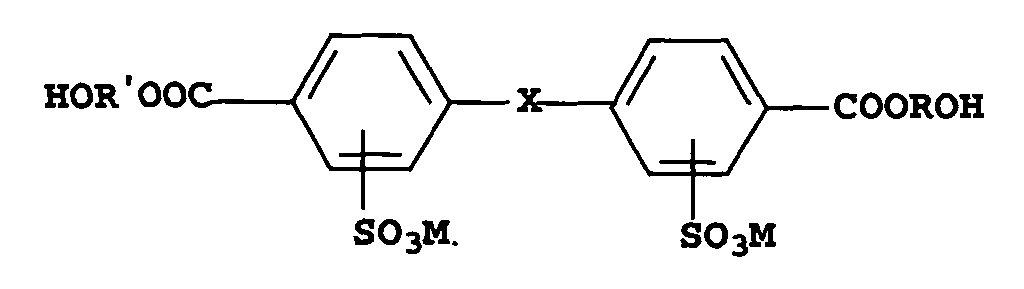 wherein X represents:
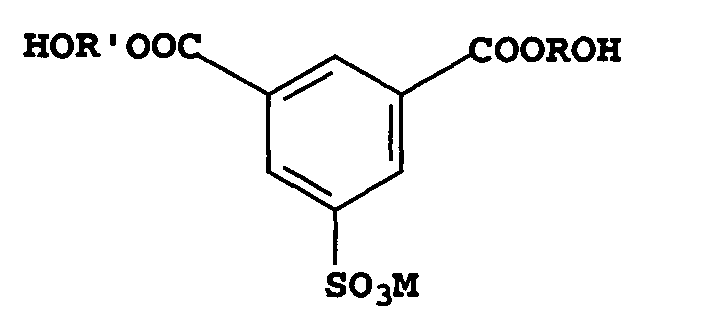 R and R' each represent -- (CH2)n -- where n represents an integer of 1 to 20; and
M represents sodium, potassium or lithium ions; and.
wherein said polyalkylene glycol is selected from the group consisting of a polyethylene glycol, polypropylene glycol, polytetramethylene glycol; and combinations thereof. - The film base of claim 1 wherein said second PET-based material comprises one or more polyester resins, in which material the total level of repeat units derived from 1,4-cyclohexane dimethanol is 5 to 10 or 90 to 100 mol %, based on the total glycol component for material in the outer layer.
- An imaging element comprising at least one light-sensitive or heat-sensitive imaging layer laminated on the film base of claim 1 wherein the imaging layer comprises a silver-halide emulsion.
Applications Claiming Priority (2)
| Application Number | Priority Date | Filing Date | Title |
|---|---|---|---|
| US327365 | 2002-12-20 | ||
| US10/327,365 US6727052B1 (en) | 2002-12-20 | 2002-12-20 | Multilayer photographic film and an imaging element made of said base |
Publications (2)
| Publication Number | Publication Date |
|---|---|
| EP1434087A2 true EP1434087A2 (en) | 2004-06-30 |
| EP1434087A3 EP1434087A3 (en) | 2004-08-25 |
Family
ID=32107724
Family Applications (1)
| Application Number | Title | Priority Date | Filing Date |
|---|---|---|---|
| EP20030078834 Withdrawn EP1434087A3 (en) | 2002-12-20 | 2003-12-08 | A multilayer photographic film base and an imaging element made of said base |
Country Status (3)
| Country | Link |
|---|---|
| US (1) | US6727052B1 (en) |
| EP (1) | EP1434087A3 (en) |
| JP (1) | JP2004206125A (en) |
Cited By (1)
| Publication number | Priority date | Publication date | Assignee | Title |
|---|---|---|---|---|
| WO2024118358A1 (en) * | 2022-11-30 | 2024-06-06 | Eastman Chemical Company | Films with improved tear strength |
Families Citing this family (5)
| Publication number | Priority date | Publication date | Assignee | Title |
|---|---|---|---|---|
| US7902296B2 (en) * | 2007-09-20 | 2011-03-08 | Sabic Innovative Plastics Ip B.V. | Poly(arylene ether) composition and article |
| US8425797B2 (en) * | 2008-03-21 | 2013-04-23 | Cabot Microelectronics Corporation | Compositions for polishing aluminum/copper and titanium in damascene structures |
| US20110177742A1 (en) * | 2008-07-09 | 2011-07-21 | Filip Frederix | Functional sheet |
| US11578167B2 (en) | 2017-07-05 | 2023-02-14 | Basf Se | Sulphur-containing polyester polyols, their production and use |
| CN112646324A (en) * | 2019-10-12 | 2021-04-13 | 中国石油化工股份有限公司 | Ultrathin high-sub-polyester film and preparation method thereof |
Family Cites Families (5)
| Publication number | Priority date | Publication date | Assignee | Title |
|---|---|---|---|---|
| JP3337518B2 (en) * | 1993-03-30 | 2002-10-21 | コニカ株式会社 | Photographic support |
| US5288601A (en) * | 1993-07-21 | 1994-02-22 | Eastman Kodak Company | Light sensitive silver halide element having photographic film base with improved curl stability |
| JP4204745B2 (en) * | 2000-07-21 | 2009-01-07 | 富士フイルム株式会社 | Thermally developed image recording material |
| US6555303B1 (en) * | 2001-12-21 | 2003-04-29 | Eastman Kodak Company | Photographic film base comprising a poly(ethylene terephthalate)-based material |
| US6558884B1 (en) * | 2001-12-21 | 2003-05-06 | Eastman Kodak Company | Photographic film base comprising a poly(ethylene terephthalate)-based material |
-
2002
- 2002-12-20 US US10/327,365 patent/US6727052B1/en not_active Expired - Fee Related
-
2003
- 2003-12-08 EP EP20030078834 patent/EP1434087A3/en not_active Withdrawn
- 2003-12-19 JP JP2003423481A patent/JP2004206125A/en active Pending
Cited By (1)
| Publication number | Priority date | Publication date | Assignee | Title |
|---|---|---|---|---|
| WO2024118358A1 (en) * | 2022-11-30 | 2024-06-06 | Eastman Chemical Company | Films with improved tear strength |
Also Published As
| Publication number | Publication date |
|---|---|
| EP1434087A3 (en) | 2004-08-25 |
| JP2004206125A (en) | 2004-07-22 |
| US6727052B1 (en) | 2004-04-27 |
Similar Documents
| Publication | Publication Date | Title |
|---|---|---|
| JP2001322220A (en) | Biaxially stretched coextrusion sealable polyester film | |
| US6558884B1 (en) | Photographic film base comprising a poly(ethylene terephthalate)-based material | |
| JP2002103546A (en) | Biaxially stretched coextruded polyester film and method for producing the same | |
| US5215825A (en) | Polyester film and photosensitive material | |
| US6737226B1 (en) | Process for making polyester photographic film base and photographic element comprising said base | |
| US6727052B1 (en) | Multilayer photographic film and an imaging element made of said base | |
| US6797458B2 (en) | Photographic multi-layer film base comprising 1,4-cyclohexane dimethanol | |
| US6555303B1 (en) | Photographic film base comprising a poly(ethylene terephthalate)-based material | |
| JPH06266288A (en) | Label using polyester film as base material | |
| US5270160A (en) | Polyester film and photosensitive material | |
| US6670110B1 (en) | Photographic multilayer film base comprising 1,4-cyclohexane dimethanol | |
| US6942831B2 (en) | Process for rapid annealing of a polyester film base to control film curl | |
| JP2000063538A (en) | Polyester film and method for producing the same | |
| JP2000103877A (en) | Polyester film for coating plywood and coated plywood laminated with it | |
| JP2000063537A (en) | Polyester film | |
| JP3183424B2 (en) | Polyester film and photosensitive material | |
| JP3429546B2 (en) | Polyester film and photographic support | |
| JPH04235036A (en) | Polyester film and photosensitive material | |
| JP3627190B2 (en) | Polyester film and photographic photosensitive material | |
| JPH06145376A (en) | Polyester film and photographic material | |
| JPH10306147A (en) | Polyethylene naphthalate copolymer and base film for photographic film | |
| JP2004330476A (en) | Biaxially stretched laminated polyester film | |
| JPH0531804A (en) | Polyester film | |
| JPH06161035A (en) | Photographic substrate | |
| JPH06110154A (en) | Photographic base |
Legal Events
| Date | Code | Title | Description |
|---|---|---|---|
| PUAI | Public reference made under article 153(3) epc to a published international application that has entered the european phase |
Free format text: ORIGINAL CODE: 0009012 |
|
| AK | Designated contracting states |
Kind code of ref document: A2 Designated state(s): AT BE BG CH CY CZ DE DK EE ES FI FR GB GR HU IE IT LI LU MC NL PT RO SE SI SK TR |
|
| AX | Request for extension of the european patent |
Extension state: AL LT LV MK |
|
| PUAL | Search report despatched |
Free format text: ORIGINAL CODE: 0009013 |
|
| AK | Designated contracting states |
Kind code of ref document: A3 Designated state(s): AT BE BG CH CY CZ DE DK EE ES FI FR GB GR HU IE IT LI LU MC NL PT RO SE SI SK TR |
|
| AX | Request for extension of the european patent |
Extension state: AL LT LV MK |
|
| AKX | Designation fees paid | ||
| REG | Reference to a national code |
Ref country code: DE Ref legal event code: 8566 |
|
| DBV | Designated contracting states (deleted) | ||
| STAA | Information on the status of an ep patent application or granted ep patent |
Free format text: STATUS: THE APPLICATION IS DEEMED TO BE WITHDRAWN |
|
| 18D | Application deemed to be withdrawn |
Effective date: 20050225 |