EP1433953A2 - Reversible pneumatic group with two stages - Google Patents
Reversible pneumatic group with two stages Download PDFInfo
- Publication number
- EP1433953A2 EP1433953A2 EP03023493A EP03023493A EP1433953A2 EP 1433953 A2 EP1433953 A2 EP 1433953A2 EP 03023493 A EP03023493 A EP 03023493A EP 03023493 A EP03023493 A EP 03023493A EP 1433953 A2 EP1433953 A2 EP 1433953A2
- Authority
- EP
- European Patent Office
- Prior art keywords
- compressed air
- motor
- reversible pneumatic
- chambers
- pneumatic group
- Prior art date
- Legal status (The legal status is an assumption and is not a legal conclusion. Google has not performed a legal analysis and makes no representation as to the accuracy of the status listed.)
- Withdrawn
Links
Images



Classifications
-
- F—MECHANICAL ENGINEERING; LIGHTING; HEATING; WEAPONS; BLASTING
- F04—POSITIVE - DISPLACEMENT MACHINES FOR LIQUIDS; PUMPS FOR LIQUIDS OR ELASTIC FLUIDS
- F04C—ROTARY-PISTON, OR OSCILLATING-PISTON, POSITIVE-DISPLACEMENT MACHINES FOR LIQUIDS; ROTARY-PISTON, OR OSCILLATING-PISTON, POSITIVE-DISPLACEMENT PUMPS
- F04C28/00—Control of, monitoring of, or safety arrangements for, pumps or pumping installations specially adapted for elastic fluids
- F04C28/04—Control of, monitoring of, or safety arrangements for, pumps or pumping installations specially adapted for elastic fluids specially adapted for reversible pumps
-
- F—MECHANICAL ENGINEERING; LIGHTING; HEATING; WEAPONS; BLASTING
- F01—MACHINES OR ENGINES IN GENERAL; ENGINE PLANTS IN GENERAL; STEAM ENGINES
- F01C—ROTARY-PISTON OR OSCILLATING-PISTON MACHINES OR ENGINES
- F01C1/00—Rotary-piston machines or engines
- F01C1/30—Rotary-piston machines or engines having the characteristics covered by two or more groups F01C1/02, F01C1/08, F01C1/22, F01C1/24 or having the characteristics covered by one of these groups together with some other type of movement between co-operating members
- F01C1/34—Rotary-piston machines or engines having the characteristics covered by two or more groups F01C1/02, F01C1/08, F01C1/22, F01C1/24 or having the characteristics covered by one of these groups together with some other type of movement between co-operating members having the movement defined in group F01C1/08 or F01C1/22 and relative reciprocation between the co-operating members
- F01C1/344—Rotary-piston machines or engines having the characteristics covered by two or more groups F01C1/02, F01C1/08, F01C1/22, F01C1/24 or having the characteristics covered by one of these groups together with some other type of movement between co-operating members having the movement defined in group F01C1/08 or F01C1/22 and relative reciprocation between the co-operating members with vanes reciprocating with respect to the inner member
- F01C1/3441—Rotary-piston machines or engines having the characteristics covered by two or more groups F01C1/02, F01C1/08, F01C1/22, F01C1/24 or having the characteristics covered by one of these groups together with some other type of movement between co-operating members having the movement defined in group F01C1/08 or F01C1/22 and relative reciprocation between the co-operating members with vanes reciprocating with respect to the inner member the inner and outer member being in contact along one line or continuous surface substantially parallel to the axis of rotation
- F01C1/3442—Rotary-piston machines or engines having the characteristics covered by two or more groups F01C1/02, F01C1/08, F01C1/22, F01C1/24 or having the characteristics covered by one of these groups together with some other type of movement between co-operating members having the movement defined in group F01C1/08 or F01C1/22 and relative reciprocation between the co-operating members with vanes reciprocating with respect to the inner member the inner and outer member being in contact along one line or continuous surface substantially parallel to the axis of rotation the surfaces of the inner and outer member, forming the working space, being surfaces of revolution
-
- F—MECHANICAL ENGINEERING; LIGHTING; HEATING; WEAPONS; BLASTING
- F01—MACHINES OR ENGINES IN GENERAL; ENGINE PLANTS IN GENERAL; STEAM ENGINES
- F01C—ROTARY-PISTON OR OSCILLATING-PISTON MACHINES OR ENGINES
- F01C20/00—Control of, monitoring of, or safety arrangements for, machines or engines
- F01C20/04—Control of, monitoring of, or safety arrangements for, machines or engines specially adapted for reversible machines or engines
-
- F—MECHANICAL ENGINEERING; LIGHTING; HEATING; WEAPONS; BLASTING
- F01—MACHINES OR ENGINES IN GENERAL; ENGINE PLANTS IN GENERAL; STEAM ENGINES
- F01C—ROTARY-PISTON OR OSCILLATING-PISTON MACHINES OR ENGINES
- F01C21/00—Component parts, details or accessories not provided for in groups F01C1/00 - F01C20/00
- F01C21/08—Rotary pistons
- F01C21/0809—Construction of vanes or vane holders
- F01C21/0818—Vane tracking; control therefor
- F01C21/0854—Vane tracking; control therefor by fluid means
- F01C21/0863—Vane tracking; control therefor by fluid means the fluid being the working fluid
-
- F—MECHANICAL ENGINEERING; LIGHTING; HEATING; WEAPONS; BLASTING
- F02—COMBUSTION ENGINES; HOT-GAS OR COMBUSTION-PRODUCT ENGINE PLANTS
- F02N—STARTING OF COMBUSTION ENGINES; STARTING AIDS FOR SUCH ENGINES, NOT OTHERWISE PROVIDED FOR
- F02N5/00—Starting apparatus having mechanical power storage
-
- F—MECHANICAL ENGINEERING; LIGHTING; HEATING; WEAPONS; BLASTING
- F02—COMBUSTION ENGINES; HOT-GAS OR COMBUSTION-PRODUCT ENGINE PLANTS
- F02N—STARTING OF COMBUSTION ENGINES; STARTING AIDS FOR SUCH ENGINES, NOT OTHERWISE PROVIDED FOR
- F02N7/00—Starting apparatus having fluid-driven auxiliary engines or apparatus
- F02N7/06—Starting apparatus having fluid-driven auxiliary engines or apparatus the engines being of reciprocating-piston type
-
- F—MECHANICAL ENGINEERING; LIGHTING; HEATING; WEAPONS; BLASTING
- F04—POSITIVE - DISPLACEMENT MACHINES FOR LIQUIDS; PUMPS FOR LIQUIDS OR ELASTIC FLUIDS
- F04C—ROTARY-PISTON, OR OSCILLATING-PISTON, POSITIVE-DISPLACEMENT MACHINES FOR LIQUIDS; ROTARY-PISTON, OR OSCILLATING-PISTON, POSITIVE-DISPLACEMENT PUMPS
- F04C18/00—Rotary-piston pumps specially adapted for elastic fluids
- F04C18/30—Rotary-piston pumps specially adapted for elastic fluids having the characteristics covered by two or more of groups F04C18/02, F04C18/08, F04C18/22, F04C18/24, F04C18/48, or having the characteristics covered by one of these groups together with some other type of movement between co-operating members
- F04C18/34—Rotary-piston pumps specially adapted for elastic fluids having the characteristics covered by two or more of groups F04C18/02, F04C18/08, F04C18/22, F04C18/24, F04C18/48, or having the characteristics covered by one of these groups together with some other type of movement between co-operating members having the movement defined in group F04C18/08 or F04C18/22 and relative reciprocation between the co-operating members
- F04C18/344—Rotary-piston pumps specially adapted for elastic fluids having the characteristics covered by two or more of groups F04C18/02, F04C18/08, F04C18/22, F04C18/24, F04C18/48, or having the characteristics covered by one of these groups together with some other type of movement between co-operating members having the movement defined in group F04C18/08 or F04C18/22 and relative reciprocation between the co-operating members with vanes reciprocating with respect to the inner member
- F04C18/3441—Rotary-piston pumps specially adapted for elastic fluids having the characteristics covered by two or more of groups F04C18/02, F04C18/08, F04C18/22, F04C18/24, F04C18/48, or having the characteristics covered by one of these groups together with some other type of movement between co-operating members having the movement defined in group F04C18/08 or F04C18/22 and relative reciprocation between the co-operating members with vanes reciprocating with respect to the inner member the inner and outer member being in contact along one line or continuous surface substantially parallel to the axis of rotation
- F04C18/3442—Rotary-piston pumps specially adapted for elastic fluids having the characteristics covered by two or more of groups F04C18/02, F04C18/08, F04C18/22, F04C18/24, F04C18/48, or having the characteristics covered by one of these groups together with some other type of movement between co-operating members having the movement defined in group F04C18/08 or F04C18/22 and relative reciprocation between the co-operating members with vanes reciprocating with respect to the inner member the inner and outer member being in contact along one line or continuous surface substantially parallel to the axis of rotation the surfaces of the inner and outer member, forming the inlet and outlet opening
-
- B—PERFORMING OPERATIONS; TRANSPORTING
- B62—LAND VEHICLES FOR TRAVELLING OTHERWISE THAN ON RAILS
- B62M—RIDER PROPULSION OF WHEELED VEHICLES OR SLEDGES; POWERED PROPULSION OF SLEDGES OR SINGLE-TRACK CYCLES; TRANSMISSIONS SPECIALLY ADAPTED FOR SUCH VEHICLES
- B62M7/00—Motorcycles characterised by position of motor or engine
- B62M2007/005—Motorcycles characterised by position of motor or engine the cycle being equipped with a pneumatic motor
Definitions
- the present finding concerns a reversible pneumatic group with two stages suitable for acting both as a compressor and a compressed air motor.
- the purpose of the present finding is that of foreseeing a pneumatic group to be used in any fixed or mobile application where one wishes to accumulate and restore mechanical energy without the need for thermal motors or electrical motors/accumulators, in particular for the movement of light vehicles without a thermal or electric motor (bicycles, velocipedes, toys, special vehicles, etc).
- the novelty characteristic of the present finding consists of the fact that such a pneumatic group, when it works in the state of compression, operates as a "two stage compressor", where the first stage uses a compression system with an eccentric bladed rotor, according to per se known ways, whereas the second stage uses a compression system with small concentric pistons which are elastically connected to the blades and floating in corresponding compression/expansion chambers, formed on the body of the rotor.
- a first compression of the air flow is generated from atmospheric pressure up to about 5 bar; such a compressed airflow is then introduced into the second stage, where it undergoes a further compression up to about 50 bar.
- the blades slide radially in the opposite direction with respect to the direction of rotation as a compressor, regulated in stroke by their contact against the wall of the stator and kept in position by suitable elastic elements (springs); said blades, rotating, radially pull and thrust the small pistons in an integral manner, which, in this operating state as a motor, can slide freely given that the chamber is kept open by an air vent.
- a second functional difference of the group according to the finding with respect to normal bladed rotating volumetric compressors is the possibility of obtaining air pressures of a greater order of magnitude, using, incorporated in the same stator, a second stage with small concentric pistons.
- the operation of the pneumatic group according to the finding is regulated by a non-return valve inside the body of the rotor, which regulate the flow of compressed air, and by an air vent which ensures the change in state from compressor to motor, freeing the inner chambers of the small pistons to allow them to slide freely, when it acts in rotating bladed motor state.
- the reversible pneumatic group according to the finding is connected to a suitable compressed air collection tank, of an appropriate shape for the specific applications and then becomes, with the tank, a reversible pneumatic accumulator.
- the reversible pneumatic group acts with a closed circuit, as a compressor which produces a flow of compressed air and as a motor actuated by the same flow of compressed air.
- An advantageous mobile application of the group according to the finding consists of use as a compressed air starter for thermal motors; it acts as a compressor during the movement of the vehicle, compressing atmospheric air in a tank to about 50 bar to then use it, after a suitable reduction in pressure, to act as a compressed air starter of the motor itself.
- a vehicle can thus be realised equipped with a compressor/compressed air starter and a tank, formed, for example, in the volume of the bumpers, which replaces the lead starter battery and electric starter motors.
- a further advantageous application of the reversible group according to the finding is on a bicycle as a reversible motor, which acts as a compressed air accumulator when one pedals downhill, whereas it becomes a compressed air motor which helps pedalling uphill, or else allows higher speeds to be reached on the flat.
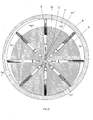
- the reversible pneumatic group according to the finding, wholly indicated with reference numeral 1, comprises a stator 2, consisting of the body 3 and the cover 4, a rotor 5, mounted eccentrically with respect to the axis of the stator, equipped with projecting radial blades 6, which go into sliding contact on the inner wall 7 of the stator through centrifugal force, when the apparatus is in motion, or else through the thrusting action of elastic bodies (springs) 8, placed between the rotor and the blades themselves, during the starter step thereof.
- a stator 2 consisting of the body 3 and the cover 4
- a rotor 5 mounted eccentrically with respect to the axis of the stator, equipped with projecting radial blades 6, which go into sliding contact on the inner wall 7 of the stator through centrifugal force, when the apparatus is in motion, or else through the thrusting action of elastic bodies (springs) 8, placed between the rotor and the blades themselves, during the starter step thereof.
- Small radial pistons 10, floating in chambers 11, with variable volume, formed on the body 12 of the rotor 5, are connected to the blades 6, through a mobile coupling 9.
- the chambers 11 communicate with the outside through suction ducts 13, all flowing on the attachment 14, formed on the rotating joint 15 and, through delivery ducts 16, all flowing on the attachment 17, formed on the flanged body of the stator.
- Each of the two types of ducts is intercepted by a corresponding non-return valve, 18 and 19 respectively, which operate against each other on the two opposite ducts.
- the chambers 11 also communicate with the outside through radial top ducts 20, which flow in a single central duct 21 and are susceptible to being blocked through a pin 22, coaxial with the axis of the rotor and moved from the outside.
- the reversible pneumatic group 1 acts as a "motor", the compressed air coming from an external tank, where it has collected at around 50 bar and, after having passed through a pressure reducer, which reduces the pressure to 6/7 bar, enters through the mouth “Y" in the chambers with variable volume “K” where, thrusting on the blades 6, it makes the rotor 5 rotate, to then come out from the port "X".
- the blades 11 are kept adhering to the wall of the stator by the thrusting action of the springs 8, until the centrifugal force reaches a value such as to naturally ensure such an adherence.
Landscapes
- Engineering & Computer Science (AREA)
- Mechanical Engineering (AREA)
- General Engineering & Computer Science (AREA)
- Chemical & Material Sciences (AREA)
- Combustion & Propulsion (AREA)
- Structures Of Non-Positive Displacement Pumps (AREA)
- Toys (AREA)
Abstract
Description
- fig. 1 (Table I) represents an elevated front section view of the group according to the finding;
- fig. 2 (Table II) represents an elevated transversal view, sectioned according to the line II-II of fig. 1;
- fig. 3 (Table III) represents an elevated transversal view, sectioned according to the line III-III of fig. 1;
- fig. 4 (Table IV) represents an overall view of the rotor equipped with blades.
Claims (15)
- REVERSIBLE PNEUMATIC GROUP WITH TWO STAGES, to be used in any fixed or mobile application, where one wishes to accumulate and restore mechanical energy without the need for thermal motors or electrical motors/accumulators, in particular for the movement of light vehicles without a thermal or electric motor (bicycles, velocipedes, toys, special vehicles, etc...) and as a compressed air starter in vehicles with an internal combustion engine to replace the lead starter battery and the electric starter motor said reversible pneumatic group being characterised in that
it can act both as a compressor and as a compressed air motor, or rather a single apparatus that can act in two different ways: as a compressor, to transfer mechanical energy into compressed air and as a motor, to restore the energy of the compressed air into mechanical energy, all of this being able to be obtained by simply inverting the direction of rotation of the rotor. - REVERSIBLE PNEUMATIC GROUP, according to claim 1, characterised in that, when it works in compression state, it operates as a "two stage compressor", where the first stage uses a compression system with a bladed eccentric rotor, according to per se known ways, whereas the second stage uses a compression system with small concentric pistons which are connected to the blades and floating in corresponding compression/expansion chambers, formed on the body of the rotor.
- REVERSIBLE PNEUMATIC GROUP, according to claim 2, characterised in that the small pistons are connected to the blades with mobile coupling.
- REVERSIBLE PNEUMATIC GROUP, according to claim 2, characterised in that when the blades slide radially towards the centre of the rotor, realising a first compression stage, they thrust the small pistons connected to it towards the centre of the rotor, which decreases the volume of the individual chambers and thus a compressing force is realised which increases the pressure value of the compressed air in the chamber, or rather a second compression stage is also realised simultaneously.
- REVERSIBLE PNEUMATIC GROUP, according to claim 4, characterised in that when the reversible pneumatic group acts as a motor, the blades slide radially in the opposite direction with respect to the direction of rotation as a compressor, regulated in stroke by their contact against the wall of the stator and kept in position by suitable elastic elements (springs), said blades, rotating, radially pull and thrust the small pistons in an integral manner, which, in this operating state as a motor, can slide freely given that the chamber is kept open by an air vent.
- REVERSIBLE PNEUMATIC GROUP, according to one or more of the previous claims, characterised in that it can acts with a "closed circuit" as a compressor which produces a flow of compressed air and as a motor actuated by the flow of compressed air itself.
- REVERSIBLE PNEUMATIC GROUP, according to one or more of the previous claims, of the type comprising a stator (2), consisting of the body (3) and the cover (4), a rotor (5), mounted eccentrically with respect to the axis of the stator, equipped with projecting radial blades (6), which go into sliding contact on the inner wall (7) of the stator, characterised in that small radial pistons (10), floating in chambers (11), with variable volume, formed on the body (12) of the rotor 5, are connected to the blades (6), said chambers (11) communicating with the outside through suction ducts (13), all flowing on the attachment (14), formed on the rotary joint (15) and through delivery ducts (16), all flowing on the attachment (17), formed on the flanged body of the stator.
- REVERSIBLE PNEUMATIC GROUP, according to claim 7, characterised in that the small radial pistons (10) are connected to the blades (6) through a mobile coupling (9).
- REVERSIBLE PNEUMATIC GROUP, according to claim 7, characterised in that each of the two types of ducts (13, 16) is intercepted by a non-return valve (18, 19), said pairs of valves operating against each other on the two opposite ducts.
- REVERSIBLE PNEUMATIC GROUP, according to one or more of the previous claims, characterised in that the chambers (11) also communicate with the outside through radial top ducts (20), which flow in a single central duct (21) and are susceptible to being blocked through a pin (22), coaxial with the axis of the rotor and moved from the outside.
- REVERSIBLE PNEUMATIC GROUP, according to one or more of the previous claims, characterised in that, when it acts as a "compressor", in the first stage, the air, sucked through the mouth (X), present on the body of the stator (2), is compressed through the chambers with variable volume (K) and discharged through the mouth (Y), present on the body itself; the flow of compressed air (W) is then conveyed to the ducts (13), through the rotary joint (15), said ducts feeding the chambers (11), which constitute the chambers with variable volume of the second compression stage of the group itself, during said operation the radial top ducts (20) of the aforementioned chambers are blocked by the conical end (23) of the pin (22).
- REVERSIBLE PNEUMATIC GROUP, according to one or more of the previous claims, characterised in that, when it acts as a "motor", the compressed air coming from an external tank, where it has collected at around 50 bar and, after having passed through a pressure reducer, which reduces the pressure to 6/7 bar, enters through the mouth (Y) in the chambers with variable volume (K) where, thrusting on the blades (6), it makes the rotor (5) rotate, to then come out from the port (X); during said operation the pin (22), commanded from the outside, simultaneously opens the radial ducts (20) to allow the evacuation of the air contained in the chambers (11) and thus allow the free movement of the small pistons (10) in the chambers themselves.
- REVERSIBLE PNEUMATIC GROUP, according to claim 12, characterised in that, during the step of passage from compressor to motor and thus of inversion of the direction of rotation of the rotor, the blades (11) are kept adhering to the wall of the stator by the thrusting action of the springs (8), until the centrifugal force reaches a value such as to naturally ensure such an adherence.
- VEHICLE WITH THERMAL MOTOR, equipped with the reversible pneumatic group as a compressed air starter, according to one or more of the previous claims, characterised in that the compressed air tank is formed in the volume of the bumpers or in the tubular frame or in the roll-bar.
- LIGHT VEHICLE WITH PEDALS, equipped with the reversible pneumatic group as a compressed air motor, according to one or more of the previous claims, characterised in that said group acts as a compressed air accumulator when one pedals downhill, whereas it becomes a compressed air motor when one pedals on the flat or uphill; in this case the compressed air tank is formed in the tubular frame.
Applications Claiming Priority (2)
| Application Number | Priority Date | Filing Date | Title |
|---|---|---|---|
| ITVI20020279 ITVI20020279A1 (en) | 2002-12-23 | 2002-12-23 | REVERSIBLE TWO-STAGE PNEUMATIC GROUP. |
| ITVI20020279 | 2002-12-23 |
Publications (2)
| Publication Number | Publication Date |
|---|---|
| EP1433953A2 true EP1433953A2 (en) | 2004-06-30 |
| EP1433953A3 EP1433953A3 (en) | 2006-05-31 |
Family
ID=32448955
Family Applications (1)
| Application Number | Title | Priority Date | Filing Date |
|---|---|---|---|
| EP03023493A Withdrawn EP1433953A3 (en) | 2002-12-23 | 2003-10-18 | Reversible pneumatic group with two stages |
Country Status (2)
| Country | Link |
|---|---|
| EP (1) | EP1433953A3 (en) |
| IT (1) | ITVI20020279A1 (en) |
Cited By (4)
| Publication number | Priority date | Publication date | Assignee | Title |
|---|---|---|---|---|
| CN103032236A (en) * | 2011-10-08 | 2013-04-10 | 威伯科有限公司 | Pneumatic starter device for internal combustion engines and method of operation |
| CN107476830A (en) * | 2017-10-06 | 2017-12-15 | 李克强 | A kind of high-power steam motor for carrier-borne aircraft catapult-assisted take-off |
| EP3483444A1 (en) * | 2017-11-14 | 2019-05-15 | Nasir, Serkan | Submersible pump motor that can work with compressed air |
| CN109944642A (en) * | 2019-04-27 | 2019-06-28 | 周垟 | Concealed big power motor |
Family Cites Families (5)
| Publication number | Priority date | Publication date | Assignee | Title |
|---|---|---|---|---|
| FR2504602A1 (en) * | 1981-04-28 | 1982-10-29 | Ervor Enve Sa Compresseurs | ROTARY PNEUMATIC STARTER FOR INTERNAL COMBUSTION ENGINE |
| US4846122A (en) * | 1985-09-26 | 1989-07-11 | Sycon Corporation | Pneumatic starter for internal combustion engine |
| JPH0723708B2 (en) * | 1986-09-24 | 1995-03-15 | 不二空機株式会社 | Air motor for starter of internal combustion engine |
| US5947712A (en) * | 1997-04-11 | 1999-09-07 | Thermo King Corporation | High efficiency rotary vane motor |
| ITVI20010110A1 (en) * | 2001-05-11 | 2002-11-11 | Capuzzo Cesare Dolcetta | STARTING SYSTEM FOR INTERNAL COMBUSTION ENGINE USING COMPRESSED AIR |
-
2002
- 2002-12-23 IT ITVI20020279 patent/ITVI20020279A1/en unknown
-
2003
- 2003-10-18 EP EP03023493A patent/EP1433953A3/en not_active Withdrawn
Cited By (4)
| Publication number | Priority date | Publication date | Assignee | Title |
|---|---|---|---|---|
| CN103032236A (en) * | 2011-10-08 | 2013-04-10 | 威伯科有限公司 | Pneumatic starter device for internal combustion engines and method of operation |
| CN107476830A (en) * | 2017-10-06 | 2017-12-15 | 李克强 | A kind of high-power steam motor for carrier-borne aircraft catapult-assisted take-off |
| EP3483444A1 (en) * | 2017-11-14 | 2019-05-15 | Nasir, Serkan | Submersible pump motor that can work with compressed air |
| CN109944642A (en) * | 2019-04-27 | 2019-06-28 | 周垟 | Concealed big power motor |
Also Published As
| Publication number | Publication date |
|---|---|
| ITVI20020279A1 (en) | 2004-06-24 |
| EP1433953A3 (en) | 2006-05-31 |
Similar Documents
| Publication | Publication Date | Title |
|---|---|---|
| CN212272509U (en) | High-low pressure electric inflator pump | |
| CN109340084A (en) | A kind of vehicle-mounted electric drive oil-free air compressor | |
| EP1433953A2 (en) | Reversible pneumatic group with two stages | |
| CN112648167A (en) | High-efficient cylinder assembly of pump | |
| CN210164597U (en) | A two-stage reciprocating electric vacuum pump | |
| US6325602B1 (en) | Automotive vacuum pump | |
| US6764288B1 (en) | Two stage scroll vacuum pump | |
| CN213478627U (en) | Diaphragm air pump with automatic air release function | |
| JPH06510252A (en) | Tire pressure adjustment device | |
| CN110848020B (en) | A system that recovers and converts braking energy into turbine drive | |
| CN104533788A (en) | Air pump | |
| US5188516A (en) | Hydraulic/pneumatic pump | |
| CN1769710A (en) | Apparatus for changing capacity of multi-stage rotary compressor | |
| CN221053884U (en) | Piston impeller parallel sectional air pump | |
| CN2661515Y (en) | Brake vacuum assistor of electric car | |
| CN218816834U (en) | Fan air pump and inflation integrated lithium battery inflator | |
| CN1080386C (en) | Valve structure in compressor | |
| CN110816499A (en) | Method for recovering and converting braking energy into turbine drive | |
| CN102926816A (en) | Vacuum cycloid vane motor | |
| JP2926602B2 (en) | Compression device | |
| CN219993856U (en) | Gear-driven double-cylinder inflator pump | |
| CN223374590U (en) | An air pump suitable for outdoor inflatable products | |
| CN224149737U (en) | Pump core of inflator pump | |
| CN214698213U (en) | Large-flow cross reciprocating small-sized oil-free air compressor | |
| CN110608151A (en) | Vacuum pump with automatic air inlet function |
Legal Events
| Date | Code | Title | Description |
|---|---|---|---|
| PUAI | Public reference made under article 153(3) epc to a published international application that has entered the european phase |
Free format text: ORIGINAL CODE: 0009012 |
|
| AK | Designated contracting states |
Kind code of ref document: A2 Designated state(s): AT BE BG CH CY CZ DE DK EE ES FI FR GB GR HU IE IT LI LU MC NL PT RO SE SI SK TR |
|
| AX | Request for extension of the european patent |
Extension state: AL LT LV MK |
|
| PUAL | Search report despatched |
Free format text: ORIGINAL CODE: 0009013 |
|
| AK | Designated contracting states |
Kind code of ref document: A3 Designated state(s): AT BE BG CH CY CZ DE DK EE ES FI FR GB GR HU IE IT LI LU MC NL PT RO SE SI SK TR |
|
| AX | Request for extension of the european patent |
Extension state: AL LT LV MK |
|
| STAA | Information on the status of an ep patent application or granted ep patent |
Free format text: STATUS: THE APPLICATION IS DEEMED TO BE WITHDRAWN |
|
| 18D | Application deemed to be withdrawn |
Effective date: 20060503 |