EP1432375B1 - Patient-support apparatus having line management system - Google Patents
Patient-support apparatus having line management system Download PDFInfo
- Publication number
- EP1432375B1 EP1432375B1 EP02766462A EP02766462A EP1432375B1 EP 1432375 B1 EP1432375 B1 EP 1432375B1 EP 02766462 A EP02766462 A EP 02766462A EP 02766462 A EP02766462 A EP 02766462A EP 1432375 B1 EP1432375 B1 EP 1432375B1
- Authority
- EP
- European Patent Office
- Prior art keywords
- panel
- patient
- support apparatus
- infant
- support
- Prior art date
- Legal status (The legal status is an assumption and is not a legal conclusion. Google has not performed a legal analysis and makes no representation as to the accuracy of the status listed.)
- Expired - Lifetime
Links
Images

Classifications
-
- A—HUMAN NECESSITIES
- A61—MEDICAL OR VETERINARY SCIENCE; HYGIENE
- A61G—TRANSPORT, PERSONAL CONVEYANCES OR ACCOMMODATION SPECIALLY ADAPTED FOR PATIENTS OR DISABLED PERSONS; OPERATING TABLES OR CHAIRS; CHAIRS FOR DENTISTRY; FUNERAL DEVICES
- A61G12/00—Accommodation for nursing, e.g. in hospitals, not covered by groups A61G1/00 - A61G11/00, e.g. trolleys for transport of medicaments or food; Prescription lists
- A61G12/002—Supply appliances, e.g. columns for gas, fluid, electricity supply
-
- A—HUMAN NECESSITIES
- A61—MEDICAL OR VETERINARY SCIENCE; HYGIENE
- A61B—DIAGNOSIS; SURGERY; IDENTIFICATION
- A61B5/00—Measuring for diagnostic purposes; Identification of persons
- A61B5/02—Detecting, measuring or recording for evaluating the cardiovascular system, e.g. pulse, heart rate, blood pressure or blood flow
- A61B5/0205—Simultaneously evaluating both cardiovascular conditions and different types of body conditions, e.g. heart and respiratory condition
- A61B5/02055—Simultaneously evaluating both cardiovascular condition and temperature
-
- A—HUMAN NECESSITIES
- A61—MEDICAL OR VETERINARY SCIENCE; HYGIENE
- A61B—DIAGNOSIS; SURGERY; IDENTIFICATION
- A61B5/00—Measuring for diagnostic purposes; Identification of persons
- A61B5/68—Arrangements of detecting, measuring or recording means, e.g. sensors, in relation to patient
- A61B5/6887—Arrangements of detecting, measuring or recording means, e.g. sensors, in relation to patient mounted on external non-worn devices, e.g. non-medical devices
- A61B5/6892—Mats
-
- A—HUMAN NECESSITIES
- A61—MEDICAL OR VETERINARY SCIENCE; HYGIENE
- A61B—DIAGNOSIS; SURGERY; IDENTIFICATION
- A61B5/00—Measuring for diagnostic purposes; Identification of persons
- A61B5/74—Details of notification to user or communication with user or patient; User input means
- A61B5/742—Details of notification to user or communication with user or patient; User input means using visual displays
- A61B5/7435—Displaying user selection data, e.g. icons in a graphical user interface
-
- A—HUMAN NECESSITIES
- A61—MEDICAL OR VETERINARY SCIENCE; HYGIENE
- A61G—TRANSPORT, PERSONAL CONVEYANCES OR ACCOMMODATION SPECIALLY ADAPTED FOR PATIENTS OR DISABLED PERSONS; OPERATING TABLES OR CHAIRS; CHAIRS FOR DENTISTRY; FUNERAL DEVICES
- A61G11/00—Baby-incubators; Couveuses
-
- A—HUMAN NECESSITIES
- A61—MEDICAL OR VETERINARY SCIENCE; HYGIENE
- A61G—TRANSPORT, PERSONAL CONVEYANCES OR ACCOMMODATION SPECIALLY ADAPTED FOR PATIENTS OR DISABLED PERSONS; OPERATING TABLES OR CHAIRS; CHAIRS FOR DENTISTRY; FUNERAL DEVICES
- A61G7/00—Beds specially adapted for nursing; Devices for lifting patients or disabled persons
- A61G7/05—Parts, details or accessories of beds
- A61G7/0503—Holders, support devices for receptacles, e.g. for drainage or urine bags
-
- G—PHYSICS
- G16—INFORMATION AND COMMUNICATION TECHNOLOGY [ICT] SPECIALLY ADAPTED FOR SPECIFIC APPLICATION FIELDS
- G16H—HEALTHCARE INFORMATICS, i.e. INFORMATION AND COMMUNICATION TECHNOLOGY [ICT] SPECIALLY ADAPTED FOR THE HANDLING OR PROCESSING OF MEDICAL OR HEALTHCARE DATA
- G16H40/00—ICT specially adapted for the management or administration of healthcare resources or facilities; ICT specially adapted for the management or operation of medical equipment or devices
- G16H40/60—ICT specially adapted for the management or administration of healthcare resources or facilities; ICT specially adapted for the management or operation of medical equipment or devices for the operation of medical equipment or devices
- G16H40/63—ICT specially adapted for the management or administration of healthcare resources or facilities; ICT specially adapted for the management or operation of medical equipment or devices for the operation of medical equipment or devices for local operation
-
- A—HUMAN NECESSITIES
- A61—MEDICAL OR VETERINARY SCIENCE; HYGIENE
- A61B—DIAGNOSIS; SURGERY; IDENTIFICATION
- A61B2560/00—Constructional details of operational features of apparatus; Accessories for medical measuring apparatus
- A61B2560/02—Operational features
- A61B2560/0242—Operational features adapted to measure environmental factors, e.g. temperature, pollution
-
- A—HUMAN NECESSITIES
- A61—MEDICAL OR VETERINARY SCIENCE; HYGIENE
- A61B—DIAGNOSIS; SURGERY; IDENTIFICATION
- A61B2560/00—Constructional details of operational features of apparatus; Accessories for medical measuring apparatus
- A61B2560/04—Constructional details of apparatus
- A61B2560/0443—Modular apparatus
-
- A—HUMAN NECESSITIES
- A61—MEDICAL OR VETERINARY SCIENCE; HYGIENE
- A61B—DIAGNOSIS; SURGERY; IDENTIFICATION
- A61B2562/00—Details of sensors; Constructional details of sensor housings or probes; Accessories for sensors
- A61B2562/22—Arrangements of medical sensors with cables or leads; Connectors or couplings specifically adapted for medical sensors
- A61B2562/221—Arrangements of sensors with cables or leads, e.g. cable harnesses
- A61B2562/222—Electrical cables or leads therefor, e.g. coaxial cables or ribbon cables
-
- A—HUMAN NECESSITIES
- A61—MEDICAL OR VETERINARY SCIENCE; HYGIENE
- A61B—DIAGNOSIS; SURGERY; IDENTIFICATION
- A61B5/00—Measuring for diagnostic purposes; Identification of persons
- A61B5/0002—Remote monitoring of patients using telemetry, e.g. transmission of vital signals via a communication network
-
- A—HUMAN NECESSITIES
- A61—MEDICAL OR VETERINARY SCIENCE; HYGIENE
- A61B—DIAGNOSIS; SURGERY; IDENTIFICATION
- A61B5/00—Measuring for diagnostic purposes; Identification of persons
- A61B5/02—Detecting, measuring or recording for evaluating the cardiovascular system, e.g. pulse, heart rate, blood pressure or blood flow
- A61B5/021—Measuring pressure in heart or blood vessels
-
- A—HUMAN NECESSITIES
- A61—MEDICAL OR VETERINARY SCIENCE; HYGIENE
- A61B—DIAGNOSIS; SURGERY; IDENTIFICATION
- A61B5/00—Measuring for diagnostic purposes; Identification of persons
- A61B5/02—Detecting, measuring or recording for evaluating the cardiovascular system, e.g. pulse, heart rate, blood pressure or blood flow
- A61B5/024—Measuring pulse rate or heart rate
-
- A—HUMAN NECESSITIES
- A61—MEDICAL OR VETERINARY SCIENCE; HYGIENE
- A61B—DIAGNOSIS; SURGERY; IDENTIFICATION
- A61B5/00—Measuring for diagnostic purposes; Identification of persons
- A61B5/08—Measuring devices for evaluating the respiratory organs
- A61B5/0816—Measuring devices for examining respiratory frequency
-
- A—HUMAN NECESSITIES
- A61—MEDICAL OR VETERINARY SCIENCE; HYGIENE
- A61B—DIAGNOSIS; SURGERY; IDENTIFICATION
- A61B5/00—Measuring for diagnostic purposes; Identification of persons
- A61B5/145—Measuring characteristics of blood in vivo, e.g. gas concentration or pH-value ; Measuring characteristics of body fluids or tissues, e.g. interstitial fluid or cerebral tissue
- A61B5/1455—Measuring characteristics of blood in vivo, e.g. gas concentration or pH-value ; Measuring characteristics of body fluids or tissues, e.g. interstitial fluid or cerebral tissue using optical sensors, e.g. spectral photometrical oximeters
-
- A—HUMAN NECESSITIES
- A61—MEDICAL OR VETERINARY SCIENCE; HYGIENE
- A61G—TRANSPORT, PERSONAL CONVEYANCES OR ACCOMMODATION SPECIALLY ADAPTED FOR PATIENTS OR DISABLED PERSONS; OPERATING TABLES OR CHAIRS; CHAIRS FOR DENTISTRY; FUNERAL DEVICES
- A61G11/00—Baby-incubators; Couveuses
- A61G11/001—Baby-incubators; Couveuses with height-adjustable elements
- A61G11/002—Baby-incubators; Couveuses with height-adjustable elements height-adjustable patient support
-
- A—HUMAN NECESSITIES
- A61—MEDICAL OR VETERINARY SCIENCE; HYGIENE
- A61G—TRANSPORT, PERSONAL CONVEYANCES OR ACCOMMODATION SPECIALLY ADAPTED FOR PATIENTS OR DISABLED PERSONS; OPERATING TABLES OR CHAIRS; CHAIRS FOR DENTISTRY; FUNERAL DEVICES
- A61G11/00—Baby-incubators; Couveuses
- A61G11/005—Baby-incubators; Couveuses with movable walls, e.g. for accessing the inside, removable walls
-
- A—HUMAN NECESSITIES
- A61—MEDICAL OR VETERINARY SCIENCE; HYGIENE
- A61G—TRANSPORT, PERSONAL CONVEYANCES OR ACCOMMODATION SPECIALLY ADAPTED FOR PATIENTS OR DISABLED PERSONS; OPERATING TABLES OR CHAIRS; CHAIRS FOR DENTISTRY; FUNERAL DEVICES
- A61G11/00—Baby-incubators; Couveuses
- A61G11/009—Baby-incubators; Couveuses with hand insertion windows, e.g. in the walls
-
- A—HUMAN NECESSITIES
- A61—MEDICAL OR VETERINARY SCIENCE; HYGIENE
- A61G—TRANSPORT, PERSONAL CONVEYANCES OR ACCOMMODATION SPECIALLY ADAPTED FOR PATIENTS OR DISABLED PERSONS; OPERATING TABLES OR CHAIRS; CHAIRS FOR DENTISTRY; FUNERAL DEVICES
- A61G2203/00—General characteristics of devices
- A61G2203/70—General characteristics of devices with special adaptations, e.g. for safety or comfort
- A61G2203/80—General characteristics of devices with special adaptations, e.g. for safety or comfort for connecting a trolley to a device, e.g. bed or column table
-
- A—HUMAN NECESSITIES
- A61—MEDICAL OR VETERINARY SCIENCE; HYGIENE
- A61M—DEVICES FOR INTRODUCING MEDIA INTO, OR ONTO, THE BODY; DEVICES FOR TRANSDUCING BODY MEDIA OR FOR TAKING MEDIA FROM THE BODY; DEVICES FOR PRODUCING OR ENDING SLEEP OR STUPOR
- A61M5/00—Devices for bringing media into the body in a subcutaneous, intra-vascular or intramuscular way; Accessories therefor, e.g. filling or cleaning devices, arm rests
- A61M5/14—Infusion devices, e.g. infusing by gravity; Blood infusion; Accessories therefor
- A61M5/1414—Hanging-up devices
- A61M5/1418—Clips, separators or the like for supporting tubes or leads
Definitions
- the present disclosure relates to a patient-support apparatus, and particularly to a patient-support apparatus having a line management system. More particularly, the present disclosure relates to a patient-support apparatus having a port integrated into an infant enclosure, or in the alternative, a patient-support apparatus having a port integrated into an infant supporting portion.
- Thermal support devices such as infant warmers and incubators, having an isolation chamber and various systems that maintain the isolation chamber at a controlled temperature and humidity to facilitate the development of a premature infant are known.
- Infant thermal support devices conventionally include a patient-support surface for supporting the infant in the isolation chamber and a set of side guard panels arranged around the patient-support surface.
- Many thermal support devices have a canopy over the patient-support surface. The canopy cooperates with the set of side guard panels to enclose the isolation chamber.
- lines both electronic and fluid, which communicate with the infant.
- These lines are conduits for electric signals, body fluids, oxygen, or any other substance that might be carried or transmitted either toward or away from the infant. At times, it may be desired to remove one line while leaving the remaining lines undisturbed, and it would therefore be advantageous to have the lines arranged and separated in an organized fashion.
- US 5,308,310 discloses a patient-support apparatus comprising a support platform and an infant enclosure coupled to the support platform and defining an infant compartment for receiving an infant, and a line management apparatus configured to separate and manage medical lines routed from between outside and inside the infant compartment, the line management apparatus including a panel extending upwardly relative to the support platform.
- the invention which is defined in claim 1, provides a patient-support apparatus which is characterized in that the line management apparatus comprises a plurality of vertically spaced plates coupled to and extending in a cantilever manner from the panel and configured to support medical lines resting thereon.
- the infant enclosure preferably includes a side panel extending upwardly from the support platform and the door panel is aligned in side-by-side relation with the side panel when the door panel is in the first position.
- An end panel is also coupled to the support platform.
- a gap is defined between the door panel and the end panel when the door panel is in the first position, and each of the medical lines supported on the plates extends through the gap.
- the infant enclosure further includes a canopy situated above the infant compartment.
- the canopy has a bottom edge, and the door panel has a top edge that confronts the bottom edge of the canopy when the door panel is in the first position.
- the illustrative plurality of line holders comprises a plurality of flexible fingers that engage the medical lines.
- the plurality of flexible fingers is grouped into pairs, each pair being associated with a respective one of the plurality of line supports.
- the flexible fingers of each pair extend away from the panel and have a distal end spaced apart from the panel.
- a slot is defined between the distal ends of each pair of flexible fingers, and the medical lines are inserted through the slots to be retained by the flexible fingers.
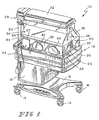
- a patient-support apparatus 10 such as an infant warming device or incubator, illustratively includes a base 12, a plurality of casters 14 extending downwardly from the base 12, and an infant supporting portion or patient support 16 supported above base 12 as shown in Fig. 1 .
- Illustrative patient support 16 includes a pedestal 18 coupled to base 12 for vertical movement, a platform tub 20 supported by pedestal 18, a platform cover 22 coupled to platform tub 20, and a mattress 24 supported on platform tub 20.
- Mattress 24 has an upwardly facing patient-support surface 26.
- Patient-support apparatus 10 also includes a canopy support arm 28 including a telescoping vertical arm 30 and a horizontal overhead arm 32.
- a canopy 34 is coupled to overhead arm 32 and is positioned to lie above platform tub 20.
- Canopy 34 includes a pair of canopy halves 36 coupled to overhead arm 32 for pivoting movement between a lowered position shown in Fig. 1 and a raised position (not shown).
- a pair of transparent side guard panels 38 and a pair of transparent end guard panels 40 extend upwardly from platform tub 20 as shown in Fig. 1 .
- Side guard panels 38 and end guard panels 40 cooperate with canopy halves 36 and overhead arm 32 to provide patient-support apparatus 10 with an isolation chamber.
- Side guard panels 38 are illustratively formed to include a pair of access ports 42, as shown in Fig. 1 .
- patient-support apparatus 10 further includes a line management system as disclosed herein.
- the line management system includes a line port 44, as shown in Fig. 1 and in more detail in Figs. 2 and 3 .
- the line port 44 illustrated in Fig. 2 is positioned adjacent one end of side guard panel 38.
- Port 44 has a line port wall 46 that extends from end guard panel 40.
- line port wall 46 extends from edge 48 of end guard panel 40 at an angle 50 relative to end guard panel 40.
- Angle 50 is illustratively an acute angle that positions line port wall 46 such that a vertically extending slot or space is formed between inner edge 52 and side guard panel 38, the slot being wide enough to allow the passage of lines 54 therethrough.
- FIG. 3 Another embodiment is shown in Fig. 3 , wherein line port wall 46' is hingedly connected for movement relative to end guard panel 40.
- line port wall 46' is hingedly connected for movement relative to end guard panel 40.
- Such a configuration allows line port wall 46' to pivot about a horizontal axis 56 relative to end guard panel 40, thereby moving inner edge 52 either closer to or farther away from side guard panel 38.
- a caregiver inserts medical lines 54 into the appropriate places on line port wall 46', and then pivotably moves line port wall 46' closer toward side guard panel 38 so that the slot between inner edge 52 and side guard panel 38 is minimized.
- line port 44 comprises line port walls 46, 46', a plurality of plates or line supports 58, and a plurality of line holders 60.
- Line supports 58 have top surfaces 62 that support respective lines 54, thereby organizing and arranging the lines 54 that are routed into the isolation chamber of patient-support apparatus 10.
- Line supports 58 extend substantially orthogonally from line port wall 46, 46'. In some embodiments, supports 58 are formed integrally with line port wall 46, 46' and in other embodiments, supports 58 are separate pieces that couple to wall 46, 46'.
- illustrative supports 58 are plate-like elements, it is within the scope of this disclosure for other structures, such as posts, tabs, hooks, fingers, and the like, as well as grooves, channels, or recesses formed in wall 46, 46', to be used as line supports.
- line support as used in this disclosure, including in the claims, is intended to broadly cover all of these structures and the equivalents thereof.
- each line holder 60 is in horizontal alignment and associated with a respective line support 58.
- Line holders 60 are illustratively C-shaped clamps or pairs of closely spaced fingers made of a resilient material that is pliable so that lines 54 can be inserted therebetween.
- line holders including hook-and-loop straps, hooks, straps with snaps, latches, clasps, clamps, and the like are within the scope of this disclosure.
- the term "line holder” as used in this disclosure, including in the claims, is intended to broadly cover all of these structures and the equivalents thereof.
- line supports 58 and line holders 60 need not be used together, but could be used individually.
- only one of line holders 60 or line supports 58 could be coupled to line port walls 46, 46', and still provide at least some arrangement to lines 54 leading into the isolation chamber of patient-support apparatus 10.
- a door 64 is coupled to platform cover 22 for pivotable movement relative to the platform cover 22.
- door 64 is coupled to platform cover 22 with hinges 66.
- Door 64 moves about a horizontal axis between an open horizontal position, shown in Figs. 2-3 , and a closed vertical position, shown in Fig. 1 .
- a gap or passageway (not shown) is formed between edge 48 and door 64 when door 64 is in the closed position.
- the passageway permits the passage of lines 54 between edge 48 and door 64 without displacement of door 64 into a non-closed position, and without compression of lines 54.
- top edge 65 of door 64 is configured to confront or be positioned proximate to bottom edge 67 of canopy 34, as shown in Fig. 1 .
- Each of line supports 58 is illustratively formed such that a first end 68 contacts door 64 when door 64 is in the closed position. Such contact prevents lines 54 from being inadvertently moved to another line support 58 when door 64 is in the closed position.
Landscapes
- Health & Medical Sciences (AREA)
- Life Sciences & Earth Sciences (AREA)
- Public Health (AREA)
- Engineering & Computer Science (AREA)
- General Health & Medical Sciences (AREA)
- Animal Behavior & Ethology (AREA)
- Veterinary Medicine (AREA)
- Biomedical Technology (AREA)
- Medical Informatics (AREA)
- Heart & Thoracic Surgery (AREA)
- Surgery (AREA)
- Molecular Biology (AREA)
- Physics & Mathematics (AREA)
- Pathology (AREA)
- Biophysics (AREA)
- Cardiology (AREA)
- Physiology (AREA)
- Nursing (AREA)
- Pulmonology (AREA)
- Pediatric Medicine (AREA)
- Gynecology & Obstetrics (AREA)
- Pregnancy & Childbirth (AREA)
- Business, Economics & Management (AREA)
- General Business, Economics & Management (AREA)
- Epidemiology (AREA)
- Primary Health Care (AREA)
- Human Computer Interaction (AREA)
- Accommodation For Nursing Or Treatment Tables (AREA)
- Electrotherapy Devices (AREA)
- Infusion, Injection, And Reservoir Apparatuses (AREA)
- Medical Treatment And Welfare Office Work (AREA)
Abstract
Description
- The present disclosure relates to a patient-support apparatus, and particularly to a patient-support apparatus having a line management system. More particularly, the present disclosure relates to a patient-support apparatus having a port integrated into an infant enclosure, or in the alternative, a patient-support apparatus having a port integrated into an infant supporting portion.
- Thermal support devices, such as infant warmers and incubators, having an isolation chamber and various systems that maintain the isolation chamber at a controlled temperature and humidity to facilitate the development of a premature infant are known. Infant thermal support devices conventionally include a patient-support surface for supporting the infant in the isolation chamber and a set of side guard panels arranged around the patient-support surface. Many thermal support devices have a canopy over the patient-support surface. The canopy cooperates with the set of side guard panels to enclose the isolation chamber.
- In such support devices, it is common to have a number of lines, both electronic and fluid, which communicate with the infant. These lines are conduits for electric signals, body fluids, oxygen, or any other substance that might be carried or transmitted either toward or away from the infant. At times, it may be desired to remove one line while leaving the remaining lines undisturbed, and it would therefore be advantageous to have the lines arranged and separated in an organized fashion.
-
US 5,308,310 discloses a patient-support apparatus comprising a support platform and an infant enclosure coupled to the support platform and defining an infant compartment for receiving an infant, and a line management apparatus configured to separate and manage medical lines routed from between outside and inside the infant compartment, the line management apparatus including a panel extending upwardly relative to the support platform. - The invention, which is defined in claim 1, provides a patient-support apparatus which is characterized in that the line management apparatus comprises a plurality of vertically spaced plates coupled to and extending in a cantilever manner from the panel and configured to support medical lines resting thereon.
- The infant enclosure preferably includes a side panel extending upwardly from the support platform and the door panel is aligned in side-by-side relation with the side panel when the door panel is in the first position. An end panel is also coupled to the support platform. A gap is defined between the door panel and the end panel when the door panel is in the first position, and each of the medical lines supported on the plates extends through the gap.
- The infant enclosure further includes a canopy situated above the infant compartment. The canopy has a bottom edge, and the door panel has a top edge that confronts the bottom edge of the canopy when the door panel is in the first position.
- The illustrative plurality of line holders comprises a plurality of flexible fingers that engage the medical lines. The plurality of flexible fingers is grouped into pairs, each pair being associated with a respective one of the plurality of line supports. The flexible fingers of each pair extend away from the panel and have a distal end spaced apart from the panel. A slot is defined between the distal ends of each pair of flexible fingers, and the medical lines are inserted through the slots to be retained by the flexible fingers.
- Additional features will become apparent to those skilled in the art upon consideration of the following detailed description of preferred embodiments exemplifying the best mode of carrying out the patient-support apparatus having a line management system as presently perceived.
- The detailed description particularly refers to the accompanying figures in which:
-
Fig. 1 is a perspective view of a patient-support apparatus according to the present disclosure showing a base, a patient support carried above the base, and an isolation chamber enclosed by an overlying canopy, a pair of transparent side guard panels, and a pair of transparent end panels, and further showing a line port having an access door; -
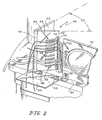
Fig. 2 is an enlarged perspective view of the line port and access door ofFig. 1 , showing the line port positioned adjacent one end of a side guard panel, and showing the line port having a vertical panel or wall, a plurality of horizontally extending line supports coupled to the panel, and a plurality of line holders coupled to the panel; and -
Fig. 3 is an enlarged perspective view of the line port and access door, similar to that ofFig. 2 , showing an alternative embodiment having a movable line port wall. - A patient-support apparatus 10, such as an infant warming device or incubator, illustratively includes a
base 12, a plurality ofcasters 14 extending downwardly from thebase 12, and an infant supporting portion orpatient support 16 supported abovebase 12 as shown inFig. 1 .Illustrative patient support 16 includes apedestal 18 coupled tobase 12 for vertical movement, aplatform tub 20 supported bypedestal 18, aplatform cover 22 coupled toplatform tub 20, and amattress 24 supported onplatform tub 20. Mattress 24 has an upwardly facing patient-support surface 26. - Patient-support apparatus 10 also includes a
canopy support arm 28 including a telescopingvertical arm 30 and ahorizontal overhead arm 32. Acanopy 34 is coupled tooverhead arm 32 and is positioned to lie aboveplatform tub 20. Canopy 34 includes a pair ofcanopy halves 36 coupled tooverhead arm 32 for pivoting movement between a lowered position shown inFig. 1 and a raised position (not shown). - A pair of transparent
side guard panels 38 and a pair of transparentend guard panels 40 extend upwardly fromplatform tub 20 as shown inFig. 1 .Side guard panels 38 andend guard panels 40 cooperate withcanopy halves 36 andoverhead arm 32 to provide patient-support apparatus 10 with an isolation chamber.Side guard panels 38 are illustratively formed to include a pair ofaccess ports 42, as shown inFig. 1 . - According to the present disclosure, patient-support apparatus 10 further includes a line management system as disclosed herein. In one embodiment, the line management system includes a
line port 44, as shown inFig. 1 and in more detail inFigs. 2 and3 . - The
line port 44 illustrated inFig. 2 is positioned adjacent one end ofside guard panel 38.Port 44 has aline port wall 46 that extends fromend guard panel 40. Illustratively,line port wall 46 extends fromedge 48 ofend guard panel 40 at anangle 50 relative toend guard panel 40.Angle 50 is illustratively an acute angle that positionsline port wall 46 such that a vertically extending slot or space is formed betweeninner edge 52 andside guard panel 38, the slot being wide enough to allow the passage oflines 54 therethrough. - Another embodiment is shown in
Fig. 3 , wherein line port wall 46' is hingedly connected for movement relative toend guard panel 40. Such a configuration allows line port wall 46' to pivot about ahorizontal axis 56 relative toend guard panel 40, thereby movinginner edge 52 either closer to or farther away fromside guard panel 38. In operation, a caregiver insertsmedical lines 54 into the appropriate places on line port wall 46', and then pivotably moves line port wall 46' closer towardside guard panel 38 so that the slot betweeninner edge 52 andside guard panel 38 is minimized. - As shown in
Figs. 2-3 ,line port 44 comprisesline port walls 46, 46', a plurality of plates or line supports 58, and a plurality ofline holders 60. Line supports 58 havetop surfaces 62 that supportrespective lines 54, thereby organizing and arranging thelines 54 that are routed into the isolation chamber of patient-support apparatus 10. Line supports 58 extend substantially orthogonally fromline port wall 46, 46'. In some embodiments,supports 58 are formed integrally withline port wall 46, 46' and in other embodiments, supports 58 are separate pieces that couple towall 46, 46'. Althoughillustrative supports 58 are plate-like elements, it is within the scope of this disclosure for other structures, such as posts, tabs, hooks, fingers, and the like, as well as grooves, channels, or recesses formed inwall 46, 46', to be used as line supports. As a result, the term "line support" as used in this disclosure, including in the claims, is intended to broadly cover all of these structures and the equivalents thereof. - Illustratively, each
line holder 60 is in horizontal alignment and associated with arespective line support 58.Line holders 60 are illustratively C-shaped clamps or pairs of closely spaced fingers made of a resilient material that is pliable so thatlines 54 can be inserted therebetween. However, it is within the scope of the disclosure to utilize any method of retaininglines 54 proximate toline port wall 46, 46'. For example, line holders including hook-and-loop straps, hooks, straps with snaps, latches, clasps, clamps, and the like are within the scope of this disclosure. As a result, the term "line holder" as used in this disclosure, including in the claims, is intended to broadly cover all of these structures and the equivalents thereof. - It should be understood that the disclosure also anticipates that line supports 58 and
line holders 60 need not be used together, but could be used individually. For example, only one ofline holders 60 orline supports 58 could be coupled toline port walls 46, 46', and still provide at least some arrangement tolines 54 leading into the isolation chamber of patient-support apparatus 10. - Illustratively, a
door 64 is coupled toplatform cover 22 for pivotable movement relative to theplatform cover 22. As shown inFigs. 2-3 ,door 64 is coupled toplatform cover 22 withhinges 66.Door 64 moves about a horizontal axis between an open horizontal position, shown inFigs. 2-3 , and a closed vertical position, shown inFig. 1 . In the closed position,door 64 is in side-by-side relation withside panel 38, anddoor 64 limits the amount of air that can exchange between the atmosphere and the patient-support apparatus by substantially coveringline port 44. In the illustrated embodiment, a gap or passageway (not shown) is formed betweenedge 48 anddoor 64 whendoor 64 is in the closed position. The passageway permits the passage oflines 54 betweenedge 48 anddoor 64 without displacement ofdoor 64 into a non-closed position, and without compression oflines 54. Whendoor 64 is in the closed position;top edge 65 ofdoor 64 is configured to confront or be positioned proximate tobottom edge 67 ofcanopy 34, as shown inFig. 1 . - Each of line supports 58 is illustratively formed such that a
first end 68contacts door 64 whendoor 64 is in the closed position. Such contact preventslines 54 from being inadvertently moved to anotherline support 58 whendoor 64 is in the closed position. - While the disclosure is susceptible to various modifications and alternative forms, specific exemplary embodiments thereof have been shown by way of example in the drawings and have herein been described in detail. It should be understood, however, that there is no intent to limit the disclosure to the particular forms disclosed.
- There is a plurality of advantages of the present invention arising from the various features of the line management system and associated method described herein. It will be noted that alternative embodiments of the line management system may not include all of the features described yet still benefit from at least some of the advantages of such features.
Claims (15)
- A patient-support apparatus (10) comprising a support platform and an infant enclosure coupled to the support platform and defining an infant compartment for receiving an infant, and a line management apparatus configured to separate and manage medical lines (54) routed from between outside and inside the infant compartment, the line management apparatus including a panel (46) extending upwardly relative to the support platform, characterized in that the line management apparatus comprises a plurality of vertically spaced plates (58) coupled to and extending in a cantilever manner from the panel (46) and configured to support medical lines (54) resting thereon.
- The patient-support apparatus of claim 1, wherein the infant enclosure comprises a door panel (64), each plate (58) of the plurality of plates has an edge that faces away from the panel (46), and the door panel (64) is pivotable about an axis relative to the support platform between a first position covering the edges, and a second position uncovering the edges.
- The patient-support apparatus of claim 2, wherein the axis is a horizontal axis.
- The patient-support apparatus of each of claim 3 or claim 4, wherein the door panel 64 is oriented substantially vertically when in the first position and the door panel is oriented substantially horizontally when in the second position.
- The patient-support apparatus of any one of claims 2 to 4, wherein the infant enclosure comprises a side panel (38) extending upwardly from the support platform and the door panel (64) is aligned in side-by-side relation with the side panel (38) when the door panel (64) is in the first position.
- The patient-support apparatus of any one of claims 2 to 5, wherein the infant enclosure comprises an end panel (40) coupled to the support platform, a gap is defined between the door panel (64) and the end panel (40) when the door panel (64) is in the first position, and each of the medical lines (54) supported on the plates (58) extends through the gap.
- The patient-support apparatus of any one of claims 2 to 6, wherein the infant enclosure comprises a canopy (34) situated above the infant compartment, the canopy (34) has a bottom edge (67), and the door panel (64) has a top edge (65) that confronts the bottom edge (67) of the canopy (34) when the door panel (64) is in the first position.
- The patient-support apparatus of any preceding claim, wherein the panel (46) is pivotable relative to the support platform about an axis.
- The patient-support apparatus of claim 8, wherein the axis is vertical.
- The patient-support apparatus of either claim 8 or claim 9, wherein infant enclosure comprises a guard panel (40) extending upwardly from the support platform and the panel (46) is pivotably coupled to the guard panel (40).
- The patient-support apparatus of any preceding claim, further comprising a plurality of line holders (60) coupled to the panel (46) and configured to inhibit movement of the medical lines off of the plates (58).
- The patient-support apparatus of claim 11, wherein the plurality of line holders comprises a plurality of flexible fingers (60) that engage the medical lines.
- The patient-support apparatus of claim 12, wherein the plurality of flexible fingers (60) are grouped into pairs, each pair being associated with a respective one of the plurality of plates (58).
- The patient-support apparatus of claim 13, wherein the flexible fingers (60) of each pair extends away from the panel (46) and has a distal end spaced apart from the panel (46), a slot is defined between the distal ends of each pair of flexible fingers (60), and the medical lines (54) are inserted through the slots to be retained by the flexible fingers (60).
- The patient-support apparatus of any preceding claim, wherein the plates (58) are configured to extend substantially parallel to a top surface of the infant enclosure.
Applications Claiming Priority (5)
| Application Number | Priority Date | Filing Date | Title |
|---|---|---|---|
| US32749601P | 2001-10-05 | 2001-10-05 | |
| US327496P | 2001-10-05 | ||
| US37341702P | 2002-04-17 | 2002-04-17 | |
| US373417P | 2002-04-17 | ||
| PCT/US2002/031408 WO2003030797A2 (en) | 2001-10-05 | 2002-10-03 | Patient-support apparatus having line management system |
Publications (2)
| Publication Number | Publication Date |
|---|---|
| EP1432375A2 EP1432375A2 (en) | 2004-06-30 |
| EP1432375B1 true EP1432375B1 (en) | 2009-03-18 |
Family
ID=26985895
Family Applications (1)
| Application Number | Title | Priority Date | Filing Date |
|---|---|---|---|
| EP02766462A Expired - Lifetime EP1432375B1 (en) | 2001-10-05 | 2002-10-03 | Patient-support apparatus having line management system |
Country Status (8)
| Country | Link |
|---|---|
| US (1) | US7357772B2 (en) |
| EP (1) | EP1432375B1 (en) |
| AT (1) | ATE425728T1 (en) |
| AU (1) | AU2002330199A1 (en) |
| CA (1) | CA2462565A1 (en) |
| DE (1) | DE60231631D1 (en) |
| ES (1) | ES2323046T3 (en) |
| WO (1) | WO2003030797A2 (en) |
Cited By (1)
| Publication number | Priority date | Publication date | Assignee | Title |
|---|---|---|---|---|
| US10582981B2 (en) | 2016-02-02 | 2020-03-10 | Stryker Corporation | Accessory support and coupling systems for an accessory support |
Families Citing this family (32)
| Publication number | Priority date | Publication date | Assignee | Title |
|---|---|---|---|---|
| US7282022B2 (en) * | 2003-09-26 | 2007-10-16 | General Electric Co | Infant care apparatus with fixed overhead heater |
| DE102004056587A1 (en) * | 2004-11-23 | 2006-05-24 | Lmt Lammers Medical Technology Gmbh | Pulse oximetric measuring device |
| NL1030654C2 (en) * | 2005-12-13 | 2007-06-14 | Univ Delft Tech | Incubator. |
| US9433549B2 (en) | 2005-12-13 | 2016-09-06 | Babybloom Healthcare B.V. | Incubator |
| EP1983958A2 (en) * | 2006-02-08 | 2008-10-29 | Hill-Rom Services, Inc. | Line management device |
| US7850595B2 (en) * | 2007-01-08 | 2010-12-14 | White Robert D | Transferring and holding device for high-risk neonatal intensive care unit (NICU) patients |
| US8079949B2 (en) | 2007-12-05 | 2011-12-20 | Draeger Medical Systems, Inc. | Method and apparatus for providing treatment in a warming device |
| USD601704S1 (en) * | 2007-12-05 | 2009-10-06 | Draeger Medical Systems, Inc. | Warming therary device |
| WO2010033429A1 (en) * | 2008-09-19 | 2010-03-25 | Draeger Medical Systems, Inc. | Warming therapy device including resuscitation control system |
| US9486374B2 (en) * | 2009-07-15 | 2016-11-08 | Hill-Rom Services, Inc. | Medical line manager |
| US8695591B2 (en) | 2010-05-26 | 2014-04-15 | Lloyd Verner Olson | Apparatus and method of monitoring and responding to respiratory depression |
| US10499830B2 (en) * | 2010-07-07 | 2019-12-10 | Aspect Imaging Ltd. | Premature neonate life support environmental chamber for use in MRI/NMR devices |
| US10076266B2 (en) | 2010-07-07 | 2018-09-18 | Aspect Imaging Ltd. | Devices and methods for a neonate incubator, capsule and cart |
| US11278461B2 (en) | 2010-07-07 | 2022-03-22 | Aspect Imaging Ltd. | Devices and methods for a neonate incubator, capsule and cart |
| IL226488A (en) | 2013-05-21 | 2016-07-31 | Aspect Imaging Ltd | Cradle for neonates |
| US8266741B2 (en) * | 2010-08-10 | 2012-09-18 | Hill-Rom Services, Inc. | Bed movement cessation based on IV pump alarm |
| US10794975B2 (en) | 2010-09-16 | 2020-10-06 | Aspect Imaging Ltd. | RF shielding channel in MRI-incubator's closure assembly |
| DE202011051313U1 (en) | 2010-09-16 | 2011-11-23 | Aspect Magnet Technologies Ltd. | Closed life support system for premature babies |
| US9889055B2 (en) * | 2013-03-15 | 2018-02-13 | Segars California Partners, Lp | Infant warming device with rotating patient support power, signal control data and communications |
| US20160199241A1 (en) | 2013-09-02 | 2016-07-14 | Aspect Imaging Ltd. | Incubator with a noise muffling mechanism and method thereof |
| DE202013104934U1 (en) | 2013-11-03 | 2014-01-09 | Aspect Imaging Ltd. | Patiententransportinkubator |
| US10383782B2 (en) | 2014-02-17 | 2019-08-20 | Aspect Imaging Ltd. | Incubator deployable multi-functional panel |
| US9629475B2 (en) * | 2014-12-30 | 2017-04-25 | Google Inc. | Crib with embedded smart sensors |
| US11287497B2 (en) | 2016-08-08 | 2022-03-29 | Aspect Imaging Ltd. | Device, system and method for obtaining a magnetic measurement with permanent magnets |
| US10224135B2 (en) | 2016-08-08 | 2019-03-05 | Aspect Imaging Ltd. | Device, system and method for obtaining a magnetic measurement with permanent magnets |
| US11988730B2 (en) | 2016-08-08 | 2024-05-21 | Aspect Imaging Ltd. | Device, system and method for obtaining a magnetic measurement with permanent magnets |
| CN206390562U (en) | 2016-09-23 | 2017-08-11 | 廖良成 | Electric lifting computer desk and its desk |
| US11019920B2 (en) | 2016-09-23 | 2021-06-01 | Varidesk, Llc | Electrically-lifted computer desk and office desk thereof |
| US11052016B2 (en) | 2018-01-18 | 2021-07-06 | Aspect Imaging Ltd. | Devices, systems and methods for reducing motion artifacts during imaging of a neonate |
| US11123249B2 (en) | 2018-05-02 | 2021-09-21 | Stryker Corporation | Vertically adjustable boom head and cable management therefor |
| USD977110S1 (en) * | 2018-05-21 | 2023-01-31 | Draeger Medical Systems, Inc. | Neonatal care device |
| USD1030063S1 (en) * | 2021-04-19 | 2024-06-04 | Draeger Medical Systems, Inc. | Incubator medical apparatus |
Family Cites Families (20)
| Publication number | Priority date | Publication date | Assignee | Title |
|---|---|---|---|---|
| US2663608A (en) * | 1949-05-19 | 1953-12-22 | Wilbert E Schauer | Swinging drawer cabinet |
| US3470866A (en) * | 1966-11-16 | 1969-10-07 | Stanley B Gittelson | Portable incubator |
| US3858570A (en) * | 1972-06-12 | 1975-01-07 | Puritan Bennett Corp | Comprehensive infant care system |
| DE7334435U (en) | 1973-09-22 | 1974-01-17 | Haenssler J | Mobile control unit for hairdressers, assembly companies or the like |
| DE2433882C3 (en) | 1974-07-15 | 1979-02-01 | Bremshey Ag, 5650 Solingen | Bed cabinet |
| SE434456B (en) | 1981-02-16 | 1984-07-30 | Landstingens Inkopscentral | SENG HOSPITAL |
| DE3915882A1 (en) | 1989-05-16 | 1990-11-22 | Medical Medizinische Einrichtu | Hospital bed with folding upper frame - enables bedside cupboard, to be placed on lower frame for convenient transport |
| US5224674A (en) * | 1989-12-19 | 1993-07-06 | Simons Ramona K | Method and apparatus for organizing and identifying intravenous administration lines |
| US5308310A (en) * | 1992-08-18 | 1994-05-03 | Vitaltrends Technology, Inc. | Plethysmograph system and air-tight sealing assembly therefor |
| DE4228873C1 (en) | 1992-08-29 | 1993-10-21 | Siemens Ag | Transportable medical supply device - has trolley for monitoring and emergency supply system which fits sidewards onto frame of wheeled stretcher |
| US5387177A (en) * | 1993-05-13 | 1995-02-07 | Span-America Medical Systems, Inc. | Adjustable pediatric incubator nest |
| DE29709848U1 (en) * | 1997-06-06 | 1997-08-21 | Kasper, Alfred, 93170 Bernhardswald | Device for receiving and holding hoses |
| US6049924A (en) | 1997-09-09 | 2000-04-18 | Hill-Rom, Inc. | Hinged panels for a thermal support apparatus |
| US6210320B1 (en) * | 1998-04-01 | 2001-04-03 | Small Beginnings, Inc. | Thermal and humidity barrier for extremely premature infants |
| US6481739B1 (en) | 1999-05-12 | 2002-11-19 | Hill-Rom Services, Inc. | Docking assembly |
| US6367476B1 (en) * | 1999-07-12 | 2002-04-09 | Brenda Sue Conn | Medical canopy and support apparatus for canopy and tubes |
| US6626445B2 (en) * | 1999-12-02 | 2003-09-30 | Alcon Universal Ltd. | Cart for surgical console |
| US6336897B1 (en) * | 1999-12-11 | 2002-01-08 | Datex-Ohmeda, Inc. | Grommet for infant care apparatus |
| US6375017B1 (en) * | 2000-03-24 | 2002-04-23 | Omnimed Acquistion Corp | Tubing organizer apparatus |
| US6310294B1 (en) * | 2000-04-03 | 2001-10-30 | At&T Corp. | Vertical separation rack for cable management |
-
2002
- 2002-10-03 WO PCT/US2002/031408 patent/WO2003030797A2/en not_active Ceased
- 2002-10-03 DE DE60231631T patent/DE60231631D1/en not_active Expired - Lifetime
- 2002-10-03 US US10/490,796 patent/US7357772B2/en not_active Expired - Fee Related
- 2002-10-03 AU AU2002330199A patent/AU2002330199A1/en not_active Abandoned
- 2002-10-03 CA CA002462565A patent/CA2462565A1/en not_active Abandoned
- 2002-10-03 AT AT02766462T patent/ATE425728T1/en not_active IP Right Cessation
- 2002-10-03 ES ES02766462T patent/ES2323046T3/en not_active Expired - Lifetime
- 2002-10-03 EP EP02766462A patent/EP1432375B1/en not_active Expired - Lifetime
Cited By (4)
| Publication number | Priority date | Publication date | Assignee | Title |
|---|---|---|---|---|
| US10582981B2 (en) | 2016-02-02 | 2020-03-10 | Stryker Corporation | Accessory support and coupling systems for an accessory support |
| US11000340B2 (en) | 2016-02-02 | 2021-05-11 | Stryker Corporation | Accessory support and coupling systems for an accessory support |
| US11540891B2 (en) | 2016-02-02 | 2023-01-03 | Stryker Corporation | Accessory support and coupling systems for an accessory support |
| US12697261B2 (en) | 2016-02-02 | 2026-08-04 | Stryker Corporation | Patient support apparatus with an accessory support |
Also Published As
| Publication number | Publication date |
|---|---|
| ATE425728T1 (en) | 2009-04-15 |
| AU2002330199A1 (en) | 2003-04-22 |
| DE60231631D1 (en) | 2009-04-30 |
| WO2003030797A3 (en) | 2003-06-19 |
| CA2462565A1 (en) | 2003-04-17 |
| EP1432375A2 (en) | 2004-06-30 |
| US7357772B2 (en) | 2008-04-15 |
| ES2323046T3 (en) | 2009-07-06 |
| US20040186341A1 (en) | 2004-09-23 |
| WO2003030797A2 (en) | 2003-04-17 |
Similar Documents
| Publication | Publication Date | Title |
|---|---|---|
| US7357772B2 (en) | Patient-support apparatus having line management system | |
| US11786428B2 (en) | User module for a patient support apparatus | |
| EP2214617B1 (en) | Warming therapy device including rotatable mattress tray | |
| JP4317617B2 (en) | Rotating infant mattress | |
| US4646211A (en) | Service outlet wall and rail system for use thereon | |
| EP1432374B1 (en) | Infant care apparatus | |
| US7904976B2 (en) | Endboard for a patient support | |
| EP0032133B1 (en) | Isolation incubator | |
| US5452807A (en) | Accessories for pivoted power column | |
| JP2005516635A (en) | Head wall | |
| US6163902A (en) | Trauma table top | |
| US6336897B1 (en) | Grommet for infant care apparatus | |
| EP1106159B1 (en) | Hood for infant care apparatus | |
| CN219645306U (en) | Intelligent dressing cabinet for hospitals | |
| CN211797429U (en) | Fixed subassembly of supporting legs | |
| CN210872667U (en) | Baby box and baby culture device |
Legal Events
| Date | Code | Title | Description |
|---|---|---|---|
| PUAI | Public reference made under article 153(3) epc to a published international application that has entered the european phase |
Free format text: ORIGINAL CODE: 0009012 |
|
| 17P | Request for examination filed |
Effective date: 20040422 |
|
| AK | Designated contracting states |
Kind code of ref document: A2 Designated state(s): AT BE BG CH CY CZ DE DK EE ES FI FR GB GR IE IT LI LU MC NL PT SE SK TR |
|
| AX | Request for extension of the european patent |
Extension state: AL LT LV MK RO SI |
|
| 17Q | First examination report despatched |
Effective date: 20071005 |
|
| GRAP | Despatch of communication of intention to grant a patent |
Free format text: ORIGINAL CODE: EPIDOSNIGR1 |
|
| RAP1 | Party data changed (applicant data changed or rights of an application transferred) |
Owner name: DRAEGER MEDICAL INFANT CARE, INC. |
|
| RAP1 | Party data changed (applicant data changed or rights of an application transferred) |
Owner name: DRAEGER MEDICAL, INC. |
|
| RAP1 | Party data changed (applicant data changed or rights of an application transferred) |
Owner name: DRAEGER MEDICAL SYSTEMS, INC. |
|
| GRAS | Grant fee paid |
Free format text: ORIGINAL CODE: EPIDOSNIGR3 |
|
| GRAA | (expected) grant |
Free format text: ORIGINAL CODE: 0009210 |
|
| AK | Designated contracting states |
Kind code of ref document: B1 Designated state(s): AT BE BG CH CY CZ DE DK EE ES FI FR GB GR IE IT LI LU MC NL PT SE SK TR |
|
| REG | Reference to a national code |
Ref country code: GB Ref legal event code: FG4D |
|
| REG | Reference to a national code |
Ref country code: CH Ref legal event code: EP |
|
| REG | Reference to a national code |
Ref country code: IE Ref legal event code: FG4D |
|
| REF | Corresponds to: |
Ref document number: 60231631 Country of ref document: DE Date of ref document: 20090430 Kind code of ref document: P |
|
| REG | Reference to a national code |
Ref country code: ES Ref legal event code: FG2A Ref document number: 2323046 Country of ref document: ES Kind code of ref document: T3 |
|
| PG25 | Lapsed in a contracting state [announced via postgrant information from national office to epo] |
Ref country code: NL Free format text: LAPSE BECAUSE OF FAILURE TO SUBMIT A TRANSLATION OF THE DESCRIPTION OR TO PAY THE FEE WITHIN THE PRESCRIBED TIME-LIMIT Effective date: 20090318 Ref country code: FI Free format text: LAPSE BECAUSE OF FAILURE TO SUBMIT A TRANSLATION OF THE DESCRIPTION OR TO PAY THE FEE WITHIN THE PRESCRIBED TIME-LIMIT Effective date: 20090318 |
|
| PG25 | Lapsed in a contracting state [announced via postgrant information from national office to epo] |
Ref country code: SE Free format text: LAPSE BECAUSE OF FAILURE TO SUBMIT A TRANSLATION OF THE DESCRIPTION OR TO PAY THE FEE WITHIN THE PRESCRIBED TIME-LIMIT Effective date: 20090618 Ref country code: AT Free format text: LAPSE BECAUSE OF FAILURE TO SUBMIT A TRANSLATION OF THE DESCRIPTION OR TO PAY THE FEE WITHIN THE PRESCRIBED TIME-LIMIT Effective date: 20090318 |
|
| NLV1 | Nl: lapsed or annulled due to failure to fulfill the requirements of art. 29p and 29m of the patents act | ||
| PG25 | Lapsed in a contracting state [announced via postgrant information from national office to epo] |
Ref country code: BE Free format text: LAPSE BECAUSE OF FAILURE TO SUBMIT A TRANSLATION OF THE DESCRIPTION OR TO PAY THE FEE WITHIN THE PRESCRIBED TIME-LIMIT Effective date: 20090318 |
|
| PG25 | Lapsed in a contracting state [announced via postgrant information from national office to epo] |
Ref country code: PT Free format text: LAPSE BECAUSE OF FAILURE TO SUBMIT A TRANSLATION OF THE DESCRIPTION OR TO PAY THE FEE WITHIN THE PRESCRIBED TIME-LIMIT Effective date: 20090826 Ref country code: EE Free format text: LAPSE BECAUSE OF FAILURE TO SUBMIT A TRANSLATION OF THE DESCRIPTION OR TO PAY THE FEE WITHIN THE PRESCRIBED TIME-LIMIT Effective date: 20090318 Ref country code: CZ Free format text: LAPSE BECAUSE OF FAILURE TO SUBMIT A TRANSLATION OF THE DESCRIPTION OR TO PAY THE FEE WITHIN THE PRESCRIBED TIME-LIMIT Effective date: 20090318 |
|
| PG25 | Lapsed in a contracting state [announced via postgrant information from national office to epo] |
Ref country code: SK Free format text: LAPSE BECAUSE OF FAILURE TO SUBMIT A TRANSLATION OF THE DESCRIPTION OR TO PAY THE FEE WITHIN THE PRESCRIBED TIME-LIMIT Effective date: 20090318 |
|
| PLBE | No opposition filed within time limit |
Free format text: ORIGINAL CODE: 0009261 |
|
| STAA | Information on the status of an ep patent application or granted ep patent |
Free format text: STATUS: NO OPPOSITION FILED WITHIN TIME LIMIT |
|
| PG25 | Lapsed in a contracting state [announced via postgrant information from national office to epo] |
Ref country code: BG Free format text: LAPSE BECAUSE OF FAILURE TO SUBMIT A TRANSLATION OF THE DESCRIPTION OR TO PAY THE FEE WITHIN THE PRESCRIBED TIME-LIMIT Effective date: 20090618 Ref country code: DK Free format text: LAPSE BECAUSE OF FAILURE TO SUBMIT A TRANSLATION OF THE DESCRIPTION OR TO PAY THE FEE WITHIN THE PRESCRIBED TIME-LIMIT Effective date: 20090318 |
|
| 26N | No opposition filed |
Effective date: 20091221 |
|
| PG25 | Lapsed in a contracting state [announced via postgrant information from national office to epo] |
Ref country code: MC Free format text: LAPSE BECAUSE OF NON-PAYMENT OF DUE FEES Effective date: 20091031 |
|
| REG | Reference to a national code |
Ref country code: CH Ref legal event code: PL |
|
| REG | Reference to a national code |
Ref country code: FR Ref legal event code: ST Effective date: 20100630 |
|
| PG25 | Lapsed in a contracting state [announced via postgrant information from national office to epo] |
Ref country code: FR Free format text: LAPSE BECAUSE OF NON-PAYMENT OF DUE FEES Effective date: 20091102 |
|
| PG25 | Lapsed in a contracting state [announced via postgrant information from national office to epo] |
Ref country code: LI Free format text: LAPSE BECAUSE OF NON-PAYMENT OF DUE FEES Effective date: 20091031 Ref country code: IE Free format text: LAPSE BECAUSE OF NON-PAYMENT OF DUE FEES Effective date: 20091003 Ref country code: GR Free format text: LAPSE BECAUSE OF FAILURE TO SUBMIT A TRANSLATION OF THE DESCRIPTION OR TO PAY THE FEE WITHIN THE PRESCRIBED TIME-LIMIT Effective date: 20090619 Ref country code: CH Free format text: LAPSE BECAUSE OF NON-PAYMENT OF DUE FEES Effective date: 20091031 |
|
| PG25 | Lapsed in a contracting state [announced via postgrant information from national office to epo] |
Ref country code: GB Free format text: LAPSE BECAUSE OF NON-PAYMENT OF DUE FEES Effective date: 20091003 |
|
| REG | Reference to a national code |
Ref country code: ES Ref legal event code: FD2A Effective date: 20110309 |
|
| PG25 | Lapsed in a contracting state [announced via postgrant information from national office to epo] |
Ref country code: IT Free format text: LAPSE BECAUSE OF FAILURE TO SUBMIT A TRANSLATION OF THE DESCRIPTION OR TO PAY THE FEE WITHIN THE PRESCRIBED TIME-LIMIT Effective date: 20090318 |
|
| PG25 | Lapsed in a contracting state [announced via postgrant information from national office to epo] |
Ref country code: LU Free format text: LAPSE BECAUSE OF NON-PAYMENT OF DUE FEES Effective date: 20091003 |
|
| PG25 | Lapsed in a contracting state [announced via postgrant information from national office to epo] |
Ref country code: ES Free format text: LAPSE BECAUSE OF NON-PAYMENT OF DUE FEES Effective date: 20110308 |
|
| PG25 | Lapsed in a contracting state [announced via postgrant information from national office to epo] |
Ref country code: TR Free format text: LAPSE BECAUSE OF FAILURE TO SUBMIT A TRANSLATION OF THE DESCRIPTION OR TO PAY THE FEE WITHIN THE PRESCRIBED TIME-LIMIT Effective date: 20090318 |
|
| PG25 | Lapsed in a contracting state [announced via postgrant information from national office to epo] |
Ref country code: CY Free format text: LAPSE BECAUSE OF FAILURE TO SUBMIT A TRANSLATION OF THE DESCRIPTION OR TO PAY THE FEE WITHIN THE PRESCRIBED TIME-LIMIT Effective date: 20090318 Ref country code: ES Free format text: LAPSE BECAUSE OF NON-PAYMENT OF DUE FEES Effective date: 20091004 |
|
| PGFP | Annual fee paid to national office [announced via postgrant information from national office to epo] |
Ref country code: DE Payment date: 20181228 Year of fee payment: 17 |
|
| REG | Reference to a national code |
Ref country code: DE Ref legal event code: R119 Ref document number: 60231631 Country of ref document: DE |
|
| PG25 | Lapsed in a contracting state [announced via postgrant information from national office to epo] |
Ref country code: DE Free format text: LAPSE BECAUSE OF NON-PAYMENT OF DUE FEES Effective date: 20200501 |