EP1432210A1 - Dispositif de contrôle de traitements associés a des flux au sein d'un reseau de communications - Google Patents
Dispositif de contrôle de traitements associés a des flux au sein d'un reseau de communications Download PDFInfo
- Publication number
- EP1432210A1 EP1432210A1 EP03292851A EP03292851A EP1432210A1 EP 1432210 A1 EP1432210 A1 EP 1432210A1 EP 03292851 A EP03292851 A EP 03292851A EP 03292851 A EP03292851 A EP 03292851A EP 1432210 A1 EP1432210 A1 EP 1432210A1
- Authority
- EP
- European Patent Office
- Prior art keywords
- application
- communications
- uei
- processing
- terminal
- Prior art date
- Legal status (The legal status is an assumption and is not a legal conclusion. Google has not performed a legal analysis and makes no representation as to the accuracy of the status listed.)
- Granted
Links
- 238000004891 communication Methods 0.000 title claims abstract description 91
- 238000000034 method Methods 0.000 title description 2
- 230000008569 process Effects 0.000 title description 2
- 238000012545 processing Methods 0.000 claims abstract description 57
- 238000000605 extraction Methods 0.000 claims description 36
- 238000013475 authorization Methods 0.000 claims description 5
- 238000012913 prioritisation Methods 0.000 claims description 2
- 238000012217 deletion Methods 0.000 claims 1
- 230000037430 deletion Effects 0.000 claims 1
- 230000004907 flux Effects 0.000 description 10
- 238000011282 treatment Methods 0.000 description 9
- 230000006870 function Effects 0.000 description 8
- 230000005540 biological transmission Effects 0.000 description 6
- 238000012790 confirmation Methods 0.000 description 5
- 230000002457 bidirectional effect Effects 0.000 description 2
- 230000009471 action Effects 0.000 description 1
- 230000000903 blocking effect Effects 0.000 description 1
- 238000004883 computer application Methods 0.000 description 1
- 238000010586 diagram Methods 0.000 description 1
- 230000004069 differentiation Effects 0.000 description 1
- 238000001914 filtration Methods 0.000 description 1
- 230000003993 interaction Effects 0.000 description 1
- 238000007726 management method Methods 0.000 description 1
- 238000012544 monitoring process Methods 0.000 description 1
- 238000005457 optimization Methods 0.000 description 1
- 238000012546 transfer Methods 0.000 description 1
Images
Classifications
-
- H—ELECTRICITY
- H04—ELECTRIC COMMUNICATION TECHNIQUE
- H04B—TRANSMISSION
- H04B7/00—Radio transmission systems, i.e. using radiation field
- H04B7/14—Relay systems
- H04B7/15—Active relay systems
- H04B7/185—Space-based or airborne stations; Stations for satellite systems
- H04B7/18578—Satellite systems for providing broadband data service to individual earth stations
- H04B7/18582—Arrangements for data linking, i.e. for data framing, for error recovery, for multiple access
-
- H—ELECTRICITY
- H04—ELECTRIC COMMUNICATION TECHNIQUE
- H04L—TRANSMISSION OF DIGITAL INFORMATION, e.g. TELEGRAPHIC COMMUNICATION
- H04L67/00—Network arrangements or protocols for supporting network services or applications
- H04L67/50—Network services
- H04L67/60—Scheduling or organising the servicing of application requests, e.g. requests for application data transmissions using the analysis and optimisation of the required network resources
- H04L67/61—Scheduling or organising the servicing of application requests, e.g. requests for application data transmissions using the analysis and optimisation of the required network resources taking into account QoS or priority requirements
-
- H—ELECTRICITY
- H04—ELECTRIC COMMUNICATION TECHNIQUE
- H04L—TRANSMISSION OF DIGITAL INFORMATION, e.g. TELEGRAPHIC COMMUNICATION
- H04L69/00—Network arrangements, protocols or services independent of the application payload and not provided for in the other groups of this subclass
- H04L69/30—Definitions, standards or architectural aspects of layered protocol stacks
- H04L69/32—Architecture of open systems interconnection [OSI] 7-layer type protocol stacks, e.g. the interfaces between the data link level and the physical level
- H04L69/322—Intralayer communication protocols among peer entities or protocol data unit [PDU] definitions
- H04L69/329—Intralayer communication protocols among peer entities or protocol data unit [PDU] definitions in the application layer [OSI layer 7]
-
- H—ELECTRICITY
- H04—ELECTRIC COMMUNICATION TECHNIQUE
- H04L—TRANSMISSION OF DIGITAL INFORMATION, e.g. TELEGRAPHIC COMMUNICATION
- H04L63/00—Network architectures or network communication protocols for network security
- H04L63/16—Implementing security features at a particular protocol layer
- H04L63/164—Implementing security features at a particular protocol layer at the network layer
-
- H—ELECTRICITY
- H04—ELECTRIC COMMUNICATION TECHNIQUE
- H04L—TRANSMISSION OF DIGITAL INFORMATION, e.g. TELEGRAPHIC COMMUNICATION
- H04L69/00—Network arrangements, protocols or services independent of the application payload and not provided for in the other groups of this subclass
- H04L69/30—Definitions, standards or architectural aspects of layered protocol stacks
- H04L69/32—Architecture of open systems interconnection [OSI] 7-layer type protocol stacks, e.g. the interfaces between the data link level and the physical level
Definitions
- the invention relates to the field of communications between terminals. of a communications network, and more particularly the management of treatment (s), such as quality of service and security, associated with application data exchanged between terminals.
- treatment such as quality of service and security
- terminal means any network equipment, and including user equipment, such as desktop computers or laptops, landline or mobile phones, routers or servers.
- CMOS complementary metal-oxide-semiconductor
- VoIP voice over IP
- MMoIP multimedia over IP
- ftp ftp
- treatments such as a certain level of quality of service (or QoS for “Quality of Service”) and / or a certain level of security (authentication and / or encryption).
- QoS quality of service
- security authentication and / or encryption
- a communications station like for example a satellite terminal, only has information contained in the data received. For example, in the case of packets of IP data the communications station has source IP addresses and recipient, source and recipient ports, and possibly a marking, for example of the Diffserv type.
- ports are recommended for some applications, such as port 25 for email (or "E-mail”) and port 80 for the Internet (or “web”), but the resulting allocation such recommendations are usually made dynamically or negotiated via a control channel (such as ftp, h323 or sip). But if we cannot spy on this control channel by monitoring connections (which requires knowing the protocol specific to each application, which is often encrypted), it is impossible to determine the application concerned.
- a control channel such as ftp, h323 or sip
- the object of the invention is therefore to remedy all or part of the aforementioned drawbacks.
- a device dedicated to processing control (s), such as quality of service (QoS) and security, associated with workflow data from applications, within a communications network comprising communications stations, on the one hand, coupled to communications terminals with at least one application and a kernel (or operating system) containing information data representative of these applications, and on the other hand, capable of exchanging between them data streams from communications terminals.
- processing control such as quality of service (QoS) and security
- each communications terminal of the network is equipped with extraction means and treatment means, and each station of communications is equipped with means of control.
- the means of control stations can operate independently, or distributed. In the latter case, they deliver their configuration data to receipt of an authorization (or confirmation) issued by a central server such a bandwidth manager (or “bandwidth broker”) or an NCC (for "Network Control Center”), or a key server responsible for distribute keys to secure links (or links).
- a central server such a bandwidth manager (or “bandwidth broker”) or an NCC (for "Network Control Center”)
- a key server responsible for distribute keys to secure links (or links).
- the invention also relates, firstly, to a terminal for communications comprising means of extraction and means of treatment of a device of the type presented above, of a second hand, on a communications terminal comprising a device of the type of the one presented above, on the third hand, on a communications, for example a satellite terminal, equipped with means of control of a device of the type presented above, and of a fourth share, on a communications network, equipped with such terminals and / or such communications stations and preferably chosen from networks satellite and wireless networks.
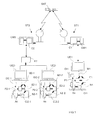
- Figure 1 We first refer to Figure 1 to describe, by way of example Illustrative, a satellite-type communications network equipped with a device according to the invention.
- the invention is not limited to this type network. It concerns all types of network capable of performing at least one processing on the data flows (such as quality service (or QoS), priority, security, filtering and the like) and especially wireless networks, such as local networks without wire (or WLAN for "Wireless Local Area Network”), local radio loops (or BLR), and point-to-multipoint wireless access.
- QoS quality service
- WLAN Wireless Local Area Network
- BLR local radio loops
- a communications terminal UEi and a STi communications station can be combined in one and the same equipment. This can in particular be the case when the communications is carried out in the form of a PCI card plugged into a PC type communications terminal.
- the communication terminals are user equipment UE1 and UE2-k, such as stationary computers or portable. But, it could be any type of communications terminal capable of exchanging data with other terminals or equipment network, such as mobile or landline phones, fax machines, personal digital assistants (or PDA for "Personal Digital Assistant ”), or content provider servers (or ASP for "Application Service Provider").
- the UE2-k user equipment is here coupled to the R2 router of a private network, such as a LAN (or "Local Area Network").
- a private network such as a LAN (or "Local Area Network”).
- the UE2-k communications terminals could not not be connected to a private or public network, whatever the type. They can indeed be coupled, like the communications terminal UE1 to one of the STi communications stations in the network, directly, for example by bus, or indirectly, for example via a hub. But, in this case, they must be equipped so that they can exchange information.
- the stations of STi communications are satellite terminals arranged to exchange data frames (eg level three IP) encapsulated according to the Ethernet level two transmission protocol.
- the invention is not limited to a protocol for transmitting level two according to the OSI layered model. It concerns all transmission protocols, and in particular 802.4, 802.5 or 802.11.
- the invention relates more particularly to the protocols for level two (2) or three (3), but it also concerns the protocols of other levels and in particular those of levels one (1) (physical layer) and seven (7) (layer of applications).
- Each STi satellite terminal includes a communications Ci responsible, on the one hand, for determining how to route frames to their destinations thanks to a routing table usually learned by learning, and secondly, to transmit the frames on the air and wired interfaces of the satellite network.
- Function routing is also called “bridging” (or “bridge”) because that being responsible for processing only the Ethernet transmission protocol it happy to provide a traffic switching function based on physical ethernet addresses contained in the frames.
- This module of communications Ci being well known to those skilled in the art, it will not be described here in detail. It is simply recalled that it is defined by the IEEE 802.1d standard.
- each user equipment UEi here comprises a operating system or Ni-k kernel, with at least one protocol stack, and one or more An applications for delivering data from different types.
- one of the applications is of the “voice over IP” type. (or VolP).
- any other type of application can be implemented in a communications terminal UEi, and in particular multimedia over IP, the email (usually associated with port 25), and access to Internet (usually associated with port 80).
- each user equipment UEi comprises also a Cli-k interface, dedicated to real-time flow control networks associated with applications, and a Gli-k graphical interface, by GUI type example (for "Graphical User Interface”).
- the Cli-k flow control interface is for example of the type of that intended for firewalls, such as the interface of the Microsoft company, or the Linux “ipchain”. This type of interface has been developed to allow a user to choose, thanks to a window which opens dynamically, the processing to be applied to an IP flow, and in particular the authorization to access a satellite network, the allocation of a quality of service, security (authentication and / or encryption (or encryption)), session establishment and association with codes error correctors.
- the invention provides a device dedicated to processing control (s), such as quality of service (QoS) and security, associated with data flow from applications installed in equipment UEi users.
- s processing control
- QoS quality of service
- security associated with data flow from applications installed in equipment UEi users.
- This control device comprises, firstly, means Pi-k processor responsible for delivering representative service data at least one processing associated with a designated application, a second part, Ei-k extraction means responsible for accessing the Ni-k nucleus of a UEi-k user equipment having sent a data stream in order to determine the application associated with this flow, then deliver to the means of processing Pi-k a message designating the determined application, and means of CMi checks loaded, when they receive delivered service data by the Pi-k processing means, to deliver configuration data allowing at least one treatment adapted to the needs of the application associated with the stream received, by the satellite terminal STi to which is coupled the UEi-k user equipment from which the flow originates.
- the means of processing and the means of extraction of each control device are distributed as Pi-k processing and Ei-k extraction modules in each UEi-k user equipment that said device controls.
- the control means of each device are preferably arranged in the form of a CMi control module installed in each station STi communications.
- the satellite network has two control devices.
- the first device includes the module control unit CM1, installed in the satellite terminal ST1, and the modules E1 extraction and P1 processing, installed in the user equipment EU1.
- the second device includes the CM2 control module, located in the ST2 satellite terminal, and the E2-1 and E2-2 extraction modules and P2-1 and P2-2 processing, installed in UE2-1 user equipment and UE2-2.
- each Ei-k extraction module observes all the flows of data entering and leaving UEi-k equipment in which it is implanted.
- the extraction module Ei-k is preferably installed in the Ni-k core protocol stacks. In particular, it can act as a "Hook" or a pilot.
- each Ei-k extraction module determines preferably the An application which is associated with a flow via of the Cli-k control interface.
- Each IP packet corresponds in fact to a connector (or "socket") which is open in UEi-k equipment identifiable by its port number. And the correspondence between the port, the connector (or socket) and the identifier of the application is available through functions made available by the Ni-k operating system of UEi-k equipment.
- each Ei-k extraction module keeps up to date a correspondence table between flow identifiers and identifiers applications from the information data it gets in the kernel Ni-k when accessing the Cli-k control interface. This can allow him to determine more quickly the application associated with a feed it has just detect and whose type it has just identified.
- an Ei-k extraction module when it has determined the application associated with a flow, it addresses to the processing module Pi-k, to which it is coupled, a message designating the determined application, of so that it can in turn determine the service data (or context), representative of the quality of service and / or safety, associated with this application.
- the Pi-k processing module interrogates preferably a correspondence table between the applications, listed in the UEi-k user equipment, and the data of service.
- This correspondence table (or context table) is preferably stored in a memory Mi-k of the equipment UEi-k concerned.
- each context table is preferably maintained by each Ei-k extraction module from data information provided by the user of UEi-k equipment either in the form a configuration file, either via the Gli-k graphical interface UEi-k equipment.
- the context table could be performed by the Pi-k processing module.
- the Pi-k processing is preferably arranged so as to address a user, via the Gli-k graphic interface of his UEi-k equipment, a message asking him to provide said service data. These can then be optionally integrated into the context table, after any authorization from the user.
- a Pi-k processing module When a Pi-k processing module has determined the context (or service data) associated with the application, it delivers to the control module CMi, which is located in the STi satellite terminal to which is coupled the UEi-k user equipment from which the flow originates, configuration for configuring said STi satellite terminal.
- This configuration is intended to allow the STi satellite terminal to update willingness of the flow to transmit resources adapted to the needs of quality of service and / or security of the application with which it is associated.
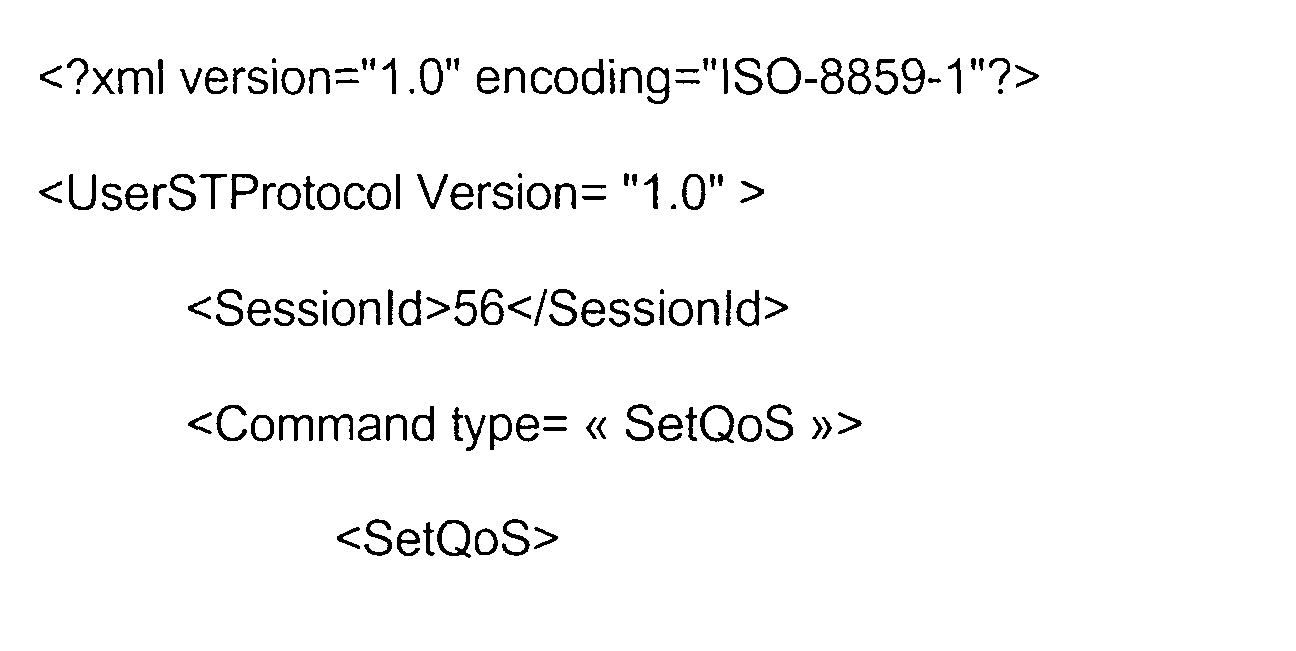
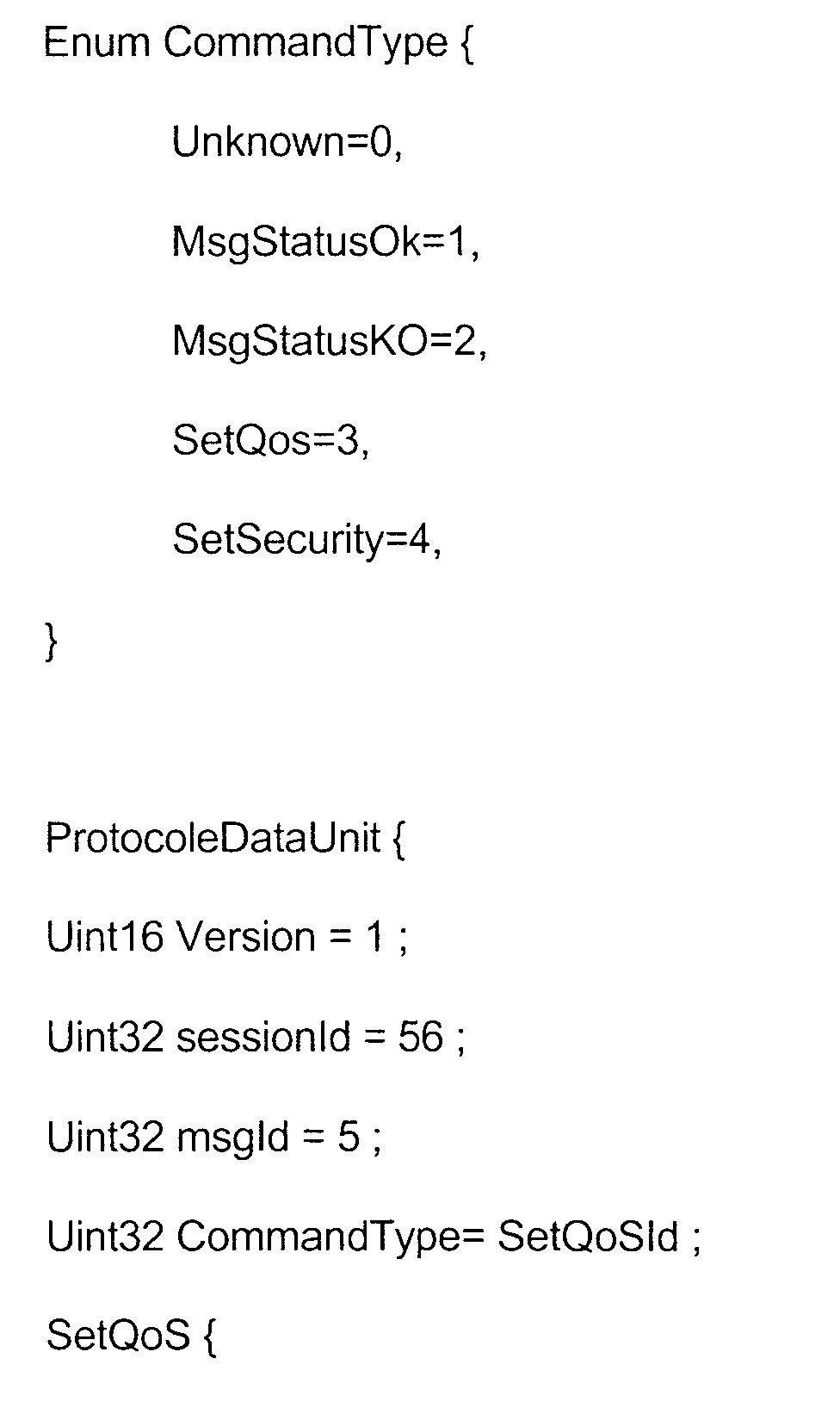
- CMi control module The transmission of configuration data between a module Pi-k processing and a CMi control module, preferably performed according to a communication protocol chosen at least from the protocol SNMP, XML and RSVP or one of its extensions. But, of course, one could also use a proprietary protocol.
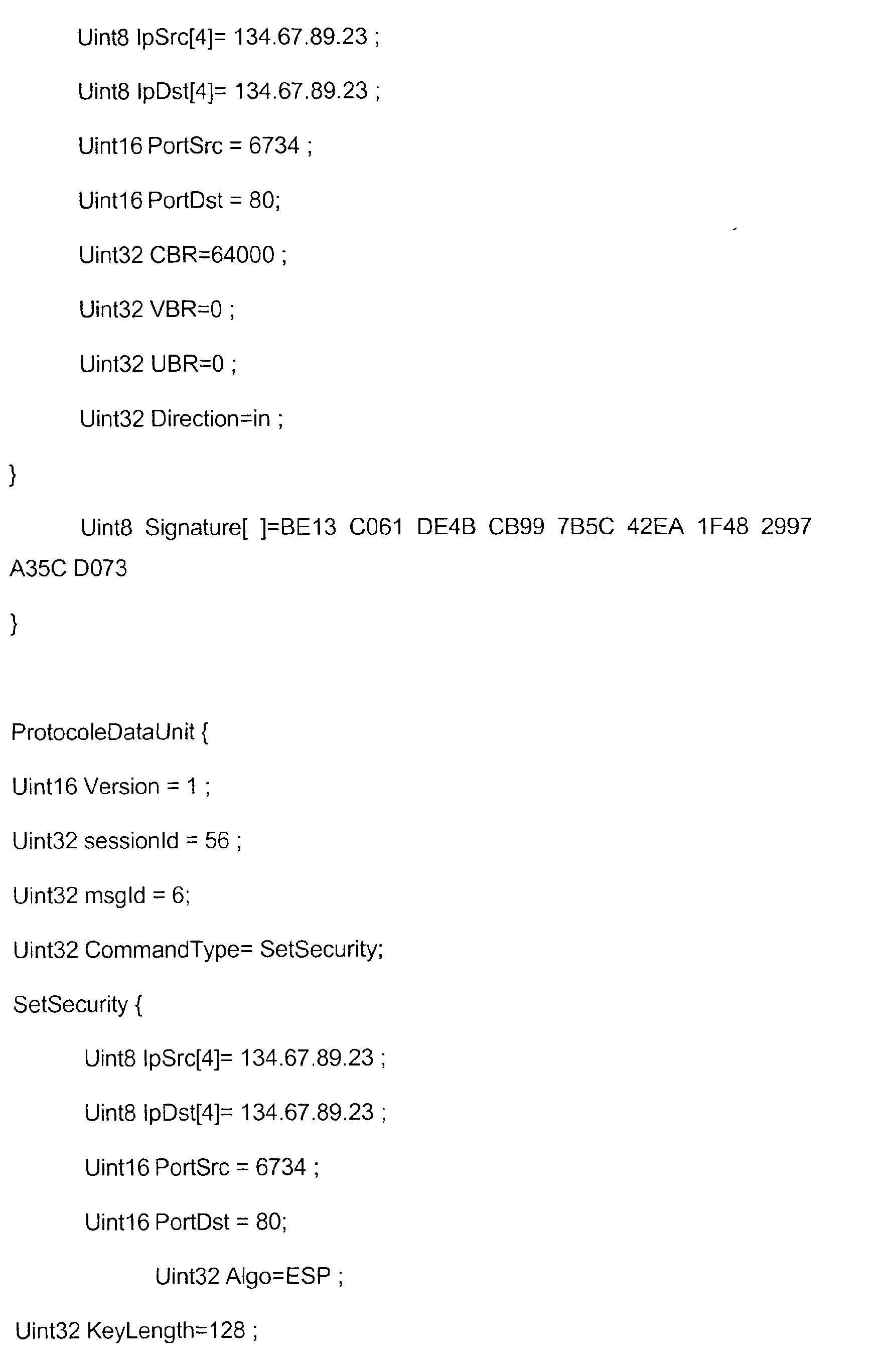
- the message containing the configuration data which is indicated below and which is sent by the user agent Pi-k to the satellite terminal STi, requests its control module CMi to provide a quality of service (QoS) of the type Constant Bit Rate (CBR) of 64kbit / s for the IP flow in the direction going from the STi satellite terminal to the SAT satellite, and to secure the transmission on the satellite link with an IPSec ESP type link (with 128-bit key) dynamic).
- QoS quality of service
- CBR Constant Bit Rate
- the Pi-k user agent is identified by a session number (56), and the message is signed.
- an optimized messaging function can be used between the user agent Pi-k, of the equipment UEi-k, and the control agent CMi, of the terminal of STi satellite, based on UDP sockets carrying C structures.
- the third example is based on the RSVP protocol which is defined by RFC 2205. Its main interest lies in its interaction with certain routers which can take into account or ignore extensions, thus allowing a reservation of bandwidth and securing of end to end or by section.
- IP flows are defined by RFC 2210 and that authentication of RSVP messages is defined by RFC 2747 standard. in addition, messages are transported here in message extensions RSVP.
- the STi satellite terminal when passing a PATH message, the STi satellite terminal add in the private fields which encapsulate the useful data (or payload) all information useful for their identification. Securing the link satellite therefore starts when an RSVP RESV message is received.
- QoS requests are updated in the RSVP PATH messages, and applied upon receipt of the RSVP RESV message.
- Optimization of messaging, resource reservations and the establishment of a secure satellite link can be done with high timers (or timers) or semi-statically (in case of release on request).
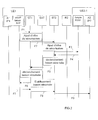
- application A1 running on the equipment user UE1, internet address IP1, sends data to UE2 user equipment, IP2 internet address, using the protocol Internet IP.
- the following processing is associated with this application A1: "Secure on the satellite link between stations ST1 and ST2".
- the data can start to be issued without security and be secure in progress transmission, or be blocked by the UE1 equipment until there has been confirmation of link security (as in the illustrated example).
- An RSVP PATH packet to the UE2 user equipment is therefore constructed by the user equipment UE1.
- This package contains the description of the IP flow and extensions specifying the treatment to be applied to it.
- This packet is sent to the station ST1 respecting the routing protocol IP (arrow F1).
- Station ST1 interprets the RSVP extensions of the PATH message, and y optionally adds information about its satellite address. Then she does follow the message to station ST2 using the satellite network (arrow F2).
- Station ST2 interprets the RSVP extensions of the PATH message, and there optionally adds information about its satellite address. Then she does follow the message to equipment UE2 (arrow F3).
- the part of the UE2 equipment responsible for RSVP interprets the RSVP PATH message, and returns an RSVP message to station ST2 RESV which takes the information from the PATH message (arrow F4).
- Station ST2 interprets the RSVP extensions of the RESV message, and initializes the securing of the satellite link between ST1 and ST2. Then she sends the message to station ST1 (arrow F5).
- Station ST1 interprets the RSVP extensions of the RESV message, including adds the confirmation of the securing of the satellite link with the station ST2, and forwards the message to the equipment UE1 (arrow F6).
- the user equipment UE1 then receives the confirmation of the secure the link, and can exchange data with the equipment user UE2 on the secure satellite link between stations ST1 and ST2 (arrows F7, F8 and F9).
- the CMi-k control module configures the MAC layer satellite (for “Medium Access Contrl”) of one of the protocol stacks of the STi satellite terminal so that processing can be applied to the stream IP. More precisely, this consists in prioritizing and / or encrypting within the satellite MAC layer source and destination addresses and source ports and destination.
- the ST station can perform any processing on streams. he can in particular be a prioritization of certain flows, a QoS on certain flows, removal of unwanted flow (s), encryption or of a flow signature, and the like.
- these flows can be, in particular, of IP, ATM level, Ethernet, MPLS, satellite, applications, and the like.
- the control device can not only allow so-called outbound flow control, as described above, but it can also allow control of so-called incoming flows and so-called bidirectional flows.
- each Pi-k processing module is preferably arranged so as to deliver to the CMi control module to which it is coupled, service data representative of the quality of service and / or security associated with an application flow to be received by the communications module Ci of the satellite terminal STi in which it is implanted.
- the CMi control module can configure the terminal of satellite STi so that it reserves for the incoming flow, which must coming soon from a remote ST communications terminal, resources, a satellite link from the remote satellite terminal to itself, adapted to the quality of service and / or security needs of the application to which said incoming stream is associated.
- the Pi-k processing module is preferably arranged so as to deliver to the control module CMi to which it is coupled, service data representative of the quality of service and / or the security associated with outgoing and incoming application flows.
- the CMi control module can configure its STi satellite terminal so that it reserves, both for future outgoing flows and for future incoming flows, resources, a two-way satellite link, adapted to the needs of quality of service and / or security of the application to which said flows inbound and outbound are associated.
- the action of the device on a flow of packets concerns all the packets of this flux.
- the first packets of a flow are transmitted by the STi satellite terminal without security and / or without quality of and that security and / or quality of service are established "at the stolen ”for the following packages.
- Diffserv type markings can be used to allow flow differentiation at a STi satellite terminal.
- the Diffserv protocol makes it possible to use bits of the header of an IP stream to specify the type of this flow.
- each extraction module Ei-k (from preferably) can be arranged to require IP packets to be observed at the level of the Ni-k nucleus, a Diffserv marking consistent with the needs of the associated application and of course with the network capabilities satellite.
- the Pi-k processing module must then report to the CMi check that the Diffserv marking used is consistent and must be taken into account account. In this case, markings of IP streams that are not of the same type are ignored and these IP flows are managed with the quality of service by default.
- the CMi control module of a station can operate independently, or distributed. In this last case, it delivers its configuration data after receiving an authorization (or confirmation) from a central server such as a tape manager bandwidth (or “bandwidth broker”) or an NCC (for "Network Control Center ”), or a key server responsible for distributing keys for secure links (or links).
- a central server such as a tape manager bandwidth (or “bandwidth broker”) or an NCC (for "Network Control Center ”), or a key server responsible for distributing keys for secure links (or links).
- control system and more precisely its modules treatment P, extraction E and control C, as well as possibly each memory M, can be implemented in the form of electronic circuits, software (or computer) modules, or a combination of circuits and software.
- Basic operation of the control device according to the invention can be summarized by the example described below.
- a user launches an ftp application located in his user equipment UE1 in order to transfer (or “upload”) a file to the server on his network.
- the ftp application then sends a first packet IP to establish a TCP connection with said server.
- the extraction module E1 installed in the equipment UE1 detects the first IP packet at the N1 kernel of its UE1 equipment, and recovers all the information associated with it (IP addresses, ports, ftp application, name, icon, etc.) to identify the application. He then addresses to the processing module P1 to which it is coupled a message designating the ftp application.
- the processing module P1 determines in the context table memory M1 if there is service data (or context) associated with the ftp application. If for example this is not the case, it opens a window of dialogue thanks to the graphical interface G11 of the UE1 equipment for ask the user for the service data (or context) they want associate with the ftp application. For example, the user wants a speed of 100 kbits / s and encryption (or encryption) of the communication.
- the user can optionally control the actual flow entering / leaving his UE1 equipment, and decide to modify the context associated with the IP flow of the ftp application.
- the invention is not limited to the network embodiments, communications station, communications terminal and communication device control described above, only as an example, but it encompasses all the variants that a person skilled in the art may envisage within the framework of claims below.
- communications networks of the satellite type but the invention relates all networks in which it is possible to associate at least one treatment particular to a data flow.
Landscapes
- Engineering & Computer Science (AREA)
- Computer Networks & Wireless Communication (AREA)
- Signal Processing (AREA)
- Computer Security & Cryptography (AREA)
- Physics & Mathematics (AREA)
- Astronomy & Astrophysics (AREA)
- Aviation & Aerospace Engineering (AREA)
- General Physics & Mathematics (AREA)
- Data Exchanges In Wide-Area Networks (AREA)
Abstract
Description
- des moyens de traitement chargés, lorsqu'ils reçoivent un message désignant une application, de délivrer des données de service représentatives d'au moins un traitement associé à cette application désignée,
- des moyens d'extraction chargés, lorsqu'ils reçoivent un flux de données émis par un terminal de communications, d'accéder au noyau de ce terminal afin de déterminer l'application associée à ce flux reçu, puis de délivrer aux moyens de traitement un message désignant l'application déterminée, et
- des moyens de contrôle chargés, lorsqu'ils reçoivent des données de service délivrées par les moyens de traitement, de délivrer des données de configuration permettant au moins un traitement adapté aux besoins de l'application associée au flux reçu par la station de communications à laquelle est couplé le terminal dont est issu le flux.
- des moyens d'extraction capables, lorsque le noyau de chaque terminal de communications comporte une interface de contrôle en temps réel des flux réseaux associés aux applications, et lorsqu'ils reçoivent un flux de données, d'accéder à l'interface de contrôle afin de déterminer l'application associée au flux reçu ;
- des moyens de mémorisation pouvant stocker une table de correspondance entre les applications et les données de service. Dans ce cas, les moyens de traitement sont chargés, lorsqu'ils reçoivent un message désignant une application, d'accéder aux moyens de mémorisation afin de déterminer des données de service stockées en correspondance de l'application désignée. Par ailleurs, lorsqu'il n'existe pas de données de services stockées dans les moyens de mémorisation en correspondance d'une application désignée, les moyens de traitement sont préférentiellement agencés de manière à adresser à un utilisateur, via l'interface graphique du terminal de communications dans lequel sont implantés les moyens d'extraction, un message lui demandant de fournir les données de service associées à l'application désignée ;
- des moyens d'extraction chargés de mettre à jour la table de correspondance en fonction d'informations reçues, par exemple, sous la forme d'un fichier de configuration ou d'une interface graphique du terminal de communications dans lequel sont implantés les moyens d'extraction ;
- des moyens d'extraction implantés préférentiellement dans l'une des piles de protocoles du noyau de chaque terminal de communications ;
- des moyens de contrôle agencés, lorsque chaque station de communications possède au moins une pile de protocoles agencée en couches, dont une couche MAC, et lorsqu'ils reçoivent des données de service, pour délivrer des données de configuration permettant de configurer la couche MAC en fonction des besoins associés à un flux à transmettre ou à recevoir ;
- des moyens de traitement capables de délivrer aux moyens de contrôle des données de service représentatives d'au moins un traitement, comme par exemple la qualité de service et/ou la sécurité, associé(s) à des flux à recevoir d'une application implantée dans un terminal de communications distant ;
- des moyens de traitement et des moyens de contrôle capables d'échanger des messages de service (contenant les données de service) selon un protocole d'échange choisi au moins parmi un protocole propriétaire, le protocole SNMP, le protocole XML et le protocole RSVP.
- la figure 1 illustre de façon schématique une partie d'un réseau de communications équipé de dispositifs de contrôle selon l'invention, et
- la figure 2 est un diagramme chronologique illustrant de façon schématique un exemple d'utilisation du protocole RSVP pour la sécurisation d'une liaison satellite.



Claims (19)
- Dispositif de contrôle de traitement(s) associé(s) à des flux de données d'applications, pour un réseau de communications comprenant des stations de communications (STi) propres à échanger entre-elles des flux de données et couplées à des terminaux de communications (UEi-k) munis d'au moins une application (An) et d'un noyau (Ni-k) contenant des données d'informations représentatives desdites applications, caractérisé en ce qu'il comprend i) des moyens de traitement (Pi-k) agencés, à réception d'un message désignant une application, pour délivrer des données de service représentatives d'au moins un traitement associé à ladite application désignée, ii) des moyens d'extraction (Ei-k) agencés, à réception d'un flux de données émis par un terminal de communications (UEi-k), pour accéder au noyau (Ni-k) dudit terminal de manière à déterminer l'application associée audit flux reçu, puis délivrer auxdits moyens de traitement (Pi-k) un message désignant ladite application déterminée, et iii) des moyens de contrôle (CMi-k) agencés, à réception de données de service délivrées par lesdits moyens de traitement, pour délivrer des données de configuration propres à permettre au moins un traitement adapté aux besoins de l'application associée au flux reçu, par la station de communications (STi) à laquelle est couplé le terminal (UEi-k) duquel est issu ledit flux.
- Dispositif selon la revendication 1, caractérisé en ce que chaque noyau (Ni-k) de terminal de communications (UEi-k) comportant une interface (Cl-k) de contrôle en temps réel des flux réseaux associés auxdites applications, lesdits moyens d'extraction (Ei-k) sont agencés, à réception d'un flux de données, pour accéder à ladite interface de contrôle (Cl-k) de manière à déterminer l'application associée audit flux reçu.
- Dispositif selon l'une des revendications 1 et 2, caractérisé en ce qu'il comprend des moyens de mémorisation (Mi-k) propres à stocker une table de correspondance entre lesdites applications et lesdites données de service, et en ce que lesdits moyens de traitement (Pi-k) sont agencés, à réception d'un message désignant une application, pour accéder auxdits moyens de mémorisation (Mi-k) de manière à déterminer des données de service stockées en correspondance de ladite application désignée.
- Dispositif selon la revendication 3, caractérisé en ce qu'en l'absence, dans lesdits moyens de mémorisation (Mi-k), de données de services stockées en correspondance d'une application désignée, lesdits moyens de traitement (Pi-k) sont agencés pour adresser à un utilisateur, via une interface graphique (Gl-k) du terminal de communications (UEi-k) dans lequel lesdits moyens d'extraction (Ei-k) sont implantés, un message requérant lesdites données de service associées à l'application désignée.
- Dispositif selon l'une des revendications 3 et 4, caractérisé en ce que lesdits moyens d'extraction (Ei-k) sont agencés pour mettre à jour ladite table de correspondance en fonction d'informations reçues.
- Dispositif selon la revendication 5, caractérisé en ce que lesdites informations de mise à jour sont contenues dans un fichier de configuration reçu par le terminal de communications (UEi-k) dans lequel lesdits moyens d'extraction (Ei-k) sont implantés.
- Dispositif selon la revendication 5, caractérisé en ce que lesdites informations de mise à jour sont délivrées par une interface graphique (Gl-k) du terminal de communications (UEi-k) dans lequel lesdits moyens d'extraction (Ei-k) sont implantés.
- Dispositif selon l'une des revendications 1 à 7, caractérisé en ce que lesdits moyens d'extraction (Ei-k) sont implantés dans une pile de protocoles d'un noyau (Ni-k) de terminal de communications (UEi-k).
- Dispositif selon l'une des revendications 1 à 8, caractérisé en ce que, chaque station de communications (STi) possédant au moins une pile de protocoles agencée en couches, dont une couche MAC, lesdits moyens de contrôle (CMi) sont agencés, à réception de données de service, pour délivrer des données de configuration propres à configurer ladite couche MAC en fonction des besoins associés à un flux à transmettre ou à recevoir.
- Dispositif selon l'une des revendications 1 à 9, caractérisé en ce que lesdits moyens de traitement (Pi-k) sont agencés pour délivrer auxdits moyens de contrôle (CMi) des données de service représentatives d'au moins un traitement associé à des flux à recevoir d'une application implantée dans un terminal de communications (UEi-k) distant.
- Dispositif selon l'une des revendications 1 à 10, caractérisé en ce que lesdits moyens de contrôle (CMi) sont agencés pour délivrer lesdites données de configuration à réception d'une autorisation délivrée par un serveur central dudit réseau.
- Dispositif selon l'une des revendications 1 à 11, caractérisé en ce que lesdits moyens de traitement (Pi-k) et lesdits moyens de contrôle (CMi) sont agencés pour échanger des messages de service contenant lesdites données de service selon un protocole d'échange choisi parmi un protocole propriétaire, le protocole SNMP, le protocole XML et le protocole RSVP.
- Dispositif selon l'une des revendications 1 à 12, caractérisé en ce que ledit traitement est choisi dans un groupe comprenant au moins la qualité de service, le chiffrement, l'authentification, l'établissement de session, la priorisation de flux et la suppression de flux.
- Terminal de communications (UEi-k), caractérisé en ce qu'il comprend des moyens d'extraction (Ei-k) et des moyens de traitement (Pi-k) d'un dispositif de contrôle selon l'une des revendications précédentes.
- Terminal de communications (UEi-k), caractérisé en ce qu'il comprend un dispositif de contrôle selon l'une des revendications 1 à 13.
- Station de communications (STi), caractérisée en ce qu'elle comprend des moyens de contrôle (CMi) d'un dispositif de contrôle selon l'une des revendications 1 à 13.
- Station selon la revendication 16, caractérisée en ce qu'elle est agencée sous la forme d'un terminal de satellite.
- Réseau de communications, caractérisé en ce qu'il comprend une multiplicité de stations de communications (STi) selon l'une des revendications 16 à 17 et de terminaux de communications (UEi-k) selon l'une des revendications 16 à 17 et des terminaux de communications (UEi-k) selon l'une des revendications 14 à 15.
- Réseau de communications selon la revendication 18, caractérisé en ce qu'il est choisi dans un groupe comprenant au moins les réseaux satellitaires et les réseaux sans fil.
Applications Claiming Priority (2)
| Application Number | Priority Date | Filing Date | Title |
|---|---|---|---|
| FR0216339 | 2002-12-20 | ||
| FR0216339A FR2849313B1 (fr) | 2002-12-20 | 2002-12-20 | Dispositif de controle de traitements associes a des flux au sein d'un reseau de communications |
Publications (2)
| Publication Number | Publication Date |
|---|---|
| EP1432210A1 true EP1432210A1 (fr) | 2004-06-23 |
| EP1432210B1 EP1432210B1 (fr) | 2013-01-23 |
Family
ID=32338987
Family Applications (1)
| Application Number | Title | Priority Date | Filing Date |
|---|---|---|---|
| EP03292851A Expired - Lifetime EP1432210B1 (fr) | 2002-12-20 | 2003-11-17 | Dispositif de contrôle de traitements associés a des flux au sein d'un reseau de communications |
Country Status (3)
| Country | Link |
|---|---|
| US (1) | US20040122920A1 (fr) |
| EP (1) | EP1432210B1 (fr) |
| FR (1) | FR2849313B1 (fr) |
Cited By (1)
| Publication number | Priority date | Publication date | Assignee | Title |
|---|---|---|---|---|
| FR2965995A1 (fr) * | 2010-10-12 | 2012-04-13 | Thales Sa | Procede et systeme pour etablir dynamiquement des tunnels chiffres sur des reseaux a bande contrainte |
Families Citing this family (5)
| Publication number | Priority date | Publication date | Assignee | Title |
|---|---|---|---|---|
| FR2854522B1 (fr) * | 2003-04-30 | 2005-09-30 | Cit Alcatel | Dispositif de traitement d'entetes de paquets de donnees, pour la commutation de niveau deux via un bus logique au sein d'un reseau de communications par satellite. |
| US7424018B2 (en) | 2004-05-05 | 2008-09-09 | Gigamon Systems Llc | Asymmetric packet switch and a method of use |
| US8028058B2 (en) * | 2005-03-18 | 2011-09-27 | International Business Machines Corporation | Dynamic discovery and reporting of one or more application program topologies in a single or networked distributed computing environment |
| US7720984B2 (en) * | 2006-02-07 | 2010-05-18 | Cisco Technology, Inc. | Method and system for stream processing web services |
| US20070240214A1 (en) * | 2006-03-30 | 2007-10-11 | Berry Andrea N | Live routing |
Family Cites Families (20)
| Publication number | Priority date | Publication date | Assignee | Title |
|---|---|---|---|---|
| FR2711026B1 (fr) * | 1993-10-04 | 1995-12-08 | France Telecom | Système de gestion de la consommation de consultations de données sur un réseau de télécommunications. |
| US5644718A (en) * | 1994-11-10 | 1997-07-01 | At&T Corporation | Apparatus using circuit manager to associate a single circuit with each host application where the circuit is shared by a plurality of client applications |
| US5623601A (en) * | 1994-11-18 | 1997-04-22 | Milkway Networks Corporation | Apparatus and method for providing a secure gateway for communication and data exchanges between networks |
| US5781449A (en) * | 1995-08-10 | 1998-07-14 | Advanced System Technologies, Inc. | Response time measurement apparatus and method |
| US5657452A (en) * | 1995-09-08 | 1997-08-12 | U.S. Robotics Corp. | Transparent support of protocol and data compression features for data communication |
| US5790789A (en) * | 1996-08-02 | 1998-08-04 | Suarez; Larry | Method and architecture for the creation, control and deployment of services within a distributed computer environment |
| US6154778A (en) * | 1998-05-19 | 2000-11-28 | Hewlett-Packard Company | Utility-based multi-category quality-of-service negotiation in distributed systems |
| US6640248B1 (en) * | 1998-07-10 | 2003-10-28 | Malibu Networks, Inc. | Application-aware, quality of service (QoS) sensitive, media access control (MAC) layer |
| US6590885B1 (en) * | 1998-07-10 | 2003-07-08 | Malibu Networks, Inc. | IP-flow characterization in a wireless point to multi-point (PTMP) transmission system |
| US6286038B1 (en) * | 1998-08-03 | 2001-09-04 | Nortel Networks Limited | Method and apparatus for remotely configuring a network device |
| US6381228B1 (en) * | 1999-01-15 | 2002-04-30 | Trw Inc. | Onboard control of demand assigned multiple access protocol for satellite ATM networks |
| US6633540B1 (en) * | 1999-07-02 | 2003-10-14 | Nokia Internet Communications, Inc. | Real-time traffic shaper with keep-alive property for best-effort traffic |
| WO2001035243A1 (fr) * | 1999-11-08 | 2001-05-17 | Megaxess, Inc. | Procedure de negociation de la qualite de service pour protocole d'acces multitransport permettant de prendre en charge des applications multimedia avec une assurance de qualite de service |
| EP1158740B1 (fr) * | 2000-05-24 | 2009-09-16 | Sony Deutschland GmbH | Négotiation de la qualité de service |
| US6804222B1 (en) * | 2000-07-14 | 2004-10-12 | At&T Corp. | In-band Qos signaling reference model for QoS-driven wireless LANs |
| US6854014B1 (en) * | 2000-11-07 | 2005-02-08 | Nortel Networks Limited | System and method for accounting management in an IP centric distributed network |
| ATE372639T1 (de) * | 2000-12-08 | 2007-09-15 | Sony Deutschland Gmbh | Schnittstelle auf hoher ebene für dienstqualitätbasierte mobile multimedia- anwendungen |
| US6535815B2 (en) * | 2000-12-22 | 2003-03-18 | Telefonaktiebolaget L. M. Ericsson | Position updating method for a mobile terminal equipped with a positioning receiver |
| US7917585B2 (en) * | 2001-06-21 | 2011-03-29 | Cybersoft, Inc. | Apparatus, methods and articles of manufacture for intercepting, examining and controlling code, data and files and their transfer |
| US7069260B2 (en) * | 2002-05-15 | 2006-06-27 | Motorola, Inc. | QOS framework system |
-
2002
- 2002-12-20 FR FR0216339A patent/FR2849313B1/fr not_active Expired - Fee Related
-
2003
- 2003-11-17 EP EP03292851A patent/EP1432210B1/fr not_active Expired - Lifetime
- 2003-11-20 US US10/716,465 patent/US20040122920A1/en not_active Abandoned
Non-Patent Citations (3)
| Title |
|---|
| COMBES, JOSSET, VERY, BURET, ZEIN: "Network scenario for the IP dedicated satellite access scheme", 8TH KA-BAND UTILIZATION CONFERENCE, 25 September 2002 (2002-09-25) - 27 September 2002 (2002-09-27), Baveno, Italy, XP002252553 * |
| COMBES: "Satelites in Next Generation Networks - QOS issues", ITU-T, 9 December 2002 (2002-12-09) - 11 December 2002 (2002-12-11), Geneva, XP002252552 * |
| JOSSET, COMBES, DUQUERROY,BURET,ZEIN: "Secure multicast with the connectionless IP-dedicated satellite access scheme", 8TH KA-BAND UTILIZATION CONFERENCE, 25 September 2002 (2002-09-25) - 27 September 2002 (2002-09-27), Baveno, Italy, XP002252554 * |
Cited By (2)
| Publication number | Priority date | Publication date | Assignee | Title |
|---|---|---|---|---|
| FR2965995A1 (fr) * | 2010-10-12 | 2012-04-13 | Thales Sa | Procede et systeme pour etablir dynamiquement des tunnels chiffres sur des reseaux a bande contrainte |
| WO2012049122A1 (fr) * | 2010-10-12 | 2012-04-19 | Thales | Procede et systeme pour etablir dynamiquement des tunnels chiffres sur des reseaux a bande contrainte |
Also Published As
| Publication number | Publication date |
|---|---|
| US20040122920A1 (en) | 2004-06-24 |
| FR2849313A1 (fr) | 2004-06-25 |
| FR2849313B1 (fr) | 2005-03-11 |
| EP1432210B1 (fr) | 2013-01-23 |
Similar Documents
| Publication | Publication Date | Title |
|---|---|---|
| US7894364B2 (en) | Method for the transmission of data packets in a tunnel, corresponding computer program product, storage means and tunnel end-point | |
| US9832169B2 (en) | Method and system for communicating over a segmented virtual private network (VPN) | |
| WO2019002754A1 (fr) | Procédé de communication quic via des chemins multiples | |
| FR3053197A1 (fr) | Procede de communication udp via des chemins multiples entre deux terminaux | |
| EP3476096A1 (fr) | Procédé de communication udp via des chemins multiples entre deux terminaux | |
| FR2954029A1 (fr) | Procede de transmission de paquets d'un flux de donnees bidirectionnel passager, dispositif gestionnaire, produit programme d'ordinateur et moyen de stockage correspondants | |
| FR2929789A1 (fr) | Procede de gestion de mecanismes d'amelioration de transmission de flux de donnees sur un tunnel, produit programme d'ordinateur, moyen de stockage et tete de tunnel correspondants | |
| EP3370363B1 (fr) | Solution de transport de données hybride notamment pour liaisons par satellite | |
| US20070133520A1 (en) | Dynamically adapting peer groups | |
| EP1552650A1 (fr) | Procede de configuration automatique d un equipement de telephone sur ip et/ou de donnees, systeme et equipement le mettant en oeuvre | |
| EP1432210B1 (fr) | Dispositif de contrôle de traitements associés a des flux au sein d'un reseau de communications | |
| EP2476225B1 (fr) | Procede et systeme pour le controle de l'acheminement d'un flux de donnees d'une classe de service a travers un reseau maille et chiffre | |
| FR2951045A1 (fr) | Procede de gestion de la taille de paquets de donnees d'un flux de donnees, produit programme d'ordinateur, moyen de stockage, et tete de tunnel correspondants. | |
| WO2025003097A1 (fr) | Procédés d'accès à un service, procédé de fourniture de services, procédé de contrôle, procédé de gestion, terminal, instance de service, contrôleur, nœud de bordure et programmes d'ordinateur correspondants | |
| WO2025104061A1 (fr) | Procédé de contrôle d'une communication au cours de laquelle sont échangées des données relatives à un service, et dispositifs électroniques associés | |
| EP4595404A1 (fr) | Procédé de gestion du trafic de données entre une entité source et une entité destinataire, entité et programme d'ordinateur correspondants | |
| WO2025003098A1 (fr) | Procédés d'accès à un service et de fourniture de services, terminal, instance de service, et programmes d'ordinateur correspondants | |
| WO2025133029A1 (fr) | Procédé d'accès à un service par un dispositif de communication via au moins un réseau de communication | |
| FR3154270A1 (fr) | Procédés de sélection de tranches réseau adaptées à un service, de gestion d’au moins une tranche réseau et de communication, et entités configurées pour mettre en œuvre ces procédés | |
| EP1738521A1 (fr) | Systeme de controle dynamique de reseau ip | |
| FR2947123A1 (fr) | Procedes de transmission entre un emetteur et un recepteur, et un recepteur, avec transmission d'une donnee additionnelle en fonction de la longueur d'au moins deux paquets, emetteur et recepteur correspondants | |
| FR2951044A1 (fr) | Procede et dispositif de gestion de transmission de donnees sur un lien de communication, produit programme d'ordinateur et moyen de stockage correspondants. |
Legal Events
| Date | Code | Title | Description |
|---|---|---|---|
| PUAI | Public reference made under article 153(3) epc to a published international application that has entered the european phase |
Free format text: ORIGINAL CODE: 0009012 |
|
| AK | Designated contracting states |
Kind code of ref document: A1 Designated state(s): AT BE BG CH CY CZ DE DK EE ES FI FR GB GR HU IE IT LI LU MC NL PT RO SE SI SK TR |
|
| AX | Request for extension of the european patent |
Extension state: AL LT LV MK |
|
| 17P | Request for examination filed |
Effective date: 20041223 |
|
| AKX | Designation fees paid |
Designated state(s): AT BE BG CH CY CZ DE DK EE ES FI FR GB GR HU IE IT LI LU MC NL PT RO SE SI SK TR |
|
| RAP1 | Party data changed (applicant data changed or rights of an application transferred) |
Owner name: ALCATEL LUCENT |
|
| 17Q | First examination report despatched |
Effective date: 20080613 |
|
| RAP1 | Party data changed (applicant data changed or rights of an application transferred) |
Owner name: ALCATEL LUCENT |
|
| GRAP | Despatch of communication of intention to grant a patent |
Free format text: ORIGINAL CODE: EPIDOSNIGR1 |
|
| GRAS | Grant fee paid |
Free format text: ORIGINAL CODE: EPIDOSNIGR3 |
|
| GRAA | (expected) grant |
Free format text: ORIGINAL CODE: 0009210 |
|
| AK | Designated contracting states |
Kind code of ref document: B1 Designated state(s): AT BE BG CH CY CZ DE DK EE ES FI FR GB GR HU IE IT LI LU MC NL PT RO SE SI SK TR |
|
| REG | Reference to a national code |
Ref country code: GB Ref legal event code: FG4D Free format text: NOT ENGLISH |
|
| REG | Reference to a national code |
Ref country code: CH Ref legal event code: EP |
|
| REG | Reference to a national code |
Ref country code: CH Ref legal event code: EP Ref country code: AT Ref legal event code: REF Ref document number: 595463 Country of ref document: AT Kind code of ref document: T Effective date: 20130215 |
|
| REG | Reference to a national code |
Ref country code: IE Ref legal event code: FG4D Free format text: LANGUAGE OF EP DOCUMENT: FRENCH |
|
| REG | Reference to a national code |
Ref country code: DE Ref legal event code: R096 Ref document number: 60343168 Country of ref document: DE Effective date: 20130321 |
|
| REG | Reference to a national code |
Ref country code: AT Ref legal event code: MK05 Ref document number: 595463 Country of ref document: AT Kind code of ref document: T Effective date: 20130123 |
|
| REG | Reference to a national code |
Ref country code: NL Ref legal event code: VDEP Effective date: 20130123 |
|
| PG25 | Lapsed in a contracting state [announced via postgrant information from national office to epo] |
Ref country code: ES Free format text: LAPSE BECAUSE OF FAILURE TO SUBMIT A TRANSLATION OF THE DESCRIPTION OR TO PAY THE FEE WITHIN THE PRESCRIBED TIME-LIMIT Effective date: 20130504 Ref country code: AT Free format text: LAPSE BECAUSE OF FAILURE TO SUBMIT A TRANSLATION OF THE DESCRIPTION OR TO PAY THE FEE WITHIN THE PRESCRIBED TIME-LIMIT Effective date: 20130123 Ref country code: SE Free format text: LAPSE BECAUSE OF FAILURE TO SUBMIT A TRANSLATION OF THE DESCRIPTION OR TO PAY THE FEE WITHIN THE PRESCRIBED TIME-LIMIT Effective date: 20130123 Ref country code: BG Free format text: LAPSE BECAUSE OF FAILURE TO SUBMIT A TRANSLATION OF THE DESCRIPTION OR TO PAY THE FEE WITHIN THE PRESCRIBED TIME-LIMIT Effective date: 20130423 Ref country code: CY Free format text: LAPSE BECAUSE OF FAILURE TO SUBMIT A TRANSLATION OF THE DESCRIPTION OR TO PAY THE FEE WITHIN THE PRESCRIBED TIME-LIMIT Effective date: 20130123 |
|
| PG25 | Lapsed in a contracting state [announced via postgrant information from national office to epo] |
Ref country code: PT Free format text: LAPSE BECAUSE OF FAILURE TO SUBMIT A TRANSLATION OF THE DESCRIPTION OR TO PAY THE FEE WITHIN THE PRESCRIBED TIME-LIMIT Effective date: 20130523 Ref country code: GR Free format text: LAPSE BECAUSE OF FAILURE TO SUBMIT A TRANSLATION OF THE DESCRIPTION OR TO PAY THE FEE WITHIN THE PRESCRIBED TIME-LIMIT Effective date: 20130424 Ref country code: SI Free format text: LAPSE BECAUSE OF FAILURE TO SUBMIT A TRANSLATION OF THE DESCRIPTION OR TO PAY THE FEE WITHIN THE PRESCRIBED TIME-LIMIT Effective date: 20130123 Ref country code: NL Free format text: LAPSE BECAUSE OF FAILURE TO SUBMIT A TRANSLATION OF THE DESCRIPTION OR TO PAY THE FEE WITHIN THE PRESCRIBED TIME-LIMIT Effective date: 20130123 Ref country code: FI Free format text: LAPSE BECAUSE OF FAILURE TO SUBMIT A TRANSLATION OF THE DESCRIPTION OR TO PAY THE FEE WITHIN THE PRESCRIBED TIME-LIMIT Effective date: 20130123 |
|
| PG25 | Lapsed in a contracting state [announced via postgrant information from national office to epo] |
Ref country code: DK Free format text: LAPSE BECAUSE OF FAILURE TO SUBMIT A TRANSLATION OF THE DESCRIPTION OR TO PAY THE FEE WITHIN THE PRESCRIBED TIME-LIMIT Effective date: 20130123 Ref country code: RO Free format text: LAPSE BECAUSE OF FAILURE TO SUBMIT A TRANSLATION OF THE DESCRIPTION OR TO PAY THE FEE WITHIN THE PRESCRIBED TIME-LIMIT Effective date: 20130123 Ref country code: CZ Free format text: LAPSE BECAUSE OF FAILURE TO SUBMIT A TRANSLATION OF THE DESCRIPTION OR TO PAY THE FEE WITHIN THE PRESCRIBED TIME-LIMIT Effective date: 20130123 Ref country code: SK Free format text: LAPSE BECAUSE OF FAILURE TO SUBMIT A TRANSLATION OF THE DESCRIPTION OR TO PAY THE FEE WITHIN THE PRESCRIBED TIME-LIMIT Effective date: 20130123 Ref country code: EE Free format text: LAPSE BECAUSE OF FAILURE TO SUBMIT A TRANSLATION OF THE DESCRIPTION OR TO PAY THE FEE WITHIN THE PRESCRIBED TIME-LIMIT Effective date: 20130123 |
|
| REG | Reference to a national code |
Ref country code: FR Ref legal event code: GC Effective date: 20131018 |
|
| PLBE | No opposition filed within time limit |
Free format text: ORIGINAL CODE: 0009261 |
|
| STAA | Information on the status of an ep patent application or granted ep patent |
Free format text: STATUS: NO OPPOSITION FILED WITHIN TIME LIMIT |
|
| REG | Reference to a national code |
Ref country code: GB Ref legal event code: 732E Free format text: REGISTERED BETWEEN 20131107 AND 20131113 |
|
| PG25 | Lapsed in a contracting state [announced via postgrant information from national office to epo] |
Ref country code: IT Free format text: LAPSE BECAUSE OF FAILURE TO SUBMIT A TRANSLATION OF THE DESCRIPTION OR TO PAY THE FEE WITHIN THE PRESCRIBED TIME-LIMIT Effective date: 20130123 |
|
| 26N | No opposition filed |
Effective date: 20131024 |
|
| REG | Reference to a national code |
Ref country code: DE Ref legal event code: R097 Ref document number: 60343168 Country of ref document: DE Effective date: 20131024 |
|
| BERE | Be: lapsed |
Owner name: ALCATEL LUCENT Effective date: 20131130 |
|
| REG | Reference to a national code |
Ref country code: CH Ref legal event code: PL |
|
| PG25 | Lapsed in a contracting state [announced via postgrant information from national office to epo] |
Ref country code: LI Free format text: LAPSE BECAUSE OF NON-PAYMENT OF DUE FEES Effective date: 20131130 Ref country code: MC Free format text: LAPSE BECAUSE OF FAILURE TO SUBMIT A TRANSLATION OF THE DESCRIPTION OR TO PAY THE FEE WITHIN THE PRESCRIBED TIME-LIMIT Effective date: 20130123 Ref country code: CH Free format text: LAPSE BECAUSE OF NON-PAYMENT OF DUE FEES Effective date: 20131130 |
|
| REG | Reference to a national code |
Ref country code: IE Ref legal event code: MM4A |
|
| PG25 | Lapsed in a contracting state [announced via postgrant information from national office to epo] |
Ref country code: BE Free format text: LAPSE BECAUSE OF NON-PAYMENT OF DUE FEES Effective date: 20131130 |
|
| PG25 | Lapsed in a contracting state [announced via postgrant information from national office to epo] |
Ref country code: IE Free format text: LAPSE BECAUSE OF NON-PAYMENT OF DUE FEES Effective date: 20131117 |
|
| REG | Reference to a national code |
Ref country code: FR Ref legal event code: RG Effective date: 20141016 |
|
| PG25 | Lapsed in a contracting state [announced via postgrant information from national office to epo] |
Ref country code: TR Free format text: LAPSE BECAUSE OF FAILURE TO SUBMIT A TRANSLATION OF THE DESCRIPTION OR TO PAY THE FEE WITHIN THE PRESCRIBED TIME-LIMIT Effective date: 20130123 |
|
| PG25 | Lapsed in a contracting state [announced via postgrant information from national office to epo] |
Ref country code: HU Free format text: LAPSE BECAUSE OF FAILURE TO SUBMIT A TRANSLATION OF THE DESCRIPTION OR TO PAY THE FEE WITHIN THE PRESCRIBED TIME-LIMIT; INVALID AB INITIO Effective date: 20031117 Ref country code: LU Free format text: LAPSE BECAUSE OF NON-PAYMENT OF DUE FEES Effective date: 20131117 |
|
| REG | Reference to a national code |
Ref country code: FR Ref legal event code: PLFP Year of fee payment: 13 |
|
| REG | Reference to a national code |
Ref country code: FR Ref legal event code: PLFP Year of fee payment: 14 |
|
| REG | Reference to a national code |
Ref country code: FR Ref legal event code: PLFP Year of fee payment: 15 |
|
| REG | Reference to a national code |
Ref country code: FR Ref legal event code: PLFP Year of fee payment: 16 |
|
| PGFP | Annual fee paid to national office [announced via postgrant information from national office to epo] |
Ref country code: DE Payment date: 20181106 Year of fee payment: 16 |
|
| PGFP | Annual fee paid to national office [announced via postgrant information from national office to epo] |
Ref country code: FR Payment date: 20181011 Year of fee payment: 16 Ref country code: GB Payment date: 20181114 Year of fee payment: 16 |
|
| REG | Reference to a national code |
Ref country code: DE Ref legal event code: R119 Ref document number: 60343168 Country of ref document: DE |
|
| GBPC | Gb: european patent ceased through non-payment of renewal fee |
Effective date: 20191117 |
|
| PG25 | Lapsed in a contracting state [announced via postgrant information from national office to epo] |
Ref country code: FR Free format text: LAPSE BECAUSE OF NON-PAYMENT OF DUE FEES Effective date: 20191130 Ref country code: GB Free format text: LAPSE BECAUSE OF NON-PAYMENT OF DUE FEES Effective date: 20191117 Ref country code: DE Free format text: LAPSE BECAUSE OF NON-PAYMENT OF DUE FEES Effective date: 20200603 |